The match is tense, the ball is in play and millions of viewers are following every movement. Then, often before the first hydration break, the television coverage leaves the pitch.
For a few seconds, Gianni Infantino fills the screen.
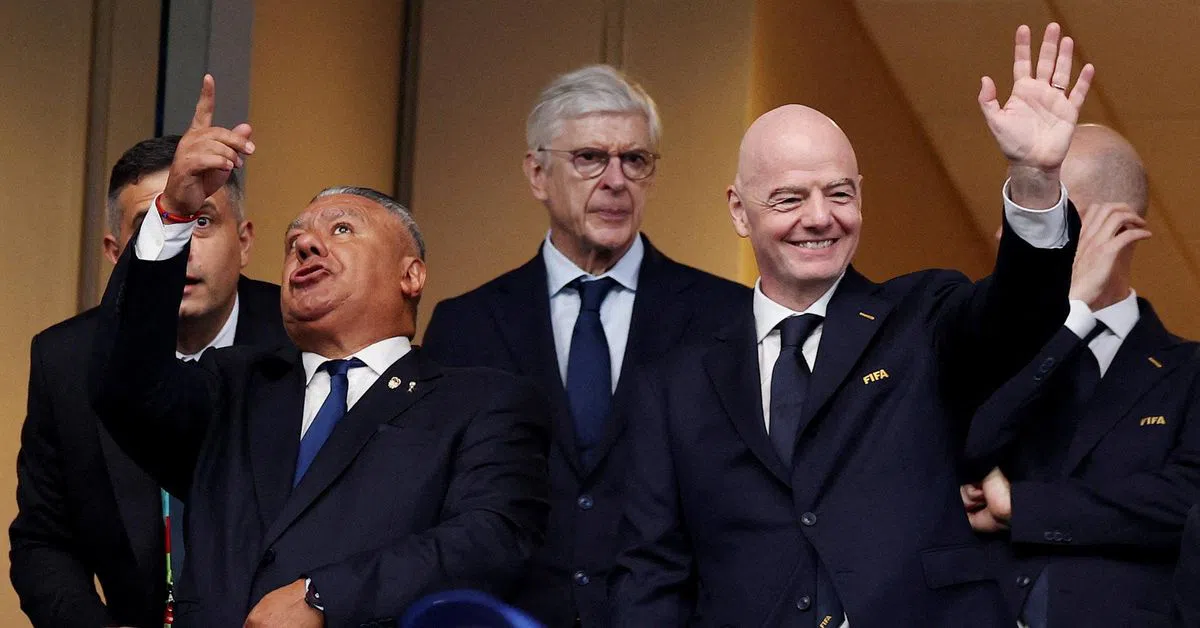
The recurring appearance of the Fifa president has become almost as predictable as the shots of players arriving at the stadium or supporters waving national flags. Infantino has been shown during matches across the 2026 World Cup, sometimes alongside heads of state, royalty or football officials, and sometimes as the clear focus of the camera.
The repetition has created an uncomfortable question for viewers: are broadcasters required to show him?
The answer is more complicated than a simple yes or no.
Television companies that purchase World Cup rights are not known to receive a direct instruction telling them to show Infantino at a particular minute. They are, however, obliged to use the international match feed supplied by Host Broadcast Services, or HBS, the company responsible for producing the tournament’s pictures.
Fifa owns 49 per cent of HBS.
The production company also operates under an agreement requiring a “dignitary shot” during each half of a match. When Infantino is the highest-ranking football official present, that arrangement creates a system in which his appearance becomes highly likely, even without an explicit instruction naming him.
What may look like a routine crowd shot is therefore connected to a much larger structure involving broadcast control, commercial rights, corporate ownership and the political ambitions of the most powerful figure in world football.
Are broadcasters obliged to show Infantino?
Broadcasters are obliged to carry the footage provided by HBS, but that does not mean they personally choose every image shown during a match.
HBS creates the central television feed distributed to World Cup rights-holders around the world. National broadcasters may add their own commentators, graphics, studio analysis and pitch-side reporting, but the core match pictures are supplied centrally.
That means when the world feed cuts from the action to Infantino in the directors’ box, hundreds of broadcasters can show the same shot simultaneously.
Fifa says it would be misleading to suggest that it has issued instructions requiring specific shots of its president during the 2026 tournament.
There is, however, an agreement between Fifa and HBS that every half should include a shot of the most senior dignitaries in attendance. These may include heads of state, senior confederation representatives, federation officials, celebrities and people carrying “VVIP” accreditation.
“It is standard practice for seats which include football officials, public figures and celebrities to be shown as part of the match running order, whoever they may be,” a Fifa spokesperson was quoted as saying by The Athletic.
That explanation places Infantino’s appearances within normal event coverage. Yet the frequency and prominence of the shots have invited scrutiny, particularly because similar arrangements are not common across other leading football competitions.
Former footballers Blaise Matuidi and Youri Djorkaeff and FIFA President Gianni Infantino and President of the French Football Federation Philippe Diallo in the stands before France vs Morocco quarterfinal match in Fifa World Cup 2026. Photo: Reuters
How the World Cup television system works |
Organisation |
Role in World Cup broadcasting |
Ownership or relationship |
Fifa |
Owns and sells World Cup media rights |
Holds a 49 per cent stake in HBS |
Host Broadcast Services |
Produces the central television feed used globally |
Majority-owned by Infront |
Infront |
Parent company and majority owner of HBS |
Owned by China’s Wanda group |
National and international broadcasters |
Buy tournament rights and distribute coverage to viewers |
Required to use the HBS match feed |
Match director and production team |
Decide which live pictures enter the world feed |
Work within the agreed broadcast running order |
HBS has offices in Zug, London and Miami and performs one of the most influential roles at the tournament.
Its cameras determine what the global audience sees beyond the football itself: supporters, coaches, celebrities, royalty, political leaders and officials.
This centralised system provides Fifa with a consistent product across markets. A viewer in India, Britain, Brazil or Japan may hear different commentary but will usually see the same replays, crowd reactions and dignitary shots.
From a commercial perspective, the model is valuable because Fifa can sell a standardised premium broadcast package to rights-holders across the world. Broadcasters receive a professionally produced feed without having to independently film every angle of every match.
The trade-off is reduced editorial control.
A rights-holder can choose to cut away from the feed using its own cameras when available, but most broadcasters remain dependent on the pictures supplied by HBS. During live play, abandoning the central feed also carries the risk of missing a significant moment.
Fifa’s 49 per cent holding in the company producing those images makes the arrangement more significant. The governing body is not merely supplying access to an independent broadcast contractor; it has a direct economic interest in the producer shaping the tournament’s visual presentation.
Former England player and Inter Miami co-owner David Beckham with his wife Victoria, sons Cruz and Romeo and daughter Harper inside the Texas stadium during England vs Argentina semifinal in 2026 Fifa World Cup. Photo: Reuters
The economics behind the global feed
The World Cup’s broadcasting model is built around scarcity and control.
Fifa owns the event, sells its media rights and determines which production feed accompanies those rights. The centralised footage becomes part of the product purchased by television companies.
The approach offers several commercial advantages.
It allows Fifa to maintain consistent production standards across more than 200 markets. It ensures that official branding, sponsors, stadium presentation and ceremonial elements are incorporated into the coverage. It also reduces the possibility that different broadcasters will present radically different versions of the same event.
HBS, meanwhile, sits at the centre of the value chain.
Fifa’s 49 per cent interest gives it exposure to the production operation, while Infront retains the controlling stake. Infront itself belongs to Wanda, the Chinese conglomerate that has previously held extensive commercial interests in global sport.
This ownership structure does not prove that individual shots are politically motivated. It does, however, make the question of editorial independence legitimate.
The organisation selling the broadcast rights is also a major shareholder in the company deciding which images accompany the matches. Those images repeatedly include the organisation’s president.
The economic value is not limited to direct production income. Visibility has institutional value.
Every shot of Infantino reinforces his position as the public face of the tournament. With the World Cup drawing one of the largest cumulative television audiences in sport, even brief appearances are distributed across countries, languages and platforms.
Unlike a paid advertisement, the images appear inside the match coverage itself and are repeated by broadcasters that have little practical ability to replace the central feed.
Dignitary shot or presidential branding?
Fifa’s dignitary-shot policy provides a formal explanation for showing Infantino.
During England’s quarterfinal against Norway, for example, he was pictured alongside Crown Prince Haakon of Norway. That shot could reasonably be viewed as part of the traditional coverage of prominent guests.
FIFA President Gianni Infantino and Crown Prince Haakon of Norway during England vs Norway quarterfinal match in Fifa World Cyup 2026. Photo: Reuters
But not every appearance has shared the focus so evenly.
Some shots have centred primarily on Infantino, including during matches in which his presence carried no obvious connection to either team. The repetition has made the coverage feel less like incidental recognition and more like an established part of the broadcast format.
The distinction matters.
A policy requiring the highest-ranking official to be shown may be technically neutral. In practice, Infantino is usually the most senior Fifa figure present, particularly when he attends games with national officials of lower rank within the football hierarchy.
The system can therefore produce the same outcome as a direct instruction without explicitly naming him.
This is also not the first World Cup at which the television treatment of Infantino has raised questions.
During the 2022 tournament in Qatar, The Times of London reported that television production crews received emails instructing them to ensure that Infantino appeared during matches. The reported guidance also said he should not be shown using his mobile phone.
That detail suggested concern not merely with documenting his presence, but with managing how that presence was presented.
Fifa disputes the suggestion that comparable instructions have been issued for the current tournament. Nevertheless, the Qatar precedent continues to shape the interpretation of the 2026 shots.
Two games a day and a sponsor’s private jet
Infantino’s visibility has also been supported by an unusually ambitious travel schedule.
During the group stage, he sought to attend two matches a day across North America, despite the vast distances between host cities and the tournament’s multiple time zones.
Qatar Airways, a Fifa sponsor, provided a private aircraft for his travel.
On June 11, Infantino attended the opening match between Mexico and South Africa in Mexico City. He then travelled about 285 miles by private jet to Guadalajara in time for South Korea’s match against the Czech Republic.
Four days later, he attended Belgium’s match against Egypt in Seattle before flying south to Los Angeles for Iran against New Zealand that evening.
The arrangement served an operational purpose, allowing the Fifa president to attend more fixtures across a geographically demanding tournament. It also dramatically increased the number of occasions on which the broadcast’s dignitary-shot requirement could feature him.
The overlap between sponsor support, executive travel and global television exposure illustrates the commercial ecosystem surrounding the World Cup.
Qatar Airways gains association with Fifa and the tournament. Infantino gains the ability to appear at more matches. HBS captures his presence, and rights-holders distribute those images worldwide.
Each part of the arrangement can be defended independently. Taken together, they create a powerful visibility machine.
Qatar had previously provided Infantino with a residence in the Gulf state ahead of the 2022 World Cup.
Why Infantino’s screen time matters politically
Infantino’s broadcast prominence has acquired additional significance because he intends to seek another term as Fifa president in 2027.
Victory would allow him to remain in office until 2031 and take his tenure to 15 years.
He is currently unopposed.
Three of football’s six continental confederations — those representing Africa, Asia and South America — have publicly backed his re-election. Together, they account for 110 of Fifa’s 211 member associations, already giving him the declared support of a majority of the electorate.
Fifa presidential elections are not decided by television viewers. Each member association holds a vote.
Yet global visibility can still reinforce political power.
Infantino’s repeated presence beside world leaders, royalty and star players presents him as the central authority of the tournament. For officials watching in Fifa’s member countries, the imagery conveys reach, access and control.
Whether that amounts to personal propaganda is a matter of interpretation. There is no publicly established evidence that every shot is deliberately inserted to support his campaign.
But the political benefit is difficult to ignore.
A president seeking another term is being repeatedly shown through a feed produced by a company in which his organisation owns 49 per cent. The broadcasters carrying those images have purchased rights from the same organisation and are required to use that feed.
The structure does not need an explicit campaign slogan to produce favourable exposure.
How Fifa compares with other competitions
The frequency with which Infantino appears is unusual when compared with other major football bodies.
Premier League coverage does not operate under a known requirement to show chief executive Richard Masters during every half of every match he attends.
Uefa president Aleksander Ceferin is normally pictured during the Champions League final and other major ceremonial occasions. He is not routinely shown whenever he attends a group-stage or knockout match.
Competition |
Senior official’s typical television exposure |
Fifa World Cup |
Dignitary shot expected in each half, often featuring Infantino |
Premier League |
No comparable requirement to show the chief executive at every match |
Champions League |
Uefa president commonly shown at the final, but not during every appearance |
Domestic leagues and cups |
Officials generally shown when their presence is relevant to the event |
The difference is partly explained by the World Cup’s ceremonial status. Heads of state and senior officials regularly attend, making dignitary coverage a conventional part of the production.
What distinguishes the current arrangement is its frequency and the centrality of one individual.
FIFA President Gianni Infantino in the stands. Photo: Reuters
Infantino cannot be everywhere — but the cameras follow when he is
Infantino attended all 64 matches at the 2022 World Cup in Qatar, where stadiums were concentrated within a relatively small geographical area.
The expanded 2026 tournament presents a different logistical challenge.
One hundred matches have already been played, with four remaining, across the United States, Mexico and Canada. Even with private air travel, Infantino has not been able to attend every fixture.
Yet when he is present, the global audience usually knows.
This is partly because the dignitary-shot agreement makes his appearance predictable. It is also because the production system ensures the same image is transmitted through broadcasters around the world.
For viewers, the effect is repetition. For Fifa, it is control over the visual identity of its most valuable tournament. For Infantino, it is unmatched exposure during the period leading towards another presidential election.







 Colorado has a challenging Big 12 schedule in 2026 with JuJu Lewis likely to take the reins at QB.




































You must be logged in to post a comment Login