
Security teams log 54% of successful attacks and alert on just 14%. The rest move through your environment unseen.
The Picus whitepaper shows how breach and attack simulation tests your SIEM and EDR rules so threats stop slipping by detection.



Looking for the most recent Connections answers? Click here for today’s Connections hints, as well as our daily answers and hints for The New York Times Mini Crossword, Wordle, Connections: Sports Edition and Strands puzzles.
The blue group in today’s NYT Connections puzzle made me laugh. Read on for clues and today’s Connections answers.
The Times has a Connections Bot, like the one for Wordle. Go there after you play to receive a numeric score and to have the program analyze your answers. Players who are registered with the Times Games section can now nerd out by following their progress, including the number of puzzles completed, win rate, number of times they nabbed a perfect score and their win streak.
Read more: Hints, Tips and Strategies to Help You Win at NYT Connections Every Time
Here are four hints for the groupings in today’s Connections puzzle, ranked from the easiest yellow group to the tough (and sometimes bizarre) purple group.
Yellow group hint: Home repair elements.
Green group hint: Put together.
Blue group hint: Think Ty D Bowl.
Purple group hint: The front part of a head.
Yellow group: Circuit components.
Green group: Digital coupling verbs.
Blue group: Things a toilet does.
Purple group: ____ face expressions.
Read more: Wordle Cheat Sheet: Here Are the Most Popular Letters Used in English Words
The completed NYT Connections puzzle for July 19, 2026.
The theme is circuit components. The four answers are breaker, fuse, relay and switch.
The theme is digital coupling verbs. The four answers are connect, join, pair and sync.
The theme is things a toilet does. The four answers are drain, flush, refill and swirl.
The theme is ____ face expressions. The four answers are game, long, poker and straight.
Microsoft announced that Windows Server 2022 will reach the mainstream end date in October 2026, but will switch to extended support and continue receiving security updates for five more years.
Windows Server 2022 was first announced in March 2021 and became generally available in September 2021 as the Long-Term Servicing Channel (LTSC) release, with 10 years of support.
“On October 13, 2026, Windows Server 2022 will reach end of mainstream support. The October 2026 security update will be the last mainstream support update available for this version,” Microsoft said in a message center update on Thursday.

“After this date, Windows Server 2022 will transition to extended support, which includes security updates at no additional cost, and will continue to receive monthly security updates through October 14, 2031.”
Customers are now advised to upgrade to Windows Server 2025 (the latest version of Microsoft’s server operating system), which became generally available in November 2024 after first rolling out to Windows Insiders in January 2024.
Windows Server 2025 will reach the end of support on November 13, 2029, with extended support ending five years later, on November 14, 2034. Those who want to test Windows Server 2025 before deployment can use the free 180-day trial available through the Microsoft Evaluation Center.
“Windows Server 2025 is now the latest Long-Term Servicing Channel (LTSC) release for Windows Server. To help keep your environment protected and supported, plan to upgrade to Windows Server 2025 for full mainstream support,” Microsoft noted.”Evaluate upgrade options and begin deployment testing early to help ensure a smooth transition.”
You can find more information about Windows servicing dates using the Lifecycle Policy search tool or on the Windows Lifecycle FAQ page. Microsoft has also shared a list of products that will reach the end of support or will be retired in 2025.
Last month, Microsoft also announced that it has extended Windows Server 2022 hotpatching until October 2027, one year after its mainstream end date of October 2026, for systems running the Datacenter: Azure Edition, and quietly extended the free Windows 10 Extended Security Updates (ESU) program for consumers by an additional year.
More recently, on Wednesday, Microsoft reminded customers that Windows 10 Enterprise LTSB 2016 and the Home and Pro editions of Windows 11 24H2 will stop receiving updates 3 months after reaching end of support.

Security teams log 54% of successful attacks and alert on just 14%. The rest move through your environment unseen.
The Picus whitepaper shows how breach and attack simulation tests your SIEM and EDR rules so threats stop slipping by detection.

A new study by researchers at the University of California at San Francisco “adds to growing research linking increased social media use to detrimental effects on attention, memory and cognition,” reports the Washington Post:
The study followed more than 11,000 U.S. adolescents over a period of five years, with participants first asked about their own social media use at the average age of 12, and surveyed annually through the average age of 16. Researchers found that increases in addictive social media use were followed by rising ADHD one year later — particularly among boys who reported rising addictive social media use at ages 14 and 15. This association was not found consistently in reverse, meaning that ADHD symptoms did not appear to precede higher levels of addictive social media use… “When an individual adolescent’s addictive social media use score increased from one year to the next, that same adolescent tended to show an increase in ADHD symptoms in the following year….” [said Jason Nagata, lead author of the study and an associate professor of pediatrics at the University of California at San Francisco]. He urged parents to consider: “Can their kids stop if they want to? Is social media interfering with their schoolwork? Is it impairing their social relationships? Are there addiction-like symptoms, like withdrawal and relapse?”
Approximately 7 million American children between the ages of 3 and 17 have received an ADHD diagnosis, according to the Centers for Disease Control and Prevention, and boys are diagnosed with ADHD at about twice the rate of girls. The study did not find a clear link between addictive social media use and ADHD among girls, Nagata said. “Some studies do suggest that teenage boys in particular may be more sensitive to immediate reward and sensation-seeking in adolescence,” he said. And social media platforms are designed to provide exactly that: “It encourages frequent task-switching, and there’s this constant stream of stimulation that might make it harder for adolescents to maintain and sustain attention that is needed for schoolwork and daily life,” he said. “The design features of social media offer the constant reinforcement of impulsivity — it offers immediate gratification and novelty and it encourages multitasking, which can then override working memory and executive control.” Experts have long noted that this kind of digital exposure is particularly significant during critical stages of mental, social-emotional and cognitive development…
[I]t’s especially important for parents themselves to demonstrate a healthier relationship with screens and social media. “One of our previous findings was that parental screen use is a very strong predictor of kids’ screen use,” Nagata said.
In the minds of prospective EV buyers, charging looms large. Just over half of those surveyed by AAA last year said that public charging infrastructure was a key concern.
Those concerns aren’t unfounded. EV fast charging has historically been lackluster. In 2023, after a disastrous road trip, I drafted an EV fast-charging “bill of rights,” outlining seven improvements charging networks needed to make to turn things around.
What a difference a few years can make.
During a recent road trip, I was surprised by how much the situation has improved. With one small exception, my charging experience was flawless.
This summer’s road trip to Montreal covered more than 600 miles. We had intended to use our Kia EV9, which will travel nearly 300 miles on a charge, but the Kia is in the shop because of a broken air conditioner. Instead, we drove our Audi e-tron, which has a range of about 220 miles per charge. Despite the disparity, the e-tron handled the trip with aplomb. Rangemaxxing might sound nice, but it isn’t necessary.
To find chargers, I used A Better Route Planner (ABRP), an app that optimizes charging stops by accounting for everything from prevailing winds and temperature to vehicle specs and battery degradation. You can use a Bluetooth OBD reader to feed live data from the car to ABRP, but I found the app to be pretty accurate without one. ABRP said our first stop should be a Rivian charger near Lebanon, New Hampshire. The app is now owned by Rivian, so I wasn’t entirely surprised.
After my experience at the Lebanon chargers, I can see why the app chose them, regardless of Rivian’s ownership. There were no lines, plenty of food options, a grocery store, and six 300-kilowatt chargers that were all working. I had downloaded the Rivian app in advance, but I needn’t have. The charger accepted my credit card and delivered more than 140 kilowatts, roughly the e-tron’s max. We used the same chargers on the way home and had a similar experience.
After that, we used a Circuit Électrique station just outside Montreal to top up for the week ahead. There, we experienced the trip’s only hitch: The card reader didn’t work, so I had to download Circuit Électrique’s app and load it with 20 Canadian dollars. After that, the session went smoothly. In retrospect, the stop wasn’t entirely necessary. We didn’t drive much during the week, and the hotel charger worked perfectly. But the kids needed a break and my wife needed a coffee, so we probably would have plugged in regardless.
Each session lasted about 20 minutes, and we combined charging with lunch or rest stops. We never once waited on the car. Altogether, the three sessions took about as long as our wait at border control on the way back into the United States.
Three years ago, the trip didn’t go nearly as well. I knew that fast charging could be hit or miss — I’ve driven non-Tesla EVs for more than a decade — but I still came away disappointed.
That summer, we drove the same Audi e-tron to Maine, a round trip of about 350 miles, roughly half the distance of our trip to Montreal. The car could have made it to Maine on one charge, but the hotel didn’t have an EV charger. To ensure we had enough juice for the long weekend and the beginning of the drive home, we planned to charge a little over halfway there.
Before we left, I had also used ABRP to weed out less reliable chargers, but the experience was still miserable. The first charger broke shortly after I plugged in, forcing me to move to another stall. The first charger never ended the session with my car, which meant the second one wouldn’t start without a call to customer service. At another stop, the charging network’s app reported two working plugs out of four, but only one actually worked. Altogether, I drove about seven hours and had to call customer service three times.
Imagine if gas stations worked like this?
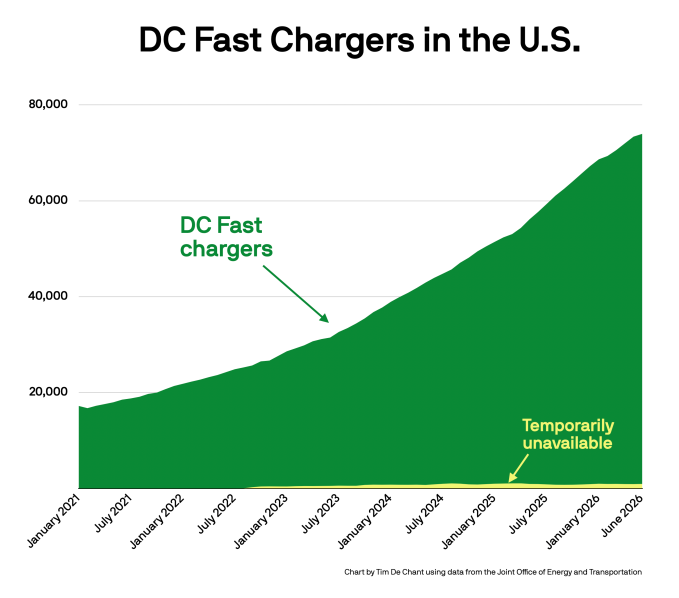
Thankfully, the EV charging infrastructure looks very different today. My experiences in 2023 and 2026 are anecdotes, of course. But the available data suggests they are representative of a broader trend: fast charging in the U.S. has improved by leaps and bounds.

Back in July 2023, the country had about 32,000 DC fast chargers, according to the Joint Office of Energy and Transportation. At the time, many of those chargers were restricted to Tesla drivers. (Tesla announced plans to open its network in 2023, but it took more than a year for widespread access.) Today, EV drivers can use most of Tesla’s network. Continued expansion by Tesla and other companies has helped push the total to more than twice the number of DC fast chargers available in 2023.
What’s more, they’re more reliable.
My nearly flawless trip last week appears to be the norm, not the exception. Since last year, reliability has improved nearly 10 points, from 85 to the mid-90s, on Paren’s reliability index, which includes metrics such as successful charging sessions and station downtime. Tesla’s network remains dominant, according to Paren, but other networks are growing quickly. That competition has undoubtedly helped improve charging experiences across the board.
Gaps in the network still exist and EV chargers still break. But more chargers are being added every month and the broken ones are being repaired more quickly than in the past.
It’s not perfect, but I’m genuinely surprised by how much better fast charging has become. Someone should tell the holdouts what they’re missing.
When you purchase through links in our articles, we may earn a small commission. This doesn’t affect our editorial independence.
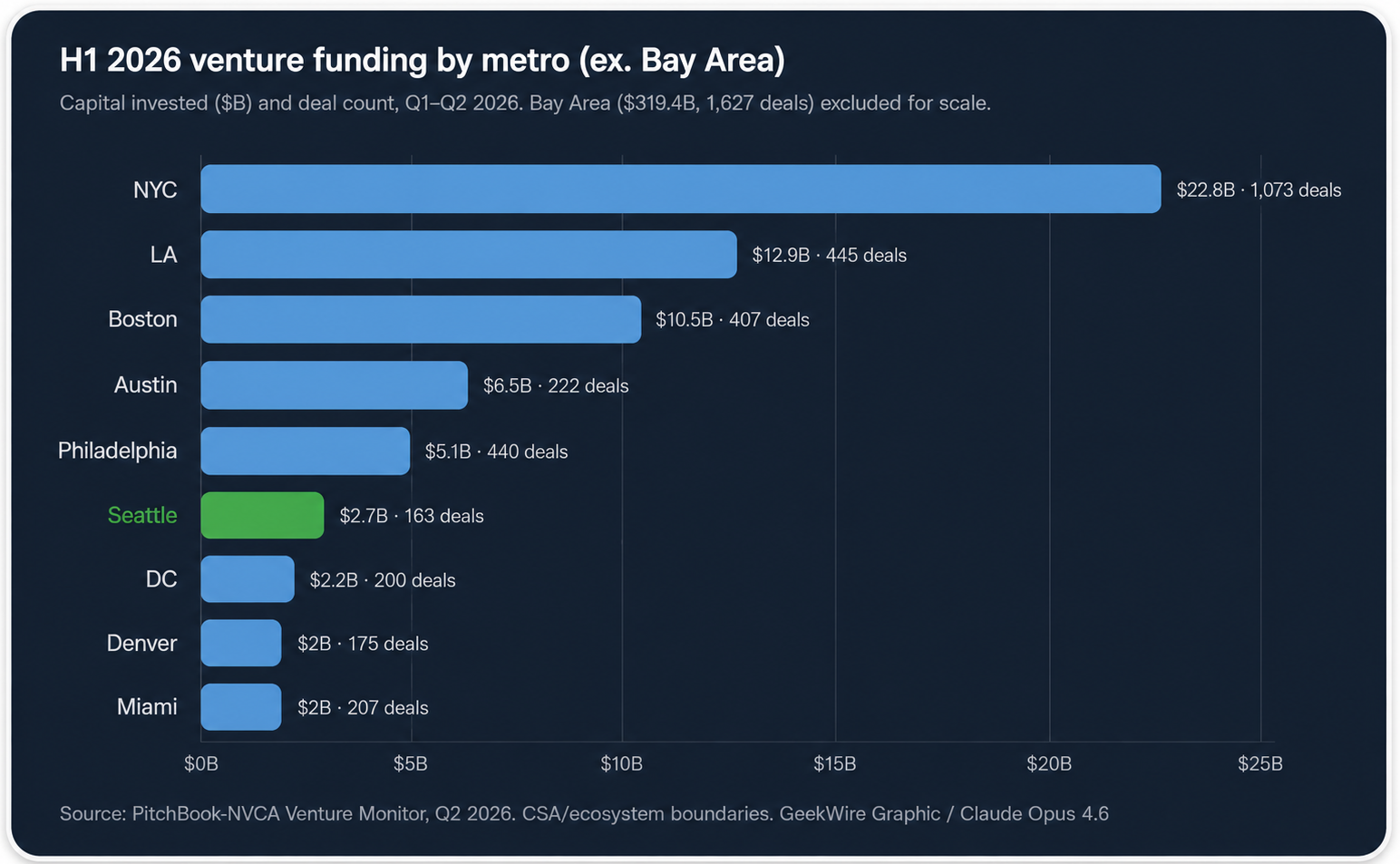

Seattle-area startups raised $2.7 billion in venture funding through the first half of 2026, across 163 deals, down about 40% from $4.5 billion in 210 deals during the same period a year ago.
The figures come from the recently released PitchBook-NVCA Venture Monitor report for Q2 2026. The decline in capital reflects fewer deals across the board in the Seattle region, with much of the funding going to a handful of large rounds for energy, cybersecurity, and space startups.
Here is the region’s top 5 for the second quarter, as tracked in the report:
Against the AI grain: In Q2 2026 specifically, startups in the Seattle area closed 85 deals totaling $1.5 billion. That was down from 101 deals and $2.3 billion in the same quarter a year ago, but up from Q1 2026, which PitchBook revised to 78 deals and $1.2 billion as part of its regular data updates.

Heavy infrastructure investments by Microsoft and Amazon have helped to establish the Seattle area as an AI hub, but the region’s pure-play AI startups, on the whole, aren’t seeing investment on the same scale as some of their peers in Silicon Valley and other tech hubs around the country.
That creates a disconnect with the larger U.S. venture capital market. AI companies accounted for 86% of all U.S. venture dollars in the first half of the year, according to the PitchBook-NVCA data.
Nationally, it was a record half: U.S. startups raised $412.7 billion through June, already surpassing the full-year record of $358.6 billion set in 2021. But the number is misleading. Deals of $100 million or more accounted for 87.5% of the total, and AI companies captured 86 cents of every venture dollar.
OpenAI and Anthropic alone absorbed roughly 43% of all global venture capital in the first half of the year, by one estimate. The Bay Area, home to both, pulled in $319 billion, about three times its H1 2025 total.
Strip out those two companies and the national picture looks very different. Seed funding fell 27% nationally in the first half, and first-time fund formation is on pace for its lowest year since 2016.
Regional trends: In that way, what’s happening in the Seattle area reflects the current realities of the market. However, the region is also slipping relative to its peers in the latest numbers.
Among the 10 largest U.S. metro areas for venture funding, Seattle ranked seventh by capital invested in the first half of the year, down from fifth in H1 2025. By deal count, the region was last in the top 10.
The data used in this analysis covers the Seattle-Tacoma combined statistical area (CSA), a broader regional boundary that includes communities beyond the core metro region.
Political climate: Washington’s shifting tax and economic landscape adds another variable.
The state now taxes capital gains at up to 9.9%, a new millionaires’ tax takes effect in 2028, and legislators this year floated taxing the federal QSBS exemption that startup founders and early employees rely on when they sell shares at exit. That bill didn’t pass, but generated enough alarm to cause a backlash from startup community leaders and investors.
Looking ahead: Blue Origin, Jeff Bezos’ Kent-based space company, is reportedly seeking up to $10 billion in what would be its first outside funding round. A deal that size would be larger than every other Seattle-area venture round this year combined.
What just happened? In an age where tech workers are losing their jobs to AI at a frightening pace, thousands of Google’s employees are taking action. Over 4,500 company staff have signed a petition calling for layoff protections, including guaranteed severance, buyouts before mandatory layoffs, and the option to take severance as extended paid leave.
Like many other companies invested in the AI boom, Google is enjoying plenty of success right now. Parent company Alphabet’s latest quarter produced $109.9 billion in revenue, up 22%, while operating income rose 30% to $39.7 billion. It’s also the third-largest company in the world by market cap with a $4.3 trillion valuation.
“Make no mistake: this is a company that is enjoying massive, unprecedented success,” Parul Koul, Google software engineer and Alphabet Workers Union president, said outside the company’s California headquarters after delivering the petition to the office of CEO Sundar Pichai.
But it seems that as these tech giants get richer, they lay off more people, often because of AI systems automating employees’ jobs. Alphabet has laid off more than 14,000 people since the start of 2023, most of whom lost their jobs that year. “These layoffs and cuts are not difficult decisions, but simply profit being put over the people that make this company run,” Koul added.
At a press conference on Thursday, employees chanted, “Google, Google, you can’t hide, we can see your greedy side,” and called out the 2023 mass layoffs.
Koul said workers were greeted with closed doors and no response for the most part after the petition was delivered to a staff member in Pichai’s office, though they agreed to pass it on to the CEO. Koul called it “the largest piece of employee feedback that Google has received about job security.”
The union also wants Google to end performance ratings that workers say are based on meeting quotas rather than merit. The company has denied forcing particular rating distributions, insisting that employees are assessed according to their individual performance, roles, levels, and expectations.
The campaign has already secured some benefits for employees. According to the union, voluntary exit packages have been made available to more than 70,000 Google workers since it began. The petition calls for these buyouts to be offered companywide before any mandatory layoffs.
Google Cloud quietly laid off employees in May, and the company eliminated more than one-third of the managers overseeing small teams last summer. More recently, hundreds of employees across its hardware, assistant, and engineering teams were let go in January 2026. Google also dismissed more than 200 contractors working on its AI products without warning in 2025 amid disputes over pay and working conditions.
Google has not confirmed that AI was responsible for its many job cuts. However, several other tech giants have been more open about the connection. Oracle reduced its workforce by 21,000 people over the last year and acknowledged that adopting AI had resulted in cuts. Block CEO Jack Dorsey cited AI efficiency gains when eliminating over 4,000 roles in February, almost half of the company’s workforce.
Google did not immediately respond to a request for comment.
Apple Music is raising U.S. subscription prices for the first time since 2022, increasing every paid tier and hitting family subscribers with the largest jump.
The Apple Music Individual plan now costs $11.99 per month, up from $10.99. The Family plan rose from $16.99 to $19.99 per month and continues to support as many as six people through Family Sharing.
Verified college students will pay $6.99 per month, up from $5.99. The Student plan includes the full Apple Music service and access to Apple TV at no additional cost.
The increases add $12 per year to the Individual and Student plans. A Family subscription will cost $36 more annually, bringing the total to $239.88 per year.
Furthermore, two out of three Apple One subscription plans have increased in cost. The individual plan is unchanged.
But, the family and Premier are more expensive now. Both Family and Premier have increased $2 per month, with the former increasing to $27.95, and Premier going up to $39.95.
The new prices appeared on Apple’s website without an accompanying Apple Newsroom announcement. The company lists a one-month trial for new Individual, Family and Student subscribers.
Apple Music hadn’t raised its broad U.S. subscription prices since October 24, 2022. The previous increase took the Individual plan from $9.99 to $10.99 and the Family plan from $14.99 to $16.99.
Apple attributed the 2022 increase to higher licensing costs and said artists and songwriters would earn more from streamed music. The company hasn’t publicly explained the July 17 increase.
The Individual plan increased by about 9%, while the Family plan rose by nearly 18%. The Family plan received the largest increase in both dollars and percentage terms.
The Family plan remains cheaper than two separate Individual subscriptions, which would cost $23.98 per month. Apple Music gives as many as six family members separate libraries, recommendations and playlists under one subscription.
The Student plan’s included Apple TV access adds value to the $6.99 monthly subscription. Apple limits student pricing to 48 months while the subscriber remains verified, and the Apple TV benefit remains a limited-time offer.
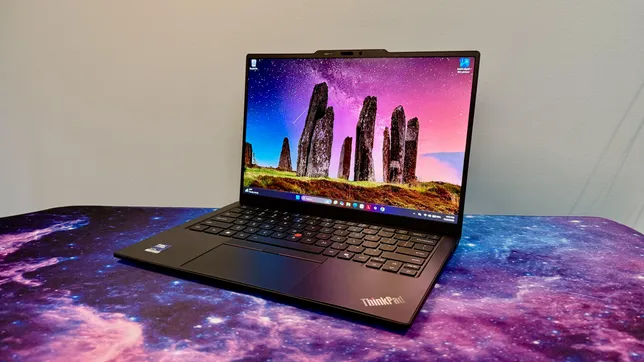

The 14th generation of Lenovo’s flagship business ultraportable, the X1 Carbon, looks no different than the previous iteration. But don’t let its comfortingly familiar design fool you: The interior has been completely reengineered to make the laptop run more coolly and quietly, and — more importantly — it’s easier to repair.
The X1 Carbon Gen 14 introduces Lenovo’s Space Frame chassis that features a smaller motherboard and larger cooling fans, along with a modular design that makes it easier to access and then repair or replace individual components. This is good news for ThinkPad buyers who care about ROI, sustainability or both.
The laptop is based on Intel’s Core Ultra 300 series processors, known as Panther Lake. If you were hoping for a big leap in performance from last year’s Lunar Lake model, you’ll need to keep waiting in the hopes that next year’s Gen 15 delivers the goods. This year’s model isn’t any faster than last year’s ThinkPad X1 Carbon Gen 13, and battery life is actually a few hours shorter.
Performance certainly suffices for basic office tasks, and you should be able to get through even the longest workdays on a single charge, but the reason to pick up the X1 Carbon Gen 14 is the increased repairability rather than anything resembling an increase in performance. Two other reasons for it: the X1 Carbon’s traditional look remains largely unchanged, which will delight longtime ThinkPad fans; and pricing hasn’t gone up (the model Lenovo sent me is actually $100 cheaper than the similar config I tested last year). That will come as a relief to any laptop buyer in this era of RAMageddon and skyrocketing prices for laptops, phones and other electronics.
Lenovo ThinkPad X1 Carbon Gen 14 Aura Edition
Price as reviewed
$2,374
Display size/resolution
14-inch, 2,880×1,800 pixels, 120Hz, OLED
CPU
Intel Core Ultra 7 355
Memory
32GB LPDDR5-7467
Graphics
Intel Graphics
Storage
512GB
Ports
3x USB-C Thunderbolt 4, USB-A 5Gbps, HDMI 2.1, combo audio
Networking
Wi-Fi 7 and Bluetooth 5.4
Operating system
Windows 11 Pro 26H1
Weight
2.16 pounds (0.98 kg)
Lenovo has kept pricing fairly consistent for this year’s ThinkPad X1 Carbon Gen 14, which ought to be applauded as laptop prices keep going up and up. As Lenovo’s flagship ThinkPad, however, the X1 Carbon remains a device more likely to be toted around by C-suite execs than the rank and file. The entry point has risen, but the cost of upgrades has surprisingly dropped a bit. And despite what Lenovo may show on its site, there is a way to get the ThinkPad X1 Carbon Gen 14 for less than $2,000.
Lenovo lists a starting price of $2,139 for a config with an Intel Core Ultra 5 335, 32GB of RAM, a 256GB solid-state drive, a 1,920×1,200-pixel IPS display and Windows 11 Home. But if you choose to upgrade to the Core Ultra 7 355, then you can downgrade the RAM to 16GB for a price of $1,884. I’m not suggesting you move off of the 32GB of RAM offered, but simply highlighting it as a somewhat hidden option.
Less hidden, and new with this year’s Panther Lake-based X1 Carbon, is the option to expand the memory to 64GB. When you choose the top CPU offered, the Core Ultra 7 365, the option for 64GB becomes available. That’s the good news. The bad news is that this memory upgrade is staggeringly expensive. It costs $720 and clearly shows how the global RAM shortage has dramatically increased PC component pricing.
My test system features the Core Ultra 7 355 chip and 32GB of RAM, along with three other upgrades: a 512GB SSD, a 2.8K nontouch OLED display and Windows 11 Pro, which raises the total to $2,374. That’s actually $100 cheaper than the X1 Carbon Gen 13 that I reviewed last year, which had the same component lineup but with the previous-gen Core Ultra 7 258V CPU.
The ThinkPad X1 Carbon Gen 14 starts at £2,366 in the UK and AU$3,779 in Australia.
The Space Frame design completely overhauls the laptop’s interior layout, making it easier to repair or replace individual components rather than replacing the entire laptop if one part fails. It’s not as modular and easy to access as I had hoped, but it’s certainly a step in the right (-to-repair) direction.
You need only to remove four screws to take off the bottom panel. Inside, the battery is held in place by three screws, and you’ll need to remove it to get to the internal frame that houses the double-sided motherboard.
In addition to removing the bottom panel, you can remove the keyboard deck to access each side of the motherboard. Six screws hold the keyboard deck in place. So, that’s a total of 13 screws to gain full access to the interior components. And they are all standard Phillips screws, so you won’t need to hunt around for a Torx or Pentalobe screwdriver. (They’re captive screws, too, so you won’t have a chance to lose any.)
In truth, taking off the two panels is slightly more complicated than removing 13 screws. There are four ribbon cables you also need to disconnect, which might make people in your organization less confident to make their own repairs and more likely to call the IT department. I also found it challenging to get all the cables on the right side of the internal frame as I attempted to line up the keyboard deck and snap it into place when I was reassembling the laptop.
Even if Lenovo’s Space Frame chassis is a bit trickier and not as modular as, say, a Framework laptop, it makes the X1 Carbon Gen 14 much more repairable than any previous ThinkPad. For starters, you can replace the battery, which often is the first component to show signs of age and wear as battery life slowly but ever-so-consistently shortens. Most of today’s laptops have batteries that are soldered to the motherboard and not replaceable, so being able to just swap in a new battery is a boon.
In addition, the laptop’s cooling fans, keyboard, speakers and the USB ports are user-replaceable. The two USB-C ports on the left side can be individually removed and replaced, but the pair on the right is a packaged set.
The USB-C and -A ports on the right side are paired on a small circuit board that’s separate from the mainboard, so you’d need to replace both ports should one fail. Still, it’s nice that this small board can be replaced rather than needing to swap out the mainboard, which usually equates to a full laptop replacement.
The X1 Carbon Gen 14’s SSD is replaceable, but it occupies the lone M.2 slot, so you’ll need to replace the existing drive, and you don’t have the luxury of simply adding a second SSD to increase the storage capacity. The RAM is not user-replaceable, so you have to get what you need upfront.
The interior has been completely redesigned, but the exterior received only minor tweaks. The latest ThinkPad X1 Carbon retains the classic ThinkPad look. It’s boxy, matte black with the familiar red accents. And it’s still exceptionally light at just under 2.2 pounds.
The keyboard received a couple of cosmetic changes. Lenovo moved the fingerprint reader, integrating it with the power button in the top-right corner. This change restores the right-Ctrl key but also means the End and Insert keys are now double-mapped to a single key. Lenovo also shifted the keyboard icons from their usual spot in the top-left corner of each key to the center, a move that also includes a slight tweak to the font.
The keyboard maintains its ThinkPad standard of excellence. It sits in the sweet spot of offering plush but firm feedback and is still the standard-bearer for laptop keyboards. It’s a pleasure to type on.
You have a choice of touchpads: mechanical or haptic. I received the mechanical one, and it’s fine for what it is. There is some diving-board effect where clicks are harder to perform as you move up the touchpad’s surface. Given that there’s no upcharge for the haptic touchpad, I think most people are better off with it because it offers a consistent click response across its entire surface.
The haptic touchpad also provides a larger surface on which to click and swipe because it integrates the mouse buttons for the pointing stick into a narrow strip at the top. The only reason I see for the mechanical touchpad is if you favor the traditional ThinkPad pointing stick over the touchpad and want the larger mouse buttons for it at the top of the touchpad.
The 2.8K OLED display is excellent and, shockingly, doesn’t cost any more than the baseline IPS panel. That’s the reason why the Gen 14 model I have is $100 less than the nearly identical Gen 13 model I looked at last year. Component prices have gone up, but Lenovo not charging $490 for the OLED upgrade certainly helps keep the price in check.
The OLED looks fantastic, with vivid colors, deep blacks and crisp images and text. Scrolling and other movements on the screen look smooth, thanks to its variable refresh rate of 30Hz to 120Hz. Color coverage is excellent with 100% coverage of the sRGB and P3 gamuts, and it proved to be even a bit brighter than its 500-nit rating, hitting a peak of 510 nits on my tests with a Spyder X Elite colorimeter.
The ThinkPad X1 Carbon Gen 14 offers a Windows Hello webcam along with the aforementioned fingerprint scanner. I like getting both types of biometrics, especially on a business machine.
The port selection has grown by one with this year’s X1 Carbon. It picked up an extra USB-C Thunderbolt 4 to bring the count to three. And, better yet, it’s located on the opposite side of the other two, giving you the ability to charge the laptop from either side.
Quick note on the Aura Edition suffix: It’s the branding for Lenovo and Intel’s partnership that makes it easier to swap files between the X1 Carbon and your phone. Less useful are its smart modes for setting a timer to focus or a wellness mode that reminds you to take a break to rest your eyes. There’s even a mildly unsettling posture warning that uses the webcam to track how you’re doing at sitting up straight and not slouching in front of the laptop.
This year’s Panther Lake model isn’t any faster than last year’s Lunar Lake system. Multicore performance crept up a smidgeon, but single-core performance slid back. Meanwhile, 3D performance also decreased, which isn’t surprising when you consider that the Core Ultra 7 355’s integrated GPU has only four Xe graphics cores, and last year’s Core Ultra 7 258V’s iGPU had eight Xe cores. Lenovo doesn’t offer a Core Ultra X7 that brings with it Intel’s higher-powered, 12-core Arc B390 integrated GPU, which is unfortunate for creators or other power users eyeing the X1 Carbon Gen 14.
I also wasn’t surprised to see battery life move three hours in the wrong direction. The Core Ultra 7 355 is a higher-wattage CPU than the Core Ultra 7 258V and, therefore, consumes battery resources at a quicker clip. The X1 Carbon Gen 13 lasted nearly 18 hours on our YouTube streaming battery drain test, and the X1 Carbon Gen 14 lasted almost 15 hours on the same test. That’s still enough to get you through most workdays on a single charge, but it doesn’t give you as much leeway as last year.
Outweighing the lack of any performance gains with this year’s edition and battery life decreasing by a few hours is the greater repairability that should help extend the useful life of the ThinkPad X1 Carbon Gen 14. The Space Frame design makes it possible to repair or replace the battery when it starts to fade, a cranky cooling fan or a bad port instead of needing to junk the laptop and buy a new one. That’s great for your ROI and the environment.
I also like two things about the X1 Carbon that didn’t change this year. First, I appreciate that in year 14, the X1 Carbon continues to stay true to its roots and keeps its traditional look and feel. It’s just a well-built machine with a rare combination of being very lightweight yet sturdy (and the keyboard is *chef’s kiss*). Secondly, I was pleasantly surprised to see pricing stay steady. Lenovo raised the entry price, but that is more than offset by removing the premium for the OLED upgrade. And since I imagine most people buying the flagship ThinkPad will want the best display offered, you’ll come out ahead on the price compared to last year’s X1 Carbon.
The review process for laptops, desktops, tablets and other computerlike devices consists of two parts: performance testing under controlled conditions in the CNET Labs and extensive hands-on use by our expert reviewers. This includes evaluating a device’s aesthetics, ergonomics and features. A final review verdict is a combination of both objective and subjective judgments.
The list of benchmarking software we use changes over time as the devices we test evolve. The most important core tests we’re currently running on every compatible computer include Primate Labs Geekbench 6, Cinebench R24, PCMark 10 and 3DMark Fire Strike Ultra.
A more detailed description of each benchmark and how we use it can be found on our How We Test Computers page.
Microsoft Surface Laptop for Business (8th Edition) 17014Lenovo ThinkPad X1 Carbon Gen 14 Aura Edition 11492Acer Swift Go 14 AI 11490Dell XPS 14 11207Lenovo ThinkPad X1 Carbon Gen 13 Aura Edition 11079HP EliteBook Ultra G1i 11032
Microsoft Surface Laptop for Business (8th Edition) 2953HP EliteBook Ultra G1i 2777Lenovo ThinkPad X1 Carbon Gen 13 Aura Edition 2742Lenovo ThinkPad X1 Carbon Gen 14 Aura Edition 2679Dell XPS 14 2599Acer Swift Go 14 AI 2422
Microsoft Surface Laptop for Business (8th Edition) 802Acer Swift Go 14 AI 709Lenovo ThinkPad X1 Carbon Gen 14 Aura Edition 647Lenovo ThinkPad X1 Carbon Gen 13 Aura Edition 557Dell XPS 14 530HP EliteBook Ultra G1i 518
Microsoft Surface Laptop for Business (8th Edition) 125HP EliteBook Ultra G1i 123Lenovo ThinkPad X1 Carbon Gen 13 Aura Edition 121Lenovo ThinkPad X1 Carbon Gen 14 Aura Edition 119Dell XPS 14 117Acer Swift Go 14 AI 107
Microsoft Surface Laptop for Business (8th Edition) 1387HP EliteBook Ultra G1i 820Lenovo ThinkPad X1 Carbon Gen 13 Aura Edition 680Lenovo ThinkPad X1 Carbon Gen 14 Aura Edition 619Dell XPS 14 524Acer Swift Go 14 AI 233
Microsoft Surface Laptop for Business (8th Edition) 9432Lenovo ThinkPad X1 Carbon Gen 14 Aura Edition 7734Dell XPS 14 7467Lenovo ThinkPad X1 Carbon Gen 13 Aura Edition 7114HP EliteBook Ultra G1i 6815
Acer Swift Go 14 AI 23 hr, 13 minDell XPS 14 21 hr, 7 minLenovo ThinkPad X1 Carbon Gen 13 Aura Edition 17 hr, 54 minLenovo ThinkPad X1 Carbon Gen 14 Aura Edition 14 hr, 49 minMicrosoft Surface Laptop for Business (8th Edition) 14 hr, 42 minHP EliteBook Ultra G1i 13 hr, 39 min
| Lenovo ThinkPad X1 Carbon Gen 14 Aura Edition | Microsoft Windows 11 Pro; Intel Core Ultra 7 355; 32GB DDR5 RAM; Intel Arc 140V Graphics; 512GB SSD |
|---|---|
| Lenovo ThinkPad X1 Carbon Gen 13 Aura Edition | Microsoft Windows 11 Pro; Intel Core Ultra 7 258V; 32GB DDR5 RAM; Intel Arc 140V Graphics; 512GB SSD |
| HP EliteBook Ultra G1i | Microsoft Windows 11 Pro; Intel Core Ultra 7 268V; 32GB DDR5 RAM; Intel Arc 140V Graphics; 512GB SSD |
| Microsoft Surface Laptop for Business (8th Edition) | Microsoft Windows 11 Pro; Intel Core Ultra X7 368H; 32GB DDR5 RAM; Intel Arc B390 Graphics; 1TB SSD |
| Dell XPS 14 | Microsoft Windows 11 Home; Intel Core Ultra 7 355; 16GB DDR5 RAM; Intel Graphics; 512GB SSD |
| Acer Swift Go 14 AI | Microsoft Windows 11 Home; Qualcomm Snapdragon X Plus X1P-42-100; 16GB DDR5 RAM; Qualcomm Adreno Graphics; 1TB SSD |


Refrigerators generally aren’t appliances that need to be replaced regularly. A high-quality fridge can have quite a long lifespan, and the best way to maximize that is to take care of it properly. The basics, such as cleaning the interior, being mindful of the temperature dial, and not leaving the door open for long periods, are pretty obvious, but there’s more that you can do. One essential maintenance step is cleaning the condenser coils — the elements responsible for dispensing heat pulled from the fridge — regularly, usually once or twice a year. Those with particularly dusty homes, or who own pets, may even want to clean them more frequently.
Fortunately, cleaning condenser coils is a reasonably easy task. Once you’ve located the coils, unplug the unit and move it so you can reach them. From here, use a screwdriver to remove any coverings. This will give you full access to the coils, and you can use a vacuum to suck away all the accumulated dust and debris. A hand brush can also be handy to loosen any stuck-on debris. Once the coils are as clean as you can get them, put the covers back on, plug the fridge back in, and slide it back into place.
As you can see, there’s really not a lot to cleaning your fridge’s condenser coils. That’s all the more reason to keep up with it, especially since failing to do so could lead to big problems.
No matter which of the major refrigerator brands you go with, or the state of your home, there are several good reasons to keep your fridge’s condenser coils clean. Condenser coils are essential for drawing heat from the fridge, keeping the inside nice and cool. Excess debris makes the coils less effective at their job, meaning the condenser has to work harder to draw the warm air out. This may shorten the condenser’s lifespan, leading to costly repairs sooner.
Dirty condenser coils can also lead to higher energy bills over time. Less-efficient cooling means the fridge has to work harder to reach the desired temperature, increasing energy use. This could be particularly noticeable in the summer months, as higher temperatures will already have your fridge working overtime to stay cool. There’s no need to risk failure by forcing a fridge to work harder than it already is during periods of high heat.
A fridge’s condenser coils are often out of sight — and out of mind. But being aware of the coils’ importance and cleaning them consistently is crucial to keeping a fridge operating at its best for as long as possible.
We’re halfway through 2026, and if there’s one thing we’ve all noticed this year, it’s rising tech prices. Everything is more expensive than last year, all thanks to AI, which has scooped up all memory production, driving prices to insane levels. This has almost killed the budget smartphone space, and the same is happening to laptops. Even Apple raised MacBook prices by well over ₹1 lakh in some configurations. Imagine this: you’re a student or a parent, and you need a budget-friendly laptop to complete schoolwork. Maybe it’s completing a project, or studying for the next exam on a bigger screen; you get the point.
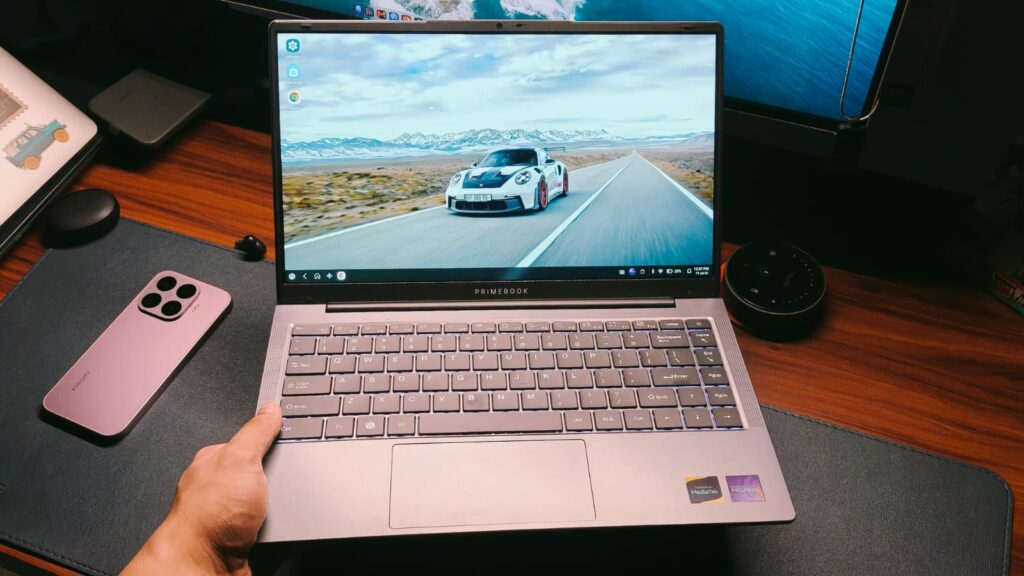
That’s exactly the problem PrimeBook aims to solve. For the uninitiated, it’s an Indian startup that focuses on making Android laptops, similar to Chromebooks, that help you write documents, study using online tools like YouTube, and don’t cost a bank. One example is the PrimeBook 2 Pro, which features a 14-inch full HD display and runs on the Helio G99 processor. Since you get all that for ₹26,999, I knew I had to test it. I’ve been using the Primebook 2 Pro for the better part of two weeks, and this review should help you decide whether it’s worth it.
Primebook 2 Pro Review
Summary
The Primebook 2 Pro is a unique machine. The design is way more premium than I expected. The keyboard is great to type on, and even the performance is serviceable. Where Primebook still needs to work on is the optimization. People shouldn’t need to request apps they want to install. Still, it’s a capable studying machine

It’s very hard to judge a laptop’s design on such tight budgets because, you know, brands simply don’t have the budget for extensive R&D. While this is what I’ve thought about many of the budget laptops I’ve tested, the PrimeBook 2 Pro is actually designed rather well. Don’t get me wrong, you won’t get the premium metal design, but for the price, the plastic build is excellent. The silver color mimics aluminum, which I quite like, and I observed no flex in the chassis, no matter the pressure. The top has a matte finish that looks sophisticated and doesn’t pick up any fingerprints. I could use the laptop in a trendy cafe without looking out of place.
Open the laptop, and you’re greeted by the same premium feel, except this time the keyboard deck has a MacBook-esque finish. The lid extends slightly below the chassis, making it easier to open. The hinge, however, isn’t much to write home about. It keeps the screen steady, but I found it to be quite stiff. I always had to use two hands to open the laptop, which is a nitpick. Still, the best part about the PrimeBook 2 Pro is the portability. The 14-inch form factor was perfect for slipping into any backpack, and the 1.38 kg weight was light enough to carry the laptop anywhere.
As far as ports are concerned, Primebook hasn’t taken the MacBook route. That’s because you get dual USB-A ports for connecting accessories, a USB-C port for charging, a microSD slot, and a 3.5mm headphone/microphone combo jack. While I couldn’t find the speeds for the mentioned ports, it’s hard to complain much at this price.

When making a budget laptop, the keyboard is usually first on the chopping board to cut costs. While I agree with this sentiment, the keyboard is one of the main ways to interact with the laptop, and I’m glad Primebook 2 Pro doesn’t follow the norm. Its keyboard is perfectly fine. There are no highlight features, but, most importantly, no glaring issues. I got used to the layout pretty quickly. The feedback, while not as tactile as my MacBook, was good enough for long typing sessions. There’s an extra row of shortcuts to get home, end task, and scroll the page, all of which were useful during my testing.
Where things went south was with the trackpad. First up, its sensitivity is way too high. A small flick raced the pointer from one end to the other when all I was trying to do was click the publish button on an article. The second issue is the gestures. Remember the extra row on the keyboard for page-up and page-down. Yeah, you’d be using that quite a lot since scrolling with two fingers moves the page by just an inch. I tried finding settings to adjust both of these things, but I couldn’t. So keep that in mind.

The PrimeBook 2 Pro features a 14-inch FHD IPS display with a 60Hz refresh rate. For the price, it’s pretty serviceable. The text was easy to read, even the smaller fine print. The colors were decent, making it a good experience to watch YouTube. Even the viewing angles were quite good. There was some color shifting when viewed from an angle, but not as much as with TN panels. The anti-reflective coating also did its job well, keeping background reflection at bay. The only complaint regarding the display would be the brightness. It’s not enough to overcome the light on a sunny day inside a brightly lit cafe.
The best way I can describe the alleged 1440p webcam is that you can use it for video calls. Don’t expect it to represent how your face actually looks or to have any sharpness, and you’d be good to go.

Inside the Primebook 2 Pro is the MediaTek Helio G99 processor, which, I agree, isn’t the newest kid on the block. It’s paired with 8GB of LPDDR4X RAM and an unnamed 128GB UFS storage. PrimeOS runs smoothly on the hardware. I could open and close applications reasonably quickly without waiting long. Most of my work happens in Chrome, so I used the laptop for a bit of news writing, along with my usual suite of research tabs. It kept over 10 tabs in memory without stuttering, so I believe studying with the 2 Pro should work out fine.
Where I did notice the 4-year-old processor was when running YouTube. The UI loaded quickly and fine, but when I clicked to play a video, there was a brief hitch before it actually played. This was the case with every video I tried playing. The issue became even more noticeable when I opened WhatsApp Web, which I believe many students would. The laptop took a long while loading my messages, and navigating between the different message tabs was a less-than-ideal experience.
The PrimeBook 2 Pro is powered by a 60Wh battery. When coupled with the non-flagship internals, the laptop’s battery life is excellent. When working on Chrome, it lasted me two full days of use, with the screen on time hovering around the 9-hour mark.

It’s time to talk about PrimeOS. It’s Primebook’s custom Android-based operating system that takes the big-screen Android experience and adds a few desktop-inspired features. It was my first time using PrimeOS, and it’s a decent take. Apps are neatly tucked away into a Finder-like place. The file manager is inspired by both macOS and Windows and does a very good job of organizing files into easily understandable tabs. App support, though, is a bit complicated. Primebook claims you get access to the “entire Android app ecosystem,” but I couldn’t find all the apps. Sure, most of the important apps like PowerPoint, Docs, and others are included, but it’s not a complete list. If you need more apps, you’ll need to request them specifically, which is a bit counterintuitive in my opinion. It’s worth checking that the apps you need are available before buying.
Beyond that, since not everything can run on Android, Primebook offers Cloud PC functionality. It lets users emulate Windows or Linux on their laptop, albeit with a fee. Subscriptions start at ₹99 for Linux and ₹499 for Windows. Sadly, I did not get the opportunity to test the functionality during my review period. There is also PrimeCoding, the brand’s own beginner-friendly coding platform. The implementation is simple but useful for beginners learning the basics of programming. Do I see PrimeOS becoming big in the next few years? Yes.

At ₹26,990, the PrimeBook 2 Pro is a unique machine. It’s neither a traditional Windows laptop nor a Chromebook. It’s something in between, and there are a lot of good things about the laptop. The design is way more premium than I expected. The keyboard is great to type on, and even the performance is serviceable. Where Primebook still needs to work on is the optimization. People shouldn’t need to request apps they want to install. Everything that runs on Android should already be there. Still, the Primebook 2 Pro is a capable machine that, if you’re looking for something to study on, will work just fine and serve you for a few years.


For the first time in several years, there are indications that the worst may be over for the Seattle region’s battered office market — and artificial intelligence companies appear to be playing a leading role.
The regional office market (spanning Seattle, Bellevue and the surrounding Eastside) posted positive net absorption during the second quarter, meaning companies occupied more office space than they vacated, according to a new report from commercial real estate firm JLL. It’s a notable shift after years of downsizing driven by remote work, layoffs and corporate cost-cutting.
Technology companies accounted for 42.5% of all leasing activity during the quarter, easily outpacing every other industry. JLL said AI-related leasing is on track for a strong year as companies establish engineering hubs in the Seattle region to tap its deep talent pool while taking advantage of office costs that remain well below San Francisco and New York.
In fact, leasing by AI companies has accounted for 21.6% of activity in the Seattle and Eastside year to date, and now the entire AI footprint in the region is 855,000 square feet. That’s double the amount in 2024, according to JLL.

The quarter’s largest deals reflected that trend.
The Pokémon deal helped push the region to 372,000 square feet of positive net absorption for the quarter — reversing a run of quarters in which tenants gave back more space than they took.
The numbers offer an encouraging change after years of gloomy office market reports, but they hardly signal a full recovery. Regional vacancy remains elevated at 23.9%, while overall availability sits at 25%.
Companies continue to consolidate space, landlords are still offering concessions, and asking rents remain under pressure as tenants retain significant negotiating leverage, JLL said in the report
Still, there are indications the market’s fundamentals are improving.
@media (max-width: 600px) {
aside.callout { float:none !important; max-width:100% !important; margin-left:0 !important; margin-right:0 !important; }
aside.callout .callout-img { display:none !important; }
}
Availability has now declined for two consecutive quarters and has fallen from a peak of 26.5% a year ago. At the same time, JLL reports there is currently no new speculative office construction under way — buildings started without tenants committed — meaning even modest growth in demand could have a greater impact on occupancy than in previous years.
Rather than signaling a broad-based office comeback, the latest leasing data suggests a more nuanced story: AI companies and other fast-growing technology firms are helping stabilize a market that had spent years moving in the opposite direction.
The report reinforces a trend GeekWire has been tracking over the past year as AI companies expand their presence across the Seattle region. Alongside Microsoft and Amazon, companies including OpenAI, Anthropic, xAI, Armada and Anduril have been building engineering teams in the area, drawn by one of the country’s deepest concentrations of AI and cloud computing talent.
Whether that momentum continues will depend on how quickly AI hiring expands and whether more companies decide they need additional space for a new generation of engineers. But after several years defined by shrinking footprints and empty offices, the second quarter offered the first meaningful indication that Seattle’s office market may finally be finding its footing.




London Mayor Sadiq Khan handed a peerage by Keir Starmer alongside 15 other Labour figures… just days before the PM leaves No10


Weekend Open Thread – Corporette.com


The House | The City of London can help the new chancellor deliver growth in every postcode


Young campaigners urge incoming PM to act on outdoor junk food ads


CFTC blocks Kalshi from unwinding Michigan trades after court order


Nvidia Stock Slips After Big Tuesday Rally as Huang Confirms Vera Rubin Chip Is Now in Production Today


Ripple Payments Joins MiCA With 14 Firms, Does It Mean Anything For XRP?

Disney’s Most Ambitious Failed Star Wars Attraction Is Coming to SDCC


Ripple wins EU-wide access as ESMA adds it to MiCA register


Palantir Shares Rise After Expanded Nvidia Partnership and Fresh Analyst Upgrades Ahead of Earnings Day


Injective Submits SEC Transfer-Agent Registration to Onchain Ownership Records


Get Your ESP32 Sunny Side Up With This Solar Dev Board


XRP BOMBSHELL… XRP OMBOARDED FOR TRANSACTIONS!!!


Registration is now open for March for Men with Kev 2026


Dark Secrets Emerge When Jailbreaking LLMs

New Cornerback Enters Vikings Trade Rumor Mill


Money | Class 12 Economics | CBSE Board Exam 2026-27

Two July Windows Left: The CLARITY Act’s Senate Fight and What Failure Means


Banco Bilbao Vizcaya Argentaria, S.A. (BBVA) Discusses Global Macro Environment and Economic Outlook for Core Markets Transcript


Claude Fable 5 Slips to Second in AI Coding Leaderboard


You must be logged in to post a comment Login