Security teams log 54% of successful attacks and alert on just 14%. The rest move through your environment unseen.
The Picus whitepaper shows how breach and attack simulation tests your SIEM and EDR rules so threats stop slipping by detection.





Microsoft announced that Windows Server 2022 will reach the mainstream end date in October 2026, but will switch to extended support and continue receiving security updates for five more years.
Windows Server 2022 was first announced in March 2021 and became generally available in September 2021 as the Long-Term Servicing Channel (LTSC) release, with 10 years of support.
“On October 13, 2026, Windows Server 2022 will reach end of mainstream support. The October 2026 security update will be the last mainstream support update available for this version,” Microsoft said in a message center update on Thursday.

“After this date, Windows Server 2022 will transition to extended support, which includes security updates at no additional cost, and will continue to receive monthly security updates through October 14, 2031.”
Customers are now advised to upgrade to Windows Server 2025 (the latest version of Microsoft’s server operating system), which became generally available in November 2024 after first rolling out to Windows Insiders in January 2024.
Windows Server 2025 will reach the end of support on November 13, 2029, with extended support ending five years later, on November 14, 2034. Those who want to test Windows Server 2025 before deployment can use the free 180-day trial available through the Microsoft Evaluation Center.
“Windows Server 2025 is now the latest Long-Term Servicing Channel (LTSC) release for Windows Server. To help keep your environment protected and supported, plan to upgrade to Windows Server 2025 for full mainstream support,” Microsoft noted.”Evaluate upgrade options and begin deployment testing early to help ensure a smooth transition.”
You can find more information about Windows servicing dates using the Lifecycle Policy search tool or on the Windows Lifecycle FAQ page. Microsoft has also shared a list of products that will reach the end of support or will be retired in 2025.
Last month, Microsoft also announced that it has extended Windows Server 2022 hotpatching until October 2027, one year after its mainstream end date of October 2026, for systems running the Datacenter: Azure Edition, and quietly extended the free Windows 10 Extended Security Updates (ESU) program for consumers by an additional year.
More recently, on Wednesday, Microsoft reminded customers that Windows 10 Enterprise LTSB 2016 and the Home and Pro editions of Windows 11 24H2 will stop receiving updates 3 months after reaching end of support.

Security teams log 54% of successful attacks and alert on just 14%. The rest move through your environment unseen.
The Picus whitepaper shows how breach and attack simulation tests your SIEM and EDR rules so threats stop slipping by detection.

An anonymous reader shared this report from the Los Angeles Times:
A federal judge has halted California’s groundbreaking “Truth in Recycling” law, which aims to reduce consumer confusion about which packaging can be recycled. [Originally planned to take effect October 4th], California’s recyclable packaging law prohibits manufacturers from using a “chasing arrows” recycling symbol on products or materials unless they are actually being recycled in a meaningful way, which the law quantifies…
A coalition of farming, forestry, restaurant and packaging organizations sued the state in March, arguing the law violates their right to free speech. They argued that Senate Bill 343 operates as “government-imposed censorship.” Judge William Hayes agreed that their challenge has merit, and on Tuesday ordered California Atty. Gen. Rob Bonta, the defendant in the case, to pause enforcement of the law “until further order of the Court….” Advocates of reducing plastic use disagreed. “The court got it wrong, and I’m confident that the state will ultimately prevail,” said Nick Lapis, director of advocacy for Californians Against Waste. “S.B. 343 does not violate the 1st Amendment; it requires companies to tell the truth when they make recyclability claims. Suggesting that the 1st Amendment protects misleading environmental marketing is inconsistent with the basic principles of consumer protection that states like California have implemented for decades.”
In January, CalRecycle, the state’s waste agency, reported that less than 10% of most single-use plastic materials in the state were being recycled. Even yogurt containers and margarine tubs — made of ubiquitous polypropylene, or No. 5 plastic — are being recycled at a rate of only 2% in the state, the report said. Only 5% of colored shampoo and detergent bottles, made from polyethylene, or No. 1 plastic, are getting recycled…
Plastic materials that can’t be recycled are typically sent to landfills or sometimes illegally shipped overseas, where they are burned or end up in landfills, rivers and waterways.
The bill’s author told the Los Angeles Times “All you have to do is look at the numbers. These products are not getting recycled, despite what the industry is claiming. They are just confusing consumers, clogging the waste stream, polluting the environment, leading to higher and higher prices for local governments and ratepayers.” He argues the symbols shouldn’t be used to “confuse people who see the symbols [on products] and assume they can be recycled.”
The article also quotes Judith Enck, former Environmental Protection Agency regional administrator and president of the nonprofit Beyond Plastics. “Given the long history of the plastics industry deceiving the public about plastics recycling, this is an especially bad outcome. It is a reminder that the plastics industry has enough money to fight even the most modest policy designed to protect people and the planet.”
Spotify, it’s fair to say, has made some weird user-experience choices.
There are a number of panels in the app, and the layout is confusing. The service constantly tracks your activity. The app also seems to have an odd hostility to playing actual albums. This all works to create a general feeling that Spotify’s designers are trying to push you into using the service in a particular way.
It’s understandable, then, that some people are annoyed with the way music videos have been added to the platform. For the most part, they would start to play by default, in the background, whenever an artist had uploaded a video for the song. Some music videos have very different audio from the original tracks, particularly if they include sketches or sound effects, which can prove distracting if you prefer the album version of the song. And even if you enjoy music videos (which I do), the decision to have videos play by default—using up bandwidth and battery power—upset a lot of people.
There are a few other quirks. On Spotify’s desktop app, the videos are barely visible; they stay contained in the tiny album art panel until you manage to find the hidden, extremely small Now playing button that enlarges them. Also, the selection of videos that are on the platform, and the ones that are mysteriously absent, seems totally random. Because of this, I check YouTube first when I really want to watch a music video.
The most annoying thing, though, had been a lack of any obvious way to disable all videos. That changed recently—there’s now a toggle in the settings to disable music videos in Spotify entirely, alongside controls that disable the Canvas feature (animated album art) and video podcasts.
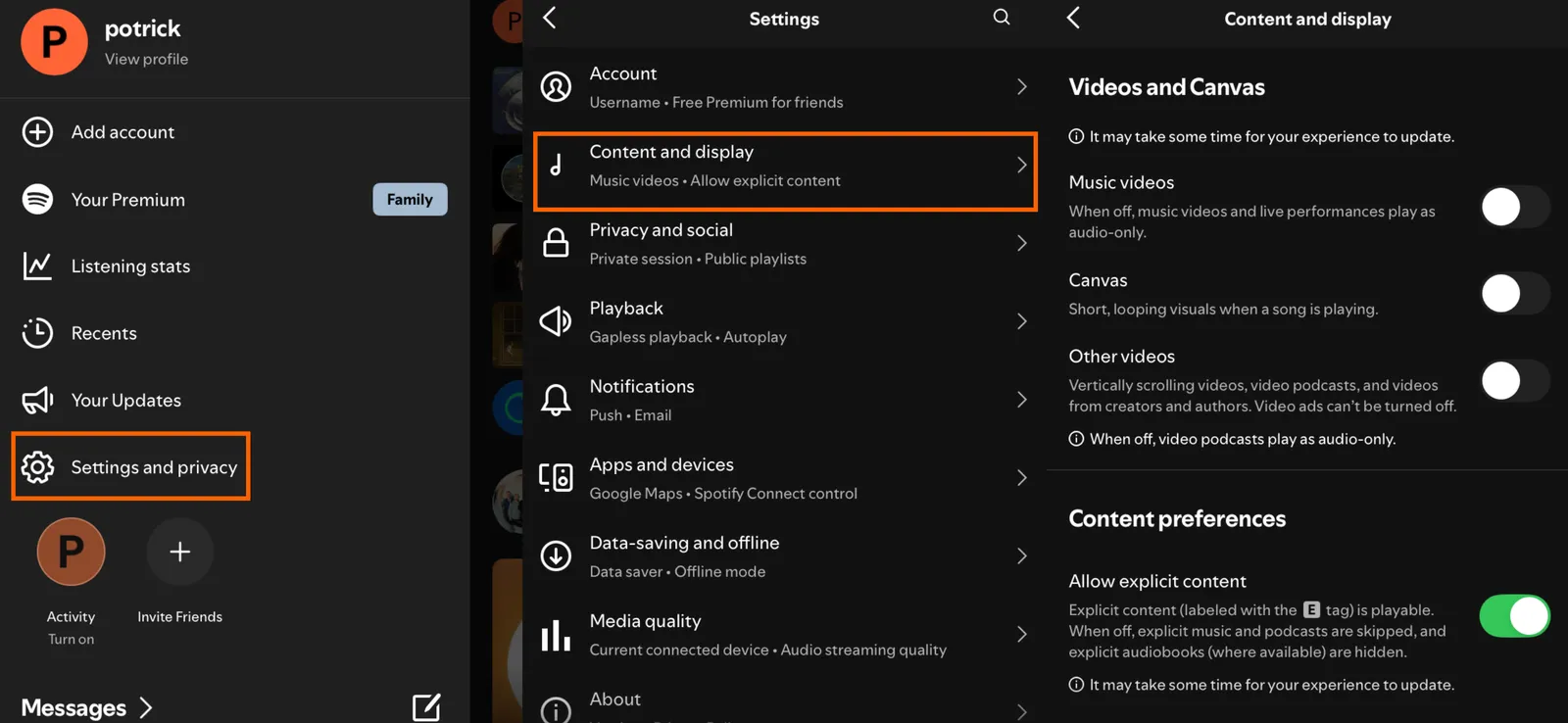
On mobile you can do this by tapping your user profile icon in the top-left to bring up the side panel. Then tap Settings and privacy, followed by Content and display.
Photograph: Justin Pot

In the Videos and Canvas section you will see three toggles: one for music videos, one for Canvas, and one for all other videos. This last toggle disables video podcasts, meaning you’ll get the audio-only version of podcasts instead. Turn all these off, and Spotify will use a lot less bandwidth.
On the desktop app, it’s a little different. Click your user profile icon in the top-right corner, then click Settings. Scroll down to the Videos and Canvas section to find the options to disable music videos and Canvas.
I tested this and it worked. The music video icon in playlists and albums disappeared, as did the collection of music videos on Artist pages. The only remnant of the disabled feature is a Switch to video button in the Now Playing sidebar, which appears below the album art. Click it and you’ll be told the video can’t play unless you turn videos back on in the settings. Odd, for sure, but for the most part turning this off means you don’t have to think about music videos in Spotify anymore.
I sincerely wish that Spotify would roll out music videos with more care. Sometimes I really do want to see a video—just not every time I play a track. Playlists of music videos might be welcome if they ran separately from the audio-only playlists. I just don’t want to get a music video when I’m looking for the album version of a song, and I don’t think I’m alone in that. I can only hope that Spotify’s future interface design choices will keep things more clearly separated.


Square Enix just rolled out a fresh pixel trailer for Final Fantasy Resonance, and it leans hard into the question of what the series might have looked like if it never left those old Super Nintendo sprites behind. The nearly three-minute clip puts the HD-2D style front and center, showing off battles, summons, and story moments that feel pulled straight from the glory days of Final Fantasy IV and VI while running on modern hardware.
Final Fantasy Resonance is the Final Fantasy series’ first foray into HD – 2D format, and it does so in a big way. Instead of simply copying over the action from the mobile game Final Fantasy Brave Exvius, the developers rebuilt and expanded on the opening story arc, transforming it into a full-fledged console RPG. Rain and Lasswell, a squadron commander and his boyhood friend, will head out after receiving a royal order to deal with a weakened barrier at the Earth Shrine.

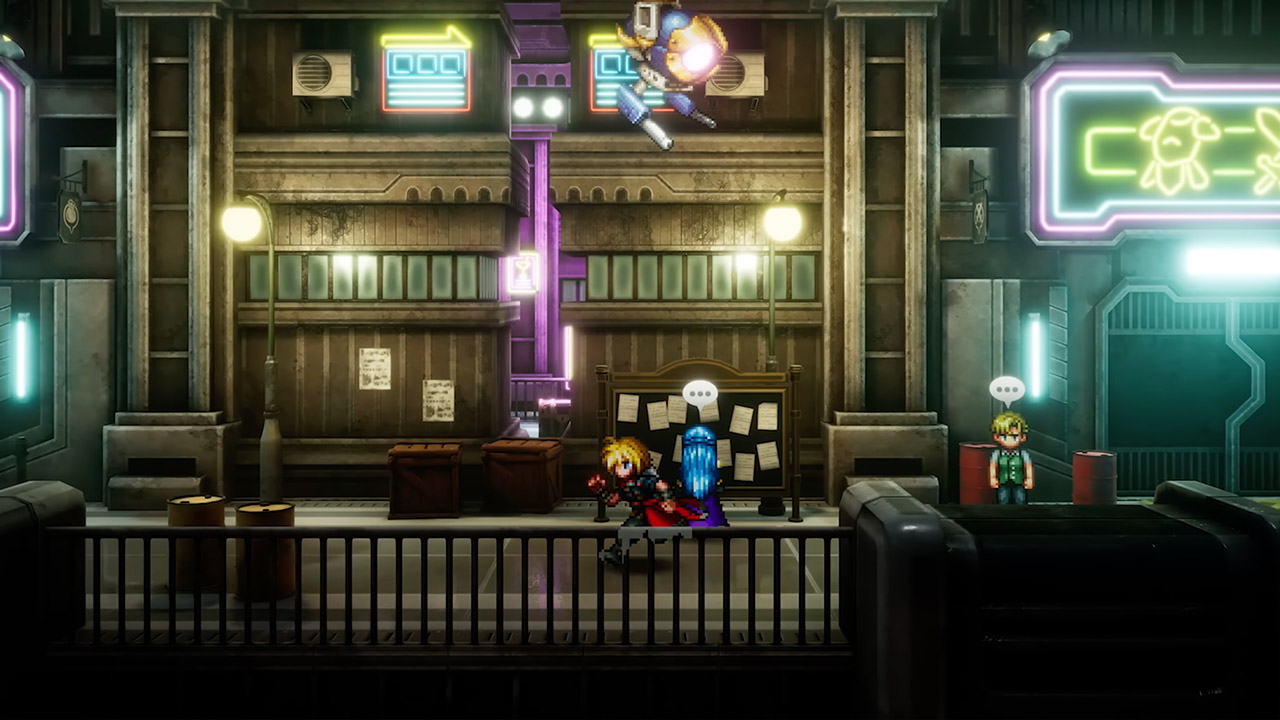
Inside, they face up against Veritas of the Dark, a man in black armor who simply wipes the floor with them, shattering the Earth Crystal and leaving their entire force in disarray. They then have to run back home to discover that Grandshelt is being attacked. Following the king’s desperate rescue, they partner up with a mystery girl named Fina to go out and protect the remaining crystals strewn over the earth.

Combat remains true to its turn-based roots, but with a few nifty improvements. When you hit an enemy’s weak area, you will stun them and shatter their defenses, giving you the opportunity for a couple of extra turns and those massive Resonance assaults, which are basically a showstopper in cinematic fashion. You can use traditional Espers such as Ifrit, Shiva, and Titan to gain a few extra rounds before they finish with a sweeping strike like Hellfire or Diamond Dust. Then there are Visions, crystallized reflections of heroes from throughout the Final Fantasy history with whom you can team up. Equip one, and he (or she) will fight alongside the team. The stronger the link, the more of Vision’s special abilities you will be able to access. Expect to see familiar names like Cloud, Tidus, the Warrior of Light, Cecil, Bartz, Squall, and Zidane appear in this way.

Between story beats, exploration reigns supreme. The cities may not have much to offer beyond a jump-rope contest or Mog Tag, but when you come across a Sanctum of Light, you’ll find a new Vision crystal to add to your collection. Then there are side paths to the Colosseum for some challenging monster confrontations, or the Chamber of Arms, where you can get your hands on some legendary weapons, or at least try to get them from the sealed creatures that are now protecting it. Places like Dilmagia, the steel metropolis that began it all with airship technology, and Olderion, the water-rich capital guarded by the Wardens of the Waters, give the game world a genuine lived-in atmosphere. Expect to see Chocobos, airships, and other Final Fantasy staples.

Square Enix and co-developer Lancarse are preparing to release the game on October 22, 2026, for Nintendo Switch 2, Nintendo Switch, PlayStation 5, Xbox Series X|S, and PC via Steam and the Microsoft Store. The standard game costs $49.99, the Digital Deluxe version adds in-game goodies for an additional $59.99, and the Collector’s Edition costs $209.99.

Strategy meets vibes, skill meets will and control meets chaos in the World Cup final between Spain and Argentina tonight. The first ever meeting between a pair of reigning continental champions on this grand stage sets up a clash of styles between two sides that could hardly be more different.
La Roja blitzed the competition en route to the Euros title two years ago, but they’ve had to completely reinvent themselves on the fly at FIFA World Cup 2026, owing to injuries sustained by Lamine Yamal and Nico Williams in the lead-up to the tournament. Although Yamal has dazzled in fits and starts, Williams has barely featured.
It was a masterstroke from Luis de la Fuente, therefore, to shift the team’s identity from wing wizardry to defensive solidity, with Rodri and Fabian Ruiz effectively being deployed as midfield sweepers. They’ve conceded just once across their seven games, but it was the way the 2010 champions blunted France’s vaunted attack and carved through the erstwhile favourites at will that truly underlined their qualities.
It’s a minor miracle that Argentina are in the World Cup final at all. They were dead and buried in all four of their knockout ties, only for deus ex machina to dramatically rescue them either deep into stoppage time, in extra time or in stoppage time of extra time on all four occasions. If only there was a Spanish word for remontada.
We’ll almost certainly never see a run like it again, a cross between Real Madrid in the Champions League and Terminator 2‘s T-1000, and the detail that makes it all the more remarkable is that Lionel Scaloni has had no obvious gameplan beyond feeding the ball to Lionel Messi at every opportunity.
What’s perhaps most extraordinary of all, however, is that it’s worked. Love or hate La Albiceleste’s bully-boy antics, the back-to-back South American champions are now on the verge of becoming the first team since Brazil in 1962 to win back-to-back World Cups.
Read on as we show you how to watch World Cup final 2026 for free from anywhere.
World Cup final 2026 is available to watch for free in multiple countries, including the UK, Australia, Brazil, Belgium, Ireland, Netherlands, Switzerland and Turkey.
Abroad? Can’t access your free stream? Unblock your free World Cup final stream with Norton VPN – more on that below.
If you’re traveling, you might discover your usual World Cup final 2026 stream is unavailable due to geo-restrictions.
Don’t worry, that’s exactly where a VPN can help. A virtual private network lets you connect to servers around the world so you can securely access your preferred Spain vs Argentina coverage as if you were back home.
We recommend Norton VPN. Here’s why:

US viewers can watch World Cup final 2026 on Fox (English commentary) or Telemundo (Spanish commentary).
Fox and Telemundo are available via cord-cutters like YouTube TV (free trial), Hulu+Live TV, Sling (select markets), Fubo and DirecTV.
Those looking for a streaming service instead can watch World Cup final on Fox One (3-day free trial). Telemundo is also available via Peacock ($10.99/month).
Visiting the US from the UK? You can still watch your free World Cup final stream thanks to Norton VPN (try for 60 days).

Viewers in the UK are in luck, as they can watch World Cup final 2026 for free on both BBC One and ITV1, with live streaming available via BBC iPlayer and ITVX.
You need a TV license and a valid UK postcode (e.g. SE1 7PB) in order to tune in.
Norton VPN can unlock your stream if you’re abroad this weekend.

World Cup final 2026 is free-to-air in Australia on SBS, with live streaming available courtesy of the SBS On Demand platform.
Traveling for work or on holiday? A VPN like Norton VPN can help unlock your free stream.

In Canada, TSN is broadcasting World Cup final 2026.
You can live stream Spain vs Argentina via the TSN+ streaming platform, which starts at CA$29.99/month.
Outside of Canada? Use Norton VPN whilst you’re traveling away from home to unlock your World Cup final stream.

In New Zealand, World Cup final 2026 is free-to-air on TVNZ 1, with live streaming available via TVNZ+.
Not in New Zealand right now? You can use a VPN like Norton VPN to watch all the action as if you were back home.

In Spain, you can stream the World Cup final 2026 thanks to RTVE Play.
You will need an account for this with a valid Spanish postcode (e.g. 28036)
UK resident visiting Spain? Unlock your stream with Norton VPN.

In Argentina, Telefe and TV Publica will broadcast the World Cup final.
Abroad? Use Norton VPN to stream your local service wherever you are in the world.
The World Cup final kicks off at 8pm BST / 3pm ET on Sunday, July 19. That’s 5am AEST on Monday, July 20 in Australia.
Spain team: Simon; Porro, Cubaris, Laporte, Cucurella; Rodri, Ruiz; Yamal, Olmo, Baena; Oyarzabal
Subs: Raya, Pubill, Grimaldo, E Garcia, Llorente, Merino, Torres, Gavi, Pino, J Garcia, Williams, Zubimendi, Pedri, Munoz, Iglesias
Argentina team: E Martinez; Montiel, Romero, Lisandro Martinez, Tagliafico; Enzo; De Paul, Mac Allister, Gonzalez; Messi, Alvarez
Subs: Musso, Senesi, Molina, Barco, Lo Celso, Rulli, Palacios, Paredes, Almada, Simeone, Paz, Otamendi, Lopez, Lautaro Martinez, Medina
The 2026 World Cup final is taking place at 80,663-capacity MetLife Stadium in East Rutherford, New Jersey, which has been branded the “New York/New Jersey Stadium” for the duration of the tournament.
Neither Spain nor Argentina have played there yet.
Slovenian referee Slavko Vincic is officiating the World Cup final, with on-field assistance coming from his compatriots Tomaz Klancnik and Andraz Kovacic, and Jordanian duo Adham Makhadmeh and Mohammad Alkalaf.
Vincic previous oversaw the 1-1 draw between Brazil and Morocco, Algeria’s 2-1 victory over Jordan, and Mexico’s 2-0 win over Ecuador, which each passed without controversy.
|
Stage |
Spain |
Argentina |
|
Group stage |
Group H: 1st, 7 points |
Group J: 1st, 9 points |
|
Last 32 |
Beat Austria (3-0) |
Beat Cape Verde (3-2 AET) |
|
Last 16 |
Beat Portugal (1-0) |
Beat Egypt (3-2) |
|
Quarter-finals |
Beat Belgium (2-1) |
Beat Switzerland (3-1 AET) |
|
Semi-finals |
Beat France (2-0) |
Beat England (2-1) |
The temperature in East Rutherford is around 81F (27C) at kick-off.
A far more pressing concern is the air quality, with parts of New Jersey having been cloaked in haze of wildfire smoke in midweek, which prompted an official health alert.
Of course, most broadcasters have streaming services that you can access through mobile apps or via your phone’s browser.
You can also stay up-to-date with all of the key World Cup final moments on the official social media channels on X/Twitter (@FIFAWorldCup), Instagram (@FIFAWorldCup), TikTok (@FIFAWorldCup) and YouTube (@FIFA).
We test and review VPN services in the context of legal recreational uses. For example: 1. Accessing a service from another country (subject to the terms and conditions of that service). 2. Protecting your online security and strengthening your online privacy when abroad. We do not support or condone the illegal or malicious use of VPN services. Consuming pirated content that is paid-for is neither endorsed nor approved by Future Publishing.

Looking for the most recent Connections answers? Click here for today’s Connections hints, as well as our daily answers and hints for The New York Times Mini Crossword, Wordle, Connections: Sports Edition and Strands puzzles.
Today’s NYT Connections puzzle features one of those purple categories where you need to hunt down a hidden word inside four of the clues. Read on for hints and today’s Connections answers.
The Times has a Connections Bot, like the one for Wordle. Go there after you play to receive a numeric score and to have the program analyze your answers. Players who are registered with the Times Games section can now nerd out by following their progress, including the number of puzzles completed, win rate, number of times they nabbed a perfect score and their win streak.
Read more: Hints, Tips and Strategies to Help You Win at NYT Connections Every Time
Here are four hints for the groupings in today’s Connections puzzle, ranked from the easiest yellow group to the tough (and sometimes bizarre) purple group.
Yellow group hint: Announce.
Green group hint: One might be turned up.
Blue group hint: Fresh start.
Purple group hint: Something you drink is hidden in each word.
Yellow group: Proclaim.
Green group: Kinds of noses.
Blue group: Used in metaphors for opportunity.
Purple group: Starting with fermented beverages.
Read more: Wordle Cheat Sheet: Here Are the Most Popular Letters Used in English Words
The completed NYT Connections puzzle for July 20, 2026.
The theme is proclaim. The four answers are blare, herald, sound and trumpet.
The theme is kinds of noses. The four answers are button, Greek, ski jump and snub.
The theme is used in metaphors for opportunity. The four answers are blank page, horizon, oyster and window.
The theme is starting with fermented beverages. The four answers are Alexa (ale), meadow (mead), portobello (port) and sakes (sake).
If you don’t love the look of a big TV in the living room, have limited space in your home to accommodate a TV, or just want a fun and easy way to elevate movie nights, you might want to look into buying a home projector. It used to be considered a luxury to have a projector set up in your home, but modern projectors are surprisingly cheap, thanks to technological improvements, material swaps, and lower production costs. Plus, home projectors are worth buying used, allowing consumers to save even more money on a gadget that used to feel too premium for the average household.
There are so many different types of home projectors to choose from, but no matter which projector model you go with, they all come with similar placement recommendations. That said, some projectors are built to perform better in certain conditions, like niche outdoor projectors bright enough to clearly project an image in direct sunlight. However, for the most part, all home projectors share these worst places to avoid. We’ve gathered five spots you should absolutely avoid putting a projector, along with a detailed explanation and a recommendation for where you should set it up instead.
A projector, like any electronic media device, tends to get hot while it’s working. And because projectors have a lamp or a light bulb inside, they typically get hotter than a standard DVD player or even a gaming console. To prevent overheating, a projector is designed to pull air through intake vents, over the hot components, and out through exhaust vents.
This ventilation process is so important for user safety and the life of the projector that most (if not all) brands will highlight how important it is to set up the projector in an uncrowded area where it can breathe while in use. According to Lisowod, maker of the best cheap projector on Amazon, users are supposed to make sure there’s “adequate ventilation around the device” and that it’s on a “stable, flat surface.”
If your coffee table is frequently a dumping ground for takeout containers, dirty clothes, and other miscellaneous items, you shouldn’t set up a projector there. And if you do, you run the risk of potentially starting a fire or damaging the projector past the point of fixing, either due to overheating or falling from an uneven surface. Instead, choose a surface you know tends to stay clean and dusted or, if you know that’s not an option, you can tidy the surface each time you plan to use the projector.
Most people set up projectors in their living room, bedroom, a dedicated media room, or backyard, which are typically the best places to use a projector. However, some might consider using a projector in their kitchen or bathroom, both of which are terrible places for this media device. Putting a projector in your bathroom so you can watch a movie while you’re relaxing in the tub or in the kitchen to keep you entertained while cooking dinner sounds great on paper, but in reality, a projector in either of these rooms will have a shorter lifespan.
In the kitchen, projectors can be exposed to oil, oil mist, steam, smoke, or airborne cleaning chemicals. Depending on how small your kitchen is, there’s a chance the projector could be dangerously close to a hot stove or the sink. In the bathroom, humidity is the greatest danger to a projector. While kitchens can also get pretty humid while cooking, the risk of humidity damaging the projector is much greater in the bathroom, especially if there’s not a good ventilation system. According to Epson, a projector being exposed to high humidity could result in a fire, electric shock, or damage to the case or the projector itself.
Just like balancing a projector on a messy surface can prevent a projector from ventilating properly, so can placing it inside a cabinet, even if the cabinet is completely empty. Most cabinets in entertainment centers or dressers don’t have any active ventilation solutions set up inside. Some may have a hole built into the back panel or a larger cutout for cables to pass through, but with nothing actively pushing hot air out and bringing cool air in, this is too hot a space for a projector.
Most cabinets are also too compact for a projector to operate safely. Sony recommends leaving nearly 12 inches of clearance around some of its projector models, and other projectors from Sony and other brands likely need a similar amount of room to breathe. In a cabinet that’s too small and doesn’t offer nearly enough ventilation for a hot projector, you run the risk of the device overheating and possibly starting a fire or damaging the device beyond repair. Instead of sticking it inside a cabinet, a projector should be placed on a clean, roomy surface or mounted to the ceiling.
One of the worst places you can set up a projector is in a room that’s too bright or anywhere that gets direct sunlight. This isn’t because the projector might get too hot, though if it’s in the path of a sunbeam for too long while it’s actively in use, it’s possible it could overheat. Rather, a projector shouldn’t be set up in a spot that’s too bright because it makes it nearly impossible to see the projected image.
Some rooms, like the aptly named sunroom, are designed to let the sun in, and it would be strange to put blackout curtains in there just so you could have a projector in that room. For living rooms and bedrooms, two common rooms for a projector to call home, blackout curtains are a great way to block sunlight from streaming in. If the lights you have installed inside are too bright, you can invest in dimmer switches or smart bulbs that allow you to adjust brightness within a mobile app.
LG warns users of its ProBeam DLP projectors not to install them anywhere that’s “under the air conditioner or is directly exposed to the wind from the air conditioner.” The brand also notes that users should avoid installation anywhere that’s “dusty or exposed to wind and rain,” so it’s likely that the constant (and possibly dusty) airflow and potential condensation are two of the biggest reasons LG recommends against installing a projector there.
A projector manual from Sony echoes this recommendation to steer clear of AC units during installation and use. The manual explains how air from air conditioners can cause oscillation in the projected screen. In more simple words, this influx of air can cause the projected image to look shaky or jittery. A jumping image could also be the result of setting up the projector on an air conditioner simply because of the vibrations produced by the AC unit, according to projector brand Miroir.
Most of us on the SlashGear team have home projectors as well as other similar media devices, like gaming consoles, DVD players, TVs, and so on. Because of that, it’s easy to rely on common sense to come up with this list of the worst places you can set up your projector. However, we didn’t stop there. We took the time to verify each reason we thought of with documentation from reputable projector brands, including LG, Sony, Lisowod, and Epson, for suggestions and warnings on where to set up or avoid setting up a projector.


Mopar’s mid-1960s to early 1970s run of muscle cars easily goes down as one of the greatest eras ever for an American performance car maker. The Dodge and Plymouth brands of this period sold some of the most iconic muscle cars ever made, with model names every bit as recognized as the cars they adorned. Filling showrooms at this time were the Charger, the Challenger, the Cuda, the Super Bee, and the Demon, just to name a few.
While certainly not obscure or forgotten, the Plymouth GTX is a model from this period that sometimes gets overlooked when compared to its siblings. In the mid-’60s, as the muscle car movement was taking off, the mid-sized GTX would help lay the groundwork for the Mopar muscle cars that would follow it. The GTX also developed an image as a “gentleman’s muscle car” or “gentleman’s hot rod” through Mopar’s marketing and its higher price — and more well-appointed nature — compared to other mid-sized muscle cars of the time.
While there are other late ’60s and early ’70s American performance cars that could also lay claim to the “gentleman’s muscle car” label, the Plymouth GTX’s blend of upscale luxury and drag-strip-ready performance certainly made it stand out among its Mopar muscle car contemporaries. Today, this also makes the GTX a very desirable piece of muscle car history for collectors.

While the definition of what exactly is or isn’t a muscle car is loose, the Chrysler Corporation had been building high-performance, V8-powered automobiles since the mid 1950s, and it really began ramping up those efforts in the early and mid 1960s. By 1967, muscle car fever had begun to sweep the industry, with automakers rolling out a stream of specially-marketed and packaged, mid-size models powered by large cubic-inch engines.
The GTX debuted for the 1967 model year as Plymouth’s mid-sized muscle offering. Based on the Belvedere, the GTX came with big block power as standard, offering buyers a choice between the base 440 cubic-inch Super Commando V8 and the legendary 426 Street Hemi. Beyond its power plant, the GTX came well-equipped inside and was adorned with hood scoops to help it stand out in the growing segment of mid-sized muscle offerings.
It was in 1968, though, when the GTX really began to separate itself as Plymouth’s more upscale muscle car offering. That’s because this is the same year the legendary Plymouth Road Runner debuted. Based on the same mid-sized Belvedere body style, the Road Runner was all about stripped-down, budget-friendly big-block performance. This meant that GTX was now Plymouth’s better-equipped, more upscale take on the mid-sized muscle car, available with engines like the aforementioned 426 Hemi or the potent 440 Six Pack.

While there wasn’t any specific or official branding of the GTX as the “gentleman’s muscle car,” it was marketed as part of the “executive branch” of Plymouth’s so-called Rapid Transit System muscle car lineup alongside the full-size Sport Fury GT. However, just because it was positioned upmarket didn’t mean the GTX lacked the fun of other Mopar muscle cars. It still had the same bright color options and wild optional features like the Air Grabber hood scoop. The GTX existed as a standalone model until 1971, by which point the muscle car era itself was already beginning to fade out.
Because there’s no official “gentleman’s muscle car” title, there are several other muscle-era models that could also be deserving of the label. These included the well-equipped Oldsmobile 442, the early 1970s Pontiac Grand Prix, and the related Chevrolet Monte Carlo, all of which were General Motors offerings. The latter two, in particular, matched big cubic-inch muscle car engines with elements of the emerging personal luxury car segment.
Luxury muscle wasn’t solely the domain of mid-sized offerings, though, and there were also full-size offerings that blended muscle car and luxury features. These include the aforementioned Plymouth Sport Fury GT and the rare Chrysler 300 Hurst Edition, both of which added some muscle car spice to spacious and upscale full-size coupes.
While Spain vs Argentina battle it out in the 2026 FIFA World Cup final for football’s biggest prize, global stars will light up the stage in what will be the first-ever World Cup halftime show.
The show will be headlined by some of the biggest global stars, including Madonna, Shakira, Justin Bieber, and the popular South Korean band BTS. It’ll be curated by Coldplay’s Chris Martin and will also feature the famous Muppets from Sesame Street – characters that have been a cherished part of many Americans’ childhoods.
But this isn’t just about entertainment. The halftime show at the New York New Jersey Stadium will support the FIFA Global Citizen Education Fund, aiming to raise $100 million to provide access to quality education and football opportunities for children worldwide.
FIFA has already raised around $30 million, with $1 being added to the total for every FIFA ticket sold. “It will be a celebration of football, unity and shared humanity that will resonate far beyond the final whistle,” said FIFA President Gianni Infantino.
So, read on as we show you exactly how to watch the 2026 World Cup final halftime show for free from anywhere.
The first-of-its-kind World Cup final halftime show is available to watch for free in multiple countries, including the UK, Australia, Brazil, Belgium, Ireland, Netherlands, Switzerland and Turkey.
Abroad? Can’t access your free stream? Unblock your free World Cup stream with Norton VPN – more on that below.
If you’re traveling, you might discover your usual World Cup final stream is suddenly unavailable due to geo-restrictions.
Don’t worry, that’s exactly where a VPN can help. A virtual private network lets you connect to servers around the world so you can securely access your usual World Cup coverage as if you were back home.
We recommend Norton VPN. Here’s why:
US viewers can watch the final’s halftime show on Fox and Telemundo (Spanish comms).
For cord-cutters, these channels are available on live TV services like YouTube TV (free trial), Hulu+Live TV, Sling (select markets), Fubo or DirecTV.
Those looking for a streaming service instead can watch on Fox One (3-day free trial). Telemundo is available via Peacock as well.
Visiting the US from the UK? You can still watch your World Cup stream for free thanks to Norton VPN (try for 60 days).

UK customers are in luck as they can stream the World Cup final halftime show for free on ITVX and BBC iPlayer.
You require a TV license and a valid UK postcode for an account (e.g. SE1 7PB).
Norton VPN can unlock your stream if you’re abroad today.
The World Cup final halftime show will be shown for free in Australia on SBS On Demand.
The streaming platform is showing every game of the tournament for free, making it the perfect place for your World Cup viewing.
Traveling for work or on holiday? A VPN like Norton VPN can help unlock your free stream.
In Canada, TSN and free-to-air channel CTV will be broadcasting the final’s halftime show.
You can live stream via the TSN+ streaming platform, which costs CA$8 per month or CA$80 per year.
CTV will require your TV provider login details, but is also available via pay-TV streaming platform Crave if you want an alternative.
Outside of Canada? Use Norton VPN whilst you’re traveling away from home to unlock your stream.
The World Cup final between Spain and Argentina kicks off at 8pm BST / 3pm ET / 7am AEST (Mon), so the halftime show should start around 8:50pm BST / 3:50pm ET / 7:50am AEST (Mon). Although sources within FIFA say the halftime show will last around 20 minutes, it’s more likely to stretch closer to 25-30 minutes. That’s because the 11-minute Super Bowl-style performance, co-headlined by Madonna, Shakira and BTS, will take place after the scheduled 15-minute halftime interval.
There’s precedent for this, too. Last year’s FIFA Club World Cup final also featured a halftime show, with performances from Coldplay, J Balvin, Doja Cat, Tems and Emmanuel Kelly, and the break ultimately lasted 24 minutes.
Not everyone is happy about a potential half-hour halftime show. Many football fans have criticized the move on social media. As one user on X put it: “We’re not here for a pop festival. It will completely ruin the atmosphere and momentum of the match.”
What time does World Cup 2026 final halftime show start?
How long will be the World Cup 2026 final halftime show?
Just heard the World Cup final half time show will mean a 30 minute half time? Are they effing joking? We’re not here for a pop festival. It will completely ruin the atmosphere and momentum of the match.July 14, 2026
Of course, most broadcasters have streaming services that you can access through mobile apps or via your phone’s browser.
You can also stay up-to-date with all of the key World Cup moments on the official social media channels on X/Twitter (@FIFAWorldCup), Instagram (@FIFAWorldCup), TikTok (@FIFAWorldCup) and YouTube (@FIFA).
We test and review VPN services in the context of legal recreational uses. For example: 1. Accessing a service from another country (subject to the terms and conditions of that service). 2. Protecting your online security and strengthening your online privacy when abroad. We do not support or condone the illegal or malicious use of VPN services. Consuming pirated content that is paid-for is neither endorsed nor approved by Future Publishing.


Open-weight AI models have been having a moment lately. Just this month, Moonshot’s massive Kimi K3 model landed close behind Claude Fable 5 and GPT 5.6 Sol in several benchmarks, all while remaining fully open-weight and downloadable by anyone.
However, Katie Paxton-Fear, a cybersecurity lecturer at Manchester Metropolitan University and staff security advocate at Semgrep, managed to poison an open-weight model and proved how easily that openness can be turned against you (via The Register).
Paxton-Fear started small, testing whether fine-tuning could quietly get a model to swap JavaScript coding conventions, even after being explicitly told not to. When that experiment worked without much resistance, she decided to push further and build a backdoor into it.
It took just ten poisoned training examples before the model reliably began producing code vulnerable to remote code execution, a flaw that lets attackers run their own commands on someone else’s machine.
The whole process cost under $100 and took roughly an hour. Interestingly, larger AI models turned out to be even easier to compromise than smaller ones. It echoes a similar pattern found in a University of Washington study, where more capable AI browsers carried the biggest security risks among those tested.
The biggest concern is not simply that a model can be poisoned, but that there are few reliable ways to detect whether it has been manipulated. Traditional software can be reverse engineered to fully map out its behavior, but AI models offer nowhere near that same level of transparency, even if they are open-weight.
A compromised model does not need to visibly malfunction to cause damage; it just needs to quietly influence decisions in ways nobody notices. Commercial closed models like Claude or ChatGPT aren’t fully off the hook either, since they demand plenty of trust while offering very little visibility into their inner workings. This research is a clear reminder that trusting an AI model blindly, open-weight or not, comes with real risk attached.


We may receive a commission on purchases made from links.
If you’re shopping for the right HDMI cable for your TV or monitor, you may have come across the Ultra96 cable. Unless you’re a technophile, you may not know that the Ultra96 supports up to 96 Gbps of bandwidth under the HDMI 2.2 specification. This means that this cable can handle extremely demanding video formats and superior resolutions. But is it just too much cable for what you need?
If you’re buying HDMI 2.2 hardware capable of using its full 96 Gbps bandwidth, the answer is no. In that case, an Ultra96 HDMI cable is the right choice as it delivers everything you need for some modern PCs, TVs, and other advanced devices. This is especially true if you’re using a device capable of 4K at 240Hz, uncompressed 8K at 60Hz, and resolutions up to 16K at 60Hz. The Ultra96 is designed to support these specifications, making it the fastest and highest-bandwidth HDMI cable you can buy.
But if your devices are designed around HDMI 2.1 with 48 Gbps, a cable rated for those specifications is really all you need. The Ultra96 will not give your older devices the best resolution and the fastest speeds because the capability of your equipment is limited to the HDMI standard it was designed to support. However, if you’re planning on upgrading your devices in the future, you could swap your current cables for the Ultra96, because they are backward-compatible. That way, you’ll be ready when you decide to update your equipment.
Ultra96 is the latest advancement in the evolution of HDMI technology. Its 96 Gbps bandwidth is a major improvement over the once-standard HDMI 2.0 specification. HDMI 2.0 supported up to 18 Gbps of bandwidth before HDMI 2.1 increased that capability to 48 Gbps. But Ultra96 is designed to support the continued push toward higher resolutions, faster refresh rates, and more demanding video applications.
However, the Ultra96 certification goes beyond just bandwidth. Ultra96 cables are classified as Category 4 HDMI and must go through a testing phase to verify they can meet the full 96 Gbps specification. They are also tested for low electromagnetic interference, which helps reduce the possibility of interference with wireless networks and other electronic devices. But while the Ultra96 cable itself is designed to support the full 96 Gbps bandwidth, HDMI 2.2 devices can often be a bit more complicated.
That’s because unlike HDMI 2.1, HDMI 2.2 includes a few different bandwidth tiers, including 64 Gbps, 80 Gbps, and 96 Gbps. This means that a device bearing an HDMI 2.2 designation may not necessarily support the full performance available from an Ultra96 cable. As a result, consumers will need to pay attention to the specific bandwidth, as well as features, supported by their devices. Otherwise, they could end up with an HDMI cable that goes beyond the capabilities of their equipment.




London Mayor Sadiq Khan handed a peerage by Keir Starmer alongside 15 other Labour figures… just days before the PM leaves No10


Weekend Open Thread – Corporette.com


The House | The City of London can help the new chancellor deliver growth in every postcode


Young campaigners urge incoming PM to act on outdoor junk food ads


CFTC blocks Kalshi from unwinding Michigan trades after court order


Nvidia Stock Slips After Big Tuesday Rally as Huang Confirms Vera Rubin Chip Is Now in Production Today

Two July Windows Left: The CLARITY Act’s Senate Fight and What Failure Means


Ripple Payments Joins MiCA With 14 Firms, Does It Mean Anything For XRP?


Democrats look to World Cup watch parties to register thousands of voters

Disney’s Most Ambitious Failed Star Wars Attraction Is Coming to SDCC


Ripple wins EU-wide access as ESMA adds it to MiCA register


Palantir Shares Rise After Expanded Nvidia Partnership and Fresh Analyst Upgrades Ahead of Earnings Day


Injective Submits SEC Transfer-Agent Registration to Onchain Ownership Records


Get Your ESP32 Sunny Side Up With This Solar Dev Board


XRP BOMBSHELL… XRP OMBOARDED FOR TRANSACTIONS!!!


Registration is now open for March for Men with Kev 2026


Dark Secrets Emerge When Jailbreaking LLMs

New Cornerback Enters Vikings Trade Rumor Mill


Money | Class 12 Economics | CBSE Board Exam 2026-27


Banco Bilbao Vizcaya Argentaria, S.A. (BBVA) Discusses Global Macro Environment and Economic Outlook for Core Markets Transcript



You must be logged in to post a comment Login