

Crypto World
Strategy’s Michael Saylor Pounds Away at “Bad Idea” BIP-110


Strategy executive chairman Michael Saylor took to social media on Sunday to detail his “110 reasons” why a proposed temporary fork to limit non-monetary transactions on the Bitcoin network, or BIP-110, is a bad idea.
Bitcoin Improvement Proposal-110 was introduced in December 2025 to stop nonfungible token-like Ordinals inscriptions and other arbitrary data from spamming the network and to preserve BTC’s main use as a peer-to-peer cash system.
In a roughly 3,700 word post on X.com, the man in control of the largest Bitcoin (BTC) corporate treasury made a case for what he said are “neutral rules, hard consensus, open markets, and permissionless innovation.”

Source: Michael Saylor on X.com
“Many Bitcoiners I respect support BIP 110. They want to keep validation accessible, protect node operators from unwanted costs and content, preserve affordable payments, and keep Bitcoin focused on sound money rather than general-purpose data storage. Those are serious concerns. I share the objectives. I disagree about the remedy,” Saylor said. He added:
“This article critiques the proposal, not the people behind it. I assume good faith. Bitcoin is strongest when we can disagree vigorously without mistaking allies for enemies.”
As of 12 p.m. ET, on Sunday, the post had been viewed 879,000 times, with 692 replies and 852 retweets.
BIP-110 is one of the more notable protocol-level disputes in the Bitcoin development community since the Blocksize Wars between 2015 and 2017, when ecosystem participants debated whether it was worth risking a chain split to raise the block size limit for scalability.
The proposal was introduced by pseudonymous Bitcoin developer “Dathon Ohm” with the support of Ocean protocol founder Luke Dashjr. Opponents include Blockstream CEO Adam Back.
Related: Bitcoin nodes running BIP-110 crosses 2% as spam wars heat up
Little certainty on BHP-110 approval
To be sure, BIP-110 won’t be activated unless 55% of Bitcoin nodes validating blocks are in support of the proposal across a Bitcoin block “period.”
In the last period, period number 475 between block 955,584 and 957,599, only 1% of blocks were in support.
The dispute comes at a time when Ordinals activity is at near all-time lows, with fewer than 10,000 Ordinals inscribed into the Bitcoin blockchain on a daily basis over the last month, down from the more than 400,000 seen during its peak in August 2023.
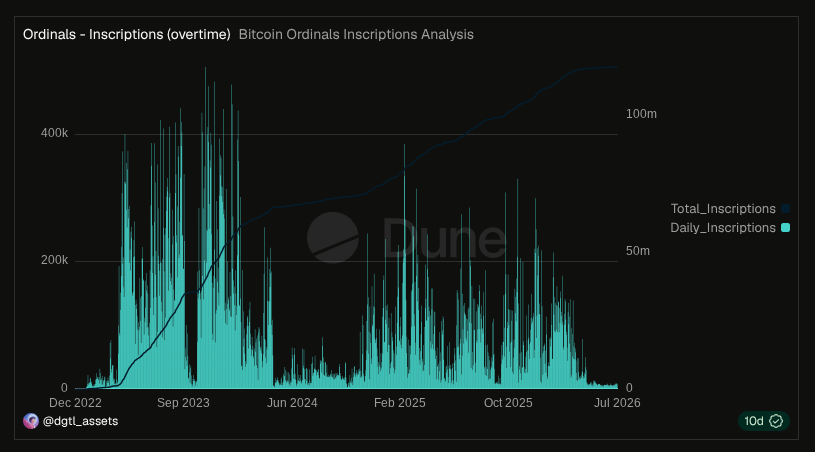
Change in daily Ordinals inscriptions since December 2022.
Source: Dune Analytics
Bock has previously criticized BIP-110, describing it as a “quest to police other people.”
He said Bitcoin’s decentralization should mean “you can’t impose your views on others,” calling it incompatible with BTC’s cypherpunk ethos of permissionless, censorship-resistant money.
Dashjr and other BIP-110 supporters have called Ordinals-driven bloat a “serious threat” to the network, prompting the need for an imminent fix.
They have also argued BIP-110 wouldn’t cause a chain split, as many fear, while adding that the BIP-110 fork imposes a temporary one-year limit and thus wouldn’t invalidate fee-paying transactions over the long term.
Features: From Bitcoin critics to blockchain believers: The 5 biggest crypto backflips



Hyperliquid said its HIP-4 upgrade will support permissionless deployment of prediction markets in a future enhancement, allowing anyone to list event contracts on the decentralized exchange, according to a statement the team posted on Telegram on Sunday. To deploy, builders will be required to… Read the full story at The Defiant
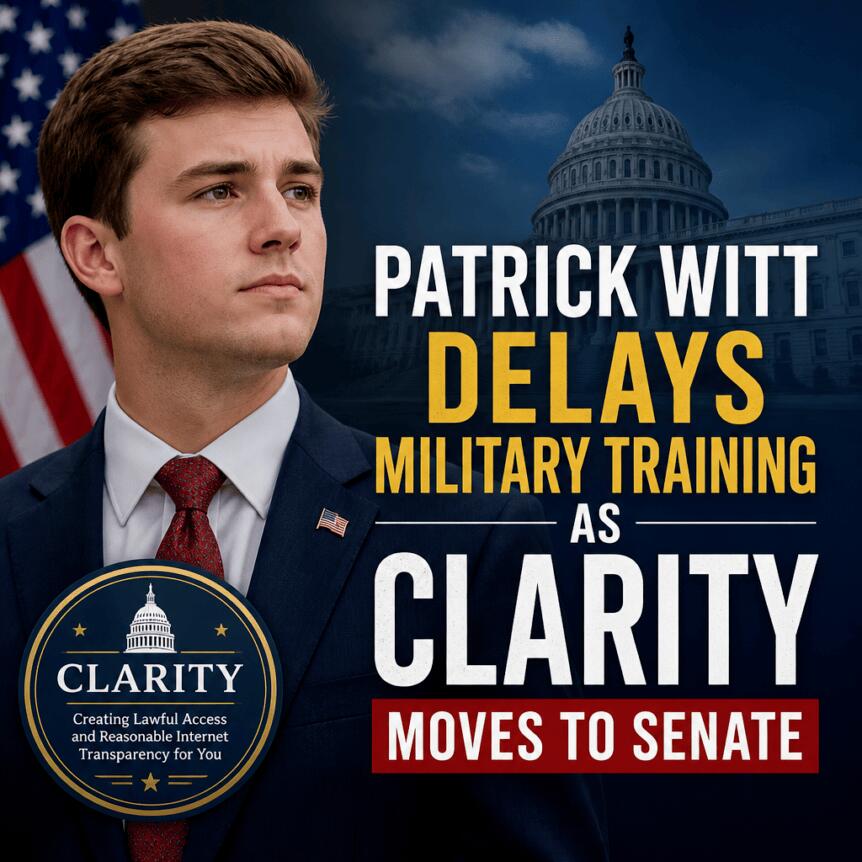
The White House’s chief crypto adviser Patrick Witt said he will not begin his scheduled military training at the end of the month, keeping him in place as a key negotiator on the CLARITY Act. Witt’s update comes as the legislation approaches a narrow Senate window ahead of the chamber’s Aug. 8 recess.
In an X post on Monday, Witt said that while he remains committed to fulfilling his service obligation, his training has been deferred, allowing him to “see this effort through to the end.” The change matters because Witt is described as the White House’s lead negotiator for the bill and a central figure in ongoing talks over how the US will regulate crypto.
Key takeaways
- Patrick Witt says his end-of-month military training has been deferred, letting him remain at the White House to keep working on CLARITY.
- The CLARITY Act needs to pass the Senate before the Aug. 8 recess, giving the legislative push a tight timetable.
- Witt had previously been reported to return for Judge Advocate General (JAG) training with the Georgia Army National Guard on July 27, but that plan has been adjusted.
- Harry Jung, Deputy Director of the President’s Council of Advisors for Digital Assets, announced he will leave government service in about two weeks.
Witt’s deferred training keeps Senate talks on track
According to Witt, the report that he would leave for mandatory training—timed around the moment CLARITY could reach the Senate floor—has changed. He said in his post that his training has been deferred, meaning he will not depart when expected and can continue working through the end of the legislative process.
The White House’s crypto policy priorities have increasingly depended on named individuals who can bridge positions between the executive branch and lawmakers. Witt’s role as the White House’s lead negotiator places him at the center of negotiations that typically involve narrowing differences on regulatory scope, compliance requirements, and consumer-related guardrails.
Why the Aug. 8 Senate deadline raises the stakes
The CLARITY Act is intended to establish what the article describes as the first comprehensive US regulatory framework for the crypto market. The bill’s prospects, however, hinge on procedural timing as much as policy design—particularly with the Senate recess looming on Aug. 8.
Witt’s continued presence at the White House during this period signals that officials are treating the current push as urgent. Earlier reporting referenced Witt being expected to report for JAG training with the Georgia Army National Guard on July 27. Under that earlier plan, his absence could have created a handoff challenge at a moment when the Senate is deciding whether it has sufficient support to advance the bill.
With Witt now stating he will stay, the White House appears to be reducing the risk of a personnel gap during the final stretch of Senate negotiations. The bill’s passage window remains the same, but the ability to sustain day-to-day talks may be improved by keeping the lead negotiator available.
Second deferment underscores ongoing CLARITY pressure
The change is not the first adjustment to Witt’s training schedule. A Tuesday report from Crypto In America said Witt had already deferred mandatory military training in April so he could remain at the White House to work on CLARITY Act negotiations. That reporting also suggested the negotiations took longer than expected.
In practical terms, this is a reflection of how political timelines can collide with other obligations—even for senior officials. Witt’s current statement indicates the intersection remains unresolved in the short term, but that the executive branch is prioritizing the legislative work during this specific Senate window.
Investors and market participants typically watch for movement in policy milestones because regulatory clarity can affect how crypto firms plan compliance, custody, market structure, and product offerings. While personnel decisions do not determine bill text on their own, they can influence how consistently negotiators engage lawmakers as deadlines approach.
Harry Jung to leave the Council as Witt stays
Witt’s decision to remain at the White House coincides with another personnel shift inside the administration’s crypto advisory structure. Harry Jung, the Deputy Director of the President’s Council of Advisors for Digital Assets, announced he will leave his post.
Jung said in an X post on Monday that he will leave government service in two weeks, adding that the past two years “transformed America’s position on crypto.” The timing of his departure is relevant because Jung had been expected, according to Crypto In America, to take over Witt’s responsibilities while Witt was on military leave.
With Witt now reporting that his training has been deferred, the need for a near-term transition may be reduced. Still, Jung’s exit changes the Council’s internal leadership landscape during the same Senate deadline period, which could affect how work is coordinated after Witt’s involvement later in the summer.
For readers tracking the CLARITY Act, these overlapping personnel updates highlight a larger theme: the bill’s advancement depends not only on committee mechanics and votes, but also on the continuity of the people tasked with negotiating and translating policy goals into legislative language.
As the Senate moves toward its Aug. 8 recess, attention should stay on whether the CLARITY Act can secure the momentum required for final passage, and on how the Council’s leadership changes play out alongside Witt’s continued involvement. The next signals to watch are procedural—committee scheduling, floor movement, and any public negotiation benchmarks—since that is where the impact of these staffing decisions is most likely to become visible.


Hut 8 and IREN announced billions of dollars in new artificial intelligence infrastructure deals on Monday as companies with roots in Bitcoin mining continued expanding into data centers and cloud computing.
Summary
- Hut 8 fully leased Beacon Point after signing a second 15-year, $9.8 billion AI deal.
- IREN added $2.8 billion in contracts and raised its AI Cloud target above $4 billion.
- Both companies gained double digits as former Bitcoin miners expanded deeper into AI infrastructure markets.
Hut 8 signed a second 15-year lease worth $9.8 billion at its Beacon Point AI data center campus in Nueces County, Texas.
Separately, IREN announced $2.8 billion in new multi-year AI cloud contracts and raised its year-end 2026 annualized run-rate revenue target to more than $4 billion. Shares of both companies rose after the announcements.
Hut 8 fully commercializes 1 GW Texas AI campus
The new Hut 8 agreement covers another 352 megawatts of IT capacity and doubles the existing tenant’s contracted footprint at Beacon Point to 704 MW. The company describes the customer as a high-investment-grade counterparty but has not disclosed its identity. The second agreement brings the campus’s combined base-term contract value to $19.6 billion.
The latest agreement follows the first $9.8 billion Beacon Point lease announced in May. As crypto.news previously reported, that deal also covered 352 MW under a 15-year contract and used NVIDIA’s DSX reference architecture. At the time, the agreement raised Hut 8’s contracted AI capacity to about 597 MW.
With the second contract, Hut 8 now reports 949 MW of contracted IT capacity across its AI data center portfolio. That includes 704 MW at Beacon Point and 245 MW at River Bend. The portfolio carries a combined base-term contract value of $26.6 billion and expected average annual net operating income above $1.75 billion, according to the company.
“Our tenant at Beacon Point chose to double its footprint at the site, the strongest validation an asset can receive,” Hut 8 CEO Asher Genoot said in announcing the latest agreement.
Renewal options could raise Beacon Point’s potential total contract value to $50.2 billion.
IREN raises AI Cloud target above $4 billion
IREN, meanwhile, said new contracts with AI developers added $2.8 billion in total contract value. The company raised its year-end AI Cloud annualized run-rate revenue target from $3.7 billion to more than $4 billion, with roughly 85% of that target now under contract.
IREN named Microsoft, NVIDIA, Perplexity, Figure AI, Together AI, Fluidstack, Fireworks AI, Fal AI and Hume AI among its customers. It also said recent agreements include advance payments equal to about 45% of the related GPU capital spending, reducing the amount IREN must fund directly for those deployments. The company held about $7.6 billion in cash and cash equivalents as of June 30, including restricted cash.
“Our vertically integrated AI Cloud platform is scaling at pace,” co-founder and co-CEO Daniel Roberts said.
IREN has expanded from about 3 MW of self-built AI Cloud capacity over the past year and plans to deliver 480 MW in 2026. It targets 1.2 GW for 2027.
The revised target builds on earlier large contracts. As previously reported, IREN signed a five-year, $3.4 billion agreement with NVIDIA after an earlier $9.7 billion Microsoft deal. The company had previously targeted $3.7 billion in annual recurring revenue by the end of 2026 before raising that figure on Monday.
Bitcoin miners continue shifting toward AI infrastructure
The announcements add to a broader change across the Bitcoin mining industry. Companies that already control large power connections, land and data center infrastructure have increasingly signed contracts with AI customers seeking access to electricity and computing capacity.
As crypto.news reported in June, more than $70 billion in AI and high-performance computing contracts had already been announced across publicly traded mining companies before the latest Hut 8 and IREN deals. The shift includes Hut 8, IREN, TeraWulf, Core Scientific and other companies that built large energy footprints for cryptocurrency mining.
IREN has also expanded beyond North America.The company acquired Nostrum Group, adding 490 MW of secured power in Spain. Its quarterly AI cloud revenue had risen to $33.6 million from $17.3 million in the previous quarter while Bitcoin mining revenue declined.
Hut 8 has followed a similar infrastructure-focused strategy at Beacon Point. The company secured 1,000 MW of utility capacity before signing its long-term tenant agreements, allowing it to commercialize the Texas campus through large AI leases.
Power access becomes central to the AI expansion
The move toward AI has increased investor attention on power capacity held by former and current Bitcoin miners. These companies often already operate near large electricity connections that can take years for new data center developers to secure.
Moreover, Bernstein estimated that Bitcoin miners controlled more than 27 GW of planned power capacity globally. The research argued that existing power infrastructure could shorten development timelines for AI projects compared with new sites waiting for grid connections.
For Hut 8, the second Beacon Point deal leaves the 1 GW campus fully commercialized under its current plan and doubles the tenant’s contracted capacity. For IREN, the new agreements place most of its revised $4 billion-plus year-end AI Cloud target under contract.
Both announcements therefore extend the sector’s movement from pure Bitcoin mining toward long-term AI infrastructure contracts. Hut 8 now reports $26.6 billion in base-term contract value across its AI portfolio, while IREN continues expanding its customer base and planned computing capacity across several regions.


The U.S. Securities and Exchange Commission has sued Mining Automatic and its owner, Zan Shaikh, after they allegedly raised about $22 million from more than 380 investors through a fraudulent crypto mining operation.
Summary
- The SEC alleges Mining Automatic raised $22 million from more than 380 investors.
- Only 13% of investor funds reportedly covered costs linked to crypto mining.
- Zan Shaikh allegedly used investor money for marketing and unrelated personal expenses.
The SEC announced the partially settled charges on July 20, accusing the Florida resident and his company, legally registered as Bright Vision Distribution LLC, of misusing investor money while promoting guaranteed monthly returns.
Filed in the U.S. District Court for the District of Massachusetts, the complaint covers conduct between June 2023 and May 2025. According to the regulator, Shaikh presented Mining Automatic as an experienced crypto mining business capable of generating steady income for its customers.
Investors were allegedly told their money would fund computing resources used to validate transactions on crypto networks. In return for providing this processing power, miners can receive crypto assets as rewards, creating the revenue that Mining Automatic claimed would support monthly payments.
Yet the SEC alleges the operation could not produce enough mining income to meet those promises. When payments became overdue, Shaikh and Mining Automatic allegedly gave investors misleading explanations about the cause of the delays and the condition of the business.
Investor money funded marketing and personal expenses
Only about 13% of the money raised went toward costs linked to the claimed mining operation, according to the SEC’s complaint. Much of the remaining capital was allegedly spent on marketing campaigns designed to attract more investors, along with Shaikh’s personal costs and expenses tied to unrelated businesses.
The regulator also accused the defendants of making false claims about their mining experience, technical knowledge and previous results. Other alleged misrepresentations covered how investor funds would be used and whether the mining infrastructure was operating as described.
Based on the complaint, Mining Automatic received at least $20 million more from investors than it returned to them. The figure leaves most of the roughly $22 million raised unaccounted for through investor repayments, according to the agency’s calculations.
SEC officials charged Shaikh and Mining Automatic with violating the registration and antifraud provisions of the Securities Act of 1933. The complaint also alleges breaches of the Securities Exchange Act of 1934 and Rule 10b-5, which prohibit fraud in connection with securities transactions.
Shaikh and Mining Automatic have consented to court judgments without the SEC’s release stating that they admitted or denied the allegations. Subject to judicial approval, the proposed orders would permanently bar both defendants from committing the cited securities-law violations.
Under the proposed settlement, Shaikh would also receive an officer-and-director ban and a conduct-based injunction. Disgorgement, prejudgment interest and civil penalties will be decided later by the court following a motion from the SEC.
The agency’s Cyber and Emerging Technologies Unit investigated the case alongside staff from its Boston Regional Office. SEC officials Joy Guo, Sejal Bhakta, Amy Gwiazda, Mark Albers and Kathleen Shields conducted the investigation under the supervision of Laura D’Allaird, while Shields will lead the litigation.
U.S. agencies pursue other alleged crypto investment frauds
Mining Automatic is the latest crypto investment operation to face a U.S. civil enforcement case. Earlier in July, the Commodity Futures Trading Commission sued North Carolina resident Trevor Vernon and Argent Capital Management LLC over an alleged $14 million commodity pool fraud.
According to the CFTC’s July 7 announcement, Vernon and Argent Capital raised money from at least 60 participants between March 2022 and February 2026. The pool traded equity-index futures, options on those futures, Bitcoin, Ether and other crypto assets.
The CFTC alleged that Vernon presented himself as a successful trader and told potential participants that the investment pool had recorded strong gains. Its lawsuit focuses on claims made while soliciting investors and the handling of the funds collected from them.
Crypto mining schemes have produced different outcomes in recent U.S. cases. Crypto.news reported this month that the Department of Justice had moved to dismiss its criminal case against the founder of BitClub Network, despite allegations that the mining operation defrauded investors of $722 million.
Outside the U.S., Taiwan’s Shilin District Court recently sentenced the alleged mastermind of the BitShine crypto exchange to 22 years in prison. Taiwan’s semi-official Central News Agency identified the defendant by the surname Shih and reported that the court convicted him of running illegal virtual asset services, fraud and money laundering.
Court findings cited by CNA showed that the group used BitShine’s appearance as a registered crypto business to conceal criminal activity. Prosecutors alleged that the operation worked with fraud syndicates and people linked to the Thento Union, a major organized crime group in Taiwan.
Investigators estimated that more than $71 million was laundered between January 2024 and April 2025, partly by converting victims’ cash into Tether’s USDT before sending it overseas. CNA reported that prosecutors identified 1,539 victims whose combined losses exceeded $39 million.
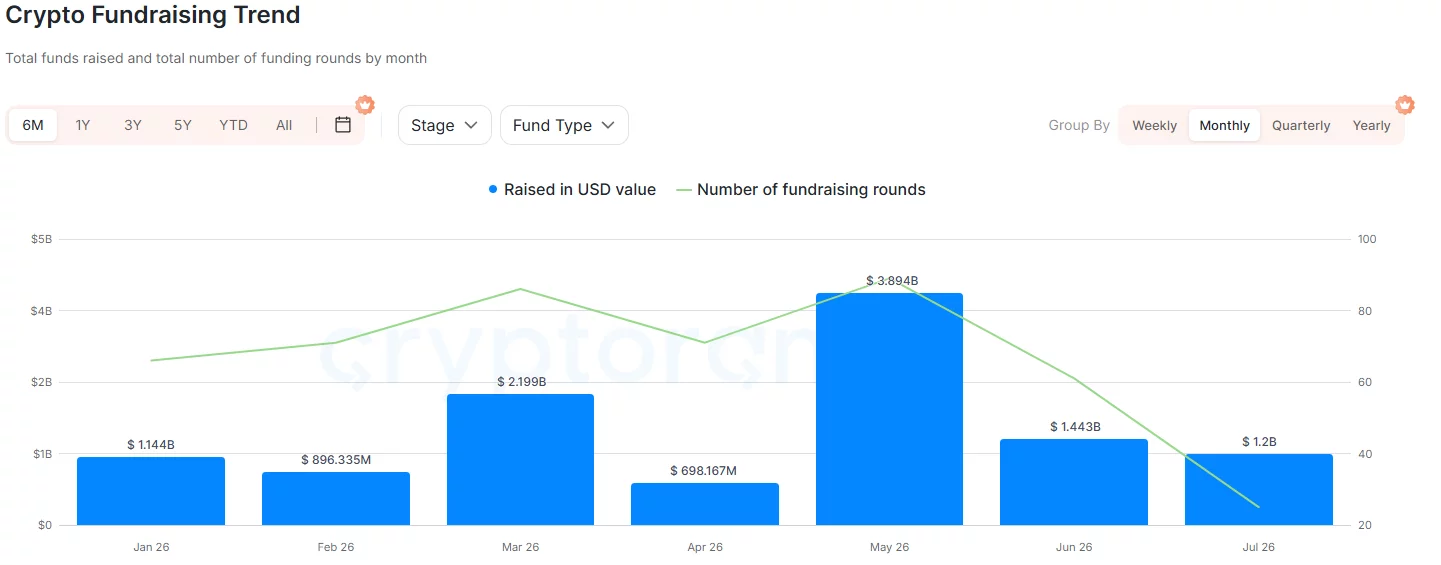
Crypto venture funding has reached $1.2 billion in July even as DeFi investment has fallen to its lowest quarterly level since late 2023.
Summary
- Crypto startups have raised $1.2 billion in July despite a sharp decline in deal activity.
- Coinbase Ventures led investor activity as exchanges, prediction markets, payments and AI attracted major funding.
- DeFi funding fell for three straight quarters, with deal numbers reaching their lowest since 2020.
CryptoRank data shows that investors completed roughly 25 funding rounds in July as of July 20, keeping capital active despite a sharp decline in the number of announced deals.
Monthly fundraising has moved unevenly throughout 2026. According to CryptoRank, crypto companies raised $1.14 billion in January before the total slipped to $896.3 million in February. Funding then climbed to $2.2 billion in March, supported by roughly 85 deals, the highest monthly count shown in the six-month chart.
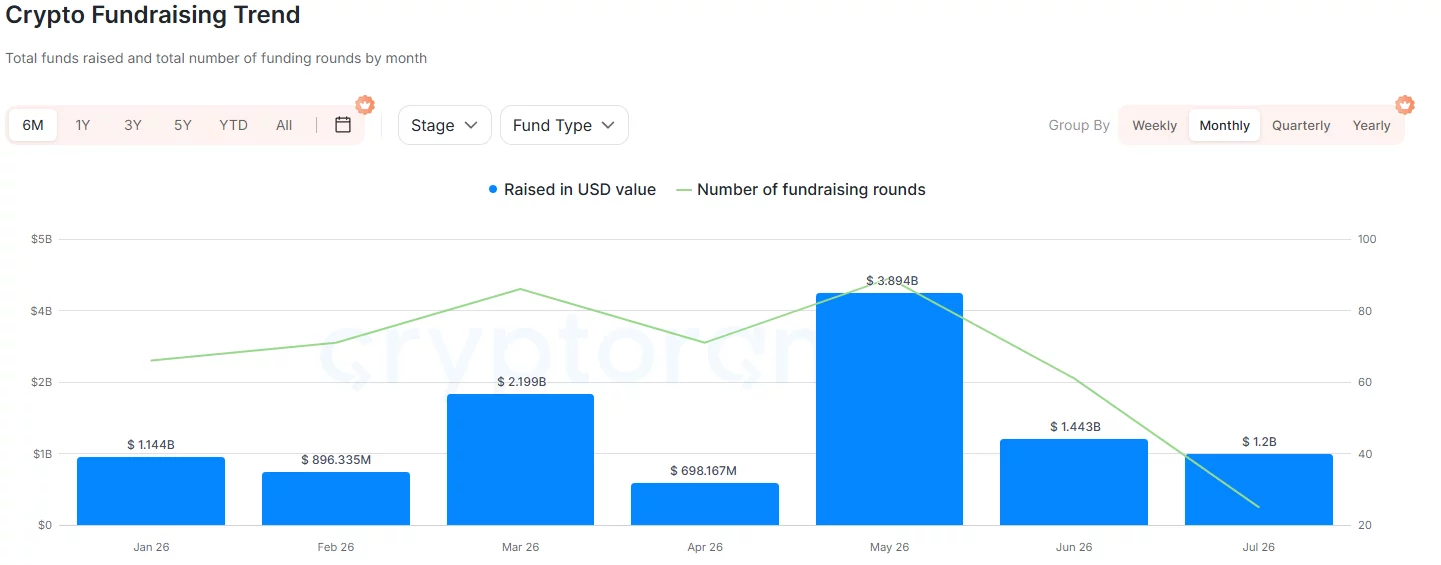
April brought the sharpest reversal of the year. CryptoRank recorded $698.2 million for the month, while an earlier crypto.news report placed the amount at $659 million across 63 funding rounds. The crypto.news figure represented a 74% decline from March’s roughly $2.6 billion and 84 deals, taking monthly funding back toward levels last seen in 2024.
Differences between the two April totals may result from later database updates or varying methods used to classify deals. CryptoRank’s current chart nevertheless confirms the same direction: both the amount raised and the number of completed rounds fell sharply after March.
Funding rebounded to $3.89 billion in May, the highest monthly total in CryptoRank’s six-month view. Although the number of deals remained below March’s peak, larger transactions pushed the total well above every other month shown in the dataset.
By June, fundraising had cooled to $1.44 billion as the monthly deal count fell to about 60. CryptoRank’s partial July reading of $1.2 billion has come with a further decline to around 25 rounds, suggesting that a smaller pool of transactions is accounting for much of the capital raised.
Major crypto investors have continued backing selected projects
Coinbase Ventures has remained the most active fund in CryptoRank’s six-month ranking, participating in 33 investments and leading one of them. The data does not provide the value of those transactions, but the deal count places Coinbase Ventures well ahead of other funds tracked during the period.
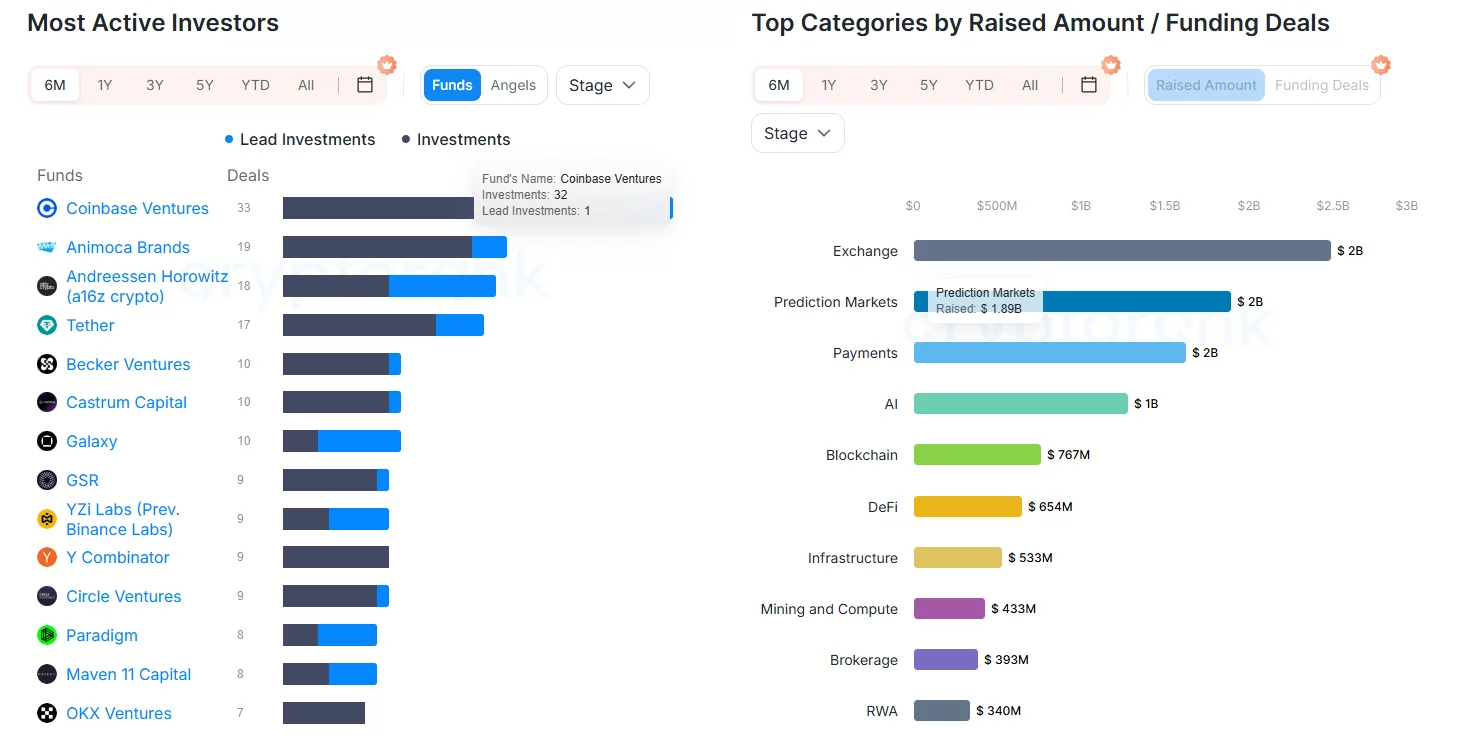
Animoca Brands ranked second with 19 deals, followed by Andreessen Horowitz’s a16z crypto with 18 and Tether with 17, according to CryptoRank. Becker Ventures, Castrum Capital and Galaxy each participated in 10 transactions, while GSR, YZi Labs, Y Combinator and Circle Ventures completed nine apiece.
Paradigm also remained active with eight investments, according to the same ranking. Earlier in July, crypto.news reported that Paradigm had raised $1.2 billion for its fourth fund, giving the firm fresh capital for investments across crypto, artificial intelligence, robotics, software and hardware.
Co-founder Matt Huang and managing partner Alana Palmedo announced the vehicle on July 8. Paradigm described the mandate as an expansion into other technology markets rather than a withdrawal from digital assets, telling investors that the firm would continue investing “first in crypto.”
Across individual categories, exchanges attracted the most capital during CryptoRank’s six-month period, raising about $2.5 billion. Prediction markets followed with roughly $1.9 billion, while payments secured around $1.6 billion and AI projects collected approximately $1.3 billion.
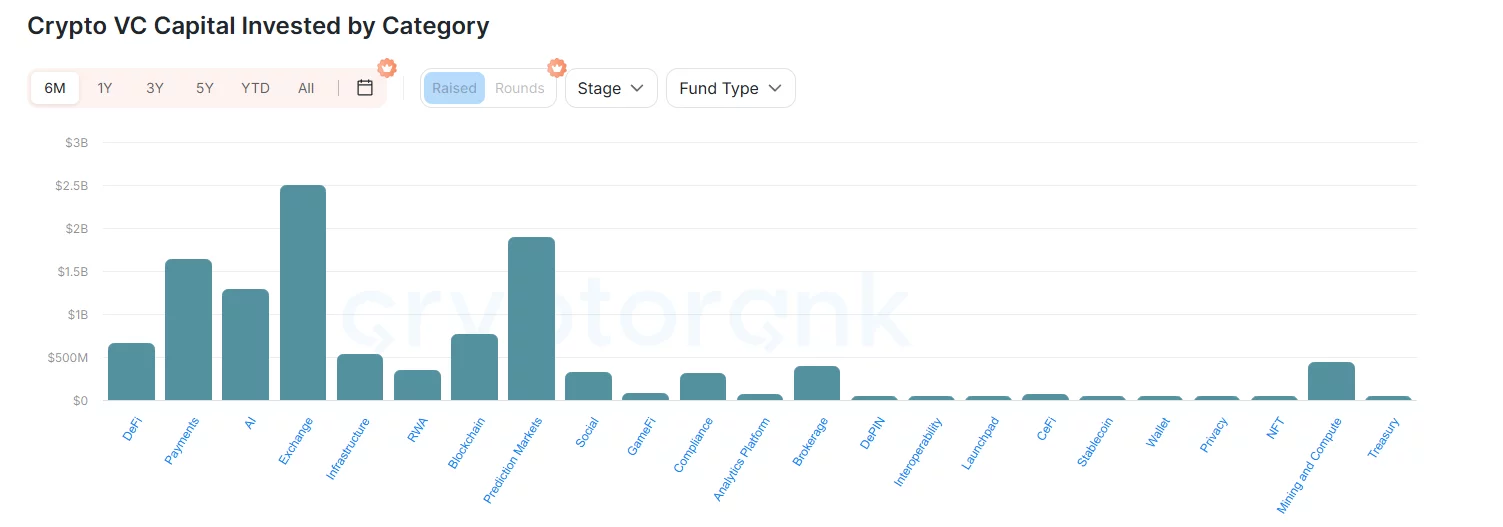
Blockchain companies raised close to $767 million, according to CryptoRank’s category ranking, while infrastructure projects secured $533 million. Mining and compute companies attracted $433 million, followed by brokerages at $393 million and real-world asset projects at $340 million.
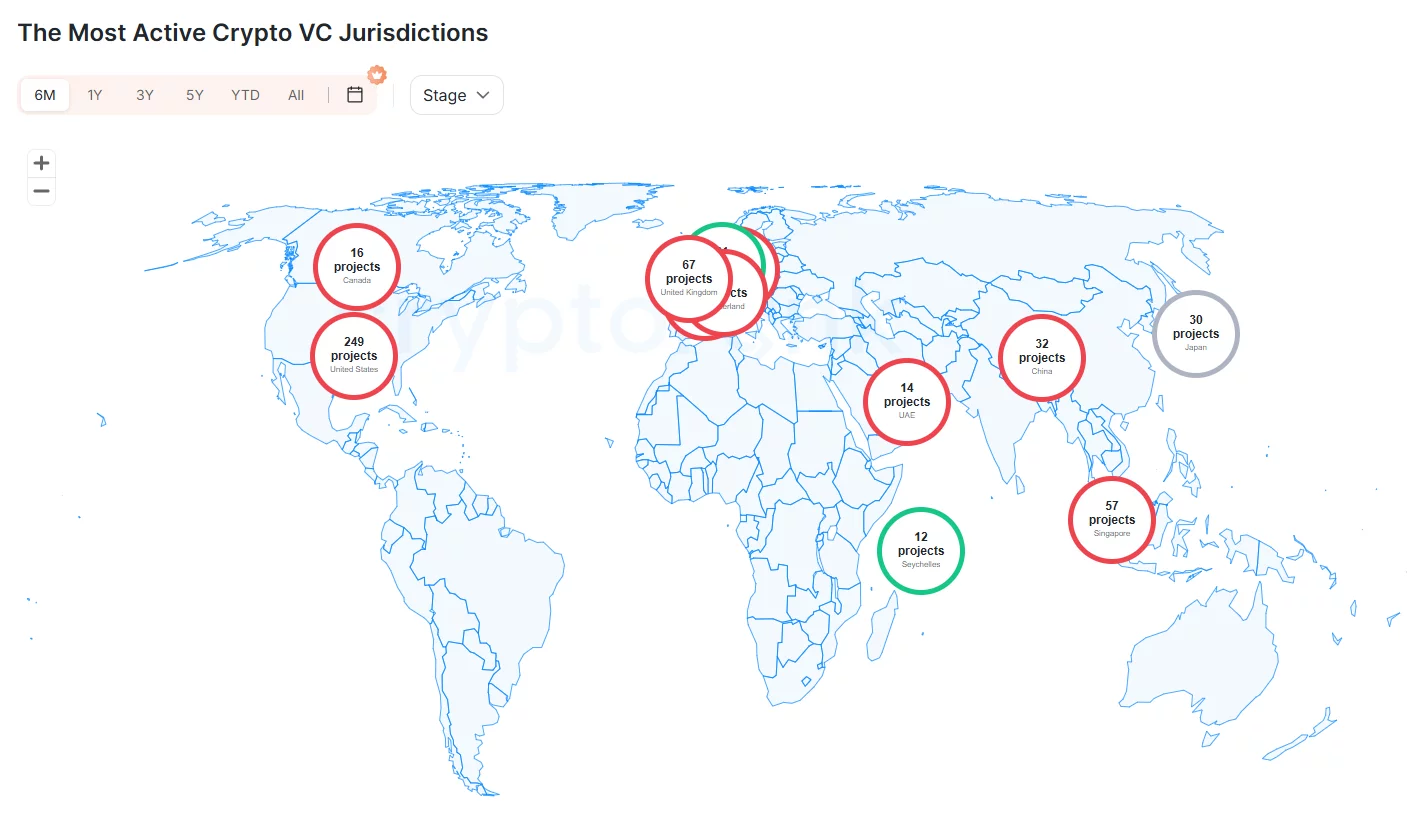
Geographically, the United States remained the most active crypto VC jurisdiction with 249 projects over the past six months, CryptoRank data shows. The United Kingdom followed with 67 projects, while Singapore recorded 57, China 32 and Japan 30. Canada accounted for 16 projects, compared with 14 in the United Arab Emirates and 12 in the Seychelles.
DeFi funding has fallen behind competing crypto sectors
DeFi projects raised about $654 million during the six-month period, placing the sector behind exchanges, prediction markets, payments, AI and blockchain in CryptoRank’s category table. The total also shows that DeFi continued receiving capital even as its position within the venture market weakened.
Quarterly data from CryptoRank shows that VC investment in DeFi has declined for three consecutive quarters. The latest quarterly amount fell to its lowest level since the fourth quarter of 2023, while the number of DeFi funding rounds in the second quarter of 2026 dropped to its lowest point since 2020.
CryptoRank’s figures indicate that investors have become more selective when backing DeFi companies, with fewer projects securing financing despite continued activity elsewhere in the crypto market. At the same time, the concentration of funds in exchanges, prediction markets and payments shows where investors committed the largest sums during the measured period.
The recent numbers leave the overall crypto VC market active but uneven. CryptoRank’s monthly data shows that capital can still rise rapidly when large deals close, while falling deal counts and weaker DeFi financing point to tighter competition among early-stage projects.

Shares in several Bitcoin mining companies jumped on Monday as major announcements tied to artificial intelligence infrastructure boosted investor confidence that the sector’s shift beyond mining is moving from concept to contracts.
In early trading, Hut 8 and IREN led the move, with other large miners and related operators—including Cipher Digital, CleanSpark, MARA Holdings, and the companies’ peers cited in the same market coverage—each rising by at least 11%. The stock surge followed new details around long-term AI data center arrangements and large-scale cloud services commitments.
Key takeaways
- Hut 8 disclosed a 15-year, $9.8 billion lease plan for an AI data center campus, reinforcing its AI infrastructure strategy.
- IREN filed disclosures showing $2.8 billion in cloud services contracts tied to AI developers.
- IREN expects over $4 billion in annual recurring revenue from its AI cloud business by the end of 2026, according to the company’s outlook.
- The rally extended beyond crypto-linked equities, coinciding with strength in broader tech indexes, including the Nasdaq and the Philadelphia Semiconductor Index.
- Analysts note the AI pivot has triggered a re-rating—but also increased scrutiny as investors track insider selling at several miners.
Hut 8’s long lease and IREN’s contract haul
The immediate catalyst for Monday’s gains was a pair of widely watched disclosures. Hut 8 announced a 15-year, $9.8 billion lease for its AI data center campus, a signal that it is treating high-performance computing capacity as a long-duration business rather than a short-term hedge.
Separately, IREN’s filing described $2.8 billion in cloud services contracts with AI developers. In the same material, the company also projected that its AI cloud segment could generate more than $4 billion in annual recurring revenue by the end of 2026.
Both companies started out as Bitcoin miners, but their narratives have increasingly centered on AI infrastructure—an evolution that has drawn investor attention as mining economics have faced pressure. The market’s reaction suggests traders are rewarding visible contract commitments and long-horizon capacity planning, not only exploratory AI messaging.
Sector-wide momentum tracked by an AI infrastructure index
The stock surge was reflected in The Energy Mag’s TEM AI Infrastructure Growth Index, which tracks 20 companies across Bitcoin mining, “neocloud,” and AI infrastructure categories. The index rose 1.4% on Monday and was up more than 12% over the prior week, according to the same coverage.
That matters for investors because it frames Monday’s moves as more than isolated company-specific hype. When a curated basket of AI infrastructure and mining-adjacent names rises together, it often indicates a broader shift in risk appetite toward the theme.
Tech stocks stabilize as chip sentiment improves
Cryptocurrency-linked equities also moved in tandem with a broader recovery in technology. The Nasdaq Composite added 0.9% by midday, while the Philadelphia Semiconductor Index climbed 2% after slipping into a “technical bear market” the prior week—defined as a 20% or more decline from its recent high.
For market participants watching AI buildout, semiconductors serve as a useful barometer: demand for chips and the supply chain powering AI compute often influences how investors price the sector’s growth prospects. The co-movement across miners, AI infrastructure indexes, and chip-related benchmarks suggests Monday’s rally was supported by a wider sentiment tailwind.
AI pivot still faces skepticism over funding and insider activity
Even as the AI pivot draws fresh capital and a stronger valuation narrative, the year has been marked by volatility. Miners are trying to navigate a weaker Bitcoin mining environment while committing substantial resources to data centers, cloud services, and high-performance computing operations.
Blocksbridge Consulting argues that the sector’s AI shift has driven a “re-rating”—but it has also increased scrutiny, particularly around insider stock sales. In a Miner Weekly newsletter, Blocksbridge pointed to insider selling attention at TeraWulf, Riot Platforms, Core Scientific, and Cipher Mining. The transactions were reportedly conducted under prearranged trading plans, but investor focus has still intensified—an indication that markets are weighing whether equity valuations are already factoring in too much AI enthusiasm too quickly.
There is also the question of how large the required investment base will be. Blocksbridge estimates the industry will need another $50 billion to realize its AI ambitions, with IREN facing a funding gap of about $21.1 billion. That estimate underscores a key tension for shareholders: while contracts and revenue projections can support near-term optimism, long-term execution depends on capital availability and the ability to scale without diluting returns or extending timelines.
In that context, Monday’s announcements may be best read as an incremental validation of the thesis—evidence that miners’ AI strategies are attracting partner demand—while investors continue to watch whether funding gaps narrow and how insider behavior evolves as stock prices move.
Next, readers should track whether the announced AI leases and cloud contracts translate into measurable progress toward recurring revenue targets—and whether funding needs and insider-selling scrutiny remain manageable as the sector’s valuation adjusts to incoming details.


Michael Saylor, co-founder and executive chairman of Strategy, published a 110-point essay on X on July 18 urging the Bitcoin network to reject BIP-110, the "anti-spam" soft fork proposal, in a rare foray into protocol governance. The essay, titled "110 Reasons BIP 110 Is a Bad Idea," had drawn… Read the full story at The Defiant
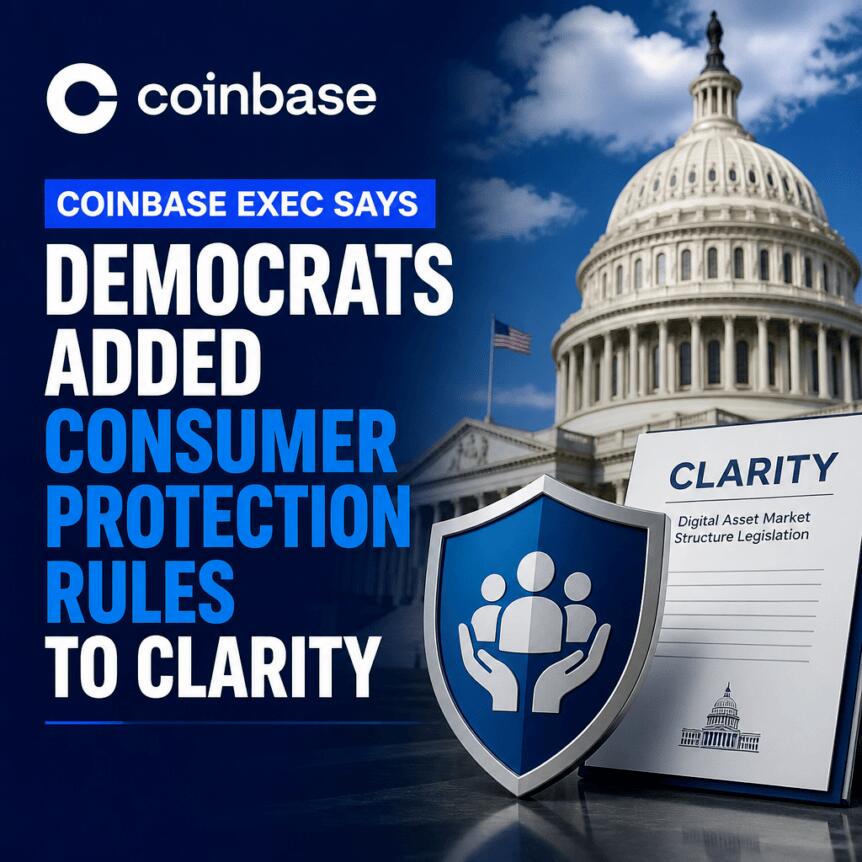
With a US Senate vote on the Digital Asset Market Clarity (CLARITY) Act appearing increasingly close, negotiations are continuing behind closed doors over the bill’s final text. In an interview with CNBC published Monday, Coinbase vice chair Ryan VanGrack said Democratic lawmakers have been adding additional customer-facing protections as the Senate works through the last drafts, framing the changes as giving the legislation “more teeth.”
VanGrack emphasized that the bill’s focus should remain on consumers, arguing that the current regulatory “status quo” does not provide adequate infrastructure for customer protection. However, he did not address whether lawmakers are also finalizing ethics-related provisions—an issue some Democrats have said will be necessary for them to support the bill.
Key takeaways
- Coinbase leadership says Democratic lawmakers are strengthening the CLARITY Act’s customer protections as final Senate negotiations continue.
- Ethics provisions remain a potential sticking point, with some Democrats indicating they may oppose the bill without them.
- Political dynamics are shifting as the White House signals support, including comments tied to the death of Senator Lindsey Graham.
- Senate timelines are still uncertain: as of Monday, lawmakers had not released the final bill text or scheduled a floor vote.
- Coinbase’s earlier public objections to an earlier version of the bill may have affected Senate committee progress.
Customer protections become the latest battleground
In his CNBC remarks, VanGrack described the ongoing negotiation as fundamentally about consumer safeguards. “At the end of the day, this is about customer protections,” he said. He added that “the status quo lacks this infrastructure, lacks these protections,” and that Democrats used the opportunity to ensure customers are “first and foremost” in the legislation.
The comment matters for both investors and users because the practical impact of market-structure bills is often determined by details: how customer assets are handled, what disclosures are required, and what enforcement mechanisms exist when firms fail to meet obligations. If the CLARITY Act’s final version meaningfully strengthens those provisions, it could reduce regulatory ambiguity for exchanges and other digital asset intermediaries while tightening compliance expectations.
Ethics provisions could determine whether support holds
While VanGrack highlighted customer protections, he did not explicitly confirm any progress on ethics provisions. That omission is notable because multiple commentators cited earlier by Cointelegraph have described ethics provisions as something Democrats may require before they vote for the bill.
For lawmakers, this creates a narrow path: the bill must satisfy both regulatory policy goals and political accountability demands. For market participants, it means the primary risk may not be whether CLARITY is “good enough” on paper, but whether it can clear enough procedural and party approval hurdles in time—especially if ethics language becomes a last-minute bargaining chip.
From SEC case dismissal to renewed momentum
CLARITY’s drive to reshape US crypto regulation comes in the context of a major legal reset. Under the Biden administration, the SEC sued Coinbase alleging the company operated as an unregistered securities exchange, broker, and clearing agency. The case was later dropped after Donald Trump took office, with Mark Uyeda—Trump’s pick for acting SEC chair—heading the agency.
That backdrop helps explain why the bill is being treated as unusually comprehensive. A market-structure law would not only influence how existing enforcement is conducted, but also shape what regulated activity looks like going forward. Even so, the bill’s future still depends on Senate consensus: the fact that one major enforcement dispute was resolved does not automatically eliminate legislative disagreement on customer rules or ethics.
Why the bill’s path has been uneven
The CLARITY Act has not moved in a straight line. Coinbase’s internal stance may have contributed to earlier procedural friction. The article notes that Coinbase CEO Brian Armstrong announced in January that the exchange could not support the legislation “as written,” and that this may have delayed a markup of an earlier version in the Senate Banking Committee.
Since then, several Coinbase executives—including chief legal officer Paul Grewal—have reportedly moved to publicly support passage of the bill, according to a post shared on X. That shift suggests the final negotiating draft may have incorporated changes Coinbase demanded. But it also underscores why investors should be careful about assuming political progress automatically resolves industry concerns: support can evolve as language changes, and the Senate’s final text may still differ from earlier versions that drew criticism.
Beyond the policy debate, the political environment is intensifying. After the death of Senator Lindsey Graham, Trump said on social media that members of the Senate should pass CLARITY “in honor of” the South Carolina lawmaker, calling him “a big supporter” of the bill. Separately, reports referenced by Cointelegraph say Republican lawmakers met with Trump to discuss the legislation amid Democrats’ worries about the president’s connections to the crypto industry.
As of Monday, lawmakers had not released the final text of the bill and had not scheduled a floor vote, leaving timing uncertain even as negotiations continue.
What to watch next as the Senate weighs the final draft
The near-term focus should be on whether the Senate publishes the final CLARITY Act text and, crucially, whether ethics provisions are addressed in a way that satisfies skeptical Democrats. If those elements are resolved, momentum could accelerate quickly; if not, customer-protection improvements may still fall short of what is needed for the bill to clear the chamber.


Hackers have disabled Kenyan President William Ruto’s official website, replaced its homepage and demanded a ransom of 5 Bitcoin.
Summary
- Hackers defaced Kenyan President William Ruto’s website and demanded a ransom of 5 Bitcoin.
- Kenyan authorities found no evidence that sensitive data was accessed, stolen, or lost.
- State investigators and external partners are examining how attackers breached the website’s security.
According to a report, the Kenyan government opened an investigation after attackers took control of president.go.ke on July 18 and posted insulting messages directed at Ruto. The hackers also threatened to release unspecified information unless officials paid the ransom by Saturday evening.
William Kabogo, cabinet secretary for Kenya’s Ministry of Information, Communications and the Digital Economy, confirmed that the government’s ICT Authority activated its cybersecurity response protocols after detecting the breach. Officials restricted public access to the website while technical teams worked to contain the attack and begin a forensic review.
“At this time, there is no evidence of unauthorized access to sensitive data, data exfiltration, or loss of information. Government systems and digital services remain secure and operational.”
Despite the government’s assurance, the website remained unavailable as of 1:51 p.m. EST on July 18, according to the original report. Officials had not publicly confirmed whether they contacted the attackers or considered paying the requested Bitcoin.
The report also did not identify the hackers, explain how they entered the website, or specify what information they claimed to possess. Bitcoin transactions can be viewed on a public blockchain, but the attackers’ wallet address was not included in the available details, preventing an independent review of any payment activity.
Kenya says sensitive government data remains secure
State House officials confirmed that government technical teams were working with the National Computer and Cybercrime Coordination Committee, known as NC4, and external technical partners. Their review focused on restoring the presidential portal and identifying how the attackers passed its security controls.
Kabogo’s statement separated the compromised public website from Kenya’s other government systems, which he described as secure and operational. Authorities had found no evidence of stolen or lost sensitive information at the time of the update, although the forensic investigation remained active.
July’s incident followed another attack on Kenyan state infrastructure in November 2025. According to the report, the coordinated operation briefly compromised several ministry websites and increased scrutiny of the security protecting the country’s digital public services.
An NC4 report recorded billions of cyber threats against Kenya’s government systems and critical infrastructure during a three-month period earlier in 2026. In response, Kenyan authorities have continued efforts to standardize how cybercrime cases are investigated across the country, according to the report.
The demand for Bitcoin placed a crypto payment at the center of the presidential website breach, but Kenyan officials had not attributed the attack to a known ransomware group. Authorities also had not disclosed whether the ransom message contained a payment deadline beyond Saturday evening or evidence supporting the threatened leak.
Crypto-linked breaches keep regulators on alert
Kenya’s investigation comes as governments and financial regulators examine separate attacks involving crypto platforms, executives and state-backed cyber groups.
Earlier in July, Airbnb CEO Brian Chesky confirmed that hackers had compromised his X account after it published a long thread about blockchain-based real-world asset tokenization. The posts discussed digital ownership and financial markets in enough detail that some observers and publications initially treated them as genuine comments from the Airbnb chief.
After the posts were removed, Chesky acknowledged the compromise and joked about the unexpected audience it brought to his profile. His account did not promote a token sale or request a crypto payment in the material described, but the incident showed how attackers can use a recognized executive’s identity to make blockchain-related claims appear credible.
South Korea’s Financial Supervisory Service has also begun a formal sanctions process against Dunamu, the operator of Upbit, following the exchange’s November 2025 wallet breach. SBS reported that the regulator sent Dunamu an inspection opinion letter after examining whether Upbit met its obligations under the Virtual Asset User Protection Act.
South Korean reports valued the Upbit assets affected by the attack at 44.5 billion won, or roughly $32 million at current exchange rates, while an earlier crypto.news estimate placed the loss near $36 million. The incident involved Solana-based assets held by the exchange.
Upbit stated that it transferred assets to cold wallets, suspended deposits and withdrawals, and began tracing the stolen funds after detecting unusual transfers. The company also promised to cover customer losses with its own money, while authorities reviewed the security failure and the timing of its public disclosure.
At the government level, G7 leaders called for coordinated action against North Korea’s cryptocurrency thefts and cybercrime following their June summit in Evian-les-Bains, France. Their geopolitical statement linked the issue to concerns about Pyongyang’s nuclear and ballistic missile programs.
Although the G7 statement urged member countries to act together, it did not announce new sanctions, crypto exchange requirements or mixer restrictions. The leaders also provided no schedule for enforcement against wallets, platforms or intermediaries suspected of handling stolen funds.
Tether Gold has gained commodity status in Abu Dhabi, as DefiLlama data shows XAUT’s locked value has climbed more than threefold to about $2.86 billion over the past year.
Summary
- ADGM recognized Tether Gold as an Accepted Spot Commodity for approved regulated firms.
- XAUT’s locked value more than tripled over the past year to $2.86 billion.
- Tether is expanding across tokenized gold, US payroll payments and Latin American banking.
Abu Dhabi Global Market has recognized XAUT as an Accepted Spot Commodity, allowing regulated firms in the international financial center to provide services involving the tokenized gold asset when they hold the required permissions.
Under the designation, eligible companies can add XAUT-related products to their regulated offerings inside ADGM. Tether CEO Paolo Ardoino described the decision as a clearer route for approved firms seeking to support the asset, while ADGM linked the addition to an expanded selection of products available within the financial center.
The decision follows ADGM’s earlier recognition of Tether’s USDT as an Accepted Fiat Referenced Token. With both assets now accepted under separate regulatory categories, Tether can place its dollar stablecoin and gold-backed token within one of the Middle East’s largest international financial centers.
ADGM’s treatment of XAUT applies only to firms that secure the relevant regulatory approvals. The designation does not give every company operating in the financial center automatic permission to offer trading, custody or other XAUT services.
Tokenized gold demand has lifted XAUT’s locked value
DefiLlama figures show that Tether Gold’s total value locked has risen from approximately $826 million to $2.86 billion within a year. Based on those figures, the increase amounts to about 246%, placing XAUT among the largest products in the tokenized commodity market.
RWA.xyz estimates that tokenized commodities hold about $4.46 billion in distributed value. The data platform places the full tokenized real-world asset market at roughly $34.73 billion, giving commodities a share of nearly 13%.
Against those figures, XAUT’s reported $2.86 billion in locked value represents a substantial portion of the commodity category tracked by RWA.xyz. Differences between TVL and distributed-value methods mean the two datasets are not directly interchangeable, but both indicate that gold-backed tokens account for a large share of commodity tokenization.
Use cases for XAUT are also moving beyond spot trading and custody. Bitcoin lending platform Ledn announced in June that it plans to accept the token as loan collateral later this year, which would let customers borrow against tokenized gold without selling their holdings.
Ledn’s planned integration would place XAUT inside a crypto-backed lending product, adding a borrowing function to an asset mainly used for gold exposure. The company has not yet disclosed detailed terms such as loan-to-value ratios, interest rates or the exact launch date.
For regulated firms in ADGM, the new status could make similar services possible when their licenses cover the relevant activity. ADGM’s announcement, however, did not identify which firms intend to add XAUT or set a timeline for the first regulated offerings.
Tether is extending its reach across payments and finance
Beyond tokenized gold, Tether has continued investing in payment systems and financial platforms. Last week, crypto.news reported that the company led a $7 million Series A round for Pact Labs alongside Blockchange Ventures and Lasagna.
According to crypto.news, the financing will support Pact Labs’ payroll and payment infrastructure while helping businesses adopt USAT, Tether’s dollar-backed stablecoin designed for the US market. The partnership focuses on wage payments rather than crypto trading, targeting a US payroll sector that processes more than $11 trillion each year.
Another investment has extended Tether’s presence in Latin American finance. Bloomberg reported that the company contributed $20 million to a $197 million equity round for Argentine digital bank Ualá, adding the platform to Tether’s portfolio of stablecoin-related investments.
Ualá announced the round in March and identified Tether among the participants, though it did not disclose the issuer’s contribution at the time. Allianz X led the financing, while Bloomberg later reported the size of Tether’s individual investment.
These investments come as Tether faces questions over USDT’s future availability on US crypto platforms. CoinDesk reported that the first anniversary of the GENIUS Act has renewed attention on whether the foreign-issued stablecoin can meet the law’s requirements before its transition period ends.
President Donald Trump signed the Guiding and Establishing National Innovation for U.S. Stablecoins Act into law one year ago, introducing a three-year compliance window. CoinDesk reported that uncertainty remains over how some deadlines will apply to foreign issuers such as Tether.
Circle has taken steps to align its operations with the incoming US framework, according to the report, while Tether has not publicly explained how it plans to bring USDT into full compliance.
The ADGM recognition gives XAUT a defined regulatory route in Abu Dhabi while Tether develops separate products and investments across gold, payroll and digital banking. USDT’s position in the United States, however, will depend on how regulators implement the GENIUS Act and whether Tether satisfies the final requirements.

What is the release date for Stuart Fails to Save the Universe on HBO Max?
![Sick Luke - MONEY MACHINE (feat. Lazza & Tony Effe) [Official Visual]](https://wordupnews.com/wp-content/uploads/2026/02/1770843044_maxresdefault-80x80.jpg)
Sick Luke – MONEY MACHINE (feat. Lazza & Tony Effe) [Official Visual]

Jacket potatoes will be fluffier if you use 1 simple ingredient before baking


-
 NewsBeat4 days ago
London Mayor Sadiq Khan handed a peerage by Keir Starmer alongside 15 other Labour figures… just days before the PM leaves No10
-

 Fashion3 days ago
Weekend Open Thread – Corporette.com
-

 Politics3 days ago
The House | The City of London can help the new chancellor deliver growth in every postcode
-

 Politics6 days ago
Young campaigners urge incoming PM to act on outdoor junk food ads
-

 Crypto World5 days ago
CFTC blocks Kalshi from unwinding Michigan trades after court order
-
 Crypto World4 days ago
Two July Windows Left: The CLARITY Act’s Senate Fight and What Failure Means
-

 Crypto World3 days ago
Ripple Payments Joins MiCA With 14 Firms, Does It Mean Anything For XRP?
-

 Business5 days ago
Nvidia Stock Slips After Big Tuesday Rally as Huang Confirms Vera Rubin Chip Is Now in Production Today
-

 Politics1 day ago
Democrats look to World Cup watch parties to register thousands of voters
-
 Entertainment5 days ago
Disney’s Most Ambitious Failed Star Wars Attraction Is Coming to SDCC
-

 Crypto World3 days ago
Ripple wins EU-wide access as ESMA adds it to MiCA register
-

 Business5 days ago
Palantir Shares Rise After Expanded Nvidia Partnership and Fresh Analyst Upgrades Ahead of Earnings Day
-

 Crypto World4 days ago
Injective Submits SEC Transfer-Agent Registration to Onchain Ownership Records
-

 NewsBeat4 days ago
Registration is now open for March for Men with Kev 2026
-

 Tech7 days ago
Get Your ESP32 Sunny Side Up With This Solar Dev Board
-

 News Videos6 days ago
XRP BOMBSHELL… XRP OMBOARDED FOR TRANSACTIONS!!!
-

 Tech6 days ago
Dark Secrets Emerge When Jailbreaking LLMs
-

 NewsBeat14 hours ago
Unregistered fitter used Gas Safe logo on business flyers
-
 Sports5 days ago
New Cornerback Enters Vikings Trade Rumor Mill
-

 News Videos4 days ago
Money | Class 12 Economics | CBSE Board Exam 2026-27
You must be logged in to post a comment Login