

Crypto World
Crypto Now Employs More Americans Than Coffee or Tobacco Manufacturing Industries

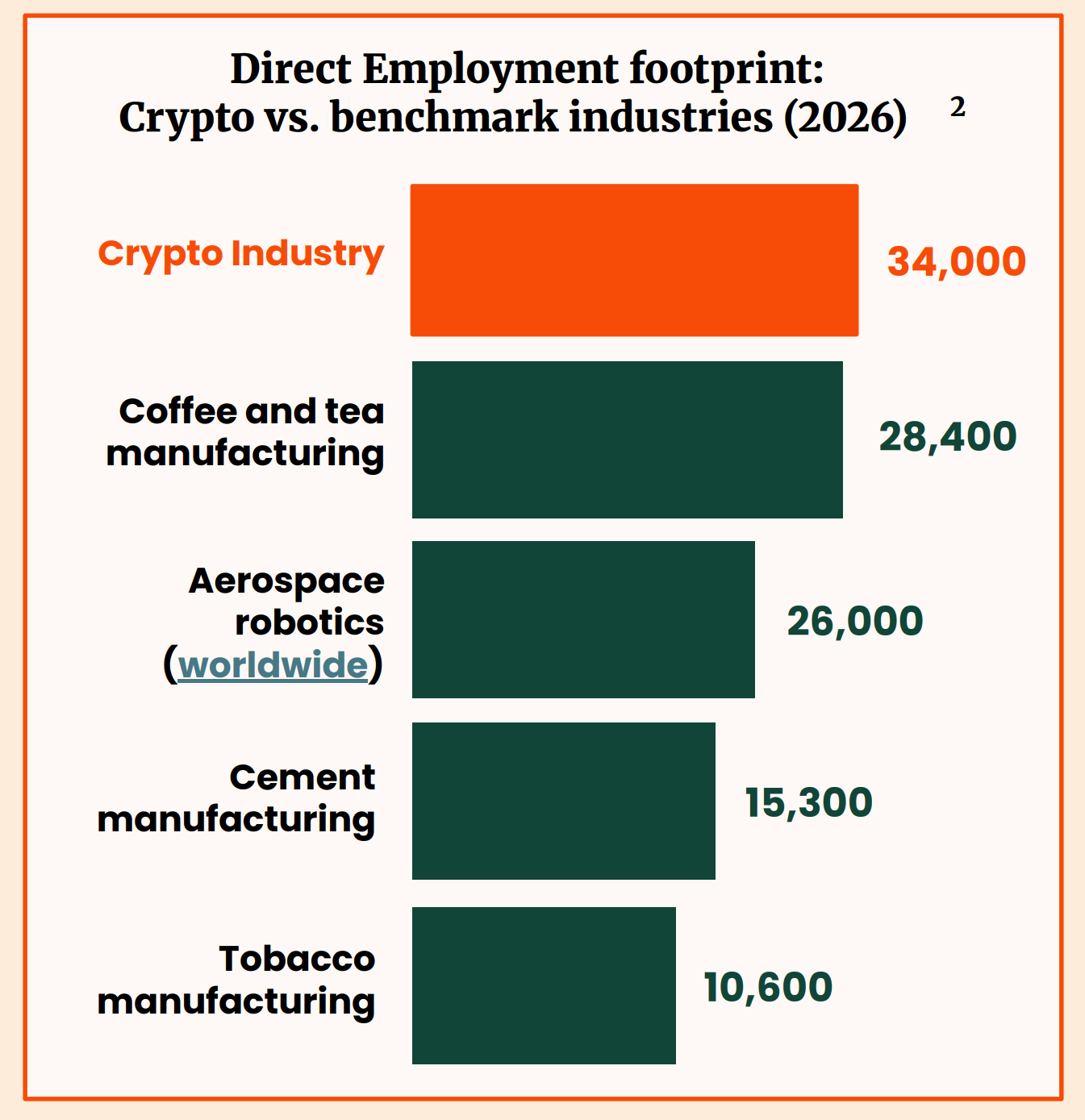
The crypto industry directly supports 34,000 jobs and contributes $55 billion to the US economy in 2026.
The findings come from a new report by the National Cryptocurrency Association (NCA), which commissioned the study from the Pragmatic Policy Group (PPG).
How Crypto Jobs Stack Up
To put that headcount in context, the report measured it against familiar industries. Crypto’s 34,000 direct workers now outnumber coffee and tea manufacturing, which supports 28,400.
Follow us on X to get the latest news as it happens

The gap widens against other benchmarks. Crypto tops both cement manufacturing at 15,300 and tobacco manufacturing at 10,600.
The report also puts the average crypto-related job at $133,000 a year, more than double the national median of $64,000.
It ranks that average above other high-paying fields, listing information and technology at $104,000 and manufacturing at $76,000. In addition, of the $55 billion total economic contribution, roughly $31 billion is worker income.
The Wider Economic Footprint
The report also estimates indirect effects. It finds that each direct crypto job supports 6 more across the economy. That brings total supported employment to 232,000 jobs in 2026.
The total figure accounts for direct, indirect, and induced jobs, not just crypto company payrolls. Supplier industries account for 75,000 roles, while worker spending adds another 123,000.
The distribution is uneven. California, New York, and Texas hold 60% of US crypto jobs, followed by Washington and North Carolina. Heartland states account for more than 17,000 positions.

Overall, crypto’s economic weight now extends well beyond trading, reaching into wages, supplier industries, and household spending across the country.
Subscribe to our YouTube channel to watch leaders and journalists provide expert insights
The post Crypto Now Employs More Americans Than Coffee or Tobacco Manufacturing Industries appeared first on BeInCrypto.

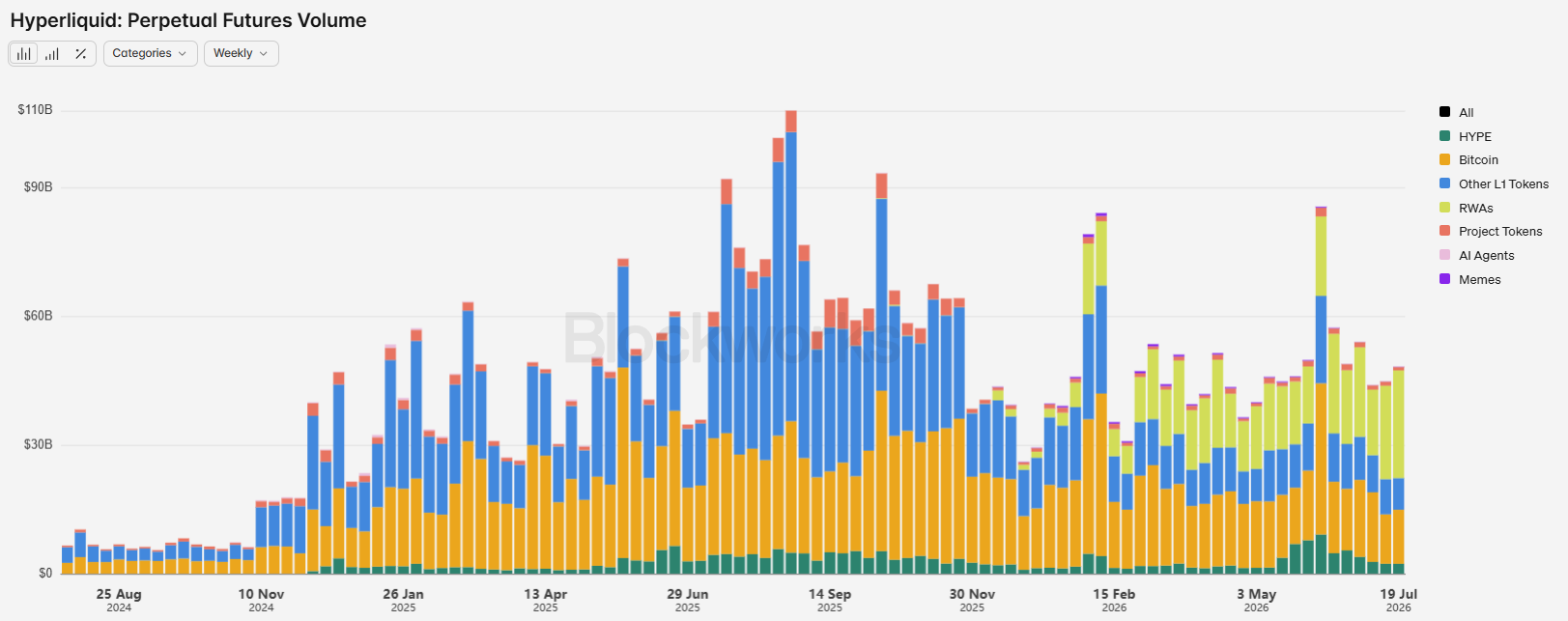
Perpetual decentralized exchange (DEX) Hyperliquid’s weekly trading volume in tokenized real-world assets (RWAs) exceeded that of all other asset categories combined for the first time.
RWAs generated $25.1 billion in trading volume from July 13 to July 19, accounting for 52% of Hyperliquid’s total weekly volume of $48.2 billion, according to Blockworks data.
“Hyperliquid’s RWA market alone was larger than the combined crypto perpetual volume of every other DEX,” wrote ARK Invest’s research director for digital assets, Lorenzo Valente, in a Thursday X post.
The milestone reflects growing demand for tokenized assets on Hyperliquid. Over the past month, RWA holders grew by 32% to 1.25 million users, while the total value of tokenized RWAs rose by 3.5% to $36.7 billion, according to data aggregator RWA.xyz.
Hyperliquid generated $7.6 million in revenue over the past week, according to DefiLlama. The perp DEX ranked third among crypto applications by weekly revenue, behind stablecoin issuers Tether and Circle, which generated $112 million and $45 million, respectively.
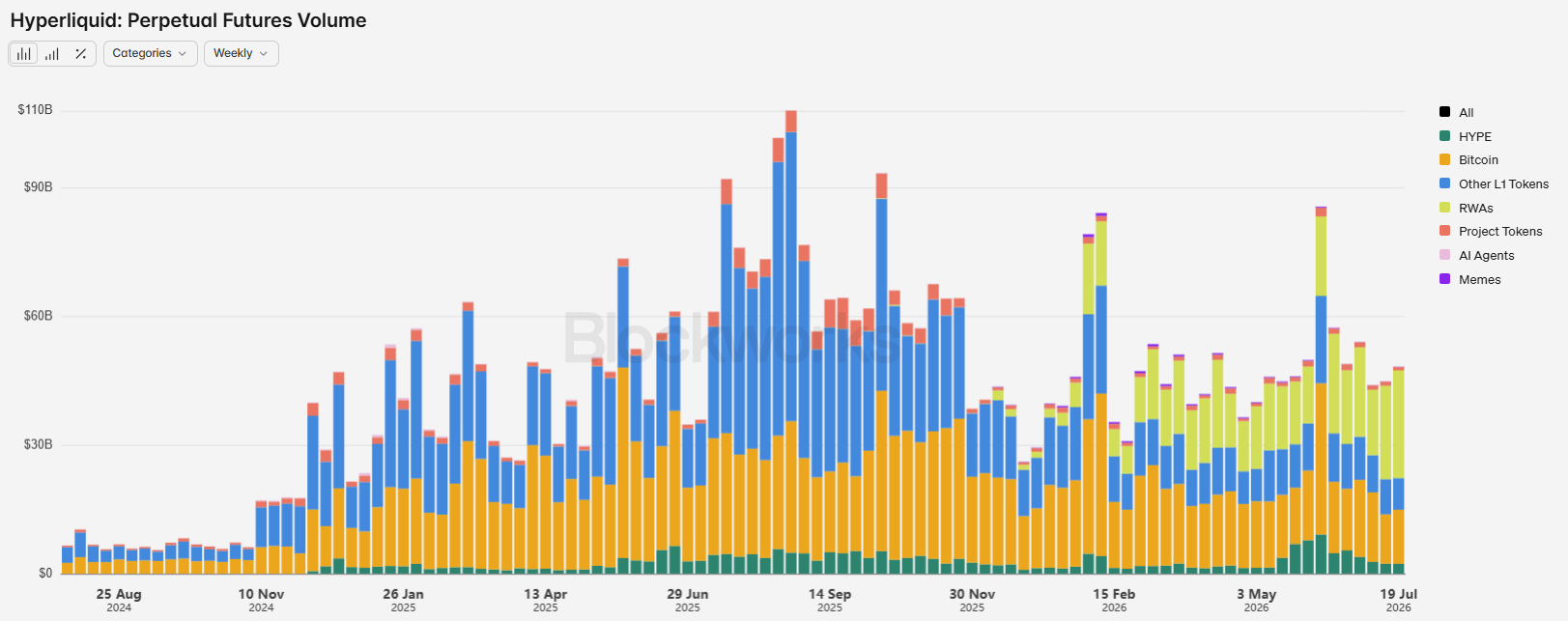
Hyperliquid: Perpetual Futures Volume, 2-year chart. Source: Blockworks
Related: Hyperliquid launches prediction markets for real-world events
Major “structural shift” for crypto markets: Circle co-founder
Crypto-native firms and traditional financial institutions have expanded tokenized asset offerings as they bring more financial assets onto blockchain networks. In March, the NYSE partnered with tokenization platform Securitize to develop blockchain-based stock trading infrastructure with 24/7 trading and settlement.
Circle co-founder and CEO Jeremy Allaire said growing RWA trading on Hyperliquid marks a “major structural shift” in crypto markets, moving “away from speculating on endogenous digital commodities,” in a Friday X post.
Earlier in July, Pantera Capital said perpetual futures could become a dominant trading instrument beyond crypto, as perps offer structural advantages over traditional derivatives, including 24/7 trading, no contract expiries, simpler position management and continuous price discovery.
Hyperliquid’s growth has drawn attention from Wall Street institutions, including NYSE parent Intercontinental Exchange (ICE), whose CEO, Jeffrey Sprecher, urged regulators to create a “level playing field” for launching 24/7 onchain perpetual futures contracts.
Magazine: How Hong Kong is turning tokenized bonds into real market infrastructure


Ten tokenized dairy cows backed a $19,600 loan registered on Brazil’s B3, in one of Brazil’s first uses of tokenized livestock as loan collateral.


The crypto market continues to mature with growing institutional participation, and memecoins are paying the price.
The combined market capitalization of and shiba inu (SHIB), the two largest memecoins by value, has fallen to $13.27 billion, the lowest in three years and down about 2% this month alone, even though market leader bitcoin has risen by 10%.
A more revealing picture emerges when you measure the top two memecoins against bitcoin’s market cap of $1.30 trillion.
That ratio now stands at just 1.02%, the lowest on record. That’s a dramatic reset if considering where things stood at the peak of memecoin mania in 2021, when DOGE and SHIB together accounted for 7% of bitcoin’s market cap. In other words, for every dollar invested in bitcoin, seven cents were chasing internet joke tokens. Today that figure is just over one cent.
Bitcoin has grown substantially since 2021, meaning memecoins haven’t just lost value in dollar terms, they have ceded ground against the very asset that defines the crypto market cycle.
Crypto World
Bitcoin holds near $65,000 as the Iran conflict sends oil to a two-month high: Crypto Markets Today
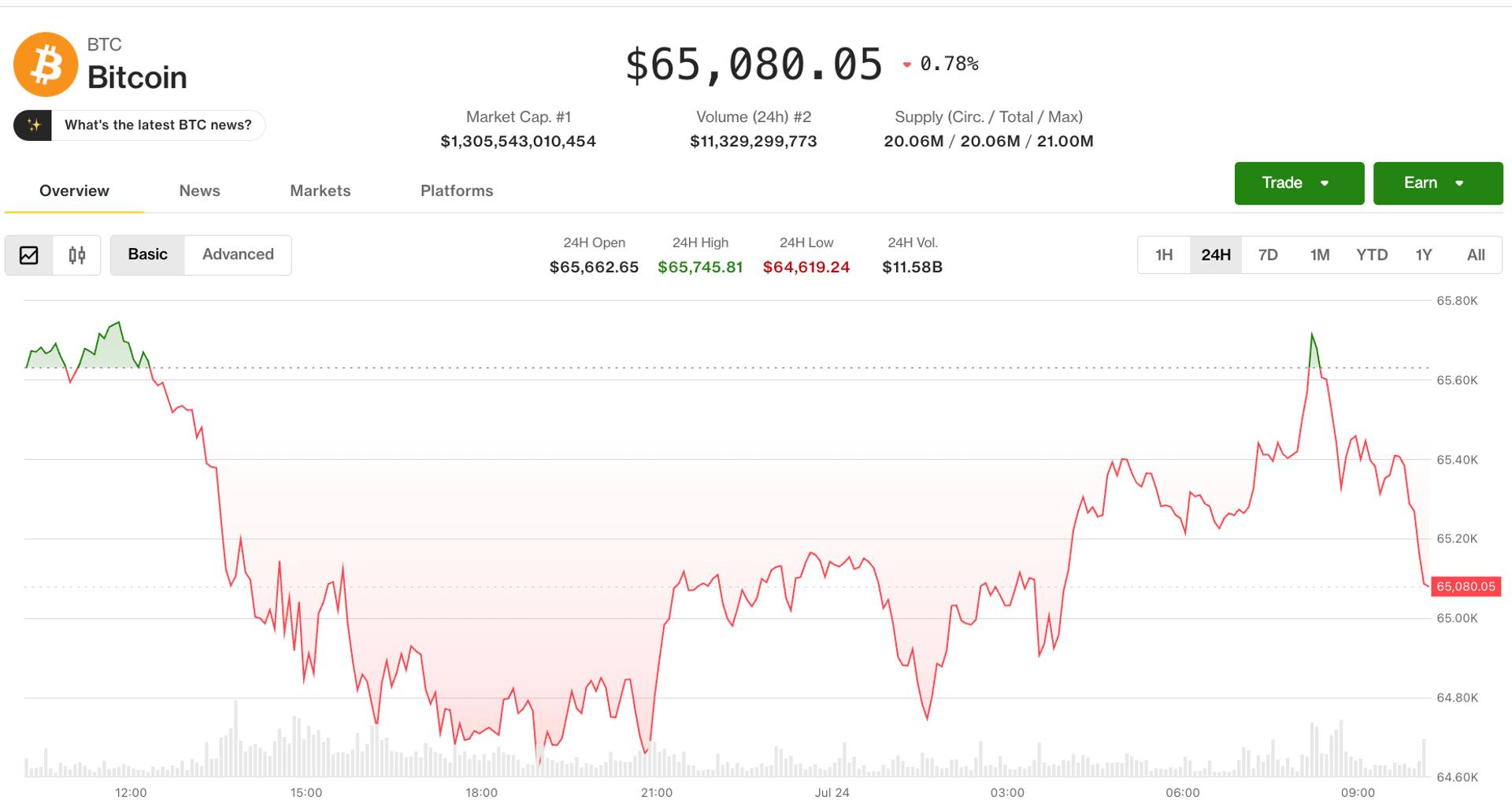
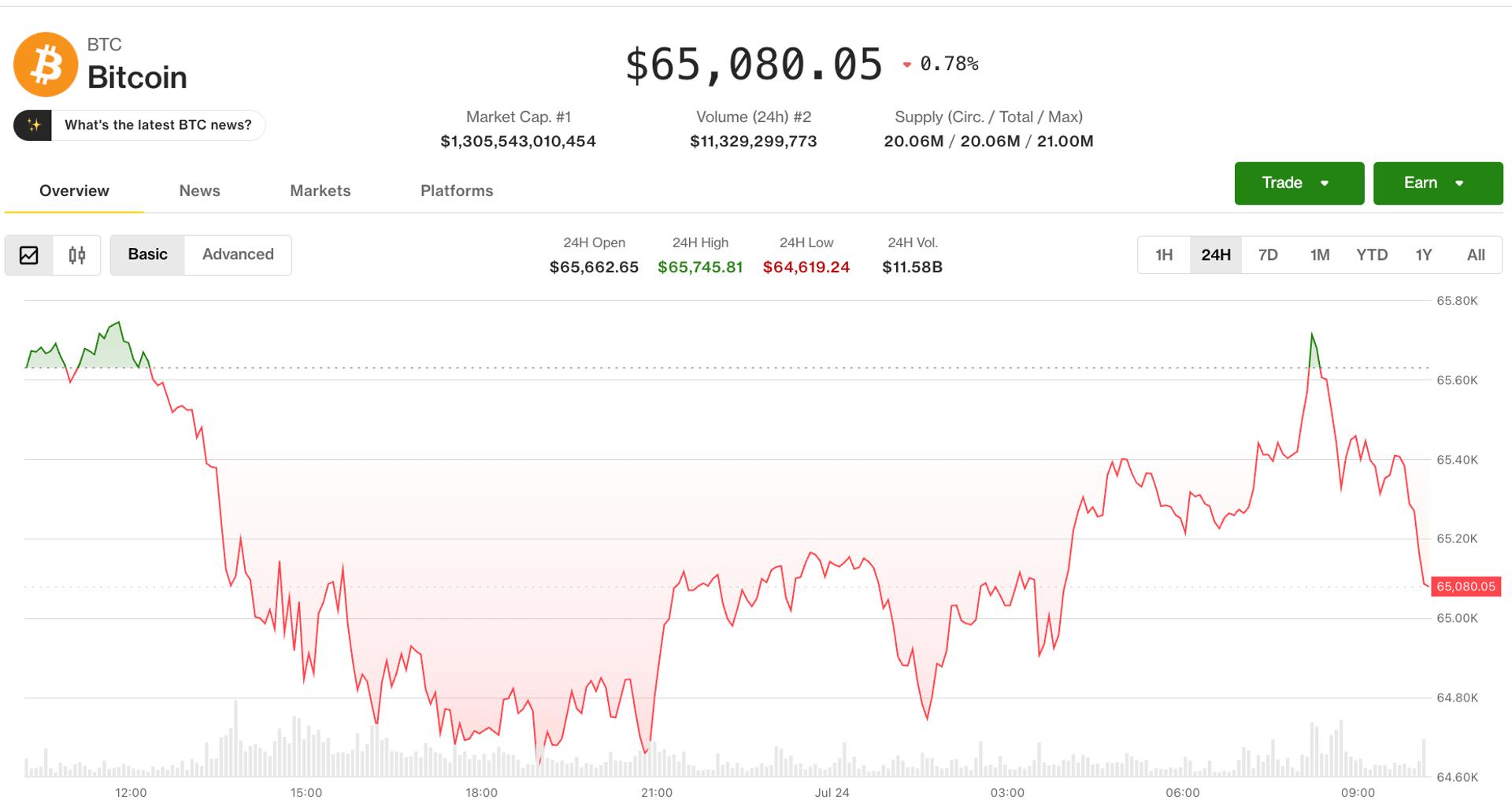
The crypto market is closing out the week on a constructive note, with bitcoin adding as much as 1.1% since midnight UTC to $65,760 as the broader market held its ground despite a macro backdrop that should be applying far more pressure.
Brent crude futures are trading at $97.66 per barrel, the highest since mid-May, as the Iran conflict shows no sign of de-escalating. While previous oil spikes have rattled risk assets including crypto, digital assets are broadly green this morning.
Ether (ETH) mirrored bitcoin’s gain, rising as much as 1.6%, while the likes of HYPE and FET rose more than 2%.
Traditional markets are muted, with S&P 500 and Nasdaq 100 index futures both marginally positive and gold holding above $4,000. The Dollar Index has edged slightly lower.
Derivatives positioning
- Market churn dominates activity: Volume increased by 11% to $165 billion in 24 hours while open interest (OI) held steady at around $116 billion. This shows a market that’s seen churn rather than positional interest.
- Bearish buildup in dogecoin: DOGE futures OI continues to rise and is nearing 16 billion tokens, the most since October. The continued gains come as DOGE’s spot price remains under pressure after falling to the lowest since November 2023 on Thursday. The combination of rising open interest alongside a drop in price is said to confirm the downtrend and signal trader interest in shorting the falling market.
- Mixed signals from ether: OI in ether futures is rising as well, currently at 14.53 million ETH, the highest since June 7. Other indicators paint a mixed picture with positive funding rates still pointing to bullish sentiment while the negative 24-hour CVD indicates that bears are leading the price aciton by shorting at market orders rather than placing limit orders.
- Broad-based bear leadership: With the exception of TRX and CRO, most tokens, including BTC, have negative 24-hour CVD.
- Volatility declines: There is good news for the bulls from the BVIV index, which measures BTC’s 30-day implied volatility. The measure has declined by 3% since midnight to 39%, halting a five-day streak of advances. Ether’s EVIV is under pressure too.
- Options cluster: In the Deribit-listed bitcoin options market, a massive $5 billion open interest cluster has formed at $70,000-$72,000 options, mainly driven by bullish bets, or call options. Volume rankings also show a bias for upside with calls at strikes $77,000 and $80,000 featuring in the list alongside other calls.
Token talk
- Hyperliquid (HYPE) led the altcoin market for the second consecutive session, rising 2.4% to $58.93 as it rebuilds with a series of higher lows since its July pullback from record highs.
- AI tokens FET and NEAR posted gains of 2.23% and 1.38%, respectively, offering tentative signs of stabilization after weeks of underperformance, while added 1.89% to extend one of the more consistent runs in the DeFi sector this month.
- gave back 2.13% of Thursday’s 12% surge, a familiar pattern for the Trump family-linked token, which remains highly susceptible to sharp reversals due to thin liquidity.
- Lighter (LIT) fell a further 1.32%, extending a slide that has now unwound close to 20% from its July peak as profit-taking continues following its 200%-plus rally between May and early July.
- The broader 24-hour picture tells a more cautious story, with WLFI, AVAX, HBAR and SUI all down between 4% and 10% over the past day, a reminder that the intraday recovery masks lingering weakness across a portion of the altcoin market.


Brazil has registered a R$100,000 ($19,600) rural loan backed by 10 digitally identified dairy cows, creating one of the country’s first formal credit transactions using tokenized livestock as collateral.
Summary
- Ten tokenized cows valued at R$120,000 secured a R$100,000 rural credit note registered on B3.
- Cowmed’s smart collars track health, behavior and location, reducing lenders’ dependence on physical farm inspections.
- Target FIDC expects monitored livestock to improve collateral values while preventing duplicate pledges between lenders.
Fazenda Engenho Velho, in Imbituva, Paraná, pledged animals valued at R$120,000 ($23,500). Target FIDC structured the transaction and registered it through Brazil’s B3 systems.
BMP Sociedade de Crédito Direto provided the funds through a financial Rural Product Note, known locally as a CPR-F. BMP later transferred the credit rights to Target FIDC. Each cow received a unique encrypted identity linked to data collected by Cowmed’s smart collars. The system records health, behavior and location information, allowing the lender to follow the collateral without relying only on scheduled inspections.
How the tokenized cattle loan works
A CPR-F allows a rural producer to raise money and repay the amount in cash at maturity. B3 explains that Brazilian law requires physical and financial CPRs to be registered with an entity authorized by the Central Bank of Brazil for validity and effectiveness. Registration confirms the note’s features and creates a record that lenders and authorized parties can check.
In this deal, the digital identity did not turn the cows into freely traded crypto tokens. Instead, it tied each animal to the credit contract and its B3 registration. Public reports did not identify a public blockchain, token standard or secondary market for the cattle records. The structure therefore uses tokenization mainly for identification, monitoring and collateral control rather than open trading.
Smart collars reduce information gaps for lenders
Cowmed’s collars monitor each cow around the clock and translate behavioral data into alerts covering health, reproduction, nutrition and heat stress. The loan model uses those records to show that an animal remains alive, located at the farm and in a condition consistent with its assigned value. This reduces the need for repeated physical checks during the financing period.
Target FIDC director Humberto Brenner said lenders have traditionally applied deep discounts to cattle because they lacked reliable information about location and condition. A cow worth R$20,000 could receive a collateral value of only R$8,000. Continuous monitoring can support a value closer to the market price, although the final lending decision and discount remain with the creditor.
The structure also aims to stop one animal from backing several loans. Each cow receives a separate code attached to the registered transaction. If an animal dies, the farmer can replace it digitally with another eligible cow. The operation includes about 20% extra animals as a buffer to maintain collateral coverage during the loan.
Tokenized collateral opens another farm credit route
Cowmed chief executive Thiago Martins said, “We take the cow, which is a real and tangible asset, and transform it into a digital asset backed by a unique code monitored in real time.” He said the model offers farmers another collateral option during a period of restricted agricultural credit. The digital record also gives the financing company a way to verify changes during the loan.
The proceeds can support working capital, equipment purchases or other farm expenses. Target FIDC is reportedly assessing four more Brazilian producers and aims to arrange R$5 million in loans through the model by the end of 2026. Those targets remain plans rather than completed transactions, and wider use will depend on lender demand, pricing and the performance of early loans.
Cowmed said the financing model could reach part of the roughly 100,000 dairy cows covered by the relevant monitoring base, with an estimated value above R$2 billion. It expects about 20% of producers in that group to consider the product, which could support close to R$400 million in credit.
Brazil expands real-world asset tokenization
The cattle deal arrives as B3 expands its role in digital asset infrastructure. As crypto.news previously reported, the exchange has outlined plans for a real-world asset tokenization platform and a Brazilian real-linked stablecoin. B3 has also developed digital registration tools for agricultural credit, including systems designed to identify collateral and reduce duplicate pledges.
Brazil’s tokenization market also includes corporate debt, investment funds and agricultural assets. Tether recently invested $20 million in Mercado Bitcoin to support tokenized assets, payments, lending and onchain capital markets. Meanwhile, crypto.news reported that tokenized real-world assets reached about $34 billion globally in 2026, led by Treasuries but increasingly covering commodities, private credit and other assets.
The cow-backed loan remains small compared with those markets. It provides a practical test of whether verified data from physical assets can improve collateral values and expand rural credit. Farmer repayment, animal replacement procedures, monitoring accuracy and enforcement during default will determine whether financial institutions adopt the model at larger scale.
Upbit has removed Taiko (TAIKO) from its trading warning list after reviewing the Ethereum layer-2 project’s explanation and response to a June security breach.
Summary
- Upbit removed TAIKO’s warning after reviewing the June exploit, project response, and later security measures.
- TAIKO deposits will resume across three markets, while delayed transfers enter user accounts in sequence.
- The token rose after delisting concerns eased, though Upbit warned traders about renewed price volatility.
The South Korean exchange announced the change on July 24 for TAIKO/KRW, TAIKO/BTC and TAIKO/USDT.
The decision removes the immediate risk that Upbit could end trading support under its warning process. The exchange also plans to restore TAIKO deposits and process transfers made during the suspension in order. Upbit warned that price differences with overseas exchanges could create sharp moves when deposits reopen.
Upbit ends TAIKO review after project response
Upbit placed TAIKO under warning on June 22 after identifying a security incident involving systems used to issue, transfer or store the asset. The exchange said an unexplained or unresolved breach could expose users to losses. It suspended deposits while it reviewed the event and Taiko’s response.
In its July 24 notice, Upbit said Taiko submitted information covering the cause of the breach and its later security work. The exchange reviewed those materials and decided that “the reason for the trading warning has been resolved.” Upbit did not publish the technical documents or list the exact controls that satisfied its review.
The review period lasted 32 days. During that time, Upbit kept three spot markets open, allowing users to trade existing balances while blocking token inflows until its security assessment ended. Bithumb followed a similar review schedule after placing TAIKO under warning on the same date.
June exploit forced Taiko to halt network activity
The warning followed an attack on Taiko’s bridge and chain-state verification system. Taiko told users to withdraw funds from bridges after crafted proofs allowed unauthorized releases from its ERC20 vault on Ethereum. The project also asked centralized exchanges to stop TAIKO deposits and halted new block production during its response.
Security researchers estimated losses at more than $1 million, while later reports placed the amount near $1.7 million. Blockaid said flawed source-signal proof checks allowed the attacker to submit withdrawal messages without matching events on Taiko. Other researchers examined whether an exposed signing key helped the attacker create proofs that the Ethereum-side verifier accepted.
Taiko contained the unauthorized withdrawals after pausing affected systems and coordinating with its Security Council and partners. The team also published attacker addresses and said it would pursue technical and legal steps. It did not immediately provide a full public timeline for restoring each affected bridge.
Deposits return as network services stabilize
Bithumb also suspended TAIKO deposits and withdrawals on June 22 because Taiko stopped block production. The exchange restored withdrawals on July 3 after the network became stable, although deposits remained unavailable while the warning review continued. Bithumb also removed its TAIKO warning on July 24 and scheduled deposits to resume.
Taiko’s public status page now shows its mainnet sequencing, batch submission, proof submission and proof verification systems as operational. That status supports the exchanges’ decision to reopen services, although it does not remove the need for continued monitoring. Upbit said transfers sent during the deposit suspension will appear after service resumes.
Upbit advised users to confirm the correct network before making new deposits. Transactions sent through unsupported networks may not reach exchange accounts. The company also said deposits made during the suspension would receive account credit in sequence once its systems reopened.
TAIKO rises after delisting threat clears
TAIKO reacted positively after the warning ended. Upbit market data showed TAIKO/KRW trading as high as 132 won on July 24, with the pair gaining about 11% during the session. Trading volume also increased from the previous day as market participants responded to the exchange notice.
The rebound followed a difficult month for the token. TAIKO reached a record low of 90.4 won on Upbit on June 25, three days after the security incident and warning designation. Even after the July recovery, the token remained far below its June 2024 record high on the exchange.
The warning removal does not represent a guarantee against another breach or future exchange review. Upbit can place an asset under warning again if new security, disclosure, liquidity or operational concerns arise. The exchange also reminded users that crypto assets can cause a partial or total loss of invested funds.The Taiko incident formed part of a wider series of bridge attacks during 2026. As previously reported, Verus Protocol’s Ethereum bridge lost more than $11.5 million after forged transfer data passed its checks. Axelar also disabled Secret Network routes after a separate $4.7 million exploit.
Those cases show why exchanges can suspend deposits even when spot trading remains open. A compromised bridge or chain can allow attackers to send assets that lack valid backing or move stolen tokens into exchange accounts. Deposit controls give exchanges time to assess the network and prevent disputed balances from entering their systems.
Upbit’s decision closes the current warning review rather than the wider security process. Taiko still needs to maintain its bridge, proof and validator protections while supporting exchanges that reconnect deposits. Upbit advised traders to watch for rapid price moves as Korean and overseas markets reconnect.
Tesla released its Q2 2026 results after the market closed on 22 July. Revenue increased 26% year-on-year to $28.24 billion, while vehicle deliveries reached a record 480,126 units. However, operating margin fell sharply to 1.4%, down from 4.1% a year earlier, and operating income declined 57% to $398 million. Adjusted earnings per share came in at $0.33, missing analysts’ consensus estimates. Free cash flow also turned negative as capital expenditure surged, driven by investment in AI, Robotaxi, and Optimus projects.
Technical Analysis
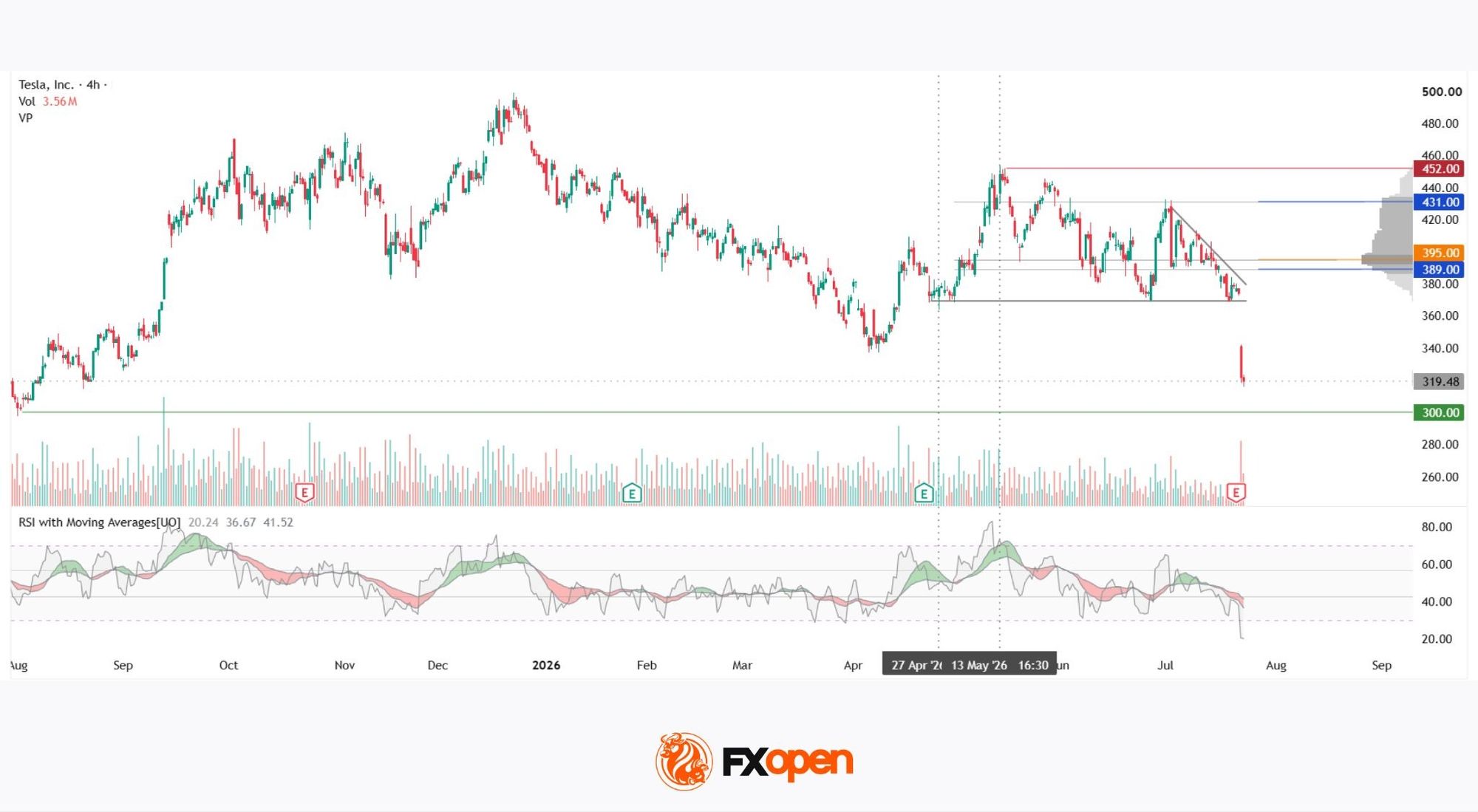
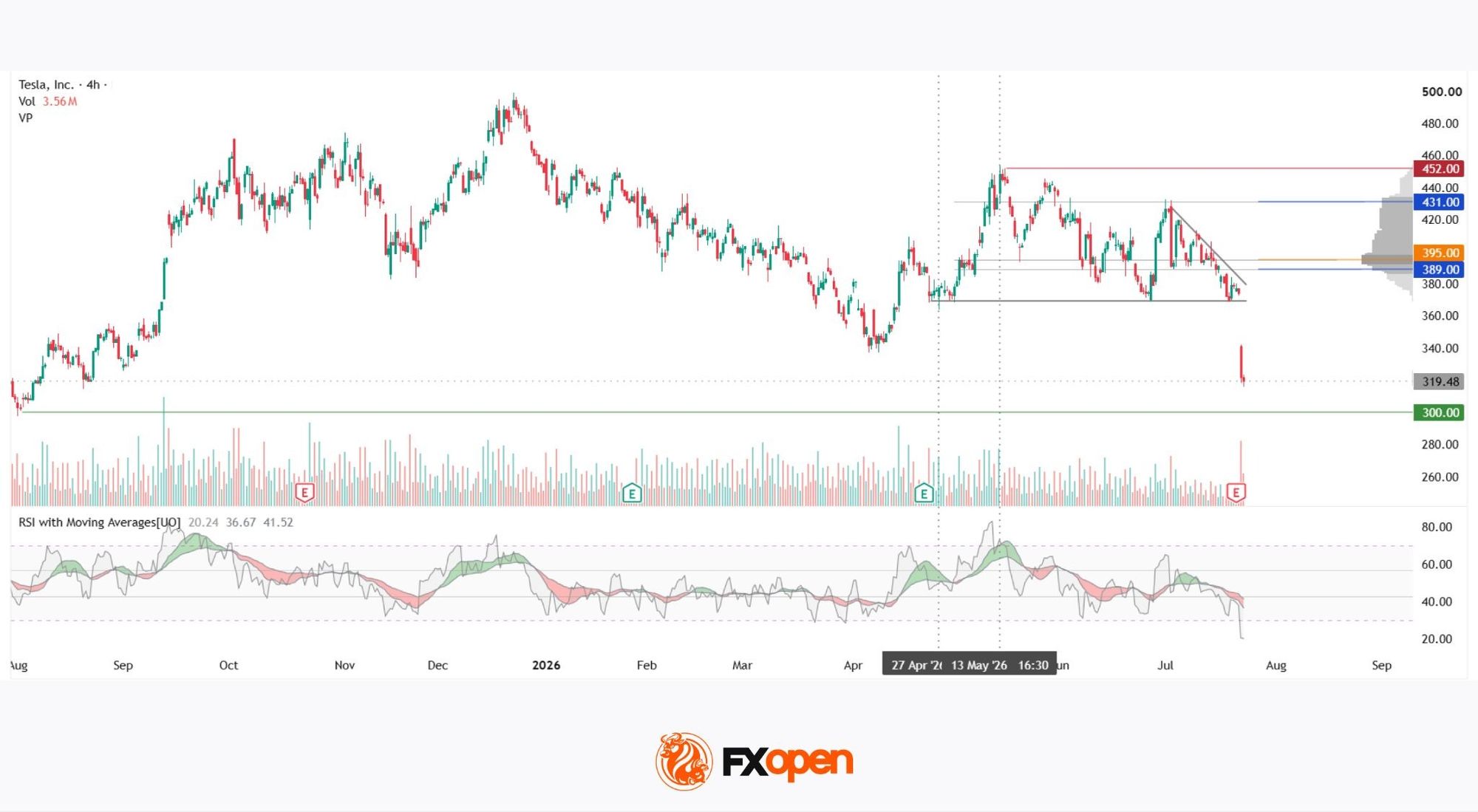
On the 4-hour chart of TSLA, the price has formed a complex sideways trading structure following this year’s short-term uptrend. On 23 July, the market reacted sharply to the earnings release, with the stock opening significantly lower in a high-volume gap down, breaking below the lower boundary of the current trading range. The price is now moving lower towards the important $300 support level.
The chart also shows that the price has fallen below the current market profile, which consists of the following levels: the lower boundary at $389, the Point of Control (POC) at $395, and the upper boundary at $431. These levels could attract renewed market interest should the trend reverse. Above the profile, resistance is located at $452, which could become the next significant barrier if the price recovers above the profile.
The RSI + MAs indicator currently shows readings of 20, 36, and 41. The gap between the moving averages remains significant, the averages are coloured red and have moved out of the uncertainty zone, indicating persistent bearish momentum. At the same time, the RSI has entered oversold territory.
Key Takeaways
Tesla’s quarterly results highlighted a sharp contrast between record revenue and a significant deterioration in profitability, shifting investors’ focus from sales growth to weakening margins. From a technical perspective, the stock has broken below its established trading range, while the RSI remains in oversold territory without yet showing clear signs of a reversal.
Buy and sell stocks of the world’s biggest publicly-listed companies with CFDs on FXOpen’s trading platform. Open your FXOpen account now or learn more about trading share CFDs with FXOpen.
This article represents the opinion of the Companies operating under the FXOpen brand only. It is not to be construed as an offer, solicitation, or recommendation with respect to products and services provided by the Companies operating under the FXOpen brand, nor is it to be considered financial advice.


BPI has launched a pilot program using stablecoin settlement rails for cross-border payments, with the Philippine lender targeting faster and lower-cost remittances for freelancers, virtual assistants, and other overseas income earners.
Summary
- BPI has launched a stablecoin settlement pilot to speed up and lower the cost of cross border payments to Philippine recipients.
- The project will first serve freelancers, virtual assistants, and other overseas income earners before expanding ahead of the ASEAN Summit.
- The pilot will run with BSP coordination as the Philippines continues tightening rules for stablecoins and other digital assets.
According to local reports from ABS-CBN and the Philippine Daily Inquirer, the Ayala-led bank is working with global digital clearinghouse Meridian to test a stablecoin-based settlement system that will process inbound international payments before converting them into Philippine pesos for deposit into customers’ BPI accounts.
The pilot will first cover payroll payments and overseas earnings received by freelancers, virtual assistants, and workers in the informal economy. BPI plans to extend the service to more customers before the 49th ASEAN Summit in November, when the bank expects to showcase the initiative as part of its digital banking efforts.
Rather than replacing existing banking infrastructure, the system uses stablecoins as a settlement layer between the sender and the recipient. Once the transfer is completed, recipients will receive Philippine pesos in their BPI accounts, allowing the bank to combine blockchain-based settlement with conventional banking safeguards.
BPI President and Chief Executive Officer Jose Teodoro Limcaoco said the project builds on the bank’s ongoing digitalization strategy, adding that the bank wants Filipinos receiving money from abroad to access their funds more quickly and at a lower cost without reducing security standards.
Meridian President and Chief Executive Officer Will Haering said the partnership demonstrates how stablecoin technology can be integrated into the banking system while maintaining reliability and customer protections.
The bank also said the pilot will proceed in coordination with the Bangko Sentral ng Pilipinas (BSP), with any future expansion depending on regulatory safeguards, including consumer protection measures and transparency around stablecoin reserves.
Pilot arrives as Philippine regulators tighten crypto oversight
The project comes as Philippine regulators continue developing rules governing digital assets, tokenization, and stablecoin-related services.
In June, the BSP introduced stricter requirements for licensed virtual asset service providers, directing them to strengthen due diligence before listing cryptocurrencies. Under the central bank’s guidance, exchanges must assess issuer background, market maturity, transparency, liquidity, legal compliance, and use cases before making digital assets available to customers.
The BSP also devoted additional attention to fiat-backed and asset-backed stablecoins. Its guidance said providers may need to examine reserve composition, redemption rights, issuance and burning mechanisms, and the quality of backing assets to ensure users can redeem tokens under normal market conditions. The central bank further required continuous monitoring of listed assets and reiterated that privacy coins remain prohibited for licensed VASPs.
Separately, the Philippine Securities and Exchange Commission has continued using its Strategic Regulatory Sandbox, or StratBox, to test digital asset products under regulatory supervision. Speaking during Philippine Blockchain Week in June, SEC Commissioner Rogelio Quevedo said the regulator had become comfortable that the country’s existing legal framework could accommodate tokenized assets, while noting that sandbox participation does not exempt companies from existing laws.
According to the SEC, four companies have already entered the sandbox, including a tokenized real estate project and firms testing investment products linked to U.S. equities. BlockShoals Technologies also received approval to test crypto-related services within the program.
Earlier this month, the SEC granted BlockShoals final approval to begin StratBox testing with Binance as its global crypto-asset service provider partner. The BSP later clarified that neither BlockShoals nor Binance currently holds a Philippine virtual asset service provider license and said participation in the SEC’s sandbox does not replace separate licensing requirements overseen by the central bank.
Stablecoin adoption continues to expand
BPI’s latest initiative also adds to the Philippines’ growing use of stablecoin technology for payments.
In 2024, Philippine cryptocurrency exchange Coins.ph expanded its peso-backed PHPC stablecoin to the Ronin blockchain, allowing users to move funds and spend gaming earnings more easily within the country. The Ethereum-based stablecoin is backed one-to-one by the Philippine peso, with Coins.ph maintaining reserves consisting of cash and other traditional financial instruments.
For BPI, the latest pilot targets a different segment by focusing on cross-border settlements handled through the banking system rather than blockchain-native payments. If the trial proceeds as planned, the project could provide overseas workers, freelancers, virtual assistants, and other recipients of foreign income with a faster settlement process while keeping transactions within the country’s regulated banking framework.
Any broader deployment, however, will remain subject to coordination with the BSP and compliance with regulatory requirements covering consumer protection, reserve transparency, and other safeguards outlined for stablecoin-based financial services.
Bitcoin holders are seeing a return to overall profitability, according to on-chain analytics, but the data also points to a familiar risk: the market may be setting up for another “false breakout” before a sustained recovery is confirmed.
CryptoQuant data cited by contributor thechessONCHAIN shows the share of Bitcoin supply currently trading above its approximate acquisition price—known as Supply in Profit—has climbed to 57.5% as of July 22. That compares with 46.2% on June 30, the platform’s reference point for a 2026 low. While that improvement is significant, CryptoQuant’s framework suggests investors should look for confirmation beyond a single rebound.
Key takeaways
- Supply in Profit has risen to 57.5% (July 22), up from 46.2% (June 30), indicating more coins are moving in profit.
- CryptoQuant says prior bear-market endings have required supply strength plus long-term holder SOPR staying in a healthy range.
- LTH-SOPR remains a key checkpoint: CryptoQuant’s conditions include a 30-day SMA staying above 1.
- CryptoQuant highlights that the cycle has already produced one failed attempt at improvement earlier in the year.
Supply in Profit rebounds toward 60%
On-chain analytics platforms track investor cost basis implicitly by looking at the conditions under which coins were last active. In this case, CryptoQuant’s Supply in Profit (%) measures the portion of Bitcoin worth more than its acquisition price. When that percentage rises, it generally implies that a larger share of the supply is back to being held at unrealized gains.
According to CryptoQuant, the metric climbed above the 50% mark in July. In the same summary, thechessONCHAIN pinpointed the move to 57.5% by July 22, following a low of 46.2% on June 30. The speed of the recovery matters: shifting from the mid-40s to the upper-50s less than a month later suggests the market’s repricing has been sharp.
That said, CryptoQuant’s contributor stresses that a sustained bull-market recovery typically requires these improvements to hold—especially when viewed together with long-term holder behavior.
Why long-term holder SOPR is still the gatekeeper
As Supply in Profit improves, CryptoQuant also expects other indicators tied to realized pressure to follow. One such measure is long-term holder SOPR (LTH-SOPR), which compares the sale price of long-dormant coins to their last transaction price.
In CryptoQuant’s framework, long-term holders are entities whose Bitcoin has remained dormant for at least six months. SOPR interprets whether LTH coins are moving at profit on-chain: values above 1 indicate LTH coins are typically being spent at higher prices than their prior transaction, while values below 1 suggest movement at a loss.
CryptoQuant argues that bear markets have not fully ended in previous cycles unless both of the following conditions align:
- The 30-day simple moving average (SMA) of LTH-SOPR should remain above 1.
- Total Supply in Profit should stay above 64%.
This combination matters because Supply in Profit can rise simply as market prices recover, but it doesn’t always guarantee that long-term holders are structurally comfortable spending into strength. If LTH-SOPR stalls or falls back below 1, it can suggest lingering caution or recurring distribution behavior from older holdings.
Potential for another “failed attempt”
CryptoQuant’s analysis includes a warning based on historical pattern recognition: the current cycle already produced a rebound that looked convincing at the time, only to roll back later.
As described by thechessONCHAIN, from April 28 to June 1 the 30-day SMA of LTH-SOPR held above 1.0 for about 35 days, while Supply in Profit reached 67%. Yet both metrics ultimately reversed, implying the market’s improvement didn’t hold long enough to qualify as a confirmed transition.
Since then, the platform notes that the 30-day SMA of LTH-SOPR has been below 1 for more than 50 days. That detail is important for investors because it means the recent Supply in Profit rebound has not yet been matched by the same level of long-term holder spending profitability implied by CryptoQuant’s “recovery” requirements.
The immediate takeaway is not that the market is bearish, but that the on-chain evidence is incomplete. A rise toward 60% in Supply in Profit can set the stage for healthier conditions, but CryptoQuant’s criteria suggest traders should be cautious about interpreting the move as confirmation of a sustained bull phase.
Broader market signals: bottom timing vs. demand uncertainty
Earlier coverage from Cointelegraph noted that Bitcoin supply in loss crossing above or past certain thresholds has historically been used to estimate where bear-market bottoms might be forming. That aligns with CryptoQuant’s perspective on why profitability metrics matter: supply transitions from loss to profit tend to coincide with turning-point behavior in prior cycles.
In that earlier context, Cointelegraph described how the supply-in-loss threshold historically preceded a “countdown” toward cycle bottoms. While that doesn’t guarantee a repeat this time, it helps explain why the current move in Supply in Profit is drawing attention.
However, demand signals remain mixed in the surrounding market narrative. Cointelegraph previously pointed to weak spot-market interest in the near term, juxtaposed with a rebound in institutional activity via Bitcoin exchange-traded products. In particular, Cointelegraph referenced weak spot-market interest alongside improving institutional BTC allocation as ETF flows turned into a short-term inflow streak.
For investors, the asymmetry matters: even when profitability metrics improve quickly, insufficient fresh demand can make breakouts fragile. Conversely, if institutional allocation continues while long-term holder SOPR stabilizes above 1, the combination could be more supportive of a durable recovery.
What to watch next
CryptoQuant’s framework implies the next checkpoint is whether LTH-SOPR keeps its momentum—specifically whether the 30-day SMA remains above 1 and whether Supply in Profit can move beyond and hold above 64%. Until those conditions align, Bitcoin’s shift back into aggregate profitability may be best viewed as a promising step that still needs confirmation.


India’s top cybercrime watchdog has ordered GitHub to take down Bitchat, the offline messaging app built by Block chief executive and bitcoin advocate Jack Dorsey, as anti-government protesters in Delhi adopt mesh-networking tools to communicate through repeated internet shutdowns.
The Indian Cyber Crime Coordination Centre, part of the Home Ministry, issued the order late Thursday under Section 79(3)(b) of the IT Act, naming three GitHub repositories tied to Bitchat and giving the platform three hours to disable access.
The notice, reviewed by CoinDesk, says the app enables anonymous communication without registration, phone numbers or centralized logging, and that its architecture “significantly impedes lawful interception, attribution, and investigation by law enforcement agencies.”
Bitchat is a decentralized messaging app that relays encrypted messages between phones over Bluetooth mesh networks, requiring no internet, servers or accounts. Dorsey released it as open-source software in July 2025.
Bitchat is built to relay bitcoin transactions offline, passing them phone to phone through the mesh until a device with connectivity broadcasts them to the network, a design meant to keep payments alive during blackouts, disasters or state-imposed shutdowns.

The Hard TRUTH about Crypto in 2026. (You May Not Want to Hear)

Extreme Heat Watch Begins Saturday Across Emporia Area After Two-Day Storm Brings Up to an Inch of Rain

Hyperliquid RWA Trading Surpasses All Other Asset Categories


-

 Fashion7 days ago
Weekend Open Thread – Corporette.com
-

 Politics6 days ago
The House | The City of London can help the new chancellor deliver growth in every postcode
-

 Crypto World6 days ago
Ripple Payments Joins MiCA With 14 Firms, Does It Mean Anything For XRP?
-

 Politics5 days ago
Democrats look to World Cup watch parties to register thousands of voters
-

 Crypto World7 days ago
Ripple wins EU-wide access as ESMA adds it to MiCA register
-

 Crypto World3 days ago
Grayscale Files For Worldcoin ETF, WLD Registers Sharp Rise
-

 Tech3 days ago
Sail Virtually Aboard The “Itanic” With IA-64 Emulator
-

 NewsBeat4 days ago
Unregistered fitter used Gas Safe logo on business flyers
-
 Tech3 days ago
Turtle Beach Command Series KB7 review: a nifty screen-equipped gaming keyboard
-

 NewsBeat7 days ago
Registration is now open for March for Men with Kev 2026
-

 News Videos5 days ago
Big Money Is Entering XRP
-
 Business2 days ago
New Jersey voter registration controversy explained: How 6,600 noncitizens got on the rolls, and what happens next
-

 Crypto World6 days ago
Kaspersky exposes OkoBot’s 20-module crypto wallet attack
-

 Business7 days ago
Airlines warn Sunshine Protection Act could disrupt flight scheduling
-
 Entertainment3 days ago
Johnny Depp’s R-Rated Gothic Cult Classic Gets New Release Ahead of Sydney Sweeney Remake
-

 NewsBeat6 days ago
Durham County Council to send out electoral registration emails
-

 Crypto World6 days ago
MiCA Licensing Faces Delays as ESMA Adds 14 CASPs to Register
-

 Crypto World1 day ago
Ethics, other provisions in crypto Clarity Act to be further discussed
-
 NewsBeat3 days ago
Shanghai science forum photos show China’s AI and robotics advances in rivalry with US
-

 Crypto World6 days ago
Chip Stocks Enter Bear Market After Moonshot Ai Unveils Kimi K3 Model
You must be logged in to post a comment Login