Patreon is laying off 20% of its workforce, or 93 people, CEO Jack Conte told employees on Thursday. In a memo to staff that was shared online by the company, Conte said Patreon’s core business is strong but that the platform has to respond to market changes and adjust its cost structure to remain stable, which is why it needs to make the “painful” but necessary cuts.
Conte wrote that “AI has fundamentally transformed the tech industry,” and that the pace of change has “never been more intense.” However, Conte went on to note that Patreon isn’t making the cuts because it wants to replace employees with AI.
“To be clear about the impact of AI on today’s decision: we are not making the above changes because we believe AI replaces humans,” he wrote. “The more we have learned to use these new tools, the clearer it has become that they are not substitutes for the creativity, judgment, detail orientation, or craftsmanship that our teammates have in spades, nor do they replace the desire for human connection that all of us cherish so deeply. That’s my personal opinion, but more importantly, it’s the foundation of Patreon’s strategy: our product vision and business are both predicated on the value of human creativity and human connection.”
He continued, “AI has fundamentally transformed the tech industry, though, including how we work, how we build products, how we communicate, and more. That does have an impact on how we operate and organize.”
Advertisement
Beyond the headcount reduction, Conte said Patreon is also restructuring how it operates, “flattening” its organizational chart and refocusing teams around its top priorities. Affected employees will receive at least 16 weeks of severance pay, plus an additional week for every year worked, healthcare coverage through the end of the year, and a $1,500 stipend to replace their company laptop.
Last week, Patreon announced that it was partnering with internet infrastructure provider Cloudflare to directly block access to AI bots designed to train their AI models on creators’ work without permission. The company said it had to enhance its efforts on this front because AI scraping has become more sophisticated. The move came as online publishers and creators are grappling with AI companies using their work to train AI models.
Patreon’s latest round of layoffs is the platform’s largest since it cut 17% of its staff back in 2022. During that earlier round of layoffs, Patreon also closed its offices in Berlin and Dublin.
When you purchase through links in our articles, we may earn a small commission. This doesn’t affect our editorial independence.
Two weeks after debuting its more naturalistic GPT-Live audio AI model with full-duplex capabilities (listening and speaking at the same time), OpenAI is bringing it directly into developer workflows.
The company announced that GPT-Live now powers the ChatGPT desktop application on macOS and Windows, integrating directly with agentic systems like Codex and ChatGPT Work (which are separate experiences available in the ChatGPT desktop app).
When OpenAI initially launched GPT-Live on July 8, 2026, it introduced a continuous audio model capable of listening and speaking simultaneously—eliminating rigid turn-taking while delegating complex reasoning to background models like GPT-5.5.
Today’s release expands that conversational layer to technical tasks, enabling software engineers to orchestrate multi-threaded coding jobs, review pull requests, and debug applications using natural voice commands.
Advertisement
As such, it could usher in a new era of “hands free” software development and even live, in-person group coding parties for the more than 10 million weekly active users across Codex and ChatGPT Work. Codex, of course, is the name given to OpenAI’s models and harness focused on coding, but which the company has this year expanded into a more general productivity platform. An OpenAI spokesperson told VentureBeat this is the first time voice activation
OpenAI posted a promotional video showing some of its employees, Codex developer experience engineer Jason Liu and Codex technical staffer Guinness Chen, speaking to the same ChatGPT desktop app session in the same room, each issuing different instructions and conversing with the same model.
New capabilities unlocked
At its core, this integration relies on decoupling the real-time voice layer from the underlying execution engines.
Advertisement
While GPT-Live maintains fluid conversation—inserting natural verbal acknowledgments like “got it” without interrupting the user—it passes heavy computational workloads to background reasoning models.
On macOS, the desktop application incorporates “Appshots” and screen context features, allowing ChatGPT Voice to analyze the frontmost window alongside local files, codebase structures, and active plugins.
This architecture creates a pair-programming dynamic where developers talk through problems conversationally while agents execute tasks asynchronously.
Rather than manually stopping coding sessions to type detailed instructions or switch windows, developers direct the system hands-free.
Advertisement
The full-duplex engine dynamically decides when to speak, pause, or invoke tools, maintaining conversational state even as background agents process complex code modifications.
Directing coding and complex builds with your voice alone
The central operational capability in this update centers on multi-task execution across Codex and ChatGPT Work environments.
Software engineers can initiate multiple concurrent task threads from a single spoken prompt. For instance, a developer preparing to ship a feature can instruct the system to investigate an open authentication bug, review a pending API migration pull request, and generate missing unit tests simultaneously.
The desktop application coordinates these actions across disparate contexts, tracing issues through Slack conversations, GitHub repositories, and local codebases.
Advertisement
Developers can also verbally convert design mockups into working code, splitting tasks across frontend, backend, and testing layers.
With support for multi-folder projects (build 26.715) and remote execution via iOS, engineers can check task progress, answer agent prompts, and redirect active jobs without switching applications or managing individual processes line by line.
Proprietary license
OpenAI’s voice-enabled desktop release operates under a proprietary, commercial enterprise model. Access is restricted to paid subscribers across Plus, Pro, Business, Enterprise, and Education plans.
For individual developers and corporate engineering departments, this commercial structure means the model weights, voice processing pipelines, and agent state architectures remain fully closed.
Advertisement
Organizations cannot modify or self-host the underlying systems. Furthermore, tasks initiated via ChatGPT Voice consume standard usage allocations directly from existing Codex and ChatGPT Work plan quotas, treating voice-triggered actions identically to standard agentic workloads.
Community reactions
Developer communities immediately noted the implications of bringing continuous full-duplex voice to autonomous coding workflows.
Reacting to the build 26.715 release announcement—which details voice integration and multi-folder project support—AI Insider journalist @ChrisGPT noted on X: “Today OpenAI will release voice and remote guidance for codex ! One step closer to personal AGI”.
Early technical feedback highlights widespread enthusiasm for orchestrating complex agentic tasks hands-free, particularly when stepping away from the workstation or managing build pipelines remotely.
Fresh off a $2 billion fundraising and $900 million line of credit, London-based data center startup Nscale is planning a big expansion at a new engineering office in Bellevue, Wash.
Nscale, one of the fastest-growing companies building AI computing infrastructure, recently inked a deal for nearly 24,000 square feet of space at The Eight office tower in downtown Bellevue.
The office is slated to open in January 2027. It will serve as Nscale’s primary engineering hub in the United States, a company spokesperson said. The company currently employs about 50 people in the Seattle area, and the new office will be able to accommodate up to 250 people.
The company earlier this year hired Nidhi Chappell, the former Microsoft corporate vice president who led Azure AI and high-performance computing infrastructure, including the supercomputers that power ChatGPT. As Nscale’s new president of AI infrastructure, based in the Seattle area, Chappell will oversee the company’s global engineering and data center operations.
“I’ve had a front-row seat to some of the biggest moments in AI over the past several years, but one thing has always stood out: the world remembers the breakthroughs, but it’s the people building the infrastructure behind the scenes who make them possible,” Chappell wrote in a LinkedIn post last week announcing the company’s first “onboarding” event in Seattle.
Advertisement
Nscale, which is also preparing to open an office in New York, said it selected Bellevue because of the Seattle region’s concentration of AI infrastructure talent and its proximity to major customers.
Microsoft is one example. Earlier this year, the companies announced an expanded collaboration to deploy Microsoft’s next-generation AI infrastructure across Europe, including large-scale installations of NVIDIA Vera Rubin GPUs in Norway, Portugal and other locations. Nscale said it would be among the first providers outside of Microsoft to deploy the Vera Rubin platform, supporting Microsoft’s growing AI cloud infrastructure.
The new office is the latest sign of Bellevue’s growing role in the AI economy. The Eastside has become a magnet for companies building AI applications and infrastructure, with xAI, OpenAI, Databricks, CoreWeave, Armada, Anduril and others establishing and expanding offices.
AI companies have been giving a boost to the regional office market overall. Claude maker Anthropic, for example, recently announced an expansion of its offices in Dexter Yard in Seattle.
Nscale was founded in 2024. Its $2 billion funding round earlier this year valued the company at $14.6 billion, believed to be the largest Series C financing ever raised by a European technology company. The capital is being used to expand Nscale’s AI cloud platform, GPU infrastructure and data center footprint across North America and Europe.
Its backers include Astra Capital Management, Citadel, Dell, Jane Street, Lenovo, Linden Advisors, Nokia, NVIDIA and Point72.
Advertisement
News of the Nscale office in Bellevue was first reported by the Puget Sound Business Journal.
The official story trailer for Marvel’s Wolverine has been released
The trailer features Jean Grey, Team X, and a multitude of villains
It looks like The Last of Us actor Troy Baker will also star in the game
Insomniac Games has revealed brand new story details for Marvel’s Wolverine alongside an official story trailer, featuring bloody battles, mutants, and a ton of villains.
Revealed at San Diego Comic-Con, the trailer kicks off with Logan, aka Wolverine, confronting Jean Grey in what looks to be the aftermath of a battle. The pair clearly share a lot of history in this story, and Jean can be shown accompanying Logan on missions as they rescue mutants and investigate threats as part of Team X.
“New allies and formidable adversaries emerge in the clash for mutant survival,” the new story description reads. “As Wolverine, unite with Jean Grey to protect those most vulnerable. Fight alongside Team X to confront the world’s deadliest villains in the caliber of Bolivar Trask, Omega Red, and Deathstrike, and stand against oppressive forces like The Reavers and The Hand.”
Latest Videos From
We also get a look at more members of Team X – the X-Men don’t exist in this story – which includes Sabretooth, Mystique, and Sunfire. At one point, we also see a quick glimpse of another unnamed character, who appears to be played by The Last of Us actor Troy Baker.
Marvel’s Wolverine – Story Trailer | PS5 Games – YouTube
There are plenty of shots of Logan in different cities around the world as he takes on enemies like Deathstrike and, notably, The Hand, which you might be familiar with because they’re one of the major villainous organizations of the Daredevil TV series and the upcoming movie, Spider-Man: Brand New Day.
Insomniac also dropped some brand new artwork for the game as well, showing Logan taking on The Hand, and it looks awesome.
In addition to a new story trailer, the studio also announced a collaboration with Arc System Works to bring Wolverine’s suit from Marvel Tōkon: Fighting Souls to Marvel’s Wolverine, as well as revealed a digital prequel comic book that takes place before the game.
Sign up for breaking news, reviews, opinion, top tech deals, and more.
It was also confirmed that award-winning composer David Fleming crafted the music behind Marvel’s Wolverine, which will be released on August 28, but fans can listen to the first track, “Logan,” on available platforms like Spotify, Apple, YouTube, and Amazon.
Advertisement
Marvel’s Wolverine launches exclusively on PlayStation 5 on September 15.
The lossy compression algorithm used by JPEG was useful for those on the early Internet not only because it enabled pictures to be shared easier, but because it allows a low-resolution version of the image to load first. This meant that users could make out the gist of an image before it finished downloading. This was a great feature for those on slow connections, but it hides some other capabilities of this image format as well.
Rather than effectively splitting up the image into chunks, each with successive amounts of detail, [maurycyz]’s project shows that this can be exploited to load more than one picture. The first is loaded into this lower-resolution area, with a second unrelated picture showing up once the higher-resolution information is available. Essentially this makes a one-way .gif of sorts. Though this method is only capable of loading about nine frames, which is not enough for much animation. Further limiting things is that there’s no way to encode timing data, so on fast computers with fast connections the animation could load faster than a user could see.
Still, it’s an interesting quirk of this older image standard, one which still is in widespread use today. And it’s also true that it’s hard to say in what ways various technologies will be used in the future. JPEG images have also been the subject of some artistic projects that might not have been possible without the JPEG standard itself, and even as other formats have tried to supplant it, it still maintains its firm grip on the images on the Internet. More JPEG, please!
Frank Ssekamwa says the United States presented his country with an impossible choice. If it accepted the terms of a new health agreement, Uganda would have to give the U.S. access to the data of millions of his fellow citizens — a decision he worries would make their personal information more vulnerable to breaches and possible exploitation.
But if it refused, the East African nation would likely lose out on more than a billion dollars to address HIV, malaria, tuberculosis and other illnesses, even as its people face ongoing threats from Ebola and other deadly infectious diseases.
Advertisement
So, on Dec. 10, it agreed.
“If you take the deal, you’re going to be exploited. If you don’t take it, you’re going to die,” said Ssekamwa, an attorney and digital rights expert in Uganda. “It’s the essence of digital colonialism.”
Across Africa, countries have faced similar dilemmas as the U.S. has held a series of closed-door negotiations in which lifesaving aid has been conditioned on access to citizens’ health data. The negotiations come in the wake of the dismantling of the U.S. Agency for International Development, which — in contrast with the new contracts — provided billions of dollars in aid with few strings attached. Officials in Zambia, Zimbabwe and Ghana have been so outraged by the demands that they rejected the initial deals.
The demand to access health data is central to the Trump administration’s new America First Global Health Strategy, an openly transactional approach that seeks to leverage the desperate need for medical treatments abroad. Aid will now be given “in a way that directly benefits the American people and directly promotes our national interest,” Secretary of State Marco Rubio stated in September.
Advertisement
The State Department declined to publicly release global aid and data-sharing agreements it has signed with more than 30 countries as part of its new approach. But a ProPublica analysis of nine of the deals offers a window into the extensive U.S. demands for access to data — and the potential risks and vulnerabilities for the citizens of countries that have signed them. ProPublica also reviewed a data-sharing agreement struck with Uganda, which has not previously been reported; a data agreement with Kenya; six agreements over the sharing of pathogens that can cause pandemics that were made public by the State Department this week; generic templates of deals for sharing both data and pathogens that can cause pandemics; and an analysis of the documents the advocacy group Public Citizen shared exclusively with ProPublica.
ProPublica also consulted more than a dozen experts in data privacy and global health, including several with direct knowledge of U.S. policy who said that the insistent demands for data access and other resources as a condition of aid are unprecedented. Without seeing the full suite of agreements, they could not identify all vulnerabilities. But they spotted some red flags: The terms of the deals are vague and lack language standard in most data-sharing agreements that adequately limits what data is collected and how it can be used. That increases the risk that individuals’ personal data could be exposed, misused or commercialized without their consent.
In the Ugandan data deal, the U.S. will get direct, real-time access to nine of the nation’s health data systems for seven years, including the central repository that stores all of its health information, lab data, data collected by community health workers and, critically, its system for managing individuals’ electronic medical records.The agreement calls for the sharing of aggregated data with all personally identifiable information removed. It also says the data should be used for delivering and auditing healthcare services.
But lawyers and digital privacy experts argue that the deal raises questions about who will have access to the massive cache of health data and whether it could be inappropriately accessed and exploited.
Advertisement
Some expressed concern that, because it is possible to reverse-engineer data that has been anonymized, people with HIV, tuberculosis and other diseases could have their records exposed.
Stephanie Psaki, who served as the U.S. coordinator for global health security under President Joe Biden, described the Trump administration’s approach as a “blunt instrument of ‘just give me the login to your data systems.’”
“The U.S. would never agree to that,” she said, if the deal were offered in reverse.
In Uganda, the U.S. will provide up to $1.7 billion over five years for global health security and the treatment and prevention of deadly conditions such as malaria, tuberculosis, HIV and polio.In the past, the U.S. gave this aid without asking for direct benefits in return, saving an estimated 170,000 Ugandan lives per year.
Advertisement
While a significant investment, it is less than the U.S. previously spent in Uganda and will decrease every year of the agreement. By 2030, the African nation will receive 45% less global health funding than when Trump retook office, according to an analysis by Vincent Lin of Partners in Health, which provides healthcare in poor countries.
Several experts said there is broad support for some of the goals of the new plan for aid, including reducing African countries’ dependence on the U.S. for healthcare needs. But they worry the transactional nature of the approach could backfire by undermining trust or, in some cases, driving nations to reject deals altogether.
After withdrawing from the World Health Organization and losing access to its global network that tracks and combats disease outbreaks, the U.S. is attempting to obtain the information necessary to address potential pandemics through a patchwork of deals with individual countries. Each of the agreements ProPublica reviewed includes a section on responding to outbreaks. And some countries have signed separate pathogen-sharing agreements, which state that countries must “initiate sharing specimen(s) and related data” within five days of a U.S. request. The Trump administration is also planning unprecedented involvement of private companies to manage and process data.
The State Department told ProPublica that it needs access to the data to improve health outcomes in recipient countries and keep Americans safe. The new approach also requires countries to invest more in their own health systems in exchange for the aid, a promise many countries will likely struggle to fulfill. And, in some cases, including the deal with Uganda, it aims to boost local manufacturing through partnerships with American companies.
Advertisement
The State Department said it took multiple factors into account to ensure the required investments from other countries were “realistic and achievable.”
“The United States is investing billions of dollars in other countries’ health systems to fight infectious disease. In return, we expect governments to increase their own spending on health, so programs are sustainable and under genuine national ownership, not permanently financed by U.S. taxpayers. For the first time, both sides are putting skin in the game to ensure lasting impact,” a State Department spokesperson said in response to questions about the agreements.
In response to follow-up questions from ProPublica, spokesperson Tommy Pigott said the agreements “share only the same kinds of aggregated, de-identified data that has been shared and used for years in the fight against HIV/AIDS, malaria, tuberculosis, and other diseases. All data sharing is consistent with each country’s laws and approvals. No personally identifiable information is being received or shared by the United States government.”
Uganda’s Ministry of Health, Ministry of Foreign Affairs, Personal Data Protection Office and embassy in Washington, D.C., did not respond to questions for this article.
Advertisement
In the age of artificial intelligence, large health data sets have become so valuable they’ve been referred to as the new gold. The precise value of the health data of an entire nation is unclear, but it could be extremely valuable to AI-driven companies for training models.The industry of buying and selling such information troves is worth billions. And countries around the world have come to regard their citizens’ health records as national assets that deserve special protections and can confer economic and strategic advantages.
Yet the agreements, which are part of a strategy the State Department openly states is intended to make America “more prosperous” and “promote American health innovations,” provide no guarantee that Africans subject to them will have a say in what happens with their data or receive a fair share of its benefits. “Once companies get this data, the value is being accrued. But there’s no way for the [African] population to know how companies will use it,” said Jane Munga of the Carnegie Endowment for Intenational Peace, who has argued that the agreements may violate African privacy laws.
Africans have also expressed concern that they will not be able to access and benefit from medicines and vaccines developed from pathogen samples shared with the U.S. Five of the six specimen-sharing agreements reviewed by ProPublica state that, in the event that a medical product is developed primarily from a specimen from the country, the U.S. government “shall prioritize” a request from that government behind the needs of the U.S. Only one of the agreements, with Nigeria, commits the U.S. to facilitating “priority access” to — and the donation of — any medical products developed using the specimens.
The phenomenon of extracting information and samples from less-resourced populations and failing to credit and compensate them for their contributions to medical developments is well known enough to have several names, including “parachute science.” Just a few years ago, countries, including some in Africa, hosted COVID-19 vaccine trials, only to later struggle to access the shots they helped to develop.
Advertisement
Each agreement includes “benefit-sharing provisions,” the State Department said in response to questions.
After the Trump administration dismantled USAID, the world’s largest provider of humanitarian assistance, it also drastically reduced funding for international health work done by the Centers for Disease Control and Prevention and severely scaled back the President’s Emergency Plan for AIDS Relief, which combats HIV globally. In addition to withdrawing from the WHO, the U.S. removed itself from international negotiations over a pandemic agreement intended to affirm countries’ sovereign rights to their biological resources and ensure equitable access to medical interventions.
Brad Smith, an entrepreneur who served in the first Trump administration, is now in charge of creating the system that would rise from the ashes. Before joining this administration, Smith founded three companies with business models that rest in part on using data to reduce healthcare costs, including CareBridge, a home care provider that sold for a reported $2.7 billion in 2024. During the presidential transition that year, Smith led the government efficiency panel that would become Elon Musk’s Department of Government Efficiency. After Trump took office, he presided over some $67 billion in sweeping cuts to the Department of Health and Human Services before being brought on as an adviser to the State Department.
Although the humanitarian aid system had been largely dismantled, Congress required the executive branch to continue providing aid. So Smith and his team had to find new ways to get the funding to countries, ensure that it was being spent wisely and address potential pandemics — all without most of the international partners and staff the government had previously relied on to carry out this complex work.
Advertisement
A Rhodes scholar known for his intense work ethic, Smith threw himself into the effort. State Department staff fielded calls from him at all hours of the night to explain budget items on spreadsheets. Through his personal lawyer, Smith referred questions to the State Department.
One of the greatest challenges lay in the handling of health data. In the past, PEPFAR, the HIV program, built its own systems to handle anonymized data, separate from government health records — a setup that Trump administration officials and others have criticized as inefficient.
The America First plan proposed standardizing data collection and processing within countries. The Ugandan data agreement requires the country to provide the U.S. — and its contractors — with logins “or other secure access mechanisms” to directly enter the country’s data systems. The new approach, U.S. officials say, will enable the U.S. to continue auditing programs and track outbreaks.
The agreements ProPublica reviewed include statements about the U.S. government’s intent to ensure data security and say that the data is being accessed for the purposes of addressing diseases and auditing that work, but they leave open the possibility that sensitive information could be revealed, according to the data privacy experts ProPublica consulted.
Advertisement
At particular risk are countries that don’t have national data privacy laws, such as Liberia, whose memorandum of understanding requires “interlinked and interoperable” data systems for “surveillance, laboratory, response, health, environment, agriculture.” That country’s main health agreement doesn’t require the U.S. to limit the amount of data it takes to the least needed, a standard clause in U.S. contracts, according to Abdoul Jalil Djiberou Mahamadou, a recent postdoctoral fellow focusing on bioethics at Stanford University. (Neither Liberia nor the State Department has released the supplemental data-sharing agreement.) “Once data is breached, it’s nearly impossible to get it back,” Mahamadou added.
The Liberian government did not respond to a request for comment.
The Ugandan data-sharing agreement says it will comply with the laws of both nations and permits the sharing of “sensitive personal data” if the consent of individuals whose data is shared is obtained, there is a compelling public health emergency of international concern and it is the only way information can be provided in a “timely and accurate format.”
Ssekamwa, the digital rights expert who also founded and runs the African Centre for Digital Justice, said there are important questions that haven’t been answered by the Ugandan government.
Advertisement
“Does the U.S. have appropriate data protections? Can the systems provide anonymized data? Are they really up to that standard?” said Ssekamwa. “If I’m someone who has had health issues, can you deny me a visa because of the health issues I’m having?”
Psaki, the former global health security coordinator, worried about the haste with which the changes to data access are happening. “Even in the best of circumstances, you can’t go from having parallel data systems that were established over 20-plus years to finding some way to integrate those data systems in six months.”
Speed has been a hallmark of the America First global health effort. In September, just a month after Smith joined the State Department, it launched the strategy at an event co-sponsored by the U.S. Chamber of Commerce and five large pharmaceutical companies. By November, Smith was crisscrossing the African continent with a small team of negotiators, trying to persuade dignitaries to agree to deals.
The State Department said the deals were “negotiated in a thoughtful and strategic way over many months.”
Advertisement
On Dec. 4, Kenya became the first country to sign, during a triumphant celebration with Rubio and President William Ruto in Washington. Outcry over the agreement had already begun two days earlier, when a Kenyan activist named Nelson Amenya announced on the social platform X that he had seen a sample of the specimen-sharing agreement as well as a legal analysis that showed it would violate Kenyan law.
As a condition for receiving $1.6 billion in aid, the Kenyan government agreed to provide access to seven years’ worth of health records — two years longer than the U.S. would provide financial support.
Although the Kenyan data-sharing agreement states that the U.S. will take “all reasonable measures to protect the confidentiality of information” and abide by American and Kenyan laws, Amenya worried that wouldn’t be enough. “Every HIV test, TB diagnosis, malaria case – accessible to US officials,” he wrote in the post, which now has one million views. “Your medical records, your children’s health data – all exposed.”
A few days later, a Kenyan senator named Okiya Omtatah sued members of the Kenyan government over the agreement, arguing that it poses a threat to citizens’ constitutional right to privacy by “allowing broad foreign access to sensitive data.” A Kenyan nonprofit also sued, and more than 50 groups weighed in on their side, describing the document as giving the U.S. “excessive access” to African data and raising the possibility of serious human rights violations.
Advertisement
In court filings, the Kenyan government argued that it is obligated to achieve the “highest attainable standard of health” and that it is unable to do that on its own. After blocking the deal for months, in May, the Kenyan court temporarily allowed implementation of the agreement to proceed while it considers the case.
Since outrage bubbled up in Kenya, some other countries have negotiated shorter terms for sharing data and pandemic specimens, and have inserted additional protections, according to the Public Citizen analysis.
Revealing whether someone has had an abortion, mental health condition, substance use treatment or sexually transmitted disease can be devastating anywhere. In Africa, research has shown it can lead to discrimination and violence. And even when personal information has been removed, individuals in “anonymized” data can be reidentified using AI and other tools.
Advertisement
The Ugandan data-sharing agreement calls for the U.S. government to “promptly notify the Government of Uganda of any unauthorized access” in such cases and requires the parties to conduct a joint breach assessment and remediation plan afterward. But by that point, it may be too late, Ssekamwa fears. “Once the data gets out of Uganda, we are skeptical that the government of Uganda will actually have any power to control it,” he said.
The secrecy around both the negotiations and the agreements has raised further suspicions. The State Department has declined to share the agreements, telling ProPublica the agency will release them when negotiations with all partner governments are complete and describing its actions as “protecting sensitive negotiations—not ‘secrecy.’” In response to a public records request filed by ProPublica, the State Department said it planned to provide the documents in September 2027. The advocacy group Public Citizen recently filed suit against the federal government in an effort to obtain the documents.
“Why are they hiding the agreement if they think the terms are OK?” asked Bernard Okpi, a Nigerian lawyer who sued his government in March, alleging that the deal violates the country’s constitutional right to privacy and promotes religious discrimination by prioritizing funding for Christian faith-based health facilities. That suit is pending, and the Nigerian government did not respond to questions from ProPublica.
The State Department said that the agreement with Nigeria “was negotiated in connection with reforms the Nigerian government has made to prioritize protecting Christian populations from violence.”
Advertisement
The Trump administration says that its new global health strategy is designed to save lives and keep the U.S. — and the world — safe from disease outbreaks. But ultimately its hard-driving and secretive negotiations may work against those goals.
While the administration aspired to strike agreements with 50 nations, including the three countries that walked away from negotiations in part over concerns about data sharing, it has fallen far short of that number. (In Zambia, officials also balked at U.S. demands for critical minerals.) The loss of aid in those countries is already proving tobe devastating.
Despite the Trump administration’s stated goal of putting “America first,” the U.S. may feel the consequences of those failed negotiations, too, as mistrust compounds the loss of long-standing systems that provided care and responded to disease outbreaks.
“It’s in everyone’s interest to have a comprehensive approach to respond to an outbreak early,” said Psaki, who pointed to the quickly escalating number of Ebola cases in the Democratic Republic of Congo as evidence. While that country struck a healthcare deal with the U.S., five of the nine countries bordering it have not. “We need to get data and samples from all nine countries to collaborate effectively on that outbreak, and now we don’t have that.”
Advertisement
The State Department said the U.S. has responded swiftly to the outbreak and has provided over $270 million to the global fight against Ebola.
In Uganda, where people have also fallen sick and died from Ebola, Ssekamwa said that his country needs all the help that the healthcare deal can bring, including improved protection from outbreaks, but there needs to be more robust protection of people’s personal data.
“We are happy to benefit from the technological advancement and the fruits of big data,” he said. Instead, he said, “the U.S. has left so many gaps within the agreement, which can be exploited in their favor.”
Selling on Amazon in the AI era has moved from a largely execution-driven operation to one that depends on intelligent oversight.
Routine and rule-based tasks now run largely on their own through automated systems, and the seller’s role has moved from performing those tasks to supervising them and making the judgment calls.
Within Seller Central, Amazon is now offering AI-powered listing tools, Seller Assistant, and analytics capabilities. On the buyer’s side, shopping assistants and discovery features are changing how they research, compare, and buy a product.
Sellers have largely settled the question of whether to use AI. What matters now is how to divide the work:
Advertisement
AI Automation: Which tasks to rely on it for
Monitoring: Which AI-generated outputs require human review before they are published or acted upon
Human-Led: Which decisions to keep with a human completely
Sellers who do not clearly distinguish which tasks should go where tend to make one of two mistakes: either underusing AI for routine work it handles well or relying on it for decisions that require human judgment.
Two Developments Reshaping Amazon Selling in the AI Era
Two major developments in the marketplace over the past year have redefined how Amazon sellers operate and where they should invest their time and expertise to streamline operations and achieve sustainable growth. Each one redraws the boundary between the work AI can execute and the tasks that still depend on a seller’s own judgment.
Integration of AI Tools Directly Into Amazon Seller Central
Over the past year, Amazon has rolled out a set of AI-powered tools and program updates for sellers, spanning intelligent AI assistants, advanced business analytics, and enhanced seller support. At the center of this is Seller Assistant, which Amazon has grown from a simple question-and-answer tool into an agentic AI business partner. It can set goals, map out strategies, and, with the seller’s permission, act on their behalf.
Amazon also released two free analytics tools. Custom Analytics brings together more than 100 metrics across sales, traffic, inventory, and marketing. Profit Analytics consolidates cost data and suggests specific actions to reduce costs and grow profitability at the SKU level based on your Cost of Goods Sold (COGS) data.
Advertisement
Further, Amazon has added “dynamic canvas” to Seller Assistant, which is accessible for free to every seller in the USA and the UK. It acts as a visual workspace that’s personalized for you, gathering relevant data and insights and suggesting recommended actions. Sellers can also discuss their “what-if” scenarios through simple conversations, and the canvas updates projections in real time, letting sellers weigh different options before settling on a decision.
Amazon’s own framing of Seller Assistant is worth noting because it sets the tone for how these tools are meant to be used:
“Like any good
assistant, it’s going to learn and adapt based on how you run your business.
Sometimes working in the background, sometimes acting for you, sometimes
offering suggestions, but always there, hard at work.”
— Mary Beth
Westmoreland, VP World Wide Selling Partner Experience
Advertisement
Either way, direction and the final call stay with the seller. These tools are made to support a person’s work, not to replace them.
Product Discovery Through an AI Shopping Assistant
Amazon is taking product discovery beyond exact keyword matching. Its search systems increasingly use semantic and AI-powered models to interpret the intent behind a query and identify products that align with shoppers’ queries.
Buyers are also asking complete, conversational questions instead of typing a few keywords, and Amazon has adapted to that through its AI shopping assistant, renamed Alexa for Shopping. Combining Rufus’ product expertise with Alexa’s personalization and contextual capabilities, this feature lets customers ask about products in natural conversation. The assistant generates responses from the details in product listings, customer reviews, and community Q&As.
Advertisement
A listing that:
clearly states what a product is,
who it is for, and
What problem it solves
…gives the assistant a better context than one crafted mainly to include search terms. Thus, write your listing content in natural, customer-focused language, but keep the accurate keywords, attributes, specifications, and structured product data to improve discoverability and the chances of inclusion in AI-generated recommendations.
Sorting Tasks by What to Automate, Monitor, and Keep Human-Led
Every task in Amazon account management demands a different degree of human judgment, which in turn determines how the task should be handled. Let’s explore which tasks a seller can safely automate, which need monitoring, and which should stay under human control:
What to Automate on Amazon?
The tasks best suited to automation share three traits:
Advertisement
They are repetitive
Follow fixed rules
Carry no direct impact on how customers perceive the brand
Such tasks can be handled by automated tools once the seller sets the parameters. Amazon’s Seller Assistant already performs several of these functions inside Seller Central.
Task
Role
of AI
Parameters
handled by Amazon Seller
Repricing
and bid adjustments
Advertisement
Adjusts
prices and PPC bids the moment conditions change
Price
floor to protect margin and targeted ACoS
Inventory
alerts
Raises
a restock alert when projected stock crosses a threshold
Advertisement
The
threshold, which is prioritized by lead time
Discrepancy
recovery
Scans
fees and shipments for reimbursement-eligible errors
Review
cadence and claim approval
Advertisement
Bulk
uploads and MAP (minimum advertised price) monitoring
Populates
listings at scale, flags price violations
Listing
data, MAP rules
Product
data management
Advertisement
Flags
duplicate, incomplete, or inconsistent records across the catalog
Data
quality standards, and which flagged records to fix or merge
Order
management (FBA)
Processes
and ships standard orders automatically through Fulfillment by Amazon
Advertisement
Exception
handling and escalations
Whatever AI produces is a starting point for a person’s decision, not the decision itself. Repricing, bid adjustments, and Amazon inventory forecasting all follow set rules and recur constantly, which makes them a natural fit for automation. Work that shapes brand perception cannot be automated entirely.
Keeping Automation Within Amazon’s Rules:
Amazon updated its Business Solutions Agreement and added a new Agent Policy for automated software and AI agents. Amazon states that any such agent must:
Advertisement
Identify itself clearly as an automated system
Comply with Amazon’s Agent Policy at all times
Stop accessing Amazon’s services if Amazon requests it
These requirements apply mainly to third-party tools and custom systems that a seller connects to or manages inside Seller Central, such as autonomous agents, browser-based automation, and custom software. Amazon’s native tools are operated and controlled by Amazon, so sellers do not need to independently verify their technical compliance.
Which Tasks Should Amazon Sellers Monitor?
Some Amazon tasks are well-suited to AI assistance but not to complete automation. Any output that a customer views, that influences advertising spend, or that’s submitted to Amazon should be reviewed by a person before it is published or acted on. Skip that checkpoint, and the added speed can turn into off-brand copy, inaccurate claims, wasted spend, or compliance risk.
The following five areas require this level of oversight:
Task
What
AI Provides/Handles
Advertisement
What
the Seller Must Review
Listing
and A+ content
Draft
copy, titles, and product details
Brand
voice, factual accuracy, claims
Advertisement
Review
analysis
Identifies
recurring concerns from existing reviews
Which
concerns to act on, and whether to fix the product, the listing, or the
messaging
Keyword
research
Advertisement
A
list of suggested search terms
Which
terms align with the product and the shoppers’ intent
Advertising
performance
Bid
and budget recommendations to meet a target ACoS
Advertisement
Whether
chasing a low ACoS is lowering overall profit and net margin per SKU, not
just ad cost.
Account
health signals
Alerts
on order defects, late shipments, and policy flags
Understanding
what flagged alerts mean and deciding how to respond
Advertisement
Content
generation
Headlines,
descriptions, and ad variations
Brand
voice, claim accuracy, and compliance checks
A/B
testing
Advertisement
Test
different ad variations and compile results
Understanding
the findings and applying appropriate variants
Customer
support
Drafted
replies to common buyer questions
Advertisement
Tone,
accuracy, and any refund or escalation commitment before it’s sent
Returns
and refund management
Processes
standard cases within your rules and flags patterns
Exceptions,
high-value cases, and whether a spike signals a product problem
Advertisement
AI can accomplish all these tasks faster than any team, but the review is what protects your selling operations on Amazon. An unchecked listing claim, a missed policy alert, or an ad setting left to run can each undo the time automation helped you save.
What Tasks to Keep Human-Led on Amazon?
The following tasks rely on judgment, relationships, or brand direction and hence cannot be executed entirely using AI.
Task
The Decision Involved
Advertisement
Why It Requires Human Judgment
Brand
story and positioning
What
the brand stands for, and what sets it apart from competitors
The
choice defines the brand and cannot be derived from data alone
Advertisement
Product
selection and sourcing
Which
products to sell and from which suppliers
Depends
on supplier terms, quality, and whether you can differentiate
Appeals
and reinstatement
Advertisement
How
to respond to a suspension or listing removal
Each
case is unique and needs a written, reasoned argument to Amazon
Pricing
strategy
The
price floors and discount limits a repricer works within
Advertisement
Sets
the boundaries that automated tools follow, and protects the profit margin
and brand positioning
Compliance
management
How
to interpret a new Amazon policy and adjust the account to stay compliant
Amazon’s
policies may leave room for interpretation, and misjudging them can put the
account at risk, so the decision needs human judgment.
Advertisement
Human oversight on these decisions is also becoming a regulatory expectation, as automated decision-making across pricing, advertising, and other areas draws closer regulatory scrutiny.
For scaling businesses where in-house oversight or expertise becomes a constraint, partnering with an Amazon account management service provider is an ideal option. These providers pair automated workflows with manual oversight to keep store operations both efficient and accurate.
From Concept to Practice: Automation, Monitoring, and Human-Led Distribution of Amazon Account Management Tasks
The sellers who get the most out of AI are not automating everything. They are the ones who are:
Advertisement
Identifying tasks to delegate, and
Responsibilities to manage themselves
For example, you can get a high-quality product listing by producing the first draft through AI. Then edit it yourself for brand voice, contextual accuracy, and relevance.
Here’s how a seller can put this into practice:
List every task in your Amazon operations that’s repetitive, from repricing to reinstatement.
Categorize each one as tasks to automate, monitor, or keep human-led, using the amount of judgment it needs.
Set your safeguards before automating your processes. Define approval points, performance limits, review schedules, and escalation procedures that keep a human in the loop. Further, confirm every tool meets Amazon Agent Policy requirements before you rely on it.
Selling on Amazon in the AI-dominant era is not about removing people from account management. It is about delegating repetitive tasks to AI and keeping people’s focus on decisions related to profitability, compliance, customer trust, and long-term brand growth.
Sila began operations at its Moses Lake, Wash., plant in September. (Sila Photo)
Sila, a startup producing next-generation battery materials, on Tuesday announced $300 million in new funding.
The company previously raised $1.3 billion and was valued at close to $2 billion two years ago, according to PitchBook. It has 400 employees.
The California-based startup has developed a silicon-carbon material that replaces graphite traditionally used in the anodes of lithium-ion batteries, delivering better performance and significantly higher energy capacity.
Last fall, Sila opened its manufacturing facility in Moses Lake, Wash. — the first automotive-scale silicon-anode plant for both the company and the nation. It’s shipping sample anode material from the facility to a variety of customers.
The cash infusion will help fund a planned expansion of its Central Washington operations.
Advertisement
The current plant has a production capacity of about 2 gigawatt-hours of anode material, which, depending on its application, could supply 20,000 to 50,000 EVs. The expanded facility could increase that volume to tens of gigawatt-hours.
EV sales cooled in the U.S. after President Trump returned to office and federal support for battery-powered cars waned. But new models are still entering the market and demand is growing for other battery applications.
“Anything that AI is touching right now is driving tremendous need for better batteries,” said Gene Berdichevsky, co-founder and CEO.
Advertisement
That includes drones, hardware deployed in outer space, robotics, autonomous vehicles, wearable consumer devices, and batteries used at AI data centers. All of those uses require higher performing batteries, he added.
It’s also essential that the U.S. bolster its domestic manufacturing of battery components given national and economic security concerns, Berdichevsky said. Because while the U.S. is racing to strengthen its AI sector, if the nation has to import all of the equipment and hardware systems that it needs, “you really don’t have an AI industry,” he added.
Sila’s round was led by Atreides Management and Sutter Hill Ventures. It was joined by 8VC, Bessemer Venture Partners, Matrix Partners, funds and accounts advised by T. Rowe Price Associates, and other existing and new investors.
Moses Lake is also home to Group14, which is producing its own version of a silicon anode material. The Washington-based competitor to Sila has put its U.S. manufacturing on pause as it focuses on its South Korean plant, which is delivering commercial-scale volumes of material for customer performance testing.
Advertisement
Editor’s note: Story updated at 9:25 a.m. July 21 to add comments from Gene Berdichevsky and to clarify that the next phase of manufacturing expansion will increase production into tens of gigawatt-hours of material.
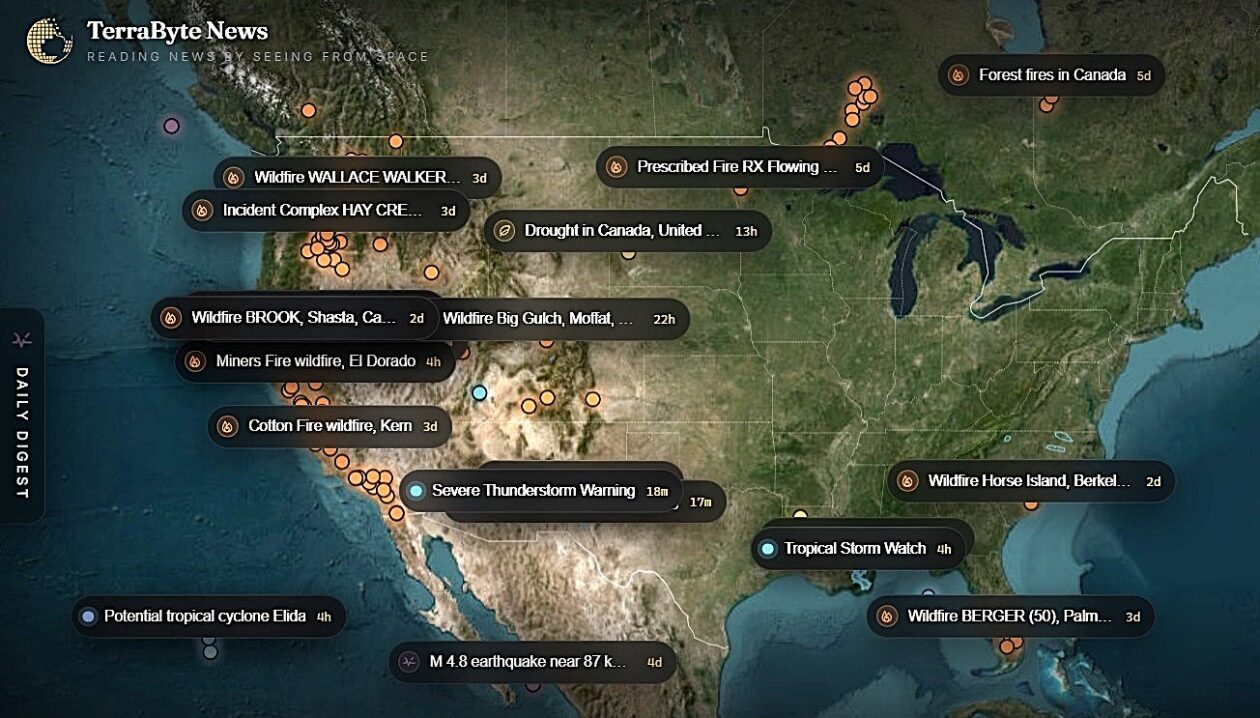
An interactive map displays the sites of wildfires, earthquakes and severe weather events, with links to satellite imagery. (Credit: TerraByte)
Two months after emerging from stealth mode, TerraByte AI is using artificial intelligence and a new partnership to upgrade its “Earth Search Engine.”
The startup, which maintains operations in Seattle as well as San Francisco, has just rolled out a TerraByte News service that pinpoints wildfires, earthquakes and severe weather events on an interactive map. Users can follow links to access news reports, social media posts and satellite views related to selected events.
The satellite views include open-source images from NASA’s Earth observation system as well as Europe’s Sentinel satellites. And now the database also features high-resolution pictures provided through a newly announced partnership with Texas-based SkyFi. The partnership gives TerraByte’s users access to SkyFi’s self-service Earth intelligence platform, which offers satellite and aerial imagery from more than 300 sources at prices as low as $15 per image.
“In May, when we came out of stealth, we made the planet searchable,” TerraByte CEO Rishi Madhok told GeekWire. “Now, the moment you find something, you can hold the imagery in your hands within a day. The next step is making Earth intelligence as routine as a web search — you ask, you see, and then you act.”
Madhok and Fuxun Yu, TerraByte’s chief technology officer, founded the company last year as a follow-up to their work on geospatial data analysis at Microsoft. They developed search tools that can recognize features of interest in satellite images and deliver data-driven insights in response to natural-language queries.
Advertisement
TerraByte’s digest entry for “Forest Fires in France” combines satellite imagery and news reports. (TerraByte Graphic)
Over the past couple of months, TerraByte’s team has grown from three to five employees, Madhok said. “Our goal is to grow the team even further this year, because we are seeing a lot of traction from users since we came out of stealth,” he said.
“A lot of traction is coming from insurance [companies], from the government, from mining, from other areas where there is the possibility to see things,” he said. “And finance, right? A lot of quant firms and hedge funds want to see all of this activity coming in.”
One key application involves emergency response. “Our big focus is on catastrophes, particularly wildfires,” Madhok said. “Our vision is that anybody should be able to track this — not limited to just journalists, but including everyone who is living in those areas and wants to see what’s going on.”
Madhok expects the revenue-sharing partnership with SkyFi to open up new opportunities. “I’m happy to say that we have customers who are paying us,” he said. “From that perspective, we’re already doing well.”
Advances in AI are creating still more opportunities. “Now you can do searches not just using text, but using images, which we call visual search,” he said. “Let’s say you’re searching for a certain kind of vessel, and it’s very hard for you to describe it in natural language. You can just take a screenshot of it, upload it, and within seconds it will literally search for what you were looking for.”
Advertisement
Looking ahead, Madhok and his teammates plan to add people power to the power of AI.
“This is the first version of a platform that we’re going to release, and we obviously want to learn more from our users,” he said. “We want this platform to become crowdsourced, so that people who are local to a region can add more information from that perspective, because then it starts becoming more powerful. We don’t want just TerraByte to be the owner of this.”
Madhok shared a video on LinkedIn that shows how TerraByte’s platform can quickly find high-resolution imagery of a shipwreck in Washington state’s Possession Sound:
Rather than relying on ground beans or a single capsule format, this machine reads the size of whatever pod you drop in thanks to its Dual Capsule Recognition technology, automatically adjusting the brew to suit each specific coffee recipe.
Advertisement
That flexibility extends to the capsules themselves, since the L’OR Barista is built around exclusive double shot capsules alongside L’OR Espresso single shots, while also staying compatible with standard Nespresso Original capsules already sitting in your cupboard.
Being able to brew two cups of espresso, or a single double espresso, from one of those double shot capsules means a ristretto for two or a stronger cup just for yourself is never more than a button press away.
Advertisement
Underneath all that convenience sits genuine brewing power, with the system pushing coffee through at up to 19 bar of pressure to chase the same crema and intensity you would expect from a proper espresso bar.
Every machine also arrives with a coffee tasting box containing four L’OR Espresso single shot capsules and five L’OR Barista double shot capsules, so there’s no need to buy pods separately before your first cup.
With over 930 reviews averaging 4.5 stars and two years of warranty cover included as standard, this is a machine that has already proven itself to plenty of buyers well beyond the strength of a single discount.
At £81 rather than £109.99, the Philips L’OR Barista pays for itself within weeks for anyone funding a coffee habit one overpriced takeaway cup at a time, and our Best Coffee Machine 2026 guide has the full rundown.
The enormous 49-inch Dual QHD OLED display and 32:9 aspect ratio effectively replace two 27-inch QHD monitors, giving you an super-wide workspace for productivity and entertainment.
Add a 240Hz refresh rate, 0.03ms response time, and Nvidia G-SYNC Compatible support, and you’ve got a display that’s as impressive for gaming as it is for multitasking and creative work.
Advertisement
Should you buy it?
✅ Buy the Odyssey OLED G9 monitor if…
You should if you’re looking for a premium ultrawide monitor that excels at far more than gaming. The OLED panel produces exceptional contrast with deep blacks, HDR10+ support adds extra punch to compatible content, and the huge desktop space makes it fantastic for productivity, video editing, and creative work.
❌ Skip the Odyssey OLED G9 if…
You shouldn’t if desk space is limited or you mainly use your PC for everyday office work. At 49 inches with a 32:9 aspect ratio, this is a huge display that demands plenty of room, and many people simply won’t need this much screen real estate.
Advertisement
Today’s top Odyssey OLED G9 monitor deal
Why we recommend it
Samsung has combined a 5120 x 1440 OLED panel with a 240Hz refresh rate and a lightning-fast 0.03ms response time, creating a monitor that feels equally at home handling fast-paced games and demanding professional workloads.
The anti-glare coating helps reduce reflections, while the height-adjustable stand, DisplayPort 1.4, HDMI 2.1, USB-C connectivity, and three-year warranty complete an impressively well-rounded package.
Advertisement
In her 4.5 star review, our monitor expert Allisa said the Odyssey OLED G9 is “an incredible monitor that’s worth the cost.” In addition, she found it to be “fantastic, with plenty of features, excellent display, and a pretty solid speaker system.”
Price Context & Historical Value
The Odyssey OLED G9 normally sells for $1,699.99 at Best Buy, and this $700 discount brings the price down to just $999.99. That makes this flagship OLED ultrawide far more affordable for any buyers who may have previously considered it out of reach.
Advertisement
The Catch: What to know before you buy
This monitor is designed for creatives and enthusiasts, and you’ll need a capable graphics card to make the most of its 5120 x 1440 resolution and 240Hz refresh rate. At its discounted price, a penny under $1000, it’s still a premium purchase, but if you can afford it, I would definitely recommend buying it.















.png)













































You must be logged in to post a comment Login