
Entertainment
White House Celebrates Valentine’s Day with Cards Featuring Nicolás Maduro, Greenland


White House
See Our Valentine’s Day Cards, Featuring Shackled Nicolás Maduro!
Published
Move aside, Melania — Donald Trump‘s White House is celebrating Valentine’s Day with some cheeky cards that applaud the administration’s accomplishments … while mocking the left.
Check out the V-Day cards the White House posted to ring in the holiday — the first shows handcuffed and blindfolded Venezuelan President Nicolás Maduro being flown out of Venezuela after the U.S. captured him in January, with the saying … “You captured my heart.”

Next up shows the prez holding an executive order that reads “UR My Valentine” … while another has a photo of Sen. Chris Van Hollen sitting with former ICE detainee Kilmar Abrego Garcia in El Salvador. The image is framed in a heart and shares 2 messages — “My love for you is as strong as Democrats love for illegal aliens” and “I’d fly 1,537 miles to have a drink with you!”
The fourth V-Day card has a photo of Greenland in a heart with the phrase “It’s time we define our situationship.” As you know … President Trump has harped on his desire to take over Greenland for months, which its residents have strongly opposed.
There’s even more — just check out our gallery.

The WH didn’t forget about Trump’s beloved wife, though … it eventually posted a snap of him and the First Lady on walking hand-in-hand together, captioned with a simple “Happy Valentine’s Day ❤️.”
The prez’s team is clearly all about celebrating Valentine’s Day — even saving some love for his enemies!

Continue Reading
Former Bachelor Ben Higgins thinks Dakota Mortensen joining Unwell Winter Games amid his ongoing domestic dispute with ex-girlfriend Taylor Frankie Paul feels odd.
“It feels weird to me to know that you’ve been in the headlines because your ex and also the
woman [who] birthed your child’s season of The Bachelorette was canceled due to a situation that you’re involved in,” Ben, 37, said on the Wednesday, April 1, episode of his “Almost Famous” podcast. “You’re still involved in [the situation and] you hold full custody of the child right now because of this situation that just happened. … That feels messy [to me].”
News broke earlier this week that Dakota, 33, is among the reality TV alums competing on Unwell Winter Games, a new reality TV show produced by Alex Cooper’s namesake Unwell company for YouTube.

Dakota Mortensen has seemingly found himself in a love triangle while filming Unwell Winter Games amid the fallout of an alleged domestic violence incident with ex Taylor Frankie Paul. “She hooked up with him, then hooked up with me,” Dakota, 33, said in a Tuesday, March 31 trailer for the competition series, after being filmed […]
In his personal life, Dakota was recently awarded temporary full custody of his 2-year-old son, Ever, amid a February domestic violence investigation with Taylor, 31. The Secret Lives of Mormon Wives stars’ first altercation occurred in 2023, leading to Taylor’s arrest. Taylor pleaded guilty to aggravated assault in exchange for the dismissal of additional charges surrounding child abuse.
Footage of Taylor and Dakota’s 2023 fight was leaked nearly three years later, in which Taylor was seen physically assaulting Dakota and throwing chairs at him in front of her daughter, Indy. (Taylor shares Indy, 8, and Ocean, 5, with ex-husband Tate Paul, as well as Ever with Dakota.)
After the 2023 video resurfaced online last month, ABC pulled Taylor’s then-upcoming season of The Bachelorette. Ben, for his part, thinks it’s “hypocritical” that Dakota is given a platform on Unwell Winter Games when Taylor’s season of The Bachelorette was pre-empted.

After The Secret Lives of Mormon Wives season 4 showed Taylor Frankie Paul and ex Dakota Mortensen together hours before she left for The Bachelorette, the question on everyone’s mind is: how open was she with the contestants about how recent that relationship had been? “I feel like I was very open with them, especially […]
“I look at this cast, I’m like, ‘OK, there’s some stuff here that, I would assume, that society still takes very seriously,” Ben said. “It feels to me almost hypocritical for Taylor Frankie Paul. I don’t agree with what happened there. I think it should have ended. I don’t think the show should have aired.”
He added, “Dakota is out here two weeks later on a new show that is not getting the same type of recourse or questions.”
While Ben acknowledged that the 2023 video was “really bad” for Taylor, Dakota allegedly is “not clean in all of this either.”


Utah police are currently investigating two separate incidents between Taylor and Dakota from 2024 and 2026, respectively. Both Taylor and Dakota have denied wrongdoing on their sides.
Cooper, 31, has not addressed the cast list for Unwell Winter Games.
If you or someone you know is experiencing domestic violence, please call the National Domestic Violence Hotline at 1-800-799-7233 for confidential support.
:max_bytes(150000):strip_icc():format(jpeg)/Survivor-Benjamin-Coach-Wade-Aubry-Bracco-Chrissy-Hofbeck-Colby-Donaldson-Joe-Hunter-Tiffany-Ervin-Genevieve-Mushaluk-Dee-Valladares-Kamilla-Karthigesu-Cirie-Fields-Jonathan-Young-Rick-Devens-Rizo-Velovic-033126-2181851da2174eeea17aeea565a770fc.jpg)
There is also an abnormally long list of Applebee’s menu items.
:max_bytes(150000):strip_icc():format(jpeg)/masked-singer-s14-finale-winner-episode-jessica-simpson-galaxy-girl-040126-51a966d0af3945cea010968c57ce7682.jpg)
A past “American Idol” winner, a former girl group member, and more stars unmasked as a new champ is named.
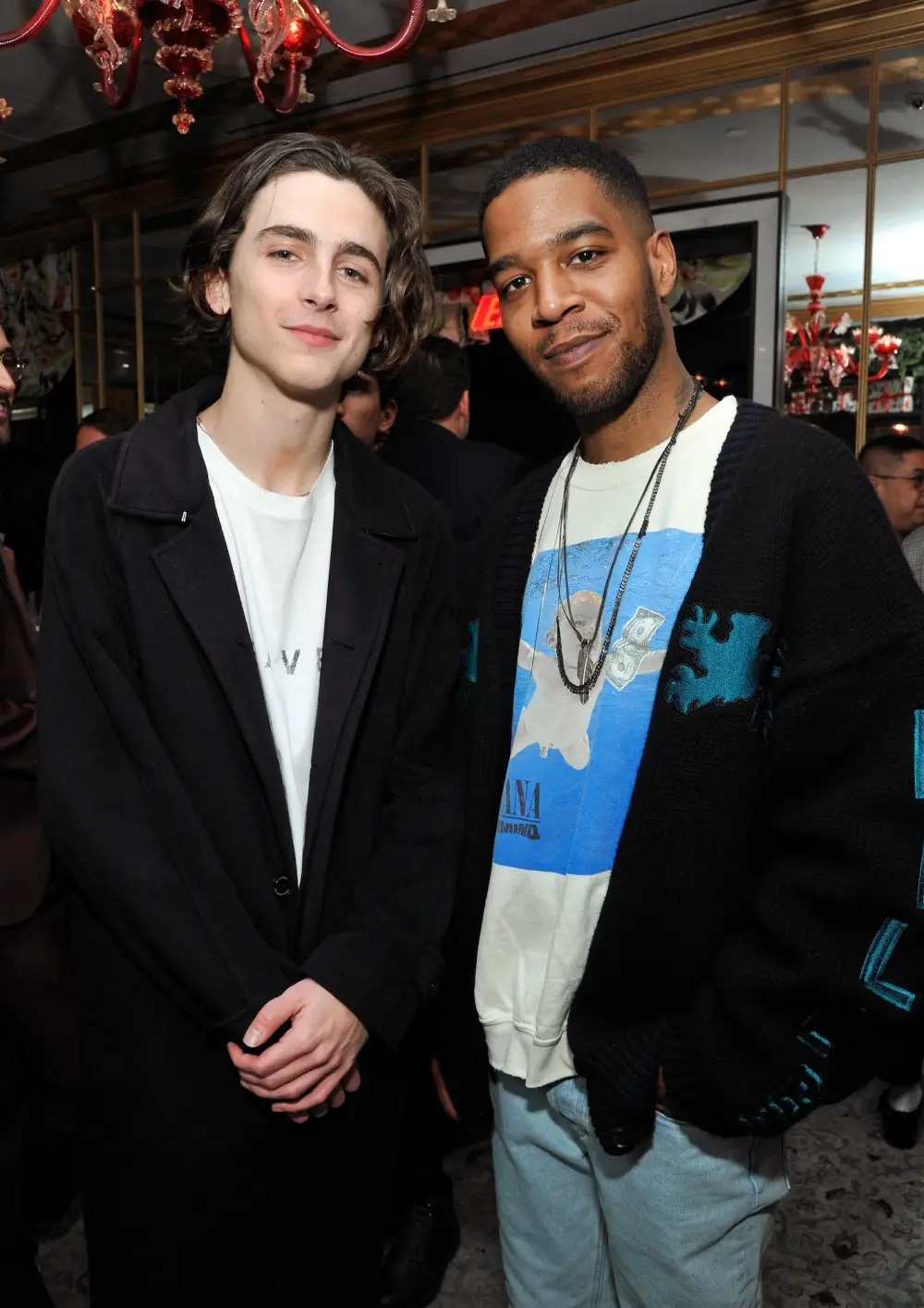
Kylie Jenner is a big fan of boyfriend Timothée Chalamet’s work — and so is Chalamet’s longtime pal Kid Cudi.
The Kardashians star, 28, discussed her favorite Chalamet movies during her appearance on the Wednesday, April 1, episode of Cudi’s “Big Bro” podcast.
“That’s hard for me because I feel like I really love them all,” Jenner said. “But Call Me by Your Name is pretty perfect. It’s just pretty perfect. And I really love [the Dune movies].”
Cudi, 42, then recalled meeting Chalamet, 30, at one of his concerts in Montreal when the Wonka actor was 17. The pair developed a close bond and have made it a tradition to watch Chalamet’s movies together.
“He was winning awards, and he would thank me and talk about me,” Cudi (real name Scott Mescudi) said of Chalamet, who has publicly credited the rapper for inspiring his acting career.
“I would just be like, ‘This kid keeps thanking me in this speech.’ I was like, ‘Do I know him?’ Because he does not look the same as when he was 17. It looked like a totally different person,” Cudi continued. “His team reached out, and then I figured it all out. I was like, ‘Oh, that’s the kid that I met when he was 17.’ And so ever since then, when we reconnected, he took me to see Call Me by Your Name in the theater. … He bought the tickets, and we went to a spot in Los Feliz, and [it was] super dope. And ever since then, that’s been our thing for us to watch his movies together.”
While Jenner wasn’t present at Cudi’s screening of Wonka, the Kylie Skin founder said she has seen the movie “seven times.”

“I remember when you guys were doing that, though. That was fun,” she concluded.
Jenner and Chalamet have been dating since early 2023. Back in January, the Dune star thanked his “partner of three years” while accepting the Critics Choice Award for Best Actor for his role in Marty Supreme.
“Thank you to my partner of three years. Thank you for our foundation. I love you. I couldn’t do this without you. Thank you from the bottom of my heart,” he said at the time.
Jenner and Chalamet have kept their romance fairly private. The reality star explained why during a December 2025 episode of The Kardashians.
“I can’t live for whatever everyone else wants me to do,” she said. “I just have to try to do what’s best for me every day. I know that fame has absolutely shaped me from experiencing these things since I was 9. But I guess I also wouldn’t know who I would be today without growing up like this. I’m just navigating through life.”

Ever since Hulu’s near-perfect sci-fi series premiered a little over a year ago, subscribers have been hooked — something clearly reflected in its strong Rotten Tomatoes scores. Now comprising two seasons with a third on the way, a lot more twists and turns are expected as the story continues to expand its already mind-bending narrative. Dan Fogelman created the sci-fi masterpiece, which premiered on Hulu on January 26, 2025, and last aired about twenty-four hours ago with its intense Season 2 finale.
Renewed for a third season last month, Paradise won’t return until sometime in 2027, though filming on the new chapter begins on April 7. Executive producer and Season 2 finale co-writer John Hoberg has confirmed that creator Fogelman’s plan is still a three-season arc, with the upcoming Season 3 serving as a “pretty definitive” ending for the story. The EP, alongside series star Sterling K. Brown, also teased exciting developments ahead, hinting at a multiverse storyline.
Brown, whose Paradise character, Xavier Collins, has a new mission heading into Season 3, connected the events of the Season 2 finale to the possibility of a multiverse already existing on the show. He shared in an interview:
“I think this is Fogelman’s exploration of the multiverse… And so now that this is introduced into our world, I think the question is, what do you really want? Do you want to go back? Do you want to move forward and leave it alone? Is it too mysterious to play with, to even tinker with, or is it too compelling to not? And different people have different decisions to make based upon where they are in life at that particular time. And you’ll see how that plays out over the course of Season 3.”

Can You Hold Your Own on the B-Ball Court? It’s Today’s Collider TV Quiz!
It’s the last day of March, and the Madness is almost behind us. Huddle up and see what you know about these depictions of basketball on television.
What To Expect in ‘Paradise’ Season 3
In the final episode of Paradise Season 2, titled “Exodus,” it’s revealed that the “Alex” that Sinatra (Julianne Nicholson) has been hiding away is an advanced supercomputer that’s capable of time travel. The finale also sees Sinatra sacrifice herself to shut down the bunker while everyone else escapes its destruction. Still, before then, she tells Xavier he has to be the one to go to Alex and save them all — because she thinks he somehow already has in the future. Teasing Xavier’s next steps, EP Hoberg said:
“The question for me is… Will Xavier answer the call to do what she wants? I don’t know if I can name a specific genre [to describe Season 3], but I do know we’re going with. Xavier has been given a task, and I’m asking myself, is he going to follow through on this? And what are the repercussions if he does and if he doesn’t?”
All episodes of Paradise stream on Hulu. Follow Collider for the latest sci-fi updates.

- Release Date
-
January 26, 2025
- Network
-
Hulu
- Showrunner
-
Dan Fogelman
- Directors
-
Gandja Monteiro
- Writers
-
Jason Wilborn
Entertainment
Courtney Love wants Dave Grohl to tell his fans they're 'cool' now, years after feud: 'Be man enough to man up'
:max_bytes(150000):strip_icc():format(jpeg)/Courtney-Love-Moonage-Daydream-premiere-2022-Dave-Grohl-BMO-Stadium-2025-040126-a49bd6c16d2042bf8ecafc97771363f8.jpg)
The Foo Fighters frontman was a member of Nirvana, the band founded by Love’s late husband Kurt Cobain.
Entertainment
Russell Crowe’s WWII Thriller Is Still One of the Most Addictive War Dramas on Netflix

Russell Crowe is wasting no time getting the ball rolling with his first movie of 2026, Beast, which hits theaters around the world next weekend. The film stars Crowe as a grizzled MMA coach opposite Luke Hemsworth and Daniel MacPherson, and it’s lining up to be a perfect movie for fans who enjoyed The Smashing Machine, Dwayne Johnson’s 2025 MMA biopic. Crowe is also still hard at work filming his new sci-fi/fantasy remake, Highlander, which also stars Henry Cavill and Dave Bautista. The film is a direct remake of the 1986 film led by Christopher Lambert and Sean Connery, and it’s being helmed by tenured John Wick director Chad Stahelski. Highlander still does not have an official release date, but it’s likely that it will make its theatrical debut sometime next year.
2025 was a relatively quiet year for Crowe, at least until November, when he made his long-awaited return to the big screen with Nuremberg, his hit WWII courtroom drama co-starring Rami Malek and Michael Shannon. When early screenings for the film first premiered in the months leading up to its global debut, Crowe was even earning Oscar buzz for his performance as Hermann Göring, but the Academy ultimately passed on recognizing him. Still, Nuremberg grossed nearly $50 million at the global box office before also going on to top VOD charts for weeks. The film debuted on Netflix last month, and although weeks have passed, it’s still one of the most popular movies on the platform. Nuremberg was written and directed by James Vanderbilt, and it’s based on the book titled The Nazi and the Psychiatrist by Jack El-Hai.

Reach into the Television Grab Bag and Pull Out a Prize — The Collider TV Quiz!
Let’s test your breadth of knowledge, not depth, with this sampling of your favorite shows. True fans will take no issue with these questions.
Why Isn’t Russell Crowe in ‘Gladiator 2’?
Even more than 25 years later, Gladiator is still one of the most famous movies of Russell Crowe’s career, so most fans thought he would have some role in the sequel despite being left out of all the trailers. Near the end of 2024, Gladiator II came and went, and there was no sign of Crowe’s Maximus, not even in flashbacks. Ridley Scott’s answer to this was simple, citing that the character died, but Crowe insists that he would have liked to have been included. Late last year, Crowe went public with his harsh criticism of Gladiator II, saying that it was an example of the creatives involved not understanding what made the first film special.
Check out Nuremberg on Netflix in America and stay tuned to Collider for more streaming updates and coverage of Crowe’s future projects.

- Release Date
-
November 7, 2025
- Runtime
-
148 minutes
- Director
-
James Vanderbilt
- Writers
-
James Vanderbilt, Jack El-Hai
- Producers
-
István Major, Richard Saperstein, William Sherak, Bradley J. Fischer, Paul Neinstein

By Jonathan Klotz
| Published

Lexx is a fascinating series to look back on, almost 30 years since its 1997 debut. Unlike every other sci-fi series, Lexx embraced sex head-on with a crew that wanted to hook up as much, or more, than they wanted to defeat His Shadow and free the galaxy from his insidious influence.
They accomplish their mission at the end of Season 2, which allowed the writers to go nuts for Season 3, sending the crew of the Lexx over 4,000 years into the future to deal with the problems plaguing the twin planets, Fire and Water. Fans of the sex obessed series stuffed with satire and irony were not ready for how dark the season would get, and especially didn’t expect Lexx’s captain to be sent to Hell.
The Last Temptation Of Stanley Tweedle

After Lexx drifts into orbit around Fire, the tyrannical Prince (Nigel Bennett) boards the ship with his loyal soldiers, capturing Stanley (Brian Downey) and Xev (Xenia Seeberg), one for torture, one for romance, and even without seeing a second of the show, you can guess who is who. Prince punishes the guilty, tempts others into committing horrendous acts, can die and be reborn, and even judges the dead, making him the closest thing in Lexx to the Devil.
Prince realizes how important Stanley is thanks to his bond with Lexx, and instead of torture, decides to tempt him into destroying the planet Water by offering up, what else, a woman. In this case, it’s gonna be May, a recently deceased citizen of Water Prince resurrected for Stanley. Stanley actively considers destroying Water using Lexx, but resists temptation, and so Prince arrives to spirit May away from him once again.

That moment comes back to haunt Stanley later in the season, when he drowns and winds up in the afterlife of Fire on a beach with one of Prince’s forms for judgment. As it so turns out, saying you were in love isn’t a valid reason to plan planetary annihilation. Thankfully for Stanley, none of his actions from the other universe, where they fought His Divine Shadow, count in this one, but there’s still more enough for Prince to condemn his soul to eternal torture.
From Sex Adventure To Philosophical Debates

If that seems a little heavy for a show that includes a love bot, that’s because it is. Stanley’s adventures during Season 3 may be the darkest of the crew, but everyone, including Kai (Michael McManus) gets put through the emotional and spiritual ringer as the nihilism and hedonism of the first two seasons are reframed through Prince. The writers, realizing that no one from the studio was paying attention, wound up crafting one of the strangest, most interesting seasons of any sci-fi series.
At the end of the day, it’s still Lexx, which means there’s an episode about Kai releasing drag queen slaves and then Lexx eating them all as they attempt to escape from Girltown. Philosophical musings on life and morality are all well and good, but fans still love Lexx because it’s absurd and unlike anything else. Watching Xev get one over on the Devil, Kai drop from space to the surface of a planet, and Stanley realize that maybe he really is a hero (he’s not) is all great, but it’s also a wild tonal adjustment from what came before.

Lexx is easy to dismiss with its low-budget special effects and plots that sound like fan fiction gone too far, but it’s also fun for the same exact reason. Even now, clips of Lexx make it feel like a weird fever dream, and there’s been nothing like it over the last 30 years. Season 3 may not be considered the best of the series, that would be Season 2, but it at least dared to try something wild and different, and in the process, sent the raunchy series in a bold direction that questioned its very existence.

Whew, Roommates! Ray J and Amber Rose are clapping back at Joseline Hernandez after she accused them of allegedly having an intimate relationship in a recent interview. Joseline said she made the assumption after they all appeared on season two of BET’s ‘College Hill: Celebrity Edition’ back in 2023.
RELATED: Ray J Leaves Fans Confused As Video Shows Him Dancing In Nightclub After Mom Confirms Health & Heart Issues
Ray J Responds After Joseline Hernandez Claims He Was Intimate With Amber Rose
Recently, Joseline Hernandez did an interview on her streaming platform ‘Why Are You Here TV.’ The reality star shared her thoughts on a bunch of topics, including Ray J and Amber Rose. She claimed she believed the two had an intimate relationship because they were too “buddy-buddy” on season 2 of the 2023 Celebrity Edition of ‘College Hill.’ Ray J appeared to peep her comments and called her out in a series of videos. He said he was tired of her talking about him and Amber on different platforms.
“You one of the dirtiest people I’ve ever been around.” He continued, “Every other network you either talking about me or Amber […] What’s wrong with you?”
From there, he even threw shade at her hygiene claiming she was allegedly “always musty on the set of the show.” He also said he was disappointed in her and she’s been messing up the brand for a minute.
“But you keep going and think that nobody is going to respond! You bark up this tree and you gon’ find something up top that you don’t want.” Ray added, “This ain’t no plum tree in the summer time.”
Amber Enters The Chat With Some Words For Joseline
Shortly after Ray went off on Joseline, Amber jumped in with her own words. She hopped on her Instagram Story to seemingly clear the air. Amber claimed Joseline allegedly tried hook up with her while they were on ‘College Hill,’ but when she shut it down, Joseline allegedly started bullying her. Amber also accused Joseline of lying about the incident and claimed the production team heard Joseline’s attempts. From there, Amber added that Joseline’s attempt to “hook up with her” didn’t air on the show, but it allegedly happened before she came at her claiming “she talks white.” That led Amber to demand that Joseline tell the truth and admit she supports Donald Trump. “And why don’t you tell Black Instagram and Black Twitter that you [love] Trump. Why don’t you tell them that? Since we putting it all out there.”
Amber also dragged Joseline for being racist and seemingly harassing her for not being ignorant enough to fit in with Black stereotypes. “I’m not Black because I don’t speak ignorantly. That’s how you look at people Joseline? That’s racist!” She continued, “You’re not even Black, you’re Puerto Rican, let’s be all the way clear.”
Joseline Stands Ten Toes Down on Ray J & Amber Being More Than Friends
Joseline seemed to set Ray J and Amber Rose off when she shared her thoughts about them on her ‘Why Are You Here TV’ streaming platform. She said they were too close on ‘College Hill’ to be just friends. “I definitely think they was f*****g in the house.” Joseline continued, “They were too tight, man. Everybody sleep y’all still outside at three in the morning.”
Additionally, she said she thinks they’re still messing around today and she doesn’t trust a male or female who calls their friend a “bestie.” She also called Ray a loser and believes he would hook up with Amber, no doubt! “I feel like they still f*****g. He’s such a cornball. He’s a loser […] so he’ll f*** her, absolutely!”
RELATED: Whew! Shyne Reacts After Ray J Says He’ll “Slap” The “Daylights” Out Of Him & Mase For Claiming They Allegedly Dated Brandy At The Same Time (VIDEOS)
What Do You Think Roomies?
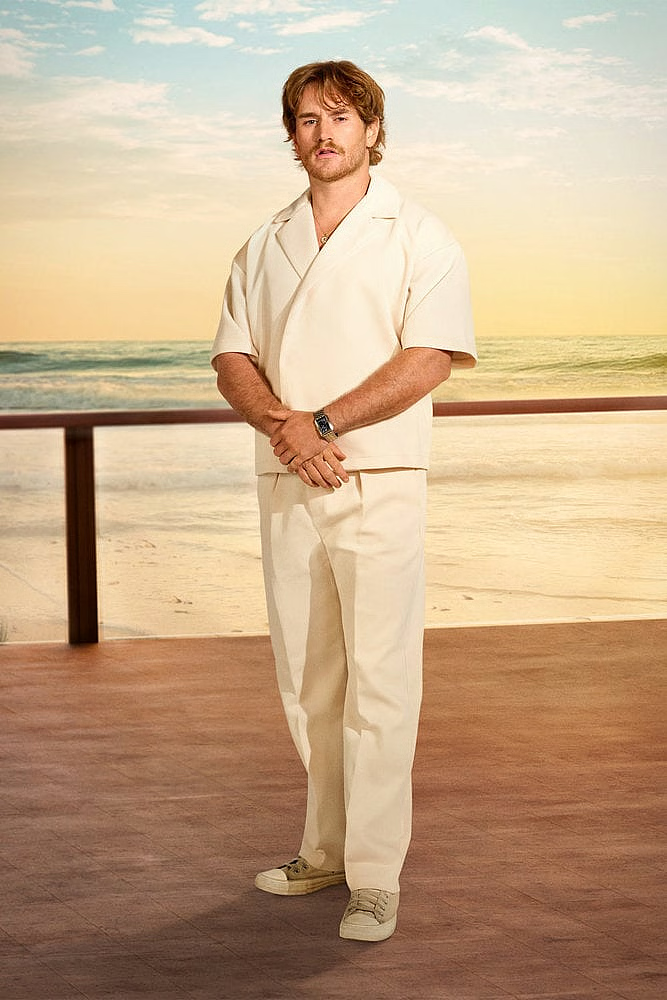
“Summer House” star Kyle Cooke is speaking out after his ex, Amanda Batula, recently confirmed her romantic relationship with cast member West Wilson.
Drama has been brewing in the Bravoverse since late March 2026, after rumors began swirling about Wilson and Batula’s reported relationship.
Kyle Cooke Opens Up About Ex Amanda Batula, Says She’s Being ‘Cyberbullied’ After Confirming Relationship With West Wilson
@adamglyn Caught up with Summer House Star Kyle Cooke and we talk about the Amanda and West Relationship. This is Part 1 of 3! #bravotv #summerhouse ♬ original sound – Adam Glyn
Cooke, who announced his separation from Batula in January 2026, was recently stopped on the streets of New York and said he was still trying to learn the details of Batula’s relationship with Wilson.
“I’ve talked to her — before they put the statement out, she gave me a heads-up, and I talked to her last night,” he said in the TikTok video. “I understand people have all sorts of opinions, and I’m not justifying any behavior, but from where I’m standing, she’s kind of getting cyber-bullied.”
Cooke Says He Is ‘Frustrated’ By Amanda Batula And West Wilson’s New Relationship
Cooke’s statement on Batula’s relationship with Wilson comes days after he dismissed the speculation as a petty rumor.
“I’m obviously frustrated,” Cooke said before appearing to show even more support for his soon-to-be ex-wife.
“I’m obviously disappointed in her, but just hearing her and how unwell she is — [having] dark thoughts — I just ask people to maybe let off the gas a little bit with the cyberbullying and hate,” he said.
Amanda Batula Confirms Relationship With Her Friend’s Ex In A Joint Instagram Statement

Wilson and Batula confirmed their relationship in a joint statement shared on their Instagram.
“We’ve seen the growing online speculation, so while this is still very new, we wanted to provide some clarity,” the post read. “It was never our intention to purposely hide anything. Given the complicated relationship dynamics involved and the scrutiny that comes with being on a reality show, we need a little space to process things privately before speaking on it.”
They added, “We’ve shown up for each other as friends over the years, through all the highs and lows, and what’s developed recently was the last thing either of us expected. Our connection grew out of a genuine, long-standing friendship, which made it especially important for us to approach this with care.”
The news of their connection also comes amid Wilson’s complicated relationship with Batula’s friend, Ciara Miller, whom he dated during season 8 of “Summer House.”
‘Summer House’ Cast Reportedly ‘P-ssed’ And ‘Disappointed’ In Amanda Batula And West Wilson

Besides Cooke, most of Batula and Wilson’s “Summer House” co-stars have stayed silent on the scandal. However, a source told Page Six that they are “p-ssed” and “disappointed” in both of them.
The insider went on to say that most of the cast members are “Team Ciara,” noting her rocky relationship with the sports writer and content creator in 2023.
In March 2026, Miller got candid about the challenges she faced after opening up about her interracial relationship with Wilson.
“I don’t think you guys also realize the interracial aspect that exists and all the s— that goes on,” Miller said. “I get a lot of blowback that’s very racial, obviously, being in this position. I was the first Black person in this house, and then dating publicly, dating white guys publicly, is a whole contraption that I don’t think you guys can understand or can even empathize with.”
According to The Blast, newcomer KJ Dillard shared an image to his Instagram Stories yesterday of a song from The O’Jays titled “Back Stabbers.”
In another post, he shared an image of himself with Miller and fellow Bravo newbie Mia Calabrese and wrote, “I love my big sisters for life.”
Dillard, Calabrese, and other “Summer House” stars have reportedly unfollowed Batula and Wilson in support of Miller.
Batula Boasted About How Great Of A Friend Miller Was To Her

Weeks before Miller and the “Summer House” crew parted ways with Wilson and Batula, the latter boasted about how great a friend Miller was to her.
Speaking with Marie Claire, the reality star described Miller as “one of the kindest, most loving, loyal friends I’ve ever had.”
“[Miller] sends me texts out of the blue, reminding me how strong, powerful, smart, and kind I am—I don’t think she even realizes how much I need those texts,” she said.

Crypto World19 seconds ago
Bitcoin Price Prediction Heats Up as Nakamoto Inc Sells $20M in BTC and Pepeto Eyes 100x Before Listing

Sports3 minutes ago
Chiefs GM Brett Veach silent on invite to Travis Kelce, Taylor Swift’s wedding

Tech4 minutes ago
Artemis II Mission Launches Successfully


![Why A Major Bitcoin Bounce Is Imminent [Data]](https://wordupnews.com/wp-content/uploads/2026/04/1775098099_maxresdefault-80x80.jpg)
-

 Business6 days ago
Instagram, YouTube Found Responsible for Teen’s Mental Health Struggle in Historic Ruling
-
 Tech6 days ago
Intercom’s new post-trained Fin Apex 1.0 beats GPT-5.4 and Claude Sonnet 4.6 at customer service resolutions
-

 NewsBeat5 days ago
The Story hosts event on Durham’s historic registers
-

 Sports5 days ago
Sweet Sixteen Game Thread: Tide vs Michigan
-
Entertainment3 days ago
Fans slam 'heartbreaking' Barbie Dream Fest convention debacle with 'cardboard cutout' experience
-
 Entertainment4 days ago
Lana Del Rey Celebrates Her Husband’s 51st Birthday In New Post
-
Crypto World2 days ago
Dems press CFTC, ethics board on prediction-market insider trades
-

 Tech3 days ago
The Pixel 10a doesn’t have a camera bump, and it’s great
-

 Crypto World7 hours ago
Gold Price Prediction: Worst Month in 17 Years fo Save Haven Rock
-

 Sports1 day ago
Tallest college basketball player ever, standing at 7-foot-9, entering transfer portal
-

 Tech2 days ago
EE TV is using AI to help you find something to watch
-

 Tech2 days ago
Apple will hide your email address from apps and websites, but not cops
-

 Tech2 days ago
Flipsnack and the shift toward motion-first business content with living visuals
-

 Tech2 days ago
How to back up your iPhone & iPad to your Mac before something goes wrong
-

 Fashion6 days ago
En Vogue in Brown Leather and Tailored Neutrals by Atelier Savoir, Styled by J Bolin
-

 Politics2 days ago
Should Trump Be Scared Strait?
-

 Crypto World2 days ago
U.S. rule change may open trillions in 401(k) funds to crypto
-

 Fashion6 days ago
What Are Your Favorite T-Shirts for the Weekend?
-

 Fashion5 days ago
Weekly News Update, 3.27.26 – Corporette.com
-

 Crypto World1 day ago
Bitcoin enters the public bond market as Moody’s gives a first-of-its-kind crypto deal a rating
You must be logged in to post a comment Login