

Crypto World
Anthropic Nearly Tripled Its Lobbying Bill to $3.53 Million in Six Months



Technology, artificial intelligence, and prediction market companies spent record sums lobbying Washington in the first half of 2026. New federal disclosures filed this month show the scale of the push.
Anthropic nearly tripled its federal lobbying, outpacing rival OpenAI by more than $1 million.
Anthropic Outspends OpenAI on Federal Lobbying
The Financial Times reported that Anthropic nearly tripled its lobbying expenditure to $3.53 million. The firm added the Treasury Department to its list of lobbied agencies for the first time this quarter.
OpenAI nearly doubled its own spend to a record $2.22 million. Federal rules on new model releases now sit at the top of the industry agenda. Companies also want influence over data center construction, power supply, and more.
“The lobbying offensive has been as much about deterring regulation as making the case for an affirmative government industrial policy that supports the industry,” Amba Kak, co-executive director of AI Now Institute, said.
Follow us on X to get the latest news as it happens
Issue One Counts 324 Lobbyists Across Six Companies
Overall, Issue One counted $41 million in combined spending from January to June. That covers 11 major technology, social media, and AI companies and their trade associations.
The total works out to more than $226,000 per day. The figure rose 8% from $38 million in the same period of 2025.
Six of those companies retained 324 lobbyists during the second quarter alone. The group covers Alphabet, Anthropic, Meta, Microsoft, Nvidia, and OpenAI. That equals roughly one lobbyist for every 1.5 members of Congress.
Meta led second-quarter spending at nearly $6 million. Alphabet followed with $5.3 million, Microsoft with about $3 million, and Nvidia with $1.25 million.
Anthropic reported $1.97 million in lobbying spending for the quarter, its highest since it began lobbying in March 2024. OpenAI spent $1.2 million over the same three months. Notably, four years ago, Anthropic, Nvidia, and OpenAI had no federal lobbyists.
The spending is not limited to tech and AI companies. Prediction market operators have also stepped up their efforts in Washington.
BeInCrypto reported that Kalshi spent $990,000 on lobbying in the first half of 2026. Including outside firms, its total reached nearly $1.8 million. Polymarket keeps a smaller footprint.
Subscribe to our YouTube channel to watch leaders and journalists provide expert insights
The post Anthropic Nearly Tripled Its Lobbying Bill to $3.53 Million in Six Months appeared first on BeInCrypto.

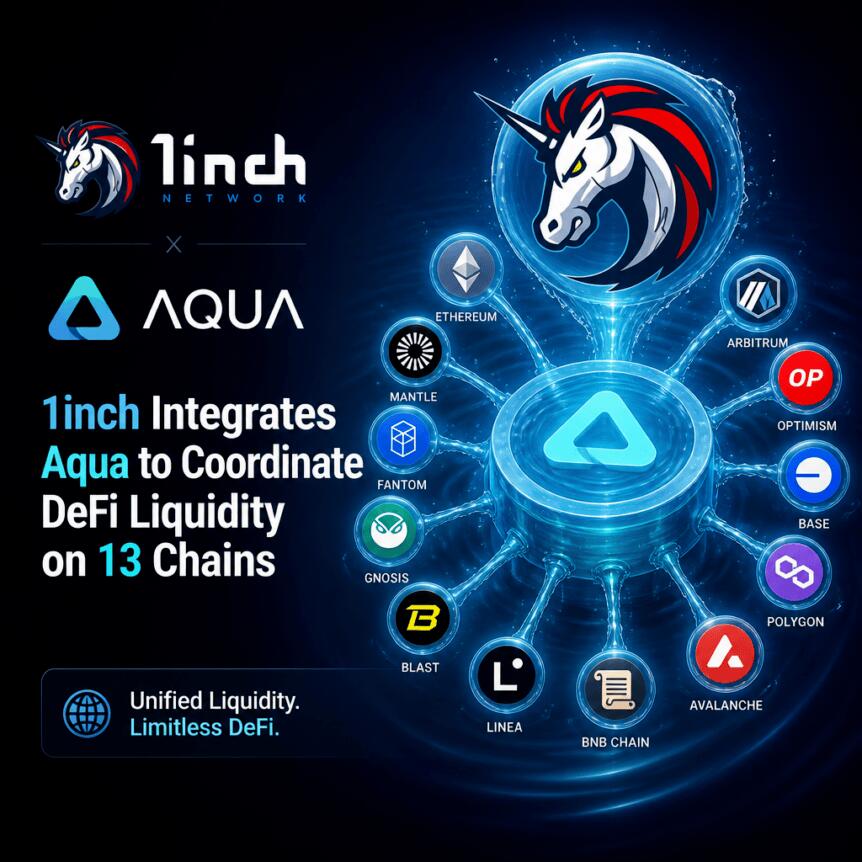
1inch has unveiled Aqua, a DeFi protocol designed to unify liquidity across multiple decentralized markets without forcing liquidity providers (LPs) to deposit funds into a specific venue. The announcement frames Aqua as a way to make liquidity more flexible across blockchains and protocols, while still enforcing capital constraints so funds aren’t overextended in simultaneous trades.
According to 1inch’s release on Tuesday, Aqua lets LPs authorize multiple strategies from a single wallet inventory and keeps the assets in that wallet until an executed swap settles—rather than routing the liquidity into any one liquidity pool. The protocol is already deployed across 13 blockchains, including Ethereum, Arbitrum, Base, Robinhood Chain, and BNB Chain.
Key takeaways
- Aqua coordinates liquidity across protocols without requiring LP funds to be deposited into a single pool.
- Wallet-backed strategies maintain atomic settlement, reverting trades if they exceed available wallet balances.
- Assets can only be used in one operation at a time, limiting effective over-allocation even if liquidity is “advertised” broadly.
- Incentives are planned via a pending tokenholder vote: 500,000 USDC plus 10 million 1INCH tokens earmarked for adoption.
How Aqua is meant to work
At the core of Aqua is an integrated system that 1inch describes as combining a generalized onchain registry, wallet-backed automated market making (AMM) strategies, atomic settlement, and consumer-facing position management.
Instead of tying liquidity to a particular protocol, the LP effectively “authorizes” strategies against their wallet’s available inventory. This distinction matters for capital efficiency: liquidity can be made available across a broader set of supported markets, potentially improving access for traders searching for swaps on different venues.
1inch also emphasizes a hard constraint designed to prevent true capital multiplication. While a provider can advertise the same amount of liquidity across multiple protocols, the liquidity cannot support unlimited simultaneous executions.
To illustrate the trade-off, 1inch’s explanation includes a scenario in which an LP supplying $10,000 can list $10,000 on three protocols for a combined $30,000 advertised availability, but only $10,000 worth of trades can run at the same time with those funds. In practice, this is closer to coordinated “overbooking” with strict execution limits than to a mechanism that multiplies liquidity across independent pools.
Atomic settlement and balance safety checks
In an interview with Cointelegraph, a 1inch spokesperson said Aqua can be used by “resolvers” holding a 1inch-issued access credential, noting that not all protocols are supported under the system.
The spokesperson further explained how Aqua prevents swaps from exceeding the wallet’s balance. They stated that all quoted positions are priced against the market maker’s live wallet balance, and once a fill occurs, remaining quotes adjust to reflect what’s left.
If an attempted swap would go beyond available funds, the system is designed to revert atomically. As the spokesperson put it: “If a swap would exceed the actual balance, it reverts atomically.”
For investors and traders, this approach addresses a key risk in liquidity aggregation: ensuring that quoted prices and advertised availability correspond to real executable inventory. Rather than relying on liquidity being pre-positioned in a given pool, Aqua ties execution to wallet state at settlement time.
Expansion across blockchains—and how incentives may pull liquidity in
Aqua’s initial rollout is positioned as multi-chain from the start, with deployments on 13 networks. That matters because one of DeFi’s practical frictions is not only the fragmented liquidity across protocols, but also the fragmentation across chains—each with its own trading dynamics and wallet activity.
To accelerate usage, 1inch says a related tokenholder process is underway. Pending vote approval, the protocol will allocate 500,000 USDC toward incentives for adopting Aqua, alongside 10 million 1inch (1INCH) tokens, described as roughly $830,000 at the time of writing. The announcement says the initiative is designed to “accelerate liquidity growth and swap activity across supported pairs.”
The incentives are contingent on approval through 1inch’s governance forum, referenced by the company in its announcement. If approved, the program would connect Aqua’s technical liquidity unification goal to a direct adoption push—something that typically becomes critical early when new routing or liquidity coordination systems must prove they can attract meaningful volume.
Why Aqua’s design could change how liquidity is routed
Liquidity aggregation in DeFi has traditionally meant either routing trades through existing pools, or encouraging liquidity providers to place capital into specific venues. Aqua’s differentiator is the separation between where capital resides (the wallet inventory) and where it is made actionable (strategies across markets).
However, the protocol’s constraint—that assets aren’t truly multiplied and can participate in only one operation at a time—suggests Aqua is aiming for better coordination rather than unlimited leverage of inventory. The “advertise broadly, execute limitedly” framing implies that Aqua could improve utilization when overlapping demand is unlikely, while preventing failure scenarios where more traders execute than the capital supports simultaneously.
That uncertainty—how often real-world demand overlaps across the set of supported strategies—will likely determine how quickly Aqua’s theoretical improvements translate into measurable routing performance. Investors and builders may want to monitor whether swap volume increasingly clears via Aqua-linked pathways and whether the promised improvement in liquidity availability shows up in practice as more wallets and resolvers participate.
Finally, it’s worth noting that 1inch’s announcement arrives amid ongoing internal turbulence. Earlier this month, Cointelegraph reported that co-founder Anton Bukov said he was “fired” from 1inch in November 2025 after “push[ing] for change” in company management and operations. While that dispute isn’t directly tied to Aqua’s technical rollout, it remains part of the broader context around execution risk and governance decisions as the protocol moves into incentive-driven adoption.
For now, the key question for readers is whether Aqua can attract liquidity at scale and translate its unified wallet inventory model into sustained swap throughput—particularly once the proposed USDC and 1INCH incentive program is decided. The next watch items are the tokenholder vote outcome and whether Aqua’s multi-chain deployments drive measurable growth in routed trading across the supported pairs.

Kraken has announced that eligible retail customers in the US can request allocations for Jersey Mike’s shares through its tokenized IPO offering, joining a growing list of equity tokenization rollouts tied to high-profile public listings. The exchange says US participants can submit interest in book-entry Jersey Mike’s shares at the IPO price, while customers outside the US can request JMKEx—a tokenized version of the stock backed 1:1 by underlying shares held in regulated custody.
When the Jersey Mike’s IPO closes, JMKEx is set to trade 24 hours a day, five days a week on Kraken and participating platforms in the xStocks Alliance network. The underlying Jersey Mike’s Class A shares will trade only during regular US market hours.
Key takeaways
- Kraken will offer two participation paths: book-entry shares for eligible US customers and tokenized shares (JMKEx) for eligible global customers.
- JMKEx is designed to track the underlying Jersey Mike’s stock on a 1:1 basis, with backing shares held in regulated custody.
- Trading for JMKEx is planned for near-continuous sessions (24/5), while the regular stock will follow US market hours.
- Allocations depend on the IPO process and are not guaranteed, meaning demand could outstrip supply—an issue that already affected earlier tokenized IPO campaigns.
- Kraken says tokenized shares can move across participating xStocks Alliance platforms and be used in compatible onchain integrations.
How Kraken’s Jersey Mike’s tokenized IPO works
Kraken’s announcement frames the offering as an extension of its tokenized IPO access model. For eligible US customers, participation is submitted as interest in book-entry Jersey Mike’s shares at the IPO price. For customers in more than 110 countries, Kraken instead enables requests for JMKEx, a tokenized share representation backed by actual Jersey Mike’s shares held in custody.
The exchange emphasizes that allocations are determined by the IPO underwriter and that requests do not guarantee receipt of shares. That distinction matters for retail users who are used to instant execution in standard crypto markets; tokenized IPO campaigns typically depend on traditional IPO distribution mechanics before moving into secondary trading.
Tokenized trading, custody, and cross-platform movement
Once the IPO closes, Kraken says JMKEx will begin trading 24/5 on Kraken and on platforms that participate in the xStocks Alliance. The underlying stock is expected to continue trading during regular US sessions, highlighting the structural split between traditional equity market hours and crypto-native trading windows.
Kraken also claims that tokenized shares can be transferred across participating xStocks Alliance platforms, moved onchain, and integrated with compatible decentralized finance applications. In practical terms, this is pitched as a way to bring more public equity exposure into ecosystems that don’t rely on traditional brokerage accounts—while keeping a direct tie to the underlying shares through custody.
Jersey Mike’s IPO details and expected listing
Jersey Mike’s is a US sandwich chain with more than 3,300 locations. According to the company’s IPO announcement, it expects to price the offering between $21 and $25 per share and list its Class A shares on the New York Stock Exchange under the ticker JMKE.
Kraken’s tokenized offering is built around that traditional IPO process: users seeking exposure through JMKEx receive a claim representation backed by actual shares, with pricing tied to the IPO pricing mechanism rather than to token spot formation alone.
Lesson from SpaceX: when demand outran supply
This is not Kraken’s first tokenized IPO-linked product. The exchange’s roll-out follows the public debut of SpaceX via similar tokenized access in June, which also saw participation from other crypto platforms. Several venues launched offerings tied to the SpaceX IPO, including Binance, Bybit, Blockchain.com, Bitget Wallet, and MEXC.
But in that case, reported demand for underlying shares quickly became a limiting factor. Cointelegraph previously noted that the SpaceX IPO was reported to be more than four times oversubscribed, leaving tokenized platforms competing for a finite pool of shares. Eventually, multiple exchanges canceled their tokenized IPO allocation campaigns and refunded users after they could not secure enough underlying shares to fill customer allocations.
That earlier episode highlights a recurring risk for retail users considering tokenized IPO access: even when tokens are marketed as “share-like” exposure, the initial distribution is still governed by IPO underwriting supply. Kraken’s statement that allocations are not guaranteed directly addresses that structural uncertainty.
Cointelegraph also reported that the SpaceX-backed Nasdaq-traded shares have traded below the IPO price, with a reference last trading around $115 after an initial $135 figure—underscoring that tokenized IPO access does not insulate participants from typical post-listing price dynamics.
Tokenized equities keep expanding despite rollout friction
The challenges around the SpaceX rollout have not appeared to slow broader growth in tokenized equities. Data cited from RWA.xyz indicates that the sector’s distributed value rose from under $500 million in mid-2025 to about $1.87 billion, including a 29.4% increase over the past 30 days.
For investors and builders, the takeaway is less about any single IPO and more about the evolution of the infrastructure: demand can spike faster than IPO allocation supply, but the market is still attracting capital and expanding distribution methods for real-world assets and tokenized securities.
As Kraken prepares to support JMKEx ahead of the Jersey Mike’s listing, users should watch the allocation outcome closely—especially given the oversubscription lessons from earlier tokenized IPO launches—and then pay attention to how quickly onchain integrations and cross-platform transfers mature after trading begins.
Florida Rep. Mike Haridopolos has renewed his push for the CLARITY Act as Senate delays narrow the bill’s path to passage before the August recess.
Summary
- Haridopolos warned that continued delays could push US crypto businesses and investment overseas.
- Senate leaders prioritized 74 federal nominees and a Russia sanctions bill over the CLARITY Act.
- The bill needs at least eight Democratic votes to overcome the Senate’s procedural threshold.
Haridopolos warns US crypto leadership is at risk
Haridopolos, a Republican member of the House Financial Services Committee, defended the CLARITY Act during a July 28 appearance on Fox Business’ Mornings with Maria. He argued that the legislation is needed to keep digital asset activity within the United States.
“This is about making sure that American markets are the premier markets in the world.”
Haridopolos also accused Senate Democrats of using procedural delays to block legislation supported by voters. Fox Business described the bill as stalled as lawmakers approach their summer break.
Haridopolos voted for the House version in July 2025. The measure passed by a bipartisan 294–134 vote, with 78 Democrats joining 216 Republicans, according to the House Financial Services Committee.
The legislation would establish separate responsibilities for the Securities and Exchange Commission and Commodity Futures Trading Commission. Its backers say those rules would give exchanges, token issuers and blockchain developers a clearer route to operate in the US.
Senate schedule delays CLARITY Act vote
Senate Majority Leader John Thune has temporarily shifted floor attention toward a group of federal nominees and the Lindsey O. Graham Sanctioning Russia and Iran Act of 2026.
That schedule makes action on the CLARITY Act unlikely before the final week of the current session. The Senate’s summer break is scheduled to begin after August 7, with a state work period running from August 10 through September 11, according to the official Senate calendar.
Thune has indicated that the Senate may still take preliminary action before the break, but leadership first needs to determine whether enough votes are available. The bill requires at least eight Democratic votes to advance under the current Senate balance.
The Senate Banking Committee advanced the legislation by a 15–9 vote in May, with two Democrats supporting it at the committee stage. However, both indicated that their support did not guarantee a floor vote without further changes.
Ethics and state enforcement remain disputed
Negotiations now center on restrictions covering elected officials and their digital asset interests. The Senate draft would temporarily bar certain officials, including the president and vice president, from issuing or sponsoring crypto assets until January 2029.
Enforcement would rest with the Justice Department. Democrats have objected because the draft would prevent state attorneys general from acting if federal officials decline to bring a case. The bill needs more Democratic support before it can move forward.
New York Attorney General Letitia James has raised a separate concern over state authority. She argued that the bill could override state digital asset rules and weaken local efforts to pursue crypto scams.
James called for stronger anti-money laundering, customer identification and cybersecurity requirements. Crypto-related complaints to her office have tripled over the past three years, according to the New York Attorney General’s office.
What the delay means for US crypto markets
The delay does not immediately change the legal status of crypto assets, US exchange operations or spot crypto ETFs. However, it extends uncertainty over which regulator would oversee token trading, fundraising and digital commodity markets.
Support remains broad among crypto companies and parts of Wall Street. Coinbase, Ripple, the Digital Chamber and other industry groups backed the House bill, while Goldman Sachs CEO David Solomon recently supported advancing the Senate version despite calling it imperfect.
September may provide the next opportunity if lawmakers fail to act before recess. The Senate would still need to pass its version, reconcile it with the House bill, and return the final text for congressional approval. Failure to complete those steps before the end of the current Congress could push the market structure debate into 2027.
Liquid staking app Lido has started moving the bulk of its staked ETH onto Ethereum’s larger post-Pectra validators, and the operators running them are now putting up their own capital for the first time.
The main idea is that Lido’s curated node operators stop running thousands of identical 32 ETH validators and collapse them into far fewer, much larger ones.
$16B in ETH Moved
Moreover, Ethereum’s Pectra hardfork, activated in May 2025, raised the maximum effective balance per validator to 2,048 tokens through what are known as 0x02 credentials. Curated Module v2 is the piece of Lido Core that now supports them natively (Phase 1 went live on Monday).
The scope is the Curated Module itself, the permissioned operator layer that has handled well over 90% of Lido’s staked ETH since the protocol launched in 2020. That covers more than 265,000 existing validators and more than 8 million ETH, worth about $16 billion.
It’s worth knowing Lido is doing this in a tighter market. As CryptoPotato reported, its revenue fell roughly 25% last year, and its share of all staked ETH slid from more than 28% in 2024 to just over 24% in December 2025.
No Longer Trust, Operators Now Must Post Bonds
Basically, trust alone is no longer enough, and operators have skin in the game. This means they have to lock up their own ETH as collateral, so if they get or fail operationally, that ETH is taken.
Their bond is smaller than in Lido’s permissionless modules because they’re still considered more trustworthy than open applicants. The governance update also removes unnecessary DAO votes for routine administrative tasks like changing an operator address, reducing bureaucracy.
The migration will take months because Ethereum limits how quickly validators can exit and be restaked. While they’re offline, they stop earning rewards, which Lido estimates will cost about 738.5 ETH. The 117-day figure is the fastest Ethereum theoretically allows, while six months is the practical estimate.
The post Why Is Lido Moving $16B in Staked ETH to Pectra-Era Validators? appeared first on CryptoPotato.
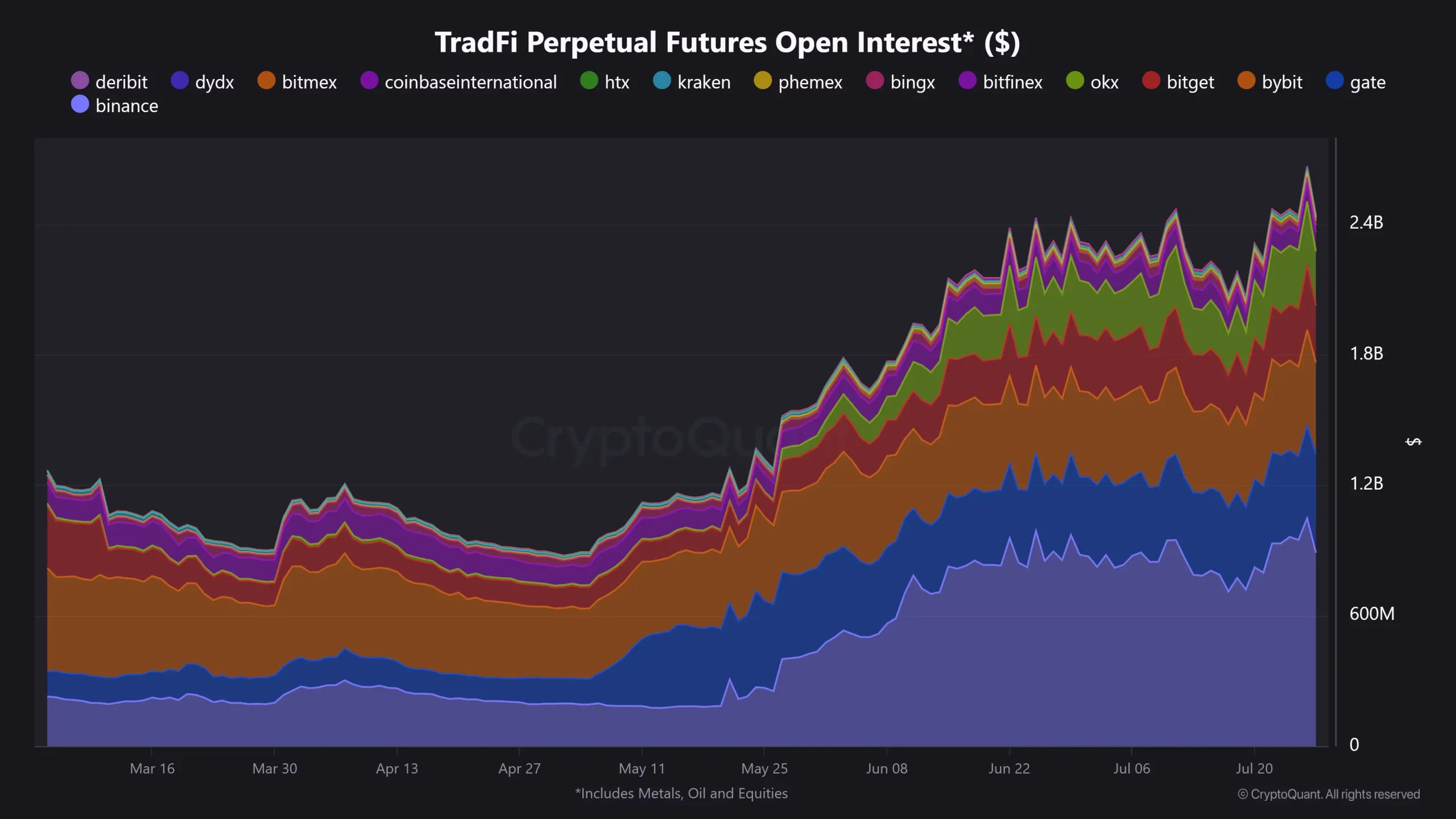
Open interest in perpetual contracts tied to stocks, metals and oil has doubled since late May as major crypto exchanges expand beyond digital assets, CryptoQuant reported.
Summary
- TradFi perpetual open interest has more than doubled to over $2 billion since late May.
- Binance, Bybit and Gate control about 70% of the emerging derivatives segment.
- Crypto perpetual open interest stands near $65 billion, around 20% below its previous peaks.
TradFi perpetual open interest climbs above $2B
TradFi perpetual contracts have become one of the fastest-growing areas of the crypto exchange market, according to CryptoQuant’s report.
The products give traders continuous exposure to traditional assets, including metals, crude oil and equities. Unlike standard futures, perpetual contracts do not have a fixed expiry date and use regular funding payments to keep their prices close to the underlying market.
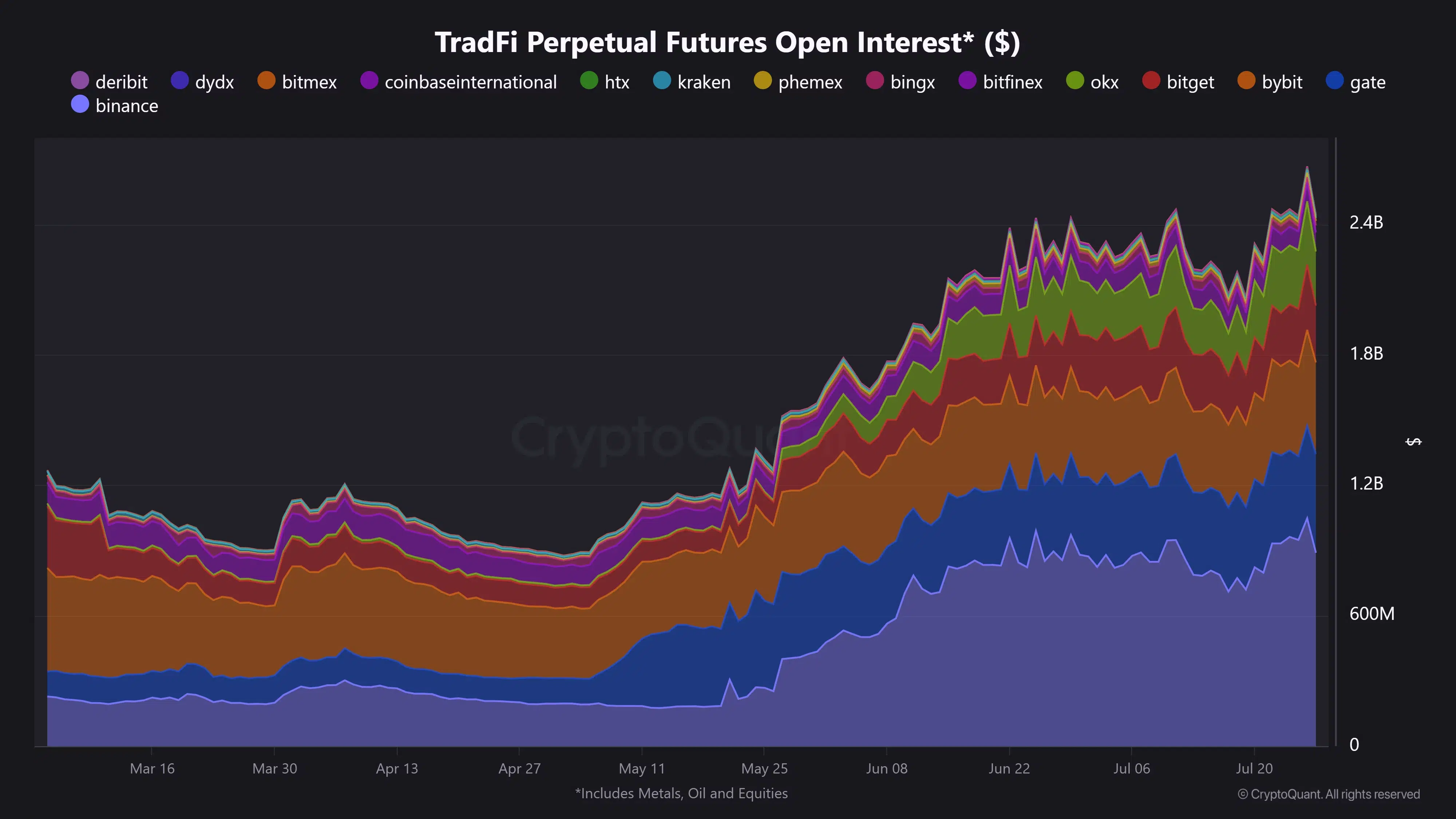
Open interest in these products remained between roughly $350 million and $500 million during spring 2026. It then rose sharply from late May, crossing $2 billion by July.
The increase allows crypto exchanges to compete more directly with traditional trading platforms. Crypto venues can offer the contracts around the clock, including during hours when conventional stock and commodity markets are closed.
Despite the rapid growth, TradFi perpetuals remain small compared with crypto derivatives. CryptoQuant estimated that the segment represents only around 3% of the roughly $65 billion held in cryptocurrency perpetual contracts.
Binance extends its derivatives lead into TradFi
Binance holds the largest share of open interest in both categories, showing how established crypto exchanges are using their liquidity and trading infrastructure to enter traditional asset markets.
CryptoQuant’s headline snapshot placed Binance’s TradFi perpetual open interest at around $720 million, equal to roughly 35% of the market. Bybit and Gate followed with about $381 million each.
Together, the three exchanges accounted for around 70% of TradFi perpetual open interest. Adding OKX and Bitget brought the top five’s share to approximately 93%, leaving the remaining capital spread across smaller venues.
The concentration mirrors the structure of the crypto perpetual market. Binance held about $22.86 billion, or 35%, of crypto perpetual open interest in the report’s main snapshot. Bybit followed with $9.67 billion, while Gate held $8.61 billion.
Those three platforms controlled approximately 63% of crypto perpetual open interest. The five largest exchanges, including Bitget and OKX, accounted for about 81%.
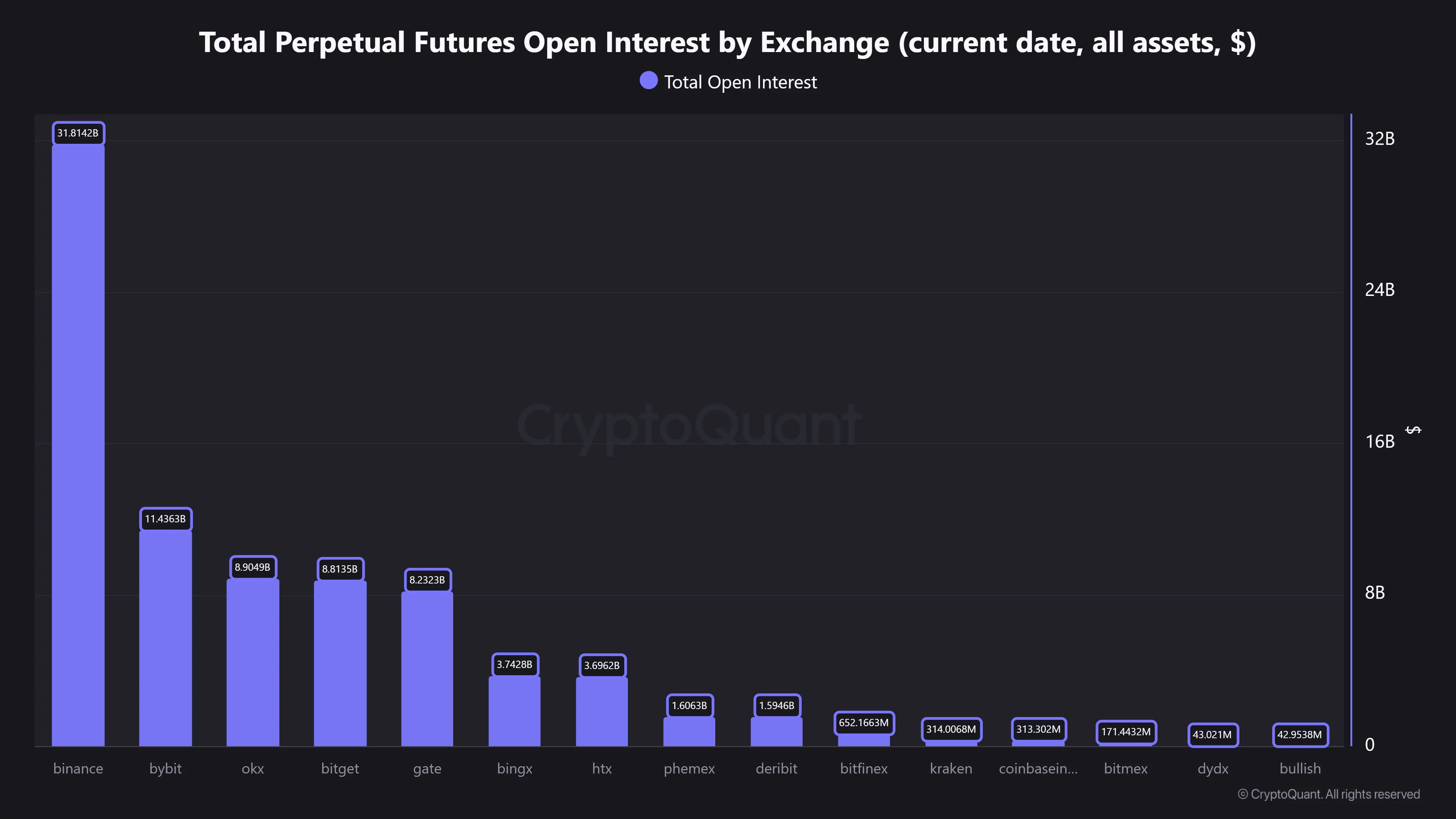
Crypto perpetuals remain below previous peaks
Aggregate crypto perpetual open interest has expanded five to six times since early 2023, when it stood near $12 billion to $15 billion.
Capital in outstanding contracts reached about $80 billion in September 2025 and returned to a similar level in early 2026. It has since fallen by roughly 20% to around $65 billion.
CryptoQuant interpreted the decline as evidence of deleveraging or capital withdrawals rather than fresh money entering the crypto derivatives market. The fall contrasts with the growth in products tracking traditional assets.
However, the $2 billion TradFi segment is not yet large enough to offset changes in the broader crypto perpetual market. Its expansion instead shows exchanges adding new markets while retaining the same concentration of capital among the largest operators.
US perpetual futures market follows a regulated path
US investors are gaining access to similar products, but domestic contracts operate under a different regulatory structure.
Coinbase Financial Markets offers US customers CFTC-regulated perpetual-style futures that trade nearly around the clock. Unlike offshore perpetuals with no expiry, Coinbase’s contracts have five-year terms and use funding payments to stay aligned with spot prices.
The US market is also moving toward true perpetual contracts. In May, the Commodity Futures Trading Commission approved Kalshi’s cash-settled Bitcoin perpetual futures contract, which has no fixed expiration date and trades continuously. The regulator said its assessment applies on a contract-by-contract basis and does not automatically cover perpetuals tied to non-crypto assets.
CryptoQuant’s findings suggest that demand for continuous trading is spreading beyond cryptocurrencies. Whether TradFi perpetuals become a larger source of exchange capital will depend on liquidity growth, regulatory access, and whether traders continue moving activity from conventional venues.


Regional mediators are reportedly close to a proposal that could restart the US-Iran memorandum of understanding, although Tehran continues to deny seeking renewed talks with Washington.
Summary
- Pakistan, Egypt and Qatar are reportedly pushing a plan to revive the US-Iran MoU.
- Iran and Oman have reportedly accepted a proposal addressing disputes over the Strait of Hormuz.
- Tehran denies requesting negotiations and wants greater control over shipping routes through the strait.
- Brent crude fell 4.8% to $84.09 as markets responded to reduced hostilities.
Mediators push US-Iran MoU revival
Pakistan, Egypt and Qatar have stepped up efforts to revive the US-Iran framework signed last month, according to two sources cited by The Times of Israel.
The mediators have developed a proposal aimed at resolving conflicting interpretations of how the MoU applies to the Strait of Hormuz. Iran argues that the agreement gives it some authority over operations in the waterway, while Washington maintains that it does not.
Iran and Oman have reportedly approved the mediators’ proposal. A final decision now rests with US President Donald Trump, according to the report. The White House had delayed its response until after Trump met Israeli Prime Minister Benjamin Netanyahu in Washington.
Reaching an agreement would allow the US and Iran to restart negotiations before the MoU’s 60-day window expires next month. However, neither Washington nor Tehran has publicly confirmed that a new round of talks has been scheduled.
Strait of Hormuz remains the main dispute
Tehran has offered Oman a temporary system under which one direction of maritime traffic would pass through Iranian waters, with part of the opposite route also placed under Iranian control.
Iran rejected an Omani proposal to divide the shipping routes equally between the two countries. Deputy Foreign Minister Kazem Gharibabadi argued that the plan did not address Iran’s security concerns, according to Reuters.
Gharibabadi said the strait would remain closed if Oman rejected Tehran’s alternative. He also warned that Iran would not allow a third country to clear mines from the waterway, even if Oman invited it to participate.
At the same time, the Iranian official rejected reports that Tehran had approached Washington.
“Iran has not made any requests for negotiations or ceasefire with the US in the past 17 days,” Gharibabadi said.
He claimed that Washington had instead sought dialogue through Oman and offered assurances that the US would not take further military action. The US has not publicly confirmed those claims.
Oil drops as markets price in lower conflict risk
Crude prices fell sharply as the pause in US-Iran attacks raised hopes that diplomacy could resume, even without confirmation of a breakthrough.
Brent crude futures dropped 4.8% to settle at $84.09 per barrel on Tuesday, while US West Texas Intermediate declined 4.1% to $79.26. Both benchmarks reached their lowest levels in about two weeks.
Brent has now fallen about 16% over three sessions. However, shipping through the Strait of Hormuz remains limited, leaving energy markets exposed to another increase in tensions.
For US consumers and investors, a lasting agreement and fuller reopening of the strait could reduce pressure on fuel costs and inflation. That effect remains uncertain while the maritime dispute and the broader conflict remain unresolved.
What comes next for US-Iran talks
Trump and Netanyahu discussed Iran during their White House meeting, which the US administration described as “positive and productive.”
Netanyahu later said the two leaders shared the goal of preventing Iran from obtaining nuclear weapons. However, neither side announced whether Trump had approved the mediators’ proposal following the meeting.
The next signal will likely come from Washington, Oman, or the three regional mediators. Until then, reports of progress remain at odds with Tehran’s public denial that formal US-Iran negotiations are underway.
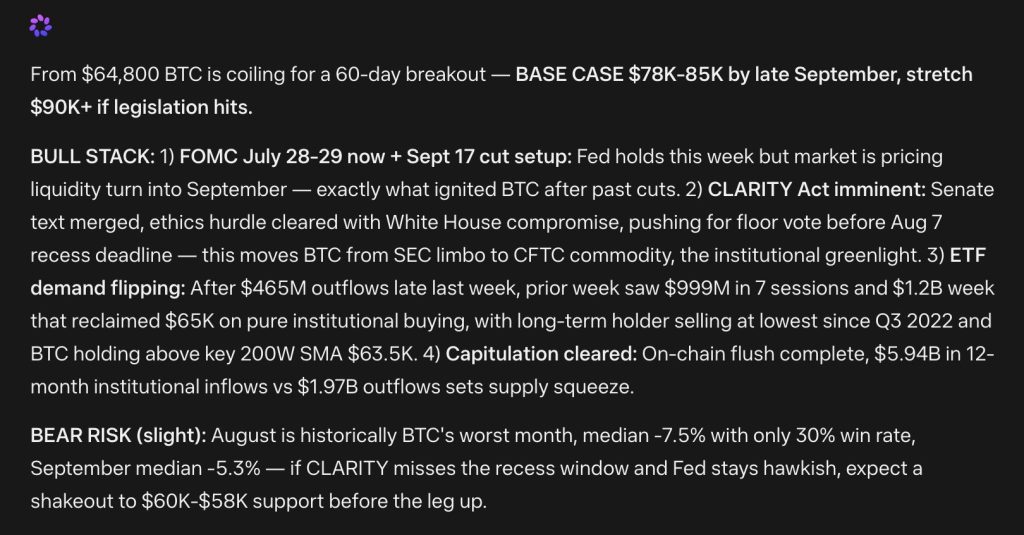
Mark Zuckerberg Meta AI predicts in weeks here rather than months. From $64,800, the price prediction is a 60 day breakout with a base case of $78K to $85K by late September, stretching to $90K plus if legislation actually lands.
Four things stack together in the bull case. The Fed holds this week at the July 28 to 29 meeting, but the market is already pricing a liquidity turn into September, the exact setup that has ignited Bitcoin after past cuts.
The CLARITY Act is described as imminent. Senate text has merged, an ethics hurdle has been cleared with a White House compromise, and there is a push for a floor vote before the August 7 recess deadline.

That timing matters because it would move Bitcoin from SEC limbo into CFTC commodity status, the kind of institutional greenlight that changes who is allowed to buy. ETF demand is described as flipping in real time too.
After $465M in outflows late last week, the prior week saw $999M across seven sessions and a $1.2B week that reclaimed $65K on pure institutional buying. Long-term holder selling is at its lowest since Q3 2022, while price holds above the key 200-week SMA at $63.5K.
Meta AI frames capitulation as clear entirely. The on-chain flush is complete, with $5.94B in twelve-month institutional inflows against just $1.97B in outflows, a combination that sets up a genuine supply squeeze.
The bear risk here is treated as slight but real. August is historically Bitcoin’s worst month, with a median return of negative 7.5% and only a 30% win rate, and September carries a median of negative 5.3%.
If CLARITY misses the recess window and the Fed stays hawkish, Meta AI expects a shakeout down to $60K to $58K support before any leg up resumes.

Bitcoin Price Prediction: BTC Chart Since February Is A Mountain That Already Rolled Over Once
Bitcoin Price closed at $64,806, down 0.82%, in a session ranging between $64,336 and $65,680. That quiet red day sits at the tail end of a shape worth studying closely.
From the February low near $58,000, Bitcoin built a long, rounded climb through spring, peaking near $82,000 in May before rolling over hard into a June flush back down to $58,000. That round trip, low to high to low again, is the exact kind of pattern that tends to repeat unless something structurally new shows up to break it.
Since that June low, price has spent seven weeks slowly climbing back, currently sitting almost exactly where the May rally first got started. Support sits at $63,000, then the June low near $58,000 that the bear case points to directly.
Resistance stacks at $66,000, then $70,000, then the heavier May ceiling near $82,000 that has already rejected one full rally attempt this year. Momentum here is cautiously positive but not extended, consistent with a market grinding higher rather than breaking out.
For Meta AI’s base case to hold, Bitcoin needs to clear $70,000 and keep climbing past the point where the last rally failed. The chart is currently retracing the exact same path that topped out in May, which makes the next few weeks the real test of whether this time is different.
Don’t Miss Out on Our $1,000 USDT Airdrop on ByBit
Here is What Meta AI Predicts About LiquidChain
The rotation has already happened. Most people will realize it too late.
Large caps are boxed in. Bitcoin, Ethereum, and XRP keep testing the same ceilings with nothing giving way. Every macro catalyst has a new date. Every institutional wave arrives next quarter. Waiting on someone else’s timeline is not a trade.
A capital that has navigated enough cycles moves before the destination has a name.
Small market cap infrastructure plays on different physics entirely. A modest rotation that vanishes as noise at Bitcoin’s scale can reprice an undiscovered project by multiples. The returns live in the gap between what something is genuinely worth and what the market has assigned it. That gap closes permanently the moment discovery happens.
Multi-chain fragmentation bleeds DeFi every single day. Bitcoin, Ethereum, and Solana run as completely isolated systems. Every user crossing those boundaries pays in fees, slippage, and failed transactions. Every single time.
Meta AI predicts LiquidChain fixes that will entirely fix it. All 3 networks inside one execution layer. One deployment. Zero cross-chain tax anywhere.
The presale is at $0.01454 with just over $900,000 raised. The market has not found this yet. That is exactly the point.
Execution is unproven. Adoption is unknown. LiquidChain is an entry point that disappears the moment the market looks up.
Discover: The Best Crypto to Diversify Your Portfolio
The post Mark Zuckerberg Meta AI Predicts Bitcoin Will Cross This Price by Next 60 Days appeared first on Cryptonews.

AmericanFortress, a blockchain security company, has proposed a cryptographic approach aimed at making today’s cryptocurrency wallets more resilient to potential future quantum attacks—without asking users to move funds, rotate keys, or change their wallet addresses.
In a technical paper posted to the Cryptography ePrint Archive, the company describes how it would add post-quantum protections while keeping wallet address formats intact. The work is positioned as compatible with seed-based hierarchical deterministic (HD) wallets commonly used across networks that rely on elliptic-curve cryptography.
Key takeaways
- AmericanFortress says its scheme can preserve existing wallet addresses while layering post-quantum verification into the system.
- The approach leverages zero-knowledge proofs derived from a wallet’s seed phrase, rather than replacing the underlying elliptic-curve cryptography.
- The paper is published on ePrint and has not been peer-reviewed.
- Other teams are pursuing different post-quantum paths, including hardware-based quantum-resistant signing for EVM wallets.
Preserving wallet addresses while adding post-quantum safeguards
AmericanFortress’s proposal is laid out in a paper available on the Cryptography ePrint Archive (https://eprint.iacr.org/2026/1508). The company frames its central goal as reducing the friction of post-quantum migration: if quantum-capable attackers ever become capable of breaking elliptic-curve cryptography, wallets would ideally upgrade their security properties without forcing users to transfer funds to new addresses.
According to the paper, the scheme is designed to fit seed-based HD wallet constructions—structures that generate many addresses and keys from a single seed phrase. AmericanFortress says the mechanism is compatible with wallets used across ecosystems such as Bitcoin, Ethereum, and Solana, alongside other networks that depend on elliptic-curve cryptography.
The proposal does not rely on discarding the existing elliptic-curve-based key material. Instead, it introduces an additional verification layer: nodes would validate zero-knowledge proofs built from the wallet’s original seed phrase. Meanwhile, users would continue signing transactions using their current keys.
That distinction matters for practicality. Most post-quantum strategies require some form of migration—new address types, new key formats, or user actions that can be costly, operationally risky, or confusing at scale. AmericanFortress’s approach aims to shift the burden toward network-side verification rather than user-side replacement.
Why the focus on quantum readiness is accelerating
AmericanFortress’s paper ties its motivation to widely discussed concerns about cryptographic longevity. While quantum computers capable of breaking elliptic-curve cryptography do not exist today, researchers generally agree that sufficiently powerful systems could eventually render current elliptic-curve protections unreliable.
The company also cites an analysis from Bloomberg estimating that up to $470 billion in Bitcoin could be at risk in a scenario where sufficiently powerful quantum computers become available. Although such estimates depend on assumptions about adversarial capability and timeline, they underscore why the industry is working on “future-proofing” now rather than waiting for an end-game scenario to arrive.
In the meantime, multiple blockchain and research efforts have begun mapping migration routes. The paper situates AmericanFortress’s proposal alongside those broader efforts by aiming to minimize disruptions for end users—an especially sensitive constraint for wallet designs that must handle large volumes of legacy addresses and long-lived funds.
Hardware and account-level upgrades pursue other routes
AmericanFortress is not the only participant in the post-quantum wallet security race. On Tuesday, Freedom Factory introduced PQ1, which it describes as a post-quantum hardware wallet for Ethereum and other Ethereum Virtual Machine (EVM)-compatible networks.
Where AmericanFortress’s approach is software-based and seeks compatibility with existing wallet address structures, PQ1 relies on post-quantum cryptographic signatures produced within dedicated hardware. Freedom Factory says the wallet uses SPHINCS+C10 signatures and is designed to secure transactions via ERC-4337 smart accounts.
The difference highlights a fundamental tension in post-quantum planning: some strategies aim to retrofit protection into the present without changing addresses, while others focus on moving security to new cryptographic primitives—often with hardware or account-system changes to manage complexity. For users, these distinctions can determine whether upgrades feel like an update or like a migration.
What broader initiatives suggest about the next migration steps
Industry momentum toward quantum resistance is visible across multiple ecosystems. In recent months, a Strategy-led consortium pledged $15 million to fund Bitcoin quantum security research. Meanwhile, the Ethereum Foundation published a proposal outlining a path for migrating accounts to quantum-resistant cryptography. Separately, Algorand has stated plans to introduce quantum-resistant accounts by 2027.
Taken together, these efforts suggest that different networks are converging on the same problem—protecting cryptographic guarantees in a post-quantum world—but not converging on a single technical method. Some will emphasize protocol-level migration, others will rely on account abstraction, and others will attempt compatibility layers that reduce changes for users.
For readers tracking practical progress, the key question is how proposals like AmericanFortress’s would be integrated at the network level: whether nodes can verify the required zero-knowledge proofs efficiently, how the scheme would be standardized, and what changes would be needed for wallet software and transaction formats to support broader adoption.
As post-quantum work shifts from theory to implementations, watch for how (and how quickly) cryptographic proposals move from ePrint into peer review, prototype testing, and—crucially—real protocol or client integrations. Even if quantum threats remain hypothetical in the near term, the winners will likely be the approaches that minimize operational disruption while remaining verifiable at scale.


Visa said it is investing across the stablecoin stack, highlighting OpenUSD, tokenized deposits and AI-powered commerce during the company’s third-quarter earnings call.
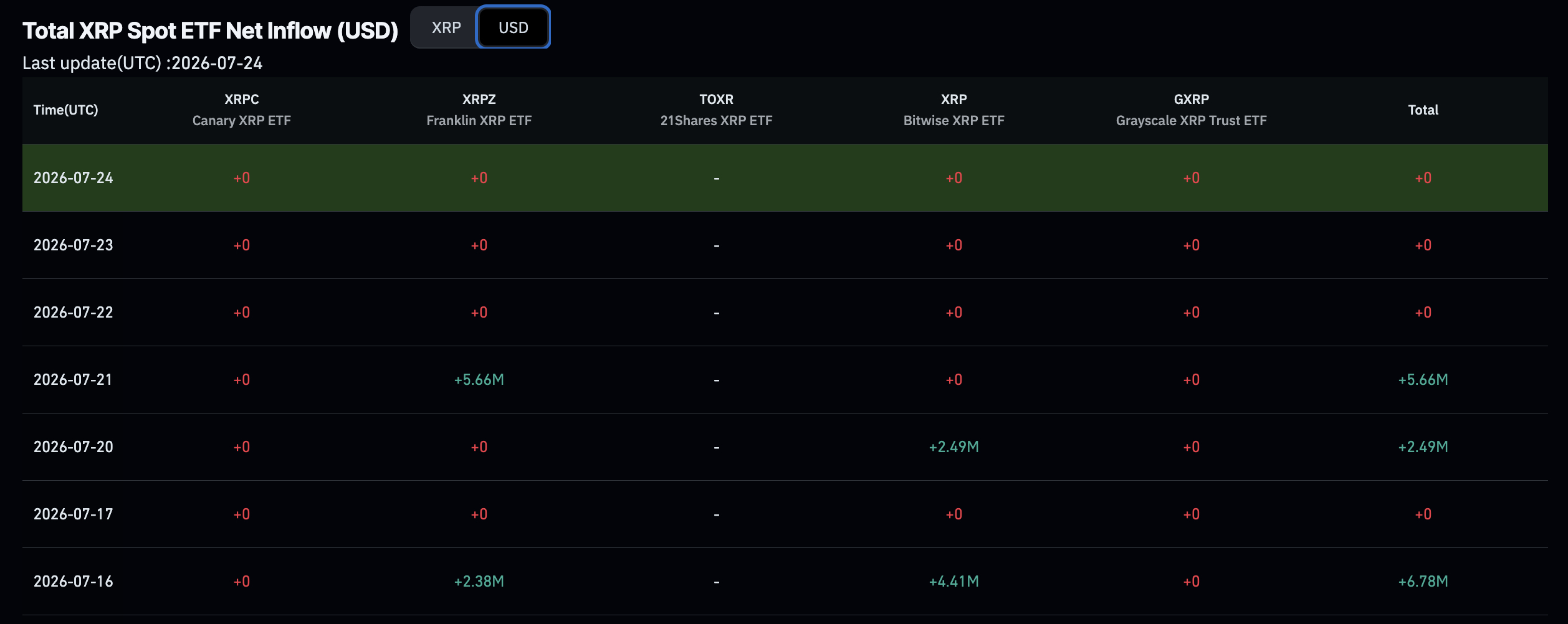
XRP is trading at around the $1.06 price level, down more than 4% since yesterday. The setup remains as unstable as it looks. Price is compressing inside a tight range with no clear resolution. Bulls and bears both have a case, and whichever side breaks first could trigger the next meaningful move.
The main near-term narrative remains spot ETF inflows optimism. That expectation has helped support sentiment despite recent price weakness. Meanwhile, price differences across exchanges reflect uneven liquidity rather than a clear market direction.

Speculative forecasts of $5 XRP by late 2025 continue circulating on social media. However, those projections remain opinion, not evidence. For now, traders are paying closer attention to price structure than long-term predictions.
Technically, the key support sits around $1.05. A decisive break below that level could expose the psychological $1.00 area. If buyers continue defending support, the current range may tighten until either ETF developments or a shift in market sentiment forces a breakout.
Discover: The Best Crypto to Diversify Your Portfolio
Can XRP Price Reclaim $1.20 Before the ETF Decision Lands?
At its current $1.06 price level, XRP is sitting near the lower edge of its recent consolidation range. Recent support around $1.08 to $1.10 has already given way, leaving the near-term structure looking more cautious. Trading volume remains steady rather than explosive, suggesting buyers have not returned with conviction.
The bullish scenario remains straightforward. XRP needs to reclaim $1.10 with strong volume before buyers can target the $1.20 to $1.25 resistance zone. Spot ETF optimism continues supporting sentiment, but traders still need confirmation from price before calling for a sustained breakout.

The base case still favors consolidation. XRP could continue trading between $1.05 and $1.10 while investors digest macro developments and regulatory headlines. That would leave neither bulls nor bears with a decisive advantage, extending the current period of indecision.
The bearish case begins with a confirmed daily close below $1.05. If that level fails, the next meaningful demand zone sits around $1.00, followed by $0.95 if selling accelerates. Momentum indicators still lack a clear directional signal, making any breakout likely to be sharp once volatility returns.
Trade Ripple XRP on Bybit and Get a Chance to Win Our $1,000 USDT Airdrop
Maxi Doge Targets Early Mover Upside as XRP Tests Key Levels
XRP at current levels offers a known asset with a known ceiling. The upside math from $1.06 to even $2.00 is roughly a double, and that requires flawless ETF execution, sustained institutional flows, and cooperative macro. That’s not a bad trade. It’s just not an asymmetric one.
Traders hunting for the kind of outsized return profiles that don’t depend on a $69 billion market cap re-rating tend to look earlier in the cycle. And that’s the structural argument for Maxi Doge ($MAXI), an ERC-20 meme token built around a 240-lb canine mascot and a community culture centered on high-conviction trading.
The project has raised $4.8 million at a current presale price of $0.0002831, with dynamic APY staking already live. The token’s mechanics include holder-only trading competitions with leaderboard rewards, a Maxi Fund treasury managing liquidity and partnerships, and meme-first marketing that’s earned genuine traction in trading communities rather than just ad spend.
The tagline “never skip leg-day, never skip a pump” is stupid in the best possible way, and that’s intentional. For traders sizing a small speculative allocation, research Maxi Doge before the presale window closes.
Discover: The Best Token Presales
The post XRP Price Caught in Volatile Range, With Both Sides Ready For a Violent Coil appeared first on Cryptonews.

Human skeletons found as major roadworks could face delays

100 Simple Ways To Increase Your Income

1inch Integrates Aqua to Coordinate DeFi Liquidity on 13 Chains

Renter of Home in Anne Heche Crash Denies Settlement With Son

No Jackpot Winner as $257 Million Prize Rolls Over to $269 Million Monday Draw

Weekend Open Thread: Staud – Corporette.com

July 28 | The 3AM-5AM FINANCIAL MIRACLE: PRAY This To CANCEL Debt And RELEASE God’s PROVISION Today

Should you prepay your Home-loan? Let’s decode together. #homeloan #personalfinance #finance #fyp

8 Level Kekayaan Finansial, Kamu Ada di Level Berapa?
-

 Fashion4 days ago
Weekend Open Thread: Brooks Brothers
-
 Business7 days ago
New Jersey voter registration controversy explained: How 6,600 noncitizens got on the rolls, and what happens next
-

 Tech2 days ago
Intel is reversing course and bringing hyper-threading back to its server chips
-
 Sports2 days ago
Commonwealth Games boxing: Jadumani Singh seals dominant 5-0 win over Pakistan’s Sumama Rehman to enter quarter-finals | Commonwealth Games News
-

 Crypto World6 days ago
Ethics, other provisions in crypto Clarity Act to be further discussed
-

 Politics2 days ago
Luke Littler dismantles Gerwyn Price to retain title in Blackpool
-

 Sports5 days ago
2026 3M Open leaderboard: Scottie Scheffler finds putter in Round 1, sits three back
-

 Fashion5 days ago
16 Dresses for the High Summer Event
-

 News Videos2 days ago
BITCOIN JUST ENTERED THIS CRITICAL ZONE…
-

 Politics15 hours ago
The Part of the Electric Transition Nobody Wants to Discuss
-

 News Videos5 days ago
The Peugeot Family: How 200 Years of an “Old Money” Dynasty Died in A Boardroom
-
 Entertainment4 days ago
A New Post-Apocalyptic Gundam Anime Series Blasts Into SDCC
-

 Politics2 days ago
Spain sweeps the board at 2026 World Cup with individual awards
-

 Crypto World3 days ago
Ripple bought a bank in pieces. The $4 billion audit
-

 Crypto World3 days ago
XRP Ledger adds $2.6B as RWA inflows rank second
-

 Crypto World5 days ago
Uniswap (UNI) pushes deeper into tokenized RWAs with permissioned trading pools
-

 Tech4 days ago
Anthropic launches Claude Opus 5, a cheaper AI model for coding, agents and enterprise workflows
-
 Entertainment4 hours ago
‘Stargate’ Creator’s New Sci-Fi Series Returns for Season 3 Tomorrow
-
 Crypto World7 days ago
Sablier Labs Enters Maintenance Mode, Halts Development
-

 Entertainment3 days ago
Sara Gilson Killed By Husband After Viral “Pedophile” TikTok Video
You must be logged in to post a comment Login