

Crypto World
US-Iran MoU revival gains pace despite Tehran denial



Regional mediators are reportedly close to a proposal that could restart the US-Iran memorandum of understanding, although Tehran continues to deny seeking renewed talks with Washington.
Summary
- Pakistan, Egypt and Qatar are reportedly pushing a plan to revive the US-Iran MoU.
- Iran and Oman have reportedly accepted a proposal addressing disputes over the Strait of Hormuz.
- Tehran denies requesting negotiations and wants greater control over shipping routes through the strait.
- Brent crude fell 4.8% to $84.09 as markets responded to reduced hostilities.
Mediators push US-Iran MoU revival
Pakistan, Egypt and Qatar have stepped up efforts to revive the US-Iran framework signed last month, according to two sources cited by The Times of Israel.
The mediators have developed a proposal aimed at resolving conflicting interpretations of how the MoU applies to the Strait of Hormuz. Iran argues that the agreement gives it some authority over operations in the waterway, while Washington maintains that it does not.
Iran and Oman have reportedly approved the mediators’ proposal. A final decision now rests with US President Donald Trump, according to the report. The White House had delayed its response until after Trump met Israeli Prime Minister Benjamin Netanyahu in Washington.
Reaching an agreement would allow the US and Iran to restart negotiations before the MoU’s 60-day window expires next month. However, neither Washington nor Tehran has publicly confirmed that a new round of talks has been scheduled.
Strait of Hormuz remains the main dispute
Tehran has offered Oman a temporary system under which one direction of maritime traffic would pass through Iranian waters, with part of the opposite route also placed under Iranian control.
Iran rejected an Omani proposal to divide the shipping routes equally between the two countries. Deputy Foreign Minister Kazem Gharibabadi argued that the plan did not address Iran’s security concerns, according to Reuters.
Gharibabadi said the strait would remain closed if Oman rejected Tehran’s alternative. He also warned that Iran would not allow a third country to clear mines from the waterway, even if Oman invited it to participate.
At the same time, the Iranian official rejected reports that Tehran had approached Washington.
“Iran has not made any requests for negotiations or ceasefire with the US in the past 17 days,” Gharibabadi said.
He claimed that Washington had instead sought dialogue through Oman and offered assurances that the US would not take further military action. The US has not publicly confirmed those claims.
Oil drops as markets price in lower conflict risk
Crude prices fell sharply as the pause in US-Iran attacks raised hopes that diplomacy could resume, even without confirmation of a breakthrough.
Brent crude futures dropped 4.8% to settle at $84.09 per barrel on Tuesday, while US West Texas Intermediate declined 4.1% to $79.26. Both benchmarks reached their lowest levels in about two weeks.
Brent has now fallen about 16% over three sessions. However, shipping through the Strait of Hormuz remains limited, leaving energy markets exposed to another increase in tensions.
For US consumers and investors, a lasting agreement and fuller reopening of the strait could reduce pressure on fuel costs and inflation. That effect remains uncertain while the maritime dispute and the broader conflict remain unresolved.
What comes next for US-Iran talks
Trump and Netanyahu discussed Iran during their White House meeting, which the US administration described as “positive and productive.”
Netanyahu later said the two leaders shared the goal of preventing Iran from obtaining nuclear weapons. However, neither side announced whether Trump had approved the mediators’ proposal following the meeting.
The next signal will likely come from Washington, Oman, or the three regional mediators. Until then, reports of progress remain at odds with Tehran’s public denial that formal US-Iran negotiations are underway.

Crypto World
Coinbase wants to be Canada’s ‘everything exchange,’ but says clearer rules are needed first


To Richmond, the delay isn’t about regulators moving slowly, but a structural difference between U.S. and Canadian frameworks.
“It’s not necessarily just a regulatory thing; just the nature of the rules is different,” he said.
Harmonized ‘national instrument’
While there is still work to be done, Richmond is encouraged by the fact that Canadian regulators are actively listening to industry players about digital asset products and are open to creating new regulatory frameworks to support the growing industry.
One example Richmond cited as “a very good piece of legislation” is the new Stablecoin Act, which was enacted by the Canadian Federal government earlier this year, after the U.S. passed the GENIUS Act last year.
In the wake of the Stablecoin Act’s passage, Canada has already seen Tetra Trust — a company backed by heavyweights such as Wealthsimple, Shopify and National Bank of Canada — launching Canada’s first regulated financial institution-issued Canadian-dollar stablecoin CADD.
Canada has already shown that crypto companies can operate inside a regulated market. The next test is whether its rules can accommodate products that move beyond spot trading into payments, derivatives, tokenized securities and decentralized finance.
Richmond said that, rather than having companies interpret these guidelines, “codifying” the existing regulatory practices into a national framework that applies consistently across provincial securities regulators will help reduce legal uncertainties for builders. Essentially, he argued that Canada should consolidate more of its existing crypto requirements into a ‘national instrument’ — a set of harmonized securities rules adopted across provincial and territorial regulators.

Kraken is expanding its tokenized-IPO offering to retail investors with access to Jersey Mike’s upcoming public listing. The exchange says eligible US customers will be able to request allocations of Jersey Mike’s shares at the IPO price, while customers outside the US can request tokenized shares designed to be backed 1:1 by the underlying stock.
The development adds another well-known US consumer brand to the small but growing menu of tokenized equities accessible through major crypto venues. It also comes after recent friction in similar campaigns—most notably around SpaceX—highlighting that investor demand for tokenized IPO access can exceed the supply of underlying shares.
Key takeaways
- Kraken will let eligible US retail users submit interest in book-entry Jersey Mike’s shares at the IPO price, while global users can request tokenized shares backed 1:1 by the stock.
- Tokenized shares will trade 24 hours a day, five days a week on Kraken and participating xStocks Alliance platforms, while the underlying Jersey Mike’s shares will trade only during regular US market hours.
- Allocations for the IPO are determined by the underwriter and are not guaranteed.
- Kraken says the tokenized shares can be transferred across participating xStocks Alliance platforms, moved onchain, and used with compatible decentralized finance (DeFi) applications.
- This marks another tokenized-IPO rollout following SpaceX’s debut, but the earlier listing faced oversubscription that led some platforms to cancel and refund.
How Kraken’s Jersey Mike’s access works
Kraken’s planned offering gives two routes depending on where a user is located. Eligible US customers can express interest in Jersey Mike’s shares in book-entry form at the IPO price. For customers outside the US, Kraken offers JMKEx, a tokenized version of the stock.
Kraken describes JMKEx as being backed 1:1 by underlying Jersey Mike’s shares held in regulated custody. In both cases, the IPO process controls outcomes: Kraken states that allocations are selected by the IPO underwriter and are not guaranteed.
The practical distinction for users is trading access. Once the IPO closes, Kraken says JMKEx will run on a near-continuous schedule—24 hours a day, five days a week—on Kraken and participating platforms in the xStocks Alliance. Meanwhile, the underlying Jersey Mike’s shares will trade according to normal US market hours.
Why tokenized IPO shares matter for investors
Tokenized equities are often discussed as a bridge between traditional capital markets and blockchain-based settlement. Kraken’s framing underscores that investors may not only buy exposure more flexibly, but also move that exposure in ways standard broker accounts typically do not allow.
Kraken says tokenized shares can be:
- Transferred across participating xStocks Alliance platforms
- Moved onchain
- Integrated with compatible DeFi applications
For market participants, that combination matters because it changes where equity-linked exposure can live. Instead of being confined to brokerage infrastructure, the tokenized wrapper is designed to be compatible with broader onchain systems—potentially improving interoperability for users who want to combine public equity exposure with onchain strategies.
At the same time, Kraken’s emphasis on underwriter-determined allocations and non-guaranteed access serves as a reminder that the tokenization layer does not remove core IPO constraints: if there are not enough underlying shares, token allocations can be limited.
Jersey Mike’s IPO details and what users should watch
Jersey Mike’s is a US sandwich chain with more than 3,300 locations. In its IPO announcement, the company said it expects to price the offering between $21 and $25 per share and to list its Class A shares on the New York Stock Exchange under the ticker JMKE. (Source: PR Newswire IPO announcement)
Those price expectations are relevant not only for standard IPO participants but also for users planning to request tokenized shares through Kraken. Because the token product is intended to be backed 1:1 by the underlying shares, the token’s credibility depends on the custody and redemption mechanics associated with the backing shares—areas Kraken states are supported through regulated custody.
What remains uncertain for investors is allocation availability. Kraken is explicit that the IPO underwriter—not the exchange—determines allocations. That means eligible users should be prepared for the possibility that demand could outstrip supply, as occurred during other tokenized-IPO rollouts.
Lessons from the SpaceX tokenized IPO rollout
Kraken’s Jersey Mike’s plan is not happening in isolation. It follows SpaceX’s tokenized IPO access in June, which multiple crypto platforms rolled out with similar structures tied to the underlying shares.
According to earlier coverage from Cointelegraph, other platforms—including Binance, Bybit, Blockchain.com, Bitget Wallet and MEXC—also launched products connected to SpaceX’s offering. However, demand appears to have been far higher than the underlying share supply. Cointelegraph previously reported that the SpaceX IPO was more than four times oversubscribed, forcing tokenized-IPO platforms to compete for limited allocations.
In the aftermath, Cointelegraph reported that several exchanges—including Binance, Bybit, Bitget Wallet and MEXC—ultimately canceled their tokenized IPO campaigns and refunded users after they were unable to secure enough underlying SpaceX shares to meet customer allocations.
The price path for the underlying listing also reflected the typical volatility that can follow oversubscribed offerings. Cointelegraph noted that those Nasdaq-traded shares have declined from their $135 IPO price, with last trading at roughly $115 on Tuesday (as cited in the earlier report).
Kraken’s Jersey Mike’s campaign is therefore best understood as a continued test of whether tokenized-IPO distribution can scale to match real-world IPO demand. For users, the key watch item is not only whether the token product goes live, but whether allocations are successfully secured for the participating customer base.
Despite the operational challenges seen in the SpaceX rollout, growth in the broader tokenized equities market has continued. Data cited from RWA.xyz indicates the sector’s distributed value rose from well under $500 million in mid-2025 to about $1.87 billion, including a 29.4% increase over the prior 30 days (Source: RWA.xyz).
Next, investors should focus on two practical milestones: whether Kraken confirms sufficient underlying share allocations for eligible customers once Jersey Mike’s IPO closes, and how smoothly tokenized trading and transfers work across xStocks Alliance platforms once JMKEx begins its extended-hours schedule.
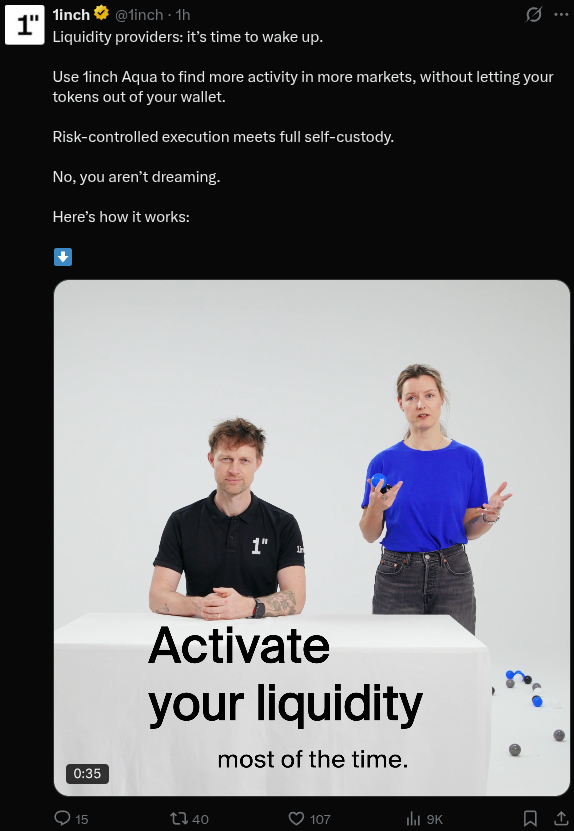
Decentralized exchange aggregator 1inch announced Aqua, a protocol aimed at unifying the liquidity pools of numerous markets in the decentralized finance ecosystem.
According to Tuesday’s announcement, Aqua allows liquidity providers to authorize several strategies against one wallet inventory, while the assets remain in the wallet until a trade settles, rather than depositing the funds to any particular liquidity pool. The protocol has been deployed on 13 blockchains including Ethereum, Arbitrum, Base, Robinhood Chain and BNB Chain.
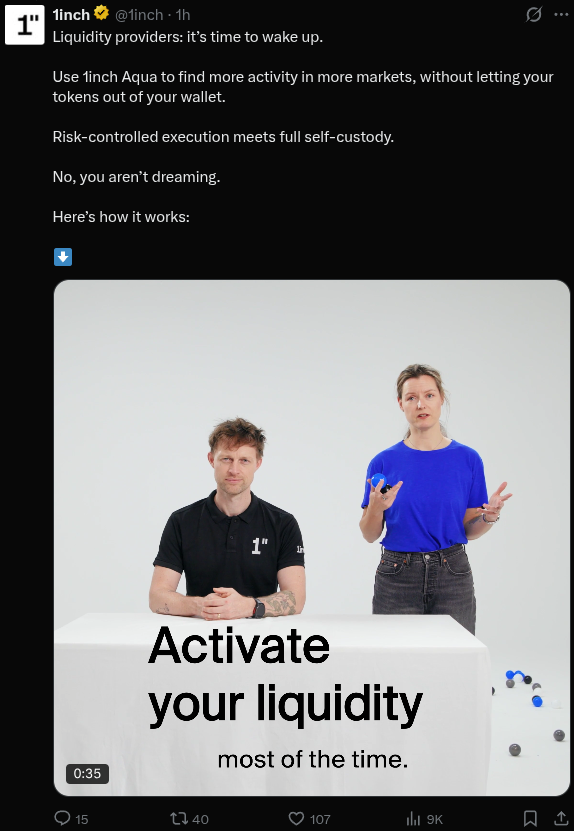
Source: 1inch
The protocol provides an integrated package including a generalized onchain registry, wallet-backed automated market making strategies, atomic settlement and consumer-facing position management. Liquidity becomes more widely available, as it does not have to be tied to any protocol in particular — but it also does not multiply, as assets can be involved only in one operation at a time.
A user providing $10,000 of liquidity can advertise $10,000 on three protocols for a total of $30,000, but only $10,000 of simultaneous trades can happen with those funds. The system resembles coordinated overbooking and may improve the utilization of liquidity capital if it is unlikely to be called for multiple operations simultaneously.
A 1inch spokesperson told Cointelegraph that Aqua can be used by resolvers holding a 1inch-issued access credential, as not all protocols are supported.
The spokesperson also explained that all positions are quoted against the market maker’s live wallet balance, so after a fill, the remaining position quotes against what is left. “If a swap would exceed the actual balance, it reverts atomically,” they said.
In a related development, pending tokenholder vote approval, the protocol will allocate 500,000 USDC (USDC) to incentives for adoption of Aqua alongside 10 million 1inch (1INCH) tokens (worth roughly $830,000 at the time of writing). “The initiative is designed to accelerate liquidity growth and swap activity across supported pairs,” according to 1inch’s announcement.
Today’s announcement follows a statement earlier this month from Anton Bukov, a co-founder of 1inch, who said that he was “fired” from 1inch in November 2025 after “push[ing] for change” in the company’s management and operations.
Bitcoin fell below $64,000 on Tuesday as traders reduced risk before the Federal Reserve’s interest-rate decision, while ETF outflows and leveraged liquidations added to selling pressure.
Summary
- Bitcoin dropped 2.5% and briefly traded near $63,327 during Tuesday’s session.
- US spot Bitcoin ETFs recorded $11.64 million in net outflows on July 27.
- BTC lost a rising 4-hour trendline, while the daily RSI slipped to 48.13.
- Liquidity clusters near $64,500 and $62,500 could shape the next short-term move.
Bitcoin price falls below rising trendline
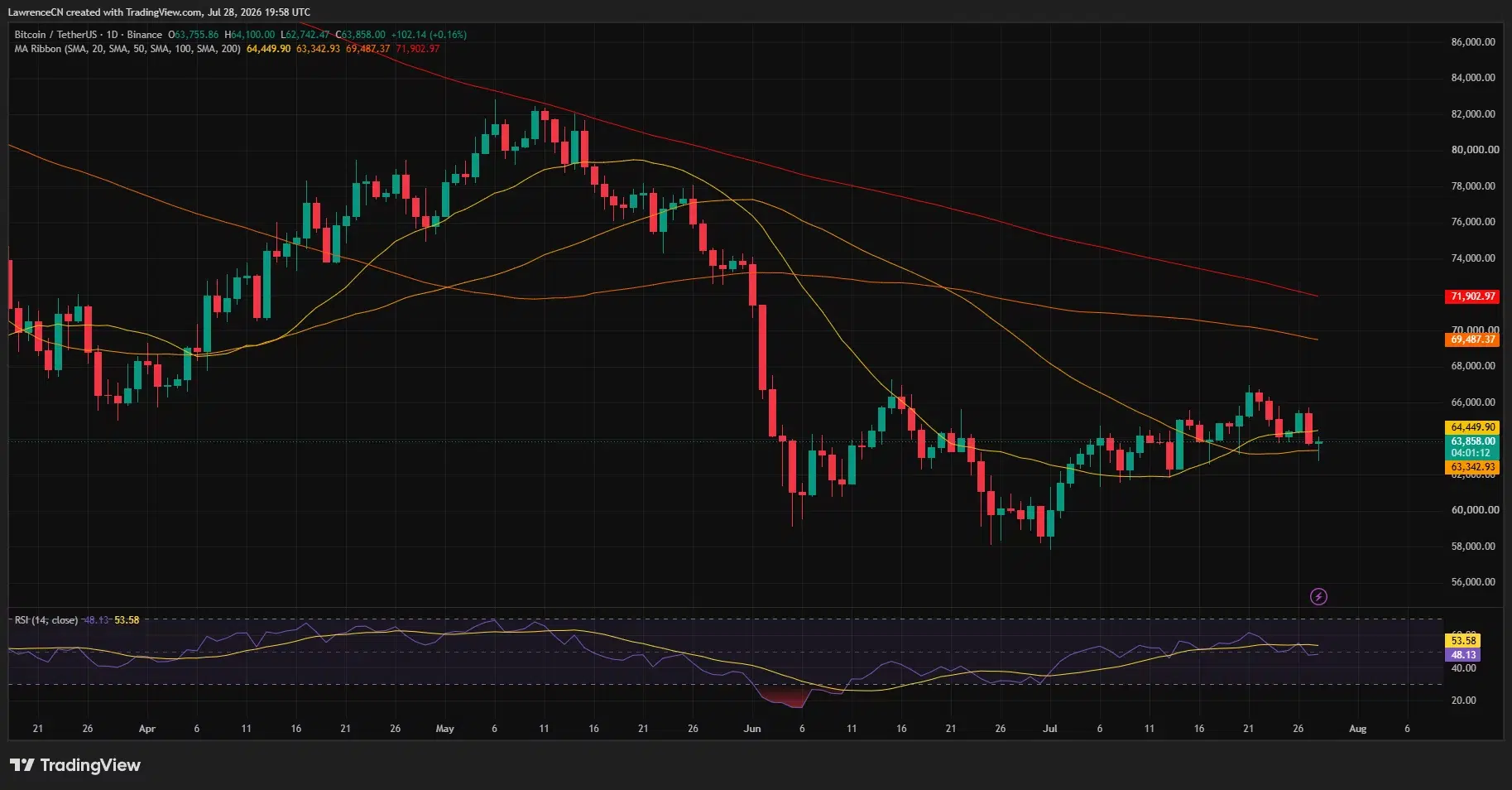
According to data from crypto.news, Bitcoin (BTC) price opened Tuesday near $63,706 and extended its decline toward $63,327 as traders cut exposure before the Fed decision. BTC later traded around $63,858, leaving it down roughly 2.5% during the session.
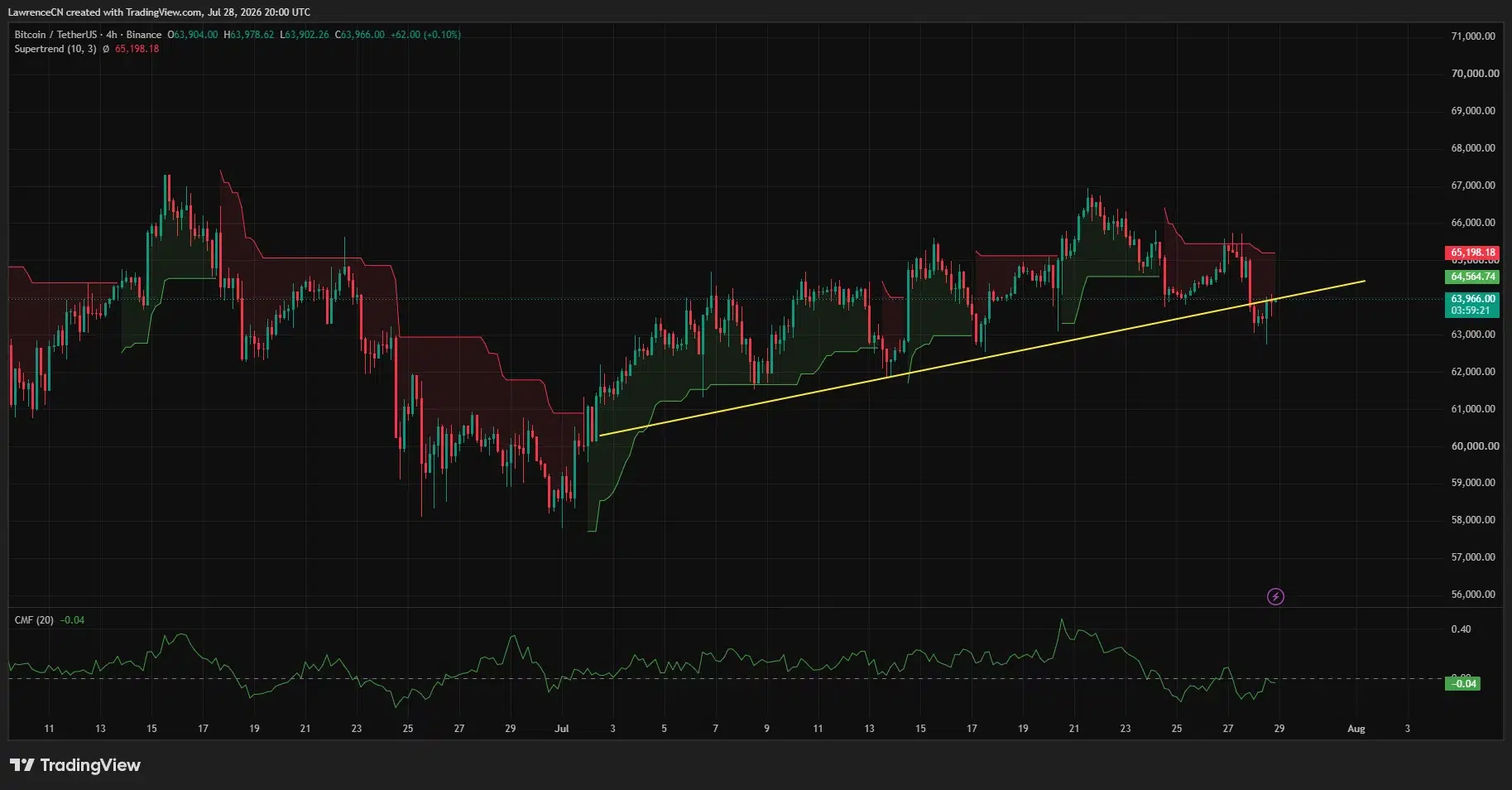
The 4-hour chart shows that Bitcoin broke below an ascending trendline that had supported the recovery from its late-June low near $58,000. Price attempted to move back above the trendline, but the rebound stalled below $64,000.
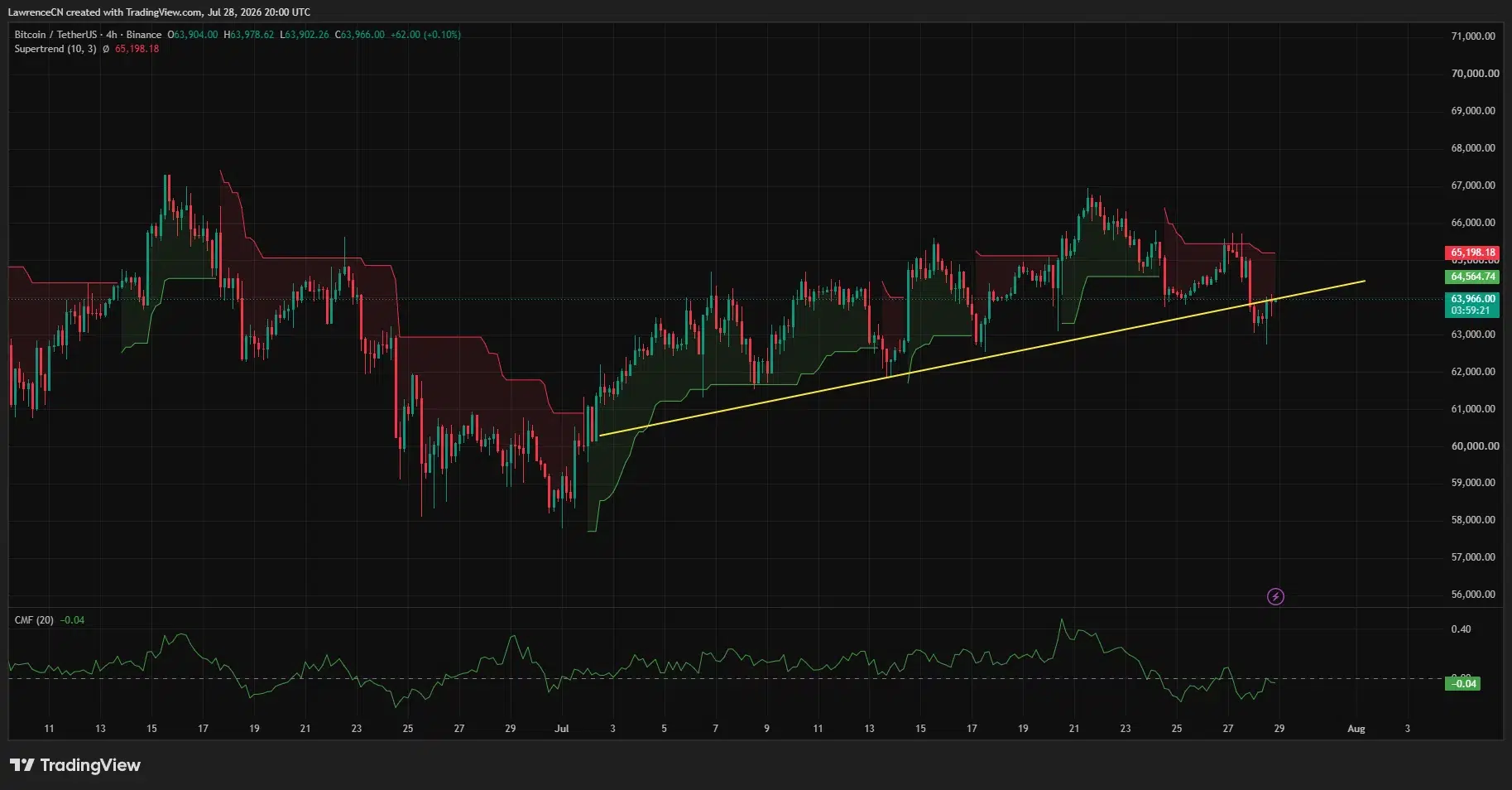
Bitcoin also remained under the 4-hour Supertrend resistance at $65,198. The indicator will continue to favor sellers unless BTC closes above that level and converts the broken trendline into support.
The Chaikin Money Flow reading stood at minus 0.04, showing that capital flows had turned slightly negative. While the reading does not point to extreme distribution, it shows that selling pressure continues to exceed buying demand.
Bitcoin’s daily chart presents a mixed structure. BTC traded below the 20-day moving average at $64,449 but remained slightly above the 50-day average near $63,343. That leaves the price compressed between short-term resistance and an important support level.
Fed decision drives demand for cash
The Federal Reserve began its two-day meeting on July 28 and will announce its decision at 2 p.m. Eastern Time on Wednesday. Chair Kevin Warsh’s press conference will follow 30 minutes later, according to the Federal Reserve’s July calendar.
Markets broadly expect policymakers to keep the federal funds rate within the current 3.50% to 3.75% range. However, futures pricing has assigned roughly a one-in-three probability to a rate increase, making the meeting less predictable than recent policy decisions.
A Reuters report said the threshold for an immediate increase remains high despite inflation concerns and hawkish comments from some policymakers. Cooler June inflation and easing geopolitical pressure support the case for holding rates steady.
A surprise increase could strengthen the US dollar and lift Treasury yields, creating another headwind for Bitcoin and other risk assets. A hold may ease immediate pressure, but markets could still sell off if Warsh signals that a September increase remains likely.
Bitcoin’s decline below $64,000 therefore reflects more than technical weakness. Traders are limiting leveraged exposure before an event that could quickly change expectations for US liquidity and borrowing costs.
US Bitcoin ETF outflows add selling pressure
US spot Bitcoin ETFs posted $11.64 million in net outflows on July 27, marking a third consecutive session of withdrawals, according to data from SoSoValue.
BlackRock’s IBIT led the daily withdrawals with $8.82 million, while Fidelity’s FBTC lost $2.82 million. The funds still held combined net assets of about $78.71 billion, but the latest outflow showed weaker institutional demand before the Fed announcement.
Spot Ether ETFs moved in the opposite direction. The products attracted $9.23 million, led by an $11.75 million inflow into BlackRock’s ETHA. Invesco’s QETH partly offset that demand with a $2.52 million withdrawal.
The split suggests some US-listed fund investors favored Ether over Bitcoin during the session. However, one day of divergent flows is not enough to establish a lasting institutional rotation between the two assets.
Bitcoin liquidation map identifies key levels
The three-day liquidation heatmap shows the nearest large concentration of leveraged positions between roughly $64,400 and $64,600. A rebound into this area could trigger short liquidations, but it also overlaps with Bitcoin’s 20-day moving average and may act as resistance.
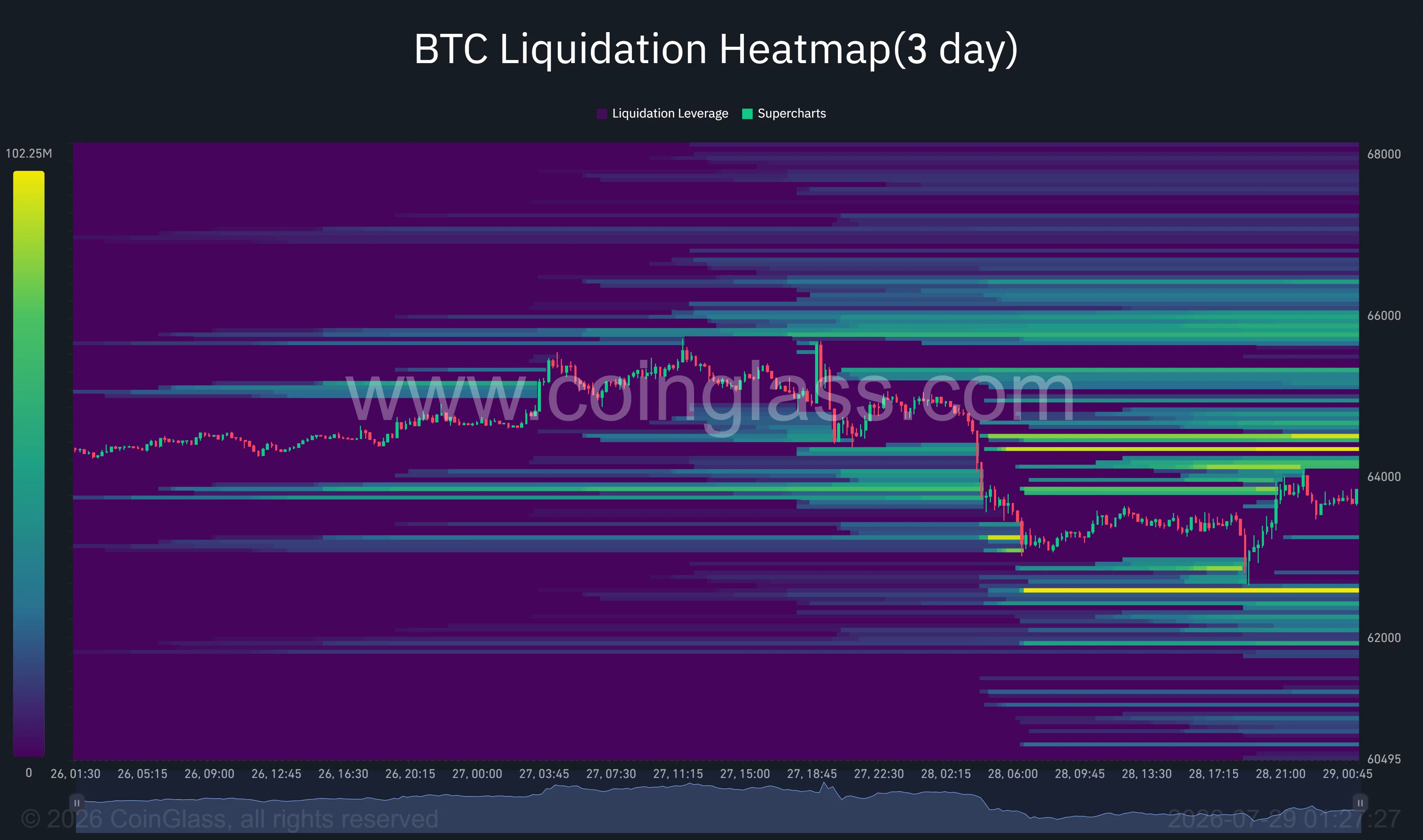
Additional liquidity sits near $65,800 to $66,200. Bitcoin would need to recover the 4-hour Supertrend at $65,198 before that upper zone becomes a realistic target.
Below the market, the strongest nearby liquidity concentration appears around $62,500 to $62,600. A break under the 50-day moving average at $63,343 could draw price toward that cluster. Lower support is visible around $61,800 to $62,000.
Daily momentum remains neutral rather than deeply oversold. Bitcoin’s relative strength index was 48.13, below its moving average at 53.58 and slightly under the neutral midpoint. The reading leaves room for further losses if sellers break the 50-day average.
Analyst sees $68,000 recovery in August
Crypto analyst Michaël van de Poppe maintained a bullish near-term outlook despite Bitcoin’s latest pullback.
“I think we’ll target $68,000 in early August again, and are likely going to break out of that fairly soon to $75,000+.”
For that scenario to strengthen, Bitcoin must first reclaim the $64,450 to $65,200 resistance region. A move above $66,000 would then expose the analyst’s $68,000 target.
On-chain analyst Ardi noted that Bitcoin’s market-value-to-realized-value ratio stood at 1.21. The level remains well above the 0.69 and 0.75 readings associated with the 2018 and 2022 bear-market lows, respectively.
That comparison suggests Bitcoin has not reached the same degree of market-wide capitulation seen at previous cycle bottoms. For US investors, Wednesday’s Fed statement and Warsh’s guidance remain the immediate catalysts: a hawkish surprise could expose $62,500, while a less restrictive message may help BTC recover $65,200.
Disclosure: This article does not represent investment advice. The content and materials featured on this page are for educational purposes only.


Cointelegraph is committed to providing independent, high-quality journalism across the crypto, blockchain, AI, and fintech industries.
All news, reviews, and analyses are produced with full journalistic independence and integrity. For more details on our standards and processes, please read our Editorial Policy.
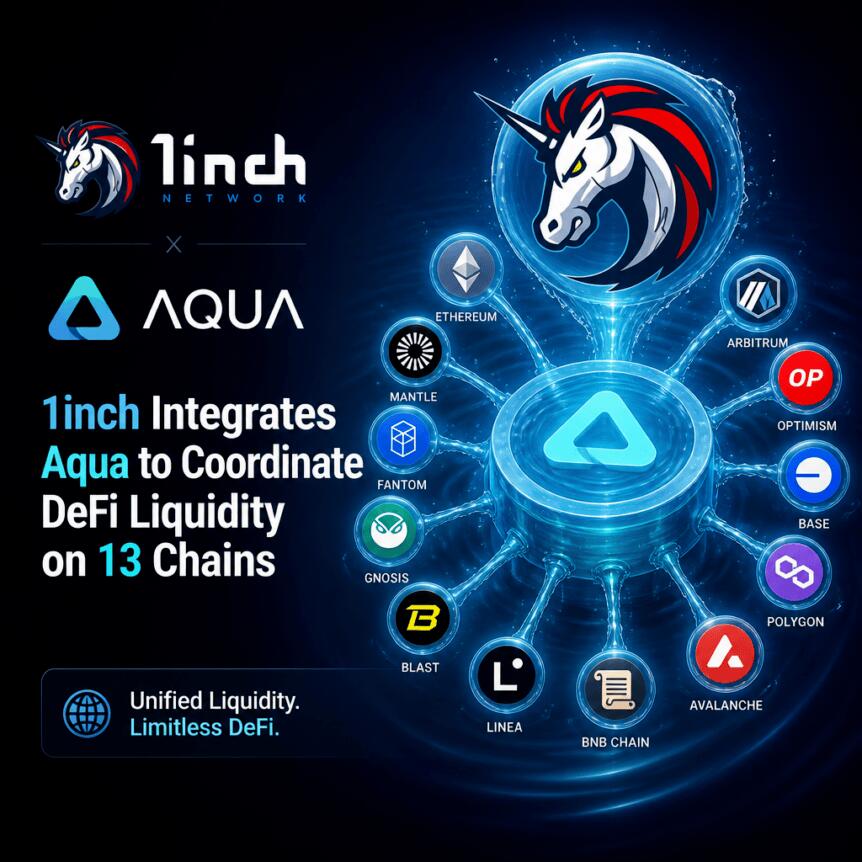
1inch has unveiled Aqua, a DeFi protocol designed to unify liquidity across multiple decentralized markets without forcing liquidity providers (LPs) to deposit funds into a specific venue. The announcement frames Aqua as a way to make liquidity more flexible across blockchains and protocols, while still enforcing capital constraints so funds aren’t overextended in simultaneous trades.
According to 1inch’s release on Tuesday, Aqua lets LPs authorize multiple strategies from a single wallet inventory and keeps the assets in that wallet until an executed swap settles—rather than routing the liquidity into any one liquidity pool. The protocol is already deployed across 13 blockchains, including Ethereum, Arbitrum, Base, Robinhood Chain, and BNB Chain.
Key takeaways
- Aqua coordinates liquidity across protocols without requiring LP funds to be deposited into a single pool.
- Wallet-backed strategies maintain atomic settlement, reverting trades if they exceed available wallet balances.
- Assets can only be used in one operation at a time, limiting effective over-allocation even if liquidity is “advertised” broadly.
- Incentives are planned via a pending tokenholder vote: 500,000 USDC plus 10 million 1INCH tokens earmarked for adoption.
How Aqua is meant to work
At the core of Aqua is an integrated system that 1inch describes as combining a generalized onchain registry, wallet-backed automated market making (AMM) strategies, atomic settlement, and consumer-facing position management.
Instead of tying liquidity to a particular protocol, the LP effectively “authorizes” strategies against their wallet’s available inventory. This distinction matters for capital efficiency: liquidity can be made available across a broader set of supported markets, potentially improving access for traders searching for swaps on different venues.
1inch also emphasizes a hard constraint designed to prevent true capital multiplication. While a provider can advertise the same amount of liquidity across multiple protocols, the liquidity cannot support unlimited simultaneous executions.
To illustrate the trade-off, 1inch’s explanation includes a scenario in which an LP supplying $10,000 can list $10,000 on three protocols for a combined $30,000 advertised availability, but only $10,000 worth of trades can run at the same time with those funds. In practice, this is closer to coordinated “overbooking” with strict execution limits than to a mechanism that multiplies liquidity across independent pools.
Atomic settlement and balance safety checks
In an interview with Cointelegraph, a 1inch spokesperson said Aqua can be used by “resolvers” holding a 1inch-issued access credential, noting that not all protocols are supported under the system.
The spokesperson further explained how Aqua prevents swaps from exceeding the wallet’s balance. They stated that all quoted positions are priced against the market maker’s live wallet balance, and once a fill occurs, remaining quotes adjust to reflect what’s left.
If an attempted swap would go beyond available funds, the system is designed to revert atomically. As the spokesperson put it: “If a swap would exceed the actual balance, it reverts atomically.”
For investors and traders, this approach addresses a key risk in liquidity aggregation: ensuring that quoted prices and advertised availability correspond to real executable inventory. Rather than relying on liquidity being pre-positioned in a given pool, Aqua ties execution to wallet state at settlement time.
Expansion across blockchains—and how incentives may pull liquidity in
Aqua’s initial rollout is positioned as multi-chain from the start, with deployments on 13 networks. That matters because one of DeFi’s practical frictions is not only the fragmented liquidity across protocols, but also the fragmentation across chains—each with its own trading dynamics and wallet activity.
To accelerate usage, 1inch says a related tokenholder process is underway. Pending vote approval, the protocol will allocate 500,000 USDC toward incentives for adopting Aqua, alongside 10 million 1inch (1INCH) tokens, described as roughly $830,000 at the time of writing. The announcement says the initiative is designed to “accelerate liquidity growth and swap activity across supported pairs.”
The incentives are contingent on approval through 1inch’s governance forum, referenced by the company in its announcement. If approved, the program would connect Aqua’s technical liquidity unification goal to a direct adoption push—something that typically becomes critical early when new routing or liquidity coordination systems must prove they can attract meaningful volume.
Why Aqua’s design could change how liquidity is routed
Liquidity aggregation in DeFi has traditionally meant either routing trades through existing pools, or encouraging liquidity providers to place capital into specific venues. Aqua’s differentiator is the separation between where capital resides (the wallet inventory) and where it is made actionable (strategies across markets).
However, the protocol’s constraint—that assets aren’t truly multiplied and can participate in only one operation at a time—suggests Aqua is aiming for better coordination rather than unlimited leverage of inventory. The “advertise broadly, execute limitedly” framing implies that Aqua could improve utilization when overlapping demand is unlikely, while preventing failure scenarios where more traders execute than the capital supports simultaneously.
That uncertainty—how often real-world demand overlaps across the set of supported strategies—will likely determine how quickly Aqua’s theoretical improvements translate into measurable routing performance. Investors and builders may want to monitor whether swap volume increasingly clears via Aqua-linked pathways and whether the promised improvement in liquidity availability shows up in practice as more wallets and resolvers participate.
Finally, it’s worth noting that 1inch’s announcement arrives amid ongoing internal turbulence. Earlier this month, Cointelegraph reported that co-founder Anton Bukov said he was “fired” from 1inch in November 2025 after “push[ing] for change” in company management and operations. While that dispute isn’t directly tied to Aqua’s technical rollout, it remains part of the broader context around execution risk and governance decisions as the protocol moves into incentive-driven adoption.
For now, the key question for readers is whether Aqua can attract liquidity at scale and translate its unified wallet inventory model into sustained swap throughput—particularly once the proposed USDC and 1INCH incentive program is decided. The next watch items are the tokenholder vote outcome and whether Aqua’s multi-chain deployments drive measurable growth in routed trading across the supported pairs.
Kraken has announced that eligible retail customers in the US can request allocations for Jersey Mike’s shares through its tokenized IPO offering, joining a growing list of equity tokenization rollouts tied to high-profile public listings. The exchange says US participants can submit interest in book-entry Jersey Mike’s shares at the IPO price, while customers outside the US can request JMKEx—a tokenized version of the stock backed 1:1 by underlying shares held in regulated custody.
When the Jersey Mike’s IPO closes, JMKEx is set to trade 24 hours a day, five days a week on Kraken and participating platforms in the xStocks Alliance network. The underlying Jersey Mike’s Class A shares will trade only during regular US market hours.
Key takeaways
- Kraken will offer two participation paths: book-entry shares for eligible US customers and tokenized shares (JMKEx) for eligible global customers.
- JMKEx is designed to track the underlying Jersey Mike’s stock on a 1:1 basis, with backing shares held in regulated custody.
- Trading for JMKEx is planned for near-continuous sessions (24/5), while the regular stock will follow US market hours.
- Allocations depend on the IPO process and are not guaranteed, meaning demand could outstrip supply—an issue that already affected earlier tokenized IPO campaigns.
- Kraken says tokenized shares can move across participating xStocks Alliance platforms and be used in compatible onchain integrations.
How Kraken’s Jersey Mike’s tokenized IPO works
Kraken’s announcement frames the offering as an extension of its tokenized IPO access model. For eligible US customers, participation is submitted as interest in book-entry Jersey Mike’s shares at the IPO price. For customers in more than 110 countries, Kraken instead enables requests for JMKEx, a tokenized share representation backed by actual Jersey Mike’s shares held in custody.
The exchange emphasizes that allocations are determined by the IPO underwriter and that requests do not guarantee receipt of shares. That distinction matters for retail users who are used to instant execution in standard crypto markets; tokenized IPO campaigns typically depend on traditional IPO distribution mechanics before moving into secondary trading.
Tokenized trading, custody, and cross-platform movement
Once the IPO closes, Kraken says JMKEx will begin trading 24/5 on Kraken and on platforms that participate in the xStocks Alliance. The underlying stock is expected to continue trading during regular US sessions, highlighting the structural split between traditional equity market hours and crypto-native trading windows.
Kraken also claims that tokenized shares can be transferred across participating xStocks Alliance platforms, moved onchain, and integrated with compatible decentralized finance applications. In practical terms, this is pitched as a way to bring more public equity exposure into ecosystems that don’t rely on traditional brokerage accounts—while keeping a direct tie to the underlying shares through custody.
Jersey Mike’s IPO details and expected listing
Jersey Mike’s is a US sandwich chain with more than 3,300 locations. According to the company’s IPO announcement, it expects to price the offering between $21 and $25 per share and list its Class A shares on the New York Stock Exchange under the ticker JMKE.
Kraken’s tokenized offering is built around that traditional IPO process: users seeking exposure through JMKEx receive a claim representation backed by actual shares, with pricing tied to the IPO pricing mechanism rather than to token spot formation alone.
Lesson from SpaceX: when demand outran supply
This is not Kraken’s first tokenized IPO-linked product. The exchange’s roll-out follows the public debut of SpaceX via similar tokenized access in June, which also saw participation from other crypto platforms. Several venues launched offerings tied to the SpaceX IPO, including Binance, Bybit, Blockchain.com, Bitget Wallet, and MEXC.
But in that case, reported demand for underlying shares quickly became a limiting factor. Cointelegraph previously noted that the SpaceX IPO was reported to be more than four times oversubscribed, leaving tokenized platforms competing for a finite pool of shares. Eventually, multiple exchanges canceled their tokenized IPO allocation campaigns and refunded users after they could not secure enough underlying shares to fill customer allocations.
That earlier episode highlights a recurring risk for retail users considering tokenized IPO access: even when tokens are marketed as “share-like” exposure, the initial distribution is still governed by IPO underwriting supply. Kraken’s statement that allocations are not guaranteed directly addresses that structural uncertainty.
Cointelegraph also reported that the SpaceX-backed Nasdaq-traded shares have traded below the IPO price, with a reference last trading around $115 after an initial $135 figure—underscoring that tokenized IPO access does not insulate participants from typical post-listing price dynamics.
Tokenized equities keep expanding despite rollout friction
The challenges around the SpaceX rollout have not appeared to slow broader growth in tokenized equities. Data cited from RWA.xyz indicates that the sector’s distributed value rose from under $500 million in mid-2025 to about $1.87 billion, including a 29.4% increase over the past 30 days.
For investors and builders, the takeaway is less about any single IPO and more about the evolution of the infrastructure: demand can spike faster than IPO allocation supply, but the market is still attracting capital and expanding distribution methods for real-world assets and tokenized securities.
As Kraken prepares to support JMKEx ahead of the Jersey Mike’s listing, users should watch the allocation outcome closely—especially given the oversubscription lessons from earlier tokenized IPO launches—and then pay attention to how quickly onchain integrations and cross-platform transfers mature after trading begins.


Florida Rep. Mike Haridopolos has renewed his push for the CLARITY Act as Senate delays narrow the bill’s path to passage before the August recess.
Summary
- Haridopolos warned that continued delays could push US crypto businesses and investment overseas.
- Senate leaders prioritized 74 federal nominees and a Russia sanctions bill over the CLARITY Act.
- The bill needs at least eight Democratic votes to overcome the Senate’s procedural threshold.
Haridopolos warns US crypto leadership is at risk
Haridopolos, a Republican member of the House Financial Services Committee, defended the CLARITY Act during a July 28 appearance on Fox Business’ Mornings with Maria. He argued that the legislation is needed to keep digital asset activity within the United States.
“This is about making sure that American markets are the premier markets in the world.”
Haridopolos also accused Senate Democrats of using procedural delays to block legislation supported by voters. Fox Business described the bill as stalled as lawmakers approach their summer break.
Haridopolos voted for the House version in July 2025. The measure passed by a bipartisan 294–134 vote, with 78 Democrats joining 216 Republicans, according to the House Financial Services Committee.
The legislation would establish separate responsibilities for the Securities and Exchange Commission and Commodity Futures Trading Commission. Its backers say those rules would give exchanges, token issuers and blockchain developers a clearer route to operate in the US.
Senate schedule delays CLARITY Act vote
Senate Majority Leader John Thune has temporarily shifted floor attention toward a group of federal nominees and the Lindsey O. Graham Sanctioning Russia and Iran Act of 2026.
That schedule makes action on the CLARITY Act unlikely before the final week of the current session. The Senate’s summer break is scheduled to begin after August 7, with a state work period running from August 10 through September 11, according to the official Senate calendar.
Thune has indicated that the Senate may still take preliminary action before the break, but leadership first needs to determine whether enough votes are available. The bill requires at least eight Democratic votes to advance under the current Senate balance.
The Senate Banking Committee advanced the legislation by a 15–9 vote in May, with two Democrats supporting it at the committee stage. However, both indicated that their support did not guarantee a floor vote without further changes.
Ethics and state enforcement remain disputed
Negotiations now center on restrictions covering elected officials and their digital asset interests. The Senate draft would temporarily bar certain officials, including the president and vice president, from issuing or sponsoring crypto assets until January 2029.
Enforcement would rest with the Justice Department. Democrats have objected because the draft would prevent state attorneys general from acting if federal officials decline to bring a case. The bill needs more Democratic support before it can move forward.
New York Attorney General Letitia James has raised a separate concern over state authority. She argued that the bill could override state digital asset rules and weaken local efforts to pursue crypto scams.
James called for stronger anti-money laundering, customer identification and cybersecurity requirements. Crypto-related complaints to her office have tripled over the past three years, according to the New York Attorney General’s office.
What the delay means for US crypto markets
The delay does not immediately change the legal status of crypto assets, US exchange operations or spot crypto ETFs. However, it extends uncertainty over which regulator would oversee token trading, fundraising and digital commodity markets.
Support remains broad among crypto companies and parts of Wall Street. Coinbase, Ripple, the Digital Chamber and other industry groups backed the House bill, while Goldman Sachs CEO David Solomon recently supported advancing the Senate version despite calling it imperfect.
September may provide the next opportunity if lawmakers fail to act before recess. The Senate would still need to pass its version, reconcile it with the House bill, and return the final text for congressional approval. Failure to complete those steps before the end of the current Congress could push the market structure debate into 2027.
Liquid staking app Lido has started moving the bulk of its staked ETH onto Ethereum’s larger post-Pectra validators, and the operators running them are now putting up their own capital for the first time.
The main idea is that Lido’s curated node operators stop running thousands of identical 32 ETH validators and collapse them into far fewer, much larger ones.
$16B in ETH Moved
Moreover, Ethereum’s Pectra hardfork, activated in May 2025, raised the maximum effective balance per validator to 2,048 tokens through what are known as 0x02 credentials. Curated Module v2 is the piece of Lido Core that now supports them natively (Phase 1 went live on Monday).
The scope is the Curated Module itself, the permissioned operator layer that has handled well over 90% of Lido’s staked ETH since the protocol launched in 2020. That covers more than 265,000 existing validators and more than 8 million ETH, worth about $16 billion.
It’s worth knowing Lido is doing this in a tighter market. As CryptoPotato reported, its revenue fell roughly 25% last year, and its share of all staked ETH slid from more than 28% in 2024 to just over 24% in December 2025.
No Longer Trust, Operators Now Must Post Bonds
Basically, trust alone is no longer enough, and operators have skin in the game. This means they have to lock up their own ETH as collateral, so if they get or fail operationally, that ETH is taken.
Their bond is smaller than in Lido’s permissionless modules because they’re still considered more trustworthy than open applicants. The governance update also removes unnecessary DAO votes for routine administrative tasks like changing an operator address, reducing bureaucracy.
The migration will take months because Ethereum limits how quickly validators can exit and be restaked. While they’re offline, they stop earning rewards, which Lido estimates will cost about 738.5 ETH. The 117-day figure is the fastest Ethereum theoretically allows, while six months is the practical estimate.
The post Why Is Lido Moving $16B in Staked ETH to Pectra-Era Validators? appeared first on CryptoPotato.
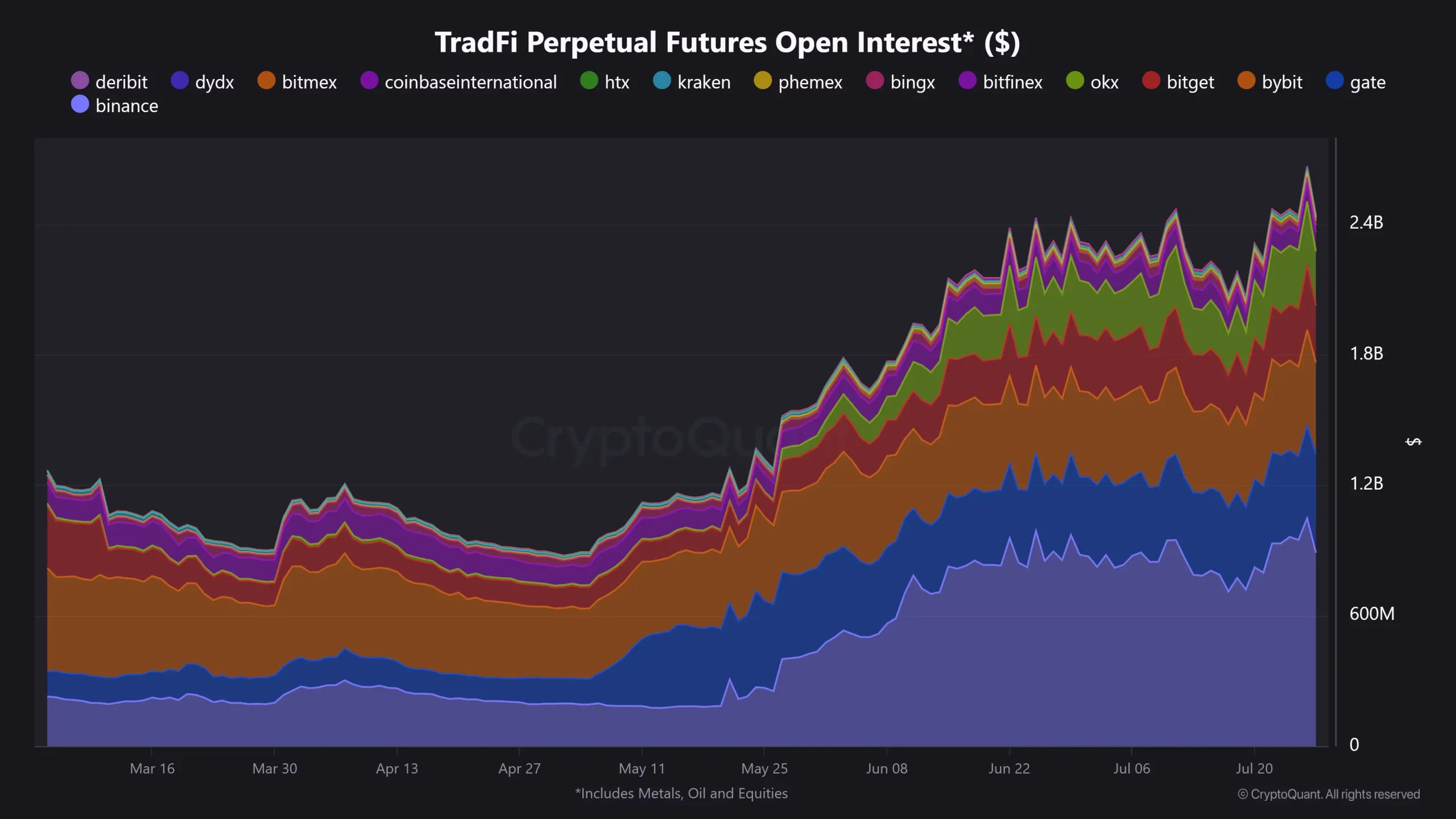
Open interest in perpetual contracts tied to stocks, metals and oil has doubled since late May as major crypto exchanges expand beyond digital assets, CryptoQuant reported.
Summary
- TradFi perpetual open interest has more than doubled to over $2 billion since late May.
- Binance, Bybit and Gate control about 70% of the emerging derivatives segment.
- Crypto perpetual open interest stands near $65 billion, around 20% below its previous peaks.
TradFi perpetual open interest climbs above $2B
TradFi perpetual contracts have become one of the fastest-growing areas of the crypto exchange market, according to CryptoQuant’s report.
The products give traders continuous exposure to traditional assets, including metals, crude oil and equities. Unlike standard futures, perpetual contracts do not have a fixed expiry date and use regular funding payments to keep their prices close to the underlying market.
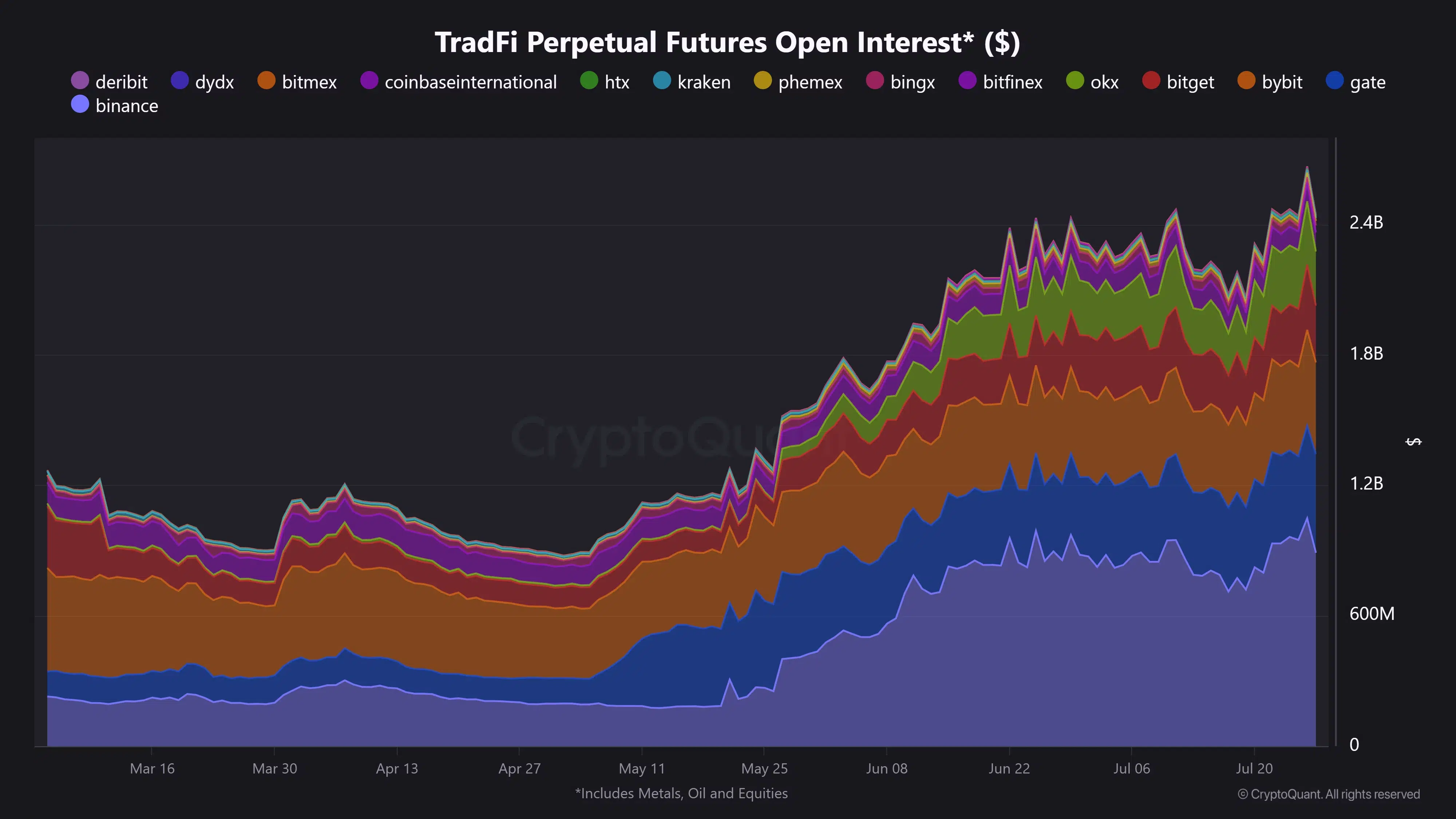
Open interest in these products remained between roughly $350 million and $500 million during spring 2026. It then rose sharply from late May, crossing $2 billion by July.
The increase allows crypto exchanges to compete more directly with traditional trading platforms. Crypto venues can offer the contracts around the clock, including during hours when conventional stock and commodity markets are closed.
Despite the rapid growth, TradFi perpetuals remain small compared with crypto derivatives. CryptoQuant estimated that the segment represents only around 3% of the roughly $65 billion held in cryptocurrency perpetual contracts.
Binance extends its derivatives lead into TradFi
Binance holds the largest share of open interest in both categories, showing how established crypto exchanges are using their liquidity and trading infrastructure to enter traditional asset markets.
CryptoQuant’s headline snapshot placed Binance’s TradFi perpetual open interest at around $720 million, equal to roughly 35% of the market. Bybit and Gate followed with about $381 million each.
Together, the three exchanges accounted for around 70% of TradFi perpetual open interest. Adding OKX and Bitget brought the top five’s share to approximately 93%, leaving the remaining capital spread across smaller venues.
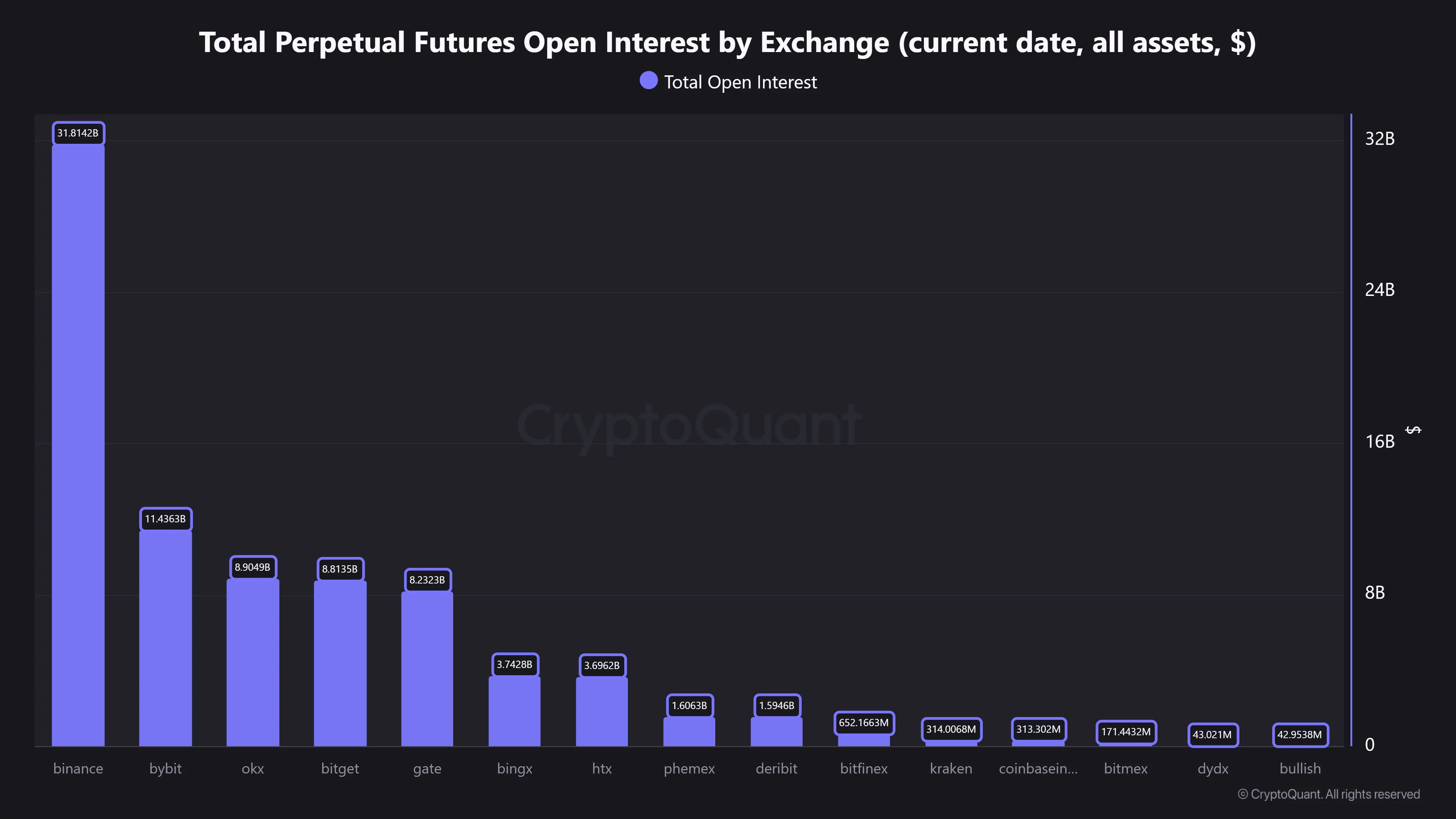
The concentration mirrors the structure of the crypto perpetual market. Binance held about $22.86 billion, or 35%, of crypto perpetual open interest in the report’s main snapshot. Bybit followed with $9.67 billion, while Gate held $8.61 billion.
Those three platforms controlled approximately 63% of crypto perpetual open interest. The five largest exchanges, including Bitget and OKX, accounted for about 81%.
Crypto perpetuals remain below previous peaks
Aggregate crypto perpetual open interest has expanded five to six times since early 2023, when it stood near $12 billion to $15 billion.
Capital in outstanding contracts reached about $80 billion in September 2025 and returned to a similar level in early 2026. It has since fallen by roughly 20% to around $65 billion.
CryptoQuant interpreted the decline as evidence of deleveraging or capital withdrawals rather than fresh money entering the crypto derivatives market. The fall contrasts with the growth in products tracking traditional assets.
However, the $2 billion TradFi segment is not yet large enough to offset changes in the broader crypto perpetual market. Its expansion instead shows exchanges adding new markets while retaining the same concentration of capital among the largest operators.
US perpetual futures market follows a regulated path
US investors are gaining access to similar products, but domestic contracts operate under a different regulatory structure.
Coinbase Financial Markets offers US customers CFTC-regulated perpetual-style futures that trade nearly around the clock. Unlike offshore perpetuals with no expiry, Coinbase’s contracts have five-year terms and use funding payments to stay aligned with spot prices.
The US market is also moving toward true perpetual contracts. In May, the Commodity Futures Trading Commission approved Kalshi’s cash-settled Bitcoin perpetual futures contract, which has no fixed expiration date and trades continuously. The regulator said its assessment applies on a contract-by-contract basis and does not automatically cover perpetuals tied to non-crypto assets.
CryptoQuant’s findings suggest that demand for continuous trading is spreading beyond cryptocurrencies. Whether TradFi perpetuals become a larger source of exchange capital will depend on liquidity growth, regulatory access, and whether traders continue moving activity from conventional venues.
“Moulin Rouge” actor says he was embarrassed to costar with Boy George: ‘He was a terrible performer’

Court Shuts Down Federal Officers Who Wanted To Run A Stingray Device For A Month Straight
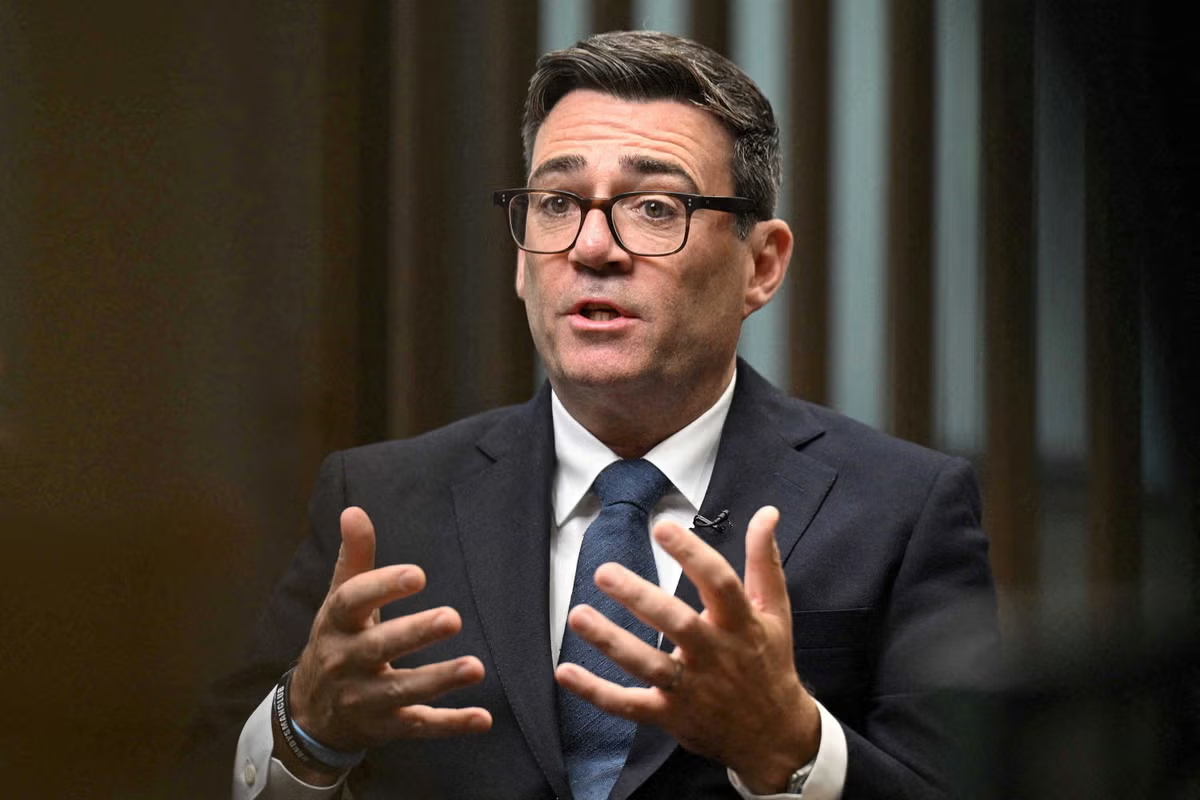
Burnham turns to Tories and Lib Dems for help on social care: ‘Help me fix this’

Renter of Home in Anne Heche Crash Denies Settlement With Son

No Jackpot Winner as $257 Million Prize Rolls Over to $269 Million Monday Draw

Weekend Open Thread: Staud – Corporette.com

The best financial advice isn’t trending.

The Future of Financial Advisors Starts Here | Growth, Partnership, & Innovation

July 28 | The 3AM-5AM FINANCIAL MIRACLE: PRAY This To CANCEL Debt And RELEASE God’s PROVISION Today
-

 Fashion4 days ago
Weekend Open Thread: Brooks Brothers
-
 Business7 days ago
New Jersey voter registration controversy explained: How 6,600 noncitizens got on the rolls, and what happens next
-

 Tech2 days ago
Intel is reversing course and bringing hyper-threading back to its server chips
-
 Sports2 days ago
Commonwealth Games boxing: Jadumani Singh seals dominant 5-0 win over Pakistan’s Sumama Rehman to enter quarter-finals | Commonwealth Games News
-

 Crypto World6 days ago
Ethics, other provisions in crypto Clarity Act to be further discussed
-

 Politics2 days ago
Luke Littler dismantles Gerwyn Price to retain title in Blackpool
-

 Sports5 days ago
2026 3M Open leaderboard: Scottie Scheffler finds putter in Round 1, sits three back
-

 Fashion5 days ago
16 Dresses for the High Summer Event
-

 Politics15 hours ago
The Part of the Electric Transition Nobody Wants to Discuss
-

 News Videos2 days ago
BITCOIN JUST ENTERED THIS CRITICAL ZONE…
-

 News Videos5 days ago
The Peugeot Family: How 200 Years of an “Old Money” Dynasty Died in A Boardroom
-
 Entertainment4 days ago
A New Post-Apocalyptic Gundam Anime Series Blasts Into SDCC
-

 Politics2 days ago
Spain sweeps the board at 2026 World Cup with individual awards
-

 Crypto World3 days ago
Ripple bought a bank in pieces. The $4 billion audit
-

 Crypto World3 days ago
XRP Ledger adds $2.6B as RWA inflows rank second
-

 Crypto World5 days ago
Uniswap (UNI) pushes deeper into tokenized RWAs with permissioned trading pools
-

 Tech4 days ago
Anthropic launches Claude Opus 5, a cheaper AI model for coding, agents and enterprise workflows
-
 Entertainment5 hours ago
‘Stargate’ Creator’s New Sci-Fi Series Returns for Season 3 Tomorrow
-

 Crypto World7 days ago
Sablier Labs Enters Maintenance Mode, Halts Development
-

 Entertainment3 days ago
Sara Gilson Killed By Husband After Viral “Pedophile” TikTok Video
You must be logged in to post a comment Login