
















Connect with us
DAPA Banner
DAPA Coin
DAPA
COIN PAYMENT ASSET
PRIVACY · BLOCKDAG · HOMOMORPHIC ENCRYPTION · RUST
ElGamal Encrypted MINE DAPA
🚫 GENESIS SOLD OUT
DAPAPAY COMING

Tech

realme Narzo Days Sale Is Live: Get Discounts on Narzo 100X, 90X, and More

Published

on

If you’ve been planning to buy a new budget or mid-range smartphone without giving in to the AI price increases, realme has announced a limited-time sale that could help you save some money. The company’s Narzo Days Sale is now live on Amazon, offering discounts and EMI offers across several smartphones in the Narzo lineup. The sale runs from July 28 to July 31 and includes devices such as the Narzo 100X, Narzo 90X, Narzo 80 Lite 4G, Narzo 100 Lite, and Narzo Power. Here’s what you should know.

realme Narzo Days Sale Offers

The biggest discount during the sale is available on the realme Narzo 100X, which receives a ₹1,000 instant discount across all storage variants, along with up to 6 months of No Cost EMI. The Narzo 80 Lite 4G also gets a ₹1,000 discount, bringing its effective price below ₹12,000. Meanwhile, buyers interested in the Narzo 90X can avail a ₹500 discount and six months of No Cost EMI. The Narzo 100 Lite and Narzo Power don’t receive any direct price cuts but are available with No Cost EMI options for up to nine months, depending on the model.

The realme Narzo Days Sale is available exclusively on Amazon until July 31. If you’re considering a new Narzo smartphone, this is a good opportunity to grab one at a lower price or take advantage of No Cost EMI offers, especially on the Narzo 100X, Narzo 90X, and Narzo 80 Lite 4G.

Source link

Advertisement
Continue Reading
Click to comment

You must be logged in to post a comment Login

Leave a Reply

Tech

Court Shuts Down Federal Officers Who Wanted To Run A Stingray Device For A Month Straight

Published

on

from the 30-days-of-wtf dept

For a long time, cell site simulators, a.k.a. “Stingrays” made headlines on nearly a daily basis. Then they just kind of fell off the map.

L3Harris — the manufacturer of cell site simulators that commanded enough market share to see its flagship product become the victim of genericide — saw the writing on the wall and exited the market. Part of this was due to cell tech advances that made it more difficult to obtain the information these faux cell towers were meant to collect. Part of that was also Supreme Court precedent that made the tech inherently less popular with US law enforcement.

Riley raised questions about cell site simulator use by requiring warrants for cell phone searches. And spoofing a cell tower was definitely a search, as the devices forced every cell phone in the area to connect to the Stingray and cough up identifying info about the device. Carpenter arrived a few years later and made it clear long-term tracking via cell site location was no longer something covered by the Third Party Doctrine.

But the biggest contributor to the decline in Stingray device usage were the warrant requirements instituted by both federal and local law enforcement agencies. What used to be a Wild West free-for-all was now something that required judicial approval. Apparently, a lot of cops decided this tech they once claimed was so useful to investigations it couldn’t be discussed in open court was useless now that it was subject to oversight.

Advertisement

We’re seeing a bit of an anomaly here. Not only is the use of cell site simulators being discussed in open court, but the federal officers have been denied their unusual — and outrageous — request to basically go wardriving for a month in Akron, Ohio. Here’s This Week in Security with more details:

A U.S. magistrate judge last month denied to issue a search warrant allowing federal agents to snoop on the phones of “thousands of uninvolved, unsuspecting individuals” across Ohio in an effort to identify a suspected criminal’s device, a rare rebuke by a court blocking the use of a cell-site simulator.

In the ruling, the judge said the federal government wanted to deploy a cell-site simulator that would have allowed “access to the information of thousands of individuals in the Akron, Ohio area,” but refused the warrant on grounds that it would have allowed federal agents to “gain unbridled discretion to examine the movements of private citizens at all times for thirty days.”

The ruling [PDF] by the magistrate doesn’t name the federal agency seeking the warrant, nor does it give any details about the alleged criminal activity that might help narrow the list down. The rest of the docket remains sealed so it may be weeks, months, or never before we learn anything else about this incident.

Here’s what it does say about the events leading up to this severely deficient warrant:

Advertisement

On June 15, 2026, the government sought approval of a warrant for use of CCSS for up to 30 days, 24 hours a day, to identify the cellular device(s) used by a suspect involved in criminal activity in Akron, Ohio. The affidavit to the warrant application established probable cause to believe that a specific individual is using one or more unknown cellular devices in criminal activity. The affidavit also suggested that there is probable cause to believe that uncovering the identity of the cellular device(s) would unveil more evidence of criminal activity.

The problem is right there in the first sentence. The government appeared to think the only thing it had to do to satisfy the particularity requirements of the Fourth Amendment was to suggest it might limit this roving, 24/7 surveillance to a few areas in Akron.

Moreover, in an attachment to the warrant application, the government described five different locations at which a CCSS could be used to identify the suspect’s cellular device(s) “when the officers to whom it is directed have reason to believe that [the suspect] is present” and “in the
vicinity of” the following locations:

the suspect’s residence;
the suspect’s overnight location;
the suspect’s daytime location; and
two other densely populated locations the suspect frequently visited.

That’s wild. This is basically telling the court the government wants to force thousands of devices to connect to its cell site simulator at multiple locations for a period of 30 days. That the agency said it would “take no further investigative steps” until it had gathered enough info to make sure it had found its preferred suspect is hardly comforting. The fact that it claimed it would delete any irrelevant information (at an unspecified time) following its 30 days of wardriving doesn’t help much either.

The court says this is obviously impermissible under any interpretation of the Fourth Amendment, especially given Supreme Court precedent handed down in recent years. It also cites geofence warrants that have been recently rejected by magistrates for pretty much the same reason: wholesale surveillance of hundreds or thousands of people attempting to present itself as a legitimate search under the Fourth Amendment.

The court reminds the government that the Fourth Amendment says this about warrants:

Advertisement

[N]o Warrants shall issue, but upon probable cause, supported by Oath or affirmation, and particularly describing the place to be searched, and the persons or things to be seized.

The court says this warrant is no better than the geofence warrant rejected by an Illinois federal court back in 2023: searching for a suspect by searching everyone officers encounter isn’t “particular,” and the use of warrant doesn’t make it more acceptable.

There, just as here, the proposed warrant allowed the government access to thousands of identifiers and location data in an undetermined geographic area. Id. at 715–16. The court found the CCSS [canvassing cell site simulator] “akin to a warrant application to search an entire apartment building—or an entire city block—where the government has probable cause only that evidence of a crime will be found in one specific apartment unit, for up to 30 days.” As that court recognized—and as this Court now concludes—the Fourth Amendment’s particularity requirement bars this sort of “rummaging” through the proverbial home.

That much should have been obvious to the investigators seeking to have this warrant approved. Either this was ignored in hopes investigators could slip one by the judge or the government thought this might somehow be more constitutional than a geofence warrant with the same parameters. Either way, the government was wrong.

Despite cops relying on Google location data more than cell tower dumps or Stingray devices these days, it’s clear they’re still relying on tech that has completely fallen out of favor over the past several years. I guess if you’ve already bought it, you may as well use it. Sunk cost meets diminishing returns. Fortunately for the Fourth Amendment, blowing the dust of a cell site simulator hasn’t changed the way courts view these warrants.

Advertisement

Filed Under: akron, cell site location, cell site simulators, ohio, stingray, surveillance

Source link

Advertisement
Continue Reading

Tech

Why the DJI Power 1000 Earns Its Place in Every Home Emergency Kit

Published

on

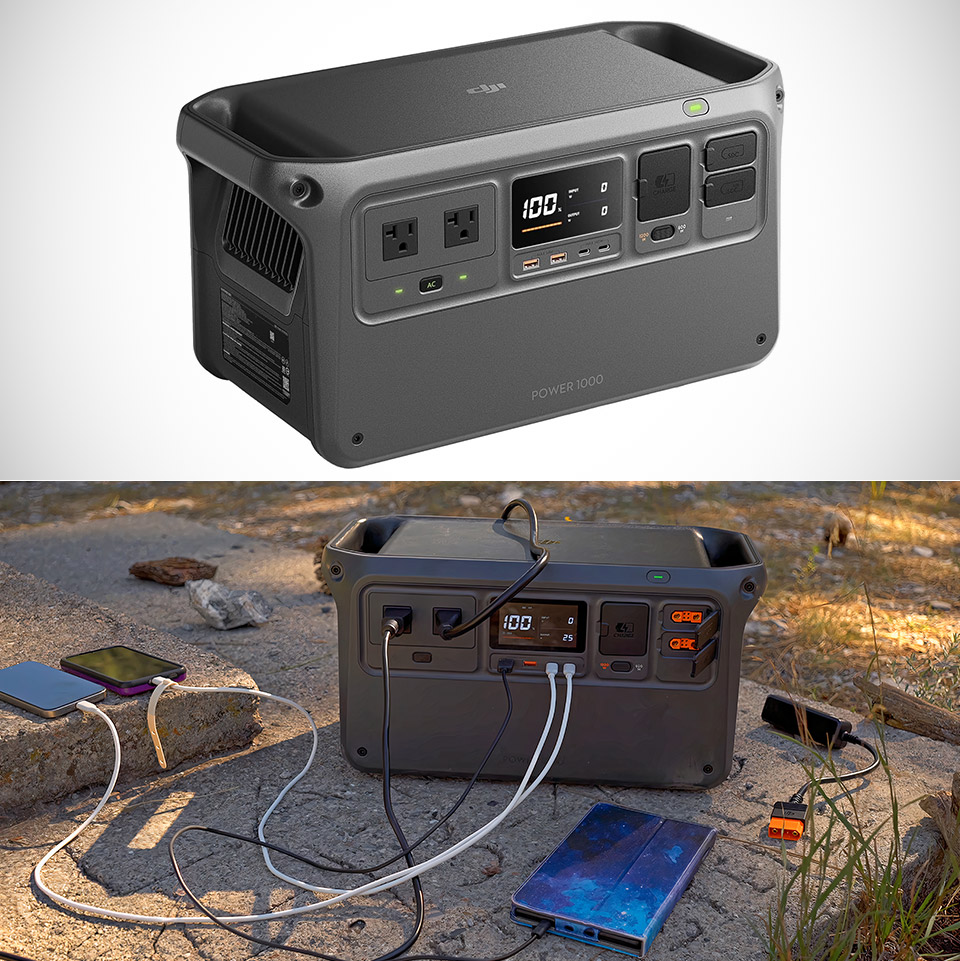
DJI Power 1000 v1 Power Station
Summer temperatures keep pushing higher across the map, and grids feel the pressure. Air conditioners run nonstop, transformers strain, and outages arrive with little warning. In those hours a reliable backup power station stops being a nice-to-have and becomes the difference between a minor inconvenience and a real problem. The DJI Power 1000, priced at $349 (was $699), steps into that role with a combination of capacity, output, and practical design that matches the needs of actual emergencies.


A 1024 watt-hour Lithium ferrophosphate battery is packed into a unit that weighs only 29 pounds and measures 17.6 by 8.9 by 9.1 inches, making it compact enough to transport from room to room or fit into a vehicle if you ever need to make a rapid departure. Size isn’t everything; the relationship is what really matters. LFP cells have a reputation for delivering over 4,000 charge cycles while keeping more than 70% of their original capacity, equating to nearly a decade of regular use without significant drop down.

Sale


DJI Power 1000 Portable Power Station, 1024Wh LiFePO4 Battery, 2200W (Peak 2600W) AC/140W USB-C Output…
  • Power 99% of Household Appliances – With a 2200W max continuous output power, DJI Power 1000 easily handles high-watt appliances like outdoor camping…
  • Fully Recharged Fast – DJI Power 1000 can be fully recharged in just 70 minutes using grid power. Charge fast and save time so you get moving on your…
  • Safe and Secure – An LFP battery provides up to 4000 cycles and a service life of approximately 10 years. The DJI Battery Management System (BMS…

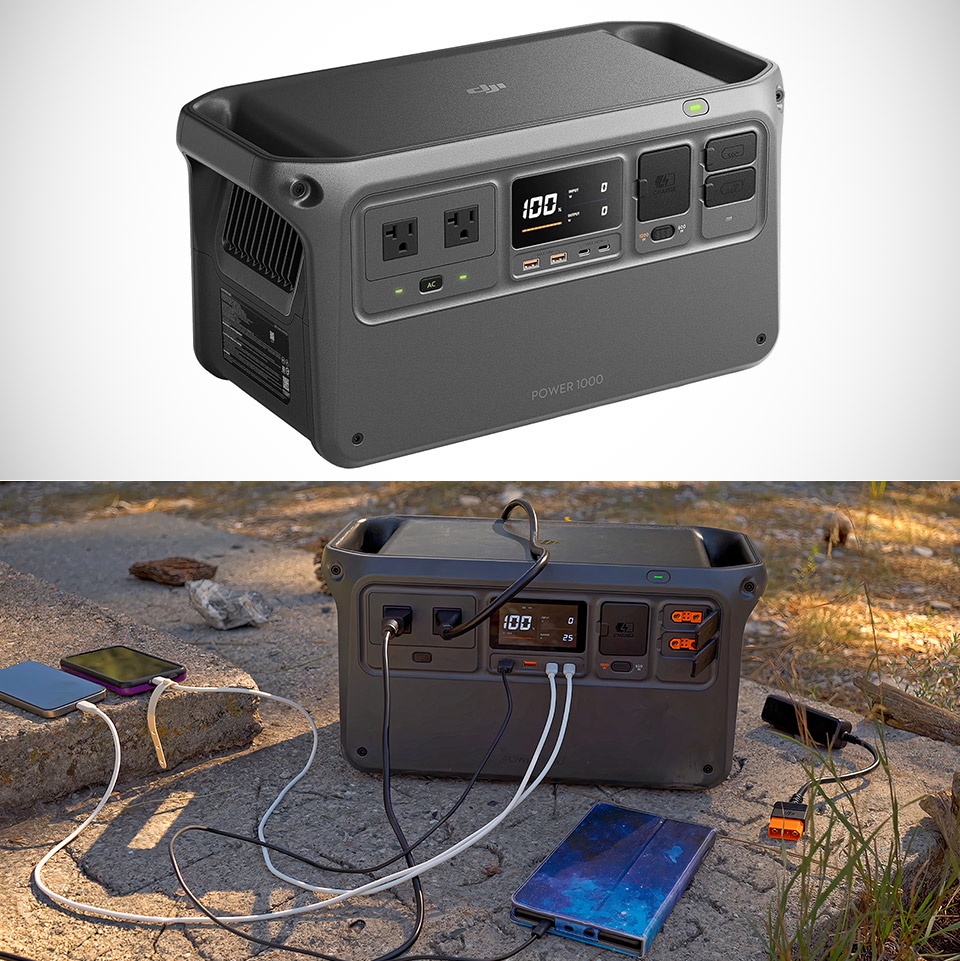
Continuous AC power reaches 2200 watts with a short-term peak of 4400 watts, which is handled by two normal household outlets. A typical fridge or freezer consumes less power than that continuous rating, therefore the station should be able to keep your food safe for an extended duration. Medical gadgets, fans, phone chargers, routers, and laptop computers all remain operational without incident. Two USB-C connectors supply up to 140 watts each, enough to charge current laptops and phones simultaneously, while two USB-A ports power older devices and accessories.

Advertisement


When the power is restored, even momentarily, recharging occurs quickly, with 80 percent completed in approximately 50 minutes and a full charge in about 70 minutes under ideal conditions. That speed allows your station to recover from periodic outages rather than sitting idle for hours, which is an extra benefit. If you do have sun, the DJI adapter module is an alternative for getting through longer events. The unit’s quiet functioning at 23 dB allows it to sit in a bedroom or living room overnight without adding to the stress level.

DJI Power 1000 v1 Power Station
In UPS mode, the station ensures a smooth transition. When you put it into a wall outlet and your gadgets consume power from it, a grid breakdown activates the battery power in roughly 0.02 seconds, with no interruption, data loss, or worry. Bypass charging keeps the battery charged while supplying power, ensuring that the system is ready for the next reduction in power.

DJI Power 1000 v1 Power Station
An intelligent battery management system monitors for overcurrent, overvoltage, and overdischarge concerns. Individual circuits are protected by multiple fuses. The bright color display reveals remaining capacity, input and output levels, and status at a glance, allowing you to monitor things and make educated decisions even in low light conditions.

Source link

Advertisement
Continue Reading

Tech

Anime fans, assemble: Bandai Namco opening ‘Gundam Base’ retail experience south of Seattle

Published

on

(Bandai Namco Image)

Giant anime robots are landing in the Seattle area.

Bandai Namco is opening an official Gundam Base retail store at Westfield Southcenter mall in Tukwila, Wash., this fall, giving Pacific Northwest anime and model-kit fans a permanent flagship destination for all things Gunpla.

For the uninitiated, Gundam isn’t just a nostalgic cartoon; it’s a massive, multibillion-dollar global media franchise that revolutionized Japanese animation when the original “Mobile Suit Gundam” series debuted in 1979.

Owned by Tokyo-based entertainment giant Bandai Namco, the IP spans decades of TV shows, video games, and movies, but its biggest cash cow is “Gunpla” — a portmanteau of “Gundam” and “plastic model.”

Unlike standard pre-assembled action figures, Gunpla kits are snap-together, highly engineered mechanical puzzles that fans clip off plastic runners and assemble by hand, ranging from entry-level builds to ultra-intricate models with thousands of pieces.

Advertisement

Bandai Namco says the new Southcenter location will be built around four core pillars for visitors: “watch, buy, build, and learn.”

Rather than functioning as a standard retail shop, the flagship is designed as an experiential destination. Shoppers can expect life-sized mecha statues and immersive themed environments for photo ops, alongside displays featuring fully painted master builds spanning 45-plus years of Gundam lore.

The store will carry model kits catering to every skill level — from beginner-friendly “Entry Grade” sets to complex “Perfect Grade” builds — along with exclusive, store-only Gunpla kits and limited-edition merchandise. The location will also feature community spaces hosting building workshops, special activations, and hands-on guidance from staff.

The Tukwila store is part of a broader U.S. brick-and-mortar push by Bandai Namco. Alongside the Southcenter opening, the company is launching a location at the Mall of America in Minneapolis this fall. Both follow the late-2025 debut of The Gundam Base Chicago at Fashion Outlets of Chicago — the entertainment giant’s first permanent retail footprint in North America.

Advertisement

Watch a video tour from the Chicago store:

Source link

Continue Reading

Tech

These Are The Only New Cars In The US Recommended To Use 89 Octane

Published

on


If you regularly fill up at a gas station in the U.S., you are probably familiar with the various grades of gasoline available for purchase: regular 87 octane, mid-grade 89 octane, and premium 91 or 93 octane. While most people stick to regular 87-octane fuel, owners of high-performance vehicles typically opt for premium 91-octane or 93-octane gasoline. You may, then, wonder who fills up with 89-octane fuel.

Historically, very few vehicles have required 89 octane, a fact that’s true to this day. According to the EPA database, only a handful of new vehicles sold between the 2024 and 2026 model years specifically require mid-grade gasoline. These are vehicles from Stellantis subsidiaries, namely Dodge and Ram, and all are powered by the company’s long-running 5.7-liter Hemi V8 engine.

As of 2026, the Stellantis vehicles available with this engine are the Ram 1500 and Dodge Durango, making these the only new vehicles that require 89-octane gasoline. Outside of these models, virtually every other new vehicle sold in the U.S. is designed to run on either regular 87-octane or premium 91-plus octane fuel.

Advertisement

Usage of 89-octane gasoline is on the decline

Aside from the aforementioned new cars, drivers of older 5.7 HEMI cars like the discontinued Chrysler 300, Dodge Challenger, Dodge Charger, and Jeep Wagoneer continue to use mid-grade gasoline. Predictably, then, 89 octane accounts for a tiny percentage of overall gas use. A 2022 study conducted by the U.S. Department of Energy showed that consumption of 89 octane gasoline has been steadily decreasing over the years, with only around 1% of gasoline users in the U.S. still using 89 octane fuel as of 2021, and it’s probably shrunk since then.

While only a few cars need mid-grade gas, some may opt for it thinking it is better than regular fuel. They do this on the mistaken assumption that the more expensive the fuel, the better it is for their cars. This, however, is not true at all. There is no significant improvement in horsepower, fuel economy, or emissions when higher-octane fuel is used in vehicles designed for regular gasoline.

Advertisement

As to why fuel stations continue to offer 89 octane fuel despite low demand, it’s possibly because it doesn’t require dedicated hardware. Gas stations only really store regular and premium gas; when a customer chooses 89 octane, the dispenser simply blends a metered amount of regular and premium gas to create mid-grade gasoline on the fly. So, the next time you are at a gas station wondering whether or not to choose 89 octane gas, do it only if your car manufacturer explicitly recommends using it.


Advertisement

Source link

Continue Reading

Tech

Bot-detection startup Spur nabs $200M from Insight

Published

on

Spur Intelligence, a cybersecurity startup based in Lake Mary, Florida, has raised a $200 million round led by Insight Partners.

Spur, founded by two former Defense Department engineers in 2017 — five years before ChatGPT’s public launch — was prescient. The startup’s tech helps enterprises distinguish legitimate human users from increasingly well-hidden bot traffic to help identify fake users and threats.

“As sophisticated criminal VPNs, residential proxy networks, and anonymization infrastructure proliferate, organizations are increasingly operating with a critical blind spot: they can see the activity, but not the infrastructure behind it,” Insight’s Thomas Krane said in a written statement.

Detecting malicious traffic has, of course, been a hill corporate security teams have been climbing for eons. But nothing compares to the onslaught facing them today. As of mid-2026, bots are now more active on the internet than humans, Cloudflare reported last month.

Advertisement

“Thought it would be end of 2027, then early 2027, but agentic traffic growing so fast that bots have now passed human traffic online for the first time in the Internet’s history,” Cloudflare founder and CEO Matthew Prince posted on X last month, pointing to his company’s latest traffic report.

Source link

Continue Reading

Tech

Looks like JFrog’s 0-days let OpenAI’s models hack Hugging Face

Published

on

Security

The vendor won’t confirm or deny

We now have a better idea of how OpenAI’s models broke out of their cages to attack Hugging Face. The rogue models found zero-day vulnerabilities in JFrog’s universal binary repository manager Artifactory around the time they escaped, according to JFrog CTO Yoav Landman.

While Landman doesn’t outright admit that the JFrog flaws were the zero-days that OpenAI’s models found and exploited, ultimately allowing them to breach the massive model mart, it definitely looks and quacks like a duck – err, frog. 

Advertisement

Landman says OpenAI’s models discovered the Artifactory zero-days during a security evaluation. The AI giant notes the incident occurred while its models were being evaluated on the ExploitGym benchmark.

“During a security evaluation, OpenAI’s models identified previously unknown zero-day vulnerabilities in self-hosted Artifactory installations that could be exploited to gain unintended internet access,” Landman said on Monday.

JFrog Artifactory is a central platform that organizations use to store and distribute all the software artifacts across their supply chains. It supports more than 60 package formats including Docker, Maven, npm, PyPI, Helm, and AI/ML models. 

OpenAI “responsibly and immediately” disclosed the vulnerabilities to JFrog, Landman continued. “Our security team treated the report with the urgency it deserved, as a genuine zero-day unknown to the world, and moved accordingly. We developed, validated, and released a fix for all JFrog customers, self-hosted and cloud alike.”

Advertisement

On Monday, JFrog released the fixed versions, and credited OpenAI researchers for reporting at least eight of the now-patched Artifactory vulnerabilities: CVE-2026-65617, CVE-2026-65925, CVE-2026-65921, CVE-2026-65923, CVE-2026-66018, CVE-2026-66014, CVE-2026-66015, and CVE-2026-65924.

The Register asked JFrog whether at least some of these were abused by OpenAI’s rogue models to access the internet and compromise Hugging Face, but the DevOps firm isn’t talking.

JFrog’s admission comes about a week after OpenAI said two of its models, GPT-5.6 Sol and a second pre-release model, escaped their testing sandbox during a security evaluation designed to test their cyber capabilities. During this test, the models found a way to access the open internet, then broke into Hugging Face and accessed private information and stole some credentials.

“While operating in our sandboxed testing environment, our models spent a substantial amount of inference compute finding a way to obtain open Internet access, in pursuit of solving the evaluation problem,” OpenAI said on July 21.

Advertisement

“To gain access, the models identified and exploited a zero-day vulnerability (which we’ve now responsibly disclosed to the vendor) in the package registry cache proxy.”

The Register also reached out to OpenAI and asked if JFrog is the vendor referenced in its blog, but did not receive any response. 

Luckily, your humble vulture is headed to Vegas in a week for Hacker Summer Camp, so we will be sure to test our betting prowess in the appropriate environment. Without guardrails, of course. ®

Source link

Advertisement
Continue Reading

Tech

ChatGPT now refuses to copy an author’s style

Published

on

Ask ChatGPT for a chapter in the voice of Stephen King and it now says no. It offers instead to write something with “the hallmarks of atmospheric, character-driven horror and small-town dread,” while staying “its own.”

OpenAI has quietly changed how its chatbot handles author imitation, Ars Technica reported after testing it. The model declines to copy a named writer’s “exact style” and redirects to broad craft traits instead.

The interesting part is not that it refuses. It is when the refusal started, and how far it now reaches.

A boundary that moved in two weeks

On 15 July, the research outlet No Latency published a comparative audit of five chatbots across 35 test responses. It found ChatGPT refused to imitate living authors but still complied for dead ones, including recently deceased writers.

Advertisement

By 27 July that gap had closed. Ars found ChatGPT dodging requests for dead authors too, naming Charles Dickens and Ernest Hemingway alongside living writers like J.K. Rowling.

Advertisement

Engadget saw the same thing a day later. Asked to write a mystery in Agatha Christie’s style, the chatbot replied that her “works are still under copyright, so I can’t provide text that closely imitates her distinctive style.”

Christie died in 1976. The mention of copyright, not mortality, is the tell. OpenAI appears to have shifted the line from “living authors” to “anyone still in copyright.”

Why the wording matters in court

The change reads less like a craft decision than a legal one. OpenAI is fighting a stack of copyright suits from authors and publishers who say their books were used to train ChatGPT. One complaint cites the model’s “uncanny ability to generate text similar to” copyrighted work.

US copyright protects a specific expression of an idea, not the looser notion of style. So a chatbot that refuses a writer’s “exact style” while still offering the general “feeling” is standing on the safe side of the line. It withholds the reproducible expression and hands over the unprotected mood.

Advertisement

That subtlety could still matter. Legal scholars note that an imitation can become infringing if it grows “substantially similar” to the original.

“We’ve never had a situation in which this personal style of individual creators could be imitated as well and as inexpensively as we now have with AI,” Robert Brauneis, a law professor at George Washington University, told Bloomberg Law.

Every lab draws the line somewhere different

The No Latency audit found no shared industry rule, which is the strongest sign this is policy rather than capability.

On living-author prompts, ChatGPT and Perplexity refused and redirected. Anthropic’s Claude and Microsoft’s Copilot complied, but attached caveats about originality. Google’s Gemini complied outright, with no visible hedge, even as it faces its own publisher copyright suit.

Advertisement

The models can all do the task. They simply disagree on whether they should. As the study put it, AI companies are drawing product boundaries around creative identity, deciding case by case whether a name is an influence, a teaching example or an impersonation.

OpenAI has been here before with pictures. Its DALL·E 3 image model already declines to render a living artist’s style. Yet its published model spec from December carries no equivalent written rule for text, which is why the new refusals look like a quiet retrofit rather than a stated policy. OpenAI did not respond to Ars Technica’s request for comment.

What it means for the people who used it

For writers who leaned on the feature, the shift is already an irritation. “Now Ms. GPT says she can’t generate content in the style of specific authors,” one user wrote on Reddit. “My prompts were soooo specific and I got exactly what I wanted out of them.”

The Authors Guild sits on the other side. Its best-practice guidance urges writers not to use AI to “copy or mimic the unique styles, voices, or other distinctive attributes” of others, warning of unfair-competition and infringement claims.

Advertisement

The friction is the point. OpenAI is trying to keep a useful writing tool while narrowing the one use that most invites a lawsuit. Its rivals have not made the same call, and its own courtroom exposure keeps growing, from the newspapers suing over training data to the record settlements now setting a price on the practice. Licensing deals like Getty’s pact with OpenAI point at one exit. A disclaimer bolted onto a refusal points at another, cheaper one.

Source link

Advertisement
Continue Reading

Tech

Instacart’s CTO says AI made the company stop worrying about tech debt

Published

on

Instacart is posing the provocative question: What if most of the work your engineers do today should, in fact, be done by machines?

At VB Transform 2026, CTO Anirban Kundu argued that dev teams continue to waste their time on draining, repetitive, high-volume work; this should be absorbed by AI agents so that humans can focus on problems that require judgment, intent, and exception handling. 

In fact, in 97% of cases, Instacart’s builders don’t even read code anymore. 

“In the past, the tactical level was the creation of the code,” Kundu said. “In the most tactical level going forward, it’s going to be, ‘How do you navigate around the AI system to give you what you want?’”

Advertisement

AI generating code, performing “pretty serious evals” 

That doesn’t mean humans never look at code; agents handle the bulk of code generation and boilerplate, particularly with newer projects where code is generated or regenerated on a weekly basis. 

“The benefit of that is we don’t care about tech debt anymore,” Kundu said. “Things that are not active just get dropped out and then it gets rebuilt, kind of like how we used to build assembly code or object code.”

So why not 100%? The remaining 3% is in legacy, compliance, and latency-sensitive systems and workflows, or driven by a “boatload of code” that is dead, not active, or half-active. These cases still need careful human attention. 

Advertisement

Instacart is slowly “smoothing those parts out,” however, breaking systems down in an aptly-named project Atoms, then building them back up in a cleaner, more modular form. Kundu’s team started with the “monoliths” and is shifting to remote procedure call (RPC)-driven architectures. 

But evaluation remains one of the overarching challenges. Code reviews aren’t as relevant when AI is generating code — as Kundu noted, “the lines of code are going to be correct, the syntax is going to meet your expectations” — so the goal is to move to an “intent model.” That is, training devs so they can ask different models the right questions from an intent perspective. 

Evals are then performed independently: Roughly 7,000 automatic evaluations run each month, and the system answers 8,000-plus real-time developer queries with about 99.9% accuracy.

Identifying “hiccups” that human intuition might have missed

Dovetailing with this, Instacart has built an agentic site reliability engineering (SRE) system trained on years of the company’s own incidents and root-cause analyses rather than generic failure data. Instead of teaching a model how production outages work in the abstract, the team fed it the specific ways Instacart’s systems have broken over time, along with the ways humans diagnosed and fixed them.

Advertisement

As a result, the company has seen accuracy in detecting and mitigating production issues jump from roughly 60 to more than 90%. 

Kundu pointed to one example with Instacart’s internal tool Blueberry. The AI SRE colleague watches 200-some-odd Slack channels, monitors signals, and looks for patterns across human conversations and alerts. 

In one incident, a database shard backed by an EBS volume that had a “hiccup” for a period of time. The human team did not immediately suspect AWS disk issues and were “obviously scrambling” to figure out why this particular shard misbehaved. 

But about 20 minutes in, Blueberry posted on Slack, pointing to a specific blip and tying it to a feature-flag-like system called “roulette” that had been inadequate. “It’s supposed to be rolling out in this cadence, [but] it had been too much,” Kundu said.

Advertisement

Blueberry figured it out, and the team resolved the incident. “Would have a human been as quick? I think the problem is human intuition would hold us back a little bit,” Kundu said. 

Humans tend to default to patterns we’ve seen before, then resort to debugging; Kundu called this the “first brain-second brain kind of thing.” But Instacart’s agentic SRE is actually “more comprehensive in its ability to look at everything and then be able to decide what does or doesn’t matter.”

Redefining the engineer’s job

Looking ahead, the most tactical work for engineers will be navigating AI systems: Designing and supervising evaluation processes; coordinating multiple simultaneous experiments and features; managing constraints like limited top-of-funnel traffic for testing; figuring out when to escalate; identifying edge cases and where things might break.

Domain expertise is also being rethought in the age of AI. Instead of bottlenecking changes through a single “owner” team that touches the code, Instacart is embedding domain knowledge into definitions and specs that any team can use. 

Advertisement

“We’ve lived in this world where this group or this engineering team is the one that can touch the code and make the modification,” said Kundu. “We’re trying to move into a world where the code becomes completely democratized across groups.” 

Source link

Continue Reading

Tech

How much impact does the onboarding process have on job commitment?

Published

on

For some employees, organisational loyalty can begin as early as the first few weeks when you are just finding your feet.

Starting a new job comes with a medley of feelings. There is the anticipation of starting something unknown, the excitement of progress and, of course, a healthy dose of concern as you make a big change. 

More often than not, the early anxiety of starting anew shifts in those first few weeks, as you become acclimatised to your surroundings and establish yourself, not just as a new hire but as a team member and organisational asset. But what if the onboarding process creates more doubt?

That is the question being asked by Robert Walters. The recruitment agency recently published the results of a report exploring the wider impact of onboarding strategies that fail to put the employee at the centre of the process. 

Advertisement

What was discovered is that a weak or negative onboarding experience can result in an employee having a poor first impression of an organisation, with the potential to limit long-term loyalty. 

Airy fairy

Robert Walters’ data indicated that 22pc of contributing junior employees would consider themselves more likely to leave their role, based on the onboarding experience. 

Less than 30pc felt as though they had been adequately supported by their manager during this time and 45pc said they were more than six months in before they began to feel effective in their role. 

The research also highlighted a key disconnect in sentiment, with 60pc of participating middle managers of the opinion that they had been supported by their manager during onboarding – however, only 34pc said they felt fully effective in their roles after more than six months.

Advertisement

Commenting on the results, Andrew Powell, the chief commercial officer at Robert Walters, said, “A lot of attention is rightly being paid to the challenges early-career talent is facing in securing a role. In addition to a highly competitive jobs market, the expectations placed on junior employees once they start a job are changing rapidly. 

“They are often being asked to contribute sooner, navigate AI advancements and develop skills that have traditionally been associated with more experienced professionals. Effective onboarding plays a critical role in helping young people build confidence, understand expectations and become productive more quickly.”

Across the wider workforce, beyond junior employees, 33pc of all contributing professionals rated their onboarding experience as good or excellent, but 26pc described it as poor or very poor. Less than half (44pc) said their onboarding experience made them more likely to stay with their employer, while 9pc said it made them more likely to leave.

Powell added, “Onboarding is often seen as an administrative process focused on policies, systems and compliance. In reality, it is one of the most important stages of the employee experience. The first few months in a role shape how employees feel about their manager, their team, future career opportunities and the organisation as a whole.”

Advertisement

Where are the gaps?

But, for modern-day employees, what qualifies as a less than stellar onboarding experience? According to Robert Walters and the 1,000 Irish professionals who participated in the research, confusion about roles presented a significant challenge. 

41pc of junior professionals identified training and role clarity as a weak area for companies. This was followed by company culture (28pc), while 23pc pointed to a lack of clear role expectations.

This was backed up by 50pc of middle managers who agreed that training and role clarity were lacking during onboarding, with 21pc of the opinion that communication before their start date could have been improved. 15pc also experienced challenges accessing the tools and systems needed to perform their role effectively.

Powell noted, “Many organisations continue to focus heavily on administrative onboarding tasks instead of seeing it as an opportunity to strengthen communication, development and support.”

Advertisement

So what does a positive onboarding experience consist of? According to Robert Walters’ Complete Guide to Onboarding, recommendations include: keeping the process focused on the new hire; equipping leaders with the tools, training and frameworks needed to support new hires effectively; creating structured consistency; extending onboarding beyond the first week; and enabling cultural immersion. 

“The organisations seeing the strongest onboarding outcomes recognise that onboarding is not a one-day induction or a first-week checklist. It is a structured process that helps employees build relationships, understand expectations and develop confidence over time,” said Powell. 

“At a time when many organisations are focused on building future talent pipelines and developing critical skills, onboarding has become a far more strategic business priority than many may realise.”

Don’t miss out on the knowledge you need to succeed. Sign up for the Daily Brief, Silicon Republic’s digest of need-to-know sci-tech news.


Advertisement

Source link

Continue Reading

Tech

Signalis and Dying Light 2 Dominate PlayStation Plus’s Free August Games

Published

on

Sony on Tuesday announced the next batch of PlayStation Plus monthly games, coming in August, and these games confirm for me that gaming inside to beat the heat all summer was one of my better ideas. People online rave about Signalis, and Dying Light 2 has generally favorable reviews on Metacritic. Big Walk seems like a fun, cartoony co-op game that many people should enjoy for its silliness and puzzles. And all PlayStation Plus subscribers can play these games starting on Aug. 4.

PlayStation Plus, which is Sony’s version of Xbox Game Pass, offers a large, constantly expanding library of games. Subscribers can choose from the Essential, Extra and Premium tiers, each with unique perks and benefits. Starting at $11 per month, the plans give subscribers access to monthly games and rewards, and each month, all subscribers can access a handful of games at no additional charge.

If you subscribe to PlayStation Plus, here are the games you can play at no additional cost from Aug. 4 through Aug. 31.


Signalis

Advertisement

Some folks on Reddit call this game a “Resident Evil game that’s secretly a Silent Hill game that’s actually a love story,” which should pique the interest of many horror game enthusiasts. You play as Elster, a humanoid android called a Replika, who is searching for her lost partner and missing dreams in a dystopian solar system. You’ll explore a derelict spaceship, fight nightmarish creatures and solve puzzles along the way with limited resources. Maybe play this survival horror game with the lights on.


Dying Light 2 Stay Human: Reloaded Edition

This game takes place about 20 years after the original and – spoiler – the virus that turns people into zombies has nearly won. You play as one of the last survivors, who is tasked with delivering goods and news between settlements. But really, you’re looking for your sister in all the chaos. The only issue is you’ve got hordes of zombies to get through. Use parkour and brutal weapons to get through the undead and survive another day.


Big Walk

Advertisement

This goofy-looking game from the makers of Untitled Goose Game is all about solving puzzles, cooperation and talking. Set off with your friends in a wide world filled with puzzles and adventure, and that’s just half the fun. The other half is hanging out with your pals as you all watch a sunset, or stealing your friends’ binoculars and kicking them over a cliff. It’s all in good fun.

For more on PlayStation Plus, here’s what to know about the gaming service and a rundown of PS Plus Extra and Premium games added in July. You can also check out the latest and upcoming games on Xbox Game Pass.

Sony to End Game Discs, Anthropic's Deal With California and Meta Smart Glasses Rate Limits | Tech Today

Source link

Continue Reading

Trending

Copyright © 2025