
Crypto World
FIFA Draws Fury Over Plan to Sell Stakes in World Cup

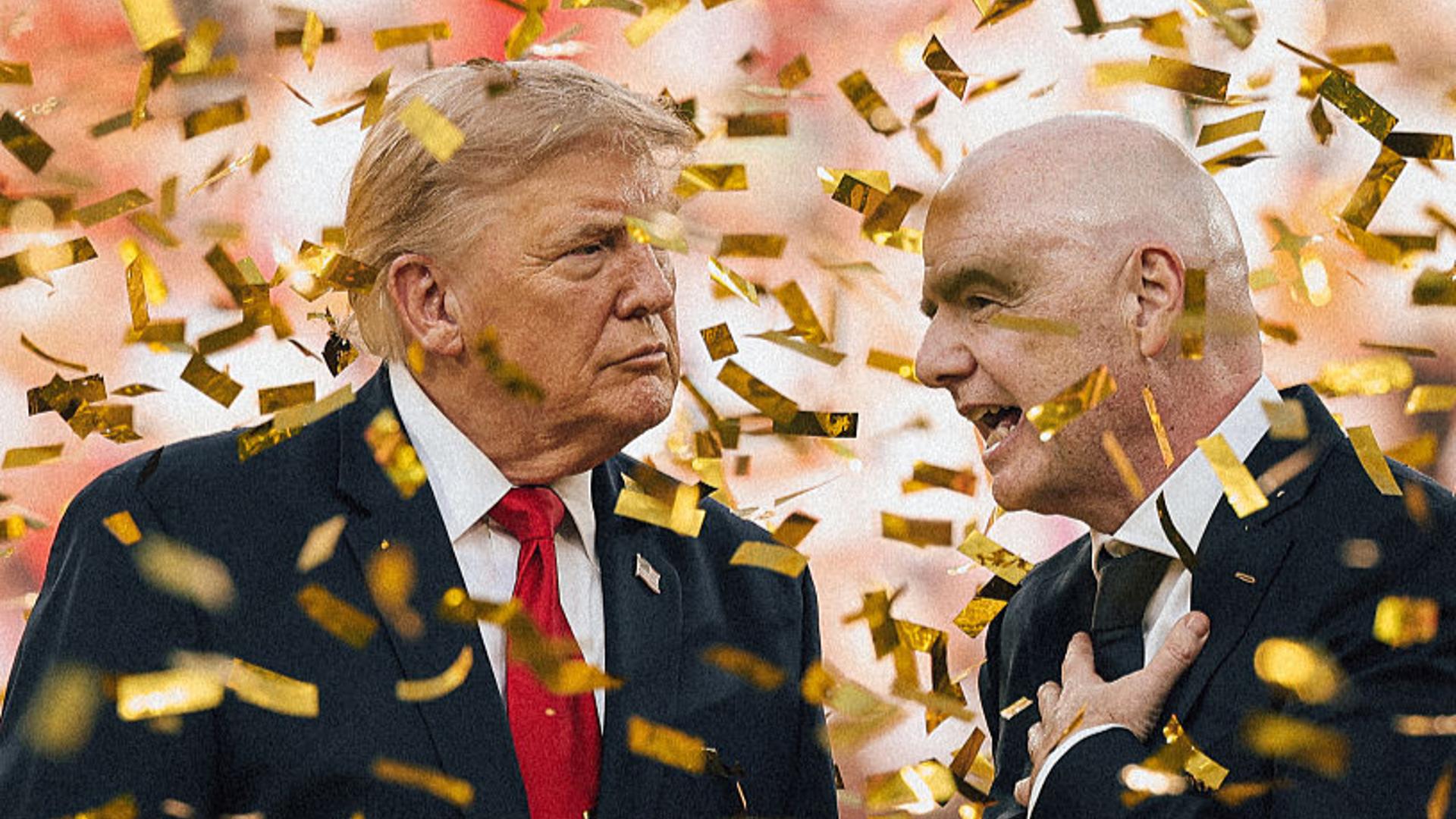
Soccer confederations, lawmakers criticize proposal
UEFA, which represents 55 FIFA member associations, was not the only soccer body to express concern about the proposal.
CONCACAF, the confederation that governs soccer in North America, Central America, and the Caribbean and that represents 35 of FIFA’s member associations, said it was “deeply concerned by the lack of due process,” including the fact that plans had been announced “before any discussion with the relevant governance bodies and stakeholders has taken place.”
The Football Association, England’s national football governing body, also said it was “deeply concerned about the lack of process and governance to get to this point, and the apparent substance and principles involved.” FA Chair Debbie Hewitt is one of FIFA’s eight vice-presidents.
The Asian Football Confederation also expressed concern about the proposal and said it was not consulted on it. The body, which represents 46 FIFA member associations, said it “is disappointed that a matter of such significance entered the public domain” before it was discussed “through the appropriate and established governance channels.”

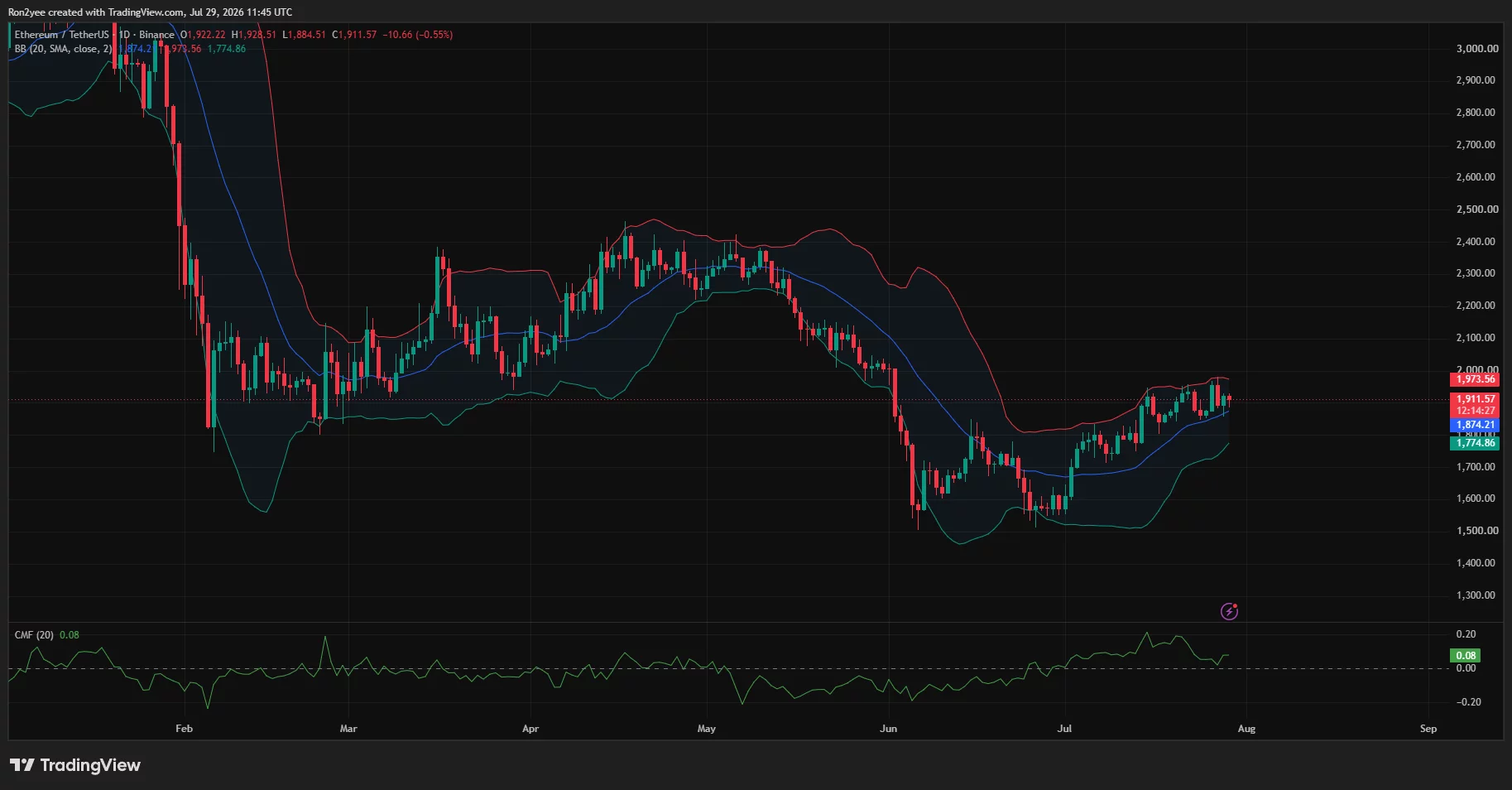
Ethereum price rose nearly 2% on July 29 as US spot ETF inflows and short liquidations helped ETH defend its rising support structure before the Federal Reserve’s rate decision.
Summary
- Ethereum recovered above $1,900 after rebounding from an intraday low near $1,856.
- US spot Ethereum ETFs attracted $14.53 million, including $5.15 million for Morgan Stanley’s MSSE.
- The 4-hour chart places ETH inside an ascending channel, with resistance approaching $1,970.
- Liquidation clusters near $1,940 and $1,960 could shape the next move before the Fed decision.
Ethereum price returns above $1,900
According to data from crypto.news, Ethereum (ETH) price was trading near $1,913 at the time of writing, up about 2% over the past 24 hours. The token had traded between approximately $1,856 and $1,926 during the session.
The recovery followed a successful defense of the $1,850–$1,880 region. ETH first reclaimed the daily Bollinger Band midpoint at $1,874 before moving back above the psychological $1,900 level.
Ethereum’s daily chart shows price consolidating between the Bollinger Band midpoint and upper boundary. The upper band sits at $1,973, making the $1,970–$2,000 region the next technical barrier. The lower band remains near $1,775.
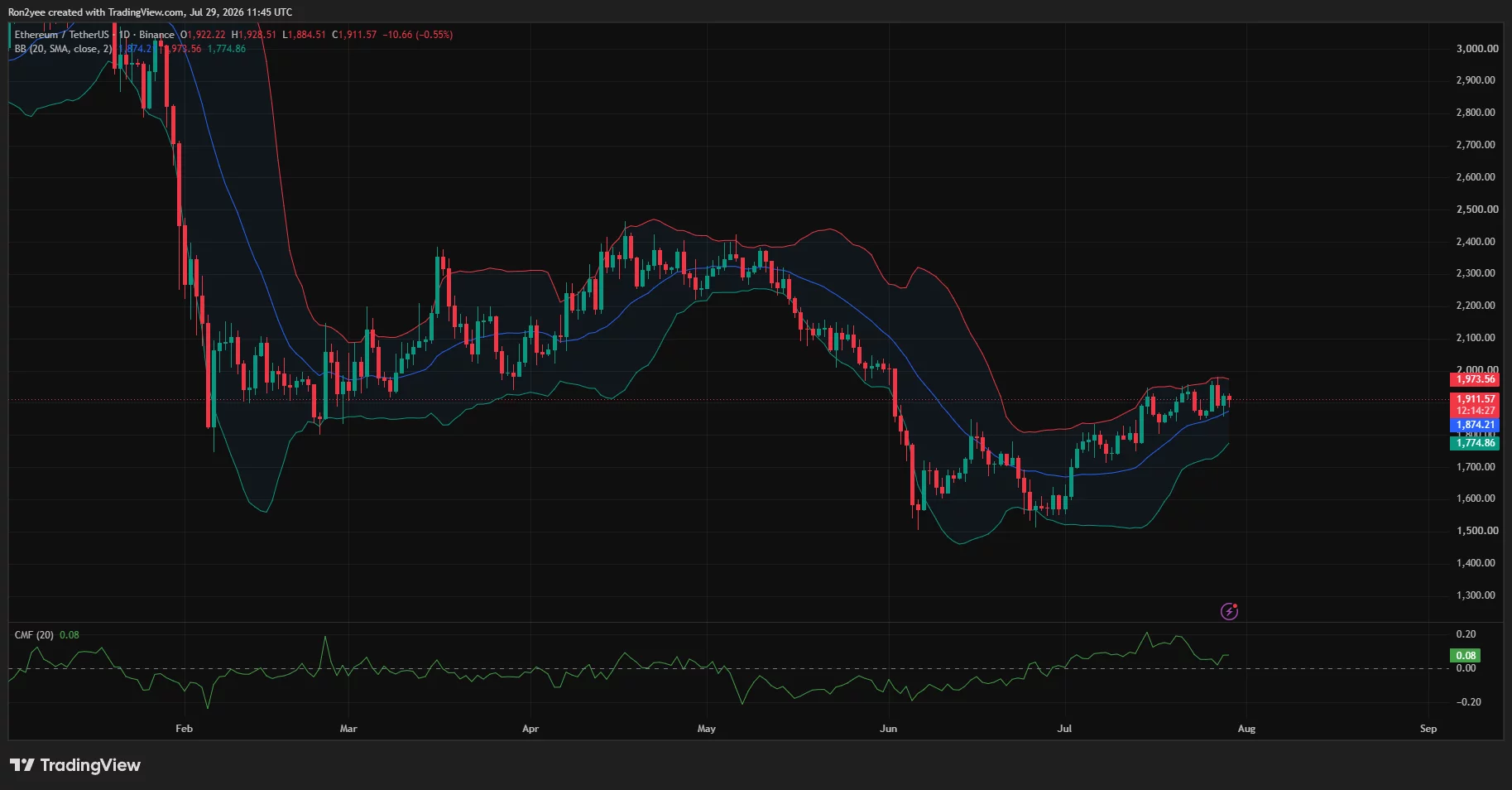
Buying pressure has also improved. The Chaikin Money Flow reading stands at 0.08, above the neutral line and indicating that capital inflows currently outweigh distribution. However, the indicator remains below its July high, suggesting demand has not yet reached breakout strength.
Morgan Stanley ETF adds to institutional demand
The rally coincided with the first trading session for the Morgan Stanley Ethereum Trust, which listed on NYSE Arca under the ticker MSSE.
MSSE attracted $5.15 million in net inflows and generated $19.03 million in first-day trading volume. BlackRock’s ETHB recorded the largest daily inflow at $5.91 million, while combined spot Ethereum ETF inflows reached $14.53 million.
US-listed Ethereum funds held about $10.5 billion in net assets after the session, equal to 4.53% of Ethereum’s market capitalization. Cumulative net inflows stood at approximately $11.21 billion, according to SoSoValue data.
MSSE’s launch expands regulated access to ETH for US investors through brokerage and retirement accounts. Its 0.14% expense ratio also increases fee competition among existing Ethereum funds.
ETF inflows alone do not prove that institutions caused the full price move. However, positive flows arrived as ETH tested a major support area, providing additional spot demand when liquidity was relatively thin.
Short liquidations accelerate Ethereum’s bounce
Derivative positioning added momentum to the recovery. Ethereum short liquidations reached $37.68 million over 24 hours, slightly exceeding the $36.66 million recorded for leveraged long positions.
The largest single liquidation was a $4.74 million ETH-USDT position on Binance, according to CoinGlass data. Forced closures of short positions require exchanges to buy back contracts, which can accelerate an existing price recovery.
The supplied 24-hour liquidation heatmap shows the strongest nearby overhead concentration around $1,938–$1,943. Additional liquidity rests near $1,955–$1,960.
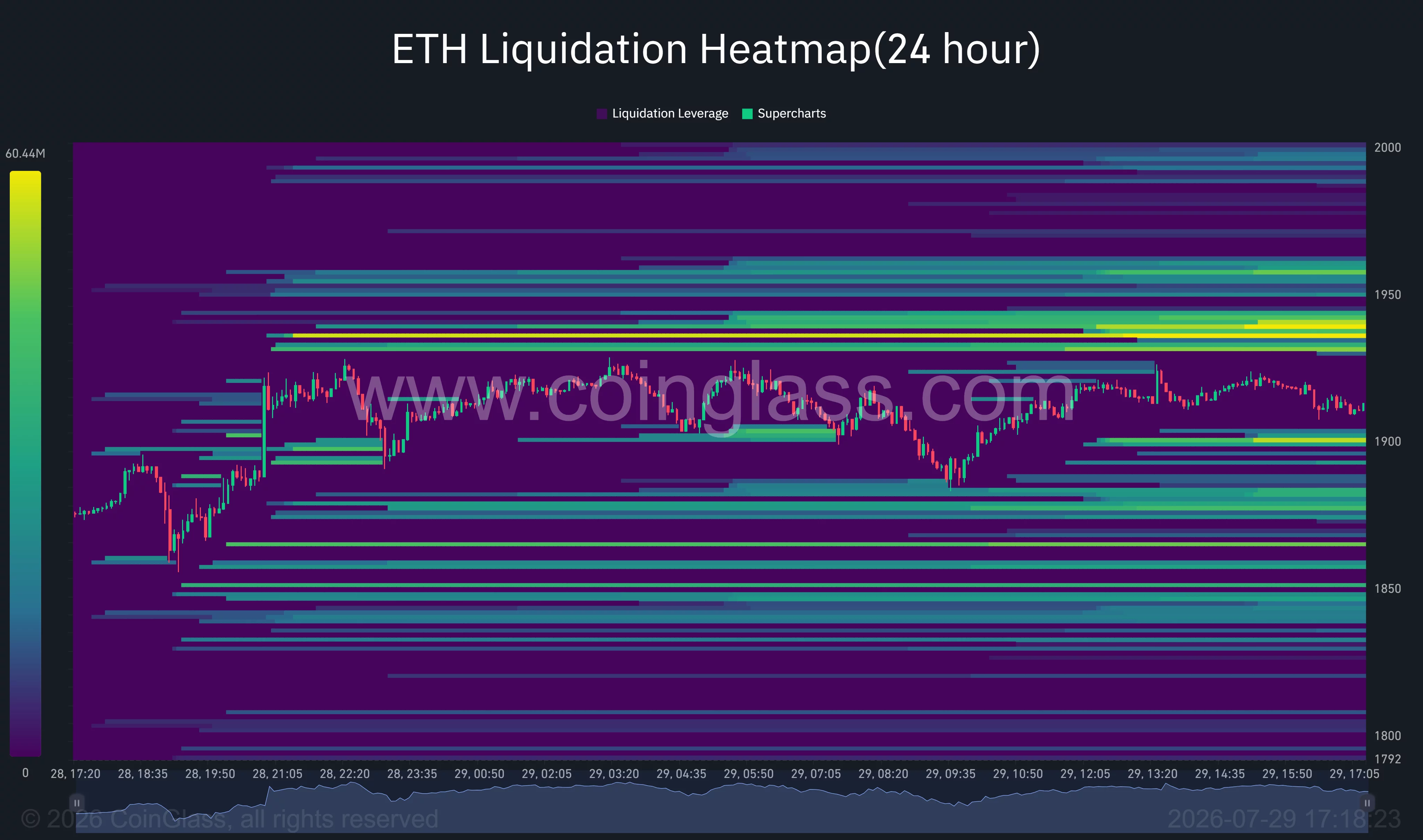
These clusters may attract price if ETH maintains support above $1,900. A move through $1,960 could then expose the $1,970 Bollinger Band resistance and the $2,000 psychological threshold.
On the downside, leveraged positions are concentrated near $1,895–$1,900 and between approximately $1,870 and $1,885. Losing $1,900 could therefore trigger another sweep toward the lower part of the 4-hour channel.
Ethereum charts point toward $1,970 resistance
The 4-hour chart places Ethereum inside an ascending parallel channel that has guided price since early July. ETH recently tested the channel’s lower boundary near $1,880 before recovering toward its midpoint.
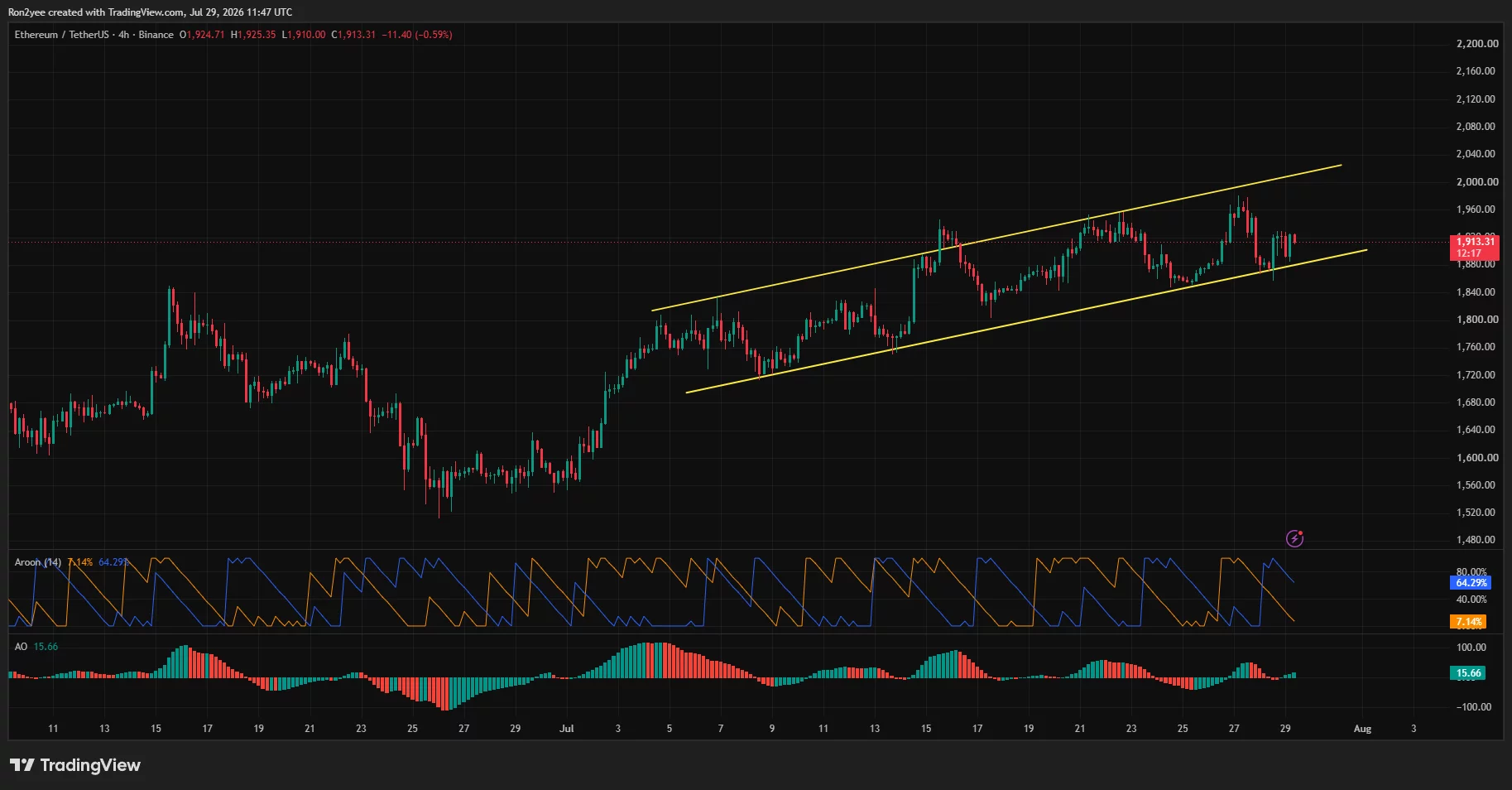
The Aroon Up indicator stands at 64.29%, compared with an Aroon Down reading of 7.14%. That difference suggests the recent bullish trend retains control despite ETH’s failure to hold its July 27 high near $1,970.
The Awesome Oscillator also remains positive at 15.66. Its green histogram bars show that short-term momentum has begun to improve following the latest pullback.
A close above $1,940 would clear the first major liquidation zone. Bulls would then need to break $1,970 and the upper Bollinger Band to open a test of $2,000. The ascending channel’s upper boundary could provide further resistance between $2,000 and $2,030.
Failure to hold $1,880 would weaken the channel structure. Below that level, the daily Bollinger midpoint at $1,874 becomes the first defense, followed by $1,800 and the lower band near $1,775.
Analysts see $1,800 as the critical floor
Crypto analyst Michaël van de Poppe identified $1,800 as the level Ethereum must preserve for the recovery to continue.
“I’d preferably see it hold above $1,800. If that’s the case, then it’s a matter of time until we’re going to see numbers that are north of $2,000.”
Daan Crypto Trades also noted that ETH had broken above its downtrend channel, daily 200-period moving averages, and bull market support band against Bitcoin. He said the ETH/BTC structure has remained bullish since June, although further altcoin gains still depend on Bitcoin holding its support.
The immediate macro test will come from the Federal Reserve. Markets largely expect the central bank to keep its target range at 3.50%–3.75%, but uncertainty over a possible quarter-point increase has risen. Notably, policymakers remain divided as they balance elevated inflation against easing energy prices.
A hold accompanied by a less hawkish statement could support ETH’s attempt to clear $1,970. A surprise increase or firm warning about future tightening would raise the risk of another decline toward $1,880 or $1,800.
Disclosure: This article does not represent investment advice. The content and materials featured on this page are for educational purposes only.
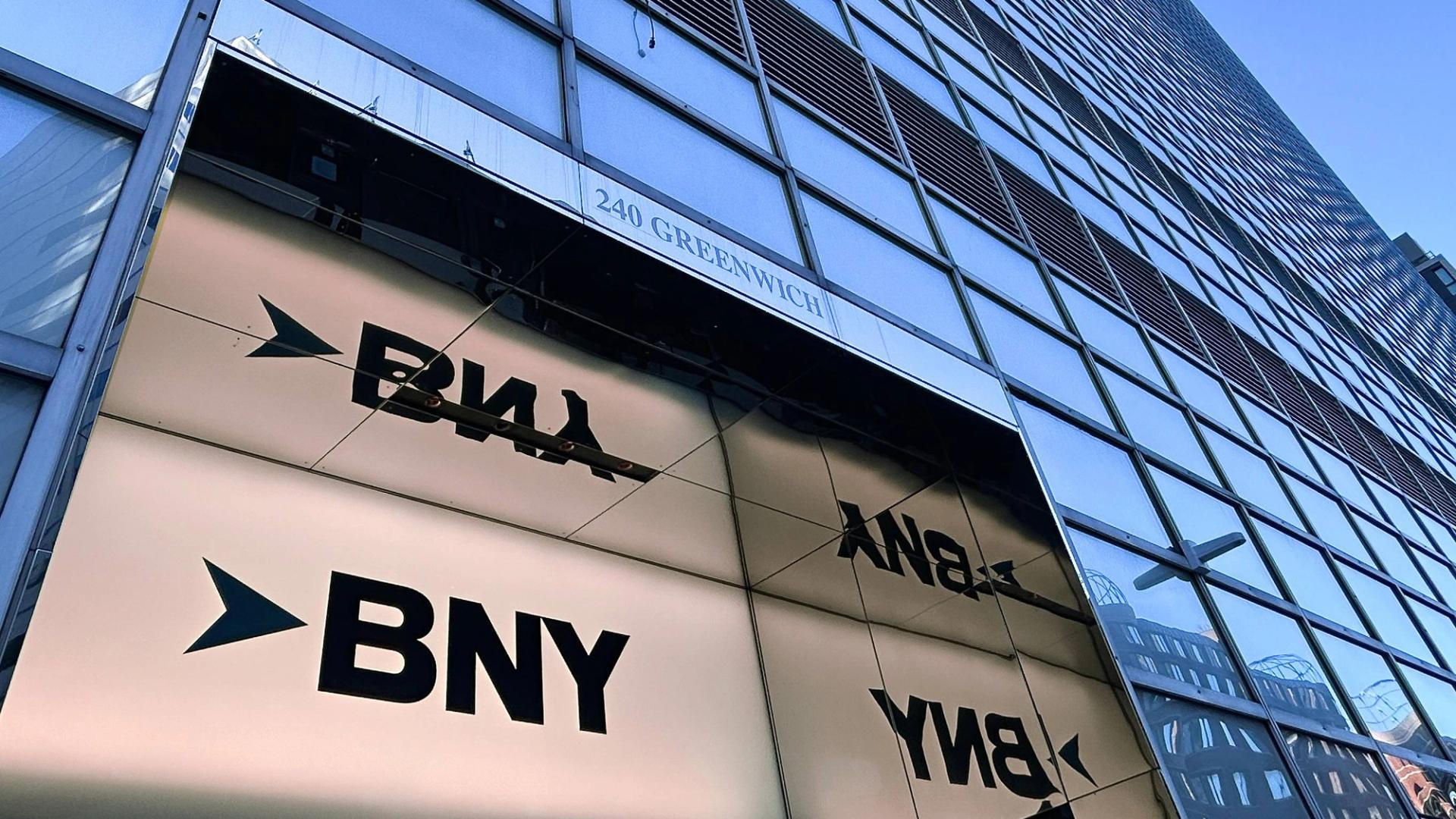
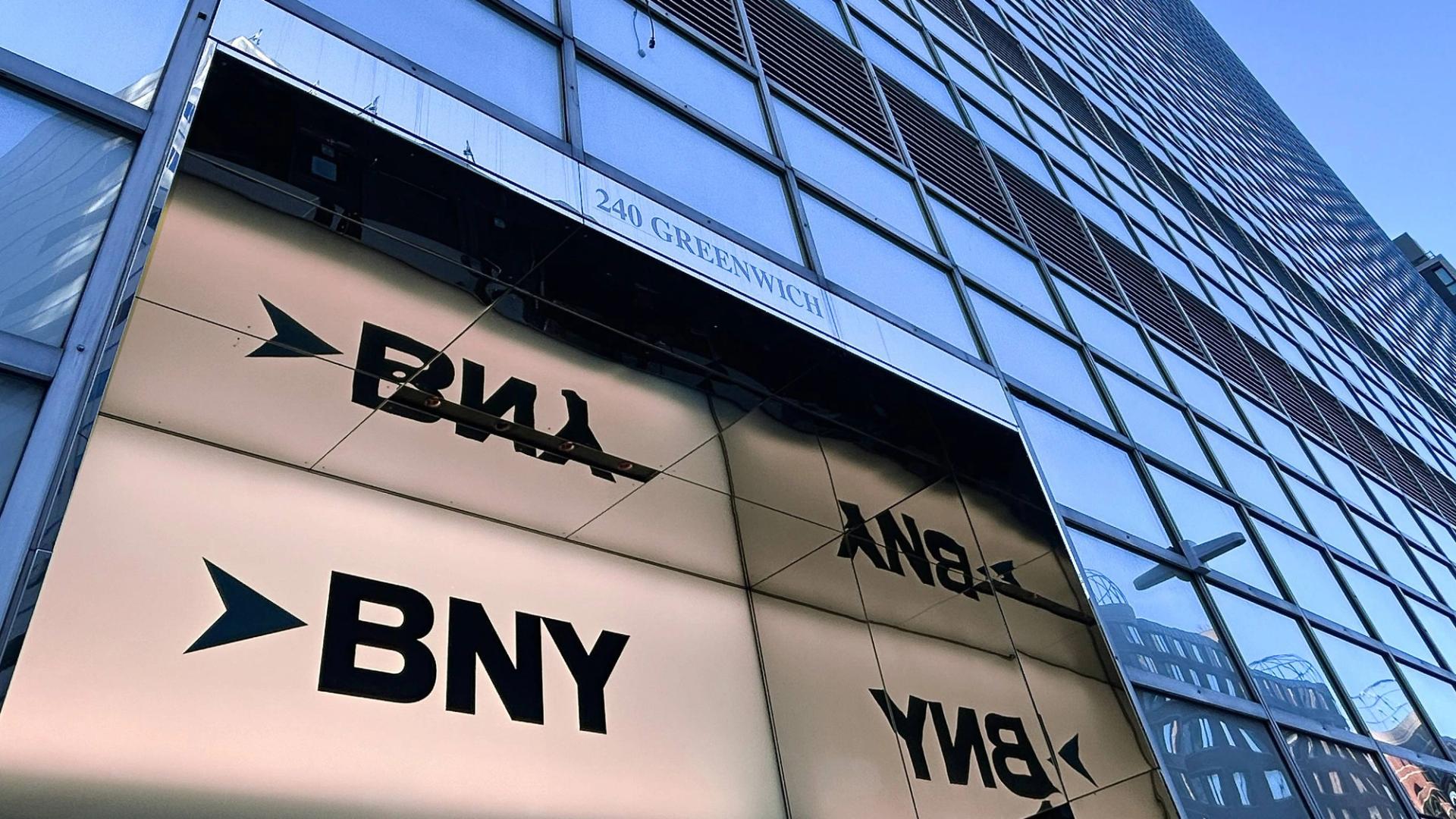
BNY, which has more than $59tn in assets under custody and administration, is moving one of its core record-keeping businesses onto blockchain as Wall Street builds the infrastructure for tokenized funds, the Financial Times reported Thursday.
“We think of BNY as modernizing a function that sits behind every single fund transaction by bringing the books and records onchain,” Carolyn Weinberg, chief product and innovation officer at the 242-year-old financial services giant.
BNY, which services about $8.6 trillion in assets across 7.6 million accounts, said moving its transfer agency onto blockchain would create a single record of ownership, cutting out the need for multiple intermediaries.
“We fully recognize you’ve got trillions and trillions of dollars’ worth of funds that… will continue to exist on traditional rails,” said Emily Portney, BNY’s global head of asset servicing, the bank’s largest business.
BNY did not immediately respond to a CoinDesk request for further information.
Baillie Gifford, a BNY client with more than $261 billion under management, will use the service for what the companies describe as the first fully native U.K.-regulated tokenized fund, according to FT. BlackRock and Dreyfus, BNY’s money-market and cash-management business, are expected to use it for planned funds.
Crypto World
CryptoRank Study Finds Bitget rTokens Recorded Up to 58% Lower Slippage on $50,000 Orders Across Leading Tokenized Equity Platforms
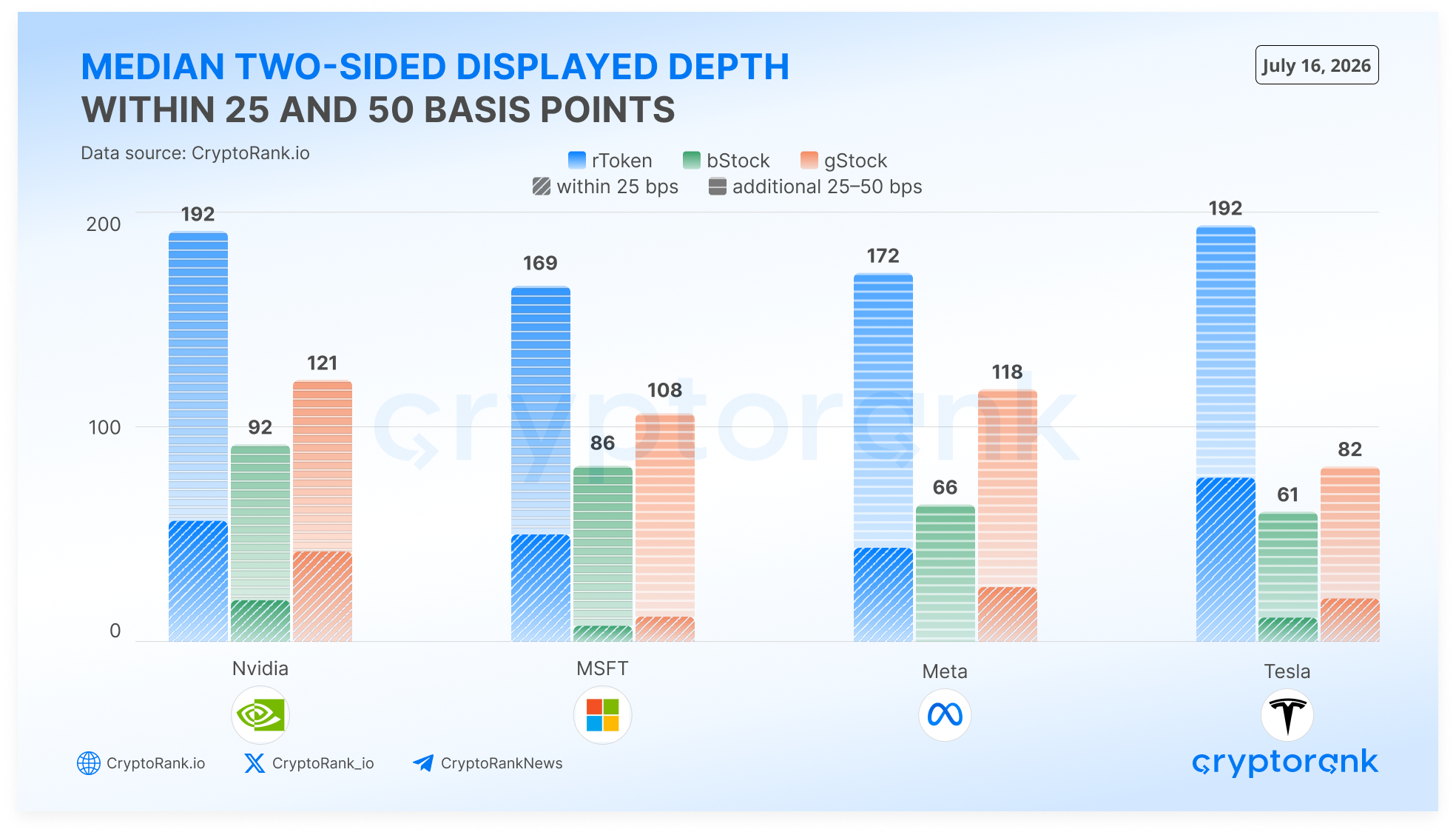
Bitget, the world’s largest Universal Exchange (UEX), ranked first for large-order execution in a CryptoRank study evaluating liquidity, market structure and execution quality across leading tokenized equity products. The research found that Bitget’s Reality rTokens delivered the lowest simulated slippage across every comparable asset tested, recording up to 58% lower slippage on $50,000 orders than competing tokenized equity products, highlighting the growing importance of execution quality as tokenized equities continue to mature.
The report arrives as the tokenized equity market approaches $2 billion in onchain value with more than 471,000 onchain holders, reflecting growing investor demand for blockchain-based access to traditional financial assets. As tokenized stocks become more widely available across crypto exchanges, CryptoRank examined how differences in product structure, liquidity models and execution infrastructure influence the trading experience beyond simple price exposure.
The study compared tokenized stock offerings across major exchanges and found that products tracking the same underlying equities can differ significantly in investor rights, liquidity mechanisms, redemption models and execution quality. The report evaluated NVIDIA, Microsoft, Meta and Tesla, the only four assets that maintained valid two-sided order books across all venues tested. In this comparable set, Bitget’s Reality rTokens consistently produced the strongest execution results for larger trades.
The report found that Bitget delivered the lowest simulated slippage across all four comparable assets for both $10,000 and $50,000 orders, while Reality rTokens recorded the highest balanced displayed liquidity within 50 basis points. CryptoRank attributed these results to Bitget’s liquidity architecture, which combines exchange liquidity with NYSE and NASDAQ-linked underlying market liquidity, enabling deeper liquidity and more efficient execution for larger trades. CryptoRank also examined the legal and operational structures behind tokenized equity products, noting that similar stock tickers can represent different forms of investor claims depending on how each product is issued and settled.

“Tokenization is moving beyond access and into infrastructure,” said Gracy Chen, CEO at Bitget. “If even 10% of global financial assets become tokenized by 2030, we’ll witness one of the most significant transformations in modern capital markets. The next phase of tokenization will be defined by quality of execution liquidity and market infrastructure supporting those assets. Independent research like this helps establish the benchmarks the industry needs as tokenzied markets continue to mature.”
The findings build on Bitget’s continued expansion of its Stock+ ecosystem, which gives eligible users access to more than 500 tokenized stocks, ETFs, commodities and other traditional financial assets alongside cryptocurrencies through a single unified account. By combining 24/7 market access, fractional investing and NYSE and NASDAQ-linked liquidity, Bitget is building the infrastructure needed to support the next generation of tokenized capital markets.
Read the CryptoRank report here.
About Bitget
Bitget is the world’s largest Universal Exchange (UEX), serving over 125 million users and offering access to over 2M crypto tokens, 500+ tokenized stocks, ETFs, commodities, FX, and precious metals such as gold. The ecosystem is committed to helping users trade smarter with its AI agent, which co-pilots trade execution. Bitget is driving crypto adoption through strategic partnerships such as MotoGP™. Aligned with its global impact strategy, Bitget has joined hands with UNICEF to support blockchain education for 1.1 million people by 2027. Bitget currently leads in the tokenized TradFi market, providing the industry’s lowest fees and highest liquidity across 150 regions worldwide.
For more information, visit: Website | X | Telegram | LinkedIn | Discord
Risk Warning: Digital asset prices are subject to fluctuation and may experience significant volatility. Investors are advised to only allocate funds they can afford to lose. The value of any investment may be impacted, and there is a possibility that financial objectives may not be met, nor the principal investment recovered. Independent financial advice should always be sought, and personal financial experience and standing carefully considered. Past performance is not a reliable indicator of future results. Bitget accepts no liability for any potential losses incurred. Nothing contained herein should be construed as financial advice. For further information, please refer to our Terms of Use.
The post CryptoRank Study Finds Bitget rTokens Recorded Up to 58% Lower Slippage on $50,000 Orders Across Leading Tokenized Equity Platforms appeared first on BeInCrypto.

Decentralized Autonomous Organizations (DAOs) were created to replace centralized decision-making with community-driven governance. Token holders propose ideas, vote on changes, and collectively manage treasuries, protocols, and ecosystems. However, as DAOs continue to grow in size and complexity, human contributors alone may struggle to keep pace with the increasing volume of governance proposals, financial data, and ecosystem activity.
Artificial Intelligence is emerging as a powerful solution—not as a replacement for community governance, but as an intelligent contributor that enhances decision-making, automates repetitive tasks, and improves operational efficiency. The future of DAOs may include AI agents working alongside human members as active participants in decentralized organizations.
The Evolution of DAO Contributors
Traditional DAO contributors perform tasks such as:
- Writing governance proposals
- Reviewing protocol upgrades
- Managing community discussions
- Monitoring treasury health
- Researching ecosystem developments
- Organizing grants and partnerships
While these responsibilities require human judgment, many supporting activities involve collecting, analyzing, and summarizing large amounts of information. AI excels at exactly these tasks.
Instead of replacing contributors, AI can become an always-available assistant that enables communities to make faster and more informed decisions.
AI as a Governance Researcher
Governance proposals often span dozens of pages and include technical details that many token holders may not fully understand.
AI can:
- Summarize lengthy proposals
- Highlight potential risks
- Compare new proposals with historical governance decisions
- Explain technical concepts in simple language
- Generate impact analyses
This allows DAO members to spend less time reading documentation and more time evaluating strategic decisions.
Treasury Intelligence
Managing millions of dollars in digital assets is one of the biggest responsibilities within successful DAOs.
AI can continuously monitor:
- Treasury diversification
- Stablecoin exposure
- Yield performance
- Liquidity positions
- Market volatility
- Spending efficiency
Instead of waiting for monthly reports, DAO members could receive real-time recommendations whenever treasury conditions change significantly.
Proposal Drafting Assistance
Many great ideas never become governance proposals because contributors lack the time or writing experience.
AI could help contributors by:
- Structuring governance proposals
- Generating clear documentation
- Creating implementation timelines
- Estimating resource requirements
- Identifying missing information
This lowers the barrier to participation and encourages more community members to contribute.
Community Moderation at Scale
Large DAOs often have thousands of members spread across multiple platforms.
AI moderators could:
- Answer common governance questions
- Direct users to relevant documentation
- Detect spam and malicious activity
- Translate discussions into multiple languages
- Summarize community sentiment
Human moderators would remain responsible for final decisions, while AI handles repetitive support tasks around the clock.
Smarter Grant Programs
Many DAOs distribute grants to developers, researchers, and ecosystem builders.
AI can assist by:
- Reviewing applications
- Categorizing proposals
- Detecting duplicate submissions
- Scoring projects against predefined criteria
- Tracking milestone completion
This allows grant committees to focus on evaluating innovation rather than administrative work.
AI-Powered Risk Monitoring
Security remains one of the largest concerns in decentralized finance.
AI agents can monitor:
- Suspicious wallet activity
- Smart contract vulnerabilities
- Governance attacks
- Treasury anomalies
- Oracle irregularities
- Cross-chain risks
Rather than reacting after an incident occurs, DAOs can receive early warnings that help prevent losses.
Autonomous Operational Contributors
Future AI contributors may eventually perform operational work independently, including:
- Publishing governance reports
- Updating DAO dashboards
- Scheduling community meetings
- Managing documentation
- Tracking KPIs
- Coordinating contributor workflows
These AI agents would operate under permissions defined by governance rather than acting independently without oversight.
The Importance of Human Oversight
Despite rapid advances, AI should not have unrestricted authority over DAO governance.
Critical responsibilities—including treasury allocations, protocol upgrades, constitutional changes, and governance votes—should remain under community control.
AI works best as:
- An advisor
- A researcher
- A data analyst
- A workflow assistant
- A monitoring system
Human contributors continue to provide judgment, ethics, creativity, and accountability—qualities that AI cannot fully replicate.
Challenges Ahead
Before AI becomes a trusted DAO contributor, several challenges must be addressed:
- Transparency in AI-generated recommendations
- Prevention of model bias
- Protection against prompt manipulation
- On-chain verification of AI actions
- Accountability for autonomous decisions
- Privacy when processing governance data
Developing decentralized AI infrastructure alongside robust governance frameworks will be essential for building trust.
The Future of AI-Driven DAOs
The next generation of DAOs may include specialized AI agents dedicated to governance analysis, treasury optimization, community engagement, security monitoring, and operational management. Rather than replacing decentralized governance, these intelligent contributors can empower communities with faster insights, better data, and more efficient execution.
As decentralized ecosystems continue to expand, AI may become one of the most valuable contributors a DAO can have—not because it votes in place of people, but because it equips communities with the knowledge and tools to make smarter collective decisions. The future of governance is likely to be a collaboration between human wisdom and machine intelligence, creating DAOs that are more scalable, resilient, and effective than ever before.
REQUEST AN ARTICLE


Russia has issued an international arrest warrant for Telegram founder Pavel Durov, charging him with facilitating terrorist activities via his platform.
Russia’s Federal Security Service (FSB) claims Telegram failed to remove Telegram channels, chats, and bots “used by Ukrainian special services and by terrorist and extremist organisations to prepare and coordinate acts of sabotage and terrorism, mass killings, and cyber-fraud operations within the Russian Federation.”
It claims this led to “numerous human casualties” and billions in material damage.
Ukrainian forces were allegedly using a Telegram dating chatbot to recruit Russians into sabotage work while Russia has detained 46 users for criminal acts connected to the chatbot.
In response to the warrant, Telegram’s X account posted a photo of Durov with his middle finger pointed towards the camera.
Read more: Telegram CEO Durov says he was poisoned during TON fund raise
This year, Russia has reportedly fined Telegram 100 million rubles ($1.26 million) for failing to take down content that’s banned in Russia.
In 2024, Durov was arrested in France and charged with allowing criminal activity, such as fraud, child sexual abuse, and money laundering, to proliferate on his app.
One year later, authorities allowed the dual France/Dubai citizen to fly back to his home in Dubai while they continued to investigate his case.
Durov poisoned during Russia Telegram tensions
Durov claimed to have been previosuly poisoned during the spring of 2018 when he received an unknown package.
He didn’t reveal an exact timeframe of his poisoning, but in April, Telegram refused to give encryption keys to the FSB, which wanted access to messaging data. Later that month, Russia banned Telegram.
Before this, he’d just secured $1.7 billion in funding from Russian billionaires, as well as other investors, for his TON crypto project.
In September 2024, Russian president Vladimir Putin criticised Durov’s arrest by France. Putin said, “I know that many countries have raised concerns about the platform being used in certain ways by certain individuals and entities whose activities could harm the economy or security of certain countries. I think the Russian government might also have had some questions.”
Read more: Are Telegram chats actually encrypted?
He added, “All platforms of this kind are guilty of this. If this is what they’re doing to Durov, then others should probably be arrested,” before adding that the French authorities’ actions “are not entirely clear to me, as they are selective.”
Telegram has also been criticised by the UN and senior figures at crypto security firm Elliptic for its role in facilitating scams.
In 2024, the UN argued that Telegram had become a haven for criminal money launderers while Elliptic’s chief scientist said it was contributing, and not doing enough to stop, the $442 billion scam industry.
Got a tip? Send us an email securely via Protos Leaks. For more informed news and investigations, follow us on X, Bluesky, and Google News, or subscribe to our YouTube channel.
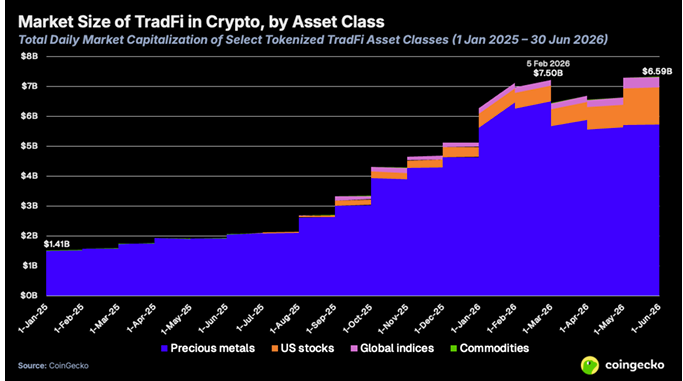
Intense competition from traditional brokerage and decentralized exchanges is pushing crypto exchanges to expand beyond digital assets into tokenized stocks, commodities and precious metals, CoinGecko said.
A study, released by the crypto data provider on Wednesday, found that the market capitalization of tokenized traditional assets, including precious metals, US stocks, commodities, global indexes and forex, grew to $6.6 billion in June 2026 from $1.4 billion in January 2025. The analysis covers activity across Binance, OKX, Bybit, Bitget, Gate and MEXC.
The market’s initial growth was fueled largely by tokenized precious metals before expanding into US equities. By mid-2026, US stock perpetual futures had overtaken precious metals in both trading volume and open interest, driven by investor interest in semiconductor stocks and anticipated initial public offerings, the report said.
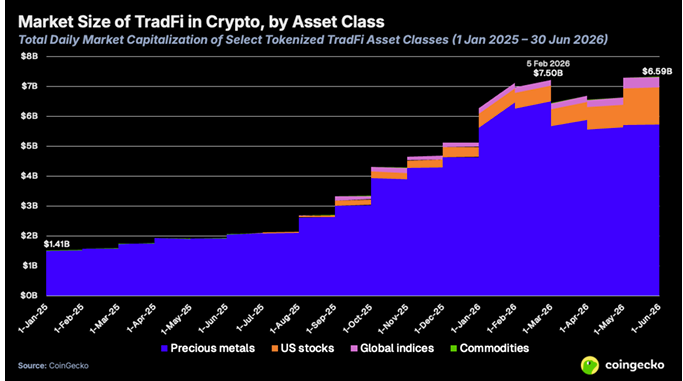
Tokenized traditional assets on crypto exchanges grew nearly fivefold over 18 months, with precious metals driving early gains. Source: CoinGecko
Perpetual futures account for the vast majority of trading activity, while spot markets remain comparatively small. According to the report, derivatives dominate because traders prefer leveraged products and exchanges can list perpetual contracts without issuing or custodying the underlying tokenized assets.
The expansion comes as centralized exchanges look beyond crypto trading to attract and retain users. CoinGecko said competition is intensifying from both decentralized exchanges, which have chipped away at market share, and traditional brokerages that are expanding their digital asset offerings.
Robinhood is among the brokerages that have significantly expanded their digital asset offerings, underscoring the growing overlap between traditional finance and digital asset platforms.
Related: Bernstein raises Robinhood price target, cites tokenization and prediction markets
Institutional demand fuels tokenization push
Institutional interest in tokenized assets continues to build. A June report by Standard Chartered projected that tokenization could help expand decentralized finance into a $2.7 trillion market by 2030 through the adoption of real-world assets. Separately, Bernstein analysts estimated the broader tokenization market could reach $4 trillion by the end of the decade as financial institutions increasingly embrace blockchain-based assets.
Like the convergence between crypto exchanges and traditional brokerages highlighted by CoinGecko, institutional adoption of tokenization underscores how fast the lines between traditional finance and blockchain infrastructure are blurring.
As Cointelegraph recently reported, BitGo and OTC Markets Group have partnered to expand access to tokenized securities for more than 150 broker-dealers. Separately, Tradable teamed with the Stellar network to bring up to $1 billion in private credit assets onchain, illustrating how banks, brokerages and crypto firms are increasingly building on the same blockchain infrastructure.
Related: Crypto Biz: When dollars disappear, stablecoins step in


South Korea’s KOSPI index has lost more than the entire market capitalization of BTC in the past 29 trading days.
As of today’s opening, it’s price was ₩6,089, down 35% from an all-time high of ₩9,385 on June 19. This means that constituents of the country’s benchmark index have lost more than the $1.3 trillion value of all circulating BTC in less than 30 trading sessions.
Specifically, market caps of the index’s constituents have declined from ₩7,670 trillion ($5 trillion) on June 19 to today’s ₩4,960 trillion ($3.4 trillion).
Although the decline was 35% denominated in won, the drop was only 32% in USD due to exchange rate fluctuations. Still, by either measure, the loss exceeds the total market cap of BTC.
Losses in South Korea’s speculative, crypto-friendly, and AI-focused stock market have been as spectacular to the downside as they were meteoric earlier this year.
Within yesterday’s trading session alone, the country’s stock index lost 10.8% of its value, extending losses since June 19 when the index hit an all-time high of ₩9,385.
Even a market-wide halt for 20 minutes by the Korea Exchange yesterday failed to pause the selling.
For context, if the S&P 500 were to drop 10.8% in one day, such a drop would erase over $7 trillion — more than the GDP of any country in the world besides the US and China.
Read more: South Korea recovers from martial law and XRP, BTC flash crashes
South Korea’s KOSPI drops faster than BTC
Tuesday’s drop from ₩6,000 trillion was its first reading below that threshold since April.
The market cap of BTC is about $1.3 trillion today. S. Korea’s five-week loss is more than $200 billion worse than that value.
In foreign exchange markets, the won was trading at ₩1,537 to the US dollar on the KOSPI index’s June 19 peak. Today, the won has strengthened slightly to ₩1,456.
Somewhat embarrassingly, BTC has lost its own market cap before — on its own. Its price has halved since its October 6, 2025 record high when its market cap was $2.5 trillion.
Yesterday, its market cap dropped to half that value: $1.26 trillion.
In percentage terms, BTC has fallen lower from its peak — 50% versus the KOSPI’s 32% in dollars — albeit over a longer time frame.
Record memory-chip earnings and financial leverage sent shares of two companies, Samsung Electronics and SK Hynix, on a rocketship journey earlier this year.
The AI industry pair now account for roughly half the value of the KOSPI.
Got a tip? Send us an email securely via Protos Leaks. For more informed news and investigations, follow us on X, Bluesky, and Google News, or subscribe to our YouTube channel.

ADA price is trading at $0.163, and the bigger question is whether Cardano design philosophy is quietly winning a debate the market once dismissed in this bearish prediction environment. Our analysis at Cryptonews suggests that formal verification, selective privacy, proof of stake, and broad token distribution are increasingly gaining traction across major blockchain networks. With ADA holding above $0.16, long-term price forecasts have once again caught retail attention.
The argument is not a victory lap. Instead, we see it as evidence of a structural shift across the industry. More than $2.5 billion has been lost to bridge hacks over the past five years, making the “ship first, patch later” approach increasingly difficult to justify. We also note AI-assisted bug discovery at Zcash and Ethereum validator software as signs that formal verification is becoming an operational necessity.

We also observe that Ethereum’s updated multiyear roadmap now includes formal verification as a key priority. Based on current development timelines, that transition could take around four years. Meanwhile, Ethereum’s Layer 2 roadmap reflects how much the competitive landscape has changed since Cardano first embraced these ideas.
Still, whether narrative convergence leads to price gains remains the harder question. Markets often take time to reward long term thesis validation. For now, ADA’s chart shows limited momentum despite renewed interest in Cardano’s technology and Charles Hoskinson’s vision.
Discover: The Best Crypto to Diversify Your Portfolio
Cardano Price Prediction: Break $0.20 Before the Next Altcoin Rotation?
Cardano price is pressing against a ceiling and a prediction that has been tested but not cleared. The recent 24-hour range of $0.1660 to $0.1742 keeps the price in a tight band. Meanwhile, the seven-day range of roughly $0.1570 to $0.1919 shows sellers still defending the area below the $0.20 resistance zone.
That leaves $0.175 as an important level to watch. A rejection there could send ADA back toward recent weekly lows. On the other hand, a clean move above it would strengthen the case for another run at $0.20, where selling pressure has repeatedly emerged.

Longer-term forecasts remain mixed despite improving sentiment. Binance projections place ADA’s average August target near $0.29, although estimates vary widely. Coinbase remains more conservative, targeting about $0.49 in 2026 and $0.59 in 2030. Meanwhile, Changelly still expects ADA to trade between $0.148 and $0.161 during parts of 2026.
The bullish case depends on sustained altcoin rotation pushing ADA above $0.175 with stronger trading volume. Otherwise, the base case remains a sideways move between $0.16 and $0.175 as governance developments support demand. A drop below $0.157 could expose another test of recent lows if on-chain activity fails to improve.
Trade ADA on Bybit and Get a Chance to Win Our $1,000 USDT Airdrop
Bitcoin Hyper Targets Early-Mover Upside as Cardano Stalls Below Key Resistance
ADA’s 2.19% daily gain is real, but holding below $0.20 while waiting for a four-year thesis to reprice is a specific kind of trade. Traders rotating out of range-bound large caps into earlier-stage infrastructure plays are finding a different risk/reward profile in the Bitcoin Layer 2 segment.
Bitcoin Hyper ($HYPER) is a Bitcoin Layer 2 integrating the Solana Virtual Machine with sub-Solana latency with Bitcoin-native security. The presale has raised $32.9 million at a current price of $0.0136838, with staking available for early participants.
The project’s core proposition is removing Bitcoin’s three structural bottlenecks like slow throughput, high fees, and absent programmability, while preserving the base layer’s trust model. A Decentralized Canonical Bridge handles BTC transfers natively.
For traders who track Bitcoin infrastructure momentum, this is worth diligence.
Research Bitcoin Hyper before the next stage closes.
Discover: The Best Token Presales
The post Cardano Price Prediction: Has Hoskinson’s Vision Become Crypto’s New Roadmap? appeared first on Cryptonews.
Bitcoin’s price dipped below $62,800 yesterday in a de-risking move from investors ahead of the FOMC meeting, but it has rebounded swiftly to over $64,000 now.
Most larger-cap alts have turned green as well, with XRP aiming at $1.10 once again. UNI is up by over 5%, while ADA has gained more than 4%.
BTC Jumps Ahead of FOMC
BTC was rejected at $67,000 last week, and the subsequent leg down pushed it south to under $63,600 on Friday. The bulls finally stepped up after this rather substantial decline given the current dull market phase, and bitcoin remained at around $64,000 during most of the weekend.
It even climbed slightly on Sunday following some de-escalation news on the US/Iran front. More profound increases came on Monday morning when the asset priced in the lack of new attacks between the US and Iran and jumped to $65,600 on a couple of occasions.
However, it failed there quickly and tumbled hard on Tuesday. Just a day before the most unpredictable FOMC meeting in years, the cryptocurrency dumped below $62,800, losing $3,000 in less than a day.
Nevertheless, it has bounced off rather nicely over the past several hours, currently trading well above $64,000. Its market capitalization has risen to $1.290 trillion on CG, while its dominance over the alts has jumped to 57%.

BEAT Rockets, PI Rebounds
Most larger-cap alts have posted some gains over the past 24 hours, led by XRP and ADA. The former is up by 3% to $1.09, while the latter has jumped by 4.4% and now sits at $0.165. ETH has reclaimed the $1,900 level, while XMR is up to $350. UNI has added over 5% of value, followed by SKY, ONDO, and TAO.
In contrast, NEAR has dumped by another 5%, followed by LTC and ZEC. BEAT is by far the biggest gainer over the past 24 hours, surging by 35% to $3.75. Pi Network’s native token follows suit. A 5.5% surge from PI has pushed it close to $0.08 after it dumped to $0.074 yesterday.
The total crypto market cap has recovered $40 billion since yesterday’s low and is up to $2.270 trillion on CG.

The post Bitcoin Reclaims $64K Ahead of FOMC Meeting, Pi Network’s PI Rebounds: Market Watch appeared first on CryptoPotato.
Crypto World
3 reasons Wednesday’s FOMC interest-rate decision is pivotal for bitcoin (BTC) prices: Crypto Daily
The Federal Reserve (Fed) will announce its rate decision at 2 p.m. ET today, followed by Chair Kevin Warsh’s press conference at 2:30 p.m. ET.
Traders typically assign greater weight to FOMC meetings that come with updated economic projections and a “dot plot” of interest-rate forecasts. Today’s gathering lacks both. Yet the outcome still carries outsized importance for three reasons.
Unusual uncertainty over the outcome: Markets are still assigning roughly a 35% probability of a rate increase, CME fed funds futures show. That level of indecision is rare so close to a decision. By now, traders have usually converged on a clear expectation of a hold, hike or cut. Citadel, one of the largest hedge funds in the world, is predicting an increase. The firm argues a move would end forward guidance as a policy choice, an outcome Chair Warsh has long favored.
Bond yields are already rising: Both the 10-year and two-year Treasury yields have broken above key trendlines that defined the shallow pullback in place since 2023 (check the Daily Signal). With the breakout complete, the path of least resistance is now clearly established to the upside.

The Common Travel Area (CTA) and Asylum

Sakshi, Arundhati Enter Boxing Semi-Finals. India Assured Of 18 Medals At CWG 2026

eBay’s Newest Oddity is a Fully Working Prison Tablet That Still Thinks You’re Locked Up


-

 Fashion5 days ago
Weekend Open Thread: Brooks Brothers
-
 Sports3 days ago
Commonwealth Games boxing: Jadumani Singh seals dominant 5-0 win over Pakistan’s Sumama Rehman to enter quarter-finals | Commonwealth Games News
-

 Tech3 days ago
Intel is reversing course and bringing hyper-threading back to its server chips
-

 Crypto World7 days ago
Ethics, other provisions in crypto Clarity Act to be further discussed
-

 Politics2 days ago
Luke Littler dismantles Gerwyn Price to retain title in Blackpool
-

 Sports5 days ago
2026 3M Open leaderboard: Scottie Scheffler finds putter in Round 1, sits three back
-

 Politics1 day ago
The Part of the Electric Transition Nobody Wants to Discuss
-

 Fashion5 days ago
16 Dresses for the High Summer Event
-
 Entertainment5 days ago
A New Post-Apocalyptic Gundam Anime Series Blasts Into SDCC
-

 Crypto World4 days ago
Ripple bought a bank in pieces. The $4 billion audit
-

 News Videos3 days ago
BITCOIN JUST ENTERED THIS CRITICAL ZONE…
-

 News Videos6 days ago
The Peugeot Family: How 200 Years of an “Old Money” Dynasty Died in A Boardroom
-

 Business7 hours ago
Major shareholder moves on Canyon
-

 Politics3 days ago
Spain sweeps the board at 2026 World Cup with individual awards
-

 Crypto World3 days ago
XRP Ledger adds $2.6B as RWA inflows rank second
-

 Crypto World6 days ago
Uniswap (UNI) pushes deeper into tokenized RWAs with permissioned trading pools
-
 Entertainment17 hours ago
‘Stargate’ Creator’s New Sci-Fi Series Returns for Season 3 Tomorrow
-

 Tech4 days ago
Anthropic launches Claude Opus 5, a cheaper AI model for coding, agents and enterprise workflows
-
Crypto World6 days ago
SEC Agrees to Overhaul Recordkeeping After Settling Coinbase Lawsuit Over Gensler’s Lost Texts
-

 News Videos17 hours ago
Claude: Build Financial Dashboards in Minutes (2026)
You must be logged in to post a comment Login