
Crypto World
Institutions Could Fire Bitcoin Devs Over Quantum Fears


Rising concerns about quantum threats to Bitcoin have captured the attention of institutions and veteran investors. In a recent appearance on the Bits and Bips podcast, venture capitalist Nic Carter warned that large holders might grow impatient with developers if action on quantum-resistant cryptography stalls, potentially triggering governance shifts. He argued that a slow pace could prompt major players to replace core contributors with new teams more willing to push forward a solution. The debate centers on risk management, control, and the pace of change at a time when the network remains one of the largest, publicly verifiable assets in the world.
BlackRock, the world’s largest asset manager, is reported to hold around 761,801 BTC, valued at roughly $50.15 billion at publication, accounting for about 3.62% of the circulating supply. The sheer scale of institutional exposure highlights why the question of security upgrades and governance is no longer purely academic. Carter’s provocative framing asks what happens if a consent-based, volunteer-driven development model cannot keep up with the demands of major participants. “If you’re BlackRock and you have billions of dollars of client assets in this thing and its problems aren’t being addressed, what choice do you have?” he asked during the discussion.
That framing has sparked a broader debate within the industry about whether Bitcoin (CRYPTO: BTC) is approaching a tipping point where governance dynamics could shift under institutional pressure. The discussion comes amid a wider conversation about the timing and feasibility of upgrading the network’s cryptographic foundations to resist quantum attacks, a threat some researchers say could become material within the next decade, while others contend the risk is overstated or manageable with incremental steps.
Key takeaways
- Institutional stakeholders are explicitly weighing governance and development tempo in response to potential quantum threats to Bitcoin’s security model.
- A number of prominent investors and commentators see the risk as real enough to spur calls for faster action or even new development leadership if progress stalls.
- One of the largest holders, BlackRock, adds a practical layer of pressure, given the scale of capital that could influence upgrade decisions and strategy for the Bitcoin network.
- The industry remains divided: some argue the threat is existential and immediate, while others say the concern is theoretical and can be mitigated through measured research and gradual hardening.
- Proposals and discussions around quantum-resistant cryptography are entering mainstream crypto discourse, with researchers pointing to tangible, albeit gradual, paths forward.
Tickers mentioned: $BTC
Market context: The conversation around quantum risk sits alongside ongoing debates about protocol upgrades, risk management by institutional holders, and the role of governance in a decentralized-but-institutionally-influenced ecosystem. As markets monitor liquidity, macro cues, and regulatory signals, the quantum-resilience question adds a new layer to how investors assess Bitcoin’s security posture and future upgrade trajectories.
Why it matters
The potential for quantum computing to undermine current cryptographic protections touches every layer of Bitcoin—from wallets and transaction verification to the very assumptions underpinning its security model. If the network’s cryptography were shown to be vulnerable, large institutions with significant BTC exposure could demand faster progress toward quantum-resistant schemes, or even push for changes in who controls core development. That possibility — sometimes described as a “corporate takeover” of the upgrade process — would represent a shift in how decentralized networks interact with centralized capital markets and risk managers. Proponents of swifter action argue that delaying a secure upgrade could amplify systemic risk, while skeptics caution against hasty changes that might fracture consensus or introduce new vulnerabilities.
A number of voices in the industry have weighed in on the urgency and feasibility of addressing quantum threats. Austin Campbell, founder of Zero Knowledge Consulting, echoed concerns that if a structural problem exists and large players maintain a long view, they will eventually demand reform or louder participation from the governance and development community. In parallel, other industry figures emphasize a more measured approach, warning against overreaction and highlighting the resilience of Bitcoin’s current security margin. Carter’s assertions that a rapid, market-driven shift could occur if developers don’t move quickly enough contrast with more conservative analyses that quantify the actual exposure and the practical timelines for cryptanalytic breakthroughs.
On the other side of the debate, proponents of the status quo point to long-term research cycles, the complexity of hard-fork upgrades, and the importance of broad consensus across a decentralized ecosystem. They note that a handful of publicized vulnerabilities do not automatically translate into imminent risk and that the path to quantum resilience will likely involve multiple layers of defense, from protocol changes to key management practices and architectural diversification. Notably, researchers at CoinShares and others have sought to quantify risk by examining the number of BTC addresses with vulnerable keys and the distribution of assets among holders, offering a more nuanced picture than headlines alone. This spectrum of views helps explain why the conversation remains contentious rather than resolved.
The market backdrop adds further texture to the debate. Bitcoin’s price action has been volatile in recent weeks, trading near the $70,000 mark at the time of reporting after a period of drawdown. This macro context — combined with an evolving risk appetite among institutional buyers — can influence how quickly stakeholders push for any technical changes. If the quantum risk becomes perceived as a credible, near-term threat, capital flows could shift toward safer hedges or more robust security architectures, potentially affecting liquidity, volatility, and the calculus around new product structures that rely on Bitcoin’s security model.
The tension between urgency and caution also reflects the broader governance challenge that applies to many decentralized networks: when and how to upgrade cryptography in a way that preserves security while maintaining broad participation and network integrity. The debate is not purely academic; it implicates who steers development, how funding is allocated, and what kinds of governance tests are acceptable for a system that prizes decentralization as a foundational principle. As institutions increasingly intersect with Bitcoin’s technical frontier, the next steps—whether they involve formal proposals, research milestones, or new collaboration mechanisms—will be watched closely by miners, custodians, and everyday holders alike.
What to watch next
- Progress updates on quantum-resistant cryptography proposals within Bitcoin development discussions and any related roadmap milestones.
- Public statements or filings from major institutions referenced in discussions, including BlackRock’s involvement or commentary on Bitcoin governance and security upgrades.
- Any new research quantifying quantum risk, particularly metrics around vulnerable keys and potential attack surfaces in exposed wallets.
- Emerging viewpoints from prominent figures in the space who advocate for faster or slower adoption of quantum-resilience measures and their rationale.
Sources & verification
- BlackRock’s BTC holdings and value reference on iShares Bitcoin Trust page.
- CoinShares research outlining the quantum vulnerability landscape for Bitcoin and the count of vulnerable addresses.
- Bitcoin price data and 30-day performance cited by CoinMarketCap.
- Remarks from Nic Carter on the Bits and Bips podcast and related discussion threads on X (Twitter).
Quantum risk, governance and the future of Bitcoin
Bitcoin (CRYPTO: BTC) sits at the center of a fraught debate about how quickly the network should respond to the looming threat of quantum computing. In the Bits and Bips discussion, Nic Carter framed a scenario where institutions with billions of dollars at stake could lose patience with a dev community perceived as dragging its feet on a critical upgrade. He warned that the gatekeepers of capital might push for a reconfiguration of development leadership, arguing that “the corporate takeover” could become a practical reality if cryptographic progress remains slow. The assertion is provocative, but it highlights a real tension: the need to balance rapid risk mitigation with the safeguards that come from broad, consensus-driven protocol evolution.
BlackRock’s reported stake in BTC amplifies the significance of this tension. With around 761,801 BTC behind a $50.15 billion position, the firm’s exposure underscores why governance and upgrade decisions in Bitcoin become questions with market-wide consequences. The argument that institutions might actively influence the upgrade path rests not on ideological appeal but on the leverage that comes from asset ownership and the perceived security of client funds. Carter’s question—what choice do institutions have when problems aren’t being addressed—frames this as a practical policy question as much as a technological one.
Yet the Bitcoin ecosystem remains far from a monolithic front. Other voices argue that large holders are primarily passive investors rather than active governance agents, suggesting that the path of protocol evolution will continue to hinge on a combination of developer consensus, open research, and gradual, tested improvements. Austin Campbell and other observers point to a need for vocal stakeholders to participate in technical discussions, ensuring that any shift toward quantum resilience reflects a broad spectrum of interests rather than a single corporate logic. On the other hand, researchers and market observers have presented data suggesting that the immediate threat may be more manageable than headline risk implies, reinforcing the idea that any upgrade will be incremental and guarded by multiple layers of security review.
As the market digests these perspectives, the next few quarters are likely to feature intensified dialogue around cryptographic resilience, governance mechanisms, and the practicalities of deploying quantum-resistant technologies without destabilizing the network. The discussion also reflects a broader trend: institutions increasingly seeking a measurable, verifiable security posture when engaging with crypto assets, and developers striving to preserve decentralization while addressing evolving risk models. The interplay between capital influence and technical progress will continue to shape how Bitcoin navigates this complex risk landscape—an evolution that could redefine how the network balances security, governance, and growth in a dynamic market environment.

The US state of Alabama has become the second US jurisdiction after Wyoming to grant decentralized autonomous organizations (DAOs) legal status under the DUNA Act.
The Decentralized Unincorporated Nonprofit Association (DUNA) Act (Senate Bill 277) was introduced in February by Republican Senator Lance Bell. The House passed it 82-7 with 16 abstentions on March 17, and has now been signed by Alabama Governor Kay Ivey, according to a16z Crypto.
Speaking about the bill’s passage, a16z Crypto’s head of policy and general counsel, Miles Jennings, said on Wednesday that “decentralized governance is essential to crypto’s future — it’s one of the core constructs in market structure legislation.”
The bill provides legal status and limited liability protections to DAOs, solving a long-unresolved question in crypto: How DAOs exist from a legal standpoint in the real world.
It gives decentralized communities “the certainty to build, govern, contract, and scale in the real world,” added Jennings.
Full legal entity status for DAOs
To qualify, a DAO must have at least 100 members joined for a common nonprofit purpose, such as governing a blockchain network or smart contract system.
Governance can operate entirely through blockchain technology and smart contracts, and voting, proposals and consensus mechanisms can all be stored onchain.
These organizations will have full legal entity status, they can own property, sue and be sued, and enter into contracts, while individual members and administrators will be shielded from personal liability.
Related: Aave DAO backs V4 mainnet plan in near-unanimous vote
“As federal crypto market structure legislation moves closer to becoming law, builders need effective domestic legal structures,” added Jennings.
West Virginia DUNA Act awaits approval
A similar DUNA bill (HB 5060), introduced by Representative Tristan Leavitt in February, passed the House on March 4 and is awaiting the governor’s signature in West Virginia.
Wyoming’s DUNA Act was signed into law by Governor Mark Gordon in March 2024. The state approved the first legally recognized DAO in the United States in July 2021.
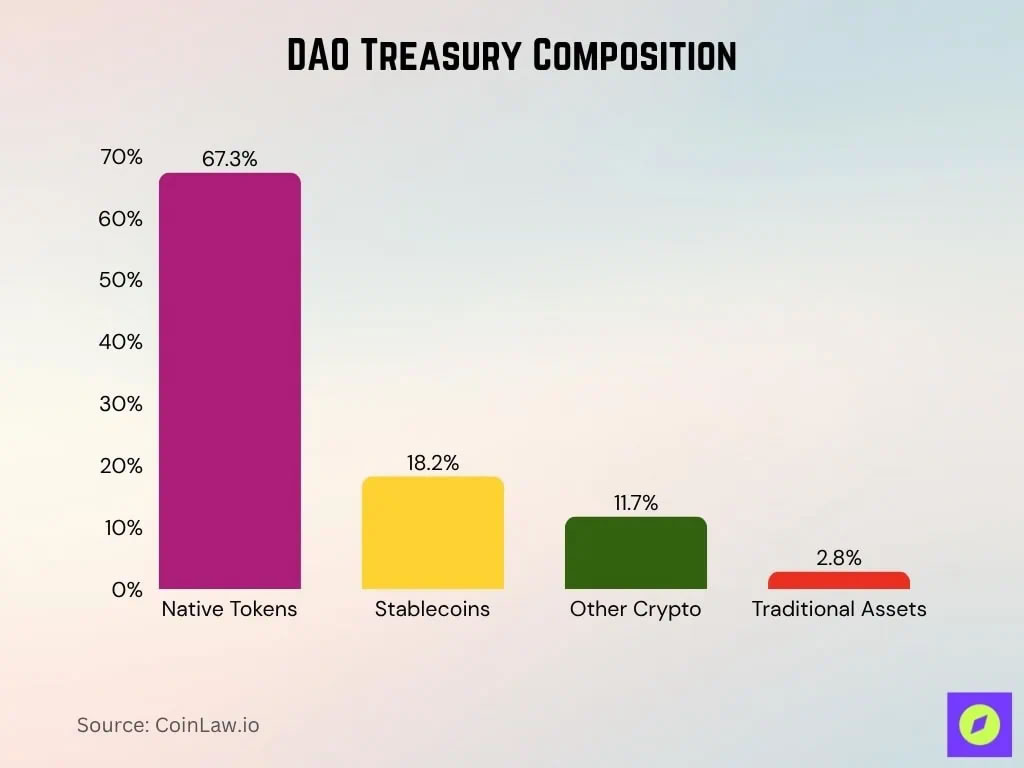
Over 13,000 DAOs exist worldwide with collective treasury assets under DAO control surpassing $24.5 billion as of 2025, according to CoinLaw. The average DAO treasury size is around $1.2 million, and Ethereum and its layer-2 networks host over 85% of DAOs, reported PatentPC in March.

European currencies have shown a recovery in recent trading sessions after their recent decline, displaying early signs of a reversal. The US dollar is weakening amid expectations surrounding upcoming US macroeconomic data, while market participants are reassessing their short-term positions and allowing for a deeper corrective move in the greenback. At the same time, the risk of renewed demand for the dollar remains in place should geopolitical tensions escalate further, a factor that is already being partly priced in.
Additional support for the euro and the Swiss franc has come from a reduced demand for the US dollar as a safe-haven asset. Earlier, geopolitical tensions had boosted demand for the dollar; however, recent comments from Donald Trump regarding the possibility of new strikes on Iran in the coming weeks have once again increased uncertainty and may revive interest in the dollar as a defensive asset.
Investors are also focused on upcoming US macroeconomic releases, including labour market and trade data. These figures may reveal early signs of economic cooling, potentially adding pressure on the dollar. At the same time, a combination of strong data and rising geopolitical risks could restore solid demand for the US currency and limit the current correction. Additional attention will also be given to data from Europe and Switzerland, where inflation and business activity indicators may influence expectations regarding central bank policies and reinforce the ongoing recovery in European currencies if the figures prove supportive.
EUR/USD
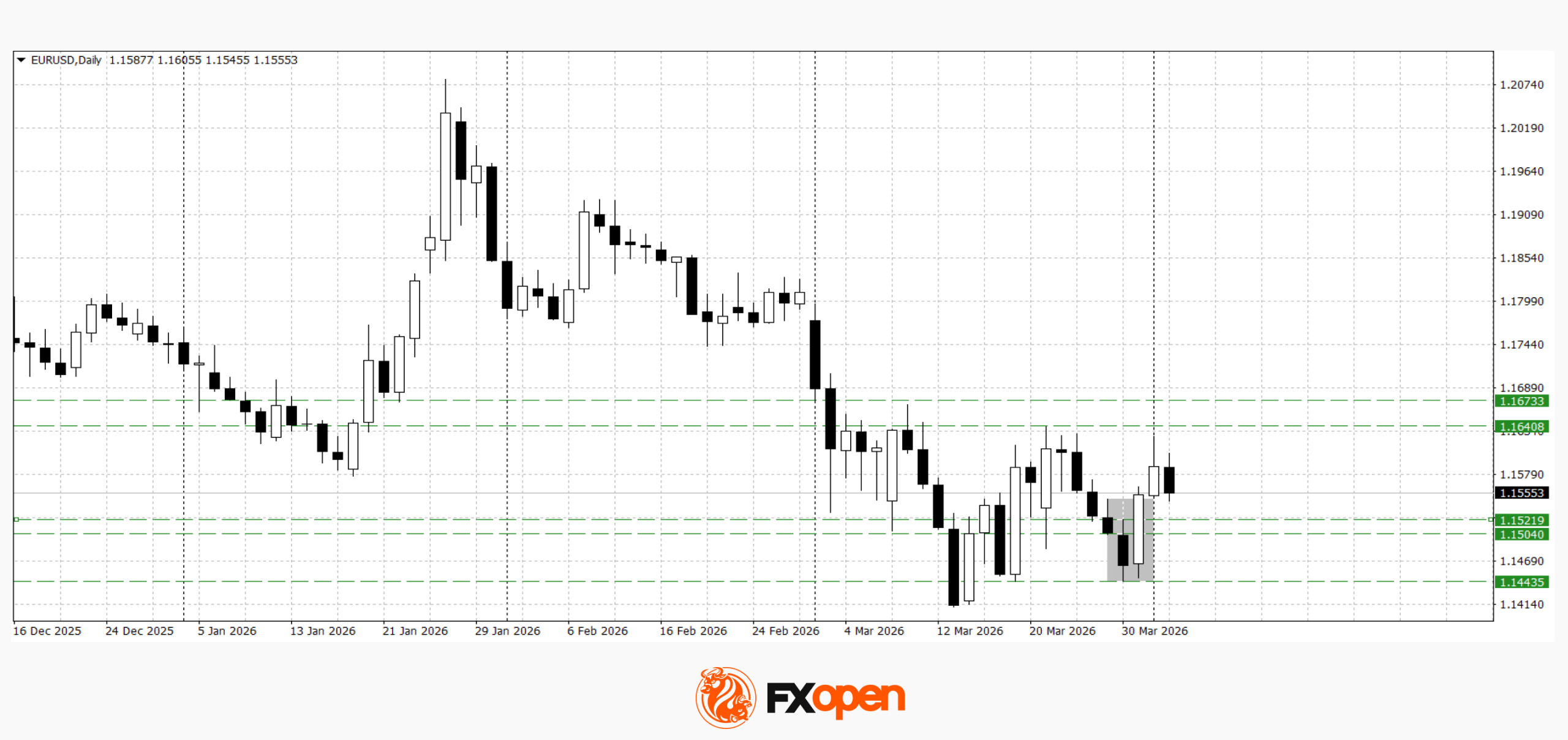
The EUR/USD pair posted a solid rebound from local lows at the start of the week. Technical analysis suggests the pair may attempt another move towards 1.1640, as a “bullish engulfing” pattern has formed on the daily timeframe. However, if buyers fail to hold the price above the 1.1500–1.1520 range, a renewed downward move cannot be ruled out.
Key events for EUR/USD:
- today at 09:45 (GMT+3): France government budget balance
- today at 15:30 (GMT+3): US initial jobless claims
- today at 15:30 (GMT+3): US trade balance
USD/CHF
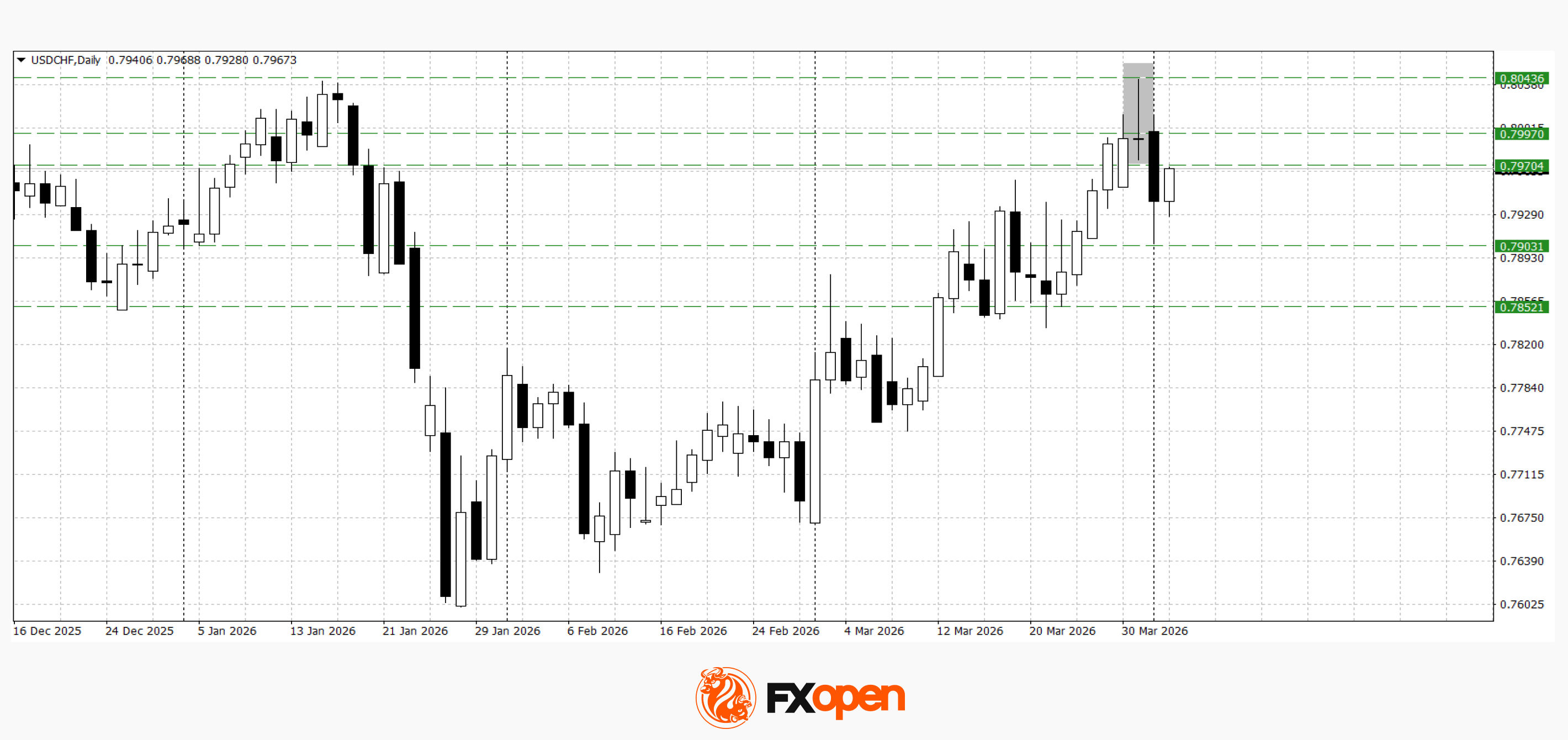
The USD/CHF pair is also showing a pullback from yearly highs and attempting to develop a corrective move. On the daily timeframe, an “evening star” pattern has formed, which may point to a decline towards the 0.7850–0.7900 area. A sustained move above 0.8000 would invalidate the bearish correction scenario.
Key events for USD/CHF:
- today at 09:00 (GMT+3): Switzerland Consumer Price Index (CPI)
- today at 18:30 (GMT+3): Atlanta Fed GDPNow indicator
- today at 19:45 (GMT+3): speech by FOMC member Michelle Bowman
Overall, the market appears to be shifting from a one-sided strengthening of the US dollar towards a corrective phase. However, rising geopolitical uncertainty and upcoming macroeconomic releases continue to leave room for a renewed increase in demand for the US currency. Further direction will depend on incoming data and how investors respond to the evolving news backdrop.
Trade over 50 forex markets 24 hours a day with FXOpen. Take advantage of low commissions, deep liquidity, and spreads from 0.0 pips (additional fees may apply). Open your FXOpen account now or learn more about trading forex with FXOpen.
This article represents the opinion of the Companies operating under the FXOpen brand only. It is not to be construed as an offer, solicitation, or recommendation with respect to products and services provided by the Companies operating under the FXOpen brand, nor is it to be considered financial advice.
Crypto World
Crypto-native media lost 33% of traffic in 2025 as crypto became easier to follow without it
Disclosure: The views and opinions expressed here belong solely to the author and do not represent the views and opinions of crypto.news’ editorial.
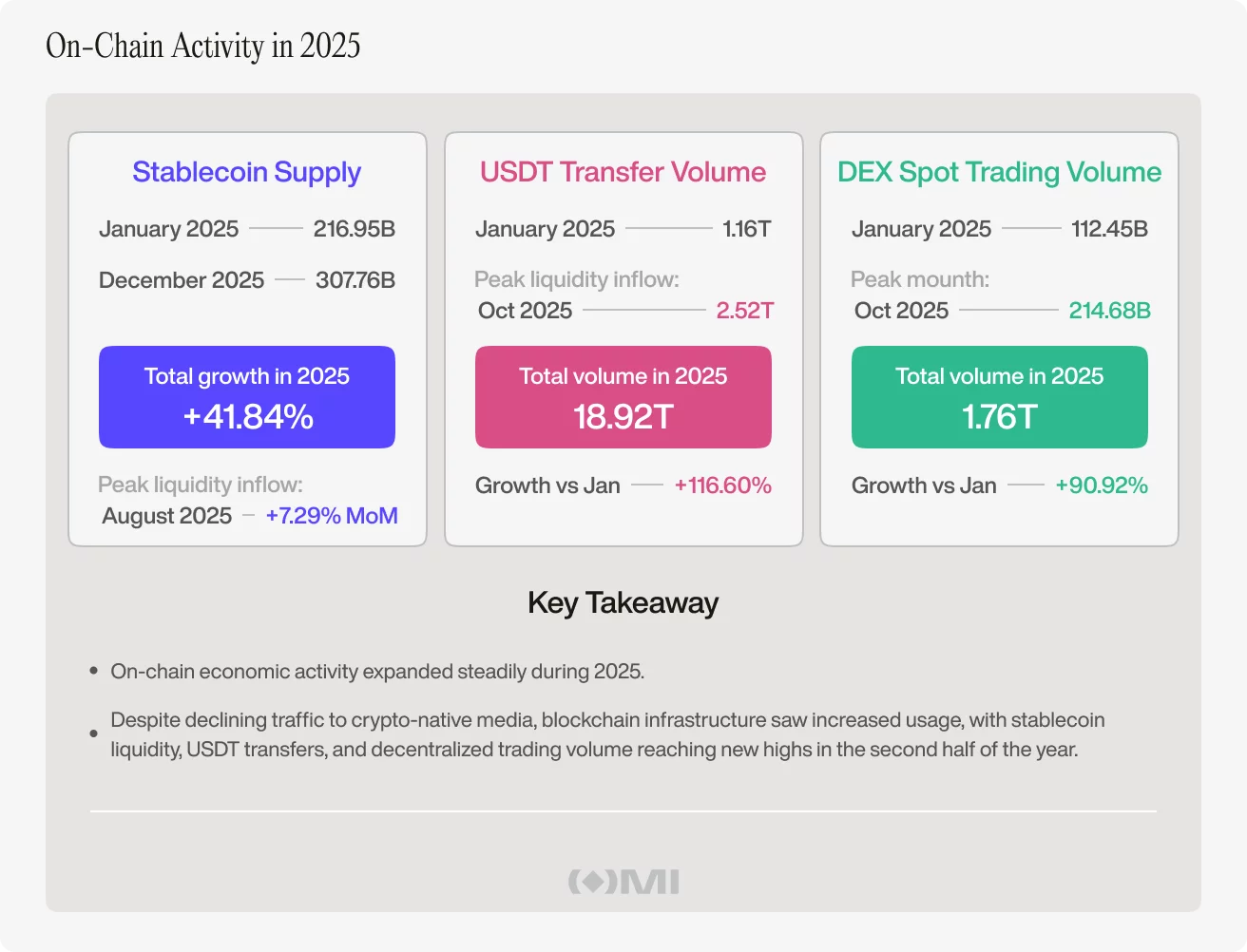
Last year, traffic to crypto-native media fell even as activity across the crypto economy remained strong: stablecoin liquidity expanded, USDT transfer volume surged, and on-chain trading stayed active.
Rather than pointing to fading interest in crypto, the divergence suggested that people were increasingly following and using the industry through channels beyond specialist media.
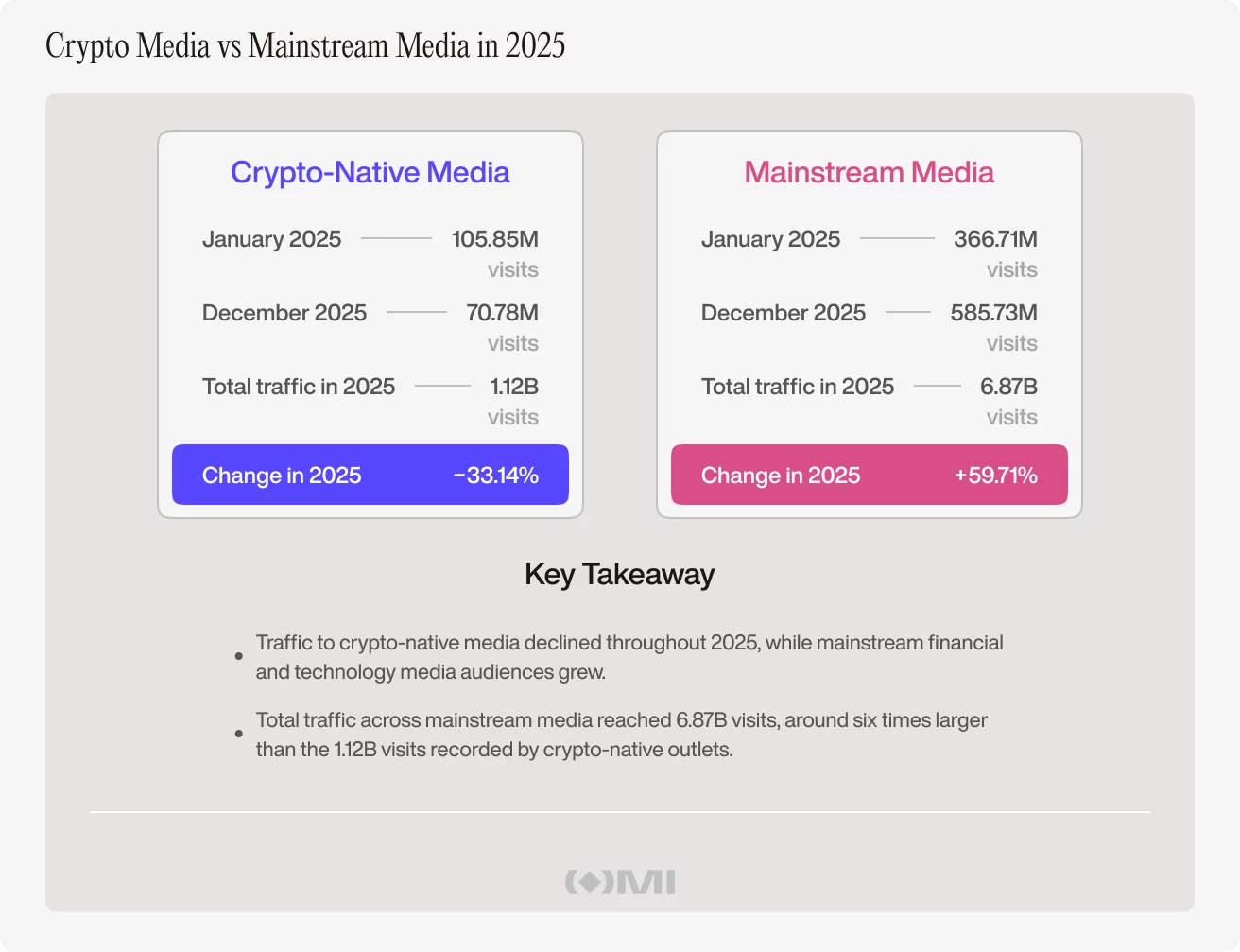
Our recent Outset Data Pulse report, built on traffic data from Outset Media Index, showed that across crypto-native outlets, global visits reached 1.12 billion in 2025, but monthly traffic moved steadily lower as the year progressed. It started at 105.85 million visits in January and ended at 70.78 million in December.
There were temporary rebounds, including a notable jump in July, but not enough to change the broader trend. By the fourth quarter, crypto-native traffic was sitting at its weakest levels of the year.
On-chain growth continued even as media traffic fell
While media traffic declined, there was an expansion of the on-chain economy. Stablecoin supply, one of the cleanest ways of tracking liquidity inside crypto, rose from $216.95 billion in January to $307.76 billion by December.
That disconnect became clearer in the underlying market data. Tether’s USDT transfer volume, a common proxy for how much value is moving across blockchain networks, soared in the second half and reached $18.92 trillion for all of 2025.
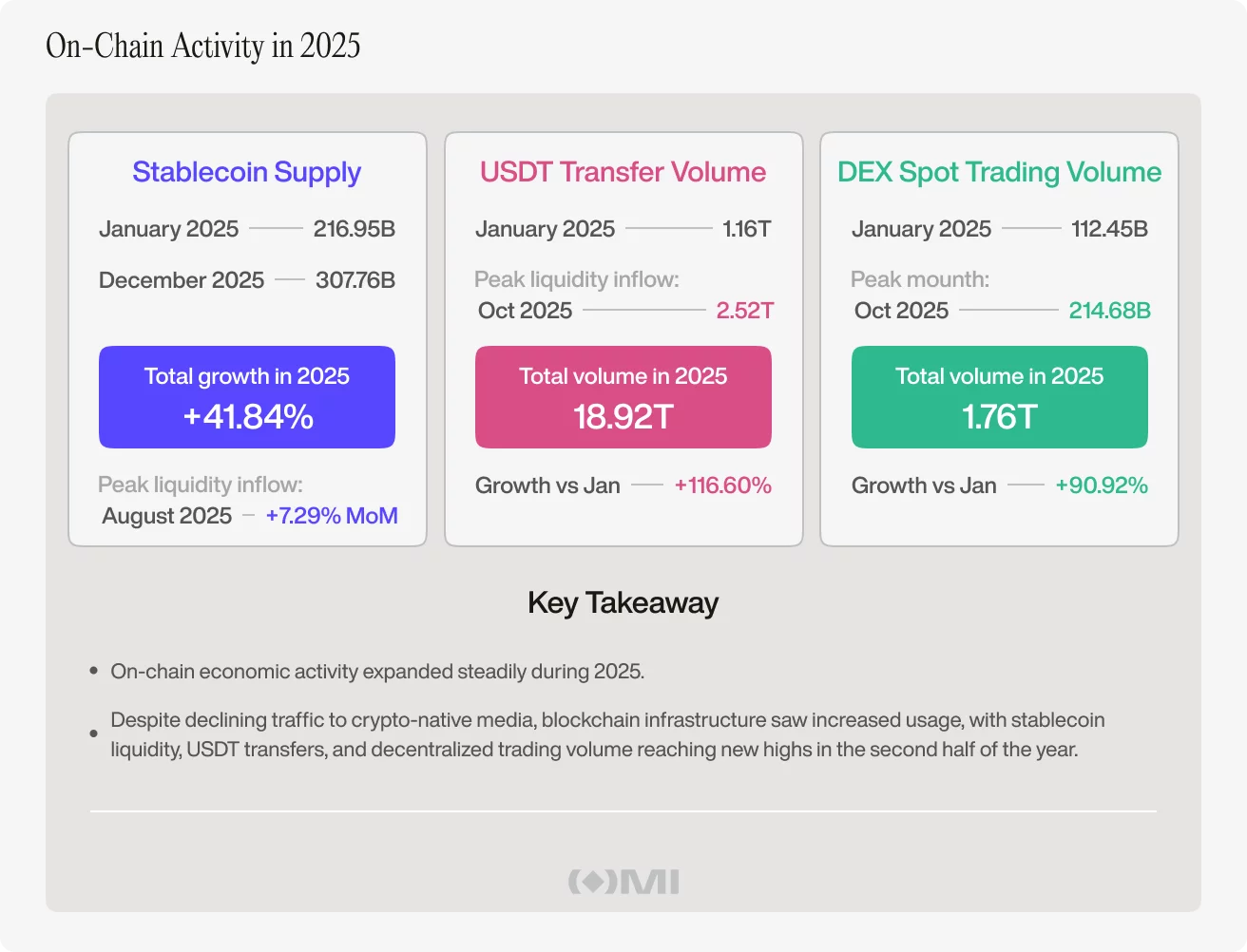
Decentralized exchange spot volume also climbed to $1.76 trillion and hit its yearly peak in October, showing that trading activity on-chain remained strong. Taken together, the data pointed to three things rising at once: more liquidity in the system, more money moving through it, and more trading happening directly on-chain.
Taken together, this was an active market, not a shrinking one. In other words, crypto-native media traffic fell when money, settlement activity, and trading continued to move through the crypto ecosystem at scale.
Crypto became easier to follow outside crypto media
Financial technology and general news outlets that include crypto in their coverage generated 6.91 billion visits in 2025. Their traffic also grew sharply during the year, rising from 366.71 million visits in January to 585.73 million in December. That alone suggests crypto lives inside a wider media environment than it once did.
Naturally, it is wrong to assume every mainstream visit was for a crypto story. But it does mean crypto no longer needs its own niche ecosystem in the same way it once did.
A few years ago, specialist crypto publications served as the default entry point into the industry. Articles explained the basics, simplified complex developments, and tracked market sentiment. They helped readers figure out what mattered most. Anyone who wanted to keep up with the sector would typically check out a crypto-native outlet first.
That competitive advantage has weakened, not because crypto got less important, but because crypto got easier to interact with elsewhere.
Today, a reader can follow crypto developments through mainstream finance coverage, follow their favourite projects and individuals on X, watch podcasts and interviews on YouTube, interact with fellow enthusiasts on Telegram, and more.
Crypto participation no longer depends on crypto media traffic
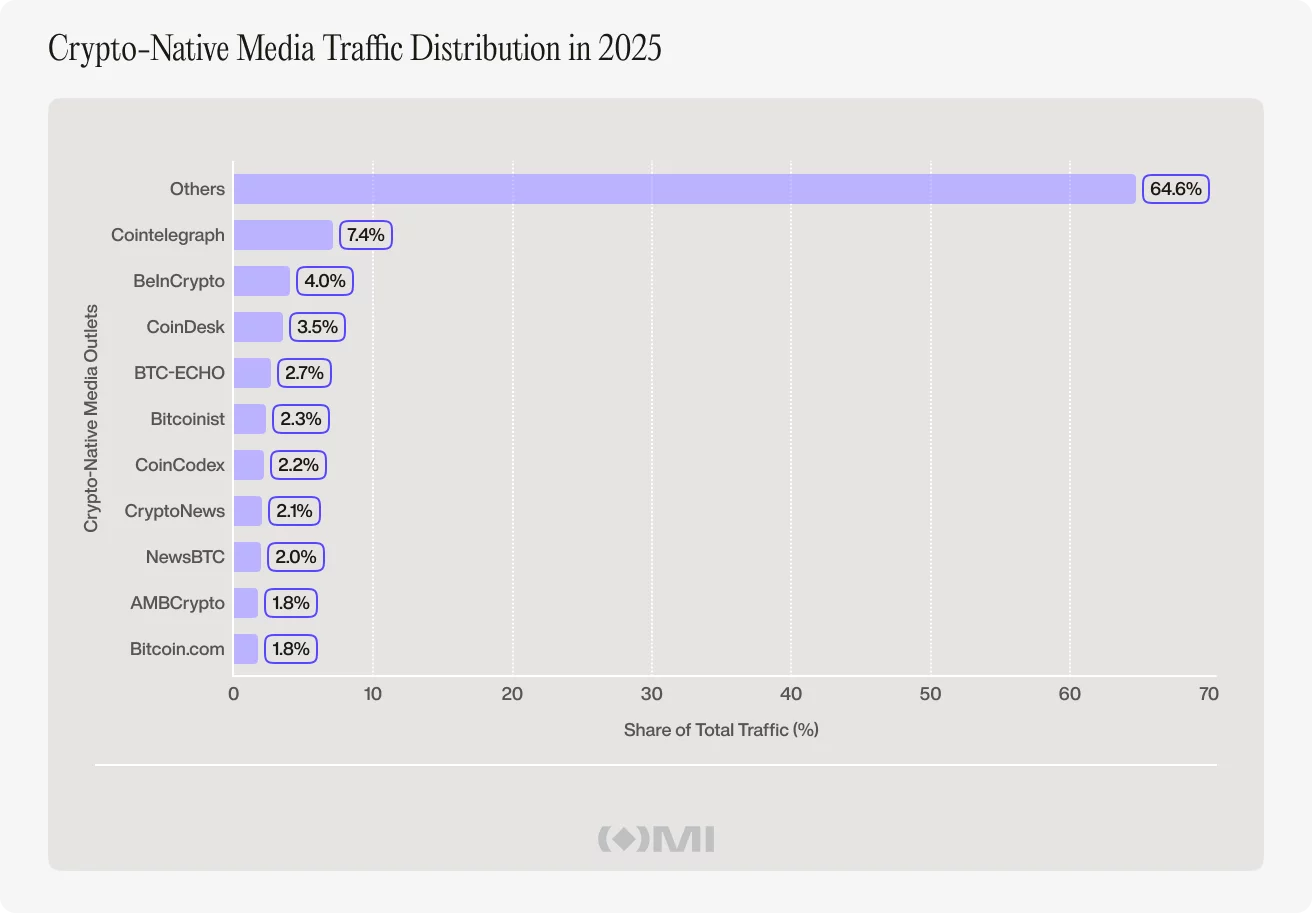
What this means is crypto-native outlets no longer have the monopoly on attention they once enjoyed. The structure of crypto media itself also matters. The top ten crypto-native outlets accounted for just a quarter of total traffic in 2025, with smaller publications making up the rest.
It is a crowded and decentralized landscape where no single player dominates and attention is dispersed across a large number of brands. That fragmentation made sense when crypto media was the centre of the industry’s information flow.
But now it exists alongside far more competition than just other crypto sites. It competes with finance media, tech media, creators, aggregators, trading interfaces, and the networks themselves.
Just as importantly, crypto-native media traffic and blockchain activity did not move together in any clean way. The analysis did not find a consistent one-month lead or lag relationship between the two. Rising on-chain activity did not reliably follow rising media traffic. Nor did rising media traffic reliably predict stronger blockchain usage in the following month.
That suggests crypto media traffic is not a proxy for crypto participation. Traffic is an important metric. But mainstream outlets cover many subjects beyond digital currencies and assets. Their overall audiences are not the same thing as crypto readership.
Monthly data can also miss shorter attention surges that happen over hours or days. But even with that, the divergence is hard to ignore. Crypto-native traffic fell while the broader crypto economy grew.
Crypto-native media still matters, but its role is changing
Crypto-native media has not lost its value but its place in the ecosystem is definitely becoming different. As crypto gets easier to discover, talk about, and use through mainstream platforms, social media, and on-chain apps, specialist outlets matter less as the first stop and more as the place people go when they want to understand what is actually going on.
That change says something bigger about crypto too. If the industry can keep growing while specialist media traffic falls, then attention is no longer the main thing holding it up. Crypto-native media still matters – just in a different way now. Less as the centre of the market, and more as the place that helps make sense of it once the noise settles.
Disclosure: This content is provided by a third party. Neither crypto.news nor the author of this article endorses any product mentioned on this page. Users should conduct their own research before taking any action related to the company.


Ripple on Thursday introduced native digital asset capabilities inside its enterprise treasury management system, letting corporate finance teams hold, view and manage XRP and RLUSD alongside traditional fiat balances for the first time within a single platform.
The two features, called Digital Asset Accounts and Unified Treasury, are built on GTreasury, which Ripple acquired in 2025. That system processed $13 trillion in payments volume last year for clients ranging from small businesses to Fortune 500 companies. The digital asset layer adds to that existing infrastructure rather than replacing it.
Digital Asset Accounts let treasury teams create a Ripple-native digital asset account inside the platform. Balances in XRP, RLUSD, and other supported tokens appear alongside cash positions with real-time fiat valuations using live exchange rates.
Transactions are recorded automatically with native notional amounts, fiat equivalents, and market price at the time of each event, creating an audit trail without manual entry. The system captures balances at 15-decimal precision to match on-chain accuracy and eliminate rounding discrepancies that cause reconciliation problems.
Unified Treasury connects digital asset holdings from multiple external custodians through the same API connectivity layer Ripple Treasury already uses for bank integrations.
“Digital assets have arrived at the CFO’s desk, and the question has shifted from whether to engage to how to do so without disrupting existing operations,” said Renaat Ver Eecke, SVP at Ripple Treasury.
The launch positions Ripple Treasury ahead of competing TMS providers, none of which currently offer native digital asset management.
Ripple said the two features are the first in a broader digital asset framework that will expand to cross-border settlement, intercompany payments, and overnight yield on idle cash through repo markets, all powered by stablecoins.


A key figure allegedly behind the Huione network has been extradited to China, where he will face fraud and money laundering charges.
Summary
- Li Xiong, linked to the Huione network, has been extradited from Cambodia to China to face fraud and money laundering charges.
- Authorities have tied Huione Group to a vast illicit marketplace that processed over $89 billion in crypto tied to scam operations across Asia.
- Despite U.S. enforcement actions, including FinCEN restrictions, the network has continued operating through new domains and active Telegram channels.
A report from Hong Kong-based news outlet Ta Kung Wen Wei noted that Li Xiong, who was part of a group that helped scam rings in Asia launder illicit funds, was escorted back to China from Phnom Penh, Cambodia, citing a statement from China’s Ministry of Public Security on WeChat.
Xiong was a core member of the Chen Zhi criminal syndicate, according to the report, and had previously served as chairman of Huione Group, a network that supported scam centers carrying out “pig butchering” schemes and other investment frauds to extract funds from victims across the globe.
For those unfamiliar, the Huione network has been linked to one of the largest illicit online marketplaces in operation, processing more than $89 billion in cryptoassets.
Xiong’s arrest and extradition come just months after the detention of Chen Zhi, the head of Prince Group, which operated Huione Group. The U.S. Department of Justice had earlier seized over 127,000 Bitcoin tied to Zhi’s operations.
The report added that several other members of Zhi’s criminal syndicate have also been apprehended, according to statements from Chinese public officials.
Efforts to cut off Huione’s financial network have been underway in the U.S. over the past few years.
Last year, the U.S. Department of the Treasury’s Financial Crimes Enforcement Network labelled the group a primary money laundering concern and subsequently directed financial institutions to cut off access linked to its operations.
However, third-party reports suggest that the network has resurfaced under new domains and continues to operate across platforms such as Telegram, maintaining activity despite enforcement pressure.


The crypto market has started tanking once again, dropping 2.6% to 2.37 trillion as US President Donald Trump announced that the U.S. campaign against Iran would be entering a final phase over the coming weeks to end the conflict once and for all.
Summary
- Crypto market fell 2.6% to $2.37 trillion as escalating U.S.–Iran tensions triggered risk-off sentiment across global markets.
- Rising oil prices above $100 fueled inflation fears, reducing expectations of Fed rate cuts and adding pressure on risk assets.
Bitcoin (BTC), the world’s largest crypto asset, fell over 4% to $66,250 amid souring market sentiment over a potential drop to $65,000, which many consider the last line of defense for a potential recovery.
Ethereum (ETH) was down 3.4%, approaching the $2,000 support, while other major crypto assets such as XRP (XRP), BNB (BNB), Solana (SOL), and Dogecoin (DOGE) posted losses between 2% and 6%. The majority of the top 100 crypto assets also shared the downward trend in the red.
As crypto prices fell, they triggered over $420 million in liquidations across leveraged markets as traders unwind their positions. The majority of this tally came from long liquidations, which saw $255 million wiped out, with Bitcoin and Ethereum accounting for around $64 million in long liquidations each, which accelerated the selloff.
The Crypto Fear and Greed Index, which shows market psychology, fell by 5 points to 27, showing increasing fear and anxiety in the market as investors expect more volatility.
Crypto prices began slipping downwards shortly after Trump said in an address to the nation on Wednesday that the U.S. military is going to hit Iran extremely hard over the coming 2 to 3 weeks to try to secure a decisive win in the ongoing war in the Middle East.
Trump warned that the U.S. would target Iranian energy infrastructures if no deal is reached. He also urged Gulf countries like Saudi Arabia, the UAE, and his allies in the region to pressure Tehran to relinquish control over the Strait of Hormuz.
Despite the rhetoric, Trump mentioned that discussions are ongoing for a ceasefire between both sides. Iran, for its part, has demanded a permanent end to the war, compensation for damages during the war, and the full withdrawal of U.S. military presence from the region.
The fresh threat of escalation pushed crude oil prices back above $100, leading to a broad selloff through crypto, stocks, and traditional safe-haven assets such as gold. Gold prices fell 4% to $4,590 today, while silver fell 7.5%. Asian stocks such as Japan’s Nikkei 225 were down 2.5% as investors moved to cash.
Surging oil prices are triggering fears of runaway inflation over the coming months. As such, the market expects the Federal Reserve to continue to hold interest rates steady or even hike them as they combat the inflation spike caused by oil prices.
Lower expectations for Fed rate cuts typically weigh heavily on risk assets like cryptocurrency.
Disclosure: This article does not represent investment advice. The content and materials featured on this page are for educational purposes only.
Nishad Singh, the former head of engineering at FTX, will pay $3.7 million to resolve his case with the US commodities regulator over his alleged role in the collapse of the crypto exchange and the misappropriation of user funds.
As part of the supplemental consent order, Singh will be required to pay a disgorgement of $3.7 million and imposes a five-year ban on trading in markets and an eight-year registration ban, blocking him from obtaining a license to operate in the sector, the US Commodity Futures Trading Commission (CFTC) said in a statement on Wednesday.
“The initial consent order and supplemental consent order resolve the CFTC’s enforcement action against Singh,” it added.
FTX’s bankruptcy in November 2022 sent shock waves through the crypto industry, erasing billions in market liquidity, shattering user confidence and prompting authorities to accuse its leadership of fraud.
David Miller, the CFTC’s director of enforcement, ruled out additional restitution or civil monetary penalties for now and said the current penalties reflect Singh’s cooperation with authorities.
“The defendant engaged in, and aided, significant violations of the Act and CFTC regulations as the former FTX head of engineering, and the consent orders reflect the severity of these violations,” Miller said.

“But this resolution also reflects the Commission’s commitment to rewarding and incentivizing material assistance in Division investigations,” he added.
Singh charged by multiple agencies after FTX collapse
Attorneys for Singh said he was grateful this latest matter was at an end, and were “pleased that the CFTC recognized our client’s limited role in the underlying conduct and his extensive cooperation,” according to Bloomberg.
The CFTC accused Singh of personally misappropriating millions of dollars in assets and charged him in February 2023 with two counts: fraud by misappropriation and aiding and abetting fraud committed by former FTX CEO Sam Bankman-Fried.
Related: FTX Recovery Trust to distribute $2.2B to creditors in March
In April 2023, Singh entered into the consent order, was found liable for the charges and agreed to cooperate with the commission’s investigators. The regulator originally sought a range of penalties, including restitution, civil monetary penalties and permanent trading and registration bans.
In a separate case brought by the Securities and Exchange Commission in February 2023, Singh was accused of misusing customer funds and committing fraud by misappropriation, in violation of securities laws. The case was settled in December with Singh receiving an eight-year industry ban.
After FTX collapsed, US prosecutors also indicted Singh and four of his colleagues on charges including fraud and campaign finance violations. He faced decades in prison if found guilty, but after testifying against Bankman-Fried and cooperating with prosecutors, he received time served and three years of supervised release.
Magazine: Ripple joins Singapore sandbox, Bhutan’s big Bitcoin selloff: Asia Express
The U.S. Treasury has proposed its first set of rules to implement the GENIUS Act and has opened a 60-day public comment period to define how stablecoin oversight can be handled at the state level.
Summary
- U.S. Treasury has proposed initial rules under the GENIUS Act, opening a 60-day consultation to define when state oversight of stablecoins is permitted.
- Issuers with less than $10 billion in circulation may fall under state supervision if frameworks meet federal standards, with strict reserve, disclosure, and compliance requirements in place.
Under the proposal, issuers with less than $10 billion in circulating stablecoins may operate under state supervision, provided those frameworks meet a “substantially similar” standard to federal regulations.
The proposal seeks to clarify how regulatory responsibilities will be divided as the regulation begins to take shape.
Stablecoin issuers with less than $10 billion in circulation are eligible for that route, though the flexibility comes with firm guardrails. Treasury has set out non-negotiable conditions, including full 1:1 reserve backing using cash or high-quality liquid assets, along with mandatory monthly disclosures.
Compliance with federal anti-money laundering and sanctions rules remains compulsory across all jurisdictions. The proposal also reinforces a ban on rehypothecation, preventing issuers from reusing reserves to support multiple obligations.
Meanwhile, state regulators are given room to impose stricter oversight, covering liquidity thresholds, reserve requirements, risk management standards, and enforcement mechanisms. Any framework introduced at the state level must deliver outcomes that match or exceed federal protections, rather than offering a lighter alternative.
Regulators are still working through how the GENIUS framework will align with existing money transmission laws and which agencies will oversee different parts of the market. Previous consultations have already covered areas such as digital forensic tools, tax reporting, and data collection.
Concerns remain over stablecoin yields
As previously reported by crypto.news, the legislation, signed into law by President Donald Trump in July, marked a major step in formalizing stablecoin regulation.
However, uncertainty around yield-bearing stablecoins continues to hold back progress on the broader CLARITY market structure bill.
Some industry players argue that yield-generating stablecoins could offer higher returns than traditional savings accounts, while banking groups remain concerned about potential deposit outflows.
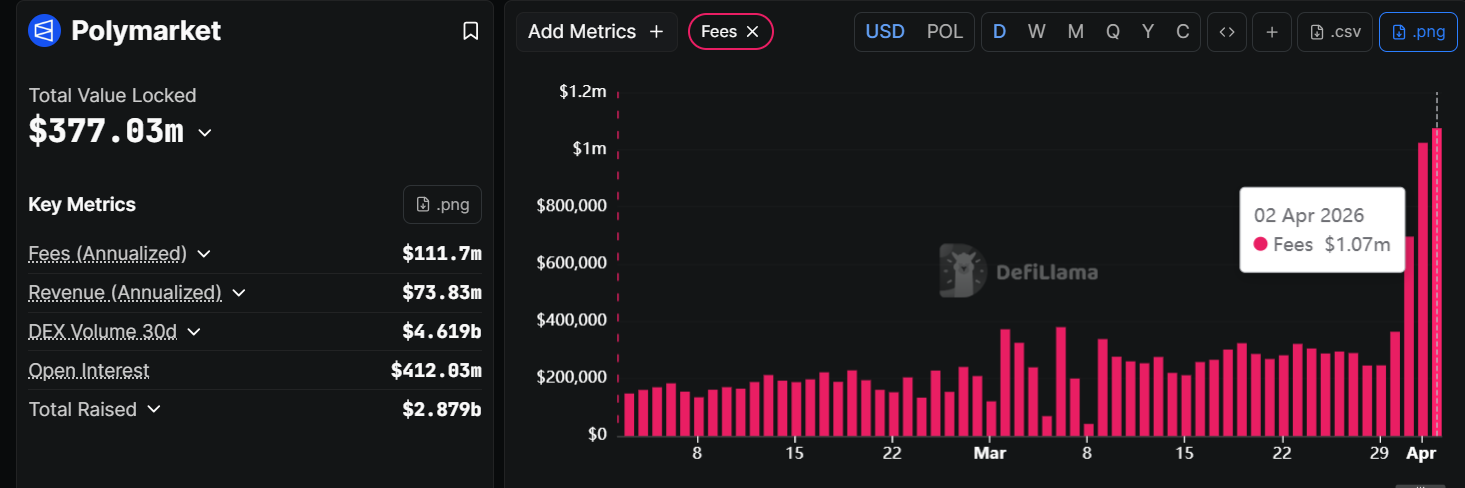
Polymarket’s daily fee revenue crossed $1 million on April 1, just two days after the platform expanded taker fees to nearly all market categories.
The surge, up from $696,000 on March 31, followed the March 30 rollout of variable taker fees across politics, finance, economics, culture, weather, and tech markets.
From Growth Play to Revenue Machine
Polymarket previously charged fees only on crypto and sports contracts. The updated structure applies a dynamic, probability-based model in which fees peak at 50% probability of the outcome and drop near the extremes.
Crypto markets carry the steepest rate at 1.80%, while sports remain the lowest at 0.75%.
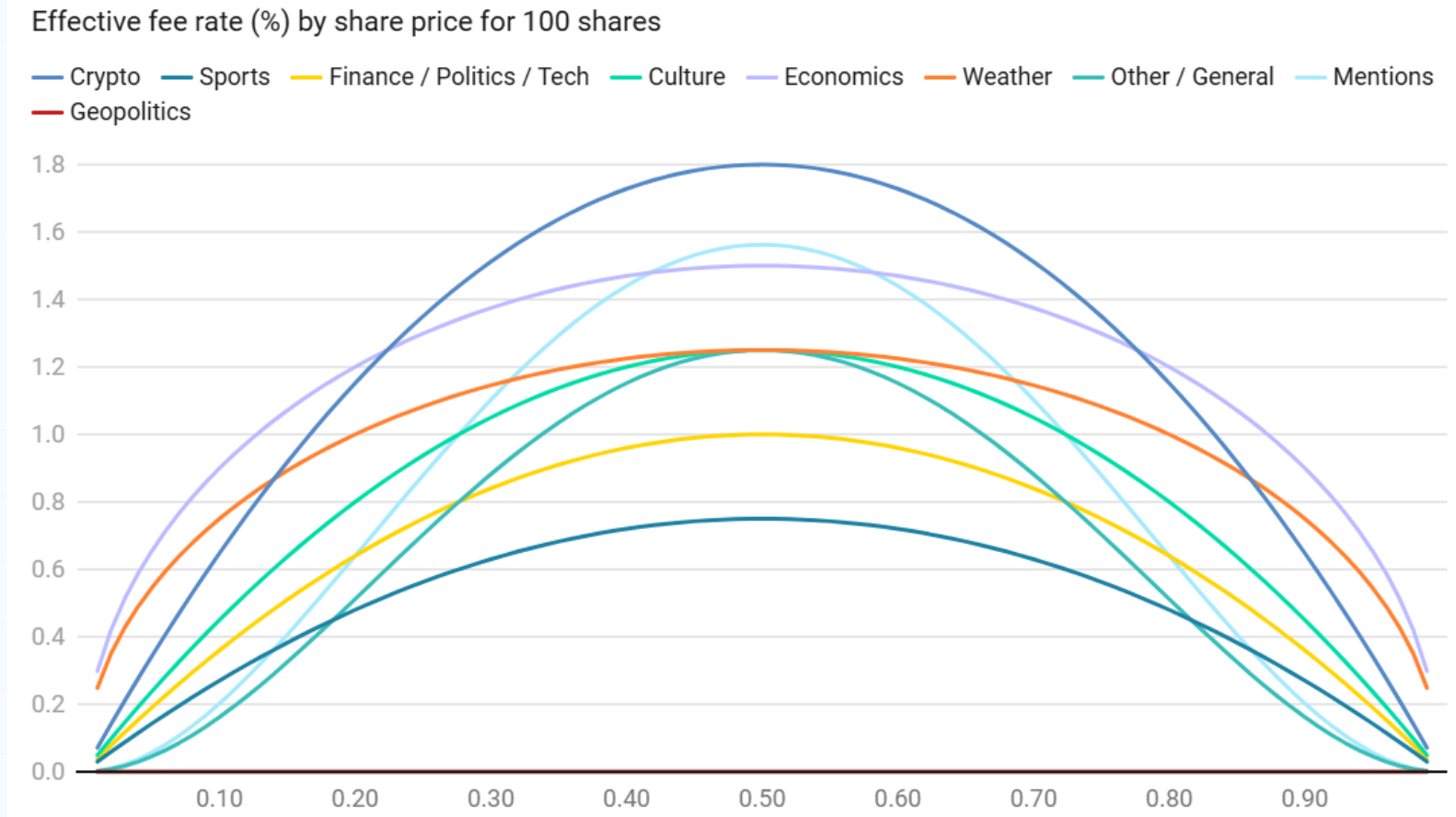
Makers pay nothing. Instead, they receive daily USDC rebates of 20% to 25% of collected fees, depending on the category. Geopolitics and world events remain entirely fee-free.
On-chain analyst DefiOasis noted that April 1 fees reached $927,000 on Dune Analytics, translating to an annualized run rate of roughly $338 million.
“The latest full single-day fee on April 1 was $927,000, and it is expected that single-day fees could exceed $1 million in the coming days. Based on the April 1 single-day fee, Polymarket’s annualized equivalent reaches $338 million,” the analyst noted.
DefiLlama data placed the figure even higher, at $1.07 million.
Competition Heats Up Across Chains
The fee shift arrives as prediction markets draw new entrants. Binance Wallet began beta-testing an in-app prediction feature through Predict Fun (Predict.fun), a BNB Smart Chain protocol that saw $7.68 million in net inflows on a single day after the integration.
Predict Fun’s open interest rebounded to $23 million, according to DefiOasis.
Monthly prediction market volume now exceeds $20 billion industrywide.
The sector’s rapid monetization, from Polymarket’s fee expansion to Kalshi’s reported $1.5 billion annualized run rate, signals a broader transition from subsidized growth to sustainable revenue.
Whether Polymarket can sustain above $1 million in daily fees will depend on trading volume resilience as takers adjust to the new cost structure.
The post Polymarket’s Fee Overhaul Pushes Daily Revenue Past $1 Million appeared first on BeInCrypto.


Bitcoin price drifted closer to a key support zone near $65,000 after Donald Trump signaled that military action in the Middle East is set to continue over the coming weeks.
Summary
- Bitcoin slipped toward the $65,000 support zone after Trump signaled continued military action in the Middle East.
- Oil prices climbed back above $100, adding pressure on risk assets as traders reacted to renewed geopolitical tensions.
Addressing the nation from the White House on Wednesday, Trump said U.S. forces are nearing the final stages of “Operation Epic Fury,” describing it as a campaign that has already crippled large parts of Iran’s nuclear and naval infrastructure.
Even so, the tone of the address left little room for de-escalation in the short term.
“We are on track to complete all of America’s military objectives shortly,” he said, before adding that the U.S. would “hit them extremely hard over the next 2 to 3 weeks.”
Markets reacted quickly. Oil prices reversed earlier softness and climbed back above the $100 mark, reflecting renewed concern over supply disruptions tied to the Strait of Hormuz. The move fed into broader unease, with equities and digital assets slipping as traders reassessed geopolitical risk.
Bitcoin (BTC), which had shown signs of stabilizing earlier in the week, extended its decline, dropping over 2% since Trump took the stage. Price action hovered just above $66,500 at last check, with buyers attempting to hold the $65,000 region that has repeatedly acted as a near-term floor.
A sustained break below it would weaken the current structure and open the door toward the $60,000 range, an area that previously drew in demand during earlier pullbacks. Market participants have treated this zone as a key inflection point, where downside momentum either stalls or accelerates.
At the same time, diplomatic channels have not been fully shut. Trump has acknowledged that discussions are ongoing, even as military pressure builds.
Washington has continued to push for Iran to dismantle its nuclear program and allow greater oversight of its facilities, alongside restoring open commercial shipping routes. Tehran, on the other hand, has called for a permanent ceasefire, compensation for damages, and a complete withdrawal of U.S. forces from the region.
Looking ahead, Trump maintained that the disruption to global energy flows may not last indefinitely. He argued that Iran would eventually ease restrictions on oil movement as it looks to rebuild.
“When this conflict is over, the strait will open up naturally,” he said, adding that oil would resume flowing and gas prices would fall as economic activity picks up again.
Any meaningful de-escalation could offer relief to risk assets, including Bitcoin, as lower energy costs and reduced geopolitical tension tend to support liquidity conditions. Until then, markets remain sensitive to headlines, with crypto trading closely tied to shifts in oil prices and broader macro signals.

How to Use AI for Financial Modeling (IRR & Entry Price Explained) | Part – 2

Belfast school accused of using charity donations for low-income families for ‘promotional prizes’

Thousands Report Global Streaming Service Disruption Worldwide

Smart energy pays enters the US market, targeting scalable financial infrastructure

Why Israel is blocking foreign journalists from entering

Bitcoin: We’re Entering The Most Dangerous Phase
How to Use AI for Financial Modeling (IRR & Entry Price Explained) | Part – 2

Why Bitcoin Has (Officially) Failed as a Currency…

Explained: 7 financial changes from April 1 | Income tax | ATM withdrawals | PAN rules | STT hike
-

 Business6 days ago
Instagram, YouTube Found Responsible for Teen’s Mental Health Struggle in Historic Ruling
-

 NewsBeat5 days ago
The Story hosts event on Durham’s historic registers
-
 Tech7 days ago
Intercom’s new post-trained Fin Apex 1.0 beats GPT-5.4 and Claude Sonnet 4.6 at customer service resolutions
-

 Sports5 days ago
Sweet Sixteen Game Thread: Tide vs Michigan
-
Entertainment3 days ago
Fans slam 'heartbreaking' Barbie Dream Fest convention debacle with 'cardboard cutout' experience
-
 Entertainment4 days ago
Lana Del Rey Celebrates Her Husband’s 51st Birthday In New Post
-
Crypto World2 days ago
Dems press CFTC, ethics board on prediction-market insider trades
-

 Crypto World11 hours ago
Gold Price Prediction: Worst Month in 17 Years fo Save Haven Rock
-

 Tech3 days ago
The Pixel 10a doesn’t have a camera bump, and it’s great
-

 Sports2 days ago
Tallest college basketball player ever, standing at 7-foot-9, entering transfer portal
-

 Tech2 days ago
EE TV is using AI to help you find something to watch
-

 Tech3 days ago
Apple will hide your email address from apps and websites, but not cops
-

 Tech2 days ago
Flipsnack and the shift toward motion-first business content with living visuals
-

 Tech2 days ago
How to back up your iPhone & iPad to your Mac before something goes wrong
-

 Fashion7 days ago
En Vogue in Brown Leather and Tailored Neutrals by Atelier Savoir, Styled by J Bolin
-

 Politics2 days ago
Should Trump Be Scared Strait?
-

 Crypto World2 days ago
U.S. rule change may open trillions in 401(k) funds to crypto
-

 Fashion7 days ago
What Are Your Favorite T-Shirts for the Weekend?
-

 Fashion6 days ago
Weekly News Update, 3.27.26 – Corporette.com
-
 Crypto World3 days ago
Bitcoin’s Six-Month Losing Streak: What On-Chain Data Says About the Market’s Next Move
You must be logged in to post a comment Login