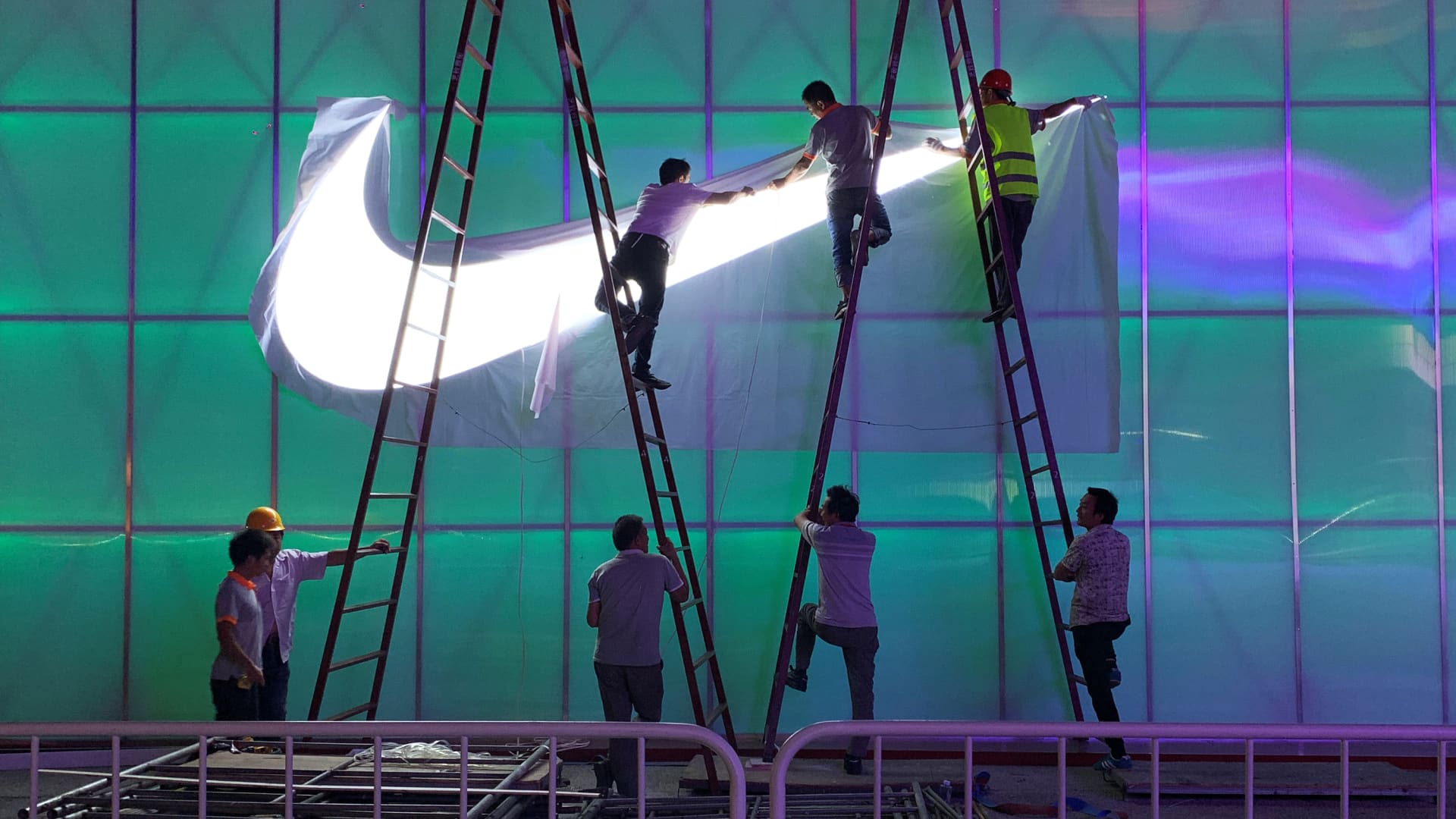
Workers install a Nike logo lamp outside the Wukesong Arena in Beijing, Aug. 28, 2019.
Tingshu Wang | Reuters
By all accounts, Nike’s business in China should be firing on all cylinders.
Advertisement
Sports-related products are the fastest growing consumer category in China and participation in sports and exercise is at its highest level in decades. The overall sportswear market has ballooned 51% in the past five years, fueled by a new focus on healthy living, according to GlobalData.
But instead of thriving during China’s sports renaissance, Nike’s business in the region is languishing. Sales have fallen from the prior year eight quarters in a row, and the overall business has shrunk 30% since 2021, with annual revenue hitting its lowest level in eight years at the end of May.
China was once Nike’s fastest-growing region, beloved by investors for its high margins and potential for sustained growth. Now, it’s the company’s smallest market and has become a drain on a global turnaround that some on Wall Street believe is taking too long.
Some U.S. analysts expect Nike’s China business to recover once its North America operations stabilize, but experts on the ground told CNBC its challenges in the region are deeper, and far different, from what it faces at home. Young Chinese shoppers are increasingly choosing domestic brands over expensive foreign names as part of a larger “China Chic” movement, and consumers are hungry for a localized assortment — not the same product that’s being replicated from Utah to Shanghai. Nike is also working to overhaul its distribution model in China, which critics say has become messy, overly complex and driven by discounts.
Advertisement
“In a way, Nike has just become irrelevant,” said Yaling Jiang, the founder of consumer research firm ApertureChina and an expert on the Chinese consumer. “I don’t think young people can remember what’s the last new thing they’ve done. But if you mention Adidas to them, they will tell you about … their pet clothes, pet jerseys, or their China jackets.”
During its most recent earnings call, Nike’s outgoing finance chief Matt Friend couldn’t say when the China business would return to growth, telling analysts that revenue trends in the near term “will be in line” with recent performance and “profitability will bottom before sales.”
In January, Nike CEO Elliott Hill announced Cathy Sparks, a 25-year Nike veteran, would become the next vice president and general manager of Greater China, reporting directly to him.
In an interview with CNBC, she said Nike is taking the steps it needs to reconnect with Chinese consumers.
Advertisement
“The one thing that I have certainly learned over the last six months is that the Chinese consumer has changed and they have high standards for what they want through product connections, engagement with the brand,” said Sparks. “We know that if we can design footwear and apparel, lifestyle or performance, that’s specifically targeted towards the unique needs of Chinese consumers, we’ll drive full price revenue.”
A Nike spokesperson pushed back on the idea that the company has lost relevance in the region and said what’s changed is younger shoppers are looking for “hyperlocal connections,” including through events and broader cultural moments.
“Nike has been in China for more than 40 years, and from day one, our approach has been to start with local consumer insight and turn that insight into inspiration, innovation and storytelling that can spark movement,” the spokesperson said.
How ‘China Chic’ changed the sneaker market
When Nike turned to China as its next major growth market in the mid-2000s, it won by largely replicating its global strategy and betting that popular clothes and shoes in the Western world would also land with Chinese shoppers.
Advertisement
For a time, the bet was right.
“The premium brand at the time that was available was Nike. Nike was just clearly better. They had cooler designs. They were more expensive. There was more brand cache,” said a retail consultant based in Shanghai who advises domestic and international brands, including Deckers and Adidas, and asked not to be named to protect client relationships.
“If you go back to the early 2000s, if consumers had some money to spend, they were really quite image conscious. They wanted to show that they had whatever the nice thing was and at the time, Nike was it.”
By the end of fiscal 2021, Nike’s annual revenue in China hit an all time high of $8.29 billion. But in the backdrop, the tide was starting to shift against Western brands.
Advertisement
A general view shows a Nike store in Guangzhou, Guangdong Province of China, July 22, 2026.
Qin Zihang | Visual China Group | Getty Images
In March 2021, a previous statement Nike made saying it was “concerned” about reports of forced labor in the Xinjiang region resurfaced, leading some Chinese consumers to call for a nationwide boycott and post videos online of them burning their sneakers. Popular Chinese actor Wang Yibo terminated his contract as a representative for Nike as domestic competitors Anta and Li-Ning doubled down on their use of Xinjiang cotton, using the conflict as a nationalistic marketing opportunity.
The controversy, which also impacted other Western brands that put out similar messaging, helped supercharge a political campaign that Chinese President Xi Jinping started years earlier called Guochao, or “China Chic” in English. It was designed to drum up pride in Chinese made and designed products and promote domestic brands over international ones.
Advertisement
“In line with the period of 2010 to just before Covid, people did feel like maybe they were inferior if they wear Chinese brands … but the elevating cultural confidence campaign really shifted that mindset,” Jiang said. “What this political campaign does is it also encouraged a lot of e-commerce platforms, including Alibaba’s Taobao, Tmall and JD.com, to have a separate section just for the China Chic brands and … people started adopting this China Chic mindset and started feeling like owning something from your own culture is cooler than owning foreign brand.”
Now, many younger consumers feel more connected to domestic brands like Anta and Li-Ning over premium, foreign brands like Nike, said Tracy Dai, the director of operations at consulting firm China Skinny, which helps overseas companies enter China or expand there.
“Years ago when you’re talking to a high school boy asking which sports shoes you may want, they probably say Nike or Adidas, but right now if you ask them, they say Anta or Li-Ning,” Dai said. “[Nike] probably is not that cool to them anymore.”
A Nike spokesperson said all brands in China are facing intense competition and a “more demanding consumer environment” and it believes its efforts to reset the region “put us on the right path to win back consumers.”
Advertisement
Beyond nationalism, Nike’s decline in China is also about value.
In the 20 years since Nike started supercharging its expansion in China, domestic brands have gotten better at production, marketing and brand building.
At the same time, Chinese consumers have become more practical and selective, prioritizing value and innovation over branding, said Wei Kan, who spent around 15 years at Nike and Converse in China and Taiwan before starting his own brand consultancy firm Conduit Asia. As shoppers become more involved with sports and niche fitness activities, highly technical products are becoming more popular than Nike’s assortment.
“Nike is still more like a global, generalist brand at this moment. At the same time, a lot of products, the innovation pipeline is actually slower than the local brands and also the competitors,” said Kan. “Chinese consumers are very sophisticated compared with like five or 10 years ago … it all goes back to how the consumer perceives what kind of value they want to get from a shoe.”
Advertisement
Nanjing styles via Portland, Oregon
While domestic brands have become major market leaders in China, some international brands are still winning, too. Lululemon‘s comparable sales, which exclude new store openings, grew 20% in China in fiscal 2025, while Adidas brand revenue grew 13% in the region during the same period.
Similar to Nike, Adidas had seen its business dramatically slow in China, but it’s now growing again after the company shifted its focus to local product creation, decentralized decision-making and empowered local teams.
For example, Adidas’s local team designed and released its mega-viral Chinese Track Top jacket earlier this year in celebration of the Chinese New Year. The jacket sold out within 27 minutes and became a global phenomenon, with some on social media saying they flew to China specifically to buy the item or spent hundreds to snag one through reseller sites like StockX.
It’s also nailing local marketing. Recently, Adidas botched a translation on its website in the product description for a jacket and ended up becoming a viral meme. Rather than ignoring the meme, it created a T-shirt with the mistranslation on the front, Jiang said.
Advertisement
Meanwhile, experts said Nike has struggled to create the same kind of localized products and marketing. During the World Cup, its marketing campaigns came off as similar to what it was doing a decade ago, said Jiang.
Part of the issue is that the Greater China team gets limited autonomy to release products and campaigns quickly without oversight from the corporate office in Portland, analysts said.
“So everything, especially in terms of design, everything is actually coming from global,” said Kan, who worked in marketing and branding for Nike and Converse in the region before leaving the company in November 2024. “There are very limited room for the local teams to build and also design the locally relevant products to the consumers. I think that is actually the biggest issue for the Chinese consumers here.”
When asked about Nike’s decision-making being concentrated at its headquarters, Sparks said the characterization was “not unfair” but added there is “nobody checking any of this work telling us yes or no.”
Advertisement
“I have felt from the moment I’ve landed in China that our local team has full autonomy to do what we need. Of course, working within the guardrails that are brand right,” said Sparks. “I’m seeing that come to action with the marketing that we’ve put out. We are localizing retail concepts. The product design that you’re gonna see from this team is really authentically Chinese, very relevant.”
Last week, Sparks announced the company had hired its first-ever Greater China vice president of local product creation, who will be focused on building an assortment that’s designed, developed and made in China for Chinese shoppers.
The company plans to start with two lifestyle capsules — one for Nike sportswear and one for Jordan streetwear — that’ll be ready in time for the holidays, followed later by performance apparel and footwear.
“We’ll be doing this over the next 18 months, bringing all these new capabilities on board so that we can complement global innovation with local innovation needs, styling needs, fit needs, even color, which can be unique in China,” said Sparks.
Advertisement
Why Nike is resetting China distribution
Marketing and localization aside, Nike’s China distribution model has become a complex web that Sparks is now working to unwind after the company allowed its brick-and-mortar distributors to start selling online during the Covid-19 pandemic even though their distribution agreements didn’t include digital.
“What we didn’t do was reset that coming out of Covid as consumers returned to brick and mortar,” said Sparks. “And because of that, it just created this incredibly fragmented marketplace where the consumer journey became really messy. Our ability to tell clear innovation stories, nearly impossible.”
Sparks said the decision to shut down those online storefronts is necessary to repair Nike’s China business, but BNP Paribas equity analyst Laurent Vasilescu estimates the change could reduce the company’s revenue by as much as $1 billion annually, representing about 17% of total sales in the region.
In response, Sparks said the change means some distribution will inevitably go away but “we believe we’ll be able to replace total value with full-price sales and a more premium experience.”
Advertisement
“We actually believe it is critical. If we don’t reset is where the long-term impact will continue to slide in a direction that we don’t want to see,” said Sparks. “We don’t actually believe that we will have a long-term negative impact. We think it’ll be stronger.”
Microsoft’s shares soared more than 15% on Thursday, putting the company on track for a record one-day gain in market value after it said it expects to keep generating cash through its new fiscal year and forecast cloud growth above Wall Street expectations.
The software giant reportedly added more than $485 billion to its market value to reach $3.35 trillion, surpassing chip giant Nvidia’s previous one-day record of $441 billion on April 9, 2025, according to LSEG data.
“Microsoft reported a very strong quarter and it struck the tone markets are looking to hear as the key drivers of growth came from the cloud and AI divisions,” said Brian Mulberry, chief market strategist at Zacks Investment Management.
The company has lagged some of its “Magnificent Seven” peers this year; its stock was down more than 18%, up to Wednesday’s close.
Advertisement
At least nine brokerages raised the target price on the stock, with the mean target now $560.90.
Live Events
The results offered fresh evidence that Microsoft’s massive AI investments are beginning to pay off, helping ease investor concerns that heavy spending on data centers and computing infrastructure could outpace demand. The company said its spending plans remain unchanged and that it expects capital expenditures of $50 billion for the fiscal first quarter of 2027 and $175 billion for the 2026 calendar year.In its first quarter, Microsoft expects a 45% growth on a constant currency basis for its Azure cloud computing unit, well above analyst estimates of 40.92%, according to data from Visible Alpha.
“The key question was whether it could shift the conversation from how much it is spending on AI to what it is earning from those investments, and the results suggested meaningful progress,” Direxion’s head of capital markets, Jake Behan, said.
Steven Rattner argues that affordable Chinese AI models could reshape the global AI industry by lowering barriers to entry and challenging dominant Western technology companies. Government-backed Chinese advancements may enable broader access to sophisticated AI tools across sectors like healthcare and manufacturing.
Geopolitical tensions, data privacy concerns, and ethical questions remain significant factors in how these developments unfold. International regulation and cooperation are seen as necessary to manage the competitive and security implications of this shifting landscape.
On Wall Street Week, Steven Rattner discussed how more affordable Chinese AI models could significantly alter the competitive landscape. These cheaper models may challenge established players, drive innovation, and influence market dynamics globally. Their adoption could democratize AI development and deployment, potentially shifting economic power and technological leadership towards China in the AI industry.
The emergence of cheaper Chinese AI models signals a potential shift in the global AI race. China’s advancements in artificial intelligence have been rapidly progressing, driven by government backing and a large tech ecosystem. Affordable AI solutions from Chinese companies could democratize access to sophisticated technologies, enabling startups and smaller nations to compete more effectively on the world stage.
These cost-effective Chinese models might challenge established Western tech giants, pushing innovation and reducing the dominance of expensive, proprietary AI systems. As the price barrier lowers, more organizations can deploy AI tools across various industries, from healthcare to automotive manufacturing, accelerating technological adoption worldwide.
However, concerns about data privacy, ethics, and geopolitical tensions may shape the impact of these cheaper Chinese models. While they could spur healthy competition and innovation, international cooperation and regulation will be vital to ensure safe and equitable AI development as the global landscape evolves.
Greggs’s pivot towards healthier products and trending drinks has helped it boost sales, with the bakery chain reporting a 20% rise in profit over the first half of the year.
Greggs, the UK’s largest fast-food chain, has launched a range of new products this year, many of which latch onto trends such as high-protein salads and matcha.
Greggs’s chief executive Roisin Currie previously told BBC News the rise of weight-loss drugs has led customers to to look for “smaller portions”, which could affect its bottom line.
Total sales for the bakery topped £1.1 billion for the 26 weeks to the end of June – 7.2% higher than the same period a year ago.
Advertisement
Pre-tax profit for the first half of the year was £76.0m – up from £63.5m for the first six months of 2025.
Currie said the company was “broadening and innovating our menu in line with changing tastes and trends”.
The company relaunched its salad range in May, “adding protein and increased choice for customers”.
It is also trying to appeal to “new and younger customers” through its new iced matcha lattes, and to health-conscious consumers by making nutritional information on its labels clearer.
Advertisement
Greggs, which has more UK outlets than McDonald’s, opened 34 stores in the first half of 2026. That brings the total to 2,773, taking into account 31 store closures.
More than half of the new openings were in areas with no Greggs stores within a mile.A similar proportion opened away from the High Street in locations including petrol forecourts, supermarkets, retail parks, hospitals and university campuses, it said.
Currie said Greggs is monitoring customer behaviour to ensure new stores boost visits “without cannibalising existing shop sales”.
She also said Greggs had no price rises planned after its breakfast, lunch and “big” deals went up in May, following multiple hikes last year.
Advertisement
“Our prices are in a good place and we will now be working hard to protect the consumer and making sure that we can offer that value throughout the rest of the year,” she said.
Rivian Automotive reduced its 2026 spending plans and slightly narrowed its previously forecasted losses this year as the company reported second-quarter results Thursday.
The revised guidance now includes adjusted losses between $1.8 billion and $2 billion, down from $1.8 billion to $2.1 billion, and capital expenditures of $1.7 billion to $1.8 billion, down from $1.95 billion and $2.05 billion. It reconfirmed a previously raised delivery target of 65,000 to 70,000 vehicles to customers.
Rivian said the $250 million reduction in capital spending at the mid-point was enabled by “project efficiencies and timing of spend,” which the automaker previously increased to allow for added investments in new technologies such as its hands-free driving system.
Here’s how Rivian performed in the second quarter, compared with average estimates compiled by LSEG:
Advertisement
Loss per share: 47 cents adjusted vs. a loss of 63 cents expected
Revenue: $1.66 billion vs. $1.51 billion expected
The company’s gross profit, which is closely watched by investors, was $179 million compared to a loss of $206 million a year earlier. That included a $36 million loss for its automotive segment and a $215 million profit for its software and services division.
Rivian’s second-quarter revenue included $1.14 billion from automotive and $515 million from software and services. The results were slightly higher than its pre-released second-quarter revenue expectations of between $1.55 billion and $1.65 billion that were released last month in conjunction with disclosing a public offering of 75 million shares of its Class A common stock.
Automotive revenue increased 23% year-over-year, primarily due to a 14% increase in vehicle deliveries and a $103 million increase in revenues related to regulatory credits, the company said.
A Rivian R2 electric SUV at the company’s Venice Hub space in the Venice Beach neighborhood of Los Angeles, California, June 17, 2026.
Patrick T. Fallon | AFP | Getty Images
Advertisement
Rivian’s net loss attributable to common stockholders during the second quarter was $837 million, or 63 cents a share, a $278 million, or 34 cent per share, improvement compared with the second quarter of 2025.
Rivian previously said the raised delivery guidance was driven by higher deliveries during the second quarter of its electric delivery van and flagship R1 products.
The company also started delivering its midsize R2 SUV during the quarter. It’s ramping up production of that vehicle at its sole production plant in Normal, Illinois, which has capacity to produce 160,000 of the vehicles annually.
“Incredibly excited with R2 now getting into customers’ hands, and the overall feedback and response to the product has just been outstanding,” Rivian CEO RJ Scaringe told CNBC’s Phil LeBeau on Thursday. “And so, of course, that’s a major step for us on our path to profitability.”
Advertisement
Scaringe has said Rivian will reach profitability this year on a per-unit production basis with the R2, a smaller and less expensive sibling to its current luxury R1s SUV. But he said the company needs more scale than the 160,000 units already planned for the vehicle at its current plant in Normal, Illinois, to achieve profitability.
Rivian on Thursday reconfirmed its cash, cash equivalents and short-term investments balance was an estimated $5.3 billion, up from $4.8 billion to end the first quarter.
The company said later this year it expects to receive $1 billion in non-recourse debt financing from its software deal with Volkswagen Group and an additional $250 million equity investment from a separate partnership with Uber.
A daily multivitamin may offer modest but measurable benefits for older adults’ cardiovascular health and their ability to perform everyday activities, according to new research presented this week at the annual meeting of the American Society for Nutrition.
The initial findings, which have not yet been published in a peer-reviewed medical journal, showed that older adults who took a daily multivitamin had significantly better measures of functional health after three years compared with those who took a placebo. Yanbin Dong, a cardiologist and director of the Georgia Prevention Institute at the Medical College of Georgia at Augusta University, led the research. “The findings show that a daily multivitamin may be a simple, low-risk strategy to help older adults maintain cardiovascular-related functional health and quality of life,” Dong said.
The study drew on data from more than 16,000 individuals ages 60 and older who did not have major cardiovascular disease at the study’s outset. Participants were randomly assigned to take a daily multivitamin, a cocoa extract supplement, both, or a placebo, with placebo pills used for the control group as well as for participants taking only one of the two active supplements.
Researchers tracked participants’ health over three years using an annual questionnaire that assessed both their ability to complete everyday tasks and possible symptoms of heart failure, including fatigue, shortness of breath, and swelling of the legs, ankles, feet or abdomen. The questionnaire uses a scale from 0 to 100, with lower scores indicating greater symptom burden and worse overall health status.
Advertisement
After three years, researchers found that participants taking multivitamins showed an average improvement of 0.45 points in symptom burden and 0.30 points in their overall clinical summary score, a combined measure averaging symptom burden with physical ability, according to Dong.
The benefit appeared substantially more pronounced among a specific subgroup of participants: those with carotid stenosis, a narrowing of the major blood vessels in the neck that supply blood to the brain. Among this group, symptom burden improved by an average of 6.75 points, while clinical summary scores improved by 6.01 points, considerably larger effects than those observed across the broader study population. “This means those who had a history of carotid stenosis and took multivitamin minerals will have a small clinical benefit of improving cardiovascular and functional health over time,” Dong said.
Dong said the underlying mechanism likely involves multivitamins correcting common micronutrient shortfalls that can otherwise go unaddressed through diet alone, potentially supporting energy production, cellular function, vascular health, inflammation control and muscle performance.
The study’s authors also examined the effects of cocoa extract supplementation separately. While cocoa extract did not produce a statistically significant change in functional health scores across the overall study population, it did show a meaningful benefit specifically among participants who went on to develop congestive heart failure during the study period, consistent with prior research suggesting that anti-inflammatory compounds found in cocoa extract may offer some degree of heart-protective effect.
Advertisement
Sarah Booth, director of the Human Nutrition Research Center on Aging at Tufts University, who was not involved in the new research, cautioned that the broader scientific record on multivitamin supplementation remains mixed. Booth noted that earlier analyses using data from the same overall participant pool had found no significant association between daily multivitamin or cocoa extract use and reduced risk of cardiovascular disease or cancer more broadly, even as other research has separately suggested multivitamins may provide a modest cognitive benefit. Booth said a fuller interpretation of the newest findings will not be possible until the complete study is formally published.
Booth also pointed to a persistent challenge in interpreting multivitamin research: participants’ underlying diets vary widely and are rarely controlled for in these kinds of trials. “Individuals still consume their usual food during these studies, so the multivitamins are adding more nutrients into the diet above and beyond the usual nutrient intake,” Booth said. “If the participants are already consuming a healthy diet, then adding more nutrients is unlikely to improve that individual’s health trajectory. Those who routinely take multivitamins tend to be individuals with healthier diets, which sometimes contributes to mixed results we see in the randomized clinical trials.”
The study’s authors pointed to its large participant population and high rate of sustained multivitamin adherence over several years as key strengths. They also acknowledged limitations, noting that most participants in the trial were, in Dong’s words, “very healthy” at the study’s outset, meaning the evidence for benefits among people already at higher risk for heart problems remains more limited. The researchers disclosed that Mars, a major chocolate manufacturer, supported the cocoa extract portion of the study, while Pfizer and Haleon, a British consumer healthcare company, provided the multivitamins used in the trial, though the researchers said none of the sponsors had any role in the study’s design, analysis or interpretation of results.
Booth emphasized that good nutrition should generally begin with a healthy diet built around whole foods rather than supplements, though she acknowledged that some people are unable to consistently achieve that on their own. She cautioned against self-diagnosing nutrient deficiencies simply because supplements are readily available over the counter. “Decisions to take multivitamins ideally should be in consultation with one’s health provider,” Booth said.
Advertisement
Given that this research involves a specific population of older adults and touches on cardiovascular health, anyone considering starting a daily multivitamin, particularly those with existing heart conditions or other chronic health concerns, is encouraged to speak with a doctor or healthcare provider before beginning any new supplement regimen, rather than relying solely on preliminary research findings that have not yet undergone full peer review.
PepsiCo CEO Ramon Laguarta discusses how the food and beverage giant is seeing massive paybacks after slashing consumer prices on ‘The Claman Countdown.’
Chipotle CEO Scott Boatwright said Wednesday the fast-casual chain is seeing improvement in customers’ perceptions of affordability.
Speaking on Chipotle’s second-quarter earnings call, Boatwright said the company’s brand tracking showed improved perceptions of value across “all income groups and age cohorts.”
Advertisement
“As it relates to value, I’m happy to report our brand tracker showed really solid progress across all income groups and age cohorts on value perception,” Boatwright said. “Our affordability scores were better in Q2 than they’ve been in probably the past couple of years.”
He noted that customers do not judge value solely by prices or discounts.
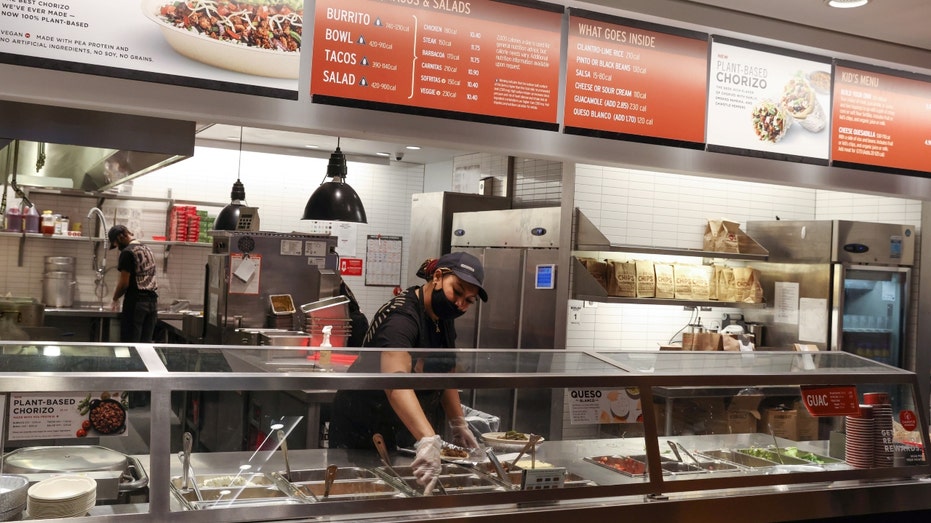
A person works in a Chipotle outlet in Manhattan, New York City. (Andrew Kelly/Reuters)
“And so I think we’re making meaningful progress as it relates to value at Chipotle. What we also learned, I think, as an important note, is [that] value isn’t just about discounting and price point. It’s about convenience. It’s about execution,” Boatwright added.
Advertisement
“It’s about menu innovation. There’s a host of things that the consumer is looking at to determine value.”
Chipotle has recently introduced lower-priced menu options.
CEO Scott Boatwright said that customers do not judge value solely by prices or discounts. (Chipotle)
In December, the company launched a high-protein menu featuring a Single Chicken Taco, starting at $3.50 at select U.S. restaurants, and a High Protein Cup of Adobo Chicken, with a national weighted average price of $3.82, the company said at the time.
Advertisement
Chipotle on Wednesday also reported second-quarter revenue of $3.3 billion, up 9.3% from the same period in 2025.
Boatwright has previously pushed back against perceptions that Chipotle has become too expensive or reduced its portions to boost profits.
Chipotle on Wednesday also reported second-quarter revenue of $3.3 billion, up 9.3% from the same period in 2025. (Angus Mordant/Bloomberg via Getty Images)
“We have an affordable price point for all walks of life, and we’re for everyone. We want everyone to have access to wholesome, nutritious food,” Boatwright said during a May appearance on Yahoo Finance’s “Power Players” podcast.
Wall Street ended sharply higher on Thursday, with chip stocks jumping and Microsoft soaring after the technology giant gave a stellar forecast that eased fears about massive spending on AI infrastructure.
Microsoft jumped by a double-digit percentage after the technology company forecast quarterly sales and cloud growth above expectations. It also reported capital expenditures below estimates and said it expects to keep generating cash through its fiscal 2027 that has just begun.
This year, investors have been spooked by heavy spending on AI at big technology firms. Negative cash-flow reports from Alphabet and Tesla last week sparked a bout of selling in AI-linked stocks, with chip stocks also under pressure as investors questioned high valuations.
Meta Platforms tumbled after the social media heavyweight reported a 91% drop in second-quarter free cash flow, indicating the financial strain of its costly AI buildout.
Advertisement
“These are true battleground stocks. Investors can’t make up their minds whether the ROI on the massive capex spending is going to be worthwhile or not,” said Jed Ellerbroek, portfolio manager at Argent Capital Management.
Live Events
“Microsoft delivered yesterday, and maybe Microsoft is going to be able to move itself from the ‘battleground’ camp to be a ‘trusted AI winner’ stock,” Ellerbroek said. The PHLX chip index surged,with Micron Technology Sandisk and Advanced Micro Devices making big gains. Amazon rose and Apple dipped, with both companies set to report their results after the market closes.
Amazon’s stock has underperformed the broader market this year due to concerns about heavy spending on AI. Apple, which has not spent heavily on AI, recently overtook Nvidia to become the world’s most valuable company, with a market value of about $4.9 trillion.
On Wednesday, U.S. stocks closed sharply lower after the Federal Reserve left interest rates unchanged, with mixed messages from new Fed Chair Kevin Warsh leaving traders confused about the path of borrowing costs.
Bond markets remained on edge, with the yield on the 30-year Treasury bond surging to its highest level in 19 years.
Advertisement
Traders are now only pricing in a 59% chance for a rate hike at the Fed’s September meeting, according to CME FedWatch, down from 82% a week ago.
U.S. economic growth slowed in the second quarter as the trade deficit widened. The economy grew at a 1.5% rate, slower than estimates of 2.1% growth, data showed. A separate reading also showed U.S. inflation slowed in June.
Qualcomm fell after the chipmaker forecast fourth-quarter profit below estimates and said revenue from Apple products would decline faster than expected.
Fair Isaac slumped. Even though the credit-scoring giant lifted its annual profit and revenue forecasts, they remained below analysts’ estimates.
Advertisement
Starbucks rose after the world’s largest coffee chain raised its annual sales and profit forecasts.
Analysts on average expect S&P 500 aggregate second-quarter earnings to jump 40% from a year ago, with AI-related stocks accounting for much of that growth, according to LSEG I/B/E/S.
Strong earnings forecasts and a recent decline in share prices have left the S&P 500 trading at about 20 times expected earnings, just above its 10-year average of 19, according to LSEG data.
The Penarth headquartered firm has released a trading statement to the City
11:08, 30 Jul 2026Updated 11:18, 30 Jul 2026
Penarth headquartered global point of care diagnostics firm EKF Diagnostics said it is on track for a stronger end to the year after posting first half numbers in line with management expectations, while confirming that cash levels held in Russia have risen.
In a trading statement the Alternative Investment Market listed firm that in the first half of this year revenues remained broadly flat at £25.m (H1 2025: £25.2m), reflecting the higher weighting of sales expected in the second half of the year. Gross margin improved to 53% (H1 2025: 50%) and adjusted Ebitda showed continued growth.
The group’s cash balance as at 30 June 2026 was £16 (31 December 2025: £15.8m), which included £2.4m held in Russia (31 December 2025: £2.1m).
Advertisement
It operates in Russia via its German-based subsidiary, in which it has a 60% stake, selling non sanctioned medical devices. However, since Russia’s invasion of Ukraine the Putin administration has put tight limits on the amount of cash from trading that foreign firms are able to move out of the country.
It is a counter measure to western sanctions. For the last two years EKF’s subsidiary has been able to release around £500,000 per annum in dividend payments. The rise in cash from £2.1m to £2.5m has in part been driven by improved exchange rates.
EKF has no bank borrowings, and the closing cash balance reflects the allocation of £1.4m for the ongoing share buyback programme, of which £900,000 has been deployed during the period, together with the continued investment for growth that is part of the five-year strategic development plan for the business.
It said: “The progress of the five-year strategy continues in line with management expectations. Diabetes and hematology delivered steady performances in the first half, with the majority of high-volume tenders already won and scheduled to be delivered in the historically stronger second half year.”
Advertisement
It added that its remains on track to deliver growth at the revenue and adjusted Ebitda levels for full year 2026 in line with current market expectations.
Following the trading statement brokers Singer, Stifel and Panmure Liberum all maintained their buy share positions. Panmure Liberum has a share price target of 34p with the other two slightly higher at 35p.
In its note Panmure Liberum said: “The shares are still cheap, and remain range bound with he buy-back providing a floor to the price.
“There is little in the statement to change this prior to the interims. However, the longer-term outlook remains more encouraging and we expect the growth rate to improve, margins to continue to expand and strong cash conversion. We retain our buy (share recommendation).
Advertisement
Shares in EKF fell slightly after the trading statement to around 25p.
An alternative approach is to ensure that everyone who is eligible, based on their needs, should get state-funded personal care that is free at the point of use.
This would be provided free regardless of an individual’s means and whether it was received by an elderly person in their own house or a residential care home.
Scotland has implemented such a system.
However, it’s important to note that personal care takes in things like helping frail elderly people wash and dress and go to the toilet.
Advertisement
But it does not include accommodation, food and everyday living costs which are subject to means testing.
The Health Foundation think tank estimates that implementing a Scottish-style system in England would cost £7.5bn a year by 2036.
Like Scotland, Japan and Germany have systems which base entitlement to personal social care mainly on people’s care needs rather than their ability to pay.
Japan and Germany though have a mandatory long-term care insurance system which is funded through contributions from workers and employers.
Advertisement
Both countries also do not usually cover the full cost of personal care so individuals are responsible for some of the expenses.
Ofgem has proposed new measures which could see developers of data centres made to pay hundreds of millions of pounds up front.
The British energy regulator said a refundable fee should be charged for projects that want to connect to the network, amid mounting demand for connections to the electricity grid.
It is proposing developers pay a deposit between £237,500 to £712,500 per megawatt – meaning data centres seeking 1 gigawatt (GW) of power would have to pay hundreds of millions up front, paid back if the project was completed.
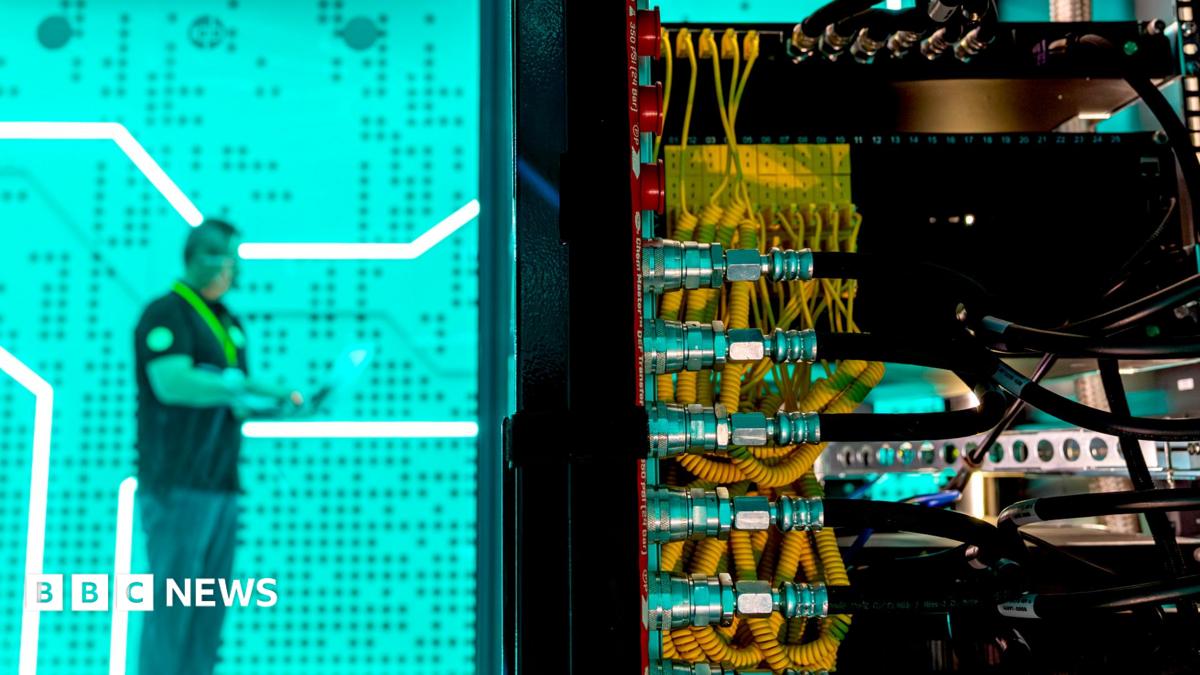
Data centres are large buildings which house computer servers used to store and process data and run the digital services which power the internet.
Ofgem has started a consultation on its proposals, which will run until 16 September.
It said the amount of electricity capacity being requested by projects seeking to connect to the grid had risen from 41 GW to 125 GW in the past year, reflecting a sharp increase in demand.
This is significantly more than double 2025’s peak electricity demand in Britain of around 46 GW.
Advertisement
The regulator said the projects would have to hit key milestones to keep their place in the grid connection queue, which has seen a surge in demand.
An increasing number of centres have been built around the world in recent years to provide the computing power needed to train and run AI systems.
But they are controversial, especially for people who live near them.
Residents have raised concerns about noise, electricity demand and the large amounts of water sometimes used to cool the high-performance chips that generate vast amounts of heat.


























































You must be logged in to post a comment Login