
Connect with us

Tech

G2A.COM’s autonomous AI agent Dave helps sellers resolve 14,400 support tickets in 63 days

Published

on

Dave, a New AI-Powered Tool for Sellers, Helps Resolve 54% of Their Cases and Efficiently Manages Demand Spikes During AAA Game Launches. Now available in 180 countries, it has reduced the number of tickets submitted to Seller’s Support teams by 30%.

G2A.COM, one of the world’s largest digital marketplaces, today announced the global launch of ‘Dave’, its proprietary autonomous customer support agent, which will be available to sellers operating on the platform, following a highly successful two-month trial period.

Although sellers ensure the high quality of their offerings, and remain autonomous in all their decisions, large-scale surges in customer support demand may occur during blockbuster video game releases such as GTA 6.

Despite their best efforts, sellers may not be able to handle all these support requests within a short period of time. Dave was built specifically to help sellers manage such spikes and now operates 24/7 across 180 countries.

Advertisement

The 💜 of EU tech

The latest rumblings from the EU tech scene, a story from our wise ol’ founder Boris, and some questionable AI art. It’s free, every week, in your inbox. Sign up now!

Dave has streamlined seller’s operations and processes, managing roughly 10,000 conversations globally per week. Unlike traditional chatbots, Dave connects directly to the seller’s transaction history and enables instant verification of payment status and the seller’s policies, allowing issues to be resolved immediately. By relying on verified data rather than solely on generative text, the system avoids the risk of AI hallucinations and errors and effectively manages complex cases involving vouchers, game keys, software licenses, and refunds processed by sellers.

In its first 63 days of full deployment, Dave achieved several key operational milestones:

Advertisement
  • Ticket Reduction: Dave streamlined the handling of approximately 15,000 tickets, helping to resolve them quickly on behalf of sellers and reducing the overall volume of tickets requiring human support by 27–30%.
  • High-Precision Routing: Achieved 93.8% routing accuracy, instantly directing cases to the relevant third-party seller or, where they related specifically to the operation of the platform, to G2A.COM Support, in line with marketplace policies.
  • Strong User Acceptance: Dave AI received a satisfaction score of 4.16 out of 5. Additionally, 74% of users rated the automated process as easy or very easy.
  • Quality and Trust Metrics: Dave’s responses achieve an average quality score of 91.2%, with only 0.81% receiving negative in-chat feedback. Every response is automatically evaluated across 13 quality and safety dimensions.

As G2A.COM continues to expand globally, ensuring that sellers can provide the highest possible standard of customer support remains a key priority. Activity across the gaming ecosystem, including major game launches, can trigger sudden spikes in user inquiries within hours, making it inefficient to scale support simply by hiring more agents. Dave was created to deliver immediate, high-quality, multilingual assistance at scale. If a case requires full manual intervention by the seller, the seller and their support team receive a comprehensive analysis and summary of the case so users never have to repeat themselves.

Dave is also another step in building an AI-native organization and environment. AI is no longer just a productivity tool or a competitive advantage. The real advantage comes from embedding AI into the core of how a company operates. Dave is a practical example of that approach, helping us and sellers using platform to scale globally while delivering faster and more trusted user experiences,” said Paweł Wróbel, CGO at G2A.COM.

About G2A.COM

G2A.COM is one of the world’s largest marketplaces for digital entertainment, serving over 35 million users from 180 countries with more than 200 million visits in 2025. As a true gateway to digital entertainment and a rapidly evolving digital ecosystem, G2A.COM gives access to over 125,000 digital offerings, including vouchers, games, DLCs, in-game items, and non-gaming items such as gift cards, subscriptions, software, or e-learning, sold by sellers from all over the world. A compliance-driven organization audited by Deloitte for over a decade, G2A.COM is a leader in online security, recognized by the prestigious American CNP Award alongside industry giants like Microsoft and PayPal. Today, the company is a key gateway for recognized global brands, leveraging its scalable infrastructure to drive the next phase of e-commerce through agentic AI and global M&A – continuously expanding its role as the Gate 2 Adventure in the digital world.

Source link

Advertisement
Continue Reading
Click to comment

You must be logged in to post a comment Login

Leave a Reply

Tech

Microsoft Says Workers Are Now Using Copilot AI as Much as Teams and Outlook

Published

on

Workers who use Microsoft software seem to be having as many conversations with Copilot AI as with real humans in Outlook and Teams, Microsoft said Wednesday during its fiscal year 2026 fourth-quarter earnings call. 

“The number of conversations per [Copilot] user nearly doubled year over year,” Microsoft CEO Satya Nadella said on the call. “Average weekly engagement is on par with Outlook and Teams.” 

There are over 30 million paid Microsoft 365 Copilot seats. And the way these workers are using AI is changing, too. Two months after Microsoft introduced Agent 365, a way for its business customers to build and use agentic AI, it has registered nearly 40 million agents across more than 10,000 companies, Nadella said. 

“The agentic era is being built on GitHub,” Nadella said, referring to the developer platform Microsoft owns. “Every major coding agent runs on the platform, and one in three pull requests on GitHub now involves an agent.” 

Advertisement

Microsoft beat investor expectations, reporting 18% revenue growth year-over-year for the quarter, which the company attributed to its AI and cloud services. Azure surpassed $100 billion in revenue for the first time ever. The company also attributed a $3.2 billion gain to its stake in Claude maker Anthropic. (Xbox severance and “impairment” charges were noted as hurting Microsoft’s financial health, as the parent company laid off 3,200 Xbox employees earlier this month, but that didn’t stop Microsoft from reporting just over $35 billion in net income.)

Like every other tech company, Microsoft has invested significant money and manpower behind its AI system, Copilot. And it seems its expensive bet on AI is possibly returning some cash on its investment; Nadella said Copilot revenue increased 60% quarter-over-quarter. But the spending isn’t slowing down; Microsoft added 31 new data centers across five continents.

The Redmond-based company has steadily and insistently integrated its AI into its software, which was already the backbone of corporate America. US adults say help with work is one of the main reasons they use AI, second only to searching for information, according to a recent Pew Research Center report.

Now, the company is betting not only that its customers will adopt AI, but that it will be so thoroughly integrated that it “transforms” how work is done – and how success is measured. 

Advertisement

Moving past ‘time saved with AI’

In the early days of AI adoption, executives and tech enthusiasts were invested in the idea that AI tech could help employees do their work faster. Stories of AI automating repetitive processes and saving people hours of work were common. 

Now, in the age of agentic AI, with agents that can autonomously complete tasks, the way people are using AI is changing. 

Ideally, this should lead to “deeper cognitive work across the ecosystem,” Matt Firestone, general manager of product marketing for Copilot, tells me. 

AI-native workers can distinguish between when they only need a quick answer from AI and when they need to use more advanced models or tools to handle more complex tasks, where there is also more human direction, engagement and approval.

Advertisement

“It’s not just about automating everything that we need to do to be more efficient. It’s about developing that judgment,” says Firestone. 

And Microsoft has been busy building these more advanced, autonomous AI tools to help with those more complex assignments. Its Copilot Cowork uses a team of agents to write reports, send messages and do personalized analysis, all of which is grounded in your documents and messages. It’s very similar to Claude Cowork, which sparked fear across Wall Street when investors saw how productive it is at software tasks when it was released at the beginning of 2025. When testing Copilot Cowork and Claude Cowork with a Microsoft 365 connector, Microsoft found that using its own Cowork tool was on average 30% to 40% cheaper to run.

Microsoft has leaned all the way in on agentic AI. Scout, which Microsoft calls an “always-on personal agent,” was introduced shortly after at Microsoft Build; it’s specific to your Teams and Outlook messages, flagging important notes and helping you with meetings and assignments.

Having agents assist with deeper cognitive work, not just answering questions, helps companies prove the usefulness of AI – a way to expand the metrics by which we judge its success or failure. Instead of just looking at time saved, companies are now looking at how agents enhance workflows, do analysis that couldn’t be done by hand and handle specialized tasks outside of just software development.

Take Kantar, for example. The marketing data and analytics company has been steadily and thoroughly integrating Copilot AI and agents into its operations over the past two years, with its HR team, not software, leading the way. It used a system of 10 agents, grounded in the company’s existing policies and procedures, to handle some employee inquiries to HR, like requesting and generating employment verification letters. AI took over 40% of those kinds of requests since the tech was implemented, with a goal of reaching 95% by the end of the year.

Advertisement
Microsoft Copilot logo on computer on wooden desk
Microsoft Copilot is increasingly present in the lives of workers who use Microsoft’s software.Adobe Stock

The human HR experts’ time was saved, but the AI agents also increased output, allowing human workers to focus on other projects. John Dicken, senior director of AI people solutions, says that applying an organizational lens to the company’s AI integration helped the company.

“A lot of people I talk to think of AI tooling as tech. I think of it as capability,” Dicken says. “It’s a technical solution to bring in capability to the organization in a different way, to bring new skills, new understanding, new knowledge, new approaches, new thought design.”

For some folks, that ability to take on more work means getting to tackle projects they’ve been waiting to have the time to do. But for others, it means having to do more work for the same pay. That can lead to a kind of AI-powered burnout, a University of California, Berkeley study found, where even with AI, we end up with longer workdays and worse work-life balance.

The ROI on AI is not just a matter of corporate talking points. Big and small businesses are paying big bucks to tech companies for the ability to run, license and personalize AI tools. And those tech companies, in turn, are asking investors for eye-watering sums to keep developing the models that power chatbots and agents. 

It’s created a monster of a trillion-dollar industry, and measuring its success in multiple ways, beyond time saved, may be vital to proving its usefulness and avoiding popping the AI bubble.

Advertisement

Source link

Advertisement
Continue Reading

Tech

States push back against rising AI-driven electricity infrastructure costs

Published

on


Artificial intelligence came at just about the right time, speeding up app and software development as the world started to contend with skills shortages, but it changed the pace so much that security teams have not been able to keep up.

Recently, we’ve seen AI being applied across multiple other domains with role-specific agents and tools, but that’s introduced its own challenges. While tools like Claude Code have proven a hit for generating, reviewing and editing code in seconds, security-focused tools like Anthropic’s Claude Mythos family of models are having broader impacts on the industry.

Source link

Continue Reading

Tech

The FTC is suing Hims & Hers for sharing patients’ health data with Meta and Snap

Published

on

The Federal Trade Commission is suing Hims & Hers, accusing the telehealth company of sharing customers’ sensitive health information with advertising platforms including Meta and Snap.

The complaint, filed on 29 July and joined by Utah and California, also alleges the company charged people without proper consent and made subscriptions deliberately hard to cancel.

The privacy claim is the most serious. The FTC says Hims & Hers passed customers’ health details to third-party advertisers, through uploaded customer lists and automatic tracking that fired off user actions to the platforms, echoing how hospital websites have leaked patient data despite promises to protect it.

The data at issue is not trivial. Hims & Hers sells treatments for conditions people rarely discuss in public, from hair loss to erectile dysfunction to mental health, which makes an alleged leak to ad platforms unusually sensitive.

Advertisement

Hims & Hers has grown into a telehealth giant on exactly these categories. It expanded into weight-loss drugs and built a subscription model that turned stigmatised prescriptions into a mass-market online business, which is why the data it holds is so revealing.

The billing allegations run alongside. The FTC says customers were charged the moment they submitted an intake form, even though the company implied they could speak to a provider first, and were enrolled in recurring subscriptions without a clear chance to review their options.

Then came the hard part: leaving. Before 2023, cancelling required contacting customer service by phone, email, or chat, and even after Hims added an online option, the FTC says it buried the cancel button behind multiple steps, a textbook dark pattern of the sort the agency has been chasing across the web.

The agency’s language was unsparing. Consumers were “unknowingly locked into recurring subscriptions” while their “most private health information” was disclosed to third parties, said Christopher Mufarrige, the FTC’s consumer-protection director.

The legal basis spans several laws. The complaint leans on the FTC Act, the Restore Online Shoppers’ Confidence Act, and consumer-protection and false-advertising laws in Utah and California, a multi-front case rather than a single charge.

Advertisement

The market reacted at once. Hims & Hers shares fell about 10% on the news, a sign investors read the suit as a real threat to a company whose growth has been built on frictionless online sign-ups.

The case is part of a wider reckoning. Regulators have spent the past few years pursuing health and wellness services that quietly fed sensitive data to ad platforms, and Hims & Hers, with its scale and its intimate categories, is a high-profile target.

Meta and Snap are not the defendants, but they hover over the case. The tracking tools at issue are the advertising pixels and data pipelines that power much of the online ad economy, and health data flowing into them has become a recurring legal flashpoint.

The legal gap is part of the problem. Federal health-privacy law was written for hospitals and insurers, not for ad-funded apps, which has let sensitive data flow to platforms in ways patients rarely understand.

Advertisement

The dark-pattern allegations may resonate more widely. Hard-to-cancel subscriptions are a familiar consumer grievance, and the FTC has made them a priority, so a case pairing privacy breaches with a buried cancel button is one it will want to win in public.

Hims & Hers did not comment in the FTC’s announcement. The company has grown fast by making telehealth feel as easy as ordering anything else online, and the suit argues that some of that ease came at the customer’s expense.

The commission voted 2-0 to file. The case now heads to federal court in northern California, where the questions will be whether the data sharing broke the law and whether the sign-up and cancellation flows crossed from aggressive into deceptive.

For a sector built on convenience, the message is pointed. Telehealth promised to strip the friction out of getting care, and the FTC is now testing how much of that friction was removed from the company’s side and quietly added to the customer’s.

Advertisement

Source link

Continue Reading

Tech

AirPods Max 2 just dropped to $449 at Amazon, save $100 now

Published

on

We covered Amazon’s $99 AirPods 4 deal yesterday, and today AirPods Max 2 are $100 off, bringing the over-ear headphones down to $449.

AirPods Max 2, which were released in 2026, are $100 off at Amazon today, with all five color options eligible for the triple-digit markdown at press time.

Buy AirPods Max 2 for $449

This AirPods deal reflects the lowest price seen this month on the over-ear headphones. In our hands-on AirPods Max 2 review, we found the 2026 release delivers better active noise cancellation (ANC) and great call quality.

Advertisement

On the earbuds side, AirPods 4 and AirPods Pro 3 are on sale as well, with prices as low as $99.

Today’s best AirPods deals

AirPods Max 2 highlights

  • Powered by Apple’s H2 chip
  • Up to 1.5x stronger Active Noise Cancellation than first-gen AirPods Max
  • Transparency mode
  • Adaptive EQ
  • Lossless Audio and ultra-low latency audio via a wired USB-C connection (requires a supported service)

You can compare prices on both current and closeout models in our AirPods Max Price Guide.

Source link

Advertisement
Continue Reading

Tech

30 years ago, AT&T gave Internet Explorer the default advantage

Published

on

OFFBEAT

Netscape still ruled the browser market, but Microsoft had Windows 95, WorldNet, and a very valuable foothold

It is 30 years since AT&T handed Microsoft a valuable foothold in the browser wars by making Internet Explorer 3 the default for its WorldNet service.

Windows 95 was barely a year old when AT&T set out to challenge CompuServe and America Online with its WorldNet service in 1996. The telecommunications giant needed a browser. Netscape Navigator dominated the market, but Microsoft was keen to make up lost ground.

Advertisement

A promotion and distribution agreement was announced on July 25, 1996, with a further announcement in October.

Under the deal, AT&T WorldNet software was included in versions of Windows 95 supplied to PC manufacturers, with Internet Explorer 3 designated as the service’s default browser. Netscape Navigator remained available, but Internet Explorer secured the valuable default slot.

Microsoft’s browser-bundling strategy would later draw antitrust action on both sides of the Atlantic, including the EU’s browser choice screen in 2010.

At the time, Tom Evslin, Vice President for the AT&T WorldNet Service, said: “Users now will find that everything they need to sign up for AT&T WorldNet Service is pre-loaded on their new computers, along with the Microsoft Internet Explorer 3.0 browser.”

Advertisement

Thirty years on, Evslin told The Register the deal came down to price. AT&T had to pay per copy activated, and he reckoned Microsoft pretty much gave its browser away (but wasn’t completely sure – it was, after all, a long time ago). Netscape Navigator was, however, better known at the time, and so was offered as an option.

By January 1997, Microsoft claimed Internet Explorer’s corporate usage had more than tripled since August while Netscape’s share declined. WorldNet was also attracting users by offering straightforward internet access rather than another AOL-style walled garden.

It rapidly became the world’s largest ISP by one contemporary measure, although it eventually wheezed its last in 2010. Internet Explorer proved more influential, dominating the browser market for more than a decade before its grip began to loosen in the late 2000s.

AT&T’s choice was only one factor in Internet Explorer’s rise, but it put the browser before WorldNet’s growing audience just as users were moving beyond the walled gardens of AOL and CompuServe. Microsoft may have been late to the browser game, but it already controlled the operating system on millions of PCs.

Advertisement

Three decades later, the deal remains an early demonstration of the value of being the default. ®

Source link

Continue Reading

Tech

A Capable KVM Built With The ESP32

Published

on

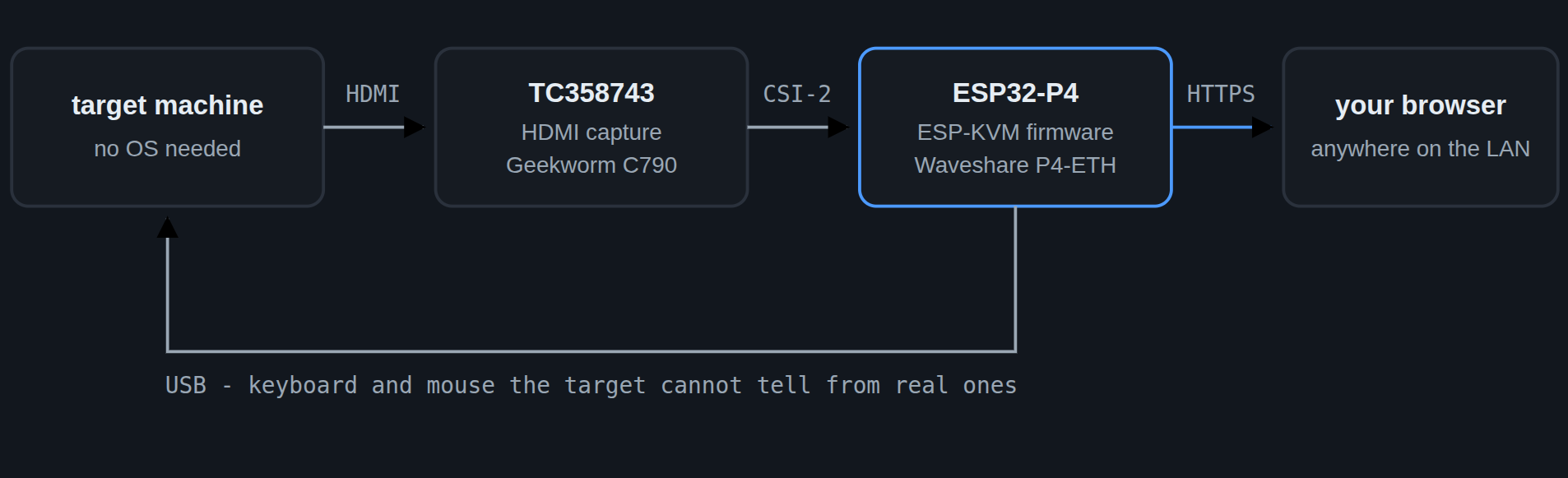
[Evgenij Spitsyn] spotted a KVM build on these very pages some time ago. That inspired their own build, leveraging the versatility of the ESP32-P4 microcontroller.

The concept is straightforward. Named the ESPKVM, the device is designed to hook up to a computer’s HDMI and USB ports. It captures the video output, while presenting itself as a standard keyboard and mouse device. In this way, it allows remote control of the machine over IP. It achieves this feat with the aid of the Toshiba TC358743 HDMI-to-CSI bridge, which is essentially the video capture hardware of the build.

The video output of the machine is streamed in MJPEG or H.264 format. The device is capable of serving up storage from a micro SD card or the onboard flash, as well as handling things like power/reset control and wake-on-LAN. All in all, it’s a very complete package, and full of useful features. Just don’t use it over the public internet yet — [Evgenij] notes it hasn’t been reviewed for potential security holes yet, even though it has some basic authentication features baked in.

Advertisement

If you’ve got an ESP32-P4 ready to go with a TC358743 HDMI bridge, you can actually head over to the ESPKVM website and flash the code right in your browser to get going. Meanwhile, if you found this build interesting, you might like to scope out the one that inspired it. If you’re cooking up similar utility hacks, be sure to notify the Hackaday tipsline.

Source link

Advertisement
Continue Reading

Tech

The majority of corporate IT is now off premises for the first time

Published

on

OFF-PREM

Survey finds more workloads run off-site than at in-house corporate facilities for the first time 

IT is going remote while sucking up more power. 

Most corporate IT is now off-premises for the first time, according to Uptime Institute, while the average rack power density has crested above 11 kW for the first time as server fleets are gradually replaced with more powerful hardware.

Advertisement

Uptime’s Global Data Center Survey 2026 reveals how the industry is managing to adapt to challenging circumstances, with the usual evergreen concerns over rising costs plus staffing and skills shortages. The survey polls more than 800 datacenter owners and operators across multiple countries, with more than half (52 percent) in North America and Europe.

Off premise dominates: Every year, Uptime asks its enterprise respondents to estimate what percentage of their IT workloads are run in-house versus in third-party facilities.

For the first time, third-party sites have the larger share, accounting for 46 percent of IT workloads, compared with 44 percent residing in enterprise-owned corporate server farms.

Those figures don’t add up to 100 percent, as some respondents (10 percent) say they are using IT rooms and server cabinets rather than a dedicated facility.

Advertisement

Uptime’s experts estimate that, by 2028, the proportion of workloads in self-owned server halls will remain the same, while those running in third-party sites will expand to 48 percent, eating away at those currently based in IT rooms and server cabinets.  

More power: While the headlines have featured AI infrastructure pushing IT infrastructure power density to 120 kW per rack or even higher, the reality is that most datacenters and servers operate at a much lower level than that.

This year, the average of the most typical rack densities now surpasses 11 kW, as a gradual ongoing shift toward higher-powered hardware was compounded by a small number of new high-density facilities with racks above 30 kW.

Without those few high-density facilities skewing the average, it sits at 7.8 kW, just slightly up from 7.5 kW in 2025.

Advertisement

The majority of facilities still do not have any racks of 30 kW or above, Uptime finds, but more respondents (24 percent) now say they have some of these, compared with 19 percent last year. The increase was mostly in the 50-plus kW ultra-high-density range, including some respondents deploying AI and GPU servers into racks configured for above 100 kW.

The trend for rising rack density will continue as organizations upgrade their infrastructure with newer hardware. Updated servers boost both workload capacity and energy performance, but maximizing these benefits means a corresponding rise in overall system power, Uptime states.

Refresh shortened: Some operators are also pursuing more aggressive technology refresh timelines of less than 4 years, the report claims. If true, this would be the reverse of what some hyperscalers such as Microsoft, Google and Meta have been doing in recent years, extending lifecycles out to 6 or 7 years to save on depreciation expenses.

Outages: When it comes to outages, this year’s report shows improvement for the sixth year in a row, with the number of respondents who experienced an outage in the past three years down by three percentage points.

Advertisement

But Uptime warns against complacency, noting that many of the factors behind outages, such as reduced or unstable power availability, local grid reliability, supply chain constraints, and extreme weather, are on the increase.

The flip side is that the costs of any outages that do occur continue to rise. This is because organizations have become more dependent on digital infrastructure, the report says, and so outages may have more financial impact than in the past.

Overall, 71 percent of survey respondents reported that their most damaging outage cost at least $100,000, compared with 57 percent a year ago.

Staffing shortage: Staffing has long been an issue for datacenter operators, and this year the greatest skills gaps reported were in electrical (38 percent of respondents), junior level operations (38 percent), operations management (35 percent) and mechanical roles (34 percent).

Advertisement

However, more than half (53 percent) of operators report difficulties finding qualified candidates for vacant roles, up from 46 percent a year ago.

Finally, Uptime found that financial pressure and resource constraints continue to grow among operators. In fact, the high prices of power, staff, and equipment, particularly for AI-related infrastructure, is the primary issue. Alongside that are escalating concerns over capacity forecasting, power availability and supply chain disruptions. ®

Source link

Advertisement
Continue Reading

Tech

Medtech manufacturer Boston Scientific plans job cuts in Ireland

Published

on

The decision comes just months after the company announced a $75m Galway expansion plan.

Global medical device manufacturer Boston Scientific is planning layoffs at its Irish operations, which employs more than 7,000 workers across facilities in Galway, Cork and Tipperary.

The Massachusetts-headquartered company informed the Department of Enterprise, Tourism and Employment of the upcoming job cuts via a collective redundancy notification on 22 July, RTÉ reported on Wednesday (29 July).

Businesses in Ireland that employ more than 300 people must notify the Government if they plan to cut 30 or more jobs. Globally, the company employs more than 59,000.

Advertisement

The exact extent of the layoffs, however, is unclear. SiliconRepublic.com has requested details from Boston Scientific. The company is still hiring across all three of its locations in Ireland.

The layoffs come just months after the company announced a major $75m expansion of its Galway facilities and a plan to open new, purpose-built laboratories.

Last week, the Boston Scientific approved a global restructuring plan, which it said would lead to “some” headcount reductions. The plan is expected to cost the company between $700m and $800m.

It expects a “substantial portion” of the savings to be reinvested in strategic growth initiatives, according to a regulatory filing on 21 July.

Advertisement

In a statement to RTÉ, a Boston Scientific spokesperson said that the restructuring programme includes “includes enhancing operational and functional capabilities as well as global supply chain network optimisation.

“Ireland has been an important part of Boston Scientific’s global organisation for more than 30 years. We are committed to our long-term future in the country and recognise the significant contributions our employees in Ireland make across our global business.

“In general, we do not break out programme details by business, region or function.”

Net sales at the global medtech grew 7.5pc year-on-year to nearly $5.5bn during the second quarter of 2026.

Advertisement

Don’t miss out on the knowledge you need to succeed. Sign up for the Daily Brief, Silicon Republic’s digest of need-to-know sci-tech news.

Source link

Advertisement
Continue Reading

Tech

Live-shopping app Whatnot is in talks to nearly double its valuation to $20bn

Published

on

The startup, which sells everything from sneakers to sports cards over livestream, is raising again barely a year after an $11.5bn round, as live commerce catches on in the West.


Whatnot, the livestream-shopping platform where hosts sell sneakers, trading cards, and vinyl to a live audience, is in talks to raise money at a valuation of about $20 billion. The figure would nearly double the $11.5 billion the company was worth as recently as late 2024.

The pace of the markup is the story. A near-doubling in under a year puts Whatnot among the fastest-appreciating consumer startups around, at a time when venture money has flowed overwhelmingly toward artificial intelligence rather than shopping apps.

Whatnot runs live video auctions and sales across categories from fashion to collectables, taking a commission on each transaction, a model that turns online shopping into something closer to entertainment.

Advertisement

The mechanics are half the appeal. A host holds up an item, buyers bid or tap to purchase in real time, and the urgency of a live sale, the countdown, the banter, the scarcity, does work that a static product page never could.

Advertisement

The numbers behind it are real. The company says it handled about $8 billion in livestream sales over the past year across North America and Europe, the kind of volume that justifies, at least to its backers, a valuation usually reserved for software firms.

The investor roster reads like a who’s who. Andreessen Horowitz, Sequoia, Lightspeed, and Google’s CapitalG have all backed Whatnot, the same names that chase the biggest rounds in technology, now betting that live commerce is more than a novelty.

The idea is not new, just newly working in the West. Livestream shopping has been enormous in China for years, where platforms like Taobao turned hosts into salespeople for millions of viewers, and Western investors have long waited for the format to cross over.

Whatnot’s bet is that it finally has. The company has grown by leaning into niche communities, the collectors and resellers for whom a live auction is both a marketplace and a hangout, rather than trying to be a general store.

Advertisement

It has also started buying capability. This month Whatnot acquired Shaped, a startup that builds real-time recommendation systems, a purchase aimed at pointing viewers toward the streams and items most likely to make them spend.

That acquisition hints at where the money would go. A larger raise would fund the recommendation engine, expansion in Europe, and the fight for hosts and buyers against social platforms circling the same behaviour.

Because the competition is coming. TikTok, Instagram, and Amazon have all pushed into live and social shopping, and Whatnot’s independence is both its advantage, a platform built for this alone, and its vulnerability against far larger rivals.

The valuation, for now, is a talk rather than a term sheet. Business Insider frames it as a round under discussion, and startup valuations at this stage can move before they are signed, especially in a market as selective as this one.

Advertisement

Still, the direction is telling. That investors would price a shopping app at $20 billion, in a year when nearly every large cheque has gone to AI, suggests live commerce has graduated from experiment to category.

It also stands out for what it is not. In a funding market fixated on AI models and infrastructure, Whatnot is a reminder that a consumer business with real transactions can still command a software-sized valuation, provided the growth is there.

The risk is the one every marketplace faces. Whatnot’s value rests on keeping hosts and buyers on the same platform, and that loyalty can erode quickly if a bigger rival offers better terms or a larger audience.

For now, the momentum is with the company. A near-$20 billion valuation would confirm that livestream shopping has arrived in the West, and that Whatnot, for the moment, is the name investors are willing to pay up for.

Advertisement

Source link

Continue Reading

Tech

Meta revenue up but income and margin down in Q2 2026

Published

on

The company said it expects total expenses for 2026 to come to between $165bn and $169bn.

Tech giant Meta’s income and operating margin for the second quarter of 2026 were down in comparison to the same time last year amid significant outgoings for the period.

Although revenues were up 28pc to $60.8bn for the period ending 30 June, the company saw a big jump in costs and expenses from around $27bn in Q2 2025 to more than $42bn this year.

Total income fell from $20.4bn to $18.8bn, with operating margin dropping from 43pc to 31pc. Net income fell year-on-year from $18.3bn to $15.8bn.

Advertisement

The 55pc year-on-year jump in expenses includes a $2.4bn outlay on charges around various legal proceedings and $1.8bn in severance costs invoked from recent layoffs by the company. It said it expects total expenses for 2026 to come to between $165bn and $169bn.

Meta’s free cash flow for the most recent quarter was $784m, compared to more than $8bn a year earlier, following declared spending of more than $31bn on leases, property and equipment.

It said it expects capital expenditures for 2026 to amount to between $130bn and $145bn.

“As AI usage in our products and businesses continues to ramp, we continue to invest aggressively in infrastructure to meet the demand,” said Meta CEO Mark Zuckerberg on the company’s quarterly earnings call yesterday.

Advertisement

“Overall, we expect that a significant portion of our compute is going to go towards training our models, growing our core business, and delivering personal agents and new products. But we also expect to grow a large business serving large customers as well.”

Meta shares were down last night following an announced projected revenue for Q3 of around $62.5bn – lower than analysts’ expectations of more than $63bn, according to media reports.

Commenting on the financial results, analyst Mike Proulx of Forrester said that “Meta believes AI infrastructure is now a strategic asset, but its bill is arriving faster than the payoff,” noting that “what it generated in cash this quarter almost all got eaten by AI infrastructure spending”.

He added: “Meta’s AI spend was easier to celebrate when margins were expanding. It’s harder to celebrate now that the costs are showing up in the numbers.

Advertisement

“There’s a bit of similarity to Meta’s metaverse missteps in that Meta is once again spending ahead of proven product demand. The difference is that AI adoption and value are real.

“Investors now have to decide whether Meta’s growing list of AI initiatives represents company diversification or distraction. What makes that question more complicated is that Meta’s legal and regulatory challenges are getting more expensive, too.”

The company’s reported headcount as of 30 June was put at 75,472, which still includes approximately 8,000 employees who have recently been or will soon be laid off.

CFO Susan Li told the earnings call that the company would “continue to monitor active legal and regulatory matters that could significantly impact our business and financial results”.

Advertisement

She added: “For example, we continue to see scrutiny on youth-related issues in several markets and have a number of youth-related trials scheduled for this year in the US, which may ultimately result in a material loss.”

Proulx noted: “Meta’s biggest regulatory battles typically centred on privacy and competition. Now the pressure is mounting around youth wellbeing, addiction and platform safety.

“That’s a different kind of risk because it impacts the future audience growth that powers Meta’s ad business that’s literally underwriting the company’s exorbitant AI costs.”

Don’t miss out on the knowledge you need to succeed. Sign up for the Daily Brief, Silicon Republic’s digest of need-to-know sci-tech news.

Advertisement

Source link

Continue Reading

Trending

Copyright © 2025