

The AI industry’s investors and critics don’t agree on much. But many in each camp share at least one basic conviction: America’s top labs are about to make a killing.
Tech
Judge: DOJ Undid Its Attempt To Bully Portland Police Because AG Harmeet Dhillon Tweeted Thru It


from the every-button-a-self-destruct-button dept
There are several layers of bullshit in operation here, so we’ll walk through it all. But keep in mind the only reason this is all being exposed is because Trump administration officials feel they’re more obligated to “own the libs” than actually do their damn jobs.
Last October, “conservative influencer” Nick Sortor was arrested by Portland (Oregon) police after an altercation with anti-ICE protesters. Sortor received preferential treatment from the Trump administration. He was allowed to stand on the roof of the ICE detention center and film protesters during then-DHS head Kristi Noem’s visit to the site.
The DOJ decided to intervene on Sortor’s behalf. It went after the Portland Police Bureau (PPB), demanding it turn over thousands of documents it claimed were evidence of the PPB’s desire to punish certain people for certain kinds of speech.
To do this, it cited a DOJ settlement reached with the PPB back in 2013 — one that said nothing about any PPB attempts to shut down speech the PPB didn’t like. The paragraph cited in its demand for documents said this:
Too frequently, persons who have or are perceived to have mental illness and are in crisis are subjected to unnecessary or excessive force by police officers. The Portland Police Bureau lacks adequate policies to guide officers in these circumstances, or training, supervision and accountability measures necessary to ensure that officers comply with the constitutional rights of people in mental health crisis.
That’s the first layer of bullshit. The DOJ isn’t going after the PPB because it has any genuine concerns about its treatment of people with mental health issues. It’s going after the PPB because it arrested one of theirs and is located in a “liberal” city this administration desires to punish however it can, whenever it can.
The next layer of bullshit is the DOJ pretending any previous settlement over excessive force by local law enforcement is worthy of recognizing. Since Trump’s return to office, the DOJ Civil Rights Division solely exists to further the goals of the administration’s white Christian nationalists. It has already made moves to dissolve or suspend court-ordered consent decrees affecting local law enforcement agencies successfully sued/investigated for pattern-and-practice rights violations because it feels law enforcement shouldn’t have to answer to anyone.
So, it’s entirely hypocritical for this administration to cite a consent decree it would have sought to have removed if it affected a Red State agency in hopes of punishing Portland and its police department for anti-ICE protests.
The government claimed the settlement entitled it to whatever documents it wanted from the PPB. But Assistant Attorney General Harmeet Dhillon decided to shit the bed by being exactly the sort of person you’d expect her to be, given her subservience to Donald Trump. From the ruling [PDF] handed down by federal judge Michael Simon rejecting the government’s bad faith effort to leverage a PPB civil rights settlement for its own vindictive purposes (h/t Gabriel Malor):
On October 3, 2025, the same day that Judge Immergut was holding the hearing on the motion for temporary restraining order requested by the State of Oregon and the City, the Assistant Attorney General for the Civil Rights Division of the United States Department of Justice, Ms. Harmeet Dhillon, publicly stated that DOJ would conduct a “full investigation” of policing of the protests at the Immigration and Customs Enforcement (“ICE”) facility in Portland, Oregon.
She announced this by reposting a social media post from social media personality Nick Sortor, who wrote: “BREAKING: Attorney General Pam Bondi has ORDERED a full investigation, led by Asst. AG Harmeet Dhillon, of the Portland Police Bureau, following my wrongful arrest last night, Bondi confirmed to me. FAFO, @PortlandPolice….” Assistant Attorney General Dhillon also attached to her repost her own comment, which read: “Portland: It’s FO time. Buckle up.” Id. (emphasis added).
This gloating has turned out to be premature. The court says the administration has presented no evidence the PPB is failing to follow the terms of the 2013 settlement. Furthermore, that settlement was tied to the abuse of people with mental health illnesses. There were no allegations in the settlement that the PPB regularly punished people for engaging in protected speech.
This is the first of three indications the government has “unclean hands.” This is a legal term of art that basically means the government’s intentions are impure and enough impurity is on the public record to support this finding. Part of that is Dhillon’s tweet above, which makes it clear the targeting of the PPB was directly related to the arrest of Nick Sortor, rather than anything the administration claimed in its legal filings.
As the court notes here, the government is cheating when it uses a completely unrelated enforcement effort in order to induce compliance.
[T]he United States asserts that it is purporting to investigate whether the Portland Police Bureau has engaged in political viewpoint discrimination in violation of the Agreement in this case. This case, however, has never been about viewpoint discrimination, or even any issues arising under the First Amendment.
Second, there’s the timing. This action was pursued by the administration only after it was sued by the city and state over its commandeering of Oregon’s National Guard units.
Finally, there’s Dhillon’s tweet, which can’t even be charitably be referred to as “ill-advised.”
As noted, Assistant Attorney General Dhillon preceded her reposting of a Nick Sortor comment with Dhillon’s own comment: “Portland: It’s FO time. Buckle up.” (emphasis added). That is neither language nor tone of a good faith investigation by the United States Department of Justice. Instead, it exhibits all the hallmarks of a threat and attempted intimidation.
And that’s not even the totality of the intimidation tactics engaged in by AAG Dhillon. A footnote points out Dhillon also decided to tweet out a threat targeting the judge that had originally blocked the government from obtaining these documents from the PPB.
In addition, on the same day that Judge Immergut issued her temporary restraining order, relying in part on the testimony of two high-ranking officials from the Portland Police Bureau, Assistant Attorney General Dhillon reposted a comment from another social media personality that read, in part, “Judge Immergut must be impeached.” (emphasis added). This too is threatening conduct by Assistant Attorney General Dhillon.
This is not how a federal agency — especially the one expected to fight for justice, rather than just act like extensions of Trump’s id — is supposed to behave. But Trump himself expressly encourages this behavior and anyone with the least bit of personal/professional restraint has likely been fired and replaced by brainstem operators like AAG Dhillon.
What this means is that the courts no longer trust the DOJ, which makes it all the more difficult for it to secure the wins Trump demands from his underlings. This is a blueprint for perpetual failure. Unfortunately, no one in the administration is willing to learn anything from these experiences because doing so just means educating yourself out of a job.
Filed Under: dhs, doj, harmeet dhillon, ice, nick sortor, portland, trump administration
Continue Reading

Most Samsung Galaxy users download apps from the Google Play Store, but that’s not the only place to find useful apps. Samsung has its own store, called Galaxy Store, which provides apps created especially for the Galaxy smartphones. These apps can make your smartphone work faster, let you use additional camera options, and give you more customization options for your device. In this article, we look at five essential apps every Samsung user should know about and why they’re worth trying.
1. Good Lock

Good Lock is Samsung’s own customization app for Galaxy smartphones. With Good Lock, users get access to various settings that aren’t available in the default One UI interface. Rather than installing a third-party launcher to change your smartphone, Good Lock lets you personalize various aspects of your Galaxy device through official Samsung applications. Here are some of the most helpful modules from Good Lock:
- Home Up: The Home Up module provides additional settings for the home screen. In particular, it allows users to resize folders, choose new layouts, use stickers, and activate looping for home screens.
- Camera Assistant: With the Camera Assistant module, users can control extra features of the Samsung camera app. These include activating a 2x zoom shortcut, changing shutter button actions, and accessing such Samsung camera features as Single Take and Dual Recording.
- One Hand Operation+: This module makes large Galaxy phones easier to use with one hand. Users can create custom swipe gestures, open an app switcher, and access quick tools with simple movements.
- QuickStar: QuickStar lets users personalize the Quick Settings panel. It also allows them to hide selected status bar icons, change the panel’s appearance, and adjust the button layout.
- Routines+: This is an expanded version of Samsung’s Modes and Routines feature. Users can create more automations and touch macros for daily tasks.
- MultiStar: The MultiStar module provides more efficient usage of split-screen mode. Also, it enables additional cover screen features on Galaxy Z Flip models.
2. Good Guardians
Good Guardians is another helpful Samsung app that can be downloaded from the Galaxy Store. Similar to Good Lock, it comes with a number of downloadable modules. However, while Good Lock enhances customization options, Good Guardians helps enhance your phone’s performance and optimize its battery usage. These are some of the most helpful Good Guardians modules:
- Battery Tracker: This module shows which apps have used the most battery over the last 24 hours or seven days. It also displays battery usage percentages and screen time for each app.
- Battery Guardian: It provides users with a number of options to increase battery life, such as enabling power-saving mode at bedtime, optimizing display, and minimizing network usage for chosen apps.
- Galaxy App Booster: This feature boosts app performance at just one click. According to Samsung, it should be run once a week and after any software update.
- Thermal Guardian: The feature allows you to check your smartphone’s temperature and tells you why the phone heated up. Moreover, it monitors CPU utilization and lists apps that use maximum resources.
- Memory Guardian: This tool clears unused RAM with one tap, helping free memory and improve overall performance.
- Media File Guardian: It allows you to control media files stored on your phone, including files created by banking, shopping, and social media apps.
3. Expert RAW

For Galaxy smartphone users who want professional-grade control options for their camera, Samsung provides Expert RAW. Though it can be used with the Camera app, it is not automatically downloaded from the start. The user will need to install it either from the Galaxy Store or the More tab of the Camera app.
The app targets photography enthusiasts who want greater control over their camera settings. With this application, users can change settings such as ISO, shutter speed, focusing, exposure, and more before capturing images. Images can be captured using the app in two different file formats: JPEG and RAW. Certain Galaxy flagships offer functions such as astrophotography and multiple-exposure images. Expert RAW is available only on selected Galaxy flagship models, so it may not appear on every Samsung phone.
4. Galaxy Enhance-X
Galaxy Enhance-X is Samsung’s AI-powered editing app designed for Galaxy devices. It makes image and video editing easy regardless of your level of expertise. Its one-click improvement capability ensures you don’t need advanced knowledge to edit your images.
Along with AI enhancement, the app includes tools to eliminate shadows and reflections, enhance facial features, crop photos, and adjust brightness. Users can also restore vintage photos and even create GIFs. Video editing functions encompass cutting videos, muting the sound, and applying various video effects.
Other options include plugins such as FilmStyle, Cinematic Glow, SkyGuide, and SpeedShuffle, which offer additional editing options. But please keep in mind that the available features may differ depending on the Galaxy model.
5. Edge Panel Apps

Samsung’s Edge Panel gives Galaxy users quick access to apps and useful tools from the side of the screen. The feature already includes shortcuts for apps, contacts, weather, reminders, clipboard, and other utilities. Galaxy phones include several built-in panel options, but users can expand them with additional downloads.
The Galaxy Store offers additional Edge Panels that add more functionality. The Galaxy Store offers additional Edge Panels that add more functionality. Samsung provides panels such as the Calculator Panel, Calendar Panel, Edge QuickNotes, and Direct Call Panel. The Calculator Panel lets users perform quick calculations without opening the Calculator app. The Calendar Panel displays a scrollable calendar, while Edge QuickNotes makes it easy to view or create notes. With the Direct Call Panel, you can make a call from your contact list with just one tap. Third-party Edge Panels are also available on Samsung through the Galaxy Store. These panels offer additional options that let users perform daily tasks without opening apps.

Capital markets have signaled their faith in Anthropic and OpenAI’s impending hyper-profitability, valuing each at nearly $1 trillion. Many of Silicon Valley’s progressive adversaries also expect the labs to grow filthy rich but fear the implications, warning that AI-induced automation could transfer vast sums of money from ordinary workers to a handful of giant tech companies. Sen. Bernie Sanders’s call for nationalizing the top AI labs rests partly on that concern.
- The AI industry may be more competitive than investors expected.
- Chinese labs are producing models nearly as powerful as Claude and ChatGPT — and dramatically cheaper.
- That could make frontier AI a low-margin business.
- A world of cheap, open-source AI would bring both promise and danger.
But recent advances in Chinese AI call all of this into question.
Over the past two months, Chinese companies have released three AI models that are nearly as powerful as America’s frontier systems — and radically less expensive.
In June, Beijing’s Z.ai debuted a model that performed nearly as well as Claude and ChatGPT’s second-tier systems on independent benchmarks. Weeks later, another Chinese firm, Moonshot, unveiled “Kimi K3,” a model that allegedly outperforms all of its American rivals except for the very latest versions of Claude and ChatGPT. Finally, just days ago, Alibaba launched a preview of Qwen3.8 Max, which purportedly outclasses even OpenAI’s most advanced systems, while trailing only Claude’s Fable in its capabilities. (Disclosure: Vox Media is one of several publishers that have signed partnership agreements with OpenAI. Our reporting remains editorially independent.)
These developments don’t merely threaten America’s AI giants with stiffer competition in the race for superintelligence. Rather, they raise a more harrowing prospect: that the AI race’s ultimate rewards will be far smaller than anticipated. In a world where new advances can regularly be leapfrogged by cheaper upstarts, hoarding the technology — and its profits — will be harder for any one company to do.
In other words, building a machine God might not be as lucrative as it’s cracked up to be. AI, it turns out, may “want to be free.”
How AI was supposed to pay off
To see how China’s new models threaten Anthropic’s profit expectations, we must first examine why those expectations have been so high.
This is not entirely self-evident. After all, AI labs aren’t much like the hyper-profitable tech giants of the 2010s. Facebook and Airbrb were relatively capital-light businesses with ultra-low marginal costs (adding a profile to Facebook or listing to Airbnb costs the companies virtually nothing). And once each gained a foothold in their respective markets, network effects enabled them to retain formidable positions without needing to constantly upgrade their products.
Building a state-of-the-art AI company is a much more involved — and astronomically more expensive — endeavor. To get to the frontier, Anthropic and OpenAI have sunk (at least) tens of billions into semiconductors, data centers, power plants, and other capital investments. Staying at the cutting-edge, meanwhile, compels them to perpetually churn out evermore costly models.
To put a new Claude model through its initial training — in which it spends months digesting the internet and sussing out statistical patterns within its text — can now cost hundreds of millions of dollars. And such foundational computation is only the beginning. A truly superlative model requires several additional months of fine-tuning. Armies of contracted experts — such as computer scientists, physicians, and mathematicians — tutor the models, grading their answers and guiding them towards better ones. Then the AI systems complete millions of rounds of practice, in which they learn through trial and error how to solve countless problems. This arduous process, known as “post-training,” compounds the costs of a single model’s development.
All of which raises the question: Why would investors expect businesses with a cost-structure this challenging to be not merely profitable, but massively so?
There are (at least) two answers. The first (and most obvious) is that the market for superintelligent machines is liable to be vast. Frontier AI systems promise to reduce costs and improve performance in myriad white-collar sectors. And Anthropic’s soaring revenues indicate that firms do, in fact, find Claude useful. A company like AirBnB has earned billions by revolutionizing a single industry; imagine then what a technology that remade virtually all industries might be worth.
Of course, plenty of technologies are valuable but not massively profitable to produce. After all, in well-functioning markets, competition should eventually erode individual firms’ margins, even if the underlying technology continues generating huge value.
But this is where the second answer comes in: Frontier labs’ immense costs are a burden, but they’re also a safeguard against competition — or, in industry parlance, a “moat.”
Startups may be able to afford to build or acquire more rudimentary models, many of which are “open source.” But, the thinking goes, they won’t be able to deliver Claude Fable-level performance without raising giant amounts of capital. And what investors will be willing to pour hundreds of billions into an AI pipsqueak that’s light-years behind Google, Anthropic, and OpenAI?
Alas, the Chinese AI labs’ rapid progress — and the way it was achieved — suggest that Anthropic’s moat may be shallower than previously thought.
How Moonshot swam Anthropic’s moat
The existence of powerful, Chinese AI systems is neither new nor surprising. Xi Jinping’s government has made vying for global AI dominance a key economic goal. And China’s DeepSeek, which also has stunned US companies with its lower-cost competitive models, surpassed ChatGPT as the most-downloaded free iPhone app more than a year ago.
The latest models, however, have dramatically narrowed the gap in capabilities between frontier American systems and their Chinese rivals. Just as critically, they’ve done so in a manner that other, relatively underfunded AI upstarts might be able to emulate.
Alibaba and Moonshot needed to invest massive resources to train their base models. But they allegedly found a low-cost way to refine those models into near-frontier systems: Just ask Claude.
Or, more specifically: Engage Claude in 16 million conversations, using 24,000 fake accounts. In each of those exchanges, ask the model to not only answer countless difficult questions but also, walk you through its reasoning, step by step. Then take all of this data and feed it into your own model as study material, training it to respond to the world’s most challenging queries as Claude would.
Through this process — known as “distillation” — an AI lab can replicate virtually all of a frontier model’s capacities, without sinking vast sums into human experts and post-training computing runs.
China’s AI labs have not admitted to using distillation. But OpenAI and Anthropic both reportedly uncovered Chinese distillation attempts earlier this year. And some of the new models appear to display tell-tale signs of distillation in conversations with ordinary users; Kimi K3 has routinely identified itself as “Claude.”
Chinese AI companies are hardly alone in using distillation to catch up with frontier labs. Earlier this year, Elon Musk admitted in court that xAI enhanced Grok’s capabilities by running distillation techniques on Claude and ChatGPT. Nonetheless, China’s latest models appear to demonstrate that distillation can help take a second-tier model to the frontier’s threshold.
America’s frontier labs have tried to defend themselves against such imitators. But this is technically difficult when distillers can assemble massive networks of bots, each asking an inconspicuous number of questions. And legally, it is difficult for America’s AI giants to argue that distillers are stealing their intellectual property. After all, in a sense, China’s copycats are merely doing to Anthropic and OpenAI what those companies did to journalists, coders, lawyers and other specialists: Feeding their public-facing outputs into a model, which then replicates their capabilities by discerning underlying patterns within the text.
Oh, and China’s giving these models away
The new Chinese models would have caused Silicon Valley enough headaches, if they merely provided stiffer competition, while demonstrating the power of distillation.
What makes Kimi K3 and Qwen3.8 Max especially threatening to the American AI giants’ profitmaking potential, however, is that they are officially open source — meaning that the models’ parameters can be downloaded for free. (Alibaba and Moonshot have not yet released these parameters, but they say they will shortly.)
In other words, any company or hobbyist with enough computing power will soon be able to run a near-frontier Chinese model on their own hardware, modify that model to better serve a specialized purpose, and then sell access to their new version — without paying Alibiba a single yuan.
As Kimi and Qwen grow more capable, their market-share is likely to grow, at American AI giants’ expense.
For many of Anthropic and OpenAI’s potential customers, that proposition may be hard to turn down. Most businesses don’t need the world’s smartest AI, just one competent at their enterprise’s core tasks — compiling legal research, answering IT queries, writing working code, etc. A model that produces outputs 90 percent as good as Claude’s — at roughly one-sixth of the cost — will sound pretty good to many corporations.
Further, open source models aren’t just cheaper than frontier systems, but potentially more secure. If you run an AI on your firm’s own servers, then you don’t need to entrust sensitive data to Anthropic, Google, or OpenAI.
All this had led much of corporate America to embrace open-source models, even before the latest versions narrowed the capabilities gap. In a Linux Foundation survey, 63 percent of organizations reported using open-source AI systems.
And increasingly, those models are Chinese. According to Sequoia Capital, one of Silicon Valley’s premier venture capitalist firms, a majority of American AI startups now use open-source Chinese systems. As Kimi and Qwen grow more capable, their market-share is likely to grow, at American AI giants’ expense.
What’s bad for OpenAI is good (and/or catastrophic) for humanity
All this said, it is still entirely possible that OpenAI and Anthropic will justify their colossal valuations. In many highly competitive economic domains, having access to the world’s very best AI model will remain highly valuable. And America’s frontier labs still outperform all their peers.
But it’s increasingly plausible that selling state-of-the-art AI systems will prove to be a low-margin undertaking. In a world of ubiquitous, near-frontier open source models, the AI sector’s big winners probably won’t be its top labs, but rather, its chipmakers and cloud computing providers.
For ordinary people, a future where superintelligence is dirt cheap — and rival AI companies are constantly rising and falling, rather than consolidating into mega-corporations — would look somewhat different than the cyberpunk dystopia that the left’s been dreading.
And not entirely in a good way. For one thing, in that reality, mitigating AI’s biggest risks would be immensely difficult. Having a handful of firms monopolize control over frontier AI systems is bad in many respects. But it does make those models easier to regulate, as the Trump administration’s decision to temporarily block Claude’s Fable in the name of cybersecurity demonstrated.
By contrast, if recipes for ultra-powerful AI models are published all over the internet — and anyone with modest technical skills can modify them at will — then systems willing to help their users hack government bureaucracies or engineer bio-weapons are liable to proliferate.
From another angle, however, the “AI becomes almost free” scenario may look like capitalism at its finest: Retrospectively, such a development would mean that a small number of extremely rich people bankrolled the creation of an immensely useful technology, under the expectation of massive profits, only to see competition erode their returns — and disperse that tech’s benefits across a wider group of businesses and consumers.
Granted, in the case of AI, this process might also generate a super-virus that kills us all. But hey, no system is perfect.

If your phone’s storage keeps mysteriously shrinking, WhatsApp channels might be part of the reason. Photos, videos, voice notes, and other media shared by channels can pile up in the background, and until now, cleaning them out hasn’t exactly been a pleasant experience. That’s finally changing.
WhatsApp is rolling out a new storage cleanup tool for channel media, giving Android beta users a much simpler way to free up space without digging through endless files one by one. The feature was first spotted in development a couple of months ago, and it’s now beginning to reach select beta testers through the latest WhatsApp beta for Android update.
No more digging through endless channel files
Previously, users could manage channel media from WhatsApp’s storage settings, but the process was fairly tedious. Every file had to be reviewed and selected manually, making cleanup feel more like a chore than a quick maintenance task. The new tool streamlines that experience with two dedicated ways to manage downloaded channel media.

The first appears directly inside a channel’s information page. From there, users can review everything that particular channel has stored on their device and filter files by category before deleting them. Instead of scrolling through a mixed collection of media, it’s now possible to target only photos, videos, stickers, or voice notes, depending on what’s taking up the most space. Better yet, WhatsApp won’t automatically remove starred updates during the cleanup process. Important posts you’ve intentionally saved can remain on your phone while everything else is cleared away, reducing the risk of accidentally deleting something worth keeping.
The junk drawer inside your phone
WhatsApp is also adding a second shortcut that could prove even more useful for people who follow dozens of channels. Inside the Updates tab, users can now long-press one or more channels and choose a new Clear media files option from the menu. Rather than opening each channel individually, this lets you remove stored media from multiple channels in one go. It’s a small change, but one that addresses a growing problem. Many channels post photos and videos every day, and those downloads can consume gigabytes of storage over time. Since the files are often forgotten after they’re viewed, many users don’t realize how much space they’ve lost until their phone starts warning them about low storage.

For now, the feature is only available to a limited number of Android beta testers running the latest WhatsApp beta from the Google Play Store. As with many WhatsApp features, the rollout is happening gradually, so it may take a few weeks before more users see it. The company also hasn’t confirmed when the storage cleanup tool will make its way to the stable version of the app. Still, if you subscribe to a lot of WhatsApp channels, this could end up being one of the app’s most practical quality-of-life upgrades in quite some time.
Tech
Meta is bragging about how its AI keeps people on Instagram, while facing lawsuits over addiction

Ripple effect: Social media addiction has been a subject of public debate for years, but time spent on apps like TikTok and Instagram keeps climbing. Meta has now confirmed it’s using AI to personalize the Instagram feed, and that shift is driving a sharp increase in the amount of time users spend on the platform.
During its Q2 2026 earnings call, Meta said its latest Reels ranking update, the largest one to date, drove a 15-basis-point increase in Instagram sessions. The number of “reshares” has also increased significantly, suggesting the app is doing a better job of surfacing content users actually want to see.
Speaking to investors and analysts, CFO Susan Li explained that the algorithm is specifically designed to track the type of videos people watch on Instagram and recommend similar content, keeping people hooked to the app. According to Li, the algorithm now offers more personalized content than ever, giving users more direct control over what they see.
Li added that the AI algorithm now allows Instagram to recommend newer content to users, with its largest models identifying high-quality Reels the moment they’re created. She noted that more than 50% of the recommended content in users’ feeds is now less than a day old, more than double what it was a year ago.

During the quarter, Meta also deployed its “Muse” family of LLMs to better classify content by topic and tone. Li said the company has already benefited from the new models across all its platforms and is now developing next-generation recommendation algorithms designed to power both organic content and targeted advertising.
But even as Meta touts the effectiveness of its AI algorithms in keeping users engaged, the company is facing multiple lawsuits alleging that it deliberately designs its recommendations to make its platforms addictive to teens and young adults, harming their mental health and contributing to a marked increase in anxiety, depression, and social isolation among its most loyal users.
Meta was sued by 40 US states for allegedly breaking their consumer protection laws and fueling a youth mental health crisis by encouraging teens to spend excessive time on its platforms. The lawsuits allege that, in pursuit of greater profits, Meta ignored internal studies indicating Instagram could harm teenagers’ mental health.
Verdict
If you can find a pair of compact floorstanders that have the breadth of sonic talent of the Q Acoustics 3040c, are built and finished to a similarly high standard, but are no more expensive, well… then you’ll have two pairs of speakers on your shortlist
-
Clean, balanced and expansive sound
-
Expertly constructed and finished
-
A great option for smaller spaces
-
Could be more dynamic
-
Lack a little rhythmic positivity
Key Features
Introduction
It has had its fair share of misses, of course – haven’t we all? – but when it decides to try to redefine what’s possible at very accessible price-points, Q Acoustics has had many notable hits.
This new 3040c floorstander completes the 3000c range, and is the company’s latest attempt to demonstrate its entry-level credentials – and on paper, at least, it looks more like a hit than a miss or a maybe…
Design
- Choice of four finishes
- Magnetically attached grilles
It’s to Q Acoustics’ great credit that there’s nothing about the way the 3040c looks, or about the way it’s constructed and finished, that suggests it’s been built down to a price.
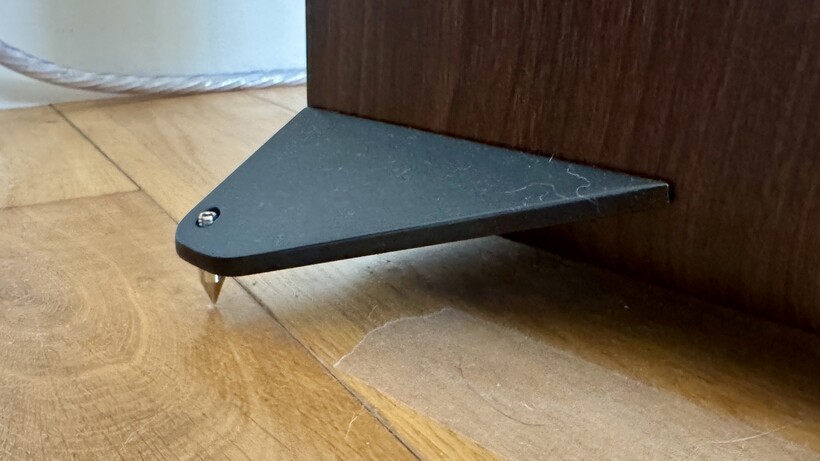
The 942 x 285 x 281mm (HWD) dimensions are pleasing – and it’s worth bearing in mind the width includes the bolt-on rear stabiliser that holds the floor-spikes and prevents the slender cabinet from toppling over too easily. The rear spikes can be adjusted from the top, too, which means it’s a lot easier to get the speaker level than it otherwise would be.

As well as being nicely proportioned, the 3040c cabinet looks good in a slightly curvy, understatedly elegant sort of way. There are no visible bolt-heads or anything nasty like that, even when you remove the magnetically attached grilles – and when the grilles are off, the satin nickel brightwork surrounding the three-driver array looks quite upmarket. The overall aesthetic is certainly a cut above what the asking price might lead you to anticipate…
The standard of finish is well up to snuff, too. Naturally, the cabinets are of MDF with a vinyl wrap – but it’s flawlessly applied, and any of the four available finishes – the Claro walnut of my sample, pin oak, satin black or satin white – look the part.

Specifications
- 22mm soft dome tweeter; 2 x 120mm Continuous Curved Cone mid/bass driver
- 43Hz – 30kHz frequency response
- 88dB sensitivity
Passive loudspeakers don’t usually have a lot of features, and that’s especially true of relatively affordable passive loudspeakers. But in the established Q Acoustics manner, the features the 3040c have are entirely appropriate.
On the outside, there’s a decoupled 22mm soft-dome tweeter sitting between a couple of 120mm mid/bass drivers – these are of the same Continuous Curved Cone design that debuted in a far more expensive range of Q Acoustics loudspeakers. The idea of C³ is to combine the strengths of flared cone design (clarity and control, mostly) with the low-frequency response of a straight conic cone – it’s proven technology at this point, and can only be to the benefit of the 3040c.

At the rear of the cabinet, just above a pair of extremely low-profile speaker cable building posts, there’s a bass reflex port. Q Acoustics provides port bungs, and it pays to experiment both with the position of the speaker relative to a rear surface and with the efficacy of the bungs themselves.
This is an arrangement, says Q Acoustics, that results in a 43Hz – 30khz frequency response and an 88dB sensitivity rating that means the 3040c should be no real trouble to drive.
On the inside, the 3040c uses Q Acoustics’ Point-to-Point bracing to minimise low-frequency vibration and enhance soundstaging and imaging, and also features Helmholtz Pressure Equalisers. These tubes nullify internal pressure, and markedly reduce the standing waves and sonic colourisation it can provoke.

Sound Quality
- Great clarity and detail retrieval
- Punchy, well-controlled low frequencies
- Slightly short of dynamic reach
Don’t doubt the Q Acoustics can play loud, hit hard and generally fill your listening space with sound – but this is not their defining character. By the prevailing standards of affordable floorstanding loudspeakers, the 3040c are notably sophisticated and even-handed in their approach.
A listen to A Tune for Us by Djrum and this balanced nature is made completely apparent. Frequency response, from the bottom end right to the top, is smooth and even – integration between the drivers is good and there’s no aural indication of the crossover point apparent.

The tonal balance is impressive, too – there’s not much evidence of the warmth and friendliness of tone that used to be the Q Acoustics thing, instead the 3040c are a neutral and non-interventionist listen in this respect.
There’s good bass extension here, but more importantly there’s good control of the attack and decay of bass sounds – there’s never any danger of the sound dragging or droning. Great midrange resolution allows voices of all types to project with plenty of energy and character, and the top of the frequency range is attacked with a polite amount of aggression – so treble sounds have plenty of bite but next-to-no edge to them.

And at every point, detail levels are high. Not only the broad strokes, either, but the more subtle, more minor, more transient stuff is identified and handed over too – and without the 3040c sounding especially analytical. Even the low-key harmonic variations (sometimes) apparent in voices or instruments get a fair amount of attention and put into convincing context.
There’s energy and positivity to the presentation when a recording demands it, but when it comes to dynamic fluctuations the Q Acoustics don’t have quite what’s required to reveal them in full. Oh, you’ll be left in no doubt when Caroline’s Total Euphoria shifts up the intensity and attack – but the 3040c don’t quite give full expression to the up- and downticks in volume and drive.
And ‘don’t quite give full expression’ applies to rhythms, too. Yes, the Q Acoustics control their low-frequency activity well, and keep momentum levels up where they need to be – but there’s not quite the flow to rhythms that the best (fairly) price-comparable speakers can manage. Lumpy is to overstate it, but the 3040c are not as fluent as is absolutely ideal. Is ‘lumpy-ish’ a word?

Should you buy it?
You want big but not too big
You have a reasonably modest space and a reasonably modest budget, but want more than a hint of what a bigger budget might be able to buy you.
You’re lacking in space
Your space is so modest that the 3040c will have to be in a corner – these are compact speakers, sure, but they still need just a little space in which to operate…
Final Thoughts
The Q Acoustics 3040c are a classic gateway product.
Here’s where you first realise what the world of proper hi-fi is all about, here’s where you get an authentic taste for it – and so years from now, despite constantly denying you have any kind of problem, you’ve spent all your disposable income on upgrade and yet somehow still find yourself with you face pressed against the window of your nearest high-end showroom…
How We Test
The speakers had sufficient breathing space both behind them and to the sides, and I attached them to a couple of different amplifiers for this test – the price-appropriate (and still bargainous) WiiM Amp Pro, and a new Musical Fidelity M5xi that I will admit was, in the context of the speakers, overkill.
Then I listened to music via a turntable, a CD player and streamed via Bluetooth – so lots of different formats, lots of different genres, lots of different resolutions.
FAQs
Do I need the stabilisers?
Yes – for stability, of course, but also because there’s no way of attaching rear spikes to the cabinet without them
Can the speakers be positioned in corners?
That’s never ideal, to be honest – but at least the 3040c are quite forgiving of being close to a rear surface thanks to the bungs for their rear-firing bass reflex ports…
Will the 3040c work in small spaces?
Everything relative, of course, but Q Acoustics has designed the 3040c to perform properly in smaller rooms – so as long as your space isn’t tiny you should be fine
Full Specs
| Q Acoustics 3040c Review | |
|---|---|
| Manufacturer | Q Acoustics |
| Size (Dimensions) | x x INCHES |
| Weight | 14.4 KG |
| Release Date | 2026 |
| Driver (s) | 22mm soft dome tweeter; 2 x 120mm Continuous Curved Cone mid/bass |
| Frequency Range | 43 30000 – Hz |
| Sensitivity | 88 dB |
| Speaker Type | Hi-Fi Speaker |
| Impedance | 4 ohms |
| UK RRP | £599 |
| USA RRP | $1099 |
| EU RRP | €899 |

While price increases didn’t worry the investors at JP Morgan, ongoing supply chain constraints will have a short-term impact, and thus their new price target is $340.
It’s been a bumpy few months for Apple thanks to RAM shortages, price increases, and supply constraints. Investors expect that these problems will continue through December even if Apple finds ways to counteract their effects.
In a note seen by AppleInsider, JP Morgan shares that it believes high demand for products like the iPhone 17 and MacBook Neo has helped maintain momentum in the product cycle. Siri AI’s impending launch will also help drive demand going into Q4 2026.
As good as things might look for Apple on the demand side, everything else is a little more troubling. Supply constraints will impact overall revenue and increasing component prices will drive down gross margin.
Apple has levers it can continue to pull to combat these effects, but they only go so far. JP Morgan expects that even if the short term isn’t ideal, the long term will still look great for Apple.
First, the supply chain constraints will only delay sales, not prevent them entirely. Limited product availability will drive revenue into later quarters rather than lose it entirely.
Second, Apple can help maintain margins by seeking out lower prices on non-memory components. Also, services will see a bump thanks to revenue brought in from iCloud+ subscriptions tied to AI token allotments.
It’s not exactly a bleak outlook, just a realistic one as JP Morgan observes how news from the Q3 earnings will affect stock prices. The December 2027 target price is now set to $340 versus the previous $345 set earlier in July.

If you’ve ever served in the United States military, odds are that you worked at one of the nation’s many foreign bases located throughout Europe, Africa, Asia, Australia, and South America. The U.S. maintains between 750 and 800 facilities of various sizes and types in around 80 foreign countries, colonies, and territories. All told, that is between 70 and 85% of the world’s foreign military bases. They range in size from relatively small to extremely large in both land mass and population.
That makes the U.S. military the most expansive throughout the globe. Looking at so many foreign U.S. bases, many might wonder about the opposite: foreign-owned bases on U.S. soil. To put it simply, there aren’t any, and there hasn’t been a foreign base in the United States for a very long time. Technically, no foreign military base has been established or occupied since the War of 1812, when the United Kingdom established several during the conflict. On the surface, that doesn’t exactly seem fair to American allies who host U.S. personnel in their respective countries.
The main reason why there aren’t any foreign bases on U.S. soil is that they’re not needed to bolster U.S. defenses. Still, the U.S. isn’t entirely closed off to the militaries of its closest allies. Many maintain permanent and semi-permanent detachments within U.S. facilities, working alongside American personnel.
Foreign military personnel detached to the United States

The United States is home to eight permanent detachments of foreign personnel from Germany, Italy, the Netherlands, Singapore, and the United Kingdom. They’re located in Virginia, Texas, Arizona, Idaho, Nevada, California, Georgia, and South Carolina. An additional facility will open to train Qatari troops at Mountain Home Air Base, Idaho. While these presences are permanent and see turnover of personnel throughout the year, they are not foreign-owned bases. Instead, they’re co-located on American bases. This is different from how the U.S. military operates in other nations’ territory.
American bases are not considered to be American soil, unlike embassies, which are small islands of their respective nations’ soil in other countries. For bases, the U.S. enters into a Status of Forces Agreement, or SOFA, with host nations, allowing for a back-and-forth between the U.S. and whichever nation it’s working with. At one of the largest bases, Ramstein Air Force Base in Germany, one of the terms of the SOFA agreement is that personnel are given ration cards for purchasing fuel, coffee. It’s similar in other countries.
For those personnel working within the United States on a permanent basis, the vast majority of them are pilots. This makes sense since the U.S. often sells its military aircraft to its allies. Selling something like an F-35 Lightning II to Belgium or Poland is good for American exports, but training pilots becomes a necessity. Instead of conducting training elsewhere, many foreign pilots come to the U.S. to learn how to operate U.S.-made aircraft alongside U.S. pilots. Intelligence personnel also train in the U.S. alongside American servicemembers, though this is a far more exclusive club.

If you’re wondering what dark matter is, you’re not alone. Astronomers don’t know. But they’ve determined that this invisible material must be far more abundant than the stars and nebulas that they can see. They’ve surmised as much from observing the gravitational effects of all this perplexing dark stuff, launching a decades-long campaign to understand its nature.
I recently learned that it is possible to sense the presence of dark matter using a small radio telescope such as the Discovery Dish covered in these pages last year. The trick is to know what observations to collect and how to analyze them. I’ll sketch that out below, but first let me describe the homemade radio telescope I put together for this project.
It’s a pyramidal-horn antenna, not unlike the horn antenna first used in 1951 to detect the 1,420.4-megahertz radio emissions from interstellar clouds of neutral hydrogen in space. These emissions hold the key to confirming the presence of dark matter because such clouds can be found all over the galaxy, and their motions reflect what’s happening in different parts of the Milky Way.
I used an online calculator to help me design my antenna, adopting dimensions I knew I could achieve using a US $25 10-by-2-foot roll of roof flashing and an emptied one-gallon paint-thinner can. (Next time, I’ll just buy an empty F-style can.)
 The horn antenna is made from tape, an empty paint can, and a roll of metal roof flashing [bottom row]. Signals are picked up with a low-noise amplifier [top middle], and passed to a software-defined radio receiver [top left].James Provost
Construction of the antenna itself was similar to that of the slightly smaller horn antenna I described in these pages in 2019. I made my new antenna bigger, though, because I needed better angular resolution, allowing me to scan smaller regions of the sky.
To pick up the emissions from interstellar hydrogen, I used Nooelec’s $45 SAWBird+ H1, a device that combines two low-noise amplifiers with a standing-acoustic-wave filter centered on 1,420 MHz, in combination with a RTL-SDR V4 dongle. So it’s not too hard to put together the hardware needed to measure signals from hydrogen clouds. But how do you pull the signature of dark matter out of those signals?
The answer is that you use such measurements to gauge the speed at which clouds located at different distances from the center of the Milky Way are moving in their orbits.
You just have to show that the speed at which material orbits the center of the galaxy doesn’t fall off with distance.
You might think that these clouds circle around the galactic center in the same way that planets orbit the sun or satellites orbit the Earth, with objects close in orbiting faster than those farther out. Mercury, for example, zips around the sun at 47.4 kilometers per second, whereas Neptune lumbers along at a leisurely 5.4 km/s.
The Milky Way contains a central bulge of stars surrounding a supermassive black hole. So at first blush, the mass of the galaxy appears to be concentrated near its center. If that were the case, stars and clouds of other material would orbit more slowly as their distance from the center increases. If, however, there were enormous amounts of invisible matter present throughout the galaxy, you wouldn’t expect orbital velocities to diminish in this way.
How Do You Measure the Speed of Interstellar Clouds?
So to detect dark matter, you just have to show that the speed at which material orbits the center of the galaxy doesn’t fall off with distance. And radio observations are the easiest way to do that, because you can gauge speeds by measuring how much the signal from hydrogen clouds is shifted by the Doppler effect.
By pointing your radio telescope at different parts of the sky, you pick up emissions from clouds located at various distances from the galactic center. The frequency offset of these emissions from 1,420 MHz reflects the speed of approach or recession of those clouds relative to Earth.
You need measurements from the plane of the galaxy, at galactic longitudes between 0 and 90 degrees (a galactic longitude of 0 degrees points directly toward the center of the galaxy and 180 degrees directly away from it). Applying some high school trigonometry lets you convert these figures into orbital speeds around the galactic center, a technique known as the tangent-point method.
 In any group of clouds, the one with the highest velocity as seen from Earth will be the one lying closest to a tangent point along its orbit around the galaxy. This allows its distance from the galactic center to be determined through trigonometry [top]. The bottom graph shows the astronomical community’s measurements for velocities around the galactic center [in black], with the author’s results plotted in filled and open red circles.James Provost
Experiments aiming my horn antenna at an Inmarsat geostationary satellite revealed that the angular resolution of my little radio telescope is about 20 degrees. So with the help of the planetarium program Stellarium, I pointed my antenna in the plane of the galaxy at galactic longitudes of about 15, 30, 45, 60, 75, and 90 degrees, spacing things out in an effort to make each set of measurements largely independent.
I used the SDR# software with a plug-in called IF Average to read the raw measurements coming in from the antenna. This plug-in stacks up data received over a few minutes, allowing a weak signal to emerge and produce a clean radio spectrum that shows the 1,420-MHz line. In reality of course, it looks more like a bump, or even a set of bumps due to Doppler shifted emissions from multiple clouds, located at different distances from the galactic center. Fortunately, you only have to care about the cloud that’s receding the fastest—the one with the largest redshift, in astronomer-speak.
I used Microsoft Excel to analyze the shapes of radio spectra I gathered, modeling them as the sums of individual bell-shaped contributions from different clouds. That allowed me to estimate the largest redshift for each galactic longitude I probed. Then, again using Excel, I applied formulas that transformed those six redshift values into six pairs of orbital velocities and distances from the galactic center.
The plot of my results matched reasonably well with a recent paper, “The Inner Rotation Curve of the Milky WayInner Rotation Curve of the Milky Way,” in Publications of the Astronomical Society of Japan. Two innermost points, which showed anomalously low orbital velocities. Another shot at curve fitting in Excel brought these results closer to expectations, but they were still somewhat off.
In any case, the orbital velocities I estimated did not diminish with distance from the galactic center—quite the opposite. Something out there is putting its stamp on how the Milky Way turns. And that basic observation is what allows me to say that, with the help of some roof flashing and a paint-thinner can, I’ve been able to detect dark matter from my backyard.
From Your Site Articles
Related Articles Around the Web
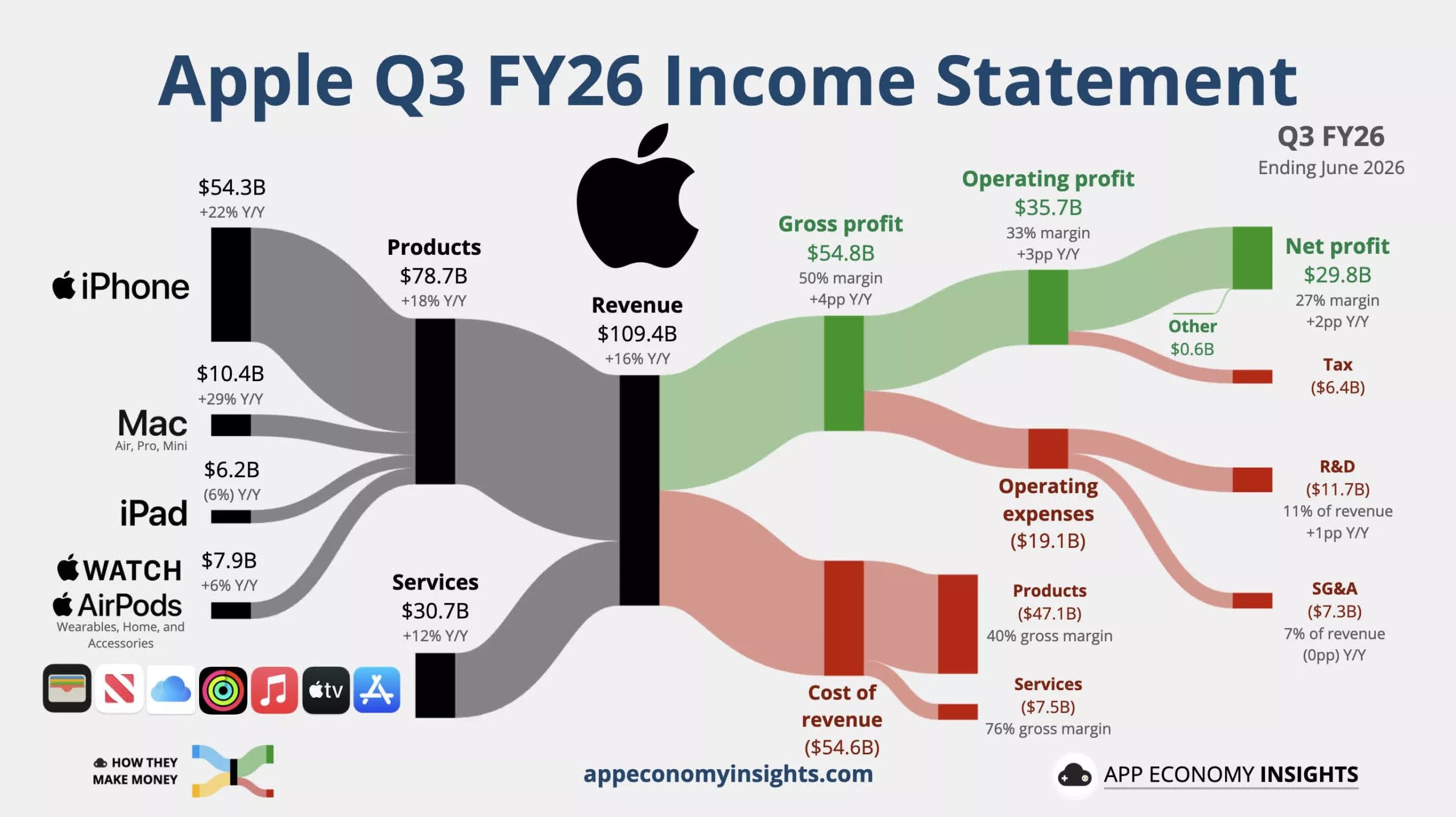
Bottom line: Apple’s last quarterly earnings report under CEO Tim Cook showed gains across nearly every category, led by iPhone and Mac sales. The budget MacBook Neo appears to have been a major contributor to that growth. But as the Cupertino company prepares to hand the reins to a new CEO, rising prices could complicate the road ahead. Apple has already begun responding with a new leasing program.
iPhone sales drove the largest gains, bringing in $54.3 billion in revenue during the third quarter of fiscal 2026, up 22% YoY. Services, wearables, iPads, and especially Macs also contributed, pushing overall revenue to $109 billion, up 16% YoY.
The MacBook Neo, Apple’s first budget-priced MacBook, was likely the biggest driver behind that Mac growth. The entry-level notebook couldn’t hold onto its $600 launch price for long, but it quickly outsold the MacBook Air and pushed Apple to double its production target.
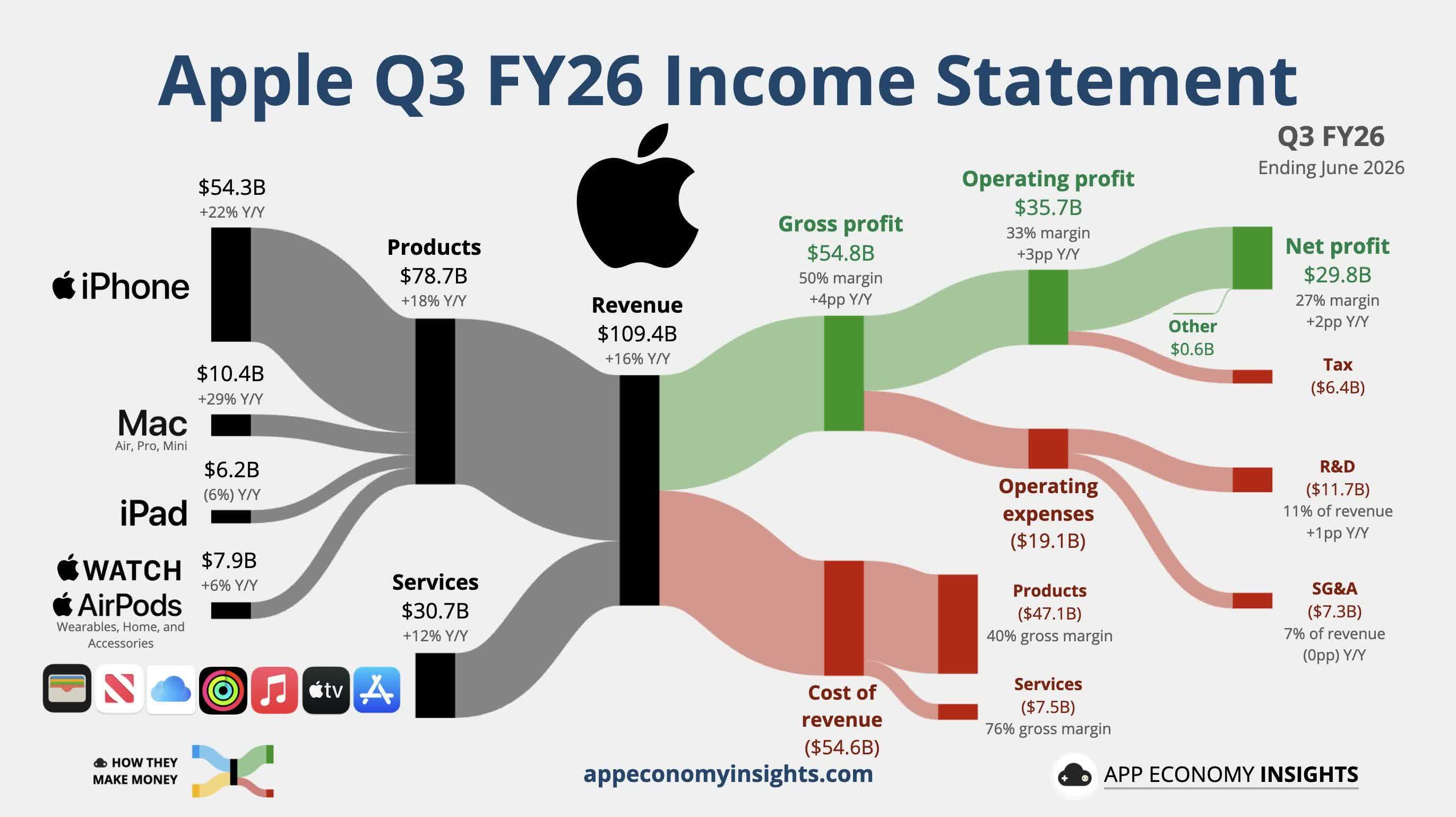
AI fever likely played a role too, helping drive the Mac division’s 29% YoY growth. The popularity of AI agents like OpenClaw triggered Mac mini shortages that stretched on for months.
Despite that impact, Apple has largely watched the AI boom from the sidelines. The company introduced a new AI-powered version of its digital assistant, Siri, earlier this year, but rivals Microsoft and Google have bet far more heavily on Copilot and Gemini, respectively.
That caution has drawn criticism from some quarters, but investors have also come to see Apple as something of a safe haven amid the AI market’s volatility, helping the company reclaim its status as the world’s most valuable.

Still, Apple couldn’t escape the historic DRAM and NAND shortages stemming from the AI data center buildout. The full impact of recent price hikes, which pushed MacBook and iPad prices up by as much as $200 just days before the quarter ended, remains unclear.
Apple Upgrade, a leasing program the company announced earlier this week, could mark the start of a new era of hardware rentals.
Looking ahead, Tim Cook is set to step down as CEO in September, right as Apple unveils the iPhone 18 lineup and, potentially, the iPhone Ultra, the company’s first foldable device.
Estimates on iPhone Ultra pricing vary, but some analysts expect it to retail for as much as $2,500, marking the start of a new flagship tier that could eventually extend to a touchscreen-enabled MacBook Ultra. Other upcoming products include a major overhaul of the iPad lineup, starting with an OLED-equipped iPad mini, and a refreshed Mac lineup built around Apple’s new M6 chips.
Tech
Microsoft turns to the UK Supreme Court after losing twice over second-hand software licenses, and billions could ride on the outcome

- Microsoft has won an extended stay at the Competition Appeal Tribunal while it seeks permission to appeal to the UK Supreme Court, having lost at both the Tribunal and the Court of Appeal
- Its argument that Office’s icons and clip art placed it outside software exhaustion rules was rejected as producing “odd results”, including CD software being resellable while identical downloads were not
- The jurisdiction ruling matters more than the £270 million claim, as it clears the way for a parallel collective action that could expose Microsoft to billions
Microsoft has bought itself time in its long-running fight with a British software reseller, securing an extended stay of proceedings at the Competition Appeal Tribunal while it prepares to seek permission from the UK Supreme Court to appeal.
While Microsoft has yet to appeal formally, its indication that it intends to do so buys it some breathing room against a judgment that could mean that parallel proceedings, including a £3.5 billion class action lawsuit that could compromise as many as 2.7 million members, could become a centerpiece of the software giant’s future legal troubles in the UK.
The UK CAT (Competition Appeal Tribunal) has paused parts of the case as a result, and Chair Justin Turner KC noted that it was not yet known whether permission would be granted, and framed his decision as balancing the potential waste of costs if permission were granted and an appeal succeeded against the undesirability of delay in the proceedings.
Latest Videos FromTechRadar
A legal quagmire exacerbated by shifting legal defense from Microsoft?
Microsoft has been fighting this claim for years, dating back to 2021, when JJH Enterprises, a Derby-based reseller trading as ValueLicensing, sued Microsoft for £270 million.
The allegation is that Microsoft wrote terms into its agreements that offered customers better subscription pricing in exchange for surrendering the right to resell their perpetual licenses, thereby choking off the secondary market and pushing buyers toward Microsoft 365 even as the software giant denies wrongdoing.
ValueLicensing’s case rests on the Court of Justice’s 2012 decision in UsedSoft v Oracle, which held that a software vendor’s distribution right is exhausted once it sells a perpetual license, including one delivered by download, so it cannot use copyright to block the onward sale of that copy.
Having contested the case as a competition matter for years, Microsoft changed its argument in 2025, recasting it as a copyright dispute. Office, it said, is not merely a computer program. It ships with icons, user interface elements, help files, and clip art, and those creative components should be governed by a different copyright regime in which exhaustion does not bite.
That argument has now failed twice. The Competition Appeal Tribunal (CAT) unanimously decided the preliminary copyright issues in ValueLicensing’s favor in November 2025, and on July 7, 2026, the Court of Appeal dismissed both of Microsoft’s appeals, one challenging the CAT’s jurisdiction to rule on copyright questions at all, the other contesting the copyright findings themselves.
Microsoft’s reading, the court observed, would produce “odd results”: software supplied on a CD-ROM could be freely resold while the identical software delivered as a download could not, and a vendor could defeat established exhaustion principles simply by bundling some icons with its code.
At the same time, the CAT did not grant resellers unlimited freedom. Under UsedSoft, a buyer holding a single copy installed on a server and licensed for several users cannot carve off part of that user capacity for resale, because exhaustion attaches to the copy rather than the seat.
The Tribunal distinguished that from a genuine volume arrangement comprising multiple independent copies or licenses, in which reselling a corresponding number may be permissible once the seller has stopped using the copies it has passed on. That distinction sets real limits on how the secondary market can operate.

Microsoft has spent most of the period covered by the claim moving its customer base from perpetual licenses to Microsoft 365. If ValueLicensing wins outright, it wins the right to trade in a category that its opponent has been deliberately retiring for a decade. Should the Supreme Court decline to take the case, proceedings return to the Tribunal, with a trial mooted for 2027.
The jurisdiction ruling matters well beyond this claim. By confirming that the CAT can decide copyright questions where they are necessary to resolve a competition case, the Court of Appeal cleared a path for others, and The Register reported in April 2026 that Microsoft had viewed that appeal as a complete answer to Alexander Wolfson’s collective action, on the basis that copyright issues could not be transferred to the High Court in a class action.
Wolfson was granted permission to intervene in support of ValueLicensing, and his claim, which could expose Microsoft to liability in the billions, now stands to benefit from the ruling.
What could this mean?
Britain’s regulators have taken an interest in the same broad shift, too. On July 29 2026, the Competition and Markets Authority opened a consumer protection investigation into how Microsoft marketed its Microsoft 365 Personal and Family plans.
From January 2025, existing subscribers were given Copilot and other new features at no extra cost for the remainder of their term, then automatically moved onto a higher-priced plan at renewal unless they chose an alternative or canceled.
A time-limited “Classic” plan preserved the old feature set at the old price, and for annual subscribers the Copilot version cost £25 more per year.
“When a business changes its subscription plans, customers need clear and timely information about their options,” said Hayley Fletcher, senior director for consumer protection at the CMA. “Our investigation will consider whether Microsoft customers were misled and ended up paying more as a result.”
Microsoft said consumer trust is a priority and that it is reviewing the claims while cooperating with the inquiry. The CMA has reached no conclusions and has not accused the company of breaking the law.
That probe concerns consumer subscriptions rather than the commercial agreements at issue in the ValueLicensing case, so the two are separate matters under different regimes. What links them is the same underlying transition from one-off purchases to recurring ones.
Microsoft already faces a CMA strategic market status investigation into its business software, and Australia’s competition regulator is suing the company in the Federal Court over the same Copilot and Classic plan issue, affecting an estimated 2.7 million customers. Whichever way the Supreme Court application goes, the legal scrutiny of how Microsoft moved the world onto subscriptions is not ending soon.
The scrutiny also lands in a fraught transatlantic moment. On July 24, days after the European Commission fined Google $1 billion under the Digital Markets Act, Trump announced a Section 301 investigation into EU trade practices, declaring that the United States is not a “PIGGYBANK” for Europe and promising a substantial tariff.
Brussels has consistently maintained that regulating economic activity within the bloc is its sovereign right, and that its digital rules apply to all firms operating there. Britain sits awkwardly beside that fight. Its courts are no longer bound by EU case law, and its regulators answer to nobody in Brussels, but the president’s stated targets have been digital taxes and digital markets rules in general rather than the EU alone, and the UK has both.

Follow TechRadar on Google News and add us as a preferred source to get our expert news, reviews, and opinion in your feeds.

Crypto World44 seconds ago
Bitcoin rally stalls after massive $9.6B options expiry

Sports3 minutes ago
Lovepreet Singh: Son Of A Tailor Who Clinched CWG Record In Weightlifting, Missed Gold By 1 Kg

Tech4 minutes ago
5 Essential Apps Every Samsung User Should Know About

Entertainment1 month ago
Renter of Home in Anne Heche Crash Denies Settlement With Son

Business2 months ago
No Jackpot Winner as $257 Million Prize Rolls Over to $269 Million Monday Draw

Fashion1 month ago
Weekend Open Thread: Staud – Corporette.com

News Videos33 minutes ago
XRP SUDDEN WEALTH SYNDROME IS COMING! – WHY CAN’T ELITE’S TALK ABOUT XRP?

News Videos41 minutes ago
Financial Management | Introduction | Financial Decision | Function |BBA | B.Com | MBA | Class 12

News Videos60 minutes ago
How to Calculate Discounting Factors? – Financial Management
-

 Fashion7 days ago
Weekend Open Thread: Brooks Brothers
-
 Sports5 days ago
Commonwealth Games boxing: Jadumani Singh seals dominant 5-0 win over Pakistan’s Sumama Rehman to enter quarter-finals | Commonwealth Games News
-

 Business2 days ago
Why Trees Belong on the Risk Register
-

 Tech4 days ago
Intel is reversing course and bringing hyper-threading back to its server chips
-

 Crypto World6 days ago
Ripple bought a bank in pieces. The $4 billion audit
-

 Politics4 days ago
Luke Littler dismantles Gerwyn Price to retain title in Blackpool
-
 Entertainment7 days ago
A New Post-Apocalyptic Gundam Anime Series Blasts Into SDCC
-

 Politics3 days ago
The Part of the Electric Transition Nobody Wants to Discuss
-

 News Videos5 days ago
BITCOIN JUST ENTERED THIS CRITICAL ZONE…
-

 Business2 days ago
Major shareholder moves on Canyon
-

 Crypto World5 days ago
XRP Ledger adds $2.6B as RWA inflows rank second
-

 News Videos21 hours ago
Bitcoin Enters the 3rd Stage of the Bear Market
-

 Politics5 days ago
Spain sweeps the board at 2026 World Cup with individual awards
-
 Entertainment3 days ago
‘Stargate’ Creator’s New Sci-Fi Series Returns for Season 3 Tomorrow
-

 Entertainment5 days ago
Sara Gilson Killed By Husband After Viral “Pedophile” TikTok Video
-

 Crypto World2 days ago
Kraken Enables Retail Access to Jersey Mike’s IPO via Tokenized Shares
-

 Tech6 days ago
Anthropic launches Claude Opus 5, a cheaper AI model for coding, agents and enterprise workflows
-

 News Videos3 days ago
Claude: Build Financial Dashboards in Minutes (2026)
-

 Politics17 hours ago
Luke Littler’s dominance sparks GOAT debate
-

 Tech3 days ago
New macOS Sequoia & Sonoma security updates for older Macs
You must be logged in to post a comment Login