Military balloons now launch reusable drones directly from the stratosphere
Solar-powered Apollo-R remains airborne for weeks after balloon deployment at altitude
Thunderhead balloon carries multiple drones during a single high-altitude deployment mission
High-altitude balloons are moving beyond surveillance roles as military developers explore using them as airborne launch platforms for long-endurance unmanned drones.
According to Aerostar, its Lightning balloon, paired with the solar-powered Apollo-R drone from Icarus, has now demonstrated a workable path toward stratospheric drone carriers.
Recent testing reportedly showed the balloon successfully releasing a single high-endurance uncrewed aircraft while cruising high in the open stratosphere.
Latest Videos FromTechRadar
Advertisement
Lightning and Thunderhead offer different endurance profiles
The Lightning platform operates for up to three days at altitudes between 50,000 and 78,000 feet, carrying payloads of up to 45 pounds.
Aerostar’s larger Thunderhead balloon covers a similar altitude band, between 55,000 and 75,000 feet, but stays aloft for 60 days or more.
The company claims that its Thunderhead can carry payloads weighing up to 200 pounds, allowing it to launch several Apollo-R drones per mission.
“Our larger Aerostar Thunderhead platform can serve as a mothership, carrying multiple Apollo-R’s,” said Russ Van Der Werff, Aerostar’s Vice President of Stratospheric Solutions.
Sign up to the TechRadar Pro newsletter to get all the top news, opinion, features and guidance your business needs to succeed!
The Apollo-R itself flies under its own power after separation, reaching altitudes near 60,000 feet and remaining airborne for weeks.
Advertisement
Unlike a one-way munition, it is designed for recovery, landing at a designated point so the airframe can be reflown on later missions.
Aerostar’s balloons also carry mesh-networking radios that offer line-of-sight data links beyond 100 miles, with throughput up to 40 Mbps.
Advertisement
Military interest extends beyond a single program
The U.S. Army has outlined plans for a persistent, all-domain sensor architecture built partly around high-altitude balloons across the Indo-Pacific theater.
Andrew Evans of the Army’s G-2 office described the goal as demonstrating autonomous swarming that sustains a cost-effective stratospheric presence.
Apollo-R has already flown from a competing Urban Sky balloon during Exercise Valiant Shield 2026, showing multiple companies now pursue similar concepts.
Balloon-launched drones are gaining traction in Ukraine while China has invested heavily in comparable swarm capabilities of its own.
Van Der Werff argued that balloons offer survivability advantages over aircraft like the Global Hawk or Reaper, which cost hundreds of millions of dollars.
This low cost of individual balloons allows militaries to distribute many across a theater, creating sensing networks resilient to losing any single node.
Beyond the Army, the Marine Corps, special operations units, and other branches are also pursuing balloon-based systems for varied missions.
Advertisement
The Naval Research Laboratory previously tested drones launched from balloons during the 2010s under a project called CICADA, short for Close-in Covert Autonomous Disposable Aircraft.
This technology is getting attention globally, and it is expected to progress beyond the testing phase.
However, stratospheric balloons have one downside — they are vulnerable to high-altitude winds, causing them to drift away from their intended operating area.
A new NYT Strands puzzle appears at midnight each day for your time zone – which means that some people are always playing ‘today’s game’ while others are playing ‘yesterday’s’. If you’re looking for Sunday’s puzzle instead then click here: NYT Strands hints and answers for Sunday, August 2 (game #882).
Strands is the NYT’s latest word game after the likes of Wordle, Spelling Bee and Connections – and it’s great fun. It can be difficult, though, so read on for my Strands hints.
Want more word-based fun? Then check out my NYT Connections today and Quordle today pages for hints and answers for those games, and Marc’s Wordle today page for the original viral word game.
Advertisement
SPOILER WARNING: Information about NYT Strands today is below, so don’t read on if you don’t want to know the answers.
Latest Videos FromTechRadar
Advertisement
NYT Strands today (game #883) – hint #1 – today’s theme
What is the theme of today’s NYT Strands?
• Today’s NYT Strands theme is… There’s nothing like it
NYT Strands today (game #883) – hint #2 – clue words
Play any of these words to unlock the in-game hints system.
GLARE
QUEEN
SOIL
SAIL
SIDE
LAID
NYT Strands today (game #883) – hint #3 – spangram letters
How many letters are in today’s spangram?
• Spangram has 10 letters
Advertisement
NYT Strands today (game #883) – hint #4 – spangram position
What are two sides of the board that today’s spangram touches?
• First side: top, 4th column
• Last side: bottom, 4th column
Right, the answers are below, so DO NOT SCROLL ANY FURTHER IF YOU DON’T WANT TO SEE THEM.
Advertisement
Advertisement
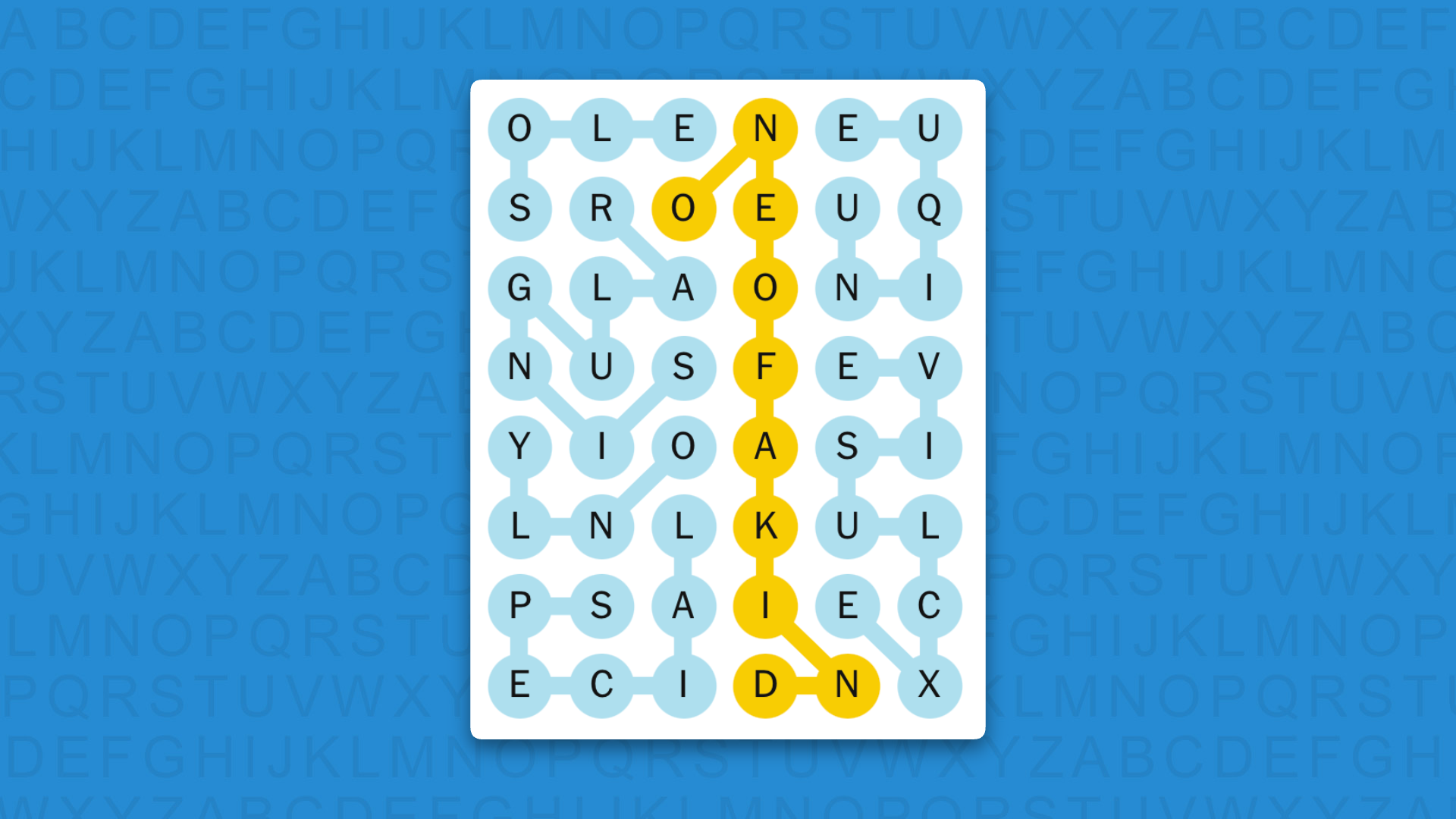
NYT Strands today (game #883) – the answers
(Image credit: New York Times)
The answers to today’s Strands, game #883, are…
ONLY
UNIQUE
SPECIAL
EXCLUSIVE
SINGULAR
SOLE
SPANGRAM: ONEOFAKIND
My rating: Easy
My score: Perfect
I had a trio of old songs buzzing around my head while playing this game.
Sign up for breaking news, reviews, opinion, top tech deals, and more.
The most dominant was soul classic There’s Nothing Like This by Omar, thanks to the theme of the day, but it was competing for earworm space with The One and ONLY by Chesney Hawkes and Free Nelson Mandela by SPECIAL AKA.
Fortunately, that didn’t distract me from a fairly straightforward game — although I did get some letter soup at the end while attempting to connect SINGULAR.
Advertisement
Yesterday’s NYT Strands answers (Sunday, August 2, game #882)
AMBITION
GOAL
PLAN
PURPOSE
OBJECTIVE
INTENTION
SPANGRAM: AIMHIGH
What is NYT Strands?
Strands is the NYT’s not-so-new-any-more word game, following Wordle and Connections. It’s now a fully fledged member of the NYT’s games stable that has been running for a year and which can be played on the NYT Games site on desktop or mobile.
I’ve got a full guide to how to play NYT Strands, complete with tips for solving it, so check that out if you’re struggling to beat it each day.
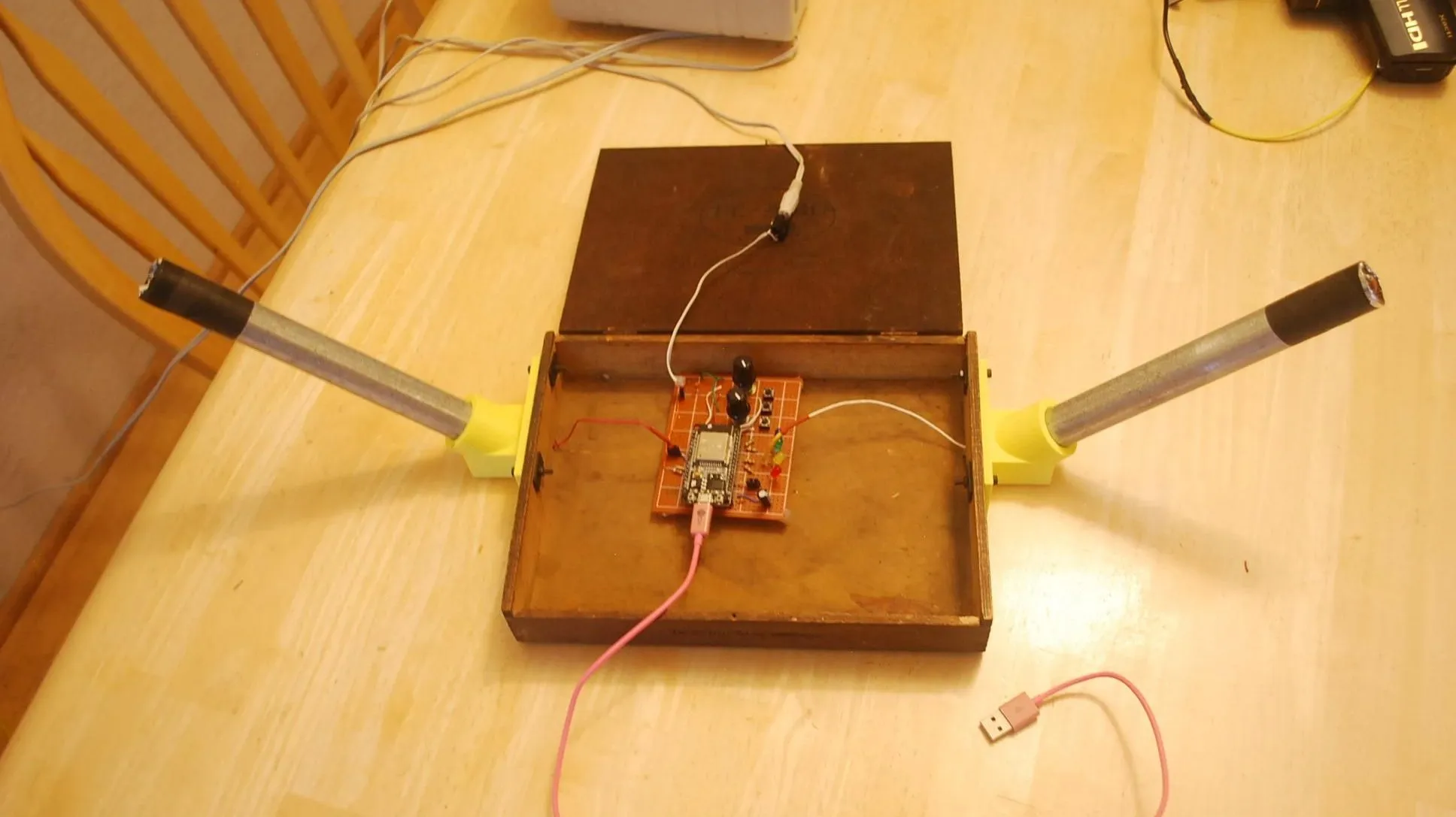
The Theremin is that classic electronic musical instrument that makes those weeee-ohhhhh noises which were so popular in mid-century science fiction movies. Mid-last-century, that is, because this century is just beginning. In any case, you could build one with old-school analog electronics, or you could go a more modern route, as [ericCycles] did.
The build relies almost entirely on an ESP32 microcontroller with minimal supporting circuitry. Like any other Theremin, pitch and volume are controlled by moving hands closer or farther away from two antenna. In this case, the ESP32 uses its capacitive touch circuitry to detect effectively detect hand proximity to the two antenna in question, and uses those values to control the pitch and volume of a synthesized waveform. That waveform is then pumped out over the onboard digital-to-analog converter for playback on external speakers.
If you want to build a simple Theremin-like instrument quickly and easily, it’s hard to beat the simplicity on offer here. We’ve featured some other fun variants over the years, too, like this version that uses time-of-flight sensors for the human interface.
After nearly three decades at Microsoft, cybersecurity executive Krishna Kumar Parthasarathy has announced he is joining Salesforce as executive vice president of engineering.
Parthasarathy is part of a wave of senior Microsoft security leaders who have departed this summer for executive roles at major tech competitors, including Amazon Web Services (AWS), ServiceNow and Salesforce.
In his new role, Parthasarathy will oversee engineering teams for core Salesforce products and features, including Agentforce, Agentforce Voice, Digital Channels, and Service Cloud.
“Salesforce sits at the exact center of enterprise trust and customer context. In an agentic world, that foundation is everything,” he said on LinkedIn.
Other high-profile departures in recent months from Microsoft’s security division include:
Rohan Kumar, former corporate vice president of Microsoft Security, who joined Salesforce as president and chief platform officer.
Rudra “Rudy” Mitra, who spent more than 27 years at Microsoft — most recently leading its Purview data-security business — and joined AWS as vice president of security services.
Rahul Prakash, former head of product for Microsoft Security Copilot, who joined ServiceNow as vice president of product management in identity security.
Vasu Jakkal, former corporate vice president of security, compliance, identity, management and privacy, who stepped down after six years and has not yet announced her next move.
Joy Chik, former president of identity and network access, who announced her retirement in April.
The leadership shifts follow a broader organizational shakeup within Microsoft’s security business under Hayete Gallot, who returned to the company from Google in February to run the group. Naseem Tuffaha also returned to Microsoft last month to take over the corporate VP role vacated by Rohan Kumar.
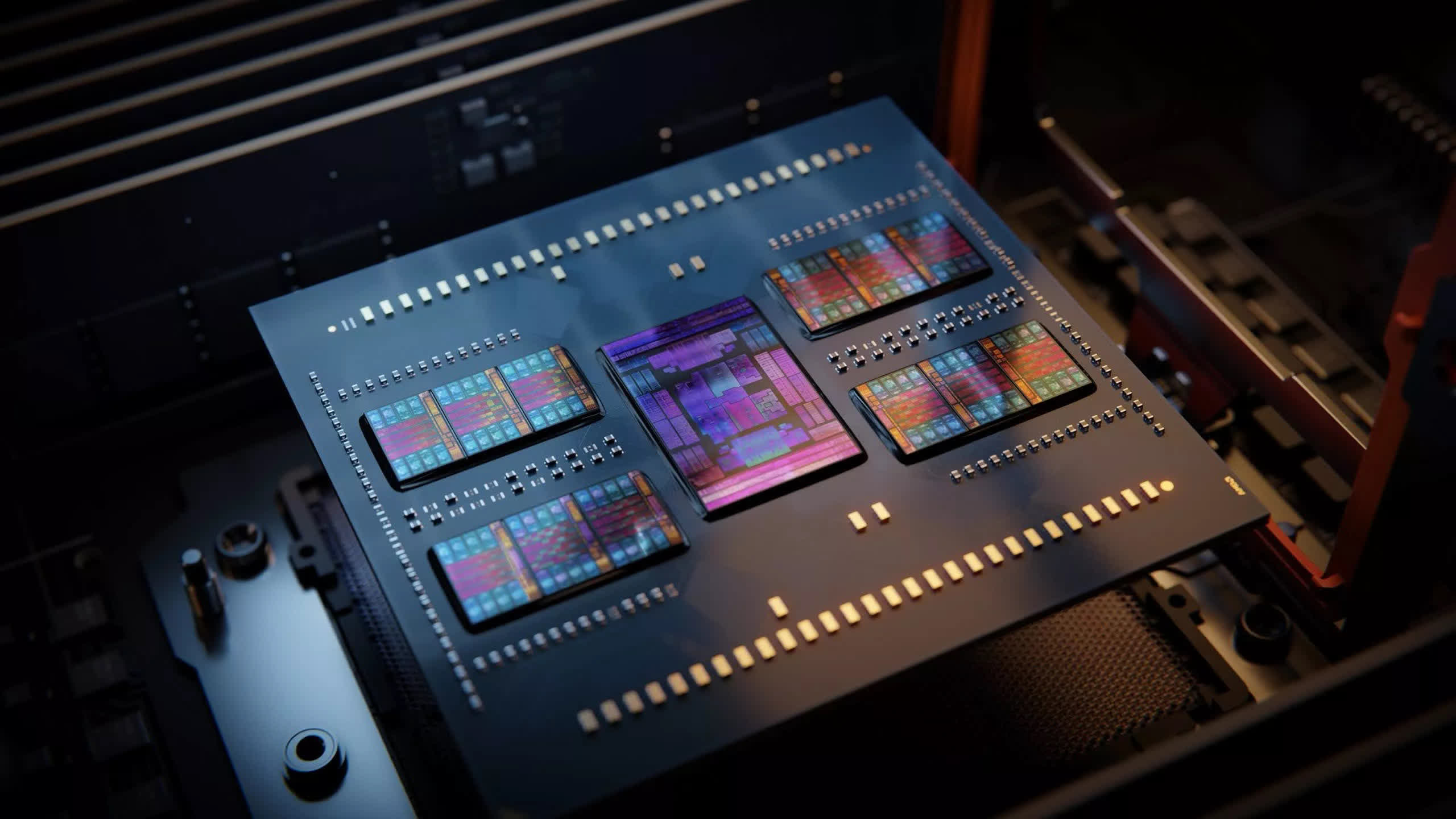
What we know so far: AMD is taking a different approach with its upcoming Zen 6 processors, introducing a new type of low-power core built from pieces of several earlier Zen designs rather than a single architecture. The change surfaced in a recent Linux kernel patch, which shows how the system identifies and manages these cores. The patch makes clear that the low-power cores are distinct enough to warrant their own classification, rather than being grouped with AMD’s existing compact “C” cores.
Patch notes that the system needs a way to properly identify these low-power cores in user space, since they currently show up as “unknown” in the CPU topology.
It also specifies that on supported AMD and Hygon chips, these cores should scale performance using amd_get_highest_perf() instead of the fixed CPPC_HIGHEST_PERF_PERFORMANCE limit, aligning them with how existing efficiency cores are managed.
What stands out is how these cores are built. Analysis from leaker InstLatX64 points to a hybrid design that combines multiple generations of Zen. The reported setup includes a Zen 6 instruction set, Zen 5 microarchitecture, Zen 4 floating-point unit, Zen 3 L2 cache, and Zen 2 L3 cache.
Instead of designing a low-power core from scratch, AMD appears to be reusing and combining existing components. That mix-and-match approach suggests the company is trying to improve efficiency while keeping development time and complexity in check.
These low-power cores would sit alongside AMD’s current Performance and Efficiency cores, creating a three-tier setup. Performance cores handle high-clock workloads, while Efficiency cores are smaller and tuned for lower power use. The new low-power cores go a step further, targeting very light workloads where minimizing power draw is the priority. In that sense, they’re closer in purpose to Intel’s low-power efficiency cores, though AMD’s design is structured differently.
The potential benefit is clearer in mobile devices. Laptops and gaming handhelds could offload lighter tasks to these low-power cores, reducing overall power consumption. That could help extend battery life and let systems run certain processes at just a few watts. How much of a difference that makes will depend heavily on how well software can manage and assign workloads across the different core types.
There are still gaps in what’s known. AMD hasn’t shared performance or efficiency data for these cores, and it’s not yet clear how well this blended architecture will scale under real workloads. The design is unconventional, and its success will likely hinge on how smoothly the hardware and software layers work together.
Advertisement
This development comes as AMD is rolling out its Zen 6 server chips, with desktop versions expected later this year. But the broader market may complicate things. PC shipments have been trending down, and higher memory prices, driven in part by AI demand, are pushing up system costs.
That matters more in laptops and handhelds, where upgrading the CPU usually means replacing the entire device. Even if AMD delivers better efficiency, adoption could be limited if buyers hold off on new hardware.
Still, the idea of building a core from a mix of proven parts marks a notable change in direction. Rather than stretching one architecture across every use case, AMD is carving out more specialized roles for different core types. If it works, it could give the company more flexibility in how it designs chips for power-sensitive devices.
The portable CD player is back, but today’s models have almost nothing in common with the plastic Discman that spent the 1990s eating AA batteries inside your Jansport backpack.
The compact disc was supposed to be dead by now.
Vinyl received the comeback tour, streaming took over the car, and the last laptop with an optical drive probably shares a drawer with your BlackBerry charger and three unidentified power supplies. For most of the past decade, buying a portable CD player meant choosing between a questionable Amazon special and something recovered from a basement beside a Case Logic binder filled with scratched copies of Ten, Automatic for the People, and the soundtrack to Singles.
Something has changed.
Advertisement
U.S. CD sales climbed 16 percent during the first half of 2026 to 16.3 million units, substantially outpacing vinyl’s 2.4 percent growth over the same period. K-pop and its collectible physical releases contributed to that increase, but CD sales were still up 6.7 percent without them.
That is not 2000 all over again, when a new Radiohead album meant a trip to HMV and enough change left for a sweet veal sandwich on the way home, but it is no longer statistical background noise either.
There is also a wonderfully strange wrinkle to the revival: close to half of the Gen Z and millennial consumers buying CDs reportedly do not own a CD player. For younger listeners, the disc has become a collectible object, a direct way to support an artist, or something tangible that exists outside a streaming service.
Manufacturers have noticed.
Advertisement
Why Portable CD Players Are Coming Back
The renewed interest in CDs is not difficult to understand once you remove the assumption that every physical format has to become vinyl.
Used CDs remain plentiful and generally inexpensive. Entire catalogs can be assembled for considerably less than the price of new vinyl reissues, and the discs are easier to store, clean, ship, and replace. You can also leave one on the passenger seat without treating the car like a temperature-controlled archive.
There is also the increasingly appealing concept of actually owning the music.
Advertisement. Scroll to continue reading.
Advertisement
Streaming remains essential, but subscription prices keep rising, albums can disappear or be replaced with different masters, and the listening experience is constantly interrupted by recommendations, notifications, podcasts, social features, and algorithms convinced that one Steely Dan song means you want to hear yacht rock until the day you die.
A compact disc does something almost radical in 2026: it plays the album you selected, in the order the artist intended, and then stops.
It does not ask whether you enjoyed the experience. It does not generate a playlist called “Ian’s Sophisticated Tuesday Vibes.” It just plays the music.
For Gen X listeners, there is another obvious reason. Many of us already own hundreds or thousands of CDs purchased over several decades. We bought the album once and considered the transaction complete.
Advertisement
What disappeared was not the music collection but the convenient hardware required to play it. New cars rarely include optical drives, computers abandoned them years ago, and many modern audio systems were designed as though everyone willingly donated their record collection to a server farm.
The current generation of portable CD players fills that hardware gap, although the word “portable” now requires some flexibility.
These Are Not the Discmans We Grew Up With
The portable players of the 1980s and 1990s were designed around one primary task: spinning a disc while attempting not to skip whenever you stepped off a curb.
They were generally made from plastic, ran on AA batteries, offered a single 3.5mm headphone output, and delivered just enough amplification for the inexpensive headphones supplied in the box. Anti-skip protection was treated like military technology. A wired remote clipped to your jacket was considered progress.
Advertisement
Today’s models are very different machines.
Depending on the price, they can include aluminum construction, rechargeable batteries, balanced headphone outputs, Bluetooth, digital connections, USB DAC operation, CD ripping, R2R conversion, selectable amplifier modes, and even vacuum tubes.
A Discman played CDs. Some of these products are complete digital source components, DACs, headphone amplifiers, wireless transmitters, and desktop transports that also happen to spin a disc.
They are not necessarily smaller. Several belong in a messenger bag rather than a jacket pocket, and nobody should attempt to jog with a 700-gram tube CD player unless the route ends at an orthopedic surgeon.
Advertisement
Advertisement. Scroll to continue reading.
They are, however, far more useful inside a modern audio system.
A Note About This Guide
This is not a ranked list of the “best” portable CD players.
We have personally used three of the models included below. The remaining selections are based on verified specifications, current availability, features, intended use, and our existing product coverage.
Advertisement
As more review samples become available, this guide will be updated with additional listening impressions and direct comparisons.
Prices were checked on July 27, 2026 and may change.
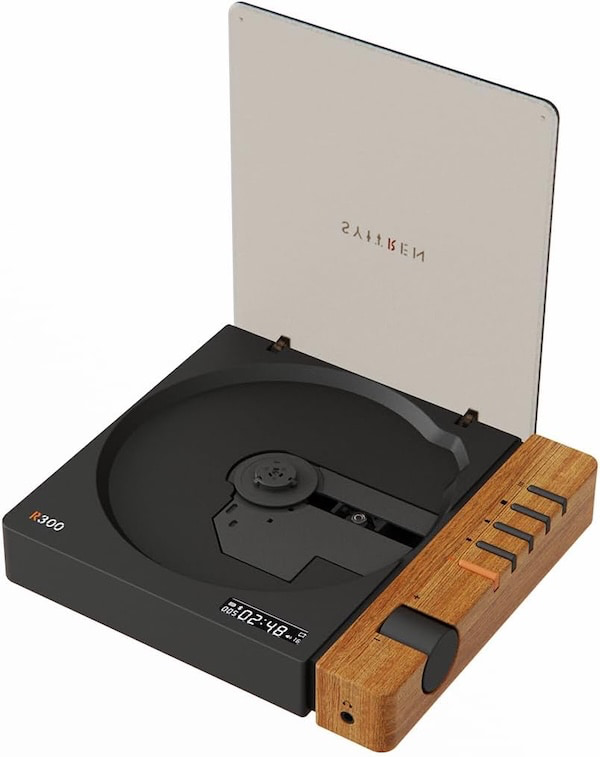
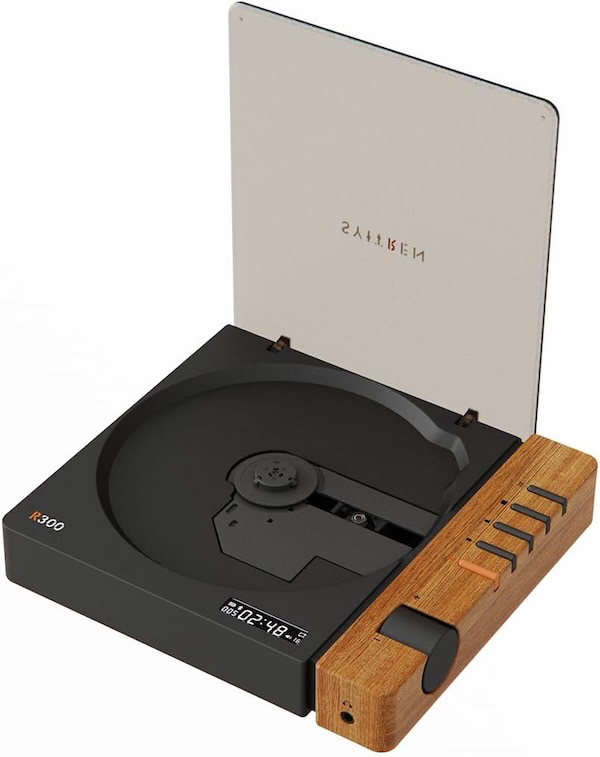
Syitren R300 ($99)
The Syitren R300 is the least expensive model in this guide and the one that looks least like traditional audio equipment. Its rounded enclosure, raised controls, and range of finishes suggest that Braun and Muji designed a CD player after spending an afternoon inside Tower Records.
It supports standard CDs, CD-G discs, and MP3 CDs. Bluetooth 5.3 can transmit playback to wireless speakers or headphones, while wired connections include a 3.5mm analog output and an optical digital output. Its 2,000mAh battery is rated for up to six hours.
The R300 does not include a balanced output, USB DAC operation, ripping, or a particularly powerful headphone amplifier. It is primarily a stylish and uncomplicated way to play discs through basic wired headphones, an external DAC, or a Bluetooth speaker.
Advertisement
Bluetooth compatibility may vary with automotive systems, so buyers hoping to restore CD playback in a newer car should temper their expectations.
At $99.99, however, it remains the most approachable entry point for someone who wants physical playback without studying an output-power chart first.
The FiiO DM13 helped establish the current portable CD player category by demonstrating that an affordable model could offer considerably more than a headphone jack and a prayer.
Advertisement. Scroll to continue reading.
Advertisement
Its dual Cirrus Logic CS43198 DACs feed both 3.5mm and 4.4mm balanced headphone outputs, with up to 180mW and 660mW per channel into 32 ohms, respectively. It also offers line-level operation, optical and coaxial digital outputs, Bluetooth transmission, gapless playback, and more than ten hours of rated battery life.
The DM13 can rip CDs directly to a FAT32-formatted USB storage device as WAV files, making it one of the least expensive ways to play and archive a collection without involving an aging computer or external optical drive.
It does not function as a USB DAC. The USB connection is used for power and ripping rather than accepting digital audio from a computer.
At $164.99, the DM13 remains one of the strongest combinations of price, output power, connectivity, wireless playback, and ripping support. It lacks the R2R conversion and more elaborate amplifier architecture of the DM15, but covers the fundamentals without turning a portable CD player into a graduate-level engineering course.
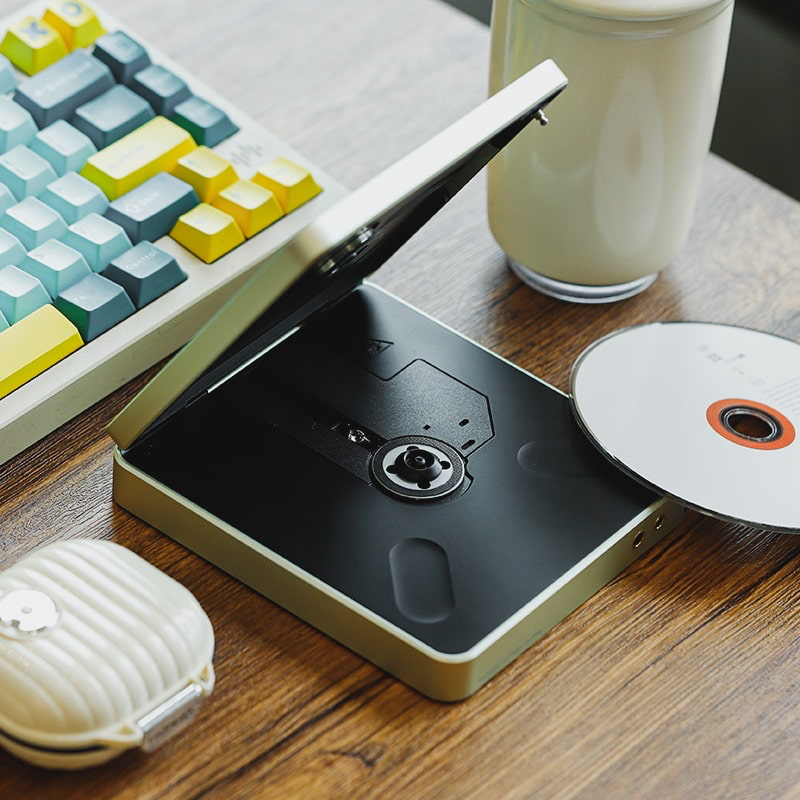
The Moondrop DiscDream 2 takes a more focused approach than the FiiO DM13.
There is no Bluetooth transmitter, balanced headphone connection, or onboard ripping. What it provides instead is a straightforward wired player with a transparent lid, clearly marked controls, USB DAC operation, and a nine-hour battery.
Its 3.5mm headphone output delivers 124mW into 32 ohms, while a multifunction connection provides line-level and optical output for use with an amplifier or external DAC. The DiscDream 2 supports CD, CD-R, and CD-RW playback, and its USB DAC mode handles high-resolution PCM and DSD files.
This is the model for listeners who want their portable CD player to remain primarily a CD player.
Advertisement
The absence of Bluetooth will be a deal breaker for some buyers, but it also means fewer menus, codecs, pairing routines, and negotiations with whatever wireless device happens to be nearby.
The design is more distinctive than the DM13, and the nine-hour battery makes it suitable for travel or extended desktop listening. Its headphone amplifier is best suited to reasonably efficient headphones and IEMs rather than difficult planar models.
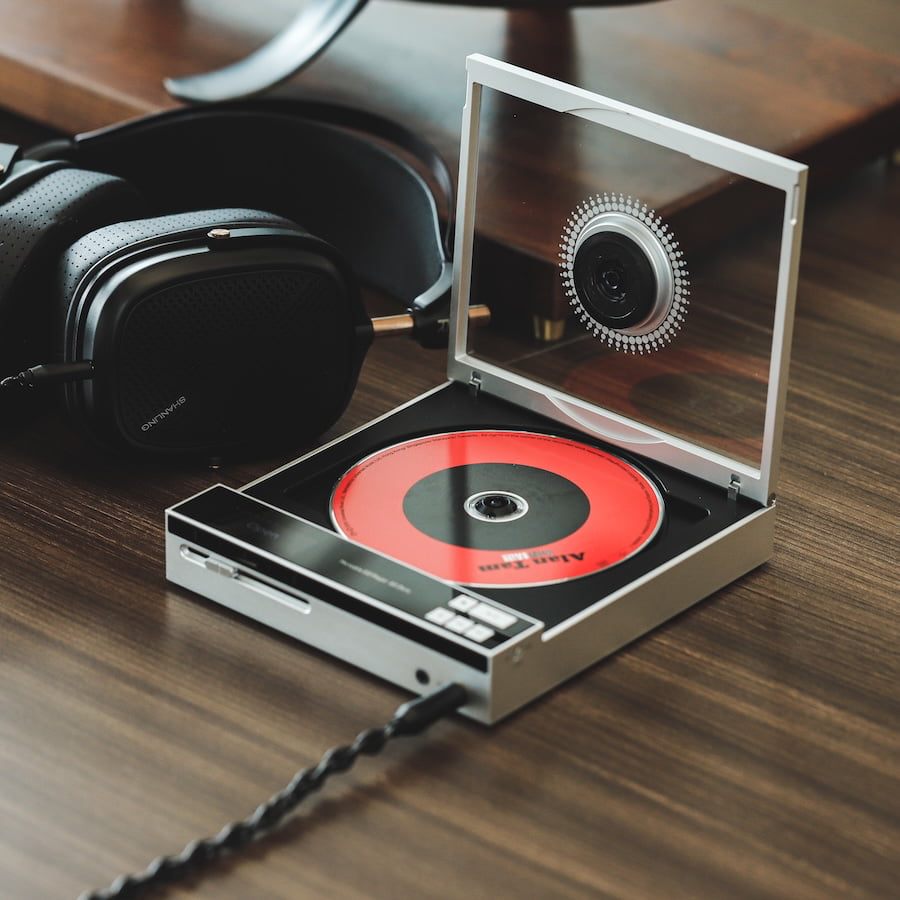
The EC Play is Shanling’s smallest, lightest, and least expensive portable CD player, although “lightest” still means approximately 418 grams.
That is considerably more substantial than the plastic players we carried during the first Bush administration, but the aluminum construction, active magnetic disc clamp, and internal hardware also belong to a different class.
A Cirrus Logic CS43198 DAC and dual SGM8262-2 amplifiers deliver 177mW through the 3.5mm output and as much as 700mW into 32 ohms through the balanced connection. The EC Play can also operate as a USB DAC and provides coaxial digital output for an external converter.
Bluetooth 6.0 works in both directions, although codec support depends on the operating mode. Receiver mode supports LDAC, AAC, and SBC, allowing the EC Play to function as a wireless DAC and headphone amplifier for a phone. CD transmission is limited to SBC.
Its 3,450mAh battery is rated for up to 12 hours, currently the longest claimed CD playback time among the models in this guide.
Advertisement
There is no ripping function, but the combination of balanced output, USB DAC operation, two-way Bluetooth, and excellent battery life makes the EC Play one of the most practical all-around designs under $200.
The FiiO DM15 R2R takes the basic formula established by the DM13 and adds a 24-bit resistor-ladder DAC, stronger amplification, USB DAC operation, improved controls, and a transparent lid that lets you watch the disc spin.
Because apparently we missed doing that.
FiiO’s fully differential R2R DAC uses 192 precision thin-film resistors and supports PCM up to 32-bit/384kHz and DSD256 in USB DAC mode. Bluetooth transmission includes aptX, aptX HD, aptX Adaptive, and SBC, while optical and coaxial outputs allow the DM15 to serve as a transport inside a larger system.
Advertisement
Output power rises substantially over the DM13. In battery mode, the DM15 provides approximately 220mW through its 3.5mm output and 812mW through its balanced connection into 32 ohms. Desktop mode increases those figures to roughly 310mW and 1,150mW.
Battery life is rated at more than seven hours during CD playback.
Advertisement. Scroll to continue reading.
The DM15 can also rip CDs to WAV while listening and includes three bass settings and eight EQ presets. At $269.99, it is the point where this category begins to resemble proper headphone hardware rather than a modern reproduction of something purchased at RadioShack.
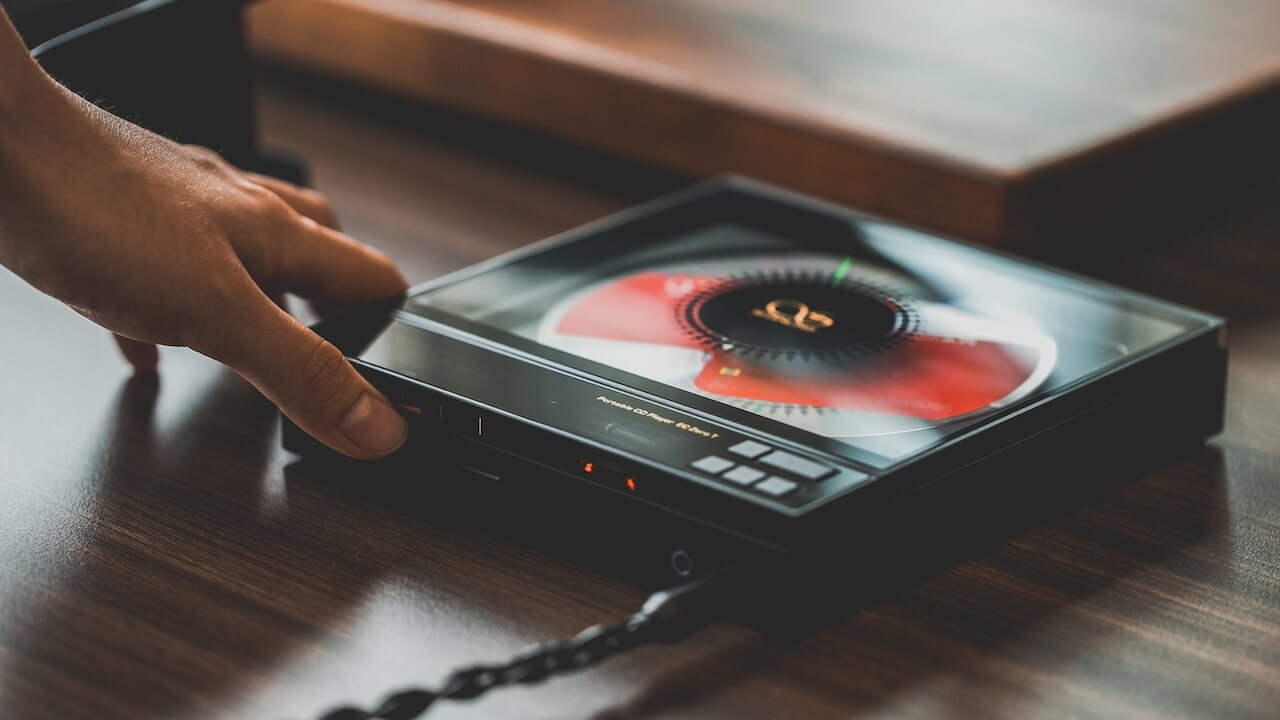
The Shanling EC Zero AKM uses the same basic enclosure, disc mechanism, display, controls, inputs, and outputs as the more expensive EC Zero T but removes the R2R converter and JAN6418 vacuum tubes.
In their place are an AKM AK4493S DAC and dual SGM8262-2 amplifiers. The change reduces the price to $319, extends rated wired playback to ten hours, lowers the output impedance for better compatibility with sensitive IEMs, and still provides up to 836mW through the balanced connection.
The EC Zero AKM includes dedicated headphone and line outputs, USB DAC operation, Bluetooth transmission with aptX Adaptive, combined optical and coaxial digital output, and real-time CD ripping to compatible USB storage.
It does not receive Bluetooth audio, and there is no LDAC support.
Advertisement
What it offers instead is most of the EC Zero platform’s flexibility without asking the buyer to pay for tubes or R2R conversion. For listeners who plan to use the player with several pairs of headphones, powered speakers, a desktop amplifier, and an external DAC, it may be the most rational member of the family.
Yes, “rational” is a relative term when discussing a $319 portable CD player in 2026.
The DiscDream 2 Ultra is the more ambitious and substantially more expensive sibling of the standard DiscDream 2. Current pricing has climbed to approximately $349.99, although the model originally entered the market closer to $289.99.
Its CNC-machined aluminum clamshell enclosure is one of the most distinctive designs in the category. Connectivity includes 3.5mm and balanced 4.4mm headphone outputs, along with a separate multifunction connection for line-level and optical output.
Advertisement
The balanced output delivers 222mW into 32 ohms, while the single-ended connection supplies 112mW. USB DAC operation supports PCM up to 384kHz and DSD256, and the 3,500mAh battery is rated for eight hours of CD playback.
Advertisement. Scroll to continue reading.
As with the less expensive DiscDream 2, there is no Bluetooth or ripping function. The Ultra is therefore less versatile than similarly priced alternatives from FiiO and Shanling, and its headphone amplifier is not intended for especially difficult loads.
What it offers is a more luxurious enclosure, balanced wired playback, and a focused operating experience without wireless features or an extensive menu structure.
Advertisement
It is also more transportable than genuinely pocketable, unless your jeans were designed by the same people responsible for JNCO.
The original EC Zero T marked the point where portable CD players stopped pretending to be simple devices.
Its in-house R2R DAC uses 192 precision resistors and offers selectable non-oversampling and oversampling modes. Dual JAN6418 vacuum tubes allow users to switch between tube and transistor output stages, while a TPA6120 headphone amplifier drives both single-ended and balanced headphones.
The EC Zero T also includes dedicated line outputs, Bluetooth transmission with aptX Adaptive, digital output, high-resolution USB DAC operation, and real-time CD ripping. Its 5,500mAh battery is rated for eight hours.
Advertisement
Output power depends on the operating mode and power source. On battery power, the balanced output reaches 551mW into 32 ohms. Connecting external DC power raises that figure to 1,220mW in transistor mode or 1,087mW in tube mode.
At 669 grams, about the weight of six Sony NW-A306 Walkmans, the EC Zero T stretches the definition of portable without completely snapping it.
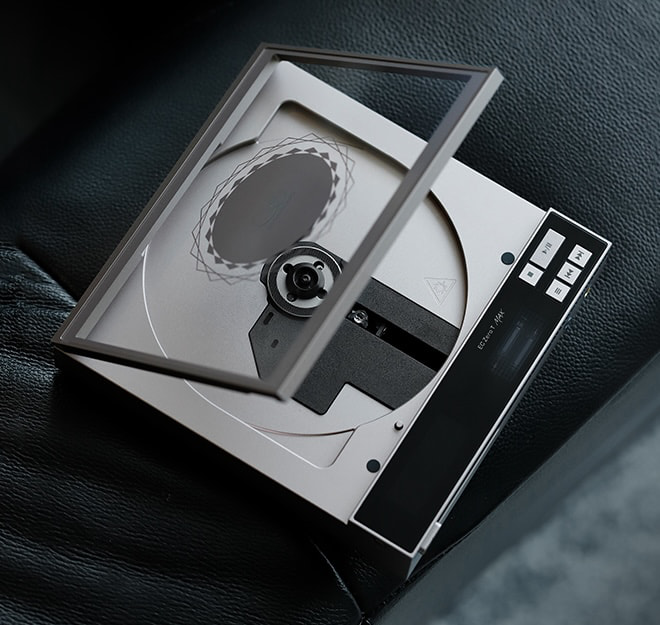
The arrival of the more powerful EC Zero T Max makes the original harder to justify at its full MSRP, but current pricing around $519 changes the equation substantially.
It takes the original EC Zero T’s R2R DAC, dual JAN6418 tubes, disc mechanism, USB DAC support, Bluetooth transmission, digital outputs, and ripping capabilities and addresses one of the original model’s primary limitations: maximum headphone power while operating from its internal battery.
The upgraded amplifier circuit is built around AD8397 devices and delivers up to 361mW into 32 ohms through the 3.5mm output and 1,300mW through the balanced connection without requiring external power. Output impedance has also been reduced, potentially improving compatibility with both demanding full-size headphones and sensitive IEMs.
Shanling also applied power-supply and circuit refinements derived from its newer R2R products, while the titanium-gray finish and patterned disc cover distinguish the Max from the original.
Advertisement
The important distinction is not merely another number on a specification sheet. The original EC Zero T required external power to deliver its maximum output, while the Max can produce 1.3 watts per channel from its battery.
That makes the “portable” part of its description considerably more convincing, even if Eugene Pontecorvo would need a larger Members Only jacket to carry it.
Shanling had not published a final battery-life rating for the Max when this guide was prepared.
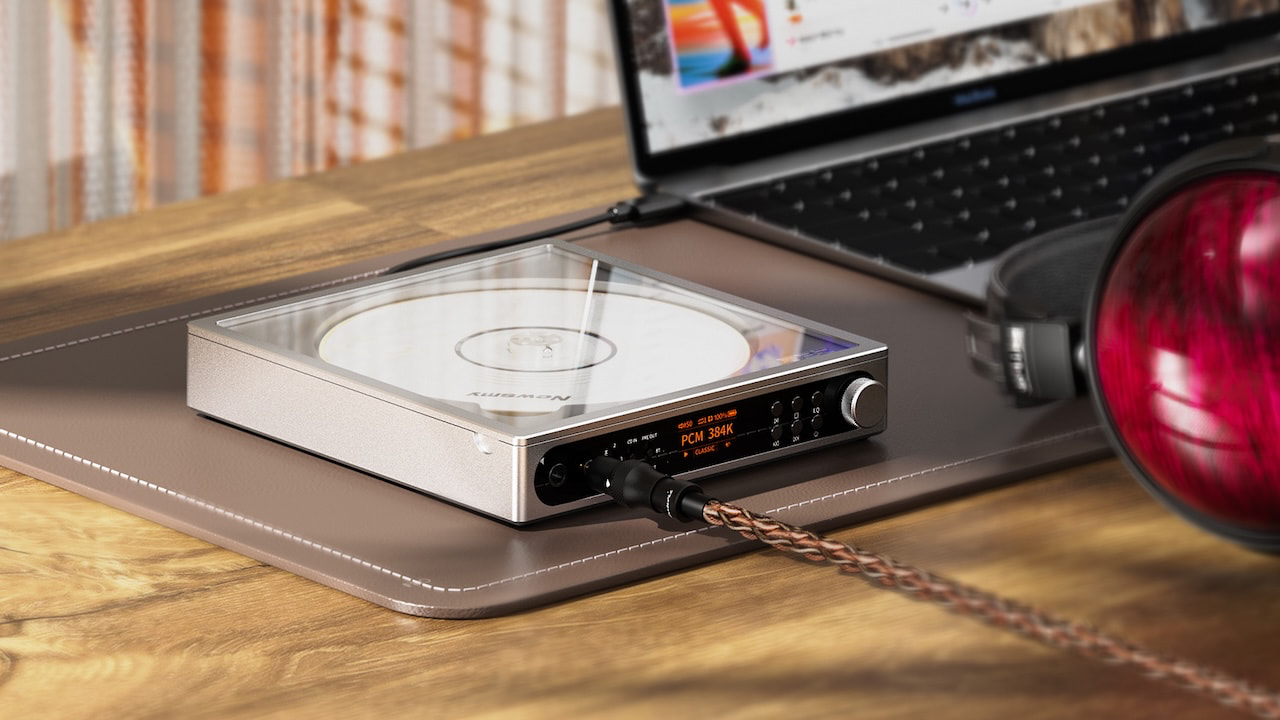
The Cayin CP6 is the most ambitious and expensive portable CD player in this group, combining dual Raytheon JAN6418 tubes, three selectable timbre modes, switchable amplifier operation, a discrete headphone output stage, dual DACs, two-way Bluetooth, USB DAC operation, CD ripping, and enough aluminum to make its definition of portability somewhat theoretical.
Its three output modes include Classic Tube, Modern Tube, and Solid State. Classic Tube is intended to provide a smoother and warmer presentation, while Modern Tube emphasizes openness and resolution. Solid State bypasses the tube character for a cleaner and more neutral output.
The digital section uses two Cirrus Logic CS4308P DACs operating in mono mode, followed by OPA1612 devices for current-to-voltage conversion and filtering. An XMOS XU316 processor manages USB audio, allowing the CP6 to operate as a high-resolution external DAC when it is not playing discs.
The CP6 includes single-ended and balanced headphone outputs, optical and coaxial digital connections, and Bluetooth 5.4 through a Qualcomm QCC3083 chipset. Unlike most of the players in this guide, it can transmit CD playback to wireless headphones or receive audio from a phone.
Battery operation is rated for up to 7.5 hours. When connected to external DC power, the balanced amplifier can deliver as much as 1,300mW per channel into 16 ohms.
Advertisement
Advertisement. Scroll to continue reading.
The CP6 does not include Wi-Fi, Ethernet, native streaming applications, SACD playback, or conventional RCA and XLR outputs. It is not a network player, and it is not trying to replace a full-size disc transport.
It is better understood as a tube DAC and powerful balanced headphone amplifier with a rechargeable battery, Bluetooth, and a CD mechanism installed on top.
Calling it a Discman is rather like calling a Porsche 911 a Volkswagen with better seats.
Below $200, the FiiO DM13 offers the broadest feature set, especially for listeners who want balanced headphone output, wireless transmission, digital outputs, and ripping. The Shanling EC Play costs slightly more but counters with USB DAC operation, two-way Bluetooth, greater balanced power, and longer battery life.
The Syitren R300 makes sense as an inexpensive and design-focused entry point, while the Moondrop DiscDream 2 is better suited to listeners who prefer a simpler wired player and have no need for Bluetooth or ripping.
Between $250 and $400, the FiiO DM15 R2R provides the most aggressive combination of output power, R2R conversion, USB DAC operation, Bluetooth, and ripping. The Shanling EC Zero AKM costs more but adds dedicated line outputs, a larger battery, and a broader range of system connections.
Advertisement
The DiscDream 2 Ultra prioritizes enclosure quality and straightforward wired playback over features.
The Shanling EC Zero T, EC Zero T Max, and Cayin CP6 occupy a very different part of the market. These are transportable audiophile source components designed for listeners who want tube output, stronger headphone amplification, multiple operating modes, and integration with desktop or full-size audio systems.
None of them will recreate the experience of skating to school with a Discman clipped to your belt and Dookie skipping every time you hit a crack in the sidewalk.
That is probably for the best.
Advertisement
Portable CD Player Comparison
Prices and specifications checked Aug 2, 2026. Manufacturer-rated battery life and output figures are shown.
Up to 1,300mW per channel at 16 ohms with external DC power
The Bottom Line
Portable CD players make sense because many of them use rather good DACs for the application, can drive everything from sensitive IEMs to demanding headphones, and fit comfortably on a desk, an airline tray at 30,000 feet, or a nightstand.
Just make sure the headphone cable is long enough. That awful thud at 3 a.m. when you roll over, pull the player onto the floor, and mumble something about not touching the last piece of biltong is not part of the listening experience anyone needs.
Advertisement
They are practical, increasingly capable, easy to move around, and yes, still undeniably cool.
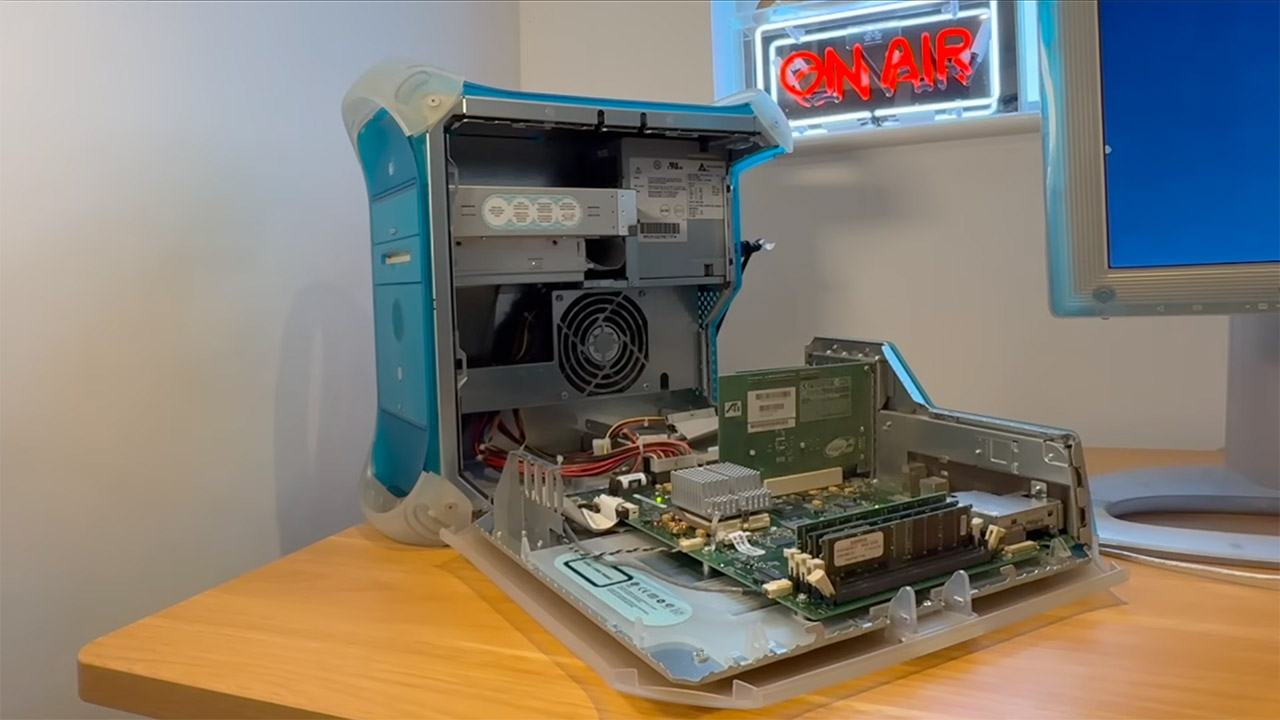
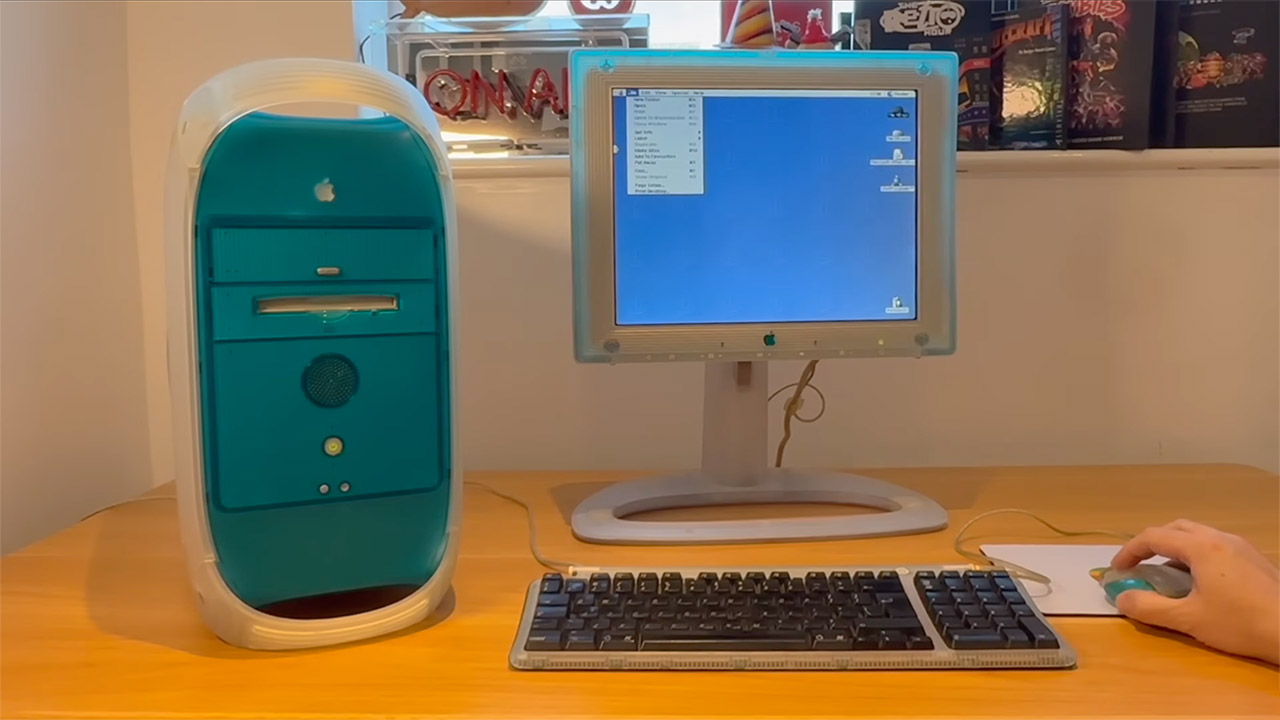
Dan Wood sat down with the same kind of machine that once filled university labs and design studios, the blue-and-white Power Mac G3, and rebuilt the exact setup he remembered from the early 2000s. Nearly three decades later the computer boots, runs its original software, and still feels purposeful in a way modern machines rarely do.
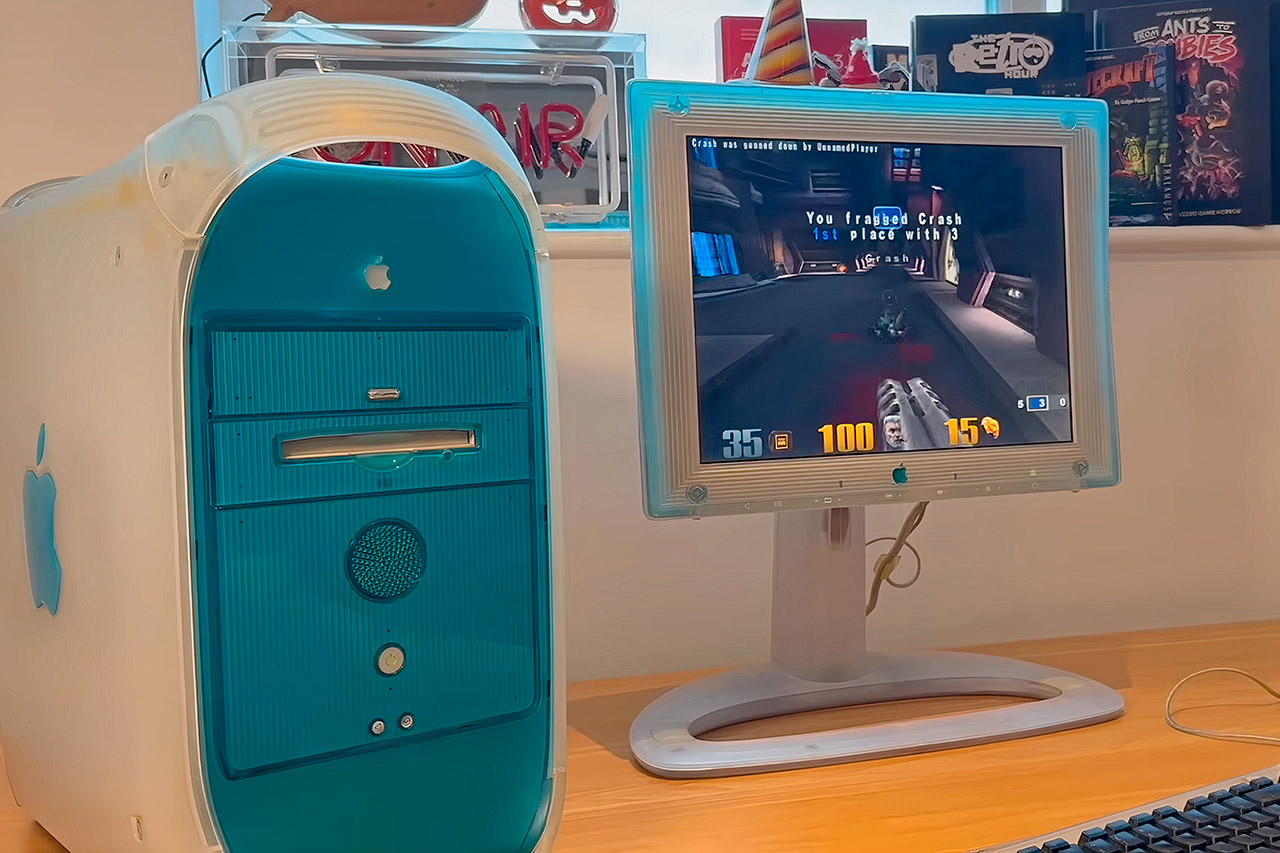
This tower, released in January 1999, appeared only fourteen months after the first aggregation of beige G3 models that were the standard for late 1990s PCs, which were essentially a lot of beige boxes. The blue and white version took a page from the iMac’s book, borrowing some of the same translucent plastic and curved design but applying it to a serious desktop system. Steve Jobs had returned to Apple, they had acquired NeXT, and suddenly the professional line had the same design swagger as the consumer goods. Dan’s particular machine is a 400 MHz model, which happens to be one of the fastest configurations available at the time.
BRILLLLLLIANT — iMac is the ultimate all-in-one desktop computer, powered by the M4 chip and built for Apple Intelligence.* With a stunning 24-inch…
FITS PERFECTLY IN YOUR SPACE — The all-in-one desktop design is strikingly thin, comes in seven vibrant colors, and elevates any space with style.
BUILT FOR APPLE INTELLIGENCE — Apple Intelligence is the personal intelligence system that helps you write, express yourself, and get things done…
Opening the case is simple, as there is only one catch on the side that lowers the entire top and swings the motherboard and all of the expansion cards out of the way. Inside, you’ll find a quiet G3 processor sitting pretty under a smallish heatsink, three of the four memory slots filled with 64MB sticks for a total of 192MB, an ATI Rage 128 graphics card with a DVD decoder daughterboard, and a front loading DVD-ROM drive, which was a real premium feature back in 1999. You have Firewire connectors next to the USB ones, an Ethernet port, and only one ADB connector for older keyboards or software that still uses those ugly old dongles. By the way, there is no disk drive in sight since Apple abandoned them with the iMac (1998) a year prior.
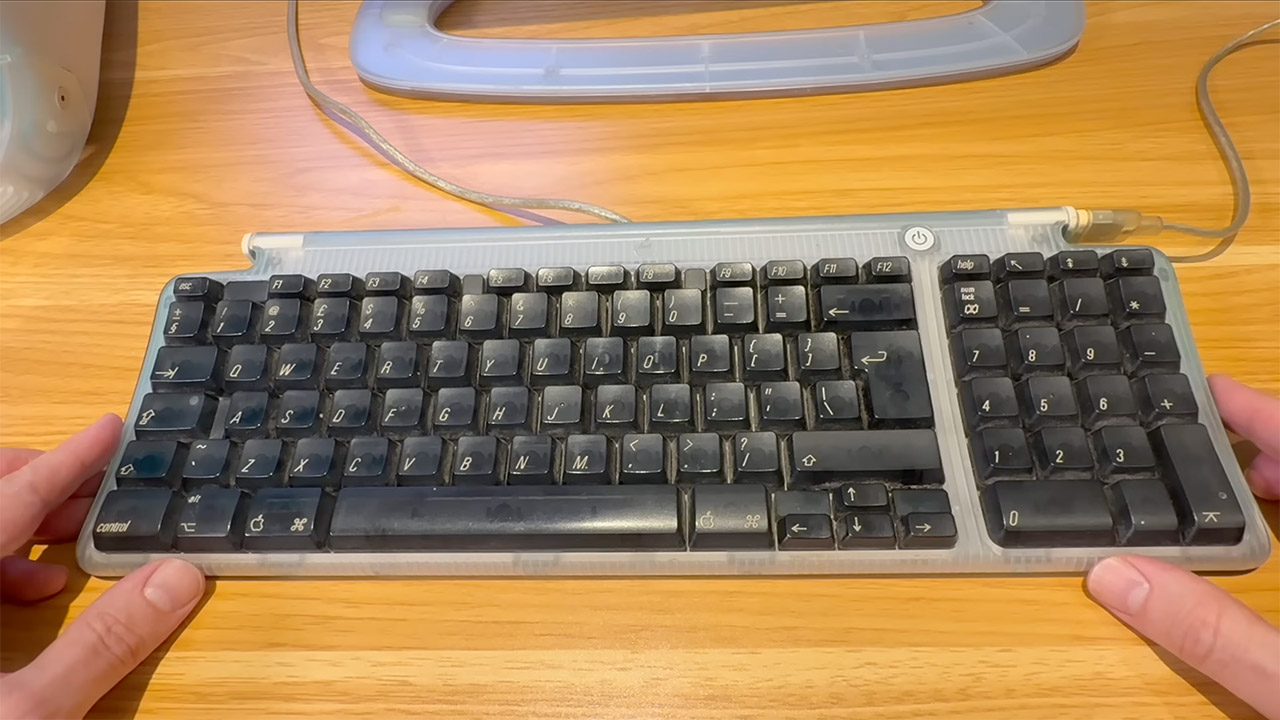
The matching keyboard feels soft and flimsy in comparison to older mechanical versions that many people still rely on. The function and arrow keys are half height, as Steve Jobs insisted, but I don’t see the benefit. The mouse that came with it is, of course, the round one-button “hockey puck,” which still elicits a strong reaction from anyone compelled to use one in a lab. Getting it to track properly requires some work, and the single button drives you into some awkward grip positions. Dan is utilizing the tower with a 15-inch Apple Studio Display, a thin screen with an active matrix that is nearly identical to the computer’s translucent blue and white plastic, and it connects by VGA and ADB.
Mac OS 8.6 boots up quickly and remains snappy, as Dan runs all of the same software that used to populate those university multimedia suites: early versions of Photoshop, QuarkXPress for page layout, and Microsoft Office 98. The machine sat in a church office for years, producing fliers and documents until being retired. Internet Explorer for Mac still works, but getting modern websites to load is nearly hard without special services that only provide a limited version of things. An outdated FTP client may still move files like people used to do.
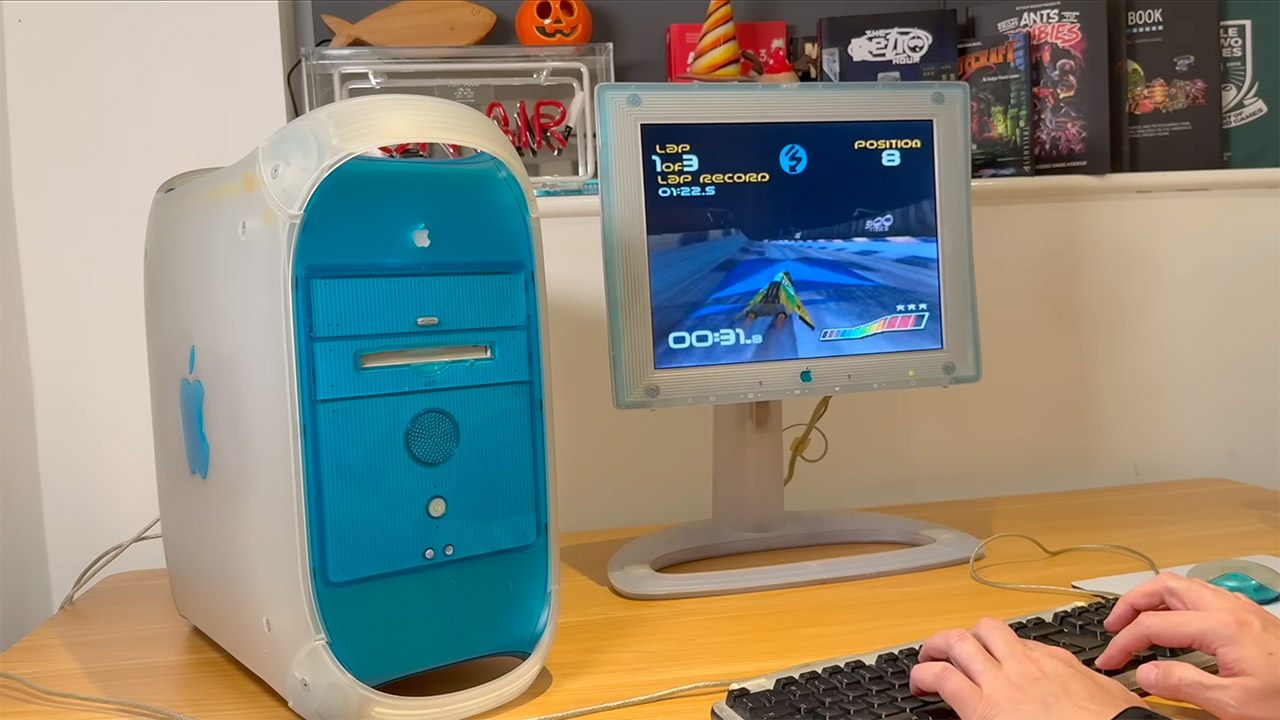
Two or three pieces of Connectix software still work on Dans machine: Virtual Game Station allows the G3 to boot up actual PlayStation discs at full speed, Wipeout runs fairly smoothly, which is a pleasant surprise, and Virtual PC boots up Windows 2000 in a matter of minutes and remains usable for older business applications. On the native side, the Rage 128 card runs Unreal and Quake III Arena with the same heavy-duty lighting and shadows that Steve Jobs used to demonstrate on stage with John Carmack.
New button beside the ribbon promises consistency – and more questions for admins
Microsoft had some news for Classic Outlook users this week, though it wasn’t an extension of support or an admission that new Outlook has failed to win over the holdouts. Instead, Copilot is getting a redesigned entry point above the ribbon.
The rest of the Microsoft 365 has been has liberally daubed with Copilot, and venerable Classic Outlook is no exception.
Advertisement
In a message posted to its administration portal, Microsoft says the redesigned entry point will make the experience “more visually appealing and consistent”.
The rollout begins in late August for users with Microsoft 365 Copilot licenses and will be “available by default.” Administrators may want to get ahead of the inevitable “why is this thing above my ribbon?” support tickets.
The update is also listed on the Microsoft 365 roadmap, where Microsoft says the redesign “anchors Copilot as one connected system across Microsoft 365, surfacing relevant actions that help you stay in flow.”
The move brings Classic Outlook into line with Word, Excel, and PowerPoint where Copilot already lives above the ribbon. It can surface “AI-powered recommendations based on the task at hand,” including summarizing an email or composing a response. The existing side pane remains; the redesigned button just provides a more familiar way to open it.
Advertisement
Microsoft has come unstuck in recent months over design decisions regarding Copilot and its productivity applications. A floating Copilot button in Word, Excel, and PowerPoint did not meet with universal approval. It led to a rare climbdown by the Windows giant as it allowed users to banish the button to the ribbon area.
In Classic Outlook, the Copilot entry point will remain above the ribbon rather than floating over messages, so users who objected to the assistant obscuring their work elsewhere in Office can take some comfort: Copilot will be easier to find, but it will not yet be hovering over the inbox.
As for the future changes to Classic Outlook? Microsoft says existing installations will remain supported until at least 2029, while the opt-out phase of the migration to new Outlook has been booted to 2027. ®
Researchers say Sapphire Sleet socially engineered maintainers before publishing malicious updates through trusted accounts
Amazon has linked the compromises of four npm packages over the past 18 months, saying they were all the work of the same North Korean crew.
In research published this week, AWS attributed the activity with medium confidence to the North Korea-linked group tracked as Sapphire Sleet, which is widely regarded as a Lazarus Group offshoot. Rather than exploiting zero-days or hacking npm itself, the crew allegedly took the slower route of befriending maintainers, stealing credentials, and publishing poisoned updates from accounts that developers already trusted.
Advertisement
The research revisits the compromises of typo-crypto, chalk and debug, and Axios, concluding that the four packages were targeted by the same North Korean operation.
Google had already attributed the Axios compromise to Sapphire Sleet, which it tracks as UNC1069, but Amazon goes further, saying the same group was behind all four incidents. The company points to shared infrastructure and technical overlaps, alongside similarities in how the attacks were carried out and which packages were targeted.
Rather than attacking npm’s infrastructure, the group allegedly went after the people trusted to publish code. Once a maintainer account was compromised, malicious releases could be pushed through the same channels developers use every day. AWS says the targets also grew more ambitious, progressing from little-known packages to some of the ecosystem’s biggest names.
AWS says this strategy is as much about economics as espionage. Instead of picking off victims individually, compromising a small number of widely used packages offers a shot at thousands of downstream environments in one go.
Advertisement
AWS warns that generative AI is making this kind of operation easier to sustain by helping attackers create believable developer personas, tailor messages to individual maintainers, and keep long-running social engineering campaigns convincing enough to earn their targets’ trust.
“Attackers can now produce thousands of lines of coherent, idiomatic, well-commented code, complete with convincing documentation, plausible commit histories, and synthetic maintainer identities, wrapped around a backdoor,” said CJ Moses, AWS CISO.
“Because each variant can be mutated, renamed, restructured, and re-encrypted, there is no single stable signature to match. Pattern-based detection loses ground against malware that looks one of a kind in every deployment.”
Amazon’s findings build on what’s already known about Sapphire Sleet. The group has long been associated with cryptocurrency theft, fake job offers, and elaborate social engineering campaigns aimed at developers. Amazon argues that the group has adapted its established methods to target the software supply chain.
Advertisement
Whether other researchers will agree that all four compromises belong to the same operation remains unclear. If AWS is correct, the incidents trace the group’s progression from an obscure package with few downloads to dependencies used across millions of projects. ®
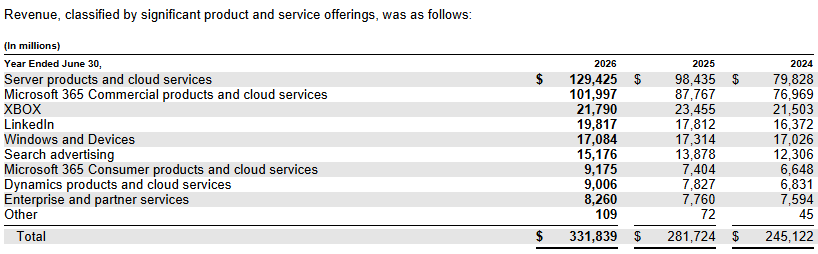
The first thing I do when Microsoft’s 10-K or 10-Q comes out is hit Ctrl-F and go waaaay down to the section called “Revenue, classified by significant product and service offerings.” It’s on Page 85 of the 10-K that came out Wednesday with its quarterly and annual results.
From my perspective, this gives the clearest view of what’s actually happening in Microsoft’s business. It groups things into categories and product names that match a real-world understanding of the company, as opposed to the mumbo jumbo you have to decode otherwise.
Microsoft reports its results in three broad segments: Productivity and Business Processes, Intelligent Cloud, More Personal Computing. Businesses like Azure, Xbox, Windows and LinkedIn all basically disappear inside them, until you dig into the filing.
The table, as it appears in Microsoft’s 10K for FY2026.
Overall, for the fiscal year ended June 30, Microsoft’s revenue increased 18%, or $50.1 billion, to $331.8 billion. Here is what the 10-K table shows about the real drivers of the business.
Two business lines are driving nearly all of Microsoft’s growth.
Of the $50.1 billion in revenue that Microsoft added for the fiscal year, $31 billion came from Server products and cloud services, accounting for 62% of the company’s growth.
Advertisement
This category includes Azure, along with SQL Server, Windows Server, Visual Studio, GitHub and Nuance. Microsoft doesn’t detail Azure revenue in its financial statements, but CEO Satya Nadella said on the earnings call that Azure passed $100 billion in annual revenue for the first time this year.
At total revenue of $129.4 billion, this is by far Microsoft’s biggest business, accounting for nearly 40% of its annual revenue.
The second biggest growth came from Microsoft 365 Commercial, which added $14.2 billion in revenue, up 16% to $102 billion. Microsoft 365 Commercial covers the business subscriptions: Office, Teams, SharePoint, Exchange, security and compliance, and Microsoft 365 Copilot.
Advertisement
Taken together these two business lines produced 90% of Microsoft’s growth for the year.
They’re also where the company is monetizing AI most successfully: Azure, AI infrastructure and GitHub Copilot in server and cloud; and Microsoft 365 Copilot in Microsoft 365 Commercial.
Two of Microsoft’s longtime businesses got smaller.
Windows and Devices revenue fell $230 million, to $17.1 billion. Once the biggest growth engine for the company as a whole, the PC operating system business has been flat for the past four years, using the categories as Microsoft now defines them.
Xbox revenue fell $1.7 billion, to $21.8 billion. That’s the first annual decline since Microsoft completed its $69 billion Activision Blizzard acquisition. It comes as Microsoft overhauls the business, cuts jobs and takes a write-down on unspecified Xbox assets.
Other notes and observations from the table:
LinkedIn, at $19.8 billion, now generates more revenue than Windows and Devices. It passed Windows in fiscal 2025 and extended the lead this year, growing 11% while Windows declined.
Microsoft 365 Consumer was the fastest-growing category after server products, up 24% to $9.2 billion.
Search advertising grew 9% to $15.2 billion, and is closing in on Windows and Devices.
Dynamics grew 15% to $9 billion. Enterprise and partner services, the consulting business, grew 6% to $8.3 billion.
Tech giant counts record piles of cash while buyers face years of elevated prices
Samsung Electronics is warning that the current memory supply crunch will deepen next year and persist through 2028, a shortage that keeps padding its own record profits at the expense of enterprise customers and consumers.
The Korean conglomerate said agentic AI has added to demand already generated by model training, driving an “unprecedented rise” in requirements for AI servers and other computing infrastructure.
Advertisement
Memory makers continue to prioritize production of components for AI servers, leading to a shortfall of the mainstream memory types needed for PCs, smartphones, and other devices.
The industry continues to invest in new capacity, but the lead time from starting construction of a fab to producing wafers exceeds three years, according to Samsung’s EVP of Memory, Jaejune Kim, meaning that any significant ramp in supply capacity will take considerable time.
“So we believe it will be unlikely to see any significant increase in incremental supply through 2028,” Kim told analysts on a call to discuss the firm’s calendar Q2 financial results for the period ended June 30.
“Based on the incoming requests that we have been seeing from the customers, unmet demand from this year is likely to carry over into the following year, contributing to tighter supply conditions going forward. The supply constraints are expected to become even more severe in 2027 than 2026, reinforcing our view that the supply shortage will persist through 2028.”
Advertisement
Kim said visibility further ahead is limited, although rising token processing by AI agents is expected to keep pressure on memory chip demand over the medium to long term.
Like rival SK Hynix, Samsung has also cut deals with customers to ensure long-term supply stability.
“Customers who want to secure substantial AI service infrastructure are increasingly approaching us for multiyear supply,” Kim told analysts.
“These multiyear arrangements actually are aligned with our objective of hedging our mid- to long-term risk. And so we have been engaging in discussions with customers, prioritizing those who can guarantee committed future captive demand.”
Advertisement
In other words, customers willing to sign up for years of memory purchases move to the front of the queue. Everyone else can take a number and get in line.
Samsung hopes the agreements will reduce its exposure to the memory market’s boom-and-bust cycles. It expects output, measured in bits, to grow by the mid-single digits for DRAM and the high single digits for NAND flash next quarter.
It will aim to expand sales of high-performance products including HBM4, HBM4E, DDR5, SOCAMM2, and enterprise SSDs, Kim said.
This approach led to Samsung reporting revenue of ₩171.5 trillion ($119 billion) for Q2, up 130 percent year-on-year. Operating profit shot up more than nineteen times the year-ago figure to ₩89.5 trillion ($62.4 billion).
Advertisement
Taiwan-based market watcher TrendForce agrees that AI will remain a primary driver of DRAM demand in 2027, but expects to see supplies of NAND flash ease in the second half of the year as new production capacity comes online.
For DRAM, several suppliers plan to start new lines in 2027, but construction schedules, equipment installation, and other requirements will delay meaningful production ramp-ups until the second half of 2027, the firm says, so substantial extra output is not expected to materialize until 2028.
In contrast, accelerated migration to NAND products with more layers and the gradual ramp-up of new fabrication plants during 2027 is expected to drive greater bit supply growth than in 2026, resulting in an expansion of industry output. ®





























































You must be logged in to post a comment Login