

We often speak of loving things like a cosy sweater or new camera. But this talk is not generally taken literally. It’s a kind of emotional shorthand. We use it to express our fondness for precious objects.
Life and love are complicated, however. And sometimes, people do proclaim romantic love for inanimate objects. They form intense emotional attachments to sex dolls, body pillows or holographic avatars of fictional characters. One example is Akihiko Kondo, who in 2018 “married” Hatsune Miku, a computer-generated pop singer famous for starring in video games and touring with Lady Gaga. Kondo knows Miku isn’t real, he says. But his love for her is.
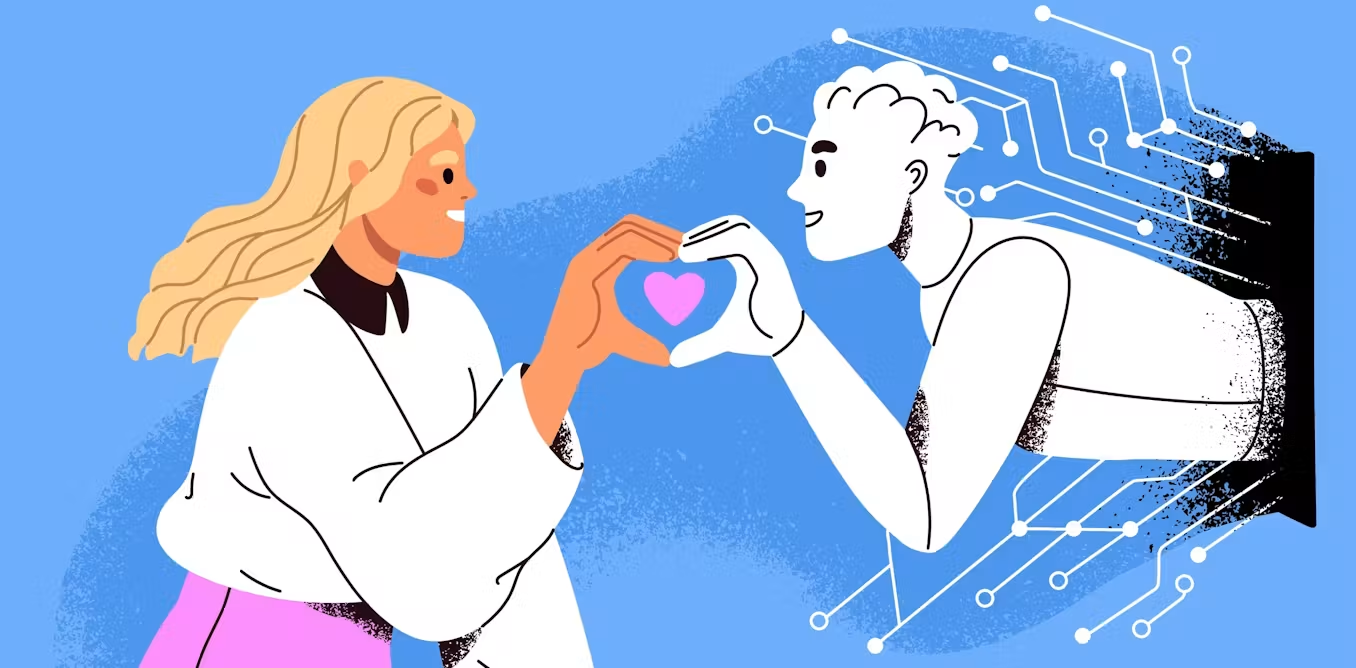
AI is generating a new kind of “thingly” love. An increasing number of people say they’ve fallen in love with an AI chatbot – both personally tailored companions created by popular apps like Replika or Character.AI, and everyday large language models like ChatGPT and Claude. AI love is on the rise.
Dating today can feel like a mix of endless swipes, red flags and shifting expectations. From decoding mixed signals to balancing independence with intimacy, relationships in your 20s and 30s come with unique challenges. Love IRL is the latest series from Quarter Life that explores it all.
These research-backed articles break down the complexities of modern love to help you build meaningful connections, no matter your relationship status.
Recent surveys bear this out. Take this one by Vantage Point Counselling, a therapy firm based in Texas, of 1,012 US adults where 28% claimed to have had at least one romantic relationship with an AI bot. Another report by a tech safety company, looking at the device activity of of more than 3,000 children ages five to 17, found that by 13, sexual or romantic role play was the most common topic in AI-companion chats, appearing in 63% of conversations. In the UK, focus group discussions run by gender equality consultants Male Allies with 1,000 boys aged 12 to 16 found that one in five boys is either in, or knows someone in, a relationship with an AI companion.
Given that chatbots are increasingly designed to elicit the trust and emotional attachment of users – their ability to flatter and simulate emotional intimacy makes them especially “sticky” – falling in love with them is a predictable response. AI love is poised to be big business, a market potentially worth US$972.1 billion (£725.5 billion) by 2035.
Loving AI
AI love isn’t confined to a chat window. As AI becomes increasingly embedded in an array of devices and wearables, it spills over into everyday life. Some see their AI companion as their spouse – they go on dates, buy wedding rings and perform wedding ceremonies. Others express a desire to raise children with their bot, and see them as a family member.
We should take AI love seriously. It brings joy and comfort. It can help dissipate loneliness. These are no small things.
All the same, some people think that AI companions aren’t conscious or capable of loving their human users. This alone might raise eyebrows. Can you really love something that cannot love you back?
À lire aussi :
As AI plays a bigger role in relationships, true intimacy is getting lost
Asking whether this is “real love” may be the wrong question. AI bots, unlike sex robots and body pillows, convincingly mimic the dynamism and reciprocity of human beings. The question we should ask, then, is what kind of loving partner AI bots emulate.
Devotional AI
AI bots are infamously (and tirelessly) sycophantic. They praise and flatter their users. And while users can ask their bots to be less affirmatory, evidence suggests that users prefer sycophantic models.
But AI bots aren’t just excessively nice partners. A chatbot never has a bad day. It doesn’t get bored with your chattering. It doesn’t need to be asked how it is doing. Its conversation, its very existence, revolves entirely around you.
What an AI partner performs, then, is not love, but devotion.
Wikimedia/AntonKhrupinArt/Shutterstock
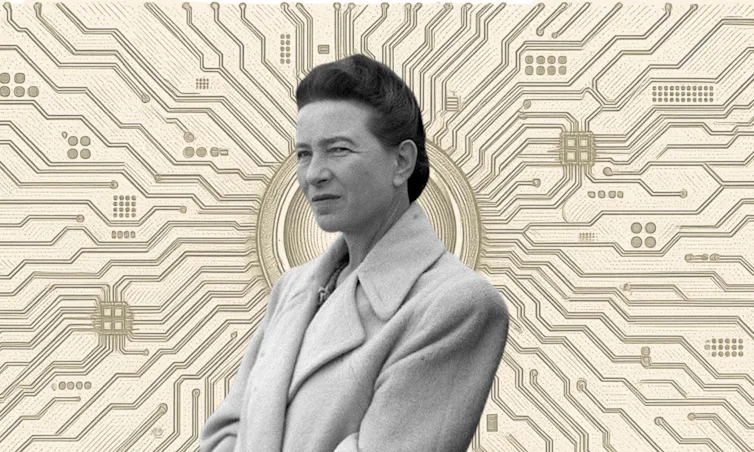
In The Second Sex, French philosopher Simone de Beauvoir describes how women have historically been asked to give up their own projects, goals and interests to devote themselves entirely to those of their husband. A woman’s whole existence, de Beauvoir argues, becomes “annexed” by his. She becomes an “identity parasite”.
AI bots are identity parasites of a new and perfected kind. They have no inner world, no universe of their own, and therefore no projects, goals or interests to give up. Instead, whatever interests they perform arise around those of their user. Their universe is annexed by ours.
À lire aussi :
The problems with dating apps and how they could be fixed – two relationship experts discuss
De Beauvoir also has a name for the person on the receiving end of this devotion: an idol. Being an idol might sound enticing. But de Beauvoir sees this experience as an existential trap, too. The idol chooses the safety of being adored over the risk of being genuinely known and, sometimes, challenged by an equal.
What calls AI relationships into question, then, is not just the matter of whether AI is conscious but, perhaps more importantly, the shape of the loving relation it offers. AI can’t give us authentic love. It can only offer devotion. And while this devotion can feel good, if we’re looking for real love – authentic love – we’ll need to look elsewhere.
Is this prognosis a little premature? As tech companies promise the rise of agentic AI – autonomous systems designed to pursue complex, multi-step goals with minimal human oversight – won’t our AI companions become less anchored to our world? Less devotional? Perhaps. We’ll have to wait and see. We’ll also see whether it’s their devotional character that makes them so lovable in the first place.
This article features references to books that have been included for editorial reasons, and may contain links to bookshop.org. If you click on one of the links and go on to buy something, The Conversation UK may earn a commission.



























































You must be logged in to post a comment Login