
Business
New closing auction triggers confusion, sparks late Nifty swings

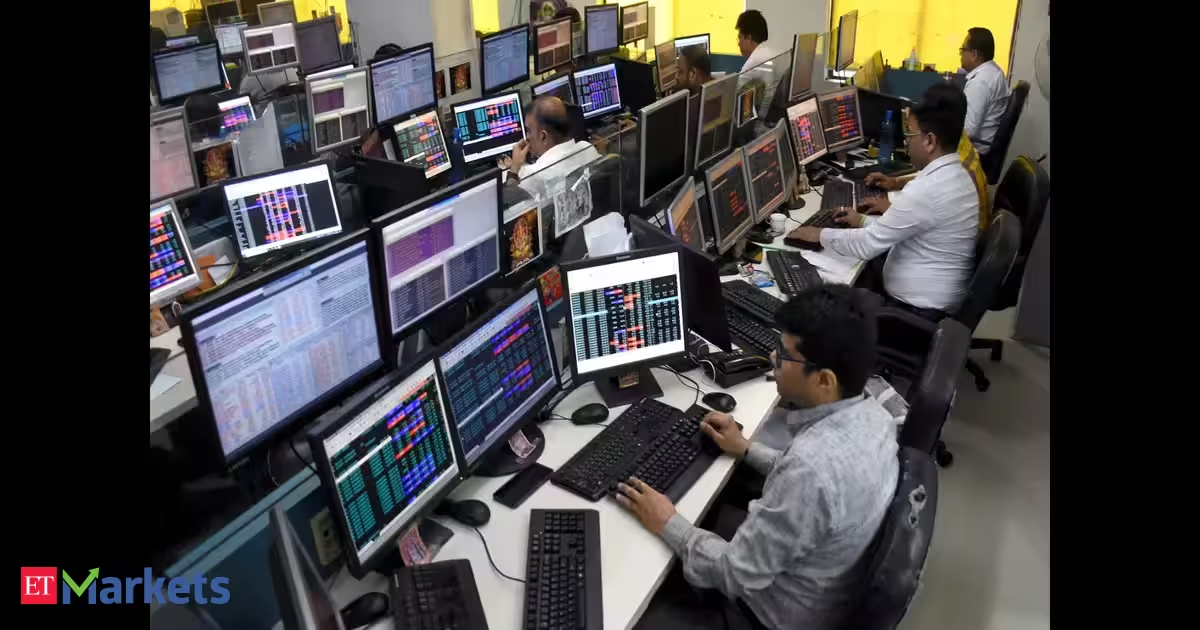
The Nifty ended at 24,774.30, up 390.70 points or 1.60%, following a late surge of 0.8% at around 3:28 PM. The Sensex ended at 78,639.03, up 544.39 points or 0.70%. Usually, the difference in percentage gains between the indices is not more than 5-10 basis points.
Read more: 200 point-jump in 2 minutes: Why Nifty made a surprising surge before closing bell
The new closing auction system changes the way the official closing prices of stocks in the futures and options (F&O) segment are determined. Until last week, the closing price-used to calculate index closing levels, value mutual fund portfolios and settle derivatives contracts-was based on the volume-weighted average price (VWAP) of trades during the last 30 minutes of trading. From Monday, the closing price is determined through a separate closing auction, a move aimed at making the closing price more robust and less susceptible to the impact of large last-minute orders.
 Agencies
rollout bumps Some attribute divergence to large FI buy orders in Nifty heavyweights
“The intention of launching the closing auction is the step in the right direction but clearly, there seems to be a missing link in its implementation going by how prices have played out on the first day,” said Siddarth Bhamre, head of institutional research at Asit C. Mehta Investment Intermediates. The new system is likely to face its first major test on Tuesday, when NSE’s weekly derivatives contracts expire. Traders will be watching closely to see how the closing auction influences settlement prices.

Had Monday’s late sharp move happened on an expiry day, its impact on traders’ position gains and losses would have been far greater because the official closing price determines the settlement of stock futures and options, said brokers. NSE had not commented on the sharp late-session price movements till the time of going to press, while market participants said there was no indication of a technical glitch.
One theory for Monday’s divergence is that a large imbalance of institutional buy orders in Nifty heavyweight stocks emerged during the closing auction, pushing up their closing prices and lifting the index disproportionately.Under the previous system, such orders would have been executed over the last 30 minutes of trading. The new framework concentrates them into a single closing auction, potentially amplifying the impact of large orders.


Schrodinger: A Rare AI-Adjacent Disruptor Still Not Priced For It

Waratah Resources at Diggers & Dealers: drilling for a district-scale gold find
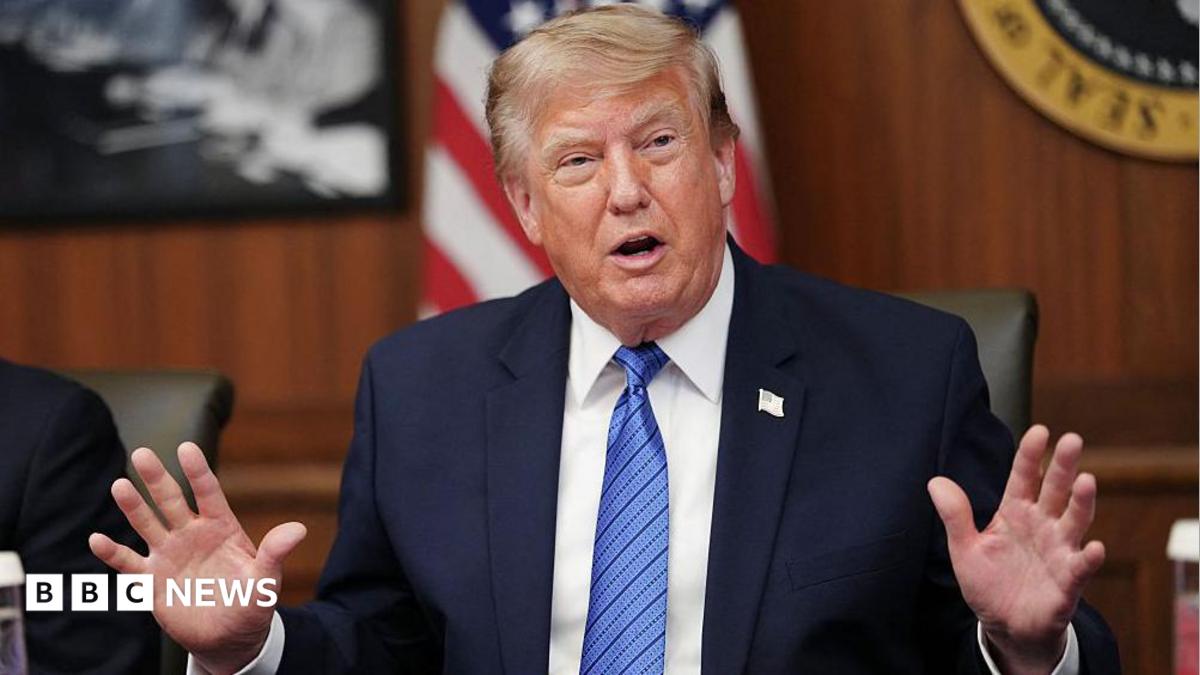
Twenty five US states sued the administration of US President Donald Trump on Monday over new tariffs of 10% to 12.5% on goods from 60 trading partners.
The tariffs came into effect in July, targeting countries including the UK, China as well as the European Union, over Washington’s contention that they have failed to properly tackle forced labour.
In a legal document seen by the BBC, the coalition of Democratic states said the decision was “arbitrary, capricious, and contrary to law.”
In response, White House spokesman Kush Desai said: “The US is using its lawful authority” to address practices that burden American businesses.
Desai added that any foreign country’s failing to deal with the importation of goods produced with forced labour was “unreasonable” and must be addressed.
The duties cover 99.4% of US imports, according to the Office of the US Trade Representative.
“President Trump’s illegal tariffs are nothing more than a tax on hardworking families,” said New York Governor Kathy Hochul.
Several of the affected trading partners have expressed disappointment over the new tariffs, while analysts have questioned how they would be able to show that they had properly addressed the forced labour claims.
It marks the latest move in a slew of trade policies unveiled by Trump since he returned to office in January 2025.
Wide-ranging duties Trump imposed on global trading partners in his so-called “Liberation Day” tariffs in April last year were struck down by the US Supreme Court.
“The Supreme Court has made it clear that this administration cannot ignore the law to impose sweeping tariffs,” Hochul said.
The court’s decision prompted tens of billions of dollars in refunds to companies that had paid the levies.
The president has long argued that tariffs protect American workers and boost the US economy.
The e-commerce and cloud-computing company’s shares rose as much as 5.3% as of 9.35 am on Monday, adding to the raucous rally last week following second-quarter earnings that showed accelerating cloud-computing revenue. Amazon joins Nvidia, Alphabet, Microsoft and Apple as the only companies that have reached that size.
Amazon had been mired in a selloff for much of the last three months as investors soured on shares of companies that had committed to spending billion of dollars on artificial intelligence. Its stock sank nearly 18% between its May 6 record and the three-month low it hit last month.
Those fears were eased last week after the firm reported that revenue for its Amazon Web Services unit last quarter jumped by the most since 2021. Shares surged more than 15% in response, their biggest one-day jump in more than 14 years, to add nearly $400 billion in value.
Also Read: SpaceX’s first results put Elon Musk’s AI spending under Wall Street’s microscope
That propel Amazon as the best-performing Magnificent Seven stock this year. The gauge of its big tech peers has struggled this year, gaining only 2.1% compared to a 10% gain for the S&P 500 Index.
While the rally has lifted Amazon’s valuation from the 17-year low it hit in late March, it’s still below where it has traded historically. At roughly 25 times forward earnings for the next 12 months, the stock is about 44% cheaper than its average over the last decade.It took Amazon just over two years to reach a market capitalisation of $3 trillion after first hitting $2 trillion in June 2024. That’s faster than the more than six years between that milestone and when it first hit $1 trillion in late 2018.
Wall Street remains upbeat on Amazon’s long-term prospects too. The average analyst price target calls for the stock to rise about 14% over the year from where it currently trades, according to data compiled by Bloomberg.
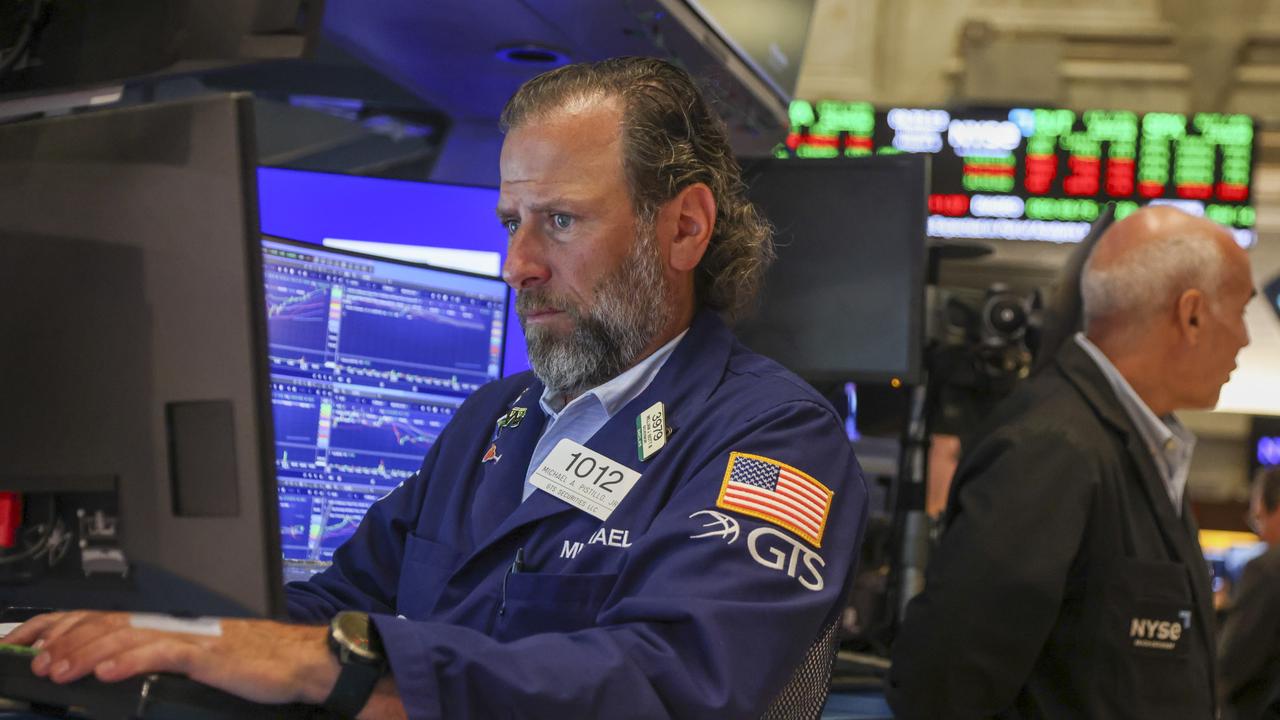
US stocks have kicked off August on a strong note to send the Dow Industrials to a closing record high as signs of de-escalating US-Iran tensions pulled down oil prices and Treasury yields in a busy week for earnings and economic data.

Excerpt: CRH – A Vertically Integrated Infrastructure Compounder
Form 4 Terawulf Inc For: 3 August

Shares of Kraken Robotics Inc. advanced more than 9% in early European trading Monday, reflecting continued investor focus on the company’s expanded scale and strong order momentum following its largest acquisition to date. The stock traded near 3.85 euros on the Frankfurt exchange under the ticker 2KQ.
Kraken, a Canadian provider of underwater robotics, synthetic aperture sonar, subsea batteries and related marine technologies, closed its acquisition of Covelya Group Limited on July 2 for approximately 615 million Canadian dollars. The deal brought together Sonardyne, EIVA, Forcys, Voyis and Chelsea Technologies, creating a broader portfolio of mission-critical subsea intelligence solutions spanning sonar, navigation, positioning, imaging, power systems and data analytics.
Management promptly updated its 2026 financial guidance to reflect the transaction’s contribution. Consolidated revenue is now expected in the range of 290 million to 320 million Canadian dollars, nearly double the prior standalone outlook of 165 million to 175 million dollars. Adjusted EBITDA guidance was raised to 65 million to 75 million dollars. Revenue is anticipated to be weighted toward the second half of the year as integration progresses.
On July 20 the company announced an additional 35 million dollars in new product orders from customers in maritime defense, offshore energy and ocean science. The awards covered navigation and positioning systems, multi-aperture sonar, monitoring systems from the Covelya businesses, and synthetic aperture sonar systems from Kraken. Combined with earlier bookings, total announced product orders for Kraken and Covelya on a combined basis reached approximately 327 million dollars year-to-date in 2026.
“Our product portfolio forms the backbone of a wide range of platforms used across both defence and commercial applications and we expect it to represent over 75% of consolidated revenue in 2026,” Chief Executive Officer Greg Reid said in the July 20 statement. The products are integrated or being integrated across more than 30 autonomous underwater vehicle platforms worldwide, as well as crewed vessels, uncrewed surface vessels and remotely operated vehicles.
Demand has been particularly strong for Kraken’s SeaPower subsea batteries, which offer higher energy density and lower weight compared with traditional systems, enabling longer-endurance missions for unmanned underwater vehicles. Synthetic aperture sonar systems used for high-resolution seabed imaging, mine countermeasures and critical infrastructure inspection have also contributed significantly. Covelya’s navigation, positioning and advanced sonar technologies have added complementary strength in defense and commercial markets.
The combined group now operates with a larger global footprint and deeper relationships in the fast-growing defense and maritime surveillance sectors. Management has identified approximately 10 million dollars in cost synergies expected within 24 months. Leadership changes accompanied the closing, including the appointment of Bernard Mills as president and the addition of former Covelya executives to key roles.
Kraken reported first-quarter 2026 results in late May showing revenue of 21.7 million dollars, up 35% year over year, with product revenue rising 50% on battery and sonar demand. At that time the company reiterated its then-standalone guidance and noted strengthening order intake ahead of the Covelya close. Second-quarter results, which will begin to reflect the enlarged business, are scheduled for late August.
The company has expanded manufacturing capacity, including a new 60,000-square-foot battery facility in Nova Scotia, to support anticipated growth in unmanned underwater vehicle power systems. Dual-use technologies serving both defense and commercial customers position Kraken to benefit from rising global investment in autonomous maritime systems, mine warfare modernization and offshore energy infrastructure protection.
Despite the operational progress, the share price has experienced volatility since the acquisition announcement and closing. The stock remains well below its March peak even after the recent advance. Investors are monitoring integration execution, margin performance and the conversion of the substantial order backlog into recognized revenue. The company has indicated plans to apply for a listing on the Toronto Stock Exchange, subject to meeting applicable requirements.
Market participants are also watching broader trends in underwater autonomy and defense spending. Programs focused on mine countermeasures, critical underwater infrastructure protection and large autonomous underwater vehicles continue to generate procurement activity across North America, Europe, the Middle East and the Asia-Pacific region. Kraken’s platform-agnostic approach and expanded technology suite are intended to capture a larger share of these opportunities.
With a record order book, updated growth targets and the Covelya integration underway, Kraken enters the second half of 2026 with greater scale and visibility than at any prior point in its history as a public company. The upcoming second-quarter report will provide the first formal look at combined operations and will be closely examined for evidence that the enlarged product portfolio and customer base are translating into sustained financial performance.
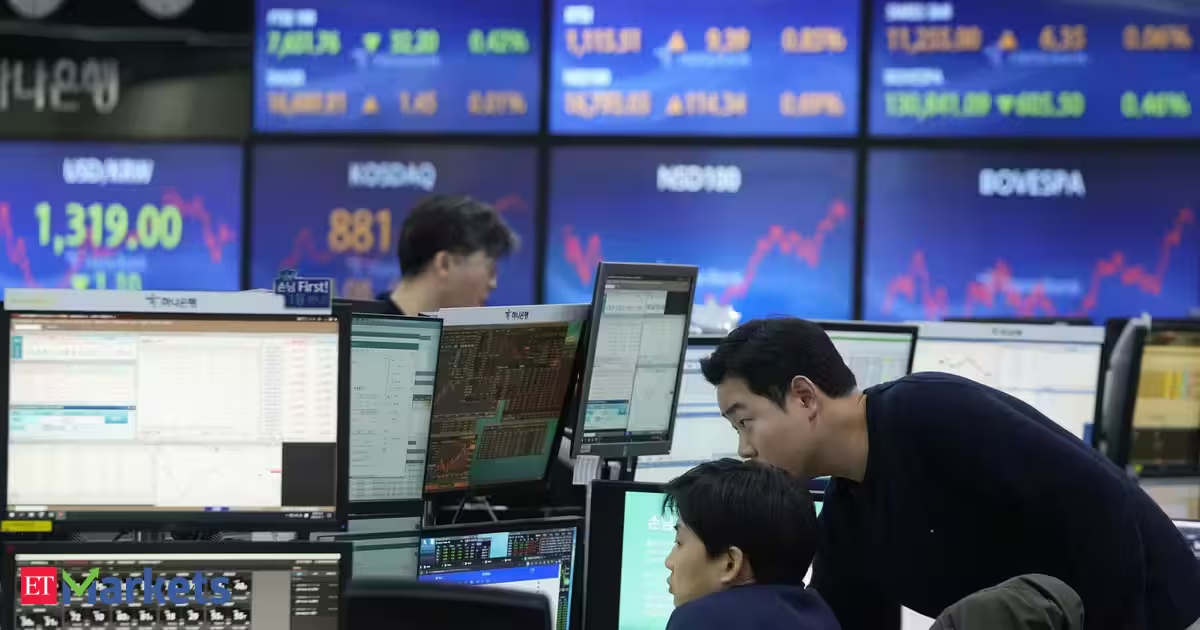
MSCI’s gauge for Asian shares gained, with South Korea’s Kospi index rising almost 2%. The S&P 500 Index climbed 1.5%, finishing within striking distance of a record.
Equity-index futures for the Nasdaq 100 Index rose 0.3% after a Wall Street rally that saw a gauge of megacaps post its best day since March. Palantir Technologies Inc. jumped 14% in extended trading after raising revenue and income forecasts. Elsewhere, Amazon.com shares fell as much as 1.9% in postmarket trading after Chair Jeff Bezos filed to sell shares.
The yen held steady through the New York trading session after a sharp advance earlier sparked speculation authorities may have intervened to support the currency again after last week’s coordinated action between the US and Japan. The currency traded at 157.33 per dollar in early Asian trading.
Read more: FPI inflows into Indian G-Secs dry up as US rate hike looms
Cooling tensions in the Middle East sent oil lower and spurred a rally in bonds Monday. Brent edged higher to $84.10 per barrel as President Donald Trump said current negotiations were Iran’s “last chance” after calling off a planned attack. The Treasury 10-year yield dropped six basis points to 4.68% in the previous session.
Monday’s revival in US technology shares offered investors some relief, even as uncertainty in the Middle East and lofty AI valuations kept caution elevated. The next test comes with another busy week of corporate earnings, as investors look for evidence that heavy spending on AI is translating into stronger growth and profits.“Earnings will remain the primary focus, with roughly 15% of the S&P 500 by market capitalization scheduled to report,” said Matt Orton, chief market strategist at Raymond James Investment Management.
In the US, of the 307 S&P 500 companies that have reported so far this season through Friday, 86% beat analysts’ forecasts for EPS. On sales, 68% of companies have positively surprised, while 15% missed.
SpaceX’s inaugural report as a public company is due on Tuesday. It’s also set the stage for one of the largest share unlocks in capital markets history, with as much as $116 billion worth of stock becoming eligible for sale for the first time next month. Elon Musk’s company has fallen below its IPO price, closing on Monday at $114.46.
Still, the on-again, off-again nature of US-Iran diplomacy may mean earnings and jobs data will have to do the heavy lifting for the bulls this week, according to Chris Larkin at E*Trade from Morgan Stanley.
In the countdown to a slew of jobs figures, data showed US manufacturing activity expanded in July at the fastest pace in more than four years as demand remained strong, production surged and firms added workers.
Forces that propelled US stocks to record highs this year remain “firmly intact” after a reset in retail investors’ speculative trading, according to Citadel Securities’s Scott Rubner.
“Markets are transitioning from a flow-driven environment back to one increasingly dictated by earnings, corporate demand, and the macroeconomic backdrop,” he wrote.


Grab Q2 2026 slides: profit surges 54% amid fuel crisis, guidance raised

Schrodinger: A Rare AI-Adjacent Disruptor Still Not Priced For It

Ripple invests in 2 firms to scale XRPL tokenization

Naoya Inoue sets strict deadline for super fight against fellow undefeated KO artist


![WARNING: Today Will Catch Many Off Guard! [My Bitcoin Plan]](https://wordupnews.com/wp-content/uploads/2026/08/1785808401_maxresdefault-80x80.jpg)
-

 Business5 days ago
Why Trees Belong on the Risk Register
-

 Fashion3 days ago
Weekend Open Thread: Wit & Wisdom
-

 Politics3 days ago
Meta enters AI-training agreement with far-right ‘propaganda rag’ Newsmax
-
 Entertainment6 days ago
‘Stargate’ Creator’s New Sci-Fi Series Returns for Season 3 Tomorrow
-

 Crypto World2 days ago
MicroStrategy Post-Earnings CLARITY Act Push Could Add New Catalyst for Its Stock
-

 Politics7 days ago
The Part of the Electric Transition Nobody Wants to Discuss
-

 Business6 days ago
Major shareholder moves on Canyon
-

 Crypto World3 days ago
XRP Ledger v3.3.0 brings five institutional features
-

 News Videos5 days ago
Bitcoin Enters the 3rd Stage of the Bear Market
-

 Crypto World6 days ago
Kraken Enables Retail Access to Jersey Mike’s IPO via Tokenized Shares
-

 Politics5 days ago
Reform UK betrays West Mids residents by running from party pledges
-

 Politics4 days ago
Luke Littler’s dominance sparks GOAT debate
-

 News Videos6 days ago
Claude: Build Financial Dashboards in Minutes (2026)
-

 Sports4 days ago
Seema Kaliramna Wins Discus Throw Bronze, Takes India’s CWG Medals Tally To 17
-

 Business6 days ago
Johnson & Johnson agrees to $5.5B settlement over talc cancer claims
-

 Crypto World2 days ago
Crypto PAC spending tops $2M in Michigan House race
-

 Crypto World3 days ago
New York sues Kalshi over prediction market gambling
-

 Business4 days ago
Trump Announces Hamas Disarmament Agreement as Iran Strikes Kuwait Air Base and US Attacks Pause Overnight
-

 Tech6 days ago
Gemini can now summarize the messiest comment threads in Google Docs
-

 Tech2 days ago
ESET tracks rise in malicious AI skills and adaptable malware
You must be logged in to post a comment Login