





Connect with us

Tech

Trump Spends The Weekend Fighting For The $1.776 Billion Slush Fund His Chosen Attorney General Swears Is Dead

Published

on

from the how-is-this-real-life? dept

Sometimes it helps to just write out everything that happened leading up to a situation so we don’t lose sight of just how ridiculous it is.

I mean, would you believe that a President would sue his own IRS for something that happened under his own watch and did him no harm, demand $10 billion, and when a judge calls into question how that’s possible, come up with a “settlement” between the two “parties” that grants himself, his family, and his far-flung businesses (already under investigation for tax fraud) a complete get-out-of-jail-free card from tax audits along with a special $1.776 billion slush fund which he can hand out to insurrectionists who tried to overturn an election he had lost?

And then, his Acting Attorney General seeking the permanent job (who had been the President’s personal lawyer in early criminal cases, including one where the President was convicted of 34 felonies), would tell inquiring Senators that the slush fund wasn’t moving forward, but refuse to put that in writing?

When you write it all out that way, it sounds kinda crazy.

Advertisement

Last month Judge Kathleen Williams nuked the fund and alerted various state bars to the ethical lapses of all the government lawyers involved, including Todd Blanche, the President’s personal criminal defense lawyer-turned Acting Attorney General-turned nominee for the permanent Attorney General position.

Blanche’s nomination had stalled out, in part because two Republican Senators (Cornyn and Tillis, both of whom are leaving office after Trump refused to support their attempts to stay) have questioned the slush fund. Blanche refused to put it in writing that the fund was going away, leading to this strained exchange with Cornyn:

Republican Sen. John Cornyn of Texas, reading from the settlement on Wednesday, noted that it says the terms of the deal “may be modified only upon the written agreement of the parties.”

“Has there been a written agreement of the parties to modify the settlement fund?” he asked.

“No, the settlement fund is just not moving forward,” Blanche responded. “There’s no modification. It never started. No money went from the Treasury to any other account.”

Advertisement

When pressed, however, as to whether the settlement agreement may be enforceable by the parties, Blanche conceded that the president could challenge it down the road.

“Yes, it’s an enforceable document, so I suppose if President Trump’s counsel sought to enforce it, that they potentially could … try to enforce the contract. They can’t force the Department of Justice to move forward with the weaponization fund. They could potentially say that we breached by not moving forward,” Blanche said. “They haven’t done that, and I’m not aware that they’re planning on doing that.”

Given all of that, you would think that, perhaps, Trump wouldn’t make any public effort to say that the fund should still exist.

But, again, we live in the upside down world, where if Donald Trump wants something, he just throws a temper tantrum until he gets it. Three new developments have happened regarding all this in the past few days.

Advertisement

First, on Friday, Donald Trump appealed Williams’ order and filed a long, rambling motion about how unfair the order was. That doesn’t sound like someone who is willing to accept that the fund is dead. Second, on Saturday, Trump posted a rant to his personal social media site about how mad he was at Cornyn and Tillis, and how he still needed the fund, and even hoped Congress would pass a separate law giving him the slush fund. Finally, despite these two things making it abundantly clear that Trump still plans to create a slush fund for his cosplay militia, on Sunday, Blanche finally signed a letter claiming the slush fund was dead.

Let’s take these each in order.

First the appeal and the whiny motion about it. The most incredible thing about it is that, even though it was filed by lawyers hired by Donald Trump (the person), as I was reading it, it read like it was filed by the Justice Department. Remember, the entire reason that Williams killed the “settlement” of Trump’s lawsuit against his own IRS was that there appeared to be no adversarial parties in the case, and it was just Donald Trump suing himself in order to give the “settlement” the stamp of authenticity that it was part of a federal case.

While, to their credit, this new filing at least brings in real lawyers from an actual serious law firm, DLA Piper, alongside Trump’s original two-bit lawyer Alejandro Brito, the argument itself is still a mess. Again, you could totally picture either Donald Trump or his DOJ/IRS filing this since the original ruling applies to both. Because they’re not adverse parties. They’re all on the same side.

Advertisement

The ruling rests on a grievous legal error: that, because President Trump supervises the Executive Branch, he and the United States necessarily possess the same legal interest and cannot be adverse to each other. That is wrong. President Trump asserted a personal claim arising from the theft of his own tax information. The IRS and the U.S. Department of the Treasury (“Treasury”) represented the sovereign’s interests in public funds and federal law. Donald Trump Jr., Eric Trump, and The Trump Organization asserted their own independent claims. Presidential supervision did not erase those rights or merge those interests.

The Sanctions Order nevertheless erroneously treated its novel theory of adversity as the starting point and then refracted the facts through that mistaken lens. Settlement became proof of collusion, even though there was none, potential (weak) defenses became proof that the claims were fictitious, which they were not, and ordinary professional relationships became proof of coordination, which did not exist. But the Sanctions Order identified no pre-filing sub rosa agreement, no false allegation, and no specific direction by President Trump controlling Defendants’ litigation decisions. The predicate legal error thus supplied the conclusion, causing the Sanctions Order to incorrectly recast entirely innocuous facts as misconduct.

The danger posed by the Sanctions Order is profound. The Court called the Article III question “unprecedented,” appointed six amici, and devoted nearly thirty pages to resolving it— yet it then declared the contrary position “so obvious and so insurmountable” that advancing it warranted career-altering sanctions. Id. at 9-38, 53 n.69. That mistake converts disagreement into professional punishment, and strikes at the integrity of the adjudicative process itself. A system that sanctions lawyers for advancing positions on constitutional questions cannot sustain fearless advocacy or principled legal development.

Note the tell in that last bit: the “professional punishment” landed on both sides — Trump’s lawyers and the government’s — which is exactly the point Williams was making. And, yes, courts are historically reluctant to sanction lawyers at all. But that reluctance is the problem, not evidence that the one judge willing to do it got it wrong.

As for the claims that the DOJ was actually representing the IRS’s best interests, and not Donald Trump’s, that’s belied by quotes from Donald Trump himself — who publicly admitted he was negotiating with himself — and the terms of the “settlement” which make no sense and do nothing to support the interests of the IRS, the public, or the American taxpayer. If this case was actually about Trump’s leaked tax returns, how does giving the family a release from tax audits or handing over nearly $2 billion to insurrectionists (wholly unrelated to this suit) have any of the American people’s interests in mind?

Advertisement

The strongest argument this filing has is that one part of the ruling is arguably prior restraint. To make sure that the settlement agreement for the slush fund was not used for improper enrichment, Judge Williams barred the parties from invoking the settlement in other proceedings. Trump’s new lawyers say that this part is prior restraint:

In addition, Rule 11 and inherent authority cannot support an order forbidding the President, private Plaintiffs, federal agencies, and sweeping categories of associated persons from “referring to” the Settlement Agreement or invoking it in any future judicial, administrative, regulatory, arbitral, or other official proceeding. D.E.106 at 47. That unprecedented injunction regulates future speech and advocacy, is unconstitutional, and is patently unlawful.

The Sanctions Order’s command is a content-based prior restraint. It singles out one subject—the Settlement Agreement—and suppresses one message, i.e., that the Settlement Agreement exists and may carry legal effect. Prior restraints carry a “heavy presumption” of constitutional invalidity, Bantam Books, Inc. v. Sullivan, 372 U.S. 58, 70 (1963), and constitute “the most serious and the least tolerable infringement on First Amendment rights.” Nebraska Press Ass’n v. Stuart, 427 U.S. 539, 559 (1976). They require findings that the threatened harm is “both great and certain and cannot be mitigated by less intrusive measures.” CBS, Inc. v. Davis, 510 U.S. 1315, 1317 (1994) (Blackmun, J., in chambers). The Sanctions Order identified no threatened unlawful speech, no resulting harm, and no reason narrower relief would be inadequate. Indeed, it did not address the First Amendment at all.

And while this is the strongest argument, that doesn’t make it actually strong. The order does not stop Trump or his lawyers from talking about the settlement. They can post about it on Truth Social, complain about it on Fox, write a book about it. What they can’t do is walk into another court, agency, or arbitration and invoke a settlement that a federal judge just voided due to the lack of adverse parties. The only “speech” being restrained is further fraud on the court.

But the fact that Trump bothered to make this argument at all is the real tell. You don’t fight for the right to invoke a settlement in future proceedings unless you’re planning to invoke it in future proceedings — which is precisely what Blanche has spent months assuring senators would never happen.

Advertisement

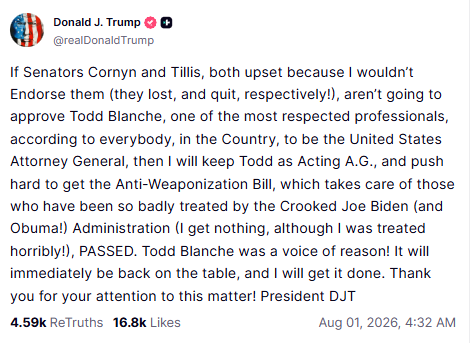
Then, even as Blanche was negotiating with Cornyn and Tillis to get them to vote in favor of his AG nomination by promising not to create the fund, on Saturday, Trump said hell yes he intends to make use of the fund — and added that he’d like Congress to pass a law establishing the same fund as a backup, in case the courts kill the one he negotiated with himself:

That’s a Trump post on Truth Social saying:

If Senators Cornyn and Tillis, both upset because I wouldn’t Endorse them (they lost, and quit, respectively!), aren’t going to approve Todd Blanche, one of the most respected professionals, according to everybody, in the Country, to be the United States Attorney General, then I will keep Todd as Acting A.G., and push hard to get the Anti-Weaponization Bill, which takes care of those who have been so badly treated by the Crooked Joe Biden (and Obuma!) Administration (I get nothing, although I was treated horribly!), PASSED. Todd Blanche was a voice of reason! It will immediately be back on the table, and I will get it done. Thank you for your attention to this matter! President DJT

Once again, Trump’s ability to shoot his allies in the back remains undefeated. Cornyn (especially) and Tillis have said that their hesitancy in approving Blanche had a lot to do with the weaponization fund. Blanche’s approval appeared contingent on a theatrical claim that the fund wasn’t going forward. To have Trump then come out and say “hell yes it’s going forward, even over the objections of Cornyn & Tillis” seems unlikely to appease those two Senators.

Tillis, for one, was not impressed:

That’s Tillis tweeting:

Despite comments as late as yesterday that the fund is dead, President Trump clearly intends to resurrect the payout pot for punks either by inappropriately establishing another bogus fund or pushing Congress to vote for a bill that the majority of Republicans in the Senate would be against.

It’s unfortunate that Todd Blanche, who I consider qualified for the job, will not be confirmed because of this reversal. Hopefully, we can resolve this by Tuesday.

Advertisement

It’s been quite clear that Trump has no intention of ever letting go of this slush fund, but it’s classic Trump that he couldn’t even keep his mouth shut long enough to pretend the fund wasn’t going forward and to get Blanche approved.

Which then brings us to the last bit that came out late Sunday: Blanche tweeting out that the DOJ had finally decided to “rescind” the weaponization fund in writing. Something he had refused to do over the past few weeks.

There are two separate letters there. The first “rescinds” the fund, while making an obnoxious snarky comment about “frivolous lawsuits” filed to challenge it:

A. The Attomey General’s May 18, 2026 Order establishing the Anti-Weaponization Fund (“Fund”) is rescinded and shall have no force or effect.

B. For the avoidance of doubt, nothing in this Order is intended to contradict or otherwise be contrary to prior representations by the Department of Justice that the Fund is not operative. No Members were appointed; no funds were transferred; no process for receiving claims was established; no claims were paid. Nevertheless, several frivolous lawsuits have been filed challenging the Fund, and at least one court has declined to dismiss those claims as moot. This Order establishes, beyond any doubt, that there is no Fund…

If the cases were “frivolous” then why would you need to rescind the agreement?

Advertisement

The second, with snide shots at Congress for not believing his statements, says a bit more on the matter:

Department of Justice Rescinds Anti-Weaponization Order and Addresses the May 19 Release

The Department of Justice today announced that the Acting Attorney General rescinded the May 18, 2026 Order that established “The Anti-Weaponization Fund.” Although the Acting Attorney General has repeatedly advised Congress through testimony, including under oath, as well as in written responses, that the Fund is not moving forward, and the Department has repeatedly represented to district courts that the Fund is not moving forward, today’s Order officially rescinds the May 18, 2026 Order.

Further, the May 19, 2026 Order regarding a mutual release of claims applies by its terms only retroactively. Additionally, the terms “Lawfare and/or Weaponization” in that Order were already defined in the Settlement Agreement as the use of government power “to target individuals, groups, and entities for improper and unlawful political, personal, and/or ideological reasons.”

The Acting Attorney General stands by all of his July 15, 2026 Senate Judiciary Committee testimony, including answers to questions asked by Senator Cornyn related to the scope and applicability of the May 19, 2026 Order. A transcript of the Acting Attorney General’s testimony is attached. He incorporates that testimony by reference, and restates that it is DOJ’s interpretation that the Order only has any effect, including on any release of claims, on the named parties in the lawsuit referenced in the Order.

Advertisement

This all seems pretty obviously designed to get Cornyn and Tillis off his back by saying “see?!? I’ve now put it in writing. Now shut up and vote to make me Attorney General.” And, who knows, it might work.

That’s even though nothing in there actually answers Cornyn’s actual question discussed above. The DOJ cannot single-handedly go back on this agreement. It was, we are told (including in the appeal from Trump on Friday), a private agreement between two distinct parties: Donald Trump and the Justice Department. As such “rescinding” it from just the DOJ side is meaningless since, as Blanche himself admitted to Cornyn, Trump can still try to claim in court that the settlement is valid.

And given Trump’s public statements about why he needs the fund, as well as his lawyers’ statement in the appeal that it tramples his rights to order him not to claim the settlement is valid in court… you’d have to be pretty slow not to pick up on what Trump intends here.

Also, notice what didn’t get rescinded. The May 18th order (creating the slush fund) is what he pretends is gone, but the May 19th order, which clears Trump, his family, and their businesses from IRS audits over past business practices remains. Blanche pretends that saying it “applies by its terms only retroactively” is a meaningful limitation, but that was always obviously the case. By all accounts, the Trump family books are a mess, and they likely owe the IRS a ton of money. And the Blanche announcement makes it clear that remains as is.

Advertisement

So, to sum it all up, Blanche has rescinded an order based on a settlement he can’t single-handedly rescind, to appease Senators whose votes he needs, while the President has made it clear he’s going to move forward with his fund no matter what.

The simple reality here is that we have a crooked President with his hand-picked henchman trying to do the bare minimum to appease a compliant GOP-run Senate, while the President himself can’t keep his own mouth shut long enough to even put up the pretend facade that there’s no corruption going on here.

Under any other President, this would be an impeachable offense. Here it was just another weekend under the Trump Presidency.

Advertisement

Filed Under: anti-weaponization fund, corruption, donald trump, john cornyn, kathleen williams, thom tillis, todd blanche, weaponization fund

Source link

Advertisement
Continue Reading
Click to comment

You must be logged in to post a comment Login

Leave a Reply

Tech

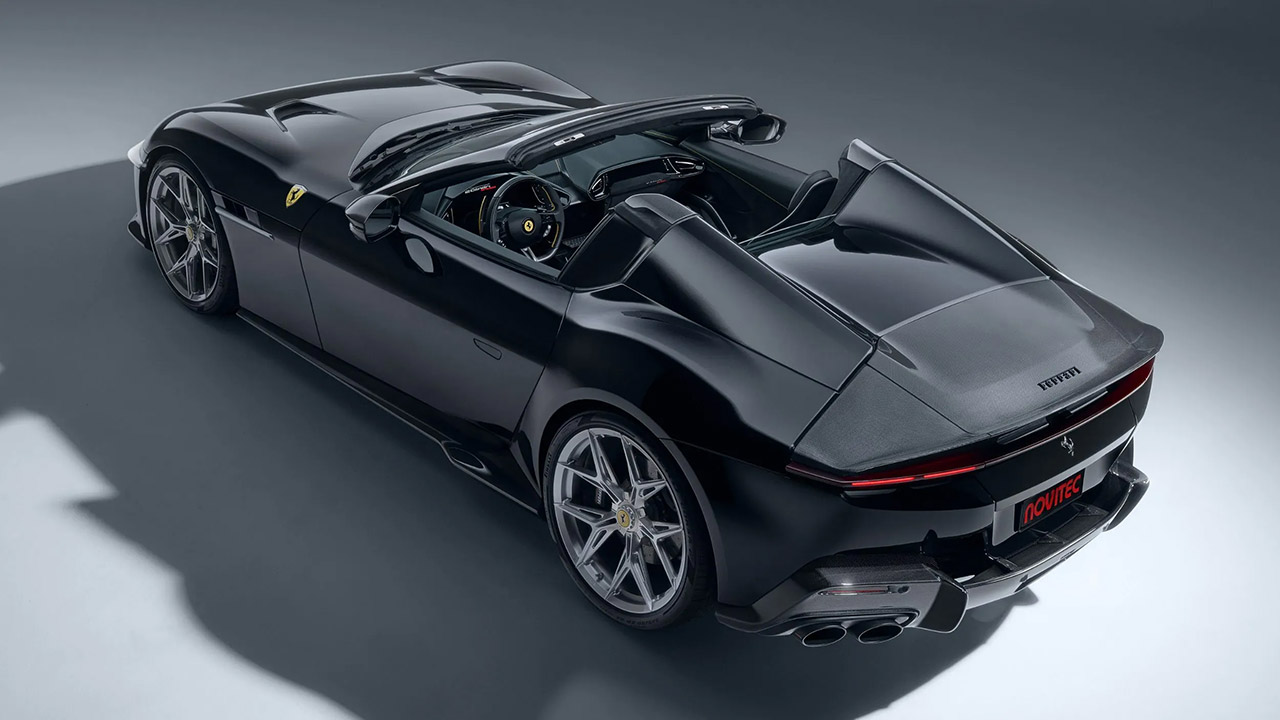
Novitec Unleashes a Louder, Lower Ferrari 12Cilindri Spider

Published

on

Novitec Ferrari 12Cilindri Spider
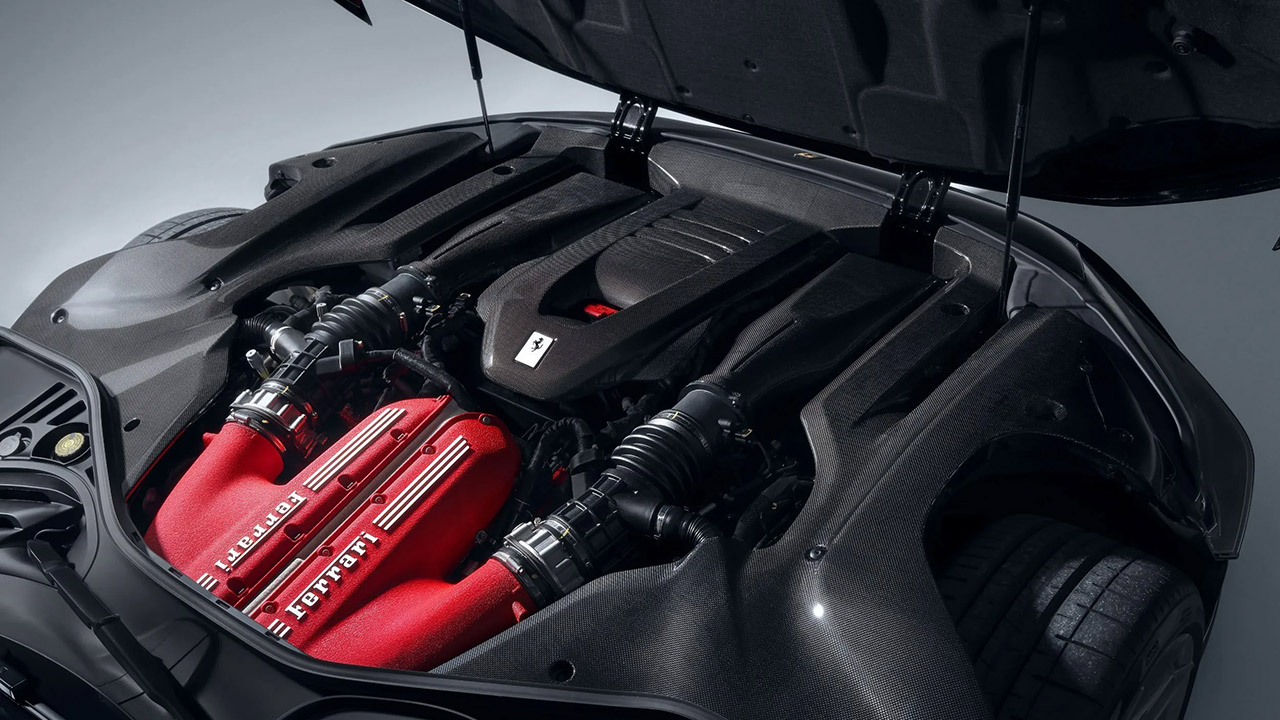
Ferrari’s 12Cilindri Spider already delivers one of the purest open-air experiences available today. Its long hood, short deck, and 6.5-liter naturally aspirated V12 create a classic front-engine layout that rewards drivers who want wind, noise, and mechanical drama in equal measure. Novitec has now applied its own set of carefully chosen upgrades that sharpen the car’s appearance, improve its stance, and most importantly give the engine a more assertive voice when the roof is stowed.


The kit includes a new high-performance exhaust system designed exclusively for this V12. The consumer can pick between stainless steel construction and a lightweight Inconel variant, which is the same material used in Formula One. The exhaust’s dynamic butterfly valves let the driver to adjust the sound to their mood, quiet it down for regular use, or turn it up for that unmistakable, sharp scream. You can also apply a 999 fine gold finish to the Inconel pipes, which improves heat dissipation and gives a distinct visual sparkle. Tailpipes are available in a variety of finishes to complement or contrast with the car, as well as insulated sports catalysts to significantly increase exhaust flow. This is where the exhaust system becomes more important in an open-top car like this. The V12’s natural intake note becomes a continuous companion, one you can enjoy every time you step behind the wheel instead of only hearing through the closed windows.


LEGO Speed Champions Ferrari 499P 77261
  • FERRARI RACE CAR SET – Build, display and recreate exciting racing action with the LEGO Speed Champions Ferrari 499P (77261) building toy for boys…
  • 1 DRIVER MINIFIGURE – Place the minifigure wearing an iconic red Ferrari outfit behind the wheel of this car toy to enjoy high-speed racing…
  • AUTHENTIC DETAILS – This Ferrari model features details inspired by the real-life, race-winning version of the car, including a rear wing, air…


Carbon fiber parts finished in high-gloss resin were employed to remodel the car’s bodywork. They’re all quite tastefully done and keep close to Ferrari’s original designs, so it’s an evolution rather than a radical shift. A front lip spoiler and covers for the side air intakes give the nose more purpose and improve airflow at higher speeds. Carbon coverings are also used on the hood outlets, trim panels under the front wheel arches, mirrors, and rocker panels. At the back, there’s a three-piece lip spoiler and a matching diffuser, which work together to generate downforce without making the car look garish or aggressive in profile. Under the hood, exposed carbon panels and dual air-filter boxes help transform the engine bay into a showcase.

Novitec Ferrari 12Cilindri Spider
These complement the new forged wheels, which are truly eye-catching. The NF12 is a novel design developed with Vossen, with five spokes that taper off into a Y shape and a centrelock-style hub cover. The front wheels are fitted with 21-inch 275/35 tires, while the rears get 22-inch 325/30 rubber. The staggered sizes fit well into the arches and assist to highlight the car’s athletic lines. Being available in a variety of colors and surface finishes definitely helps them blend in with the rest of the car. On top of the wheels, you can have Novitec sports springs, which will lower the car by 30mm, helping to tighten the handling response and giving the car a more grounded appearance when parked.

Novitec Ferrari 12Cilindri Spider
Inside, Novitec has completely retrimmed the cabin in leather and Alcantara, with options ranging from a plain black interior to a fully bespoke affair. There are no changes to the car’s chassis here, only some new materials to complement the more aggressive exterior look. The 6.5-liter V12 engine remains intact, producing 830 horsepower and 678 Nm of torque. There has been no tinkering of power figures, only a concentration on getting the sound correct, keeping the heat under control, and getting the chassis and body improvements exactly right. The eight-speed dual-clutch transmission and rear-wheel drive layout are all typical Ferrari features.
[Source]

Advertisement

Source link

Continue Reading

Tech

The 16K Display That Ate Las Vegas

Published

on

You may have a 4K television. Perhaps you have even bought an 8K screen, despite the shortage of things worth watching in 8K. A 16K display is, today, a rarity. But even when those eventually become commonplace, yours probably will not cover 14,900 square meters, rise 73 meters into the air, or wrap over your head and behind your peripheral vision.

That is approximately what happens inside Sphere in Las Vegas. The venue’s interior display is quoted as having a resolution of 16K by 16K and an area of 160,000 square feet, or about 3.7 acres. Unlike most enormous movie screens, it is not illuminated by a projector. The entire surface is a direct-view LED display: an immense, curved video wall assembled from tens of thousands of smaller pieces.

After seeing The Wizard of Oz at Sphere, however, the most interesting part was not simply the screen’s size. It was how thoroughly the screen could disguise itself.

Where Did The Theater Go?
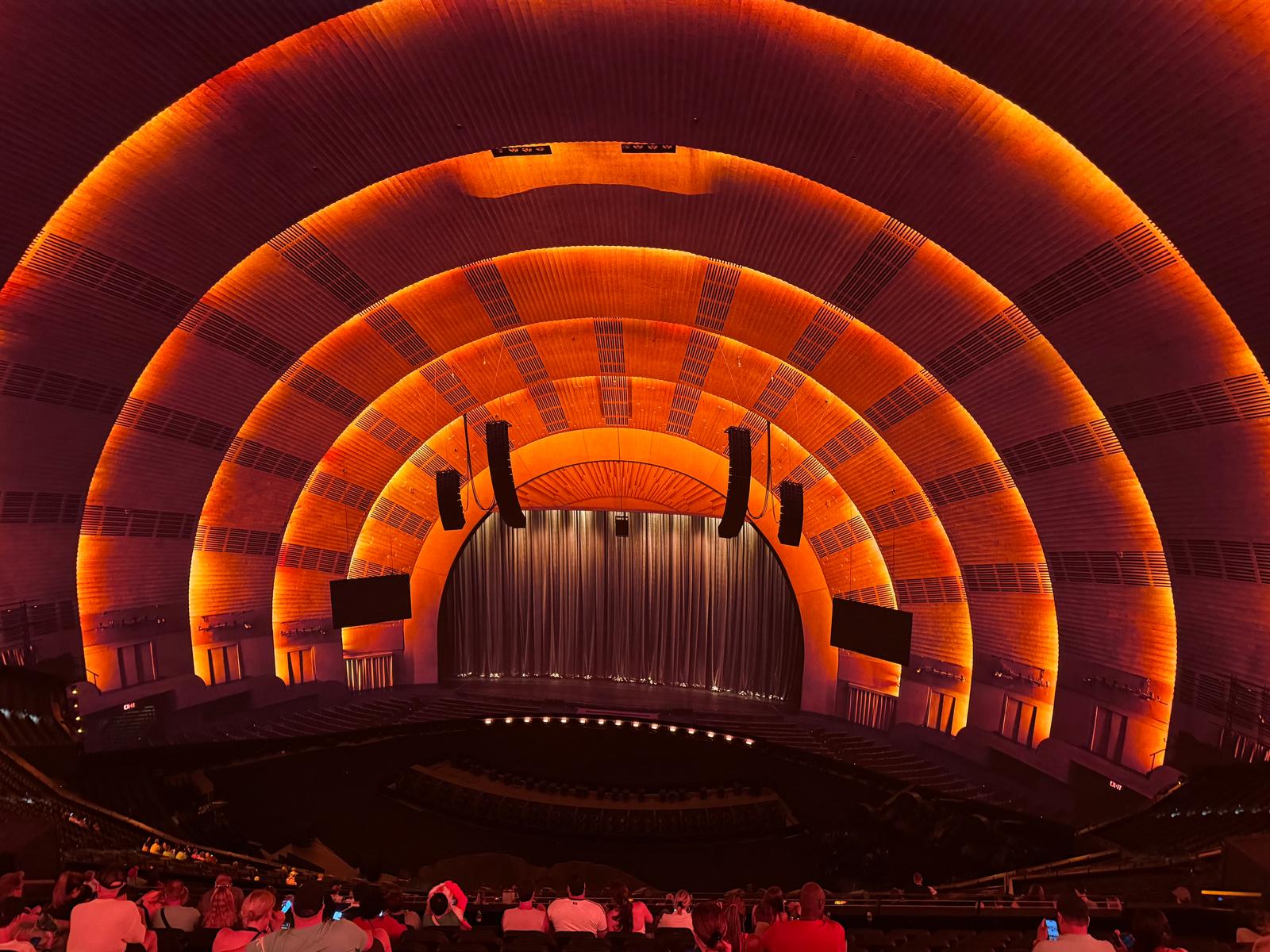
Radio City or the Sphere? (It is the Sphere; photo courtesy [DP])

Before the presentation began, the auditorium appeared to have a conventional architectural ceiling. Great orange ribs curved over the seating, while ventilation grilles, suspended loudspeakers, lighting fixtures, curtains, and video monitors completed the illusion. It looked like the Radio City Music Hall’s proscenium. Then the show started — and the apparent theater completely disappeared. The speakers, the TVs, even the stage.

The obvious first conclusion was that the LED surface must be optically transparent, allowing the audience to see the real roof behind it until the pixels illuminated. That explanation was attractive because Sphere’s audio system really is installed behind the display, and the surface must allow sound through it.

Advertisement

It was also, apparently, wrong. The only explanation that makes sense is that the ceiling, ribs, grilles, speakers, and monitors were already being displayed by the screen. It was like a holodeck impersonating a physical theater interior. When the Oz material began, the system simply replaced one complete visual environment with another.

That’s what happens when a display fills nearly all of your useful visual field. A normal screen announces itself with a bezel, a wall, or at least a clearly visible edge. Sphere’s display extends upward and around the audience, removing many of those references. Give the image credible perspective, texture, shadows, and familiar architectural details, and the brain accepts the pixels as a room.

The same effect makes the Oz landscapes seem less like scenes displayed in front of the audience and more like places into which the auditorium has been inserted. Of course, there are more special effects. For The Wizard of Oz, there is wind and smoke, along with paper leaves, flower petals, and foam-rubber apples that fall from the sky. All of this makes it even more immersive.

Advertisement

Not Your Standard 16K Monitor

Calling it “16K” is not exactly untruthful, but potentially misleading. Consumer display resolutions normally describe a rectangular raster. A 4K UHD television has 3840 by 2160 pixels, or about 8.3 million pixels. An 8K set has four times as many, at roughly 33 million.

A literal 16,384-by-16,384 image contains about 268 million picture locations, but that’s not how Sphere is built. Sphere describes its interior display plane as 16K by 16K, but that does not mean it is equivalent to a square desktop monitor with a neat, uniformly spaced Cartesian grid. It is a custom media surface with complex curvature and geometry, driven as one enormous canvas.

Sphere says the screen reaches 240 feet high and wraps up, over, and around the audience. SACO, the company responsible for the LED technology, describes the interior as the world’s highest-resolution LED screen and says it has more than 120 times the resolution of an HDTV.

Advertisement

Published numbers vary slightly depending on the source. One source describes approximately 64,000 SACO LED tiles, while structural contractor Seele refers to approximately 65,000 LED screens or frames. The difference may be terminology, rounding, or the boundary between the LED tile and its mechanical carrier. Either way, this is clearly not a single panel that arrived in the world’s largest shipping crate, but rather was built on-site.

The surface is assembled onto a precisely engineered secondary structure. Seele says it created 839 facet units containing approximately 45,500 custom structural components. Those facets establish the overall geometry and give the LED hardware suitable mounting points while maintaining alignment across the enormous screen wall.

In other words, the apparent smooth curve is made from many accurately positioned pieces. At the intended viewing distance, the facets and individual emitters merge into a continuous image.

Feeding The Beast

Foam apples rain down on the audience during one scene.

Building the display is only half the problem. The other half is getting a quarter-billion-pixel-class image onto it up to sixty times per second without tearing, losing synchronization, or pausing while somebody clears a buffering dialog.

The public description of the playback chain resembles a broadcast plant crossed with a high-end video wall. Pre-rendered content is kept on network-attached storage and streamed to dozens of 7thSense media servers. Each server produces 4K video at 60 frames per second, with the streams distributed using the SMPTE ST 2110 professional-media-over-IP standards. Pixel processors drive the appropriate regions of the display.

Advertisement

Hitachi Vantara says the storage system can deliver data at up to 400 GB/s with less than five milliseconds of latency. (At least it did for Postcard from Earth; it could be capable of more, for all we know.) The material is handled using 12-bit color and uncompressed 4:4:4 chroma sampling. That does not necessarily mean every show continuously consumes the maximum quoted bandwidth, but it provides some sense of the infrastructure needed to treat the whole venue as a dependable display rather than an interesting laboratory experiment.

Content also has to be geometrically transformed for the screen. An image that looks correct on a flat monitor would be badly distorted if copied directly onto the curved surface. The production pipeline therefore needs a detailed model of the display and the audience’s relationship to it.

Stretching Oz Beyond The Frame

The Wizard of Oz presents an additional problem: the 1939 film was photographed for a nearly square 1.37:1 frame. Sphere’s interior is absolutely not 1.37:1 or even close.

Advertisement

Simply magnifying the original would waste most of the display. Cropping it to fill the screen would remove the actors and much of the composition. Instead, Sphere Studios expanded the film’s world beyond the photographed frame, using Google AI tools along with conventional restoration, compositing, animation, and visual-effects work.

The original photography remains central to the presentation, but scenery, skies, crowds, buildings, and environmental details extend far outside the old frame. Sphere says the project used AI to enhance characters and expand scenes while attempting to preserve the performances and familiar imagery.

This is more complicated than expanding a still photograph. The additions must remain temporally consistent as the camera and characters move. A tree cannot change shape from frame to frame, and a newly invented Munchkin cannot grow an extra arm whenever the model becomes distracted. The generated material also has to survive at extraordinary scale, where a small artifact can become several meters wide.

Advertisement

Whatever one thinks about altering a classic film, it is difficult to imagine adapting this particular source material to this particular display without reconstructing substantial portions of the unseen world.

Of course, not everyone is thrilled. If you hated colorizing black-and-white movies, this will probably set you off. Even the original Star Trek got new digital effects.

What Happens When A Pixel Dies?

With roughly 64,000 or 65,000 LED assemblies, failures are inevitable. We couldn’t find much public information about Sphere’s exact maintenance procedure, but we can infer some probable scenarios from other large LED systems. Big systems generally report power, temperature, communications, and controller faults automatically. We would imagine that Sphere can do this, too. Then, technicians can also probably display red, green, blue, white, black, and low-gray test patterns while cameras or human observers look for dead, stuck, or miscalibrated pixels.

A single failed subpixel may be invisible from most seats during moving content. A stuck-bright pixel in a dark sky would be much more conspicuous, as would an entire failed tile or data branch.

Advertisement

Seele says the screen structure includes 229 accessible panels, suggesting that maintenance access was designed into the system rather than left to exceptionally adventurous climbers. A failed field-replaceable assembly could be swapped, repaired on a bench, and returned to the spare inventory.

The replacement would then need calibration. LEDs from different production batches — and LEDs of different ages — do not produce precisely identical brightness or color. A technically functional replacement could appear as a visible rectangle unless the controller corrected its red, green, and blue response, gamma, and low-level output to match its neighbors.

Curiously, this may be one of the hardest features to appreciate during a show: tens of thousands of modules are working together, yet the audience perceives no modules at all.

The Screen That Pretends Not To Exist

Sphere’s specifications are impressive, but resolution alone does not explain the experience. Spread 16K pixels across a screen tens of meters high and the pixel density is far below that of a phone. The system works because the pixel pitch, viewing distance, brightness, content, architecture, and human visual system were engineered together using a lot of science.

Advertisement

While the Wizard of Oz was an impressive feat, we hope they’ll bring us something like 2001: A Space Odyssey. Or maybe a triple feature with shorts from Star Trek, Star Wars, and Avatar. Sure, the rights to pull that off would take a team of lawyers, but we can dream, can’t we? What movie would you like to see on a giant screen like Sphere? Or would you only see an original production? Any of you out there work behind the LED curtain?
Source link

Advertisement
Continue Reading

Tech

Want The Best Bass Out Of Your Headphones? Here’s What To Look For

Published

on

Try these adjustments before you go buy a new pair.

Getting powerful bass from your headphones doesn’t always mean buying new ones. In many cases, it’s more about tweaking some settings on the pair you already have.

But better bass doesn’t just mean more of it. The goal isn’t to make your music sound like a car trunk rattling at a stoplight. It’s about a deeper, punchier bass that doesn’t overpower everything else. Here are a few simple ways to do that.

Advertisement

Check your fit

Before we dive into settings, make sure your headphones have a good seal. Without that, bass is often the first casualty.

The type of headphones makes a difference. Closed-back headphones and earbuds with a tight seal are usually the best options. Open-back cans can be among the most natural-sounding, but they aren’t the best choice for punchy bass. And while open-fit earbuds like the AirPods 4 and open-ear options like the Shokz OpenFit Pro have much better bass than older models, they still aren’t the best place to start.

If you use earbuds with interchangeable tips, try a few different sizes. Tips that are too big or small can thin out the low end, making music sound weak. Foam tips can also help, since they often create a tighter seal than silicone. Software-based fit tests, like the one Apple offers for AirPods Pro, can also give you a good idea of what works.

Advertisement

If you use over-ear headphones, make sure the cups are comfortably covering your ears. And be mindful of things like glasses, hair or worn-down pads that could compromise your seal. Even if it’s something you can’t change, at least you’ll be aware of one factor limiting the sound.

EQ: Start with the headphone app

One common mistake is stacking equalizer (EQ) settings. For example, boosting the bass in both Spotify and the Sony Sound Connect app can lead to garbled, distorted audio. A good rule of thumb is to turn off all EQ settings, then start making gradual adjustments in the headphone app.

You’ll want to opt for the music app’s EQ if your headphones don’t have one in their companion app or if you want an adjustment that applies only to one app.

Advertisement

Unsure if your music app’s EQ is on? You can check Spotify’s settings at Settings and privacy > Playback > Equalizer. (On Android, Spotify’s EQ option may open the system audio settings instead.) For Apple Music, go to Settings > Apps > Music > EQ. (Apple’s are labeled by genre rather than a visible EQ curve.) Unfortunately, YouTube Music relies on the phone’s EQ settings on Android and still doesn’t offer an in-app EQ on iOS. Tidal doesn’t have an EQ option on either platform.

Once you’re in the headphones app, avoid using “bass boost” settings, which can bloat the bass in ways that might sound good for a few minutes but will quickly lead to fatigue. Instead, start with the EQ curve.

Advertisement

Understanding the EQ curve

The EQ curve lets you tune specific parts of the frequency range, changing the sound’s balance. Bass is the low frequencies (the left side of the graph), mids carry most vocals and instruments (the middle) and treble handles the high-pitched sounds (the right side). Moving the curve up or down raises or lowers the volume for that part.

We’re focusing on the left side. The far left (roughly 20 to 60 Hz) controls the deepest rumble, and the area just to the right of that (60 to 150 Hz) affects punch and weight. Go much higher than that, and you’re drifting out of bass territory and into the low mids.

Keep in mind that not every EQ graph will offer fine-grained control. Some apps only give you a few broad bands instead of a full multi-point curve. Apple’s new EQ curve for supported H2-chip AirPods, for example, uses three controls (one apiece for low, mid, and high) rather than a more detailed graph.

Advertisement

Adjusting the EQ

An ideal bass EQ isn’t always one sharp bump across the entire left side of the graph. A small lift down low might sound better than jacking up everything at once. Again, the goal is to make the bass sound more impactful, not skull-shaking.

Watch out for bass that dominates the mids and highs. The best approach is to start with a small adjustment, listen to a few songs in different genres (at a typical listening volume) and only add more if you need it. If it starts blocking out the vocals or muddying everything else, pull it back. Incremental wins the day here.

Play with different genres that span your listening habits. If a setting only makes one song sound better, it probably isn’t worth it. Also, remember that what might sound good on a quick test may not be the best choice for long listening sessions.

If you frequently switch between different listening modes, you might want to keep that in mind when testing EQ settings. On some headphone models, normal, noise-canceling and transparency modes could lead to subtle differences in bass response. Ditto for the spatial audio tricks found on Apple’s AirPods and Bose’s QuietComfort Ultra. Test the EQ in the modes you use the most.

There’s no one-size-fits-all setting. The key is to experiment with the curve, try a few songs and aim for bass that’s powerful but under control. And trust your impressions over longer sessions, not just a few seconds.

Advertisement

If all else fails, go shopping

Source link

Advertisement
Continue Reading

Tech

Energizing A Vacuum Tube Flip-Flop Module Of The IBM 604

Published

on

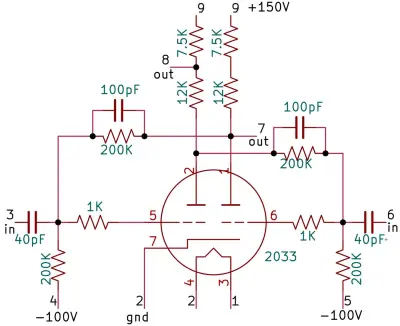
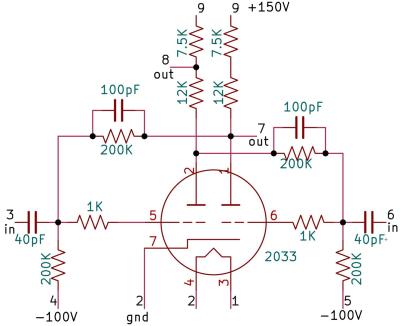
Reverse-engineered schematic of the IBM 604's TR-3 module. (Credit: Ken Shirriff)
Reverse-engineered schematic of the IBM 604’s TR-3 module. (Credit: Ken Shirriff)

Taking a break from ogling microscopic features in Intel’s semiconductor processors, [Ken Shirriff] is back to instead poking at decidedly macroscopic pluggable modules from the 1948 IBM 604 Electronic Calculator. This time around it’s one of the so-called trigger modules in the form of the TR-3, which uses a flip-flop circuit to implement the timing signals and pulses that made the 604 work.

This differs from the thyratron module that we covered previously. A thyratron is a high current switch and rectifier, which is useful more for the periphery of the computer system. These TR-3s on the other hand were used to implement the basic logic circuits, even if a flip-flop by itself seems rather boring, being just a circuit that toggles between two states.

In this TR-3 module we find a 2033 dual triode design which thus increases density by having the two inverters of the flip-flop in the same tube. The rest of the module is taken up by the requisite capacitors and resistors that complete the circuit. After wiring up this original module, [Ken] was able to make it trigger somewhat reliably, requiring a stable input trigger.

Notable is that in the IBM 650 from 1954 this flip-flop circuit was abandoned in favor of one based on diode logic, presumably to use more reliable Boolean logic instead of the much fussier analog interactions. Naturally, in the first transistorized computers the use of diode-transistor logic (DTL) was exceedingly common, so this makes a lot of sense.

Advertisement

Source link

Advertisement
Continue Reading

Tech

Sketching Temporary Circuits With A Light-Triggered Floquet Topological Insulator

Published

on

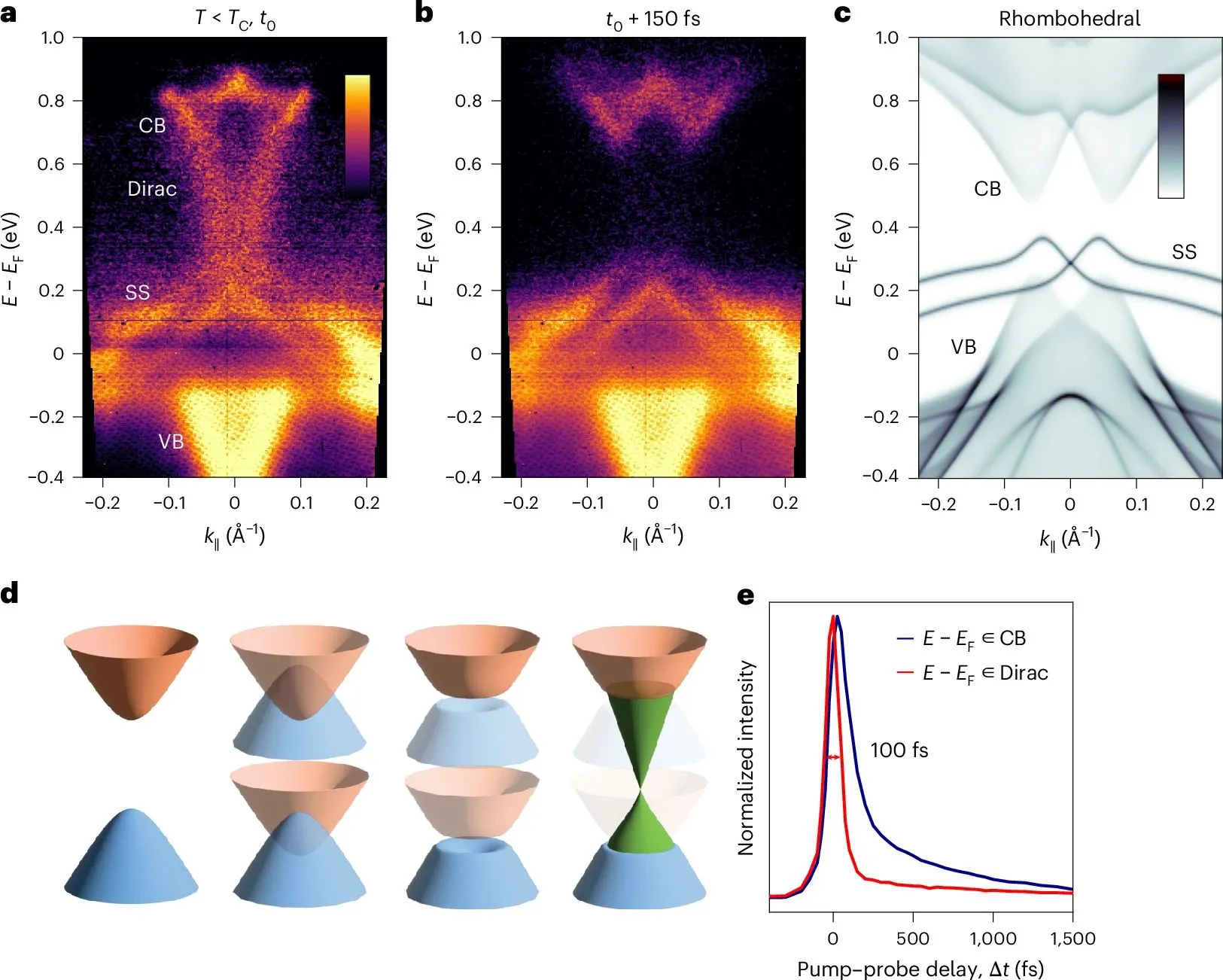
In semiconductor technology, a base material like silicon is permanently modified to induce certain electrical behavior. In comparison a topological insulator material could be used to create temporary circuits using something like light exposure. An example of this is the Floquet topological state, which has long been theorized, but is now claimed to have been demonstrated in SnTe semiconductor material, per a paper by [F. Chassot] et al. in Nature Physics.

The concept of topological insulators was first proposed in 1985, but proving their existence was hard. Recently photonic Floquet topological insulators (PFTIs) have gained interest, with experiments by [Qian Ma] et al. in 2025 as well as other teams confirming aspects of the theory.

This recent publication by [Chassot] et al. would thus confirm that optical control of topological insulators is thus possible. At the core of this effect is the band inversion that results from the light pulses, with the change in conduction being very brief, essentially for as long as the femtosecond pulses were maintained.

Advertisement

Although still very much in the fundamental research phase, the research on these electronic topological insulators offers an interesting look at potential new technologies, much like the field of photonic topological insulators does for photonics.

Source link

Advertisement
Continue Reading

Tech

Amazon Is Developing A Warhammer 40,000 Animated Show

Published

on

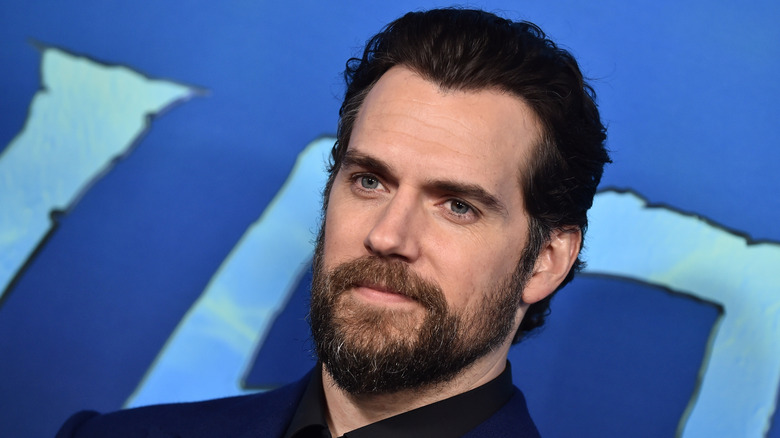
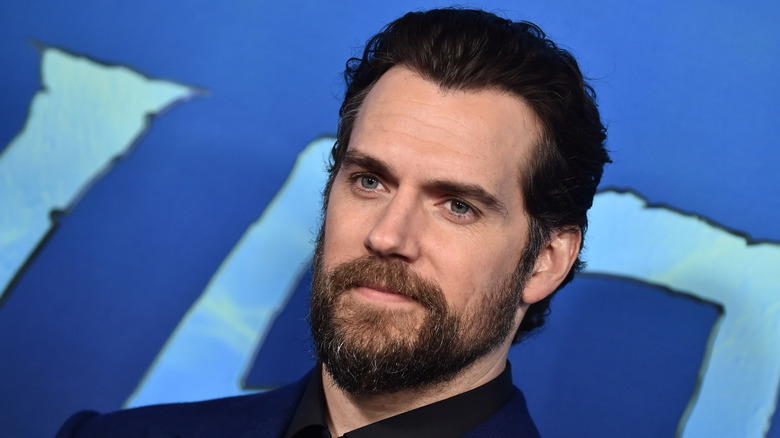
And of course, Henry Cavill is involved.

Warhammer 40,000 is getting an animated TV show. Variety reported that Amazon MGM Studios, Blur Studios and Games Workshop are developing an adaptation of the sci-fi franchise. The new project will be a spinoff of the Secret Level episode based on the game. Dave Wilson directed the Warhammer 40K episode of that Prime Video anthology show, and he will serve in the same role for the new animated show as well as being its co-creator. Famed Warhammer 40K fan Henry Cavill, who is already involved in live action adaptations of the game, has been attached as an executive producer.

Wilson isn’t the only talent from Secret Level to join this adaptation. Creator Tim Miller will also be an executive producer for the upcoming animated project and Blur Studios, which Miller co-founded, helped produce the anthology. Each installment of that show was based on a different video game, meaning even the short-lived Concord has been immortalized on (CG) film.

Games Workshop, which makes the tabletop wargame, shared a few updates about the live-action projects during a recent financial report. It has apparently been slow-moving, with the creative team only now moving toward penning a script several years after Amazon inked its deal for the rights to the property. CEO Kevin Rountree also confirmed Cavill’s continued involvement, since fans had worried that a lack of updates might have signaled the actor’s departure.

Advertisement

Source link

Advertisement
Continue Reading

Tech

Snap CEO sidesteps Specs preorder questions on Q2 earnings call

Published

on

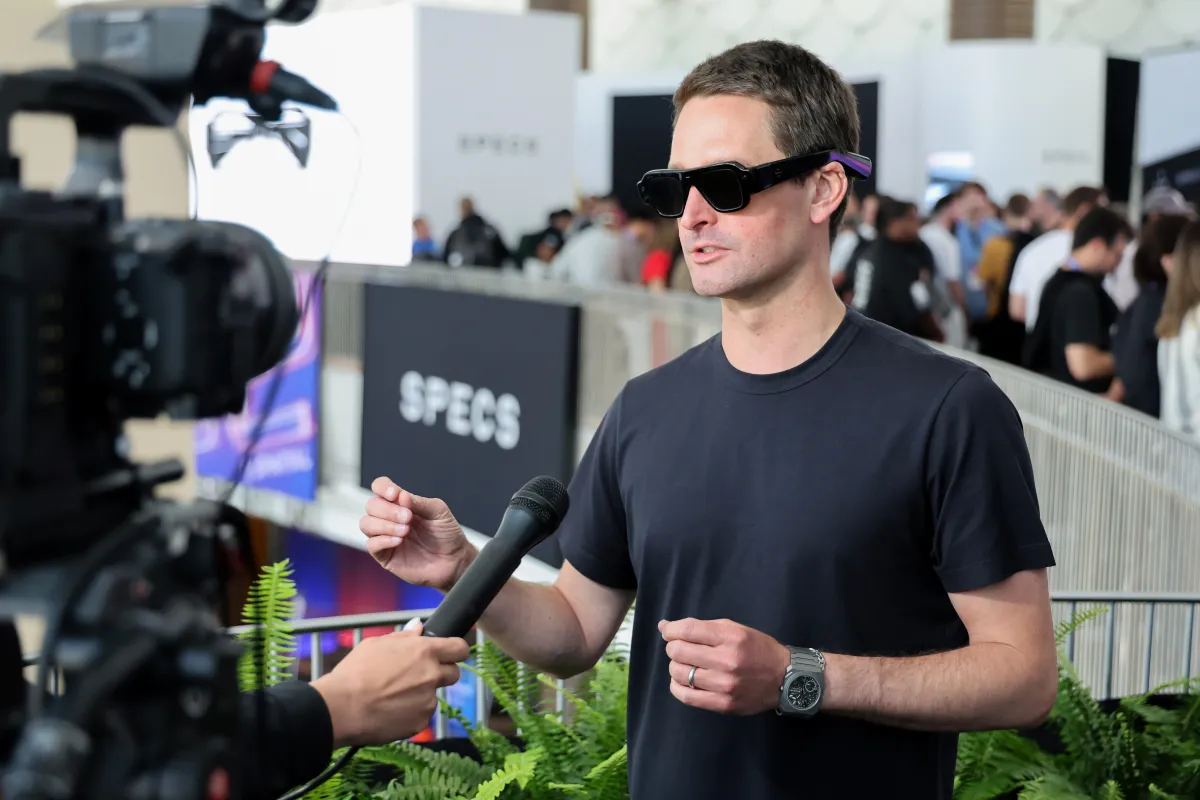
Snap CEO Evan Spiegel sidestepped investors’ questions about preorder demand for the company’s long-awaited Specs smart glasses during Monday’s earnings call, just weeks before the device’s September launch event.

“What we’re hearing from folks is really that they want to try Specs,” Spiegel told investors. “It’s obviously a high consideration purchase at $2,195. Obviously, developers and folks who are familiar with the platform really understand it and understand the technical leaps we’ve made with this generation. I think for the broader public and consumers, it’s going to be really important for folks to go hands-on. Our upcoming launch event will be an important sort of starting point for that consumer-oriented journey.”

The company unveiled Specs in June after spending more than a decade developing the device. The wearable’s $2,195 price tag is significantly higher than most Meta Ray-Ban smart glasses, which start at around $350, but lower than Apple’s Vision Pro, which starts at $3,500.

Investors also pressed Spiegel on why he believes Snap’s strategy is financially viable for a company of its size, why it chose to go it alone rather than partner with another company, and what gives him confidence that the company can compete with Apple, Meta, and Alphabet.

Advertisement

Spiegel responded that Snap believes the long-term opportunity to develop the next computing platform is “enormous.”

“I think what some folks maybe don’t understand yet, especially because Specs are so new and we’re really the first mover in this category, is how difficult the product is to execute from a technical perspective,” Spiegel said. “When we started innovating in the social space, we were a late entrant. So, most of the apps at the time, whether it was Facebook or Instagram or Twitter, were already in existence, and we had to really innovate to continue to grow. What’s so unique about this opportunity for us is really that we’re a first mover, and that really plays to our strengths as an innovator.”

When asked about product-market fit, Spiegel said it will likely be closer to the end of the decade before the company sees mass-market consumer adoption.

“I think things, for example, like weight and cost are going to have to come down to see you know unit volumes really meaningfully pick up.” But we do have, I think, a real advantage here in that developers have been building on the Specs platform now for several years.”

Advertisement

When you purchase through links in our articles, we may earn a small commission. This doesn’t affect our editorial independence.

Source link

Continue Reading

Tech

An AI-Supervised Remote Exam Went So Badly That 58,000 Students Must Retake It

Published

on

An anonymous reader quotes a report from Ars Technica: Earlier this summer, nearly 160,000 applicants took the entrance exam for UNAM, Mexico’s largest university. For the first time, they did it completely remotely, using a “lockdown” browser and AI-powered webcam proctoring software, over several weeks from late May through early June. It was a disaster. When exam results came in, they bore little resemblance to past results, especially at the top. Between 2021 and 2025, 3.5 percent of test takers scored 100 or more on the 120-question UNAM test. This year, 16.3 percent did so. The story was even worse at the highest of the high end. Between 2021 and 2025, 0.9 percent of test takers scored 110 or more; this year, 5.5 percent did so.

The surge in top scores led to accusations of widespread cheating, and UNAM appointed a commission of experts to investigate the situation. The group was given the unwieldy name “la Comision Tecnica de Personas Expertas para la Revision del Proceso de Seleccion de Ingreso a Licenciatura para el Circlo Escolar 2026-2027/1,” and it has just submitted its recommendations. The commission believes that the best path forward, given all the concerns, is to administer a “control exam” — that is, applicants will have to sit for another test, and they will do so in person.

This control exam will apply not only to those who secured a spot at UNAM based on this year’s test but also to everyone who would have been admitted based on minimum successful scores in their program of study since 2021. About 58,000 people could be affected, and places at UNAM will now depend on the results of the new test. (Details on the control exam should appear soon; classes are currently scheduled to begin on August 10, so everything will have to move quickly unless the school decides to delay classes.) According to Gaceta UNAM, the school’s official news publication, the university rector has apologized to honest applicants, since they will now have to prepare for and take the test again despite doing nothing wrong. Still, the control exam is “necessary to give certainty and guarantee equity in access,” the rector added.

Source link

Advertisement
Continue Reading

Tech

iPhone to Windows clipboard sharing coming to iOS 28 in the EU

Published

on

If you’ve ever wanted to copy something on your iPhone and paste it on your Windows PC, the feature is coming in a fall 2027 release of iOS 28 to users in the EU.

Third-party developers can request interoperability features to be developed by Apple via a web portal. If the request is deemed possible it can take anywhere from six months to eighteen months to build the feature and submit it for release.

One such request was made by Microsoft (Request ID: FB22329535) for cross-device clipboard sharing access between iOS and Windows. The request was submitted on March 25, 2026, and after being reviewed by Apple, was approved on June 26, 2026.

Microsoft’s request argued that consumers expect features like clipboard sharing between devices to “just work.” Currently, the solution requires third-party apps to connect the devices, the iOS app to be open in the foreground, and a permission request for each cliard share.

Advertisement

The request suggests that if a solution is developed, it would allow copying from iPhone and pasting to Windows, or vice versa, without needing complicated apps or permission structures. Microsoft shared that it expected the feature would maintain user control and privacy.

Apple’s system shows that the request was picked up on March 31, and after an initial assessment, moved up for further evaluation on April 27. It is interesting to observe Apple’s systems at work, as this goes beyond simple app review or other systems.

A peek behind the DMA curtain

The EU DMA demands that Apple allow developers to request interoperability, and Apple has made it mostly transparent for anyone to view the goings-on. Some requests show as “Confidential,” while others, like Microsoft, show the developer’s name.

Since Apple is fundamentally altering how its OS operates, it is expected for any request to take some time. The clipboard sharing feature seems to fall into the longest-expected timeline of around 18 months.

Advertisement

While Apple says in these submissions that the features will be built for the EU only, there is always the chance they could be released globally. Emulation, for example, was brought about by DMA complaints, but was enabled worldwide.

If Apple builds the shared clipboard system for Windows, it could always make its way to US users, especially if regulators push for it.

iPhone to Windows clipboard sharing

Apple says the solution it has come up with is similar to the Accessory Notifications and Accessory Live Activities frameworks introduced in iOS 26.5 for the EU. Developers will need to implement AccessorySetupKit to enable a one-time permission prompt for users to pair an accessory and share the clipboard.

Of course, the timeline and implementation are Apple’s decision. Whether or not the end result, or the timeline, satisfies Microsoft and the EU is another question entirely.

Advertisement

While Apple didn’t say it explicitly, the feature will be ready for a version of iOS 28. Since it explicitly said “fall” 2027 for the solution’s arrival, it may not be available in the point zero release, which begins beta testing in June.

Source link

Advertisement
Continue Reading

Tech

Daily Deal: Rosetta Stone Sapphire 1-Year Subscription

Published

on

Rosetta Stone Sapphire combines over 30 years of language-learning expertise with immersive technology designed to help you speak naturally and confidently in real-world situations. Trusted by millions of learners worldwide, Sapphire brings together structured lessons, pronunciation coaching, conversation practice, flashcards, and personalized learning tools in one complete platform. Built around Rosetta Stone’s proven Dynamic Immersion method, Sapphire teaches you through context, imagery, listening, reading, and speaking instead of relying on direct translation or memorization drills. As you progress through bite-sized lessons, the platform gradually develops your vocabulary, grammar, pronunciation, and conversational confidence through practical everyday scenarios. With access to 25 languages, Rosetta Stone Sapphire also includes advanced learning tools like TruAccent speech recognition, immersive Chat Missions, personalized Sapphire Studio activities, and 500+ flashcard sets covering travel, business, hobbies, culture, sports, and more. Whether you’re preparing for travel, career growth, school, or personal enrichment, Sapphire helps you build practical language skills designed for real conversations. A one year subscription is on sale for $127.20.

Note: The Techdirt Deals Store is powered and curated by StackSocial. A portion of all sales from Techdirt Deals helps support Techdirt. The products featured do not reflect endorsements by our editorial team.

Source link

Advertisement
Continue Reading

Trending

Copyright © 2025