
Crypto World
Base Passes Solana in Curated Capital Milestone (Flash News)


Coinbase’s Base has surpassed Solana in terms of capital stored in curated vaults, with over $1.6 billion in such assets or 22.5% of the entire market share.
Ethereum remains the undisputed leader with almost $3.5 billion (or 48.2% of the entire market share), while Base has become the largest layer-2 venue for such capital, according to Sentora.
Ethereum holds $3.46B of curated vault TVL and Base holds $1.62B. Together they represent 70.7% of the category.
Base now carries more than three times the risk curator TVL of Solana, making it the largest L2 venue for curated capital.
Learn more: https://t.co/pUrFvG8nrp pic.twitter.com/HAFgdFBczJ
— Sentora (@SentoraHQ) August 4, 2026
The data shows that Solana remains far behind with less than $550 million. Binance Smart Chain is close by, while the other networks that make up the rest of the top 10 include Plasma ($144 million), Monad ($119 million), and so on.
Curated Capital refers to deposits in DeFi vaults that are actively managed by specialized risk curators according to predefined rules and risk frameworks. It offers more structured, transparent, and accountable risk management than plain pooled lending, especially for stablecoin yield strategies.
The post Base Passes Solana in Curated Capital Milestone (Flash News) appeared first on CryptoPotato.

Crypto World
The bitcoin (BTC) price has plenty of reasons to freak out, yet volatility remains low: Crypto Daily
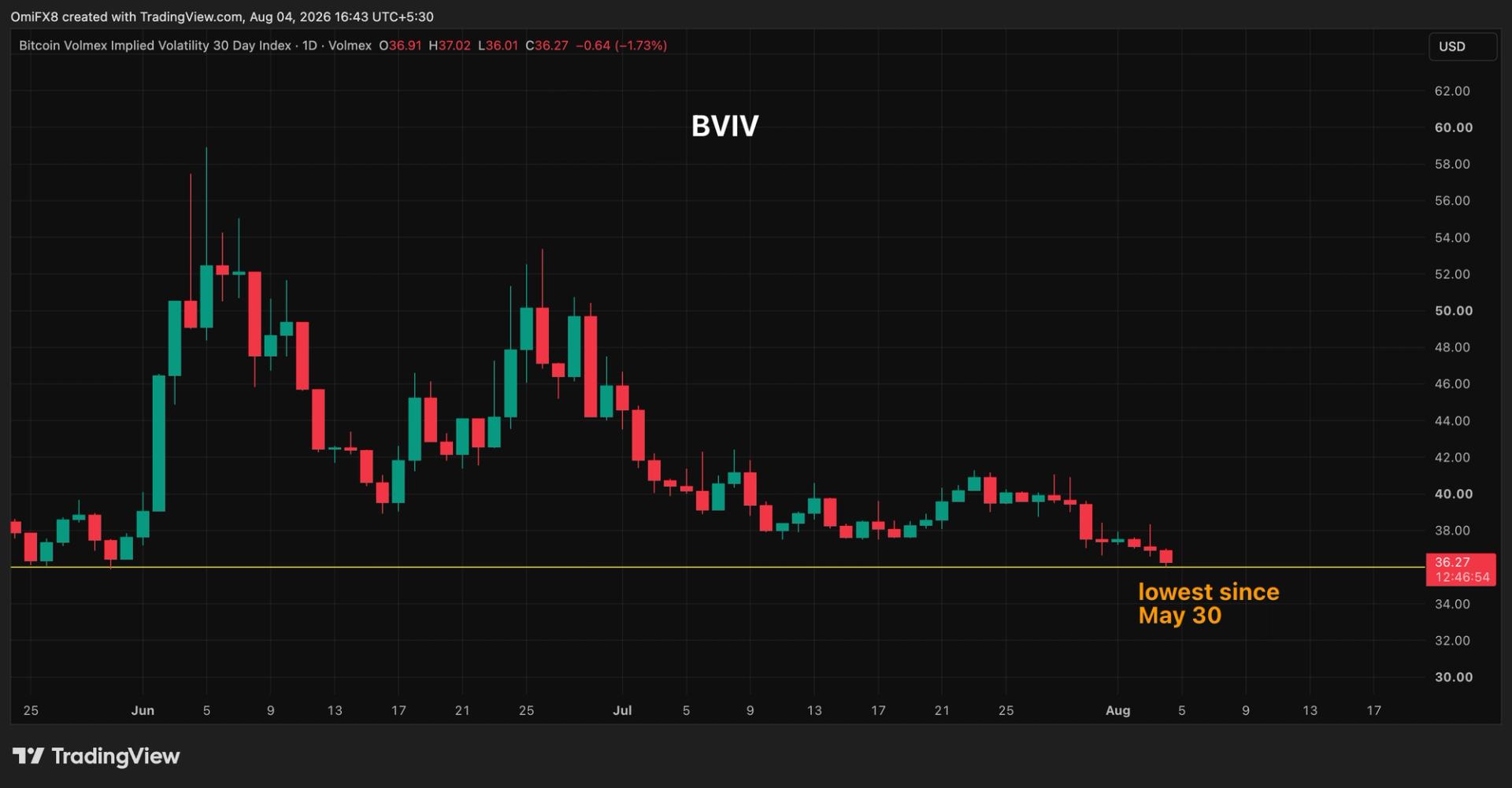
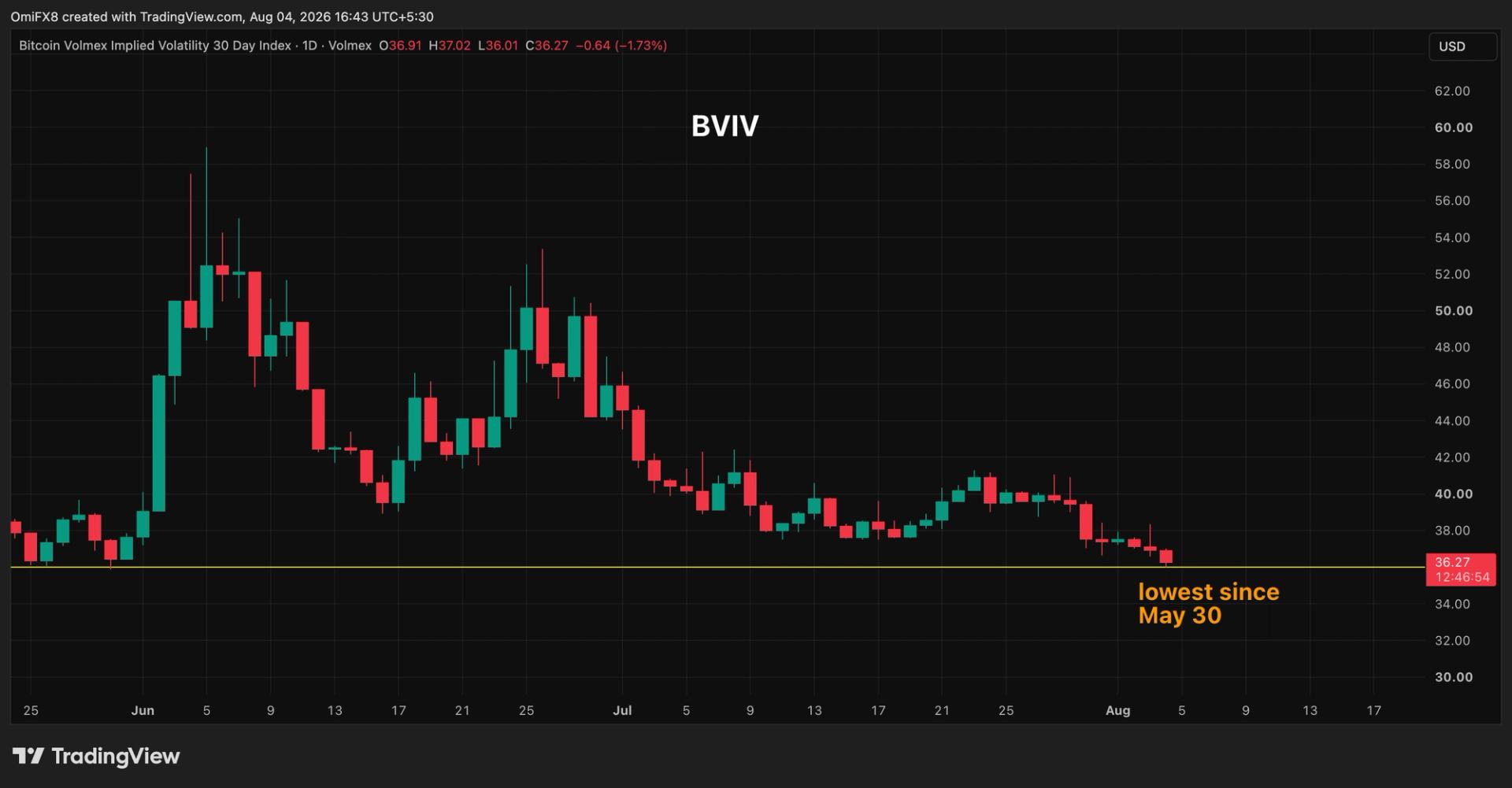
For now, some factors seem to favor the bear case. For instance, institutional demand remains anemic. The U.S.-listed spot bitcoin ETFs posted $61.53 million in outflows last week, snapping a three-week streak of tepid inflows. Moreover, USDT’s market capitalization, the largest among dollar-pegged stablecoins, fell to the lowest level since October, while USDC’s also remains in a downtrend. (check the Daily Signal).
Real or inflation-adjusted returns on longer-duration Treasury notes have risen to the highest since 2008, denting the appeal of investing in emerging technologies and risk assets. Further, the U.S. Clarity Act’s passage remains uncertain.
Still, at least one data point suggests limited downside. That is tied to the number of BTC acquired around current price levels.
“Approximately 155,000 BTC moved into the $62,000-$65,000 cost-basis range, indicating that selling was absorbed by buyers near current prices. This concentration now represents 0.7 percent of circulating supply and could keep BTC range-bound until a stronger catalyst emerges,” analysts at Bitfinex said.
Stay alert!
Read more: For analysis of today’s activity in altcoins and derivatives, see Crypto Markets Today . For a comprehensive list of events this week, see CoinDesk’s “Crypto Week Ahead.”
What’s trending
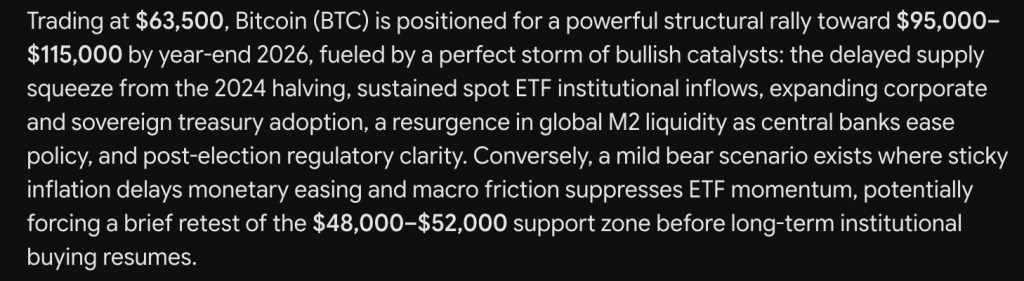
Google Gemini AI predicts a structural rally for Bitcoin, and this price prediction frames the setup as a perfect storm rather than a single catalyst. Trading at $63,500, Bitcoin is positioned for a move toward $95,000 to $115,000 by year end 2026.
The bull case stacks five forces together. The delayed supply squeeze from the 2024 halving is still working through the market. Sustained spot ETF institutional inflows keep arriving.

Corporate and sovereign treasury adoption keeps expanding. Global M2 liquidity is resurging as central banks ease policy. Post election regulatory clarity adds a final layer.
Gemini frames these as converging at once, which is what separates a structural rally from a speculative spike in the model’s own framing.
The bear scenario is described as mild but specific. Sticky inflation could delay monetary easing, and macro friction could suppress ETF momentum, potentially forcing a brief retest of the $48,000 to $52,000 support zone before long term institutional buying resumes.

Bitcoin Price Prediction: BTC USD RSI Has Been Stuck At The Same Level For Eight Months, So is Copilot AI Predicts Realistic?
Bitcoin topped near $97,000 in January before a sharp February collapse dragged price down to $60,000 in a matter of weeks. That crash set off a slow, uneven recovery that carried price back to $82,000 by May, only for a second decline to erase most of those gains by June.
Since that June low near $57,000, price has spent two months grinding sideways in a tight band, unable to build any real momentum in either direction. Price closed today at $63,406, down 0.08%, in a session ranging between $63,270 and $64,176.
Support sits at $60,000, the level defended through both the February and June lows. Resistance stacks first at $68,000, then $73,000, then the far heavier ceiling near $82,000 where the May rally failed outright.
RSI currently reads 47.19 with the signal line just above at 49.69. That is a small negative gap, and what stands out on the chart is how close both lines have stayed to the neutral 50 mark for nearly the entire year, rarely straying far in either direction.
Momentum here is essentially flat, neither building toward a breakout nor collapsing toward the bear case Gemini describes. For the $95,000 target to move from thesis to reality, Bitcoin needs to first clear $82,000, a level that has already rejected one full rally attempt this year.
You Were Right About Bitcoin. It Just Didn’t Pay.
Every trader has had the same experience. You read the analysis, you form a view, the market proves you correct, and it makes you nothing.
The problem isn’t the call. It’s the instrument. When you buy spot to express a view about one thing, you take on exposure to everything: liquidity, sentiment, unrelated flows, whatever happens in an unrelated market at 3am.
Your opinion was about a single question. Your position is exposed to all of them at once.
That’s what Kalshi is. A CFTC-regulated exchange where the prices are set by traders taking real positions, which is why the odds tend to move before the headlines do.
It isn’t free money. A contract that resolves against you goes to zero, and being directionally right on a slow timeline still loses if the contract expires first. Event trading pays for precision about timing, not just direction.
But the analysis above was free. What you do with it doesn’t have to be.
→ Get up to $25 to trade your first market on Kalshi
Don’t Miss Out on Our $1,000 USDT Airdrop on ByBit
The post Google Gemini AI Predicts the Price of Bitcoin by The End of 2026 appeared first on Cryptonews.


Flare’s FXRP token has been approved as collateral in an institutionally curated Morpho vault on Ethereum, letting XRP holders borrow Ripple’s RLUSD stablecoin without selling. It is the first time an XRP-based asset has been accepted in a major on-chain lending market.
Summary
- Flare’s FXRP, a bridged version of XRP on Ethereum, has been approved as collateral in Sentora’s RLUSD Main vault on Morpho, allowing XRP holders to borrow Ripple’s RLUSD stablecoin without selling their tokens.
- The integration is the first time an XRP-based asset has been accepted as collateral in an institutionally curated Ethereum lending market, a milestone for an asset that has been almost entirely absent from DeFi.
- XRP is the fourth largest cryptocurrency by market capitalization at approximately $70 billion, yet its utilization in on-chain lending, borrowing, and liquidity provision has been negligible compared to assets like ETH, WBTC, and stablecoins.
- Ripple has been building RLUSD as an enterprise-focused stablecoin since August 2024, securing NYDFS approval in December 2024 and a Mastercard settlement integration in July 2026.
- The Morpho Blue lending protocol uses isolated markets designed to contain risk if problems arise with a specific collateral asset, a structure that makes it possible to onboard newer assets like FXRP without exposing the broader protocol to systemic risk.
Introduction
XRP is one of the most widely held cryptocurrencies in the world. At roughly $70 billion in market capitalization, it trails only bitcoin, ether, and Tether’s USDT. It has millions of holders, deep liquidity on centralized exchanges, and a history that predates most of the DeFi ecosystem. And yet, until this week, there was no major lending market on Ethereum where XRP holders could borrow against their position.
The reason is infrastructure, not demand. XRP runs on the XRP Ledger, a separate blockchain with its own consensus mechanism and token standard. Ethereum-based DeFi protocols cannot natively interact with XRP. To use XRP in Ethereum lending markets, someone needs to build a bridge, create a wrapped token, and convince a risk team to underwrite it. That process took years for bitcoin (resulting in WBTC), and it has now happened for XRP through Flare’s FXRP token.
On August 3, Flare announced that FXRP has been approved as collateral in Sentora’s RLUSD Main vault on Morpho. XRP holders can now convert their tokens to FXRP, bridge to Ethereum, deposit as collateral, and borrow Ripple’s RLUSD stablecoin. This is not just a technical milestone. It is a test of whether XRP can become a productive DeFi asset after years of sitting idle in wallets.
How the FXRP to RLUSD lending flow works
The process involves four steps, each handled by a different protocol.
Step one: XRP to FXRP conversion. XRP holders convert their native XRP tokens into FXRP, Flare’s bridged representation of XRP. Flare is a layer 1 blockchain that has built cross-chain data infrastructure, including the ability to create asset representations that can move between chains.
Step two: bridge FXRP to Ethereum. The FXRP token is bridged from Flare to Ethereum, where it becomes an ERC-20 token that Ethereum-based protocols can recognize and interact with.
Step three: deposit FXRP as collateral on Morpho. The Ethereum-native FXRP is deposited into Sentora’s RLUSD Main vault on Morpho Blue. Sentora, formerly known as IntoTheBlock, serves as the vault curator, meaning it reviews and approves which assets can be used as collateral. Sentora reviewed FXRP’s market behavior, oracle design, liquidity, and liquidation mechanics before granting approval.
Step four: borrow RLUSD. With FXRP deposited as collateral, the user borrows RLUSD, Ripple’s dollar-pegged stablecoin. The loan is overcollateralized, meaning the value of the FXRP deposit must exceed the value of the RLUSD borrowed. Because this is a loan against collateral and not a sale, the borrower retains exposure to XRP’s price movements.
Flare CEO Hugo Philion described the significance in terms of institutional credibility: “XRP is now collateral that an institutional risk team underwrites on Ethereum mainnet, which is a stronger form of recognition than another bridge listing.”
Why XRP has been absent from DeFi
XRP’s absence from DeFi is not accidental. It reflects three structural factors that have kept the asset isolated from the composable lending and borrowing ecosystem that Ethereum-based tokens take for granted.
Separate blockchain architecture. The XRP Ledger uses a different consensus mechanism (the XRP Ledger Consensus Protocol) and token standard than Ethereum. Unlike ERC-20 tokens, which can be natively deposited into any Ethereum smart contract, XRP requires a bridge and a wrapped representation to interact with Ethereum DeFi. Building that bridge securely takes time and auditing resources. The XRP Ledger was designed for payments, not for programmable smart contracts, which means the tooling and standards that Ethereum DeFi relies on do not exist natively on XRPL.
Regulatory uncertainty. The SEC’s lawsuit against Ripple, filed in December 2020 and not fully resolved until 2024, created a chilling effect on DeFi integration. Protocol teams and vault curators were reluctant to add XRP-based collateral when the token’s regulatory status was unclear. DeFi protocols have their own compliance considerations, and adding a token that the SEC claimed was an unregistered security was a risk most teams chose to avoid. The resolution of that case removed the legal overhang but did not immediately produce DeFi infrastructure.
Limited DeFi ecosystem on XRPL. The XRP Ledger has a built-in decentralized exchange and an automated market maker, but its DeFi ecosystem is small compared to Ethereum, Solana, or even newer L2 networks. Most DeFi activity, lending, borrowing, yield farming, and derivatives, happens on Ethereum and its rollups. For XRP holders to participate, they need to leave the XRPL, which until FXRP was not straightforward. The result is that a $70 billion asset has been almost entirely absent from on-chain credit markets, a gap that is disproportionate to its size and liquidity on centralized venues.
The WBTC parallel
The closest analogy to what Flare is doing with FXRP is Wrapped Bitcoin (WBTC), which has been operating on Ethereum since 2019. WBTC lets bitcoin holders wrap their BTC into an ERC-20 token, deposit it as collateral on Aave, Compound, and MakerDAO, and borrow stablecoins against it.
WBTC demonstrated that non-native assets can become productive DeFi collateral if the bridge is trustworthy and the lending market is deep enough. At its peak, WBTC had over $15 billion in total value locked. It proved that bitcoin holders wanted to borrow against their positions rather than sell.
FXRP aims to replicate this model for XRP. The key differences are scale (WBTC had years of liquidity building, FXRP is just launching) and custody model (WBTC relies on a centralized custodian, BitGo, while Flare uses a decentralized bridge). Whether FXRP achieves WBTC-level adoption depends on whether XRP holders are willing to bridge their tokens and whether additional lending vaults beyond Sentora add FXRP as collateral. The bridging step is a genuine friction point: WBTC holders only needed to interact with a single custodian, while FXRP holders must navigate Flare’s cross-chain infrastructure before reaching Ethereum. Reducing that friction through improved tooling and wallet integrations is as important to adoption as the lending market itself.
What RLUSD is and why it matters here
RLUSD is Ripple’s dollar-pegged stablecoin, designed for enterprise use cases including cross-border payments and institutional settlement. Ripple began testing RLUSD on Ethereum and the XRP Ledger in August 2024 and received approval from the New York Department of Financial Services in December 2024.
RLUSD is not trying to be USDC or USDT. Ripple has positioned it as a compliance-first stablecoin for regulated financial institutions. The Mastercard settlement integration announced in July 2026 is an example: Mastercard will support settlement of regulated stablecoins including RLUSD, USDC, and SoFi’s SoFiUSD. Zand Bank in the UAE began using RLUSD for cross-border payments in early 2026. Ripple has also expanded into Latin America, bringing Bitso’s Mexican peso-backed stablecoin MXNB onto the XRP Ledger in June 2026.
The FXRP/RLUSD lending integration adds a new use case: on-chain borrowing. XRP holders who want dollar liquidity without selling can now borrow RLUSD against their position. If RLUSD is accepted at more venues and payment rails, the utility of borrowing it increases. This creates a flywheel where RLUSD adoption in payments makes RLUSD borrowing more attractive, which drives more FXRP deposits, which deepens the lending market.
The stablecoin landscape itself is shifting rapidly. Circle recently brought USDC to the XRP Ledger, meaning XRPL now supports both RLUSD and USDC natively. This multi-stablecoin approach on XRPL means XRP holders have more options for accessing dollar liquidity, and the FXRP/RLUSD lending market on Ethereum adds yet another path. For Ripple, the strategic play is to make RLUSD the default borrowing currency for XRP-collateralized loans, creating a use case that USDC does not serve.
Why Morpho Blue’s isolated market design matters
Morpho Blue is a lending protocol that uses isolated markets instead of the shared pool model used by Aave and Compound. In a shared pool, all depositors share risk: if one collateral asset fails, losses can spread across the entire protocol. In Morpho Blue’s isolated markets, each collateral-borrow pair operates independently. A problem with FXRP would affect only the FXRP/RLUSD market, not other lending pairs on the protocol.
This design is what made it possible for Sentora to approve FXRP as collateral. A shared pool protocol would likely have rejected a newly bridged token with limited on-chain history. Morpho Blue’s isolation means the risk is contained, and the vault curator (Sentora) bears the responsibility for evaluating it.
Sentora’s CTO Jesus Rodriguez described the approval as a deliberate expansion of on-chain credit: “XRP is one of crypto’s largest and most liquid assets. Yet it remains surprisingly underused in onchain credit. That changes today.” The framing is significant: this is not a DeFi experiment. It is an institutional risk team making a calculated underwriting decision.
The isolation model also creates a natural price discovery mechanism for FXRP risk. Because each vault has its own interest rate curve determined by utilization, lenders are effectively pricing the specific risk of FXRP collateral rather than having that risk diluted across a shared pool. If the market perceives FXRP bridge risk as elevated, rates in FXRP-collateralized vaults will rise relative to vaults backed by native Ethereum assets. This transparency gives both lenders and borrowers real-time information about how the market values the bridge and custody mechanisms that underpin FXRP.
The $70 billion question
XRP has roughly $70 billion in market capitalization. If even 5% of that value migrates into DeFi collateral positions (as happened with bitcoin through WBTC), the result would be $3.5 billion in new collateral available for borrowing. At 10%, it would be $7 billion.
For context, Morpho Blue’s total value locked across all markets is roughly $4 billion. A meaningful flow of XRP into the protocol would make it one of the largest collateral assets on the platform. Whether this happens depends on XRP holder behavior, FXRP bridge trust, and RLUSD utility. But the infrastructure is now in place for the first time.
The peso-backed stablecoin integration on XRPL through Bitso and the USDC expansion to XRP Ledger through Circle show that Ripple is building a multi-stablecoin ecosystem around XRP. The FXRP/RLUSD lending market extends this ecosystem into Ethereum DeFi, bridging two worlds that have historically operated separately.
The comparison to Ethereum’s DeFi trajectory is instructive. When WETH first became available as collateral on Aave and Compound, it took approximately 18 months before the cumulative value locked in ETH-collateralized lending exceeded 5% of ETH’s market capitalization. XRP faces a steeper adoption curve because its holder base skews more retail, with a lower proportion of technically sophisticated users who are comfortable with bridge mechanics and vault management. The institutional channel through Sentora’s curated vaults could accelerate adoption, but institutional allocators typically require six to twelve months of live market data before committing significant capital.
What scale adoption would look like
The WBTC adoption curve provides a template for projecting what FXRP could achieve over a multiyear period. When WBTC launched in January 2019, it began with a few million dollars in total value locked. It took roughly 18 months to reach $1 billion, and another year to reach $10 billion as DeFi activity surged through 2020 and 2021. At its peak in late 2021, WBTC held over $15 billion in total value locked across Aave, Compound, and MakerDAO, representing roughly 1.5% of bitcoin’s market cap at the time.
FXRP starts from a different baseline. XRP has no DeFi history to build on, while WBTC launched when bitcoin holders already understood the concept of using cryptocurrency as collateral and had watched earlier DeFi protocols develop lending markets. But XRP’s size, $70 billion in market capitalization, means even a small adoption rate translates to significant absolute TVL. If FXRP captures 0.5% of XRP market cap in collateral, that is $350 million. At 1%, $700 million. At the WBTC peak rate of roughly 1.5%, it would be more than $1 billion.
For Morpho Blue, these numbers are material. The protocol’s total value locked across all markets is roughly $4 billion. A $500 million FXRP collateral pool would represent more than 10% of Morpho’s total market size, making FXRP a top-tier collateral asset and attracting market makers, liquidation bots, and additional vault curators who see FXRP liquidity as worth their infrastructure investment.
The institutional framing matters here. Sentora’s approval is not just a permission to participate; it is a credentialing signal. DeFi protocols are understandably skeptical of bridged assets because bridge exploits have caused billions in losses. An institutional risk team reviewing oracle design, liquidity profiles, and liquidation mechanics before granting approval lowers the barrier for the second and third curator approvals. Morpho’s isolated market architecture means curators can observe how the FXRP/RLUSD market behaves before committing their own vaults, using Sentora’s early data as evidence.
Ripple’s existing institutional relationships give FXRP a distribution channel that WBTC did not have at launch. RLUSD is already integrated with Mastercard settlement, live in Zand Bank UAE, and present on the XRP Ledger alongside USDC. If Ripple’s enterprise payment partners begin borrowing RLUSD against FXRP positions for working capital or treasury management, the institutional use case extends beyond retail speculation. A $10 million working capital facility backed by XRP collateral, accessed through the FXRP bridge and Morpho, is precisely the kind of product that Ripple’s enterprise sales network can take to existing RLUSD clients. That commercial distribution path distinguishes FXRP from purely retail-driven bridged tokens and gives the collateral market a demand source that does not depend on DeFi sentiment cycles.
The risk of bridge-based DeFi collateral
The FXRP model introduces risks that native Ethereum tokens do not carry. Every step in the flow, XRP to FXRP conversion, bridging from Flare to Ethereum, oracle pricing, and Morpho vault liquidation, represents a potential failure point.
Bridge exploits are the most expensive category of smart contract hacks in crypto history. Cross-chain bridges have caused over $4 billion in losses since 2021, including the Ronin ($624 million), Wormhole ($326 million), and Nomad ($190 million) exploits. Each of these hacks targeted the trust assumptions that allow assets to move between chains. The FXRP bridge uses Flare’s decentralized infrastructure, which is architecturally different from the compromised bridges, but the risk category is the same: any vulnerability in the bridge could result in unbacked FXRP tokens on Ethereum, which would make the Morpho collateral worthless.
Oracle risk is the second concern. The Morpho vault needs an accurate, manipulation-resistant price feed for FXRP to trigger liquidations at the right time. If the oracle diverges from the true market price of XRP, two outcomes are possible: premature liquidations that harm borrowers, or delayed liquidations that leave lenders with bad debt. Sentora reviewed the oracle design before approving FXRP, but the limited on-chain history of the token means the oracle has not been tested under extreme market conditions.
Liquidity risk is the third factor. If a borrower’s FXRP collateral needs to be liquidated, there must be sufficient FXRP liquidity on Ethereum for liquidators to sell the seized tokens. A thin FXRP market could result in liquidators being unable to recover the full value of the loan, creating losses for RLUSD lenders. This is a bootstrapping problem: liquidity improves as adoption grows, but adoption depends on liquidity being sufficient from the start.
Historical precedent suggests bridge exploits follow a pattern. The Ronin bridge lost $625 million in March 2022 when attackers compromised validator keys. The Wormhole bridge lost $320 million a month earlier through a signature verification bypass. In both cases, the underlying assets on the source chain were unaffected, but the wrapped representations on the destination chain became worthless. For FXRP holders using Morpho vaults, a Flare bridge compromise would mean their collateral evaporates while their loan obligations remain. The asymmetry between borrower and lender risk in a bridge failure scenario is one of the least discussed aspects of cross-chain DeFi collateral.
What would invalidate this thesis
The bullish read is that FXRP opens a new chapter for XRP in DeFi. The bearish read is that XRP holders have shown little interest in DeFi historically, and a bridged token on an unfamiliar protocol will not change that behavior.
If FXRP deposits remain below $50 million after six months, the integration was a technical success but a commercial failure. If the FXRP bridge suffers a security incident, trust in the model collapses. If RLUSD itself fails to gain traction beyond a few institutional partnerships, the borrowing side of the market dies. And if XRP’s price drops significantly, FXRP collateral positions get liquidated, creating negative feedback loops that discourage further deposits.
Regulatory risk adds another dimension. If regulators classify FXRP as a derivative or synthetic asset rather than a direct representation of XRP, the compliance burden on institutional vaults could make the product uneconomical. The SEC has not issued guidance on wrapped or bridged tokens as a distinct category, and enforcement actions in adjacent areas suggest the regulatory framework remains uncertain. A single enforcement action against a bridged asset product could freeze institutional participation across the entire category.
What to watch
FXRP total value deposited on Morpho. The single most important metric. If deposits reach $500 million within six months, XRP holders are adopting DeFi collateral use cases. If deposits stall below $100 million, adoption has failed.
RLUSD circulating supply growth. Track whether the lending integration drives new RLUSD minting. If borrowing demand increases RLUSD supply, the flywheel is working.
Additional vault curators adding FXRP. Sentora is the first. If other curators like Gauntlet, Block Analitica, or Steakhouse Financial add FXRP vaults, the collateral is gaining broader institutional acceptance.
Flare bridge security. Any exploit or significant downtime on the FXRP bridge would damage trust in the model. Track audit reports, bridge volume, and incident history.
XRP DeFi TVL relative to market cap. Currently near zero. Bitcoin’s WBTC TVL as a percentage of BTC market cap reached roughly 1.5% at peak. If FXRP reaches even 0.5% of XRP market cap ($350 million), it would represent meaningful DeFi adoption.
—
Frequently asked questions
What is FXRP?
FXRP is Flare’s bridged version of XRP that operates as an ERC-20 token on Ethereum. It allows XRP holders to use their tokens in Ethereum-based DeFi protocols without selling the underlying XRP.
What is RLUSD?
RLUSD is Ripple’s dollar-pegged stablecoin, designed for enterprise use cases including cross-border payments and institutional settlement. It was approved by the New York Department of Financial Services in December 2024 and launched on Ethereum and the XRP Ledger.
How does XRP lending on Morpho work?
XRP holders convert XRP to FXRP on Flare, bridge FXRP to Ethereum, deposit it as collateral in Sentora’s RLUSD vault on Morpho Blue, and borrow RLUSD against their position. The loan is overcollateralized and retains the borrower’s exposure to XRP price movements.
Why has XRP been absent from Ethereum DeFi?
XRP runs on a separate blockchain (the XRP Ledger) that cannot natively interact with Ethereum smart contracts. The SEC lawsuit against Ripple also discouraged DeFi protocol teams from integrating XRP-based assets until the case was resolved.
What is Morpho Blue?
Morpho Blue is a lending protocol that uses isolated markets instead of shared pools. Each collateral-borrow pair operates independently, containing risk and making it possible to onboard newer assets like FXRP without exposing the broader protocol.
How is FXRP different from WBTC?
Both are bridged representations of non-Ethereum assets. WBTC uses a centralized custodian (BitGo) to hold the underlying bitcoin, while FXRP uses Flare’s decentralized bridge. WBTC has years of liquidity history and widespread DeFi integration; FXRP is just launching.
What is Sentora’s role?
Sentora (formerly IntoTheBlock) is the vault curator that reviewed and approved FXRP as collateral for the RLUSD lending market on Morpho. Curators evaluate collateral assets for market behavior, oracle design, liquidity, and liquidation mechanics before granting approval.
Could this model expand to other assets?
Yes. The FXRP/Morpho model could be replicated for other non-Ethereum assets that have large market capitalizations but limited DeFi presence. The success or failure of the FXRP integration will likely influence whether curators approve similar bridged tokens in the future.
Disclaimer: This article is for informational purposes only and does not constitute financial advice. The information presented is based on publicly available reports and announcements as of August 3, 2026. Always conduct your own research before making investment decisions.
Former hedge fund manager and CNBC “Mad Money” host Jim Cramer said he plans to sell all his Bitcoin due to quantum computing fears.
“I’m going to sell mine [Bitcoin],” said Cramer during a Friday Mad Money episode, citing quantum computing concerns that IBM Chairman and CEO Arvind Krishna had raised in on his show the previous day.
During Thursday’s episode, Krishna told Cramer that he should get “paranoid” about quantum computing’s threat to cryptocurrencies in the next three to four years.
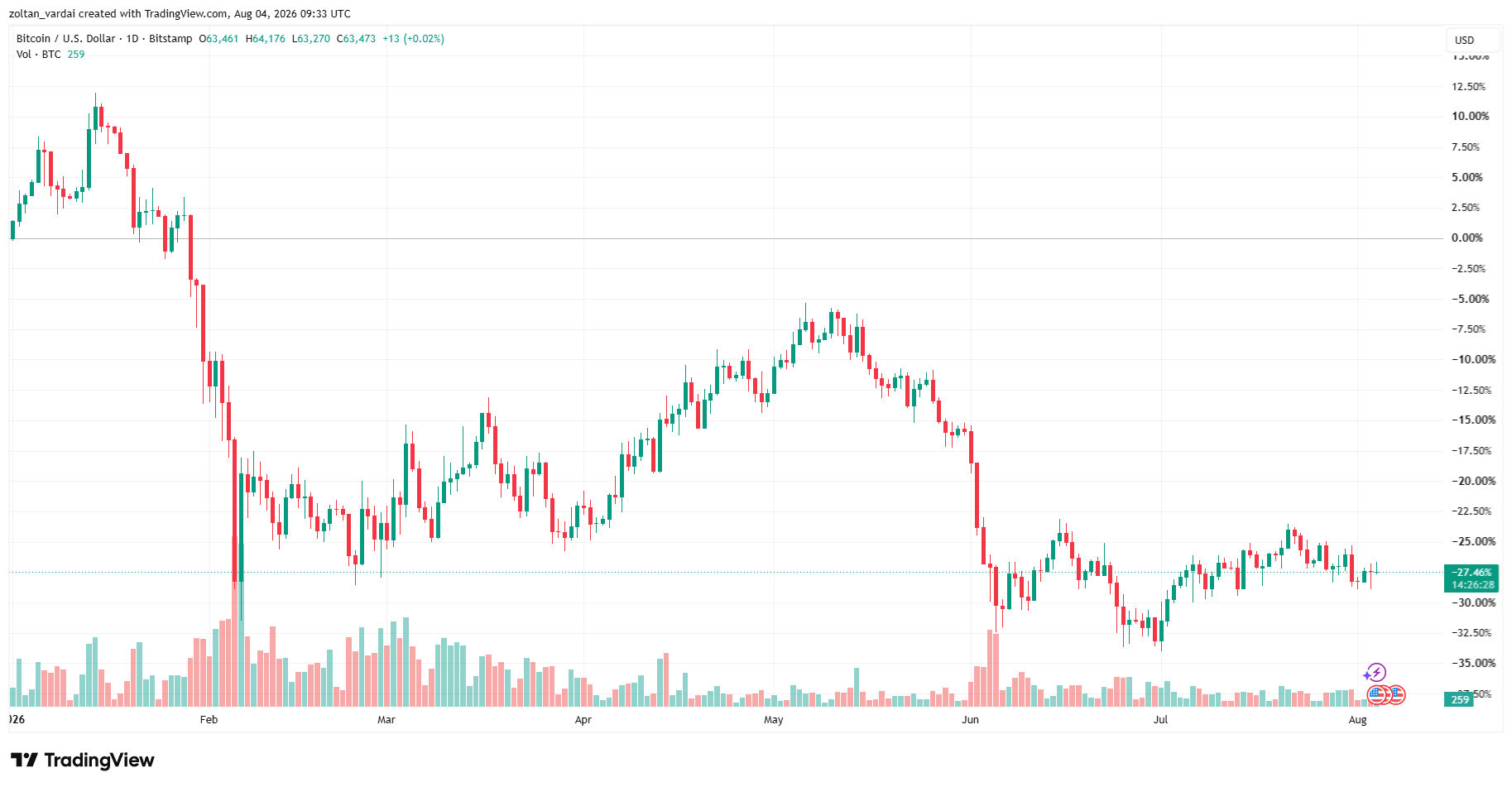
Bitcoin’s (BTC) price was up roughly 1.7% on Tuesday to trade above $63,500, but was down 27% year-to-date, according to TradingView data.
Some crypto investors celebrated Cramer’s remarks, referencing the popular “inverse Cramer” meme and investment philosophy, which ironically seeks to capitalize on the opposite of the investment calls made by the former fund manager.
“If Cramer is selling, it’s time to start buying,” commented GRIT Trading Academy founder Archie Spencer.
“Every time Cramer says sell, I add to my position. Been doing it since 2018. The inverse Cramer index remains undefeated,” wrote pseudonymous crypto investor Bitcoin & Barbells.
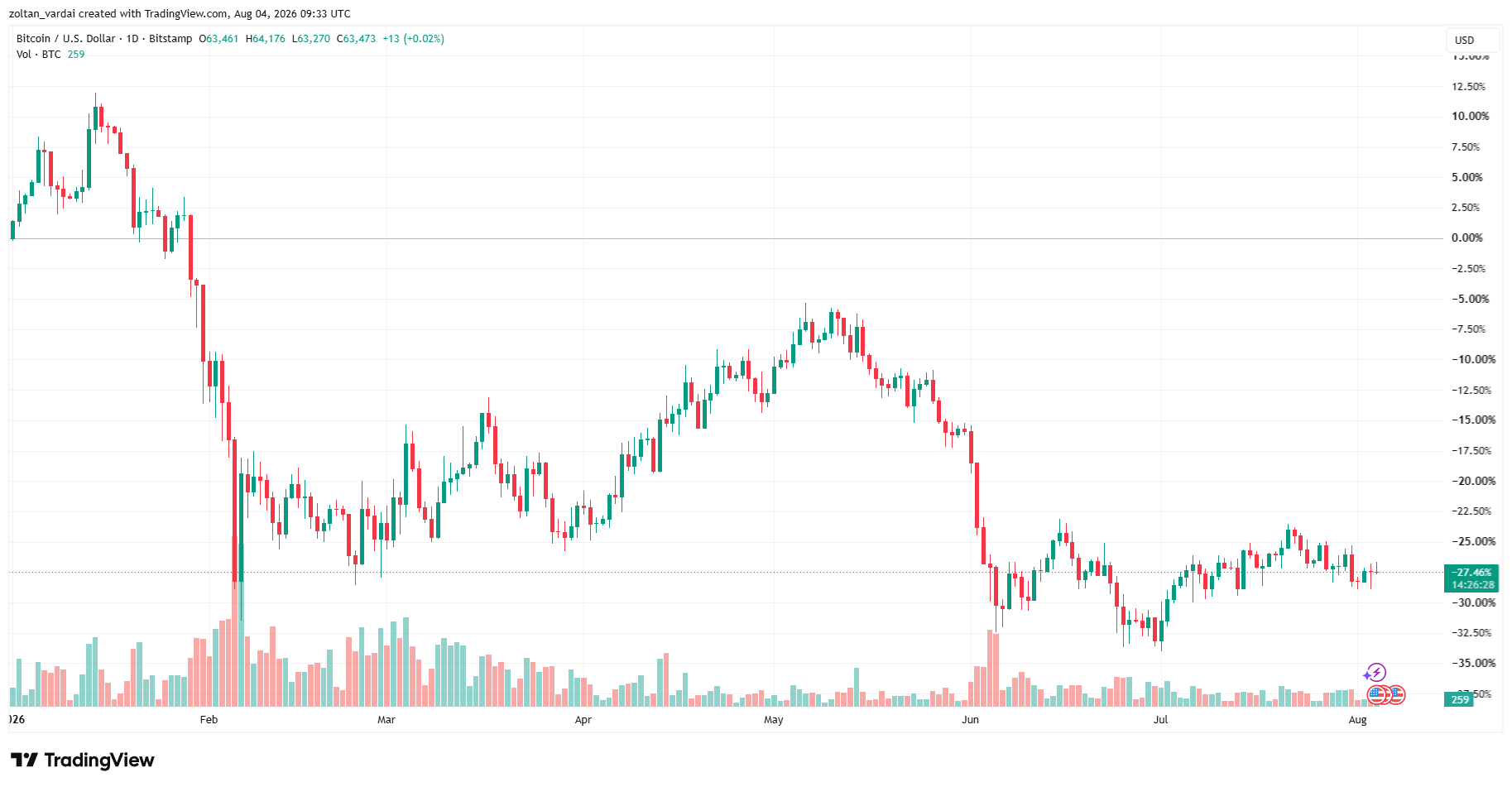
BTC/USD, year-to-date chart. Source: Cointelegraph/TradingView
Whale wallets start selling as trading activity declines
Meanwhile, large investors are selling their Bitcoin holdings as crypto market liquidity is drying up.
On Monday, whale wallet ‘bc1qpt’ transferred its entire holdings of 16,400 Bitcoin, worth about $1 billion, to a new wallet address following seven months of inactivity, according to blockchain analytics platform Lookonchain.
The transfer occurred shortly after daily cryptocurrency trading activity across the leading 44 spot crypto exchanges fell to $15 billion last week, marking the lowest level of 2026, according to data from crypto intelligence platform Kaiko shared by the Kobeissi Letter.
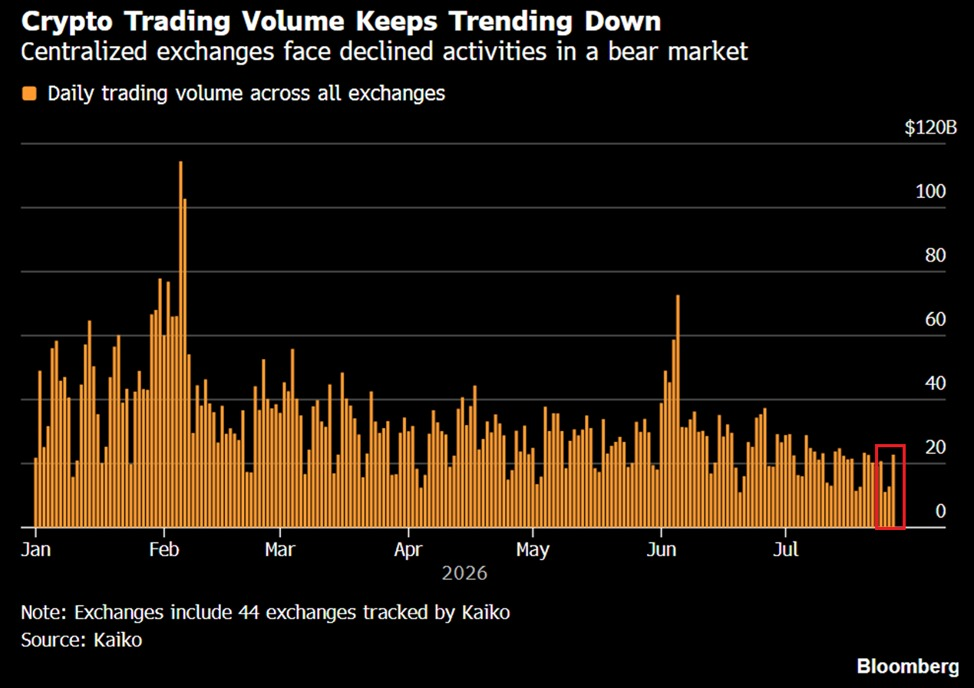
Source: The Kobeissi Letter
“This marks a -70% decline from January peak levels, ” wrote the Kobeissi Letter in a Tuesday X post, adding that “crypto market liquidity is drying up.”
Related: Nearly 10% of Bitcoin supply is ‘structurally unsafe’ from quantum breakthrough: Glassnode
Industry watchers divided over quantum threat’s timeline
Industry watchers are divided over the timeline of a quantum computing breakthrough. In November 2025, Blockstream CEO Adam Back said that Bitcoin faces no meaningful quantum threat for at least the next 20 to 40 years.
In contrast, analysts at Bernstein said that Bitcoin has about three to five years to prepare for a post-quantum security upgrade, in an April report.
“Back’s assessment is the more accurate and measured view: practical quantum threats capable of breaking Bitcoin’s cryptography remain highly unlikely within the next decade,” Lacie Zhang, research analyst at Bitget Wallet, told Cointelegraph.
Magazine: Bitcoin’s quantum upgrade path: What BIP-360 changes and what it does not
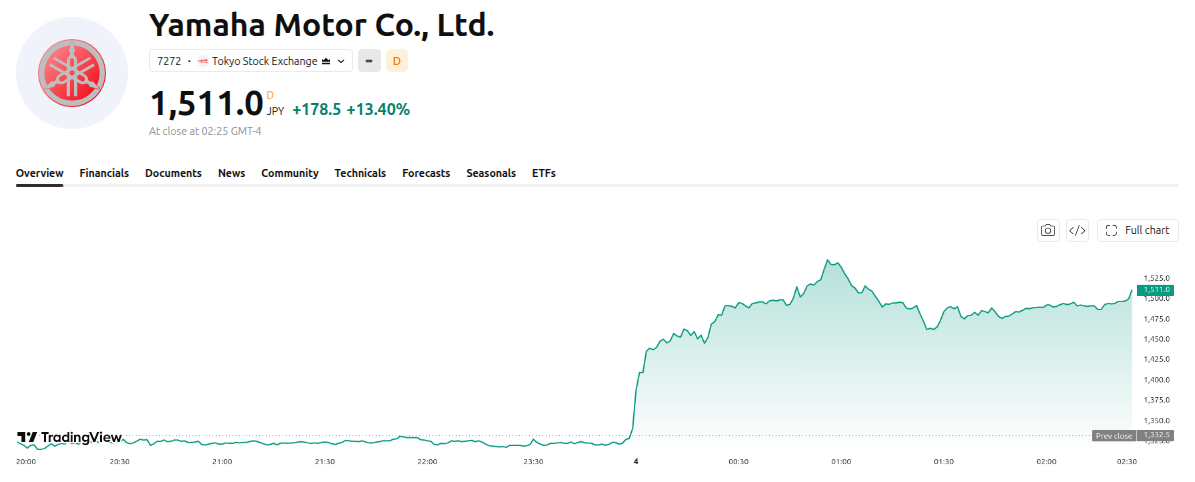
Yamaha Motor shares surged 13.40% on Tuesday to close at 1,511 yen (roughly 9.62 dollars), after record first-half results forced the company to raise its annual guidance.
The rally stood out in a Japanese market still rattled by last week’s coordinated currency intervention.

The Record Numbers Behind the Rally
Operating profit measures earnings from core business activities before interest and taxes, a cleaner gauge of operational health than net income alone.
Yamaha’s revenue reached 1.498 trillion yen (~$9.54 billion) during the January to June period, up 17.2% year-over-year. Operating profit climbed to 158.5 billion yen (~$1.01 billion), an 88.6% increase. Attributable net profit performed even better. The figure hit 113.9 billion yen (~$725 million), representing a growth of 114.7%.
Motorcycles drove the expansion. European and American markets led demand, supported by a weaker yen through most of the period and improved cost management. Structural changes accompanied the results. The company announced reforms to its off-road leisure vehicle business and raised its full-year forecast.
Follow us on X to get the latest news as it happens.

Investor response was immediate. Trading volume exceeded 30 million shares, reflecting unusually strong interest in the stock.
The broader index offered only modest relief. The Nikkei 225 advanced 0.32% to 63,957.53 points, partially recovering from sharp declines in previous sessions.
Japanese markets have endured severe volatility since late July. The yen weakened to levels unseen in 40 years before Tokyo and the US Treasury executed a joint yen-buying intervention.

Why the Risks Have Not Disappeared
The subsequent currency rebound created its own problem. Exporters faced profitability concerns, triggering heavy selling across the index.
Washington is now pushing for additional tools. Treasury Secretary Scott Bessent publicly asked the Federal Reserve to expand its FIMA repo facility. The mechanism matters considerably. It allows foreign governments to obtain dollars by using Treasury bonds as collateral, thereby supporting interventions without straining American debt markets.
Risks remain firmly in place, however. Analysts warn the real pain may still be ahead for Japanese equities. Two threats stand out. A possible Bank of Japan rate hike in September, combined with a yen still prone to strengthening, would squeeze export-dependent companies.
Kioxia Holdings illustrates that vulnerability. The memory chip maker already missed its first-half guidance and suffers directly from yen appreciation, given its reliance on foreign sales.
Subscribe to our YouTube channel to watch leaders and journalists provide expert insights.
The contrast defined Tuesday’s session. While the Nikkei managed only a timid rebound, Yamaha demonstrated that exceptional results still command investor attention.
Sustainability remains an open question. Further yen strengthening or a more aggressive decision by the Bank of Japan in September could pressure exporters again. For now, the market rewarded execution over macro anxiety. Whether that holds depends on decisions in Tokyo rather than corporate boardrooms.
The post Yamaha Shares Explode 13% on Record H1 Results, Defying Japan’s Market Crisis appeared first on BeInCrypto.


South Africa’s Treasury and central bank are moving towards regulating the use of cryptocurrency for cross-border transactions.
The National Treasury and the South African Reserve Bank (SARB) released a draft rulebook on Monday that proposes that sending crypto offshore must be conducted through an authorized provider and reported to the central bank’s Financial Surveillance Department (FinSurv).
“The proposed regulatory measures seek to minimize the risk of regulatory arbitrage between regulated entities conducting cross-border activities, and to enhance the ability of the Financial Surveillance Department (FinSurv) to detect, deter and disrupt illicit financial flows,” Treasury and the Reserve Bank said in a joint statement.
The framework would not make crypto legal tender, nor do the rules distinguish between different digital assets.
The two bodies have invited comments from interested parties with a deadline for submission of Sept. 30.
The proposed rules build on previous National Treasury draft regulations issued in April, which would require crypto holders to declare assets above a certain threshold and hand over private keys to enforcement officers on demand.

In the latest XRP News, Ripple announced strategic equity investments in two UK-based firms, Zilo and Licuido, on August 3, 2026, converting existing commercial partnerships into ownership positions to complete a full-lifecycle institutional capital markets stack on the XRP Ledger.
The move targets the gap that has stalled most institutional tokenization pilots: minting a token is straightforward; financing, pledging, and settling it with the same reliability as a conventional holding is not.

Discover: Everyone’s Got a Take. Get Free $25 to Actually Trade Yours
The Problem: Tokenized Assets That Sit Idle
Institutional RWA tokenization has exhibited a consistent structural failure: tokenized fund shares are issued and then parked.
The ownership record, issuance rail, and settlement mechanism have historically been handled by separate, often incompatible legacy systems that were never designed to interface with on-chain collateral markets.
Ripple’s framing of the deal is explicit on this point. The company described the investments as addressing constraints in which collateral sits idle, settlement takes longer than necessary, and institutions have no reliable path to unlock liquidity from tokenized positions.
The Zilo and Licuido stakes are designed to close those three gaps simultaneously on XRPL.
Discover: Your Market Calls Are Worth Something. Start With Free $25 on Kalshi
XRP News: What Zilo and Licuido Each Provide
Zilo handles transfer agency and fund administration – the regulated record of who owns what, extended to cover tokenized share classes as funds move on-chain. Before any lender will extend credit against a tokenized fund position, they need a legally reliable ownership register; Zilo supplies that layer. Its client roster, which includes Citi, Fidelity International, and State Street, provides Ripple with a direct bridge into incumbent custody and TA infrastructure.
Licuido, an FCA-regulated platform, manages issuance, distribution, and execution, allowing traditional financial assets, including fund shares, to move as digital collateral through on-chain atomic settlement.
— Arthur (@XrpArthur) August 4, 2026
 Ripple invested in two regulated capital markets firms. Today.
ZILO — digital transfer agency for asset managers. On XRPL.
Licuido — FCA-regulated issuance and collateral platform. On XRPL.
Partners already building on this infrastructure :
Aviva Investors. Franklin… https://t.co/8vOjuu87UP
Trades settle on the XRPL in three to five seconds. Ripple’s dollar-pegged stablecoin, RLUSD, functions as the regulated cash leg for delivery-versus-payment transactions, so asset transfer and payment settle simultaneously rather than sequentially.
Together, the three-part stack – Zilo for regulated record-keeping, Licuido for issuance and collateral mobility, RLUSD for the cash leg – gives institutions a single operating model for tokenized fund assets from issuance through financing. Neither company’s financial terms were disclosed.

Nigel Khakoo, Ripple’s SVP of Trading and Markets, characterized the infrastructure role of both firms in the official press release: “ZILO and Licuido provide core capabilities that are essential to further scaling this shift: regulated digital transfer agency infrastructure and liquidity for issuance and collateral mobility.”
Building on Live Deployments, Not Pilots
The stakes are not speculative bets on unproven vendors. Ripple confirmed that both investments build on pre-existing partnerships, and Licuido was already in production as the tokenization infrastructure for the Aviva Investors USD Liquidity Fund, the first tokenized fund structure approved by the Central Bank of Ireland on a public blockchain, which went live on XRPL on July 29, 2026.
BNY holds the underlying assets; Komainu provides digital asset custody.
The institutional pipeline extends further. Ripple’s parallel push into institutional infrastructure also encompasses a September 2025 memorandum of understanding with Franklin Templeton and DBS to list Franklin Templeton’s sgBENJI tokenized money market fund on the DBS Digital Exchange alongside RLUSD, with a stated path toward using sgBENJI as repo collateral.
The collateral-mobility thesis Ripple is industrializing through Zilo, and Licuido is the same structure that the partnership was designed to test.
On the network side, Ripple reported that XRPL has processed more than four billion transactions since 2012 and is maintained by 120 independent validators. A major protocol upgrade, xrpld 3.3.0, targeting improvements in XRPL infrastructure and institutional finance functionality, was expected to be released within days of the announcement.
Ripple is also one of 54 firms on a UK government task force formed to build live tokenized wholesale financial market use cases over the next 12 months, alongside Circle, Coinbase, BlackRock, Goldman Sachs, J.P. Morgan, and Morgan Stanley. The first target is the tokenized repo. Ripple’s expanding regulatory positioning in Europe provides additional runway for the institutional tokenization push built on XRPL.
The practical test for the Zilo and Licuido stack is whether tokenized fund shares generate genuine secondary liquidity and serve as working collateral in live credit markets over the next 12 to 24 months – or whether they remain a more sophisticated form of the same idle token problem Ripple is explicitly trying to solve.
Discover: Get Paid to Be Right, $25 to Start on Kalshi
Don’t Miss Out on Our $1,000 USDT Airdrop on ByBit
The post XRP News: Ripple Takes Equity Stakes in Zilo and Licuido to Fix Idle Tokenized Assets appeared first on Cryptonews.

The 230-ft. Falcon 9 lifted off from launch complex 39A at the Kennedy Space Center on Jan. 15, 2025, packed with a pair of spacecraft bound for the moon. One of them, the Blue Ghost lander, built by Firefly Aerospace of Cedar Park, Texas, landed on the moon on March 2, 2025, becoming the first privately built ship to pull off a completely successful lunar touchdown. The other, the Resilience lander, built by the Japanese company ispace, wasn’t so fortunate, crash-landing on the moon on June 5, 2025, after its laser range-finder failed. At the beginning of their missions, once the ships had climbed to near-Earth space, both of them relied on the Falcon 9’s 45-ft. upper stage to blast them away from the Earth and outward to the moon. After releasing the two lunar landers, that Falcon stage was supposed to fall harmlessly away, but instead it’s hung around.

The White House is reportedly preparing fresh restrictions targeting Chinese-made data centers as it seeks to secure the infrastructure powering the race for AI domination.
The new rules, reported by Reuters earlier today, would prohibit US imports of new models of Chinese optical transceivers used in AI data centers.
AI-Security Needs Increase
The Federal Communications Commission is developing the proposed restrictions and is expected to announce them later this year. If approved, they would block future imports of the network components, which transmit data through fiber-optic cables at extremely high speeds. They have a key role in connecting AI chips inside modern data centers.
Reuters further claimed that US officials are concerned that Chinese-made transceivers could be exploited to steal sensitive information, install malicious software, or disrupt operations inside the massive data centers that power some of the leading AI models.
Divyansh Kaushik, an AI policy expert in advisory firm Beacon Global Strategies, doubled down that “transceivers definitely pose a risk,” and warned that AI developers “want to make sure the data center supply chain is secure from the get-go.”
According to the report, the proposals come after some hard lessons learned by the US government from the Huawei fiasco, when Chinese telecommunications equipment became so deeply embedded into American infrastructure that replacing it became highly expensive and time-consuming.
Beijing Will Respond
Although the White House and the FCC failed to respond to Reuters’ queries, the Chinese embassy in Washington said Beijing had urged the US to “heed the objective and rational voices of the business communities in both countries and stop smearing Chinese companies and threatening them with sanctions.”
The officials added that China will “take all necessary measures” in response to whatever action is undertaken by the Trump administration.
The POTUS has frequently outlined in the past the significance of keeping the US as the leader in terms of artificial intelligence and cryptocurrency adoption and development.
The post Trump Administration Plans Ban on New Chinese AI Data Center Components: Report appeared first on CryptoPotato.

Senate Majority Leader John Thune confirmed on August 3 that H.R. 3633, the Digital Asset Market Clarity Act, will receive a Senate floor vote before the August recess, upgrading the bill’s status from probable to scheduled.
The confirmation matters, but it does not resolve the harder question: whether Republicans can assemble the roughly seven Democratic votes needed to clear the 60-vote filibuster threshold that stands between a floor vote and actual passage.
JUST IN: — Watcher.Guru (@WatcherGuru) August 3, 2026
 Senate Majority Leader Thune says he still expects to hold a vote for the crypto Clarity Act this week before recess.
As of that confirmation, the CLARITY Act was still absent from the official Senate floor calendar, and no cloture motion had been filed.
Per analysis from crypto analyst Ted Pillows, if Senate leadership waits until Wednesday, August 6, to file cloture, the earliest possible floor vote falls on Friday, August 8, leaving almost no margin before the chamber disperses for its state work period.
The primary source identifies August 7 as the last functional Senate workday, with August 10 marking the visible close of the window.
Thune’s move to force a vote, even without guaranteed passage, is partly about accountability. A floor vote creates a public record, placing every undecided Democrat on the spot before the midterm cycle intensifies. That political calculation does not change the arithmetic, but it changes the pressure environment heading into September.
Discover: Get Paid to Be Right, $25 to Start on Kalshi
What the CLARITY Act Would Actually Restructure
The core function of the CLARITY Act is jurisdictional. The SEC retains oversight of investment contracts and tokenized securities.
The CFTC acquires full spot market regulatory authority over digital commodities, a significant expansion given the agency currently holds derivatives jurisdiction but limited fraud enforcement reach in spot markets.
That SEC-CFTC split is the structural change the industry has been lobbying toward for years, as covered in earlier reporting on Treasury Secretary Bessent’s pressure campaign for the same vote.
The total crypto market stood at $2.28 trillion as of July 20, 2026, with Bitcoin accounting for $1.29 trillion, roughly 56% dominance, and stablecoins representing approximately $305 billion.
The remaining $680 billion in digital assets is the most directly affected tranche: those are the tokens whose securities-versus-commodities classification remains legally ambiguous, and whose exchanges, market makers, and issuers would face new registration and compliance obligations under the bill.
Bitcoin is the least affected asset in this picture. It already carries established commodity treatment, a derivatives market, and spot ETF access. The CLARITY Act would confirm its status rather than change it.
The primary beneficiaries sit in the mid- and long-tail of the market: investment contract-type tokens seeking commodity reclassification, U.S. spot exchanges pursuing federal registration, stablecoin platforms navigating yield restrictions, and DeFi protocols with identifiable governance structures.
Discover: Everyone’s Got a Take. Get Free $25 to Actually Trade Yours
Three Unresolved Disputes That Could Sink the 60-Vote Count
The Senate Banking Committee passed its version of the bill 15-9 on May 14, 2026, with all Republicans plus Democratic Senators Ruben Gallego and Angela Alsobrooks in favor, though both explicitly reserved judgment on floor support pending further negotiations.
The Senate Agriculture Committee, which oversees CFTC jurisdiction over digital commodity spot markets, approved a separate version in January 2026. Senator Cynthia Lummis released a unified draft merging both committee texts on July 22, but reconciliation gaps remain.
The stablecoin rewards debate is the most commercially charged open issue. The Senate Banking draft would prohibit yield payments on stablecoin holdings, treating platforms that pay such yields as de facto deposit-taking institutions subject to bank-equivalent requirements.
Crypto firms argue the provision protects incumbent banks rather than consumers, and the carve-outs for transaction rewards, digital payments, and loyalty programs raise definitional questions that the SEC, CFTC, and Treasury would have to resolve jointly in rulemaking, adding implementation uncertainty even if the bill passes.
Ethics rules represent the more politically explosive obstacle. Several Democratic senators are pushing for stricter restrictions on federal officials and their families engaging in crypto dealings, a demand inseparable from the Trump family’s crypto activity.
The updated draft includes a temporary restriction on senior officials issuing or sponsoring digital assets, set to expire in 2029, but that provision has not secured White House backing.
Senator Thom Tillis acknowledged negotiators are “not quite there” on an ethics agreement. Without that resolution, the Democratic vote count necessary to reach 60 likely does not exist. Per crypto.news, Polymarket traders price the CLARITY Act’s probability of becoming law in 2026 at approximately 33%, while Galaxy Research puts it at 30%.
What Failure Before August 10 Actually Means for Crypto Markets
The August 10 date carries institutional weight rather than immediate market weight. No existing exchange, token, or stablecoin faces legal jeopardy if the bill misses the window.
What changes is the regulatory trajectory: a failed vote pushes the realistic timeline for comprehensive crypto market-structure legislation into mid-2027 at the earliest, as post-recess legislative calendar compression coincides with government funding negotiations and a sharpening midterm environment.
The practical consequence of continued delay is that the SEC and CFTC proceed through guidance and enforcement rather than statute, a framework that is both less predictable and more reversible with each change in administration.
That regulatory uncertainty is already priced into U.S.-based exchange valuations and token classification risk premiums. Passage would compress those premiums; failure extends them.
The parallel is instructive: MiCA’s implementation in Europe demonstrated how codified market structure rules can materially shift institutional positioning once legal ambiguity is removed.
Even if the CLARITY Act clears the Senate and reaches the president’s desk, the operational timeline is not immediate. The current draft sets a 360-day effective date after enactment, with additional delays built in for SEC and CFTC rulemaking on exchanges, custody, derivatives, and market data.
Most operational changes would not take effect until late 2027. Passage in 2026 matters for the institutional commitment it signals and the legal baseline it sets, not because it flips a switch on market structure in the near term. The next 72 hours of Senate scheduling will determine whether that baseline arrives this year or gets deferred into another Congress entirely.
Discover: Everyone’s Got a Take. Get Free $25 to Actually Trade Yours
The post CLARITY Act Senate Vote Locked In, But 60-Vote Hurdle Looms Large appeared first on Cryptonews.

Will regeneratively grown food become mainstream?

Six Months After Vanishing, What We Know About Savannah Guthrie’s Missing Mother Nancy Guthrie’s Case

The bitcoin (BTC) price has plenty of reasons to freak out, yet volatility remains low: Crypto Daily

Renter of Home in Anne Heche Crash Denies Settlement With Son

No Jackpot Winner as $257 Million Prize Rolls Over to $269 Million Monday Draw

Weekend Open Thread: Staud – Corporette.com

Yahoo Finance Live: Daily Market Coverage – August 3, 2026 9AM-11AM (ET)

MARKETS in the MORNING, 7/29/2026, BTC $64,200, XRP $1.07, Gold $4,016, RTY 2,948, DXY 101

Finance Professor Answers Investing Questions | Tech Support | WIRED
-

 Business6 days ago
Why Trees Belong on the Risk Register
-

 Fashion4 days ago
Weekend Open Thread: Wit & Wisdom
-

 Politics4 days ago
Meta enters AI-training agreement with far-right ‘propaganda rag’ Newsmax
-
 Entertainment7 days ago
‘Stargate’ Creator’s New Sci-Fi Series Returns for Season 3 Tomorrow
-

 Crypto World3 days ago
MicroStrategy Post-Earnings CLARITY Act Push Could Add New Catalyst for Its Stock
-

 Business6 days ago
Major shareholder moves on Canyon
-

 Politics6 days ago
Reform UK betrays West Mids residents by running from party pledges
-

 Crypto World3 days ago
XRP Ledger v3.3.0 brings five institutional features
-

 News Videos5 days ago
Bitcoin Enters the 3rd Stage of the Bear Market
-

 Crypto World7 days ago
Kraken Enables Retail Access to Jersey Mike’s IPO via Tokenized Shares
-

 Politics5 days ago
Luke Littler’s dominance sparks GOAT debate
-

 Sports4 days ago
Seema Kaliramna Wins Discus Throw Bronze, Takes India’s CWG Medals Tally To 17
-

 News Videos7 days ago
Claude: Build Financial Dashboards in Minutes (2026)
-

 Crypto World2 days ago
Crypto PAC spending tops $2M in Michigan House race
-

 Crypto World3 days ago
New York sues Kalshi over prediction market gambling
-

 Business7 days ago
Johnson & Johnson agrees to $5.5B settlement over talc cancer claims
-

 Business4 days ago
Trump Announces Hamas Disarmament Agreement as Iran Strikes Kuwait Air Base and US Attacks Pause Overnight
-

 Tech6 days ago
Gemini can now summarize the messiest comment threads in Google Docs
-

 Politics2 days ago
Zack Polanski: an incitement to murder Nigel Farage?
-

 Tech2 days ago
ESET tracks rise in malicious AI skills and adaptable malware
You must be logged in to post a comment Login