

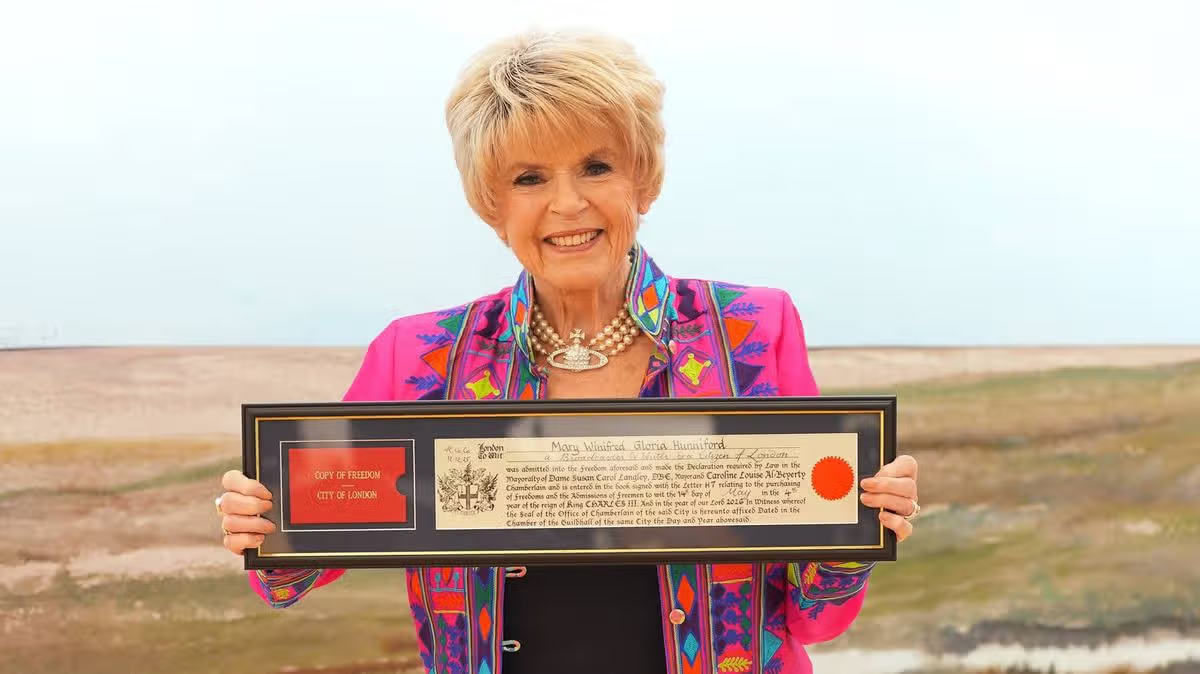
The 86-year-old from Portadown began her career as a singer before moving into broadcasting.
Northern Irish broadcaster Gloria Hunniford has long been regarded as a national treasure, with a television and radio career spanning six decades.
The 86-year-old, from Portadown, Co Armagh, began her career as a singer before moving into broadcasting. She worked as a production assistant at UTV in Belfast before joining the BBC as a local radio broadcaster.
By the 1970a, she had become the face of Good Evening Ulster and went on to become the first woman to host her own daily show on BBC Radio 2.
She presented the programme for 13 years before becoming one of the first female broadcasters to front her own television chat show, Sunday, Sunday, where she interviewed stars including Audrey Hepburn and Bette Davis.
More recently, she has become known to a new generation of TV viewers as a presenter on the BBC One consumer series Rip Off Britain and as a panellist on ITV‘s Loose Women.
Her remarkable contribution to television and radio is set to be celebrated by BBC Four with a special evening of programmes.
Hunniford, whose second husband, Stephen Way, died in 2024, says she has no intention of slowing down.
“Now that I’m in my 80s, I’d hate to be without the stimulation my work gives me. I’d hate to stop learning something new every day, and I’d hate to stop meeting new people,” she says.
“That’s exactly what my job allows me to do. Of course, I love spending time with my girlfriends, and I enjoy going out for lunch with them. Friends are hugely important. But would I want to spend every single day just going out to lunch? No, I wouldn’t.
“I like having that balance. I love my work, and I love my friendships. Friends have become even more important since I lost my husband. If I didn’t have my work, my friends and my family, what else would I do?
“They give me purpose. They keep me interested, they keep me engaged with life, and I think that’s incredibly important. As long as I’m enjoying it, still learning and still able to contribute, I can’t see any reason to stop.”
Hunniford credits the late broadcaster Dan Gilbert with giving her first break and instilling in her the confidence to succeed in what was then a male-dominated industry.
“On my first day, he took me into the newsroom. You have to remember, this was 1969, at the outbreak of the Troubles,” she recalls.
“He said, ‘What do you see?’ I said, ‘I see a lot of men working away on their typewriters,’ because there were no computers then.
“He said, ‘Remember, you’re not coming in here as a woman to do women’s programmes, recipes, knitting or sewing. You’ve been out on the streets of Northern Ireland dealing with bombs, bullets and barricades, just like any man in this room.’
“Then he said something I’ll never forget: ‘Remember, you’re as good as any bloke in this room.’
“Without me ever having thought about it, he put that belief into my head. From that day on, I never felt, at least in my own mind, that I was any less capable than the men around me.”
Although Hunniford is widely regarded as a trailblazer for women in broadcasting and later generations of Northern Irish presenters, she says she never saw herself in that role.
“I wasn’t aware that I was paving the way. I was just delighted to be doing the job.
“It was only much, much later that other women began saying to me, ‘You were the first.’ As it turned out, I was the first woman to present a daily television programme, but even then I didn’t think of it in those terms.”
In 1982, Hunniford moved to London to present her BBC Radio 2 show at the height of the Troubles.
She vividly remembers being at work on the day of the Hyde Park bombing, when an IRA bomb killed four soldiers of the Queen’s Life Guard and seven horses.
“In those days everything was self-operated. I’d finished my programme, closed the microphone and was gathering my things together when I noticed there were a lot of men standing in the control room next to the studio,” she recalls.
“Unfortunately, it was the day the bomb went off in Hyde Park. Several horses were killed and a number of soldiers lost their lives. That day I received a threat. Someone had phoned the radio station saying, ‘Get that Irish woman off the radio.’
“The men who were waiting came in and told me what had happened. They wouldn’t let me drive home on my own. Instead, they arranged for me to be taken home by car.”
She adds: “Having said that, Irish accents were actually quite common in England at the time, so day to day I didn’t generally have a problem.”
The death of her daughter, Caron Keating, from breast cancer in 2004 at the age of 41 inspired Hunniford to establish the Caron Keating Foundation.
She was appointed an Officer of the Order of the British Empire (OBE) in the 2017 Queen’s Birthday Honours for services to cancer charities, particularly breast screening and cancer support.
In May, she was awarded the Freedom of the City of London in recognition of her contribution to entertainment and her work as a breast cancer charity campaigner.
Looking to the future, Hunniford says: “My late daughter Caron’s son is having a baby in September, so I’ll be a great-grandmother.
“So I’m going to be called Super Gran. I’m not going to be called a great-grandmother, and that’s like a new life beginning. I’m looking forward to that.
“There’s always something to be charmed by or excited by. Our family is like that, and we enjoy it. I’m just glad that I’ve had the zest and the appetite to do it, and that I still want to.”
BBC Four’s tribute night for Gloria Hunniford is scheduled for Saturday August 8 2026 at 8pm.
For all the latest news, visit the Belfast Live homepage here and sign up to our What’s On newsletter.



















































You must be logged in to post a comment Login