Connect with us

Business

People Incorporated 2026 Q2 – Results – Earnings Call Presentation (NASDAQ:PPLI) 2026-08-04

Published

on

OneWater Marine Inc. (ONEW) Q1 2026 Earnings Call Transcript

This article was written by

Seeking Alpha’s transcripts team is responsible for the development of all of our transcript-related projects. We currently publish thousands of quarterly earnings calls per quarter on our site and are continuing to grow and expand our coverage. The purpose of this profile is to allow us to share with our readers new transcript-related developments. Thanks, SA Transcripts Team

Continue Reading
Click to comment

You must be logged in to post a comment Login

Leave a Reply

Business

Traders on edge! Why Nifty jumped 150 points in final minutes again

Published

on

Traders on edge! Why Nifty jumped 150 points in final minutes again
India’s benchmark Nifty saw another sharp late-session move on Tuesday, jumping nearly 150 points in the final few minutes during the closing auction window, a day after a similar end-of-day spike of around 200 points surprised traders. The index still ended lower for the day, closing at 24,614, down 159 points, or 0.64%. But the late rebound helped it recover from the day’s low of 24,427 and close well above the bottom.

The move came as traders continued to adjust to the newly introduced Closing Auction Session, or CAS, which has changed how the closing prices of large F&O stocks are decided. The system came into effect from August 3 and applies to stocks that are part of the futures and options list.

On Monday, the Nifty had jumped nearly 200 points in just two minutes near the close. Tuesday’s 150-point recovery again showed that the closing auction window can now have a visible impact on index levels.

Also Read: Promoter ownership climbs to two-year high despite persistent FII selling

Advertisement

Nifty weak for most of the day


The Nifty opened with a 71-point gap-down at 24,703, which also became the day’s high. The index remained under selling pressure for most of the session as investors booked profits after the recent rally.
Largecap stocks in financial services and IT weighed on the index. The Sensex held up better, but the Nifty remained under pressure through most of the day. The index later slipped to an intraday low of 24,427. From there, the closing auction helped lift the Nifty by about 150 points before it finally settled at 24,614.The recovery helped the index form a long lower wick on the daily candle, suggesting buying support at lower levels. Despite the fall, the Nifty continues to trade above key moving averages, which indicates that the broader bullish structure remains intact.

Closing auction in focus again

The late move has put the new closing auction system back in focus. From August 3, stocks that are part of the F&O list no longer trade continuously until 3:30 pm Continuous trading in these stocks stops at 3:15 pm After that, they enter a closing auction process.

Other stocks continue trading until 3:30 pm, while index and stock F&O contracts trade until 3:40 pm

Advertisement

The key point is that F&O-linked stocks do not fully shut at 3:15 pm Only normal trading stops. A 20-minute auction process then runs until 3:35 pm to decide their official closing price.

Since many Nifty stocks are part of the F&O list, the closing auction price of these stocks directly affects the final index level. That is why the Nifty can move sharply near the close, even after regular continuous trading in those stocks has ended.

Earlier, the closing price of a stock was calculated using the volume-weighted average price, or VWAP, of trades in the final 30 minutes of continuous trading. Under the new CAS system, buy and sell orders are pooled during the auction and matched at one equilibrium price. This price becomes the official closing price.

Expiry adds to volatility

Advertisement

Vinod Nair, Head of Research at Geojit Investments, said Tuesday’s weekly expiry, along with the new mechanism for deciding F&O closing prices, had distorted market trends. “Tuesday’s weekly expiry, combined with the implementation of the new mechanism for determining F&O closing prices, has led to a distortion in market trends,” Nair said.

He said the gap between the 3:30 pm and 3:40 pm closing prices of Nifty stocks and the index, along with the divergence with the Sensex, suggested that the new system was not functioning as intended.

“This has triggered forced square-offs of positions, particularly among retail investors, ahead of the 15 minutes blind derivatives window closing session,” he said.

Nair said these appeared to be initial teething issues and that exchanges and the market regulator need to address the discrepancies. He added that the impact was currently limited to the F&O segment of trading stocks and main indices.

Advertisement
Continue Reading

Business

Goodles explores new pasta format

Published

on

Goodles explores new pasta format

The company’s Twirly Mac features three flavors.

Continue Reading

Business

Palantir Stock Soars 27% After Karp Calls Blowout Earnings ‘Otherworldly,’ Raises Full-Year Guidance

Published

on

Palantir

Palantir Technologies shares surged more than 27% Tuesday, trading at $159.74 as of 11:49 a.m. Eastern time, after the AI software company posted second-quarter results that far exceeded Wall Street expectations and sharply raised its full-year revenue guidance, marking the stock’s best single-day gain in more than a year.

The rally, which pushed shares up as much as 27.13% during Tuesday’s session, reversed a stretch of declines for Palantir earlier this year tied to broader investor anxiety over the sustainability of AI-related spending across the technology sector.

A quarter Karp called ‘otherworldly’

Palantir reported second-quarter revenue of $1.94 billion, up 93% from roughly $1 billion a year earlier and well ahead of analyst estimates of $1.8 billion, according to data compiled by LSEG. Adjusted earnings per share came in at 41 cents, comfortably topping Wall Street’s expectation of 35 cents. Net income roughly tripled during the quarter, with Palantir crossing $1 billion in quarterly profit for the first time in the company’s history.

Advertisement

Chief Executive Alex Karp did not hold back in describing the results. “This quarter was otherworldly,” Karp said in a statement, pointing to the company’s surging commercial business and describing rising demand for what he called AI sovereignty, the ability of companies and governments to keep their data private from major AI developers, as a defining driver of the quarter’s performance.

Commercial and government revenue both surge

Palantir’s U.S. commercial revenue jumped 149% year-over-year to $764 million, while U.S. government revenue climbed 90% to $809 million, underscoring broad-based strength across both sides of the company’s business. Total contract value rose 49% year-over-year to $3.373 billion, while U.S. commercial total contract value specifically surged 153% to $2.132 billion.

The company’s remaining deal value within its U.S. commercial segment, representing the value of contracts still awaiting fulfillment, jumped 124% year-over-year and 27% quarter-over-quarter to $6.24 billion, a figure analysts pointed to as evidence that Palantir’s growth trajectory remains firmly intact heading into the second half of the year.

Advertisement

Profitability metrics also impressed

Beyond top-line revenue growth, Palantir posted GAAP operating income of $912 million, representing a 47% operating margin, while adjusted operating income reached $1.194 billion, translating to a 62% margin. The company generated operating cash flow and adjusted free cash flow of $1.2 billion during the quarter, a 63% margin, while its Rule of 40 score, a common measure of software company financial health that combines growth and profitability, climbed to 155%, far above the 40% threshold typically viewed as a sign of strong performance. Palantir ended the quarter with $9.4 billion in cash and equivalents.

The company also disclosed strong deal activity during the quarter, closing 220 deals worth at least $1 million, including 98 deals worth at least $5 million and 73 deals worth at least $10 million.

A dramatically raised outlook

Advertisement

On the strength of those results, Palantir significantly raised its guidance for the remainder of the year. The company now expects full-year 2026 revenue between $8.15 billion and $8.158 billion, up sharply from its previous guidance range of roughly $7.65 billion to $7.66 billion, implying annual growth of approximately 82%, up from the 71% growth rate management had forecast just one quarter earlier. Palantir also raised its full-year adjusted operating income guidance to between $4.889 billion and $4.897 billion, along with adjusted free cash flow guidance of $4.5 billion to $4.7 billion.

For the third quarter specifically, Palantir guided toward revenue of $2.160 billion to $2.164 billion, above the roughly $2 billion analysts had been expecting, along with adjusted operating income of $1.292 billion to $1.296 billion.

Karp defends the company’s growth trajectory

During the company’s earnings call, Karp struck a confident tone about Palantir’s position relative to the broader software industry, arguing that few companies operating at Palantir’s scale have posted comparable growth rates. He also expressed confidence that the current pace of expansion has room to continue, suggesting the company’s growth trajectory could persist for at least another year and a half. In a letter to shareholders, Karp framed the company’s growth around demand for what he described as AI independence, arguing that customers have increasingly sought to avoid becoming overly reliant on major AI language model providers.

Advertisement

Wall Street responds positively

Analysts at Citi were among those reacting favorably to the results, writing in a note that Palantir’s performance helps weaken the broader bear case around rising competition in the AI software space, arguing that the company’s focus on data privacy and sovereignty sets it apart from rivals building on top of major AI labs’ infrastructure.

A boost for Karp personally

Tuesday’s rally also had a direct impact on Karp’s personal wealth. His net worth rose by an estimated $2 billion during Tuesday’s trading, pushing his total estimated net worth to roughly $14.2 billion, according to tracking of the stock’s movement. Karp co-founded Palantir alongside several partners, including fellow billionaire Stephen Cohen, and the company became publicly traded on the New York Stock Exchange in 2020 through an unconventional direct listing process rather than a traditional initial public offering.

Advertisement

A notable weak spot

Despite the overwhelmingly positive results, the company’s international business emerged as one of the few relatively soft spots in an otherwise strong report, with growth outside the U.S. lagging behind the explosive gains seen domestically across both Palantir’s commercial and government segments.

With Tuesday’s surge marking Palantir’s largest single-day stock move in more than a year, investors will be watching closely in the coming quarters to see whether the company’s dramatically raised guidance holds up, particularly as broader questions continue to swirl around the pace and sustainability of enterprise AI spending across the technology sector. For now, Tuesday’s results appear to have significantly bolstered confidence among both Wall Street analysts and Palantir’s own leadership that the company’s rapid growth trajectory remains firmly on track heading into the back half of 2026.

Advertisement
Continue Reading

Business

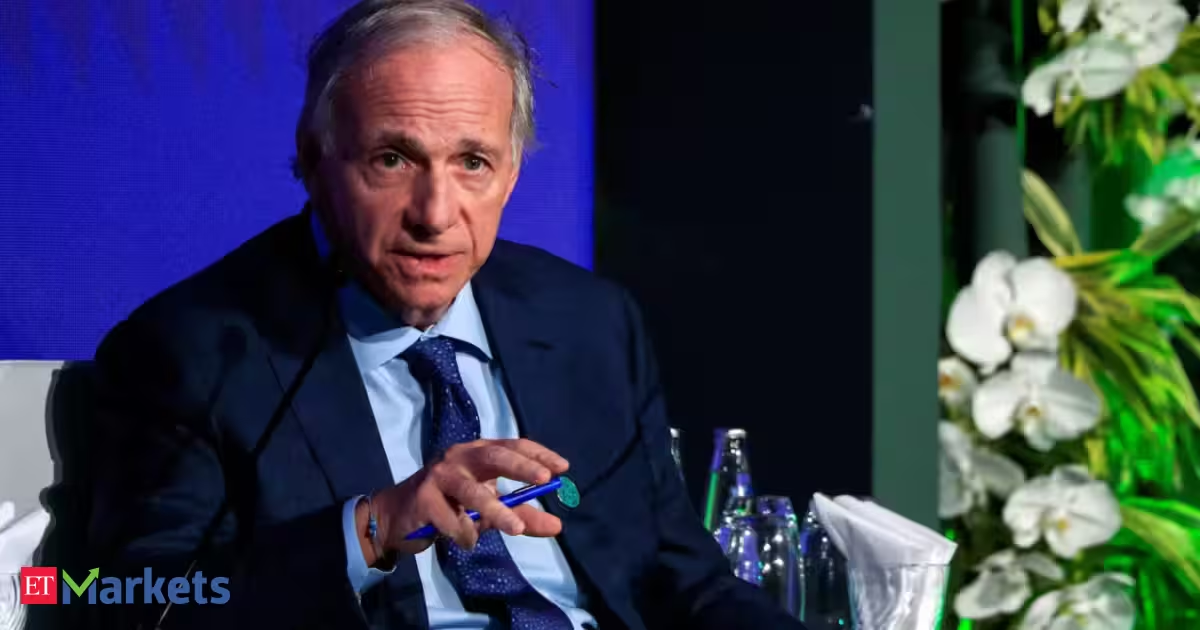
A crash coming? Ray Dalio warns AI rally looks like 1929 and 2000 bubbles

Published

on

A crash coming? Ray Dalio warns AI rally looks like 1929 and 2000 bubbles
Ray Dalio, the billionaire founder of Bridgewater Associates, has warned that the market rally driven by artificial intelligence is showing signs of a bubble similar to those seen before the 1929 crash and the dot-com bust in 2000. Dalio made the comments during an appearance on The Diary of a CEO with Steven Bartlett. Bartlett referred to investor Jeremy Grantham’s warning that markets are facing “the biggest investment bubble in American history.” Dalio agreed.

Dalio said the current market has many features seen during earlier speculative periods. Investor excitement around AI has pushed valuations higher, while companies linked to the theme are attracting large amounts of capital.

His warning comes as some of the biggest AI-linked companies are moving toward public markets. SpaceX has already completed what was described as the largest IPO ever, while Anthropic and OpenAI are reportedly moving toward valuations near or above $1 trillion.

Also Read: 9 microcap multibaggers: How India’s stock market minnows beat every major index in six months

Advertisement

Dalio said rising interest rates and a wave of stock issuance are among the main risks that can burst a market bubble. In past cycles, markets have often become vulnerable when investors were willing to pay very high prices for fast-growing companies, just as more companies rushed to sell shares.


SpaceX’s market performance has added to those concerns. Since listing in June, the company has lost more than $500 billion in market value, according to CNBC. Its shares have posted four straight weekly losses and are more than 50% below their intraday high.
The stock recently closed at $108.37, below its IPO price, although the company still has a market value of about $1.4 trillion. Its price-to-sales ratio remains in the 70s, while the company is burning billions of dollars each quarter and carries almost twice as much debt as cash.Dalio’s comments add to a growing debate on whether the AI trade has moved too far, too fast. Supporters argue AI will reshape the economy and justify large investments. Critics say valuations have run ahead of earnings and cash flow.

Grantham has also warned about bubble-like conditions. He has a long record of calling major market excesses, including the Japanese asset bubble, the dot-com bubble and the US housing bubble before the 2008 financial crisis.

Strategists at Goldman Sachs have also flagged risks around tech valuations and earnings expectations.

(Disclaimer: Recommendations, suggestions, views and opinions given by the experts are their own. These do not represent the views of Economic Times)

Advertisement
Continue Reading

Business

ON Semiconductor: Near-Term Headwinds, Long-Term Upside (NASDAQ:ON)

Published

on

ON Semiconductor: Near-Term Headwinds, Long-Term Upside (NASDAQ:ON)

This article was written by

As of June 2026, I’m globally ranked in the top 1.9% of investment experts and financial bloggers on TipRanks. My goal is to clarify the complexities of investment opportunities and risks for both individual and professional investors, while also helping newer investors build confidence as they learn to evaluate opportunities with a disciplined, long-term mindset, so please follow me if this is the type of research you’re looking to read.

Analyst’s Disclosure: I/we have a beneficial long position in the shares of ON either through stock ownership, options, or other derivatives. I wrote this article myself, and it expresses my own opinions. I am not receiving compensation for it (other than from Seeking Alpha). I have no business relationship with any company whose stock is mentioned in this article.

Seeking Alpha’s Disclosure: Past performance is no guarantee of future results. No recommendation or advice is being given as to whether any investment is suitable for a particular investor. Any views or opinions expressed above may not reflect those of Seeking Alpha as a whole. Seeking Alpha is not a licensed securities dealer, broker or US investment adviser or investment bank. Our analysts are third party authors that include both professional investors and individual investors who may not be licensed or certified by any institute or regulatory body.

Advertisement
Continue Reading

Business

Bev Craig: ‘Getting to Leeds, Sheffield or Bradford has to be made easier’

Published

on

Business Live

New Greater Manchester mayor says she will work with other mayors to find transport solutions

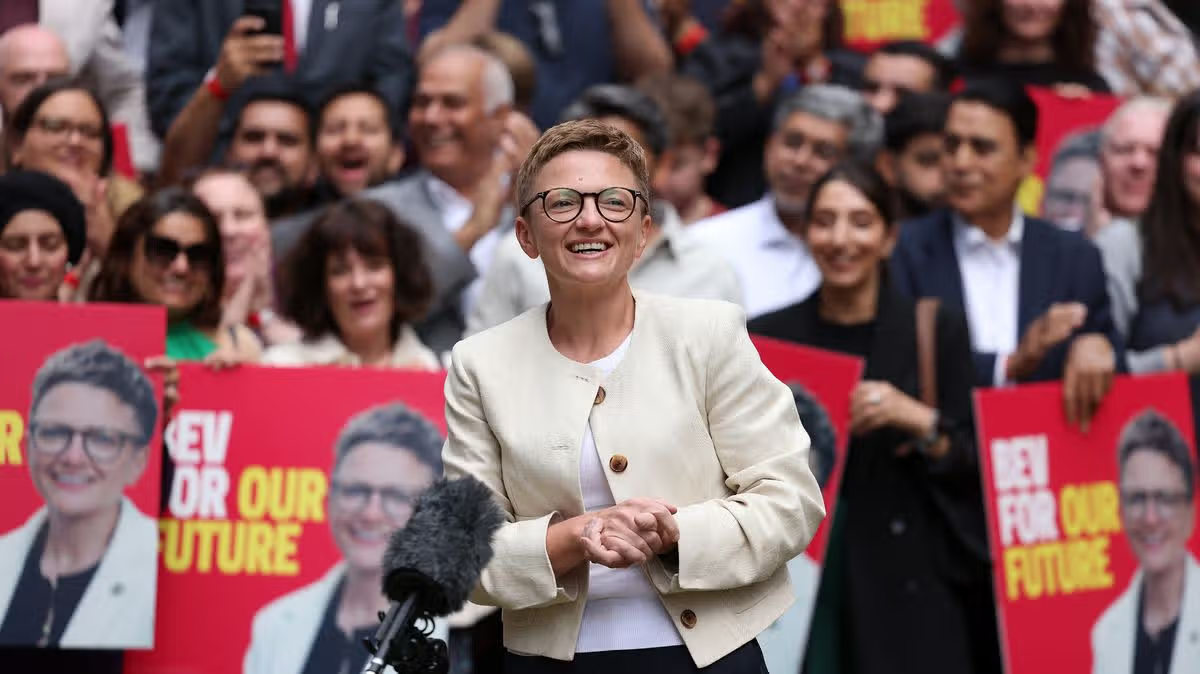
Bev Craig at a victory rally on Saturday

Bev Craig at a victory rally last Saturday(Image: Sean Hansford | Manchester Evening News)

Greater Manchester mayor Bev Craig has said travel from the North West to cities such as Sheffield and Leeds ‘has to be made easier’ as she pledged to push for improvements.

Advertisement

She told the Local Democracy Reporting Service that she will work with other mayors to find ‘solutions’ to make east-west transport connections better.

Journeys times from Manchester across the Pennines are currently lengthy and can be hit with delays.

Those who choose to drive to Sheffield from Manchester often rely on using Snake Pass (A57) through the Peak District, a journey of around 40 miles which can take an hour and 30 minutes or longer during busy times of day.

Catching the train from Manchester to Sheffield can take between 45 minutes to an hour depending on the service, in a route which also crosses the Peak District.

Advertisement

But new calls have been made to revive plans for a 14-mile tunnel between Manchester and Sheffield, led by a team known as Future Works who reckon the project could cost around £2bn.

Asked about the idea on Monday, Bev Craig said: “I’ve been a long advocate of better east-west connections, we’ve seen throughout the debates we’ve been having about Northern Powerhouse Rail that getting to Leeds, getting to Sheffield or Bradford has to be made easier.

“I’m looking forward to getting stuck in over the next few weeks, working with colleagues in Transport for the North and linking up with other mayors to be able to see what solutions we can get.

“The reality for me is that train travel just isn’t reliable enough, it isn’t quick enough, and it isn’t effective enough in this country, and we think that mayors will be able to help with that and be able to push for faster travel.”

Advertisement

Plans for a tunnel under the Pennines connecting Manchester and Sheffield were explored a decade ago as a way of cutting congestion levels and boosting connections between Greater Manchester and South Yorkshire, but the idea was eventually shelved.

The Northern Powerhouse Rail (NPR) scheme also aims to boost railway travel across the north, including with a new line between Manchester and Liverpool.

This could see up to £45bn being invested and ultimately transform rail services across Liverpool, Manchester, Leeds, Bradford, Sheffield and York.

The project would be delivered in three phases, with upgrades to the lines east of the Pennines, including electrification, specifically on the Leeds-Bradford, Leeds-Sheffield and Leeds-York corridors.

Advertisement

It would then move to plans for a new line between Liverpool and Manchester, via Warrington and Manchester Airport, before the third phase to focus on better links across the Pennines.

To find all the planning applications, traffic diversions, road layout changes, alcohol licence applications and more in your community, visit the Public Notices Portal.

Continue Reading

Business

McDonald’s names Skye Anderson as its U.S. president

Published

on

McDonald's names Skye Anderson as its U.S. president

Skye Anderson, president of McDonald’s USA

Source: McDonald’s

McDonald’s announced that company veteran Skye Anderson will lead its U.S. business, effective Tuesday, as the company tries to win over cost-conscious diners in its largest market.

Advertisement

“I look forward to working closely with her and the U.S. leadership team to help accelerate performance and unlock the significant opportunity in front of us, and I have tremendous confidence that she is the ideal leader for this next phase of our U.S. business,” McDonald’s CEO Chris Kempczinski said in a statement.

Earlier this year, Anderson was named chief operating officer for McDonald’s USA. Before that, she led the company’s Global Business Services segment, which was created with the aim of making its corporate operations more efficient and using the restaurant giant’s scale. She also spent four years in charge of McDonald’s U.S. West Zone; in that role, she increased average restaurant unit cash flow by $100,000 and drove same-store sales growth of more than 30%, according to the company.

Anderson has been with the company for 26 years.

“I’ve had the opportunity to work closely with Skye throughout much of her career, and I’ve repeatedly turned to her to lead some of our most important businesses and transformation efforts because she’s a proven change agent who can act with urgency to mobilize our System,” Kempczinski said.

Advertisement

Anderson succeeds Joe Erlinger, who has held the role for more than six years. Erlinger will stay on as an advisor through early 2027.

McDonald’s also reported its second-quarter results on Tuesday. The company’s earnings topped Wall Street’s estimates, but its revenue fell short of analysts’ expectations. U.S. same-store sales grew just 0.8%, and traffic to its domestic restaurants fell during the quarter.

Broadly, McDonald’s has outperformed U.S. rivals by leaning into value meals and buzzy promotions to attract diners. But a successful marketing move — like its tie-in meal with the “Minecraft” movie during the year-ago period — means that the burger chain has to keep surpassing its own wins to grow same-store sales.

In early June, the company unveiled a new growth strategy as it aims to become diners’ first option. The plan includes menu innovation that elevates taste and quality, listening to how consumers interact with brands, and a new restaurant design.

Advertisement
Choose CNBC as your preferred source on Google and never miss a moment from the most trusted name in business news.
Continue Reading

Business

Royal Author Says Harry and Meghan’s Exit Caused ‘Very Serious Damage’ to the British Monarchy Today

Published

on

Meghan Markle

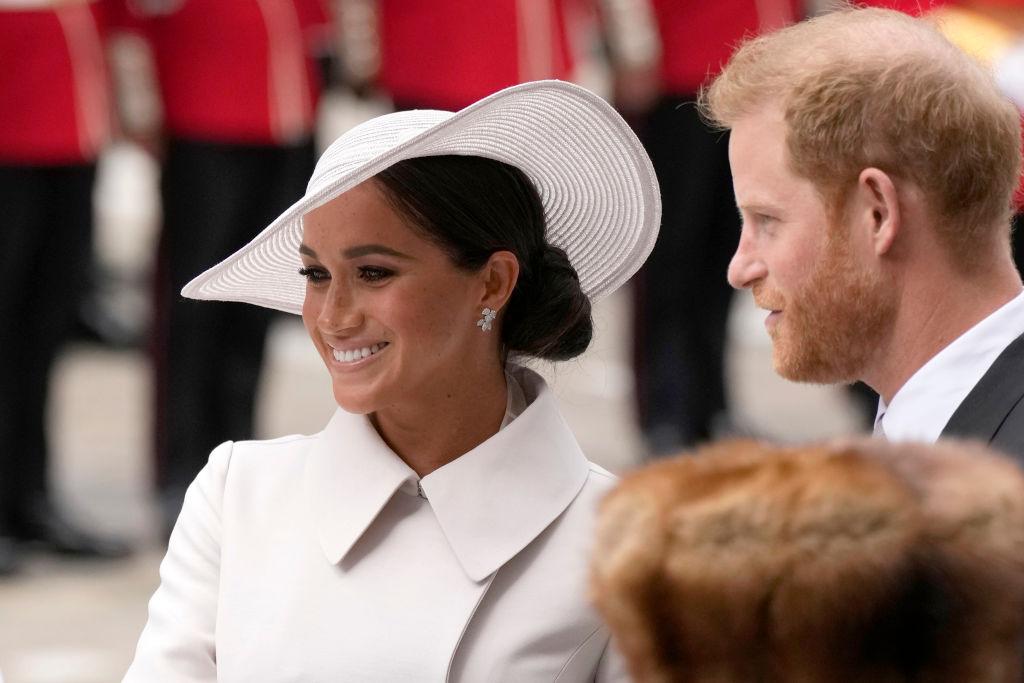
LONDON — Prince Harry and Meghan Markle’s departure from royal life has inflicted lasting harm on the British monarchy’s ability to connect with younger generations, according to royal author Catherine Mayer, who argues the couple’s exit left a gap in the institution’s public appeal that has yet to be filled.

Mayer, whose new book “Divide & Rule” is now out, made the comments to Fox News Digital as Meghan celebrated her 45th birthday on Monday, offering a fresh assessment of how the Sussexes’ 2020 departure from senior royal duties continues to shape public perception of the monarchy more than five years later.

A rupture with lasting consequences

Speaking about the impact of Harry and Meghan’s exit, Mayer was direct in her assessment of the institutional fallout. “Has done very serious damage to the monarchy,” Mayer said, describing the broader rupture within the royal family that led the couple to relocate to the United States.

Advertisement

Mayer was careful to clarify that her assessment was not intended as criticism of Harry and Meghan themselves. She said the framing of the situation as something the couple did to the monarchy oversimplifies what she described as a genuinely painful episode for everyone involved, including the institution as a whole. She pointed to recent public opinion polling on the monarchy’s popularity as evidence that the institution’s standing has continued to erode in the years since the Sussexes stepped back.

A missing generational bridge

Central to Mayer’s argument is the idea that Harry and Meghan once served as a bridge between the monarchy and younger, more diverse audiences, a role she argues has gone unfilled since their departure. She suggested that Prince William and Catherine, Princess of Wales, while central figures in the modern monarchy, tend toward a more traditionally cautious public approach compared with the broader appeal Harry and Meghan once offered.

Mayer also noted a generational gap within the family itself, observing that there is currently no adult royal positioned between Prince George, still a child, and his parents, William and Catherine, capable of capturing the imagination of younger audiences the way Harry and Meghan once did. She argued that despite being roughly the same age as William and Catherine, Harry and Meghan carried a broader public appeal that has since been lost to the institution.

Advertisement

A birthday marked by continued distance

Mayer’s comments arrived on the same day Meghan turned 45, a milestone marked amid what remains an unresolved rift between the Sussexes and the wider royal family. The couple had a private meeting with King Charles and Queen Camilla on July 10, marking Meghan’s first return to England since 2022, though she made no public appearances during that visit, underscoring the continued distance between the Sussexes and official royal life.

The couple stepped back from their roles as senior working royals in 2020, citing intrusive media coverage and what they described as insufficient support from the palace. As part of that departure, Harry and Meghan lost their taxpayer-funded security detail, a change Harry has long sought to reverse, citing ongoing concerns for his family’s safety while in the United Kingdom.

Where Mayer places the real blame

Advertisement

Despite her assessment that the Sussexes’ departure damaged the monarchy’s broader appeal, Mayer pointed elsewhere when identifying the primary driver behind the institution’s declining popularity in recent polling. She argued that the steepest losses in public support trace back to Andrew Mountbatten-Windsor, who was formally stripped of his princely title following the fallout from his widely scrutinized associations, a controversy Mayer suggested has done more sustained reputational harm to the monarchy than Harry and Meghan’s exit.

A recurring theme among royal commentators

Mayer’s comments echo broader debate among royal authors and commentators over the lasting impact of the Sussexes’ departure, a discussion that has resurfaced repeatedly since Harry and Meghan first stepped back from official duties. Earlier assessments of the couple’s high-profile interviews and media projects, including their sit-down with Oprah Winfrey and subsequent Netflix documentary series, similarly described the revelations as damaging to the institution’s carefully managed public image, even as royal watchers have generally predicted the monarchy would ultimately withstand the controversy.

The Sussexes have previously pushed back forcefully against authors and commentators they viewed as unfairly characterizing their motives or actions, at times issuing formal statements disputing specific claims made about their departure and its aftermath. Neither Harry nor Meghan’s representatives had issued a public response to Mayer’s latest comments as of Monday.

Advertisement

A monarchy navigating multiple challenges

Mayer’s broader assessment reflects a monarchy currently facing scrutiny on several fronts simultaneously, from the continued fallout surrounding Andrew Mountbatten-Windsor to ongoing questions about how the institution can maintain relevance with younger, more diverse audiences in an era of declining public deference toward traditional institutions. Her comments suggest that, in her view, no single royal currently occupies the space Harry and Meghan once filled in projecting a more modern, broadly appealing image of the monarchy to younger generations both in Britain and internationally.

With Meghan’s birthday passing largely out of the public eye and the Sussexes continuing to operate primarily from their base in California, questions about whether, or how, the family’s rift might eventually narrow remain unresolved. Mayer’s comments add to a growing body of commentary suggesting that regardless of how relations between Harry, Meghan and the wider royal family ultimately develop, the institutional impact of their 2020 departure continues to shape public conversation about the monarchy’s future years later, with no clear resolution in sight for either the family rift or the broader generational gap Mayer describes.

Advertisement
Continue Reading

Business

Gatwick expansion appeal dismissed by Court of Appeal

Published

on

Gatwick expansion appeal dismissed by Court of Appeal

The Court of Appeal has refused campaigners permission to challenge the government’s approval of a two-runway operation at Gatwick Airport, clearing the way for the £2.2bn Northern Runway project to move into design and delivery.

Lord Justice Holgate and Lord Justice Dove dismissed the appeal bids in a ruling on Tuesday. In a 29-page judgment, they said: “We conclude that each of the grounds of appeal raised by each appellant is unarguable. Neither appeal has a real prospect of success. We also consider that there are no other compelling reasons for either appeal to be heard.”

The challenge was brought by Peter Barclay and campaign group Communities Against Gatwick Noise Emissions (Cagne), who had taken legal action against the Department for Transport over the decision to approve the plans, including over claims that the government did not properly assess the climate impact of the scheme.

The scheme moves the West Sussex airport’s emergency runway 12m (39ft) north to allow 100,000 more flights a year. The development consent order for the Northern Runway project was granted by the Transport Secretary. The expansion will allow the site to be used for departures of narrow-bodied planes such as Airbus A320s and Boeing 737s.

Mr Justice Mould dismissed the original challenges in June, finding that it was “neither illogical nor contradictory” for Transport Secretary Heidi Alexander not to refuse the proposed development “on the basis that it would have a material impact on the ability of Government to meet its carbon reduction targets”. He also rejected an argument about the need for expansion at Gatwick given the proximity to Heathrow. The two senior judges said that ruling was “detailed and thorough”.

Advertisement

Gatwick is the UK’s second busiest airport and one of the busiest single-runway airports in the world.

Barclay said: “We are very disappointed with the Court’s decision. We took this challenge as far as we could because we believed that the decision to allow Gatwick to expand was fundamentally flawed. It was not supported by government policy, would only serve to line the pockets of the airport and airlines, and would do so at the expense of local residents and the climate.”

Cagne said: “Residents should be immensely proud of what they have achieved in holding Gatwick Airport’s shareholders to account. This proposed new runway will come at a significant cost to both the taxpayer and the planet.”

Pierre-Hugues Schmit, chief executive of London Gatwick, said the decision to approve the plans “was taken properly and lawfully”.

Advertisement

He added: “We are also very pleased that this ruling, from senior Court of Appeal Judges, brings to an end an eight-year planning and legal process which has carefully tested and scrutinised every aspect of our expansion plans on multiple occasions. This final ruling means that we can now press on with the important job of bringing this exciting project to life and move forward into the design and delivery phase.”

Schmit said the Northern Runway project was expected to deliver 14,000 new jobs and a £1bn boost to the economy every year.

Muniya Barua, deputy chief executive at BusinessLDN, said: “Today’s ruling is the final step in a long-running process that clears the way for Gatwick’s Northern Runway project to move forward, providing welcome certainty for businesses, investors and communities.”

She added: “The airport’s expansion will strengthen London’s connections with key international markets, help to create 14,000 jobs and provide a £1bn boost to the economy every year. With the UK seeking to drive investment and growth, expanding aviation capacity is a vital part of maintaining London’s position as a leading global city.”

Advertisement

Alexander said the decision was “a major milestone for Gatwick and for local communities, with expansion unlocking investment and creating thousands of new jobs”.

She said: “Around 13 million more passengers and 100,000 more flights will give holidaymakers greater choice and strengthen global links to help make the UK one of the most attractive places in the world to invest. We’ll back expansion that supports growth and our climate goals.”

Alexander said the government was also investing over £219 million for green fuel production to cut emissions from flying and secure the future of aviation.

The ruling comes as Heathrow’s separate third runway proposals continue to draw scrutiny over costs and timelines, with Gatwick having previously reported a 7.7 per cent rise in passenger numbers on short-haul demand. Chancellor Rachel Reeves gave official backing to Heathrow expansion earlier in the process.

Advertisement

Amy Ingham

Amy Ingham

Amy Ingham is a reporter at Business Matters, covering UK business news with a focus on breaking news, business policy, late payments and insolvency. She joined the magazine in 2026 after completing the NCTJ Diploma in Journalism at Harlow College’s journalism school. Her recent reporting includes British Steel’s nationalisation and its impact on SME suppliers, the decline in late payments by large firms, and Insolvency Service director disqualifications. Reach her at aingham@cbmeg.co.uk.

Advertisement
Continue Reading

Business

Elon Musk likely to face tough questions during SpaceX’s first earnings call after stock market listing

Published

on

Elon Musk likely to face tough questions during SpaceX's first earnings call after stock market listing
Investors in Elon Musk‘s space company get a chance to question him Tuesday after SpaceX issues its first quarterly earnings since going public.

SpaceX shares are down by half from their June peak as investors worry Musk may have oversold them on its future prospects. They’re also bracing for volatile trading as some company insiders get the opportunity to sell shares after the expiration of what’s known as a lockup provision later in the week.

The shares jumped 19% on their first day of trading, making Musk the first-ever trillionaire. The subsequent drop in SpaceX, as well as a decline in the shares of Musk’s electric vehicle company Tesla, have knocked his wealth down to $726 billion, according to Forbes.

Part visionary engineer, part stock salesman, Musk is likely to be asked about when he expects to finish testing SpaceX’s giant Starship rockets that NASA hopes to use to put men on the moon again, his plans for its satellite network and the prospects of putting football-field sized data centers in orbit.

Advertisement

Given rumors of SpaceX possibly merging with Musk’s Tesla car company, he may also face questions about that tie-up but that is likely to yield few details. Neither company has confirmed plans for a combination and Musk has parried questions before by noting securities regulations bar him from discussing the issue.


SpaceX is losing money fast, with net losses for its first half this year expected to exceed more than the $5 billion in losses for all of last year. Some analysts have penciled in a strong rebound for the rest of the year that will return it to profitability.
For the second quarter ended June 30, SpaceX is expected to report a net loss of $1.9 billion, or 23 cents a share, according to a FactSet survey of analysts.SpaceX insiders were barred from selling in the public offering in June but that prohibition begins to ease on Thursday when more than 900,000 shares are released for trading, more than doubling the amount currently available for trading. The prospect has weighed on the shares, which closed Monday at $114.46, down from both the peak of $225 in June and also the IPO price of $135.

The lockup release is the first of several tranches of stock that will be freed to trade over the next several months.

After an abandoned launch, the Starship rocket successfully deployed satellites in orbit during a test late last month. Future tests could include trying to use giant arms at its Starbase launching site in Texas to grab the rocket and its booster upon its hovering return to earth.

SpaceX’s satellite communication business, Starlink, is a big cash generator for the company with contracts around the world. The company also runs a money-losing AI business, known for its Grok tool, as well as the social media platform X, the renamed Twitter.

Advertisement
Continue Reading

Trending

Copyright © 2025