Security teams log 54% of successful attacks and alert on just 14%. The rest move through your environment unseen.
The Picus whitepaper shows how breach and attack simulation tests your SIEM and EDR rules so threats stop slipping by detection.




The Greatness phishing-as-a-service (PhaaS) platform has expanded from credential phishing to adversary-in-the-middle attacks and device-code phishing targeting Microsoft 365 accounts.
The platform has been active since at least mid-2022, targeting Microsoft 365 users in the United States, Canada, the UK, Australia, and South Africa.
It evolved over the years and now targets multiple platforms, including Microsoft 365, iCloud, Yahoo, and Google Workspace.

Currently, it is sold for $289 per month to cybercriminals over a Telegram channel with thousands of subscribers.
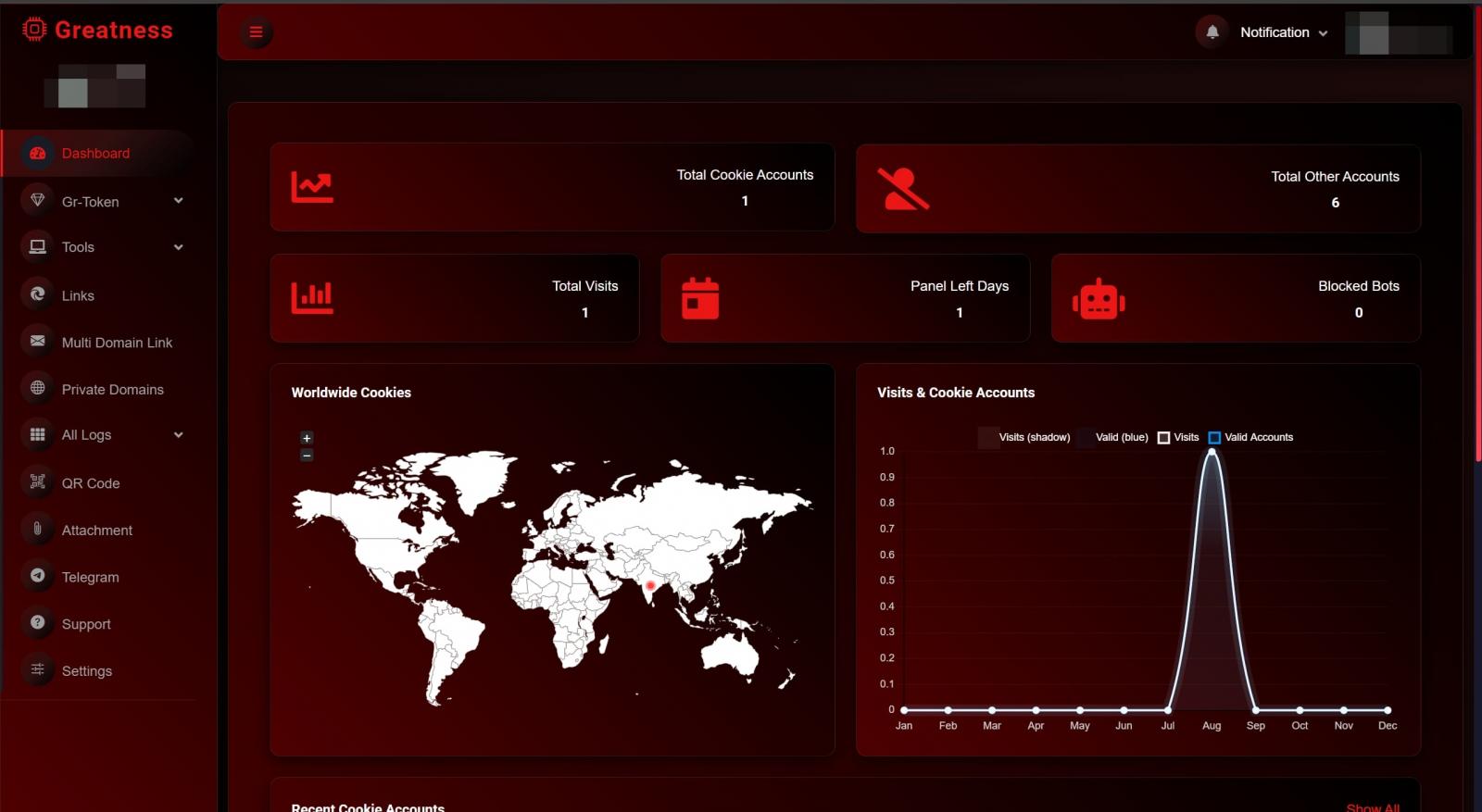
In a recent campaign observed by researchers at email security company ZeroBEC, Greatness operators abused the RingCentral communications platform to bypass email security filters on the recipient side.
RingCentral is a communications platform used by businesses for services such as cloud calling, messaging, and voicemail.
In the Greatness phishing activity, the attacker impersonated the platform by claiming their emails came from service@ringcentral[.]com, targeting actual users of the service.
These emails used fake voicemail and performance-review notifications as lures to entice recipients to open them.
Although the messages originated from an unknown IONOS mail server, failed SPF and DMARC checks, and had no DKIM signature, they were still accepted by the receiving systems because RingCentral was whitelisted.
Moreover, the emails included a fraudulent banner claiming that the sender had been verified by the organization’s safe-sender list, which helped reduce suspicion at the human level.
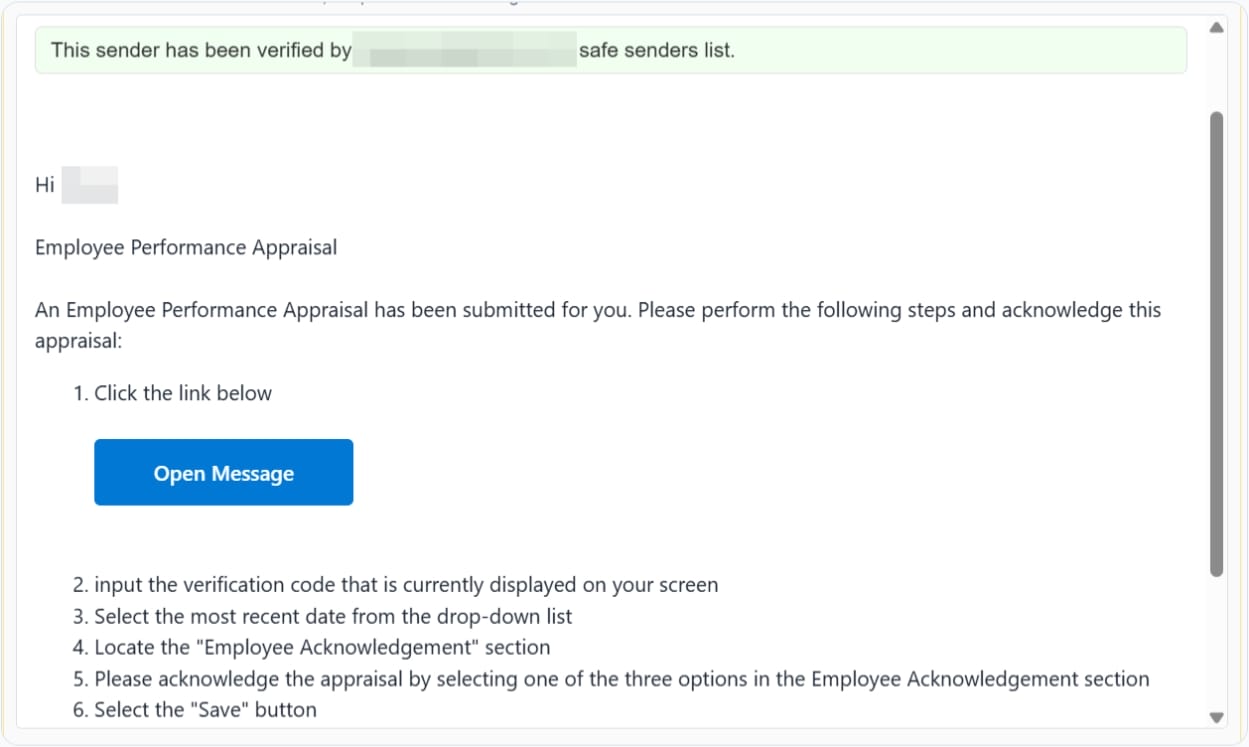
ZeroBEC explains that the tactic achieved a Spam Confidence Level (SCL) of -1 on Microsoft Exchange, allowing them to bypass the normal email filtering stages.
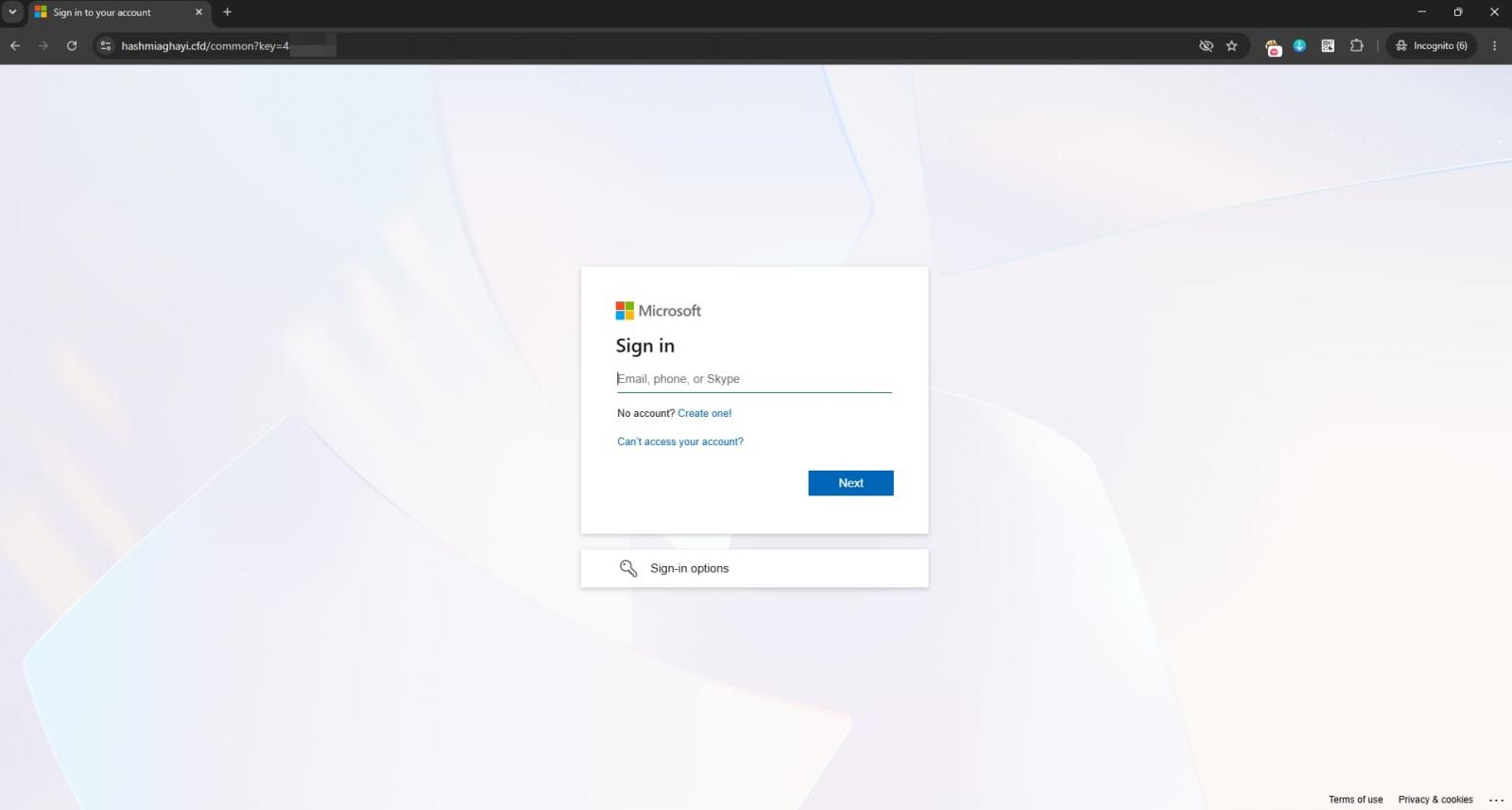
Clicking the button embedded in those emails took victims to the Greatness infrastructure, where they were routed either through a Microsoft adversary-in-the-middle (AiTM) phishing flow that captured an MFA-approved authentication token or through a device-code phishing flow.
Post-compromise, the attacker replayed Microsoft 365 authentication tokens from VPS and commercial VPN infrastructure to access the compromised accounts.
They then enumerated Outlook mailboxes, Teams conversations, SharePoint sites, OneDrive files, contacts, calendars, and registered applications through Microsoft Graph, with access persisting for more than two weeks in some cases.
It should be noted that RingCentral recently disclosed a data breach incident which was claimed by threat actor ShinyHunters.
“This incident has affected data for a limited portion of RingCentral customers, and we are communicating with affected customers directly,” explained the company in a security bulletin published July 28.
ZeroBEC comments that it’s likely that cybercriminals using Greatness got a list of valid targets, users of the RingCentral platform, from that incident, though a connection cannot be confidently made.
The researchers recommend auditing safe-sender lists and replacing blanket domain exclusions with rules requiring valid email authentication.
Also, hunt for Greatness infrastructure and suspicious MFA-approved Microsoft 365 sign-ins from hosting or VPN addresses.
If compromise is suspected, administrators should revoke all access and refresh tokens, review OAuth consent, Microsoft Graph activity, and access to Microsoft 365 services.

Security teams log 54% of successful attacks and alert on just 14%. The rest move through your environment unseen.
The Picus whitepaper shows how breach and attack simulation tests your SIEM and EDR rules so threats stop slipping by detection.
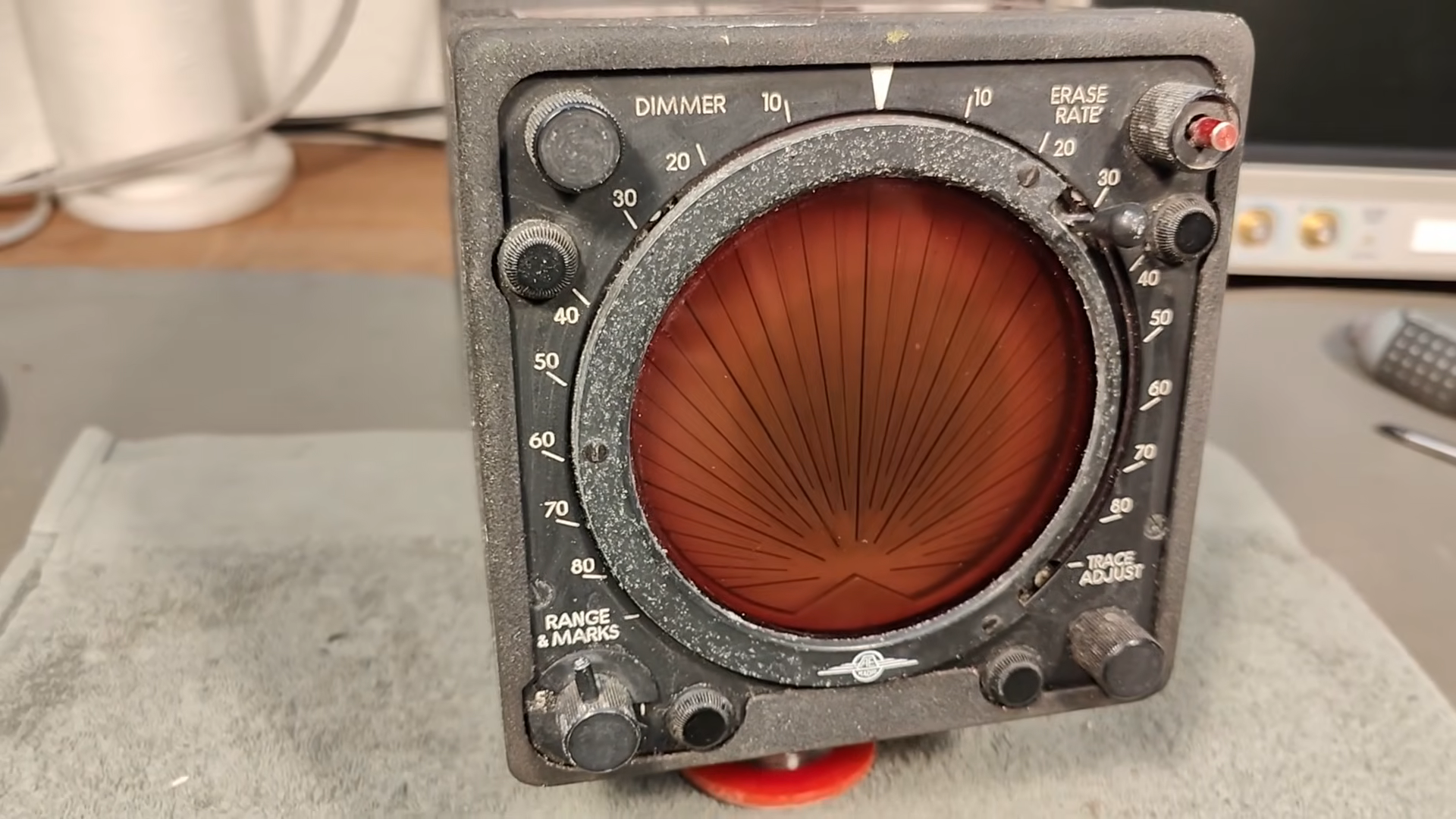
If you’re flying high in the sky, it’s useful to know if there’s turbulence, heavy rain, or other nasty weather ahead. Onboard weather radar is a useful tool that pilots use to scope out conditions ahead. [Thomas Scherrer] came into possession of a weather radar display from a vintage aircraft, and decided to tear it apart for our viewing pleasure.
The unit in question is a Bendix PPI-1 plan position indicator. This particular 1971 example was scored from a McDonnell-Douglas DC9. [Thomas] only has the display itself, not the radar that would feed it or the power supply to turn it on. Still, even just the readout unit is super interesting to look inside. Right off the bat, there’s a neat dimming filter on the front, and the case itself is really beautifully designed for service. The design is very much of its time, full of neat wire harnesses and chunky through-hole components. There are some neat surprises inside, too, like an interesting device shaped like a triangular prism whose purpose we won’t spoil here.
If you’re wondering what one of these units looks like in action, you can see such an example on YouTube. The display basically lights up in areas where there were stronger radar returns indicating weather to be avoided.
We love radars around these parts, and we feature them all the time. Video after the break.

Elon Musk spent SpaceX’s first earnings call making some out-of-this-world claims about the company’s business and future prospects, while his fellow executives kept trying to bring his ideas closer to Earth — providing a hint of what’s to come now that his rocket-launching, compute-leasing, satellite-based telecom is public.
The conference call, held Tuesday, was the latest in a years-long succession of Musk making outrageous promises that his executives then have to make more digestible for the investing public — like at Tesla, where a recent analysis by TechCrunch showed that the world’s richest man is increasingly focused on futuristic topics while his colleagues spend their time talking about the actual business of selling cars.
Let’s start with one of the biggest ideas Musk floated on the call: that he expects SpaceX’s Starlink service to “deliver a majority of the world’s internet” in “less than 10 years.” Musk made the comment in the context of SpaceX preparing to launch the first “V3” versions of its Starlink satellites, which have much higher bandwidth than previous versions.
Here’s what he said:
It’s kind of hard for people to wrap their minds around this, but like, it’s not out of the question that at some point, Starlink will deliver a majority of the world’s internet, at least in countries where we’re allowed to operate, which is the vast majority of countries. So this is, you know, important to bear in mind, and it’s not in like the infinity future. It’s, you know, less than 10 years.
Contrast that with what chief operating officer Gwynne Shotwell said just a few minutes later, emphasis mine:
The significant amount of capacity we’re able to add to the Starlink constellation from the V3 satellites will enable us to continue providing even better service — and it’s pretty great already — but to do so while serving more and more customers over the world. In fact, in the years ahead, we expect Starlink will represent a significant portion of global internet traffic, which Elon also talked about.
It’s a far more lawyered-up claim to make, even though it’s still obviously ambitious.
But that was not the only instance where Musk optimistically diverged. At one point, SpaceX chief financial officer Bret Johnsen offered investors one of the few new financial targets discussed on the call. Johnsen was highlighting SpaceX’s relatively new business of renting out compute power to other AI players, which has helped the company generate billions in fresh, fast cash.
I’ll once again emphasize the big promise Johnsen made during his prepared remarks, and note how carefully he phrased it. It’s a very hedged and quite specific claim that he’s making. It’s clearly meant to excite investors while also leaving room for the company to avoid legal exposure if it misses the projection:
Looking ahead, we continue to see robust demand in all three of our business segments, but in particular in our cloud services arrangements. We see increasingly favorable economics with each agreement we sign, and as Elon mentioned, we expect the supply-demand imbalance in the compute market to continue. The current economics have translated into a less than one-year payback on our new capital deployments for compute. For example, in the first few weeks of the third quarter, we’ve already contracted an additional $6.7 billion of cloud services revenue over a six-month period that begins ramping starting in October of this year. We believe this puts us on a trajectory, including contribution from Cursor, to reach $100 billion of ARR, or annualized revenue run rate by the end of this year, based on our expected revenue in the month of December of this year.
Musk, 20 minutes later, bulldozed that carefully constructed statement before immediately inflating it:
To be clear, the $100 billion ARR in December is not a question mark. That’s… that’s what we would achieve if we basically did nothing. So like, you know, I think it may be higher than that. It probably will be higher than that.
Musk also riffed on another major prediction about overall revenue on the call, pumping up a goal that SpaceX laid out just two months ago in its IPO documents:
It’s probably also worth mentioning that our internal projections for reaching a trillion dollars in revenue, not ARR, but revenue, have moved up from 2031 to 2030. So prior to the IPO, the financial projections we had were reaching a trillion dollars in revenue in 2031. We now expect that to be in 2030. And there’s a non-zero chance of that being in 2029.
The pattern kept repeating throughout the call. A shareholder question about progress on the “human landing system” that SpaceX is developing for NASA’s Artemis moon missions using Starship prompted Musk to all but claim that the prototype rocket will be ready to fly people by the end of next year. He later said SpaceX would be flying Starship rockets once a day, or “possibly more,” by this time next year.
Shotwell immediately followed Musk’s comments about human flight to clarify that SpaceX is still focused on NASA-mandated milestones, and offered a more vague (but still ambitious) goal (again, emphasis mine) that “we want to put boots on the ground, boots on the moon, in 2028.”
None of that will happen unless SpaceX can prove that Starship can fly without failing and, crucially, become fully reusable. A huge part of making it reusable is the heat shield that keeps the Starship upper stage from exploding when it re-enters Earth’s atmosphere. The company saw the best results from its improved heat shield on the most recent Starship test flight, which splashed down in the Indian Ocean last month and is still intact. But before the rocket stage had even been recovered, Musk was willing to claim on Tuesday that he’d “consider the heat shield problem solved at this point.”
Musk has made many wild promises about SpaceX that never came true, such as when he said in 2016 that he’d put humans on Mars in six years. The difference now is that SpaceX is a public company, and ostensibly subject to regulation and fines if the company and its executives make promises they know can’t be met.
Of course, the Securities and Exchange Commission has pulled way back on corporate enforcement, especially against public companies. The Department of Justice is doing the same. And if SpaceX can’t follow through on Musk’s wide-eyed claims, investors won’t even be able to do much in civil court — because the company has all but inoculated itself against those kinds of lawsuits by incorporating in Texas.
When you purchase through links in our articles, we may earn a small commission. This doesn’t affect our editorial independence.


Media reports have placed the fund behind Germany’s The Exploration Company and the Paris-based Mistral AI.
The Europe Union is ready to back deep-tech businesses in the bloc with a new funding mechanism aimed at helping the region catch up with the US and China.
The European Commission said on Tuesday (4 August) that its $5bn Scaleup Europe Fund has passed final legal hurdles and is ready to start operating at full capacity.
The multibillion-euro fund was initially announced back in October 2025, and is designed to build on the ‘choose Europe to start and scale’ strategy launched earlier that year.
It’s the largest fund of its kind ever launched in Europe and is expected to direct growth capital at high-potential companies across a range of strategic sectors, including artificial intelligence, quantum computing, clean energy, space technology, biotech and medical innovation. With an initial goal of €5bn, the Commission hopes to eventually raise €25bn for the scale-up fund.
The bloc tapped Stockholm-headquartered EQT to manage the fund earlier this year. The EU’s investment into the fund is backed by Horizon Europe, which is the world’s largest research and development programme and headed by the EU with more than €90bn in allocated funding up to 2027.
Recent reports have already placed Scaleup Europe Fund behind the Bavarian space-tech The Exploration Company in an upcoming $300m funding round. It is also reportedly expected to back the Paris-based Mistral AI in its upcoming raise.
The fund emerges as EU-based companies face “significant challenges”, its operators said, in accessing the necessary capital for growth from within the bloc, often leading them to search for funding elsewhere or move bases away from Europe altogether.
In July 2025, an Irish Government report found that scale-up enterprises in the country face a €1.1bn gap in equity financing over the next three to five years.
“When Europe invests in its innovators, Europe invests in its future,” said European Commission president Ursula von der Leyen.
“This is the goal of our Scaleup Europe Fund. From today, it will ensure our scale-ups can find what they need right here in Europe to grow into world-leading companies, to turn European innovation into our competitive edge.”
Don’t miss out on the knowledge you need to succeed. Sign up for the Daily Brief, Silicon Republic’s digest of need-to-know sci-tech news.


ai and ml
New plugins for K-12 teachers, university instructors, and college kids? Read the room, guys
In the face of an epidemic of AI-enabled cheating and research suggesting its products hamper learning, OpenAI is doing the sensible thing and pushing more AI on students and teachers.
Wait, did I say sensible? My mistake.
The House of Altman announced a trio of new education-focused offerings on Tuesday: one for K-12 teachers, another for college educators, and a third for college students. The new plugins, the company explained, will help students and educators make more use of ChatGPT’s agentic capabilities for both studying and teaching. The new features are available through ChatGPT Edu, an institutionally licensed suite for higher education, and ChatGPT for Teachers, a free resource available to verified US K–12 educators and school districts.
The new offerings, says OpenAI, build on its educational AI philosophy that “AI should support learning, not shortcut it, and the best learning experiences keep educators and students in control.”
Plenty of educators might disagree. Cheating with AI has become a sad norm in schools around the world, and the US is no exception. Many young people admit to using AI to cheat on school assignments, and college students have been caught doing it, too.
Mexico’s largest university, the National Autonomous University of Mexico, last week suspended enrollment for incoming students after suspected widespread cheating in its admissions exams. The university also decided this week to require about 58,000 applicants who qualified in the remote entrance exam to take an in-person proctored control exam after scores surged during its first remotely administered admissions test.
As for how teachers relate to AI in the classroom, a 2025 study from the Center for Democracy and Technology suggests it’s going to take more than some new OpenAI software to help teachers feel more comfortable.
CDT said last year that K-12 teachers widely complained of not being given the necessary resources to understand how to integrate AI into schools, or how to tackle the potential harms AI may be causing to their students’ ability to learn and personal development alike.
Rather than helping teachers and professors regain control of the academic process or better understand how AI is affecting their students, however, OpenAI wants to simply let them foist off more of their work to ChatGPT, too.
“The K–12 Educator plugin is designed to help teachers plan and create for their classrooms,” OpenAI explained. The tool can use materials teachers already have on hand “to create differentiated resources, design interactive visuals, and surface actionable insights.”
Integration with educational AI infrastructure outfit Learning Commons allows ChatGPT to automatically consider local educational standards for anything it creates for teachers, the company explained, while educators get to remain “in control of pedagogical decisions, grading, and agentic actions.”
The plugin for college professors is largely the same.
“The College Educator plugin enables course design, teaching, and academic planning,” OpenAI said in its announcement. “Faculty can update syllabi, create interactive websites or multimedia assessments, adapt materials for diverse learners, or package content for their Learning Management System.”
For college students, the plugin is designed to bring ChatGPT further into students’ study routines, the latest expansion of AI tools that have already complicated essay writing and take-home testing.
“The College Student plugin helps students turn what they are already studying into more personalized learning experiences,” said the ChatGPT maker. AI tutors are available (sorry, grad students), as are AI-generated quizzes, study guides, flashcards, and AI-generated visual explanations.
“The plugin draws on learning science to prioritize deeper understanding and build stronger study habits,” OpenAI claims. You’d be right to doubt that. Aside from being used to cheat on exams, AI also has a demonstrable effect on harming learning outcomes.
MIT researchers last year hooked a group of students up to EEGs to study their brain activity while writing essays. Some of them were allowed to use the internet to conduct research, while others were told to use AI. Not only did the AI cohort have far less ability to recall what they wrote when asked about it later, but they also showed far less brain activity, suggesting that relying on AI simply doesn’t lead to better learning.
It’s not much of a leap to go from AI lowering brain activity while doing essay research to figuring that relying on AI tools to help one study, create flashcards, or receive tutoring will likely lead to similar outcomes. Real learning still takes legwork, and other studies suggest overreliance on tools like ChatGPT can undermine deeper learning.
Why teachers and professors would want to embrace an expansion of AI into their workflow when they’ve seen what it can do to their students is a question for OpenAI. The AI giant didn’t initially respond to our questions for this story, but we’ll update if that changes. ®

What just happened? Texas has put a hold on new data center approvals that require access to the state’s grid, a move that could slow a long list of projects already waiting in line. Governor Greg Abbott has ordered the Public Utility Commission of Texas and ERCOT to pause approvals until the agencies complete an audit of applicants, a move that could stall a large backlog of projects seeking to connect.
The state wants more information before granting access. Abbott said applicants must provide tax break details, power use and generation data, water use and cooling plans, steps to reduce community impact, and facility ownership information. Any project missing that information will not be allowed onto the grid.
“Our top priority is to protect Texans’ safety and quality of life,” Abbott wrote. “Any project that fails to comply with the requirements set forth by the PUCT (Public Utility Commission of Texas) and ERCOT (Electric Reliability Council of Texas), and by state law, must be denied connection to the Texas grid. Simply put, Texans must come first.”
The review appears to follow a PUCT survey that most companies ignored. The agency said it asked 377 data center firms for information on water and power use, but only 28 responded.
The order isn’t a statewide ban, but it still affects a major chunk of the projects in ERCOT’s queue. More than 1,800 projects are waiting for approval to connect, and about 90% of them are data centers. Together, those applications could require 474 gigawatts, which is far above ERCOT’s current peak demand.

Even so, the directive does not hit every project in Texas. Data centers outside ERCOT’s territory, including those in El Paso, are not covered. Projects that bring their own power are exempt too, since they don’t need to connect to the grid.
The move drew criticism from opponents pushing for the legislature to step in with stricter rules. Texas Agriculture Commissioner Sid Miller called the directive “all hat and no cattle” on the Texas Department of Agriculture’s official Facebook page, saying, “Texans need laws with teeth, not another press release designed to make it look like something is being done while hyperscale projects continue moving forward.”
State Rep. Gina Hinojosa, who is challenging Abbott in the 2026 governor’s race, dismissed the move as too little, too late. She said Abbott has spent months promoting Texas as a friendly place for data centers, and argued his new pause wouldn’t convince anyone the state is suddenly cracking down.
The Texas move is narrower than New York’s statewide data center moratorium, but it still adds a major hurdle for developers. For an industry built around fast buildouts and heavy power demand, the pause could have immediate effects.

As strong and light as carbon fiber-epoxy composites are, the same can’t always be said of carbon-fiber reinforced 3D printer filaments. Of those that do improve over stock filament, the best performance comes from long, continuous strands, but the printers that can embed these are quite expensive. [MagicLAG], looking for a cheaper method, made something even stronger: prints reinforced with subsurface carbon-fiber cloth.
They tried a few other methods first, including pausing the print and manually embedding carbon fiber strands, ironing strands into the finished part, and ironing carbon fiber cloth into the bottom layer. For the main method, though, he printed the test part in three pieces: a core part, and two outer shell layers. Between the core and the shell is a small gap, into which carbon-fiber cloth can be epoxied. Under good conditions (not using quick-setting epoxy), this mostly preserves the outer surface and dimensional accuracy.
To test the various strengthening methods, [MagicLAG] printed hooks and tensioned them on a load cell until failure. None of the methods using single-stranded fiber showed any improvement; the fiber simply bent and let the surrounding plastic break. As a control for the epidermal cloth parts, they printed shells and cores and epoxied them together. These controls performed better than the standard parts, but not nearly as well as the carbon-fiber cloth composites. With only a few layers of cloth, these more than tripled the yield strength of the basic hook.
If you’d rather use a carbon-fiber filament, the type of plastic matters; carbon fiber makes PLA, at least, weaker. Regardless of form, some caution is called for whenever handling carbon fiber, since it seems to show some asbestos-like effects.

Google has finally addressed one of the biggest frustrations for Fitbit users on iPhone.
The latest Google Health 5.05 update allows health and fitness data collected by Fitbit devices to sync directly with Apple’s Health app. This eliminates a long-standing limitation that previously only allowed information to flow in one direction.
Until now, iPhone users could import data from Apple Health, HealthKit and Apple Watch into Google Health. However, they couldn’t send Fitbit-recorded information back to Apple’s platform without relying on third-party apps, a restriction that dates back more than a decade. This happened after Fitbit chose not to support Apple’s HealthKit framework when it launched in 2014.
With version 5.05, supported Fitbit data including workouts, step counts, sleep tracking and other health metrics can now be shared with Apple Health automatically. The feature is available through the Partner apps section within the Google Health app. Here users can connect Apple Health and decide exactly which categories of data they want to sync.
There are still a few limitations, however. Not every health metric is currently supported. Reports suggest that heart rate variability (HRV) is among the data types that don’t yet transfer between the two platforms.
The update marks another step in Google’s efforts to improve the experience following the transition from the standalone Fitbit app to Google Health earlier this year. Improving compatibility with rival ecosystems has been a frequent request from Fitbit users. This is especially true for those who use an iPhone but prefer Fitbit’s hardware for fitness tracking.
Google Health 5.05 also introduces another notable feature, although it’s currently limited to the US. Smart Health Links lets users share medical records stored in Google Health with healthcare providers or family members using either a URL or QR code, making it easier to access important health information when needed.
While Apple Health and Fitbit have historically been reluctant partners, this update makes life considerably easier for users who want to take advantage of both ecosystems without juggling multiple apps or relying on third-party syncing tools. It also brings Google Health closer to the seamless cross-platform experience many Fitbit owners have been asking for.


Rent the Runway’s Mark Walsh discusses the tech ecosystem in Galway and how he found himself in the role of director of engineering.
It was “half accidental and half strategic, with the accidental being the bigger half, as my kids would say”, joked Mark Walsh, when asked what led him to become the director of engineering at Rent the Runway’s Galway location.
“On the accidental side, I began my tech career in a start-up in Spiddal in Galway, and spent a decade working as a software engineer,” he said. “Then came the advent of DevOps and a wave of emerging technologies beyond Java, which pulled me into different areas, cloud, solution architecture and even product management-type roles.
“People management arrived completely by accident about six years ago, not as any great career strategy, and it has evolved from there into what I do today.”
Prior to joining the organisation he was commuting to a different role, four hours there and back, which he explained took a toll on his family life. Moreover, he had always planned on returning to Galway.
“I wanted to return to Galway. Crucially though, I was focused on a destination, not just another job. Rent the Runway was somewhere I already knew through former colleagues, it had the kind of opportunities that genuinely motivated me and it felt like somewhere I could add something meaningful rather than just fill a seat.”
I have to be honest and say I can’t speak adequately for the tech landscape much beyond Galway, as that would be overstepping what I actually see day to day. What I will say is that from a Galway perspective, the picture is more positive than the broader headlines might suggest.
There is a real depth of engineering talent here, and a sense that you don’t need to be in the capital city to work on interesting, complex problems at scale. The mix of homegrown companies maturing alongside international organisations that have put down genuine roots has created a stronger local ecosystem than people sometimes give it credit for. It is not without its challenges, but the opportunity feels real.
There genuinely isn’t one, which I think is part of what keeps it interesting. As a US company, our natural overlap with our US team members falls in the afternoon Irish time, so that tends to be where the collaborative work lands: cross-team meetings, planning sessions, working through anything that needs real-time conversation across time zones. Mornings are generally freer, which I try to protect for focused work, Galway-based one-to-ones, or anything that benefits from uninterrupted thinking time.
The nature of the work itself shifts depending on where we are in the cycle. We run quarterly planning and within that there are shorter-term operational necessities running alongside medium-term delivery work and longer horizon strategic efforts. As a platform team with an SRE mindset, that means BAU maintenance such as managing upgrades across our existing portfolio, future-looking initiatives addressing our strategic vision such as platform migrations and responding to emergent support or security issues as they arise.
The intent is always the long-term health of Rent the Runway as a platform and a business. In practical terms that means a few things running in parallel: reducing operational overhead and complexity where it has built up over time, managing risk and compliance thoughtfully and continuing to advance our existing capabilities while staying open to where new opportunities might emerge.
What I find genuinely motivating about engineering at this level is that the decisions you make about architecture, tooling and how teams are structured have a compounding effect. Good calls made now create headroom for the business to move faster later. Poor ones create drag that someone, usually a future version of your team, has to unpick.
So while the immediate focus is always on what needs to happen this quarter, the framing I try to bring to it is, what are we making easier or harder for ourselves two or three years from now?
When I hear the word research I tend to map it back to engineering practice as a whole. My teams are engaged in continuous research, whether we label it that way or not, because the technology landscape never stops moving.
The old saying that today’s problem was yesterday’s solution is as true now as it has ever been, arguably more so. My teams are always engaged in some form of discovery work: reducing technical uncertainty, evaluating emerging approaches, making sure that what we build is robust, secure and fit for purpose beyond the immediate delivery. That process of deliberate inquiry is baked into how our engineering teams operate, even when it doesn’t carry the formal title of research.
My advice is, even if it sounds old-fashioned, given the pace of change right now, don’t abdicate your thinking completely to your tooling.
The engineers and knowledge workers I see navigating uncertainty well are those grounded in the fundamentals, reasoning through complex problems, communicating clearly about risk and sitting with ambiguity rather than rushing to the first solution. Those qualities are always in demand, at least with me.
Staying current matters and I am not suggesting otherwise. But understanding why you are reaching for a particular approach, rather than just something that appears to work, has always been important. Value your judgement and decision-making rigour first, the tools will follow.
Don’t miss out on the knowledge you need to succeed. Sign up for the Daily Brief, Silicon Republic’s digest of need-to-know sci-tech news.


Jon Prosser’s latest Front Page Tech (FPT) lays out the most complete picture yet of what he calls the iPhone Ultra. He presents it as a book-style foldable that arrives this September alongside the iPhone 18 Pro and Pro Max, and positions it as the clear premium model of the year. Base iPhone 18 and Air models wait until later, with two color options being offered at launch: black / grey, and white / silver.
Closed, this phone feels completely familiar, somewhat wider than previous iPhones but still fits easily into your pocket, measuring approximately 9 to 9.5 millimeters thick. When you open it up, it’s only 4.5 mm thick, which is significantly thinner than the existing iPhone Air. Prosser claims that the difference will be noticeable the first moment someone picks up both handsets, owing to the titanium build and painstaking engineering that has gone into making the open phone feel as strong as a rock. Many users may even be tempted to forego a case entirely, as Apple proved with the Air by performing a few flashy (but probably not very rigorous) drops.

In terms of this phone, the hinge receives the most attention, with Prosser revealing that it is constructed on a liquid-metal design that relies on custom 3D-printed pieces and a unique plate that disperses any strain or stress. The crease depth is roughly 0.15 millimeters, so it’s not fully gone, but it’s less obvious in regular use, with the inner display looking practically seamless. This is the same architecture that allows the phone to be so thin while still feeling so robust.

Screen sizes follow a nice pattern, with a compact outer panel and a significantly larger inner one. Expect something around 5.5 inches on the exterior and 7.8 inches on the inside, with a larger aspect ratio and more tablet-like design than a regular phone. When closed, it behaves similarly to any other iPhone, but when opened, it transforms into a tiny tablet that you can still easily carry in one hand. According to Prosser, Apple actively pushed developers at WWDC to stop designing for the same old fixed sizes and orientations, and code strings for fold state and angle degrees are already appearing in iOS 27 builds to match the updated hardware.

Cameras are kept very practical rather than striving for the ‘largest and flashiest’ approach, with a dual setup on the rear consisting of a 48-megapixel main and ultra-wide lens lying on a horizontal plateau reminiscent of the Air. There is no telephoto lens in sight since there just isn’t enough room. When the phone is closed, the front-facing selfie camera handles calls and other functions. Some prototypes have placed the camera underneath the display, allowing it to disappear while the device is open, yet the physical Camera Control button remains, albeit taking up interior space.
Power comes from an A20-series chip paired with a large 12 gigabytes of RAM, which should be sufficient for Apple’s AI tasks. There is also an in-house C2 modem, which enhances efficiency and provides satellite communication. The battery capacity appears to be the highest of any iPhone so yet, built around some high-density cells in the 5,800 milliamp-hour area. Face ID is no longer available because there is no physical space for that hardware in this tiny body, however Touch ID returns in the power button.

Software receives as much attention as hardware. Split screen mode now appears on the large inner screen, and it is a long-awaited feature that makes the larger display more functional than just something to show off; running two programs side by side is the new normal. Everyday operations, such as watching a video while answering messages, no longer require awkward workarounds and instead become second nature.

The price is rumored to be far higher than $2,000, and may even exceed $2500 for those with higher end storage levels, putting the Ultra in a league far above the Pro Max. Apple has not confirmed anything, and has even sued Prosser for some previous leaks he did, but the sheer volume of matching code references, WWDC clues, and all the physical facts he has matching up is keeping the whole story alive.

The Russo-Ukrainian War has seen both sides of the conflict innovate with all kinds of new and improved high-tech tools. Drones have become some of the most important weapon platforms of the war, but that’s only one aspect of innovation that’s seen new weapons, vehicles, and ammunition arrive in the battlespace. Getting personnel into and out of dangerous areas quickly has long been an aspect of modern military operations, and a new motorcycle Ukraine is using is a cut above the rest.
The MUL.E is Ukraine’s first all-wheel-drive electric motorcycle, and it received operational approval for use in combat in July 2026. While motorcycles are nothing new to military units and have been in use since World War I, an electric bike that’s not only ruggedized but also mine-resistant with a range of 62 miles is something the world’s battlefields haven’t seen previously. The bike’s design and various features offer an impressive option to the constantly-moving Ukrainian forces, which will receive an unknown number of MUL.Es via the Ukrainian Department of Defense.
Much of the MUL.E’s design was informed by combat experiences and lessons learned, helping to drive innovation while maintaining performance goals with the new vehicle. Of course, there’s more to the MUL.E than a simple mine-resistant electric bike, as it is chargeable in the field via a gasoline generator that’s mounted onto the frame. If personnel run down its batteries, they can throw some gas at the problem and charge them back up to return to the fight, making the MUL.E an incredibly useful military motorcycle. Additionally, it can be used to provide power to a unit.

The MUL.E is more than meets the eye, though it’s not a Transformer. Instead, it’s a highly versatile two-wheeled vehicle that’s likely to make an impact in the ongoing conflict. The motorcycle is packed with features, including two independent motors offering improved stability, silent operation with high-performance electronic motors, a long autonomous operating time, an extensive range of around 62 miles, high mine resistance via low ground pressure, a high top speed, and more.
The MUL.E can also tow a loaded trailer; it’s quick to deploy and pack up to redeploy to other areas, and it has low visibility. Silent operation and mine resistance are two of its greatest battlefield features, as traditional military motorcycles make plenty of noise that is detectable from a great distance. The MUL.E. seeks to outperform its predecessors and has the tech to do so. The bike features wide off-road tires, enabling it to cover all kinds of terrain, whether it’s deep snow, loose sand, or marshland.
Anti-tank and anti-vehicle mines are designed to detonate when enough pressure is applied, but the MUL.E. offers little more than an infantryman’s foot-worth of pressure, making it possible to operate across a minefield. This isn’t true of incredibly dangerous anti-personnel mines, and the two types are often co-located to create mixed minefields. The Ukrainian MoD authorized the purchase of 1,500 bikes in 2026, though it’s unclear how many of them will be MUL.Es, as the nation also operates numerous dirt bikes and other two-wheeled vehicles.





Why Trees Belong on the Risk Register


Weekend Open Thread: Wit & Wisdom


Meta enters AI-training agreement with far-right ‘propaganda rag’ Newsmax


Reform UK betrays West Mids residents by running from party pledges


MicroStrategy Post-Earnings CLARITY Act Push Could Add New Catalyst for Its Stock


Major shareholder moves on Canyon


Zack Polanski: an incitement to murder Nigel Farage?


XRP Ledger v3.3.0 brings five institutional features


Bitcoin Enters the 3rd Stage of the Bear Market


Luke Littler’s dominance sparks GOAT debate


Seema Kaliramna Wins Discus Throw Bronze, Takes India’s CWG Medals Tally To 17


New York sues Kalshi over prediction market gambling


Crypto PAC spending tops $2M in Michigan House race


Trump Announces Hamas Disarmament Agreement as Iran Strikes Kuwait Air Base and US Attacks Pause Overnight


Gemini can now summarize the messiest comment threads in Google Docs


ESET tracks rise in malicious AI skills and adaptable malware


DTCR: Deleveraging And A Hedge Fund Collapse Point To A Possible AI Bottom


Four people die trying to cross Channel in small boats


Gemini Spark can now use Chrome logins and saved passwords to run errands on your behalf


Sakshi, Arundhati Enter Boxing Semi-Finals. India Assured Of 18 Medals At CWG 2026



You must be logged in to post a comment Login