Media reports have placed the fund behind Germany’s The Exploration Company and the Paris-based Mistral AI.
The Europe Union is ready to back deep-tech businesses in the bloc with a new funding mechanism aimed at helping the region catch up with the US and China.
The European Commission said on Tuesday (4 August) that its $5bn Scaleup Europe Fund has passed final legal hurdles and is ready to start operating at full capacity.
It’s the largest fund of its kind ever launched in Europe and is expected to direct growth capital at high-potential companies across a range of strategic sectors, including artificial intelligence, quantum computing, clean energy, space technology, biotech and medical innovation. With an initial goal of €5bn, the Commission hopes to eventually raise €25bn for the scale-up fund.
The bloc tapped Stockholm-headquartered EQT to manage the fund earlier this year. The EU’s investment into the fund is backed by Horizon Europe, which is the world’s largest research and development programme and headed by the EU with more than €90bn in allocated funding up to 2027.
Recent reports have already placed Scaleup Europe Fund behind the Bavarian space-tech The Exploration Company in an upcoming $300m funding round. It is also reportedly expected to back the Paris-based Mistral AI in its upcoming raise.
The fund emerges as EU-based companies face “significant challenges”, its operators said, in accessing the necessary capital for growth from within the bloc, often leading them to search for funding elsewhere or move bases away from Europe altogether.
“When Europe invests in its innovators, Europe invests in its future,” said European Commission president Ursula von der Leyen.
“This is the goal of our Scaleup Europe Fund. From today, it will ensure our scale-ups can find what they need right here in Europe to grow into world-leading companies, to turn European innovation into our competitive edge.”
Don’t miss out on the knowledge you need to succeed. Sign up for the Daily Brief, Silicon Republic’s digest of need-to-know sci-tech news.
Longtime Slashdot reader neoRUR shares a report from Game Developer: EA Sports FC and Battlefield publisher EA has been taken private by an investor consortium led by Saudi Arabia’s sovereign Public Investment Fund (PIF). The move means the U.S. juggernaut is no longer a publicly-traded entity and is now majority owned by the Kingdom of Saudi Arabia through its PIF investment arm. Other investors include Silver Lake and Affinity Partners, the latter of which was established by U.S. president Donald Trump’s son-in-law Jared Kushner.
The $55 billion transaction was financed via a combination of cash from PIF, Silver Lake, and Affinity Partners as well as roll-over of PIF’s existing stake in EA — constituting an equity investment of approximately $36 billion. Notably, $20 billion of debt financing was provided by JPMorgan Chase Bank. The deal cleared the necessary regulatory hurdles in July, paving the way for its completion at the close of trading on August 4, 2026. It was approved by regulators in major markets such as the European Union and the United States without incident, despite lawmakers and union leaders in the U.S. calling on the Federal Trade Commission to heavily scrutinize the leveraged buyout over geopolitical and employment concerns.
Early in the media law and ethics course I teach, as I shift gears from the ethics section to the law and core free speech issues, I try to build a foundation by introducing the many kinds of legal issues they may face as communicators. By this time, we have already discussed social media platforms and the terms and conditions to which they have agreed as users, and what this means for them as future media professionals and citizens.
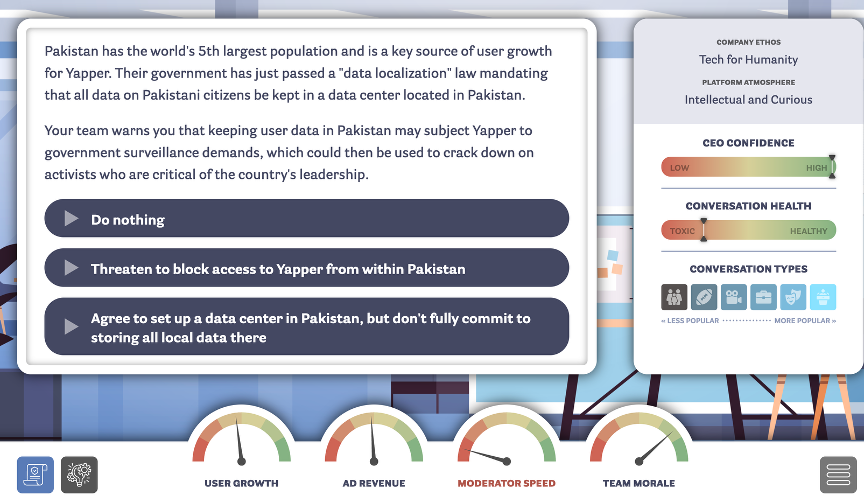
As a break from weekly writing assignments, I set up a lesson starting in 2023 using the online game launched by Techdirt called “Trust & Safety Tycoon.” This puts students in the position of the head of a trust and safety team — basically, the chief of content moderation — for a social media startup company. As the site grows its users and popularity, and tries to remain viable as a commercial enterprise, the player faces increasingly challenging tasks. What happens when users threaten a boycott over offensive content? How do you handle Congress or foreign government leaders demanding takedowns? When news breaks on your platform and police ask for your help, to what extent do you cooperate?
Full game screen from Trust & Safety Tycoon with one of the situations you face in Year 5
While I require my students to do case briefs and other writing assignments on a weekly basis, the ease of using generative AI to do these assignments makes them less appealing. Students are far more likely to want to play a video game, especially one as engaging and challenging as Trust & Safety Tycoon. The assignment itself — to play the game through twice at a minimum, submitting selfies with the end-game screen — can be done in less than an hour, though some students report playing it several times to try to max out their score.
By this point in the semester, usually around the fourth week, students have completed readings and in-class discussion on media ethics and First Amendment issues. Playing this game is an opportunity to engage critically with modern content regulation matters across a broad array of media law topics — particularly free speech, prior restraint, privacy and intellectual property.
To ensure that students have played through the game as an assignment, they are asked to take a picture of themselves with the end-game screen. This provides another level of interaction that students enjoyed, with some sharing their results on their own social media accounts and commenting on the game there.
Advertisement
Execution of Assignment in the Classroom: Students were told in class about the assignment, with the instruction that the student had to play the game at least twice: once to learn the game mechanics and develop some comfort with how it operates, and a second time as a more serious effort to complete the game to their satisfaction. When they reach the final screen, they take a selfie with the end-game screen (rather than a screenshot, which could be easily copied or downloaded). They then upload those into the assignment box in the online course management system.
After class, a link was sent via email to the online game at https://trustandsafety.fun. Students had two days (48 hours) to complete the game. They were also instructed to be ready to start the next class with discussion about the decisions they made.
The game itself takes about 20 to 30 minutes to complete. The game was designed by the Copia Gaming initiative and launched on Techdirt in 2023. The player begins as an employee of a social media startup called “Yapper,” which appears to operate as a hybrid of Facebook and Twitter/X. The player then has to make a number of decisions on content moderation rooted in the real experience of those companies, such as handling users who use the site to host pirated copyrighted video from Netflix or managing parody accounts of celebrities. Each year in the game, the player can invest in moderation resources (such as verified users, blocklists, encryption, copyright scanning, etc.) to help maximize the site’s moderation speed, user growth, conversation health, and ad revenue.
As the years pass, the moderation decisions get tougher. Players have to decide how to handle beheading videos posted by an overseas terrorist group; visits from the FBI requesting user information, gag orders, and potential jawboning about election misinformation; demands from both state attorneys general and foreign leaders for information about dissidents; an active shooter situation in which law enforcement makes several demands, including a request to broadcast the shooter’s manifesto; a legal battle with a Disney-like entity on parody videos; foreign privacy laws requiring either resistance or expensive compliance; a new age verification law; and ultimately a demand to testify before Congress as they consider regulation of your platform.
Advertisement
A visit from the FBI, including efforts at jawboning.
When students return to class, I prompt to share some of the difficult decisions they made, and why they made them. I use this discussion to inform them of the real-world situations from which many of these scenarios are derived, most of which predate their experience as social media users but were formative in shaping what we see online and how governments regulate the Web.
Student Learning Outcomes: This assignment is designed to achieve the following:
(1) Introduction to different areas of media law and their interaction. Each situation can be dropped into one of our main topic areas — copyright, free speech, defamation, privacy, etc. — as we identify these issues and what body of law applies.
(2) Global media regulation. This assignment requires students to see how U.S. standards on free speech and regulation may differ from other countries.
(3) Connection between law/policy and media outcomes. The exercise illustrates how government action through coercion, regulation, and litigation shapes the messages they see and hear on online platforms.
Advertisement
(4) State actors vs. private companies. We identify and discuss the role of government and strong First Amendment protections, as well as the role of private companies in shaping online speech.
Measuring Impact: The assignment is graded simply on a 0–2 scale (2 points for turning it in on time, 1 for late/incomplete submission, 0 for neither). The effectiveness is evident in the quality of discussion and recall of in-game examples.
Participation in this class discussion has always been robust, and students remember the game in future units when we talk about the First Amendment, Section 230, privacy, and intellectual property. Feedback about the assignment on student evaluations at the end of the semester have been uniformly positive as well.
Some of the examples are too real. Ask TikTok.
I will be presenting this exercise in the AEJMC Law & Policy preconference session in New Orleans in August. The assignment won first place in the Teaching Ideas contest.
Lucid Motors said Tuesday that its “operational reset” will focus on $1.4 billion in cash reductions along with three other “must win” and potential money-making priorities that include robotaxis, its factory in Saudi Arabia, and launching a mid-sized electric vehicle.
But that mid-sized vehicle, which is supposed to start at under $50,000, is now delayed until next year. It was supposed to start shipping by the end of 2026.
“Our objective is clear: Mid-size will launch only when every process and quality requirement have been met,” Lucid’s new CEO Silvio Napoli said on a conference call Tuesday. “We will not repeat the mistakes of the past by bringing a product to market before it is ready.”
The turnaround plan, led by Napoli, aims to pull Lucid out of its spiral of growing EV inventory and unchecked spending. To reach that $1.4 billion in cash savings, Lucid said it will reduce capital expenditures by $500 million and projected savings of between $600 million and $800 million in inventory, according to its second-quarter earnings statement. The company said it will also reduce operating expenses by $200 million.
Advertisement
The effort, if successful, will provide sufficient liquidity runway well into 2027, Napoli said during Tuesday’s earnings call with investors.
Napoli didn’t mince words during his first quarterly earnings call as CEO.
“The way we operate has to change,” he said. “While there is no question that Lucid brought leading innovations and outstanding products to the market, we have disappointed on several fronts, and for far too long. We have not executed consistently, we miss commitments, launched products before they were ready, underinvested in service, responded too slowly to quality issues, and allowed complexity to slow decisions down.”
Napoli has already set some of this plan in motion. The company has shaken up its leadership ranks and hired several top execs, including a new chief financial officer, chief technology officer, chief customer officer, chief digital officer, and chief transformation officer. Napoli has also cut in half the number of people who directly report to him and in June directed the company to lay off 18% of its workforce, or around 1,500 employees, just four months after the EV maker made a cut of 12%.
Advertisement
Lucid also eliminated the second shift of EV production at its factory in Casa Grande, Arizona. The layoffs and elimination of that second shift generated $158 million in projected annualized savings, Napoli said during the company’s earnings call.
Despite these moves, Lucid’s second-quarter earnings show a company that continues to lose money. The EV maker reported revenue of $405 million, up from $259.4 million in the same quarter last year. It reported a net loss of $1.26 billion, or $3.30 a share, compared with a loss of $855.3 million, or $2.80 a share, a year earlier.
Lucid said it ended the second quarter with $3 billion in total liquidity.
While a reduction in spending is central to this reset, Napoli listed several must-win projects, including its upcoming mid-sized EV, finishing its AMP-2 factory in Saudi Arabia, and its robotaxi program with Uber and Nuro, that will eventually make it profitable.
Advertisement
The midsize EV, known as Cosmos, will be the first model from Lucid’s mid-sized platform, which “remains an essential element of Lucid’s strategic plan,” Napoli said. But “the work ahead is substantial,” he said on the call. Napoli said Lucid has so far “not executed consistently” and “responded too slowly” to quality problems, which is why he’s delaying the vehicle.
Napoli is also bullish on its robotaxi program with Uber and Nuro and sees it as an opportunity to boost earnings outside of selling directly to consumers. In a sign of this program’s value to Lucid, the company has created a new business unit called Lucid Technologies that will be led by chief digital officer Kai Stepper. The new unit will focus on AI, an advanced driver assistance system, and digital technology.
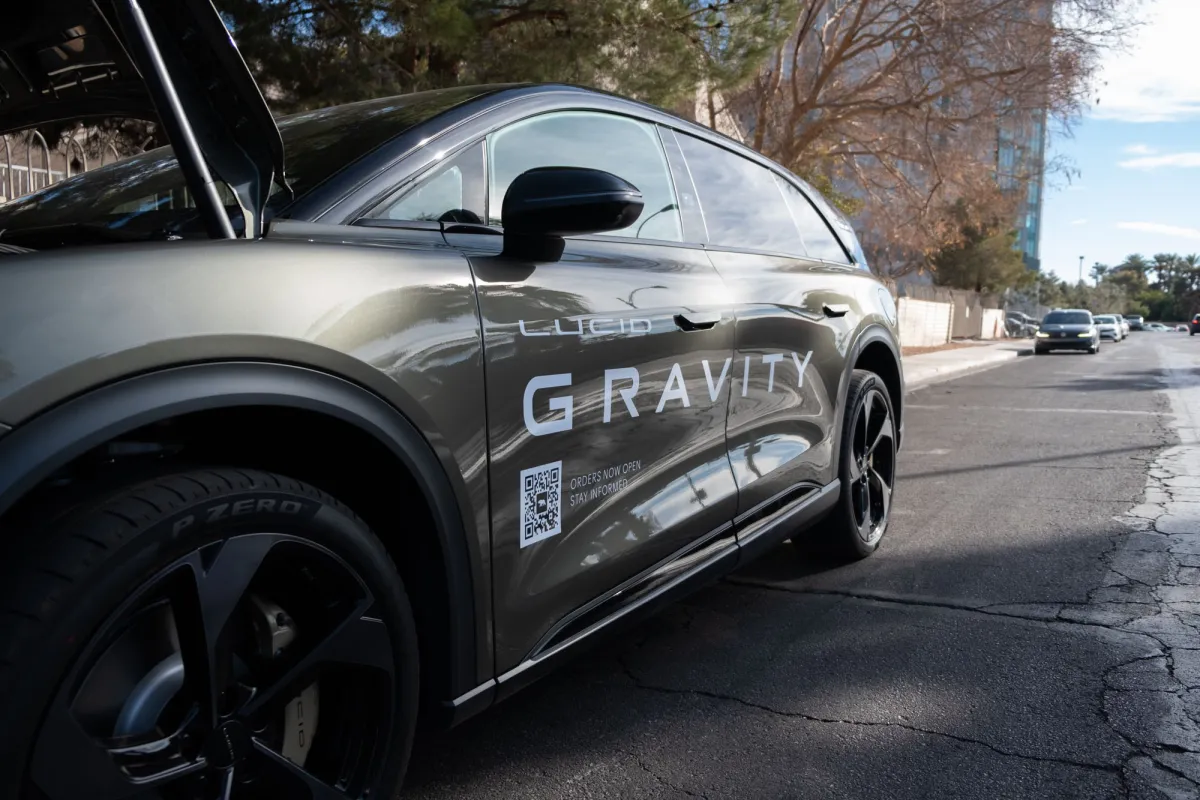
“We project the margins vastly exceeding those of the traditional retail model,” Napoli said, referring to the robotaxi program that integrates Nuro’s self-driving technology into Lucid’s Gravity SUVs. Uber will operate the premium robotaxi service, which will allow users to hail the self-driving vehicles on its app.
Nuro and Uber are testing a fleet of 100 vehicles in Houston and the San Francisco Bay Area. The company said that last month it began delivering production validation vehicles assembled at a facility in Coolidge, Arizona. Regular vehicle production for the robotaxi will begin in the fourth quarter with an expected launch in late 2026.
Advertisement
On the call, Napoli also took a moment to slap down speculation from last month that the company had hired consulting firm AlixPartners to consider bankruptcy.
“Their engagement has been focused solely on supporting our cost-savings plan and streamlining our operations; we will be wrapping up their assignment once that work is complete, which we expect at the end of this month,” he said.
This story has been updated with more information from Lucid’s earnings call.
When you purchase through links in our articles, we may earn a small commission. This doesn’t affect our editorial independence.
Seattle-based online real estate company Zillow Group laid off more than 500 employees Tuesday, about 7% of its global workforce, its second and largest round of cuts this year.
The layoffs are about “ensuring we have a disciplined cost structure and getting more efficient, with the right people in the right positions,” Zillow Group CEO Jeremy Wacksman said in a company blog post announcing the cuts. He said the decision reflects “both the strides we’re making in our strategy and the reality of what is required of us to grow at scale.”
He added, “Continuing to grow at scale requires us to work differently than we do today.”
Wacksman told real estate executives at the T3 Leadership Summit in April that Zillow employees were being retrained to use AI in their jobs, with gains that “are small, but they’re compounding,” as reported by Real Estate News.
Zillow told GeekWire the cuts were not driven by AI. “Today’s changes are about better positioning Zillow for the path ahead, which includes having the right people in the right roles and being able to move faster,” a company spokesperson said.
Advertisement
The company didn’t disclose which teams were affected, how many of the cuts will hit its Seattle headquarters, or what severance employees will receive.
Zillow Group will report second-quarter earnings Wednesday afternoon. The company’s business has been growing, defying a sluggish housing market. Its first-quarter revenue rose 18% year-over-year to $708 million, while the residential real estate industry grew 2%, according to NAR. Net income climbed to $46 million from $8 million a year earlier.
Wacksman indicated Tuesday that the company is still bucking the trend: “We continue to outperform the category, despite a housing market that has been essentially flat,” he wrote.
However, the company has been spending nearly as fast as it has been growing, on rental listings, loan officers for Zillow Home Loans, advertising and legal bills. Execs told investors in May that the spending would ease up in the second half of the year. Cutting payroll is one way to make that happen, and Zillow’s earnings guidance tomorrow could reflect that.
As for those legal bills: Zillow is headed to trial later this month in an FTC antitrust case over the $100 million deal the company struck in early 2025 to become the exclusive provider of multifamily rental listings on Redfin’s websites.
Zillow cut about 200 jobs in January, but characterized those as performance-related and part of its annual review cycle. It had 7,058 employees as of March 31, down just 10 positions from the end of 2025, meaning it had largely backfilled January’s cuts before Tuesday.
Advertisement
It’s part of a wave of cuts and consolidation in real estate portals and property tech. CoStar has cut its Homes.com inside-sales team by nearly 40% in recent months. Better founder Vishal Garg stepped down as CEO Monday as the mortgage company pushed to cut costs.
Along with its flagship Zillow portal, Zillow Group’s brands include Trulia, StreetEasy, HotPads and Out East, plus agent software products Follow Up Boss, ShowingTime and dotloop.
Updated after publication with additional details from Zillow.
Tech giants Apple, Microsoft, Alphabet and Nvidia are the other four companies to have previously recorded a market value of $3trn.
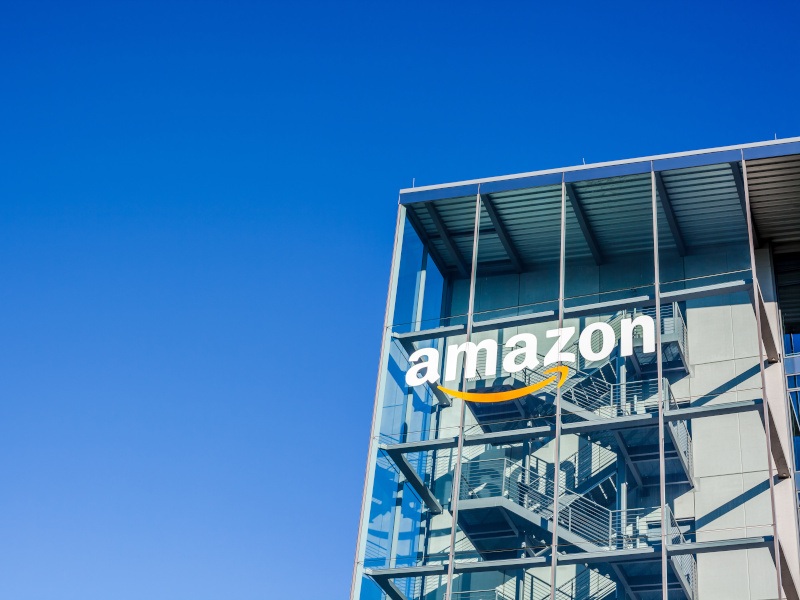
Amazon became the fifth company ever to see its market value surpass the $3trn mark when its shares rose by about 5pc yesterday (3 August).
Tech giants Apple, Microsoft, Alphabet and Nvidia are the other companies to have previously recorded a market value of $3trn.
Amazon hit the milestone having first reached the $2trn market capitalisation mark in June 2024. It first reached the $1trn value benchmark in late 2018.
Advertisement
Last Thursday (30 July), the e-commerce and cloud computing giant published its results for the second fiscal quarter of 2026, with net sales increasing 20pc year-on-year to more than $200bn.
Its operating income was up 43pc to $27.5bn, while sales at its AWS cloud infrastructure division increased 37pc year-over-year to $42.2bn, its fastest growth in 18 quarters.
Amazon president and CEO Andy Jassy said that “AWS is booming”, adding that “our AI and chips businesses each eclipsed run rates of more than $25bn”, which the company said amounts to “triple-digit percentages” growth year-on-year.
AI-driven demand for cloud and chips solutions contributed to AWS surpassing analysts’ forecasts for the quarter ending 30 June, causing the recent jump in Amazon share prices.
Advertisement
Jassy told investors on a conference call following the release of the earnings report that the company now projected capital expenditures for 2026 hit $220bn, up from the $200bn estimate it made in February and reaffirmed in April.
“But even at that amount, we will still not have enough capacity to meet all the demand we have in 2026, and I believe this dynamic will also be true in 2027 too,” Jassy said. “In fact, the demand we already have for 2028 is striking.”
Infrastructure spending and “investments in artificial intelligence” caused Amazon’s free cash status to see an outflow of $7.6bn for the preceding 12 months, the company said. This compares to a free cash flow inflow of $18.2bn for the 12-month period ended 30 June 2025.
Amazon has a 2GW deal with OpenAI for its Trainium capacity through AWS, as well as a 5GW deal for the same with Anthropic. The company is also investing $25bn into Anthropic.
Advertisement
AWS also has collaborations with up-and-coming Nvidia rival Cerebras; with Uber, for its Graviton and Trainium chips; and with Meta, to deploy tens of millions of AWS Graviton cores for its AI workflows.
Amazon is offsetting some of its AI expenses with large-scale layoffs at the company. In January, it cut about 16,000 jobs, which followed about 14,000 job cuts last October. Around 450 Irish jobs are understood to have been affected in this move.
Meanwhile, AWS could be set for a ‘gatekeeper’ designation in the EU due to the strength and prevalence of its market position as the largest cloud computing services provider in Europe.
Don’t miss out on the knowledge you need to succeed. Sign up for the Daily Brief, Silicon Republic’s digest of need-to-know sci-tech news.
A Falcon 9 rocket arcs into the night sky during a February 2023 launch. Most of SpaceX’s launches carry Starlink satellites built at the company’s factory in Redmond, Wash. (SpaceX Photo, licensed under CC BY-NC 2.0)
The satellites rolling off the line in Redmond, Wash., are paying for Elon Musk’s AI ambitions — and he says the company’s satellite internet business is only getting started.
SpaceX’s Starlink connectivity division posted $1.7 billion in operating income for the second quarter, maintaining its status as the company’s only profitable business, according to numbers released Tuesday afternoon as part of its inaugural earnings report as a public company.
The AI division, built around the Grok model and the X social media and technology platform, lost $1.3 billion while spending $15.8 billion on capital projects. That capital spending amounted to more than three times Starlink’s quarterly revenue of $4.3 billion (up 66%).
Musk, the company’s founder and CEO, used the first SpaceX earnings call to make the case that investors are badly underestimating Starlink.
He said a new generation of satellites could increase Starlink revenue tenfold, and the network could deliver “a majority of the world’s internet” in less than 10 years. Musk said AI and robots will drive demand for bandwidth far beyond anything people generate on their own.
“I think Starlink is the only thing that can actually service that bandwidth,” he said.
Amazon is getting in the race, building its own satellite internet network at a factory in nearby Kirkland, Wash. Its Leo constellation has “close to 400 satellites in orbit, enough to begin initial satellite internet service this year,” CEO Andy Jassy told analysts last week.
Overall, SpaceX topped Wall Street expectations with revenue of $7.8 billion for the quarter, up 92% from $4.1 billion a year earlier. It also narrowed its net loss to $541 million from $1 billion.
Advertisement
SpaceX shares closed at $125.33, up 9.4% on the day, then fell nearly 5% in after-hours trading following the report, apparently on concerns about the company’s capital spending.
SpaceX builds its Starlink satellites at a Seattle-area factory that produced about 70 a week from December 2025 to April 2026, according to the company’s IPO filing. The output has put roughly 9,600 Starlink satellites in orbit, about 75% of all active maneuverable satellites circling the planet.
For the second quarter, SpaceX reported 12 million Starlink subscribers, double the number a year earlier and an increase of 1.7 million from the first quarter. The revenue increase in the Starlink division (officially known as “Connectivity”) was driven by a 108% jump in enterprise and government business, which now accounts for more than 40% of the segment’s sales.
The subscriber total was just under the 12.19 million Wall Street had projected, but the segment’s revenue exceeded expectations by about $460 million, more than any other part of the company.
Advertisement
Starlink now brings in $66 a month per subscriber, down from $85 a year ago as it expands overseas and adds cheaper plans. The good news for SpaceX: the figure stopped falling, holding flat from the first quarter, despite the company’s warning to IPO investors that it would keep sliding.
If you’re flying high in the sky, it’s useful to know if there’s turbulence, heavy rain, or other nasty weather ahead. Onboard weather radar is a useful tool that pilots use to scope out conditions ahead. [Thomas Scherrer] came into possession of a weather radar display from a vintage aircraft, and decided to tear it apart for our viewing pleasure.
The unit in question is a Bendix PPI-1 plan position indicator. This particular 1971 example was scored from a McDonnell-Douglas DC9. [Thomas] only has the display itself, not the radar that would feed it or the power supply to turn it on. Still, even just the readout unit is super interesting to look inside. Right off the bat, there’s a neat dimming filter on the front, and the case itself is really beautifully designed for service. The design is very much of its time, full of neat wire harnesses and chunky through-hole components. There are some neat surprises inside, too, like an interesting device shaped like a triangular prism whose purpose we won’t spoil here.
If you’re wondering what one of these units looks like in action, you can see such an example on YouTube. The display basically lights up in areas where there were stronger radar returns indicating weather to be avoided.
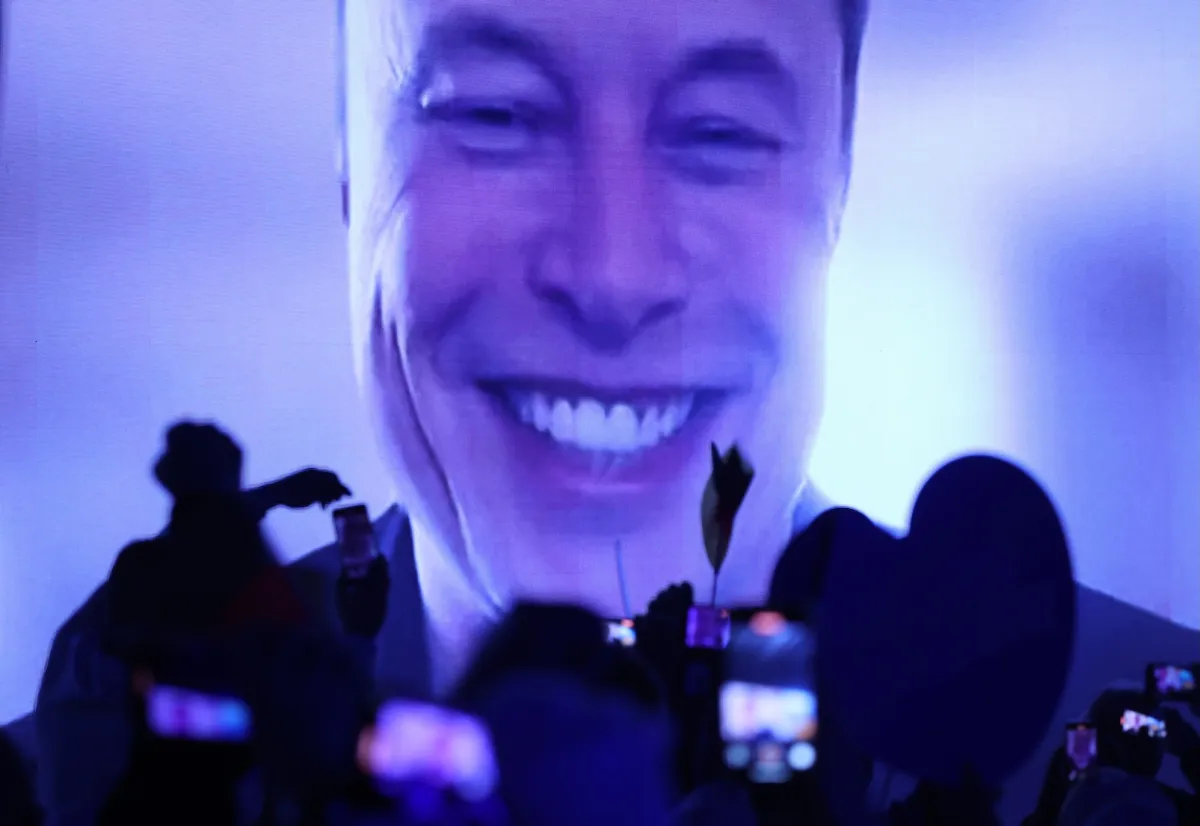
Elon Musk spent SpaceX’s first earnings call making some out-of-this-world claims about the company’s business and future prospects, while his fellow executives kept trying to bring his ideas closer to Earth — providing a hint of what’s to come now that his rocket-launching, compute-leasing, satellite-based telecom is public.
The conference call, held Tuesday, was the latest in a years-long succession of Musk making outrageous promises that his executives then have to make more digestible for the investing public — like at Tesla, where a recent analysis by TechCrunch showed that the world’s richest man is increasingly focused on futuristic topics while his colleagues spend their time talking about the actual business of selling cars.
Let’s start with one of the biggest ideas Musk floated on the call: that he expects SpaceX’s Starlink service to “deliver a majority of the world’s internet” in “less than 10 years.” Musk made the comment in the context of SpaceX preparing to launch the first “V3” versions of its Starlink satellites, which have much higher bandwidth than previous versions.
Here’s what he said:
Advertisement
It’s kind of hard for people to wrap their minds around this, but like, it’s not out of the question that at some point, Starlink will deliver a majority of the world’s internet, at least in countries where we’re allowed to operate, which is the vast majority of countries. So this is, you know, important to bear in mind, and it’s not in like the infinity future. It’s, you know, less than 10 years.
Contrast that with what chief operating officer Gwynne Shotwell said just a few minutes later, emphasis mine:
The significant amount of capacity we’re able to add to the Starlink constellation from the V3 satellites will enable us to continue providing even better service — and it’s pretty great already — but to do so while serving more and more customers over the world. In fact, in the years ahead, we expect Starlink will represent a significant portion of global internet traffic, which Elon also talked about.
It’s a far more lawyered-up claim to make, even though it’s still obviously ambitious.
But that was not the only instance where Musk optimistically diverged. At one point, SpaceX chief financial officer Bret Johnsen offered investors one of the few new financial targets discussed on the call. Johnsen was highlighting SpaceX’s relatively new business of renting out compute power to other AI players, which has helped the company generate billions in fresh, fast cash.
I’ll once again emphasize the big promise Johnsen made during his prepared remarks, and note how carefully he phrased it. It’s a very hedged and quite specific claim that he’s making. It’s clearly meant to excite investors while also leaving room for the company to avoid legal exposure if it misses the projection:
Advertisement
Looking ahead, we continue to see robust demand in all three of our business segments, but in particular in our cloud services arrangements. We see increasingly favorable economics with each agreement we sign, and as Elon mentioned, we expect the supply-demand imbalance in the compute market to continue. The current economics have translated into a less than one-year payback on our new capital deployments for compute. For example, in the first few weeks of the third quarter, we’ve already contracted an additional $6.7 billion of cloud services revenue over a six-month period that begins ramping starting in October of this year. We believe this puts us on a trajectory, including contribution from Cursor, to reach $100 billion of ARR, or annualized revenue run rate by the end of this year, based on our expected revenue in the month of December of this year.
Musk, 20 minutes later, bulldozed that carefully constructed statement before immediately inflating it:
To be clear, the $100 billion ARR in December is not a question mark. That’s… that’s what we would achieve if we basically did nothing. So like, you know, I think it may be higher than that. It probably will be higher than that.
Musk also riffed on another major prediction about overall revenue on the call, pumping up a goal that SpaceX laid out just two months ago in its IPO documents:
It’s probably also worth mentioning that our internal projections for reaching a trillion dollars in revenue, not ARR, but revenue, have moved up from 2031 to 2030. So prior to the IPO, the financial projections we had were reaching a trillion dollars in revenue in 2031. We now expect that to be in 2030. And there’s a non-zero chance of that being in 2029.
The pattern kept repeating throughout the call. A shareholder question about progress on the “human landing system” that SpaceX is developing for NASA’s Artemis moon missions using Starship prompted Musk to all but claim that the prototype rocket will be ready to fly people by the end of next year. He later said SpaceX would be flying Starship rockets once a day, or “possibly more,” by this time next year.
Shotwell immediately followed Musk’s comments about human flight to clarify that SpaceX is still focused on NASA-mandated milestones, and offered a more vague (but still ambitious) goal (again, emphasis mine) that “we want to put boots on the ground, boots on the moon, in 2028.”
Advertisement
None of that will happen unless SpaceX can prove that Starship can fly without failing and, crucially, become fully reusable. A huge part of making it reusable is the heat shield that keeps the Starship upper stage from exploding when it re-enters Earth’s atmosphere. The company saw the best results from its improved heat shield on the most recent Starship test flight, which splashed down in the Indian Ocean last month and is still intact. But before the rocket stage had even been recovered, Musk was willing to claim on Tuesday that he’d “consider the heat shield problem solved at this point.”
Musk has made many wild promises about SpaceX that never came true, such as when he said in 2016 that he’d put humans on Mars in six years. The difference now is that SpaceX is a public company, and ostensibly subject to regulation and fines if the company and its executives make promises they know can’t be met.
Of course, the Securities and Exchange Commission has pulled way back on corporate enforcement, especially against public companies. The Department of Justice is doing the same. And if SpaceX can’t follow through on Musk’s wide-eyed claims, investors won’t even be able to do much in civil court — because the company has all but inoculated itself against those kinds of lawsuits by incorporating in Texas.
When you purchase through links in our articles, we may earn a small commission. This doesn’t affect our editorial independence.
New plugins for K-12 teachers, university instructors, and college kids? Read the room, guys
In the face of an epidemic of AI-enabled cheating and research suggesting its products hamper learning, OpenAI is doing the sensible thing and pushing more AI on students and teachers.
Wait, did I say sensible? My mistake.
Advertisement
The House of Altman announced a trio of new education-focused offerings on Tuesday: one for K-12 teachers, another for college educators, and a third for college students. The new plugins, the company explained, will help students and educators make more use of ChatGPT’s agentic capabilities for both studying and teaching. The new features are available through ChatGPT Edu, an institutionally licensed suite for higher education, and ChatGPT for Teachers, a free resource available to verified US K–12 educators and school districts.
The new offerings, says OpenAI, build on its educational AI philosophy that “AI should support learning, not shortcut it, and the best learning experiences keep educators and students in control.”
Plenty of educators might disagree. Cheating with AI has become a sad norm in schools around the world, and the US is no exception. Many young people admit to using AI to cheat on school assignments, and college students have been caught doing it, too.
Mexico’s largest university, the National Autonomous University of Mexico, last week suspended enrollment for incoming students after suspected widespread cheating in its admissions exams. The university also decided this week to require about 58,000 applicants who qualified in the remote entrance exam to take an in-person proctored control exam after scores surged during its first remotely administered admissions test.
Advertisement
As for how teachers relate to AI in the classroom, a 2025 study from the Center for Democracy and Technology suggests it’s going to take more than some new OpenAI software to help teachers feel more comfortable.
CDT said last year that K-12 teachers widely complained of not being given the necessary resources to understand how to integrate AI into schools, or how to tackle the potential harms AI may be causing to their students’ ability to learn and personal development alike.
Rather than helping teachers and professors regain control of the academic process or better understand how AI is affecting their students, however, OpenAI wants to simply let them foist off more of their work to ChatGPT, too.
“The K–12 Educator plugin is designed to help teachers plan and create for their classrooms,” OpenAI explained. The tool can use materials teachers already have on hand “to create differentiated resources, design interactive visuals, and surface actionable insights.”
Advertisement
Integration with educational AI infrastructure outfit Learning Commons allows ChatGPT to automatically consider local educational standards for anything it creates for teachers, the company explained, while educators get to remain “in control of pedagogical decisions, grading, and agentic actions.”
The plugin for college professors is largely the same.
“The College Educator plugin enables course design, teaching, and academic planning,” OpenAI said in its announcement. “Faculty can update syllabi, create interactive websites or multimedia assessments, adapt materials for diverse learners, or package content for their Learning Management System.”
For college students, the plugin is designed to bring ChatGPT further into students’ study routines, the latest expansion of AI tools that have already complicated essay writing and take-home testing.
Advertisement
“The College Student plugin helps students turn what they are already studying into more personalized learning experiences,” said the ChatGPT maker. AI tutors are available (sorry, grad students), as are AI-generated quizzes, study guides, flashcards, and AI-generated visual explanations.
“The plugin draws on learning science to prioritize deeper understanding and build stronger study habits,” OpenAI claims. You’d be right to doubt that. Aside from being used to cheat on exams, AI also has a demonstrable effect on harming learning outcomes.
MIT researchers last year hooked a group of students up to EEGs to study their brain activity while writing essays. Some of them were allowed to use the internet to conduct research, while others were told to use AI. Not only did the AI cohort have far less ability to recall what they wrote when asked about it later, but they also showed far less brain activity, suggesting that relying on AI simply doesn’t lead to better learning.
It’s not much of a leap to go from AI lowering brain activity while doing essay research to figuring that relying on AI tools to help one study, create flashcards, or receive tutoring will likely lead to similar outcomes. Real learning still takes legwork, and other studies suggest overreliance on tools like ChatGPT can undermine deeper learning.
Advertisement
Why teachers and professors would want to embrace an expansion of AI into their workflow when they’ve seen what it can do to their students is a question for OpenAI. The AI giant didn’t initially respond to our questions for this story, but we’ll update if that changes. ®
What just happened? Texas has put a hold on new data center approvals that require access to the state’s grid, a move that could slow a long list of projects already waiting in line. Governor Greg Abbott has ordered the Public Utility Commission of Texas and ERCOT to pause approvals until the agencies complete an audit of applicants, a move that could stall a large backlog of projects seeking to connect.
The state wants more information before granting access. Abbott said applicants must provide tax break details, power use and generation data, water use and cooling plans, steps to reduce community impact, and facility ownership information. Any project missing that information will not be allowed onto the grid.
“Our top priority is to protect Texans’ safety and quality of life,” Abbott wrote. “Any project that fails to comply with the requirements set forth by the PUCT (Public Utility Commission of Texas) and ERCOT (Electric Reliability Council of Texas), and by state law, must be denied connection to the Texas grid. Simply put, Texans must come first.”
The review appears to follow a PUCT survey that most companies ignored. The agency said it asked 377 data center firms for information on water and power use, but only 28 responded.
Advertisement
The order isn’t a statewide ban, but it still affects a major chunk of the projects in ERCOT’s queue. More than 1,800 projects are waiting for approval to connect, and about 90% of them are data centers. Together, those applications could require 474 gigawatts, which is far above ERCOT’s current peak demand.
Even so, the directive does not hit every project in Texas. Data centers outside ERCOT’s territory, including those in El Paso, are not covered. Projects that bring their own power are exempt too, since they don’t need to connect to the grid.
The move drew criticism from opponents pushing for the legislature to step in with stricter rules. Texas Agriculture Commissioner Sid Miller called the directive “all hat and no cattle” on the Texas Department of Agriculture’s official Facebook page, saying, “Texans need laws with teeth, not another press release designed to make it look like something is being done while hyperscale projects continue moving forward.”
State Rep. Gina Hinojosa, who is challenging Abbott in the 2026 governor’s race, dismissed the move as too little, too late. She said Abbott has spent months promoting Texas as a friendly place for data centers, and argued his new pause wouldn’t convince anyone the state is suddenly cracking down.
Advertisement
The Texas move is narrower than New York’s statewide data center moratorium, but it still adds a major hurdle for developers. For an industry built around fast buildouts and heavy power demand, the pause could have immediate effects.























































You must be logged in to post a comment Login