
Crypto World
SpaceX just posted a $540 million bitcoin loss and every corporate BTC holder felt it



The first public earnings from Elon Musk’s space company reveal the real cost of holding bitcoin on a balance sheet under the new accounting rules. The numbers tell a story that the “laser eyes” crowd would prefer to skip.
Summary
- SpaceX reported second quarter revenue of $7.8 billion, beating Wall Street expectations by $900 million, but its bitcoin holdings fell from $1.64 billion at the end of 2025 to $1.10 billion at the end of June 2026, a decline of $540 million that flowed directly through the income statement.
- The company disclosed it holds 18,712 BTC in its SEC filing, more than double the 8,285 coins that on-chain analytics firm Arkham Intelligence had tracked to SpaceX wallets as recently as May 2026, suggesting the company aggressively accumulated bitcoin in the weeks surrounding its $86 billion IPO.
- Under the FASB fair-value accounting standard (ASU 2023-08) that took effect for fiscal years beginning after December 15, 2024, companies must now report both gains and losses on crypto holdings through the income statement each quarter, replacing the old impairment-only model that could only write values down.
- SpaceX is the first major company to report its initial quarterly earnings as a public entity under the new rules during a significant bitcoin drawdown, making its filing a template for how markets will react to crypto volatility on corporate balance sheets.
- The timing is particularly exposed: on August 6, roughly 912 million shares held by employees and early backers become eligible for sale, and the bitcoin loss will factor into every analyst model used to price that unlock.
SpaceX topped every financial estimate Wall Street had for it. Revenue came in $900 million above consensus. Adjusted EBITDA nearly tripled year over year to $3.5 billion. The net loss narrowed from $1.0 billion to $541 million. By every operational measure, the company’s launch business, Starlink subscriber growth, and AI infrastructure expansion are performing ahead of schedule.
None of that made the stock go up after hours. SPCX fell six percent in extended trading on August 4, the same day the Nasdaq 100 gained 3.3 percent. The reason is not in the revenue line. It is in the balance sheet, where 18,712 bitcoin sat at the end of June worth $540 million less than they were worth six months earlier.
This is the first time a company of SpaceX’s size has published quarterly earnings as a newly public entity while holding a significant bitcoin position during a major drawdown. The filing is not just an earnings report. It is a live demonstration of what the new FASB fair-value accounting rules do to a corporate income statement when bitcoin drops 33 percent in six months.
What the filing actually shows
SpaceX’s SEC filing disclosed $1.10 billion in digital assets as of June 30, 2026, down from $1.64 billion at the end of 2025. The $540 million decline represents the mark-to-market impact of bitcoin’s price falling from roughly $87,600 at the end of December 2025 to approximately $58,800 at the end of June 2026, a 33 percent drop.
The 18,712 BTC position is itself a revelation. As recently as May 18, 2026, on-chain analytics from Arkham Intelligence showed SpaceX holding 8,285 BTC in Coinbase Prime custody, a position that had been unchanged since June 2022. The SEC filing showing 18,712 BTC means SpaceX acquired approximately 10,427 additional bitcoin in the weeks surrounding its June IPO.
That acquisition timing is significant. SpaceX was buying bitcoin while the price was falling, accumulating more than $600 million in additional exposure during a period when the asset was in a sustained downtrend. Whether this was a deliberate dollar-cost averaging strategy, part of the IPO capital allocation plan, or simply the transfer of previously untracked cold storage into the disclosed entity is not clear from the filing. What is clear is that the company’s bitcoin exposure is substantially larger than the market believed before these earnings.
The net loss of $541 million is almost exactly equal to the decline in bitcoin holdings. Strip out the crypto mark-to-market, and SpaceX’s core operations would have been approximately breakeven, a significant milestone for a company that has historically reinvested aggressively at the expense of profitability.
How the new accounting rules changed the math
Before FASB ASU 2023-08 took effect, companies that held bitcoin classified it as an indefinite-lived intangible asset. Under those rules, if bitcoin’s price fell below the carrying value at any point during a quarter, the company had to write the asset down to the lowest price reached. But if the price recovered, the company could not write the value back up. The accounting was one directional: losses were permanent on the books, gains were invisible until the company sold.
This created a perverse incentive structure. A company that bought bitcoin at $60,000 and watched it fall to $30,000 and then recover to $60,000 within the same quarter would still report a $30,000 per coin impairment loss. The balance sheet would show the asset at $30,000 even though it was trading at $60,000. The only way to recognize the recovery was to sell the bitcoin and realize the gain, which defeated the purpose of holding it as a long-term treasury asset.
Strategy, formerly MicroStrategy, reported a $670 million impairment loss in its fourth quarter 2024 earnings under the old rules. That loss appeared on the income statement despite bitcoin’s price being higher at the end of the quarter than at the beginning. The loss reflected intra-quarter price dips that triggered mandatory write-downs, not actual economic losses.
The new standard, which applies to fiscal years beginning after December 15, 2024, replaces this with fair-value measurement. Companies report bitcoin at its market price on the last day of the quarter. If the price goes up, that gain flows through the income statement. If it goes down, that loss flows through the income statement. The accounting now reflects economic reality in both directions.
For SpaceX, this means the $540 million loss is real in the accounting sense but potentially temporary in the economic sense. If bitcoin recovers to its year-end 2025 price, SpaceX would report a corresponding $540 million gain in a future quarter. Under the old rules, the $540 million loss would have been permanent on the books regardless of any price recovery.
The arithmetic of corporate bitcoin at $63,000
The current bitcoin price of approximately $63,000 creates a specific set of exposures for the major public company holders. The arithmetic illustrates why SpaceX’s earnings report sent a ripple through every corporate treasury that holds bitcoin.
SpaceX holds 18,712 BTC at a current market value of approximately $1.18 billion. Every one percent move in bitcoin’s price changes SpaceX’s reported earnings by roughly $11.8 million. A ten percent quarterly swing, which is historically common for bitcoin, would produce a $118 million line item on the income statement, positive or negative.
Strategy holds approximately 580,000 BTC, making it the largest corporate holder by a wide margin. At $63,000, that position is worth roughly $36.5 billion. A one percent bitcoin move changes Strategy’s reported earnings by $365 million. Strategy’s entire business model is now a leveraged bitcoin bet, so investors expect this volatility. But for companies where bitcoin is a treasury allocation alongside an operating business, like SpaceX, Tesla, and Block, the earnings volatility creates a communication problem.
Tesla sold roughly 75 percent of its bitcoin position in 2022, retaining a smaller allocation. Block holds bitcoin as both a treasury asset and a product feature through its Cash App. Neither company has the combination of a massive bitcoin position and a first-ever public earnings report that made SpaceX’s filing uniquely consequential.
The problem for CFOs considering a bitcoin treasury allocation is straightforward: under fair-value accounting, the bitcoin position will dominate the earnings narrative in any quarter where bitcoin moves significantly. SpaceX beat revenue estimates by 13 percent and tripled its EBITDA, and the post-earnings conversation is about bitcoin. That is the cost of holding a volatile asset on a public balance sheet under mark-to-market rules.
Why SpaceX bought more bitcoin into the decline
The increase from 8,285 to 18,712 BTC is the most under-discussed element of the filing. SpaceX more than doubled its bitcoin position during a period when the price was falling.
Several explanations are plausible. The most straightforward is that SpaceX used a portion of its IPO proceeds to purchase additional bitcoin as part of a predetermined treasury allocation strategy. The $86 billion IPO raised substantial capital, and allocating roughly $600 million to bitcoin would represent less than one percent of the company’s market capitalization.
Another possibility is that the Arkham Intelligence data was incomplete. On-chain analytics can only track wallets that have been identified and linked to a known entity. If SpaceX held bitcoin in wallets that Arkham had not attributed to the company, the “new” purchases may actually be the disclosure of a position that already existed but was not publicly known. The SEC filing requires disclosure of total holdings regardless of which wallets hold them.
A third explanation is that the increase reflects bitcoin received as payment for Starlink subscriptions or launch services. SpaceX began accepting bitcoin payments for certain services in 2022, and accumulated bitcoin from customer payments would appear in the total holdings disclosed in the SEC filing.
Whatever the reason, the decision to maintain or increase bitcoin exposure while the price was declining signals that SpaceX’s bitcoin position is strategic rather than opportunistic. Companies that view bitcoin as a short-term trade typically sell into weakness. Companies that view it as a long-term treasury allocation buy into weakness. SpaceX’s behavior matches the second pattern.
The August 6 share unlock and the bitcoin overhang
Two days after this earnings report, on August 6, approximately 912 million SpaceX shares held by employees and early backers become eligible for sale. This is the first major share unlock since the June IPO, and it will significantly increase the stock’s public float.
The bitcoin loss complicates the unlock pricing. Every analyst covering SPCX must now model the bitcoin position as a source of earnings volatility. A shareholder deciding whether to sell at unlock must factor in not just SpaceX’s launch revenue and Starlink growth but also their view on bitcoin’s price trajectory for the remainder of the year.
If bitcoin remains at $63,000 or falls further, the Q3 earnings report will show another markdown or a flat position at best. If bitcoin recovers to $80,000, SpaceX would report a gain of approximately $318 million, which would make Q3 earnings look dramatically better without any change in the underlying business.
This is the volatility import problem. By holding 18,712 BTC, SpaceX has imported the volatility of the bitcoin market into its equity. Shareholders who bought SPCX for exposure to the space economy and Starlink’s subscriber growth now also have exposure to bitcoin’s price, whether they wanted it or not. There is no way to separate the two exposures in the stock price.
The unlock timing creates a specific risk scenario. If bitcoin drops further between now and August 6, unlocking shareholders face the prospect of selling into a stock that carries both the dilution pressure of increased float and the uncertainty of a declining bitcoin position. Conversely, if bitcoin rallies before the unlock date, some shareholders may hold rather than sell, reducing the supply pressure. Bitcoin’s price has become a variable in SpaceX’s equity supply and demand dynamics, a relationship that did not exist before the company went public with a significant crypto position.
For institutional investors analyzing the unlock, the bitcoin position complicates standard models. A fund that typically evaluates aerospace companies based on launch cadence, satellite deployment, and government contract revenue must now incorporate a cryptocurrency price forecast into its SpaceX model. Many institutional investors lack the internal expertise or mandate to evaluate bitcoin as an asset class, which may lead them to apply a discount to SPCX shares simply because the bitcoin exposure introduces a risk factor they cannot model with confidence.
The earnings call problem: when bitcoin overshadows the business
SpaceX’s post-earnings price action illustrates a dynamic that every corporate bitcoin holder will face: the bitcoin line becomes the story, regardless of how the rest of the business performs.
Consider the information hierarchy that analysts process after an earnings release. Revenue beat by 13 percent. EBITDA tripled. The net loss narrowed by nearly half compared to the prior year. Under normal circumstances, these numbers would produce a positive after-hours reaction. Instead, SPCX fell six percent.
The bitcoin loss did not cause a financial crisis for SpaceX. The company has billions in cash and growing revenue streams. The $540 million decline is a paper loss that could reverse in any future quarter. But earnings reports are not evaluated in isolation. They are evaluated relative to expectations and narratives, and the narrative for SpaceX’s first public earnings was supposed to be about the launch business and Starlink momentum. Instead, the narrative became about bitcoin.
This is the communication tax that bitcoin imposes on any company that holds it. Investor relations teams must prepare for bitcoin questions on every earnings call. Analysts must build bitcoin price sensitivity tables into their models. Media coverage will lead with the bitcoin loss or gain rather than the operational metrics that management considers more relevant to the company’s value.
For a company like Strategy, which has explicitly positioned itself as a bitcoin investment vehicle, this is not a problem. Strategy’s investors bought the stock specifically for bitcoin exposure. But for SpaceX, Tesla, Block, or any operating company that holds bitcoin as a treasury allocation, the communication tax is real and recurring. Every quarter where bitcoin moves more than ten percent in either direction, the earnings narrative will be hijacked by the crypto position.
The CFOs at companies considering bitcoin allocations are watching SpaceX’s experience closely. The question is no longer whether bitcoin can appreciate over the long term. The question is whether the quarterly earnings disruption is worth the potential long-term return, and whether there are ways to gain bitcoin exposure without importing the volatility directly into the income statement.
What this means for the corporate bitcoin thesis
The corporate bitcoin treasury thesis, popularized by Michael Saylor at Strategy, rests on the argument that bitcoin is superior to cash or treasury bonds as a reserve asset because of its fixed supply and potential for long-term appreciation. Under the old accounting rules, this thesis was harder to evaluate because the impairment-only model obscured the true economic performance of the bitcoin position.
Under fair-value accounting, the thesis is fully exposed. Every quarter, the market gets to see exactly how much bitcoin helped or hurt the company’s earnings. SpaceX’s Q2 2026 filing is the first high-profile test case, and the result is a $540 million loss that turned what would have been a breakeven or profitable quarter into a half-billion-dollar loss.
This does not disprove the thesis. Bitcoin could recover and produce gains in future quarters that more than offset this loss. But it does reveal the cost of the thesis in practical terms. A CFO who allocates to bitcoin must be prepared to explain to analysts, board members, and shareholders why the company’s earnings swung by hundreds of millions of dollars because of an asset that has nothing to do with the company’s core business.
For companies already holding bitcoin, the SpaceX filing provides a preview of what their own earnings calls will look like in quarters where bitcoin moves significantly. For companies considering a bitcoin allocation, the filing is a case study in what they are signing up for.
The distinction between stablecoins and bitcoin as corporate treasury assets becomes sharper in this context. A company holding USDC does not face mark-to-market earnings volatility because the asset is pegged to the dollar. A company holding bitcoin does, and SpaceX’s filing quantifies exactly how much.
What to watch
SpaceX Q3 earnings and the bitcoin line. If bitcoin remains near $63,000, the Q3 filing will show a roughly flat or modestly positive bitcoin line. If bitcoin recovers to $80,000 or above, the reversal gain will show the upside of fair-value accounting as clearly as this quarter showed the downside.
Strategy’s next quarterly filing. Strategy holds roughly 31 times more bitcoin than SpaceX. Its earnings volatility under the new accounting rules will be correspondingly more extreme. How Strategy’s stock responds to fair-value reporting will signal whether the market values bitcoin treasury companies differently from operating companies that happen to hold bitcoin.
New corporate bitcoin buyers. Watch whether the SpaceX filing accelerates or decelerates corporate bitcoin adoption. If new companies see the earnings volatility and decide the communication cost is too high, the corporate adoption wave may have peaked. If they see SpaceX buying more bitcoin during the drawdown as a signal of conviction, more may follow.
Bitcoin ETF flows versus corporate treasury flows. The emergence of spot bitcoin ETFs in 2024 gave institutions a way to gain bitcoin exposure without the balance sheet volatility. Corporate treasuries that might have held bitcoin directly may increasingly prefer the ETF route, which does not create income statement effects for the holding company.
The share unlock aftermath. How SPCX trades after the August 6 unlock, and whether insider selling is concentrated or distributed, will reveal whether SpaceX’s own employees and investors are comfortable holding a stock with embedded bitcoin volatility or whether they prefer to reduce that exposure.
What is SpaceX’s bitcoin loss?
SpaceX reported that its bitcoin holdings declined in value by approximately $540 million during the first half of 2026, from $1.64 billion at the end of 2025 to $1.10 billion at the end of June 2026. This decline flowed through the income statement under the new FASB fair-value accounting rules, contributing to the company’s reported net loss of $541 million for the second quarter.
How much bitcoin does SpaceX hold?
SpaceX holds 18,712 BTC according to its SEC filing for the second quarter of 2026. This is significantly more than the 8,285 BTC that on-chain analytics firm Arkham Intelligence had tracked to SpaceX wallets as recently as May 2026, suggesting the company acquired additional bitcoin around the time of its IPO.
What are the FASB fair-value accounting rules for bitcoin?
FASB ASU 2023-08, which took effect for fiscal years beginning after December 15, 2024, requires companies to report crypto asset holdings at fair market value each quarter. Both gains and losses flow through the income statement. This replaced the previous impairment-only model, which required companies to write down bitcoin to its lowest price during the quarter but never allowed them to write the value back up, even if the price recovered.
Did SpaceX lose money on its core business?
No. SpaceX’s core business performed strongly, with revenue of $7.8 billion (beating the $6.9 billion consensus estimate) and adjusted EBITDA of $3.5 billion (nearly triple the prior year). The $541 million net loss was almost entirely attributable to the mark-to-market decline in bitcoin holdings. Without the bitcoin position, the company’s operations would have been approximately breakeven.
Why did SPCX stock fall after earnings?
SPCX fell six percent in after-hours trading despite beating revenue and EBITDA estimates because the bitcoin loss dominated the earnings narrative. The decline also came ahead of the August 6 share unlock, when approximately 912 million shares held by employees and early investors become eligible for sale, creating additional selling pressure concerns.
How does SpaceX’s bitcoin position compare to other companies?
SpaceX’s 18,712 BTC makes it one of the largest known corporate bitcoin holders. Strategy (formerly MicroStrategy) holds approximately 580,000 BTC, making it the largest by far. Tesla retains a smaller position after selling roughly 75 percent of its holdings in 2022. Block (formerly Square) holds bitcoin as both a treasury asset and a product feature.
What would happen if bitcoin recovers?
Under fair-value accounting, if bitcoin returns to its year-end 2025 price of approximately $87,600, SpaceX would report a gain of roughly $540 million in the quarter when that recovery occurs. This is a key advantage of the new accounting rules over the old impairment model, where such a recovery would not have been reflected in the financial statements unless the company sold its bitcoin.
Should companies hold bitcoin on their balance sheet?
The SpaceX filing illustrates the tradeoff clearly. Holding bitcoin provides potential long-term appreciation and diversification from dollar-denominated assets, but under fair-value accounting, it introduces quarterly earnings volatility that can overshadow the company’s operational performance. Companies considering a bitcoin allocation must weigh the strategic benefits against the communication cost of explaining crypto-driven earnings swings to analysts and shareholders.
Disclaimer: This article is for informational purposes only and does not constitute financial, investment, or legal advice. Cryptocurrency investments carry significant risks. Always conduct your own research before making any financial decisions. The information in this article is current as of August 4, 2026.

Democratic senators Elizabeth Warren and Richard Blumenthal have asked the SEC to investigate whether the TRUMP meme coin facilitated fraud or improper enrichment after its value collapsed 98% from its peak.
Summary
- Warren and Blumenthal urged the SEC to investigate possible fraud involving the TRUMP token.
- Nearly 989,000 wallets lost a combined $3.81 billion, according to Nansen data.
- TRUMP trades near $1.47, down about 98% from its all-time high above $73.
- The request adds pressure to the CLARITY Act’s unresolved ethics negotiations.
Senators ask SEC to investigate TRUMP coin
Warren and Blumenthal sent a letter to SEC Chair Paul Atkins asking the agency to determine whether the president-linked token involved illegal fraudulent activity or allowed insiders to obtain improper gains.
“We are concerned that President Trump’s memecoin scheme may constitute an illegal scam,” the lawmakers wrote, according to CNN reporting cited by multiple outlets.
The senators reportedly asked the SEC to examine whether the project operated as a “soft rug pull.” The term describes a situation in which insiders or developers gradually withdraw support or extract value instead of abandoning a project in one sudden move.
Their letter does not establish that fraud occurred. The SEC would need to determine whether federal securities laws apply to the token and whether its promotion, distribution, or trading involved any legal violations.
TRUMP coin investors lost $3.81 billion
The lawmakers cited the scale of investor losses surrounding the Solana-based token, which launched shortly before Trump returned to the White House in January 2025.
Data from blockchain analytics firm Nansen showed that 988,905 of the 1.48 million wallets that purchased TRUMP were carrying losses by the end of June. Their combined losses reached approximately $3.81 billion.
Trump reported earning about $636 million from the meme coin, while his wider crypto-related income exceeded $1.4 billion in 2025, according to financial disclosures reported by US media. Those figures have intensified questions about whether a sitting president should benefit from digital assets while shaping federal crypto policy.
TRUMP traded near $1.47 on Aug. 4, with a market capitalization of approximately $366 million and daily volume near $159 million, according to CoinMarketCap. Its price has fallen roughly 98% from an all-time high of $73.43, although the token was slightly higher over the previous 24 hours.
CLARITY Act ethics dispute remains unresolved
The SEC request comes as senators remain divided over an ethics provision in the CLARITY Act, a broader bill intended to establish US rules for digital asset markets.
As crypto.news reported on Aug. 4, the White House had not responded to a bipartisan counterproposal from Republican Sen. Thom Tillis and Democratic Sen. Ruben Gallego. The compromise would allow state attorneys general to sue the Department of Justice if it failed to enforce restrictions on crypto activity involving federal officials.
Democrats opposed an earlier version that left enforcement solely with the DOJ. Warren has argued that passing the bill without stronger safeguards could expand conflicts of interest tied to Trump’s crypto businesses.
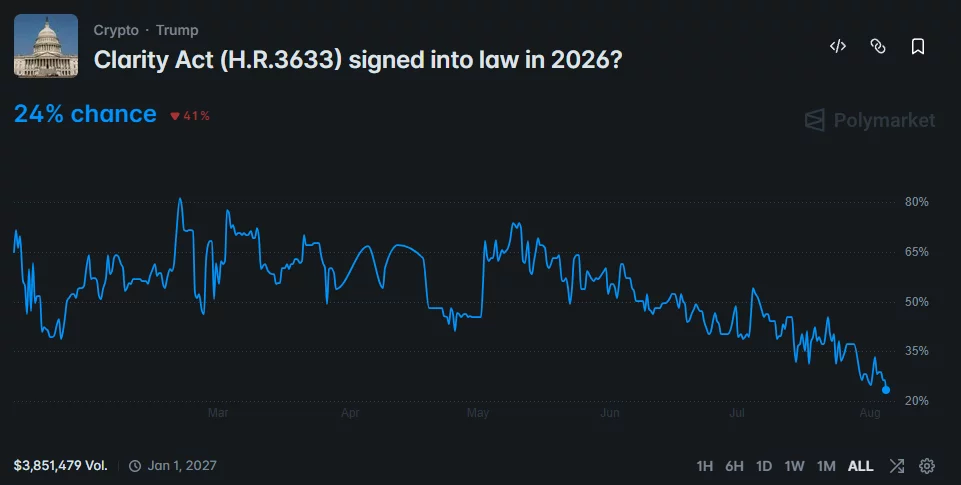
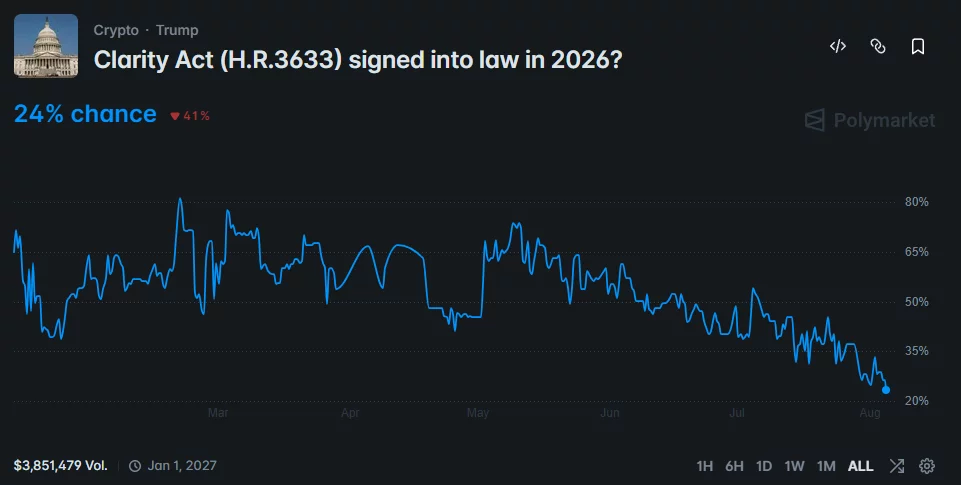
The delay pushed Polymarket’s estimated chance of the legislation becoming law in 2026 to an all-time low of 24%. The measure must still pass the Senate and resolve any differences with the House before reaching Trump’s desk.
Senate faces wider fight over developer protections
The ethics dispute is not the only issue slowing the CLARITY Act. The Blockchain Association sent an eight-page letter to Senate leaders on Aug. 3 disputing claims from the National Sheriffs’ Association that the latest draft creates broad exemptions from anti-money laundering rules.
The trade group argued that Section 10604 protects developers who create neutral software without controlling customer assets or transactions. It said intermediaries that exercise control would remain subject to the Bank Secrecy Act, sanctions and anti-money laundering requirements. The Blockchain Association’s response also rejected the view that earning revenue alone makes a developer a financial institution.
The Senate ended Monday without taking action on the bill, leaving it without a publicly announced vote as lawmakers approach the August recess. Warren and Blumenthal’s request could now place the TRUMP coin and presidential crypto conflicts more firmly at the center of those negotiations.


SpaceX shares rebounded ahead of the company’s first quarterly report since its June IPO, as investors looked beyond an expected $1.9 billion loss toward its AI infrastructure plans and Starlink growth.
Summary
- SpaceX is expected to report $6.8 billion in quarterly revenue and a $1.9 billion loss.
- Bernstein maintained its Outperform rating and $239 price target before the results.
- SPCX remains more than 50% below its $225.64 high despite its latest rebound.
- Investors are watching Starship reuse, Starlink growth, and AI computing demand for signs of long-term value.
SpaceX earnings put AI strategy in focus
SpaceX is scheduled to publish its second-quarter results after the U.S. market closes on Tuesday, marking its first earnings report as a public company.
Analysts expect the company to post revenue of about $6.8 billion and a net loss near $1.9 billion. Starlink growth is expected to offset some of the losses from SpaceX’s launch and artificial intelligence operations, according to estimates cited by CBS News.
The headline financial figures may receive less attention than management’s outlook for AI infrastructure. SpaceX has been developing plans to deploy space-based data centers, which would use satellite networks to provide computing capacity.
The company’s AI strategy also includes terrestrial infrastructure agreements. Anthropic agreed to pay SpaceX $1.25 billion per month through May 2029 for computing capacity, although the arrangement was expected to generate lower payments during its initial ramp-up period, Axios reported.
Investors will want details about when these contracts will contribute materially to revenue and whether they can offset the high spending required to expand computing capacity.
Bernstein keeps $239 target despite SpaceX stock slide
Bernstein SocGen Group maintained an Outperform rating and a $239 price target on SpaceX ahead of the report. That target implies substantial upside from the stock’s recent trading range.
The firm identified rapid Starship reuse as the most important factor supporting SpaceX’s long-term valuation. A reusable Starship system could lower the cost of deploying the satellites needed for orbital data centers and expand the company’s launch capacity.
Bernstein also identified semiconductor supply, regulatory approvals, and continued demand for computing power as major risks. These issues could determine how quickly SpaceX can develop its planned satellite-based AI network.
Competition from China, Starlink’s international broadband expansion, and the company’s direct-to-device mobile business remain other considerations. However, Bernstein said those areas are secondary to SpaceX’s ability to execute its AI infrastructure strategy.
The company’s first public earnings call could provide investors with clearer timelines for Starship development, satellite deployments, and capital spending.
SPCX stock targets $124 after its rebound
As reported by crypto.news, SPCX stock traded around $119.71 after gaining 4.6%, extending its recovery from a recent low near $105. The rebound came after the shares lost more than half their value from a 52-week high of $225.64.
Holding above $119.34 could allow the stock to challenge $124.15. A move through that level would place $130.67 in focus, followed by higher resistance at $138.63 and $146.58.
Failure to remain above $119.34 could expose the stock to another decline toward $114 and $110. The main downside level remains near $104.91, close to the floor established during the latest sell-off.
Despite the rebound, the broader trend remains weak. SPCX has fallen from above $172 in early July and remains below its June IPO price of $135.
Starlink and Starship could decide what comes next
Starlink remains SpaceX’s strongest operating business and the only segment consistently producing profits. Its broadband subscriber growth will be important because that cash flow helps fund Starship development and the company’s capital-intensive AI expansion.
Wall Street will also examine management’s spending plans. Building computing infrastructure, manufacturing satellites, and testing Starship require substantial capital before they can generate sustainable returns.
For U.S. investors, the report will provide the first detailed test of whether SpaceX’s public valuation can be supported by its operating results. Strong Starlink growth and clearer AI revenue guidance could support the recovery, while higher spending or delays to Starship reuse could renew pressure on SPCX shares.
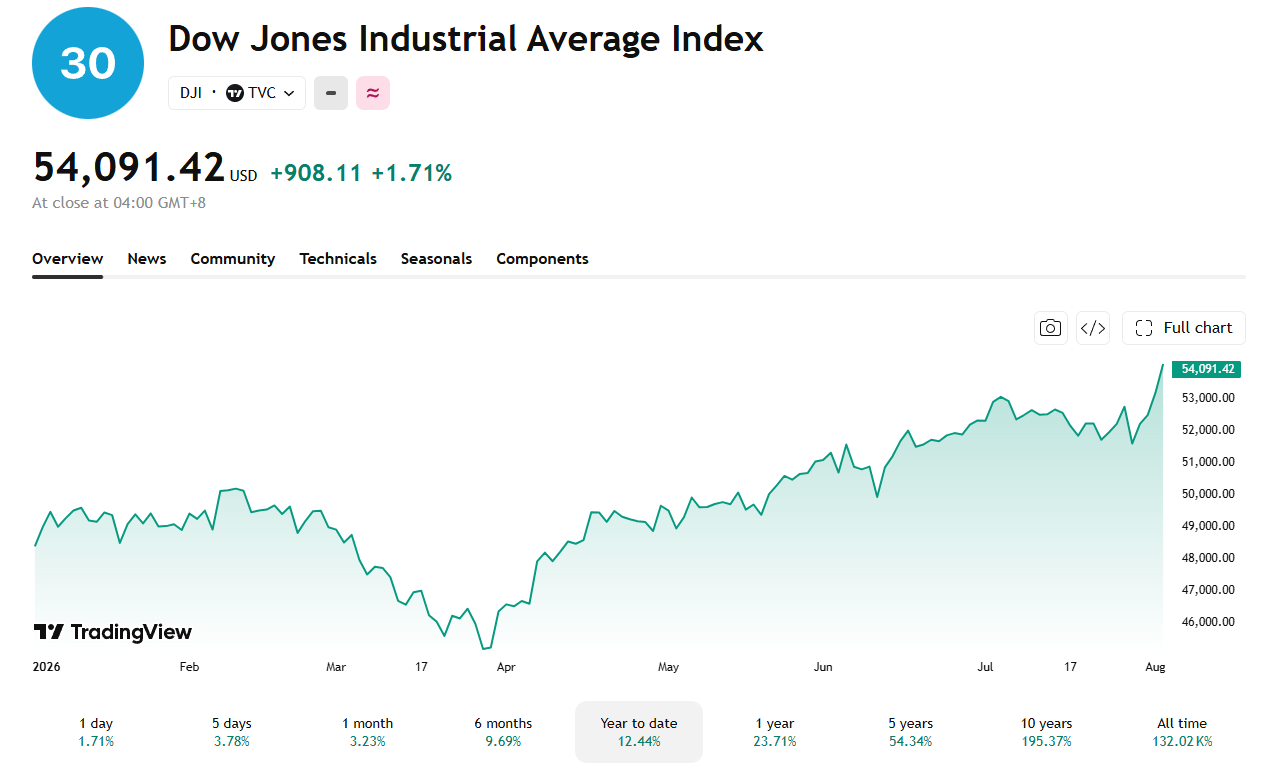
Upbeat earnings from Caterpillar and Palantir Technologies (PLTR) drove the Dow Jones Industrial Average and S&P 500 to record closes on Tuesday, easing concerns over artificial intelligence (AI) spending.
The Dow gained 907 points, or 1.71%, to close at 54,091.42. The S&P 500 rose 1.79% to 7,736.52. The Nasdaq Composite jumped 2.59% to a record 26,584.99.
AI Earnings Beat the Street
Caterpillar raised its annual revenue growth forecast as AI data center construction drove demand for its power-generation equipment. Its stock jumped 5.6%, the single biggest boost to the Dow.
Palantir’s blowout earnings drove an even bigger move. Shares climbed 29.5% after the company raised its own annual revenue forecast, marking its best single-day gain since February 2024.

Optimism extended well beyond those two stocks. Of the 304 S&P 500 companies that had reported second-quarter results, 85.2% beat estimates, versus a long-term average of 67.5%, according to Reuters.
Investors view semiconductor stocks as AI beneficiaries, and those shares rose for a fourth straight session. The Philadelphia Semiconductor Index climbed 6.6% and extended its rebound after tumbling 20.6% in July.

The Rally Went Global
Technology shares and a wave of corporate earnings updates pushed the pan-European STOXX 600 to a record close, up 0.73% to 656.86. MSCI’s All Country World Index gained 1.30% and hit an intraday record too.
Oil added fuel to the rally. Brent crude fell 5.3% to $79.36 a barrel on hopes for a diplomatic resolution to the Iran war that could reopen the Strait of Hormuz to more shipping. The drop pushed September rate-hike odds down to 56.9% from 67.2% and sent two-year Treasury yields to a two-week low.
Not Everyone Is Convinced
Not every voice on Wall Street shared the enthusiasm. Jack Ablin, chief investment strategist at Cresset Capital Management, raised that note of caution even as records piled up.
“I don’t sense one ounce of skepticism among investors, from oil to interest rates to equities. The earnings reports were certainly supportive, and that’s great news, but I’m not sure a handful of earnings reports justifies new records in the S&P.”
Oliver Pursche, senior vice president at Wealthspire Advisors, saw it differently, pointing to “stronger earnings and stronger expectations” behind the mood.
That split showed up again hours later. SpaceX’s debut earnings beat Wall Street on revenue, up 92% year over year, yet shares fell roughly 8% in after-hours trading once results landed.
Ablin’s caution points to a real question. Does a rally built on a handful of earnings beats justify fresh records, or is the market pricing in AI demand that has yet to prove durable?
Tuesday’s numbers don’t settle it, and the rest of earnings season should offer more evidence.
The post Dow and S&P 500 Hit Records on AI Earnings: When Will the Bubble Burst? appeared first on BeInCrypto.

Kelly Sawyer Patricof and Norah Weinstein are a dynamic duo who have made a significant impact on the lives of families who are struggling. Their dedication and tireless efforts to provide essential items for children through their work with Baby2Baby have helped so many families across the country—their passion for giving back is truly inspiring. Kelly and Norah’s leadership and vision have transformed Baby2Baby into a beacon of hope, providing items such as diapers, clothing, and other necessities to ensure that children have what they need to thrive.
Through their collaborative efforts, Kelly and Norah have shown that when people come together with a shared goal of helping others, incredible things can happen. Their compassion, generosity, and dedication to making a difference serve as a powerful reminder of the impact one can have
when driven by a desire to be of service. Thank you, Kelly Sawyer Patricof and Norah Weinstein, for your unwavering commitment to creating a brighter future for families in need.


BNY is adding Galaxy’s staking infrastructure to its digital asset custody platform, giving eligible institutional clients access to custody and staking through one servicing model.
Summary
- Galaxy will provide institutional staking through BNY’s Digital Asset Custody platform.
- The service remains subject to regulatory review and will be limited to eligible clients.
- BNY is also developing onchain transfer agency and tokenized Treasury infrastructure.
- BNY’s Belgian subsidiary recently received MiCA authorization for crypto custody and transfers.
BNY adds staking to institutional crypto custody
Galaxy said it has entered a strategic collaboration with BNY to integrate staking into the bank’s Digital Asset Custody platform. The arrangement will combine asset safekeeping and staking within a single institutional workflow.
Eligible clients will be able to use staking alongside BNY services such as fund accounting, tax reporting, payments and client reporting, where applicable. Galaxy will supply the staking infrastructure and act as a design partner for BNY’s broader digital asset platform.
The companies said the model could simplify institutional participation in proof-of-stake networks by reducing the need to coordinate between separate custody and staking providers. Client assets would remain within BNY’s institutional custody framework while accessing Galaxy’s staking capabilities.
However, the companies did not disclose which proof-of-stake assets the platform will support or when the service will become available. The launch remains subject to regulatory review.
“As digital assets continue to evolve, clients want more than safekeeping alone — they want a broader set of capabilities delivered through an institutional-grade model,” BNY Chief Product and Innovation Officer Carolyn Weinberg said.
Why the Galaxy partnership matters for US institutions
The collaboration expands the services available through a major U.S. custodian as banks compete to support institutional demand for digital assets. BNY reported $62.6 trillion in assets under custody or administration as of June 30.
Institutional staking can generate protocol rewards by committing eligible crypto assets to proof-of-stake networks. Yet the activity also introduces operational, technical and regulatory considerations that differ from conventional asset custody.
Combining both services could give asset managers and other institutions a more familiar route into staking. BNY would provide the custody and reporting framework, while Galaxy would handle the underlying staking infrastructure.
For U.S. institutions, the regulatory-review condition remains important. The companies have not said which regulators must approve the service or whether access will vary by client type or jurisdiction.
“The future of financial markets will be built on open, programmable rails, and the institutions that move first will define the era that follows,” Galaxy Global Co-Head of Digital Assets Steve Kurz said.
BNY expands onchain fund infrastructure
The staking agreement follows BNY’s move in late July to bring investment fund ownership records onchain through a blockchain-enabled transfer agency platform.
The platform will allow fund transactions and official shareholder records to be maintained on a shared digital ledger. BNY will continue operating its traditional transfer agency services alongside the blockchain-based system.
Rather than only tokenizing investment products, the bank is applying blockchain technology to the record-keeping systems that support fund administration. The model is intended to create a shared source of ownership information for institutions involved in processing and servicing funds.
BNY has also completed after-hours U.S. Treasury transactions with stablecoin issuers. The bank reportedly plans to introduce tokenized U.S. Treasuries before the end of 2026 and conduct pilot transactions on a private blockchain during the year.
MiCA approval supports BNY’s European crypto push
BNY is also expanding its regulated digital asset operations in Europe. ESMA added BNY SA/NV, the bank’s Belgian subsidiary, to its interim Markets in Crypto-Assets register in July.
The National Bank of Belgium authorized the subsidiary to provide crypto-asset custody and transfer services. Its addition came as ESMA’s register reached 309 authorized providers following 15 new entries.
The approval gives BNY a regulated route to offer specified crypto services under the European Union’s MiCA framework. Combined with the Galaxy agreement and its onchain fund platform, the authorization shows BNY is building separate but connected infrastructure across custody, staking, tokenized assets and fund administration.
The next step will depend on regulatory clearance for the staking service and details about supported assets, client eligibility and launch timing.
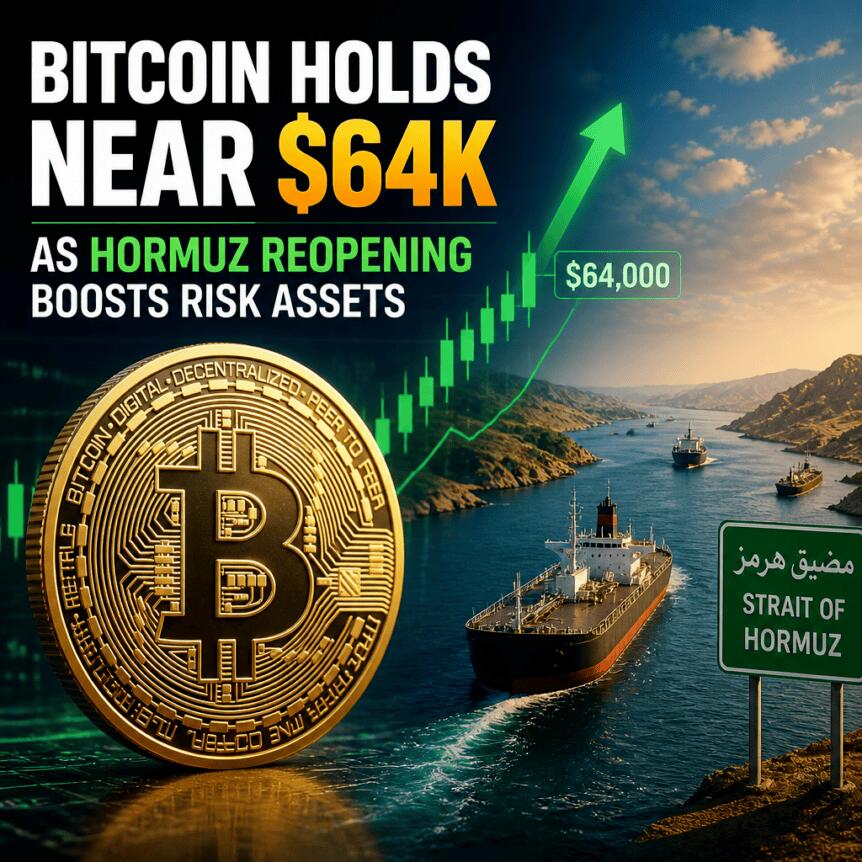
Bitcoin pushed to fresh August highs as hopes that the Strait of Hormuz could reopen calmed broader energy-market fears and lifted risk assets into Tuesday’s Wall Street open. While equities surged, crypto’s rally stayed more controlled—yet on-chain data suggested investors were accumulating rather than chasing.
TradingView data showed BTC/USD rising to $64,176 on Bitstamp, posting maximum daily gains of roughly 1% as market attention focused on US-Iran developments, oil price moves, and how those dynamics could shape expectations for the Federal Reserve.
Key takeaways
- Bitcoin extended gains toward $64,000 on Tuesday, with TradingView marking a peak around $64,176 on Bitstamp.
- US-Iran reopening signals for the Strait of Hormuz pushed oil prices lower; WTI and Brent were down about 4.8% and 4.6%, respectively.
- BTC traded between key moving averages on the hourly view, with the 21-day SMA near $64,388 acting as a near-term ceiling.
- CryptoQuant reported “strong accumulation,” pointing to investors taking positions in the $62,000–$65,000 cost-basis band.
- With rate expectations tied to oil and bond-market dynamics, FedWatch probabilities pointed to a 0.25% hike as a leading scenario for September.
Hormuz optimism lifts stocks—and pulls oil down
The crypto move was part of a wider risk-on shift driven by geopolitical headlines. US Treasury Secretary Scott Bessent told CNBC that there is “a chance we may have a deal today or tomorrow to open the Strait and move towards a more normalized position” amid ongoing US-Iran discussions. The comments followed a day after President Donald Trump said reopening dialogue could happen “as soon as tomorrow.”
Oil reacted quickly. At the time of writing, WTI and Brent crude were trading 4.8% and 4.6% lower, respectively, with prices at their lowest levels since July 13. The direction of travel matters for markets not only because oil is a direct input for inflation expectations, but also because reopening assumptions can quickly change the probability of supply disruptions.
US stocks futures moved higher ahead of the open, and the S&P 500 topped a new milestone. According to market tracking cited in the report, the index reached a record high of 7,713 and achieved a $70 trillion market capitalization for the first time.
Fed expectations hinge on oil, bonds, and the market’s interpretation
Traders linked the Hormuz outlook to future Federal Reserve decisions. The report highlighted an environment of debate among policymakers, describing an “emerging hawkish split” regarding interest-rate timing and magnitude, while markets watched how energy prices could influence the inflation picture.
According to CME Group’s FedWatch Tool, investors were pricing in a 56.7% probability of policymakers approving a 0.25% rate hike at the September meeting. Earlier in the day, Bloomberg macro strategist Michael Ball was quoted emphasizing that Chairman Kevin Warsh’s limited guidance on the Fed’s reaction function means coming data—along with oil prices and the bond market—will have an outsized impact on how investors forecast the policy path.
For Bitcoin, the key takeaway is not that crypto is trading directly off oil headlines, but that macro expectations determine the liquidity and risk appetite that typically flows into high-beta assets. If the market believes reopening reduces inflation pressures, it can soften the “higher for longer” narrative that often weighs on speculative demand.
Bitcoin stays in a tight range, but on-chain shows buyers soaking up dips
Despite BTC/USD slipping into a comparatively narrow technical rhythm, the price still managed to break toward the low-to-mid $64,000s. On the hourly chart referenced in the report, analysts noted BTC was trading between two daily moving averages: the 21-day simple moving average (SMA) near $64,388 acted as an overhead reference, while the 50-day SMA provided support in shorter time frames.
In a market that appears to be waiting for a clearer macro catalyst, this kind of range behavior often reflects “positioning” rather than fresh momentum chasing. That’s where on-chain analysis came in.
CryptoQuant reported “strong accumulation” among investors. Specifically, the platform said 0.7% of the BTC supply—about 155,000 coins—now belongs to participants with a cost basis between $62,000 and $65,000. In CryptoQuant’s framing, the pattern signals absorption rather than capitulation: buyers were accumulating during weakness instead of selling under pressure.
For traders, the practical implication is that a stubborn local range can be consistent with accumulation, especially when there’s no broad liquidation wave. However, accumulation data doesn’t guarantee an immediate breakout; it mainly clarifies whether demand is present beneath the surface.
What to watch next as macro headlines evolve
As the Strait of Hormuz reopening narrative continues to develop, the next swings in oil and US bond yields are likely to remain central to how risk assets—including Bitcoin—trade. Investors should also monitor whether BTC can hold above the 50-day SMA on lower time frames and whether accumulation signals persist as price tests the $64,000 area and beyond.


Most meme coin guides explain culture and community. This one explains plumbing: the bonding curve formula that sets the price, the graduation threshold that moves a token to a real exchange, and the arithmetic that shows why the vast majority of buyers lose money before a single meme goes viral.
Summary
- A bonding curve is a smart contract that mints tokens on demand and prices each successive unit higher than the last, removing the need for a traditional order book or market maker.
- Pump.fun, the largest meme coin launchpad, allocates 800 million of each token’s one billion supply to its bonding curve and graduates the token to a decentralized exchange once the curve accumulates roughly 85 SOL.
- Fewer than two percent of all tokens launched on Pump.fun ever reach graduation, meaning the bonding curve itself is where the overwhelming majority of trading activity and losses occur.
- A rug pull on a bonding curve platform does not require removing liquidity in the traditional sense; it requires only that insiders accumulate tokens cheaply at the bottom of the curve and sell into the buying pressure of later arrivals.
- The math of any convex bonding curve guarantees that late buyers pay exponentially more per token than early buyers, creating a structural transfer of value from latecomers to early participants regardless of the creator’s intentions.
The popular narrative frames meme coins as jokes that accidentally made money. The reality is more mechanical than that. Every meme coin that trades on a launchpad like Pump.fun follows an identical mathematical structure, and that structure determines who profits and who loses before a single holder posts a rocket emoji. Understanding the bonding curve, the graduation process, and the wallet concentration patterns that precede most collapses is not optional for anyone putting capital into this market.
What a bonding curve actually does
A bonding curve is a pricing function embedded in a smart contract. When a buyer sends SOL to the contract, the contract mints new tokens and sends them to the buyer at a price determined by how many tokens have already been sold. When a seller sends tokens back, the contract burns them and returns SOL at the current curve price.
The simplest version of the formula is:
Price = k * (supply sold)^n
In this equation, k is a scaling constant and n determines the steepness of the curve. When n equals 1, the price rises linearly with each token sold. When n is greater than 1, the price rises exponentially, meaning the gap between what early buyers paid and what late buyers pay widens dramatically as more tokens enter circulation.
The critical property is that the contract itself holds the reserve. There is no counterparty. The SOL that buyers send in sits inside the contract and is available for sellers to withdraw when they sell back. This creates automatic liquidity at every price point on the curve, which is why bonding curve tokens can trade immediately after creation without anyone needing to seed a liquidity pool.
The tradeoff is that this liquidity is thin by design. Because the price is a function of cumulative supply, even a moderately sized sell order pushes the price significantly lower. The contract guarantees you can sell, but it does not guarantee the price at which you sell will resemble the price at which you bought.
How Pump.fun structures a token launch
Pump.fun, which launched on Solana in January 2024, standardized the meme coin creation process into a single transaction. A creator pays a small fee, names the token, uploads an image, and the platform deploys a bonding curve contract with fixed parameters.
Every Pump.fun token has the same structure:
Total supply: 1 billion tokens. No exceptions.
Bonding curve allocation: 800 million tokens go into the curve. These are the tokens available for purchase during the pre-graduation phase.
Graduation reserve: 200 million tokens are held back. These tokens, along with the SOL accumulated in the curve, form the initial liquidity pool when the token graduates.
Graduation threshold: The bonding curve completes when it accumulates approximately 85 SOL from purchases. At that point, the token “graduates” and migrates to PumpSwap, the platform’s own automated market maker. Before March 2025, graduation sent tokens to Raydium, a third-party decentralized exchange.
Fee: Pump.fun charges a one percent fee on every trade that occurs on the bonding curve. This fee alone generated hundreds of millions of dollars in revenue during the platform’s first year of operation.
The standardization is the key innovation. Because every token uses identical contract parameters, buyers do not need to audit the smart contract for hidden functions. The risk surface shifts entirely from the contract code to the market dynamics and wallet distribution.
The graduation bottleneck
The graduation threshold is where theory meets reality. Reaching 85 SOL of cumulative purchases sounds modest, but the graduation rate tells a different story.
Across the millions of tokens launched on Pump.fun since January 2024, fewer than two percent have ever reached graduation. The remaining 98 percent die on the bonding curve, meaning they never accumulate enough buying pressure to migrate to a real trading venue.
For the tokens that do graduate, the transition creates a structural shift. On the bonding curve, the contract itself provides liquidity. After graduation, liquidity depends on the pool seeded by the 200 million reserved tokens and the accumulated SOL. If the pool is small relative to the holders who want to sell, slippage on exit can be severe.
The graduation event often triggers the first wave of selling. Early buyers who entered at the bottom of the curve now hold tokens that have appreciated by orders of magnitude. Many of them sell into the post-graduation liquidity, which pushes the price down and traps later buyers who entered near the top of the curve expecting graduation to be a catalyst for further appreciation.
The arithmetic of who wins and who loses
The bonding curve’s convex shape creates a mathematical certainty: the average buyer loses money.
Consider a simplified example. Suppose a token’s bonding curve prices the first 100 million tokens at 0.000001 SOL each and the last 100 million tokens at 0.0001 SOL each, a 100x increase. The first buyer spends 0.1 SOL and receives 100 million tokens. The last buyer spends 10 SOL and receives 100 million tokens.
Both buyers hold the same number of tokens, but the last buyer paid 100 times more. If the price settles anywhere below the last buyer’s entry, the last buyer is underwater. The first buyer can sell at any price above 0.000001 SOL and turn a profit.
Scale this across thousands of buyers, and the pattern becomes clear: the bonding curve redistributes value from late buyers to early buyers. This is not a bug. It is the intended function of the mechanism. The curve incentivizes early participation by rewarding those who take risk when the token has no community, no narrative, and no trading volume.
The problem is that the people who benefit most from this structure are often the creators themselves and their associates, who can buy at the absolute bottom of the curve in the same block that the token is deployed.
Now extend the arithmetic to the total SOL deposited into the curve. If the curve accumulates 85 SOL before graduation, that 85 SOL is the total capital base supporting all token holders. But the token’s implied market capitalization at the graduation price is much higher than 85 SOL, because the market cap is calculated by multiplying the last traded price by the total supply. The difference between the implied market cap and the actual SOL in the contract is the gap that makes exits painful. There is not enough SOL in the system for every holder to sell at the last traded price. Someone must sell at a loss for anyone else to sell at a profit. The bonding curve does not create wealth. It redistributes the SOL that buyers deposited, minus the platform’s one percent fee on every trade.
How rug pulls work on bonding curve platforms
A traditional rug pull involves a creator removing liquidity from a decentralized exchange pool, leaving holders with tokens that cannot be sold. Bonding curve platforms change this dynamic.
On Pump.fun, the bonding curve contract is standardized and the creator cannot modify it after deployment. There is no liquidity to remove during the curve phase because the contract itself is the liquidity. This leads many buyers to assume they are safe from rug pulls on bonding curve platforms. They are not.
The modern meme coin rug pull has three common forms:
Insider accumulation. The creator or a coordinated group buys a large percentage of the available supply at the bottom of the curve using multiple wallets. Because early curve prices are near zero, acquiring 20 to 30 percent of the supply costs very little SOL. The insiders then promote the token on social media, driving external buyers onto the curve. As the price rises, the insiders sell their holdings back into the curve or on the post-graduation DEX, extracting the SOL that later buyers deposited.
Bundled launches. A creator deploys the token and purchases a large allocation in the same transaction or the same block, ensuring no one else can buy before them. On-chain analysis tools can detect bundled transactions, but most retail buyers do not check before buying.
Post-graduation dump. After a token graduates, the creator’s reserved allocation or accumulated holdings are sold into the DEX liquidity pool. Because post-graduation pools are typically small, concentrated selling can drain the pool and crash the price in seconds. The token remains technically tradable, but at a fraction of its graduation price.
None of these require the creator to insert malicious code into the contract. The standardized contract is functioning exactly as designed. The extraction happens through market dynamics, not technical exploits.
On-chain signals that precede most collapses
The advantage of bonding curve platforms is that every transaction is public. The disadvantage is that most buyers never look at the data.
Several on-chain patterns consistently appear before meme coin collapses:
Wallet concentration. If the top 10 wallets (excluding the bonding curve contract) hold more than 30 percent of the circulating supply, the token is structurally fragile. A coordinated sell from those wallets will overwhelm available liquidity.
Creator wallet activity. Check whether the deployer wallet or wallets funded by the same source have already begun selling. Blockchain explorers and dedicated meme coin analytics tools show wallet funding trees, which reveal when multiple “independent” buyers are actually controlled by the same entity.
Velocity of new holders. A sudden spike in new holders driven by a single social media post or influencer promotion, followed by a plateau, suggests the buying pressure is temporary. Sustainable price action on bonding curve tokens typically shows a steady accumulation of holders, not a single burst.
Time between deployment and significant volume. Tokens that see large buy volume in the first minutes after deployment often have coordinated insider buying. Organic discovery of a new token rarely happens within the first block.
Social media timing. Compare when the first large purchases appeared on-chain with when the first promotional posts appeared on social media. If the wallet accumulation predates the promotion by hours or days, the promotion is likely a distribution event, not a discovery event.
What this does not cover
This guide explains the mechanics of bonding curves, launchpad economics, and the market dynamics that produce losses. It does not cover:
- Tax treatment of meme coin profits and losses, which varies by jurisdiction and is evolving rapidly.
- The social and cultural dynamics that determine which meme coins attract attention. Virality is real and valuable, but it is not a mechanical process that can be analyzed the same way as a bonding curve.
- Cross-chain meme coin platforms on Ethereum, Base, or other networks. The core bonding curve mechanics are similar, but fee structures, graduation thresholds, and DEX integrations differ.
- Celebrity and influencer token launches, which follow the same bonding curve mechanics but carry additional reputational and legal considerations that are outside the scope of this guide.
Practical checks before buying any meme coin
Before sending SOL to a bonding curve, run these checks:
Check the holder distribution. Use a Solana block explorer or a meme coin analytics dashboard to see how many wallets hold what percentage of the supply. If the distribution is heavily concentrated, the risk of a coordinated dump is high.
Check for bundled transactions. Look at the token’s first few transactions. If the creator’s wallet or wallets funded from the same source bought a large portion of the supply in the deployment block, the launch was not organic.
Check the creator’s history. Most launchpad platforms track the creator wallet’s previous deployments. If the wallet has launched dozens of tokens that all collapsed shortly after, the pattern speaks for itself.
Check the curve position. Understand where on the bonding curve the current price sits. If the curve is 70 percent filled, you are paying prices much higher than early buyers. The remaining upside before graduation may not justify the risk relative to what you would lose if the curve reverses.
Set a loss limit before buying. Bonding curve tokens can lose 80 percent of their value in minutes. Decide before purchasing how much you are willing to lose, and sell if the token hits that level. The curve guarantees you can sell; it does not guarantee you will want to.
Understand your position on the curve. The percentage of the bonding curve that has been filled tells you where you sit in the queue of buyers. If you are buying when the curve is 90 percent full, nearly all of the upside between the initial price and the graduation price has already been captured by earlier buyers. Your potential gain is limited to whatever premium the market assigns after graduation, minus the slippage you will face when selling into post-graduation liquidity.
What to watch
Regulatory attention to launchpad platforms. The SEC and international regulators have not yet taken formal action against bonding curve launchpads, but the volume of trading and the frequency of losses make regulatory scrutiny increasingly likely.
Platform fee changes. Pump.fun’s one percent trading fee is a significant revenue source. Changes to this fee, or the introduction of new fee structures on competing platforms, would alter the economics of token creation and trading.
Graduation destination changes. The shift from Raydium to PumpSwap in March 2025 changed where post-graduation liquidity lives. Further changes to graduation mechanics or liquidity seeding would affect the risk profile of tokens that reach the threshold.
Anti-bundling tools. Several analytics platforms now flag bundled launches automatically. As these tools improve and become more widely used, the effectiveness of insider accumulation strategies may decrease, though new evasion methods will likely follow.
Cross-chain competition. Bonding curve launchpads on Base, Ethereum, and other chains are gaining volume. Fragmentation of meme coin trading across chains affects liquidity depth and graduation dynamics on every platform.
What is a bonding curve in meme coin trading?
A bonding curve is a mathematical formula embedded in a smart contract that sets the price of a token based on how many tokens have been sold. As more tokens are purchased, the price rises along the curve. As tokens are sold back, the price falls. The contract itself holds the reserve currency (typically SOL) and provides automatic liquidity at every point on the curve.
How does Pump.fun work?
Pump.fun is a meme coin launchpad on Solana where anyone can create a token by paying a small fee. The platform deploys a standardized bonding curve contract with a fixed supply of one billion tokens, 800 million of which go into the curve. When purchases accumulate roughly 85 SOL, the token graduates to PumpSwap, a decentralized exchange, where it begins trading with traditional pool-based liquidity.
What does it mean when a meme coin graduates?
Graduation is the moment when a bonding curve token accumulates enough buying volume to migrate from the launchpad’s internal trading mechanism to a decentralized exchange. On Pump.fun, this happens at approximately 85 SOL. After graduation, the token trades in a standard liquidity pool, which changes the liquidity dynamics and price behavior.
Why do most meme coins fail?
Fewer than two percent of tokens launched on Pump.fun reach graduation. Most tokens fail because they never attract enough buying interest to fill the bonding curve. Without sustained demand, the price stalls or declines as early buyers sell, and the token becomes effectively abandoned while still technically tradable at near-zero prices.
Can you get rug pulled on Pump.fun?
Yes. While Pump.fun uses standardized contracts that prevent the creator from modifying the code or removing liquidity from the bonding curve, rug pulls still occur through market manipulation. Insiders buy large allocations at the bottom of the curve, promote the token to attract external buyers, and then sell their holdings into the rising price, extracting the capital that later buyers deposited.
How can you spot a meme coin rug pull before it happens?
Check the holder distribution for concentration in a few wallets, look for bundled transactions in the deployment block, review the creator wallet’s history of previous launches, and examine whether early buying activity appears coordinated. None of these signals guarantee a rug pull is imminent, but their presence significantly increases the probability.
What is the difference between a bonding curve and a liquidity pool?
A bonding curve uses a mathematical formula to mint and burn tokens, with the contract itself acting as the sole counterparty. A liquidity pool pairs two tokens in a smart contract, and the price is determined by the ratio of tokens in the pool. Bonding curves provide liquidity from the moment of creation without external providers, while liquidity pools require someone to deposit both tokens before trading can begin.
Is buying early on a bonding curve a guaranteed way to profit?
No. Buying early means you pay a lower price per token, but the token must attract enough subsequent buyers to push the price above your entry before you can profit. Since over 98 percent of bonding curve tokens never reach graduation, the most common outcome for early buyers is that the token attracts minimal interest and their investment approaches zero. Early entry improves the odds relative to late entry, but the base rate of failure is extremely high.
This article is for informational purposes only and does not constitute financial, investment, or legal advice. Meme coin trading carries extreme risk, including the potential for total loss of capital. Always conduct your own research before making any investment decision. Information current as of August 4, 2026.


Getting listed on Binance, Coinbase, or OKX is the single most consequential event in most tokens’ histories. The price reaction can be immediate and dramatic. What almost no one explains clearly is what happens before that listing announcement, how much it costs, who pays, and why the price so often falls after the listing pump. This guide covers the complete picture.
Summary
- A centralized exchange listing involves multiple parties beyond just the project and the exchange: market makers, legal counsel, compliance teams, and often a broker intermediary who facilitates the application process.
- Listing fees are the visible cost, but they are often the smallest one. A top-tier exchange listing can require a combination of listing fees ($100,000 to $3 million), market making retainers ($15,000 to $50,000 per month), and security deposits held by the exchange for compliance purposes.
- The “listing pump and dump” pattern, where a token’s price spikes on listing announcement and then falls below pre-announcement levels, is not random. It follows directly from the structure of pre-listing accumulation and post-listing distribution by insiders and market makers.
- Tier 1 exchanges (Binance, Coinbase, Kraken) have formal listing processes with legal review, security audits, and compliance due diligence. Tier 2 and Tier 3 exchanges have lighter requirements and lower fees but offer less liquidity and credibility.
- Some exchanges, including Coinbase, list tokens without charging listing fees, but this does not mean the process is free. Projects still incur market making costs, legal fees, and compliance preparation that can total hundreds of thousands of dollars.
Every week, dozens of tokens announce listings on major exchanges. The announcement is almost always framed as a milestone: validation from a respected institution, a signal that the project has arrived. What the announcements do not mention is the months of preparation, the legal and compliance documentation, the market making arrangements that must be in place before the exchange will approve the listing, and the economic dynamics that determine who actually profits from the listing event.
The listing pipeline from application to announcement
A major exchange listing does not begin with a formal application. It begins with a relationship.
Most successful Tier 1 listings start with an introduction through an existing relationship between the project team and someone connected to the exchange’s listing team. Cold applications submitted through public listing request forms are rarely approved for projects without established networks. The first step for any serious project is building connections at industry events and through mutual introductions from investors or advisors who have prior relationships with the exchange.
Once contact is established, the formal process has several stages:
Initial screening. The exchange’s listing team evaluates the project’s fundamentals: team background, token economics, trading history on existing venues, community size, and legal structure. Projects with anonymous teams, unaudited smart contracts, or regulatory red flags are rejected at this stage. Coinbase, which publishes its listing criteria publicly, evaluates factors including legal compliance, technology security, market supply and demand, and team quality.
Due diligence. Projects that pass initial screening enter a formal due diligence process. This includes legal review of the token’s regulatory status (is it a security? a commodity? a payment token?), a technical security assessment of the smart contract or blockchain, and a review of the project’s tokenomics including vesting schedules, insider holdings, and inflation rate.
Compliance documentation. The exchange requires KYC documentation for the project’s key personnel, AML (anti-money laundering) policy disclosures, and legal opinions on the token’s regulatory status in major jurisdictions. For US exchanges, this is particularly important given the SEC’s enforcement activity around unregistered securities. The legal fees for preparing this documentation typically run between $50,000 and $200,000 for a Tier 1 listing.
Market making arrangement. Before approving a listing, Tier 1 exchanges require confirmation that the project has market making coverage. The exchange needs assurance that the order book will have meaningful slippage-free depth from day one. Projects without an established market maker are typically required to arrange one as a condition of listing approval.
Listing fee negotiation. After due diligence passes, the exchange and project negotiate the listing fee. For Tier 1 exchanges, publicly disclosed listing fees range from $100,000 to $3 million depending on the exchange, the trading pair, and the project’s strategic value to the exchange. Some exchanges, particularly during bear markets or for tokens with existing substantial trading volume on competitor venues, reduce or waive listing fees.
Integration and testing. The exchange integrates the token contract, sets up withdrawal and deposit infrastructure, and runs testing before the public listing announcement. This typically takes two to eight weeks and requires technical cooperation from the project team.
What listings actually cost across tiers
The full cost of a major exchange listing is rarely disclosed publicly, but the components are well-documented through industry sources, court filings, and whistleblower disclosures.
Tier 1 exchanges (Binance, Coinbase, Kraken, OKX). Listing fees range from $100,000 to $3 million. Market making retainers add $15,000 to $50,000 per month. Legal and compliance preparation costs $50,000 to $200,000. Some exchanges require a security deposit of $500,000 to $2 million held in escrow, which is returned if the project meets listing requirements over a set period. Total first-year cost for a Tier 1 listing: $500,000 to $5 million.
Tier 2 exchanges (Bybit, KuCoin, Gate.io, HTX). Listing fees range from $20,000 to $300,000. Market making requirements are less rigorous. Legal review is lighter, and compliance documentation is less extensive. Total first-year cost: $50,000 to $500,000.
Tier 3 exchanges (smaller regional or niche venues). Listing fees range from zero to $50,000. Some small exchanges list tokens for free in exchange for marketing commitments, trading volume guarantees, or token airdrops to their user base. The liquidity provided is typically minimal, and trading volume may be wash-traded to appear more active.
The geography of listing matters as well. Binance is the global leader by trading volume but has faced regulatory challenges in several major markets including the UK, Netherlands, and Canada. Coinbase is the preferred venue for US regulatory compliance and Nasdaq-listed institutional legitimacy. OKX dominates in parts of Asia. A project building for a specific geographic audience may prioritize a regional leader over the global volume leader.
The listing fee controversy came to a head when Changpeng Zhao (CZ), then CEO of Binance, publicly stated in 2019 that Binance did not charge listing fees, contradicting widespread industry reporting. He later clarified that projects could donate to Binance Charity instead. In 2023, leaked documents and court filings in Binance’s regulatory proceedings revealed that listing arrangements were more complex than public statements suggested, with multiple forms of financial consideration exchanged between projects and the exchange.
Why Coinbase listings are different
Coinbase occupies a unique position in the listing landscape because of its publicly stated no-listing-fee policy and its status as a publicly traded US company subject to SEC oversight.
Coinbase publishes its listing framework online through its Digital Asset Framework, which outlines the criteria the exchange evaluates: legal compliance, technology security, market supply and demand, and team quality. The exchange states it does not charge listing fees and that listing decisions are made independently of commercial relationships.
This policy has made Coinbase listing announcements particularly powerful market signals. When Coinbase announces it is considering a token for listing, the price often jumps significantly before the formal listing, a phenomenon known as the “Coinbase effect.” The pre-announcement price action has attracted regulatory attention, including SEC allegations that Coinbase employees front-ran listing announcements. One former Coinbase employee was convicted in 2022 for trading on insider knowledge of upcoming listings.
Even without a listing fee, the process of achieving Coinbase listing is expensive. Legal counsel to prepare US compliance documentation, the cost of passing a technical security audit, and the market making arrangements required to support trading post-listing still total hundreds of thousands of dollars. The absence of a direct fee does not mean the listing is free.
The anatomy of a listing pump and dump
The pattern is consistent enough to have a name: list, pump, dump. Understanding why it happens requires looking at who knows what and when.
Before a listing is announced publicly, several parties know it is coming: the project team, the exchange’s listing department, the assigned market makers, and any brokers or advisors involved in the process. This information asymmetry creates predictable trading behavior.
In the weeks before a major listing announcement, the token typically sees quiet accumulation in its existing trading venues — a decentralized exchange or smaller CEX. This accumulation often happens in wallets connected to project insiders or people with access to the listing timeline. The accumulation phase is visible on-chain but rarely analyzed by retail traders watching price charts.
When the listing is announced publicly, retail buyers flood in, pushing the price up dramatically. This is the moment when the people who accumulated during the quiet phase begin to distribute their holdings into the buying pressure. The market makers who were given token loans to provide exchange liquidity may also use this moment to sell borrowed tokens at elevated prices, intending to buy them back cheaper after the announcement excitement fades.
The result is a characteristic price shape: a spike on announcement, a period of volatile trading during the first days of listing, and then a gradual decline as selling pressure from pre-listing accumulators overwhelms the diminishing flow of new buyers. Tokens that maintain post-listing price appreciation are the exception, not the rule. The ones that do tend to have genuine demand fundamentals that exist independent of the listing event itself.
The market maker compound dynamic amplifies this pattern. During the first weeks on a new exchange, market makers typically build their inventory by buying the token on existing venues and selling it on the new exchange at a slight premium. This cross-venue arbitrage brings the prices into alignment but also increases selling pressure on the new exchange as the market maker’s inventory stabilizes. Retail buyers who purchased at the listing price often find themselves holding a token that is quietly declining while the price appears stable on the chart.
The geographic dimension of listing strategy
Where a token lists first matters as much as where it eventually lists. The sequencing of exchange listings across geographies reflects both regulatory strategy and market building priorities.
A project targeting US retail investors will typically prioritize Coinbase, which is the dominant US retail crypto exchange and provides the regulatory legitimacy that US institutional allocators require. A project targeting Asian retail investors may prioritize Binance or OKX, which have deeper penetration in markets where Coinbase is not available.
Projects with regulatory uncertainty around their token’s status — particularly those that might be classified as securities by the SEC — often list first on non-US exchanges that operate under different regulatory frameworks. This approach allows the project to build trading volume and price history before addressing US compliance, but it also limits access to US retail capital and signals regulatory caution to sophisticated investors.
The sequencing from Solana DEXs and smaller CEXs to Tier 2 exchanges to Tier 1 exchanges is the standard path. Each step up the tier ladder increases liquidity, visibility, and credibility, but also increases cost and regulatory scrutiny. Projects that try to shortcut this ladder by paying for a Tier 1 listing before building genuine trading volume often find that the listing fails to deliver sustained price appreciation because the organic demand foundation is not there.
What this does not cover
This guide covers the process, costs, and economics of CEX listings. It does not cover:
- Perpetual futures and derivatives listings, which have different requirements from spot listings and are often easier to achieve on exchanges that want to offer leveraged trading products.
- Decentralized exchange listings, which require no application or approval. Any token with a deployed smart contract can be added to Uniswap or similar protocols immediately and without cost beyond the gas fee to seed a liquidity pool.
- The regulatory legal analysis of whether a specific token qualifies as a security, commodity, or other asset class. This is highly fact-specific and requires qualified legal counsel in each relevant jurisdiction.
- Delisting mechanics and criteria, which are different from listing but equally consequential. Exchanges delist tokens for low volume, regulatory concerns, security issues, or failure to pay ongoing compliance fees.
Practical checks before buying a newly listed token
The listing announcement is the beginning of the analysis, not the end of it.
Check where the token was trading before the listing. If a token has minimal trading history before a major exchange listing, the listing price may be entirely artificial. Compare the listing price to the price on smaller venues where the token has traded for weeks or months.
Check the token unlock schedule relative to the listing date. Project team tokens, investor tokens, and market maker loans often have lock-up periods that expire in the months after listing. Selling pressure from unlocking insiders is predictable and will weigh on the price.
Look for on-chain accumulation before the announcement. Wallet activity in the weeks before a listing announcement often shows quiet buying from wallets connected to project insiders or market makers. This pre-announcement accumulation means the listing pump is already partially spent before retail buyers see the announcement.
Understand the exchange tier. A Tier 1 listing is meaningful. A listing on a Tier 3 exchange with wash-traded volume provides no real liquidity benefit and may signal that the project could not meet Tier 1 requirements.
Check the project’s market making disclosure. Some projects disclose which firm is providing market making services. If the market maker is one known to take aggressive directional positions, the post-listing price action may be more volatile than expected.
Wait for the initial volatility to pass. The first 48 to 72 hours after a listing announcement are the period of peak price distortion. Retail buyers who wait for the initial excitement to subside often find better entry prices, and by then the on-chain data from listing day trading is available for analysis.
What to watch
SEC enforcement against listing fee arrangements. The SEC has taken the position that some token listing arrangements constitute unregistered securities activity. Further enforcement against exchanges or projects that structure listing fees as investment contracts could reshape how listings are negotiated.
Regulatory harmonization. As more jurisdictions develop crypto asset frameworks, the compliance requirements for exchange listings are converging. EU MiCA compliance may become a baseline standard that reduces the legal uncertainty around listing in European markets.
Exchange consolidation. The failure of FTX and subsequent regulatory pressure on Binance have reduced the number of credible Tier 1 exchanges. Fewer top-tier venues mean more competition for listings and potentially higher listing costs as the remaining exchanges gain pricing power.
Algorithmic listing criteria. Some exchanges are experimenting with objective, data-driven listing criteria that reduce the role of relationship-building and fee negotiation. If this approach scales, it could lower barriers for projects with strong on-chain fundamentals but limited industry connections.
Cross-listing coordination. Several projects have secured simultaneous listings on multiple Tier 1 exchanges, coordinating the announcement to maximize attention. This approach concentrates the listing pump into a single event and then distributes the selling pressure across more venues, which can reduce the severity of the post-listing decline relative to single-venue listings.
How much does it cost to get listed on Binance?
Binance has not published official listing fees, and the terms of individual listing arrangements are typically confidential. Industry estimates and court disclosures from Binance’s regulatory proceedings suggest that listing fees, market making arrangements, and compliance costs for a Binance listing can total $500,000 to $3 million or more. Binance has publicly stated that projects can make charitable donations instead of paying fees, but the full cost picture is more complex than that framing suggests.
Does Coinbase charge a listing fee?
Coinbase states publicly that it does not charge listing fees and that listing decisions are made independently of commercial relationships. However, a Coinbase listing still requires significant investment in legal compliance documentation, security audits, and market making arrangements, which can total hundreds of thousands of dollars in preparation costs.
What is the Coinbase effect?
The Coinbase effect refers to the price appreciation that typically occurs when Coinbase announces it is evaluating a token for listing or confirms a listing decision. Because Coinbase is a publicly traded company with a reputation for regulatory compliance, a Coinbase listing is seen as a credibility signal. Prices often rise significantly before the formal listing as traders anticipate increased retail demand from Coinbase’s large US user base.
Why do token prices often drop after a listing?
Token prices frequently fall after the initial listing excitement because the listing event is when pre-listing accumulators, including project insiders, early investors, and market makers, distribute their holdings into the buying pressure from new retail investors. The asymmetry of information between those who knew about the listing in advance and those who learn about it from the announcement creates a predictable pattern of accumulation before and distribution during the listing event.
What is the difference between a Tier 1 and Tier 2 exchange listing?
Tier 1 exchanges (Binance, Coinbase, Kraken, OKX) have the highest trading volume, deepest liquidity, largest user bases, and most rigorous listing requirements. A Tier 1 listing provides the most significant price and liquidity impact but costs the most and requires the most compliance preparation. Tier 2 exchanges (Bybit, KuCoin, Gate.io) have substantial volume but lower requirements and lower costs. A Tier 2 listing is often a stepping stone toward a Tier 1 listing.
What does a market maker do in the context of an exchange listing?
A market maker continuously places buy and sell orders on the exchange’s order book for the newly listed token, ensuring that traders can execute transactions immediately without significant slippage. The exchange requires this arrangement before approving a listing because a token without market making coverage would have an empty order book, making it practically untradable. The project typically pays the market maker a monthly retainer and may provide a token loan to fund the initial order book inventory.
Can a token get listed without paying any fees?
Some exchanges do not charge explicit listing fees for tokens that meet their criteria through organic processes. Uniswap and other decentralized exchanges allow any token to be listed without permission or fees. Among centralized exchanges, some smaller Tier 3 venues list tokens for free in exchange for marketing commitments or trading volume guarantees. However, even fee-free listings incur indirect costs through market making arrangements, legal preparation, and integration work.
How can you tell if a listing announcement is worth buying?
Check whether the token has genuine trading history before the listing at prices comparable to the listing price. Look at the token’s unlock schedule for insider selling pressure in the months ahead. Examine whether on-chain activity shows quiet accumulation in the weeks before the announcement, which would signal that informed buyers have already acted. Compare the exchange tier to the project’s actual fundamentals. And consider waiting 48 to 72 hours after the announcement before buying, when initial excitement subsides and on-chain data from listing day is available for analysis.
This article is for informational purposes only and does not constitute financial, investment, or legal advice. Token listings and trading carry significant risks, including the potential for total loss of capital. Always conduct your own research before making any investment decision. Information current as of August 4, 2026.

Bitcoin miner Bitdeer has secured a major data center lease aimed at artificial intelligence and high-performance computing, a move that highlights how mining firms are increasingly positioning their power and infrastructure assets for the AI boom. The company says it has signed a 16-year agreement potentially worth up to $4.7 billion to make room for 121 megawatts of IT capacity at an AI data center in Tydal, Norway.
While Bitdeer is best known for operating and expanding its Bitcoin mining footprint, this deal shows a broader shift: investors are watching how miners can diversify revenue beyond hash-rate economics—especially as demand for GPU-based computing grows across the AI sector.
Key takeaways
- Bitdeer signed a 16-year AI/HPC data center lease worth up to $4.7 billion.
- The agreement covers 121 MW of IT capacity at Bitdeer’s Tydal, Norway facility configured for Nvidia GPU workloads.
- The tenant is identified only as a Volta Infra subsidiary; Bloomberg reported Volta’s $10 billion cloud contract is with Anthropic.
- Bitdeer said the lease is still subject to closing conditions and is not yet effective, with ~$1.3 billion expected in letters of credit for payment security.
- Bitdeer shares reportedly rose about 8% in early Nasdaq trading after the announcement.
A long-dated lease ties mining infrastructure to AI demand
Bitdeer’s announcement centers on a high-capacity AI data center offering that will be dedicated to Nvidia GPU-based AI workloads. Under the lease, Bitdeer plans to provide 121 megawatts of IT capacity at its Tydal site. The company did not publicly disclose the tenant’s full identity beyond stating it is a subsidiary of Volta Infra, nor did it clarify whether Volta is the final customer or an intermediary.
For investors, the key question is how effectively this type of infrastructure revenue can diversify results. Unlike Bitcoin operations—where earnings can swing with network difficulty, power costs, and coin prices—AI data center contracts are typically structured around contracted capacity and service timelines. A 16-year horizon can therefore reduce uncertainty about utilization and cash-flow stability, at least in theory, if the tenant’s payment obligations hold.
Who’s behind the tenant: Bloomberg links Volta to Anthropic
The deal’s commercial context is complicated by Bitdeer’s lack of full tenant disclosure. Bloomberg News, in a report published alongside the announcement, said that Volta’s $10 billion cloud contract is with Anthropic, citing people familiar with the matter.
That reporting helps explain why a mining-linked infrastructure provider might find demand for long-duration AI capacity. If Volta’s cloud obligations relate to major frontier AI workloads, then a large contracted power and compute footprint in Norway could be part of meeting those compute requirements. Still, until all parties confirm the final customer and configuration details, readers should treat the end-user linkage as informed by reporting rather than an explicit contractual disclosure from Bitdeer.
Terms, financing support, and what must happen before it takes effect
Bitdeer said the lease agreement is not yet effective and remains subject to customary closing conditions. The company also indicated it expects financing arrangements to support the tenant’s payment obligations: affiliates of JP Morgan and another unnamed global financial institution are expected to issue approximately $1.3 billion in letters of credit (or a similar bank guarantee structure). This type of security is designed to ensure the landlord can recover funds if contractual payment obligations are not met.
From a risk perspective, these protections matter because long-horizon AI capacity deals can be exposed to utilization changes, customer liquidity, or renegotiation dynamics. The presence of letters of credit suggests Bitdeer is attempting to reduce downside around payment failure, though the lease’s final economics and operational start date will depend on the closing conditions being satisfied.
AI expansion meets a distinct treasury strategy
Bitdeer’s lease announcement adds to a broader trend of crypto infrastructure companies moving toward AI and high-performance computing. In addition to building and monetizing data center capacity, the company has been pursuing ways to reduce reliance on third-party supply for mining-related hardware.
Last month, Bitdeer announced a $36 million investment in a manufacturing facility in Nevada, framed as part of its strategy to expand manufacturing operations. That context matters because it signals the company is trying to control more of its value chain while it pursues new, non-mining revenue streams.
Just as important is the way Bitdeer has handled its Bitcoin holdings relative to many listed peers. Earlier this year, Bitdeer fully liquidated its Bitcoin treasury. The company previously said it reduced its holdings to zero after holding roughly 943 BTC in early February, stating that the sales were meant to support its broader expansion strategy, including AI and powered infrastructure acquisitions.
That contrasts with several major mining companies that continue to maintain sizable Bitcoin treasuries. According to BitcoinTreasuries.NET, MARA Holdings, Riot Platforms, CleanSpark, and Hut 8 each hold at least 10,000 BTC, with MARA reportedly exceeding 36,000 BTC. Bitdeer’s approach suggests a willingness to convert crypto exposure into capital for operational and infrastructure expansion—an idea the latest lease reinforces.
Market reaction appeared to be positive. Bitdeer shares reportedly jumped about 8% in early Nasdaq trading following the announcement, indicating that investors are receptive to the company’s efforts to connect its energy and infrastructure capabilities with the AI compute cycle.
What to watch next is whether the lease clears closing conditions and how quickly the promised IT capacity translates into contracted, operating revenue. Equally important will be any further clarification on the tenant structure—especially whether reporting about Volta’s link to Anthropic aligns with the final end-customer arrangements under the agreement.
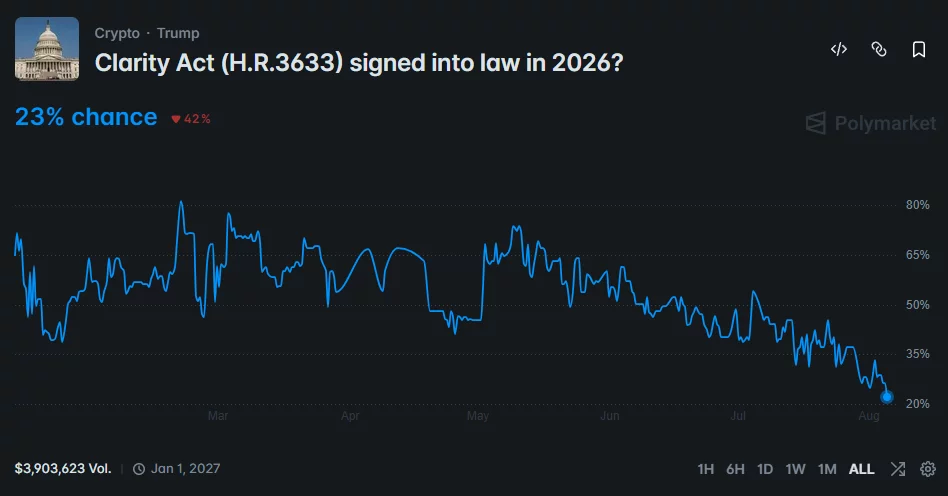
The CLARITY Act was absent from the U.S. Senate’s Aug. 4 schedule, narrowing the window for lawmakers to advance the crypto market structure bill before their August recess.
Summary
- H.R. 3633 was not included in the Senate’s official Tuesday schedule.
- No cloture motion had been filed for the bill, leaving Friday as the earliest possible vote if leadership acts Wednesday.
- Polymarket traders placed the chance of passage in 2026 at 23%, down 42%.
- A dispute over the bill’s treatment of DeFi has added pressure during its final legislative window.
CLARITY Act left off the Senate schedule
Senators convened at 10:00 a.m. ET on Tuesday before breaking until 2:15 p.m., according to the Senate Daily Press schedule.
Following leadership remarks, the chamber was expected to resume consideration of the motion to proceed to H.R. 6500, a vehicle for a continuing resolution, after cloture.
The schedule also listed possible votes on Erica Schwartz’s nomination to lead the Centers for Disease Control and Prevention and a group of 74 nominations considered together. It did not mention H.R. 3633, formally known as the Digital Asset Market Clarity Act.
The omission does not prevent Senate leaders from adding the crypto bill later. However, no cloture motion had been filed on H.R. 3633 as of Tuesday, leaving lawmakers without the procedural step needed to move toward a vote.
Analyst Ted Pillows said that if Senate leadership waited until Wednesday to file cloture, Friday would likely be the earliest day for a procedural vote.
Thune still wants a market structure vote
Senate Majority Leader John Thune has continued to identify digital asset market structure as a legislative priority, although government funding remains ahead of it.
“We have a bunch of stuff that we have to finish, and we’ll just stay here until we finish it,” Thune said.
Asked specifically about the crypto bill, he added:
“I think market structure we’ll get a vote on. Whether we can get on it or not, we’ll see.”
Thune previously described market structure legislation as a candidate for Senate consideration, but said funding the government was the chamber’s most urgent task. The Senate is now working through the continuing resolution as the recess deadline approaches.
Without floor action this week, the CLARITY Act could face a longer delay. Lawmakers will have a limited legislative calendar after returning, with the November elections likely to compete for attention.
DeFi dispute adds pressure on lawmakers
The schedule setback follows a dispute between the Blockchain Association and the National Sheriffs’ Association over how the latest bill would regulate decentralized finance.
In an eight-page response sent to Thune and Senate Minority Leader Chuck Schumer on Aug. 3, the Blockchain Association rejected claims that the July 22 draft gives DeFi protocols, software developers, mixers and bridges a “blanket exemption” from anti-money laundering and sanctions rules.
The industry group argued that the legislation distinguishes intermediaries controlling customer funds or transactions from developers who only publish neutral software. Registered brokers, exchanges and other intermediaries would remain subject to compliance requirements.
The National Sheriffs’ Association has argued that developer protections could leave gaps that make financial crime investigations harder. However, other law-enforcement groups have supported the legislation’s control-based framework. A Blockchain Association letter published in June carried signatures from 160 former national security, intelligence and law-enforcement officials.
Polymarket odds fall to 23%
Prediction-market traders have become less confident that the CLARITY Act will clear Congress this year.
A Polymarket contract asking whether H.R. 3633 will become law in 2026 placed the probability at 23%. The chart showed the odds down 42%, with approximately $3.9 million in trading volume.
The decline reflects market sentiment rather than an official forecast. The bill remains alive, but its path depends on Senate leadership filing cloture and securing enough support to begin floor consideration.
For the U.S. crypto industry, the legislation could define the respective roles of the Securities and Exchange Commission and Commodity Futures Trading Commission. For now, the missing Senate slot and unresolved procedural steps leave that regulatory framework waiting for another opening.

Ranking the best accounts to use for achieving financial freedom

Ruling due on Coronation Street star Julie Goodyear’s Heywood mansion

Crexendo, Inc. (CXDO) Q2 2026 Earnings Call Transcript


-

 Business6 days ago
Why Trees Belong on the Risk Register
-

 Fashion4 days ago
Weekend Open Thread: Wit & Wisdom
-

 Politics4 days ago
Meta enters AI-training agreement with far-right ‘propaganda rag’ Newsmax
-

 Politics6 days ago
Reform UK betrays West Mids residents by running from party pledges
-

 Crypto World3 days ago
MicroStrategy Post-Earnings CLARITY Act Push Could Add New Catalyst for Its Stock
-

 Politics2 days ago
Zack Polanski: an incitement to murder Nigel Farage?
-

 Business7 days ago
Major shareholder moves on Canyon
-

 Crypto World4 days ago
XRP Ledger v3.3.0 brings five institutional features
-

 News Videos6 days ago
Bitcoin Enters the 3rd Stage of the Bear Market
-

 Politics5 days ago
Luke Littler’s dominance sparks GOAT debate
-

 Sports5 days ago
Seema Kaliramna Wins Discus Throw Bronze, Takes India’s CWG Medals Tally To 17
-

 Crypto World4 days ago
New York sues Kalshi over prediction market gambling
-

 Crypto World3 days ago
Crypto PAC spending tops $2M in Michigan House race
-

 Business5 days ago
Trump Announces Hamas Disarmament Agreement as Iran Strikes Kuwait Air Base and US Attacks Pause Overnight
-

 Tech7 days ago
Gemini can now summarize the messiest comment threads in Google Docs
-

 Tech3 days ago
ESET tracks rise in malicious AI skills and adaptable malware
-

 Business2 days ago
DTCR: Deleveraging And A Hedge Fund Collapse Point To A Possible AI Bottom
-

 NewsBeat6 days ago
Four people die trying to cross Channel in small boats
-
 Tech5 days ago
Gemini Spark can now use Chrome logins and saved passwords to run errands on your behalf
-

 Tech5 days ago
Building A Reproduction PlayStation Motherboard
You must be logged in to post a comment Login