
Crypto World
Tornado Cash Logs 968 Deposits in Busiest Day of 2026, L2Beat Says

Tornado Cash processed 968 deposits on July 23, its busiest day of 2026, according to L2Beat data. The spike shows large-scale attackers have returned to the privacy protocol since the U.S. Treasury lifted sanctions in March 2025 — and that its baseline usage keeps climbing even as developer Roman… Read the full story at The Defiant

Decentralized exchanges handled spot volume equal to 24% of centralized exchange volume in July, the highest ratio since The Block's data series began in 2019. The record share came in a shrinking market: onchain volume held up better than centralized exchange volume as both fell, extending a climb… Read the full story at The Defiant


Cointelegraph is committed to providing independent, high-quality journalism across the crypto, blockchain, AI, and fintech industries.
All news, reviews, and analyses are produced with full journalistic independence and integrity. For more details on our standards and processes, please read our Editorial Policy.
Uniswap Labs launched Pools.trade on Aug. 5, moving the decentralized exchange developer directly into memecoin creation on Robinhood Chain.
Summary
- Pools.trade offers crowd and instant launches that settle into permanently locked Uniswap v4 liquidity pools.
- Robinhood Chain launched publicly in July with Uniswap serving as its primary public liquidity protocol.
- Santiment reported UNI exchange supply fell 15.7% while prices rose about 47% since July began.
- DefiLlama recorded Robinhood Chain at $519.97 million daily DEX volume and $597.51 million stablecoin capitalization.
- FRONG and POOLS attention remains speculative because token status and fundamentals remain difficult to verify.
The platform lets users create, discover and trade tokens through one interface. Every completed launch ends in a Uniswap v4 liquidity pool, while each token begins with a fixed supply of one billion.
The release expands Uniswap’s role on Robinhood Chain beyond swaps and liquidity provision. Robinhood opened the public mainnet on July 1, with Uniswap serving as a primary public liquidity protocol. Uniswap v2, v3, v4 and UniswapX were available from the network’s first day through its web app, wallet and API.
Pools.trade offers two routes into Uniswap v4
Pools.trade supports Crowd Launch and Instant Launch formats. Both create one billion tokens and end with permanently locked liquidity. Uniswap says trading fees automatically compound into the locked position, which prevents creators from withdrawing the initial liquidity after launch.
A Crowd Launch runs for four hours and fills bids gradually through a time weighted mechanism. The token becomes tradable only if the process reaches a $10,000 launch valuation. Otherwise, bidders receive refunds. An Instant Launch starts immediately and uses a bonding curve without a minimum graduation requirement.
Uniswap charges no separate launchpad fee. Each pool uses a standard 0.25% liquidity provider fee. Creators may activate a fee that pays them 0.05% from each trade, giving them a direct financial interest in continued activity around their token.
Uniswap’s developer records show its launchpad contracts deployed on Robinhood Chain, including its current liquidity bootstrapping strategy and initializer hook. Uniswap previously expanded its Continuous Clearing Auction system to Base, where projects can establish a market price before moving liquidity into v4.
Robinhood Chain gives Uniswap an active retail venue
Pools.trade arrives on a network that has already drawn heavy decentralized trading. At the time of review, DefiLlama recorded $519.97 million in 24 hour DEX volume and $2.48 billion over seven days. Stablecoins on the chain had a market capitalization of $597.51 million, while Uniswap held about $69.75 million in protocol value.
However, seven day DEX volume had fallen 32.81% from the preceding period. The decline shows that early activity has not moved upward in a straight line and does not prove the launchpad will maintain current trading levels.
As previously reported, Robinhood Chain reached $500 million in daily Uniswap volume eight days after its public launch. Early activity mixed tokenized assets with intense memecoin trading, giving Pools.trade a ready audience but also exposing it to rapid changes in retail attention.
For U.S. users, Robinhood’s branding may create confusion about where the product sits. Robinhood says its permissionless chain operates independently from customers’ brokerage and crypto accounts. Pools.trade activity takes place onchain through compatible wallets rather than inside a standard brokerage portfolio.
UNI gains while token claims require caution
Santiment Intelligence said early attention centered on FRONG and POOLS, while older launchpad tokens faced pressure as traders rotated toward the new product. The analytics firm also reported that UNI supply on exchanges fell 15.7% over one month and that the token had risen about 47% since the start of July.
A separate CoinGecko snapshot placed UNI near $4.07, up 30.8% over 30 days, with a market capitalization near $2.54 billion. The return differs from Santiment’s figure because the two measures use different starting dates and data windows.
Santiment said the combination of rising prices and falling exchange balances suggested the rally “may not be over.”
This is an analytical view, not a verified forecast. Exchange withdrawals can reflect custody changes, transfers between venues or other activity that does not necessarily reduce selling pressure.
The official Pools.trade announcement did not identify FRONG or POOLS as endorsed tokens. Uniswap also stated that it had not independently reviewed or verified any token displayed on the platform. Traders should therefore avoid treating a ticker, logo or social media association as proof of an official connection.
What happens next for Pools.trade
The first practical test will be whether Crowd Launch projects reach the $10,000 threshold and retain trading demand after their four hour windows close. Market participants will also watch whether Instant Launch tokens develop durable liquidity rather than brief bursts of volume.
Permanent locking reduces one form of liquidity withdrawal risk, but it does not remove risks involving token contracts, concentrated ownership, manipulation or weak demand.
Uniswap warns that assets on Pools.trade are “extremely volatile and may go to zero.”
The company also says the platform is restricted to memecoins and that displayed projects do not receive an endorsement. Some tokens may pay creator fees, meaning their creators have a financial interest in driving trading activity.
The launch moves Uniswap closer to the earliest stage of a token’s life. It can now support creation, distribution and secondary trading instead of waiting for outside launchpads to seed pools. As crypto.news reported, Robinhood Chain volume has already fueled debate over Uniswap’s fee capture and UNI’s role in the protocol’s economics.
The next useful measures will include completed launches, locked liquidity, unique traders, creator fee use and the share of tokens retaining volume after their first day. UNI price action and exchange balances may attract attention, but contract verification and ownership concentration will provide a clearer view of individual token risk.
Russian President Vladimir Putin signed a comprehensive digital asset law on Aug. 4, creating a regulated route for retail and qualified investors to trade cryptocurrencies through approved intermediaries.
Summary
- Russia will allow tested retail investors to buy liquid cryptocurrencies through regulated intermediaries from September.
- Nonqualified investors face a 300,000 ruble annual purchase cap through each intermediary under the law.
- Registered crypto exchanges must hold 15 million rubles in equity and join an approved SRO.
- Qualified investors may trade any cryptocurrency without purchase limits after completing mandatory suitability tests successfully.
- Domestic crypto payments remain banned, while foreign trade settlements receive explicit legal permission under exceptions.
The core provisions will take effect on Sept. 1, 2026, according to TASS and the Bank of Russia.
The law covers crypto exchanges, digital depositories, brokers, management companies, trading venues and clearing houses. It also addresses mining, custody, accounting and foreign digital instruments. However, it does not recognize cryptocurrency as legal tender for ordinary domestic purchases.
Retail investors face annual limits and testing
Nonqualified investors will be permitted to buy only cryptocurrencies that regulators classify as the “most liquid.” They must complete a suitability test and will face a purchase limit of 300,000 rubles per year through each intermediary. Authorities have not yet published the final list of eligible assets.
Qualified investors must also pass testing, but they may purchase and sell any cryptocurrency without an amount limit. Individuals may qualify partly through their previous crypto transaction history, according to TASS. The Bank of Russia will need to provide more detailed standards before intermediaries can apply the rules consistently.
The structure follows the framework lawmakers developed earlier in 2026. As previously reported, the bill’s first reading included regulated intermediaries, mandatory testing and the 300,000 ruble annual retail ceiling.
A later revision removed a proposed requirement for investors to disclose their crypto wallet addresses. In related coverage, the revised proposal retained the purchase cap while adding controls covering transfers and crypto funded investments.
Russia crypto law creates a licensed exchange system
Crypto exchange providers must join a “special registry,” maintain at least 15 million rubles in equity and become members of a financial market self regulatory organization. The law defines systematic exchange activity as completing two or more transactions in one month with a combined value exceeding 3.5 million rubles.
Existing crypto exchange providers may operate without registration until July 1, 2027. This differs from the March 1, 2027 transition granted to existing digital financial asset exchange operators, which form a separate category under the wider framework.
Banks and Russian branches of foreign banks will also have to block transfers when they suspect an unauthorized digital currency exchange provider is involved. Meanwhile, the law grants judicial protection to digital currency holders even when the assets were not previously declared.
The Bank of Russia has already started drafting the regulations needed to operate the market. Its July 27 proposals cover organized trading, pricing methods, asset records and digital depositories.
Proposed minimum equity for digital depositories ranges from 50 million to 250 million rubles, depending on the services provided. Those capital requirements are separate from the 15 million ruble minimum imposed on exchange providers.
Domestic payments remain banned despite trade exception
The legislation continues Russia’s prohibition on using cryptocurrency to pay for goods, services, information or intellectual property inside the country. It also prohibits advertising that presents digital currencies as a domestic payment option.
However, crypto may be used for settlements under foreign trade contracts between Russian residents and nonresidents. Other exceptions cover specified transactions involving mined cryptocurrency, securities, other digital currencies, digital rights and fees required under approved information systems.
The Bank of Russia said exporters and importers may use cryptocurrencies for cross border payments without transaction amount limits. Those transactions may pass through intermediaries or use wallets directly, although Russian residents must report certain overseas holdings to tax authorities.
The foreign trade permission also creates a clear U.S. compliance consideration. The U.S. Treasury says its Russia sanctions apply to virtual currency just as they apply to fiat transactions. U.S. exchanges, wallet providers and other persons remain prohibited from facilitating transactions involving blocked Russian parties.
Treasury previously sanctioned the Moscow linked exchanges Garantex and Grinex, along with businesses connected to the A7 cross border settlement network. It said the network supported sanctions evasion and used the ruble backed A7A5 token when moving customer balances.
Russian businesses have explored cryptocurrency for foreign trade as sanctions complicated access to conventional international payment channels. Russia’s domestic law may authorize those transactions, but it cannot remove sanctions or compliance obligations imposed by other jurisdictions.
What happens before the September rollout
The core framework starts on Sept. 1, 2026. Before then, the Bank of Russia must complete rules covering eligible retail assets, investor testing, organized trading, exchange supervision and digital depository operations.
Other sections will begin later. Provisions involving certain transfer restrictions and nonresident digital depositories take effect on July 1, 2027. Technical rules for digital financial assets, nominal holders and depositories will start on Sept. 1, 2027.
Russia is also tightening controls over other parts of the crypto sector. In related coverage, officials advanced long term mining restrictions in Moscow, the surrounding region and parts of Kursk. Those measures concern electricity use and mining oversight rather than retail trading.
The next practical test will be whether intermediaries can receive approvals and launch compliant products on schedule. Retail access will remain limited until regulators identify qualifying cryptocurrencies, establish registries and finalize the suitability tests required under the law.
Flap, a BNB Chain token launchpad, generated $1.18 million in revenue on Aug. 1, passing Pump.fun in daily revenue for the first time, according to DefiLlama. Flap earned $1,183,980 on Aug. 1, edging out $1,103,266 for the entire Pump family — the pump.fun launchpad plus its PumpSwap AMM and… Read the full story at The Defiant
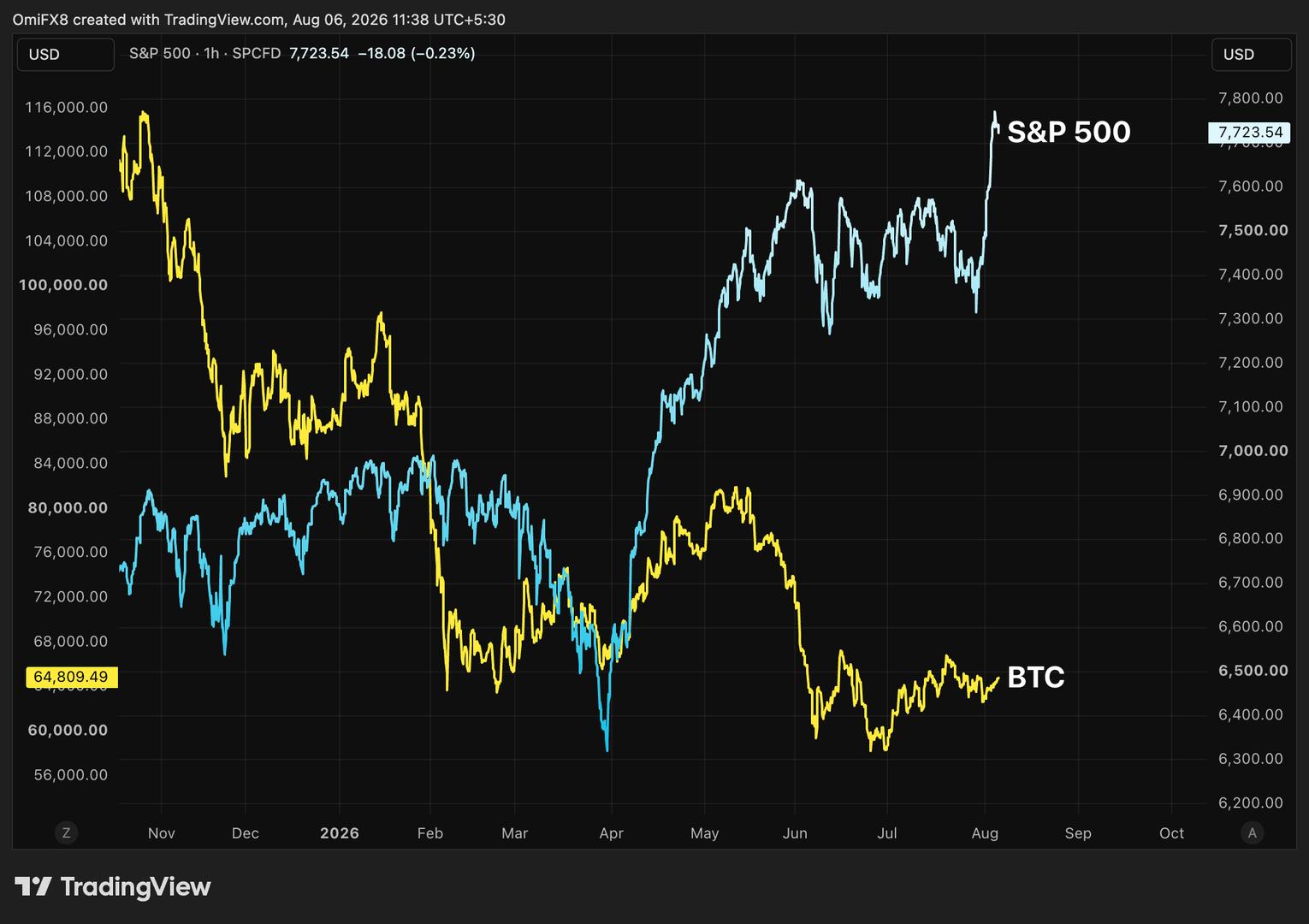
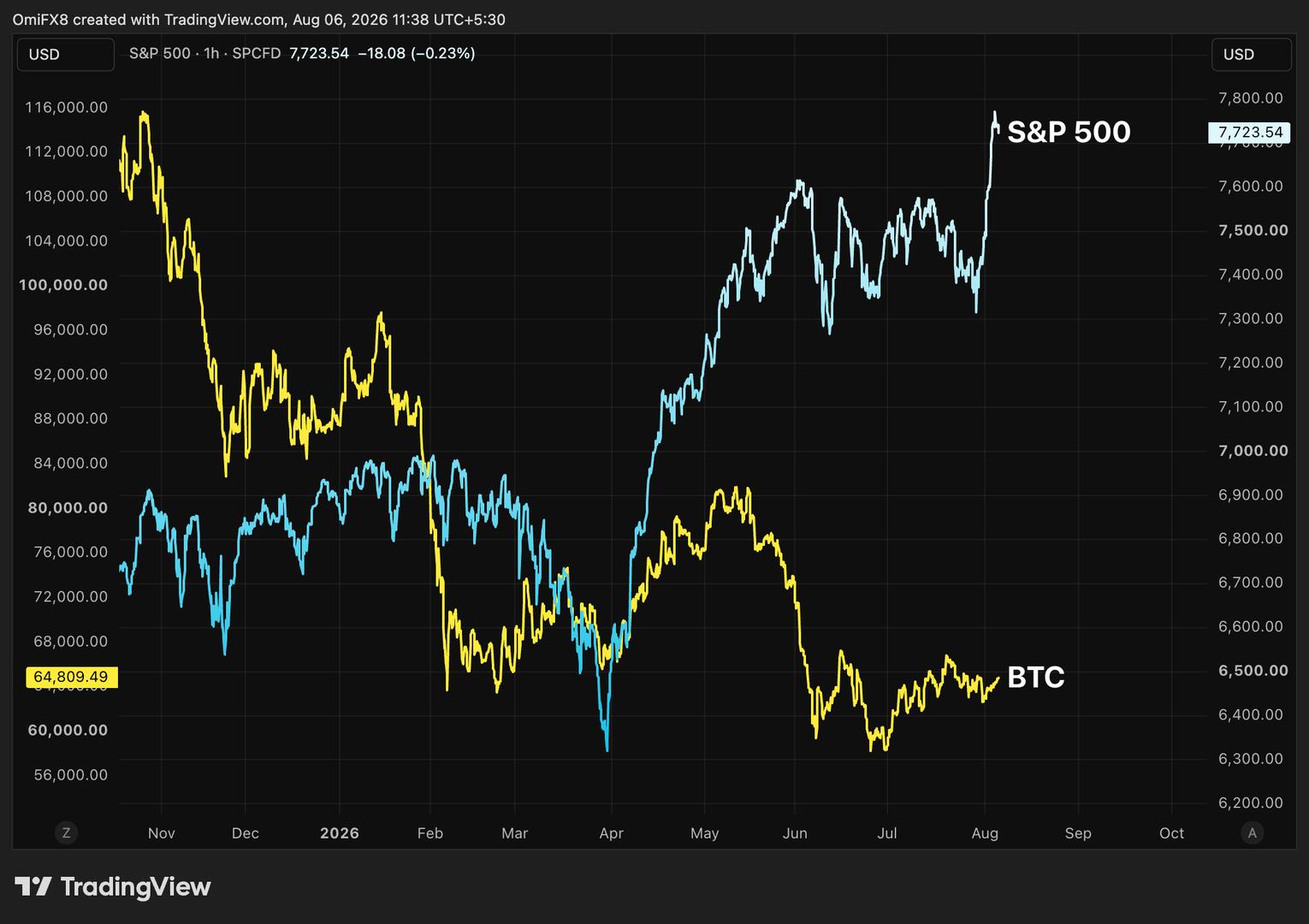
According to Thielen, traders are missing the key point that BTC’s failure to move lower despite the hawkish Fed is itself a bullish signal.
“Traders are underestimating the upside risk from a less hawkish Fed, and overlooking the possibility that the four-year cycle has already bottomed,” he noted.
Other market watchers point to erratic demand for ETFs, a preferred vehicle of institutional investors, as the reason for BTC’s underperformance. These U.S.-listed funds registered an outflow of $61.53 million, snapping an equally anemic three-week streak of inflows, according to data source SoSoValue. This week, they have pulled in $626 million in investor money, the highest tally since early May, but that trend needs to hold.
“Several consecutive days of inflows will be needed to confirm a sustained recovery in institutional demand,” Vikram Subburaj, CEO of India-based FIU-registered Giottus.com, said in an email. For now, he’s watching a tight range, with support near $63,000-$63,400 and resistance between $64,500 and $66,000.
The other problem, according to leading market maker Wintermute, is that whatever ETF flow there has been may not be directionally bullish, but could instead be arbitrage.
“That ETF bid getting absorbed without moving price says the marginal buyer in spot isn’t outright long,” Wintermute noted. “Risk appetite went single-name instead, with ZEC up 10.9% on the week on DCG’s Fortitude expanding its Zcash mining footprint and HYPE adding 5% on a dead beta day. For breadth to expand, we likely need to see BTC vol off this floor first.”
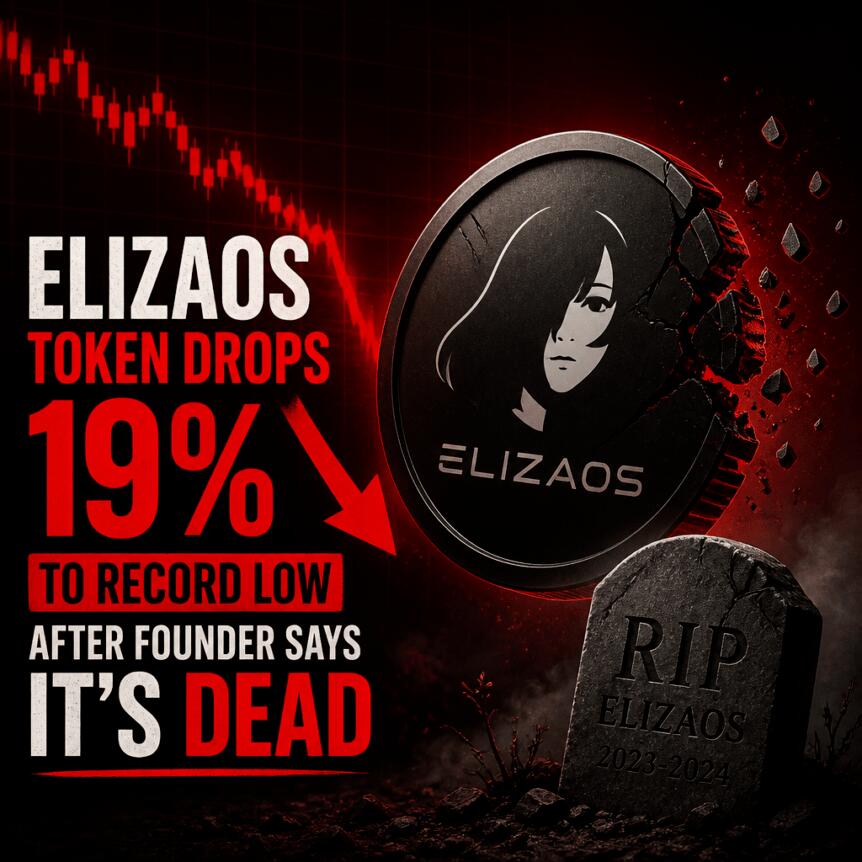
ElizaOS, a token tied to the open-source Eliza AI-agent framework, has plunged to a fresh all-time low after its creator, Shaw Walters, said the asset is effectively “dead” and that the Eliza Foundation is winding down.
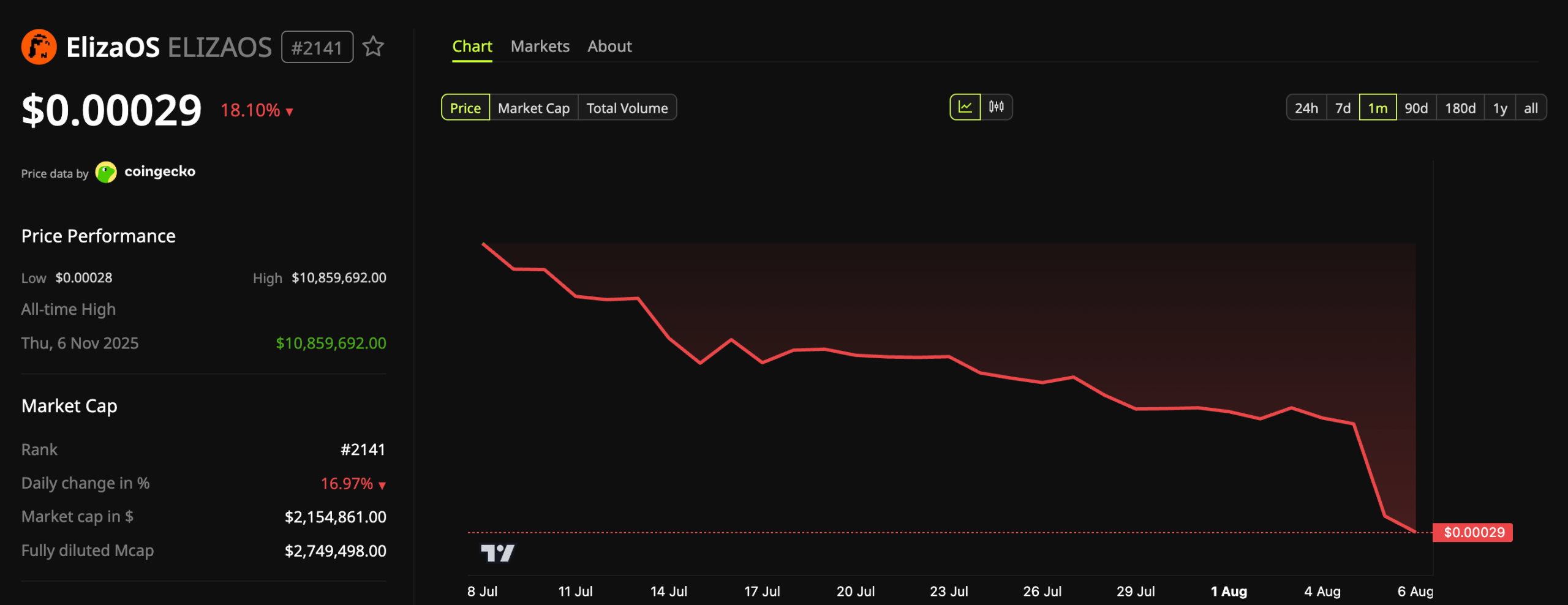
CoinGecko data shows ElizaOS trading around $0.000285 at the time of writing, after briefly hitting a record low of $0.000284 on Thursday. The token’s market capitalization was about $2.1 million, following a reported 19% drop over 24 hours.
Key takeaways
- Walters says ElizaOS has no future token support, describing the token as “dead” and stating he no longer owns or backs it.
- The Eliza Foundation is winding down, removing an expected institutional backstop for the token ecosystem.
- A legal dispute is central to the founder’s explanation, with a settlement referenced and parts of the case dismissed in July.
- Eliza’s software work is expected to continue even if the token is abandoned.
- The token’s collapse reverses a major prior run-up, when the project’s earlier version peaked at about $2.5 billion market cap in January 2025.
A sharp reversal after the founder’s “token is dead” message
The latest selloff follows a direct statement from Walters that he views ElizaOS as finished. In a post on X, Walters said, “The token is dead. Completely,” adding that he neither owns nor supports the token. He also indicated that development of the open-source Eliza software would continue independently of both the token and the Eliza Foundation.
For many participants, the announcement marks a rare moment where an AI-agent category token is explicitly disavowed by its founder—rather than merely experiencing a typical liquidity or adoption slowdown. The market reaction was immediate, with ElizaOS falling to a new low on CoinGecko.
It is also a striking reversal compared with the token’s prior peak. CoinGecko shows that before rebranding as ElizaOS, the asset—then known as AI16Z—reached a peak market capitalization of about $2.5 billion in January 2025, underscoring how quickly sentiment can turn when expectations about continuity and ecosystem support collapse.
Legal pressure and “no capital to keep fighting” claims
Walters tied the project’s current state to ongoing legal problems and said the team privately settled with a group of tokenholders represented by Burwick Law. He said the settlement involved giving the represented tokenholders the project’s remaining treasury and funds.
According to Walters, the lawsuit was “ridiculous,” but he argued the project lacked resources to continue defending itself. The dispute, filed in April, named Eliza Labs, Walters, Sebastian Quinn-Watson, and the AI16Z DAO as defendants. The complaint alleged false advertising, deceptive practices, negligent misrepresentation, and unjust enrichment—claims described earlier in reporting by Cointelegraph in connection with the filing.
Court docket information referenced in the article indicates that the named plaintiff’s claims were dismissed with prejudice by stipulation on July 8, while proposed class claims were dismissed without prejudice.
Cointelegraph reported that it reached out to Walters and Burwick Law founder Max Burwick for comment but had not received a response at the time of publication. That leaves an open question for investors: while settlement and dismissals are documented, the broader dispute narrative—particularly whether any additional claims or future litigation could arise—remains less clear from the available details.
What Walters says will (and won’t) happen next
Beyond describing the token as unsupported, Walters said there would be no remaining funds for token buybacks. He also said there would be no foundation and no future supply intervention to support the asset.
Walters further indicated he would not allow another token to be associated with Eliza while he continues building the underlying operating system. In the X post, he wrote that he is “starting over” because he owns the intellectual property, and that he would “never” let a token come close to Eliza again.
For holders, those remarks matter because they point to a fundamental shift in the project’s economic model: instead of token-driven incentives or treasury-backed market measures, the software may proceed as a standalone open-source effort.
ElizaOS itself is described as an open-source framework for building and managing AI agents. The project launched in October 2024 as ai16z with an initial goal of raising $75,000 for what was described as an autonomous investor.
In January 2025, the project rebranded to ElizaOS, according to the article’s account of an earlier development. The change followed concerns raised by Andreessen Horowitz about potential confusion with its “a16z” brand. The token later underwent a migration as well.
All of these steps show how the ecosystem evolved quickly—but the current announcement suggests the latest stage will be different: the token component may be intentionally severed from the broader building effort.
Why this matters for AI-agent token investors
AI-agent tokens have often been marketed around long-term narratives: an ecosystem matures, a product ships, and token utilities follow. In this case, the story is less about technical progress and more about governance, funding, and the legal/branding realities that can decide whether a token survives as an ongoing mechanism.
Walters’ comments also highlight a tension common in crypto projects: even when the underlying software remains open-source and continues, the token can still lose its perceived support structure. With ElizaOS described as having no future foundation intervention, investors are left to reassess what determines value—development alone, market liquidity, and any remaining community coordination—especially when the figure most directly tied to the token’s origin says he will not support it.
Finally, the token’s trajectory—from a reported January 2025 peak market capitalization to a new all-time low—illustrates how quickly the market can reprice perceived credibility and continuity in token-managed ecosystems. The current move may become a reference point for how founders handle legal disputes and whether open-source continuity can compensate for the loss of an active token mandate.
Investors watching ElizaOS next should focus on whether any additional on-chain activity or ecosystem announcements emerge after the winding-down claim—particularly around the settlement outcome, any remaining treasury controls, and how the Eliza software roadmap proceeds without token-linked incentives.
Eliza Labs founder Shaw Walters declared the ElizaOS (ELIZAOS) token “dead” and said the foundation is winding down, sending the altcoin token to a record low.
Walters posted the statement on X, telling holders that no supply, buybacks, or foundation support remain to defend the price.
What Happened With ELIZAOS
Walters said law firm Burwick sued the project, and his side settled with a group of holders. The team handed over what he described as the rest of the treasury and all remaining money.
He called the claim “ridiculous” but said the project lacked the capital to fight it in court. Burwick filed the federal class action in the Southern District of New York on April 22, 2026.
The complaint alleged that the project engaged in false advertising, deceptive practices, negligent misrepresentation, and unjust enrichment. It also challenged the migration from ai16z to ElizaOS, which expanded supply from 1.1 billion to 11 billion tokens.
“According to the complaint, on-chain data reflects losses across at least 3,945 customer wallets, with total class harm believed to be in the hundreds of millions of dollars,” the text read.
The ai16z token launched on Solana (SOL) in October 2024. The project rebranded to ElizaOS in January 2025. At its January 2025 peak, ai16z carried a market capitalization of nearly $2.4 billion.
Follow us on X to get the latest news as it happens
Why the ELIZAOS Token Crashed and What Walters Does Next
ELIZAOS fell to a record low near $0.000284 earlier today. At press time, it traded at $0.00029, down about 18% on the day. That left the token with a market capitalization of nearly $2.15 million.

Walters revealed that he never sold his ai16z holdings and drew only a modest salary, comparable to that of the project’s other engineers. He said he no longer owns any tokens and will never attach a token to Eliza again.
“The token is dead. Completely. The foundation is winding down. I am starting over, since I own the IP, and I am never letting a token come close to Eliza again, maybe,” he added.
Walters said he wants the industry to break with its casino mentality and focus on building real products. He added that he has turned bearish on crypto while staying optimistic about artificial intelligence (AI).
Subscribe to our YouTube channel to watch leaders and journalists provide expert insights
The post ElizaOS Token Collapses to All-Time Low as Foundation Shuts Down appeared first on BeInCrypto.
Ether’s holder base is splitting, however. Wallets holding 10,000 to 100,000 ETH have risen from about 14 million ETH in mid-2025 to record highs near 19.6 million now.

The 100,000-plus cohort fell to roughly 2.6 million ETH in mid-2025 before climbing to about 4.6 million by May 2026, an addition CryptoQuant put at roughly 1.8 million. The 1,000 to 10,000 cohort has gone the other way, peaking near 15.6 million ETH in January 2026 and falling to about 12.9 million since.
Bitcoin whales, excluding exchange and mining-pool addresses, bottomed near 2.87 million BTC in December 2025 and hold about 3.06 million now, buying hardest as price fell below $60,000 in June. That remains roughly 170,000 BTC below the 2025 bull-cycle peak near 3.23 million.
CryptoQuant calls this the last stage of the decline while stating plainly that valuation leaves room for one more leg lower before a floor is confirmed.
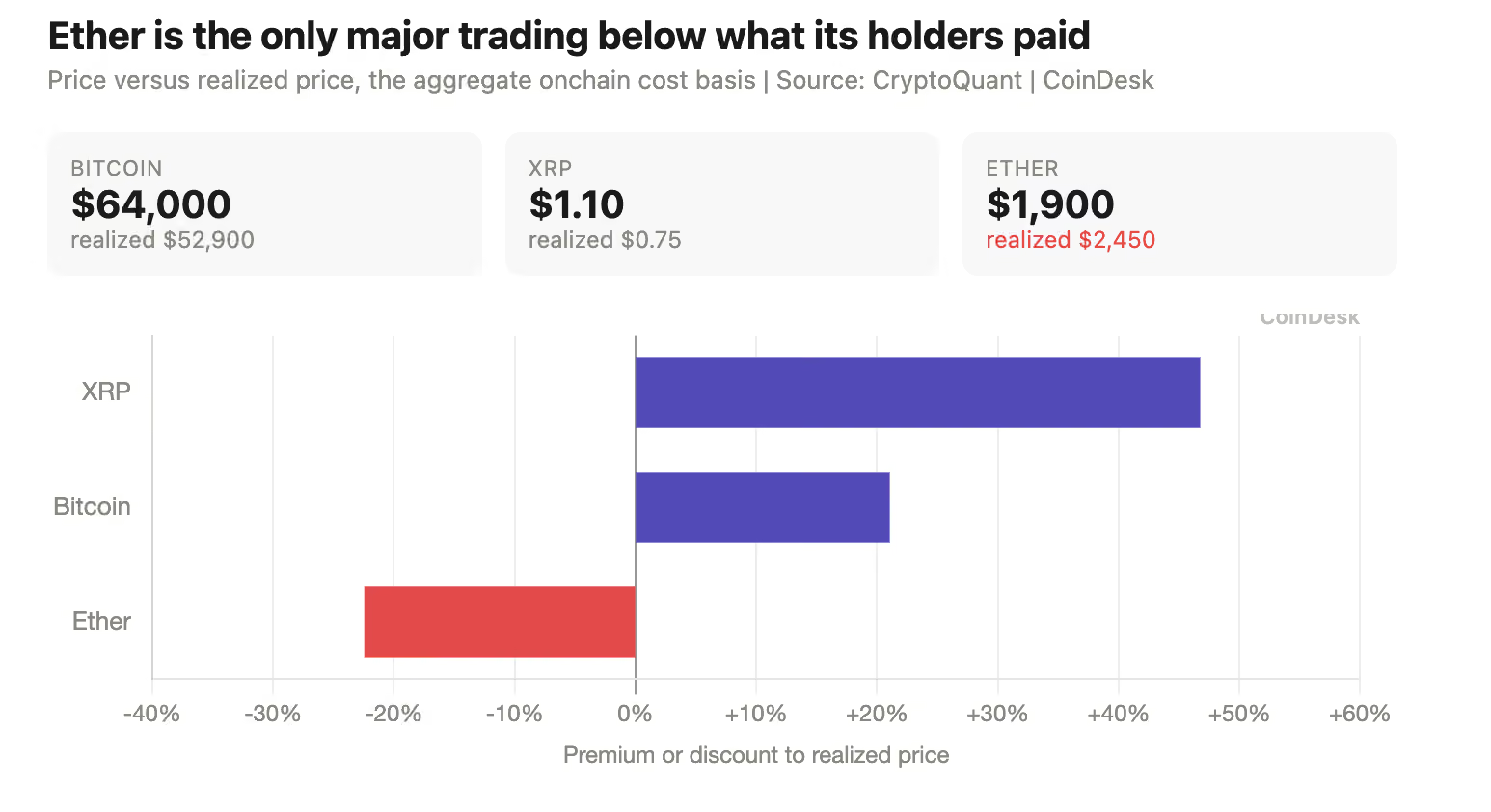
Ether below cost basis is the thing to watch. It is the only one of the three where the market has already capitulated on paper, and CryptoQuant noted ETH bottomed in early 2025 at a similar level and a similar distance from its lower band.


Disclosure: This article does not represent investment advice. The content and materials featured on this page are for educational purposes only.
ZIGChain has secured a strategic investment from Laser Digital to expand institutional-grade investment products onchain.
Summary
- Laser Digital invested in ZIG and will support institutional risk governance for ZIG Markets products.
- ZIGChain targets at least $100 million in total value locked across planned institutional-grade vault products.
- The partnership plans onchain private credit, PayFi, invoice financing, SME financing, and stablecoin infrastructure products.
ZIGChain announced that Laser Digital has made a strategic investment in ZIG and partnered with ZIG Markets. Laser Digital, the digital assets arm of Nomura Group, will help structure products and design risk controls. The ZIGChain Laser Digital partnership aims to bring private credit, PayFi, invoice financing, small-business funding, and stablecoin-based services onchain for institutions and everyday users.
ZIGChain Laser Digital partnership sets governance role
Under the agreement, Laser Digital will provide product structuring support, risk framework design, and governance for a pipeline of ZIG Markets vault products. ZIG Markets serves as the product and access layer within the wider ZIGChain ecosystem. Its role includes finding and developing financial opportunities in regional markets. The partnership focuses on emerging-market origination rather than adding another source of onchain yield, according to the companies’ joint public announcement.
The partners said the model combines ZIG Markets’ regional origination capabilities with Laser Digital’s global asset management experience. Laser Digital will apply institutional risk standards and oversight to products linked to emerging-market private credit. Nomura identifies Laser Digital as its digital asset subsidiary, while ZIGChain presents its network as infrastructure for onchain investment opportunities.
$100 million TVL target for vault products
ZIGChain is targeting at least $100 million in total value locked across the planned institutional-grade vault products. The announcement did not disclose the size of Laser Digital’s investment in ZIG. It also did not provide detailed terms for individual vaults or a timetable for reaching the TVL goal.
The pipeline will cover private credit and related financing products. The companies plan to explore PayFi, financing for small and medium-sized enterprises, invoice factoring, and stablecoin-enabled products. Their stated goal is to make categories that have often been hard to access at scale available through onchain infrastructure with formal risk controls.
Private credit forms central part of plan
The partners described onchain private credit as a leading use case within more than $30 billion of tokenized real-world assets. They said global asset managers have increased activity, but credible institutional origination from emerging markets remains limited. The collaboration seeks to address that gap through regional access and institutional governance.
Abdul Rafay Gadit, co-founder and chief commercial officer of ZIGChain, said onchain finance has attracted capital but still needs greater institutional credibility. “Our partnership with Laser Digital brings institutional governance, product expertise, and global best practices to our offering,” he said. Gadit added that the approach could make the products more accessible to banks, family offices, and other investors.
First product expected in coming months
Dr. Jez Mohideen, co-founder and chief executive of Laser Digital, said execution risk in onchain finance has often been underestimated. He said ZIG Markets brings regional depth and an origination record, while Laser Digital will apply the risk frameworks used across its broader offerings. “The shared vision remains to make the next generation of asset management products accessible to those moving serious institutional capital,” Mohideen said.
The agreement follows ZIGChain partnerships with Beehive, Taurus, and ADI Foundation, along with a growing pipeline of real-world asset products across MENAP and other markets. The first product under the Laser Digital partnership is expected to launch in the coming months. The companies said they will release more details as the product nears completion.
Disclosure: This content is provided by a third party. Neither crypto.news nor the author of this article endorses any product mentioned on this page. Users should conduct their own research before taking any action related to the company.

FLOSS Weekly Episode 878: A Tool With Opinions

India and Pakistan’s 79-year rivalry has made the dangerous move into space

World of Warcraft Down? Downdetector Reports Player Issues Since Early Wednesday Morning Outage This Week

Renter of Home in Anne Heche Crash Denies Settlement With Son

No Jackpot Winner as $257 Million Prize Rolls Over to $269 Million Monday Draw

Weekend Open Thread: Staud – Corporette.com

Cabaret | “Money” Musical Number | Warner Bros. Entertainment

Live GOLD and CRYPTO Scalping Trading | DAY 300 #goldtrading #cryptotrading #bitcoin

RBI REPO Rate unchanged || Plastic Note in next financial year || 23 Medicine price fixed by Govt
-

 Fashion6 days ago
Weekend Open Thread: Wit & Wisdom
-

 Politics5 days ago
Meta enters AI-training agreement with far-right ‘propaganda rag’ Newsmax
-

 Politics4 days ago
Zack Polanski: an incitement to murder Nigel Farage?
-

 Crypto World5 days ago
MicroStrategy Post-Earnings CLARITY Act Push Could Add New Catalyst for Its Stock
-

 Crypto World5 days ago
XRP Ledger v3.3.0 brings five institutional features
-

 News Videos7 days ago
Bitcoin Enters the 3rd Stage of the Bear Market
-

 Politics7 days ago
Luke Littler’s dominance sparks GOAT debate
-

 Sports6 days ago
Seema Kaliramna Wins Discus Throw Bronze, Takes India’s CWG Medals Tally To 17
-

 Crypto World5 days ago
New York sues Kalshi over prediction market gambling
-

 Crypto World4 days ago
Crypto PAC spending tops $2M in Michigan House race
-

 Business3 days ago
DTCR: Deleveraging And A Hedge Fund Collapse Point To A Possible AI Bottom
-

 Business6 days ago
Trump Announces Hamas Disarmament Agreement as Iran Strikes Kuwait Air Base and US Attacks Pause Overnight
-
 Crypto World5 days ago
3 Fed Officials Just Explained Their Rate Hike Vote: Is Inflation Winning?
-

 Tech4 days ago
ESET tracks rise in malicious AI skills and adaptable malware
-

 Tech6 days ago
Gemini Spark can now use Chrome logins and saved passwords to run errands on your behalf
-

 Sports5 days ago
France Cricket implodes: letters hidden in a drawer and a board at war
-

 NewsBeat7 days ago
Four people die trying to cross Channel in small boats
-

 Tech6 days ago
Building A Reproduction PlayStation Motherboard
-
Crypto World4 days ago
XRP Ledger urges node upgrade after manifest flood
-

 Crypto World5 days ago
Moneyflip CEO charged in $40K murder-for-hire plot
You must be logged in to post a comment Login