
Crypto World
ElizaOS Token Drops 19% to Record Low After Founder Says It’s Dead

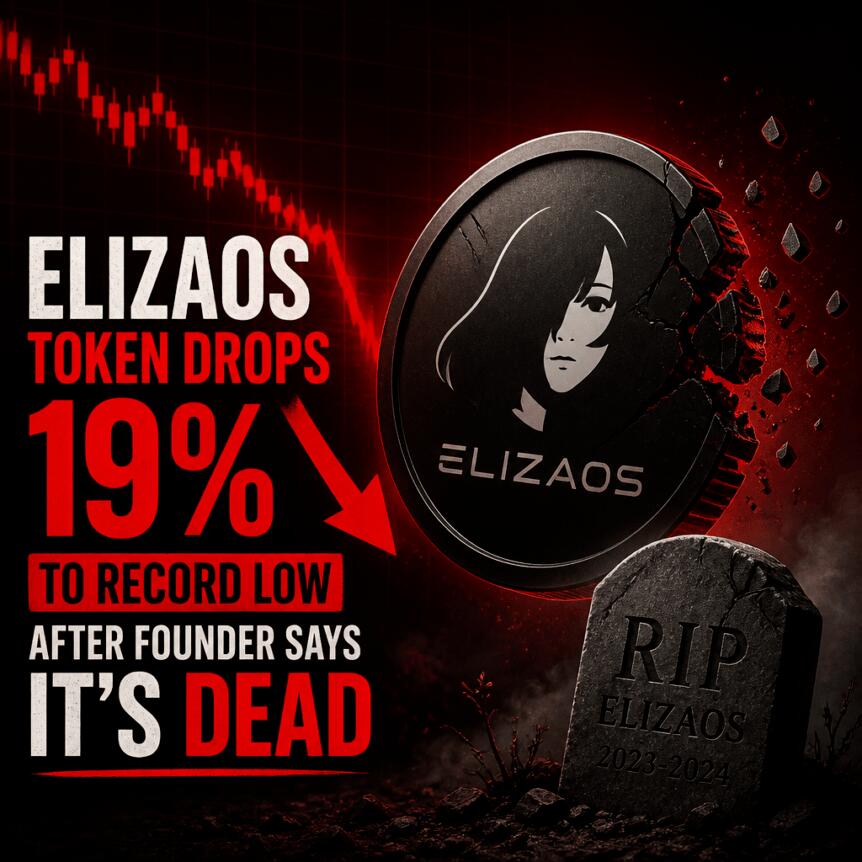
ElizaOS, a token tied to the open-source Eliza AI-agent framework, has plunged to a fresh all-time low after its creator, Shaw Walters, said the asset is effectively “dead” and that the Eliza Foundation is winding down.
CoinGecko data shows ElizaOS trading around $0.000285 at the time of writing, after briefly hitting a record low of $0.000284 on Thursday. The token’s market capitalization was about $2.1 million, following a reported 19% drop over 24 hours.
Key takeaways
- Walters says ElizaOS has no future token support, describing the token as “dead” and stating he no longer owns or backs it.
- The Eliza Foundation is winding down, removing an expected institutional backstop for the token ecosystem.
- A legal dispute is central to the founder’s explanation, with a settlement referenced and parts of the case dismissed in July.
- Eliza’s software work is expected to continue even if the token is abandoned.
- The token’s collapse reverses a major prior run-up, when the project’s earlier version peaked at about $2.5 billion market cap in January 2025.
A sharp reversal after the founder’s “token is dead” message
The latest selloff follows a direct statement from Walters that he views ElizaOS as finished. In a post on X, Walters said, “The token is dead. Completely,” adding that he neither owns nor supports the token. He also indicated that development of the open-source Eliza software would continue independently of both the token and the Eliza Foundation.
For many participants, the announcement marks a rare moment where an AI-agent category token is explicitly disavowed by its founder—rather than merely experiencing a typical liquidity or adoption slowdown. The market reaction was immediate, with ElizaOS falling to a new low on CoinGecko.
It is also a striking reversal compared with the token’s prior peak. CoinGecko shows that before rebranding as ElizaOS, the asset—then known as AI16Z—reached a peak market capitalization of about $2.5 billion in January 2025, underscoring how quickly sentiment can turn when expectations about continuity and ecosystem support collapse.
Legal pressure and “no capital to keep fighting” claims
Walters tied the project’s current state to ongoing legal problems and said the team privately settled with a group of tokenholders represented by Burwick Law. He said the settlement involved giving the represented tokenholders the project’s remaining treasury and funds.
According to Walters, the lawsuit was “ridiculous,” but he argued the project lacked resources to continue defending itself. The dispute, filed in April, named Eliza Labs, Walters, Sebastian Quinn-Watson, and the AI16Z DAO as defendants. The complaint alleged false advertising, deceptive practices, negligent misrepresentation, and unjust enrichment—claims described earlier in reporting by Cointelegraph in connection with the filing.
Court docket information referenced in the article indicates that the named plaintiff’s claims were dismissed with prejudice by stipulation on July 8, while proposed class claims were dismissed without prejudice.
Cointelegraph reported that it reached out to Walters and Burwick Law founder Max Burwick for comment but had not received a response at the time of publication. That leaves an open question for investors: while settlement and dismissals are documented, the broader dispute narrative—particularly whether any additional claims or future litigation could arise—remains less clear from the available details.
What Walters says will (and won’t) happen next
Beyond describing the token as unsupported, Walters said there would be no remaining funds for token buybacks. He also said there would be no foundation and no future supply intervention to support the asset.
Walters further indicated he would not allow another token to be associated with Eliza while he continues building the underlying operating system. In the X post, he wrote that he is “starting over” because he owns the intellectual property, and that he would “never” let a token come close to Eliza again.
For holders, those remarks matter because they point to a fundamental shift in the project’s economic model: instead of token-driven incentives or treasury-backed market measures, the software may proceed as a standalone open-source effort.
ElizaOS itself is described as an open-source framework for building and managing AI agents. The project launched in October 2024 as ai16z with an initial goal of raising $75,000 for what was described as an autonomous investor.
In January 2025, the project rebranded to ElizaOS, according to the article’s account of an earlier development. The change followed concerns raised by Andreessen Horowitz about potential confusion with its “a16z” brand. The token later underwent a migration as well.
All of these steps show how the ecosystem evolved quickly—but the current announcement suggests the latest stage will be different: the token component may be intentionally severed from the broader building effort.
Why this matters for AI-agent token investors
AI-agent tokens have often been marketed around long-term narratives: an ecosystem matures, a product ships, and token utilities follow. In this case, the story is less about technical progress and more about governance, funding, and the legal/branding realities that can decide whether a token survives as an ongoing mechanism.
Walters’ comments also highlight a tension common in crypto projects: even when the underlying software remains open-source and continues, the token can still lose its perceived support structure. With ElizaOS described as having no future foundation intervention, investors are left to reassess what determines value—development alone, market liquidity, and any remaining community coordination—especially when the figure most directly tied to the token’s origin says he will not support it.
Finally, the token’s trajectory—from a reported January 2025 peak market capitalization to a new all-time low—illustrates how quickly the market can reprice perceived credibility and continuity in token-managed ecosystems. The current move may become a reference point for how founders handle legal disputes and whether open-source continuity can compensate for the loss of an active token mandate.
Investors watching ElizaOS next should focus on whether any additional on-chain activity or ecosystem announcements emerge after the winding-down claim—particularly around the settlement outcome, any remaining treasury controls, and how the Eliza software roadmap proceeds without token-linked incentives.



Cointelegraph is committed to providing independent, high-quality journalism across the crypto, blockchain, AI, and fintech industries.
All news, reviews, and analyses are produced with full journalistic independence and integrity. For more details on our standards and processes, please read our Editorial Policy.
Memory-chip maker Sandisk (SNDK) late Wednesday beat Wall Street’s targets for its fiscal fourth quarter as demand from AI data centers remains strong, but it disappointed with an in-line outlook. Sandisk stock fell in extended trading. The Milpitas, Calif.-based company earned an adjusted $39.25 a share on sales of $8.97 billion in the quarter ended July 3. Analysts polled by…
Copyright ©2026 Investor’s Business Daily, LLC. All rights reserved. 87990cbe856818d5eddac44c7b1cdeb8


Ether.fi has captured roughly $223 million in annualized fees and about $51 million in annualized revenue. In the second quarter, it earned $41 million in gross revenue and nearly $10 million in earnings after rewards and other costs, with only $30,000 of value distributed to ETHFI holders through buybacks.
The split lands as Ethereum’s staking economics are under debate.
A group of Ethereum researchers, one from the Ethereum Foundation, proposed this week that the network stop paying people to stake once half of all ether is locked up. Under the current setup the payment never falls to zero no matter how much gets staked, so there is always a reason to stake more, and they argue that concentrates ether with a handful of large custodians.
Their proposed fix destroys a growing share of the rewards until the payment disappears entirely at around 60 million ether. About a third is staked today.
Ether.fi founder Mike Silagadze was among the proposal’s critics, arguing it would push out smaller stakers and weaken the products built on staking rewards, his own among them.

DoorDash (DASH) stock wavered late Wednesday after the food-delivery company’s second-quarter earnings slightly missed estimates, despite easily beating revenue forecasts. For the June-ended quarter, DoorDash earned 46 cents per share, down 29% from a year earlier. That missed the 47 cents per-share earnings that analysts polled by FactSet were forecasting. Sales increased 36% to $4.5 billion, easily beating analyst estimates…
Copyright ©2026 Investor’s Business Daily, LLC. All rights reserved. 87990cbe856818d5eddac44c7b1cdeb8
MARA Holdings reported weaker second-quarter 2026 financial results on Aug. 6. Revenue fell 27% year over year to $174.9 million, while the Nasdaq-listed company recorded a $611.3 million net loss and negative adjusted EBITDA of $360.9 million, according to its official presentation.
Summary
- MARA’s Bitcoin holdings fell 29% year over year to 35,577 BTC at June quarter-end 2026.
- Q2 revenue fell 27% to $174.9 million while net losses widened sharply to $611.3 million.
- Bitcoin production increased 3% to 2,422 BTC as energized hashrate reached 70.3 EH/s during Q2.
- MARA sold 2,213 BTC during Q2 after selling 20,880 BTC in the preceding first quarter.
- Post-quarter financing pledged 18,750 BTC as collateral while MARA continued expanding its AI infrastructure strategy.
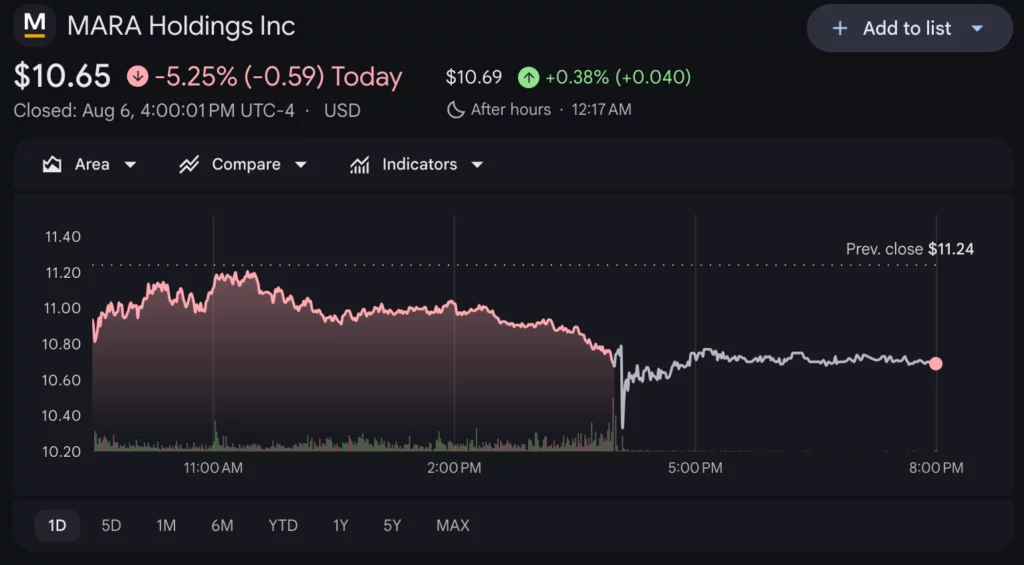
The company ended June with 35,577 BTC, down 29% from 49,951 BTC a year earlier. However, that headline decline masks a small sequential increase from 35,303 BTC at March 31. MARA’s presentation also showed approximately $2.5 billion in combined cash and Bitcoin holdings at quarter-end. Shares closed Aug. 6 at $10.65, down 5.25%, according to Google Finance data.
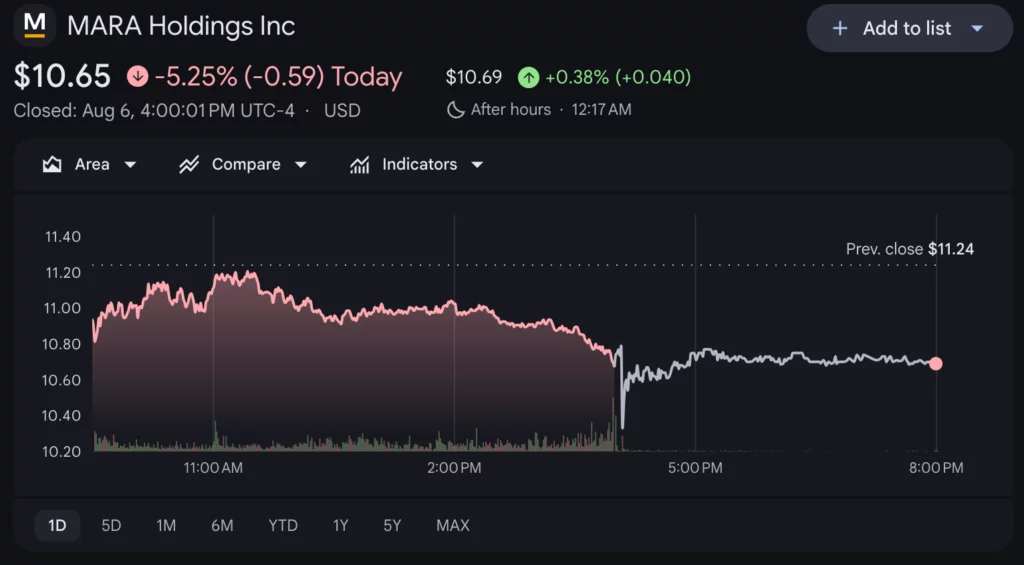
Source: Google Finance
MARA’s Bitcoin holdings fell after heavy first-quarter sales
The annual decline in MARA’s Bitcoin treasury largely reflects sales earlier in 2026 rather than falling mining production. Its first-quarter filing showed the company sold 20,880 BTC for about $1.5 billion as it funded operations, repurchased debt and pursued new infrastructure investments. Earlier Q1 coverage detailed how the sales reduced MARA’s position from 53,822 BTC at the end of 2025.
During Q2, MARA sold another 2,213 BTC at an average price of $73,078 while producing 2,422 BTC. That left holdings slightly higher than at the end of March. The company’s treasury policy now permits opportunistic sales of balance-sheet Bitcoin, a change from its earlier emphasis on retaining mined coins.
At June 30, 4,742 BTC were loaned and 4,528 BTC were pledged as collateral, while 26,307 BTC were unrestricted. After the quarter ended, MARA pledged another 18,750 BTC as initial collateral for two Bitcoin-backed credit facilities, increasing the portion of its treasury being used to support financing.
Mining output rose despite weaker Bitcoin economics
Operational performance improved in several areas. Energized hashrate reached 70.3 EH/s, up 22% from 57.4 EH/s a year earlier. Bitcoin production increased 3% to 2,422 BTC, and blocks won rose 1% to 700. Cost per petahash per day improved 4% to $27.70 from $28.70.
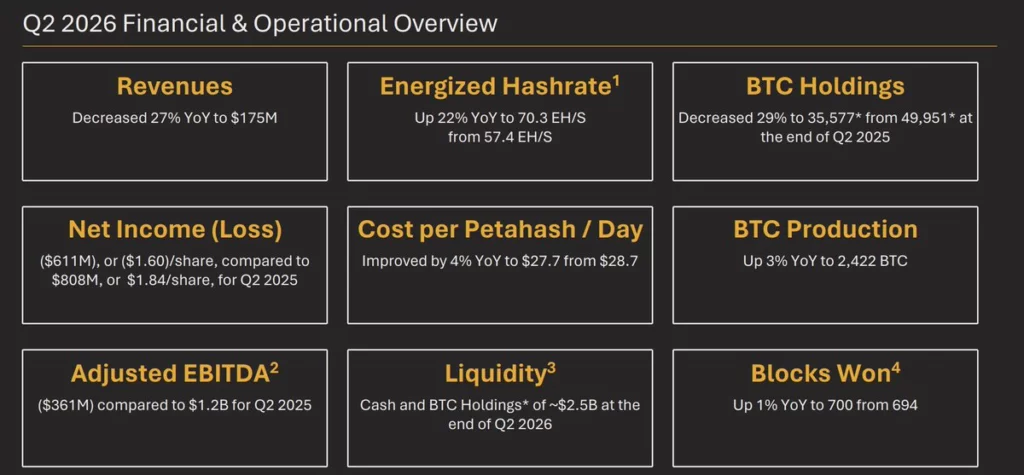
Those gains did not prevent revenue from falling because the average Bitcoin price associated with mining revenue dropped sharply from the prior-year period. MARA reported an average price of Bitcoin mined of roughly $71,325, compared with $98,975 in Q2 2025. Purchased energy cost per Bitcoin at owned sites also rose, showing that greater hashrate alone did not remove profitability pressure.
The net loss was also affected by Bitcoin price accounting. The company recorded roughly $343 million of fair-value losses tied to digital assets and related receivables. That contrasts with the large fair-value gains that supported earnings in the year-earlier quarter and helps explain the swing from $808.2 million in net income to the latest loss.
MARA is using its Bitcoin balance sheet to fund an AI pivot
The company’s strategy increasingly links its Bitcoin reserves with expansion into power and computing infrastructure. After quarter-end, the company arranged two credit facilities that provide $600 million of incremental borrowing capacity and pledged 18,750 BTC as initial collateral. Proceeds may support general corporate purposes, including the planned Long Ridge acquisition.
The Long Ridge transaction is central to MARA’s effort to add AI and high-performance computing capacity. Earlier AI pivot coverage reported that the proposed $1.5 billion acquisition includes a 505-megawatt Ohio gas plant and a campus with potential for more than one gigawatt of computing capacity. The deal still requires regulatory approval before closing.
The firm is also pursuing a Texas project. Its Texas expansion plan covers a 1,200-acre powered site expected to provide up to 2 GW of grid capacity over time. Combined with Long Ridge and other assets, management says its potential power portfolio could reach about 4.8 GW.
What happens next for MARA
The main near-term milestones are financing execution, regulatory approval for Long Ridge and progress on the Texas development. Investors will also watch whether MARA continues selling or pledging Bitcoin as it funds infrastructure. The company has made clear that its treasury can serve as both a long-term asset and a source of liquidity.
Chief Executive Fred Thiel said Bitcoin mining provided the company’s foundation and that digital infrastructure and other initiatives “will expand the value we create from that foundation.” The statement is forward-looking, and the Q2 results show the transition remains costly. Mining output improved, but weaker Bitcoin pricing, higher per-coin energy costs and fair-value losses weighed heavily on reported results.
For now, MARA remains a major public Bitcoin miner and one of the largest corporate Bitcoin holders. Its next quarters will test whether expanding AI infrastructure can add steadier revenue while the company preserves enough Bitcoin exposure to benefit from a recovery in mining economics.
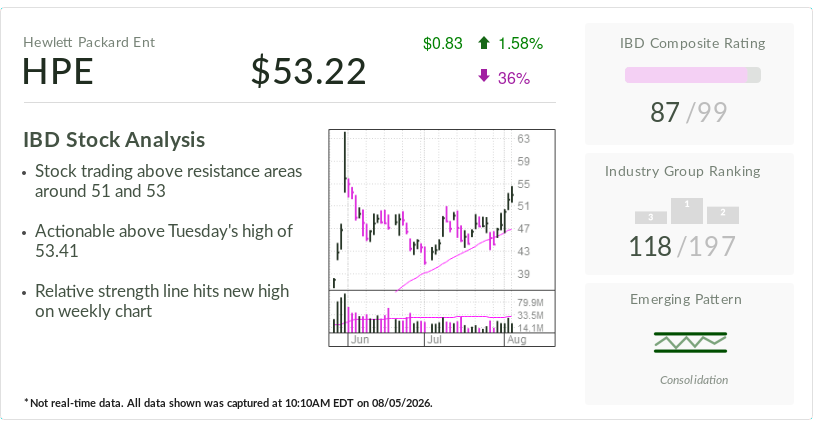
Hewlett Packard Ent Hewlett Packard Ent HPE $ 53.22 $0.83 1.58% 36% IBD Stock Analysis Stock trading above resistance areas around 51 and 53 Actionable above Tuesday’s high of 53.41 Relative strength line hits new high on weekly chart IBD Composite Rating 87/99 Industry Group Ranking 118/197 Emerging Pattern Consolidation Consolidation A sideways pattern that doesn’t fit traditional base definitions.…
Copyright ©2026 Investor’s Business Daily, LLC. All rights reserved. 87990cbe856818d5eddac44c7b1cdeb8


Bitcoin traded near $64,350 on Friday, unchanged on the week, as the whole market drifted ahead of the US payrolls report, per CoinDesk data. Ether held at $1,903 and the rest of the majors sat within a point or two, a market waiting on the data rather than moving on anything of its own.
The setup turned slightly less friendly overnight. Brent rose 1.4% to $83.61 after reports Iran will try to restrict US and Israeli ships through the Strait of Hormuz and demand compensation from countries it deems hostile before letting them pass, stalling the deal that had been pulling oil lower. Higher crude revives the inflation worry that keeps the Fed leaning tight, and the 10-year Treasury yield climbed seven basis points on it during the US session.
That macro chain is the one bitcoin has been stuck inside all summer. Oil up feeds inflation, inflation keeps yields and the dollar firm, and firmer financial conditions cap risk assets. The dollar just posted its best day in two weeks, which is the opposite of the easing setup bulls want.
Today’s jobs number is the release that matters. A soft print revives the case for the Fed to loosen and gives bitcoin room above its range. A strong one, stacked on climbing oil, hands the hawks another reason to hold, and the range that has held since May holds again. Watch the reaction in yields, not just the headline number.

Axon Enterprise, the S&P 500 maker of Tasers, body cameras and software for law enforcement, topped Q2 earnings forecasts and raised its outlook as revenue growth accelerated amid surging demand for its AI Era software bundle and drone systems. Still, Axon stock turned lower after hours, retracing some of the big gains earlier this week heading into earnings. Axon Enterprise…
Copyright ©2026 Investor’s Business Daily, LLC. All rights reserved. 87990cbe856818d5eddac44c7b1cdeb8
Wednesday’s mixed trading session left the Dow Jones Industrial Average with its highest close on record, following reports of a tentative agreement between Iran and Oman about operations in the Strait of Hormuz. Other major stock indexes failed to keep up with the blue-chip gauge and posted losses. On the stock market today, Shark Ninja (SN) soared on an earnings…
Copyright ©2026 Investor’s Business Daily, LLC. All rights reserved. 87990cbe856818d5eddac44c7b1cdeb8


Sui has added two NIST-approved post-quantum signature schemes to its blockchain roadmap as it prepares optional quantum-safe accounts and vaults for future network upgrades.
Summary
- Sui plans to add two NIST approved post quantum signature schemes for accounts and smart contract vaults.
- Existing recovery phrases and wallet addresses can be retained when users move to quantum safe authentication.
- Quantum safe vaults are targeted for mainnet this year, with native accounts planned for testnet by the end of 2026.
- ML DSA 65 and SLH DSA are designed to protect different types of assets using separate cryptographic approaches.
- The announcement follows similar post quantum security work across Bitcoin custody, BNB Chain and other blockchain projects.
According to Sui’s latest announcement, the blockchain plans to introduce ML-DSA-65 as a native signature scheme for regular accounts and SLH-DSA-SHA2-128s for high-value smart contract vaults, giving users an optional way to protect accounts against future quantum computing risks without replacing their recovery phrases or moving assets.
The rollout comes as blockchain developers and infrastructure providers increasingly prepare for the possibility that future quantum computers could break today’s public-key cryptography.
Unlike traditional systems where public keys often remain hidden until needed, Sui said blockchain accounts expose public keys onchain once transactions occur, allowing attackers to collect them years before practical quantum computers exist.
The network warned that such “harvest-now-forge-later” attacks do not require quantum hardware today because attackers can simply archive exposed public keys and wait until sufficiently capable machines become available.
Citing research from Google Quantum AI published in March 2026, Sui said recovering a private key from an exposed public key could eventually take minutes on a fault-tolerant quantum computer using fewer than 500,000 physical qubits.
Sui also pointed to changing government timelines around quantum security. The announcement noted that while the U.S. National Institute of Standards and Technology previously targeted 2030 to phase out classical cryptographic algorithms and 2035 to prohibit them, Executive Order 14412, signed in June 2026, requires U.S. federal agencies to deploy post-quantum key establishment by the end of 2030 and post-quantum digital signatures by the end of 2031 for sensitive systems.
Sui has chosen two algorithms for different security needs
Instead of relying on one post-quantum algorithm, Sui said it selected two standardized signature schemes built on different mathematical foundations so that a weakness discovered in one would not affect the other.
For everyday user accounts, the blockchain will integrate ML-DSA-65, the Level 3 parameter set defined under NIST’s FIPS 204 standard, directly into the protocol.
The network said it intentionally selected the higher-security Level 3 option instead of Level 1 following a July 2026 incident in which researchers used an AI model to reduce the effective security of the HAWK post-quantum signature candidate after experts had previously reviewed it. According to Sui, the incident did not affect ML-DSA, but it reinforced the value of choosing stronger security margins rather than lower-cost parameters.
The announcement added that ML-DSA-65 has already gained support elsewhere. Chrome and Cloudflare use the same security level for post-quantum encryption protecting more than half of human-initiated web traffic, while AWS Key Management Service now supports ML-DSA signing and Android 17’s Keystore generates quantum-safe signatures using ML-DSA-65 inside secure hardware.
Meanwhile, high-value assets will rely on SLH-DSA-SHA2-128s, the hash-based signature scheme standardized under FIPS 205. Rather than embedding it into the protocol itself, Sui will implement it through Move smart contracts, allowing vaults to remain compatible with future post-quantum standards without requiring changes to the network’s core protocol.
According to the announcement, using separate lattice-based and hash-based cryptographic families reduces the chance that a single cryptographic breakthrough would affect every protected asset.
Existing recovery phrases will continue to work
Instead of requiring users to generate completely new wallets, Sui said its deterministic key architecture allows quantum-safe private keys to be derived from the same recovery phrases users already store today.
Wallet backup and restoration therefore continue to work through existing seed phrases, while new derivation paths generate ML-DSA-65 keys.
Existing accounts will also avoid transferring assets to new addresses. Address aliases, which have already been deployed on Sui, let users replace their authorization keys with post-quantum keys while keeping the same wallet address and asset balances.
According to the network, larger signatures remain the main trade-off. Post-quantum signatures and public keys occupy substantially more space than Ed25519 keys, increasing transaction sizes across the network.
Verification costs, however, remain much closer to existing Ed25519 signatures than the larger key sizes might suggest. Sui said transaction size limits and programmable transaction blocks can accommodate the additional data while further optimization work continues.
Rollout starts with vaults before native accounts
The blockchain said its core implementation has already been completed and benchmarked, although independent security audits are currently underway.
Quantum-safe vaults are scheduled for mainnet deployment later this year. Native ML-DSA-65 accounts are expected to reach testnet before the end of 2026, while native account authentication on mainnet is targeted for the first quarter of 2027 alongside wallet, software development kit and command-line interface support.
The rollout remains optional, following the same deployment model previously used for zkLogin and passkeys. Existing accounts, applications and smart contracts continue operating without modification, and developers do not need to update applications immediately, according to the announcement.
Support for ML-DSA-65 will also extend to Sui’s multisignature authenticator, allowing accounts to require both a classical Ed25519 signature and a post-quantum ML-DSA-65 signature before authorizing transactions.
Other blockchain projects have also accelerated quantum-security work
Sui’s announcement follows a series of post-quantum security initiatives announced across the digital asset industry during recent months.
In May, BNB Chain reported successful testing of ML-DSA-44 transaction signatures and pqSTARK consensus aggregation for BSC. While the blockchain concluded that post-quantum migration could work with existing wallets and infrastructure, testing also showed signature sizes growing from 65 bytes to roughly 2,420 bytes, reducing transaction throughput by about 40% to 50% because of larger blocks and increased network traffic.
Institutional custody providers have also started focusing on future quantum risks rather than immediate attacks. BitGo introduced quantum-risk management tools in July that measure public-key exposure, group UTXOs to avoid leaving exposed balances behind, and help institutions move assets into fresh addresses after public keys become visible onchain.
Another proposal came from AmericanFortress, which published its Zero-Knowledge Proof of Seed Provenance design through the International Association for Cryptologic Research’s ePrint archive.
The proposal would allow existing Bitcoin, Ethereum, and Solana wallet addresses to prove ownership using zero-knowledge proofs without requiring users to rotate keys or transfer funds, although deployment would still depend on blockchain protocol upgrades and adoption by wallet providers. The proposal also cited Google’s recent quantum research while noting that current quantum computers remain incapable of carrying out such attacks today.

The Brick Lane data centre is Labour’s ‘market Stalinism’ in action

Carl Froch says one British fighter’s legacy stands above all others as the greatest ever

Nintendo’s Switch 2 sells over 23 million units in its first year, outpacing the original’s 17 million

Renter of Home in Anne Heche Crash Denies Settlement With Son

No Jackpot Winner as $257 Million Prize Rolls Over to $269 Million Monday Draw

Weekend Open Thread: Staud – Corporette.com

Crypto Trading For Beginners Free Course

Chirapunji | Music Video | Nihal Sadiq | Hanan Shaah | Suhail Koya | Ivine Eric | Saina Music Indie

Crypto Trading For Beginners Full Course | Learn Trading From Scratch | Trading Course (Day 2/10)
-

 Fashion7 days ago
Weekend Open Thread: Wit & Wisdom
-

 Politics6 days ago
Meta enters AI-training agreement with far-right ‘propaganda rag’ Newsmax
-

 Politics5 days ago
Zack Polanski: an incitement to murder Nigel Farage?
-

 Crypto World6 days ago
MicroStrategy Post-Earnings CLARITY Act Push Could Add New Catalyst for Its Stock
-

 Crypto World6 days ago
XRP Ledger v3.3.0 brings five institutional features
-

 Crypto World6 days ago
New York sues Kalshi over prediction market gambling
-

 Crypto World5 days ago
Crypto PAC spending tops $2M in Michigan House race
-

 Business7 days ago
Trump Announces Hamas Disarmament Agreement as Iran Strikes Kuwait Air Base and US Attacks Pause Overnight
-

 Business4 days ago
DTCR: Deleveraging And A Hedge Fund Collapse Point To A Possible AI Bottom
-

 Tech5 days ago
ESET tracks rise in malicious AI skills and adaptable malware
-
 Crypto World6 days ago
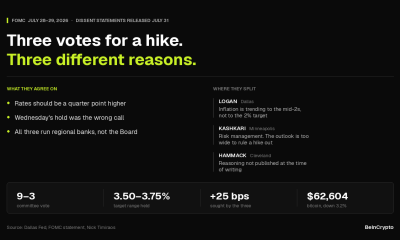
3 Fed Officials Just Explained Their Rate Hike Vote: Is Inflation Winning?
-

 Tech7 days ago
Gemini Spark can now use Chrome logins and saved passwords to run errands on your behalf
-
 Tech7 days ago
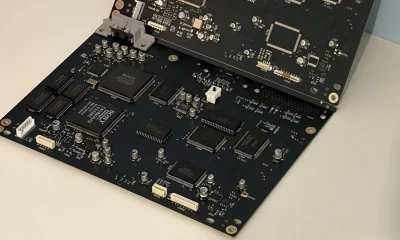
Building A Reproduction PlayStation Motherboard
-

 Sports6 days ago
France Cricket implodes: letters hidden in a drawer and a board at war
-
Crypto World5 days ago
XRP Ledger urges node upgrade after manifest flood
-

 Crypto World6 days ago
Moneyflip CEO charged in $40K murder-for-hire plot
-
 Sports6 days ago
Bruno Fernandes decision made as Man United ‘discuss’ striker transfer option
-

 News Videos5 days ago
Financial Crash Expert: The 90-Day Collapse Timeline They Are Desperately Hiding.
-

 Sports1 day ago
Jordan Coyle & Cordiamo take Laya Arena Stakes at RDS
-

 Sports7 days ago
Commonwealth Games 2026 Live Updates | Day 9 CWG 2026: Lovlina Borgohain, Sachin Siwach Enter Final After Indian Judokas Script History
You must be logged in to post a comment Login