
Crypto World
Coinbase brings nearly 4,000 U.S. stocks to UK users

Coinbase has begun rolling out access to nearly 4,000 U.S. stocks for eligible UK users, bringing 24/5 equities trading, zero-commission investing and USDC-funded purchases to its platform as it expands its Everything Exchange strategy.
Summary
- Coinbase has started rolling out access to nearly 4,000 U.S. stocks for eligible UK users.
- UK customers can trade U.S. equities 24 hours a day for five days a week using GBP or USDC.
- The launch adds stock trading to Coinbase’s UK savings, borrowing and crypto products.
- Coinbase said the rollout supports its Everything Exchange strategy for combining multiple asset classes in one app.
- The company plans to introduce more regulated financial products across the UK and Europe.
According to Coinbase, eligible UK customers will progressively gain access to buy, sell and manage U.S. equities alongside their crypto and fiat holdings from Aug. 6. The company said users can fund purchases instantly with GBP or USDC, trade fractional shares from as little as £1, and access nearly 4,000 U.S. stocks within the Coinbase app.
The rollout adds another product to Coinbase’s UK lineup after the exchange introduced savings accounts and crypto-backed borrowing earlier this year. It also advances the company’s “Everything Exchange” strategy, which seeks to bring traditional financial products and digital assets into a single platform.
UK users can trade U.S. stocks with GBP or USDC
Beginning Aug. 6, eligible UK users will receive phased access to select U.S. equities, Coinbase said. Trading is available 24 hours a day for five days each week, extending access beyond normal U.S. market hours.
Users can fund purchases directly with GBP or existing USDC balances without moving assets to another platform. Coinbase One subscribers are also eligible to earn uncapped rewards on their USDC holdings while using the service.
The company said fractional investing allows users to purchase portions of shares from as little as £1, lowering the minimum amount needed to invest in U.S. companies.
According to Coinbase, it is the first crypto-native trading application to launch direct access to U.S. equities in the UK. The company said the product is intended to let customers manage stocks, crypto and cash balances from one account instead of using separate investment platforms.
Orders are routed through Coinbase Capital Markets Corporation for execution by Apex, while U.S. shares are custodied by Apex Clearing in the United States, Keith Grose, Coinbase’s Regional Managing Director for the UK and Europe, told The Block.
Everything Exchange strategy now includes UK stock trading
The latest launch follows Coinbase’s June announcement outlining plans to combine crypto trading, stocks, commodities, derivatives, lending, payments and artificial intelligence tools within what it calls the Everything Exchange.
At the time, the company said it wanted to replace separate financial accounts with a unified platform capable of supporting multiple asset classes around the clock. It also argued that blockchain infrastructure could reduce settlement delays and remove restrictions created by traditional market hours.
Adding U.S. equities in the UK brings part of that roadmap into production. Alongside crypto trading, UK users can now access savings products, borrowing services and stock investing from the same application.
Grose told The Block that Coinbase plans to introduce additional products across both the UK and European Union over the coming months as it continues building compliant infrastructure for the platform.
He also said the company chose conventional U.S. equities before tokenized stocks because it wanted to provide immediate value to UK customers. While Coinbase views tokenized equities as an important part of financial markets in the future, Grose said the company intends to work with regulators before introducing them.
UK regulation has opened new products for Coinbase
Grose said Coinbase’s recently obtained UK MiFID licence expanded the company’s ability to introduce additional financial products, including equities for retail investors and derivatives for professional traders.
He added that the UK’s upcoming crypto regulatory framework gives Coinbase the certainty needed to continue expanding its integrated financial platform. The Financial Conduct Authority has already finalized its rules, while the authorization gateway is expected to open in September ahead of the regime taking effect in October 2027.
Coinbase said survey data continues to show UK retail investors participate in stock markets at lower rates than investors in the United States. The company believes offering U.S. stocks with longer trading hours inside an app already used for crypto could make stock investing more accessible.
Risk disclosures accompanying the launch state that out-of-hours trading carries additional risks and that fractional share trading is unavailable outside normal U.S. market hours. Coinbase also noted that U.S. equities are denominated in dollars, meaning exchange-rate movements will affect purchases funded with GBP.
CB Payments Ltd is authorized and regulated by the Financial Conduct Authority for investment services and electronic money activities. The company also reminded users that capital remains at risk and that third parties execute, clear and settle equity trades.
USDC remains part of Coinbase’s expansion plans
Funding stock purchases with USDC extends the role of the stablecoin across Coinbase’s product lineup.
Earlier this week, Circle confirmed during its second-quarter earnings call that its commercial agreement with Coinbase had automatically renewed on existing terms, extending the partnership through 2029. Under that arrangement, Coinbase continues supporting USDC across its services while receiving a share of reserve income generated under the collaboration agreement.
Circle previously reported that 30% of USDC in circulation was held on Coinbase’s platform at the end of the second quarter, making the exchange one of the stablecoin’s largest distribution channels.
The latest stock launch therefore adds another use case for customers already holding USDC inside Coinbase’s ecosystem, allowing them to move directly between crypto assets, stablecoins and U.S. equities without first converting funds outside the platform.
Coinbase has been expanding similar financial services outside the UK as well. In June, the company introduced direct Indian rupee deposits and withdrawals through IMPS after reopening the Indian market in late 2025, giving local customers bank-linked access to crypto trading alongside spot markets and perpetual futures.
Recent launches across the UK and India continue building the product lineup Coinbase outlined earlier this year, combining traditional financial services with crypto products inside a single regulated platform.

Crypto World
JPYC raises $38 million Series B led by major Japanese logistics firm AZ-COM Maruwa (9090)
JPYC Inc. raised 6 billion yen ($38 million) in an extension of its Series B funding round to accelerate the expansion of its yen-pegged stablecoin.
The investment brings the company’s total raised to $106 million across seven funding rounds since November 2021, according to venture capital data site Tracxn.
New investors in the latest round include AZ-COM Maruwa Holdings (9090), a major Japanese logistics company.
AZ-COM plans to settle payments in JPYC with its clients, including Amazon Japan. Its network of around 2,300 partners is made up of subcontractors, drivers and so on. The move marked the first large-scale corporate use of a stablecoin for daily business operations in Japan.
JPYC is one of the most prominent stablecoins pegged to the Japanese yen with a market cap of $55.5 million, according to data tracked by CoinGecko.
Stablecoins are digital tokens pegged to the value of a traditional financial asset, usually a fiat currency. The market is overwhelmingly dominated by tokens pegged to the U.S. dollar. The yen stablecoin sector is growing, helped by adoption among some of Japan’s largest financial institutions, but remains negligible in the context of the USD-dominated market.
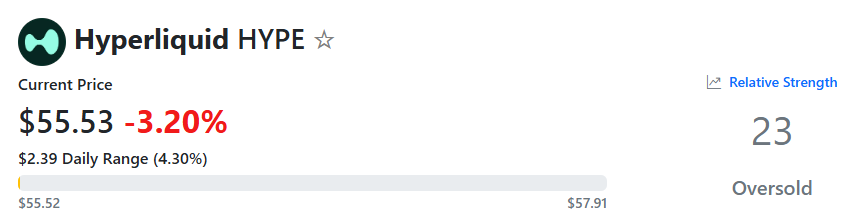
HYPE – the native token of the decentralized crypto exchange Hyperliquid – currently trades at around $55.50 (per CoinGecko), translating into a major 22% decline on a monthly scale.
According to some market observers, conditions may even worsen from here, with expectations of a further downtrend.
How Much Lower?
Earlier this week, Ali Martinez analyzed HYPE’s recent performance and revealed that its TD Sequential indicator has flashed a sell signal, which could potentially lead to a plunge to $50.
BATMAN and Altcoin Sherpa are also among the pessimists. The former claimed the liquidity sweep setup has played out perfectly, warning about the formation of a possible local top that could be followed by a pullback.
The latter argued that HYPE may not yet have reached its cycle bottom, suggesting the valuation might tumble to the low $50s or high $40s in the short term. At the same time, the analyst remains bullish on the asset for the long term, saying:
“Regardless, it’s 1 of the few coins you can hold for months on end and sleep comfortably knowing the fundamentals are the best in crypto.”
X user Ryker appears to be among the biggest bears. The popular trader was recently asked about their opinion on HYPE, predicting that its price could soon plummet to $32.
What About a Pump?
Crypto X is not entirely filled with pessimists, as some think Hyperliquid’s native token might be on the verge of a significant resurgence. The analyst using the moniker Gerla noted that the asset has been moving within a descending channel for the past month, opining that one breakout could send it “flying.”
For his part, Martinez claimed that HYPE has the chance to rally to $64 and even $75 as long as bulls hold the crucial zone at approximately $53.
The token’s Relative Strength Index (RSI) supports the uptrend perspective. The technical indicator’s ratio has dropped well below 30, meaning that HYPE has entered oversold territory and could be gearing up for a pump. The RSI runs from 0 to 100, where anything above 70 is typically considered a precursor to a correction.
The post Hyperliquid (HYPE) in Danger: Analysts Explain Why It Could Plunge in the Short Term appeared first on CryptoPotato.
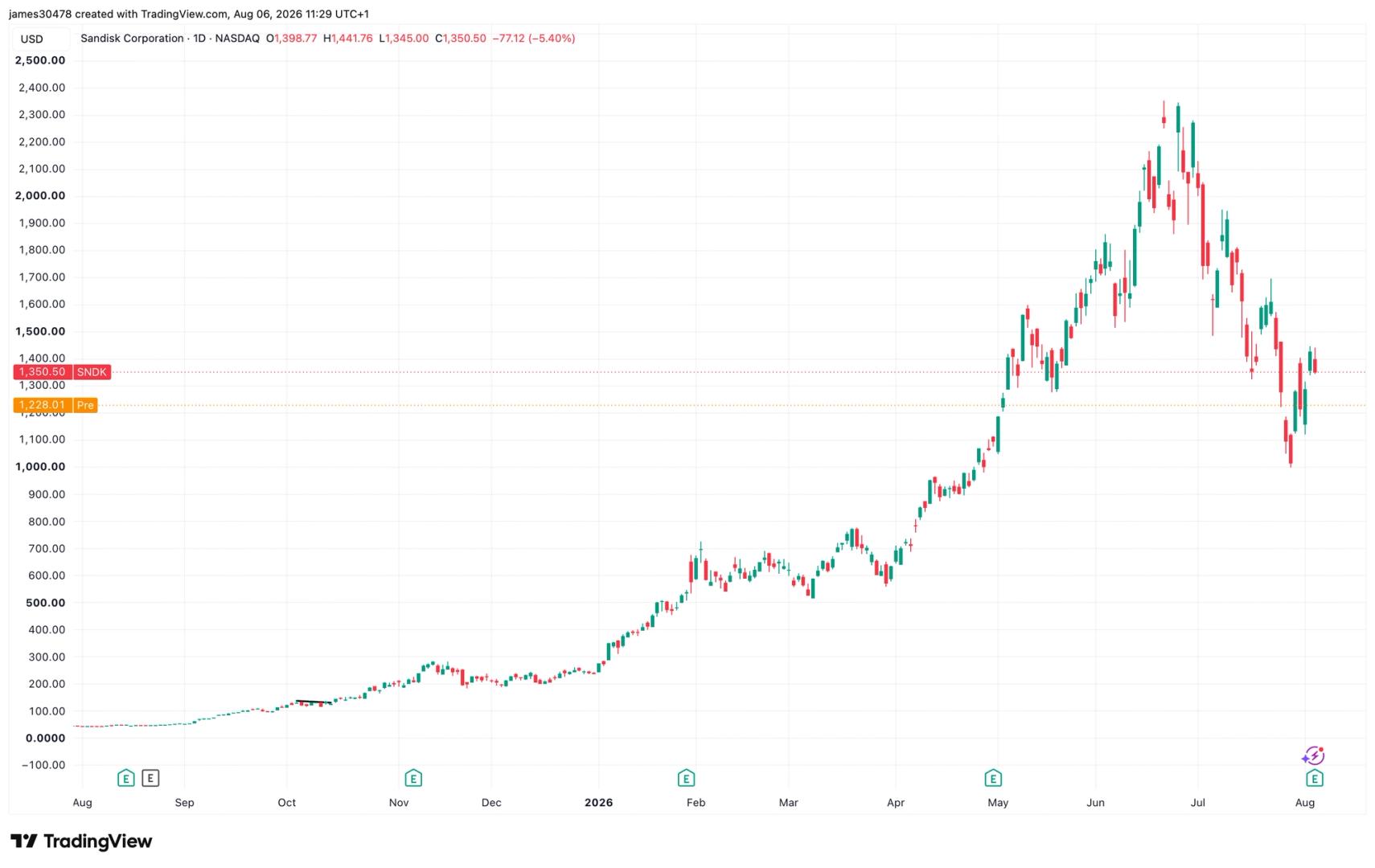
Sandisk (SNDK) and Western Digital (WDC), two of the biggest beneficiaries of the AI storage boom, were both 10% lower in pre-market trading Thursday, despite reporting strong quarterly results.
Sandisk posted record fourth-quarter revenue of $8.97 billion and non-GAAP EPS of $39.25, comfortably beating expectations. Western Digital also delivered a double beat, reporting revenue of $3.75 billion, up 44% year over year, while its gross margin surged to 54.4%. Despite those results, both stocks are now trading roughly 50% below their all-time highs.
The problem was guidance. Sandisk’s first-quarter outlook came in below expectations, with projected revenue of $10.7 billion versus the $11.2 billion analysts had estimated. Its EPS guidance also fell short. Western Digital’s first-quarter outlook was solid, but after a 500% run, investors were looking for another blowout beat.
Sandisk and Western Digital have gained more than 3,000% and 550%, respectively, over the past 12 months, propelled by the AI boom and leaving assets such as crypto and precious metals in the rearview mirror.
In addition, Sandisk’s board of directors has also approved an additional $14 billion share buyback program, bringing the total authorization to $15.5 billion.
MetronomeDAO disclosed that roughly 6,367 msETH and 4.57 million msUSD in circulation, about $15.7 million at current prices, have no collateral behind them, after trading bots spent months exploiting delayed price data in the protocol's swap feature. The hole equals about 31% of all msETH and 16%… Read the full story at The Defiant


Bitget has signed a cooperation agreement with Bhutan’s Gelephu Mindfulness City Authority to establish a local presence and pursue a Financial Services Licence under the city’s virtual asset framework.
Summary
- Bitget has signed an agreement to pursue a licensed presence in Bhutan’s Gelephu Mindfulness City.
- The exchange plans to establish a local entity and apply for a Financial Services Licence under GMC’s regulatory framework.
- Bhutan’s digital asset hub will work with Bitget on regulation, operations and ecosystem development.
- The move extends Bitget’s strategy of expanding through local regulatory approvals across selected markets.
According to Bitget, the agreement provides a framework for the exchange to establish a legal entity in Gelephu Mindfulness City (GMC), prepare an application for a Financial Services Licence under the regulatory framework administered by the Gelephu Financial Services Office (GFSO), and collaborate with the Gelephu Mindfulness City Authority (GMCA) on operational, regulatory and ecosystem development workstreams. The company said the cooperation remains subject to the required regulatory approvals.
Bitget plans legal entity and license application in Bhutan
Under the announced framework, Bitget intends to establish offices in GMC over time and hire locally as part of its long-term presence in Bhutan. The company said the local setup will support talent development, knowledge transfer and capability building alongside its exchange operations.
Gracy Chen, chief executive officer of Bitget, said Bhutan combines long-term planning, renewable energy resources and a regulatory framework that supports digital assets. She added that the company intends to contribute exchange infrastructure, operational experience and local talent development as the ecosystem develops.
The agreement also commits both parties to cooperate on regulatory processes and ecosystem-building activities tied to GMC’s financial services framework rather than limiting the relationship to licensing alone.
Gelephu Mindfulness City requires licensed virtual asset firms
Located in southern Bhutan, Gelephu Mindfulness City is being developed as a Special Administrative Region with ambitions to become an international financial and innovation hub.
Its virtual asset regime operates under the Financial Services Act 2025 and related rulebooks. Under that framework, companies providing regulated financial services or virtual asset activities in or from GMC must obtain a Financial Services Licence from the GFSO before operating.
Jigdrel Singay, board director of Gelephu Mindfulness City, said the city’s objective is to develop a digital asset ecosystem built on regulation, institutional standards and long-term economic value. He said partners such as Bitget contribute international expertise while helping strengthen local capabilities and the financial ecosystem.
The announcement also referred to Bhutan’s Bitcoin Development Pledge announced in December 2025, which presented the country’s strategy for integrating digital assets into economic development while promoting institutional participation and regulatory oversight.
Bhutan has already drawn attention within the digital asset industry for using surplus hydropower to support environmentally powered Bitcoin mining as part of efforts to diversify the economy, create employment opportunities and retain young professionals.
Bhutan agreement extends Bitget’s jurisdiction-by-jurisdiction strategy
The Bhutan announcement follows several regulatory moves by Bitget across different markets during the past few weeks.
Earlier this month, the exchange announced that it would withdraw services for residents of Japan instead of seeking local authorization. New account registrations have already been suspended, while account restrictions are scheduled to begin on Nov. 1. Bitget also said any positions that remain open on Dec. 31 will be closed automatically.
The Japan withdrawal came after repeated warnings from Japan’s Financial Services Agency in 2023 and 2024 over operating without registration. In June 2025, the Kanto Local Finance Bureau also issued a warning to BTG Technology Holdings Limited, identifying the company as operating under the Bitget name while allegedly soliciting certain online derivatives transactions without registration.
Outside Japan, the exchange has continued applying for registrations and approvals where it plans to maintain a local presence.
In July, Bitget completed registration on New Zealand’s Financial Service Providers Register across five financial service categories, including foreign exchange, client asset custody, domestic and cross-border money transfers, portfolio management, and execution of financial products. The company also joined New Zealand’s Insurance and Financial Services Ombudsman dispute resolution scheme.
New Zealand’s Companies Office has stated that registration on the FSPR does not itself constitute government approval or active regulatory supervision. Depending on the activity involved, separate authorization from the Financial Markets Authority or the Reserve Bank of New Zealand may still be required.
Local licensing remains central to Bitget’s expansion plans
Bitget has adopted a market-by-market regulatory approach rather than offering identical services across all jurisdictions.
During July, the exchange confirmed that Singapore remains a restricted jurisdiction because it is not licensed, approved, registered or supervised by the Monetary Authority of Singapore. The company said it neither offers services to nor targets residents in the country.
The exchange is also preparing for a return to the United States. As previously reported by crypto.news, Bitget plans to establish an independent U.S. entity before launching services and will first pursue money-transmitter, broker-dealer and derivatives approvals. She said the company’s U.S. expansion will proceed regardless of whether Congress ultimately passes the CLARITY Act.
Alongside its regulatory work, Bitget has continued expanding its tokenized investment products. Chen previously said tokenized traditional assets accounted for between 20% and 30% of the exchange’s spot trading volume during the previous quarter, while 52% of Bitget users held both cryptocurrencies and stocks.
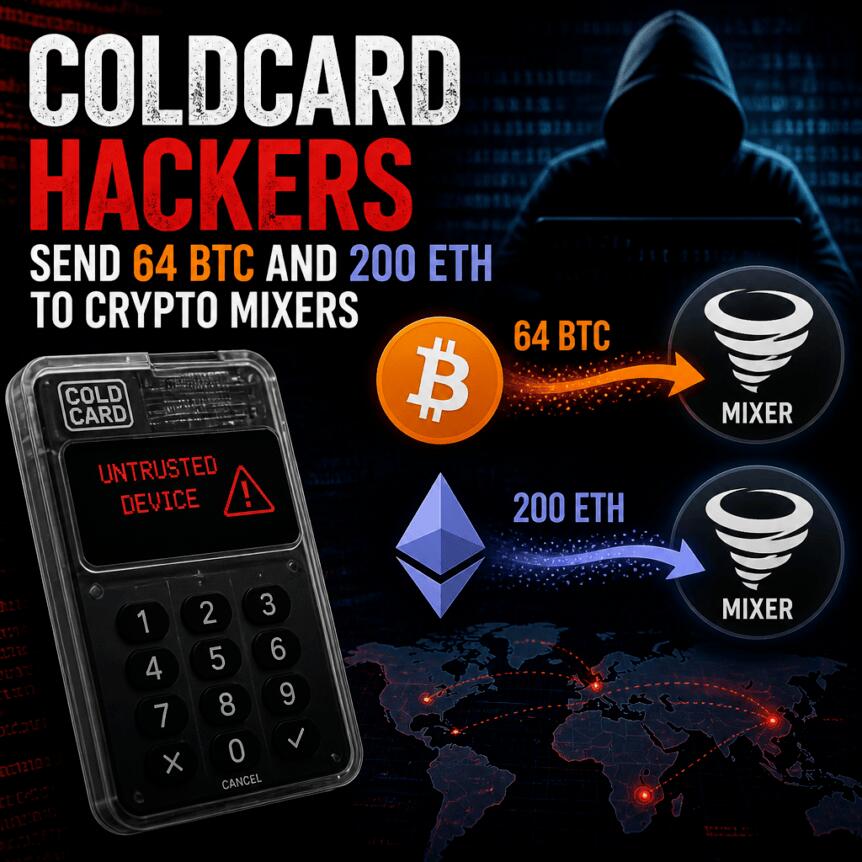
Stolen funds tied to the Coldcard hardware wallet exploit are showing early signs of laundering, but blockchain security researchers say most potential copycats have not yet moved large amounts of the victimed crypto. According to CertiK, about 64 Bitcoin (worth roughly $4.17 million) and 200 Ether (worth about $380,000) linked to the attack were routed into well-known mixing services—Wasabi for BTC and Tornado Cash for ETH.
The Coldcard incident has quickly become one of the largest crypto hacks of the year. Galaxy Digital previously put confirmed losses at least at $100 million in Bitcoin across three waves, and it also flagged a possible fourth wave that could raise total losses to around $130 million.
Key takeaways
- CertiK says roughly 64 BTC linked to the Coldcard exploit were sent to Wasabi, and 200 ETH were moved to Tornado Cash.
- Mixing services typically pool funds and obscure onchain linkages, reducing the odds of recovery for victims.
- TRM Labs’ tracing suggests most victim balances remain concentrated in a small set of attacker-controlled addresses with limited mixing activity.
- Analysis of transaction patterns across attack waves indicates the exploit may involve more than one actor.
Mixing services enter the Coldcard laundering picture
CertiK’s blockchain monitoring connected specific transfer activity to the Coldcard exploit and mapped part of the flow into privacy and obfuscation tooling. In its reporting, CertiK indicated that the Bitcoin transfer—sourced from address bc1q0—was sent to the Wasabi mixing protocol on Tuesday, using CertiK’s address data shared with Cointelegraph.
On the Ethereum side, CertiK stated that 200 ETH were sent to Tornado Cash on Wednesday, pointing to an X post from its account as the basis for the observation.
Crypto mixers like Tornado Cash operate by pooling deposits from multiple users and then releasing funds in a way that breaks straightforward onchain tracking from original sender to final recipient. That feature is precisely what makes tracing more difficult and asset recovery less likely—especially when attackers move quickly and fragment funds across multiple addresses and services.
Why this matters: laundering momentum vs. copycat behavior
CertiK’s spokesperson told Cointelegraph that the activity could be linked to a smaller exploiter, adding that “there’s likely a few copycats after the initial exploit.” The implication is straightforward: if additional parties used the same weakness, their onchain movement could help or hinder investigators depending on whether they follow up with laundering at scale.
That’s where TRM Labs’ findings become important. In a Thursday report titled “The largest hardware wallet exploit of 2026: inside the $116 million Coldcard hack”, TRM Labs said its onchain tracing indicates most victim funds were still pooled in a limited number of attacker-controlled addresses and that mixing attempts appeared restrained.
TRM Labs also highlighted that “differences in transaction construction” between each wave suggest multiple attackers. In other words, even if the underlying vulnerability was shared, the operational playbook may not be identical—an asymmetry that can be useful for investigators trying to separate participant identities, funding sources, and laundering pathways.
Coldcard hack scale and the “waves” pattern
Galaxy Digital previously characterized the Coldcard exploit as the third-largest cryptocurrency hack of 2026 so far, based on confirmed activity. In its assessment, Galaxy put drained losses at at least $100 million in Bitcoin across three verified attack waves involving 7,300 victim wallets. Galaxy also pointed to a suspected fourth wave that could lift total losses to roughly $130 million in BTC, according to earlier coverage from Cointelegraph.
Those wave-based findings matter for how analysts interpret laundering. If attackers are not distributing funds aggressively—or if only one portion of the stolen assets has been moved into mixers—then the time dimension becomes critical: investigators may still be waiting for broader follow-through as additional actors or additional batches of stolen funds begin to move.
Galaxy’s earlier analysis, also cited by Cointelegraph, suggested at least 15 different attackers exploited the vulnerability. This lines up with TRM Labs’ point about differences in transaction construction between waves, reinforcing the idea that what may look like a single incident could actually be a coordinated (or at least parallel) operation with distinct participants.
The technical weakness behind the exploit
TRM Labs’ report attributed part of the vulnerability to a firmware bug from March 2021 that weakened seed randomness on some Coldcard wallets. According to TRM Labs, the bug effectively reduced key strength to 40 bits from 128 bits, making it “brute-forceable without physical access.”
Other commentary around the fix has emphasized the low cost of better security hygiene. Dragonfly managing partner Haseeb Qureshi wrote that approximately “$2 of AI hardening” could have prevented the Coldcard exploit, referencing social media reports that some AI models rediscovered the vulnerability quickly—though those claims are framed as commentary rather than formal technical findings.
For investors and builders, the core takeaway is less about any single price tag and more about how quickly weaknesses can be weaponized once public knowledge spreads. When a vulnerability can be exploited remotely and at scale, incident response needs to account for both immediate attackers and longer-tail copycats.
Going forward, readers should watch whether additional attacker-controlled addresses begin pushing larger portions of stolen balances into mixing services, and whether the “suspected” fourth wave confirmed by Galaxy develops further. As more funds move—or fail to move—onchain, investigators will gain clearer signals about how many actors are involved and how successfully they’re managing to break traceability.
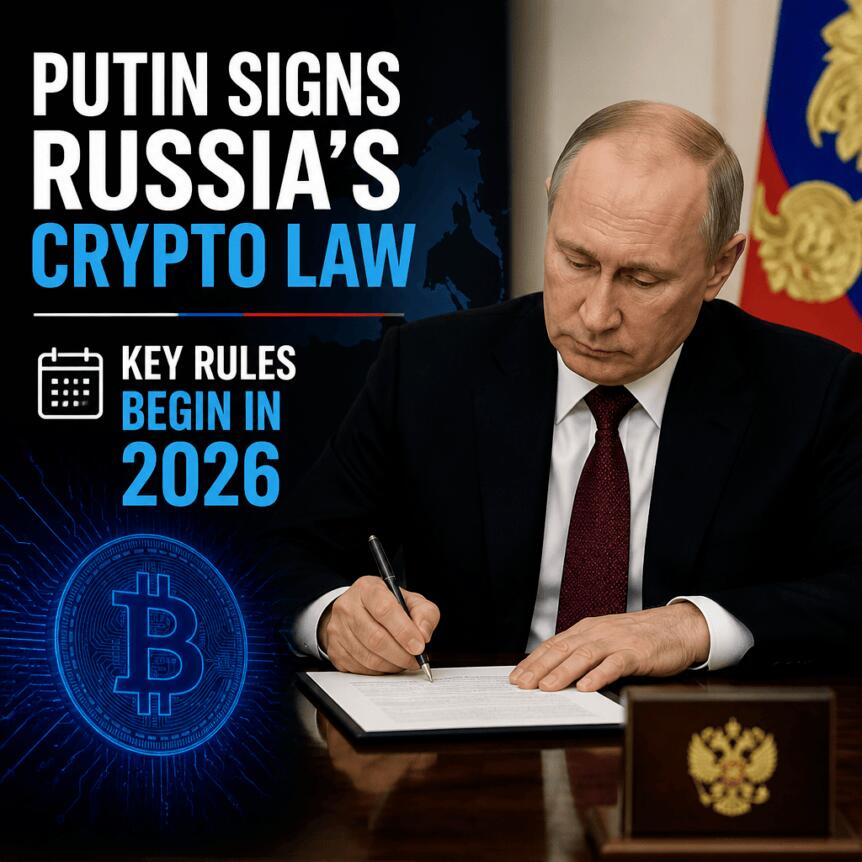
Russian President Vladimir Putin has signed legislation that lays out a regulated framework for cryptocurrency markets in Russia, marking a significant shift from the country’s largely restrictive posture toward a formal rules-based approach for licensed crypto activity.
The law, identified as bill No. 1194918-8 and titled “On Digital Currencies and Digital Rights,” was signed on Tuesday, according to official records from the State Duma, Russia’s lower house of parliament. It sets out requirements for major categories of crypto market participants, including exchanges, brokers, custodians, and other service providers.
Key takeaways
- Russia has moved toward a regulated crypto market through bill No. 1194918-8 (“On Digital Currencies and Digital Rights”).
- Crypto exchanges must meet regulatory conditions and join a financial market self-regulatory organization.
- Retail investors will be limited to purchasing only approved digital assets via intermediaries, with a 300,000 ruble annual cap per intermediary.
- Qualified investors are expected to face fewer restrictions and be able to buy any cryptocurrency.
- The law keeps Russia’s ban on using crypto assets to pay for goods and services domestically.
What the law changes for Russian crypto activity
At the center of the new bill is a licensing and oversight model intended to bring Russia’s crypto market into a clearer regulatory structure. The legislation defines rules for key participants across the crypto ecosystem, including trading venues (exchanges) and intermediary services such as brokerage and custody.
Under the framework, operators of crypto exchanges are required to comply with regulatory requirements and become members of a financial market self-regulatory organization. That combination suggests that, beyond direct supervision, exchanges will likely be subject to additional industry-level governance through the self-regulatory body.
Limits for retail investors, flexibility for qualified investors
A major practical feature of the law is how it differentiates between types of market participants. The bill limits retail investors’ access to cryptocurrencies by requiring intermediaries to sell only approved crypto assets and by imposing a quantitative ceiling on purchasing activity.
Specifically, the law sets an annual cap of 300,000 rubles (about $3,700) per intermediary for retail investors. Qualified investors, by contrast, will be allowed to purchase any cryptocurrency without the same restrictions.
For everyday users and smaller investors, the implication is straightforward: access to the broader crypto market could become more fragmented and filtered through intermediaries—while larger or more formally designated investors may be able to maintain wider exposure.
Regulatory oversight and the approval process
According to the law as reported through official parliamentary records, the Bank of Russia will be responsible for overseeing the regulated crypto market. That includes issuing related regulatory rules and determining which crypto assets licensed intermediaries can offer to investors.
In late July, the State Duma approved the legislation after final readings, an earlier step referenced in separate coverage at Cointelegraph. With the signing now completed, implementation becomes the next critical phase—particularly because different parts of the law take effect at different times.
When rules take effect—and what stays prohibited
Timing matters for investors, exchanges, and service providers because regulatory obligations rarely arrive all at once. The core provisions of the law take effect on Sept. 1, 2026. Some elements—including rules covering non-resident digital depositories—are scheduled to begin on July 1, 2027.
The law also preserves an existing prohibition on using crypto assets to pay for goods and services within Russia. That means the new regulatory structure is aimed at governance of crypto market participants and investor access, rather than enabling everyday crypto spending domestically.
Why this framework could reshape Russia’s crypto market
This legislation matters beyond legal formality because it defines who can participate, what assets can be offered through licensed channels, and how investors access those markets. By placing responsibility on the Bank of Russia to issue rules and approve which assets intermediaries may provide, the law effectively creates a gatekeeping mechanism—one that could influence liquidity, available trading pairs, and the list of cryptocurrencies that reach retail customers.
The retail investment cap per intermediary may also affect product design for brokers and custodians, since their compliance exposure would be linked to both approved asset lists and distribution limits. Meanwhile, the distinction between retail and qualified investors suggests that market access will not be uniform: segments of the investor base could experience different levels of flexibility and risk exposure depending on their classification.
As the implementation dates draw closer, market participants will likely focus on how the Bank of Russia translates the law into operational guidance—especially around licensing conditions, asset approval procedures, and the treatment of non-resident digital depositories.
Investors and builders should watch closely for the Bank of Russia’s rulemaking and for how “approved” crypto assets are selected, since those decisions will determine what retail users can realistically access before the Sept. 1, 2026 start date.
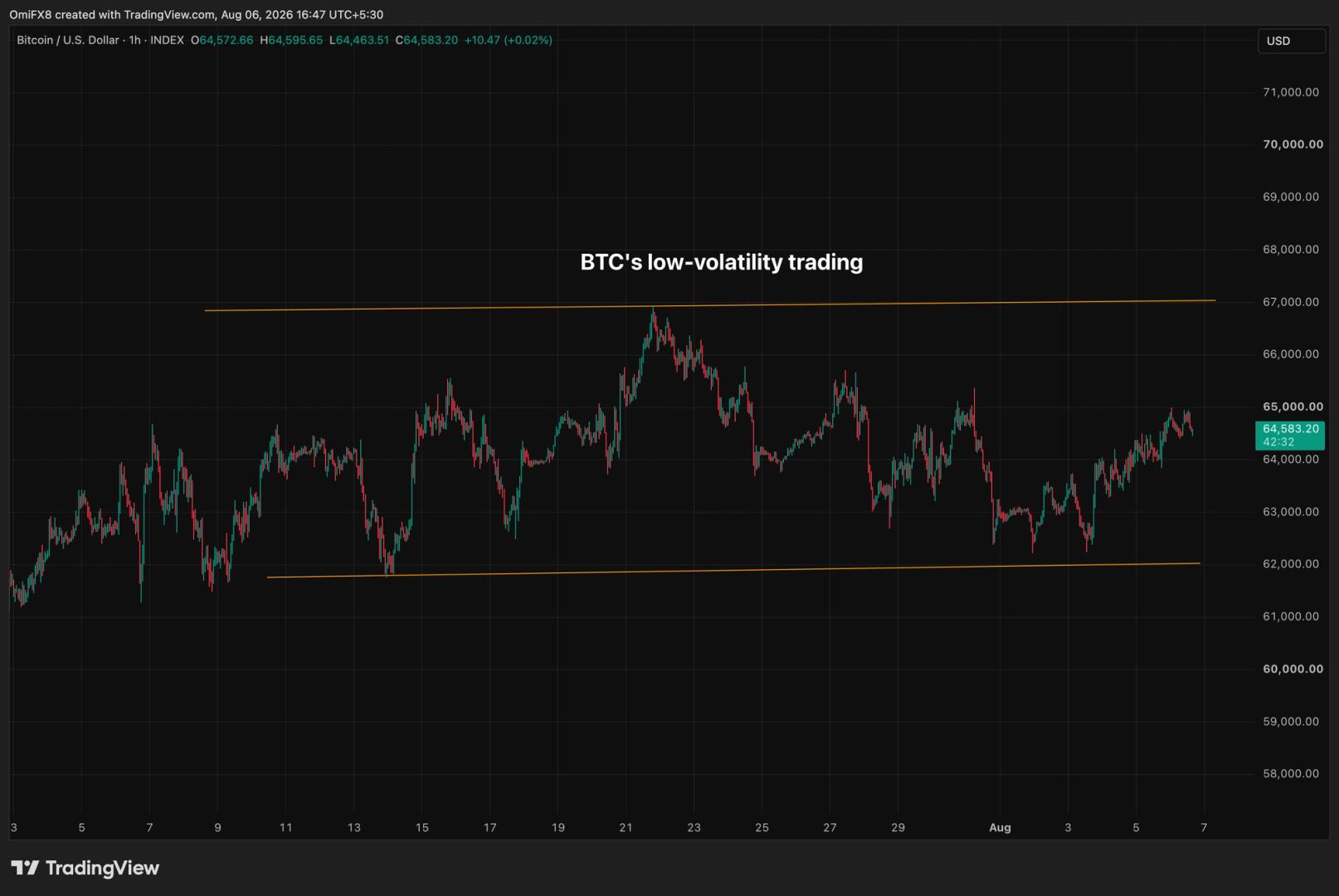
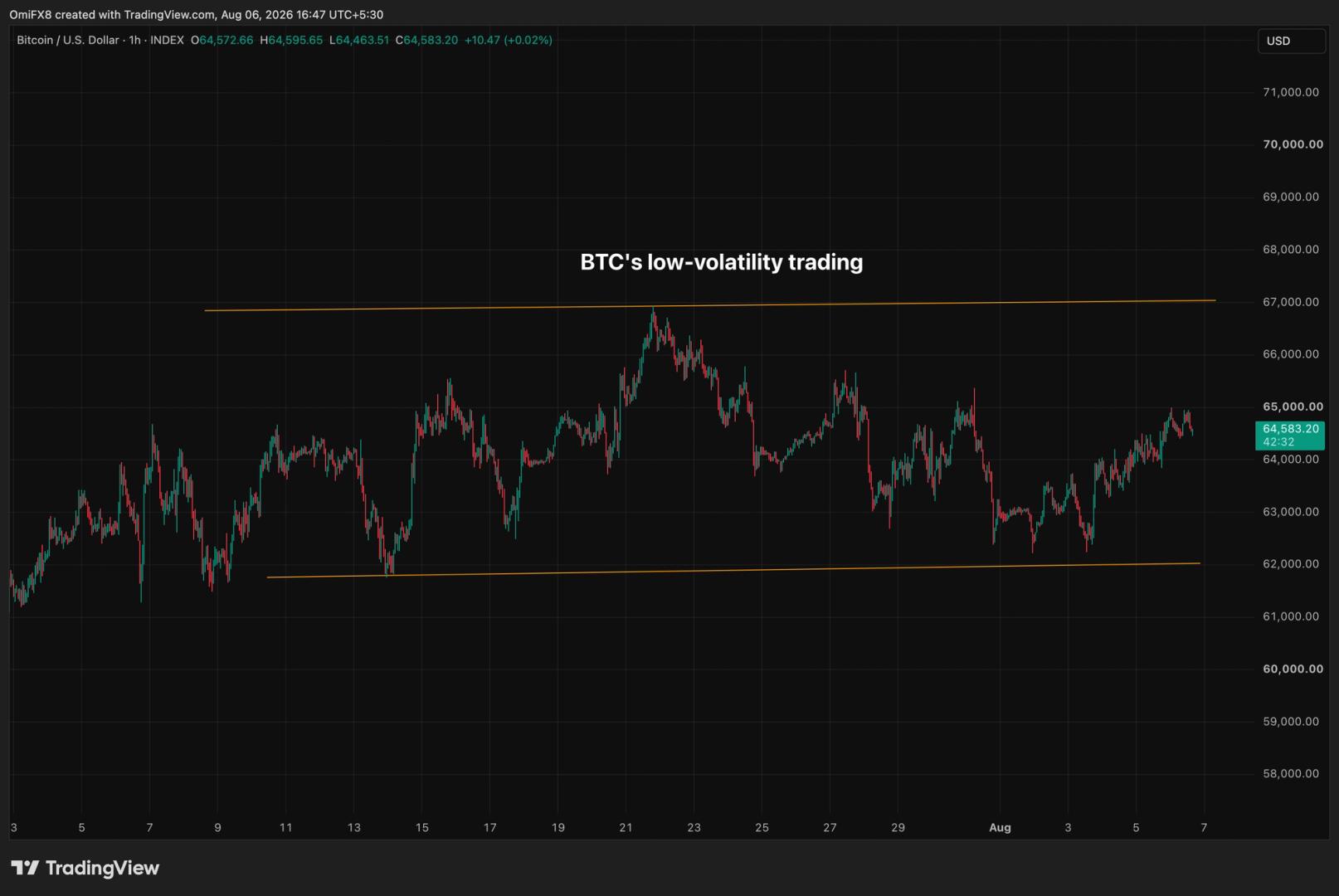
“When volatility is cheap, traders can build directional positions and hedges at relatively low cost. If the market then moves through a level with concentrated positioning, dealer hedging can accelerate the move,” Adam Haeems, head of asset management at Tesseract Group, which manages $500 million in client assets, said in an email.
“The practical implication is that low volatility should not be mistaken for low risk. It is a reason to be careful with leverage, particularly when trading volumes and market depth are subdued.”
For now, BTC remains choppy below $65,000 with some green shoots.
According to Paul Howard, a senior director at market-making firm Wincent, demand for puts, or downside protection, has weakened. At the same time, there is a lack of strong bids for upside exposure.
“It indicates that the bear market is close to trading at its lowest price range for this cycle, arguably over the coming weeks,” he said in an email.
“The asymmetry is not a bid for puts; it is the disappearance of the call bid. Nobody is paying for upside, and nobody is paying much for downside,” Glassnode said.
According to Howard, the next big catalyst would be “some positive regulatory news such as with the Clarity Act, which would likely manifest as institutional ETF inflows.”


What Clarity declines to do is impose customer identification duties on software that has no customers. Software that takes no custody and controls no transactions is in no position to identify anyone. Requiring KYC on code does not create a compliance obligation on intermediaries; it creates a prohibition on publishing code.
Tokenized securities
The last worry is that stocks will migrate to decentralized shadow markets with few investor protections. As clearly stated in section 10505, a security does not cease to be a security simply because it settles on a blockchain. Securities remain under SEC authority, and Section 10301 is the provision that reaches whoever exercises control over the venue where that trading happens.
But notice what the editorial does with tokenization across four paragraphs. When banks issue and settle tokenized stocks and bonds, it removes friction, lowers costs, and merits support. When the same instruments trade somewhere else, it is a shadow market inviting regulatory evasion. The technology did not change between those two passages. The identity of the firm using it did.
That pattern runs through the piece: nobody needs to explain to the Journal’s editorial page what it looks like when an established industry asks Washington to slow down a competitor. That is usually the argument it makes in the spirit of free and open markets, which is why this latest editorial is so disappointing. The editorial suggests Republicans are rushing this bill through before leaving town. It ignores that market structure legislation has been in the works for years. The House passed it a year ago with overwhelming bipartisan support. Senate Banking reported it in May. It has been on the Senate calendar since June and is not yet on the floor schedule this week. Haste is not the problem.


Yield Guild Games co-founder Gabby Dizon said its web3 game publishing arm went dark on Friday. "@YGG_Play services will shut down as of today," Dizon wrote on his verified X account on Friday, adding that "our @YieldGuild story continues – more on this starting next week!" The unit posted its own… Read the full story at The Defiant

People Don’t Understand Most Crypto Coins Are Dead.. And Never Coming Back

London bus drivers ‘break down’ from tiredness after working 13 days in a row

Thousands missing out on Child Trust Fund government money


-

 Fashion6 days ago
Weekend Open Thread: Wit & Wisdom
-

 Politics6 days ago
Meta enters AI-training agreement with far-right ‘propaganda rag’ Newsmax
-

 Politics4 days ago
Zack Polanski: an incitement to murder Nigel Farage?
-

 Crypto World5 days ago
MicroStrategy Post-Earnings CLARITY Act Push Could Add New Catalyst for Its Stock
-

 Crypto World5 days ago
XRP Ledger v3.3.0 brings five institutional features
-

 Politics7 days ago
Luke Littler’s dominance sparks GOAT debate
-

 Sports6 days ago
Seema Kaliramna Wins Discus Throw Bronze, Takes India’s CWG Medals Tally To 17
-

 Crypto World5 days ago
New York sues Kalshi over prediction market gambling
-

 Crypto World4 days ago
Crypto PAC spending tops $2M in Michigan House race
-

 Business3 days ago
DTCR: Deleveraging And A Hedge Fund Collapse Point To A Possible AI Bottom
-

 Business6 days ago
Trump Announces Hamas Disarmament Agreement as Iran Strikes Kuwait Air Base and US Attacks Pause Overnight
-

 Crypto World6 days ago
3 Fed Officials Just Explained Their Rate Hike Vote: Is Inflation Winning?
-

 Tech6 days ago
Gemini Spark can now use Chrome logins and saved passwords to run errands on your behalf
-

 Tech4 days ago
ESET tracks rise in malicious AI skills and adaptable malware
-

 Sports5 days ago
France Cricket implodes: letters hidden in a drawer and a board at war
-
Crypto World4 days ago
XRP Ledger urges node upgrade after manifest flood
-

 Tech6 days ago
Building A Reproduction PlayStation Motherboard
-

 Crypto World5 days ago
Moneyflip CEO charged in $40K murder-for-hire plot
-
 Sports5 days ago
Bruno Fernandes decision made as Man United ‘discuss’ striker transfer option
-

 News Videos5 days ago
Financial Crash Expert: The 90-Day Collapse Timeline They Are Desperately Hiding.
You must be logged in to post a comment Login