ROME (AP) — Italy placed all of its major cities under the highest heat alert Thursday as a blistering heat wave gripped Europe, setting a national temperature record in Austria, fueling wildfires in France and disrupting energy and transport systems across the continent.
The extreme weather has pushed temperatures above 40 degrees Celsius (104 Fahrenheit) in several countries, prompting health warnings for millions of people.
Across Europe, authorities are grappling with the consequences of extreme heat: health alerts for millions in Italy, record temperatures in Austria, drought-related disruptions to energy and shipping in Central Europe, and wildfires stretching from France to the Balkans.
Scientists and officials warn that such events are becoming more frequent and intense as the climate warms.
Advertisement
Climate change drives more extreme summers
From the Mediterranean to Central Europe, prolonged heat, drought and wildfire conditions are increasingly becoming defining features of summer. The current heat wave has exposed vulnerabilities in public health systems, power generation, transportation networks and tourism infrastructure, forcing governments and businesses to adapt to more frequent periods of extreme weather.
Italy’s Health Ministry placed all 27 cities monitored under its national heat surveillance system on red alert Thursday — the first time this year the entire network has been under the highest warning level simultaneously.
The alerts stretch from Trieste in the northeast to Palermo in Sicily and signal a health risk for the entire population, not only vulnerable groups such as older adults and people with chronic illnesses.
Authorities urged residents and tourists to avoid direct sunlight during the hottest hours of the day, remain indoors where possible and drink plenty of water as temperatures in some areas approached 40 C (104 F).
Advertisement
The heat has also forced adjustments at major tourist attractions. The ministries of tourism and culture extended evening opening hours at landmarks including Rome’s Colosseum and Pantheon.
Cooling mist fans have been installed at the Colosseum’s entrances and additional medical stations have been made available.
Austria breaks national temperature record
The most intense temperatures were recorded in Austria, where the mercury reached 41.2 C (106.2 F) on Wednesday in the village of Bad Deutsch-Altenburg near the Slovak border, according to GeoSphere Austria. It was the highest temperature ever recorded in the country.
Austria is also facing severe drought. Rainfall from Jan. 1 through June 30 was 27% below the long-term average nationwide, while some eastern regions received only half their normal precipitation.
Advertisement
Climatologist Alexander Orlik said some parts of the country had not experienced such dry conditions since 1885.
Advertisement
Sign up for Morning Wire:
Our flagship newsletter breaks down the biggest headlines of the day.
Hungary cuts power use as drought hits nuclear plant
In Hungary, prolonged drought and record-low water levels on the Danube River have severely affected the country’s only nuclear power plant, which relies on river water to cool its reactors.
Advertisement
Plant operators have reduced output to about 10% of normal production, prompting the government to introduce emergency conservation measures as a record-breaking heat wave grips the country.
Authorities have asked major industrial users and households to cut electricity consumption, particularly during peak demand hours between 5 p.m. and 10 p.m. Freight trains have been barred from operating during those hours, while decorative lighting on landmarks in Budapest has been switched off.
Several major companies, including energy company Mol, pharmaceutical maker Gedeon Richter and automakers Suzuki, Mercedes-Benz, Audi and BMW have announced plans to curb electricity use.
The government also canceled parliamentary sessions this week in an effort to conserve power.
Advertisement
The heat wave has shattered temperature records across the country. On Wednesday night, Budapest recorded its warmest overnight low temperature on record, with temperatures falling only to 28 degrees Celsius (82 degrees Fahrenheit), underscoring the persistence of the extreme heat.
Germany worries about shrinking rivers
Germany faced growing concerns over the impact of drought on transportation and industry as water levels on the Rhine and other rivers continued to fall.
Transport Minister Steffen Bilger met affected organizations Thursday and warned that low water levels posed major challenges for inland waterway shipping, industry and the broader logistics chain.
Environmental group BUND urged authorities to focus not only on the economic impacts but also on making rivers more resilient to climate change by retaining more water in landscapes and reducing withdrawals during periods of drought.
Advertisement
France remains on high wildfire alert
In southeastern France, firefighters maintained a large presence in the Var region after authorities said a major wildfire there was no longer spreading but remained capable of reigniting.
The blaze, which began July 20, has burned more than 60 square kilometers (23 square miles), making it the largest recorded in the region in recent decades.
Authorities warned that strong winds and extremely dry conditions left southeastern France at very high risk for additional wildfires.
Balkans battle fires and drought
The heat wave reached its peak across the Balkans on Thursday as temperatures neared 40 C (104 F) and authorities battled drought and wildfires.
Advertisement
In Serbia, firefighters struggled to contain several blazes after days of dry weather. One major fire burned through pine forests west of Belgrade, while another spread near the central town of Kraljevo, where difficult terrain complicated firefighting efforts.
In neighboring Croatia, tourists in Dubrovnik sought refuge in shade and avoided beaches during the hottest hours of the day as temperatures soared along the Adriatic coast.
———
Associated Press journalists Sylvie Corbet in Paris, Jovana Gec in Belgrade, Serbia and Karel Janicek in Prague contributed to this report.
The university said that the inquiry into Mr Arday came “following new information” about his “academic qualifications and honorary appointments”.
It comes following a series of reports regarding his achievements and allegations of plagiarism in his PhD thesis.
Mr Arday has admitted errors in his work, but said he was not a liar, amid “an unrelenting level of public scrutiny and personal attack”.
In his statement, he said that he had resigned as the “relentless accusations, speculation and public commentary have taken a profound toll on me and on those I love”.
Advertisement
So, who is Jason Arday, and what are the claims against him?
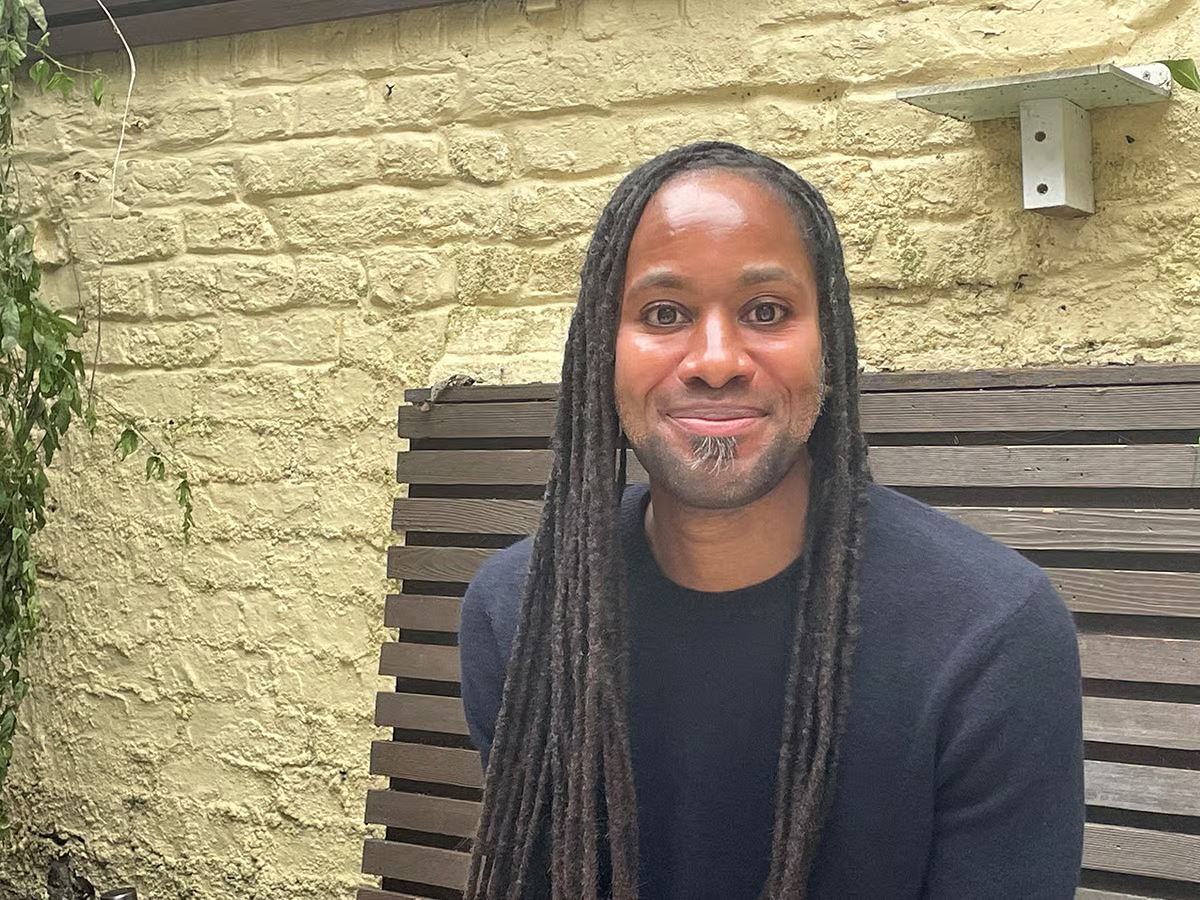
Jason Arday was appointed as professor of sociology at Cambridge in 2023, becoming the establishment’s youngest black professor at the age of 37.
Mr Arday was diagnosed with autism at the age of three, being unable to speak until he was 11, and he could not read or write until the age of 18.
Jason Arday carried the Olympic Flame in 2012
PA
Advertisement
Mr Arday overcame these factors, attending university and climbing the academic ladder, receiving his PhD in 2015.
He later held academic posts at Leeds Beckett, Roehampton and Durham universities, and was appointed professor of sociology of education at Glasgow University in 2021, before his move to Cambridge in 2023.
What are the allegations against him?
Allegations that he plagiarised his PhD thesis and other research
Advertisement
There have been a number of reports that Mr Arday plagiarised his PhD thesis and other research.
These accusations were first voiced by Nathan Cofnas, a US researcher whose own role at Cambridge was terminated after he said that, in a true meritocracy, black people would “disappear from almost all high-profile positions outside of sports and entertainment”.
Mr Cofnas claimed that he had put Mr Arday’s work through plagiarism detection software and found that “many passages are lifted with minimal editing, sometimes retaining copy-editing mistakes from the original source”.
A subsequent investigation by Liverpool John Moores University, which awarded his PhD in 2015, did not uphold the plagiarism charges but said they were probably caused by “honest and reasonable error”.
Advertisement
Jason Arday
ES
More recently, The Telegraph reported that analysis had found more than 100 passages in Mr Arday’s PhD were similar to a thesis by Brunel student Paula Zwozdiak-Myers, which was published six years earlier.
John Preston, an emeritus professor of sociology at the University of Essex, told The Guardian: “Having seen the evidence, it triangulates and there is, in my judgment, a case to answer here.”
Mr Arday has denied all accusations of plagiarism, saying: “There have been multiple thorough investigations across several institutions as a result of the allegations, and immense scrutiny, including with an academic misconduct panel who concluded that there was no plagiarism or academic misconduct.”
Advertisement
Running and fundraising feats
Mr Arday has claimed to have completed 30 marathons in 35 days, and 600 miles in six days, as well as raising £5.5 million for charity.
He has since revised some of those claims – including telling the Guardian that the money was raised with the help of others over a two-decade period, who he cannot name due to the signing of non-disclosure agreements.
He also said that the 600 mile challenge, completed on a treadmill, was actually completed over 12 days to allow for rest days due to “cumulative wear and tear”.
Advertisement
Regarding his other records, Mr Arday told the Times: “I can’t make people believe me. Nobody lives their life having a receipt for every single thing they say or they’ve done.”
Fellowships at other institutions
Mr Arday has claimed that he has held a number of visiting fellowships and professorships at other universities.
These include statements dating back to 2018 that he was a visiting fellow or visiting professor at Ohio State University in the US – who have denied that Mr Arday was ever employed in any role.
Advertisement
Mr Arday told the Guardian that, since his appointment at Cambridge, he has received multiple threats, including being targeted by knife-wielding masked intruders.
He said that he was confronted at his faculty building on two occasions by a masked man threatening to harm him if he did not resign, who evaded detection on both occasions.
Mr Arday said that on the second occasion the intruder produced a knife and threatened him with it. He did not inform colleagues that a masked man with a knife was in the faculty building.
Subsequent investigations found no evidence to support his claims.
Advertisement
Pig’s head delivered to his parents’ home
Mr Arday has also claimed that a severed pig’s head was delivered in a large cardboard box to his parents’ home address in south London.
He claimed to have intercepted the package and immediately thrown it away, only telling the police several months later.
He said that the police investigated, checking with butchers in south London if they had sold a pig, but when the Guardian checked those details with the local butchers Mr Arday named, they said no police officer had come in to ask them about a pig.
Advertisement
When details Mr Arday gave about the pig’s head investigation were checked, the Met told the Guardian that they were “categorically” incorrect and no investigation had taken place.
What did Jason Arday say in his resignation letter?
In his resignation letter, Mr Arday said: “While criticism is an inevitable part of academic life, what I have experienced has gone far beyond scholarly disagreement.
“The relentless accusations, speculation and public commentary have taken a profound toll on me and on those I love.”
Advertisement
In the statement, which was posted by the Good Law Project, Mr Arday said he had “concluded that the only way to bring this chapter to an end is to step away”.
Mr Arday said that being appointed professor had been “without question, the greatest professional privilege of my life” but that there “comes a point when the personal cost becomes too great.”
“This decision should not be interpreted as a loss of faith in scholarship or in the values that first brought me to Cambridge. Nor should it be mistaken for an acceptance of the narratives that have surrounded me.
He said “this is not the end of my work” and that he needed “time to heal”.
Advertisement
“When that time comes, I will return,” he added.
What has the University of Cambridge said?
Cambridge initially defended Prof Arday, saying that allegations made against him were a “vile campaign to undermine his credibility”.
However, on Wednesday, the university of Cambridge said it had begun an investigation into the professor “following new information”.
Advertisement
The University of Cambridge
PA Archive
A statement added: “Separately, there remains a number of ongoing complaints regarding academic misconduct, which are being handled in line with our Misconduct in Research policy.
“While we are fully aware of the public commentary and concerns around this matter, it remains vital that any process is thorough and adheres to both university policies and employment law.
“We also fully recognise that there is a person at the centre of this situation, and we continue to provide support to him.”
Advertisement
A spokesperson for Jesus College, where Prof Arday is a fellow, said it was launching its own process “parallel” to the university’s investigation.
They said: “Prof Arday remains a fellow during this process. We recognise that this is a very difficult time for him and his family, and ask that they are treated with compassion and respect.”
Dianne Buswell gushing over one of her new Strictly Come Dancing co-stars following her return to work after the birth of her first child
Dianne Buswell has been seen gushing over one of her new Strictly Come Dancing co-stars following her return to work, which comes after the birth of her first child.
Advertisement
The professional dancer and her YouTube star partner Joe Sugg welcomed their baby boy, named Bowden, into the world in March, having announced their pregnancy joy ahead of the BBC One dance show’s 2025 series, which she competed in with Neighbours legend, Stefan Dennis.
At the end of last month, Dianne shared a picture of herself with her son, Bowden, and appeared emotional as she prepared to head back to work on the popular programme, which is due to return in September for its 2026 series.
She penned alongside the image of her baby boy, who is nicknamed ‘Bowie’ by his doting parents, resting on her shoulder, posted to her Instagram Story: “First day back at work [face holding back tears emoji]. Mummy will miss you so much my boy [heart emoji].”
And the post seemingly got quite the response as she went on to follow up the post with another selfie, alongside which she wrote in view of her Instagram followers: “So many lovely positive msgs from other mummas. Thank you all. Means a lot.”
Advertisement
Dianne returned to social media later and things appeared to go well, as she shared a photo of her alongside her Strictly co-stars, including the show’s five new professional dancers, and wrote: “What a team! Happy first day pros. And biggest welcome to our newbies. Can’t believe this is my 10th year on Strictly.”
Now, she has been showing her support for one of the five new pros, Aleksandra Isaeva, who is a multiple Ukrainian National Latin Champion and is ranked in the world’s top 21 Latin dancers. Sharing a video of them both smiling for the camera together, Dianne wrote on her Instagram Story: “What an amazing woman you are. So excited for you all to get to know this beautiful girl on Strictly @aleksa_isa_eva.”
The sweet tribute came before Dianne was given a reminder of her pregnancy. She joined in an Instagram trend in which people are asked to a share a photo of themselves from August last year.
Advertisement
In her image, Dianne could be seen with mascara around on eye as she covered the other with her hand and looked towards the camera. “This time last year I was in my first trimester and nobody knew yet.”
It won’t be long until fans see Dianne back in the ballroom, after it was confirmed in May that she’ll be among the professional dancers returning for Strictly’s 2026 series, which will be hosted for the first time by Emma Willis, Josh Widdicombe and Josh Widdicombe.
Joining Dianne in the famous ballroom this year are Jowita Przystal, Alexis Warr, Amy Dowden, Aljaz Skorjanec, Dianne Buswell, Julian Caillon, Kai Widdrington, Katya Jones, Lauren Oakley, Nancy Xu, Neil Jones, Nikita Kuzmin, Vito Coppola, and Carlos Gu, who won last year’s series with former England footballer Karen Carney.
The nanny of Lindsay Clancy’s children has testified at her murder trial, giving an insight what the mum was really like before the tragic deaths.
Advertisement
Elaine Rossi took to the stand on day seven of the high-profile trial, where Clancy — who faces life without parole — is charged with three counts of first-degree murder over the deaths of her three children.
Clancy fatally strangled Cora, five, Dawson, three, and Callan, eight months, with exercise bands in the basement of their Duxbury, Massachusetts home on January 24, 2023.
However, Clancy is pleading not guilty to the charges, with her defence team arguing that she was not criminally responsible due to suffering from extreme postpartum psychosis.
Elaine Rossi (left) testified at Lindsay Clancy’s trial (Picture: David L. Ryan/Pool The Boston Gl)
Prosecutors say that Clancy planned the killings and deliberately sent her husband Patrick out of their home on the day of the deaths.
Advertisement
They argue this gave her enough time to strangle the children to death before attempting to take her own life.
Now, Rossi has provided the jury with a positive character reference for Clancy — a former labour and delivery nurse — describing her as a ‘wonderful mother.’
The experienced nanny began working for the Clancy family in September 2022 after responding to a job advert.
Advertisement
Her initial role was to look after Callan when Clancy returned to work, which was expected to be around Thanksgiving.
Lindsay Clancy is on trial for the deaths of her three children (Picture: via REUTERS)
Rossi called Clancy a ‘wonderful’ mother (Picture: David L. Ryan/Globe Staff)
According to the nanny, Clancy would leave a sleep schedule for Callan in a yellow notebook, as the mother was reportedly worried about his sleeping and feeding at the time.
Rossi testified that she was never concerned about Clancy’s treatment of her children, or worried about them being left alone with her.
When asked this question, Rossi replied: ‘Not at all. She was a wonderful mum.’
Rossi then gave an example of Clancy’s parenting style. She recalled a situation when Dawson, who she said was ‘full of energy,’ struck his younger brother.
Advertisement
Clancy reportedly removed Dawson from the room and made sure her baby son was OK. Rossi said Clancy then spoke with Dawson about his unacceptable behaviour.
‘I observed a wonderful mom who loved her kids,’ Rossi said, adding: ‘I did love Lindsay, yes.’
Lindsay’s defence team say she was suffering from postpartum psychosis (Picture: Facebook)
Rossi also provided her perspective of Clancy’s mental health at the time.
She said that the mother of three had confided in her about her decision to stop breastfeeding Callan so that she could start taking medication.
Rossi recalled Clancy also talking to her about her ‘postpartum and insomnia’ struggles.
Advertisement
What is postpartum psychosis?
According to the NHS, postpartum psychosis is a rare, severe mental illness that causes hallucinations, delusions, and extreme mood swings.
It affects about 1 in 1,000 mothers and is a medical emergency that needs quick hospital care.
Symptoms of postpartum psychosis include:
Hallucinations – hearing, seeing, smelling or feeling things that are not there.
Delusions – suspicions, fears, thoughts or beliefs that are unlikely to be true.
Mania – feeling very ‘high’ or overactive, for example, talking and thinking too much or too quickly, restlessness or losing normal inhibitions.
A low mood – showing signs of depression, being withdrawn or tearful, lacking energy, having a loss of appetite, anxiety, agitation or trouble sleeping.
Sometimes a mixture of both a manic mood and a low mood – or rapidly changing moods.
Feeling very confused.
On the day of the murders, Clancy attempted suicide by jumping from a second-story window.
Advertisement
Clancy had asked her husband, Patrick, to collect medicine for their children and a takeaway after she said she’d had an exhausting day.
However, less than an hour later, at around 6pm, Patrick returned to find blood on the floor of the couple’s bedroom, a bloody knife on a bedside table and an open window.
Lindsay’s ex-husband, Patrick Clancy testified at the trial last week (Picture: David L. Ryan/Pool The Boston Gl)
He discovered Clancy on the frozen ground outside, having jumped around 20ft from the window. She had also cut her wrists and neck.
Clancy’s fall caused spinal injuries which left her paralysed. She now uses a wheelchair.
Upon finding his wife on the floor, Patrick said Clancy told him that she’d tried to kill herself and said that the children were in the basement.
Advertisement
Cora and Dawson were pronounced dead at the scene, while Callan was airlifted to hospital and died several days later.
Patrick — who has publicly forgiven Clancy — was visibly emotional on the witness stand, recalling how she was a devoted, loving mother who suffered from severe mental health issues.
If Clancy is found not guilty, she will likely face an indefinite stay in a secure state mental health facility. The trial continues.
Executive Director of Finance and Corporate Resources, Jackie Taylor, said: “We recognise that part of being an open and transparent council is giving people the opportunity to engage with us directly.
“The petitions process, and ultimately the Petitions Committee, gives people that opportunity.”
A number of changes as to how the Petitions Committee will function moving forward was agreed at a recent meeting of the Executive Committee.
Advertisement
*Don’t miss the latest headlines from around Lanarkshire. Sign up to our newsletters here.
And did you know Lanarkshire Live had its own app? Download yours for free here.
Ross Stewart has completed his move to Swansea City, with the Scotland striker signing a three-year deal after leaving Southampton as a free agent
Swansea City have completed the signing of Scotland international Ross Stewart on a free transfer, with the experienced striker putting pen to paper on a three-year deal.
Advertisement
The 30-year-old becomes the Swans’ sixth signing of the summer and will wear the No.31 shirt after arriving following his departure from Southampton.
The arrival of the proven Championship goalscorer further strengthens Vitor Matos’ attacking options ahead of the new campaign, competing with Zan Vipotnik and Adam Idah.
Stewart joins having enjoyed an impressive campaign with Southampton last season, scoring 11 goals in 33 appearances in all competitions. That included a return of eight goals in 16 matches as the Saints finished the season strongly to reach the Championship play-offs and the FA Cup semi-finals.
The striker was also part of Scotland’s squad at this summer’s World Cup, making an appearance from the bench against Morocco.
Stewart first made his name south of the Scottish border with Sunderland, where he scored 40 goals in 81 appearances, helping the Black Cats win promotion from League One via the play-offs and lift the EFL Trophy at Wembley before earning a move to Southampton in 2023.
His arrival inevitably raises further questions about the long-term future of star striker Vipotnik, who continues to attract interest from clubs in England and across Europe. However, Swansea have maintained throughout the summer that there has been no change to the Slovenian’s situation despite strengthening their forward line.
Advertisement
Head coach Vitor Matos believes Stewart’s experience and leadership qualities will prove just as valuable as his goals.
“Ross is an experienced and proven performer in the Championship, and we are delighted to have him as part of what we are trying to build here at Swansea City,” said Matos.
“In our conversations he has made clear his hunger and desire to be an important senior figure and leader in our dressing room.
Advertisement
“His goalscoring record shows he is someone who relishes responsibility and we look forward to getting down to work with him and settling him into the group.”
Sporting director Ben Stevens added that Stewart’s pedigree made him an obvious target.
“We are delighted that Ross has joined Swansea City. He brings a wealth of experience on and off the pitch.
“His performances last season in the Championship were a standout, and it earned him a deserved place in Scotland’s World Cup squad.
Advertisement
“We are very excited to see Ross in a Swansea shirt.”
Stewart’s signing is unlikely to be Swansea’s final piece of business before the transfer window closes.
Stevens revealed at Wednesday night’s supporters’ forum that further additions are being worked on, while the Swans remain in talks over Valencia midfielder Andre Almeida. The club also continue to pursue Senegalese youngster Ousseynou Fall Seck as Matos looks to further strengthen his squad ahead of the Championship campaign.
Nearly 10,000 people were referred to the government’s anti-terrorism scheme Prevent in the year to September 2025, Home Office figures show, a record number for the programme.
Figures show 10,293 referrals were made in England and Wales for 9,957 people – up by 39% from the previous 12 months and the highest number in a single year since records began in 2015.
Where the age is known, 393 referrals were for children under 10, the largest proportion concerned 11 to 15-year-olds at 36%, followed by 16 to 17 year-olds at 13% of referals.
The Home Office said the spike was in part due to “heightened public awareness of Prevent” after the Southport attacks in July 2024, where a teenager killed three girls at a dance class.
Advertisement
Axel Rudakubana was 17-years-old when he stabbed 11 children and two adults, killing nine-year-old Alice da Silva Aguiar, seven-year-old Elsie Dot Stancombe, and six-year-old Bebe King at a Taylor Swift–themed yoga and dance workshop.
Rudakubana was referred to Prevent on three occasions between 2019 and 2021 due to his interest in terrorist attacks and school shootings, but there was no evidence of a fixed ideology or motivation.
A government review found that his case was closed “prematurely”, and that counter terrorism officers staffing the Prevent scheme had “sufficient information” to escalate Rudakubana’s case to the next stage – known as Channel – which would have included enhanced monitoring for those deemed at risk of radicalisation.
The Home Office said the Southport attacks may have also led to a 117% increase in referrals discussed at a Channel panel, rising from 997 to 2,159.
Advertisement
It also cited a major review from last year led by Lord David Anderson KC, which found an increase in Prevent referrals from January to March 2025 during Rudakubana’s trial.
The Home Office said it was possible that “a number of operational and policy changes and improvements, along with associated training rolled out” may have also had an impact on referrals.
Thursday’s figures show that 20% of the total referrals were because of concerns over extreme right-wing ideology – an increase from 1,480 to 2,103 in the previous 12 months – while 8% of referrals concerned Islamist extremism.
A further 8% of referrals concerned fascination with extreme violence or mass casualty attacks, 1% concerned Incel extremism, and 0.3% concerned left-wing extremism.
Advertisement
More than half of the referrals (56%) were for individuals with no identified ideology.
The Home Office also published data showing the ethnicity of those referred to Prevent.
This is not mandatory and can be left blank, and only 5,315 (52%) referrals included the data.
Of these referrals, 68% were white, 18% were Asian, 8% were black, while 7% were listed as “other”.
Advertisement
Prevent, which forms a key part of the UK’s counter-terror strategy, places a legal duty on public bodies to identify people who may turn to extremism.
The Home Office figures are for England and Wales. Scotland reports its referral figures separately.
Campaigners challenged a ‘carbon bomb’ gas expansion
Conservationists in Australia have taken on the country’s largest gas producer in a landmark court battle that will decide the fate of a giant fossil fuel project.
The Australian Conservation Foundation (ACF) and Friends of Australian Rock Art (FARA) challenged the government’s approval of plans to extend the Woodside North West Shelf gas export project.
The permit allows Woodside to operate its Karratha gas plant, on the Burrup Peninsula, 1,260km (783 miles) north of Perth, until 2070. The plant sits next to the sprawling Murujuga Indigenous rock art complex, a World Heritage site which is home to around two million rock engravings dating back 50,000 years.
Advertisement
FARA claims emissions are degrading the ancient artworks while ACF says environment minister Murray Watt failed to consider “devastating climate change impacts” when he approved the scheme.
ACF estimates the extension will spew 4bn tonnes of CO2 into the atmosphere, and both groups also accuse Watt of being biased towards Woodside, a relationship described in court as ‘chumminess or cosiness’ between his department and the fossil fuel giant.
Justice Catherine Button will decide the outcome at a later date. “Depending on what the Court says, this could involve reassessment of impacts on a huge range of protected parts of nature across Australia,” said the ACF.
Image: The ‘Future Man’ rock carving at the Murujuga Indigenous rock art complex. Credit: Marius Fenger
These occasions haven’t always been the most pleasant for Swansea City.
But in comparison to some years, Wednesday night’s fans’ forum was a serene, bordering on routine exercise for all involved.
Swansea City feel in a good place right now. Celebrity investment, a deal to buy their stadium in the pipeline, some moves in the transfer market that look dangerously close to some semblance of competence and a bid to improve the club’s academy.
There’s a lot to be positive about, as evidenced by one supporter using his chance to ask a question from the floor to offer Tom Gorringe, Ben Stevens and Vitor Matos a drink on him.
Advertisement
But optimism wasn’t the only different about this evening.
Musician Mal Pope, who counts the vocals to the Fireman Sam theme tune among his sterling catalogue of work, was handed the role of hosting in place of Kev Johns, who continues to recover from a stroke earlier this year.
The evening began with a rapturous round of applause for Johns, which largely set the tone for a night that gave fans a first glimpse into what feels, for several reasons, a new era for the club.
Advertisement
Gorringe alluded to that very point at one stage, casting his mind back to the club he walked into back in March 2025.
“Before I joined I came here for a game against Sheffield Wednesday at home,” he said.
“Luke Williams was still the manager at the time, the stadium was half empty, we lost 1-0 from a mistake. It was two awful teams, it was an awful game of football.
“You could feel the apathy in the air. This club had drifted far too far away from where we want to be.”
Advertisement
“I came in with my eyes wide open [about] what we wanted to do, to give everybody hope again, to make everybody believe that we can be a force, that we can be true to our past, do things the right way and ultimately that we can move up the leagues and compete at the level we want to compete at,” Gorringe added.
“In order to do that we have to make a lot of decisions, we had to make a lot of changes. We had to make sure we brought the right people in.
“I think I can sit here today, probably for the first time since I joined, and say now all of those foundations are in place.
“I think everything is here that we need to really kick on and improve. We have got the right people in the building.”
Advertisement
Some have clearly left the building, including several of the club’s homegrown first-team stars, with Liam Cullen, Sam Parker, Ollie Cooper and Cameron Congreve all heading out the door.
It’s another blow to the strong Welsh core that the club had relied upon in previous years, and this point was brought up by one fan, who asked “Are we confident we’ve got enough players in the dressing room that will fight for the badge?”
The selling off of the club’s Welsh contingent has become something of a talking point on social media, with some fans concerned the identity of the club is being lost. Others are adamant it’s the right move to make for the club to progress.
In his own opinion Matos clearly believes in the strength of the senior players still in the building, which he suggested will form the spine of the squad’s ambitions. The seniority of some of the new arrivals too, he claims, will help maintain Swansea’s ability to compete in games where heart, as well as ability, prove important.
Advertisement
“We have important players. From Vigs, even Paul Farman, from Ben Cabango, from Cam Burgess, from Jay Fulton, even from players now coming in.
“One of the things we tried in the market was to go for players whose character fits the club. That’s quite important because when we sign a player we are signing a human being and we need to understand how they will fit in the squad and the club.
“The other thing we tried is to sign talent and potential, and at the same time sign players that are emotionally stable.
“For example, Elijah Just. He seems a really young kid, but he’s 26, and he can perform already in different kinds of contexts.
Advertisement
“Players like that bring seniority to the group. They bring experience.”
Bringing young players through the academy, however, is still a big part of how Swansea claim they want to operate, and there are some promising signs that a couple of players are now on their way through.
Matos confirmed Filip Lissah is to stay with the first team next season, and also praised young Carter Heywood for his progress.
“We always dream to have a team built from the ground in the academy,” Matos admitted.
Advertisement
One of the plans to help keep Swansea’s talent factory ticking over appears to be he move to Category One status.
The academy was downgraded ahead of the 2020-21 season, but Gorringe confirmed on the night that moves are in place to change things.
“We’ve made the formal application now to move back to Cat 1. What that means in practical terms is we will be assessed over the course of next season.
“There’s criteria you have to meet and I think we’re comfortable and confident we can meet that criteria.”
Advertisement
Gorringe also admits that player trading is likely to remain a key part of the operational model, which he says has helped free up the funds for this summer’s transfer efforts.
“We are operating a player trading model,” he added. “Ultimately that means we will, and always have actually, regularly sell players.
“I think we’ve averaged over £11m profit over a 10-year period and that pre-dates where we are now. If you look at the squad we’ve got, we’ve got more assets in it.
“When I look back to that first game against Sheffield Wednesday, I remember saying to a friend of mine, ‘I’m not sure where the assets are or where the value is’.
Advertisement
“Now I think you can look through the squad and see value and assets. Ultimately that provides us with opportunities.”
Whether that says anything about any potential appetite to sell star striker Zan Vipotnik, arguably the club’s biggest asset right now, remains to be seen.
Sporting director Stevens insists there is a blueprint in place should they decide to cash in.
Advertisement
“Yes we have a plan behind the scenes,” he said. “We’re making sure we have all options available if as a board and a club we decided to take an offer for Zan.”
Some might say the imminent capture of Ross Stewart could well be what Stevens is referring to.
Time will tell if that now widely-held presumption is accurate.
It is legal for bus drivers on local routes – those less than 50km – to work ten-hour days, with no weekly or fortnightly limit apart from one day off every two weeks. It is also legal for these staff to work 130 hours over two weeks, with only a 30-minute break after five and a half hours driving.
US President Donald Trump ‘clashed’ with Defence Secretary Pete Hegseth over extreme munition shortages that could limit Washington’s military operations in Iran, sources have claimed.
Two insiders told the Washington Post that Trump lashed out at Mr Hegseth saying that he thought the munitions issue ‘had been fixed’, during a Cabinet meeting at Camp David on Friday.
Shortages of long-range guided missiles and air defence interceptors are among the reasons Trump has held back from launching further large-scale strikes against Iran in recent days, one source said.
When confronted by Trump over dwindling weapons stockpiles, sources said Mr Hegseth blamed his deputy, Stephen Feinberg, for the shortages and for failing to keep the president fully informed.
Advertisement
The White House has denied the clash ever took place, however, with press secretary Karoline Leavitt saying: ‘This is 100% fake news. Literally never happened. And President Trump has the utmost confidence in Secretary Hegseth.’
Pentagon chief spokesman Sean Parnell also added: ‘Secretary Hegseth did not mislead anyone about our munitions posture, and he did not blame Deputy Secretary Feinberg. These claims about depleted stockpiles, internal disagreements, the Secretary’s position on Iran … are equally fictional.
‘Secretary Hegseth isn’t going anywhere, and he’s going to continue to work side by side with Deputy Secretary Feinberg to execute President Trump’s agenda.’
At a Senate hearing in July, Mr Hegseth clashed with Democratic lawmakers over whether he had given Trump an accurate assessment of the Iran conflict, including the strain a prolonged campaign could place on US weapons stockpiles.
Advertisement
US President Donald Trump and US Secretary of Defense Pete Hegseth listen to questions from the press during a Cabinet meeting at Camp David
Trump denied these claims on Thursday, taking to his Truth Social
The US Army has used up much of its stockpile of highly accurate long-range missiles during its five-month war with Iran, according to sources
Advertisement
He declined to discuss the advice he gave the president, instead blaming any shortages on the Biden administration’s management of the military rather than operations carried out under Trump.
Mr Hegseth, Mr Feinberg and Joint Chiefs Chairman General Dan Caine have asked Congress to approve an additional $67billion in military funding to help cover the cost of the Iran war.
Testifying before lawmakers last month, Mr Hegseth said the request was needed to replenish the US military’s depleted weapons stockpiles.
It comes as the US Army reportedly burned through nearly its entire arsenal of offensive precision missiles during its five-month war with Iran, according to those familiar with the matter.
Advertisement
Three officials, granted anonymity to discuss sensitive US military matters, told Reuters that the stocks of Army Tactical Missile Systems (ATACMS) and Precision Strike Missiles (PrSM) have dwindled to new staggering lows.
Two of the officials said the US has used ‘virtually all’ of these missiles in its stockpile.
All three sources expressed concern that the low stockpiles could hamper Washington’s ability to fend off Russia, China and other adversaries.
But Trump denied these claims on Thursday, taking to his Truth Social to say: ‘The US has massive amounts of “munitions”, especially of certain types.
Advertisement
‘Additionally, large amounts are being manufactured and shipped to the US as needed. Defense companies are building the largest number of plants and factories in our country’s history.
‘The “leakers” of these treasonous statements are being hunted down. Long term jail sentences will be sought! President DJT.’
General Caine previously warned Trump that dwindling supplies in the region could increase the risks faced by US forces there.
Lawmakers have also expressed concern over General Caine and Mr Hegseth acting as ‘yes men’ for the President.
Advertisement
A fourth source said that Central Command, which organizes US military forces in the Middle East, has expended nearly all the land-based missiles it had before the war began in February, though it has since restocked from other US stockpiles located across the globe.
Both the ATACMS and the PrSM systems allow for long-range strikes with deadly precision while not putting US pilots at risk.
ATACMS can travel approximately 185 miles, while the newer PrSM system has a range around 300 miles.
They each cost over £1million per missile, with prices ranging far higher depending on the munition’s exact specs.
Advertisement
The sources refused to reveal exactly how many of each munition remains in US inventories.
The President has met with executives from Lockheed and other major US military contractors as the war with Iran drags on and the military’s thirst for additional munitions appears unquenchable.
‘Our defense companies are, at this moment, making more munitions than they have ever made before, in addition to expanding their plants and equipment at record levels,’ Trump has said.
The surface-to-surface missile systems are crucial for attacking targets at ranges that could only otherwise be targeted by US pilots.
Advertisement
Given their long ranges, the ATACMS and PrSM systems are favoured for strikes against Iran because it keeps pilots far from the front lines where the regime’s anti-air systems are waiting.
File image: An explosion erupts following strikes near Azadi Tower close to Mehrabad International Airport in Tehran on March 7, 2026
The munitions would also be crucial in any potential conflict with China, experts have warned, noting how any US military strategy near the mainland would need to employ long-range options.
Advertisement
ATACMS have also been provided to Ukrainian forces so that they could strike deep within Russian territory, further straining the supply of the critical munition.
There are also major concerns among US officials about defensive weapons in the US arsenal.
Patriot interceptor missiles and Terminal High Altitude Area Defense (THAAD) systems, two US-made defensive systems used to shoot down incoming missiles, drones and aircraft, have also seen their supply dwindling.
The Center for Strategic and International Studies released a report last week estimating that 65 per cent of Patriot interceptors had been used since the beginning of the war.
Advertisement
The study also found that THAAD interceptor stockpiles were at least 38 per cent lower than the levels before the conflict.
The President has repeatedly threatened and then walked back claims he would strike Iran with overwhelming force.
On various occasions, Trump has said that he’s called off the strikes because officials in Iran have signalled they want to make a deal.



























































You must be logged in to post a comment Login