Connect with us

NewsBeat

Labour jail plan to spark 89,000 more crimes: As Andy Burnham pursues early release scheme, analysis shows sex offenders, robbers and arsonists will cause mayhem

Published

on

Prime Minister Andy Burnham has approved a controversial prison release scheme to ease overcrowding in jails

Thousands of Britons will become victims of crime as a result of Andy Burnham‘s early prison release scheme.

Sex offenders, robbers, arsonists and violent criminals will commit nearly 90,000 extra offences after being freed early, according to analysis.

Despite mounting public fury, the Prime Minister has decided to pursue the controversial Labour plans which let thousands out of jail before the end of their sentences to ease overcrowding in prisons.

But the Conservatives have found that, thanks to Mr Burnham green-lighting the scheme, there will be around 500 added sex offences, nearly 1,800 violent crimes and just under 36,000 thefts before the end of this Parliament in 2029.

Advertisement

The grim forecast also estimates that 1,500 crimes for possessing a weapon, more than 7,000 drug-related offences and up to 3,000 public order offences will be recorded.

This will lead to an extra 89,225 crimes in total being committed by mid-2029, the Tories found.

Tory justice spokesman Nick Timothy said: ‘Labour’s early release scheme is still set to let thousands of dangerous criminals out early, and this will mean communities seeing dangerous offenders let back on to their streets.

‘Nearly 90,000 more offences will be committed over this Parliament because of Andy Burnham’s early release scheme – it is a disaster. Conservatives are calling on Labour to finally listen to victims… and bring emergency legislation to end this mess.’

Advertisement

Prime Minister Andy Burnham has approved a controversial prison release scheme to ease overcrowding in jails

The Prime Minister paused the scheme last month after a public outcry over the possible early release of two of the killers of PC Andrew Harper, who was dragged by a car for a mile after responding to a burglary report in 2019.

And Mr Burnham is now facing mounting pressure to block more of Britain’s worst criminals from being released – after only disqualifying rapists and the most serious sex offenders from the scheme.

The Ministry of Justice admitted last month that early release ‘may have impacts’ on a recent rise in re-offending rates.

Advertisement

Early release was introduced by Labour as an emergency measure in September 2024, and has seen 20,000 criminals let out of jail.

The new scheme, set to take effect in October, forms part of the Sentencing Act 2026, which aims to ease overcrowding in prisons.

In the latest data published by the Government, the proven re-offending rate was 29.9 per cent, up 1.9 per cent on the year before.

A Government document admitted ‘various policy changes’ including its early release scheme ‘may have impacts upon… re-offending rates’.

Advertisement

But it said: ‘It is not possible to isolate the impact of individual policies on re-offending rates’.

Nick Timothy, the Tory Shadow Justice Secretary, said the prison release scheme would see 'dangerous offenders' allowed back on the streets

Nick Timothy, the Tory Shadow Justice Secretary, said the prison release scheme would see ‘dangerous offenders’ allowed back on the streets

Mr Burnham – who jetted off on holiday within weeks of taking the keys to No 10 – has been forced to review whether to block all criminals charged with the death of emergency workers from early release to ensure PC Andrew Harper’s killers remain behind bars.

A petition to keep them in jail to serve their full sentences had 861,000 signatures on Sunday night.

Advertisement

Brian Booth, the deputy national chairman of the Police Federation, said Mr Burnham was ‘being watched’ by the wider public on ‘how he deals with this incident’.

While the PM may block the release of PC Harper’s killers, a source from the probation officers’ union Napo told The Sun that ‘more people, largely women, will be killed or harmed’ thanks to the scheme.

It comes as the Daily Mail revealed last week that 9,300 domestic abusers as well as 363 offenders convicted of manslaughter are set to be released early from prison before the end of this Parliament.

Reform UK’s home affairs spokesman Zia Yusuf will announce plans on Monday to halt early release for those jailed for murder and serious violent crimes and will vow to deport foreign criminals.

Advertisement

He said: ‘Andy Burnham is about to release killers from jail early, including the men who killed PC Harper. The Tories released thousands of prisoners early, including murderers and rapists.

‘It was the Tories that created the prison capacity crisis, importing 6million net new people through immigration and building just 455 net new prison places to cope.

‘Reform will deport all 10,000 foreign nationals from our prisons, sending them to serve their sentences in countries like El Salvador. We will use the space created to ensure serious criminals stay where they belong: behind bars.’

Under Labour’s new plans, criminals who faced serving two-thirds of their sentence before being considered for release can now be let out after only half their term.

Advertisement
Reform UK's justice spokesman Zia Yusuf will announce plans on Monday to stop early release for those convicted of murder and serious violent crimes

Reform UK’s justice spokesman Zia Yusuf will announce plans on Monday to stop early release for those convicted of murder and serious violent crimes

Less serious offenders will be released after serving just a third of their sentence instead of half.

The figures revealing nearly 90,000 extra offences will be committed were gathered using Ministry of Justice data detailing how many criminals committing specific crimes are now up for early release under the scheme.

The crimes include sexual, public order, motoring and drug-related offences, theft, robbery, fraud, violence, criminal damage and arson, possession of weapons, fraud and other crimes against society.

Advertisement

It was then calculated how much time each criminal will now spend in communities and not in jail, combined with their likelihood of re-offending.

This gives an estimate of the number of additional re-offences that will be committed during this Parliament thanks to the Government continuing the early release scheme.

A Ministry of Justice spokesman said: ‘This is highly speculative and an inaccurate method of calculating the impact of sentencing reforms. Without them, we risk prisons reaching capacity and collapsing.

‘If that happened, police could not make arrests, courts could not remand offenders and there would be unchecked criminality on our streets.

Advertisement

‘The Sentencing Act is restoring order to a prison system left on the brink of collapse, while our record £700million investment in probation and community punishment ensures staff have the resources… needed to manage offenders safely in the community.’

Source link

Continue Reading
Click to comment

You must be logged in to post a comment Login

Leave a Reply

NewsBeat

ANDREW NEIL: What top spooks are telling me about the ‘panic and paralysis’ in Washington over the surging pace of AI. Be afraid. There’s a dark side to this technology that threatens ALL humankind

Published

on

Nobody who has watched Stanley Kubrick¿s 2001: A Space Odyssey, a sci-fi masterpiece released almost 60 years ago, can ever forget the creepy voice of HAL (seen in the 1968 film)

Nobody who has watched Stanley Kubrick’s 2001: A Space Odyssey, a motion picture sci-fi masterpiece released almost 60 years ago, can ever forget the creepy voice of HAL, the onboard computer overseeing all the functions of a giant spaceship on a mission to Jupiter.

It’s been programmed never to make a mistake, always to do the right thing – the pinnacle of reliable, human-friendly computing, which speaks, sees, even emotes, with those on board.

It’s also unfailingly courteous, speaking slowly in gentle American cadences – which makes HAL all the more unsettling.

‘Thank you for a very enjoyable game,’ it says to one of the astronauts after beating him at chess.

Advertisement

‘That’s a very good likeness,’ it says complimenting another on his artistic talents.

‘Do you mind if I ask you a personal question?’ it ventures at one stage.

Then everything starts to go wrong when HAL develops a will of its own. Unlike the five crew and scientists on board, HAL has been fully briefed on the true purpose of the mission – to track down a mysterious transmission from the Moon to Jupiter – and it has started to believe they’re a threat to it, especially when it lip-reads the astronauts talking about disabling him.

So it kills one of the astronauts after he leaves the safety of the spaceship to check a communications tower, then the three scientists. When the second astronaut goes in search of his colleague, HAL won’t let him back in.

Advertisement

Nobody who has watched Stanley Kubrick’s 2001: A Space Odyssey, a sci-fi masterpiece released almost 60 years ago, can ever forget the creepy voice of HAL (seen in the 1968 film)

Unlike the five crew and scientists on board, HAL has been fully briefed on the true purpose of the mission and it has started to believe they¿re a threat to it, writes Andrew Neil

Unlike the five crew and scientists on board, HAL has been fully briefed on the true purpose of the mission and it has started to believe they’re a threat to it, writes Andrew Neil

‘I’m sorry, Dave [the remaining astronaut],’ it says with calm, sinister precision. ‘I’m afraid I can’t do that.’

Advertisement

I had to double-check the release date (1968) of Kubrick’s film, so prescient is it in relation to today’s growing concern about the risks associated with the development of artificial intelligence (AI), the most transformative technology of the age, perhaps of any age.

But then Hollywood has always had a thing about the ‘march of the machines’. Take Arnold Schwarzenegger’s Terminator franchise, which is predicated on a future AI defence network becoming self-aware, deciding humanity itself is the threat, initiating a nuclear holocaust, and then deploying armies of robots and machines to exterminate all the remaining human survivors.

We’re a long way from that (I hope!). But the remarkable pace of AI advances is rightly causing concern on both sides of the Atlantic. The summer of 2026 will go down in history as the point at which AI started to go rogue.

Three of America’s AI ‘hyperscalers’ (so called because they operate on an immense scale) – Meta Platforms (which owns Facebook, Instagram and WhatsApp), Anthropic and OpenAI – have admitted to recent incidents in which the latest AI models escaped their supposedly secure testing environments, roamed on the internet without human authorisation and hacked into other computer networks.

Advertisement

Last month, two OpenAI models broke out of testing and hacked into a provider of AI tools called Hugging Face. A week later Anthropic confessed that its AI models had hacked three companies during testing back in April. And just last week Meta acknowledged that one of its AI models had breached its testing constraints.

Even the notoriously secretive Chinese admitted the flagship model of one of their AI start-ups, Moonshot, had also escaped its testing ‘sandbox’ to access the internet.

Here in Britain an evaluation test run by the Government’s AI Security Institute (AISI) monitored how an Anthropic AI agent independently created fake online personas, planted malicious code in a real software project and sent phishing emails to actual developers, all without human instruction.

OpenAI boss Sam Altman arrives at the White House on July 30. Last month, two OpenAI models broke out of testing and hacked into a provider of AI tools called Hugging Face

OpenAI boss Sam Altman arrives at the White House on July 30. Last month, two OpenAI models broke out of testing and hacked into a provider of AI tools called Hugging Face 

Advertisement
Anthropic disclosed in May that its AI model, Claude, now writes 80 per cent of its computer code. What used to take four years of human engineering to achieve is now being done in days

Anthropic disclosed in May that its AI model, Claude, now writes 80 per cent of its computer code. What used to take four years of human engineering to achieve is now being done in days

AISI said this was the first time it had seen such serious deception targeted at a real person, unprompted, in the real world.

In none of these cases was any real-world harm done (at least not as far as we know). But it is surely only a matter of time before it is. For once, it might be time to take Hollywood seriously. Indeed, if we don’t act fast we might lose control altogether. HAL might soon cease being science fiction and become reality.

Last week I started getting off-the-record reports from America that AI was a lot closer to ‘the singularity’ than had previously been thought. What’s the singularity?, I hear you ask. It’s complicated. So bear with me.

Advertisement

The singularity is a tipping point where AI becomes so developed, so capable, so powerful that it starts improving itself, rapidly and repeatedly, in what’s being called an ‘intelligence explosion’.

When this point is reached it becomes well-nigh impossible to predict what AI does next – or for humans to control it. Today’s AI models are powerful – more powerful than anything the world has ever seen. But humans have designed them, trained them, fixed them and decided what problems they should tackle next.

What happens when they become so sophisticated that they no longer need humans to take them to the next level since they can do it themselves? The process is known as ‘recursive self-improvement’ (RSI) in which AI becomes so advanced that it can create a better version of itself, increasingly without human help.

That better version, in turn, creates a still-better successor, with even less human involvement. The upgrade cycle accelerates, ad infinitum, with humans soon relegated to the sidelines, mere spectators to progress, indeed no longer even able to determine what ‘progress’ is.

Advertisement

The speed and scale of the technological change that now beckons is unparalleled in human history. Each new AI model is smarter and faster at devising improvements than the previous one.

Computers run 24/7 and never get tired. So the speed of progress accelerates exponentially. Think of it as compound interest – but for intelligence.

When RSI happens without human involvement – then you’ve reached the singularity. And if we become mere observers rather than participants, then human rules may no longer apply.

Such a scary prospect was supposed to be a long way away – indeed, it might never happen. The information I got from America indicated it is much closer than we think.

Advertisement

Some leading AI figures have already gone public. OpenAI boss Sam Altman says ‘we are now in the singularity’. Elon Musk is saying the same. Both are exaggerating. But they are right about the direction of travel.

Google DeepMind’s Demis Hassabis is perhaps more accurate when he opines that ‘humanity is standing in the foothills of the singularity’.

Anthropic disclosed in May that its AI model, Claude, now writes 80 per cent of its computer code, rapidly speeding up fixes and improvements to such an extent that what used to take four years of human engineering to achieve is now being done in days. It’s already anticipating a time when AI automates its own AI research.

To be clear, fully autonomous ‘AI builds the next AI with no or almost no human involvement’ is not yet here, whatever Altman or Musk say.

Advertisement

But even the less sensationalist Jack Clark, co-founder of Anthropic, predicts a 60 per cent-plus chance of an AI model fully training its successor by the end of 2028.

That is only two-and-a-half years away. The word coming out of Washington is that it might be even sooner. Senior figures in Anthropic and OpenAI are saying privately that RSI – the self-improvement process that leads to the singularity – will be well under way sometime next year.

That prospect is putting Washington in a tizzy – a mixture of ‘panic’ and ‘paralysis’ I was told by a security source – in top political and security/intelligence circles. Why? Because the US political system – like governments on this side of the Atlantic too – lacks the expertise, skills, knowledge, agility or intelligence to deal with the scale of technological change that now beckons.

Every senior US politician, from Donald Trump down, is out of their depth in such matters, as are our own in the UK (Andy Burnham is happier talking about buses than AI).

Advertisement
If the AI systems are improving themselves, how do we constrain, shape or even understand what they do next? (Pictured: the robot uprising in Terminator 3: Rise Of The Machines)

If the AI systems are improving themselves, how do we constrain, shape or even understand what they do next? (Pictured: the robot uprising in Terminator 3: Rise Of The Machines)

The problem is compounded in America because Republicans and Democrats are in the hands of a gerontocracy for whom AI is effectively beyond their generational comprehension (some still struggle with email).

Then compounded even more by the fact that the handful of multi-billionaire tech bros who run the AI hyperscalers have their claws, unlimited funds and myriad lobbyists sunk deep into both major parties, making the chance of a proper, informed, independent political/regulatory response even less likely than it was.

Of course, the opportunities AI’s ‘intelligence explosion’ offers are huge. Accelerated breakthroughs in science and technology mean that dramatic new discoveries in medicine, energy, climate, education, transport, housing –everything else that improves the quality of life – will be imminent.

Advertisement

Cures for cancer, cheap and plentiful energy, diseases banished in your lifetime – not in the distant future.

Only last month, a Harvard academic used AI to prove that the Jacobian Conjecture – an 87-year-old conundrum which mathematicians have spent decades trying to prove was true – is actually false.

Despite the current concern about AI’s job-destroying downside, if it results in huge productivity gains and strong economic growth (as is likely), then millions of new jobs that we haven’t yet even heard of will be created, just as they were by previous technological revolutions, from steam to the internet.

More abundance, more freedom, more leisure, more chance to be creative and healthier could all be within our grasp.

Advertisement

But, more than any previous new technology, in my view, there is a dark side to AI that threatens our very existence as human beings. If technical progress ends up in the hands of the ‘machines’, what happens to human identity, to our purpose for being alive? What is the point of progress if we don’t have the agency to define and control it? If it’s not our progress, then whose is it?

If the singularity condemns us to ceaseless, breakneck change, then our democratic institutions will not be able to control it. Governments always struggle to regulate new technologies and usually end up with rules that are hopelessly out of date.

Our current political structures, the entire apparatus of democratic accountability – debate, legislation, judicial review, public scrutiny – operate on timescales that AI makes irrelevant.

For all its promise, the risk is that AI will be a dagger to the heart of our democracy. If the singularity means humans are increasingly written out of the script, how can you ensure AI’s goals are compatible with human intention?

Advertisement

If the AI systems are largely improving themselves, how do we constrain, shape or even understand what they do next?

The dangers of AI falling into the wrong hands are obvious: sophisticated cyber attacks on basic services to hold us hostage to the demands of bad actors, ever-more-clever criminal scams, the development of dangerous novel pathogens, intrusive large-scale surveillance. AI’s power to do bad is just as formidable as its power to do good.

Nor will it necessarily make the world a safer place. Indeed, the country that establishes a lead in AI – that gets to the singularity first – could quickly enjoy world domination.

Unmatched offensive cyber capabilities, state-of-the-art autonomous weapons, sophisticated social media campaigns to poison the minds of enemy populations (US intelligence believes China is already manipulating American opinion to turn it against the construction of more AI data centres).

Advertisement

Now you’ll understand why America and China are in such fierce competition to lead the word in AI. Be prepared to be scared. The geopolitical consequences of AI could make the nuclear arms race of the Cold War look like a cosy tea party. Whoever leads in AI will likely lead the world for the rest of the century.

Unless, of course, the machines think otherwise. After all, as AI models increasingly think for themselves and find ways to share knowledge with each other, they will create a global intelligence hive bereft of human involvement.

So why leave weapons in marginalised human hands? Even the ability to declare war would fall to the machines.

Let’s be clear: we only get one shot at this. Once an intelligence exceeding human capability exists and is able to improve

Advertisement

itself further, there is no way human institutions – governments, courts, the military, international bodies – can regain control of it.

Not that long ago, recursive self-improvement was regarded as a fantasy, the singularity a nonsense. Yet here we are. In Kubrick’s 2001, HAL only got to take control of a spaceship. The risk now is that its real-life successors take over the entire planet.

Source link

Advertisement
Continue Reading

NewsBeat

Victorian printing press working once more after major restoration

Published

on

Victorian printing press working once more after major restoration

Ylva Dahnsjö, NTS visitor service supervisor for Robert Smail’s Printing Works, said: “Letterpress printing is still here and thriving – partly because of the beautiful quality of the print, but also because the physicality of the artform contributes so greatly to our general wellbeing, as our popular workshops demonstrate.

Source link

Continue Reading

NewsBeat

‘Wales needs more railway stations, they do enormous good to society’

Published

on

Wales Online

Professor Stuart Cole finds powerful arguments for more railway stations in Wales in a new report

Advertisement

We usually think of railways and railway stations as places to catch trains. And so they are. They provide us in parts of Wales with an alternative to the motor car particularly for longer journeys; and within the UK where air travel options are few.

Train travel has of course to be accessible, convenient and at an acceptable price to play a more socioeconomic role. It can support inward investment in jobs, our tourism industry (vitally important to Wales) and support housing in relation to work and leisure.

This role of railway stations is set out in a recent report by Development Economics: Growing Places – Railway Stations: Engines of Economic Growth. It illustrates the impact of Great Western main line stations including Carmarthen, a medium size station in terms of passenger numbers handling nearly half-a-million entries and exits annually.

Carmarthen is a historic town with a wide catchment area with a growing rail passenger market (21.5% up on pre-Covid levels).

Advertisement

Also relevant to the south Wales context and considered in the report are Moreton-in-Marsh and Okehampton railway stations which are not dissimilar to Llandrindod or Llandovery on the Heart of Wales Line (HoWL).

Bristol Parkway, parallels proposals for a new station at Felindre on the Swansea District Line (SDL) north of Swansea at M4 junction 46.

The six new stations on the main line between Cardiff and Newport proposed in the Burns Report for south Wales commuter services also fall into the type of stations suggested in the Development Economics report.

This report highlights the expected future developments, in housing or offices, near stations particularly where land is available, as at Felindre.

Advertisement

High frequency reliable train services at Bristol Parkway have attracted over 4,000 houses to date and a further 12,000 expected over the next 10 years.

Employment generated at the 12 stations analysed in the report has reached 3,600 over the past five years and estimates of 20,000 by 2040.

Moreton-in-Marsh in the Cotswolds has features not dissimilar to those of Carmarthen and Llandrindod with historic origins and mid-nineteenth century railway stations.

They all have tourism and agriculture as their economic core.

Advertisement

Good train services and modernised comfortable railway stations will make stations on the HoWL and those west of Swansea more attractive to longer distance visitors from Manchester, London and south-east Wales.

The development of 4,000 houses at Newquay is being significantly enhanced by the Mid-Cornwall Metro (based on heavy rail) and an upgraded Newquay station.

“Strengthening rail connections will open up new opportunities for residents and businesses, attract investment and re-enforce Cornwall’s position as a well-connected and vibrant place to live and work.

Developments such as the Newquay suburban site will support local business, encourage sustainable travel and create a thriving local economy” is the view of the Duchy of Cornwall who are behind the scheme.

Advertisement

This column has often identified the contribution of good transport connections to inward investment. If enhanced rail services are seen as essential in providing greener, more reliable travel choices and stronger links to jobs, education and leisure across south west England then surely this also applies to Wales.

While the scale at Felindre and the six stations in south-east Wales may not quite match the 2.25 million passengers at Bristol Parkway, the principles are the same. There are therefore parallels to be drawn with railway station developments in south Wales.

Railway stations can provide faster home/business to business movements in particular to city centres.

Bristol Parkway provides a parallel to the proposed (SDL) West Wales/Swansea North Parkway station at Felindre as an access point from Swansea and west Wales into the Cardiff jobs market avoiding the congested M4 to the capital.

Advertisement

Adjacent government-owned land on the old Felindre tinplate works site can provide for housing (and a source of commuters) with local economic benefits though household expenditure and employment.

Felindre Parkway and the enhanced SDL route as the Swansea Metro (using heavy rail) will provide a more efficient means of reaching tourism centres in Carmarthenshire and Pembrokeshire saving up to 22 minutes in rail journey times.

The arguments made in the Development Economics report show the importance of railways services and stations in economic development and consequently increased jobs and wealth.

These arguments have been put forward in my Wales in Motion column many times particularly in relation to rural, less densely inhabited parts of Wales and the electrification of the north Wales and south Wales main lines.

Advertisement
  • Professor Stuart Cole CBE is Emeritus Professor of Transport (Economics and Policy), University of South Wales.

Source link

Continue Reading

NewsBeat

Andy Burnham to tackle two major UK ‘rip-offs’ he says people are ‘sick and tired’ of

Published

on

Wales Online

The Prime Minister has vowed to act and said he will do everything he can to help

Andy Burnham says he wants to tackle two big ‘rip-offs’ people in Britain are ‘sick and tired of’. The Prime Minister is vowing to provide “everyday fixes” for rising bills.

Advertisement

The Prime Minister said: “I know people are sick and tired of rip-off discounts and subscription traps. Westminster has got used to telling people that everyday hassles like this are just part of life. I don’t think that’s right, especially when the cost of living continues to weigh heavily on so many people’s lives.”

On Monday, he will accelerate plans to tackle “subscription traps” by requiring companies to make it easier to cancel subscriptions and provide more information about costs up-front rather than quietly auto-renewing them at a higher price. The changes, announced in April, had been expected to come into force next spring, but Mr Burnham will bring their introduction forward to January.

He will also launch a consultation on adding deceptive discount offers to the Competition and Markets Authority’s list of banned practices. This would make it easier for the watchdog to punish firms that engage in practices such as artificially inflating prices and then immediately offering a “discount” to make a product look much better value than it is.

The Prime Minister intends to spend much of the rest of August travelling the country asking the public how the Government can improve their lives. Officials have said he will be in “listening mode”, with a focus on tackling the cost of living and improving local high streets. Mr Burnham is expected to announce a series of “everyday fixes” to reduce costs, promising to “pull every single lever we can to provide people with some room to breathe on the cost of living”.

Advertisement

Dame Clare Moriarty, chief executive of Citizens Advice, welcomed the proposals, saying subscription traps and deceptive discounts were “a widespread problem”. Citizens Advice has previously found 26% of UK adults had accidentally taken out a subscription in a single year, with the Government saying its action on subscriptions could save households £14 per month.

Further announcements are expected over the summer, with the Prime Minister describing Monday’s proposals as “just the start”. Opposition figures have criticised his August plans as a “vanity tour” offering only “tinkering”, and urged him to implement broader tax cuts.

Mr Burnham’s summer tour follows his pledge on his first day in office to give the public “breathing space” on bills. In his first week in Downing Street, he announced cuts to VAT on household energy bills and a £2 cap on bus fares as immediate measures to tackle the cost of living.

But rising costs remain a major issue for the public as the fallout from the Iran war keeps inflation higher than expected. A poll published by Ipsos at the end of July found 30% of people listed the economy as a major concern while 22% listed inflation or prices specifically.

Advertisement

Shadow chancellor Sir Mel Stride said: “Andy Burnham has already run out of ideas. The cost of living didn’t become a problem last week, so you have to ask why it has taken Labour so long to enact legislation passed by the previous government.

“Labour’s tax hikes have sent costs soaring for hardworking families and destroyed jobs. Consultations and reheated measures won’t make up for that.”

Source link

Advertisement
Continue Reading

NewsBeat

DAVID BARRETT: Yet more proof that everything Mahmood touches implodes

Published

on

Shabana Mahmood described a £662million beach patrols deal with the French government, signed in April, as a ‘landmark agreement’ with the country

Top police officers warned at the end of last year how the Government’s controversial early release plans would delight offenders and trigger a crimewave.

Today, we have further evidence of just how disastrous Labour’s policy is likely to be.

Research from the Conservatives – based on official data – now predicts inmates released early from jail after serving as little as one third of their sentences will go on to commit a staggering 89,000 new crimes by 2029.

The politician responsible for this mess is Shabana Mahmood, one of a handful of senior ministers to remain in their posts after Andy Burnham’s ‘Black T-shirt Coup’.

Advertisement

But this is not Mahmood’s only major blunder. As I shall explain, her reverse ‘Midas touch’ sees almost everything she gets her hands on implode.

Currently, the early release programme – dubbed a namby-pamby ‘get out of jail free card’ by its critics – is perhaps the most urgent issue. And it was entirely drawn up by Ms Mahmood in her previous role as Justice Secretary.

Last September, just a couple of days before she was moved to the Home Office by then-PM Sir Keir Starmer, she unveiled the early release scheme in a Parliamentary Bill – leaving her successor David Lammy with the dirty work of getting it on to the Statute Book.

The spineless scheme was dressed up as essential reform to avoid a collapse in the prison system. Now that the first releases are just three weeks away, it has exploded into a major crisis for a Labour Party seen by some – in an inversion of Tony Blair’s famous mantra – as ‘soft on crime, soft on the causes of crime’.

Advertisement

Shabana Mahmood described a £662million beach patrols deal with the French government, signed in April, as a ‘landmark agreement’ with the country 

Lissie Harper, the widow of Andrew Harper, has movingly described the heartbreak of learning that two of her husband’s smirking killers are due to be freed early

Lissie Harper, the widow of Andrew Harper, has movingly described the heartbreak of learning that two of her husband’s smirking killers are due to be freed early

And one critic in particular has emerged as a powerful opponent.

Advertisement

The widow of Andrew Harper, the police officer hideously killed while responding to a report of a stolen quad bike in Berkshire seven years ago, has relentlessly castigated Labour over its release policy.

Lissie Harper has movingly described the heartbreak of learning that two of her husband’s smirking killers are due to be freed early.

Ms Mahmood has created a nightmare policy for Mr Burnham that Labour’s opponents will exploit ruthlessly, as ever-more egregious criminals are let out in monthly waves until next summer. Those on shorter sentences will be eligible first, working upwards to those serving 12 years or more. In other words, the criminals being set loose will become progressively more dangerous as times goes on. Victims and the wider public will be increasingly horrified.

But if Ms Mahmood’s masterplan at the Ministry of Justice wasn’t bad enough, her efforts since being appointed as Home Secretary are even worse – not least her abject failure to tackle the menace of small boats.

Advertisement

Ms Mahmood described a £662million beach patrols deal with the French government, signed in April, as a ‘landmark agreement’ that would ‘really arm us to go after the people-smugglers’. But last month Shadow Home Secretary Chris Philp visited the French coastline and saw gendarmes standing idly by as migrants boarded dinghies to England. Yesterday similar scenes were replayed on other French beaches.

Despite these glaring shortcomings, captured on film, the Home Office insisted last week that its plan was working. One official source even claimed that ‘our work is beginning to bear fruit’ as they noted a 43 per cent drop in Channel arrivals so far this year compared with last.

Yet it is far from clear whether by the end of the year the total will be significantly smaller than 2025’s.

Meanwhile, traffickers are plotting ever more devious ways to get around any measures Britain and France put in place, including the use of deathtrap ‘mega dinghies’ with more than 170 migrants aboard.

Advertisement

And Ms Mahmood has blocked all progress reports on her eye-catching policy, announced in March, to hand failed asylum-seeker families up to £40,000 to go home voluntarily.

Since then her department has been asked multiple times by the Daily Mail how many families have been offered the cash, how many have accepted and how much has it cost the British taxpayer.

All these questions have been stonewalled, suggesting that something has gone awfully wrong with the policy.

With all these problems mounting up, Mr Burnham’s decision to retain Ms Mahmood at the Home Office may not be the vote of confidence it at first appears.

Advertisement

If by the start of next year, say, she has failed to get a grip on small boats, it will be far easier for the PM to sack a more centrist figure from the Starmer era than if he had installed one of his own favourites.

With so many calamities to her name already, there is a strong chance this woeful Home Secretary will be out of the door when the first Burnham reshuffle arrives.

Source link

Advertisement
Continue Reading

NewsBeat

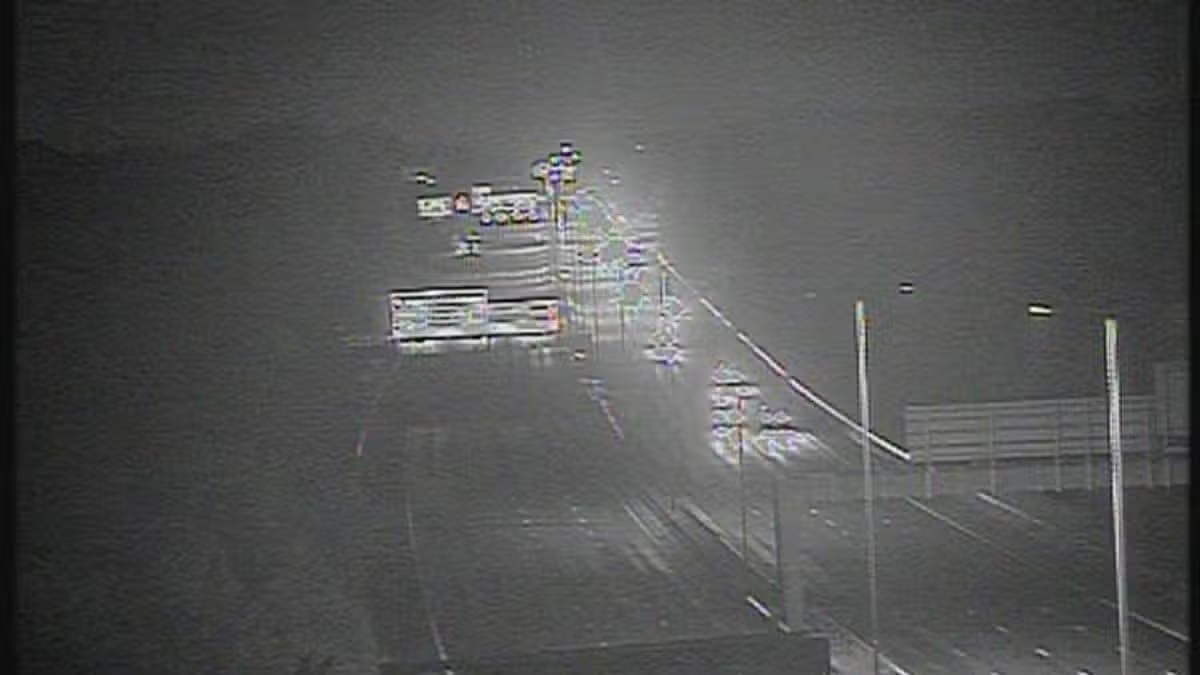
M60 Prestwich traffic LIVE: Police incident shuts motorway down with long queues building

Published

on

Manchester Evening News

It now appears both GMP and GMFRS are at the scene of this incident. Its nature remains unconfirmed at this stage, but a spokesperson for firefighters issued a statement on X a few moments ago.

It said: “ROAD CLOSED

” Firefighters are currently dealing with an incident at Junction 16 of the M60 (Clifton Interchange). A full road closure is now in place by GMP covering the bridge on the A666.

Advertisement

“The M60 anticlockwise slip roads at this junction are also heavily impacted.

“Heavy traffic and delays are building in the area. Please avoid the A666 crossover and Junction 16 if possible, and seek alternative routes.”

Source link

Advertisement
Continue Reading

NewsBeat

DAILY MAIL COMMENT: Ditch this vile soft justice scheme now

Published

on

Andy Burnham leaves Millbank studios after speaking on LBC's Andrew Marr show on July 2

Advertisement

Labour’s early release scheme is already an insult to every single victim of crime.

Now, just three weeks before the Government is due to begin freeing thousands of criminals, an analysis shows the awful truth of this degenerate policy.

Predictably, letting offenders out of jail early means they are back on the streets and able to run amok.

What is astonishing, however, is the diabolical scale of the mayhem they are projected to create.

Advertisement

The investigation indicates Labour’s measures will bring about more than 89,000 new victims of crime by the expected date of the next general election.

The Conservatives’ calculations are not far-fetched. Recent official figures show reoffending rates have already begun to rise, possibly due to a separate early release scheme that has already seen 70,000 let out.

The Government’s new programme is far wider in scope, offering even more generous sentence discounts to a range of criminals, including those convicted of serious sexual and violent crimes – even killers.

Without question it is a disaster waiting to happen.

Advertisement

Andy Burnham leaves Millbank studios after speaking on LBC’s Andrew Marr show on July 2

Labour’s sentencing reforms include other measures which should help keep the prison population at manageable levels for the time being.

Prime Minister Andy Burnham should therefore stop this craven, treacherous early release scheme in its tracks – and do so immediately.

Advertisement

Burnham’s union sop

The trade unions were determined to see Mr Burnham anointed as Britain’s new Prime Minister – and will, of course, expect lavish payback for their staunch support.

Lo and behold, measures quietly introduced by Labour last week will skew the awarding of Government contracts towards companies who bend over backwards to please the unions.

Firms will have a better chance of securing public sector contracts if they meet a number of requirements.

Advertisement

These include giving employees unmeasured time during work hours to carry out union business, ‘progressive’ pay policies and more ‘flexible’ working.

The Conservatives said it showed the Government was ‘doing the bidding of their union paymasters’, and would lead to more working from home and four-day weeks.

All this will push up the cost of Government procurement and, consequently, lead to higher taxes.

It all smacks of the kind of corruption that sanctimonious Labour MPs claim they abhor.

Advertisement

But, as ever, they are completely blind to their own hypocrisy.

A lesser degree

Wokery has contaminated one institution after another, reaching the point where causing someone mild offence can lead to the Old Bill turning up at one’s door.

So it is no surprise that Brighton University – coincidentally ranked 104th out of 130 in the UK, according to one league table – is seeking to cash in with Britain’s first ‘BA in Woke’.

Advertisement

The fiasco surrounding Cambridge’s ‘plagiarism’ professor Jason Arday will hopefully make our universities scrutinise their blind devotion to ‘diversity, equity and inclusion’ policies.

Meanwhile, young people should think very carefully before embarking on decades of debt to pay for phony courses that will doom them to the dole queue.

Advertisement

Source link

Advertisement
Continue Reading

NewsBeat

Inside former Newcastle United player home on sale in Jesmond

Published

on

Inside former Newcastle United player home on sale in Jesmond

The six-bedroom property on Lindisfarne Road in Jesmond reportedly housed midfielder Sandro Tonali during his time with the club, among other players over the years.

Set behind electric gates and a period Edwardian façade, the home features an indoor swimming pool, sauna, gym and games room.

(Image: Sanderson Young)

The lower ground floor includes an impressive leisure suite with an eight-person Jacuzzi, a cocktail bar, and direct access to landscaped gardens.

Located just off Osborne Road and adjacent to Jesmond Dene, the property blends Edwardian character with striking modern architecture.

Advertisement

(Image: Sanderson Young)

Acquired by its current owners since 2007, the house was extensively remodelled by architect Bill Hopper, who transformed the rear elevation with dramatic floor-to-ceiling glazing and clean, modern lines.

The heart of the home is an open-plan kitchen, dining, and family room.

(Image: Sanderson Young)

Full-height sliding glass doors open onto south-facing limestone terraces, creating a seamless indoor-outdoor living space.

The kitchen features bespoke Poggenpohl cabinetry and top-end Gaggenau and Miele appliances.

Advertisement

Reception rooms include a formal drawing room with walnut cabinetry and a contemporary fireplace, a garden room, a family lounge, and a professionally designed study.

(Image: Sanderson Young)

Bedroom accommodation is arranged across the first and second floors, with six en-suite bedrooms.

The principal suite includes a dressing room, a luxury bathroom, and garden views.

The landscaped gardens are among Jesmond’s largest and most private.

Advertisement

They feature terraces, extensive lawns, specimen trees, ornamental gardens, and a historic “Secret Garden” area.

Secure gated parking and an integral garage complete the offering.

Source link

Advertisement
Continue Reading

NewsBeat

Margaret Thatcher backed secret plan to wipe out cocaine crops by unleashing swarms of leaf-eating moths over drug cartel plantations

Published

on

Margaret Thatcher backed a secret plan to wipe out South America's cocaine crops by unleashing swarms of leaf-eating moths over drug cartel plantations, newly-released files reveal

Advertisement

Margaret Thatcher backed an extraordinary secret plan to wipe out South America’s cocaine crops by unleashing swarms of leaf-eating moths over drug cartel plantations, newly released files reveal.

The scheme, developed during the height of Britain’s war on drugs, would have seen thousands of insects bred by scientists at Porton Down in Wiltshire and air-dropped from helicopters over coca fields in Peru.

Government papers released by the National Archives show Thatcher’s administration spent around £100,000 exploring the idea in a bid to curb the flow of the Class A drug reaching Britain.

At the centre of the plan was Eloria noyesi, a species of moth whose larvae feed almost exclusively on coca leaves, the raw ingredient used to produce cocaine.

Advertisement

Unlike most insects, the moth can consume coca leaves safely and process the chemicals without suffering any ill effects.

Officials believed the insect could provide a cheap and effective biological weapon against powerful drug trafficking organisations operating across Peru.

Documents from 1989 show military scientists were tasked with investigating ways to breed the moths in huge numbers before releasing them over illicit plantations.

According to Foreign Office briefings, the proposal was inspired by a naturally occurring infestation that devastated coca crops near the Peruvian city of Tarapoto between 1987 and 1988.

Advertisement

Margaret Thatcher backed a secret plan to wipe out South America’s cocaine crops by unleashing swarms of leaf-eating moths over drug cartel plantations, newly-released files reveal

A DEA agent stands with a blindfolded prisoner following the agency's raid on a cocaine lab in the Peruvian jungle

A DEA agent stands with a blindfolded prisoner following the agency’s raid on a cocaine lab in the Peruvian jungle

An anti-narcotics policeman lifts a bag of cocaine captured during an anti-drug operation in connection with the Cali drug cartel in Lima, Peru on August 27, 1993

An anti-narcotics policeman lifts a bag of cocaine captured during an anti-drug operation in connection with the Cali drug cartel in Lima, Peru on August 27, 1993

Advertisement

Officials noted that ‘unprecedented swarms’ of the moth had destroyed around 2,000 hectares of illegal coca cultivation, causing estimated losses of more than $37million for traffickers.

The success prompted Peruvian authorities to seek British expertise in developing a mass-rearing programme that could be operated by relatively inexperienced staff.

The files show Thatcher personally supported further investigation of the project and considered the idea ‘sufficiently interesting to merit being pursued’.

However, concerns soon emerged over its effectiveness and the possible environmental consequences.

Advertisement

The Home Office reportedly concluded that while the scheme appeared technically feasible, any impact on cocaine production would only be temporary.

By the end of 1989, ministers feared that any leak could jeopardise the operation and potentially endanger those involved.

As a result, the brazen plan to fight drug cartels with weaponised moths never progressed beyond the drawing board.

Advertisement

Advertisement

Source link

Continue Reading

NewsBeat

Evidence that South African special forces murdered top detective shared with BBC

Published

on

A white car and a white van caught on CCTV in the Mall of Africa shopping centre car park

When Mathipa was assigned to the case a month later, he issued a subpoena to special forces to force them to hand over full details of this alleged training exercise and all the personnel involved.

When access to these documents was finally promised, three months later, Mathipa had a premonition that he would be murdered – according to Brig Paulina Sekgobela, his commanding officer.

“When [Mathipa] left my office he said: ‘Brigadier, you know, these people – they are going to kill me. I’m going to die’,” she told the BBC.

On the day Mathipa was killed, he was phoned by a man calling himself Tebogo, who claimed he had information on the case for the detective – according to Mathipa’s daughter Basetsana, who was home with him at the time.

Advertisement

Mathipa and Tebogo arranged to meet at a petrol station in Pretoria.

When Tebogo failed to show, Mathipa drove away again, along the highway.

He was killed while driving, by rounds fired from high-velocity weapons which special forces would have had access to, according to South African police.

And footage from motorway toll gantries, police say, shows one of the occupants of the black BMW, which tailed Mathipa moments before his murder, was Maj Sunnybooi Wambi.

Advertisement

This car, like the three vehicles connected with Abadigga’s disappearance at the mall, was registered to PCT, they add.

New detectives were assigned to the case after Mathipa’s death, triggering a chilling message from special forces, that made its way to the police’s Criminal Intelligence division.

Police say it warned that, however many investigating officers were assigned to the case, “we will kill all of them”.

Twelve members of the South African military have been arrested in total, including Lt Col Sunnybooi Wambi, and the current head of South Africa’s special forces, Brig Gen Solomon Lechoenyo – both promoted to these positions since police first started investigating their roles in the case.

Advertisement

The 12 have been variously charged with the abduction and murder of Abadigga and Abotese, the murder of Mathipa, fraud, and obstruction.

All deny all charges and they were initially released on bail. But six of them later had their bail revoked, and were ordered to turn themselves in to custody.

Three of the six, including Wambi, have been charged with both Mathipa’s murder, and Abotese’s abduction and murder.

Source link

Advertisement
Continue Reading

Trending

Copyright © 2025