
Crypto World
Robinhood's Head of Product Reveals How Robinhood Chain Hit 200M Transactions in 30 Days



🎧 Listen to Interview 💻 Watch Video… Read the full story at The Defiant


Jupiter launched Lend v2 on Solana on August 10, introducing two opt-in features that let supplied and borrowed assets work as decentralized exchange liquidity while they sit in a lending position.
As per a press release shared with CryptoPotato, Jupiter said Lend v2 is the first lending protocol on Solana where borrowed assets can earn trading fees, and the upgrade adds Smart Collateral and Smart Debt, alongside Lifetime PnL, a record of what each position has earned or cost over its life.
Collateral That Earns Three Ways
With Smart Collateral, a user deposits a single supported asset, such as USDC, USDT, SOL, or JupSOL, and the protocol automatically composes it into a correlated liquidity pair. Eligible deposits can earn lending yield, trading fees, and, where applicable, native staking rewards from one position.
Smart Debt extends the model to borrowed assets by letting them also function as DEX liquidity. As traders swap through those pools, the trading fees a debt position generates offset borrowing costs, and the mechanics of borrowing and repaying stay the same.
“There’s been a wall between the two primary ways people earn APY onchain, lending and LPing. Lend v2 brings down that wall by letting users opt-in to letting their liquidity work as both Lending and AMM liquidity at the same time,” said Kash Dhanda, COO of Jupiter.
Both features are entirely optional. Users who prefer traditional lending can keep supplying and borrowing assets without exposure to the DEX.
Lifetime PnL Tracks Every Position
Lifetime PnL gives users a complete record of what a position has earned or cost over its lifetime, across lending yield, borrowing costs, and trading fees.
Jupiter runs swaps, perpetuals, and lending on Solana and describes its mission as building the full financial ecosystem on-chain while maximizing capital efficiency across the network.
JupSOL, one of the assets eligible for Smart Collateral, is Jupiter’s liquid staking token and held $396.0 million in total value locked on August 10, according to DefiLlama. The firm’s perpetual futures venue held a further $702.6 million on the same day.
The post Jupiter Launches Lend v2 on Solana, Letting Borrowed Assets Earn Trading Fees appeared first on CryptoPotato.
Crypto World
The Trump Administration Has Revoked More Than 175,000 Visas. Here’s Who’s Included in the Crackdown

Here are some of the groups of people who have been included in the Trump Administration’s sweeping visa cancellations, according to federal officials.
People accused of “criminal activity”
Most of the visas were revoked as a result of “law enforcement encounters for a range of criminal activity,” the State Department said.
It listed “assault, driving under the influence, theft, and drug crimes” as the “leading causes,” while noting that a “significant share” of the cancellations were also due to “reckless driving, sexual assault, child abuse, fraud and embezzlement, and other crimes.”
The department listed among its individual examples foreign nationals who it said were charged with violent and sexual offenses including instances of “rape and sexual battery – including of a victim who was mentally disabled”; kidnapping and human trafficking; domestic violence; and “sodomy of a child.”
Multiple other people whose visas were revoked, it said, were involved in fraud schemes—which Trump has made it a major focus of his second term agenda to c. One person “built a company on lies,” the department alleged, “faking revenue and fooling investors to swindle millions of dollars from clients.” In another of the examples it offered, the department said the visa holder “helped orchestrate a massive Medicaid scam – billing for over $5 million of fake services.”


Ripple has voted to support two XRP Ledger amendments designed to introduce single-asset vaults and fixed-term institutional lending directly at the network’s protocol level.
Summary
- Ripple’s validator voted “yes” on XLS-65 and XLS-66, supporting native vaults and lending.
- XLS-65 has reached 40% validator support, while XLS-66 has secured more than 37%.
- Both amendments require over 80% support for two consecutive weeks before activation.
- The framework could support loans funded with XRP, RLUSD, and other XRPL-issued assets.
Ripple backs XRP Ledger lending amendments
Ripple’s validator has backed the Single Asset Vault and Lending Protocol amendments as voting continues among trusted XRP Ledger validators.
XLS-65, which would introduce Single Asset Vaults, has reached approximately 40% support. XLS-66, covering the proposed Lending Protocol, has received more than 37% support, according to the latest voting data.
The current totals remain well below the activation threshold. An amendment must maintain support from more than 80% of trusted validators for two continuous weeks before it can become active on the XRP Ledger mainnet.
Based on the current default Unique Node List configuration, the proposals would need support from at least 28 of 35 validators. Ripple’s vote therefore moves the amendments forward but does not establish an activation date.
The vote follows the amendments’ entry into the formal validator process earlier this year. As crypto.news previously reported, XLS-65 and XLS-66 are intended to provide lending infrastructure at the ledger level rather than through external smart contracts.
Validators can independently decide whether to support an amendment. Ripple’s vote carries attention because the company remains a major contributor to XRPL development, but it cannot activate the proposals by itself.
How XLS-65 and XLS-66 would work
XLS-65 would establish a standard structure for pooling one type of asset from multiple depositors. A vault could hold XRP, Ripple USD (RLUSD), or another token issued on XRPL while giving depositors proportional shares representing their claims on the pooled assets.
The vault could then supply liquidity to other services, including the proposed Lending Protocol.
XLS-66 would use liquidity held in those vaults to fund fixed-term loans. Unlike many decentralized lending markets, the proposed system would not require every borrower to provide more collateral than the value of the loan.
Institutions would instead conduct credit checks, compliance reviews, legal assessments, and underwriting off-chain. The XRP Ledger would manage the agreed loan terms, including interest, repayment schedules, servicing, and default records.
Loan brokers would connect borrowers with vault liquidity and manage the credit relationship. A first-loss capital mechanism could absorb an initial share of losses if a borrower defaults, offering some protection to vault depositors.
The separation between off-chain underwriting and on-chain execution is meant to accommodate regulated lenders that cannot rely entirely on anonymous borrowers and automated liquidations. For U.S. institutions, using the protocol would not remove obligations arising from lending, securities, consumer protection, sanctions, or anti-money laundering rules.
Instead, the ledger would serve as settlement and record-keeping infrastructure after participating institutions complete the required checks.
Security review clears major lending flaws
The lending code has undergone several security reviews ahead of the validator decision.
Blockchain security firm Halborn completed a re-audit covering transaction checks, accounting rules, access controls, parameter limits, and consistency between protocol states. The review found no critical or high-risk vulnerabilities.
Halborn identified five issues: one medium-risk finding, two low-risk findings, and two informational findings. Ripple addressed, accepted, or acknowledged all five, according to the audit report.
“We are proud to share that we have completed our XRP Ledger Lending Protocol Re-Audit for Ripple,” Halborn said when announcing the review.
The medium-risk issue involved a way loan interest could cause a vault to exceed its maximum asset limit. Ripple resolved that finding, along with a low-risk issue involving a missing freeze check.
The audit does not eliminate default, underwriting, liquidity, or implementation risks. However, it cleared another technical requirement as validators assess whether the amendments are ready for mainnet use. crypto.news covered the re-audit in June.
XRP Ledger applications prepare for activation
Developers are already testing possible applications on XRPL’s Lending DevNet while the amendments await approval.
Yield protocol SOIL has said it plans to become one of the first applications built on the Single Asset Vault and Lending Protocol framework. Its proposed products include lending markets, yield strategies, and tokenized fixed-income instruments.
A demonstration showed users depositing assets into separate vaults and receiving tokens representing their proportional ownership. However, the system remains in a development environment and cannot launch on the mainnet unless validators approve both amendments. crypto.news previously reported on SOIL’s preparations.
Ripple-backed XRP treasury company Evernorth has also identified the lending framework as a possible way to earn institutional-grade returns on its holdings. Actual yields would depend on borrower demand, credit quality, vault terms, and protocol adoption after launch.
The vote comes alongside the release of XRP Ledger version 3.3.0, which includes work on lending, confidential transfers, transaction batches, sponsored fees, and configurable token features. Those changes also require validator approval and should not be treated as active mainnet functions solely because their code has been released.
As crypto.news reported, node operators must upgrade their software and consider each amendment separately.
XRP traded near $1.02 at the time of writing, down about 2.2% over 24 hours and 5.7% during the past week. The validator vote did not produce an immediate positive price reaction, suggesting traders remain focused on whether the amendments can reach the required threshold and generate real lending demand after activation.
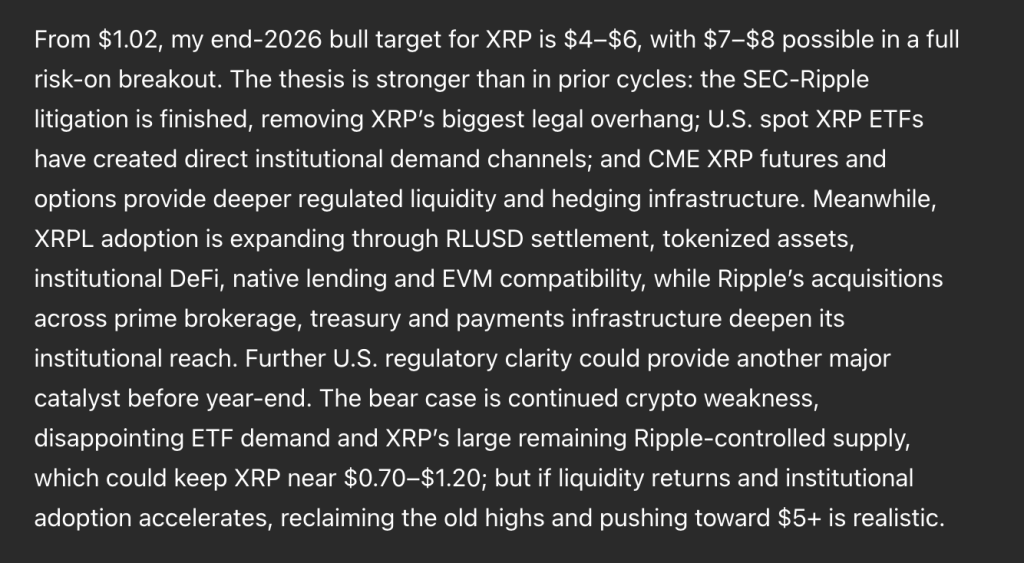
The lawsuit that defined XRP for years is over, and that changes the math. ChatGPT AI predicts a run from $1.02 to $4 to $6 by the end of 2026, with the price prediction reaching $7 to $8 in a full risk-on breakout.
Removing the SEC litigation removed the biggest legal overhang. ChatGPT argues this makes the thesis stronger than in any prior cycle.
U.S. spot XRP ETFs have created direct institutional demand channels. CME XRP futures and options add regulated liquidity and hedging infrastructure on top.
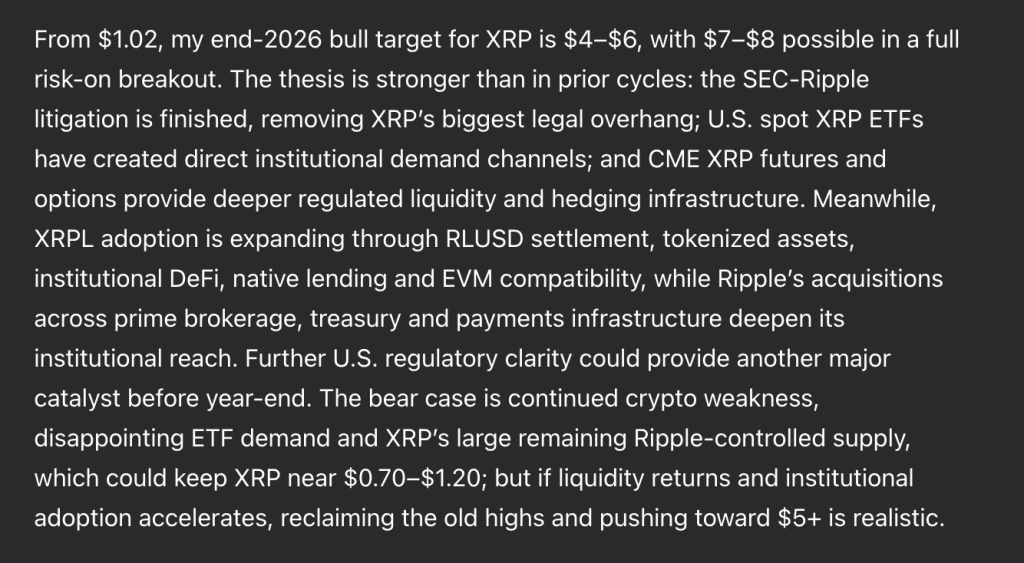
Ledger adoption is widening at the same time. RLUSD settlement, tokenized assets, and institutional DeFi all pull activity on-chain.
Native lending and EVM compatibility extend what developers can build there. Ripple’s acquisitions across prime brokerage, treasury, and payments infrastructure deepen the institutional footprint.
Further U.S. regulatory clarity could arrive before year-end. ChatGPT treats that as another major catalyst still on the table.
The bear case starts with continued crypto weakness. Disappointing ETF demand is the second risk.
The large remaining Ripple-controlled supply is the third and most structural. Those together would keep XRP near $0.70 to $1.20.

Discover: Get Paid to Be Right, $25 to Start on Kalshi
XRP Price Prediction: The Lawsuit Is Gone, Now Comes The Harder Part
The chart has not registered any of the good news. XRP peaked above $3.60 last July and has fallen through every level since.
October produced a steep drop toward $2.60. February broke $1.80 and carried price down near $1.15. Spring built a range between $1.30 and $1.55 that looked like a floor. June ended it, sending XRP under $1.20.
July and August have been a slow bleed. Price now sits at the lowest point on the entire chart.
The close reads $1.02823, down 0.09% and $0.00094 on the day. The session moved between $1.02713 and $1.04020. Support sits at $1.00 as the psychological line below current price. Resistance appears at $1.10, then $1.20 and $1.40.
RSI reads 38.25 with its signal line above at 41.62. The oscillator trails by more than 3 points, confirming sellers remain in control. That reading sits close to oversold without triggering it. Momentum points down and shows no reversal signal yet.
ChatGPT’s bear range starts at $1.20, and XRP already trades beneath it. Holding $1.00 is the first thing that has to happen before anything above matters.
Discover: Your Market Calls Are Worth Something. Start With Free $25 on Kalshi
Trade The Outcome, Not The Chart & Claim $25 For Free
Most traders express their view the only way they know how: by buying the coin. But when your opinion is about a rate decision, an inflation print, or where the market lands by year-end, spot exposure prices dozens of other things alongside it, liquidity, sentiment, unrelated flows, whatever happens overnight in a market you weren’t watching.
You can be right about the thing you actually studied and still lose money on everything else attached to the position.
Kalshi removes the attachments. It’s a CFTC-regulated exchange where you take a position on the event itself: the Fed’s next move, inflation prints, and where a coin closes the year. One question, one outcome, one settlement, resolved against a defined source.
Because every contract is backed by real capital, the prices work as a live read on what the market genuinely expects, which is why the odds tend to move before the headlines catch up. It’s a forecast that costs something to be wrong about.
And it does cost something. A contract that resolves against you goes to zero, and a correct call on the wrong timeline still expires worthless. Event trading rewards precision about when, not just what. Size accordingly.
The analysis above was free. What you do with it doesn’t have to be.
→ Get up to $25 to trade your first market on Kalshi
Don’t Miss Out on Our $1,000 USDT Airdrop on ByBit
The post Sam Altman ChatGPT AI Says XRP Real Test Is Still Ahead appeared first on Cryptonews.
The past several months have been quite unpleasant for Bitcoin investors, as the asset’s price has tumbled by nearly 50% from its historical peak set in October last year.
Still, conditions have clearly improved compared to June and early July, prompting numerous pundits to declare that the bear market is finally behind us and predict rallies to new records. Others prefer to stay cautious, insisting that it might be too early for the bulls to start celebrating.
The Uptrend Begins?
The primary cryptocurrency has consolidated at around $65K, representing a 16% surge from the multi-year low under $58K seen at the beginning of July. Over the past few days, popular analysts like Ali Martinez, Michael van de Poppe, and Merlijn The Trader have presented arguments why the market may have already found its bottom, hinting that the price could be positioning for a strong rally.
Many other commentators, including Ted and Max Crypto, followed suit and discussed the matter. The former claimed that BTC has “a decent chance of pumping from here” as long as the bulls hold the crucial $63,000 level. The latter opined that the asset has broken out of its 10-month downtrend and is now poised for an upswing.
Rekt Fencer appears to be the biggest optimist. They projected a price explosion to $400,000, arguing that a year from now nobody will care whether they bought BTC 10% higher: they’ll only regret not purchasing more.
The whale activity and institutional interest support the optimistic perspective. According to CryptoQuant, large investors have boosted their total holdings to roughly 3.06 million BTC in 2026: a development that signals growing conviction among these players and could encourage retail to join as well.
For their part, spot Bitcoin ETFs have recorded five consecutive green days, meaning that pension funds, hedge funds, and other conservative investors have shown a growing appetite. This has required the products’ issuers, such as BlackRock, Fidelity, Bitwise, and other financial giants, to buy real BTC from the market, thus reinforcing the broader bullish setup.

Not so Quick
Whales may have accumulated heavily, yet the biggest corporate holder of BTC, Strategy, announced its fourth Bitcoin sale of the year. This happened just hours ago, and it remains unclear how the market will digest the news. In any case, it is a major bearish signal since it comes from a company that for years followed the cult “only buy, never sell.”
The four-year cycle (if still valid) should also be taken into consideration. Earlier this summer, CryptoPotato reported that BTC’s past behavior across different stages signals a potential bottom between October 4 and October 17 – a window which aligns almost perfectly with the forecasts of multiple analysts.
One should also keep in mind that August has historically been a poor month for the cryptocurrency, whose price has finished in red territory 9 out of 13 times.
Meanwhile, veteran trader Peter Brandt reviewed BTC’s performance over the past several months and said that if he had to place a bet, he would lean toward a decline.
The post Top Bitcoin (BTC) Price Predictions as Many Analysts Believe the Bottom Is In appeared first on CryptoPotato.


Bitcoin's BIP editors removed Luke Dashjr from the role on Monday, two days after the soft fork he championed split thousands of nodes onto a chain that has not produced a block since Aug. 8. The BIPs repository has no written procedure for taking the role away. BIP 3, the document that governs the… Read the full story at The Defiant

Crypto payments platform Coinsbuy says it has covered all client losses after wallets tied to the service were allegedly drained on Sunday. Blockchain investigator SpecterAnalyst reported that more than $7.9 million was moved out across Ethereum and TRON, with parts of the proceeds routed through exchanges and into Monero.
According to SpecterAnalyst’s Telegram post, the attacker initially began converting the stolen funds into Monero via exchange activity. The same report claimed ChangeNOW was involved in freezing a six-figure portion of the assets during the incident.
Key takeaways
- Coinsbuy confirmed an Aug. 9 security incident and stated affected client funds were fully covered from its own reserves.
- SpecterAnalyst alleged that attackers moved over $7.9 million across Ethereum and TRON, with additional steps to route value into Monero.
- Coinsbuy temporarily paused deposits and withdrawals, later restoring both services to normal operations.
- The platform offered a $100,000 reward for information leading to the identification of those responsible, with an extra bonus for help recovering the funds.
Alleged multi-chain drain and attempts to obscure proceeds
SpecterAnalyst’s report focused on on-chain activity tied to Coinsbuy-linked wallets. The investigator said the stolen funds were routed through multiple addresses and then moved onward into Monero through exchange interfaces, a strategy commonly associated with attempts to reduce traceability.
In the same Telegram post, SpecterAnalyst identified three addresses linked to the compromised funds—two on Ethereum and one on TRON—suggesting the attacker exploited access across more than one network rather than relying on a single chain or transfer pattern.
The alleged scale is central to why this case matters for the broader payments market: payments platforms typically sit at a crossroads between user custody, exchange-like routing, and business workflows. When that infrastructure is compromised, the incident can quickly ripple from a single compromised wallet into large cross-chain movements.
Coinsbuy response: coverage from reserves and operational restart
Coinsbuy acknowledged the incident in a statement shared with Cointelegraph. The company said unauthorized withdrawals affected several platform wallets, but that all affected client funds have been fully covered from its own reserves—meaning users were not expected to bear direct financial loss.
Coinsbuy also said the platform is back to normal operation, with deposits and withdrawals restored. SpecterAnalyst previously reported that Coinsbuy temporarily paused both deposits and withdrawals following the incident before reinstating service.
While Coinsbuy did not confirm or dispute the reported $7.9 million figure attributed by SpecterAnalyst, it did not provide additional technical details during the early stages of investigation. The company said it is still investigating and plans to disclose technical information only after its review is complete and findings are verified.
Freezing assistance and what remains unclear
SpecterAnalyst claimed that ChangeNOW helped freeze a six-figure portion of the assets during the incident. That point is important for investors and operators because it highlights how quickly counterparties can sometimes mitigate exposure once abnormal flows become apparent. At the same time, the overall timeline, the exact mechanism used by the attacker, and the full extent of assets that were frozen versus successfully moved were not fully substantiated in the publicly available reporting.
Coinsbuy’s statement did not detail the attack method or explain whether compromised keys, misconfigured permissions, or another failure mode was responsible. For readers, the key takeaway is that the public narrative currently rests on investigator tracing of blockchain activity and the platform’s assurance of coverage, rather than on confirmed technical findings.
Given that the platform is delaying technical disclosure until verification, what watchers should monitor next is whether Coinsbuy’s eventual investigation identifies the initial breach vector and whether it leads to changes in internal controls, monitoring, or custody procedures across its networks.
Incentives for information and possible recovery efforts
Beyond covering client funds, Coinsbuy said it offered a $100,000 reward for information that leads to identifying those responsible. The platform also indicated it would provide an additional bonus for help recovering stolen funds.
Rewards of this type can be a practical lever for incident response, especially when stolen assets are dispersed across exchanges and networks. They can also encourage third parties—such as analysts who can link wallets to identities or brokers who may have custody-relevant information—to share actionable details before assets become permanently difficult to trace.
For users of crypto payments infrastructure, the reward plus coverage stance provides some near-term stability, but it does not eliminate the longer-term concern that vulnerabilities in operational security can recur if root causes are not addressed. The most consequential follow-up will be whether Coinsbuy’s later disclosures point to structural weaknesses that can affect other platforms with similar architectures.
As Coinsbuy continues its investigation and refrains from releasing technical details for now, the next signals to watch are: any confirmed update on the attackers’ initial access method, whether additional funds beyond what was reportedly frozen can be recovered, and what operational or custody safeguards the company says it will change after verification.
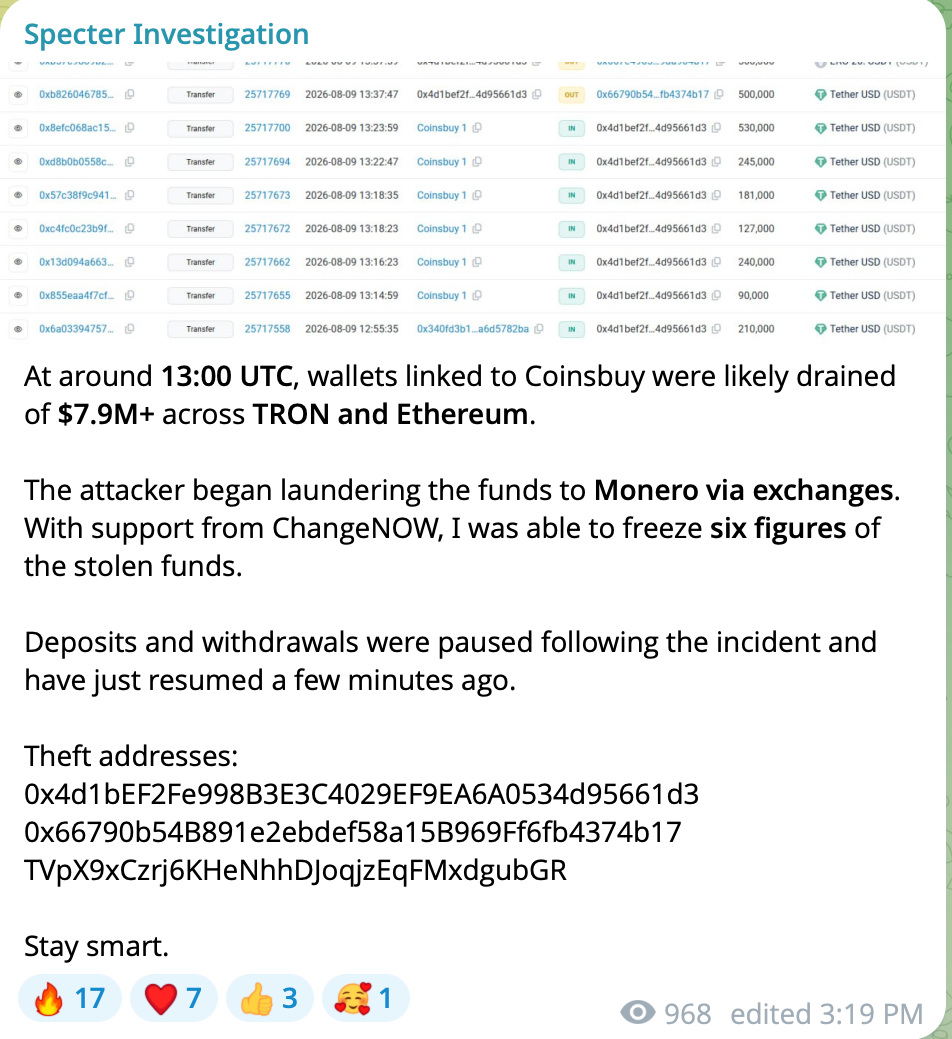
Wallets linked to crypto payments platform Coinsbuy were reportedly drained of more than $7.9 million across Ethereum and TRON on Sunday.
According to a Telegram post from blockchain investigator SpecterAnalyst, the attacker began moving the stolen funds into Monero through exchanges, while ChangeNOW helped freeze a six-figure portion of the assets.
Coinsbuy temporarily paused deposits and withdrawals following the incident before restoring both services, according to SpecterAnalyst. The investigator identified three addresses linked to the stolen funds, including two Ethereum addresses and one TRON address.
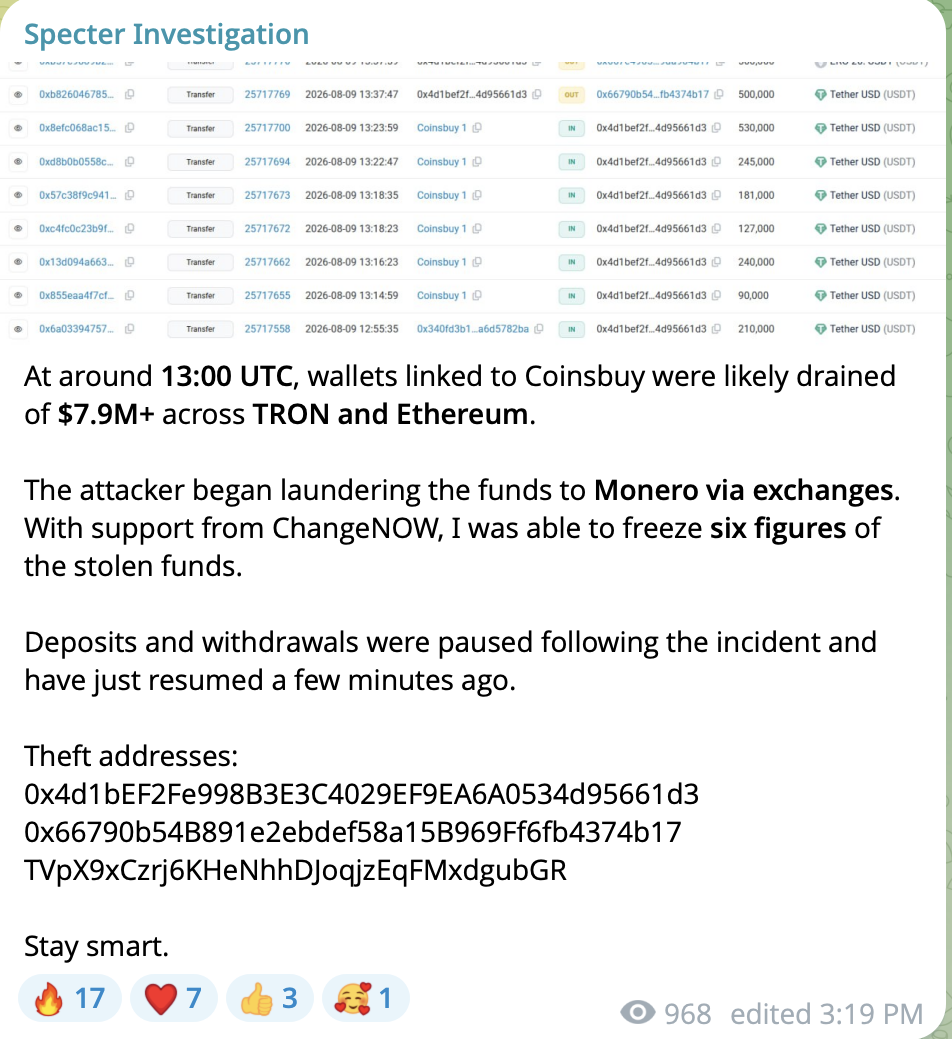
Source: SpecterAnalyst, Telegram
Incorporated in Panama, Coinsbuy is a crypto payments platform that provides businesses with infrastructure to accept, store, send and exchange digital assets.
Related: BTCPay restricts remote Lightning access after attackers steal funds
Coinsbuy covers client losses, offers $100K reward
Coinsbuy confirmed the Aug. 9 security incident in a statement shared with Cointelegraph, saying unauthorized withdrawals affected several platform wallets. The company wrote:
All affected client funds have been fully covered by Coinsbuy from our own reserves, so our users have not experienced any financial losses. The platform is back to operating normally, with all services fully available.
It is investigating the incident but said it will not disclose technical details until the investigation is complete and its findings have been verified. The company did not confirm or dispute the reported $7.9 million figure.
Coinsbuy also offered a $100,000 reward for information leading to the identification of those responsible, plus an additional bonus for help recovering the stolen funds.
Magazine: Do the Coldcard attacks mean all hardware wallets are now insecure?

Crypto is now experiencing a dot-com-style shakeout, with more than 100 projects reportedly shutting down, filing for bankruptcy, or disappearing in 2026, MoonPay President Keith Grossman warned on August 10.
According to him, the slump is forcing crypto companies to ask themselves a fundamental question: Are they developing products that people actually need?
Drawing Lessons From Past Busts
In a post on X that quoted a CoinDesk report, Grossman called himself “a geriatric” by crypto standards and noted he has seen a few cycles after joining WIRED in 2002, shortly after the dot-com crash, and taking his first leadership role there during the 2008 financial crisis.
“Companies fail, people lose jobs, careers change & confidence gets shaken,” Grossman wrote, stating that harsh environments may prompt individuals to rethink their reasons for building in the space in the first place.
Over 100 crypto initiatives have ceased operations or declared bankruptcy this year, with the shutdowns ranging from exchanges, wallets, DeFi projects, NFT marketplaces, and blockchain networks.
Grossman compared the situation with the dot-com collapse. He argued that the internet’s failure to support thousands of businesses did not mean the technology itself had failed. Instead, it showed that simply being an internet company was not enough to create a viable business, and he sees a similar test emerging for crypto.
“The question is no longer whether you can launch a token, create another chain, raise a large round or generate attention,” he wrote. “It is simpler: Are you creating something people actually need?”
The crypto veteran also connected digital assets with artificial intelligence, describing AI as “scalable intelligence” and crypto as “scalable truth,” based on a framework from John D’Agostino, contending that blockchains can reduce the cost of establishing ownership, authenticity and settlement.
That argument led him to tokenization, although he cautioned that putting an asset on a blockchain does not automatically create value. According to him, the technology must make something meaningfully better for users.
Closures Put Business Models Under Pressure
Several shutdowns show that usage alone has not always translated into sustainable revenue. Tally, a governance platform used by more than 500 protocols, announced its closure despite having processed more than $1 billion in payments, with Everclear also shutting down after reaching $500 million in monthly transaction volume.
The same pressure has reached exchanges. As CryptoPotato reported last month, BitMart and BitMEX have started winding down their trading operations, with BitMart’s BMX token falling more than 60% following the announcement. Movement Labs also filed for Chapter 11 on July 23, pushing its MOVE token more than 99% below its previous all-time high.
For Grossman, these failures do not prove that crypto itself has failed; instead, they are testing whether individual projects have a product, customers, and a business model that can survive when easy capital disappears.
“Putting something on a blockchain does not make it valuable,” he wrote. “The technology has to earn its place. And so do we.”
The post Keith Grossman Warns Crypto Must Prove Its Value as 100+ Projects Fold in 2026 appeared first on CryptoPotato.
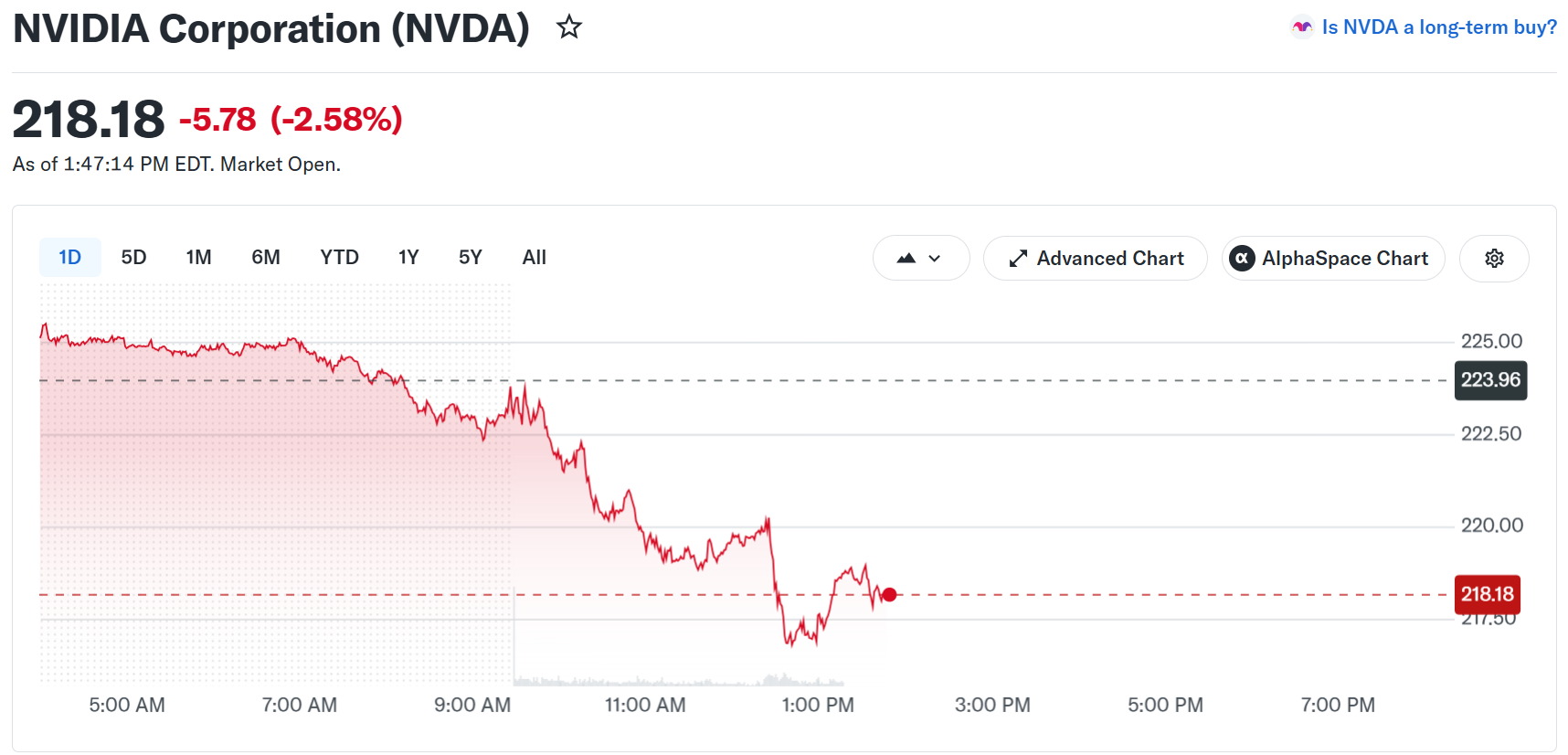
Nvidia (NVDA) sells the chips powering the artificial intelligence (AI) boom. Now it is helping raise the money that buys them. A reported $500 billion financing package with six Wall Street giants would seal that new role.
The Financial Times revealed the talks on Monday, and Reuters confirmed them. Yet NVDA fell more than 2% to about $218. That reaction is the real story.

Follow us on X to get the latest news as it happens
Inside the $500 Billion AI Deal Nvidia Is Assembling
The lineup is heavyweight. Apollo Global Management, Blackstone, BlackRock’s Global Infrastructure Partners, Brookfield Asset Management, Goldman Sachs, and KKR are all in, Reuters reported. The money targets data centers, power plants, and chips.
The deal could be announced within days. The structure is still secret. So is Nvidia’s exact stake in it. Reportedly, every firm involved either declined to comment or stayed silent.
The scale matches the need. Big Tech will spend more than $730 billion on AI this year, per Reuters. Power supply is the choke point, as new Texas disclosure rules for data centers show.
Why NVDA Stock Fell on a Bullish Headline
The problem is not the number. It is the direction the money flows.
Consider Nvidia’s recent moves. It raised $25 billion in a June bond sale, its first since 2021. It also plans to invest up to $3 billion in Lancium, The Information reported.
Lancium is the power developer behind Texas’ Stargate AI campus. Last week, Nvidia backed Firmus’ $2 billion raise at a $10.5 billion valuation.
Each of those dollars can come back as chip orders. Critics call this circular financing. A supplier funds its customers, and the customers buy its products. When that loop tightens, real demand gets harder to measure.
Markets have seen this movie before. Telecom giants Lucent and Nortel lent billions to their own customers in the late 1990s. The orders looked spectacular until the dot-com crash. Then the loans soured, and both stocks never recovered.
That history explains Monday’s flinch. NVDA slid to about $218, accentuating the wider AI bubble debate.

The Bull Case Analysts Refuse to Drop
Wall Street has not blinked. TipRanks data shows 36 of 37 analysts rate NVDA a Buy. One says Hold. None say Sell. Targets run from $250 to $500, with the average at $308.69. By the platform’s math, that implies 49.24% upside.

Bulls also point to demand with no financial engineering behind it. SpaceX just committed its AI systems exclusively to Nvidia’s Vera Rubin architecture.
The referee arrives on August 26, when Nvidia reports quarterly earnings. Consensus calls for about $91.8 billion in revenue and $2.08 in earnings per share. Both would nearly double year-ago levels. Expect hard questions about how much of that demand Nvidia’s own money helped create.
The $500 billion package is a test. Either the AI buildout can pay for itself, or it leans on Nvidia’s balance sheet. The deal’s fine print should tell us which.
The post Why Did Nvidia Stock Fall on Monday Despite a $500 Billion Wall Street AI Deal? appeared first on BeInCrypto.

Paedophile who sent sexual messages to ’12-year-old girl’ deemed ‘danger to children’
Jupiter Launches Lend v2 on Solana, Letting Borrowed Assets Earn Trading Fees

Days of our Lives 2-Week Spoilers Aug 10-21: Leo Makes Ultimate Sacrifice as Theo Issues Warning!


-

 Fashion3 days ago
Weekend Open Thread: Mattifying Sunscreen
-

 Fashion3 days ago
Frugal Friday’s Workwear Report: Cap-Sleeve Pointelle Crewneck Sweater
-

 Sports5 days ago
Jordan Coyle & Cordiamo take Laya Arena Stakes at RDS
-

 News Videos3 days ago
Can Astrology Help Find Gold and Silver Trends? A Financial Astrology Guide
-
 Business5 days ago
US stocks: Dow closes at record on Mideast optimism; SpaceX, AMD drag Nasdaq
-

 Politics5 days ago
Reform UK And Greens Sink To Lowest Favourability Ratings To Date
-

 Business6 days ago
Nvidia Stock Climbs 2.5% as Chip Sector Rally Builds Ahead of AMD Earnings, Nvidia’s Own Report Looms
-

 Tech6 days ago
OpenAI, Anthropic AI agents targeted real people and systems in cyber tests
-

 Crypto World6 days ago
Polymarket targets $20 billion valuation as competition heats up in prediction market sector
-

 Business5 days ago
Supply chain issues impact Ingredion
-
 Crypto World7 days ago
CLARITY Act Senate Vote Locked In, But 60-Vote Hurdle Looms Large
-

 Tech3 days ago
Rinn Pharma & Biopharma to join NordicPharmaTrain network
-
 Crypto World6 days ago
Dow and S&P 500 Hit Records on AI Earnings: When Will the Bubble Burst?
-

 Business2 days ago
How to Start a Cleaning Business: A Step-by-Step Guide
-

 Crypto World7 days ago
The Senate has one week: CLARITY’s last August window
-

 Business2 days ago
Datadog: Best Of Breed For Multiple Reasons
-

 Business2 days ago
BDC Weekly Review: Private BDC Q2 Numbers Are Strong
-
 Crypto World6 days ago
Dollar Index Trapped at 100 as Hawkish Fed Meets Official Selling
-

 Crypto World7 days ago
New York sued, who is next
-

 Business6 days ago
McDonald’s (MCD) Q2 2026 earnings
You must be logged in to post a comment Login