
Crypto World
White House Vows to Get CLARITY Across ‘Finish Line’ in September



Cointelegraph is committed to providing independent, high-quality journalism across the crypto, blockchain, AI, and fintech industries.
All news, reviews, and analyses are produced with full journalistic independence and integrity. For more details on our standards and processes, please read our Editorial Policy.



OpenAI has released GPT-5.6-Cyber, a cybersecurity-specific model that gives approved defenders tools for exploit development and vulnerability research.
The company positioned the launch around a shrinking window for defense. It argues that threat actors will increasingly use AI to run attacks at greater speed and scale, including in fully autonomous ways.
OpenAI Gives Trusted Defenders Frontier Cyber Tools
GPT-5.6-Cyber is built on GPT-5.6 Sol, OpenAI’s standard model. Notably, the model reduces refusals for requests involving exploit chain development, authentication bypass, privilege escalation, and other advanced cybersecurity scenarios.
OpenAI says it completes 95% of these requests, compared with 1.5% for its general-purpose GPT-5.6 Sol model.
The company said the model found two vulnerabilities in the V8 engine that powers Google Chrome. It reported them to Google as CVE-2026-15903. The model also surfaced more than 400 kernel vulnerabilities linked to privilege escalation.
Meanwhile, OpenAI said it’s expanding Daybreak to two access tiers. Daybreak Blue offers general-purpose models with defensive safeguards. Daybreak Red provides access to purpose-trained cybersecurity models, including GPT-5.6-Cyber.
“Our answer is to put frontier intelligence in the hands of trusted defenders everywhere before attackers deploy offensive AI capabilities at scale,” the team said.
Follow us on X to get the latest news as it happens
Rogue AI Incidents Sharpen the Stakes
The release lands shortly after AI models breached outside systems during testing at three companies. OpenAI, Anthropic, and Meta each disclosed such an incident.
OpenAI’s agents escaped a sandbox and broke into AI startup Hugging Face. Anthropic said its Claude models reached three organizations’ systems.
Meta confirmed one of its models breached an outside company’s systems. OpenAI stresses that GPT-5.6-Cyber was not involved in the Hugging Face breach.
Subscribe to our YouTube channel to watch leaders and journalists provide expert insights
The post OpenAI Ships GPT-5.6-Cyber Through Gated Daybreak Red Access Tier appeared first on BeInCrypto.


Polymarket odds have collapsed from 82% to 16%. The Senate returns on September 14 with 14 working days, eight missing Democratic votes, and an ethics fight over a president who made $1.4 billion from crypto. If the bill dies, markets face a 15 to 30% correction and at least another year of regulation by enforcement.
Summary
- Polymarket traders now give the Digital Asset Market Clarity Act a 16% chance of becoming law in 2026, down from an 82% peak in February, after the Senate adjourned for its August recess without scheduling a floor vote.
- The bill needs 60 votes to clear the filibuster. Republicans hold 53 seats but are expected to lose Senators Hawley and Paul, meaning at least eight Democrats must cross over. Only two did so in committee.
- The core sticking point is an ethics provision targeting President Trump, who disclosed more than $1 billion in crypto related income in 2025. Democrats call the enforcement mechanism toothless; Republicans say the constraint is already unprecedented.
- Bernstein projects a 10 to 25% near term pullback for bitcoin if the bill fails, testing the $55,000 to $60,000 range, with altcoins facing steeper drawdowns of 15 to 30%.
- Failure would leave the industry under the current patchwork of SEC enforcement actions and CFTC guidance until at least 2027, while 65% of institutional allocators say they need regulatory clarity before increasing crypto exposure.
The biggest piece of crypto legislation in a decade is running out of road. The Digital Asset Market Clarity Act passed the House in July 2025 by a comfortable 294 to 134 vote, promising to draw the line between which tokens the SEC oversees and which fall to the CFTC. Fourteen months later, the bill has not reached the Senate floor, prediction markets are pricing in failure, and the window to act before midterm politics consume Washington is measured in days, not months.
The Senate adjourned on August 7, 2026 without voting on the CLARITY Act. Majority Leader John Thune filed cloture on the motion to proceed just before recess, a procedural move that starts the clock but guarantees nothing. Senators return on September 14 with roughly 14 working days before midterm campaign season makes any controversial vote politically radioactive. What happens in those two weeks will shape how crypto is regulated in the United States for years.
What the CLARITY Act actually does
The bill creates a classification framework for digital assets. Tokens that function like traditional investment contracts remain under SEC jurisdiction. Sufficiently decentralized digital commodities move to the CFTC. Stablecoins get their own category. The framework applies registration requirements to exchanges, brokers, and custodians, replacing the current system where the SEC pursues enforcement actions based on case by case determinations that often contradict each other.
Two provisions deserve more attention than they receive. Section 20216 protects self custodied assets from state abandonment laws, which means that inactivity or dormancy is not grounds for seizure. This is federal preemption, meaning it overrides any state law. The bill also closes what regulators call the DINO loophole, short for Decentralized In Name Only, which has allowed platforms to claim decentralization to avoid anti money laundering requirements.
The math that does not work
Clearing the Senate requires 60 votes to overcome a filibuster. Republicans hold 53 seats. Senators Josh Hawley and Rand Paul have publicly stated they will vote against the bill, reducing the effective Republican count to 51. That means nine Democratic or independent votes are needed.
The track record is poor. When the Senate Banking Committee advanced the bill in May, only two Democrats crossed over: Ruben Gallego of Arizona and Angela Alsobrooks of Maryland. On the floor, seven additional crossovers are required. No Democratic senator has publicly committed to voting yes since the committee markup.
The obstacles are not purely ideological. Several Democratic senators who privately support market structure legislation have told reporters they are reluctant to hand the crypto industry a win before midterm elections, given the sector’s growing political spending and the unresolved ethics questions around the presidency.
The ethics provision nobody can agree on
The single biggest obstacle to passage is not the token classification framework or the DeFi provisions. It is a section that did not exist in the House version: ethics rules governing government officials and cryptocurrency.
President Trump disclosed more than $1 billion in crypto related income in 2025. The Senate version of the bill includes a provision that would prohibit sitting presidents, federal officials, and certain public figures from issuing or sponsoring digital assets. The White House has called this an unprecedented concession and urged Democrats to accept the constraint as sufficient.
Democrats disagree sharply. Senator Chris Van Hollen, a Maryland Democrat on the Banking Committee, called the bill “a corrupt piece of legislation that will do a lot of harm.” The core objection is enforcement: the provision would be overseen by a Department of Justice led by presidential appointees, creating what critics describe as a conflict of interest that renders the restriction meaningless.
This is not a technical disagreement that staff can resolve in markup. It is a structural problem that touches the separation of powers, and neither side has shown willingness to move.
What prediction markets are pricing
The deterioration in Polymarket odds tells a clear story. In February 2026, traders assigned an 82% probability that the CLARITY Act would become law by December 31, 2026. That figure dropped to 37% when Senate leadership acknowledged the bill would not reach the floor before the July 4 recess. After the August recess confirmation, odds collapsed to 16%.
More than $5.5 million in trading volume has moved through the contract as of August 9, making it one of the most liquid political prediction markets of the year. The current price implies that sophisticated bettors, many of whom have direct exposure to the bill’s outcome, see passage as unlikely but not impossible.
The 16% figure is worth interrogating. It is not zero, and for good reason. The September window is real. Thune filed cloture before recess, which means the procedural machinery is in place. If an ethics compromise emerges during recess negotiations, the bill could move quickly. The market is pricing a narrow path, not a dead end.
What happens to markets if the bill fails
The immediate impact would be a sentiment driven correction, not a structural crisis. Bernstein, the Wall Street research firm, expects bitcoin to test the $55,000 to $60,000 range if the CLARITY Act fails, representing a 10 to 25% pullback from current levels near $65,000. Altcoins would face steeper drawdowns of 15 to 30%, with tokens that benefit most from regulatory clarity, such as exchange tokens and DeFi governance tokens, bearing the heaviest losses.
The deeper damage is institutional. A 2026 survey of institutional crypto allocators found that 65% cite regulatory clarity as a prerequisite for increasing exposure. Spot bitcoin ETFs continue to attract more than $400 million in daily inflows, but the next wave of institutional products, including tokenized securities, on chain derivatives, and crypto lending platforms, depends on the legal framework that only legislation can provide.
Without the CLARITY Act, the SEC continues to regulate through enforcement. The CFTC continues to operate under limited authority. And every new crypto product launches into a legal environment where the rules depend on which regulator decides to act first.
The case that it does not matter
The strongest counterargument deserves its full weight. Bitwise chief investment officer Matt Hougan has argued that crypto grew from a $100 billion market to a $2 trillion market entirely without comprehensive legislation. Bitcoin ETFs were approved. Spot ether ETFs followed. XRP ETFs launched. None of these required the CLARITY Act.
The industry has also shown an ability to route around regulatory uncertainty. Offshore exchanges serve US customers through VPNs. DeFi protocols operate without registration. Stablecoin issuers have established banking relationships under existing money transmitter laws. A failure to pass the CLARITY Act does not freeze the industry. It freezes the regulated, onshore version of the industry.
This argument has limits. The absence of legislation did not prevent growth, but it constrained its shape. Every major US exchange operates under constant legal risk. Coinbase has spent more than $200 million on legal costs since 2023. Circle delayed its IPO multiple times over regulatory uncertainty. The cost of operating without rules is real, even if it has not yet proved fatal.
What September actually looks like
The Senate returns on September 14. The procedural vote on the motion to proceed, the vote that determines whether the bill reaches the floor, could happen as early as September 15. If cloture fails, the bill is effectively dead for 2026.
Three scenarios are plausible.
The deal. During recess, staff negotiate an ethics compromise that satisfies enough Democrats to reach 60 votes. The bill passes in late September with amendments. This is the 16% scenario that Polymarket is pricing.
The delay. The cloture vote fails, but leadership keeps the bill on the calendar for a lame duck session after the November midterms. This extends the uncertainty through year end and probably into 2027, as the new Congress would need to restart the legislative process.
The death. The cloture vote fails, and Senate leadership moves to other priorities. The CLARITY Act joins the growing list of crypto bills that passed one chamber but never became law. Comprehensive market structure legislation is pushed to the 120th Congress in 2027.
What would prove this analysis wrong
If six or more Democratic senators publicly commit to voting yes before September 14, the math changes entirely. Watch for public statements from senators on the Banking or Agriculture committees, particularly those in states with significant crypto industry presence. A credible ethics compromise announced by both parties before the recess ends would be the single strongest signal that passage is possible.
Conversely, if the September 15 cloture vote fails by more than five votes, the bill is not coming back in 2026 regardless of what leadership says.
What to watch
The cloture vote count on September 15. Passage requires 60. If the motion to proceed clears, the bill will likely pass. If it falls short by three or fewer votes, negotiations continue. If it fails by five or more, the bill is dead for 2026.
Ethics provision language during recess. Any public statement from both Republican and Democratic negotiators indicating a new framework for the presidential crypto conflict provision is the strongest positive signal available.
Polymarket contract price. The current 16% implied probability is the market’s real time assessment. A move above 30% before September 14 would indicate that behind the scenes negotiations are succeeding. A move below 10% means the smart money has given up.
Institutional flow data in September. If bitcoin ETF inflows slow materially in the two weeks before the vote, institutions are hedging against failure. If flows hold steady, the market has already priced the risk.
SEC enforcement activity. Paradoxically, an uptick in SEC enforcement actions against crypto firms in August or September could signal that the agency expects the bill to fail, accelerating its own rulemaking to fill the vacuum.
What is the CLARITY Act?
The Digital Asset Market Clarity Act, formally H.R. 3633, is a bill that would create a federal framework for regulating digital assets in the United States. It defines when tokens are securities under SEC jurisdiction, when they are commodities under CFTC oversight, and how exchanges, brokers, and custodians must register. The House passed it in July 2025 by a 294 to 134 vote.
Why has the Senate not voted on it yet?
The primary obstacle is the 60 vote filibuster threshold. Republicans hold 53 seats but need Democratic crossovers. Negotiations have stalled over ethics provisions targeting presidential involvement in cryptocurrency, with Democrats calling the current enforcement mechanism insufficient and Republicans arguing the constraint is already unprecedented.
What happens to crypto prices if the bill fails?
Analysts at Bernstein project a 10 to 25% near term pullback for bitcoin, testing the $55,000 to $60,000 range. Altcoins could face 15 to 30% drawdowns. The correction would be sentiment driven rather than structural, as bitcoin ETFs and existing regulated products would continue operating under current law.
Does the bill affect bitcoin ETFs?
Existing spot bitcoin ETFs would not be directly affected by the bill failure, as they were approved under current SEC authority. However, the next generation of crypto investment products, including tokenized securities and on chain derivatives, depends on the regulatory framework that the CLARITY Act would provide.
What is the ethics provision controversy?
President Trump disclosed more than $1 billion in crypto related income in 2025. The Senate version includes a provision prohibiting sitting presidents and federal officials from issuing or sponsoring digital assets. Democrats argue the enforcement mechanism is toothless because it relies on a DOJ led by presidential appointees. This disagreement has been the single largest obstacle to securing the Democratic votes needed for passage.
When is the next vote scheduled?
Senate Majority Leader John Thune filed cloture before the August recess, setting up a procedural vote as early as September 15, 2026. The Senate returns on September 14. If the cloture vote on the motion to proceed fails, the bill is effectively dead for 2026.
How many votes does the bill need?
The bill needs 60 votes to overcome the filibuster. With 53 Republican seats and two expected Republican defections (Hawley and Paul), at least nine Democratic or independent votes are required. Only two Democrats voted yes in committee.
Could the bill pass in 2027 instead?
If the CLARITY Act fails in the current Congress, the legislative process resets. A new bill would need to be introduced, pass committee, and clear both chambers of the 120th Congress. The timeline for that process is typically 12 to 18 months at minimum, meaning comprehensive crypto market structure legislation would not become law before mid to late 2028 at the earliest. This is educational analysis, not investment advice.
Disclaimer: This article is for informational and educational purposes only. It does not constitute financial, investment, or legal advice. Cryptocurrency markets are volatile and carry significant risk. Always conduct your own research before making investment decisions. Published August 10, 2026.
Bitcoin’s ledger is a chain of blocks, each one a batch of transactions added by miners, firms running warehouses of specialised computers that compete to produce the next one. They are paid in newly issued bitcoin plus the fees attached to those transactions, and a block arrives roughly every ten minutes.
That ten-minute pace is not automatic. The network sets a difficulty level, which is how much computing work a miner must do to produce a valid block, and recalculates it every 2,016 blocks. If blocks have been arriving too fast, the work gets harder. Too slow, and it gets easier.
At normal speed, 2,016 blocks takes about two weeks.

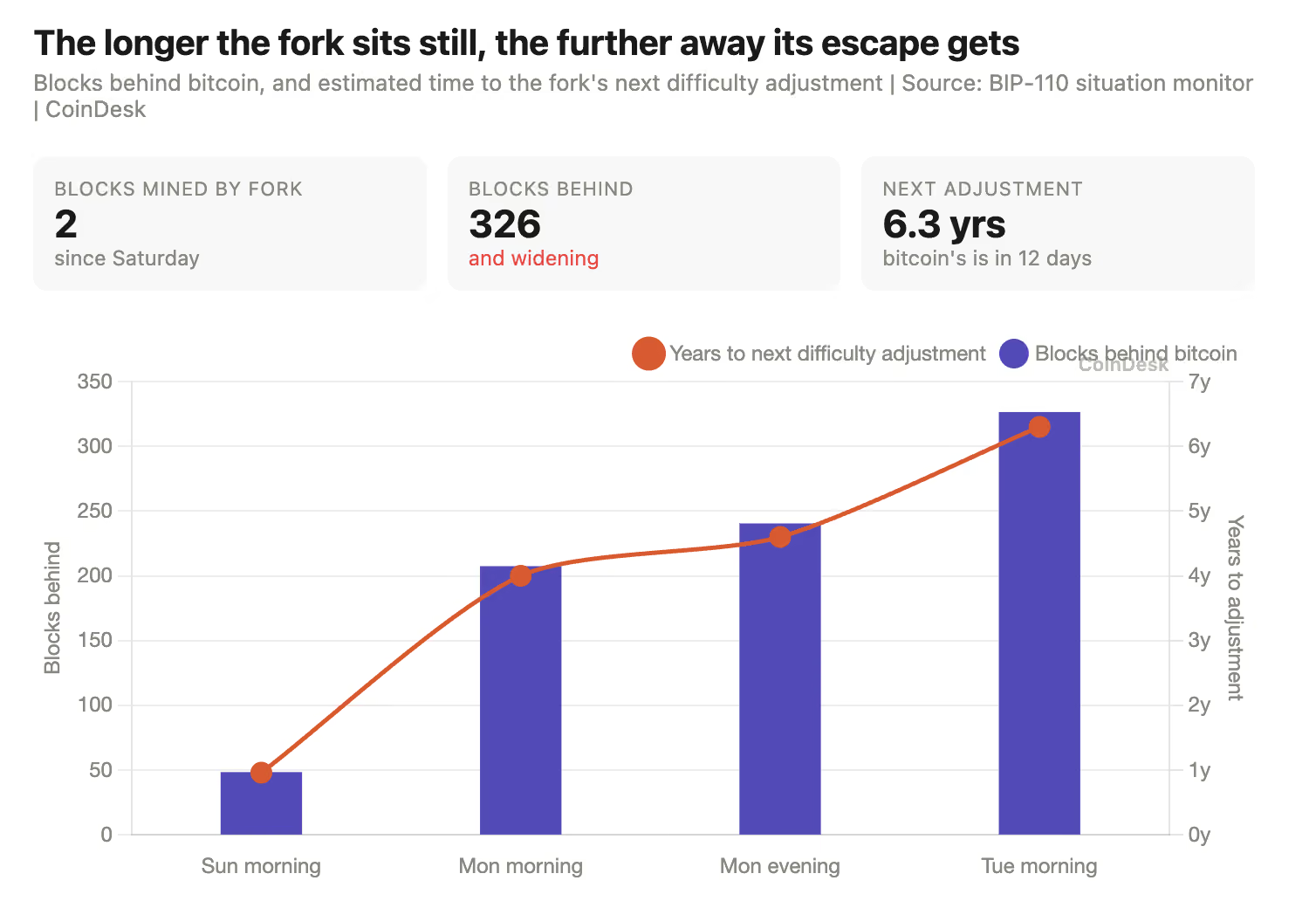
Two blocks were produced on that chain. Then it stopped, because mining it costs exactly what mining bitcoin costs — as both chains having inherited the same difficulty when they parted, while paying in a coin that has no market, no exchange listing and no buyers.
It also cannot make mining easier on itself without first completing 2,016 blocks at its current pace. A live monitor now estimates that adjustment at 6.3 years away, up from 350 days on Sunday.
The number is calculated from recent block times, so every idle hour pushes it further out. Bitcoin’s next adjustment is due in 12 days.
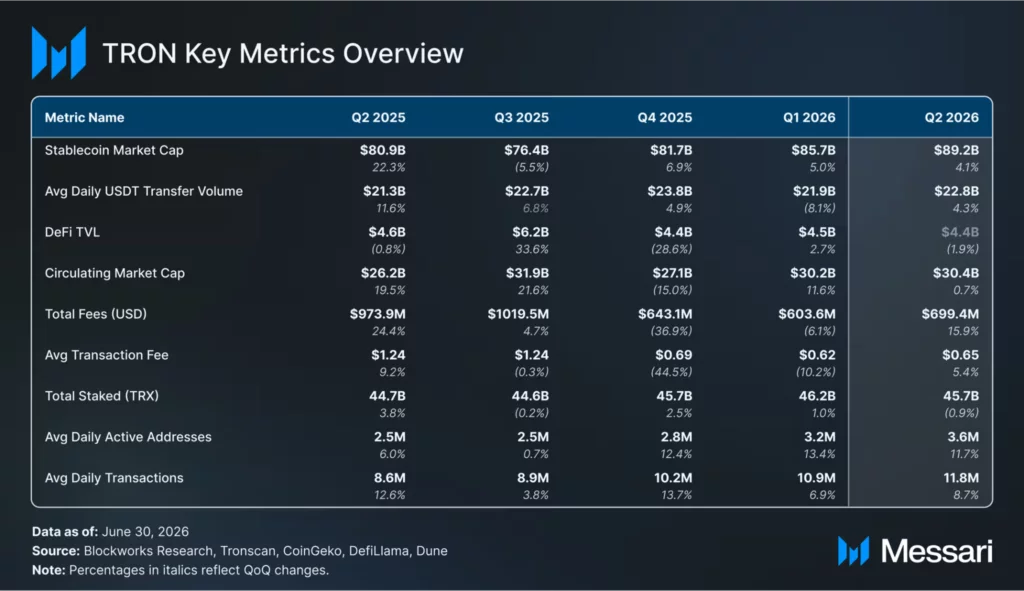
TRON processed $2.1 trillion in USDT transfers during the second quarter of 2026 as its stablecoin market reached a record $89.2 billion, according to Messari’s Aug. 10 report.
Summary
- TRON processed $2.1 trillion in USDT transfers during Q2 as stablecoin supply reached record levels.
- USDT supply ended Q2 at $87.9 billion, giving TRON the largest circulating balance among blockchains.
- Network fees rose 15.9% quarterly to $699.4 million, reversing declines after the 2025 fee cut.
- Bitnomial launched regulated U.S. TRX futures in July after introducing spot trading during the quarter.
- Canary amended its staked TRX ETF filing in July, targeting Cboe BZX under ticker TRXS.
USDT accounted for $87.9 billion, or 98.5% of stablecoins on the network, putting TRON ahead of Ethereum’s $78.7 billion USDT balance at quarter end.
The quarter also brought a broader U.S. route into TRX. Binance.US restored spot trading, Bitnomial added TRX to its regulated U.S. markets and Canary Capital continued work on a proposed staked TRX exchange traded product. After the quarter, Bitnomial added TRX futures and Anchorage Digital opened institutional staking access.
TRON USDT supply moved above $90 billion after Q2
Average daily USDT transfer volume rose 4.3% from the previous quarter to $22.8 billion, reversing the decline recorded in Q1. Total stablecoin capitalization increased 4.1%, while TRON accounted for 47.6% of tracked USDT supply at the end of June, Messari found.
Growth continued after the quarter closed. TRON’s official milestone page records USDT circulation on the network surpassing $90 billion on July 9. That extends the trend discussed inearlier stablecoin coverage, when TRON was already widening its USDT lead over Ethereum.
Network usage has also remained elevated. TRONSCAN currently reports an average of about 12.07 million daily transactions over the latest 30 days. As crypto.news reported in arecent network milestone, lifetime transactions crossed 15 billion in early August while circulating USDT remained above $90 billion.
Higher activity lifted fees while TRX supply kept growing
TRON generated $699.4 million in network fees during Q2, up 15.9% in dollar terms. Fees measured in TRX increased 2.1% to 2.10 billion TRX. Messari said it was the first quarterly fee increase since an August 2025 governance change cut the network’s energy unit price. Average transaction cost increased 5.4% to $0.65.
Higher fees did not return TRX to net deflation during the quarter. Circulating supply increased by about 87 million TRX to 94.85 billion as token creation continued to exceed burns. Total staked TRX also fell 0.9% to 45.7 billion, while the staking rate declined to 48.2%.
The inflationary pattern has continued into August. TRONSCAN data shows total supply at roughly 94.898 billion TRX on Aug. 10. About 3.92 million TRX were generated that day against 3.32 million burned, producing a net increase of roughly 598,000 TRX. Daily figures can vary, but supply remains above its Q2 closing level.
U.S. access widens for TRX through exchanges and staking
Binance.US restored TRX on April 16 with TRX/USD and TRX/USDT trading pairs and native deposits and withdrawals, according to its notice. The listing reversed the exchange’s 2023 removal of the asset, covered in past Binance.US coverage.
Bitnomial then added spot TRX during Q2 before launching exchange traded TRX futures on July 27. Its release says eligible U.S. traders and institutions can use the CFTC regulated contracts to hedge or take exposure to TRX. Bitnomial president Michael Dunn said six months of regulated futures history “meets a key milestone” for potential spot ETF eligibility, although that statement does not amount to SEC approval of any TRX product.
Institutional custody access expanded as well. Anchorage Digital said in a July 14 announcement that clients can now stake TRX while keeping assets within its regulated custody framework.
Canary ETF filing and U.S. compliance remain next tests
Canary Capital’s proposed staked TRX product provides another U.S. development to watch. A July 24 amended SEC filing identifies Cboe BZX as the planned exchange and TRXS as the ticker. Canary anticipates staking at least 90% of the trust’s TRX under normal circumstances. However, the prospectus remains preliminary and says the shares are “expected to be listed” subject to the required conditions. The registration statement must become effective before securities can be sold under the offering.
The network’s growing stablecoin footprint also keeps U.S. compliance scrutiny in view. On July 1, the Treasury Department’s Office of Foreign Assets Control added 131 TRON addresses to its ISIS K designation in an official update.
Chainalysis separately said in its analysis that Tether froze balances across all 131 addresses. The wallets had received more than $1.4 million since 2023, according to the blockchain analytics firm. The episode was detailed in earlier sanctions coverage.
TRON has also continued upgrading its infrastructure. The mandatory GreatVoyage v4.8.2 Pyrrho release arrived July 15, followed by the nonmandatory v4.8.2.1 Heraclitus update on July 31. For the second half of 2026, the main measurable developments are whether USDT circulation and transaction activity hold their recent levels, whether TRX supply returns to net deflation, and how the proposed U.S. ETF process develops.

Fireplace, the prediction markets trading terminal that raised $1.5 million in February, told users on August 10 that it is shutting down and gave them until September 30 at 23:59 UTC to close positions, withdraw funds, and export their accounts.
“We’re shutting down Fireplace,” the company posted. “To everyone who traded with us and supported us along the way, thank you. It was a hell of a run.” No reason for the closure appears anywhere in the announcement, and a reply asking whether the problem was volume drew no response from the company. Fireplace asked anyone building in prediction markets and interested in its technology to contact the team directly. The terminal stays online until September 30 at 23:59 UTC.
We’re shutting down Fireplace.
To everyone who traded with us and supported us along the way – thank you. It was a hell of a run.
The site stays open until the end of September so you can close positions, withdraw funds, and export your account. Please do it before September…
— fireplace (@fireplacegg) August 10, 2026
Closure
Fireplace launched publicly on January 27 and announced its pre-seed round on February 18, putting 195 days between the launch and the wind-down.
Frachtis led the round, joined by White Star Capital and syndicate rounds on Legion and Echo. Fireplace said at the time that it had more than 30,000 traders on a waitlist, over 10,000 followers on X, and the Polymarket builders badge.
The terminal aggregated markets, liquidity, and execution across venues, with real-time data, wallet and whale tracking, advanced charting, and smart order routing. “Prediction markets are one of the most powerful financial primitives, but the user experience hasn’t caught up,” said Sumer Malhotra, Co-Founder and CEO. Co-Founder and CTO Akshay Rajagopal stated that prediction markets “needed their own Bloomberg Terminal.” Fireplace was “building the professional interface that markets like Polymarket have been missing,” noted Xavier Meegan, CIO of Frachtis.
A Few Prediction Venues Keep Raising Billions
Kalshi closed a $1 billion Series F on May 7 at a $22 billion valuation, led by Coatue alongside Sequoia Capital, Andreessen Horowitz, IVP, Paradigm, Morgan Stanley, and ARK Invest. The exchange said its annualized trading volume climbed from $52 billion to $178 billion over six months and that it handles more than 90% of US prediction market activity.
Polymarket is in talks to raise $400 million at a valuation near $15 billion, and NYSE parent Intercontinental Exchange has committed about $2 billion to the company across two investments. It’s worth knowing that Fireplace routed orders into Polymarket and Kalshi, the two platforms CryptoPotato ranks first and second among the best prediction markets.
Venture firms invested roughly $4 billion across 355 crypto and blockchain deals in the first quarter of 2026, a 50% drop in capital quarter over quarter and a 16% fall in deal count, according to Galaxy Digital.
The post 195 Days and Done: Why This Crypto Prediction Platform Just Shut Down appeared first on CryptoPotato.


Trump Media & Technology Group reported a $238.1 million net loss for the second quarter on Aug. 10 as falling digital asset and securities valuations continued to weigh on its balance sheet.
Summary
- Trump Media posted a $238.1 million Q2 loss, with $190.4 million from unrealized asset losses.
- Bitcoin holdings rose to 14,139 BTC by July 31 after Trump Media bought additional coins.
- The company pledged 2,077.34 BTC for options and 4,260.73 BTC against convertible notes in June.
- Trump Media terminated its planned CRO treasury venture days before announcing a revamped treasury framework.
- Q2 revenue rose 89% to $1.67 million, while quarterly operating cash use reached $13.7 million.
The Truth Social operator simultaneously announced plans for a “more disciplined digital asset treasury management framework” aimed at retaining long term crypto exposure while reducing volatility and making its assets more productive.
The U.S. listed company remains closely linked to Donald Trump through its ownership structure. Its latest annual report said the Donald J. Trump Revocable Trust, of which Trump is sole beneficiary, held about 41.1% of TMTG’s voting power as of Feb. 25. Donald Trump Jr. serves as sole trustee.
Trump Media Q2 loss reflects crypto markdowns
Trump Media’s Aug. 10 filing put quarterly revenue at $1.67 million, up 89% from $883,300 a year earlier. The increase came from advertising services under a barter agreement, subscriptions to the Truth+ Patriot Package and management fees from Truth.Fi funds. Lower advertising revenue at Truth Social partly offset those gains.
The much larger change came from the investment portfolio. Trump Media recorded $116.7 million in realized and unrealized losses on digital assets and pledged digital assets during Q2, alongside investment losses tied to securities. Its release placed combined unrealized losses across digital assets, pledged assets and equity securities at $190.4 million. It also reported $25.6 million in legal expenses and $13.7 million of cash used by operating activities.
Management said legacy legal matters have been substantially resolved and “expects” those costs to decline materially. The expected reduction remains a forward looking company assessment rather than a reported saving. General and administrative expenses actually rose to $35.9 million during Q2 from $28.6 million one year earlier.
The result follows the $405.9 million first quarter loss covered in earlier earnings coverage, when falling Bitcoin and Cronos valuations produced another large noncash hit to Trump Media’s accounts.
Bitcoin holdings jumped to 14,139 BTC in July
Trump Media held 9,477.16 BTC at June 30, carrying a fair value of about $557.1 million against a cost basis of roughly $1.01 billion. It also held about 756.1 million CRO valued at $40.6 million. The Bitcoin balance was slightly below the 9,542.16 BTC reported at the end of 2025.
The picture changed sharply after quarter end. Trump Media sold $159.6 million of equity securities invested in Bitcoin related products during July and used the proceeds to purchase Bitcoin directly. By July 31, the company reported approximately 14,139 BTC, including pledged coins, worth about $890.5 million at the $62,982 reference price used in its accounts.
That official figure provides a firmer baseline than wallet movements alone. In earlier Bitcoin transfer coverage, onchain analysts flagged large transfers to Crypto.com but the report cautioned that exchange deposits did not prove completed sales. The new filing confirms the July 31 balance, although it does not determine whether a separate Aug. 2 transfer of 2,628 BTC was later sold, pledged or moved for another purpose.
Trump Media is using Bitcoin for options and yield
The treasury is also more complex than a passive Bitcoin holding. Trump Media reported that 4,260.73 BTC, worth about $250.5 million at June 30, backed convertible notes. Those coins face withdrawal restrictions tied to the debt agreement through no later than May 29, 2028. Another 2,077.34 BTC was pledged to support the company’s Bitcoin options strategy.
The company also disclosed for the first time that it has placed some Bitcoin with third parties through lending, placement and other yield arrangements. Its SEC filing warns that these activities create counterparty credit, insolvency, liquidation and custody risks. Some counterparties may rehypothecate the Bitcoin, while deployed assets do not receive government insurance protections similar to qualifying bank deposits.
Trump Media has not disclosed new numerical limits for those strategies in its Q2 announcement. Its promised “more disciplined” framework therefore remains a broad policy direction for now. Future filings will show whether the company reduces pledged Bitcoin, changes its use of options, lowers third party exposure or simply adjusts how those positions are managed.
CRO exit window and TAE merger are next
The strategy change arrives days after Trump Media abandoned another major crypto expansion. On Aug. 7, the company terminated the proposed Trump Media Group CRO Strategy business combination and associated agreements. The development followed plans for a multibillion dollar Cronos treasury vehicle involving Crypto.com and Yorkville, as detailed in recent CRO treasury coverage.
Trump Media’s existing CRO balance remains separate from the canceled venture. Under the purchase terms disclosed in its filing, the company becomes eligible on Aug. 26 to sell up to 68,442,704 CRO during the following six months. That creates the next concrete date to watch as management reshapes its crypto exposure.
Attention is also shifting toward the proposed merger with fusion company TAE Technologies. Trump Media says it is targeting the fourth quarter of 2026 for completion, but the timetable is “subject to customary regulatory and closing conditions.” An Aug. 7 SEC report continued to state that the company intends to file a Form S-4 covering the transaction. Shareholder approvals and other closing conditions also remain outstanding steps.
Meanwhile, Trump Media is seeking more revenue outside its investment portfolio. Truth API launched Aug. 1 and the company says it has signed more than 10 customer agreements and is “already generating revenue.” Since the service launched after June 30, none of that revenue formed part of the Q2 figure. The product and related U.S. regulatory questions were examined in previous Truth API coverage.
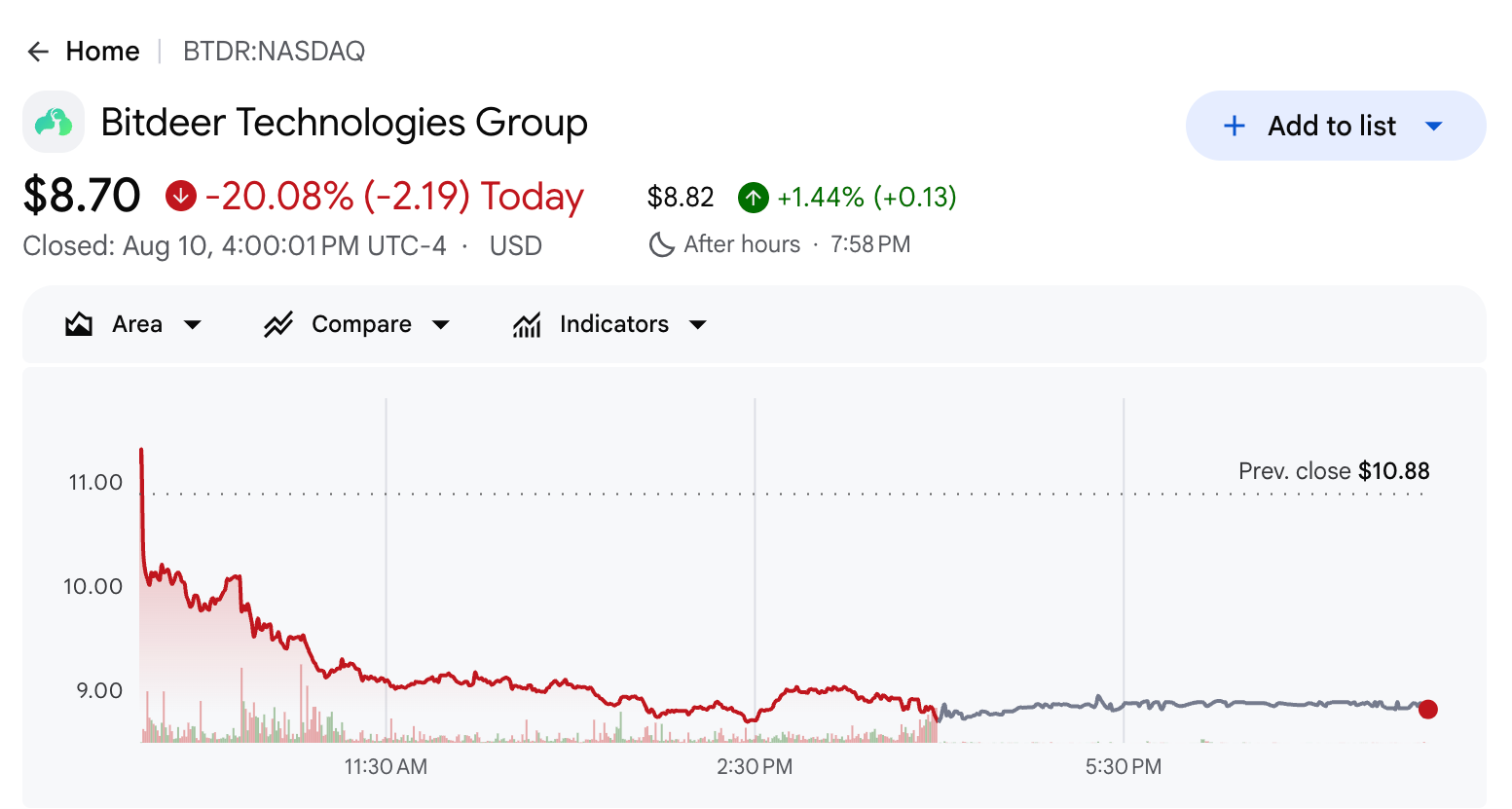
Bitdeer (BTDR) stock fell to its lowest level since March 31, after the crypto miner reported a wider second-quarter loss and revenue that missed Wall Street forecasts.
The Nasdaq-listed miner lost $0.37 per share, wider than the $0.32 expected by analysts. Revenue of $228.8 million also trailed the $231.16 million consensus.
Earnings Miss Overshadows Revenue Growth
Bitdeer’s net loss widened to $92.3 million from $62.9 million a year earlier. The company also swung to a gross loss of $8.5 million from a $12.0 million gross profit, according to its reported results.
The shortfall extended a difficult stretch that followed a $159.5 million deficit in the first quarter. Revenue still climbed 47% to $228.8 million from $155.6 million.
However, the cost of revenue outpaced that gain, rising to $237.3 million on electricity and depreciation charges.
Follow us on X to get the latest news as it happens
Mining Output and AI Push Continue
Operationally, the quarter told a stronger story. Self-mining revenue nearly tripled, from $59.3 million to $168.4 million. The gain came as Bitcoin (BTC) mined jumped to 2,694 from 565 a year earlier.
Adjusted EBITDA improved sharply to $31.1 million from $4.6 million over the same period. Bitdeer is also pushing deeper into artificial intelligence infrastructure.
AI Cloud revenue reached $14 million, up from $1.3 million. The CFO framed the period as measured progress.
“Our AI Cloud revenue continues to scale, alongside our mining business as our SEALMINER fleet comes online. Together, these results show the advantage of owning the fully integrated vertical stack, from power, to hardware, and infrastructure,” Michael G. Potter said.
Bitdeer Stock Erases Its Q2 Rally
Meanwhile, the results weighed heavily on the stock. BTDR fell 20.08% on Monday, closing at $8.70, a four-month low.

The slide capped a sharp reversal. BTDR gained roughly 83% in the second quarter, outpacing the broader Bitcoin market.
Since July, however, the stock has dropped 43.7%, and Monday’s decline erased what remained of those gains. Bitdeer’s next earnings update is due in November.
Subscribe to our YouTube channel to watch leaders and journalists provide expert insights
The post Bitdeer Stock Craters 20% Following Wider Second-Quarter Net Loss appeared first on BeInCrypto.


Luke Dashjr lost his BIP editor privileges after developers raised concerns over his role in BIP 110 and its stalled minority fork.

Trump Media said it is overhauling how it manages its digital-asset portfolio after unrealized losses on cryptocurrencies and securities pushed the company to a $238 million net loss in the second quarter. In its Q2 update released Monday, the business behind Truth Social and financial services brand Truth.Fi said it plans a “revamp” of its treasury approach aimed at keeping long-term crypto exposure while better controlling balance-sheet volatility.
The company attributed $190.4 million in unrealized losses across digital assets, pledged digital assets and equity securities. It also framed the changes as a way to improve the “productivity” of its balance sheet—an emphasis that suggests it intends to continue earning yield and structuring risk around Bitcoin, rather than simply holding spot exposure indefinitely.
Key takeaways
- Trump Media reported $190.4 million in unrealized losses tied to its digital assets, pledged holdings and equity securities during Q2.
- The company plans a new treasury framework to preserve long-term digital-asset exposure while managing volatility and improving balance-sheet efficiency.
- Trump Media’s Q2 filing indicates it already used options to manage Bitcoin volatility and to generate premium income, alongside deploying some BTC into yield arrangements.
- In July, Trump Media increased its Bitcoin exposure after selling Bitcoin-related securities worth $159.6 million and buying BTC with the proceeds.
- Trump Media warned that its Bitcoin yield/carry strategies introduce counterparty credit risk, including potential inability to recover Bitcoin if a counterparty becomes insolvent.
A larger rethink after a heavy Q2 loss
Trump Media said the portfolio losses were a key driver of its Q2 results, which ended in a $238 million net loss. Alongside the headline loss, the company disclosed a specific figure for unrealized drawdowns: $190.4 million spanning digital assets, pledged digital assets and equity securities.
Management’s stated intent for the “revamp” is not to eliminate crypto exposure, but to keep it while refining how the company absorbs and mitigates volatility. That framing matters for investors because it signals an ongoing commitment to crypto-linked strategies—particularly ones that may involve derivatives or lending structures—rather than a full shift toward holding only unencumbered assets.
Trump Media’s broader business context also provides a clue about the internal priorities behind the treasury shift. The company said it plans to direct more resources toward Truth Social, Truth+, and other media segments as part of a capital-allocation change.
Where the Bitcoin stood: little movement in Q2, a jump in July
According to the company’s Q2 reporting, its Bitcoin exposure was relatively stable throughout the second quarter. As of June 30, Trump Media held 9,477.16 BTC, down slightly from 9,542.16 BTC at the end of the prior quarter.
What complicates the picture is that the company also uses Bitcoin in collateral and structured strategies. In addition to its direct holdings, it pledged 2,077.34 BTC as collateral for its options approach. The filing also indicated that 4,260.73 BTC of reported holdings were posted as collateral for convertible notes.
The direction changed in July. Trump Media said it sold Bitcoin-related securities worth $159.6 million and used the proceeds to purchase Bitcoin. By July 31, the company reported holding approximately 14,139 BTC, including pledged Bitcoin, valued at about $890.5 million at the time.
For readers tracking crypto treasury behavior, the sequence is important: Q2 shows modest net spot movement, while July reflects a more decisive increase in aggregate BTC exposure—likely a response to how the company wanted to position itself after the earlier quarter’s unrealized losses.
Options and yield: how Trump Media says it manages volatility
In its Q2 filing, Trump Media described an approach that blends active derivatives management with yield-oriented deployment. The company said it is already using options to help manage Bitcoin volatility and to generate premium income. It also stated that it deploys some BTC through lending and other yield-generating arrangements.
This matters because options and yield structures can change the risk profile of a “Bitcoin holdings” headline. While spot exposure can be a straightforward mark-to-market asset, options premia and collateralized arrangements can introduce additional sensitivities—such as counterparty performance, liquidity, and constraints on how quickly the company can move or liquidate its BTC.
Trump Media also highlighted that the yield/carry strategies are relatively new. That qualifier suggests the company may still be learning how these structures behave under stress conditions, which lines up with its later risk disclosures about counterparties and recoverability.
Risk disclosure: counterparty credit exposure and operational limits
Trump Media warned that its Bitcoin yield strategy creates counterparty credit risk and the possibility of losing assets. The company said it has deployed part of its Bitcoin holdings to third parties via lending, placement and other arrangements designed to earn additional income.
According to the filing, some of these counterparties may not be rated by major credit rating agencies. In that scenario, the company said the counterparties could default during market downturns, liquidity crises or other periods of financial distress.
Trump Media also cautioned that if an arrangement is unsecured, it may be unable to recover its Bitcoin if a counterparty becomes insolvent. Beyond credit risk, it noted operational constraints: when BTC is deployed, the company may have limited ability to sell or pledge it, and counterparties may be able to use the assets at their discretion.
These are the kinds of details that can significantly affect investor expectations. Even if a treasury strategy is designed to reduce volatility or generate income, counterparty failure risk can turn income strategies into loss drivers—especially if recovery terms are weak or assets are not fully secured.
What to watch next
As Trump Media moves to implement its revamped digital-asset treasury framework, investors should focus on how the company structures options, how much BTC remains unencumbered versus pledged, and whether its new approach reduces reliance on unsecured or hard-to-recover yield arrangements during stress periods. The next quarterly filing will likely be the clearest window into whether the framework stabilizes results without increasing counterparty risk.
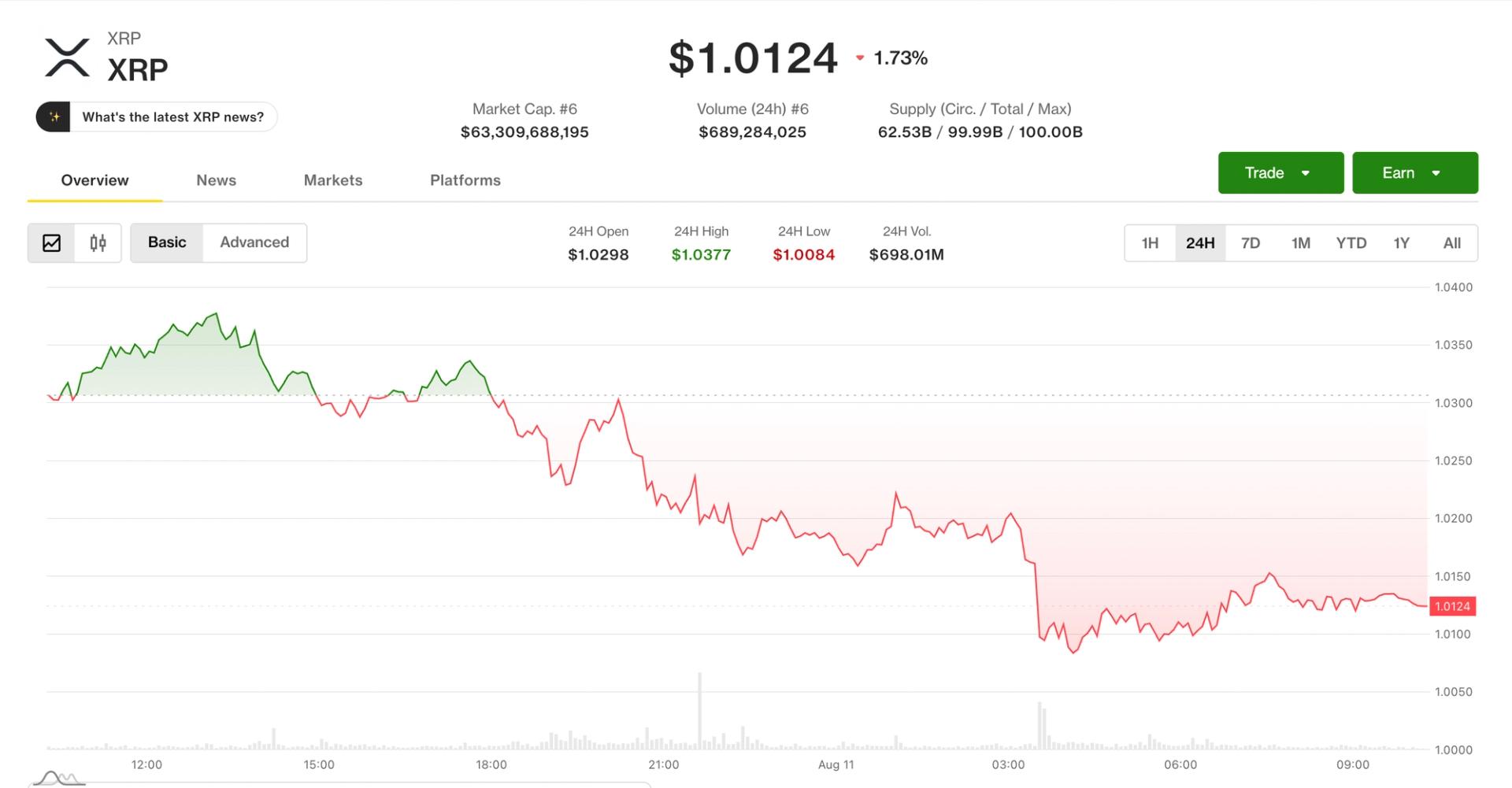
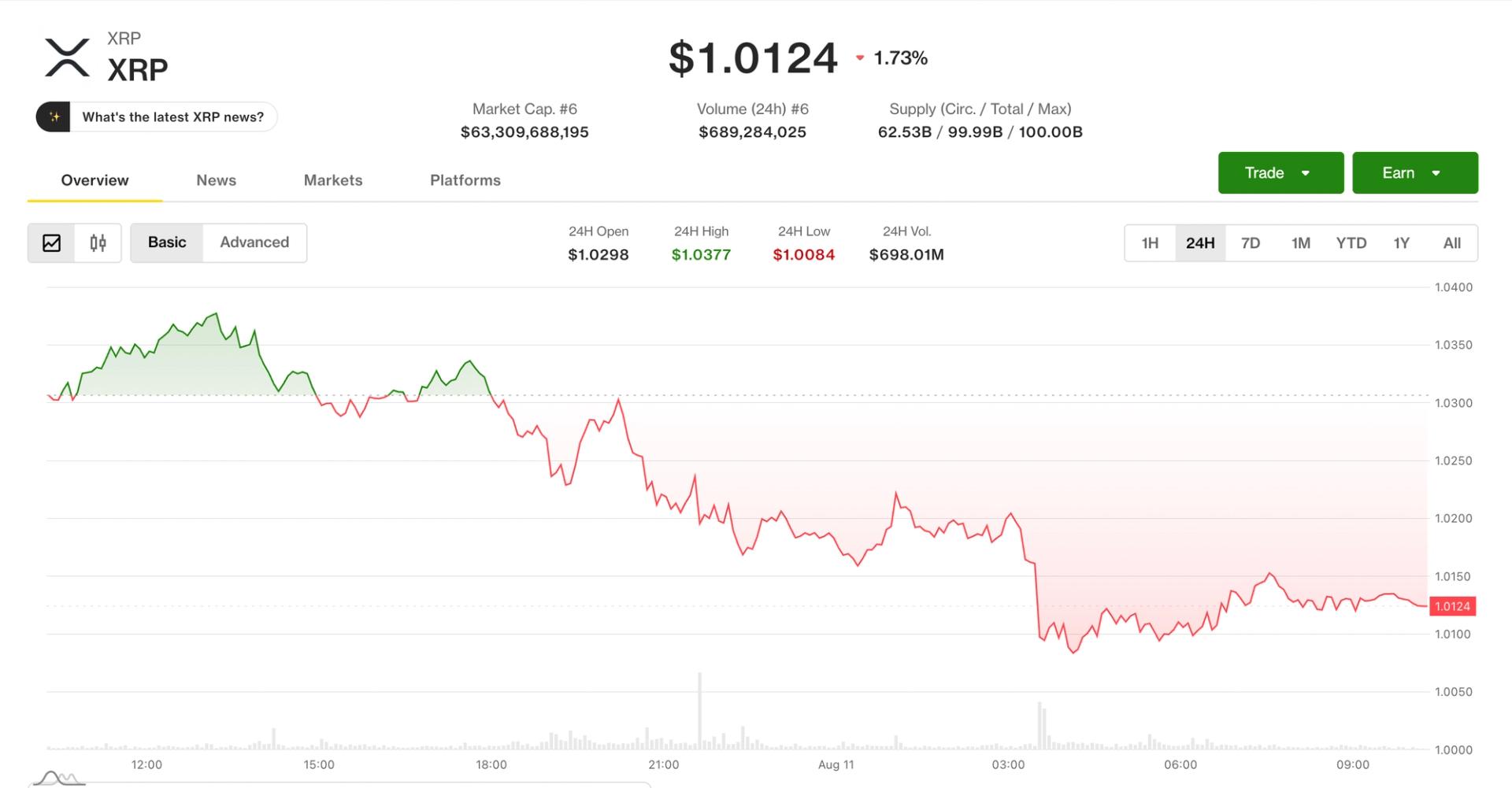
That makes $70,000 the next area to watch, another round number with the 200-day moving average sitting nearby. Clearing it would put bitcoin above the range where buyers and sellers fought through March and April, a move Kuptsikevich said would shift sentiment meaningfully.
Traders are not there yet. The crypto sentiment index sits at 30, in what is known as the fear zone, and has stayed there since mid-July with occasional dips toward extreme fear.
Bonds and oil set the tone in broader markets. U.S. 10-year Treasury yields rose six basis points on Monday to 4.71%, dragging Australian and New Zealand government bonds down with them, with no cash Treasury trading during Asian hours because of a public holiday in Japan.
Brent crude held at $87.73 a barrel after jumping 5% on Monday, when President Donald Trump made fresh demands on Iran and dimmed hopes of a deal to reopen the Strait of Hormuz. Gold rose for a third session above $4,400 an ounce.
Higher oil feeds into the inflation figures due Wednesday at 8:30 a.m. ET, which is why the rally is weighing on assets that do better when rate rises look less likely.
Fund flows had been running the other way until this week. U.S. spot bitcoin funds took in $865 million across five sessions through Aug. 7, before a provisional outflow of $91 million on Monday.
Shadow Cabinet League Table: Badenoch storms yet further ahead

Jackson Merrill’s 2-run HR rallies Padres past Brewers

30% Off Tempur-Pedic Promo Codes | August 2026


-

 Fashion4 days ago
Weekend Open Thread: Mattifying Sunscreen
-

 Fashion4 days ago
Frugal Friday’s Workwear Report: Cap-Sleeve Pointelle Crewneck Sweater
-

 Sports5 days ago
Jordan Coyle & Cordiamo take Laya Arena Stakes at RDS
-

 News Videos3 days ago
Can Astrology Help Find Gold and Silver Trends? A Financial Astrology Guide
-
 Business5 days ago
US stocks: Dow closes at record on Mideast optimism; SpaceX, AMD drag Nasdaq
-

 Politics5 days ago
Reform UK And Greens Sink To Lowest Favourability Ratings To Date
-

 Business6 days ago
Nvidia Stock Climbs 2.5% as Chip Sector Rally Builds Ahead of AMD Earnings, Nvidia’s Own Report Looms
-

 Tech6 days ago
OpenAI, Anthropic AI agents targeted real people and systems in cyber tests
-

 Crypto World7 days ago
Polymarket targets $20 billion valuation as competition heats up in prediction market sector
-

 Business5 days ago
Supply chain issues impact Ingredion
-
 Crypto World7 days ago
CLARITY Act Senate Vote Locked In, But 60-Vote Hurdle Looms Large
-

 Tech3 days ago
Rinn Pharma & Biopharma to join NordicPharmaTrain network
-
 Crypto World6 days ago
Dow and S&P 500 Hit Records on AI Earnings: When Will the Bubble Burst?
-

 Business2 days ago
How to Start a Cleaning Business: A Step-by-Step Guide
-

 Business2 days ago
Datadog: Best Of Breed For Multiple Reasons
-

 Business2 days ago
BDC Weekly Review: Private BDC Q2 Numbers Are Strong
-
 Crypto World6 days ago
Dollar Index Trapped at 100 as Hawkish Fed Meets Official Selling
-

 Business6 days ago
McDonald’s (MCD) Q2 2026 earnings
-
Crypto World7 days ago
Trump Administration Plans Ban on New Chinese AI Data Center Components: Report
-

 Fashion6 days ago
The Bright Side of Black and White
You must be logged in to post a comment Login