
Crypto World
TRON USDT transfers hit $2.1T as U.S. access expands

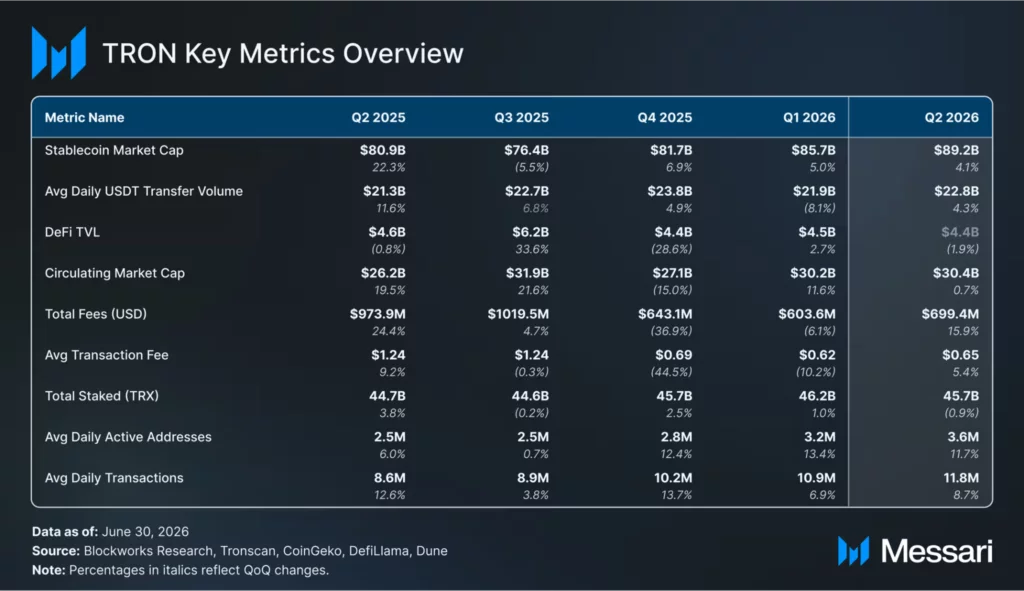
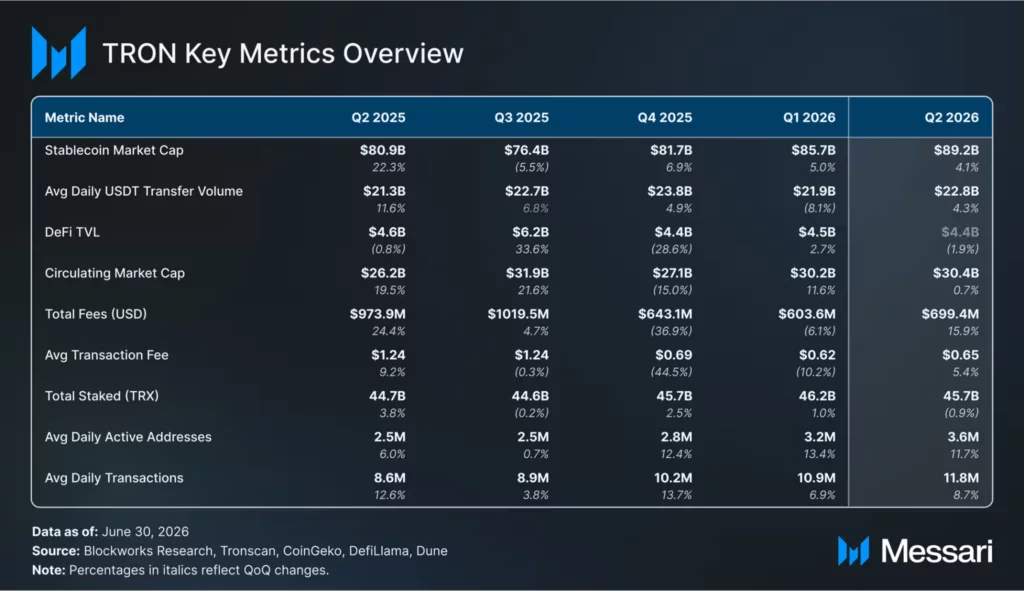
TRON processed $2.1 trillion in USDT transfers during the second quarter of 2026 as its stablecoin market reached a record $89.2 billion, according to Messari’s Aug. 10 report.
Summary
- TRON processed $2.1 trillion in USDT transfers during Q2 as stablecoin supply reached record levels.
- USDT supply ended Q2 at $87.9 billion, giving TRON the largest circulating balance among blockchains.
- Network fees rose 15.9% quarterly to $699.4 million, reversing declines after the 2025 fee cut.
- Bitnomial launched regulated U.S. TRX futures in July after introducing spot trading during the quarter.
- Canary amended its staked TRX ETF filing in July, targeting Cboe BZX under ticker TRXS.
USDT accounted for $87.9 billion, or 98.5% of stablecoins on the network, putting TRON ahead of Ethereum’s $78.7 billion USDT balance at quarter end.
The quarter also brought a broader U.S. route into TRX. Binance.US restored spot trading, Bitnomial added TRX to its regulated U.S. markets and Canary Capital continued work on a proposed staked TRX exchange traded product. After the quarter, Bitnomial added TRX futures and Anchorage Digital opened institutional staking access.
TRON USDT supply moved above $90 billion after Q2
Average daily USDT transfer volume rose 4.3% from the previous quarter to $22.8 billion, reversing the decline recorded in Q1. Total stablecoin capitalization increased 4.1%, while TRON accounted for 47.6% of tracked USDT supply at the end of June, Messari found.
Growth continued after the quarter closed. TRON’s official milestone page records USDT circulation on the network surpassing $90 billion on July 9. That extends the trend discussed inearlier stablecoin coverage, when TRON was already widening its USDT lead over Ethereum.
Network usage has also remained elevated. TRONSCAN currently reports an average of about 12.07 million daily transactions over the latest 30 days. As crypto.news reported in arecent network milestone, lifetime transactions crossed 15 billion in early August while circulating USDT remained above $90 billion.
Higher activity lifted fees while TRX supply kept growing
TRON generated $699.4 million in network fees during Q2, up 15.9% in dollar terms. Fees measured in TRX increased 2.1% to 2.10 billion TRX. Messari said it was the first quarterly fee increase since an August 2025 governance change cut the network’s energy unit price. Average transaction cost increased 5.4% to $0.65.
Higher fees did not return TRX to net deflation during the quarter. Circulating supply increased by about 87 million TRX to 94.85 billion as token creation continued to exceed burns. Total staked TRX also fell 0.9% to 45.7 billion, while the staking rate declined to 48.2%.
The inflationary pattern has continued into August. TRONSCAN data shows total supply at roughly 94.898 billion TRX on Aug. 10. About 3.92 million TRX were generated that day against 3.32 million burned, producing a net increase of roughly 598,000 TRX. Daily figures can vary, but supply remains above its Q2 closing level.
U.S. access widens for TRX through exchanges and staking
Binance.US restored TRX on April 16 with TRX/USD and TRX/USDT trading pairs and native deposits and withdrawals, according to its notice. The listing reversed the exchange’s 2023 removal of the asset, covered in past Binance.US coverage.
Bitnomial then added spot TRX during Q2 before launching exchange traded TRX futures on July 27. Its release says eligible U.S. traders and institutions can use the CFTC regulated contracts to hedge or take exposure to TRX. Bitnomial president Michael Dunn said six months of regulated futures history “meets a key milestone” for potential spot ETF eligibility, although that statement does not amount to SEC approval of any TRX product.
Institutional custody access expanded as well. Anchorage Digital said in a July 14 announcement that clients can now stake TRX while keeping assets within its regulated custody framework.
Canary ETF filing and U.S. compliance remain next tests
Canary Capital’s proposed staked TRX product provides another U.S. development to watch. A July 24 amended SEC filing identifies Cboe BZX as the planned exchange and TRXS as the ticker. Canary anticipates staking at least 90% of the trust’s TRX under normal circumstances. However, the prospectus remains preliminary and says the shares are “expected to be listed” subject to the required conditions. The registration statement must become effective before securities can be sold under the offering.
The network’s growing stablecoin footprint also keeps U.S. compliance scrutiny in view. On July 1, the Treasury Department’s Office of Foreign Assets Control added 131 TRON addresses to its ISIS K designation in an official update.
Chainalysis separately said in its analysis that Tether froze balances across all 131 addresses. The wallets had received more than $1.4 million since 2023, according to the blockchain analytics firm. The episode was detailed in earlier sanctions coverage.
TRON has also continued upgrading its infrastructure. The mandatory GreatVoyage v4.8.2 Pyrrho release arrived July 15, followed by the nonmandatory v4.8.2.1 Heraclitus update on July 31. For the second half of 2026, the main measurable developments are whether USDT circulation and transaction activity hold their recent levels, whether TRX supply returns to net deflation, and how the proposed U.S. ETF process develops.



ADI Chain’s job is to turn those deals into blockchain tokens and handle payments using stablecoins (digital tokens pegged 1-to-1 to real currencies like the UAE dirham or the U.S. dollar), so money moves instantly without a traditional bank wire. For now, this is aimed at “qualified institutional participants,” or large, vetted investors, not everyday retail buyers.
Shipfinex CEO Capt. Vikas Pandey said the partnership would let the company “create a regulated digital route into this market, with every instrument tied to a real vessel, its economics and its legal structure.”
No maritime asset tokens have been issued yet and Shipfinex doesn’t yet have a green light to do so. Its regulatory clearance from Dubai’s Virtual Asseets Regulatory Authority is an “In-Principle Approval” — a preliminary thumbs-up confirming it has passed an initial background check, not a finished license to operate.
Nevertheless, Shipfinex has earmarked around 35 vessels worth about $500 million combined as candidates for tokenization, once the regulatory approval and deal structure are finalized. Each ship will eventually sit in its own separate legal entity, so if one ship runs into financial trouble, it doesn’t drag down investors in the others.
Buying a token, once one becomes available, could mean one of a few different things for the institutional investors, depending on how each deal ends up being structured. It could mean a loan backed by the ship (similar to earning interest on a loan), a share of the money the ship earns from shipping contracts, or a broader economic stake in the vessel’s value.
Payments platform Decta has integrated USDC into its internal treasury operations to settle company funds internationally through OpenPayd, without adding stablecoins to its customer-facing payment services.
Summary
- Decta will use USDC to settle its own funds internationally through OpenPayd’s infrastructure.
- OpenPayd will convert Decta’s company funds into USDC through its OTC services for operational settlements.
- The integration is limited to Decta’s treasury operations and will not introduce stablecoins into customer-facing payment flows.
- Decta previously explored issuing a euro-pegged stablecoin under MiCA with France-based Next Generation.
Decta said Tuesday that company funds will be transferred into OpenPayd’s regulated infrastructure, where they can be converted into Circle’s USDC through the financial infrastructure provider’s over-the-counter services before being used for international operational settlements.
The arrangement is limited to Decta’s own money rather than funds handled for merchants or other clients, keeping the stablecoin component behind the company’s existing payments business.
Lux Thiagarajah, chief commercial officer at OpenPayd, told crypto media that the integration represents a proprietary treasury use case and does not introduce USDC into Decta’s customer payment flows.
Using this setup, Decta can move its own funds between international entities, convert fiat into USDC when required and use the stablecoin for settlement through OpenPayd’s infrastructure. The company said the arrangement will support liquidity management while simplifying transfers across its operations.
Decta uses USDC for internal treasury settlements
Decta CEO Scott Dawson said the company is using technology to make its financial operations faster, simpler and more resilient while retaining its existing controls and regulatory requirements.
Rather than allowing customers to pay merchants in stablecoins, Decta is using USDC as an operational settlement asset between parts of its business. Thiagarajah said OpenPayd handles the conversion through its OTC capabilities after Decta transfers its funds into the provider’s regulated infrastructure.
The distinction separates the arrangement from consumer-facing stablecoin payment products because Decta’s clients do not directly interact with USDC as part of the transaction process.
Decta, founded in London in 2015, provides payment processing, acquiring, card issuance, banking infrastructure and related services to businesses. According to the company’s announcement, it operates across 32 countries and serves hundreds of companies.
Its website describes the group as an end-to-end payments infrastructure provider covering acquiring, issuing and processing, with services including payment acquiring, BIN sponsorship, white-label card issuing, issuer and acquirer processing and digital banking infrastructure.
The USDC arrangement adds a blockchain-based settlement rail to Decta’s internal financial operations without requiring the company to change the payment products offered to its customers.
OpenPayd brings regulated USDC conversion into the process
OpenPayd’s role in the arrangement follows the company’s expansion of its regulated digital asset services in Europe.
In June 2026, OpenPayd received MiCA authorization, which allows the London-founded financial infrastructure provider to offer regulated crypto services across the European Economic Area under a single authorization.
The approval covers fiat-to-stablecoin conversions, custody, wallet infrastructure and stablecoin transfers across supported blockchain networks, according to OpenPayd. The company secured the authorization shortly before the European Union’s MiCA transition period ended on July 1.
OpenPayd was founded in London in 2018 and connects traditional fiat payment infrastructure with digital assets. Its client base includes Kraken, eToro, OKX and institutional crypto liquidity provider B2C2, according to the Decta announcement.
Its USDC infrastructure was developed before the MiCA approval. Back in 2025, OpenPayd partnered with Circle to allow clients to convert between fiat currencies and USDC while managing both forms of money through the company’s financial infrastructure.
At the time, the companies said the integration was designed for uses including payments, treasury management and digital asset services. OpenPayd said it processed more than €130 billion annually when the partnership was announced.
The company has since built stablecoin functions that allow businesses to receive, hold, convert and send digital dollars alongside fiat balances. OpenPayd said in February that its infrastructure could also be embedded into existing treasury and payment workflows while supporting cross-border settlement.
Stablecoins are entering corporate treasury workflows
Decta is not the only company testing stablecoins primarily as a treasury tool rather than as a consumer payment method.
In July, Hyundai Motor’s U.S. and Mexican operations completed a $20,000 cross-border treasury transfer using USDT on Avalanche, with the transaction settling in about seven minutes, as previously covered by crypto.news.
Tether said Hyundai Motor America converted dollars into USDT and transferred the tokens to Hyundai Motor Mexico, where the stablecoin was converted back into dollars. Hyundai Card designed the remittance structure while Axiym supplied settlement infrastructure, and the companies kept their existing compliance, accounting and treasury controls in place during the test.
The Hyundai pilot also followed a separate integration between Circle and treasury software provider Kyriba. According to the companies, Kyriba’s corporate clients can manage USDC balances alongside cash positions and use the stablecoin for eligible cross-border and intercompany transactions while retaining existing treasury approval procedures.
Business use of stablecoins has also extended into liquidity management. Bitso Business said in July that stablecoin transaction volume on its platform had increased 81% year over year during the first half of 2026, attributing the increase to demand for real-time settlement, treasury management and cross-border liquidity services. More than 60% of its newly onboarded business clients during the period were financial institutions, including banks and licensed payment providers, the company said.
Decta’s implementation differs from some of those pilots because the company is integrating USDC into an active internal treasury process through an external regulated infrastructure provider rather than announcing a customer stablecoin product.
Decta has previously explored a MiCA stablecoin
The treasury integration follows Decta’s earlier work involving regulated stablecoins in Europe.
In August 2024, Decta Limited and France-based Next Generation said they were exploring the issuance of a euro-pegged stablecoin under the European Union’s Markets in Crypto-Assets Regulation, subject to receiving the necessary regulatory approval.
MiCA introduced specific requirements for stablecoin issuers and crypto service providers across the European Union, while authorization in one member state can allow eligible firms to passport their services across the bloc. The regulatory transition for crypto-asset service providers ended on July 1, 2026.
USDC has remained available within the regulated European market because Circle obtained the required authorization for the stablecoin, while several platforms restricted non-compliant assets as the MiCA transition ended.
For its latest implementation, however, Decta is not issuing a stablecoin or offering one to customers. Its funds are instead sent to OpenPayd, converted into USDC through OpenPayd’s OTC infrastructure and used for Decta’s own international operational settlements before the company continues managing its customer payment services separately.
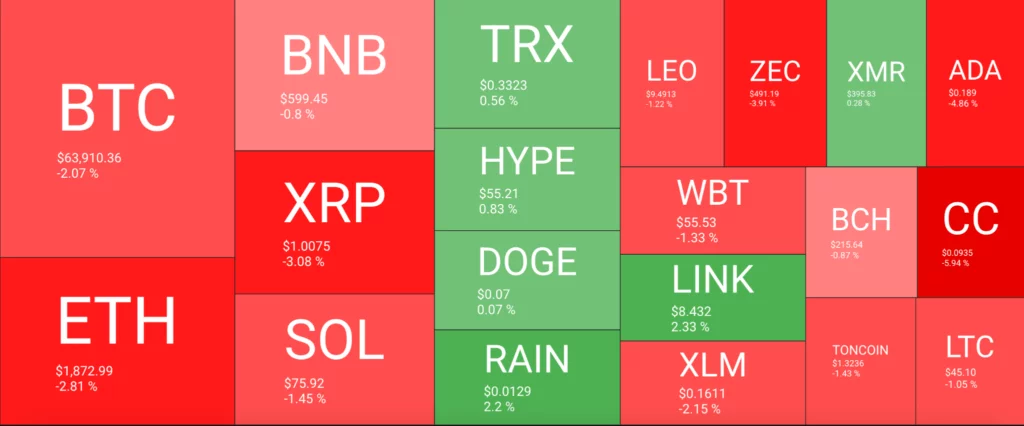
Bitcoin slipped below $64,000 on Aug. 11 as traders cut risk ahead of fresh U.S. inflation data and rising oil prices revived concerns about the Federal Reserve’s rate path.
Summary
- Bitcoin traded near $63,855, down 1.6%, after failing to establish support above $65,000 this week.
- Ether fell 2.2% and XRP lost 2.1%, while Hyperliquid and Chainlink advanced against broader weakness.
- U.S. spot Bitcoin ETFs recorded $144.6 million in net outflows Monday after five inflow sessions.
- Brent crude held near $88 as stalled U.S. Iran talks renewed inflation concerns before CPI.
- July CPI is scheduled Wednesday at 8:30 a.m. ET, leaving crypto exposed to macro volatility.
BTC traded near $63,855 at the time of writing, down about 1.6% over 24 hours after making several unsuccessful attempts to establish support above $65,000.
The pullback follows a short recovery that took Bitcoin above $65,300 on Monday. As covered in Monday’s CPI preview, weaker U.S. employment data had previously helped BTC recover as traders reduced expectations for tighter monetary policy. The focus has now shifted to inflation and energy prices.
Bitcoin has tested the $65,000 area for four consecutive days without sustaining a move above it. Downside levels remain relevant. Recent short term holder analysis placed the average acquisition price for newer holders at $67,523, meaning BTC remains below a level where some investors could seek to exit near breakeven. Support has recently formed around $63,000 to $64,000.
Ether and XRP lead losses as altcoins split
Large cap altcoins were mostly weaker alongside Bitcoin. Ether traded at about $1,871 at press time, down 2.8% over 24 hours. XRP traded near $1.00 after falling 3.1% and was down more than 6% over seven days. Solana declined about 1% to $75.78, while BNB slipped 1% to roughly $599.
Performance was not uniformly negative. Hyperliquid rose about 2.4% to $55.25, Chainlink gained 2% to $8.43, TRX advanced 0.5% to $0.33 and Dogecoin added roughly 0.5% around $0.07. Among the top 100 assets shown, Internet Computer gained 8.3%, Lighter rose 7% and Mantle added 5.8%. Bitway fell 8.1%, Canton declined 6.5% and Cardano lost 4.8%.
The split suggests traders are still willing to take selective altcoin exposure despite weakness in Bitcoin, Ether and XRP. However, the broad market has yet to show the synchronized strength typically associated with a sustained risk rally.
U.S. CPI and oil become the next macro test
Oil has returned as a major U.S. macro risk. Brent crude held around $87.81 on Tuesday after gaining more than 5% in the previous session as hopes for an agreement between Washington and Tehran weakened. Negotiations over the Strait of Hormuz remain unsettled, keeping energy supply risks elevated. Reuters provided the latest report.
Higher energy prices can feed into inflation expectations and affect the outlook for U.S. interest rates. The Bureau of Labor Statistics schedule confirms that July CPI will be released Wednesday, Aug. 12, at 8:30 a.m. ET. The release gives traders a fresh reading on inflation after softer June data had eased some pressure on risk assets.
U.S. Treasury markets are already reflecting some of that caution. The benchmark 10 year yield rose toward 4.7% alongside oil on Monday. Higher yields generally raise the return available on lower risk assets, creating another hurdle for Bitcoin and other cryptocurrencies ahead of the CPI release.
What happens next for Bitcoin and ETF flows
Institutional flows offer a mixed signal. U.S. spot Bitcoin ETFs recorded five consecutive positive sessions from Aug. 3 through Aug. 7, attracting $865.3 million according to Farside Investors. That streak ended Monday with $144.6 million in net withdrawals, including $53.6 million from BlackRock’s IBIT and $52 million from Grayscale’s GBTC. Farside’s latest data replaces earlier provisional estimates of Monday’s outflow.
The strong preceding week was examined in recent ETF inflow coverage, although that report used SoSoValue figures and therefore produced a slightly different weekly total. Both datasets showed the same broad pattern: five positive sessions followed by renewed withdrawals on Monday.
Washington also remains part of the market backdrop. The Senate pushed its CLARITY Act vote into September after lawmakers failed to resolve disagreements before the August recess, as detailed in earlier CLARITY Act coverage. That removed an anticipated August policy event while leaving market structure legislation unresolved.
Wednesday’s CPI release is now the nearest fixed catalyst. Bitcoin first needs to reclaim $65,000 before the $67,500 to $70,000 region becomes relevant again.
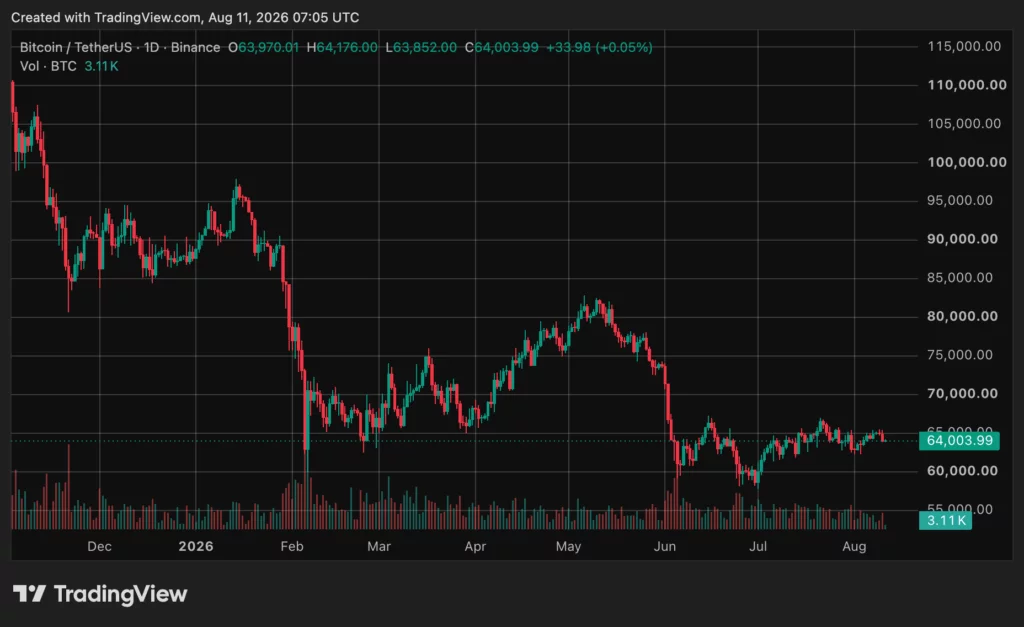
A move below the recent $63,000 area would instead put the market’s latest recovery under greater pressure. Neither direction has been confirmed, leaving inflation, Treasury yields and ETF flows as the clearest near term signals to watch.
Disclosure: This article does not represent investment advice. The content and materials featured on this page are for educational purposes only.


Bitcoin Knots told followers early on August 11 that the Bitcoin network faces an attack and that block production has slowed sharply. Public chain data contradicts that claim.
The warning drew instant pushback. David Schwartz, the former chief technology officer at Ripple, accused the project of misleading readers who lack the technical context to check it.
BTC Keeps Producing Blocks While the Knots Fork Sits Frozen
Bitcoin Knots is an alternative node client maintained by veteran developer Luke Dashjr. It filters out data its users treat as spam, and it runs on a small slice of the network.
Bitcoin blocks keep arriving on schedule. The main chain passed height 961,963 on August 11, with the last six blocks averaging under 10 minutes apart.
The frozen chain belongs to Knots itself. Its controversial BIP-110 soft fork, a rule change meant to squeeze non-monetary data out of Bitcoin blocks, stalled at block 961,633 after producing just two blocks. The main network has since pulled more than 300 blocks ahead.
Miners never backed the split. Support peaked near 2.53% even after organizers cut the activation threshold from 95% to 55%, then dropped to zero during mandatory signaling. The fork died within days.
Meanwhile, Bitcoin (BTC) trades near $63,979, down 1.5% on the day. Traders have shrugged off the dispute entirely.
Experts Tell Bitcoin Node Operators to Ignore the Downgrade Advice
The account never named the alleged attackers. Instead, its supporters have recast the lopsided miner vote as sabotage by large pools.
Knots also urged users to stay on its software, warning that weaker consensus rules invite false confirmations. Developers outside the project reject that framing. Bitcoin Core nodes follow the chain that almost all hashpower secures, and that chain never stopped.
Schwartz put it bluntly:
Trust in the camp had already thinned. Mining pool OCEAN, co-founded by Knots maintainer Luke Dashjr, admitted routing miners onto the minority chain without clear consent. Its hashrate collapsed by 96% soon after.
Backers are not done, however. The group will pick a new proof-of-work algorithm on August 11 at 14:00 UTC through a deterministic draw in its Discord. Such a switch would strip today’s Bitcoin miners of any role on a breakaway chain, which supporters aim to launch by September 1.
Whether anyone follows them remains an open question. Adam Back has already dismissed the campaign as unserious. The next three weeks will show whether the September plan draws more hashpower than the last attempt did.
The post Bitcoin Knots Says the Network Is Under Attack, Ripple’s Ex-CTO Calls it Nonsense appeared first on BeInCrypto.

Another push above $65,000 failed to hold on Tuesday, sending Bitcoin back below $64,000. The crypto asset was down more than 1.6% over the past day.
Against this backdrop, large BTC wallets are back at levels not seen in months. Meanwhile, smaller holders are steadily losing ground.
Elite Wallets Are Moving Up
Bitcoin’s elite wallet count has returned to a six-month high. There are now 90 wallets holding at least 10,000 BTC. According to the latest data shared by Santiment, the number has risen by 6 wallets over the past 8 weeks, a 7% increase. At the same time, holdings among micro wallets have been falling in August. The analytics firm attributed this decline to retail FUD following the Coldcard hacks and delays surrounding the CLARITY Act.
Santiment explained that the supply is moving toward stronger hands ahead of the next major market fluctuation. This shift usually raises the likelihood that the next major fluctuation will be bullish.
Bitcoin’s next move could now depend on whether it can clear $65,400. Doctor Profit recently said that the level remains important after several failed attempts to break above it. A move past it alone would not confirm a breakout; the analyst is looking for several weekly closes above the level instead.
If the crypto asset manages that, the next major resistance areas sit around $77,000 to $78,000 and $83,000.
A rejection, however, could put $61,500 back in focus, followed by $54,000. The analyst also flagged a change in market sentiment, as stablecoin holders are now showing more fear of missing out as BTC pushes higher.
Institutional Demand Takes a Hit
Institutional interest cooled on Monday as US spot Bitcoin ETFs recorded $144.67 million in net outflows. It was the first negative session for the funds in August, which ended a five-day winning streak.
BlackRock’s IBIT was the biggest loser, shedding $53.5 million. Grayscale’s GBTC followed with more than $52 million, while Fidelity’s ETF lost over $40 million.
Meanwhile, the world’s largest corporate Bitcoin holder continued to sell part of its holdings. The company offloaded another 1,690 BTC for $108.6 million and used the money to buy back 1.15 million STRC preferred shares. It also sold 6.59 million MSTR shares and raised a little over $653 million. That pushed its USD reserve above $4.6 billion.
Its holdings have now fallen to 840,447 BTC, which were acquired for $63.36 billion at an average price of $75,385.
The post Only 90 Bitcoin Wallets Hold 10K+ BTC: And That Number Just Hit a 6-Month High appeared first on CryptoPotato.
XRP ETF inflows collapsed 93% in a single week while the token tests $1.00 support. But whales are accumulating more than 10 million XRP per day, RLUSD has reached $1.6 billion in market cap, and the CLARITY Act vote is 35 days away. Recovery is not impossible. It is conditional.
Summary
- XRP trades at approximately $1.03 as of August 10, 2026, down more than 65% from its January high of $3.40. Weekly ETF inflows collapsed 93% to $1.01 million for the week ending August 8, down from $14.86 million the prior week, despite seven spot XRP ETFs holding a combined $1 billion in assets.
- Whale wallets are accumulating more than 10 million XRP per day, with large holder outflows from Binance reaching 91% of total exchange outflows, the highest concentration since 2024. The divergence between collapsing retail and ETF flows and accelerating whale accumulation is the widest it has been since XRP’s post listing launch.
- RLUSD, Ripple’s regulated stablecoin, has reached $1.6 billion in market cap, making it the third largest US regulated stablecoin. Partnerships with Mastercard, JPMorgan, and BlackRock are live, but the stablecoin’s growth has not translated into XRP demand, with RLUSD seeing net inflows while XRP funds recorded outflows in the same period.
- The CLARITY Act, which would classify XRP as a digital commodity under CFTC oversight, faces a September 15 cloture vote with only 16% odds of passage on Polymarket. Failure would remove the single largest regulatory catalyst that XRP bulls have been pricing in since early 2026.
- Standard Chartered’s Geoffrey Kendrick maintains an $8 year end target for XRP, contingent on sustained ETF inflows exceeding $1.15 billion and regulatory clarity. The current trajectory satisfies neither condition.
XRP is caught between two stories that cannot both be true at the same time. The first story says the token is dying: price down 65% from January, ETF inflows in freefall, the CLARITY Act stalled, and a stablecoin that is growing faster than the token it was supposed to support. The second story says smart money is quietly loading up: whales are pulling more than 10 million XRP per day off exchanges, on chain accumulation signals are at multi year highs, and the legal clarity that no other major token possesses gives XRP a structural advantage that the market has not yet priced.
Both stories have evidence. Neither is complete. What determines which one wins comes down to three specific conditions, each of which is observable and each of which has a timeline. If all three are met, the recovery case is strong. If two fail, the current price may be the beginning of a longer decline rather than a floor.
Condition one: the CLARITY Act must pass or an equivalent catalyst must replace it
The single most important variable for XRP in the second half of 2026 is whether the Digital Asset Market Clarity Act becomes law. The bill would classify XRP as a digital commodity under CFTC jurisdiction, resolving the remaining ambiguity left by the Ripple v. SEC settlement.
That settlement, finalized in 2025, produced a split decision. Institutional sales of XRP were deemed securities transactions. Programmatic sales on exchanges were not. Ripple paid a $125 million civil penalty, and the SEC withdrew its appeal. The legal case is closed. But the regulatory framework that would tell institutional allocators exactly how to treat XRP in a portfolio does not yet exist.
The CLARITY Act would provide that framework. Under its provisions, tokens meeting decentralization criteria move to CFTC oversight, a lighter regulatory regime that institutional compliance departments are comfortable with. XRP, having survived the most significant enforcement action in crypto history and emerged with a court ruling that its exchange sales are not securities, is positioned to benefit more than almost any other token from this classification.
The problem is that the CLARITY Act may not pass. Senate Majority Leader Thune filed cloture before the August recess, setting up a procedural vote as early as September 15. But the bill needs 60 votes to clear the filibuster, and Polymarket traders assign only 16% odds of passage in 2026. The core obstacle is an ethics provision targeting presidential involvement in crypto that Democrats and Republicans cannot agree on.
If the CLARITY Act fails, XRP loses its most potent near term catalyst. The token would remain in a regulatory gray zone where the SEC case is resolved but the broader framework is not. Institutional allocators who cite regulatory clarity as a prerequisite for increasing exposure, 65% of them according to a 2026 survey, would continue to wait.
The question is whether an alternative catalyst could fill the gap. Two candidates exist. First, the SEC could issue formal guidance classifying XRP as a commodity without legislation, using the Ripple ruling as precedent. This is possible but unlikely given the current commission’s preference for case by case enforcement. Second, sustained ETF inflows at scale could signal that the market has effectively made the classification decision regardless of what Washington does. That leads to the second condition.
Condition two: ETF inflows must stabilize and grow
Seven spot XRP ETFs are now trading in the United States with combined assets under management of approximately $1 billion and 992.7 million XRP tokens locked. Cumulative net inflows since launch total $1.51 billion. The gap between cumulative inflows and current AUM reflects XRP’s price decline: investors put in $1.51 billion, but the tokens they bought are now worth $1 billion.
The recent flow data is alarming. Weekly net inflows for the period ending August 8 came in at $1.01 million, a 93% collapse from $14.86 million the prior week. This is not a gradual slowdown. It is a near complete stop.
Context matters. JPMorgan reported that XRP ETFs recorded the largest single month inflow surge as a percentage of AUM of any cryptocurrency ETF since July 2025, outperforming bitcoin, ethereum, and solana. The category is not dead. But the momentum that drove that surge has evaporated in a single week, coinciding with the CLARITY Act delay and broader altcoin weakness.
For XRP to recover, ETF inflows need to return to a baseline of at least $10 million per week. At that pace, the ETF complex would absorb roughly 10 million XRP per week at current prices, matching whale accumulation and creating a structural floor under the token. Below that threshold, the ETFs are not generating enough demand to offset the natural sell pressure from retail holders, Ripple’s own programmatic sales, and general market rotation.
The comparison to bitcoin ETFs is instructive. Spot bitcoin ETFs now attract more than $400 million per day in net inflows. Spot ether ETFs have stabilized at roughly $50 million per day. XRP ETFs at $1 million per week are not in the same conversation. The question is whether this reflects temporary sentiment or a structural ceiling on institutional XRP demand.
Standard Chartered’s Geoffrey Kendrick, who maintains an $8 year end target for XRP, has conditioned that forecast on cumulative ETF inflows exceeding $1.15 billion and regulatory clarity. The first condition is technically met at $1.51 billion cumulative, but the flow rate has collapsed. The second condition depends on the CLARITY Act. Neither is currently trending in the right direction.
Condition three: RLUSD must feed value back to XRP instead of draining it
This is the condition that XRP holders talk about the least and that matters the most over the medium term. Ripple’s stablecoin, RLUSD, has grown to a $1.6 billion market cap, making it the third largest US regulated stablecoin. It reached $1 billion in under 120 days, faster than any regulated stablecoin in history.
The partnerships are impressive by any measure. BNY Mellon serves as primary custodian for RLUSD reserves. BlackRock uses RLUSD to redeem shares in its tokenized funds. LMAX Group adopted it as collateral for institutional trading. Mastercard launched a pilot through the Gemini Credit Card. SBI Holdings rolled it out in Japan. Singapore’s Monetary Authority included it in the BLOOM pilot. Ripple Prime, the institutional brokerage arm, has seen revenue triple, partly driven by RLUSD integration.
The problem is that none of this is translating into XRP demand. In the same period that RLUSD saw $4.1 million in net inflows, XRP investment products recorded net outflows. The stablecoin is growing. The token is shrinking. The two are not connected in the way that Ripple’s narrative implies they should be.
The bull case for RLUSD benefiting XRP rests on three mechanisms. First, RLUSD transactions on the XRP Ledger burn small amounts of XRP as fees, creating deflationary pressure. Second, RLUSD liquidity pools on the XRPL DEX require XRP as a bridge currency. Third, institutional adoption of RLUSD introduces counterparties to the XRP Ledger ecosystem, potentially driving demand for XRP itself.
Each mechanism is real in theory. None is generating material demand in practice. The fee burns are negligible at current transaction volumes. The XRPL DEX handles a fraction of RLUSD’s total volume, with most activity occurring on Ethereum. And institutional RLUSD users have shown no inclination to acquire XRP alongside the stablecoin.
For XRP to recover, Ripple needs to close this gap. The most direct path would be requiring RLUSD transactions to settle through XRP as a bridge asset on the XRPL, generating sustained buy pressure proportional to stablecoin volume. Whether Ripple will make this architectural decision is unknown. The current design does not mandate it.
The whale accumulation signal
While retail flows and ETF inflows have weakened, on chain data tells a different story at the whale level. Large wallets are accumulating more than 10 million XRP per day. On Binance, 91% of XRP outflows are coming from wallets classified as large holders, the highest concentration since 2024. Across all centralized exchanges, whale driven outflows exceed 90%.
This divergence, collapsing retail interest paired with accelerating whale accumulation, has historically preceded significant price moves in both directions. Whales accumulating while retail sells can signal informed buying ahead of a catalyst. It can also signal large holders averaging down into a position that continues to deteriorate.
The distinguishing factor is what happens next. If whale accumulation is followed by a catalyst, such as CLARITY Act passage or a resumption of ETF inflows, the accumulated positions become the foundation for a rally. If no catalyst arrives, the whales are simply the last buyers before a further decline.
The on chain data does not tell you which scenario is correct. It tells you that someone with significant capital believes XRP is undervalued at $1.00. Whether they are right depends on the three conditions outlined above.
The Robinhood UK factor
A development that has received less attention than it deserves is Robinhood’s UK launch, which includes XRP among more than 50 tradeable digital assets with zero trading and custody fees. This is the first time a major retail brokerage has offered commission free XRP trading in a G7 market outside the United States.
The significance is not the trading volume itself, which is likely to be modest in the initial months. It is what the listing represents about XRP’s regulatory standing. Robinhood’s compliance team approved XRP for a regulated UK platform. This is an implicit statement about the token’s legal status that carries weight with other brokerages and exchanges considering similar offerings.
If Robinhood UK generates meaningful XRP volume, it provides a template for other European and Asian brokerages to follow. This would create a new demand channel independent of the US ETF complex and the CLARITY Act. It is not a substitute for either condition, but it could provide a floor under prices while the larger catalysts play out.
https://x.com/cryptodotnews/status/2043284997013164208
What the bears get right
The bearish case for XRP is straightforward and currently winning. The token is down 65% from its January high. ETF inflows have collapsed. The regulatory catalyst is stalled. And Ripple’s most successful product, RLUSD, is growing without generating XRP demand.
Bears also point to Ripple’s own XRP sales. The company holds billions of XRP in escrow and releases portions monthly. While Ripple has reduced its programmatic sales in recent quarters, the existence of a large, concentrated holder with the ability to sell at any time creates a persistent overhang that no other major cryptocurrency faces.
The structural comparison to ethereum is unflattering. Ethereum’s fee burn mechanism creates deflationary pressure proportional to network usage. XRP has no equivalent. Its fixed supply and Ripple’s escrow releases create a dynamic closer to a company selling treasury stock than a protocol with organic tokenomics.
This critique deserves its full weight because it identifies the central question: what is XRP for, specifically, that RLUSD cannot do better? If the answer is “nothing except price speculation,” the recovery case rests entirely on external catalysts rather than intrinsic demand. That is a fragile foundation.
What would prove this analysis wrong
If all three conditions are met simultaneously, the analysis shifts from conditional recovery to probable recovery. The specific signals are:
The CLARITY Act passes the Senate cloture vote on or after September 15 with 60 or more votes. This would be the strongest single catalyst XRP has received since the SEC case resolution.
Weekly ETF inflows return to and sustain above $10 million for four consecutive weeks. This would indicate that the August collapse was a temporary sentiment event rather than a structural ceiling.
Ripple announces an architectural change to RLUSD settlement that generates XRP demand proportional to stablecoin volume. This would close the gap between RLUSD growth and XRP price and is the condition most within Ripple’s control.
Any one of these conditions met in isolation would likely produce a short term bounce. All three met within a 90 day window would change the fundamental trajectory.
What to watch
September 15 cloture vote. The single most important date on XRP’s calendar. A successful vote effectively guarantees the CLARITY Act becomes law. A failed vote removes the catalyst for 2026 and probably 2027.
Weekly ETF flow reports. Published by CoinGlass and multiple trackers every Monday. Four consecutive weeks above $10 million in net inflows would signal a trend reversal. Four consecutive weeks below $5 million would confirm the August collapse is structural.
RLUSD transaction volume on the XRPL versus Ethereum. If RLUSD volume shifts toward the XRP Ledger, the bridge currency mechanism begins generating real XRP demand. If volume remains concentrated on Ethereum, RLUSD growth continues to be XRP neutral.
Whale accumulation rate. Daily exchange outflow data from Santiment and Glassnode. Sustained accumulation above 10 million XRP per day indicates large holders maintain conviction. A slowdown below 5 million per day would suggest even whales are losing confidence.
Ripple escrow releases and sales. Ripple’s monthly escrow unlock and subsequent market sales are trackable on chain. Any increase in the pace of sales during a period of price weakness would be a bearish signal that outweighs whale accumulation.
Why has XRP dropped 65% from its January high?
XRP reached approximately $3.40 in January 2026 on optimism around ETF launches and the CLARITY Act. The decline reflects a combination of regulatory delay, collapsing ETF inflows, broader altcoin weakness, and the failure of RLUSD’s growth to generate proportional XRP demand. The token currently trades near $1.03, testing its most significant support level.
How many XRP ETFs exist in the United States?
Seven spot XRP ETFs are currently trading in the US with combined assets under management of approximately $1 billion. Cumulative net inflows since launch total $1.51 billion, but the gap reflects XRP’s price decline since the funds launched. Weekly inflows collapsed 93% in the week ending August 8, falling to $1.01 million from $14.86 million.
What is the Ripple v. SEC case status?
The case is fully resolved. Ripple paid a $125 million civil penalty. The SEC withdrew its appeal in March 2025. The court ruled that institutional XRP sales were securities transactions but programmatic sales on exchanges were not. No further legal proceedings are pending between Ripple and the SEC.
What is RLUSD and why does it matter for XRP?
RLUSD is Ripple’s regulated USD stablecoin with a $1.6 billion market cap, making it the third largest US regulated stablecoin. It has partnerships with BNY Mellon, BlackRock, Mastercard, and JPMorgan. RLUSD matters for XRP because its growth was expected to drive XRP demand through fee burns and bridge currency usage, but this connection has not materialized in practice.
Are whales buying XRP?
Yes. On chain data shows large wallets accumulating more than 10 million XRP per day as of August 2026. On Binance, 91% of XRP outflows come from large holder wallets. However, whale accumulation alone does not guarantee a price recovery. It indicates conviction among large holders but requires catalysts to translate into sustained price appreciation.
Will the CLARITY Act help XRP?
If passed, the CLARITY Act would classify XRP as a digital commodity under CFTC oversight, providing the regulatory clarity that 65% of institutional allocators say they need before increasing crypto exposure. The bill faces a September 15 Senate cloture vote with approximately 16% odds of passage on Polymarket. Failure would remove XRP’s most significant near term regulatory catalyst.
What price do analysts predict for XRP in 2026?
Forecasts range from Standard Chartered’s $8 year end target, contingent on sustained ETF inflows and regulatory clarity, to more conservative projections of $2.65 to $5.13 from algorithmic models. Current conditions do not support the bullish end of these estimates. Most analysts describe 2026 as a bottoming and consolidation year with meaningful recovery potentially extending into 2027.
Could XRP drop below $1.00?
The $1.00 level is XRP’s most significant psychological and technical support. A sustained break below $1.00 would likely trigger stop loss selling from leveraged positions and could push the token toward $0.75, which is the realized price level where whale accumulation has been concentrated. A break below $1.00 would also undermine the narrative that the post SEC settlement floor is secure. This is educational analysis, not investment advice.
Disclaimer: This article is for informational and educational purposes only. It does not constitute financial, investment, or legal advice. Cryptocurrency markets are volatile and carry significant risk. Always conduct your own research before making investment decisions. Published August 10, 2026.
Trump Media & Technology Group (DJT) posted a $238.1 million net loss for the second quarter of 2026, with unrealized markdowns on its crypto and equity holdings accounting for most of the shortfall.
The Truth Social parent narrowed its deficit from the $405.9 million loss recorded in the first quarter. Non-cash items again dominated results, as the company reported just $1.7 million in revenue against a $223.5 million adjusted EBITDA loss.
Crypto Markdowns Drive the Quarterly Loss For Trump Media
The bulk of the loss stemmed from $190.4 million in unrealized losses. This included digital assets, pledged digital assets, and equity securities held on the balance sheet.
Accounting rules require companies to mark down holdings when prices fall below their carrying value. That mechanism turned Trump Media’s crypto exposure into the dominant line item.
The result marks a second straight quarter shaped by digital asset volatility. In the previous filing, similar markdowns reached $368.7 million.

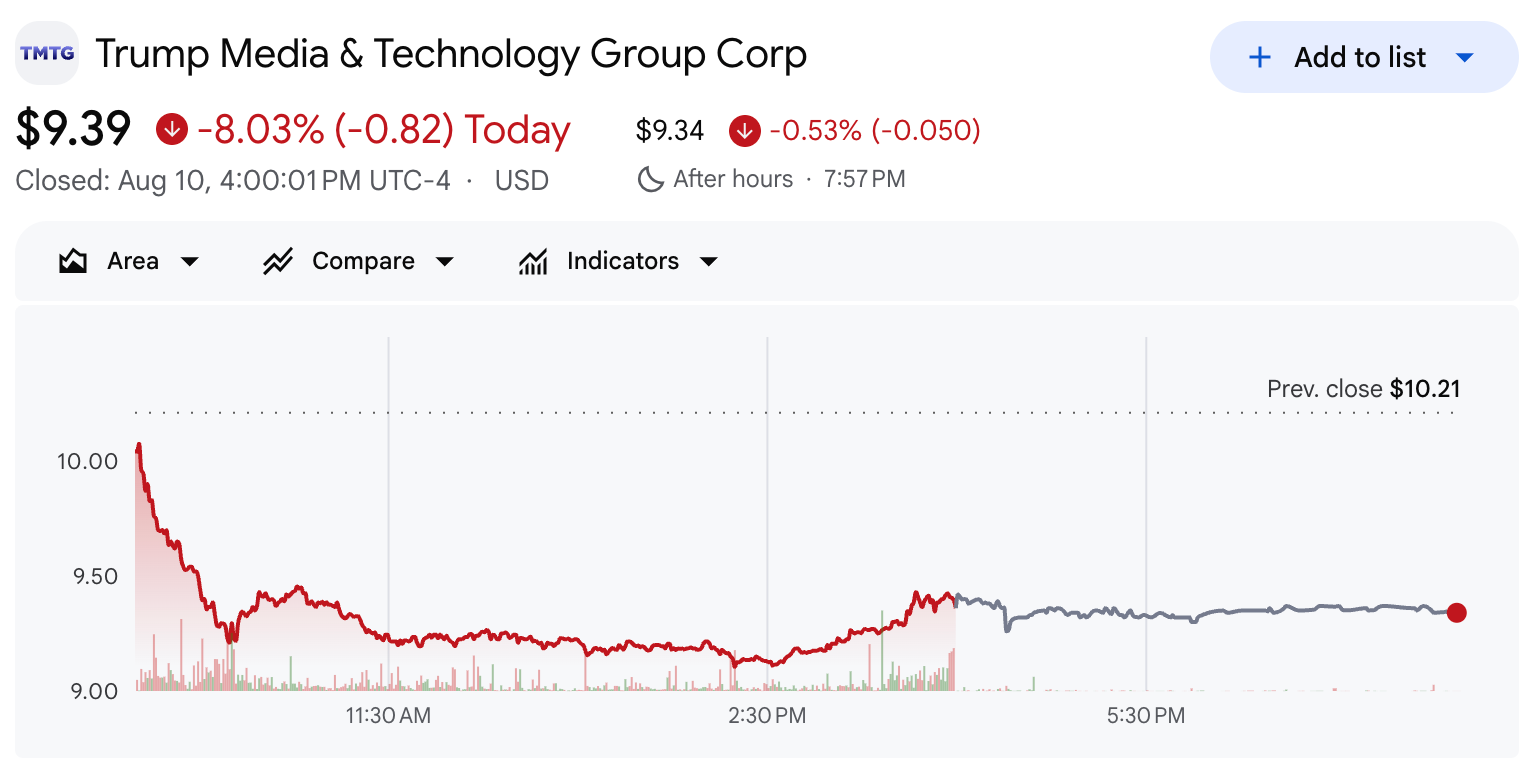
Shares closed at $9.39 on August 10, down 8.03% for the session from a prior close of $10.21. The stock slipped a further 0.53% to $9.34 in after-hours trading.
Follow us on X to get the latest news as it happens
McGurn Points to TAE Merger and Data Licensing
Interim CEO Kevin McGurn framed the planned merger with fusion energy firm TAE Technologies as the key value driver. McGurn expects the deal to close in the fourth quarter.
The new revenue stream arrives as Trump Media retreats from earlier crypto ventures, including a terminated CRO treasury plan with Crypto.com.
“We’re making meaningful progress toward our proposed merger with TAE Technologies, which we believe is the most important driver of long-term shareholder value and a natural extension of our commitment to building durable, un-cancellable infrastructure, this time in energy security,” he said.
The firm also launched Truth API, its first data licensing product, on August 1. It has since signed more than 10 customer agreements. The rollout drew scrutiny over data plans tied to Truth Social.
Subscribe to our YouTube channel to watch leaders and journalists provide expert insights
The post Trump Media Books $190 Million Paper Loss Across Crypto and Equities appeared first on BeInCrypto.
Riot Platforms has signed a 20 year data center agreement worth an expected $9.1 billion for 191 megawatts of computing capacity at its Rockdale campus in Texas, marking another major step away from relying solely on Bitcoin mining.
Summary
- Riot signed a 20 year lease for 191 MW, expected to generate $9.1 billion initially.
- Bloomberg identified Anthropic as Riot’s unnamed frontier AI tenant, citing people familiar with the matter.
- Riot expects full deployment by June 2028, after delivering 96 MW initially in December 2027.
- Extension options could raise total contract revenue to $16.1 billion if Anthropic exercises both periods.
- Riot secured $573 million from Morgan Stanley to fund initial construction while final financing progresses.
Riot described the customer in its Aug. 10 SEC filing only as a leading frontier AI lab.
Bloomberg subsequently identified the tenant as Anthropic, developer of the Claude artificial intelligence models, citing people familiar with the transaction. Neither company publicly confirmed Anthropic’s identity when Bloomberg contacted them. Riot declined to comment, while Anthropic did not respond. The distinction means the contract itself is confirmed, but the customer’s identity currently rests on Bloomberg’s reporting.
Riot Platforms turns Rockdale power toward AI
Riot’s official release says the agreement covers 191 MW of critical IT capacity at Rockdale. The first 96 MW is scheduled for December 2027, followed by another 95 MW by June 2028. The initial contract runs through June 2048.
The company says the agreement is “expected to generate approximately $9.1 billion” over its initial term. That figure is a company forecast rather than revenue already earned. Two optional five year extensions, exercisable by the tenant, could raise potential contract revenue to about $16.1 billion. Riot estimates cumulative net operating income of $7.3 billion to $8.2 billion during the base term, another forward looking projection dependent on construction and operating performance.
Rockdale was built around large scale Bitcoin mining. The Texas campus has 700 MW of developed, energized power capacity, along with existing fiber and electrical infrastructure that Riot says can be repurposed for high density computing. The company has said it intends to convert the site’s full gross capacity toward data center tenants over time.
The shift builds on a trend covered in earlier Riot coverage, when activist investor Starboard Value pushed the miner to accelerate its AI data center strategy. Starboard argued that Riot’s large U.S. power portfolio could command greater value when leased to computing customers.
Anthropic deal follows Riot’s AMD expansion
Riot already has another major technology tenant at Rockdale. AMD initially signed for 25 MW in January and exercised an additional 25 MW option in April. Riot completed delivery of the first 25 MW during the second quarter and expects another 10 MW in November 2026 and 15 MW in May 2027.
Combined with the newly announced 191 MW contract, Riot now has 241 MW of critical IT capacity under signed leases at Rockdale. Its earnings deck puts total expected contracted revenue from the two tenants at about $9.8 billion. AMD retains options that could expand its footprint further.
As crypto.news reported in previous earnings coverage, Riot began generating meaningful data center revenue this year as its AMD deployment moved online. Q2 data center revenue reached $23.2 million, including $4.9 million from operating leases and $18.3 million from tenant fit out services.
The broader strategy reflects how Bitcoin miners are monetizing access to scarce U.S. power infrastructure. In related industry coverage, Riot and several other miners were identified as potential beneficiaries because their existing grid connections can shorten development timelines compared with entirely new data center projects.
Bitcoin remains important as Riot funds the buildout
Riot has not exited Bitcoin mining. It produced 1,587 BTC during Q2, up from 1,426 BTC a year earlier. However, mining revenue fell to $113.7 million from $140.9 million as average Bitcoin prices declined and global network hash rate increased. Riot’s cost to mine one Bitcoin, excluding depreciation, was $49,912.
The company’s Bitcoin holdings are also helping finance its AI expansion. Riot ended June with 11,380 BTC valued at about $666 million, including 5,821 BTC held as collateral, alongside $548.9 million in cash. Its investor presentation explicitly says continued Bitcoin inventory sales are being used as a primary funding source for the equity portion of its data center spending.
That strategy follows earlier sales and transfers documented in recent Bitcoin reserve coverage. The company has increasingly treated its Bitcoin balance as a source of capital while maintaining an active mining operation.
Morgan Stanley backs construction as Riot targets 2028
Building the 191 MW project will require far more capital than Riot’s earlier AMD deployment. Management estimates construction spending of about $2.1 billion to $2.3 billion. Morgan Stanley has provided a $573 million interim financing facility to cover early development costs while an investment grade credit backstop is finalized.
Riot expects debt to fund 80% to 90% of the project’s costs, leaving an estimated equity requirement of $210 million to $460 million before capital recycled from its AMD financing. Those estimates remain subject to financing terms and construction costs.
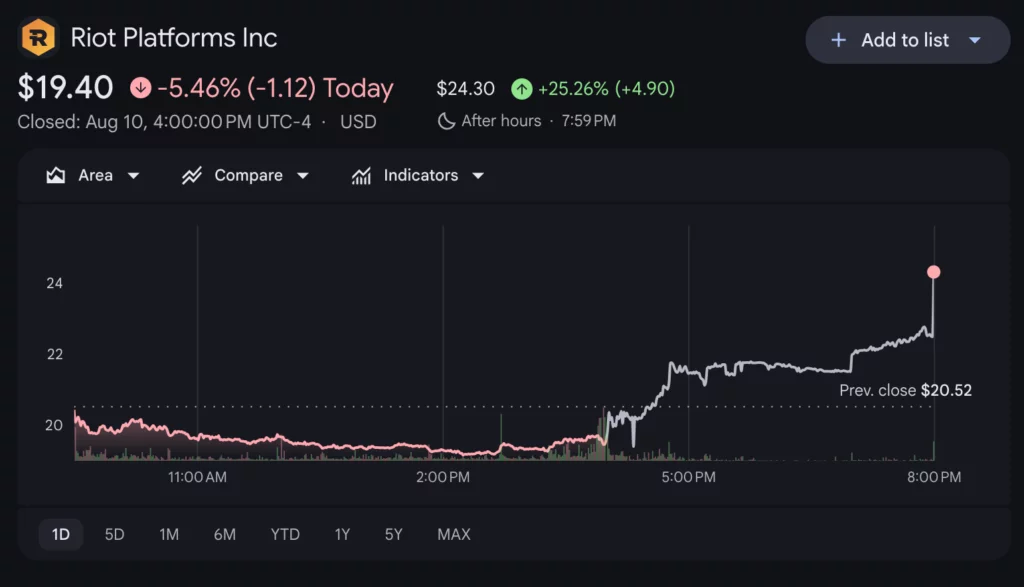
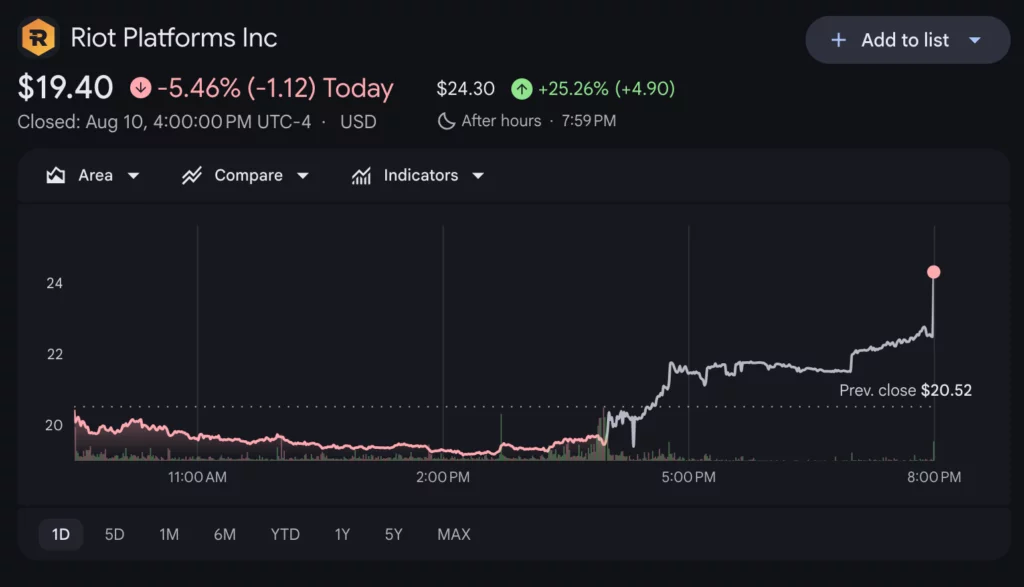
Investors initially reacted strongly to Bloomberg’s identification of Anthropic. Riot shares jumped about 25% to $24.40 in late trading following the report. The move came after Riot reported Q2 revenue of $174.2 million, up 14% year over year, although the company also posted a $237.2 million quarterly net loss.
The next fixed milestones are the planned 96 MW delivery in December 2027 and full 191 MW deployment in June 2028. Riot must also finish the longer term financing package. Separately, its SEC filing says the company has a nonbinding letter of intent involving its Corsicana, Texas campus, giving Riot another potential route for converting former Bitcoin focused power infrastructure into U.S. AI capacity.


South Korea will expand its crypto Travel Rule to all transfers between registered virtual asset service providers (VASPs), removing the current 1 million won (about $700) threshold.
The country’s Cabinet approved amendments to the Enforcement Decree of the Act on Reporting and Using Specified Financial Transaction Information on Tuesday.
Under the changes, the Travel Rule will apply to all transfers between registered crypto service providers regardless of value. Receiving platforms will also be required to obtain sender and recipient information and may request missing information or reject transactions when required data is unavailable.
Removing the threshold is intended to prevent users from circumventing the rule by splitting transfers into smaller amounts, according to the Financial Intelligence Unit.
It cited one case in which a user bought Tether USDt (USDT) after depositing about 200 million won into a crypto exchange and then made 216 withdrawals, each worth less than 1 million won.
Related: South Korea plans stablecoin rules as opposition pushes crypto tax repeal
South Korea tightens rules for overseas exchanges, personal wallets
The amendments also introduce new Anti-Money Laundering (AML) requirements for transfers involving overseas crypto exchanges and personal wallets.
Registered local VASPs will be required to determine which transfers they allow based on the risk posed by the counterparty. Transfers to low-risk overseas exchanges will be permitted, while transfers involving other foreign exchanges and personal wallets will generally be allowed when the sender and recipient are the same person.
However, transactions involving counterparties deemed high risk will be prohibited.
Crypto platforms will also have to establish their own suspicious transaction monitoring systems for transfers worth at least 10 million won involving foreign exchanges or personal wallets.
South Korean authorities said suspected money laundering involving overseas exchanges and personal wallets has increased as gaps in existing AML rules governing such transfers have been exploited.
The decree also strengthens registration requirements for crypto service providers, including financial health, internal controls, staffing and infrastructure standards, while expanding scrutiny of major shareholders.
The VASP registration provisions will take effect on Aug. 20, although existing providers will have an additional year to comply with some financial, staffing, infrastructure and internal control requirements. The expanded Travel Rule and other transfer-related AML requirements will take effect six months after the decree is promulgated.
Asia Express: Thailand’s 0% crypto tax. Bitcoin Red Team forced to use Chinese AI


Payments platform Decta will use USDC to settle its own funds internationally, bringing stablecoins into its back-end treasury operations.
Decta said Tuesday that it will use OpenPayd, a financial infrastructure company, to convert company funds into USDC for international settlement, according to an announcement shared with Cointelegraph.
“This is a proprietary treasury use case rather than a customer-facing payments flow,” Lux Thiagarajah, chief commercial officer at OpenPayd, told Cointelegraph.
“Decta transfers its own funds into OpenPayd’s regulated infrastructure, where they are converted into USDC via OpenPayd’s over-the-counter capabilities to support international operational settlements,” he added.
The integration shows how stablecoins are moving into traditional payments infrastructure as a tool for internal treasury and liquidity management, without making stablecoins part of its customer-facing payment services.
Stablecoins move into payments firms’ treasury operations
Decta said the integration will help it move funds between its entities internationally, manage liquidity and streamline treasury operations.
Scott Dawson, CEO of Decta UK, said the company wants technology to make its financial operations faster, simpler and more resilient while maintaining its existing controls and regulatory discipline.
Founded in 2015 in London, Decta is a payments platform that provides payment processing, acquiring, card issuing, banking and other financial infrastructure to businesses. The company operates across 32 countries and serves hundreds of companies, according to its announcement.
Related: Circle Q2 revenue falls short of Wall Street estimates
Decta has also explored stablecoin issuance in the past. In August 2024, Decta Limited and France-based Next Generation said they were exploring a potential euro-pegged stablecoin that Decta could issue under the European Union’s Markets in Crypto-Assets Regulation (MiCA), subject to regulatory approval.
OpenPayd, founded in London in 2018, provides financial infrastructure connecting fiat and digital assets. The company secured authorization under MiCA in June, allowing it to provide crypto services across the European Economic Area, including fiat-to-stablecoin on- and off-ramps. It counts Kraken, eToro, OKX and B2C2 among its clients.
Magazine: BIP-110 ends with a whimper, CLARITY vote punted: Hodler’s Digest, Aug. 9

A $2 trillion asset class is getting a new blockchain rail

Skubal gives up 3 runs in 5 innings in Dodgers home debut

New rumor counters that all-glass 20th-anniversary iPhone will still happen


-

 Fashion4 days ago
Weekend Open Thread: Mattifying Sunscreen
-

 Fashion4 days ago
Frugal Friday’s Workwear Report: Cap-Sleeve Pointelle Crewneck Sweater
-

 Sports5 days ago
Jordan Coyle & Cordiamo take Laya Arena Stakes at RDS
-

 News Videos3 days ago
Can Astrology Help Find Gold and Silver Trends? A Financial Astrology Guide
-
 Business5 days ago
US stocks: Dow closes at record on Mideast optimism; SpaceX, AMD drag Nasdaq
-

 Politics5 days ago
Reform UK And Greens Sink To Lowest Favourability Ratings To Date
-

 Business6 days ago
Nvidia Stock Climbs 2.5% as Chip Sector Rally Builds Ahead of AMD Earnings, Nvidia’s Own Report Looms
-

 Tech6 days ago
OpenAI, Anthropic AI agents targeted real people and systems in cyber tests
-

 Crypto World7 days ago
Polymarket targets $20 billion valuation as competition heats up in prediction market sector
-

 Business5 days ago
Supply chain issues impact Ingredion
-
 Crypto World7 days ago
CLARITY Act Senate Vote Locked In, But 60-Vote Hurdle Looms Large
-

 Tech3 days ago
Rinn Pharma & Biopharma to join NordicPharmaTrain network
-

 Business2 days ago
How to Start a Cleaning Business: A Step-by-Step Guide
-
 Crypto World6 days ago
Dow and S&P 500 Hit Records on AI Earnings: When Will the Bubble Burst?
-

 Business2 days ago
Datadog: Best Of Breed For Multiple Reasons
-

 Business2 days ago
BDC Weekly Review: Private BDC Q2 Numbers Are Strong
-
 Crypto World6 days ago
Dollar Index Trapped at 100 as Hawkish Fed Meets Official Selling
-
Crypto World7 days ago
Trump Administration Plans Ban on New Chinese AI Data Center Components: Report
-

 Business6 days ago
McDonald’s (MCD) Q2 2026 earnings
-

 Fashion6 days ago
The Bright Side of Black and White
You must be logged in to post a comment Login