Connect with us

NewsBeat

Andy Burnham tells Justice Secretary to find way to stop release of PC Harper’s killers

Published

on

Daily Mirror

Justice Secretary Alex Norris has been tasked by new PM Andy Burnham with finding ways to keep the serious offenders in prison, including the killers of PC Harper

Andy Burnham has ordered his Justice Secretary to “work through further options” to prevent the early release of PC Andrew Harper’s killers .

Advertisement

Downing Street had said it was “not possible” to exempt “one or two offenders” convicted of manslaughter from the early release scheme.

However, Justice Secretary Alex Norris has now been tasked with finding ways to keep “a greater number of the most serious offenders” behind bars.

It comes amid increasing pressure from PC Harper’s family and the police not to allow Jessie Cole and Albert Bowers, who were sentenced to 13 years for manslaughter, to be freed in January.

A Government spokesperson said: “The Prime Minister has asked the Justice Secretary to work through further options to keep a greater number of the most serious offenders in prison, including the killers of PC Harper.”

Advertisement

Speaking on Tuesday morning, Angela Rayner said the PM understands the “rage and the anger” over the potential early release, and was working to stop it.

The Communities Secretary told BBC Breakfast: “He understands the rage and the anger and he’s not accepting that we can’t do anything to prevent that, and he’s been really clear that he wants the Justice Secretary to look at that again.”

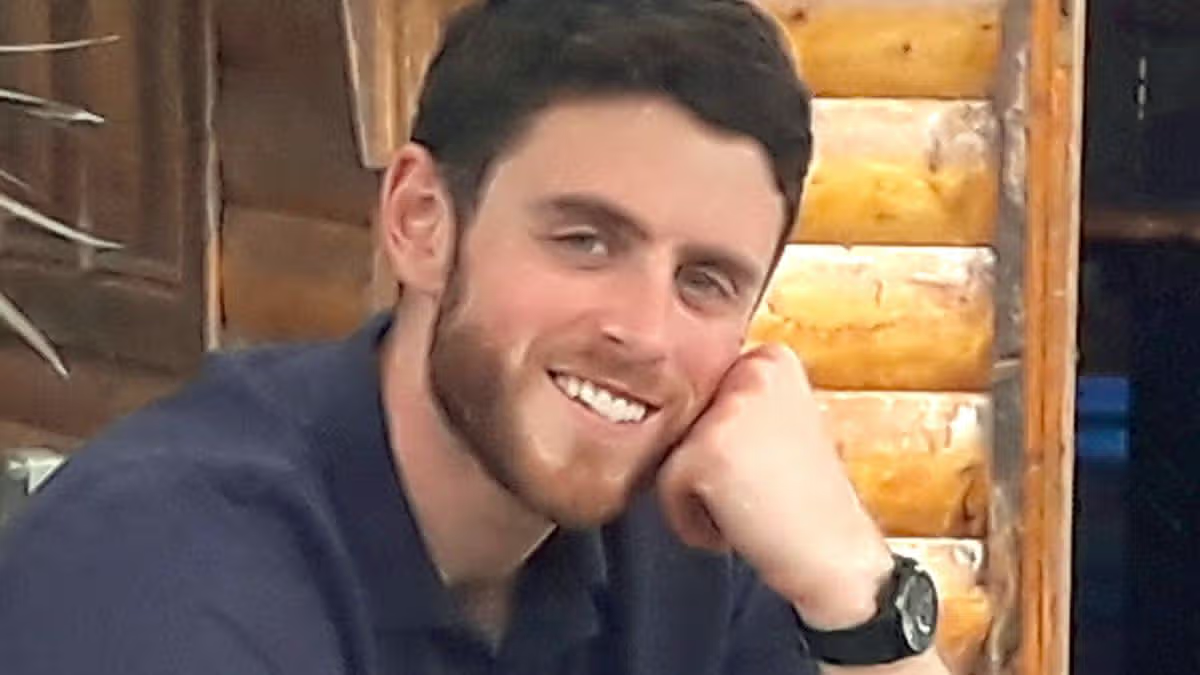
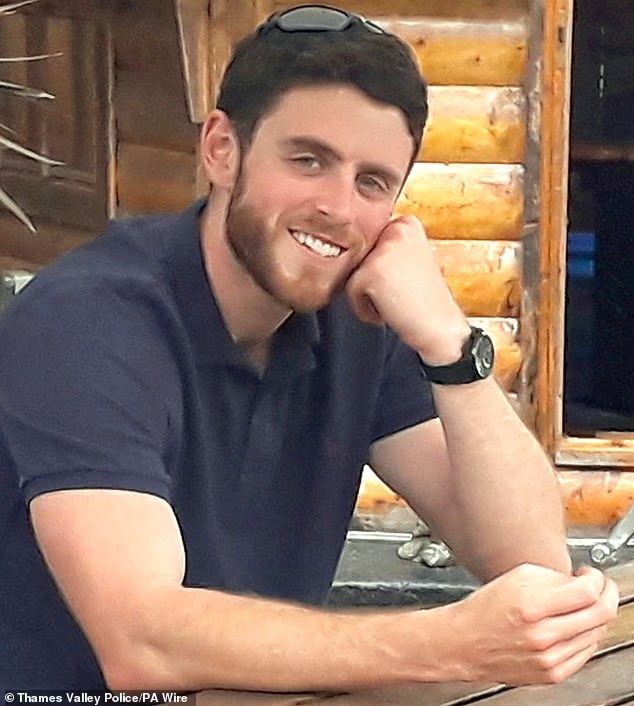
PC Harper was 28 when he sustained fatal injuries while responding to a quad bike theft in Sulhamstead, Berkshire, in August 2019. He died after getting caught in a strap attached to the back of a car and dragged down a country road as three teenage suspects fled the scene of the burglary.

Advertisement

The driver of the vehicle, Henry Long, received a 16-year sentence and will not be eligible for release.

More than 880,000 people have signed a petition calling for PC Harper’s killers to remain in jail. Speaking on Tuesday morning, the police officer who started the petition said she is “optimistic” the Government will prevent them being freed.

Thames Valley Police Federation chairwoman Aileen O’Connor told BBC Radio 4’s Today programme: “There’s a little bit of glimmer of hope and encouragement with this latest release that we heard last night, but I can’t lose sight of just hours before that we heard that there was no possibility. So for me, I’m encouraged, I’m optimistic.

“And I genuinely believe that the powers that be, Andy Burnham – and the difficult decisions that they have to make – he will make the right choices here, and he will come on board with us, and he’ll get the right side of the line. The strength of feeling up and down the country, where over 900,000 people have signed that petition, that’s the British public that have got behind this campaign.

Advertisement

“This is their voice, and this is about justice for Andrew and justice for Lissie and his family.”

It comes after Mr Burnham last week tightened rules so that rape and serious child sexual offences would be excluded from early release. The controversial programme to let offenders free early was designed to avoid the collapse of the crisis-hit prison system

The early release changes were part of the Sentencing Act passed earlier this year that cut the minimum amount of time many offenders would have to spend in prison.

Those freed will face tougher probation conditions, including electronic monitoring, random drug testing and possible bans from driving, pubs and events such as football matches.

Advertisement

Source link

Continue Reading
Click to comment

You must be logged in to post a comment Login

Leave a Reply

NewsBeat

Inside the mysterious rise of ‘milk duct’ cancer in women in their 40s… and the alarming link to IVF, alcohol and the Pill

Published

on

Sarah Stirk learned she had abnormal cells after a breast screening, and was later diagnosed with an early-stage breast cancer in the milk ducts

Just one hour after a mammogram that changed her life, Sarah Stirk arrived for her TV presenting job at Sky Sports and fought to put on a brave face.

The breast screening had revealed abnormal cells in her milk ducts, the tiny tubes that carry milk to the nipple, and while not always cancerous, Sarah had a gut feeling something wasn’t right.

‘I saw the doctor’s face and could tell straight away it wasn’t good news,’ recalls Sarah, 47, a golf presenter and mother of one from York.

‘I asked if there was a lump and she said: “no, but there are abnormal cells…”. Afterwards, I went straight to work. I was a bit of a mess. I didn’t know for sure but no part of me expected good news.’

Advertisement

And she was right. Sarah was later diagnosed with ductal carcinoma in situ (DCIS) in her left breast, an early-stage breast cancer within the milk ducts.

Sometimes known as a ‘stage zero’ cancer (as it hasn’t spread), DCIS is on the rise, particularly among women in their 40s. Until recently, it was usually only seen in women over 50.

Aged 47, three years before the NHS invites women for routine screening, Sarah only went for the mammogram as the private specialist she’d seen for perimenopause symptoms including hot flushes advised her to have the scan before starting HRT.

Advertisement

Sarah Stirk learned she had abnormal cells after a breast screening, and was later diagnosed with an early-stage breast cancer in the milk ducts

‘I had a feeling something wasn’t right so wanted to go for the appointment,’ says Sarah. ‘I’ve always had a fear of breast cancer. The fear was maybe irrational as size has nothing to do with cancer risk, but my breasts are quite large.’

The radiographers spotted a large area of calcifications, small white calcium deposits that sometimes indicate cancer – calcium deposits can occur with age but they can also form as a result of breast cells being replaced faster than usual, which can indicate pre-cancerous changes.

Sarah was referred to the NHS for a further mammogram and biopsy, which was carried out last December.

Advertisement

This time doctors said it was ‘50/50’ as to whether it was cancer. Two weeks later – just days before Christmas – Sarah had her hair cut and was standing outside the hairdresser’s when a consultant phoned and delivered the bad news.

She recalls: ‘I can’t remember exactly what was said but I remember hearing the word mastectomy. I was devastated.

‘My worst fears were realised. I was in tears and had to walk back through town to my car, crying. I knew I had a gruelling journey ahead of me.’

Professor James Harvey, a consultant oncoplastic breast surgeon at the private The Alexandra Hospital in Manchester, says DCIS is only picked up during screening as typically it’s symptomless.

Advertisement

‘The breast is full of milk ducts and inside each of those ducts is a lining of cells,’ he says.

‘DCIS is a cancerous overgrowth of those cells. They haven’t yet developed the ability to grow or spread. But if you leave them long enough, one of them will turn into invasive cancer, bursting out of the duct. It might create a lump and spread.’

A lumpectomy or radiotherapy are usually first-line treatments. But a mastectomy may be required if a large area is affected.

It is increasingly common – ‘we are seeing more younger women with DCIS, particularly in the last two or three years,’ explains Professor Harvey, who also works at the NHS Nightingale and Prevent Breast Cancer Centre in Manchester. The number of diagnoses has tripled in the UK since the early 1990s. Rates have increased by 29 per cent since 2019.

Advertisement
There is strong evidence in favour of doing mammography screening younger, Sarah says. She has signed a petition to lower the screening age to 40

There is strong evidence in favour of doing mammography screening younger, Sarah says. She has signed a petition to lower the screening age to 40

‘Research groups are being set up internationally to try to get to the bottom of why this is happening,’ says Professor Harvey.

‘It’s likely to be a combination of factors. Something to do with how our lifestyles have changed. No one knows for sure.’

Possible factors include women having children later as this changes exposure to oestrogen and other hormones, use of the contraceptive pill, alcohol and sedentary lifestyles.

Advertisement

Obesity is another factor, likely due to how it encourages inflammation in the body.

Sarah had IVF to have her son Milo, now four, and she believes the hormones she was given as part of the treatment might have had an impact.

Most studies suggest fertility drugs do not increase the risk of cancer, but evidence is limited and experts believe more research is needed.

Whatever the cause, Sarah’s cancer might have spread if she’d waited until 50 for a mammogram on the NHS.

Advertisement

‘I think there is good evidence that there is benefit of doing mammography screening younger, certainly from the age of 45,’ Professor Harvey explains.

‘It comes down to the resources available and whether we can afford that as a society.’

Sarah needed a mastectomy to remove all her cancer and choosing the right surgeon caused her ‘emotional turmoil’.

Sarah had IVF to have her son, Milo, and believes the hormones she was given as part of that treatment might have had an impact

Sarah had IVF to have her son, Milo, and believes the hormones she was given as part of that treatment might have had an impact

Advertisement

‘I’ve always had body confidence and liked my boobs,’ she says. ‘The decision I made was going to affect what I looked like for the rest of my life and it was very overwhelming.’

Using her private health insurance, she chose to have a mastectomy with a synthetic implant with Professor Harvey at The Alexandra Hospital. The procedure included a mastopexy, a breast lift and skin tightening on the right side to help her breasts look symmetrical.

‘On the day, I had a bit of a cold,’ recalls Sarah.

‘I was half hoping they’d say I was too unwell and to come back another day. The anxiety was horrific. I was worried that losing a breast would make me less of a woman somehow, less feminine.

Advertisement

‘I vividly remember walking to the anaesthetic table. I nearly said “I can’t do this”.

‘It was fear. I didn’t feel unwell and yet I was going into surgery and I knew I’d come out with a different body and have weeks of recovery ahead of me.’

Sarah’s four-hour surgery was a success and though she says ‘it was three months before I was able to look at myself in the mirror’, six months later she remains ‘sore and tired’ – but she is ‘delighted’ with the results. She has gone from a 35F to a 34DD.

‘After breastfeeding, my breasts had become heavy and saggy and were too big for my frame,’ she says. ‘But I didn’t want small boobs. Appearance matters to me, especially with the job I do.’

Advertisement

Sarah attends six-monthly scans and takes tamoxifen to cut the risk of her cancer returning.

She is now on a mission to raise awareness of DCIS and has signed a petition, organised by a chemotherapy nurse, to lower the screening age to 40. The petition, now closed, gathered more than 106,000 signatures.

‘DCIS is a silent killer,’ says Sarah. ‘The only way you catch this is with screening. If I’d waited until I was 50, my cancer might have been stage three or four. It might have been too late.’

She adds: ‘All the nurses told me they are seeing more younger women with DCIS. Lowering the screening age would save lives.’ Professor Harvey says if the screening age was lowered, the majority of women diagnosed would be offered radiotherapy and a lumpectomy and could keep their breasts.

Advertisement

This wasn’t an option for Sarah as the abnormal cells had spread to a larger area.

Some experts argue that as younger women have denser breast tissue, which can make mammograms less accurate, reducing the screening age may lead to overdiagnosis and unnecessary treatment.

Caught at its earliest stage, the cure rate for non-invasive DCIS is 99 per cent.

Jennifer Rusby, a consultant oncoplastic breast surgeon at The Royal Marsden NHS Foundation Trust in London, says if more women attended screenings when invited it would help catch breast cancer at this early stage and save more lives.

Advertisement

‘Breast screening is offered every three years to all women between the ages of 50 and 70. But, currently, only 60 to 70 per cent of women attend screening appointments when invited.’

The AgeX trial, run by the University of Oxford, has been looking at whether breast cancer outcomes could be improved if the screening age was lowered to 47 and raised to 73. Initial results are expected in December.

Treatment would be much less radical and invasive if caught early, says Ms Rusby.

Sarah returned to work in April: ‘I love my job and it’s great to get back to work and keeping busy,’ she says. ‘The team at Sky are like a little family and they have all been incredibly supportive.

Advertisement

‘But the diagnosis has changed me. I really embrace the small things in life and I’m incredibly grateful for everything I have and for catching it early.’

Source link

Continue Reading

NewsBeat

‘Urgent health warning’ issued about High Street underwear that could be leaving wearers with silent but stubborn foul-smelling bacterial infections

Published

on

While silver-infused clothing is a lucrative market, research now shows the particles may kill off beneficial bacteria while leaving more resilient infectious bugs unharmed

From period pants or ‘leakproof’ underwear to sportswear, socks – and even ‘recovery-boosting’ post-surgery bras sold by Britain’s biggest cancer charity – all sorts of clothing is sold nowadays containing a material claimed to kill germs, prevent odour and even prevent infections.

That material is silver. It’s woven as tiny particles into clothes as an anti-bacterial agent.

And silver-infused clothing is a lucrative market, now worth an estimated £10.5billion worldwide, according to analysts Research and Markets – and it is projected to more than double by 2030.

But growing scientific evidence suggests silver in clothes may actually cause serious harm, possibly risking damage to internal organs, disrupting hormones and making wearers more susceptible to bacterial infections.

Advertisement

Currently, a proposed new law is making its way through Parliament that could effectively ban silver from being incorporated into clothing – especially underwear.

Launching the proposed legislation two years ago, Baroness [Natalie] Bennett of Manor Castle described the use of silver in clothing, as well as cosmetics and personal care products, as an ‘urgent health threat’.

Silver in clothing can kill bacteria because, when in contact with bodily fluids, such as sweat, saliva or menstrual fluid, it releases tiny, charged particles that lethally damage bacterial cell walls and DNA.

However, new research shows silver particles may kill off beneficial bacteria while leaving more resilient infectious bugs unharmed – leading to increased risk of bacterial infections.

Advertisement

While silver-infused clothing is a lucrative market, research now shows the particles may kill off beneficial bacteria while leaving more resilient infectious bugs unharmed

Furthermore, silver particles in clothing can enter the body and, ultimately, migrate to the liver – where they could affect its functioning and disrupt the natural balance of hormones in our body, according to a study published in 2024 in the journal Environmental Science: Nano.

The study’s laboratory tests on cell cultures showed that the particles can then interfere with the liver’s ability to regulate hormone levels.

Advertisement

In particular, this liver disruption seemed to reduce activity in the thyroid system (which regulates energy and metabolism) and separately the androgen system (which plays vital roles in development, reproduction and overall health).

Such worrying research prompted the European Union last year to impose a ban on the use of silver additives in all cosmetic products (it’s long been used as a germ-killing preservative and also as a shiny pigment in lipsticks and eyeshadow). The ban came into force in May.

Baroness Bennett’s Bill would restrict silver use in clothing and cosmetics in the UK.

In fact, action is already being taken here against cosmetics.

Advertisement

In February, the Office for Product Safety and Standards said that due to mounting scientific evidence, the use of silver nanoparticles and larger silver particles would be banned in cosmetics – new products have not been allowed to contain silver since March, while existing products containing it must be withdrawn from sale by the end of next month.

However, it’s still permitted in clothing. Of particular concern to experts are silver-containing period pants, marketed as an alternative to sanitary pads and tampons.

Dr Katy Stokes, a research fellow in biomedical research and health policy at the University of Warwick, who wrote the policy briefing paper advising the new parliamentary Bill, told Good Health: ‘Silver is typically added as an antimicrobial agent to period pants to combat user concerns about smell and hygiene. But the risks outweigh the benefits.’

Dr Stokes cites research backed by the US Food and Drug Administration, published in the journal ACS Applied Materials & Interfaces in 2018, which found nanosilver (silver in tiny particles measuring no bigger than 100 nanometres – by comparison a human hair is up to 100,000 nanometres wide) can kill protective healthy bacteria in the vagina.

Advertisement

‘This could potentially lead to increased incidence of bacterial infections among wearers,’ she says.

Indeed, the study found that nanosilver can kill helpful vaginal bacteria such as Lactobacillus very effectively. Worse, infectious bacteria such as Staphylococcus aureus that can colonise the area are so resilient they can shrug off attacks by nanosilver, researchers from the University of Memphis in the US, and Soochow University in China, found.

Another concern is the potential damage beyond women’s reproductive organs.

In 2024, scientists at the US National Center for Toxicological Research said their research on female rats showed that vaginal exposure to nanosilver promptly caused tissue inflammation and disrupted the healthy balance of bacteria.

Advertisement

Furthermore, the nanosilver found its way into the bloodstream, where it migrated to other organs of the body and throughout the digestive system.

Thiago Verano-Braga, an associate professor of physiology and biophysics at the Federal University of Minas Gerais in Brazil, who has studied silver nanoparticles’ effects for years, has declared that ‘manufacturers absolutely shouldn’t be using silver nanoparticles in pants before there is a critical assessment of potential risks’.

Professor Verano-Braga supported a scientific study by the UK consumer body Which? and the Italian consumer organisation Altroconsumo in 2023, that tested a range of period pants and found ‘unnecessary high levels of silver which could have unknown health implications for wearers and damage the environment’. (If particles leach into waterways they can be harmful to aquatic life.)

There are no legal limits in the UK about how much silver can be added to period pants. Nor do clothing manufacturers have to declare the presence of silver on the packaging or website.

Advertisement

Consumers might find several types of silver in clothing, including nanosilver, silver copper zeolite, silver zinc zeolite, silver chloride, or Agion (a branded product made with silver zeolite).

Which? and Altroconsumo’s tests were not able to determine which type of silver was present, but said they had safety concerns regardless of the type used.

Their analysis found Intima by Bodyform and Marks & Spencer’s period pants contained the highest amount of silver of all the UK-marketed brands tested, at 126.7mg/kg and 57.8mg/kg respectively.

A spokeswoman for M&S told Good Health that the company’s period-pant products still contain the same amount of silver as in the 2023 tests.

Advertisement

She added: ‘Silver chloride is approved under UK regulations for use on textile products.

‘We, like many brands, use a trace amount of silver chloride in the middle part of the gusset – away from the skin – which is perfectly safe and designed to combat odour.’ Silver-containing period pants are also still sold by other major brands such as Victoria’s Secret and Next.

However, a spokesman for Bodyform told Good Health: ‘Since 2023, Bodyform has switched suppliers for its range of washable absorbent underwear and the new product range – including any products launched in the last two and a half years – do not contain silver.’

Dr Stokes’s briefing paper highlighted concerns about a ‘healing bra’ containing silver that is marketed by Cancer Research UK and ‘designed for use after any type of breast or chest surgery’.

Advertisement

On its website, the cancer charity describes its Royce post-surgery bra – which sells for £37.50 – as being ‘developed from anti-bacterial, anti-odour, thermo-regulating X-STATIC silver fibre (which contains a silver alloy) to aid the healing process’.

But Dr Stokes is highly concerned about this product and its marketing. ‘As well as an example of inherent exposure risk, this can also be seen as exemplifying the worrying trend of the unnecessary incorporation of additives,’ her paper says.

A spokeswoman for Cancer Research UK told Good Health it believed the type of silver used in the bra was not harmful to wearers, but that the maker, Royce, should be contacted for a definitive comment.

Royce, however, has not responded to Good Health’s questions.

Advertisement

The website of arc.com, which markets the X-STATIC silver fabric yarn, states: ‘Disclaimer: Products containing X-STATIC are not intended to be used in the diagnosis, cure, or treatment of human infection.

‘They are solely intended to protect the finished product itself from microbial growth. We make no public health claim.’

Dr Stokes told Good Health: ‘I would also be concerned the bra might be used outside of doctors’ advice on wound care, or for prolonged periods, whereby antimicrobial properties may cause microbiome or hormone disruption.’

On top of such concerns is evidence suggesting that adding silver to clothes may not be very effective against odour-causing strains of bacteria anyway.

Advertisement

For a study published in the International Journal of Clothing Science and Technology in 2014, scientists led by Rachel McQueen, a professor of human ecology at the University of Alberta, Canada, analysed textiles coated in a silver compound after they had been worn.

They found the textiles were not as good at preventing micro-organisms from surviving in real life as the makers’ original lab tests had suggested.

According to Dr Stokes, old-fashioned textiles may offer more effective alternatives.

‘For instance, natural fibres like merino wool offer inherent anti-odour properties, thanks to their ability to wick moisture and naturally inhibit bacterial growth,’ she says.

Advertisement

‘Their use is not only potentially more sustainable but also safer for consumers.’

Source link

Continue Reading

NewsBeat

M62 traffic LIVE: Drivers stuck in delays with lanes shut on motorway

Published

on

Manchester Evening News

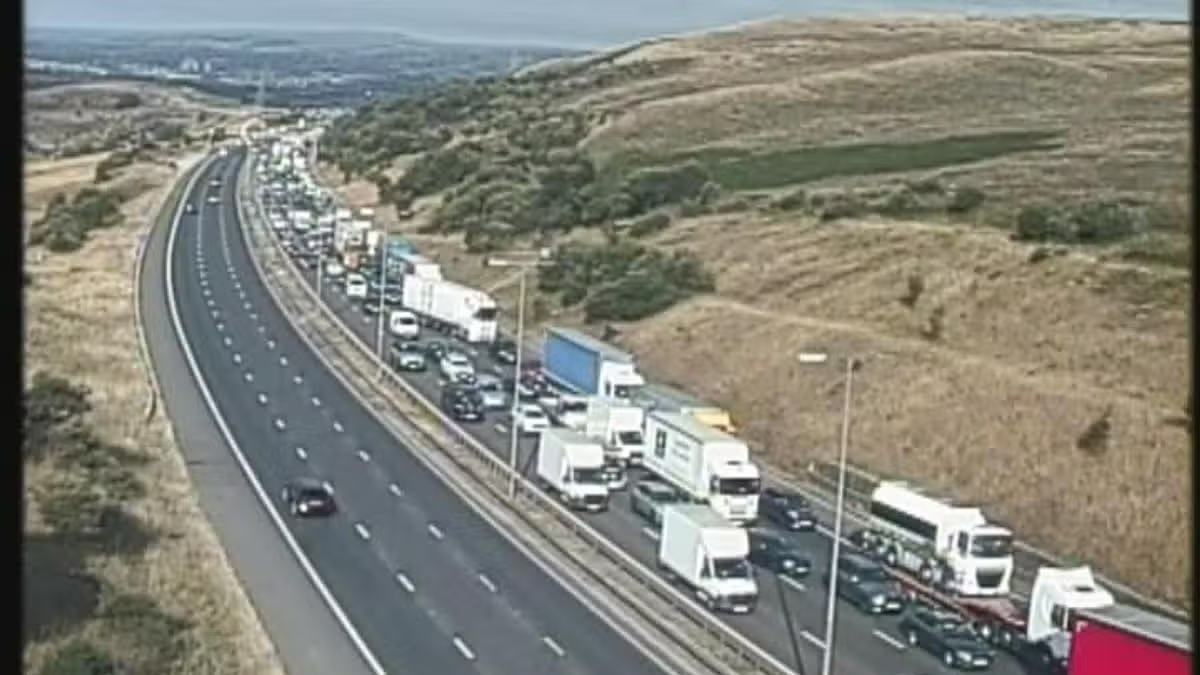
Drivers are facing delays on a stretch of the M62 motorway this morning (August 11).

Two lanes have been shut off on the westbound carriageway between junction 23 for Huddersfield and junction 22 for Rishworth Moor.

According to traffic alert service Inrix, ‘fire services activity’ is underway on the scene. Traffic is also being temporarily held on the eastbound side between junctions 22 and 23 due to ‘animals on the road’ as of 8.55am.

Advertisement

Click here to get the biggest stories straight to your inbox in our Daily Newsletter

Queues are building on both sides of the motorway.

Follow our live blog below for the latest traffic updates.

Source link

Advertisement
Continue Reading

NewsBeat

Coronation Street co-stars dating as they post romantic holiday snaps

Published

on

Daily Mirror

Coronation Street co-stars Jonathan Howard and Olivia Frances Brown – who play Carl Webster and Jodie Ramsey on the ITV soap – are dating

Coronation Street co-stars Jonathan Howard and Olivia Frances Brown have revealed they are dating

The pair – who star as Carl Webster and Jodie Ramsey on the ITV soap – have gone public with their romance after the actor shared new holiday photos of the pair in Ibiza with friend Jamie Lomas and his fiancé Jess Bell.

The couple ‘hard launched’ their romance on social media with pictures from Ibiza, and in one photo, they are lying next to each other on sunbeds whilst in another they’re out at a big club event.

Advertisement

Jonathan also later shared some snaps from a holiday in France, where his daughter spent quality time with her two grandmothers. His ex-wife Elodie Young is tagged in the new pictures.

Elodie is best known for starring as Elektra Natchios in the Marvel Cinematic Universe, whilst she has also appeared in Fox series The Cleaning Lady. She is currently in Los Angeles after relocating for film work.

Advertisement

“Jonathan and Elodie separated over a year ago and remain close friends and co parents,” a source told The Sun. Elodie has been open about her marriage to Jonathan, sharing how they wed in lockdown.

“It was during COVID, during lockdown. The cute part was we had another couple of friends (who) were here. Our parents are in Europe, my mum is in Paris, and his mum is in the UK,” she said.

“So Jonny had his mum on his phone, and I had my mum on my phone, and they were all dressed up. They made an effort! And this is how we did it, which was fun.”

Olivia was previously dating This City is Ours actor James Nelson-Joyce months after getting engaged. A source said at the time: “It’s finished. They were a rock-solid showbiz couple, and their fans will be absolutely shocked and devastated.”

Advertisement

Olivia’s character has caused quite a stir since her arrival on the Cobbles during the iconic Corriedale episode. The half sibling of Corrie fan favourite Shona Ramsey, Jodie has reunited with her sister but things have not got off to a good start as her love of lying and revenge has seen her thrown out by Shona and David Platt.

For Jonathan, his character Carl Webster has broken up his brother Kevin’s marriage to Abi by having an affair. Debbie was later revealed to be Carl’s mother after years of believing they were siblings.

Like this s tory? F or more of the latest showbiz news and gossip, follow Mirror Celebs on TikTok , Snapchat , Instagram , Twitter , Facebook , YouTube and Threads .

Advertisement

Source link

Continue Reading

NewsBeat

A0179 – crash in Market Weighton with traffic running slowly

Published

on

A0179 - crash in Market Weighton with traffic running slowly

As a subscriber, you are shown 80% less display advertising when reading our
articles.

Those ads you do see are predominantly from local businesses promoting local
services
.

These adverts enable local businesses to get in front of their target audience – the local
community
.

It is important that we continue to promote these adverts as our local businesses need
as much support as possible during these challenging times.

Advertisement

Source link

Advertisement
Continue Reading

NewsBeat

Andy Burnham HAS found a way to stop PC Harper’s killers being freed early, ministers claim

Published

on

PC Andrew Harper, a Thames Valley Police officer, was killed in August 2019 when responding to a quad bike theft in Sulhamstead, Berkshire

Andy Burnham has found a way to prevent the early release from prison of PC Andrew Harper’s killers, ministers have claimed.

The Prime Minister is under huge pressure to block Jessie Cole and Albert Bowers from being freed under Labour‘s early release scheme.

Downing Street on Monday said it was ‘not possible’ to exempt ‘one or two offenders’ convicted of manslaughter from the early release scheme.

But less than 24 hours later, Angela Rayner, the Communities Secretary, said the Government would announce an exemption when Parliament returns from its summer break next month.

Advertisement

She told LBC this morning: ‘The Prime Minister is really clear, the Justice Secretary (Alex Norris) will come to Parliament in September to lay out our plans on how we keep the most serious criminals in jail.’

Asked to clarify if this included the killers of police officers, Ms Rayner replied: ‘Yes.

‘The Prime Minister is really clear that these people that have created the most abhorrent crimes should not be released early and that he wants to set out in September with the Justice Secretary how we can resolve this issue.’ 

Sally Jameson, a junior minister in Ms Rayner’s department, had earlier told Times Radio that a way to stop PC Harper’s killers being released early has been ‘identified’.

Advertisement

PC Andrew Harper, a Thames Valley Police officer, was killed in August 2019 when responding to a quad bike theft in Sulhamstead, Berkshire

The Prime Minister is under huge pressure to block Jessie Cole and Albert Bowers from being freed under Labour's early release scheme

The Prime Minister is under huge pressure to block Jessie Cole and Albert Bowers from being freed under Labour’s early release scheme

It came as Debbie Adlam, the mother of PC Harper, revealed she had been contacted by Downing Street on Monday night.

Advertisement

She told BBC Breakfast: ‘I had an interview yesterday, and it obviously must have shown something because I then had a call from Downing Street quite late last night.

‘It’s just been up and down. It’s just the rollercoaster of just hope, not even more than that is really, really draining. We’ve now got a little bit of hope that we didn’t have before.’

Discussing the call with a member of the PM’s staff, Ms Adlam said: ‘She said that he wanted to convey that he wants to do everything that he can and has more hope now of finding a resolution to this to try and keep them in prison.

‘I think the fact that it’s actually come from Downing Street – I’ve got to try and have some faith in it, but at the same time, I have to protect my own feelings.’

Advertisement

Discussing the efforts to keep her son’s killers in jail, Ms Adlam said: ‘It feels like a hash. It feels like a rush job. It feels like nobody’s put enough effort into actually look for reasons or ways.

‘We are having to push on every level, and it just doesn’t feel like, as a British citizen, I shouldn’t be doing this.

‘They weren’t given extreme sentences, and I’m only asking for them to do what they were given.’

PC Harper was fatally injured when he got caught in a strap attached to the back of a car and was dragged down a country road as the killers fled the scene of a quad bike theft in Sulhamstead, Berkshire, in 2019.

Advertisement

Two out of three of PC Harper’s killers, Cole and Bowers, are set to be released half way through their 13-year sentences, after being convicted of manslaughter in 2020.

Some 5,000 people are expected to be released early under sentencing changes, down from 6,000 after some exemptions were announced as part of an urgent review of the scheme to tackle jail overcrowding.

Exemptions were made for those convicted of rape, serious child sex offences and grooming offences.

Last week, the Prime Minister said he had ‘pushed to the very limits of what is possible to do without risking the prison system reaching capacity and collapsing’ by making these exemptions.

Advertisement

However, more than 880,000 people have signed a petition calling for Pc Harper’s killers to remain in jail.

Source link

Continue Reading

NewsBeat

Half of holidaymakers have changed travel plans due to costs

Published

on

Half of holidaymakers have changed travel plans due to costs

A poll of 2,000 adults who go on holiday found 22 per cent are arranging their getaways closer to departure and 32 per cent would rather stay somewhere closer to the UK.

Almost seven in 10 (67 per cent) are eager to avoid the strain of busy airports while 16 per cent have delayed getaways due to worldwide instability.

And 54 per cent have already committed to a staycation over the warmer months this year – having booked their UK getaway.

Advertisement

Further to this, more travellers will be heading to the South West of England this summer than making the traditional jaunt to Spain.

Ryan Johnson, senior vice president at Enterprise Mobility in the UK and Ireland, which commissioned the research, said: “This summer’s travel trends paint a clear picture of how UK holidaymakers are approaching their summer holidays, with domestic travel, and road trips in particular, firmly at the forefront.

“Cost, convenience and a desire for more flexibility are all shaping those decisions in meaningful ways.”

It also emerged cost was another key factor in the emergence of ‘stay-trippers’, people swapping overseas holidays for road trips and short breaks across the UK.

Advertisement

More than a third (37 per cent) would choose a domestic road trip over travelling overseas on price, according to the OnePoll.com data.

A third (35 per cent) also saw easier planning as a benefit of staying closer to home, while 33 per cent cited the added bonus of being able to be more flexible with their plans.

For those planning a road trip specifically, the Scottish Highlands (42 per cent), Lake District (40 per cent) and Cornwall (37 per cent) ranked as the most sought-after stops.

When it comes to driving specifically, reliability was the top priority when selecting a car up to the task (46 per cent), ahead of comfort and passenger space (39 per cent) and fuel efficiency (33 per cent).

Advertisement

Traffic, meanwhile, was the most cited concern for those taking to the road this summer (54 per cent).

Ryan Johnson from Enterprise Mobility added: “We see the results reflected in the way our customers choose their travel.

“Having the right vehicle in the right place at the right time is fundamental, and customers need a vehicle that is reliable, comfortable and well suited to the journey ahead, qualities that are essential to creating a great road trip experience.”

Advertisement

Source link

Continue Reading

NewsBeat

Dustbowl Britain: Heat health alerts issued for all of England as 36C heatwave arrives and almost three-quarters of country is plunged into drought

Published

on

The Met Office forecast for London shows highs of 34C tomorrow and 35C on Thursday

Britain’s sixth heatwave of the year will build from today to a 36C peak this Thursday – with no rain in the forecast and almost three-quarters of England now in drought.

UK Health Security Agency (UKHSA) amber heat health alerts will be active for most of England from this morning until Friday evening, warning of a ‘rise in deaths’.

The Government urged people to stay safe by drinking plenty of water, checking on vulnerable friends and family and avoiding the sun at the hottest part of the day.

Highs of 26C in London, 28C in Manchester and 29C in Cardiff are expected today, before the mercury soars in some areas to 34C tomorrow and 36C on Thursday. Friday is likely to hit at least 30C, before a slight drop to 26C across this weekend.

Advertisement

The Met Office is considering issuing an extreme heat warning, after doing so in the June heatwave – which was the first time such an alert had been issued in four years.

It comes as the Environment Agency (EA) said 71 per cent of England is experiencing a ‘flash drought’ as a dry start to August followed the country’s driest July on record.

While there is no meaningful rain in this week’s forecast for drought-hit areas of England, meteorologists have spotted early signs that showers could move across the country on Sunday – bringing the first proper rain to southern areas in two months.

Met Office chief forecaster Jason Kelly said: ‘Heat will gradually build this week, with temperatures reaching into the mid-30Cs in what will be a fairly widespread heatwave for England and Wales.

Advertisement

The Met Office forecast for London shows highs of 34C tomorrow and 35C on Thursday

Dry grass surrounds Brockwell Lido in south London yesterday amid the ongoing hot weather

Dry grass surrounds Brockwell Lido in south London yesterday amid the ongoing hot weather

Met Office satellite view from May 23
Met Office satellite view from yesterday

Met Office satellite views show the transformed landscape from May (left) to yesterday (right)

Advertisement

Advertisement

A UK Centre for Ecology and Hydrology map shows the extent of the drought across England and Wales, by displaying current soil moisture levels compared to the historical average

A UK Centre for Ecology and Hydrology map shows the extent of the drought across England and Wales, by displaying current soil moisture levels compared to the historical average

Advertisement

‘The driver for this week’s heat is high pressure, this becoming dominant over the next day or so, bringing plenty of sunshine and allowing temperatures to build day-by-day. 

‘Southerly or southeasterly winds will also tap into the hot conditions over Europe, meaning we’re looking at further notable heat for many this week, likely peaking on Thursday.’

UKHSA amber heat health alerts have been issued for the Midlands, South East, North West and South West of England, while a yellow alert will be in force for the North East.

The amber alerts warn of ‘significant impacts’ across health and social care services due to the heat. This includes a ‘rise in deaths, particularly among those aged 65 and over or with health conditions’. 

Advertisement
TOP TEN HOTTEST DAYS IN BRITAIN – INCLUDING TWO IN JUNE 2026
1 40.3C July 19, 2022 Coningsby, Lincolnshire
2 38.7C July 25, 2019 Cambridge
3 38.5C August 10, 2003 Faversham, Kent
4 38.2C July 18, 2022 Pitsford, Northamptonshire
5 38.0C June 26, 2026 Lingwood, Norfolk 
6 37.8C July 31, 2020  London Heathrow
7 37.1C August 3, 1990 Cheltenham, Gloucestershire
8= 36.7C August 9, 1911 Raunds, Northamptonshire
8= 36.7C July 1, 2015 London Heathrow
8= 36.7C June 25, 2026 Merryfield, Somerset

The latest heatwave is set to subside over the weekend and bring fresher air and rain – although this is not expected to make up for the shortfall in recent months.

Sarah Davies, head of environment and energy at the Met Office, said: ‘Forecasts for the remainder of August and into September suggest a good deal of dry weather is expected, mixed with some unsettled spells.

‘While some areas may see useful rainfall at times, there is currently no strong signal for a sustained period of widespread rainfall, with below-average rainfall more likely than above-average for the period as a whole.’

Examining the possibility of rain later week, BBC lead weather presenter Simon King wrote: ‘We have to look towards Sunday, where there are some signs of some rain coming into the UK from the Atlantic.

Advertisement

‘Low pressure bringing rain-bearing weather fronts will move in across Wales and southern England and – for some – a spell of rain.

‘While this does not currently look to be particularly heavy or persistent, there could be the first bit of proper rain for many in nearly two months.’

This summer has been one of extreme heat and dry conditions, with two record-breaking heatwaves in May and June that led to the deaths of more than 2,800 people.

This was followed by two further heatwaves in July, and a fifth was confirmed last week.

Advertisement
An aerial view of the dry grass at Radnage Recreation Ground in Buckinghamshire yesterday

An aerial view of the dry grass at Radnage Recreation Ground in Buckinghamshire yesterday

Dried and yellowed grass at Parliament Square in London yesterday amid drought conditions

Dried and yellowed grass at Parliament Square in London yesterday amid drought conditions

The artificial hockey pitch at Marlow Hockey Club and the desiccated cricket pitches yesterday

The artificial hockey pitch at Marlow Hockey Club and the desiccated cricket pitches yesterday

The UK has been struggling with the impact of extreme weather including drought, heatwaves and wildfires.

Advertisement

Some 45million people are in drought-stricken areas, and 27million customers are under hosepipe bans as rivers and reservoirs run low.

Rainfall in July ranged from 1 per cent of the average in the South East to 26 per cent in the North West. Some parts of Hampshire, Isle of Wight and West Sussex have not had rain for 59 days.

Farmers have warned of a ‘brutal harvest’ for crops and a lack of feed for livestock, and there have been warnings of food price inflation shocks later in the year as a searing summer across Europe feeds through from fields to supermarket shelves.

Meanwhile firefighters continue to battle a series of fires across the UK, including one in the New Forest National Park which began in a van and spread to nearby heathland.

Advertisement

Families were forced to abandon their cars on Sunday and flee for their lives after police feared the fuel-laden vehicles could become ‘bombs’ if caught in the flames, and told occupants to flee to ‘stay alive’.

Dozens of fire crews fought to control the blaze, which leapt through acres of ‘tinderbox bracken’ by the A31 near Ringwood in Hampshire.

The area hit by the blaze is protected heathland and home to a number of rare species. Hampshire Fire and Rescue Service said crews had worked overnight as more than 120 firefighters attended the scene.

Elsewhere, South Wales Fire and Rescue Service said crews were attending ‘multiple wildfire incidents’, including at Cwmavon Woods in Blaenavon, Wattsville in Sirhowy Valley and Abernant in Aberdare.

Advertisement
Advertisement

The EA said yesterday that the East Midlands, Lincolnshire and Northamptonshire, Kent and East Sussex, and Solent and the South Downs have become the latest areas to move into drought.

A ‘flash drought’, which the country is experiencing, is one which develops very quickly because of a combination of very low rainfall and high temperatures.

The announcement came after a meeting of officials, water companies and farming leaders under the National Drought Group, which warned that all regions of the country are experiencing pressure on their water resources, with impacts on agriculture, public water supplies and the environment.

Last week, the EA said half of England had plunged into flash drought – one which develops very quickly because of a combination of very low rainfall and high temperatures – and the latest announcement means 71.3 per cent of the country is in drought.

Advertisement

Water firms imposing hosepipe bans in 2026

  • Affinity Water
  • Anglian Water
  • Cambridge Water
  • Dŵr Cymru Welsh Water
  • Essex and Suffolk Water
  • Southern Water
  • South East Water
  • South West Water
  • Thames Water

<!- – ad: https://mads.dailymail.co.uk/v8/de/news/none/article/other/mpu_factbox.html?id=mpu_factbox_1 – ->

The North East and Yorkshire have moved to ‘prolonged dry weather’ status, the stage before drought, and nowhere in England is in ‘normal’ status, the EA said.

Downing Street defended the Government’s response to the heatwave and wildfires, insisting it was focused on the immediate response and long-term resilience to increasing extremes, from working with the National Drought Group to backing major investment in infrastructure such as reservoirs.

After the latest meeting of the National Drought Group, its chairman Tony Grayling, strategic drought lead at the Environment Agency, said: ‘Drought conditions are worsening and will continue to do so until we see significant and sustained rainfall.

Advertisement

‘We know the hot and dry weather is taking a real toll on farming and there will be long-lasting impacts on our environment.

‘We want everyone to stay safe and hydrated over the summer, but we need everyone’s help in using a little less water to make sure our current water reserves last. Every drop we can save is a drop more for your local farmers, local wildlife and local rivers.’

Water minister Emma Hardy, who attended the National Drought Group, said: ‘We know how challenging this summer has been, especially for our hard-working farmers who are at the sharp end of climate change and an increasing number of floods and droughts.’

The UK Health Security Agency (UKHSA) has issued amber heat health alerts across England

The UK Health Security Agency (UKHSA) has issued amber heat health alerts across England

Advertisement
A UK heatwave is official when a location records at least three consecutive days of daily maximum temperatures which meet or exceed a specified threshold - which varies by region

A UK heatwave is official when a location records at least three consecutive days of daily maximum temperatures which meet or exceed a specified threshold – which varies by region

She said the Government was working to make it easier for farmers to build more onsite irrigation reservoirs – something farming leaders have been calling for – and was delivering ‘long-term change’ in the water industry to reduce leaks and deliver nine new reservoirs.

‘As we move through this period of drought, I expect water companies to take every available step to minimise leakage and support customers in using water wisely,’ she said, as she thanked people for abiding by the hosepipe bans.

The EA said rivers, reservoirs and groundwater continue to decline, water temperatures are rising, leading to more fish rescues, 245 wildfires have been reported on protected sites this year, and important wetland and peatland habitats are drying out.

Advertisement

Only 14 per cent of rivers are at normal levels and more than a fifth (22 per cent) are exceptionally low, including the Avon, Wye, Ely, Ouse and Exe, while reservoir levels have fallen to 69 per cent – well below normal for the time of year.

The agency added that the latest drought is the third in the past five years, after 2022 and 2025, and mainland Europe is also struggling with heatwaves, dry weather and low river flows.

Meanwhile, Chessington World of Adventures Resort will reopen today after being forced to shut yesterday due to a water outage.

Thousands of disappointed families were turned away from the theme park in Surrey after a burst water main forced it to close in the middle of the summer holidays.

Advertisement

Thames Water, which supplies Chessington, said engineers worked to fix a burst main on a road leading into the attraction that was affecting customers in the KT9 area.

Households across 10 postcode areas in east London and Essex also faced water disruption after a large Thames Water main burst in South Woodford on Sunday morning.

Pipe damage left some homes and businesses across the E4, E18, IG2, IG4, IG5, IG6, IG7, IG8, IG9, and RM4 postcodes facing low water pressure or no running water.

Thames Water apologised and said it was carrying out emergency repair work.

Advertisement

Source link

Continue Reading

NewsBeat

London travel news LIVE: Southern trains hit by points failure amid Elizabeth line Heathrow delays

Published

on

London travel news LIVE: Southern trains hit by points failure amid Elizabeth line Heathrow delays

Many London Overground services also serve Heathrow. You’ll need to make a change at an interchange station such as Stratford, Liverpool Street, Clapham Junction or Shepherd’s Bush. You don’t need to buy separate tickets to do this, you can just tap in and out using the same payment method across both networks.

Source link

Continue Reading

NewsBeat

Daniel Kinahan’s wife lavish life in Dubai unveiled with glittering wedding and six luxury homes

Published

on

Manchester Evening News

Daniel Kinahan’s wife Caoimhe Robinson has been living a life of luxury in Dubai but he has now been extradited to Ireland

Daniel Kinahan’s wife had been enjoying an extravagant life in Dubai, but now finds herself in a precarious position following her husband’s extradition to Ireland on accusations of heading an international drugs operation.

Advertisement

Caoimhe Robinson, a mum of five, had been living a glamorous, sun-drenched life at the family’s seven-bedroom residence on the city’s Palm Jumeirah resort. Her property portfolio also includes six luxurious homes, among them a villa in the highly exclusive Emirates Hills neighbourhood, where Petra Ecclestone lives nearby.

For years, she and her alleged cartel boss husband were considered the power couple at the heart of Dubai’s elite social circle. However, sources suggest the “bubble” she and other Kinahan associates’ partners have lived in has now burst following the bombshell extradition.

Click here to get the biggest stories straight to your inbox in our Daily Newsletter

Caoimhe had been living her sun-soaked, glamorous Dubai life. Her husband stands accused of funding his lifestyle via criminal cash from a cartel accused of controlling roughly a third of Europe’s cocaine trade.

Advertisement

Kinahan fled to Dubai in 2016 following an assassination attempt at the Regency Hotel in Dublin. There, he and Caoimhe lived a golden lifestyle that featured £220 tasting menus and £500 Beluga caviar, reports the Daily Star.

Their glittering wedding at the seven-star Burj Al Arab hotel in 2017 was attended by alleged criminals and even heavyweight boxing champ Tyson Fury.

The hotel’s eye-wateringly expensive Michelin-starred restaurant reportedly became a favourite haunt of Caoimhe and Kinahan and they were the ultimate power couple of the Dubai social scene.

Advertisement

Leaked records repor­ted by the Con­sor­tium of Invest­ig­at­ive Journ­al­ists (CIJ) show she has been buying and selling property in Dubai since 2017, includ­ing a villa bought for about €2.1m.

In addition, she was lis­ted as the joint owner, with her husband, of four Dubai prop­er­ties in 2022. But Caoimhe, from Darndale in north Dublin, no longer has a home in Ireland and didn’t return for her mum’s funeral in 2020.

Her crime links started long before joining the Kinahan clan as her previous gangster husband Mika ‘The Panda’ Kelly was gunned down in September 2011 by the Real IRA. Following Kelly’s murder, she is reported to have met Kinahan during a trip to Spain in 2014.

Advertisement

And it is the Criminal Assets Bureau which could ultimately bring down her lavish lifestyle. Kinahan’s extradition follows the arrested and prosecution of Sean McGovern, the first cartel member to be extradited from Dubai to Dublin last year.

Said to have been Kinahan’s right-hand man, he was convicted and is now serving 24 years in prison. His long-term partner Anita Freeman has ditched her luxury lifestyle in Dubai to return to Ireland. In 2016, the ex-council house they shared in Dublin was seized.

Advertisement

Source link

Continue Reading

Trending

Copyright © 2025