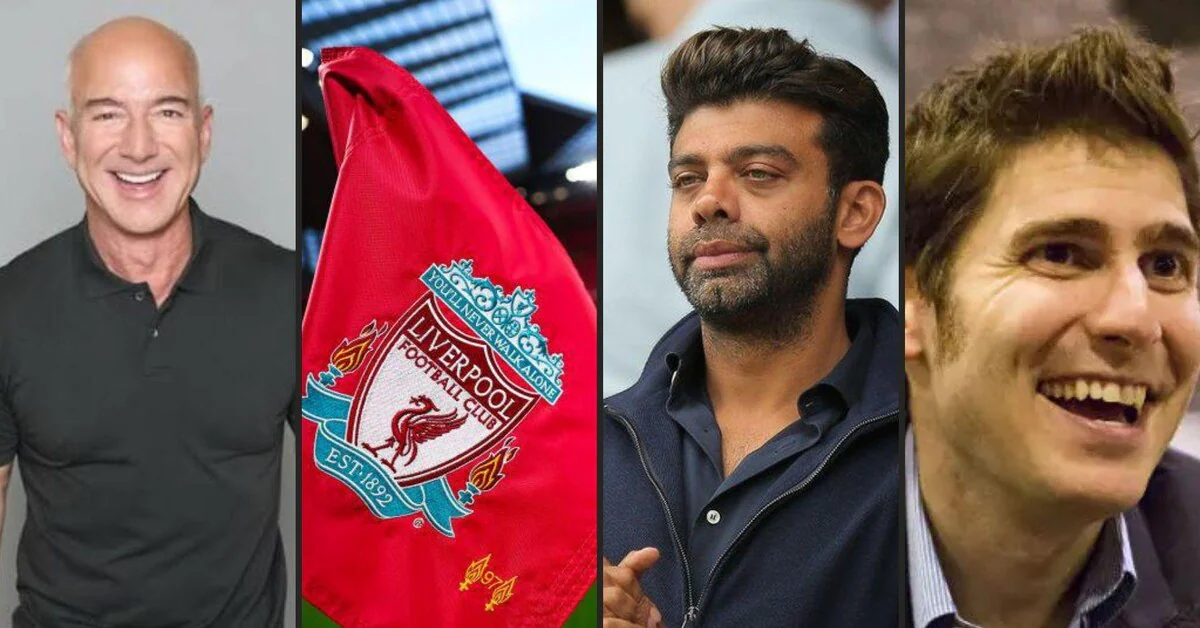
British-Indian businessman Amit Bhatia is at the centre of a consortium that is closing in on a potentially major investment in Liverpool, with Amazon founder Jeff Bezos and Facebook co-founder Eduardo Saverin among the high-profile names backing the proposed deal.
The group is in talks with Fenway Sports Group (FSG), Liverpool’s controlling owner since 2010, over a significant minority stake in the Premier League club. While reports have suggested the consortium could acquire around 30% of Liverpool, the final size of the investment could be slightly higher.
The reported transaction could value Liverpool at around £4.4 billion ($6 billion), with the consortium’s investment potentially worth about £1.35 billion ($1.8 billion).
For Bhatia, however, Liverpool would not represent his first major involvement in football. The 46-year-old has spent almost two decades around English football, most notably through his association with Queens Park Rangers (QPR).
Who is Amit Bhatia?
Bhatia is a British-Indian businessman and investor who has interests across several sectors, including technology, media, property, real estate, consumer retail and healthcare.
He began his professional career in investment banking at Morgan Stanley before moving into entrepreneurship and investment. He is associated with AyBe Capital and has also been involved with property investment firm Summix Capital. He is also chairman of British construction company Breedon Group.
His connection to one of India’s most prominent business families comes through his marriage to Vanisha Mittal, daughter of steel magnate Lakshmi Mittal.
That relationship has also placed Bhatia within a family with growing interests in global sport.
Lakshmi Mittal has long been one of India’s wealthiest businessmen, while the wider Mittal family has increasingly expanded its presence in sports investment. Aditya Mittal, Bhatia’s brother-in-law, recently invested in the Boston Celtics, while the family has also entered the Indian Premier League through Rajasthan Royals.
But Bhatia’s own football journey began long before the current Liverpool talks.
From QPR to a potential Liverpool investment
Bhatia entered English football in 2007 through Queens Park Rangers. He initially became involved as a representative of his father-in-law after Mittal acquired a stake in the Championship club alongside Bernie Ecclestone and Flavio Briatore.
He subsequently became QPR’s vice-chairman before taking over as chairman, a position he held until 2023.
During his association with the club, QPR returned to the Premier League and spent multiple seasons in England’s top flight.
Bhatia’s relationship with the club continued until July 2026, when he stepped down from the QPR board and transferred his stake to majority owner Ruben Gnanalingam.
His departure came just weeks before his name emerged at the centre of discussions over a much larger and more valuable English football asset.
Who else is in the Liverpool consortium?
Bhatia is leading a group that includes two of the world’s wealthiest technology entrepreneurs: Jeff Bezos and Eduardo Saverin.
Jeff Bezos
Bezos, 62, founded Amazon in 1994 after leaving investment bank D.E. Shaw. What began as an online bookseller eventually became one of the world’s largest technology and e-commerce companies.
He stepped down as Amazon’s chief executive in 2021 but remains its executive chairman. He also owns The Washington Post and founded aerospace company Blue Origin.
Forbes’ real-time estimates put Bezos’ fortune at roughly $280 billion, making him one of the world’s richest individuals.
A Liverpool investment would mark a significant new chapter in Bezos’ sporting interests. He has previously explored opportunities to invest in American football, including interest around NFL franchises, but has not previously completed a major football club investment.
Eduardo Saverin
Saverin, 44, is best known as one of Facebook’s co-founders. Born in Brazil, he later moved to the United States before relocating to Singapore.
He has since become a prominent technology investor and co-founded venture capital firm B Capital with Raj Ganguly.
Saverin is also no stranger to football ownership discussions. He was part of the consortium that backed Steve Pagliuca’s unsuccessful attempt to buy Chelsea in 2022.
His potential Liverpool investment would therefore represent another attempt to enter the ownership structure of a major English football club.
How big is the proposed Liverpool deal?
The exact terms have not been formally announced, but reports suggest the consortium is targeting a stake of around 30% or potentially slightly more.
The reported valuation of Liverpool is approximately £4.4 billion ($6 billion). At that valuation, a 30% stake would be worth around £1.32 billion, broadly in line with reports that the transaction could be worth about £1.35 billion.
However, the proposed investment should not be confused with a full takeover.
FSG would retain control of Liverpool if the consortium acquired a minority stake of around 30%. The transaction would instead bring a group of extremely wealthy investors into the club’s ownership structure.
FSG has previously made clear that it is open to outside investment if it believes the arrangement is in Liverpool’s best interests.
Why is FSG selling part of Liverpool?
FSG has controlled Liverpool since October 2010, when it acquired the club for around £300 million.
Under its ownership, Liverpool have undergone a dramatic transformation both on and off the pitch.
The club won the Premier League title, Champions League and other major trophies, while Anfield was expanded and the club’s commercial revenues increased substantially.
Liverpool have also adopted a largely self-sustaining financial model, with revenue generated by the club being used to fund operations and investment.
That does not mean FSG needs to sell Liverpool.
Instead, the proposed transaction could allow FSG to monetise part of the enormous increase in Liverpool’s value while simultaneously bringing additional capital and influential investors into the club. FSG has followed a similar approach before.
In 2021, RedBird Capital Partners acquired an 11.5% stake in FSG for around $735 million. In 2023, Dynasty Equity purchased a small stake directly in Liverpool.
The Dynasty investment reportedly helped fund infrastructure projects, including the redevelopment of the Anfield Road Stand and the repurchase of the Melwood training ground.
Will FSG remain in control?
If the reported deal goes through as a minority investment, yes. A stake of around 30% would leave FSG with a controlling position at Liverpool. However, the arrival of such a powerful consortium could still have implications for how the club is run.
Bhatia, Bezos and Saverin would collectively bring enormous financial resources, business networks and commercial expertise to the ownership structure.
The size of the proposed investment also raises a natural question: could a minority investment eventually become something bigger?
There is currently no indication that FSG is preparing to sell control of Liverpool. But a substantial minority stake would give the new investors a significant financial interest in the club and potentially increase their influence over time.
For now, however, the reported transaction remains a strategic minority investment rather than an outright takeover.
Why would Bezos and other billionaires want to invest in football?
Football clubs are increasingly being viewed by wealthy investors as long-term global assets rather than simply sporting businesses.
Liverpool is particularly attractive because it combines a globally recognised brand, a huge international fanbase, regular participation in elite European competitions and significant commercial revenues.
Unlike many traditional businesses, top-level sport also offers something increasingly scarce in the digital economy: live, appointment-based global audiences.
Fans still tune in at a specific time to watch Liverpool play, creating a valuable platform for broadcasters, sponsors and commercial partners. There is also a scarcity factor.
There are only a limited number of clubs with Liverpool’s history, global following, commercial reach and ability to compete at the highest level. That makes established elite football clubs difficult assets to replicate.
How wealthy are the potential investors?
The consortium brings extraordinary financial firepower. Bezos is estimated to have a net worth of around $280 billion, putting him among the three richest people in the world.
Eduardo Saverin’s fortune is estimated at around $33 billion.
Bhatia himself is not a billionaire on the scale of Bezos or Saverin, but his position within the Mittal family and his own business interests give him substantial experience in investment and sport. His father-in-law Lakshmi Mittal is estimated to be worth more than $30 billion.
The combination gives the consortium an unusual mix of technology wealth, investment experience, global business connections and football expertise.
What could the investment mean for Liverpool?
The immediate impact would be financial and strategic rather than a change in ownership control. Liverpool could potentially gain access to new commercial relationships and investment networks through the consortium.
A group containing Bezos and Saverin could also strengthen the club’s connections with technology, media and global investment markets.
That could become increasingly relevant as football clubs seek to expand their digital businesses, international commercial operations and global fan engagement. The investment could also provide FSG with greater financial flexibility while allowing it to retain control.
However, there is no guarantee that a large minority investment would translate directly into a huge transfer-market spending spree.
Liverpool operate under financial regulations, and modern football’s financial rules limit the extent to which owners can simply inject unlimited amounts of money into the playing squad.
Liverpool’s financial position is already strong
The potential investment comes at a time when Liverpool are already one of the world’s most valuable football clubs. The club recently reported record revenues of more than £700 million and ranked fifth in the Deloitte Football Money League.
Liverpool have also demonstrated a willingness to spend heavily in the transfer market, including an investment of close to £450 million in a single summer window.
That means the proposed transaction is not necessarily about rescuing a club in financial difficulty. Instead, it could be about strengthening an already powerful sporting and commercial operation.
For FSG, it also represents an opportunity to realise some of the enormous value created during its 15-plus years at Anfield.
Could this eventually become a full takeover?
That remains one of the biggest unanswered questions.
A 30%-plus investment would not give the consortium outright control, but it would make Bhatia, Bezos and Saverin major stakeholders in one of football’s biggest clubs.
Whether that eventually leads to a larger investment would depend on several factors, including FSG’s long-term plans, the consortium’s appetite for greater control and the future valuation of Liverpool. For now, there is no evidence that FSG intends to walk away from Liverpool.
In fact, the proposed structure would allow FSG to retain control while sharing the financial exposure and future growth of the club with new partners.
Bhatia’s sporting connections go beyond Liverpool
Bhatia’s experience at QPR could be particularly relevant to his role in the proposed consortium.
His near two-decade association with English football means he understands the business and regulatory environment surrounding the Premier League in a way that Bezos and Saverin do not.
His family also has a growing presence in global sport.
The Mittal family’s involvement in the Boston Celtics and Rajasthan Royals reflects a broader trend of Indian business families investing in major international sporting properties.
For Bhatia, Liverpool would therefore represent the biggest sporting investment of his career and potentially place him at the centre of one of the most significant ownership developments in English football in recent years.
What happens next?
FSG and the Bhatia-led consortium are continuing discussions, with reports suggesting an announcement could come soon.
The precise size of the stake, valuation, investment structure and rights attached to the new shareholders will determine the significance of the transaction.
If completed, it would bring together three exceptionally wealthy and globally connected investors around one of football’s most recognisable clubs. For Liverpool, it would mean FSG retaining control while gaining powerful new partners.
For Bhatia, it would represent a remarkable progression from his involvement at QPR to a potential stake in one of the biggest clubs in world football.
And for Bezos and Saverin, it would offer entry into a sporting asset whose value has grown dramatically over the past decade and a half.
The proposed deal, therefore, is more than a simple minority share sale. It is a meeting point between football, global wealth, technology and investment, with Liverpool sitting at the centre of it.
Who Stands to Gain From the Liverpool Deal?
If the proposed investment goes through, the benefits will extend well beyond the Amit Bhatia-led consortium. Fenway Sports Group (FSG) stands to be the biggest winner, with its valuation of Liverpool soaring since its 2010 acquisition while retaining control of the club.
LeBron James, who holds a minority stake in Liverpool, could also see a substantial increase in the value of his investment if the club’s valuation rises to the reported $6 billion level.
Jeff Bezos and Amazon could gain strategically too, as the billionaire’s involvement could strengthen the company’s links with elite live sport and potentially open the door to future Premier League broadcasting opportunities. For Liverpool, the deal could bring fresh capital, global business connections and additional commercial opportunities.
The proposed investment therefore has the potential to create winners across ownership, existing shareholders, media and the wider sports-business ecosystem.




















































You must be logged in to post a comment Login