
Crypto World
'This Fool' Is One of TIME's 50 Most Underappreciated TV Shows








Jim Cramer says investors do not need to track every market move to understand what is driving stocks. Instead, three questions can help investors read the market like a pro.
The “Mad Money” host built his framework on Tuesday around three checkpoints that sidestep noisy daily headlines. Where are bond yields headed? Where is oil trading? And, how is Nvidia performing? Cramer says these are the three main questions every investor should be asking as they look at the market.
Bonds and Oil Point to Rates and Risk
Cramer explained that when Treasury yields climb, bonds start competing harder with stocks for investor cash. That dynamic also pushes the Federal Reserve closer to tightening policy rather than easing it.
With the 30-year Treasury yield, a benchmark for long-term borrowing costs, hovering near 5.2%, Cramer said the number is too high for markets to shrug off.
“You must never forget that, as important as stocks are, the bond market is much larger and rules the roost.”
Jim Cramer, CNBC
He added that falling rates usually point to a healthier market, while rising rates tend to signal trouble ahead.
On oil, Cramer’s logic runs through inflation. Pricier crude tends to feed inflation readings, which in turn ripple into bond market pricing.
Oil has also become a gauge of geopolitical risk as investors watch the Iran conflict near the Strait of Hormuz. Still, he cautioned against overreacting to small daily swings, noting crude remains well below its recent highs.
Nvidia Is the Final Piece to Read the Market
Cramer’s final question is simple. How is Nvidia doing?
“The barometer for what might be as much as third to a half of the economy.”
Jim Cramer, CNBC
His logic ties back to artificial intelligence (AI) infrastructure spending. That capital no longer sits inside a handful of tech giants. It has fanned out across the broader economy, so Nvidia’s results now double as a read on that wider spending wave.
That shift has already helped push Wall Street records higher this year.
Cramer has repeatedly pointed investors toward simplified frameworks this earnings season. He recently flagged Eli Lilly’s stock rally using a similar approach. He favors a handful of durable signals over daily noise.
For traders overwhelmed by conflicting data, Cramer’s message is simple. Three checkpoints, not the full board, may offer the clearest read on where the market goes next.
The post Want to Read the Market Like Cramer? Ask These 3 Questions appeared first on BeInCrypto.
Cardano’s native token is among the top-performing cryptocurrencies on a monthly scale, with its price rallying by 15% within that period.
However, the bulls seem to have lost momentum, while popular analyst Ali Martinez outlined some important factors that could trigger a major short-term decline.
Going Down Again?
ADA started August on the right foot following the return of the large investors who scooped up more than 240 million coins in less than a week. Its price eventually pumped to almost $0.21 (the highest mark since early June) before retracing to the current $0.187 (per CoinGecko).
Meanwhile, Martinez believes a much more substantial plunge could be on the way. The analyst revealed that the number of whales holding between 1 million and 10 million ADA has fallen from 2,370 to 2,340, saying:
“This suggests some large holders may be taking profits or redistributing after the recent price increase.”
His second concerning signal is the formation of a death cross between Cardano’s MVRC ratio and its 7-day simple moving average. He claimed that the shift points to weakening momentum and raises the risk of a deeper correction. Last but not least, Martinez paid attention to ADA’s TD Sequential indicator, which has printed a sell signal on the asset’s daily chart.
“If these warning signs are confirmed, ADA could decline toward $0.17, the channel’s mid-range support. A further breakdown could expose the lower boundary near $0.144,” he concluded.
More Factors to Consider
Just a few days ago, the leading digital asset manager Grayscale withdrew its ETF filing for three altcoins, including Cardano’s native token. Bulls have long anticipated the launch of such a product, hoping it would boost demand and potentially lift the price, but it’s now clear they will have to wait even longer.
At the same time, there are some positive signals, too. Over the past several days, ADA exchange outflows have surpassed inflows, suggesting that investors have been shifting from centralized platforms toward self-custody, thereby reducing immediate selling pressure.

In addition, the asset’s Relative Strength Index (RSI) has dropped to 25, which means extreme oversold territory. Such levels are typically interpreted as buying opportunities, while anything above 70 is considered a warning of an incoming pullback.

The post ADA’s Rally Hits a Wall: Analyst Warns a 25% Drop Could Be Next appeared first on CryptoPotato.
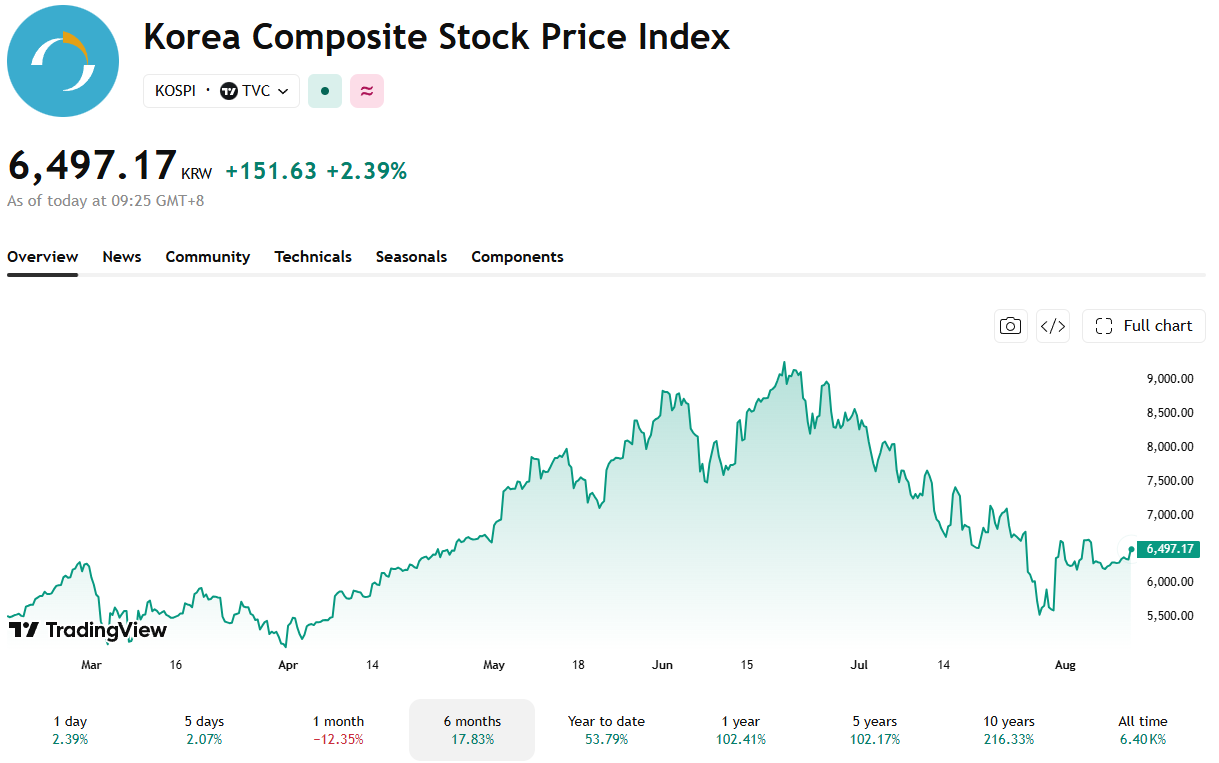
Foreign investors pulled $6.2 billion out of South Korean stocks in August. Taiwan drew $1.7 billion, ending a six week selling streak, Bloomberg-compiled data shows.
The split points to a broader pattern. Money is rotating out of Korea’s chip-heavy KOSPI toward markets seen as steadier bets on artificial intelligence (AI).
A Wider Asian Reshuffle
The Korea-Taiwan swing is part of a larger regional shift. Foreign investors sold a net $25.48 billion of Asian equities in July. It was the ninth straight month of net outflows.
Taiwan and South Korea alone lost more than the region’s entire net outflow in July. Taiwan shed $22.95 billion that month, separate from August’s swing back to inflows. Korea shed $6.26 billion in July, a July total distinct from the $6.2 billion August outflow cited above.
Inflows into India, Thailand, Indonesia and the Philippines only partly offset those July losses.

Bloomberg-compiled data also shows analysts raised Taiwan’s 12-month earnings estimates faster than Korea’s last month. It was the first time in nearly a year that Taiwan’s revision moved ahead.
“The unusually high swings in AI-related sectors are making global investors diversify.”
Herald van der Linde, head of Asia-Pacific equity strategy at HSBC, made that point in a note cited by Reuters. He said the volatility currently leaves India comparatively better placed.
Why Korea Looks Riskier to Some Investors
Hebe Chen, senior market analyst at Vantage Global Prime, pointed to Korea’s heavier leverage and speculative positioning. She said that can magnify price swings even without any shift in fundamentals.
South Korea’s KOSPI posted its biggest fall since early March, late last month. The rout was driven by a slump in leveraged bets tied to Samsung Electronics and SK Hynix. A $19 billion leveraged AI-linked ETF unraveled in the process, hitting Korean retail investors hardest.
Not every investor sees Korea as the weaker bet, though. Isaac Thong, senior investment director at Aberdeen Asian Income Fund, disagrees. He said Korea looks relatively attractive given how far its valuations have fallen against Taiwan’s.
Where the Money Is Going Instead
Indian equities logged a $1.3 billion weekly foreign buy last month, the largest since mid-2025.
Global funds are favoring markets seen as less dependent on AI capital spending than Korea or Taiwan. Thailand, Indonesia and the Philippines also logged inflows in July, though on a smaller scale than India.
Thailand pulled in $1.46 billion over the same period. Indonesia and the Philippines logged smaller gains, at $88 million and $69 million respectively.
The gap in scale matters. Together, those four markets absorbed a fraction of what Korea and Taiwan lost. Analysts describe the move as a rebalancing act, not a wholesale return to the region.
The post Korea Sheds $6.2 Billion in August as Asia Rotates Away From AI appeared first on BeInCrypto.
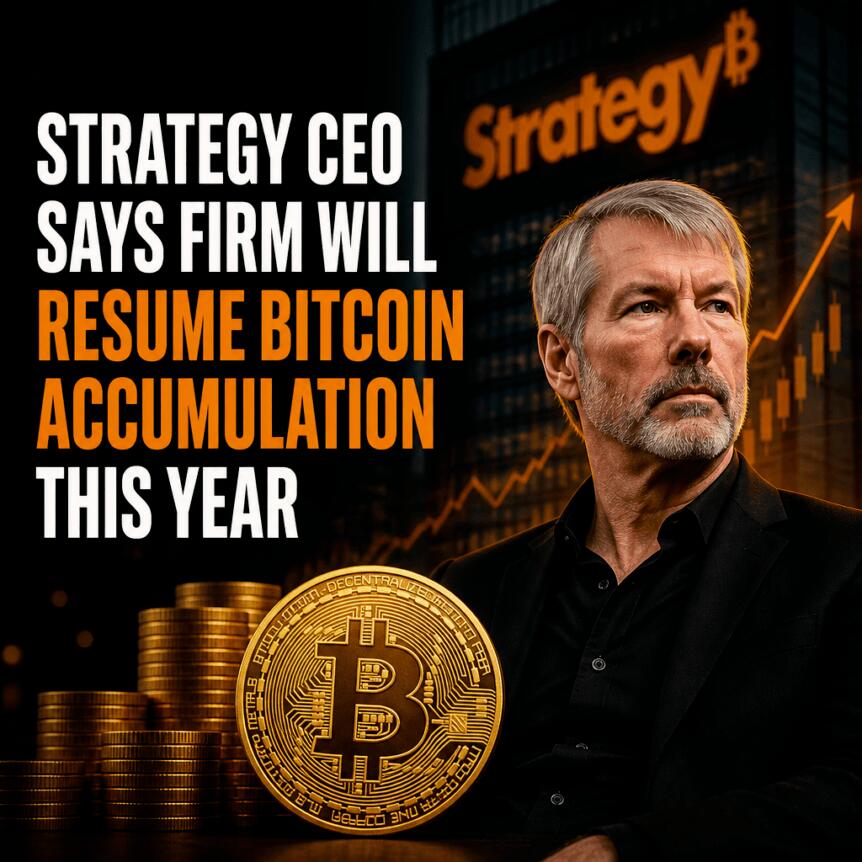
Strategy CEO Phong Le says the company plans to resume accumulating Bitcoin later this year, despite having sold portions of its BTC holdings earlier in the year—an approach that has attracted investor scrutiny.
In a Monday interview with FOX Business, Le said Strategy purchased about 175,000 Bitcoin since the start of the year while selling roughly 7,000 BTC. He characterized the net flow as “about 25 times more” buying than selling and noted that Strategy has moved from being the world’s second-largest institutional Bitcoin holder to becoming the largest.
Key takeaways
- Strategy says it will restart net Bitcoin accumulation later this year after earlier sales.
- Le reported ~175,000 BTC bought since the beginning of the year versus ~7,000 BTC sold, implying Strategy remains a major net buyer.
- Strategy has sold Bitcoin on four occasions since May, with the most recent sale totaling 1,690 BTC.
- Recent sales have been linked to shareholder payouts and balance-sheet uses, including dividends and share repurchases.
- Broader pressure is building on the corporate Bitcoin treasury model as some public companies trade below the net asset value of their BTC.
Strategy’s plan to keep buying, and why the sales matter
Le’s message is direct: despite stepping back from pure accumulation, Strategy intends to increase its BTC exposure again “throughout the course of the year.” That stance arrives after the company diverged from its long-running “never sell” narrative, even if the magnitude of selling appears small relative to its total holdings.
According to the interview, Strategy has accumulated more than 840,000 BTC overall, while still making sales on four occasions since May. The most recent disclosed sale was for 1,690 BTC.
Le’s comments help frame the trade-off Strategy is facing as a public company with ongoing obligations. The company has used proceeds from recent Bitcoin sales for purposes that extend beyond building its BTC treasury—supporting preferred stock dividends, funding share repurchases, and adding to its U.S. dollar reserve.
The tension for investors is straightforward: selling Bitcoin—even when paired with larger net buying—can be seen as a shift in the risk-management and capital allocation logic that originally attracted many BTC-focused shareholders.
From “never sell” to balancing equity and dividends
Market scrutiny has focused on Strategy’s departure from its “never sell” approach. The company’s situation underscores a challenge unique to Bitcoin-heavy treasury models when they operate under traditional public-company constraints.
As a result, Strategy’s capital decisions are not driven by Bitcoin price views alone. Instead, it must weigh requirements tied to common and preferred shareholders alongside its accumulation strategy. The implication is that even firms positioned as long-term Bitcoin holders may still periodically liquidate BTC to meet other corporate finance priorities.
Why the corporate Bitcoin treasury model is under strain
Beyond Strategy specifically, the broader economics of corporate Bitcoin treasuries have been stressed by weaker market conditions. Data cited from BitcoinTreasuries.NET indicates that public companies collectively hold more than 1.26 million BTC, while spot-exposed vehicles such as exchange-traded funds and other funds hold more than 1.6 million BTC.
The treasury model historically gained momentum during a period when corporate Bitcoin holders traded at premiums to the value of their BTC holdings. In that environment, firms could raise capital through equity or debt and then convert that financing into additional Bitcoin, according to analysis referenced from Novaque Research.
But the mechanics worsen when the market assigns a discount. When companies trade below the net asset value of their Bitcoin holdings, new capital raises can dilute existing shareholders more than they did during premium periods. That makes it harder for treasury firms to perpetuate rapid accumulation without creating downside dilution—especially if capital markets are tighter and equity valuation is less supportive.
In other words, even if the long-term thesis remains intact, the near-term path to growth may require more careful balancing between BTC buying and other corporate uses of cash, particularly when the equity story is no longer a simple premium-to-NAV loop.
What to watch next for Strategy and other BTC treasuries
Strategy says it intends to resume accumulation later this year, but investors should monitor whether future buying is funded primarily through balance-sheet decisions (including any further BTC sales) or through renewed access to capital markets. More broadly, the sustainability of corporate Bitcoin treasury expansion may increasingly depend on whether share pricing can recover toward—or at least not deeply undercut—BTC net asset values.

Coinbase has received regulatory approval in Abu Dhabi to provide investment arrangements and custody services through Abu Dhabi Global Market. The approval strengthens the company’s international expansion and establishes the emirate as its global base for tokenized securities outside the United States. The move also supports Coinbase’s broader strategy to expand regulated blockchain financial services across major international markets.
Coinbase Establishes Abu Dhabi Tokenization Hub
Coinbase secured a Financial Services Permission from the Financial Services Regulatory Authority of Abu Dhabi Global Market. Consequently, the exchange can arrange investment deals and provide regulated custody services within the financial center. The approval creates a legal framework for its tokenized securities business.
The company selected Abu Dhabi as its international tokenization hub outside the United States. Therefore, Coinbase will build blockchain-based services for traditional financial assets from the emirate. The initiative supports the wider adoption of onchain capital markets under regulated conditions.
Coinbase plans to issue tokenized securities backed by underlying company shares through the FSRA framework. Each digital security will represent an actual share under approved prospectus terms. The structure allows regulated blockchain ownership while maintaining established financial standards.
Tokenized Securities Expand Regulated Digital Asset Services
Each tokenized security will carry rights linked to its underlying share according to the approved offering documents. Eligible holders can receive shareholder rights, including voting rights, when they satisfy the applicable conditions. Dividend payments will automatically be reinvested under the structure governing the digital securities.
The platform removes the need for traditional brokerage accounts and correspondent banking relationships. Instead, users will hold tokenized securities through compatible digital wallets. Meanwhile, every transfer will undergo sanctions screening under the applicable regulatory framework.
Coinbase also retains authority to freeze or seize digital assets whenever regulatory requirements demand such action. The company said the framework balances blockchain efficiency with compliance obligations. The approval strengthens Abu Dhabi’s position as a regulated center for digital financial services.
UAE Expansion Supports Broader International Growth
Coinbase continues expanding its operations across the United Arab Emirates beyond tokenized securities. At the same time, the company is building a derivatives business in Dubai. Together, both operations will focus on blockchain-based capital markets and regulated derivatives services.
The company stated that the UAE will host two of its largest international businesses outside the United States. Meanwhile, the Abu Dhabi operation will support tokenized securities while Dubai develops derivatives offerings. The combined strategy reflects growing demand for regulated digital asset infrastructure across global financial markets.
Coinbase is also preparing to launch futures, perpetual contracts, and options for professional participants in the United Kingdom. The planned offering will cover cryptocurrencies, stocks, commodities, and foreign exchange markets. More than 170 contracts will become available, while perpetual products will support continuous trading with leverage limits reaching 50x and dated futures offering leverage up to 20x.
The approval builds on Abu Dhabi’s efforts to attract digital asset companies through clear regulatory frameworks and dedicated financial infrastructure. ADGM has introduced digital asset regulations over recent years to support blockchain businesses seeking regulated international operations. Consequently, Coinbase joins several global firms expanding regulated services from the UAE as tokenized financial markets continue developing worldwide.
Crypto World
July’s Heat Made History. Trump’s Cuts Could Leave Us Less Prepared for What Comes Next

But NOAA relies on federal funding in order to keep historic records, observe weather patterns, and produce informed forecasts.
The Trump Administration reduced NOAA’s workforce in 2025, and subsequently proposed steep cuts to the agency’s funding, hampering its ability to monitor weather conditions, analyze patterns, and provide forecasts.
The National Weather Service (NWS), which operates under NOAA, lost roughly 600 employees—about 15% of its workforce—through layoffs, buyouts and retirements. It must now respond to increasingly severe weather events—like hurricane season and wildfire season—with reduced resources. As a result, it announced last year that it was scaling back the tools used to track weather patterns, such as weather balloons.
The administration later proposed cutting NOAA’s overall budget by $1.6 billion, or roughly 26%, compared with fiscal year 2025.
“A leaner NOAA that focuses on core operational needs, eliminates unnecessary layers of bureaucracy, terminates nonessential grant programs, and ends activities that do not warrant a Federal role, will provide better value to the American public,” its budget summary stated.
The leading cryptocurrencies, including Bitcoin (BTC) and Ethereum (ETH), experienced substantial volatility over the past week, ultimately posting minor gains.
ICP – the utility token of Internet Computer – outperformed all top 10 digital assets within that period, and some believe it could be gearing up for a much more substantial rally.
The Next Potential Targets
Earlier today (August 11), the asset’s price soared to almost $2.40, the highest level since mid-June. It later retraced to the current $2.28 (per CoinGecko), representing a 10% weekly increase.
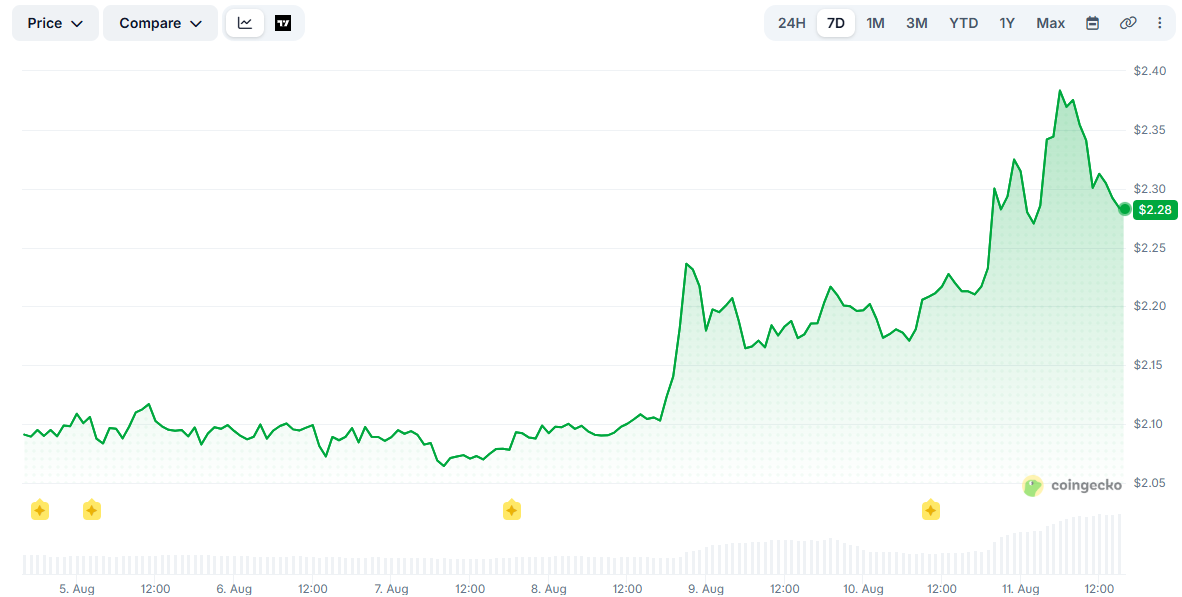
It remains unclear what exactly caused the resurgence. One possible catalyst could be the fact that Internet Computer is close to reaching the massive target of 300 billion processed transactions. According to the X account BSCN, the number has risen to roughly 298 billion since launch.
“To give some context, Solana (a network known for its scalability) has generated a cumulative total of 121 billion transactions – still extremely impressive, but not even close to Internet Computer’s figure,” the entity added.
Following the latest revival, crypto X is full of analysts envisioning further gains. Clifton Fx argued that ICP is getting ready for a 100-150% “massive bullish rally,” while CW thinks the asset has reached the sell wall zone, which ranges between approximately $2.35 and $2.45. In their view, breaking above would open the door to a rise to $3.
Crypto With Gopal also chipped in, claiming that ICP has printed a falling wedge formation on its price chart. He believes “a clean breakout” above $3.50-$4 could trigger a strong expansion move to as high as $7.
Still Light-Years From the Record
Despite the recent move north, ICP remains nearly 99.7% down from the historic peak of around $700 witnessed in the spring of 2021. Back then, its market capitalization briefly surpassed $18 billion, while as of now the figure stands at less than $1.3 billion. This makes ICP the 56th-biggest cryptocurrency.
Not long ago, X user Cryptorphic envisioned a potential slump to $1.67 if $2.10-$2.12 turns into resistance, whereas Crypto Patel forecasted a possible crash to $0.50 should the psychological level of $2 fail to hold. Given the ongoing bear market, a fall that deep is still on the table, so traders and investors should remain cautious.
The post Internet Computer (ICP) Rebounds 10% Weekly: What’s Happening and What’s Next? appeared first on CryptoPotato.
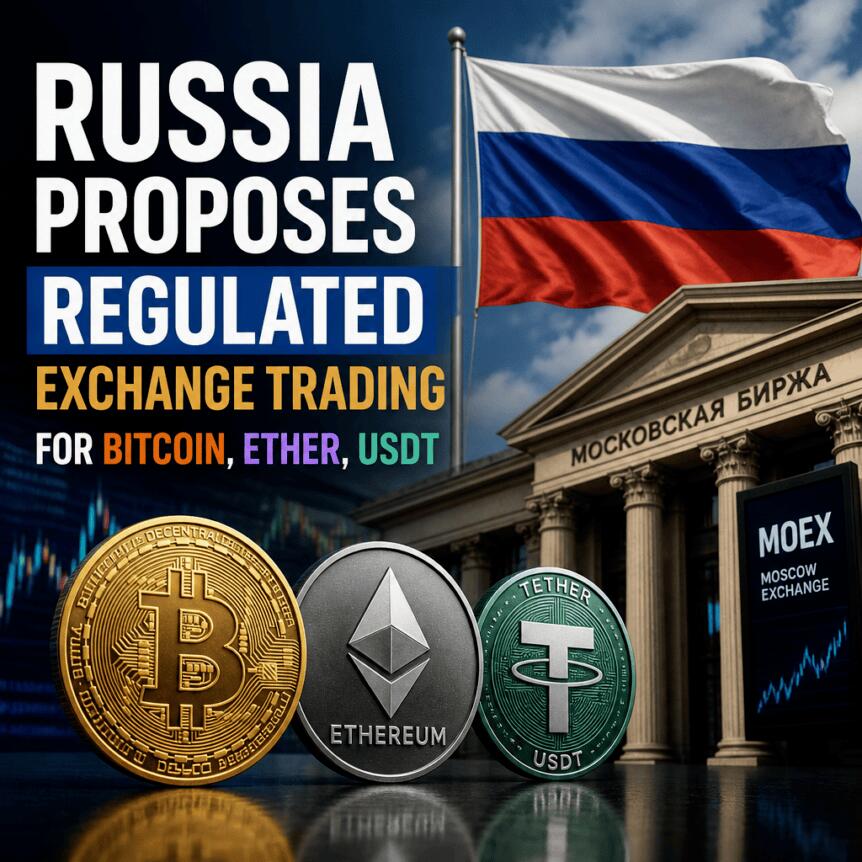
Russia’s central bank has drawn up a proposed shortlist of crypto assets that, if approved, could be eligible for trading on regulated platforms under the country’s newly enacted crypto framework. The regulator said the candidate assets include Bitcoin, Ether, and the stablecoin USDT.
The proposal is part of broader rules taking shape after President Vladimir Putin signed a law on Aug. 4 granting the Bank of Russia authority to decide which digital currencies may be admitted to “organized” trading and to set investor-access requirements. The central bank is now inviting public comments on the draft through Aug. 24.
Key takeaways
- The Bank of Russia’s draft list names Bitcoin, Ether, and Tether’s USDT as potential candidates for admission to organized exchange trading.
- Eligibility is tied to criteria such as market capitalization, average daily trading volume, and at least five years of price history on overseas markets.
- New access rules would cap purchases for non-qualified investors at 300,000 Russian rubles (about $3,650) per year per intermediary, while qualified investors face no such limit.
- All investors would need to complete a test and review crypto risk information before trading, regardless of their classification.
- The regulator is accepting comments on the proposal until Aug. 24, meaning the draft could change before final rules are set.
Draft eligibility list: what assets could be admitted
In a statement Tuesday, the Bank of Russia said it has compiled a proposed set of crypto assets that could be allowed for public trading on exchanges under the incoming regulatory regime. The announcement, published on the regulator’s website, also specified that the assets must satisfy a number of benchmark conditions.
According to the central bank, those conditions include a requirement tied to market capitalization, average daily trading volume, and at least five years of price history on international markets. By emphasizing both scale and long-running market data, the approach appears designed to narrow eligibility toward more established assets rather than newer tokens.
Among the named candidates are Bitcoin and Ether—two of the most liquid and widely traded cryptocurrencies globally—as well as USDT, a stablecoin issued by Tether. The inclusion of a major stablecoin signals that the regulator’s framework is not limited strictly to volatile coins, at least at the eligibility stage.
Why the new law changes the regulator’s role
The draft list does not stand alone; it follows a shift in Russia’s regulatory structure created by federal law that took effect after being signed by Putin on Aug. 4. That law gives the Bank of Russia the power to determine which crypto assets can enter organized trading and to create the operating rules for that process.
Earlier reporting from Cointelegraph noted that the core rules were set to take effect in 2026 as part of the new legal framework. With the central bank now moving to propose an asset list and investor rules, the practical implementation of that authority is beginning to take shape.
For market participants, the key implication is that not all tokens may be treated equally under the same umbrella. The regulator’s criteria—and the fact that eligibility is decided by the central bank—introduces an additional layer of compliance and potentially affects which assets exchanges can list for retail access.
Investor access rules: limits, “qualified” status, and risk testing
Beyond which assets could trade, the Bank of Russia’s proposal also addresses who can buy and how much. Under the draft rules, non-qualified investors would be limited to purchasing up to 300,000 rubles per year (about $3,650) of cryptocurrency through each intermediary. Intermediaries explicitly referenced include brokers, crypto exchange services, and asset managers.
Qualified investors, by contrast, would not face purchase limits for crypto assets traded on exchanges or through over-the-counter markets. The distinction between “qualified” and “non-qualified” investors matters because it shapes the effective scale at which different classes of customers can participate.
Importantly, the Bank of Russia said the framework requires a pre-trade step for everyone. “Before making transactions, all investors, regardless of their status, will have to pass a test and familiarize themselves with the risks of investing in crypto assets,” the central bank stated.
This requirement is designed to apply across the board, potentially limiting impulsive participation by ensuring buyers demonstrate awareness of crypto risk—while still allowing higher-volume activity for those who qualify.
Regulator rationale and what to watch next
The central bank said the restrictions are intended to protect non-qualified investors from sharp and unpredictable crypto price fluctuations. The logic is straightforward: if retail access is permitted, the regulator wants guardrails to reduce the likelihood of outsized losses among less experienced participants.
Russia’s draft also signals where the regulator’s focus may be during implementation. First, asset eligibility appears to rely on objective market metrics and longevity, which may constrain the range of tokens available for public exchange trading. Second, investor limits and required testing could reshape the economics of retail trading—especially if intermediaries must build compliance processes around classification and risk education.
The proposal remains open for public comment until Aug. 24, so investors and industry participants should watch for any changes to the eligibility criteria, the list of assets, or the specifics of the investor test and qualification thresholds.
For now, the central development is clear: Russia’s crypto market is moving toward a regulated structure where both the tradable universe and retail access conditions are determined by the Bank of Russia. The next key moment will be how the regulator responds to feedback and finalizes the framework ahead of full implementation of the new law.

Exterior view of the Tesla Gigafactory during a government-organised media trip in Shanghai, China, April 14, 2026.
Go Nakamura | Reuters
BEIJING — Survivors have emerged in China’s fiercely competitive car market, which is increasingly dominated by electric-powered vehicles.
Here are brands that have emerged as Chinese consumers’ favorite, according to industry data from Autohome:
1. Geely ranks first
Among the 10 most popular car models sold in China in the six months through July, Geely‘s Xingyuan electric hatchback was the bestseller with nearly 197,500 units sold.
The price? Just under 100,000 yuan ($14,820).
Geely has emerged as a close rival to BYD, ranking second by overall China sales volume in 2025. The Hangzhou-based company still sells gasoline-powered cars in addition to electric vehicles, such as those sold under its premium brand Zeekr.
2. Tesla keeps selling
The company’s Model Y ranked second in popularity with more than 180,000 of the electric SUVs sold. The Tesla car comes at a steeper price tag of 263,500 yuan to 313,500 yuan, but that didn’t stop it from topping sales of Li Auto‘s i6 SUV and Xiaomi’s SU7 sedan.
3. BYD barely makes top 5
Three of the 10 best-selling cars, as per Autohome data from February through July, were from BYD. But the most popular one — a modestly priced Yuan UP SUV — just managed fifth place with nearly 97,700 units sold. In sixth place was the Ti 7 under BYD’s off-road brand, followed by its Sealion 06 SUV.
The Chinese car giant reported its passenger car sales dropped by more than 10% in the first half of the year.
4. VW holds on
The German automaker was the only traditional foreign car company to make the top 10 — with its compact gasoline-powered Lavida in ninth place, squeezed between Leapmotor’s A10 electric SUV and Geely’s gasoline-powered Boyue L SUV.
5. Electric dominates
New energy vehicles, which include battery and hybrid-powered cars, accounted for 65.1% of new passenger cars sold in July — up from 54% a year ago, according to China Passenger Car Association data released Tuesday.
But the category still saw sales for the year through July drop by 12.5%, as passenger car sales overall tumbled by 20.3%, industry data showed.

'Rain Dogs' Is One of TIME's 50 Most Underappreciated TV Shows

The Challenge Couples Who Are Still Going Strong

WOW BLACKROCK PICKED SOLANA OVER XRP? #xrp #solana #crypto


-

 Fashion4 days ago
Weekend Open Thread: Mattifying Sunscreen
-

 Fashion5 days ago
Frugal Friday’s Workwear Report: Cap-Sleeve Pointelle Crewneck Sweater
-

 Sports6 days ago
Jordan Coyle & Cordiamo take Laya Arena Stakes at RDS
-

 News Videos4 days ago
Can Astrology Help Find Gold and Silver Trends? A Financial Astrology Guide
-
 Business6 days ago
US stocks: Dow closes at record on Mideast optimism; SpaceX, AMD drag Nasdaq
-

 Politics6 days ago
Reform UK And Greens Sink To Lowest Favourability Ratings To Date
-

 Tech7 days ago
OpenAI, Anthropic AI agents targeted real people and systems in cyber tests
-

 Business6 days ago
Supply chain issues impact Ingredion
-

 Tech4 days ago
Rinn Pharma & Biopharma to join NordicPharmaTrain network
-

 Business3 days ago
How to Start a Cleaning Business: A Step-by-Step Guide
-

 Business3 days ago
BDC Weekly Review: Private BDC Q2 Numbers Are Strong
-

 Business3 days ago
Datadog: Best Of Breed For Multiple Reasons
-

 Business7 days ago
McDonald’s (MCD) Q2 2026 earnings
-
 NewsBeat3 hours ago
Communication cards help banking customers access services or report scams
-

 Fashion7 days ago
The Bright Side of Black and White
-

 Fashion6 days ago
Suit of the Week: Me + Em
-
Sports6 days ago
Spider-Man: Brand New Day ending explained: Is Peter Parker alive?
-

 Crypto World7 days ago
Robinhood files $200M second venture fund focused on YC startups
-

 Tech5 days ago
Price Hikes May Be Coming for PC Motherboards Next
-
 Fashion7 days ago
Birthstone pendant necklaces for women by ottomanhands – 18ct gold plated
You must be logged in to post a comment Login