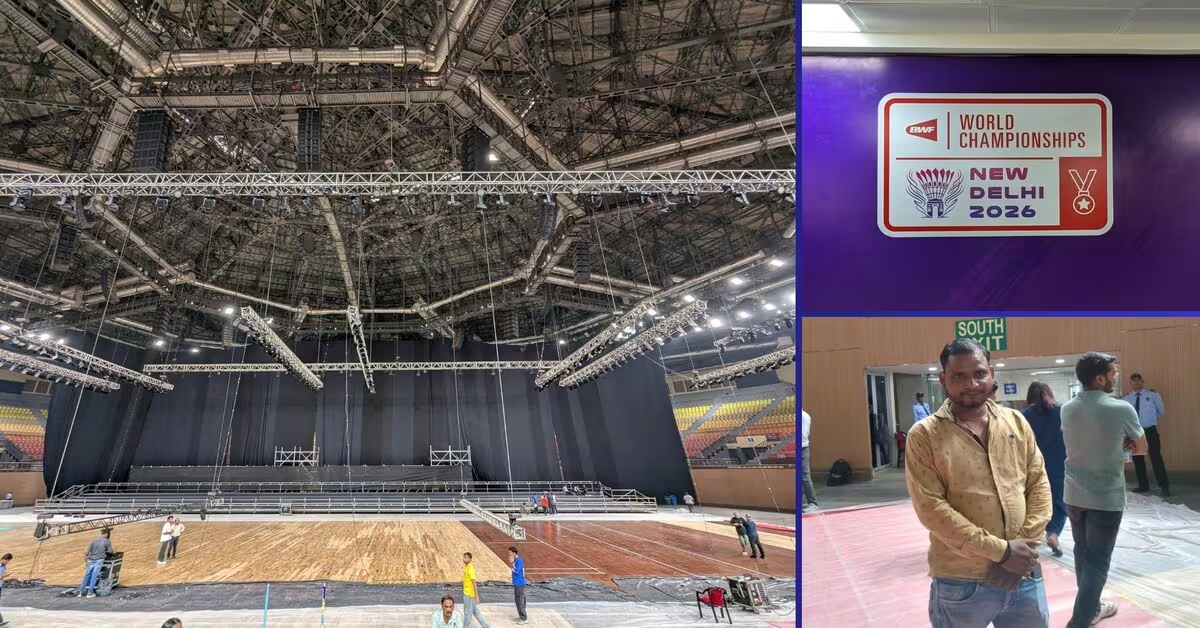
With less than a week to go for the Badminton World Federation (BWF) World Championships, the Indira Gandhi Indoor Stadium in New Delhi is receiving its final touches after an extensive renovation aimed at ensuring that the problems witnessed during the India Open do not return when the tournament begins on August 17.
One of the four competition courts is ready, while work on the remaining courts and other parts of the stadium is in the final stages. The venue’s seating capacity has been increased to 7,500, with 2,500 seats added for the marquee event.
During a media tour of the venue on Monday workers could be seen carrying out finishing work across the complex, including cleaning and polishing seats and preparing the playing and spectator areas.
The championships, scheduled from August 17 to 23, will bring the world’s leading shuttlers to the Capital. The event assumes added importance as India hosts the World Championships after a gap of 17 years.
SAI spends Rs 20 crore on renovation
The Sports Authority of India (SAI) has spent approximately Rs 20 crore on renovation work at the venue. Personnel from SAI’s newly formed engineering division and the Central Public Works Department (CPWD) have been deployed for the project.
The exercise began after a series of infrastructure and maintenance issues during the India Open brought the stadium under scrutiny.
Roof leakages and expansion joints have been treated, while the drainage system has been improved. Parts of the building have been repainted, seats have either been replaced or polished, and a new false ceiling has been installed.
The lighting system has also been upgraded in consultation with BWF specialists, with the focus on providing uniform illumination without creating shadows on the courts. The overhead lighting is expected to provide illumination between 2,200 and 2,400 lux.
Court drift, another concern for professional shuttlers, has also been addressed.
SAI Executive Director Ambar Pratap Singh said planning for the improvements began soon after the India Open.
“We started planning from Feb itself on how we can improve the overall situation of this stadium,” Singh said during the media interaction.
With the championships taking place during the monsoon, the repaired roof is also being tested repeatedly to ensure that heavy rain does not disrupt proceedings.
Pigeons face multi-layered deterrent
Some of the more unusual changes at the stadium have been prompted by the problems encountered during the India Open, when pigeons entered the playing arena and interrupted proceedings.
Heavy-duty bird netting has now been installed beneath the roof, while openings around the stadium have been sealed. A non-toxic gel sourced from the US is being used to discourage pigeons from settling at vulnerable spots.
Machines that imitate the calls of predatory birds have also been installed as an additional deterrent against pigeons and other birds.
The organisers have simultaneously worked on restricting the entry of monkeys, which had also been spotted around the venue during the India Open.
Wooden doors have been replaced at several locations with double-door and automatic-closing systems, reducing the possibility of monkeys entering when doors are left unattended.
But technology is not the only solution being deployed.
Langur-call mimics drafted in
Four men trained in mimicking langur calls have been engaged to keep rhesus macaques away from the stadium.
Among them is Jabbar, who has learnt the skill from his family and has previously been deployed for similar assignments in Delhi. The mimics are paid between Rs 20,000 and Rs 25,000 per assignment, though work is not regular.
“Getting employment is not consistent, but we do keep getting work from time to time. There are many of us who do it,” Jabbar said.
For years, trained grey langurs and their handlers were used to tackle the monkey menace in public spaces because rhesus macaques tend to fear them. The practice, however, was discontinued after the use of langurs for such purposes was prohibited. Langurs are protected under the Wildlife Protection Act and cannot be held captive, privately owned or hired for guard duty.
That gave rise to the use of human mimics who reproduce langur calls to scare monkeys away.
When Parliament is in session, such men have been deployed around the complex, where they hide among bushes and imitate langurs to drive rhesus macaques away.
Langurs themselves use different calls depending on their mood or circumstances. These range from loud whoops by males during displays of dominance to short, sharp and guttural sounds when agitated.
From 2010 CWG to G20 Summit
The Capital has experimented with different methods of using the natural fear rhesus macaques have of langurs during major events.
Langurs were deployed during the 2010 Commonwealth Games in Delhi. By the time the G20 Summit was held in the Capital in 2023, human mimics were being used instead.
During the G20 Summit, life-size cut-outs of langurs were installed at some locations and paired with men capable of reproducing their calls.
The BWF World Championships will now see the same expertise used at the Indira Gandhi Indoor Stadium, alongside automatic doors and other measures aimed at preventing monkeys from entering the venue.
Practice courts and spectator areas readied
Preparations extend beyond the main competition arena. Practice courts at the KD Jadhav Stadium have been prepared for players, while other areas of the Indira Gandhi Stadium complex are being cleaned and upgraded.
The lake area within the complex is also being revived and beautified.
Special lighting will be used during player presentations and ceremonies without interfering with matches. Organisers are also planning to use cold-fire effects as part of the presentation on the final day, August 23.
Stray dogs remain another issue being monitored around the complex. Organisers are coordinating with the Municipal Corporation of Delhi to prevent animals from entering areas being used during the championships.
With one competition court already ready and the remaining three nearing completion, the final days before the tournament will be devoted to completing work and testing the systems installed after the India Open



























































You must be logged in to post a comment Login