The app was banned from government devices in 2022.
Al Drago/Getty Images
Trump administration officials are now free to post and endlessly scroll TikTok, a new memo from the Office of Management and Budget (OMB) says. The memo is the latest move from the federal government formally undoing a 2022 law that banned the app from most government-issued devices,
The OMB memo cites an earlier opinion from the Justice Department. The DoJ said the 2022 law no longer applies because the current version of TikTok has American owners and relies on a different recommendation algorithm than the app that operated under ByteDance. “TikTok may be used on government devices,” the OMB memo confirms.
The memo ends what’s among the last vestiges of the TikTok bans. The app was banned from most federal government devices in 2022 amid rising concerns about its parent company’s ties to China. Government officials under then-President Joe Biden, including FBI Director Chris Wray, said the app posed a national security threat, though the exact nature of the risk was the subject of intense debate.
Advertisement
Intelligence officials never publicly disclosed specifics about the threat posed by TikTok, but lawmakers cited the app’s data collection practices, and raised questions about whether the app’s recommendation algorithm could be subject to influence from the Chinese government.
The app briefly went dark in the US last year after President Biden passed a law requiring ByteDance to sell the app to American owners or face a ban. The app came back online as Trump took office, and a deal to spin off the US version of the app was finalized earlier this year. The US version of the app is now controlled by an entity called TikTok USDS Joint Venture, which is controlled by a group of investors that includes Oracle, Silver Lake and others. ByteDance maintains a 19.9 percent stake in the company.
Chainalysis reports impersonation scams grew over 1,400% in 2025, with AI-linked operations generating 4.5x the revenue at 9x the activity of non-AI operations. Deepfake KYC bypasses now cost about $20 and 30 minutes, defeating standard liveness checks 58% of the time. Crypto accounts for 88% of all detected deepfake fraud globally. Enforcement has responded with $4.4B in frozen Tether and nearly 5,800 arrests across 97 countries, but none of that stops a forged identity clearing a check.
Impersonation scams grew more than 1,400% year over year in 2025, according to Chainalysis, with the average payment into those clusters rising more than 600%. Across all scam categories the average crypto payment climbed from $782 to $2,764.
An attack class does not scale like that because more people are running it. It scales because fewer people are running it with better tools.
Fraud Used to Have a Headcount Problem
An investment scam or a romance approach had to be staffed. Someone trained had to hold the conversation, in the victim’s language and across weeks. Those requirements set a ceiling on how many people a network could work at once, and for years the ceiling held.
Advertisement
Generative tooling removed it without changing the underlying deception. The con is the same one the industry has seen since the first fake exchange support agent. What changed is that the expensive part of running it stopped being expensive.
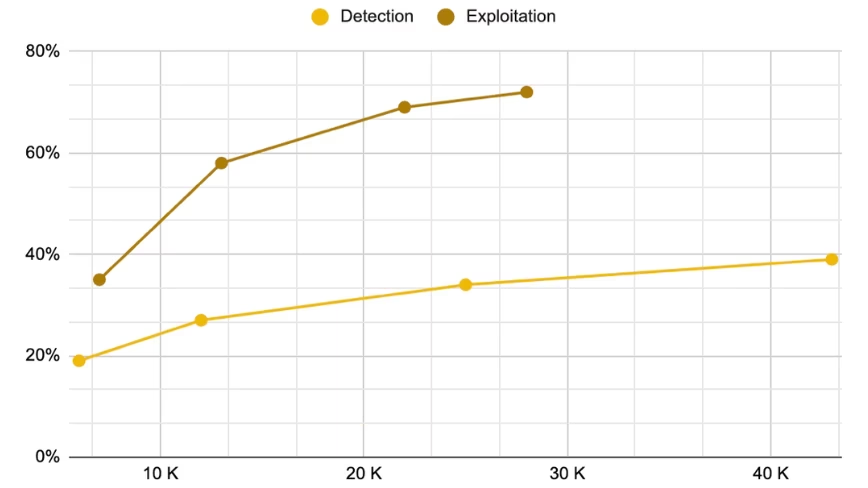
The economics are visible on-chain. Chainalysis found that operations with observable links to AI tooling vendors extracted an average of $3.2 million against $719,000 for those without, while generating 35.1 transfers a day against 3.89. That works out to roughly 4.5 times the revenue on about nine times the activity: the same operation reaching more people and converting more of them. TRM Labs separately observed close to a 500% increase in AI-enabled scam activity over the past year.
Credit: Chainalysis
“Code is no longer necessarily the weakest link in Web3,” says Jimmy Su, Chief Security Officer at Binance. “As smart contract security improves, attackers are shifting their attention to the people, credentials and governance systems surrounding protocols. We saw this firsthand when Binance Security helped prevent a $1.2 million governance attack on BrainTrust. Protecting a protocol today means securing not just its code, but also who can control it, how that control is exercised, and the infrastructure and people behind it.”
The Verification Stack Was Built for a Different Attack
Identity checks were designed against a threat model of printed photographs, recorded video and low-grade physical spoofs. That is why liveness prompts still ask a user to blink or turn their head. The threat model moved and the prompt did not.
Vendor research from Socure puts the current cost of defeating that stack at roughly $20 and about 30 minutes, and finds that injection attacks, which feed a synthetic video stream straight to the verification interface rather than through a camera, defeat standard liveness checks about 58% of the time. Socure and Zyphe, whose figures it cites, both sell detection products in this category.
Advertisement
“Across the crypto industry, impersonation scams are increasing and becoming more sophisticated,” says Lior Aizik, co-founder and COO of XBO. “Scammers have impersonated me by name, using fake profiles to contact people in the industry and request money while pretending to represent XBO. These attacks rely on urgency and trust, not technology.”
The volume lands disproportionately on this sector. Binance Research reports that cryptoaccounts for 88% of all detected deepfake fraud cases globally, that North American deepfake-related losses exceeded $410 million in the first half of 2025, and that around 80% of attacks against the exchange involve some level of KYC fraud.
Detection Is Automated. Recovery Is Not.
Two things are working against this volume, and only one of them is a model.
Automated screening is the first, and it mostly buys throughput rather than certainty: Binance Research reports up to a 100x efficiency gain from applying AI to KYC processing, with face-attack and liveness models retrained against each new generation of spoofing technique.
The other effective response is considerably older: coordinated enforcement and the ability to freeze funds after the fact. Binance Research puts Tether’s total frozen at more than $4.4 billion as of April 2026, and the T3 Financial Crime Unit, a joint venture with TRON and TRM Labs, at more than $300 million in its first year, including $19 million tied to the Bybit hack. Both figures come from the exchange’s research arm rather than from the issuers themselves.
Advertisement
Conventional law enforcement has scaled alongside it. INTERPOL’s Operation First Light 2026 spanned 97 countries as well as produced nearly 5,800 arrests and intercepted $293 million. Europol’s Operation Endgame froze about $47 million while taking down 326 servers and 142 domains and recovering 27 million stolen credentials.
None of that stops a forged identity clearing a check. It does mean the money can sometimes be stopped after it moves, which is something a wire transfer cannot offer and something the sector rarely bothers to argue in its own defense.
The Deception Is Old. The Price Is New.
The cons here are the ones fraud has always used. What changed is the cost of producing them, which makes the defensive question less about detecting novel attacks than about matching the rate at which familiar ones are now generated.
Reporting in this category remains incomplete, so every scam figure above should be read as a lower bound. The gap between what it costs to forge an identity and what it costs to check one is the number worth tracking, because everything else in this category follows it.
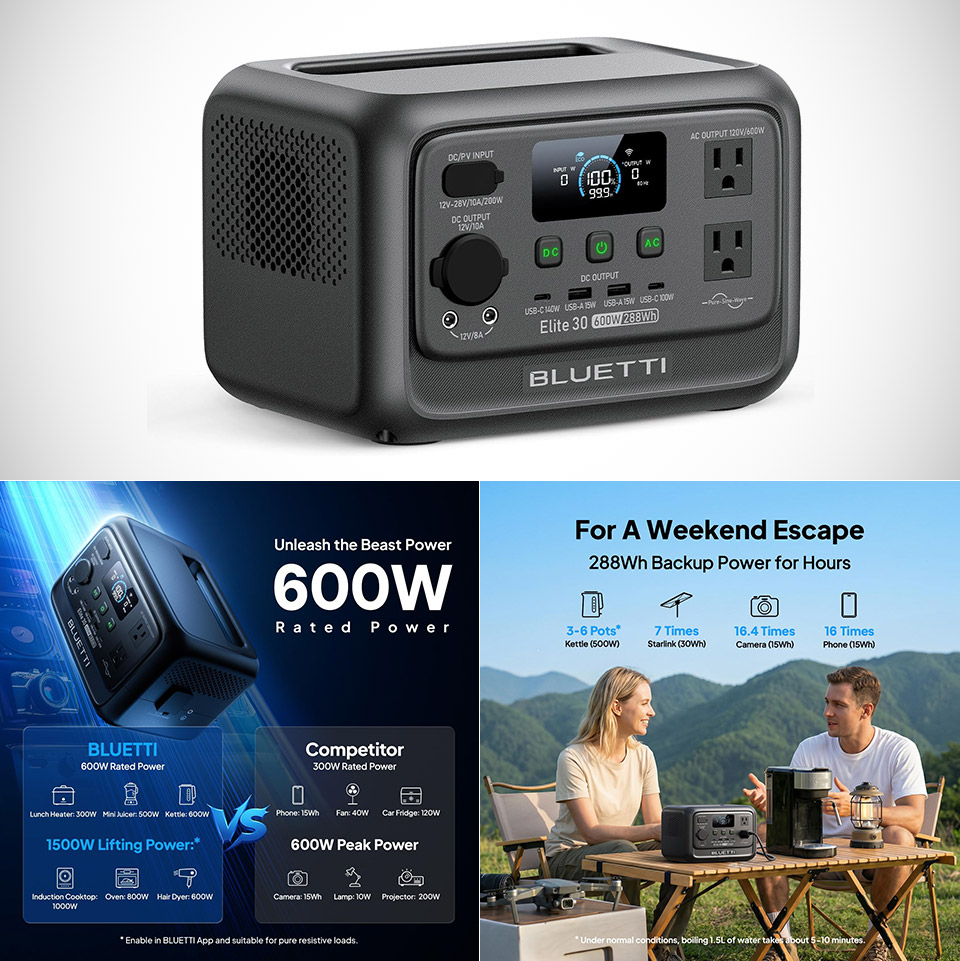
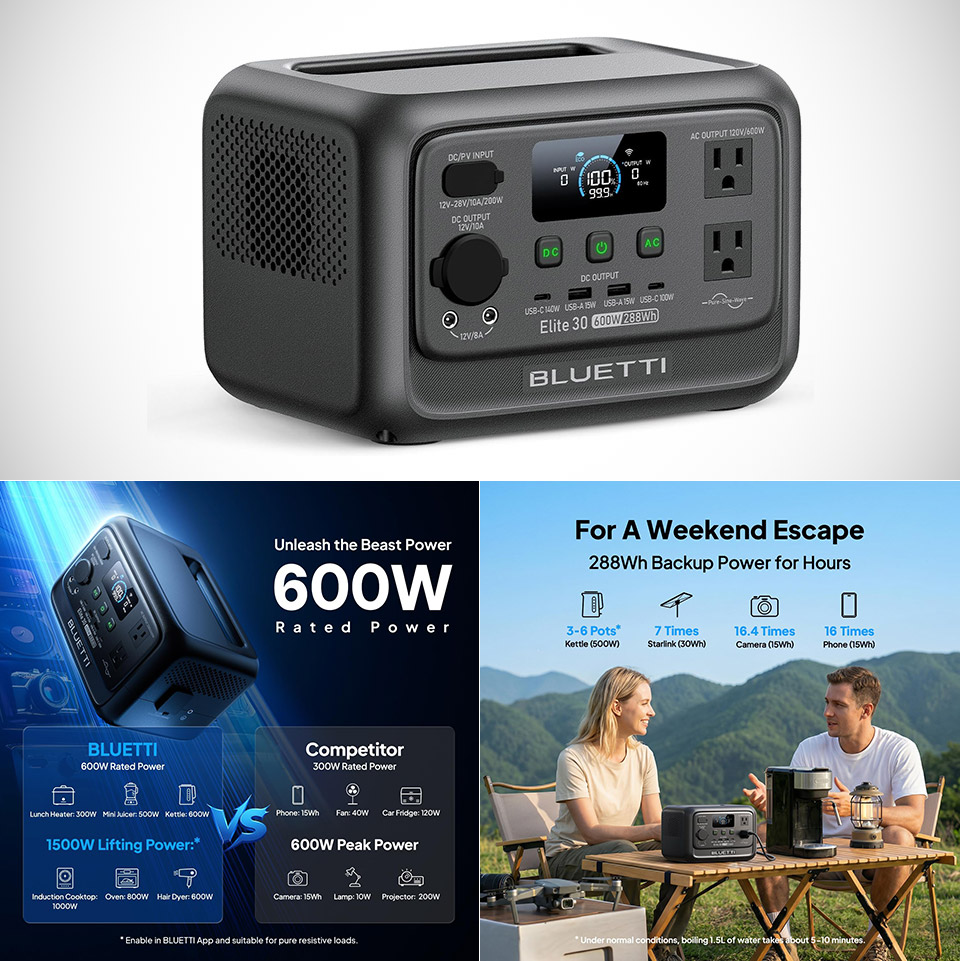
BLUETTI’s Elite 30 V2, priced at $219 (was $299), arrives as one of those rare small power stations that feels useful the moment you pick it up. At just under 10 pounds and measuring roughly 9.8 by 7 by 6.6 inches, it slips into a larger backpack, the trunk of a car, or a corner of a campsite without demanding attention. A molded handle makes carrying it one-handed straightforward, and the overall size stays practical for daily travel or emergency kits.
Inside, there is a 288-watt-hour lithium iron phosphate battery and a 600-watt pure sine wave inverter, which can easily power computers, photography gear, small appliances, CPAP machines, fans, and phone chargers. If a device requires a sudden power increase, they have a ‘Power Lifting’ mode that raises the power ceiling to 1500 watts for resistive loads, giving you a lot of versatility from something that doesn’t appear nearly as large as it is. There are nine ports to meet most demands, including two normal AC outlets, a 140 watt USB-C port, another 100 watt USB-C port, two USB-A ports, a 12 volt vehicle socket, and two DC barrel connectors. The USB-C ports can even deliver high power simultaneously, which is really useful when attempting to charge a laptop and whatever else at the same time.
[288Wh On-the-Go Power] – Only 9.4 lbs lightweight, carry it anywhere during storms! 288Wh capacity meets daily & outdoor needs—camping, road trips…
[600W Continuous & 1500W Surge Power] – Get a full 600W output—twice as much as others. When you need serious power, activate Power Lifting Mode for…
[50% Lower Power Consumption] – Upgraded UltraCell tech & smart cooling system cut power consumption by 50%. Enhances overall energy efficiency…
Recharging is also relatively quick for a unit of this size, with AC power in Turbo mode bringing the battery up to 80% in around 45 minutes and a full charge in around 70 minutes. Solar input can handle up to 200 watts, and you can continue to charge while driving. There are also numerous charging patterns that allow you to balance speed, noise, and available power. The battery’s low standby drain is due to the company’s UltraCell design, which allows it to maintain a charge for much longer when lying idle.
Advertisement
The lithium iron phosphate chemistry provides the durability required for regular use, with BLUETTI claiming the cells will endure over 3,000 cycles to 80 percent capacity and a ten-year lifespan under typical conditions. In addition, there is a 5-year warranty to back it up. The unit is also rather quiet, often under 30 decibels under light load, so it can be placed near a bed or workstation without being a disturbance.
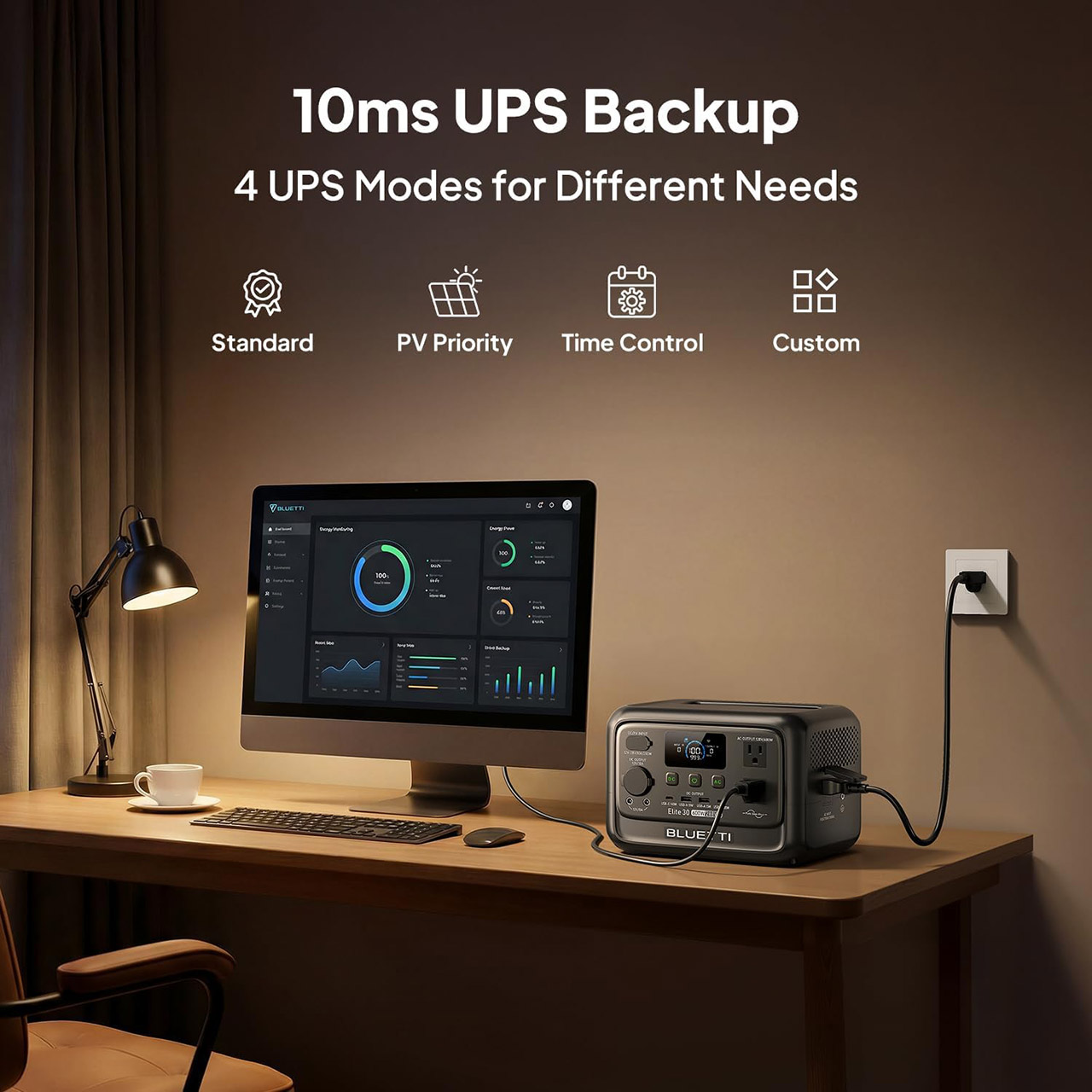
The unit also has built-in UPS functionality that switches to battery power in 10 milliseconds or less, which is extremely fast, and there are several operating modes to support various situations, such as keeping the battery charged for a quick backup, following time of use electricity rates, or prioritizing solar when solar panels are connected – or mixing settings as needed.
The Elite 30 V2 operates brilliantly throughout day trips, weekend camping, remote work sessions, and temporary power outages. It can recharge airplane and drone batteries on-site, keep a laptop running all day with leftover direct DC power, and even power lights or a small fan when camping. Of course, it isn’t perfect and won’t last for weeks or power the TV and lights all day, but for its size and price, the balance of output, ports, and speed is outstanding.
In addition to a historic total solar eclipse, August also features one of the most spectacular meteor showers of the year. On the night of August 12 and into the early morning of August 13, astronomy enthusiasts in the northern hemisphere and parts of the southern hemisphere will be able to admire the Perseids during a particularly favorable viewing window.
Occasionally, Earth passes through the trails of particles left behind by some comets as they travel through the solar system. When these tiny fragments enter Earth’s atmosphere, friction with the air heats them until they burn up. From below, it looks as though the sky is filled with bright flashes streaking across the heavens at high speed. These are meteor showers. There are several throughout the year, and the one in August is called the Perseids.
Although a meteor shower is one of the few astronomical phenomena that can be observed with the naked eye, it is not always easy to track. To enjoy it to the fullest, it’s a good idea to follow some basic recommendations for stargazing.
This Year’s Perseids Are Especially Visible
Traditionally, the Perseids reach a rate of up to 100 meteors per hour during their peak activity—at least, under ideal viewing conditions. This makes them one of the three most intense meteor showers of the year, along with the Geminids in December and the Quadrantids in January.
Advertisement
In 2026, the viewing conditions are particularly favorable. The peak of activity, expected on the night of August 12–13, will coincide with the new moon phase. This means that virtually none of the moon’s illuminated side will be visible from Earth, so there will be no moonlight to interfere with meteor viewing. In other words, the sky will be much darker than usual.
What’s the Best Way to View the Perseids?
The main advice from NASA and the European Space Agency (ESA) for enjoying a meteor shower is to get away from light pollution. Ideally, head out of the city and find a spot with dark skies, as well as a horizon that’s as unobstructed as possible to ensure a wide field of view.
Keep in mind that it takes the human eyes 20 to 30 minutes to fully adjust to the dark. Once that time has passed, it will be easier to spot faint meteors. While observing, it’s also advisable to avoid using your cell phone or other bright screens, as they reduce your eyes’ sensitivity.
Another important tip is to avoid using telescopes and binoculars. Although they might seem useful, NASA explains that these instruments narrow your field of view, whereas meteors can appear anywhere in the sky. It’s best to observe with the naked eye.
Advertisement
Although the Perseids get their name because they appear to radiate from the constellation Perseus, it is not necessary to look toward it. Both NASA and the ESA point out that meteors can streak across any part of the sky. Ideally, lie down or use a reclining chair to observe a wide portion of the sky, preferably after midnight, when the meteor shower’s radiant reaches a higher point above the horizon and the frequency of visible meteors increases.
Finally, the agencies remind us that patience is also part of the experience. Meteors do not appear at a steady rate. Several minutes may pass without any activity, and then suddenly, several may be seen in quick succession. Staying under a dark sky for at least an hour offers the best chance of enjoying the show.
This story originally appeared onWIRED en Españoland has been translated from Spanish.
The Toyota Corolla is a commuter staple, known for its reliability and ability to consistently get you to work for decades as long as you do a few oil changes. And, while many Toyota models have unfortunate depreciation, the Corolla holds on to its value well past six figures on the odometer. The 2021 Toyota Corolla has a resale value of $14,350 in 2026, which means it lost just 24.45% of its value over five years, according to Kelley Blue Book. iSeeCars has the Corolla at 27.4% depreciation in the same time span, while CarEdge calculates 33%. Of course, the value depends on variables like mileage, condition, and location.
However, cars often lose 50% to 60% of their value in five years, making the Corolla pretty phenomenal in comparison — especially when you consider that most cars lose 10% of their value within one month of driving. And the Toyota Corolla Cross does even better in the resale market.
One interesting thing to note in Kelley Blue Book’s depreciation data is that the Toyota Corolla gained some value in 2026. The 2021 model was worth $13,876 in 2025, which was a $2,258 drop from 2024. However, it’s worth $14,350 in 2026, a $474 increase. This is due to the higher demand for used cars in 2026 as new car prices continue to increase — and drivers want a reliable used car, like the Corolla.
Advertisement
Why has the 2021 Toyota Corolla held its value more than other cars?
Iurii Vlasenko/Shutterstock
Used cars can often be seen as a bit of a gamble, but the Toyota Corolla takes a lot of that uncertainty out of the equation as one of Toyota’s most reliable small vehicles. Toyota, in general, is known for its reliability. It’s consistently at the top of Consumer Reports’ reliability studies since the automaker is slow to implement big changes but also takes the time to address previous manufacturing issues. The Toyota name alone gives buyers confidence that even high-mileage vehicles will last a long time without running into a lot of big-budget repairs.
And the Corolla is seen as one of the most durable in the lineup. Owners always boast about their Corolla reaching seemingly high mileage without really running into any problems during that time — Kelley Blue Book states that the 2021 model’s reliability is its strongest feature, according to owners. Consumer Reports backs this up, noting it’s much more reliable than other models from the same year.
Advertisement
Its parts are also affordable and widely available (front bumper covers are a little over $140 and suitable brake pads can cost around $50), so the few issues you likely will run into won’t deplete your bank account. That peace of mind is priceless to many used car buyers, making the simple, reliable, and affordable Corolla hold a lot of its value even after five years of commuting.
Gemini has become Google’s fastest-growing product ever, reaching 1 billion monthly active users faster than any of the company’s 13 other billion-user services. Ars Technica reports: Gemini has wormed its way into virtually every Google product and service, powering email organization in Gmail, document summary in Drive, and much more. Gemini is also core to Google’s flagship search experience, with AI Mode and AI Overviews becoming increasingly hard to avoid. The 1 billion-user metric has nothing to do with any of that, though.
These 1 billion users may also be encountering Gemini in all those places, but that’s not the MAU metric. Pichai is talking only about people who are opening the Gemini app or visiting the Gemini web interface to enter a prompt or access Gemini Live. If you used Gemini only once in the past month, you are part of this cohort.
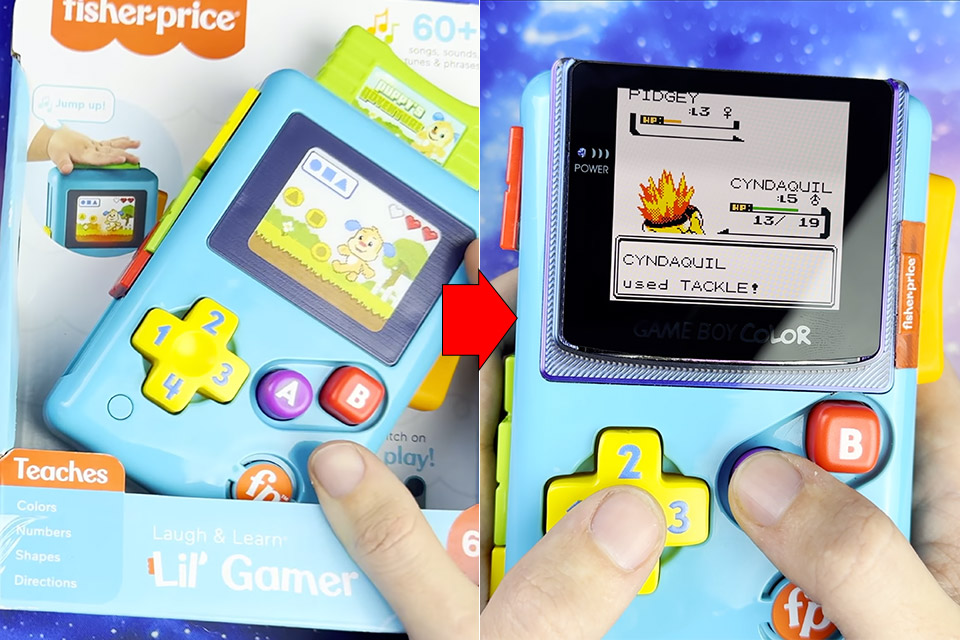
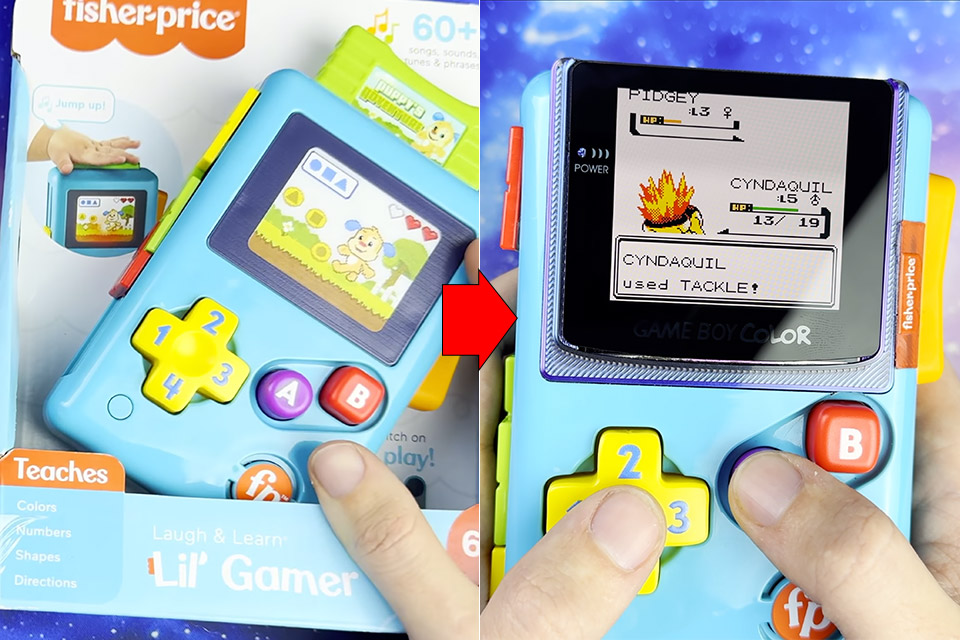
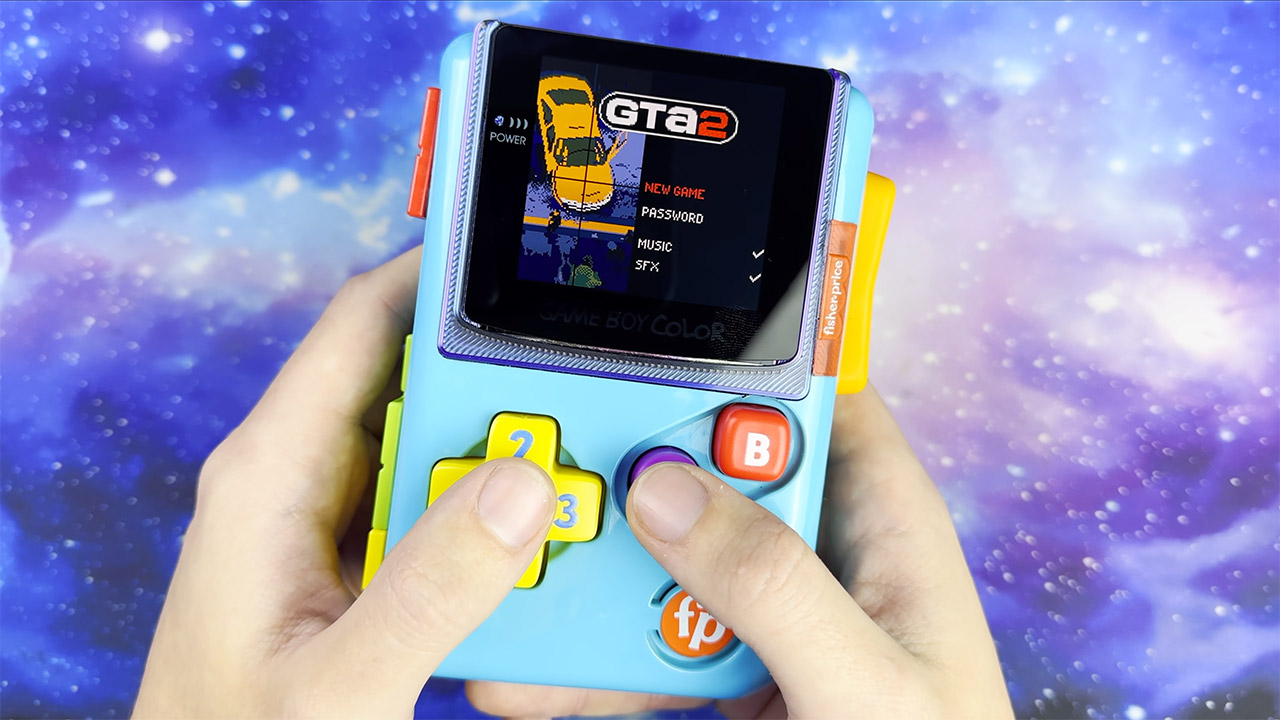
A Fisher-Price Laugh & Learn Lil’ Gamer sits on store shelves looking every bit like a colorful, oversized Game Boy meant for tiny hands. Its screen is a printed sticker, its cartridge springs in and out for show, and its buttons trigger songs and light patterns that teach shapes and colors. Press the right sequence and it even plays Super Mario Bros. sound effects. Most parents hand it over and move on. One modder named KOUZEX looked at the same plastic shell and decided it should play actual Game Boy Color games instead.
The goal was to maintain as much of the original toy’s appearance and feel intact as feasible. For us, this meant maintaining all of the huge chunky buttons, the sliding Tetris-style blocks on the side, the brilliant blue plastic, and even the orange rocker switch. This was not going to be a simple shell replacement, because the toy’s personality needed to survive the procedure.
Flip Into Play – Flip down, ready to play. Take a call or reply to a message mid-game—just flip it open without unplugging. The hinge is rated for…
Vertical Mobile Gaming – Designed around portrait play, FlipPad brings a classic handheld feel to your phone. Perfect for retro games and…
USB-C Plug and Play – Built-in USB-C connection makes setup simple and direct. Plug in and start playing instantly. The USB-C port is rated for over…
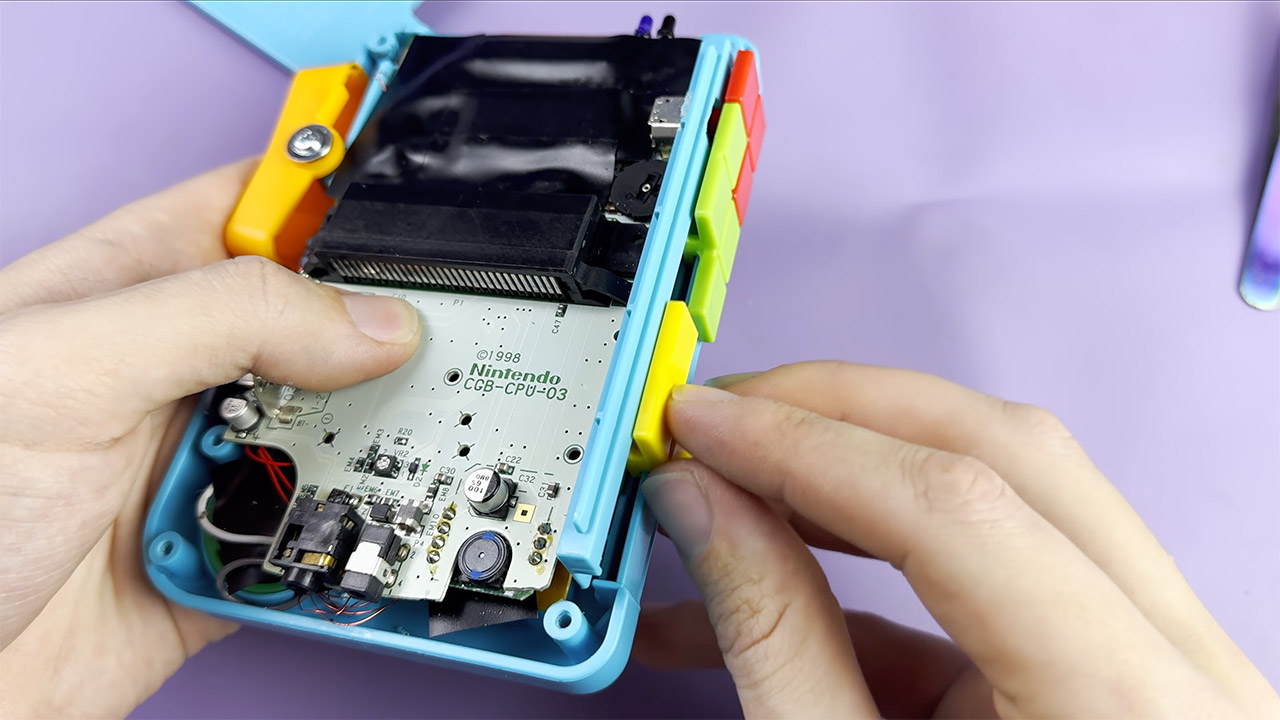
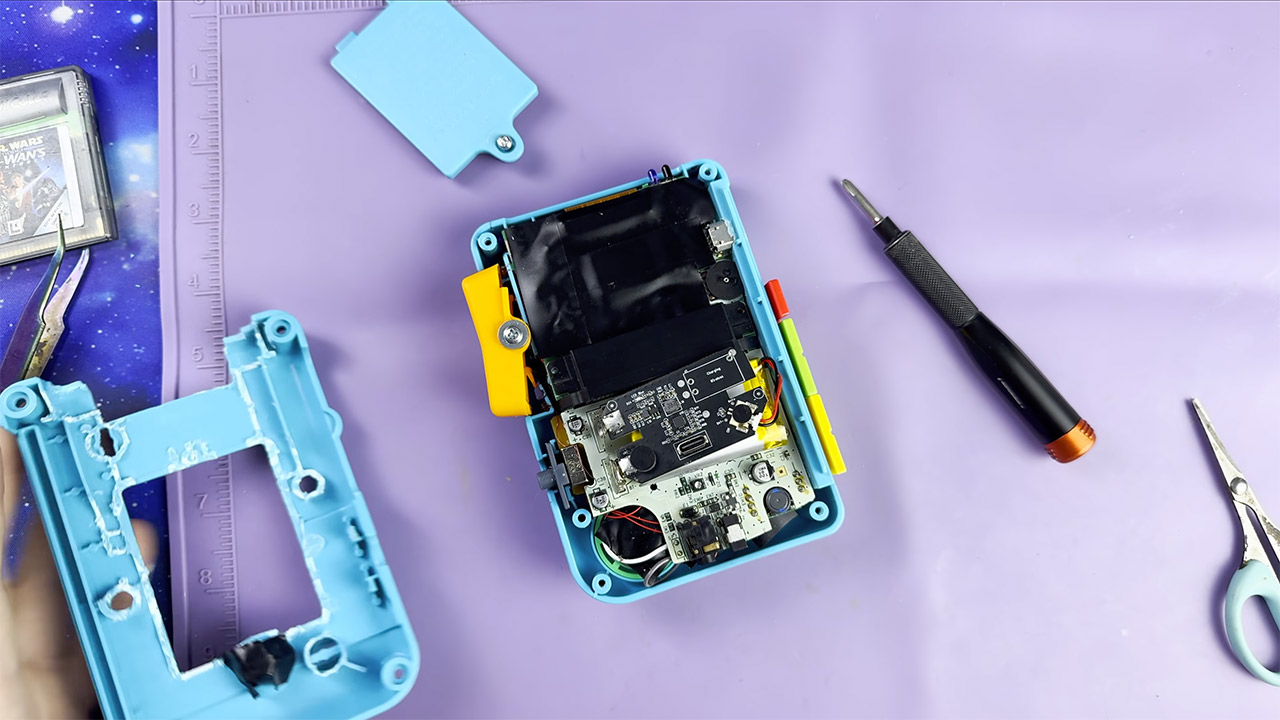
He began by splitting the toy open to get inside, but four large screws and a piece of hot glue glued the halves together tightly, so it required some elbow grease to separate them. Once inside, he discovered a simple board, a non-removable springy cartridge, and the familiar button membranes, all of which were exactly where he needed them. As a great touch, the button caps stayed put, so the finished product felt like the original toy in your hands, even under your fingers. For the time being, the sliding blocks and side switch have been left alone to preserve the vibe.
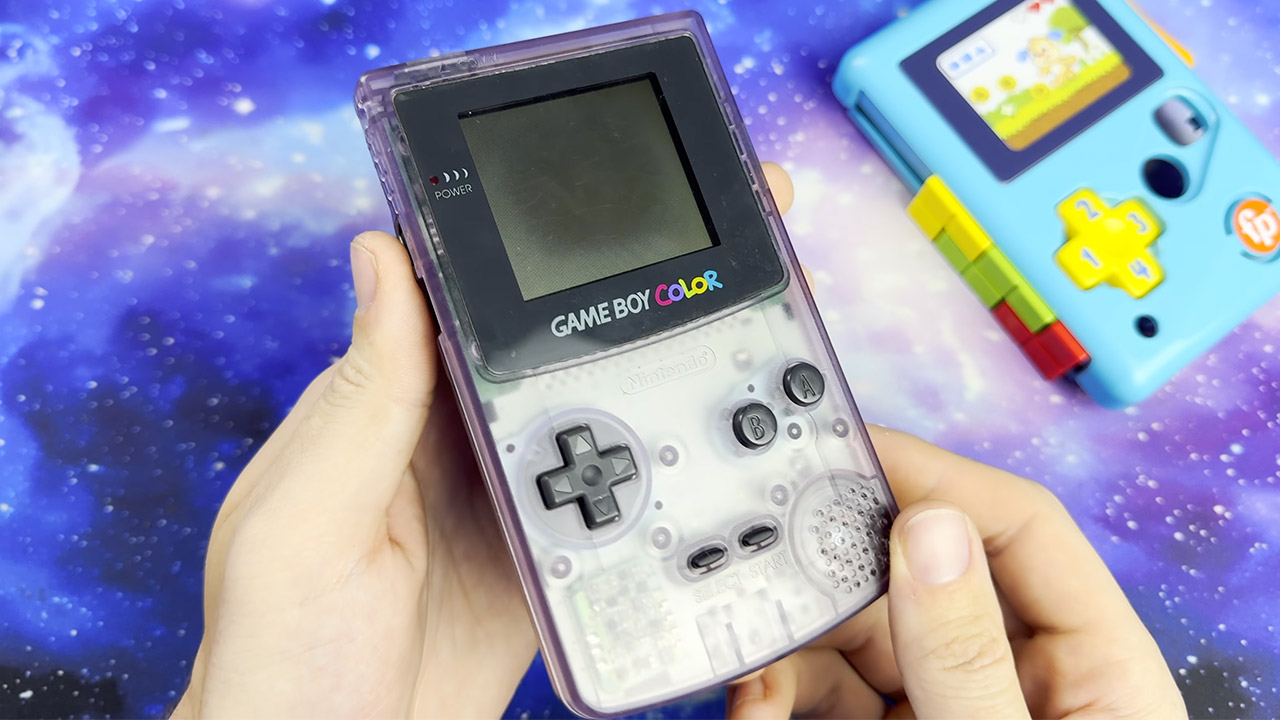
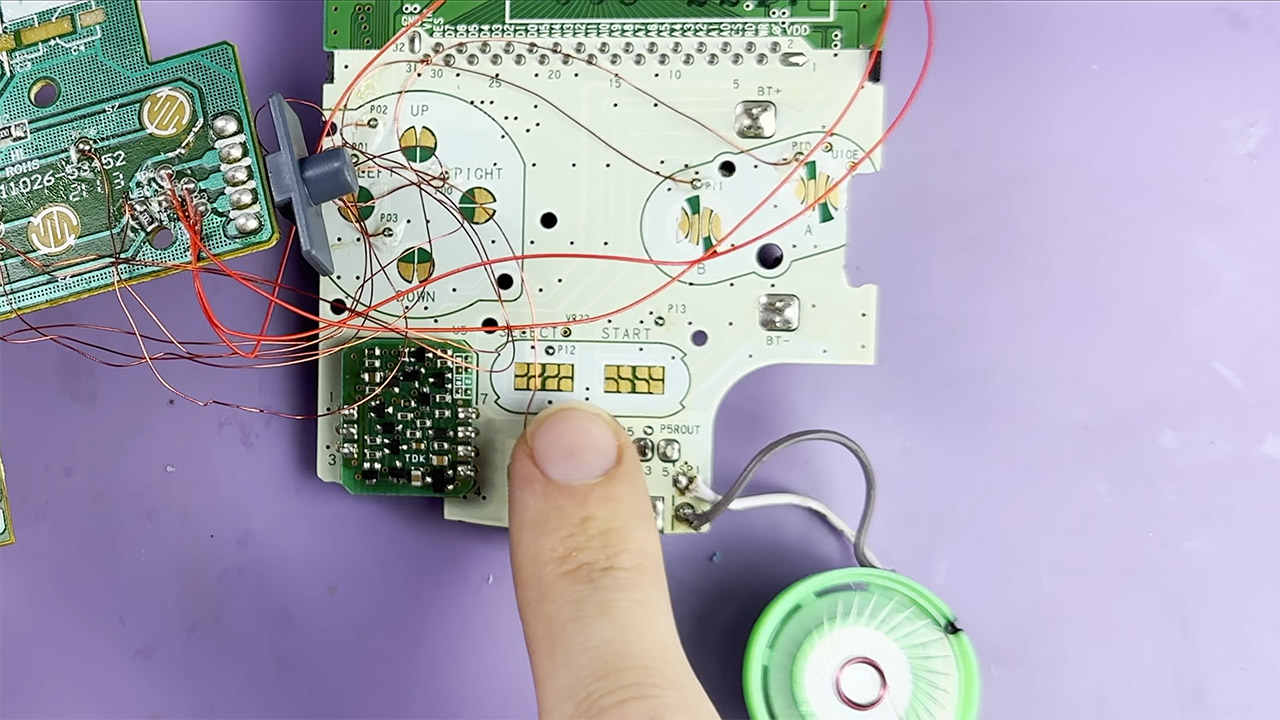
One broken Game Boy Color provided him with the necessary circuitry. He snuck its mainboard inside the toy’s cavity and was surprised to see how easily it slid in. Only minor cutting was required to ensure a snug fit, and we then connected the Nintendo board to the toy’s original button contacts and speaker. Early tests revealed that the D-pad and face buttons registered properly provided the signals were accurately mapped out. However, during one of those tests, a fuse on the Game Boy Color board blew, most likely because he was providing power in the wrong direction. Fortunately, once he removed some non-essential elements from the toy’s board, the electronics were fine, with no more damage done.
The Start and Select buttons were gone, which required some creative thinking. The orange rocker switch on the side of the toy saved the day. He put tiny switches within it, kept in place with epoxy, such that one direction would trigger Start and the other would trigger Select. The signals for the A and B buttons only needed to be altered, owing to the toy’s slightly skewed configuration in comparison to the original Game Boy. Once he sorted out the wiring, the controls behaved as he expected.
Screen work was a real test of patience, as the original Game Boy Color display had long since died, forcing him to replace it with a current OLED panel. The new screen is slightly larger than the original, and it fits well against the toy’s strong plastic. Fitting it in required some attention with a Dremel, as well as some careful 3D-printed frames and machine work to ensure a clean opening and protect the panel edges. He also connected power wires to the OLED and the power switch. The old AA arrangement was replaced by a rechargeable battery and a beautiful USB-C charging board. A little hole carved in the back of the shell allows the port to pass thru, making it easy to charge.
He was able to fit everything into the space inside the shell; however, he needed some room for the motherboard, battery, charge board, and cartridge slot to nestle together without turning the casing into Swiss cheese, so we had to whittle away at the excess material in gradual passes until everything fit together nice and snug. A 3D printed chunk covered the cartridge slot, and he also had a printed piece to cover some of the rougher bits left over from the fitting procedure that were beginning to look a little out of place.
When the shell snapped shut for the final time, the device turned on and finally ran a real Game Boy Color cartridge, with no concerns about Pokémon Yellow or other programs. The OLED panel produced some great deep blacks and vivid colors, which the old screen couldn’t match. The buttons are functional, just not as sharp as the default Game Boy. The slider blocks still operate, the speaker still works, and the overall appearance remains that of a Fisher-Price toy that a toddler could pick up and throw across the room. [Source]
FlightAware is seeking a permanent injunction against the prediction market platform.
Gece33/Getty Images
FlightAware, a flight tracking service and data provider, is suing Kalshi for using its “data and name to run gambling markets,” TechCrunch writes. The lawsuit was filed in New York, where Kalshi is currently being sued by New York Attorney General Letitia James for allegedly running an illegal gambling operation.
FlightAware claims that it was “never informed” that Kalshi would be using its data or trademark, and that the company has continued to do so, despite FlightAware sending a cease-and-desist letter. For violating its terms, using its trademark and harming its reputation, FlightAware is seeking damages from Kalshi and a permanent injunction that will prevent Kalshi from using its data.
Engadget has asked Kalshi to comment on FlightAware’s lawsuit. We’ll update this article if it responds.
Advertisement
Kalshi began offering users the ability to bet on the percentage of flights cancelled at an airport in a given timeframe in July 2026. At the time, the company said it was verifying flight cancellations with data from FlightAware and the US Department of Transportation, according to The Wall Street Journal. In a statement to the publication at the time, FlightAware made it clear that wasn’t allowed. “No company is — or will be — authorized to use the data collected through the FlightAware network for this purpose,” the company said. “Any customer who uses FlightAware in violation of the terms of use will have their account terminated.”
FlightAware only learned Kalshi was using its data when media outlets started reaching out for comment, according to the lawsuit. After discovering the company planned to offer prediction markets that were “verified from FlightAware,” it sent its cease-and-desist letter. Besides the ways Kalshi allegedly violated its rules and trademark, the company echoes the concerns of the airline industry that prediction markets for flights incentivize the “mass disruption of air travel” for anyone who wants to make money on the platform.
Kalshi has tried to prevent some of that behavior by enforcing insider trading rules, like verifying a user’s employer for some bets, and preventing politicians and athletes from betting on elections and games, respectively. Manystates still view Kalshi as gambling and want it to be treated accordingly. The Commodity Futures Trading Commission, Kalshi’s assigned regulator, has managed to fight back against some attempts to rein in the platform, but New York’s lawsuit will be another test.
Cloudflare data suggests desktop Linux usage in North America has climbed to 6.4%, up from 4.1% a year earlier, with one post-holiday workday briefly spiking to 22%. ZDNet reports: [B]elieve it or not, on Monday, July 6, when people were back after the July 4 holiday, Linux usage jumped to a high of 22%. The users of these systems are not AI agents or bots, but real people. I set Cloudflare to count humans rather than bots. If you include people and bots, Linux has a 9.7% market share. That proportion is similar to StatCounter’s score. By Cloudflare’s count, bots alone come to 19%.
These numbers tell us that workers are leading the way to the Linux desktop. […] However, past performance doesn’t explain present trends. So, why are we now seeing such a bump in Linux desktop growth? Experts believe this trend is largely AI developers and Linux users running AI Agents. For example, as David Linthicum, former managing director and chief cloud strategy officer at Deloitte Consulting and AI and cloud influencer, recently observed, while “Windows 11 can technically run local AI workloads, but as you begin using multiple tools, managing different projects, and installing various dependencies, the friction starts to build,” it’s a different story for Linux users.
Linthicum continued: “Linux delivered what I can only describe as a true ‘AI desktop’ experience. Setup was straightforward, mainstream AI instructions matched what you’d actually see in your environment, and GPU-accelerated apps simply worked — consistently. I spent far less time troubleshooting and far more time actually executing on projects.” As for agents, Linux Foundation CEO Jim Zemlin summed up their role succinctly: “Linux is the OS of choice for AI agents.” Desktop Linux is also gaining momentum as frustration with Windows 11 and the end of Windows 10 support push users to alternatives, particularly on older PCs that can’t officially upgrade. At the same time, Linux has become much easier to use, install software on, and game with, lowering many of the traditional barriers to switching.
DBSCs are an antidote to session cookie theft. Once a website sets a session cookie, the visiting browser must send a form of the cookie that’s signed with the key stored in the silicon. Properties in the TPM or secure enclave isolate the key in a way that prevents it from being extracted. Apple explains the process here.
“The attacker can’t steal the private key from the device because the TPM / Secure Enclave will not release it. That is the core protection here,” Scott Helme, a researcher and founder of Report URI who blogged about the new protections on Tuesday, told Ars. “The attacker can steal the cookie, but they can’t answer a DBSC challenge by signing it with the private key, which is still safe on your device.”
For the moment, DBSCs are supported only in Chrome version 147 for Windows and 150 for macOS. Even then, DBSCs are turned on only for a limited set of users. Presumably, Google is testing the feature before making it generally available. Chrome users on Windows and macOS can check whether it’s running in their browser by opening developer tools, clicking on the application tab across the top, and scrolling down. When a user is logged into a site that supports DBSCs, “device bound sessions” will appear if the protection is turned on.
It’s unclear when, or if, other Chromium-based browsers will implement DBSCs, but it’s likely they will be coming.
Advertisement
DBSCs are the latest form of authentication that eliminates the reliance on a shared secret, which, as the world has known for years, is painfully easy for attackers to steal. Under this new model, web servers store the visitor’s public key. The servers then send an authentication challenge incorporating the session cookie. Unless the resulting answer, known as an authentication assertion, is signed by the private key stored safely in the TPM or secure enclave, the assertion is rejected. Passkeys—which you can read about in this post published earlier on Tuesday—work the same way.
Held on 9 and 10 June in Paro, in the eastern Himalayas, the event was designed to help Bhutan navigate its digital transformation by focusing on the critical intersection of digital transformation, engineering education, and sustainable development.
The summit brought together global academic leaders, technology experts, and Bhutanese government officials to discuss how modern engineering curricula can evolve from theory-centric models into application- and skills-based frameworks. Discussions focused on how to build high-value research capabilities in the country, integrate artificial intelligence into higher education, and address foundational infrastructure challenges to ensure equitable, nationwide digital readiness.
“IEEE is proud to collaborate as a catalyst for progress in higher education as AI shifts the technology landscape and Bhutan prepares for its next era of innovation and resilience,” Mary Ellen Randall, 2026 IEEE president and CEO, said at the event. “Our goal is to support local universities and students as they develop trusted, future-ready technology that honors the nation’s commitment to sustainability and human well-being.”
Advertisement
The event featured an address by Bhutanese Princess Chimi Yangzom Wangchuck, who emphasized the importance of aligning technological innovation with the nation’s philosophy of gross national happiness (GNH), which prioritizes well-being, sustainability, and ethics.
“The question before us is not whether technology will shape the future; it certainly will,” the princess said. “The more pressing question is whether we can shape technology according to our values.”
A blueprint for Bhutan’s future
The summit helped establish a collaborative blueprint for a high-value knowledge economy in Bhutan through several key focus areas:
Workforce readiness: designing industry-driven curriculum modernization and cocreating skills programs to equip graduates with practical, technical competencies.
AI and research infrastructure: strengthening open science, trusted regional datasets, and global citation impact to prepare universities for AI-enabled learning environments.
Values-driven innovation: merging GNH principles with technological advancement and helping ensure new engineering practices support climate-resilient infrastructure and green innovation.
Institutional connectivity: using digital transformation to bridge technical capability gaps between urban and rural institutions; linking classrooms to a global research network.
Promoting sustainability: convening stakeholders to exchange ideas on green innovation, climate-resilient infrastructure, and engineering education.
Expanding digital access
To help promote the effort, IEEE offered Bhutanese universities, government institutions, and industries a six-month complimentary trial of two key technical resources:
IEEE Electronic Library.Delivered via the IEEEXplore Digital Library, the IEL gives users access to more than 7 million documents—including trusted IEEE journals, conference proceedings, standards, and technical papers—to enhance research, teaching, and technology development.
IEEE eLearning Library.This platform offers online courses developed by experts in engineering, computing, and technology, supporting flexible learning across core and emerging technical fields for professionals, faculty and students.






















































You must be logged in to post a comment Login