
Crypto World
One overlooked group has added $1.78 billion of selling pressure to bitcoin market



That amount is smaller than the ETF outflows. But in financial markets, price is set at the margin. The most recent buyers and sellers, not the cumulative volume over months, determine where the price goes. In a downtrend, when buying interest is already weak, even relatively modest and steady selling can have an outsized impact.
“Early year sales from public miners are an underdiscussed contributing factor [in] Bitcoin’s poor price performance in 2026,” the research and analysis division of Blockware Solutions said in its latest newsletter.
Many of these companies are facing squeezed margins, with the average cost to produce one bitcoin at $74,300. In response, a growing number are pivoting into AI and using their secured high-voltage electrical capacity to support that shift.
At the same time, mining difficulty, the computational work needed to add a new block, has fallen about 18% from its November peak, marking the longest stretch of declining hashrate.
In other words, the exodus and AI pivot of several large miners has eased competition, making BTC cheaper to mine and boosting rewards for those still in the game, a classic free-market reset that could lure new miners back in.
“In other words, the rest of the miners are earning ~18% more Bitcoin now than they were 10 months ago. The exodus of the largest players in the industry is improving the economics for the miners that remain,” Blockware said.


A coalition of crypto firms and industry groups has urged frontier artificial intelligence labs to grant Bitcoin developers and other open-source defenders early, trusted access to their most capable models. The call comes in a letter published Monday by the Bitcoin Policy Institute (BPI), arguing that public access and “guardrails” on top-tier systems can leave key maintainers reliant on less capable alternatives.
In the letter, BPI and the signatories say many people responsible for maintaining critical digital infrastructure—including Bitcoin Core developers—may not have the ability to run high-end AI tools against complex codebases. That, they argue, can slow security research and reduce defenders’ ability to respond as threats evolve.
Key takeaways
- BPI says open-source financial infrastructure defenders often lack early access to frontier AI tools needed to keep pace with escalating cyber threats.
- The letter argues that guardrails on public frontier models can block qualified researchers from conducting effective security work.
- Signatories call for “standing trusted-access programs” for qualified maintainers of open-source financial infrastructure.
- BPI cites recent increases in crypto hacking activity and warns that AI-enabled attack techniques can increase risk for users.
Why the letter focuses on “trusted access”
The BPI letter frames frontier AI as a shift in how security research is performed. According to the letter, advanced models can scan large codebases more efficiently, flag potential weaknesses, and compress timelines for complex technical analysis—capabilities that can benefit both defenders and adversaries.
The core recommendation is practical: frontier AI labs should establish or expand “standing trusted-access programs” that allow qualified open-source financial infrastructure defenders to use high-performing models. Without such programs, the letter warns that defenders “may lack the tools needed to keep pace with evolving threats to the infrastructure they maintain.”
BPI also says it has received multiple independent reports from open-source maintainers describing sophisticated actors using advanced AI capabilities to support attacks. The implication is that defenders may be forced to work from a disadvantage if they cannot access the same level of AI capability under safe, controlled conditions.
Open-source infrastructure risk and why Bitcoin is central
The letter argues that open-source software underpins key parts of digital and financial systems. It singles out Bitcoin, stating that it alone secures more than $1 trillion in value. While the letter does not detail the measurement method, it uses that figure to emphasize the real-world stakes of maintaining and securing open-source infrastructure.
BPI further states that vulnerabilities in open-source infrastructure can endanger users’ life savings. That argument links the access request to a broader security policy question: how to balance model safety and guardrails with the need for qualified maintainers to conduct effective defense research.
Just as importantly, the letter suggests a mismatch between “publicly available” AI systems and the reality of defending production-grade infrastructure. If frontier tools are constrained such that certain security workflows are blocked, then—even for well-intentioned developers—defense capacity may not scale at the pace of attacker capabilities.
Crypto hacking surge underscores the pressure on defenders
The letter’s security pitch arrives alongside signs of mounting pressure across the broader crypto ecosystem. It points to DefiLlama data indicating that hacking activity across the industry surged in April 2026, when malicious actors reportedly stole more than $634 million from cryptocurrency platforms—described in the letter as the highest monthly total since the Bybit hack.
DefiLlama’s dashboard is cited in the letter for those figures, and it also notes that the Bybit incident contributed to total losses of roughly $1.4 billion in February 2025. While the letter does not attribute the April 2026 thefts to AI-enabled techniques, the juxtaposition is clear: as cyber incidents increase, defenders need better tooling and faster ways to assess and mitigate vulnerabilities.
For market participants who rely on infrastructure maintainers—exchanges, custody providers, wallet vendors, and protocol teams—the practical effect of slower vulnerability discovery can be significant. The difference between months and weeks can determine how quickly patches roll out, how quickly monitoring improves, and how much exposure a system carries before fixes reach production.
AI-enabled vulnerability discovery and the “vulnerability apocalypse” concern
The letter ties its access request to a broader trend in crypto security: AI-assisted vulnerability discovery is raising concerns across the industry. It references commentary from Mitchell Amador, CEO of bug bounty platform Immunefi, who described the current environment as a “vulnerability apocalypse,” in earlier coverage by Cointelegraph.
That earlier reporting cited the growing role of frontier models such as Claude Opus 4.8 and ChatGPT 5.5 in accelerating vulnerability research. The BPI letter uses that context to argue that advanced AI is increasingly part of the threat landscape—meaning defenders also need effective, timely access to advanced tools to conduct their own research and response.
Crucially, this is not framed as unrestricted model use. Instead, it centers on the idea that defenders should be able to work with frontier systems through trusted programs, designed to allow security research while reducing the risks associated with misuse.
Who signed the open letter
The open letter was co-signed by multiple crypto companies and organizations, including the African Bitcoin Institute, Anchorage Digital, BitGo, Bitwise, Blockstream, Bull Bitcoin, MARA, Kraken, Ledger, and Trezor, among others.
With this mix of infrastructure providers, custodians, security-oriented stakeholders, and Bitcoin-focused organizations, the letter reflects a common concern across the sector: that the security advantage could tilt toward attackers if AI capability is easier for adversaries to access than for open-source maintainers.
Going forward, the key question for readers is whether major AI labs respond by creating or expanding trusted-access programs that can be used by qualified open-source financial infrastructure defenders—and, if so, what eligibility and guardrail structures will look like in practice. The next signals to watch are concrete policy changes from frontier labs and measurable shifts in how quickly critical vulnerabilities are identified and patched as hacking activity remains elevated.
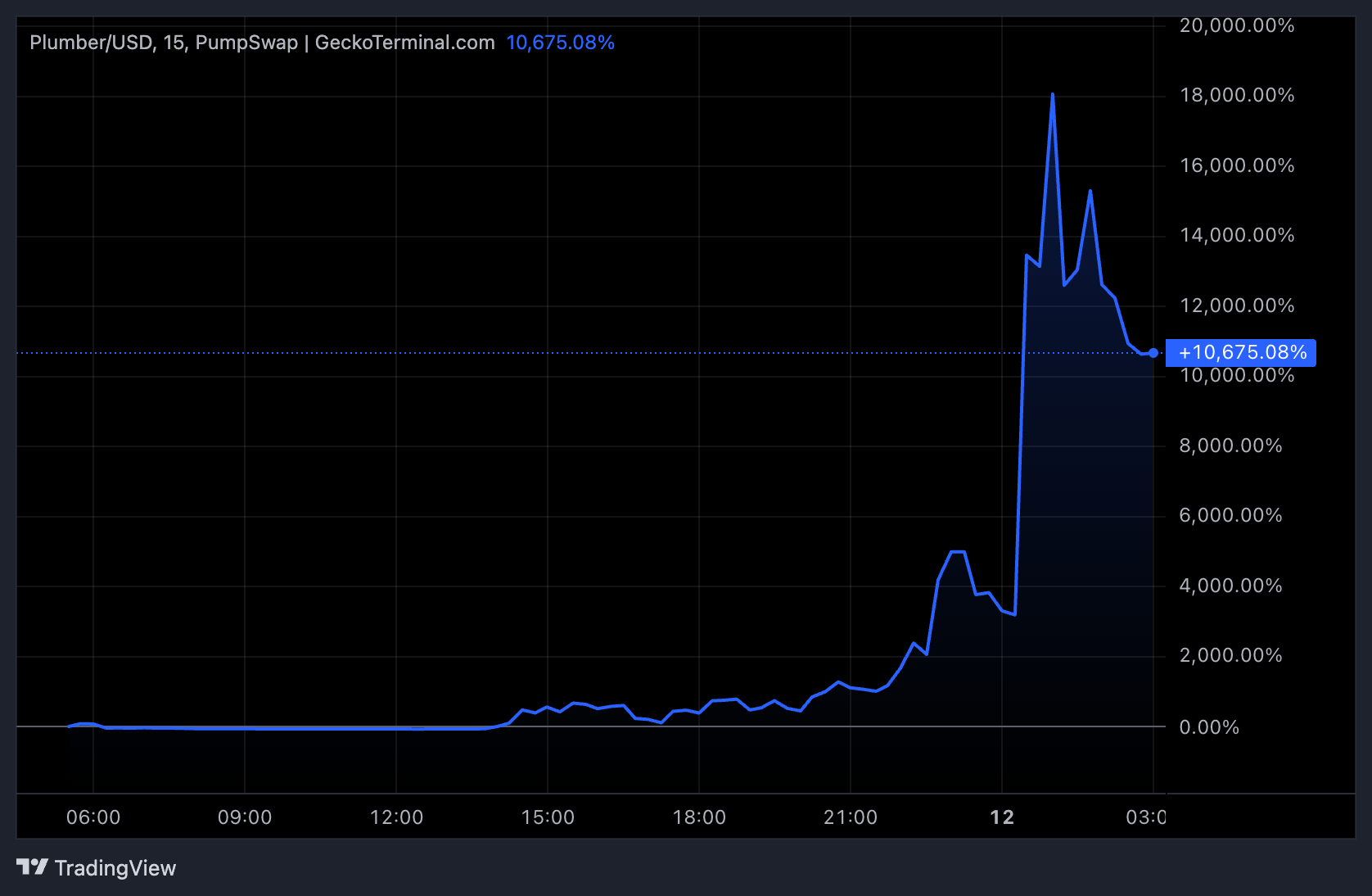
A meme coin called PLUMBER has surged more than 10,000% since its launch, riding a viral Crypto Twitter argument over whether early crypto traders once beat weaker rivals.
The token’s market capitalization climbed from below $1 million to above $5 million on its first day, then pulled back and held in the multimillion-dollar range.

What is PLUMBER Meme Coin?
According to analyst Stitch, it all began with a simple post. Trader Frank DeGods claimed crypto veterans were trading against weaker retail players he called “plumbers.”
Follow us on X to get the latest news as it happens
Commentator Threadguy pushed the point further. He suggested that legendary traders from 2017 to 2019 simply faced softer competition.
Trader Ansem pushed back. He argued those years were brutal, full of scams, leverage wipeouts, and tokens that later collapsed to near zero. The exchange hardened into a running theme on Crypto Twitter, framed as “oldheads versus plumbers.”
A developer then created the PLUMBER meme coin. Moonshot also verified it earlier today.
“Then someone did what CT always does: tokenize the attention. PLUMBER didn’t create this meme. The dev simply saw the ‘oldheads vs plumbers’ debate heating up and deployed a token right in the middle of it,” Stitch said.
Attention Is Doing the Heavy Lifting
Trading volume has surged to $14.2 million as the meme spread across group chats and timelines. Well-known accounts amplified it. Cobie posted plumber memes, and traders, including traderpow and ResellCalendar, bought into the token.
That created a familiar feedback loop. Social attention drew key opinion leaders (KOLs), capital followed, volume rose, and fresh visibility pulled in more buyers. The chart tracked the frenzy.
Yet, the token carries risks. Similar attention-driven rallies tend to fade. Cash Cat (CASHCAT) jumped roughly 4,000% in a week during July before the rally lost momentum.
Coinbase Man (BRIAN) jumped from under $1 million to $37 million after CEO Brian Armstrong changed his profile picture. The token crashed roughly 90% once he reverted it.
“The bundle is currently around 60%…For a token this dependent on momentum, the worst combination would be the narrative cooling down while supply starts hitting the market at the same time. That can turn a strong chart into a completely different setup very quickly,” Stitch added.
For now, PLUMBER’s momentum depends on the meme staying loud. Whether the developer builds anything beyond the joke remains an open question.
Subscribe to our YouTube channel to watch leaders and journalists provide expert insights
The post A Crypto Twitter Post Just Spawned a 10,000% Meme Coin Rally appeared first on BeInCrypto.


“If these processes can become faster and more efficient, U.K. businesses could unlock working capital sooner and make it easier to finance international trade,” Jacobsson said in an interview over LinkedIn.
The BOE named NOBO Finance, Dun & Bradstreet, a global provider of business decisioning data, analytics, and credit-rating services, and Polygon Labs, a software and blockchain company, as participants in its Digital Pound Lab.
The project will be the first time the Digital Pound Lab tests how public stablecoins and central-bank money work in a single payment flow alongside a portable credit identity for small businesses. The lab uses no real customers or money and does not signal any decision to issue a digital pound.
NOBO, a U.K.-based fintech building digital trade finance infrastructure that helps small and medium-sized enterprises (SMEs) become visible, verifiable, and bankable, was already involved in Phase 1. During the first phase, NOBO helped demonstrate conditional business-to-business escrow payments relevant to trade finance workflows.
A first workstream will build an SME “bankable profile.” NOBO, Dun & Bradstreet and Polygon plan to combine wallet transaction data, open-finance information and business intelligence to create a reusable credit assessment. Polygon will provide smart contracts intended to record the verified outcome and manage consent.

The world’s third-largest public holder of Bitcoin made a substantial transfer hours ago, which raised some questions given the peculiar timing.
Metaplanet, which adopted its BTC strategy a few years ago and was described as Japan’s Strategy, has moved 3,881 units (worth around $250 million), according to data from Arkham and Lookonchain.
The company currently holds 43,000 BTC after its latest purchase, which was announced in early July, of 2,823 units for $222 million. Its goal of holding 100,000 BTC by the end of 2026 appears unreachable at the moment, given its current portfolio and a substantial reduction in the frequency of its purchases.
Its average acquisition price remains just over $96,000, meaning it has spent over $4.1 billion to accumulate its BTC fortune. However, the asset’s significant correction over the past several months has put Metaplanet’s position well in the red, with a paper loss of $1.4 billion.
Metaplanet (@Metaplanet) transferred a total of 3,881 $BTC ($247.3M) over the past 3 hours.
Metaplanet bought a total of 43,000 $BTC at an average price of $96,191 and is currently sitting on a loss of $1.4B(-34%).https://t.co/HGljOETBsX pic.twitter.com/L0JeP8wHxv
— Lookonchain (@lookonchain) August 12, 2026
The timing of the transfer is interesting. There’s no confirmation that the company intends to sell, but it wouldn’t be a surprise since many other BTC treasury companies have done so, including the leader, Strategy.
The largest corporate holder of the cryptocurrency has completed several sales this year, and the trend was mimicked by miners and other firms that hold Bitcoin on their balance sheets. Metaplanet has refrained from doing so for now, but such transfers raise some questions.
The post Metaplanet Moves $250M in Bitcoin as Paper Loss Swells to $1.4B appeared first on CryptoPotato.


A group of crypto companies and industry organizations has called on frontier AI labs to give Bitcoin and other open-source financial infrastructure developers trusted access to their most capable models as AI-assisted cyber threats become more advanced.
Summary
- Crypto companies have urged frontier AI labs to give Bitcoin and open source financial infrastructure developers trusted access to their most capable models.
- The Bitcoin Policy Institute said current restrictions can leave qualified defenders relying on less capable AI tools while sophisticated attackers gain access to advanced systems.
- Anchorage Digital, BitGo, Bitwise, Blockstream, Kraken, Ledger, MARA and Trezor were among the companies and organizations that signed the open letter.
- BPI said advanced AI can help defenders scan large codebases and find vulnerabilities faster, but the same capabilities can also be used by attackers.
The Bitcoin Policy Institute said in an open letter published Monday that developers responsible for securing open-source financial systems can be excluded from specialist cyber programs or restricted by safeguards built into publicly available frontier AI models.
Bitcoin developers seek access to stronger AI security tools
Under the proposal, AI companies would “establish or expand standing trusted-access programs for qualified defenders of open-source financial infrastructure,” allowing vetted security researchers and maintainers to use capabilities that may otherwise be restricted.
BPI argued that access has become more important as advanced AI systems gain the ability to examine large codebases, identify potential vulnerabilities and speed up difficult technical work. These capabilities can help legitimate researchers find flaws, but the institute said they can also be used by attackers looking for weaknesses.
For Bitcoin developers, the letter said the access gap can leave maintainers dependent on less capable open-weight models when frontier systems either refuse security-related requests or remain available only through programs that do not include open-source financial infrastructure.
The institute pointed to the amount of capital dependent on such software, noting that Bitcoin alone secures more than $1 trillion in value. A serious vulnerability in financial infrastructure can therefore put users’ savings at risk, the letter said.
Several major crypto companies joined the request, including Anchorage Digital, BitGo, Bitwise, Blockstream, Bull Bitcoin, MARA, Kraken, Ledger and Trezor. The African Bitcoin Institute was also among the organizations that signed the letter.
Bitcoin Core’s recent security work has provided examples of the type of vulnerabilities maintainers must identify before they can affect users. In June, crypto.news previously reported that Bitcoin Core 31.1rc1 fixed a privacy problem involving PrivateBroadcast that could expose a user’s IP address under certain network conditions. The release candidate also contained changes covering wallet accuracy, networking, blockchain validation, and MuSig2 security.
A month earlier, Bitcoin Core developers disclosed a high-severity bug tracked as CVE-2024-52911 that could allow miners to remotely crash some nodes. The vulnerability affected versions after 0.14.0 and before 29.0, although triggering it required miners to produce costly proof-of-work blocks. Security researcher Cory Fields privately reported the flaw in 2024 before Bitcoin Core 29.0 shipped with the fix in April 2025.
Frontier AI could strengthen open-source defenders
BPI described frontier AI as a technology that is changing the economics of both cybersecurity research and cyber operations because increasingly capable models can perform tasks that previously required substantial amounts of specialist human work.
Advanced models could eventually become one of the “most powerful defensive technologies ever developed,” the institute said, particularly when researchers use them to inspect software and identify weaknesses before attackers exploit them.
“Without dedicated access programs, defenders may lack the tools needed to keep pace with evolving threats to the infrastructure they maintain,” the letter said.
BPI also said it had received multiple independent reports from open-source maintainers about sophisticated actors using advanced AI capabilities to sustain attacks. Some of the activity potentially involved foreign adversaries, according to the institute.
Rather than asking AI developers to remove security controls from their models for all users, the signatories are seeking standing programs through which qualified defenders could receive additional access after being vetted.
The proposal would put open-source financial developers closer to researchers and organizations already permitted to use advanced cyber capabilities under controlled programs, while retaining restrictions intended to prevent unrestricted access by malicious users.
The potential defensive value of AI has already been tested elsewhere in crypto. In July, an Ethereum Foundation study found that coordinated AI agents could uncover genuine vulnerabilities in software used by Ethereum, including a libp2p flaw later disclosed as CVE-2026-34219. The Foundation’s Protocol Security team said the harder part was determining which AI-generated reports represented real vulnerabilities rather than convincing false positives.
Human validation and reproducible proof therefore remained necessary even when AI systems successfully identified security problems, according to the Foundation.
AI-assisted attacks raise pressure on crypto security
The request comes after crypto platforms suffered another heavy period of security losses in 2026, with attackers increasingly able to combine software vulnerabilities, compromised credentials, social engineering and other attack methods.
DefiLlama data cited in June showed more than $634 million was stolen from cryptocurrency platforms during April, the industry’s highest monthly loss since the Bybit hack, which contributed to roughly $1.4 billion in losses in February 2025.
Earlier figures covered in April showed more than $606 million had already been stolen across 12 incidents during the first 18 days of the month. The amount was roughly 3.7 times the $165.5 million lost throughout the first quarter of 2026.
Two attacks accounted for most of April’s losses at that stage. Drift Protocol lost about $285 million, while an exploit involving KelpDAO resulted in losses of roughly $292 million, with the two incidents accounting for about 95% of the reported total during the first 18 days.
The attack pattern has also moved outside isolated smart-contract bugs. DefiLlama had recorded more than $17 billion in losses across 518 crypto hacking incidents over the previous decade by April, with private-key leaks, phishing and credential theft accounting for an increasing part of the damage alongside protocol exploits.
At the same time, security companies have warned that AI can lower the amount of time and technical work required to search for exploitable weaknesses. CertiK said in April that AI-assisted phishing, deepfakes and automated exploit tools were making attacks faster and harder to detect, while cross-chain infrastructure and social engineering remained important attack routes.
Advanced AI models have changed vulnerability discovery
Concerns over access have intensified as frontier models demonstrate stronger vulnerability-discovery capabilities, giving security researchers tools that can inspect software at a scale that was previously difficult to achieve.
Mitchell Amador, CEO of bug bounty platform Immunefi, described the proliferation of systems including Claude Opus 4.8 and ChatGPT 5.5 as contributing to a “vulnerability apocalypse” for crypto security, arguing that advanced models had changed the balance between attackers and defenders.
Amador said the next three to four years could be critical for crypto cybersecurity while defensive teams work to use the same AI capabilities to produce more secure codebases. Increased use of crowdsourced security systems could shorten that period to less than two years, he added.
AI-based security tools were already part of the industry’s defensive infrastructure before the latest concerns. In an October 2025 interview with Immunefi, Amador said automated vulnerability detection should operate alongside audits, bug bounties, monitoring systems and transaction firewalls rather than replace them. He said at the time that fewer than 10% of projects used AI vulnerability tools.
Ethereum co-founder Vitalik Buterin made a similar case for defensive uses in May, arguing that AI-assisted formal verification could eventually allow developers to combine highly optimized software with machine-checked proofs of correctness. He cited potential applications across Ethereum’s consensus systems, zero-knowledge technology, and quantum-resistant cryptography while cautioning that formal verification could not eliminate every source of software risk.
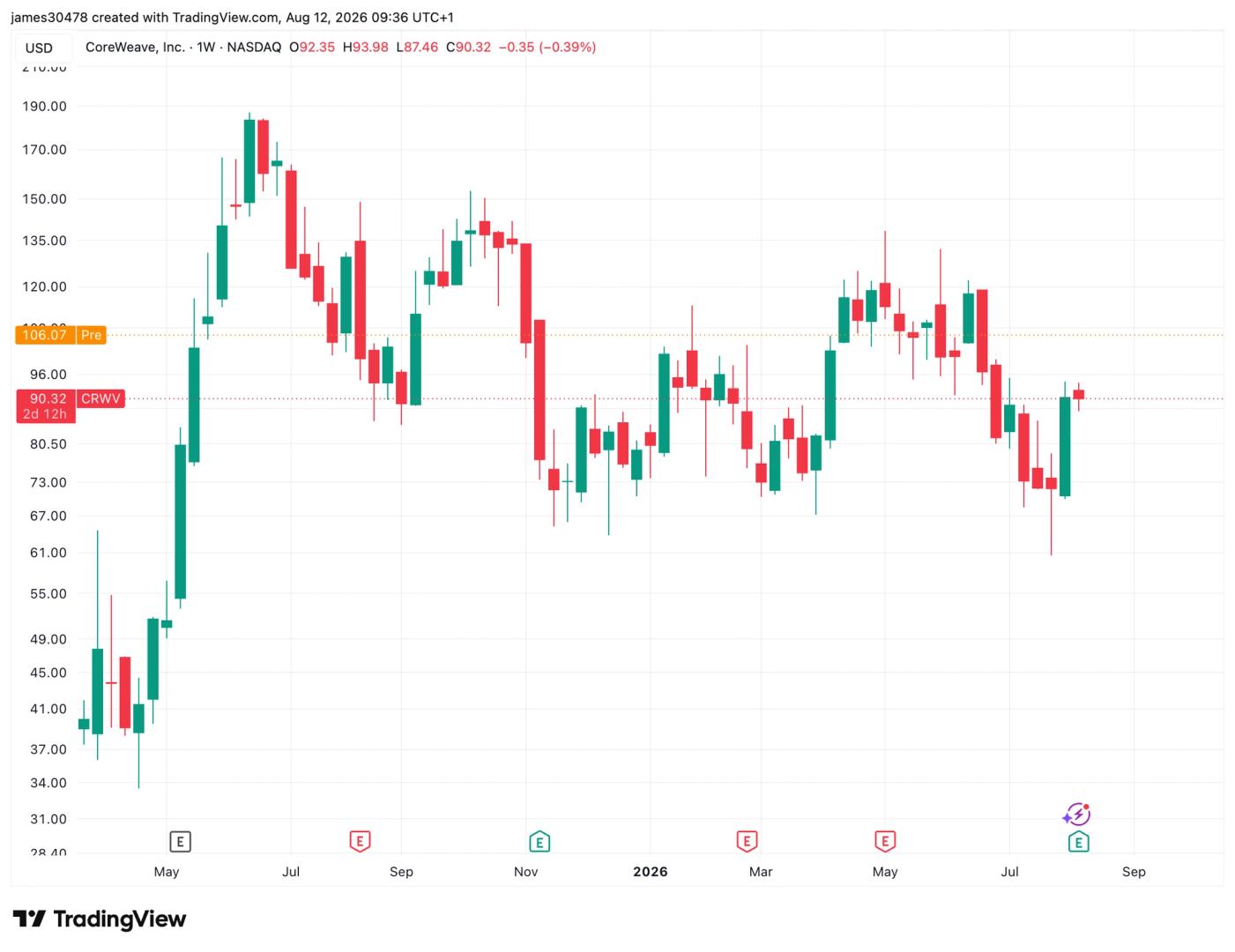
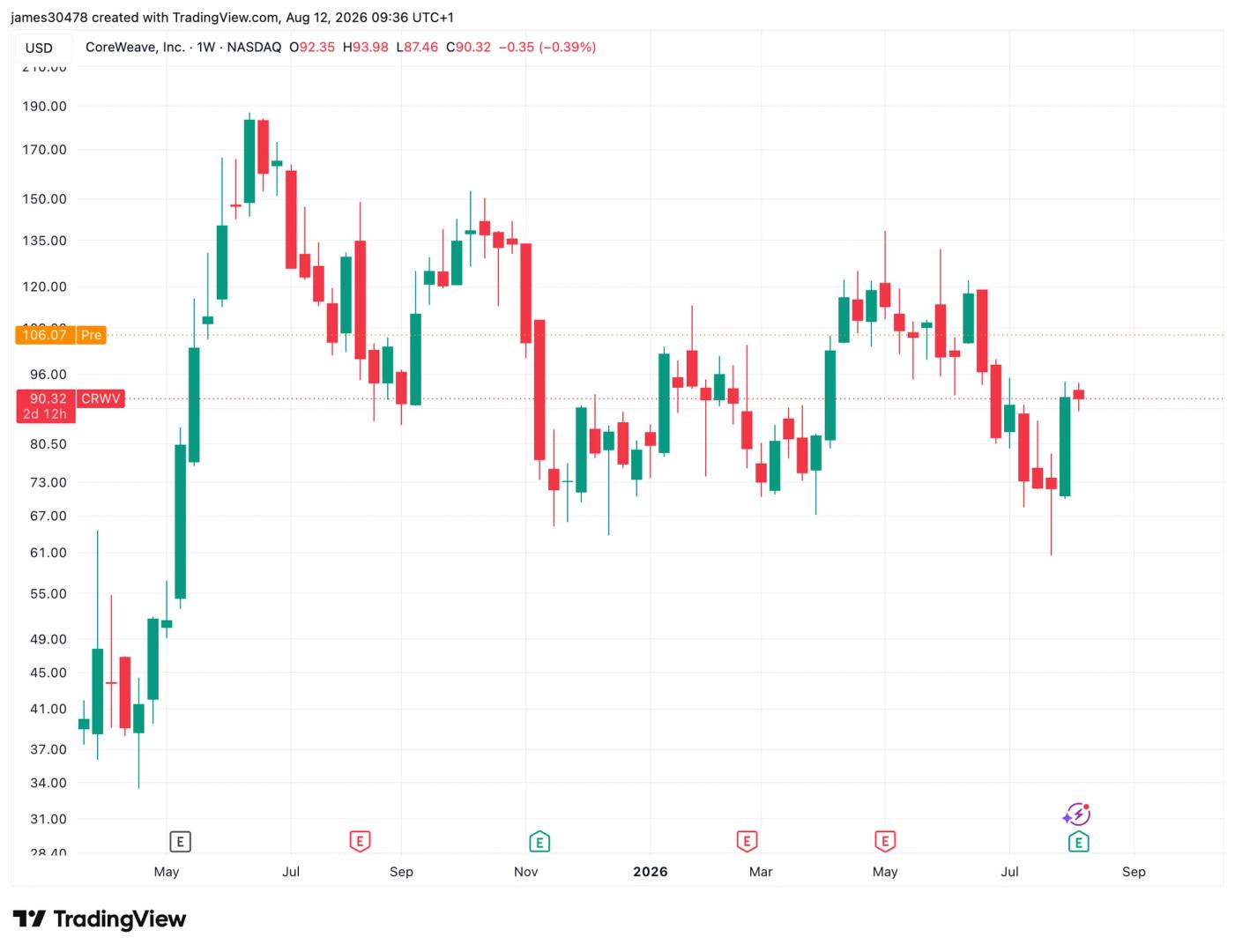
CoreWeave (CRWV) shares surged 16% in pre-market trading on Wednesday after the company delivered stronger growth and raised its full-year outlook, lifting the broader neocloud market.
The AI infrastructure provider said second-quarter revenue more than doubled to $2.58 billion, narrowly beating expectations, while its net loss of $626 million was smaller than analysts projected. The company forecast third-quarter sales of $3.45 billion to $3.6 billion and increased its 2026 revenue guidance to between $12.4 billion and $13.2 billion.
IREN (IREN) and Cipher Digital (CIFR), both gained 5% as investors piled into companies positioned to benefit from accelerating demand for AI computing.
CoreWeave ended the quarter with $104 billion in contracted business and added more than $25 billion of customer commitments after the period closed. Management also said recently signed deals carried margins five to 10 percentage points above recent levels, reflecting scarce capacity and favorable pricing.
The results reinforce a widening market divide. AI infrastructure continues to attract capital, customers and premium valuations, while bitcoin and the broader crypto trade struggle to match that momentum as bitcoin trades below $64,000.
Bitcoin’s price rejection at $65,400 from earlier this week brought another leg down in the past 24 hours as the asset slipped to a 9-day low of $63,200, where it finally found some support.
Interestingly, most larger-cap alts are slightly in the green on a daily scale now, even Ripple’s XRP, which dipped below $1.00 for the first time in nearly two years yesterday.
BTC Tried to Recover
The primary cryptocurrency’s August low came at the start of the month when it dipped to $62,200 on a couple of occasions, the latest being August 3. It reacted well and surged to $64,000 within a day. It kept climbing in the following days and eventually tapped $65,000 before it was halted there after the CLARITY Act stalled in the US Senate.
The weak US jobs report on Friday resulted in a relief rally for BTC, which jumped to $65,400. However, it was stopped there and spent the weekend trading sideways at around $65,000. It tried to break out on Monday, but it was halted at $65,400 again. This time, the correction was more violent as BTC slipped to $63,800.
It rebounded to $64,400 yesterday, but another leg down followed that drove it to its lowest level since last Monday at $63,200. It has recovered some ground since then but still trades below $64,000 as of press time.
Its market cap has stalled at $1.280 trillion on CG, while its dominance over the alts has dipped to under 57% on CG.

XRP Dipped Below $1
After a few days of gradually increasing selling pressure, Ripple’s XRP finally slipped below $1.00 yesterday for the first time since late 2024. Although it has currently rebounded to $1.02, analysts are still split on whether this is a warning of a bigger storm ahead or a hidden accumulation opportunity.
ETH has neared $1,900, BNB has reclaimed the $610 level, while TRX stands close to $0.34. SOL, DOGE, RAIN, XMR, and LINK are slightly in the green, while HYPE, ADA, and ZEC are in the red.
Uniswap’s UNI has dropped the most over the past 24 hours, losing more than 10% of value to $3.55. PUMP follows suit with a 7% nosedive.
The total crypto market cap has remained at essentially the same level as yesterday at $2.250 trillion on CG.

The post Ripple’s XRP Rebounds From Sub-$1 Dip, Bitcoin (BTC) Hit 9-Day Low: Market Watch appeared first on CryptoPotato.

TIME: Our readers from all around the world may not be familiar with the peculiarities of British politics or your political platform. Can you introduce us to Count Binface, the candidate?
Count Binface: I am an intergalactic space warrior, leader of the Recyclons from planet Sigma IX, and a part-time democratic politician on Earth. My hobbies include invading star systems, dominating species, and watching the Lovejoy box set. That won’t mean anything to most of your readers, but it should. It’s the greatest art your planet has produced. Well, that and the Sistine Chapel.
You have stood in a number of elections, sometimes in different forms. Can you tell us what drew you to this one in Clacton?
Clacton is where the election is. If I’d gone elsewhere, it would have been less effective. Dare I say it, we wouldn’t be talking now.
You’ve stood in many elections, and lost them all. This time people appear to be taking you a bit more seriously. They think you may be able to improve on your previous personal best of 308 votes. Why do you think that is?


Grayscale Research’s head said the adoption of artificial intelligence (AI) will create demand that public blockchains are positioned to serve, naming Ethereum (ETH), Solana (SOL), Worldcoin (WLD), and Bittensor (TAO) as the networks tied to three emerging needs.
The blog identified agentic finance, verifiable record-keeping, and decentralized AI as the areas most likely to drive demand toward crypto rails.
Why Grayscale Sees AI and Crypto Converging
In the note, published on August 11, Grayscale Head of Research Zach Pandl argued that AI and public blockchains are complementary technologies. He said that traditional systems were not built for the demands AI is about to generate.
“AI adoption will increase demand for public blockchains as programmable financial infrastructure; a verifiable record layer for computation, identity, and reputation; and a foundation for open, user-owned AI ecosystems,” the note read.
Pandl noted that AI agents will need programmable wallets that hold and deploy capital without intermediaries. This activity would drive micropayments, instant cross-border settlement, and automated trading and risk management.
He pointed to Ethereum and Solana as the networks built for that kind of settlement.
Follow us on X to get the latest news as it happens
Identity and Decentralized AI Round Out the Thesis
The second demand area covers identity. As AI agents take on more decisions, firms will need stronger ways to verify their actions and trustworthiness.
This includes tracking which models, data, and rules influenced an agent’s decisions, verifying whether online accounts represent real people, and establishing reliable reputation records before agents handle sensitive tasks such as investments or purchases.
Pandl cited Worldcoin and its identity service as one way to tell humans apart from agents.
“Public blockchains—and applications built on them, such as Worldcoin’s identity service—can anchor these records in transparent, neutral infrastructure rather than place them under the control of a single corporation or government,” he wrote.
The third area targets the concentration of AI power among a few frontier labs and hyperscalers. Grayscale described Bittensor (TAO) as an open network that anyone can access, contribute to, and stake in.
Subscribe to our YouTube channel to watch leaders and journalists provide expert insights
The post Grayscale Says AI Adoption Creates Demand These 4 Networks Could Fill appeared first on BeInCrypto.


Fidelity is preparing to add staking and quarterly cash payouts to its Fidelity Ethereum Fund (FETH), one of the largest spot ether ETFs in the U.S.
FETH, with $898 million in net assets, could stake as much as 100% of its ether under normal conditions, though Fidelity set no minimum, according to an amended registration statement. The fund would keep some ETH available for redemptions, expenses and other liquidity needs.
The shift follows an IRS safe harbor bulletin issued in November 2025 that lets qualifying crypto trusts stake assets without losing their grantor-trust tax status. Fidelity would join Grayscale and 21Shares in adding staking to existing ether funds. BlackRock took a different route by introducing a separate staking product.
Fidelity would retain 85% of gross staking rewards, while the remaining 15% would go to the fund sponsor, custodians and node operators. Blockdaemon, Figment and Galaxy are named as the trust’s node operators.
Net staking rewards would first cover fund expenses and would then be used for quarterly cash distributions. Funds must distribute net staking rewards at least quarterly, according to the IRS rules.
The fund may also sell some ETH to raise cash for payouts, Fidelity said.

Why You Shouldn’t Use Your Washing Machine During Today’s Eclipse

The Vikings’ Training Camp Controversy Gets Clarity from Plugged-In Writer

What is the release date for Lioness season 3 episode 3 on Paramount+?


-

 Fashion5 days ago
Weekend Open Thread: Mattifying Sunscreen
-

 Fashion5 days ago
Frugal Friday’s Workwear Report: Cap-Sleeve Pointelle Crewneck Sweater
-

 News Videos4 days ago
Can Astrology Help Find Gold and Silver Trends? A Financial Astrology Guide
-

 Sports6 days ago
Jordan Coyle & Cordiamo take Laya Arena Stakes at RDS
-
 Business6 days ago
US stocks: Dow closes at record on Mideast optimism; SpaceX, AMD drag Nasdaq
-

 Politics6 days ago
Reform UK And Greens Sink To Lowest Favourability Ratings To Date
-

 Business7 days ago
Supply chain issues impact Ingredion
-

 Tech5 days ago
Rinn Pharma & Biopharma to join NordicPharmaTrain network
-

 Business3 days ago
How to Start a Cleaning Business: A Step-by-Step Guide
-

 Business3 days ago
Datadog: Best Of Breed For Multiple Reasons
-

 Business3 days ago
BDC Weekly Review: Private BDC Q2 Numbers Are Strong
-
 NewsBeat11 hours ago
Communication cards help banking customers access services or report scams
-
Sports6 days ago
Spider-Man: Brand New Day ending explained: Is Peter Parker alive?
-

 Fashion7 days ago
Suit of the Week: Me + Em
-
 Fashion7 days ago
Birthstone pendant necklaces for women by ottomanhands – 18ct gold plated
-

 Tech5 days ago
Price Hikes May Be Coming for PC Motherboards Next
-
 Crypto World6 days ago
Galaxy Digital Stock Slides 14% as Crypto Prices Hit Earnings
-

 Business5 days ago
Brightwater secures funding for WA-first dementia projects
-

 Politics7 days ago
Comedian Jimmy Cricket Has Died, Aged 80
-
 Politics6 days ago
The Not-So Talented Mr Arday
You must be logged in to post a comment Login