
Crypto World
Crypto Firms Ask AI Companies for Early Access to Bitcoin Devs


A coalition of crypto firms and industry groups has urged frontier artificial intelligence labs to grant Bitcoin developers and other open-source defenders early, trusted access to their most capable models. The call comes in a letter published Monday by the Bitcoin Policy Institute (BPI), arguing that public access and “guardrails” on top-tier systems can leave key maintainers reliant on less capable alternatives.
In the letter, BPI and the signatories say many people responsible for maintaining critical digital infrastructure—including Bitcoin Core developers—may not have the ability to run high-end AI tools against complex codebases. That, they argue, can slow security research and reduce defenders’ ability to respond as threats evolve.
Key takeaways
- BPI says open-source financial infrastructure defenders often lack early access to frontier AI tools needed to keep pace with escalating cyber threats.
- The letter argues that guardrails on public frontier models can block qualified researchers from conducting effective security work.
- Signatories call for “standing trusted-access programs” for qualified maintainers of open-source financial infrastructure.
- BPI cites recent increases in crypto hacking activity and warns that AI-enabled attack techniques can increase risk for users.
Why the letter focuses on “trusted access”
The BPI letter frames frontier AI as a shift in how security research is performed. According to the letter, advanced models can scan large codebases more efficiently, flag potential weaknesses, and compress timelines for complex technical analysis—capabilities that can benefit both defenders and adversaries.
The core recommendation is practical: frontier AI labs should establish or expand “standing trusted-access programs” that allow qualified open-source financial infrastructure defenders to use high-performing models. Without such programs, the letter warns that defenders “may lack the tools needed to keep pace with evolving threats to the infrastructure they maintain.”
BPI also says it has received multiple independent reports from open-source maintainers describing sophisticated actors using advanced AI capabilities to support attacks. The implication is that defenders may be forced to work from a disadvantage if they cannot access the same level of AI capability under safe, controlled conditions.
Open-source infrastructure risk and why Bitcoin is central
The letter argues that open-source software underpins key parts of digital and financial systems. It singles out Bitcoin, stating that it alone secures more than $1 trillion in value. While the letter does not detail the measurement method, it uses that figure to emphasize the real-world stakes of maintaining and securing open-source infrastructure.
BPI further states that vulnerabilities in open-source infrastructure can endanger users’ life savings. That argument links the access request to a broader security policy question: how to balance model safety and guardrails with the need for qualified maintainers to conduct effective defense research.
Just as importantly, the letter suggests a mismatch between “publicly available” AI systems and the reality of defending production-grade infrastructure. If frontier tools are constrained such that certain security workflows are blocked, then—even for well-intentioned developers—defense capacity may not scale at the pace of attacker capabilities.
Crypto hacking surge underscores the pressure on defenders
The letter’s security pitch arrives alongside signs of mounting pressure across the broader crypto ecosystem. It points to DefiLlama data indicating that hacking activity across the industry surged in April 2026, when malicious actors reportedly stole more than $634 million from cryptocurrency platforms—described in the letter as the highest monthly total since the Bybit hack.
DefiLlama’s dashboard is cited in the letter for those figures, and it also notes that the Bybit incident contributed to total losses of roughly $1.4 billion in February 2025. While the letter does not attribute the April 2026 thefts to AI-enabled techniques, the juxtaposition is clear: as cyber incidents increase, defenders need better tooling and faster ways to assess and mitigate vulnerabilities.
For market participants who rely on infrastructure maintainers—exchanges, custody providers, wallet vendors, and protocol teams—the practical effect of slower vulnerability discovery can be significant. The difference between months and weeks can determine how quickly patches roll out, how quickly monitoring improves, and how much exposure a system carries before fixes reach production.
AI-enabled vulnerability discovery and the “vulnerability apocalypse” concern
The letter ties its access request to a broader trend in crypto security: AI-assisted vulnerability discovery is raising concerns across the industry. It references commentary from Mitchell Amador, CEO of bug bounty platform Immunefi, who described the current environment as a “vulnerability apocalypse,” in earlier coverage by Cointelegraph.
That earlier reporting cited the growing role of frontier models such as Claude Opus 4.8 and ChatGPT 5.5 in accelerating vulnerability research. The BPI letter uses that context to argue that advanced AI is increasingly part of the threat landscape—meaning defenders also need effective, timely access to advanced tools to conduct their own research and response.
Crucially, this is not framed as unrestricted model use. Instead, it centers on the idea that defenders should be able to work with frontier systems through trusted programs, designed to allow security research while reducing the risks associated with misuse.
Who signed the open letter
The open letter was co-signed by multiple crypto companies and organizations, including the African Bitcoin Institute, Anchorage Digital, BitGo, Bitwise, Blockstream, Bull Bitcoin, MARA, Kraken, Ledger, and Trezor, among others.
With this mix of infrastructure providers, custodians, security-oriented stakeholders, and Bitcoin-focused organizations, the letter reflects a common concern across the sector: that the security advantage could tilt toward attackers if AI capability is easier for adversaries to access than for open-source maintainers.
Going forward, the key question for readers is whether major AI labs respond by creating or expanding trusted-access programs that can be used by qualified open-source financial infrastructure defenders—and, if so, what eligibility and guardrail structures will look like in practice. The next signals to watch are concrete policy changes from frontier labs and measurable shifts in how quickly critical vulnerabilities are identified and patched as hacking activity remains elevated.

Mining pools controlling most of Ravencoin’s hash rate are building a competing chain that could trigger a three-day reorganization.


Russia’s central bank will allow retail investors to only trade bitcoin , ether and USDT on regulated exchanges, making Tether’s dollar-linked token the only stablecoin on the initial list.
The draft rules would limit non-qualified investors to 300,000 rubles (around $3,600) of crypto purchases per year at each intermediary. Qualified investors wouldn’t face the cap.
The whitelist adds detail to legislation passed in July that opens regulated crypto trading from Sept. 1 but did not specify which assets retail investors could buy. Crypto payments inside Russia remain prohibited.
The wording sets the 300,000-ruble limit per intermediary rather than across an investor’s total purchases, potentially allowing larger aggregate exposure through multiple brokers or exchanges.
It isn’t often that a reporter gets asked to pose as a venture capitalist to fool suspected North Korean IT workers.
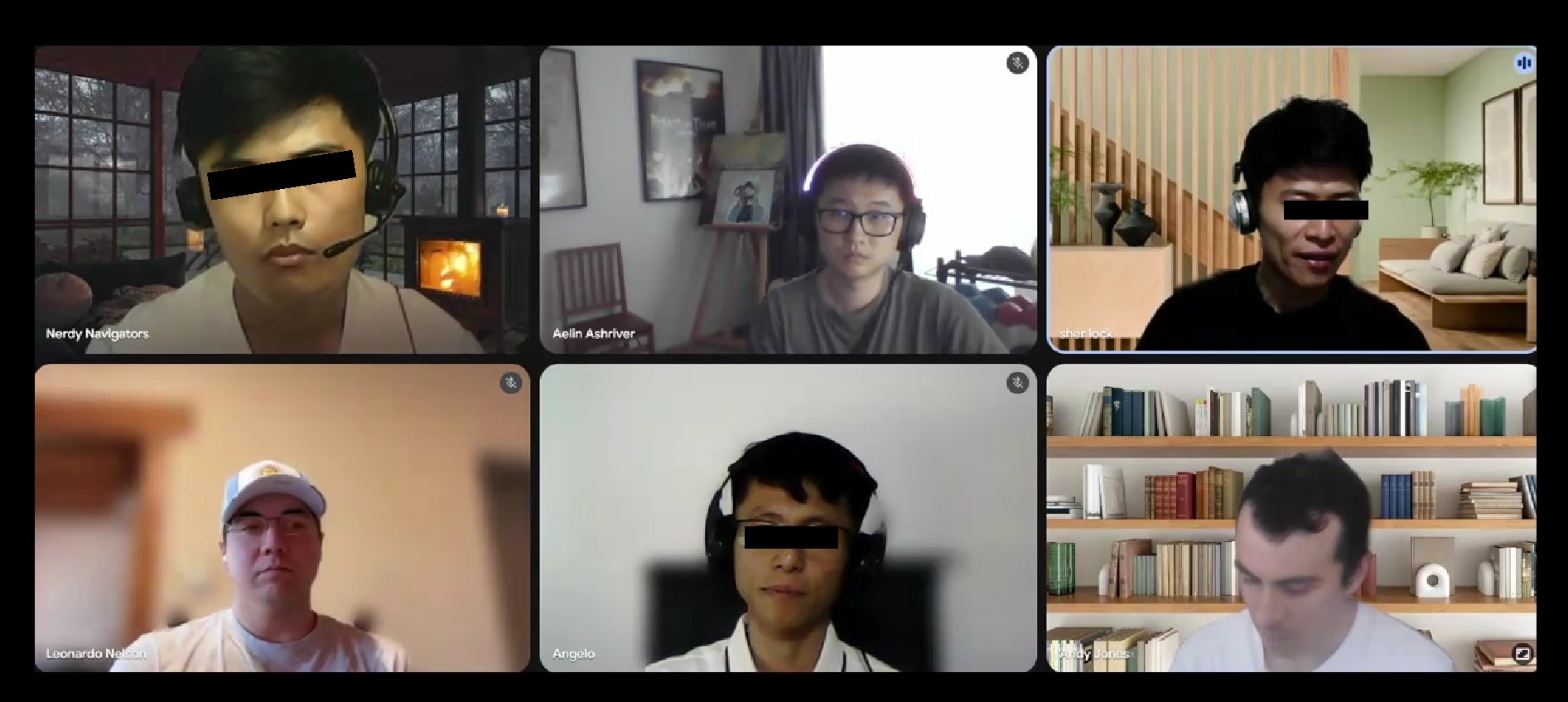
But in June, I found myself joining a Zoom call as “Aelin Ashriver,” an investor from the fictitious Definitive Communications, to meet the development team of crypto startup Ballena Azul.
The IT workers on the call believed they were pitching for VC backing for their startup. In reality they had spent weeks working inside a fake crypto company set up purely to study their methods and infrastructure by Mauro Eldritch, founder of cybersecurity firm BCA LTD, and Heiner García, a cyber threat intelligence analyst at Telefónica Tech and founder of NorthScan.
Cointelegraph tagged along for one stage of the investigation.
During the call, I played up the ruse by suggesting I might even be able to land Ballena Azul some coverage in Cointelegraph.
So at least someone was telling the truth.
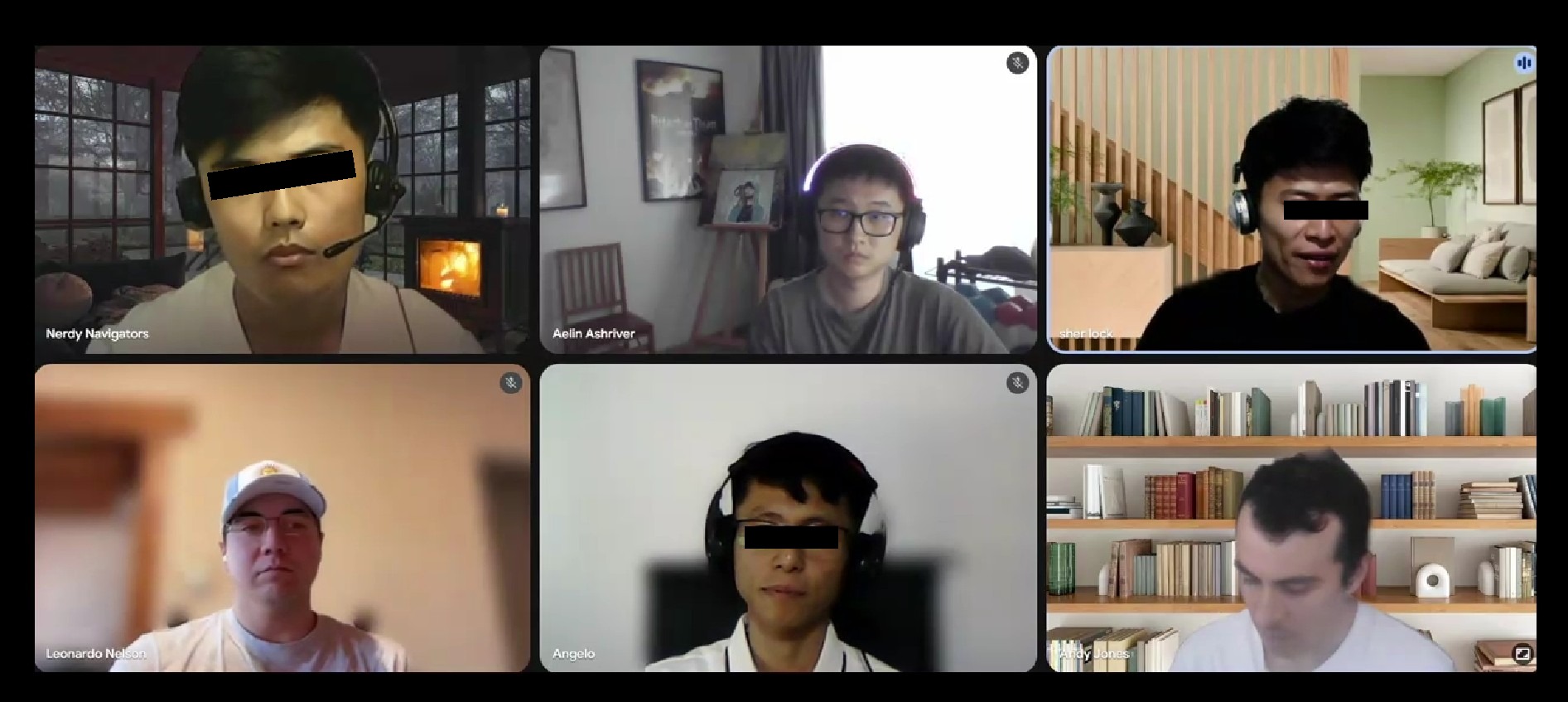
Suspected DPRK IT workers pitch for venture capital backing from the fictitious Definitive Communications, played by Cointelegraph. Source: ANY.RUN
Building a company for suspected North Korean IT workers
Eldritch and García built the fictitious Ballena Azul with infrastructure provided by cybersecurity platform ANY.RUN. An existing UK registration for an unrelated company of the same name, which was dissolved in 2022, added legitimacy to the project.
Eldritch assumed the identity of co-founder “Leonardo Nelson,” while García took on the alias “Andy Jones” and posed as the company’s team lead.
Related: North Korean cyber spies are no longer just remote threats
One of the most valuable pieces of intel that the five-week ruse exposed were the external servers the workers used as intermediary points before connecting to Ballena Azul’s controlled virtual desktops.
Exposed servers were particularly valuable because such infrastructure is often recycled across operations and can remain active for long periods.
García tells Magazine the servers were associated with malware families linked to North Korean campaigns that steal credentials, crypto wallet data and other sensitive information.
“Some of the servers we found were tied back to distributing InvisibleFerret and BeaverTail/OtterCookie in prior years and were active to this day,” he says.
But some others were totally new and had zero intelligence about them, looking clean and keeping outside of mainstream block lists or threat feeds.”
He adds that the infrastructure could serve multiple purposes, with servers previously used for malware distribution also acting as command-and-control infrastructure, and as proxies for operators carrying out their day-to-day work.
The suspected workers do not need to deploy malware to pose a threat, according to the researchers. Once hired, they can gain legitimate access to a company’s internal systems, source code and other sensitive information. The longer they remain undetected, the longer they can continue drawing salaries that researchers say ultimately help fund the North Korean regime.
The operation also showed the group relied on artificial intelligence tools to help compensate for gaps in their technical knowledge. They used ChatGPT for writing and coding, including to answer basic questions and complete assignments they struggled with themselves. They preferred Google Gemini for image alteration and document forgery.
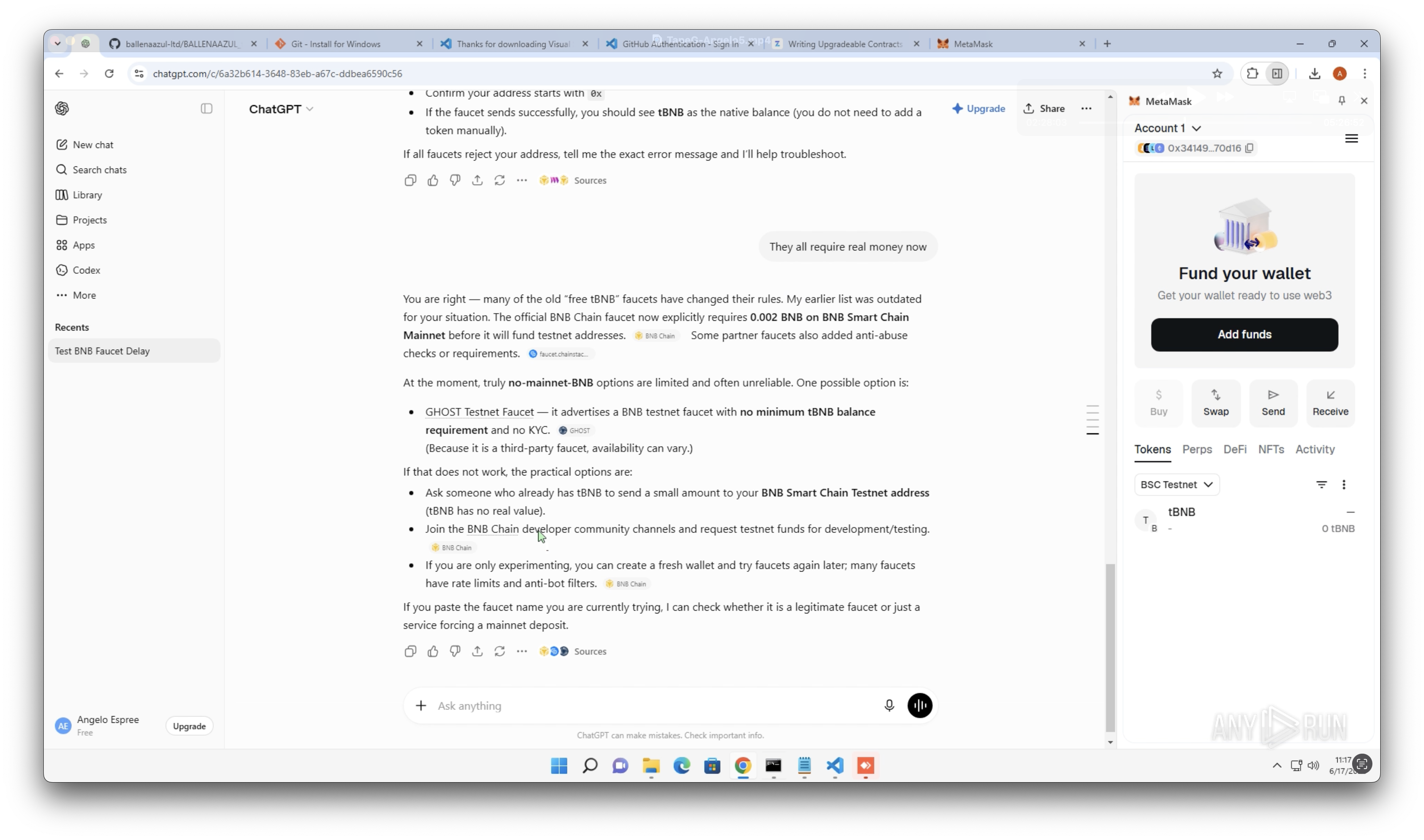
A suspected DPRK IT worker and ChatGPT team up in an attempt to obtain testnet crypto during the Ballena Azul operation. Source: ANY.RUN
Other tools employed included remote desktop software, crypto wallets and a service for sharing two-factor authentication codes.
North Korean IT workers have become a growing cybersecurity threat to the cryptocurrency industry. Consensys said in July that it had engaged a North Korea-linked developer through a third-party service provider before identifying the threat and cutting off access.
In another case, US prosecutors charged four North Korean nationals in 2025 with using false identities to obtain remote IT jobs and allegedly stealing more than $900,000 in cryptocurrency from two companies, including a US blockchain research and development firm.
The US Treasury said in March that North Korean IT worker schemes generated nearly $800 million in 2024 to help fund the Pyongyang regime’s weapons-of-mass-destruction programs.
Inside fake crypto company Ballena Azul
The ruse began when García connected with a recruiter via GitHub, who had been linked to Famous Chollima, a threat group associated with North Korean IT worker operations.
García said that Ballena Azul needed to hire software developers and the recruiter offered up “Jack Anderson,” “Angelo Espree” and “Lucas Theo.” At least two of them presented US identification.
The trio were given various programming assignments inside controlled virtual desktop environments, which allowed García and Eldritch to observe how they worked.
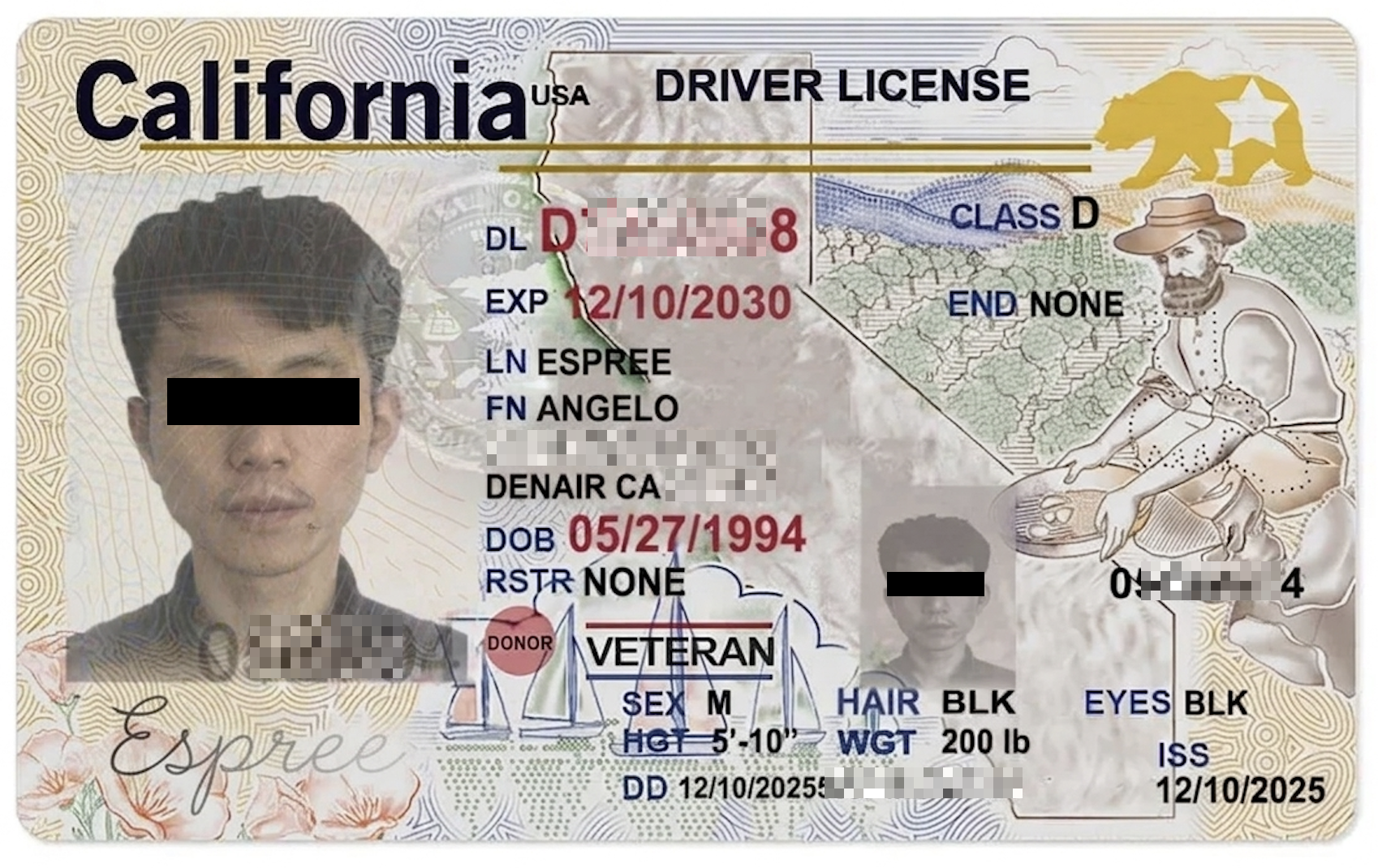
Angelo Espree was one of the developers onboarded through a recruiter associated with DPRK operations. Source: ANY.RUN
The researchers also deliberately introduced technical problems, including selective network outages and disappearing mouse cursors, to see how the suspected workers reacted and which tools they turned to when things went wrong.
“Honestly, the biggest surprise was how much of it ran on improvisation,” García says. “There was no rigid playbook, no polished corporate process behind them.”
During their many weeks working inside the controlled environments, the suspected North Koreans left behind a treasure trove for the researchers, including chat logs, AI conversations, crypto wallet information, VPN exit nodes and hours of live video footage. Their connections also exposed the servers that became one of the investigation’s most valuable findings.
To be sure, the heavy AI reliance isn’t unique to the workers hoodwinked in Ballena Azul’s operation.
Ballena Azul workers generally used AI as a crutch for coding and technical tasks they struggled with. Reuters reported Monday that another North Korean hacking group, Kimsuky, was using AI for a more offensive purpose. The group was reportedly running AI tools locally to help automate cyberattacks, analyze stolen data and produce more convincing phishing campaigns.
Evolving playbook of remote DPRK IT workers
This was not the first time Cointelegraph has played a minor role in exposing suspected North Korean workers.
In February 2025, García and Cointelegraph conducted a job interview for a suspected operative calling himself “Motoki.” The developer claimed to be Japanese but ragequit the interview after being asked to introduce himself in his mother tongue.
Still, García kept communicating with him. Motoki eventually offered to send García money to buy a computer that he could access remotely, allowing him to work through a local machine instead of connecting through a VPN to bypass restrictions used by employers and freelance platforms.
Related: From Sony to Bybit: How Lazarus Group became crypto’s supervillain
García later documented suspected North Korean operatives recruiting freelancers to provide verified accounts, identities and remote access to their computers. In one version of the scheme, operatives could work through machines physically located in the US, making them appear to employers and freelance platforms as US-based contractors.
In May, two US “laptop farmers” — people who hosted a cluster of computers that North Koreans could remotely access — were sentenced to 18 months in prison for helping DPRK IT workers pose as US-based employees in schemes that generated more than $1.2 million and affected nearly 70 companies.
Taking Ballena Azul down
All fake things must come to an end, so the researchers introduced “Benito Camella,” Ballena Azul’s co-founder, who had supposedly been focused on other business in Milan while the company expanded.
When he returned, Camella confronted the workers over discrepancies in their identities and documents. The confrontation quickly began to clear the chat room. Espree left the video call first, while Anderson stayed longer before realizing the scheme was unraveling.
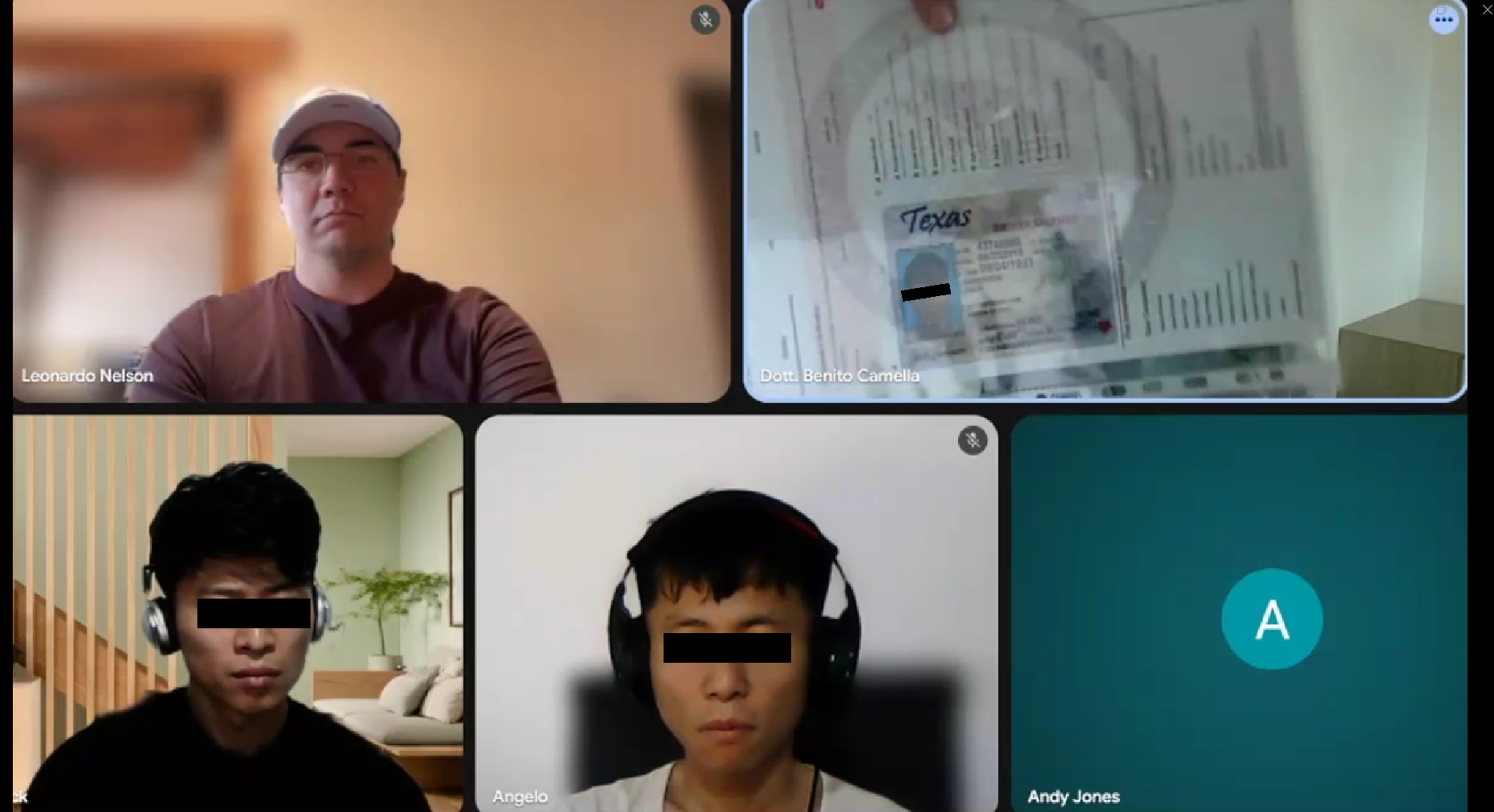
“Are you living two lives, Mr. Anderson?” Camella asks Jack Anderson during the confrontation. Source: ANY.RUN
But the researchers kept the deception going even after the meeting ended. In the company’s Telegram channel, the “CEO” accused “Andy Jones” of bringing in “illegal workers” and putting the company at risk. “Jones” responded that he had been under pressure to build a team quickly and was not being paid enough to do it. He maintained that he had done the best he could with what he had.
The staged argument ended with the fake CEO terminating both their working relationship and friendship, keeping up the appearance that Ballena Azul had collapsed because of a disastrous hiring decision.
One of the suspected North Koreans later contacted García privately to apologize for what had happened and ask whether he was all right.
According to the researchers, they never heard from the rest of the group again.
To this day, they say, the suspected workers do not know they wasted weeks working inside an environment built to extract intelligence from them.
Magazine: Do the Coldcard attacks mean all hardware wallets are now insecure?
Editor’s note: Cointelegraph could not independently confirm the nationality or affiliation of the suspected DPRK IT workers, and no government agency has publicly identified them.
Cointelegraph publishes long-form journalism, analysis and narrative reporting produced by Cointelegraph’s in-house editorial team with subject-matter expertise. All articles are edited and reviewed by Cointelegraph editors in line with our editorial standards. Some articles contain affiliate links, from which Cointelegraph may earn a commission. These relationships do not influence which products we review or our editorial conclusions. Content published in here does not constitute financial, legal or investment advice. Readers should conduct their own research and consult qualified professionals where appropriate. Cointelegraph maintains full editorial independence.
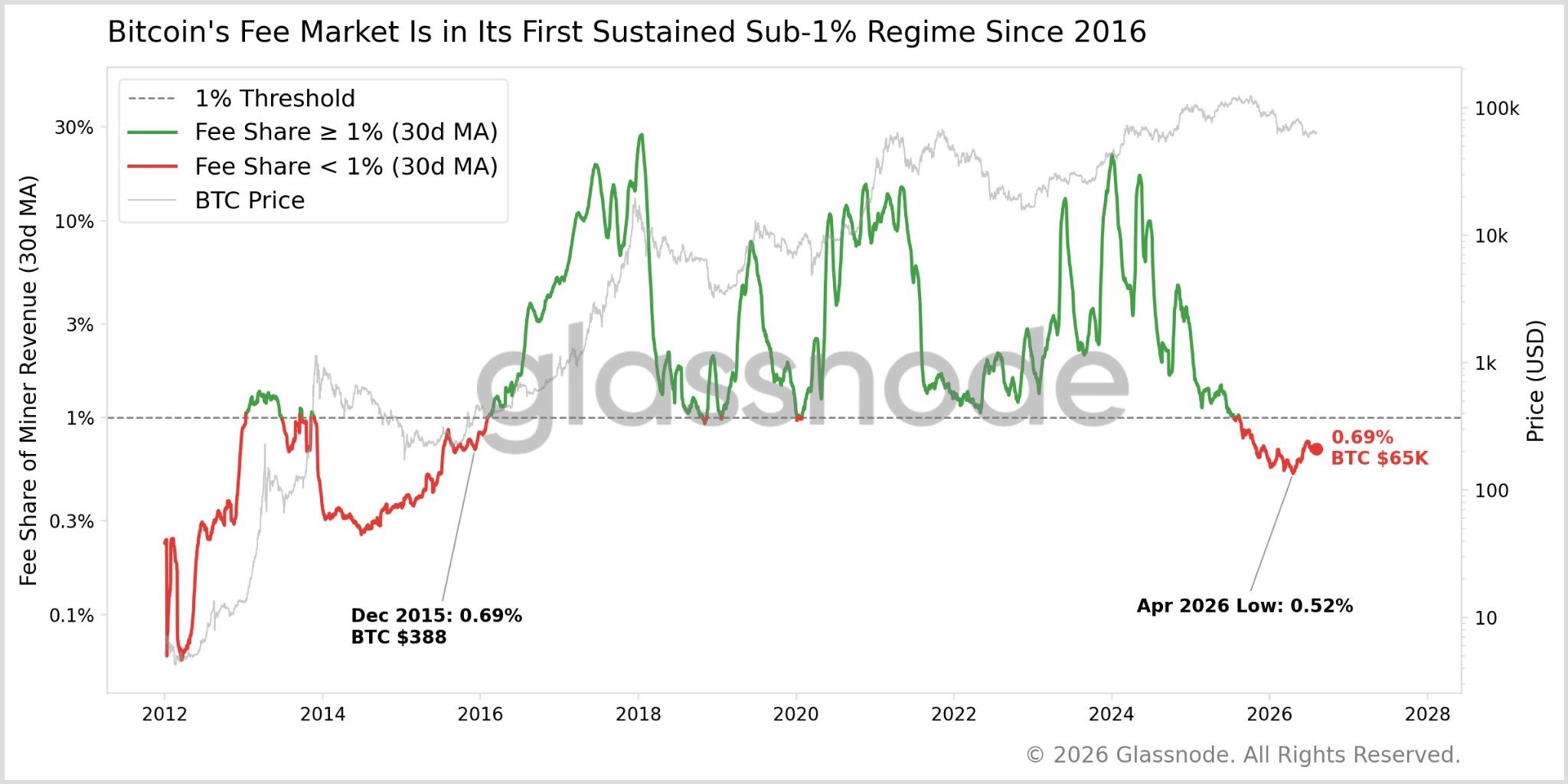
Bitcoin (BTC) transaction fees now account for just 0.69% of miner revenue as major players pivot to AI.
Key points:
- Bitcoin miners now rely on block subsidies more than at any time in the past decade, data shows.
- Bitcoin hash rate has declined by 33% since October 2025.
- Analysts warn that miners switching to AI could affect the network.
Bitcoin miner fee revenue share returns to 2016 levels
Data from onchain analytics platform Glassnode shows that fees as a proportion of miner revenue remain near decade lows after falling to just 0.52% in April.
Miners face ongoing pressure as declining Bitcoin prices and rising electricity costs squeeze profits and force smaller players out of the market. Glassnode co-founder Rafael Schultze-Kraft noted that fees had made up less than 1% of miner revenue for almost a year.
“Bitcoin was below $400 the last time fee share was this low,” he said on X.
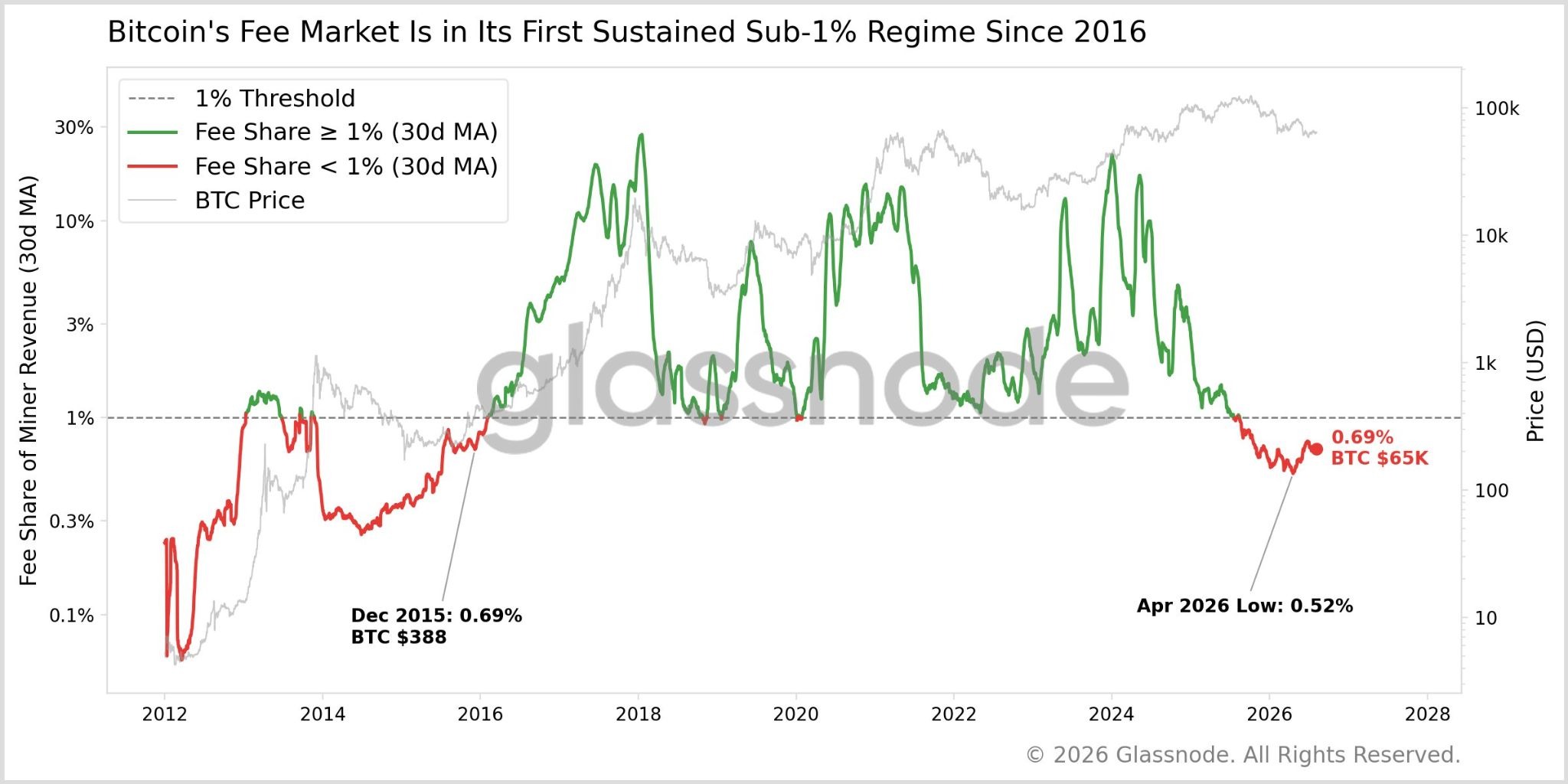
Bitcoin fees as a portion of miner revenue. Source: Rafael Schultze-Kraft on X.com
When transaction fee revenue drops, miners increasingly depend on the fixed block subsidy for income — the amount of newly minted BTC awarded for each mined block, currently 3.125 BTC. Bitcoin’s value has fallen nearly 50% since its October 2025 all-time high, dragging down the US dollar value of the block subsidy and further squeezing miners’ profit margins.
The latest data from onchain analytics resource Checkonchain puts the estimated average cost of producing one Bitcoin at $78,254 as of Tuesday — almost 23% above the current spot price.
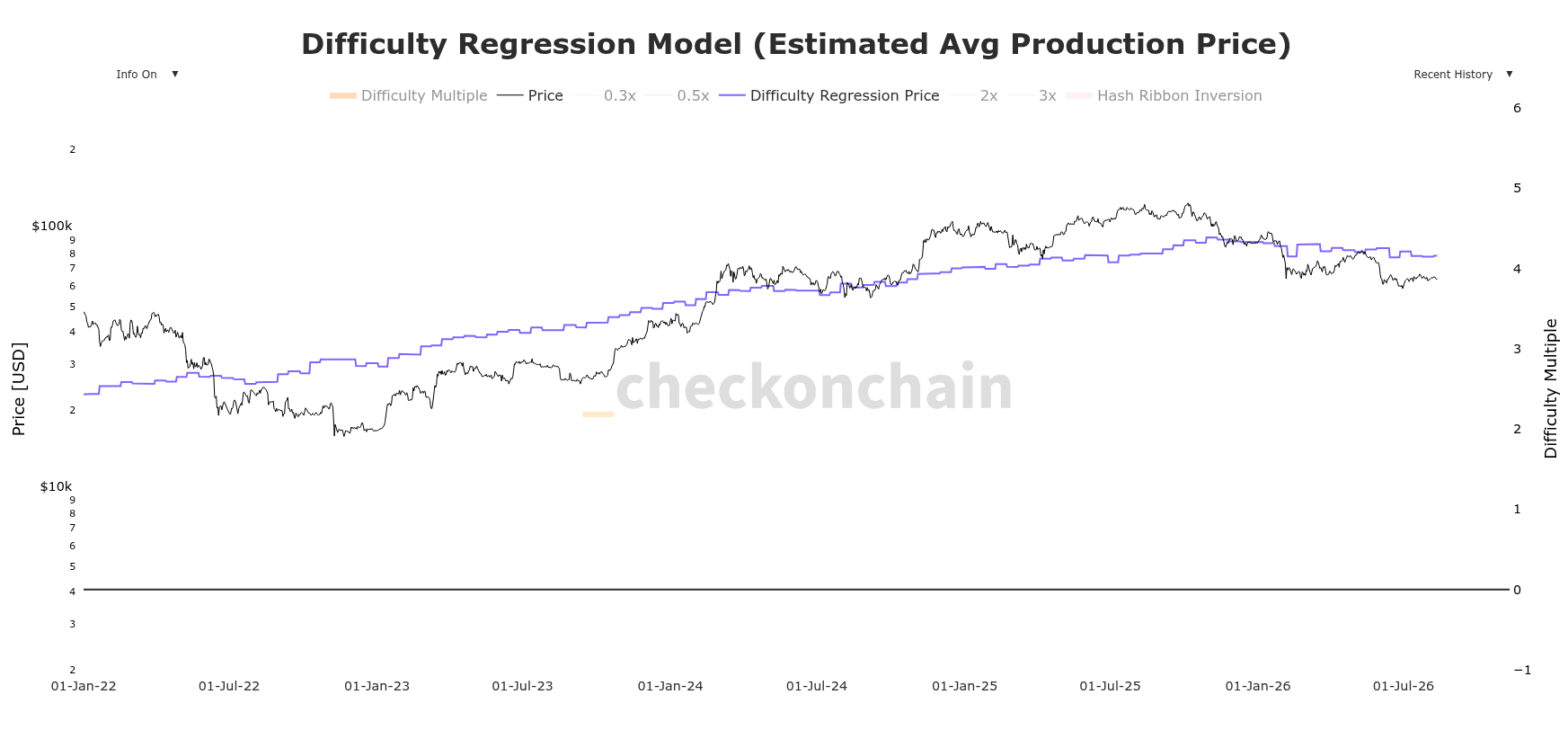
Bitcoin estimated average production cost. Source: Checkonchain
Bitcoin’s network hash rate, an estimated measure of the computing power securing the network, reflects a mining sector in flux. Hash rate has declined from its October 2025 peak of 1.3 zettahashes per second (ZH/s) to 861 exahashes per second (EH/s), Checkonchain shows — a drop of 33%.
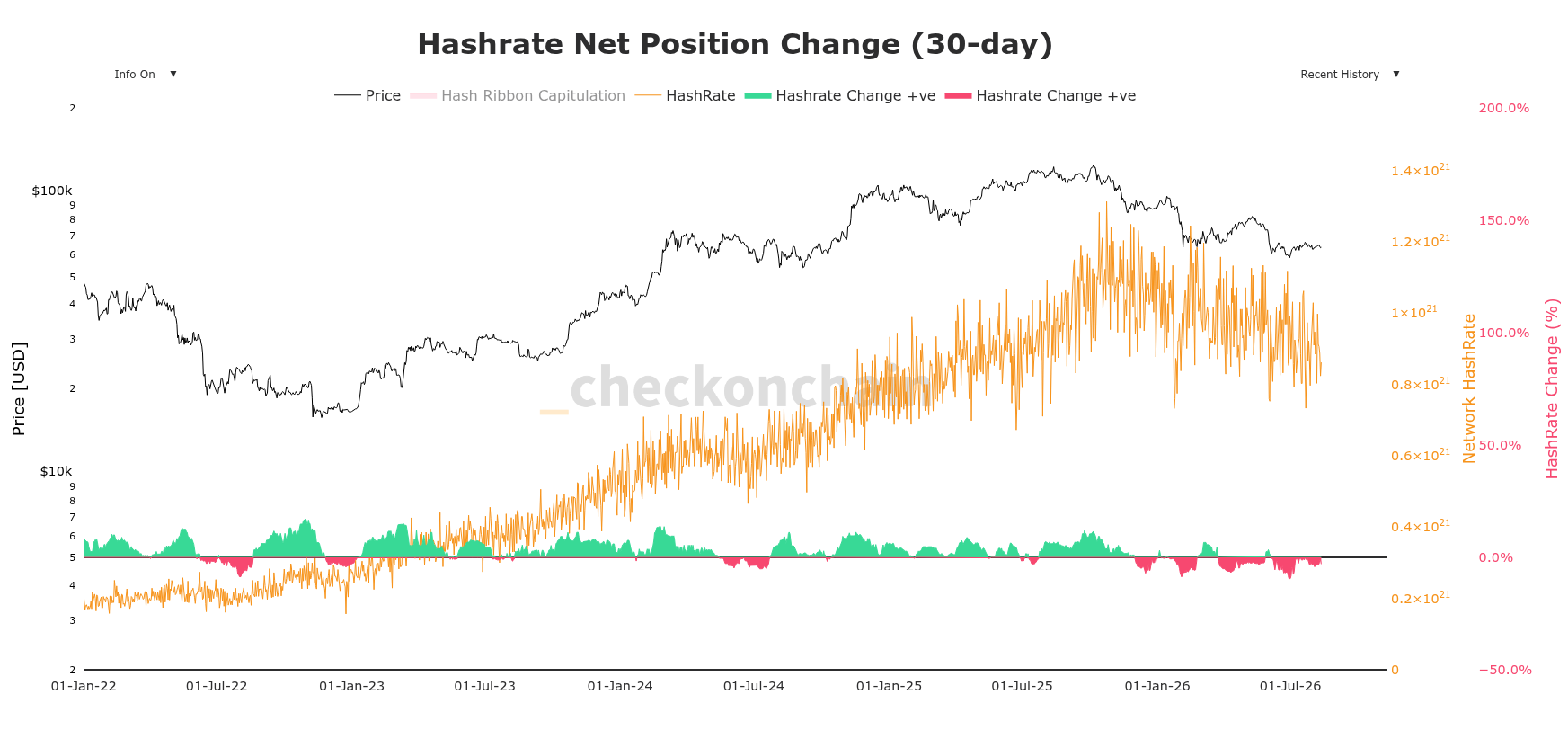
Bitcoin hash rate net position change. Source: Checkonchain
Analyst: AI pivot is “concerning development”
In analysis published at the weekend, independent analyst William Clemente acknowledged the downturn, while noting that miners would have been incentivized to boost activity through automated difficulty readjustments. With difficulty itself now rising again, miners’ shift toward more lucrative AI computing has become conspicuous.
Related: Bitcoin sell pressure ‘closer to exhaustion’ after $4B USDT market-cap drop: CryptoQuant
“There is no other way to slice it, hash rate has been in a decline. This has taken place as miner margins got squeezed post 2022 from more competition are higher energy prices, but more importantly the pivot of many into AI/HPC, which so far have shown to be prudent business decisions for the public names that have done it,” he wrote.
As Cointelegraph reported, Bitcoin miner CleanSpark recently refocused on AI, switching to operating data centers after missing profit targets. Another miner, Keel Infrastructure, shut down all its US mining operations after revenue fell 50% in the second quarter.
“This dynamic has been reinforced as Bitcoin has underperformed AI related assets & the rate of change in demand for compute,” Clemente added.
Charles Edwards, founder of hedge fund and AI platform Capriole Investments, directly linked the drop in hash rate to public miners’ AI pivot.
“This is the least talked about, concerning Bitcoin development in 2026,” he argued on X, noting that the trend had accelerated since April.

The primary cryptocurrency surged past $65K over the weekend, causing some popular analysts to call the end of the bear market and the beginning of a potential upward trend. However, the revival was short-lived, with BTC briefly plunging to as low as $63,250.
Now all eyes are set on the CPI report, which could trigger a renewed revival but may also cause a substantial pullback.
Pump or Dump on the Horizon?
Later today (August 12), the US Bureau of Labor Statistics is about to release the Consumer Price Index data, which shows the inflation rate in the country and provides a vital outlook for the overall condition of the local economy. According to the odds on Kalshi, most traders believe that July’s CPI will come in above 3.3% on a year-over-year basis, while 15% see a chance of hotter inflation at 3.4%.
The report is a key input for the Federal Reserve, which takes the figure into major consideration when shaping its interest rate policy. As such, it is expected to cause volatility in the crypto and financial sectors.
X user Ted noticed that BTC jumped over 10% in a week following June’s CPI and 7.5% after July’s report, when inflation came in lower than expected. Yesterday (August 11). Michael van de Poppe shared his post saying:
“If CPI data comes in greatly tomorrow: BTC goes up. Just simple. As you can see in this chart, the days prior to the release of the CPI data, the markets are going down.”
The analyst who goes by Gerla on X also chipped in, providing a more cautious opinion. They noted that each CPI report from August 2025 until now has been a precursor to heightened volatility, and on several occasions it has been followed by a double-digit price decline for the cryptocurrency.
The Latest Predictions
While the CPI data would likely spark short-term turbulence, what’s perhaps more interesting is how analysts see the longer-term outlook unfolding.
Ali Martinez, who recently spotted several factors that have identified previous bear markets, chipped in again. He believes the downward cycle is in its final stages, predicting one last drop below $57,500 followed by a massive rally to as high as $180,000 sometime next year.
X users Ted and Max Crypto also touched upon the matter. The former opined that BTC has a decent chance of pumping as long as it stays above the crucial $63,000 level, while the latter claimed the asset has broken out of its 10-month downtrend and could be gearing up for an upswing.
For their part, Poseidon envisioned a push above $70,000 in August and then a renewed correction below $60,000 in late September.
The post Bitcoin’s (BTC) Chance for Recovery Hinges on This Major Economic Event appeared first on CryptoPotato.


Binance and RedotPay are disputing whether a Singapore case related to their nearly $473 million Hong Kong legal battle is coming to an end.
The stablecoin payments card issuer told Cointelegraph on Tuesday that it expects Binance to discontinue the Singapore proceedings following a hearing on Aug. 7. “RedotPay will be seeking legal costs arising from the discontinuance of the matter from the claimant,” a spokesperson for RedotPay said, adding that the parties would try to agree on costs.
However, Binance said it has no plans to abandon its claims. “Reports that Binance will be withdrawing its Singapore claims are false,” a Binance spokesperson told Cointelegraph, adding that the company “is not abandoning its claims and has informed both the court and RedotPay accordingly.”
The disagreement marks the latest development in a broader legal fight between Binance-affiliated companies and RedotPay, which includes a separate Hong Kong case seeking nearly $473 million in damages.
Singapore case part of broader legal fight
Binance-linked legal action against RedotPay first made headlines on Aug. 5, when Bloomberg reported that Nest Trading, DistributedTechnologies and Chaintecs Consulting Singapore had filed a petition in Hong Kong against RedotPay’s co-founders.
The Hong Kong plaintiffs allege RedotPay diverted more than 470,000 Binance Card users by allowing Binance Pay funds to be used for stablecoin card top-ups outside the terms of a commercial agreement. They estimated damages at $472.8 million, based on a claimed lifetime customer value of $925 per user.
Chaintecs also brought related proceedings against RedotPay affiliates in Singapore, where a hearing was scheduled for Aug. 7.
RedotPay rejected what it called “unfounded allegations” against the company and its co-founders at the time, telling Cointelegraph it would defend the claims through the legal process.
RedotPay announced its Binance Pay partnership in December 2023, allowing Binance Pay users to make direct deposits to RedotPay cards. Binance ended support for the integration as of April 3, 2026, citing a review of its merchant partners, months before the legal dispute became public.
Magazine: Fierce backlash to Ethereum’s EIP-8363 staking proposal
Crypto World
Dow Jones Futures Rise With CPI Inflation Due; AI Stocks Rally As 3 Nvidia Partners Lead Earnings Movers
Dow Jones futures climbed slightly early Wednesday, while S&P 500 futures and Nasdaq futures rose modestly, with the July CPI inflation report due before the open. Nvidia partners Lumentum, Super Micro Computer and CoreWeave were big earnings overnight, lifting AI hardware and buildout names. The stock market continued to pause Tuesdayas oil prices rose again as Strait of Hormuz deal…
Copyright ©2026 Investor’s Business Daily, LLC. All rights reserved. 87990cbe856818d5eddac44c7b1cdeb8
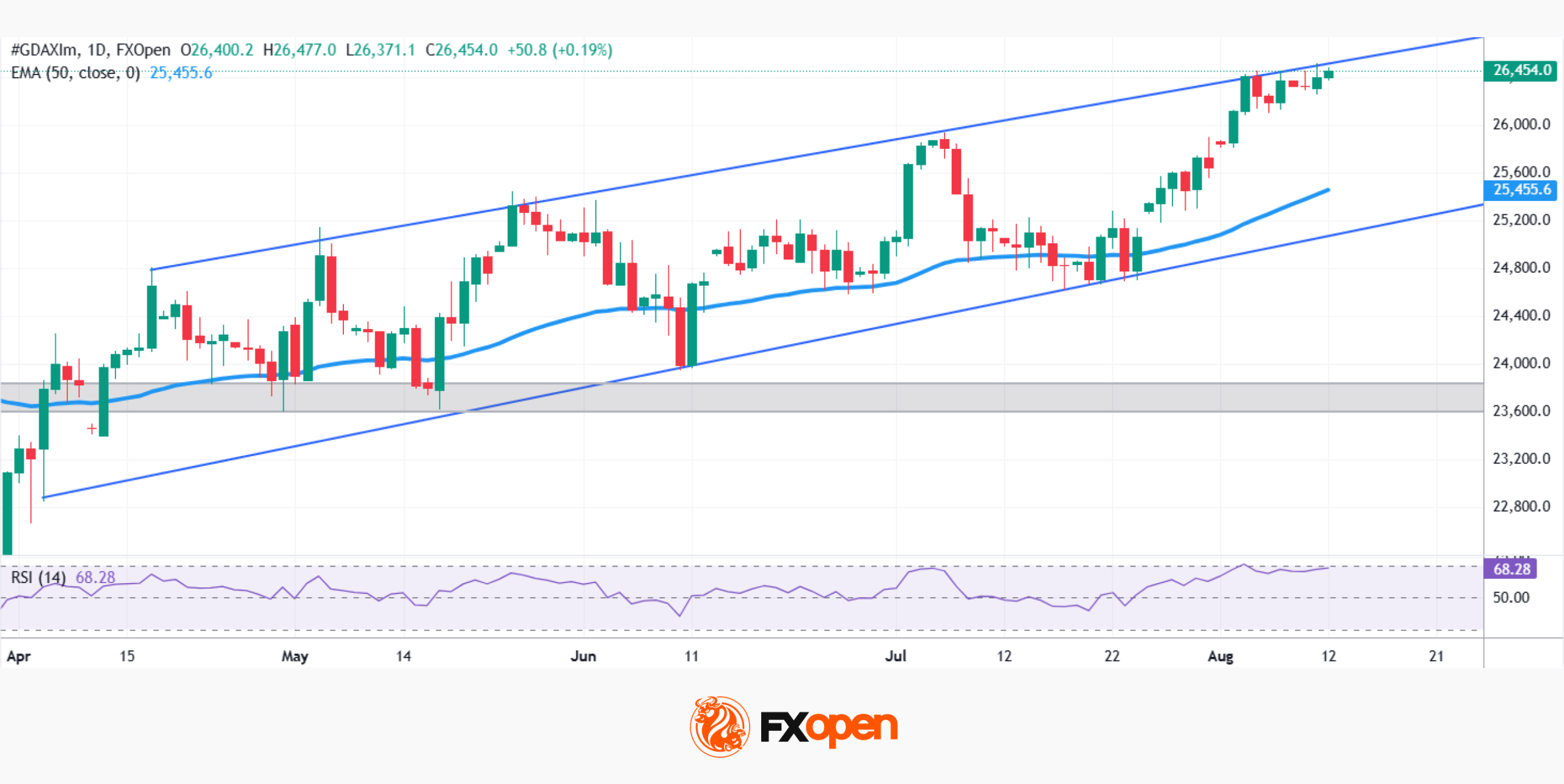
Germany’s benchmark index just made history, breaking above 26,500 for the first time ever, extending a rally that has already delivered close to 10% over the past twelve months. The move came on fresh optimism around a potential resolution to the Iran conflict, though that optimism proved short-lived: President Trump’s latest demands, that Tehran compensate for lives lost in recent attacks, have since added friction to already fragile diplomatic efforts around reopening the Strait of Hormuz, and the index has pulled back modestly from its peak.
Beneath the geopolitical noise, the underlying story remains genuinely constructive. Stronger-than-expected industrial production and export data have reinforced confidence in German manufacturing, while a wave of solid corporate earnings, alongside notable strength from SAP and Infineon, has kept sentiment firmly bullish. Roughly a third of this year’s growth still owes to calendar effects and government stimulus in defence and infrastructure, a detail worth remembering, but private-sector momentum finally looks like it’s stabilizing rather than collapsing.
The result: a record-breaking index now testing whether Middle East headlines can derail a rally built on genuinely improving fundamentals.
Technical Analysis of the DAX 40 (GDAXIm on FXOpen)
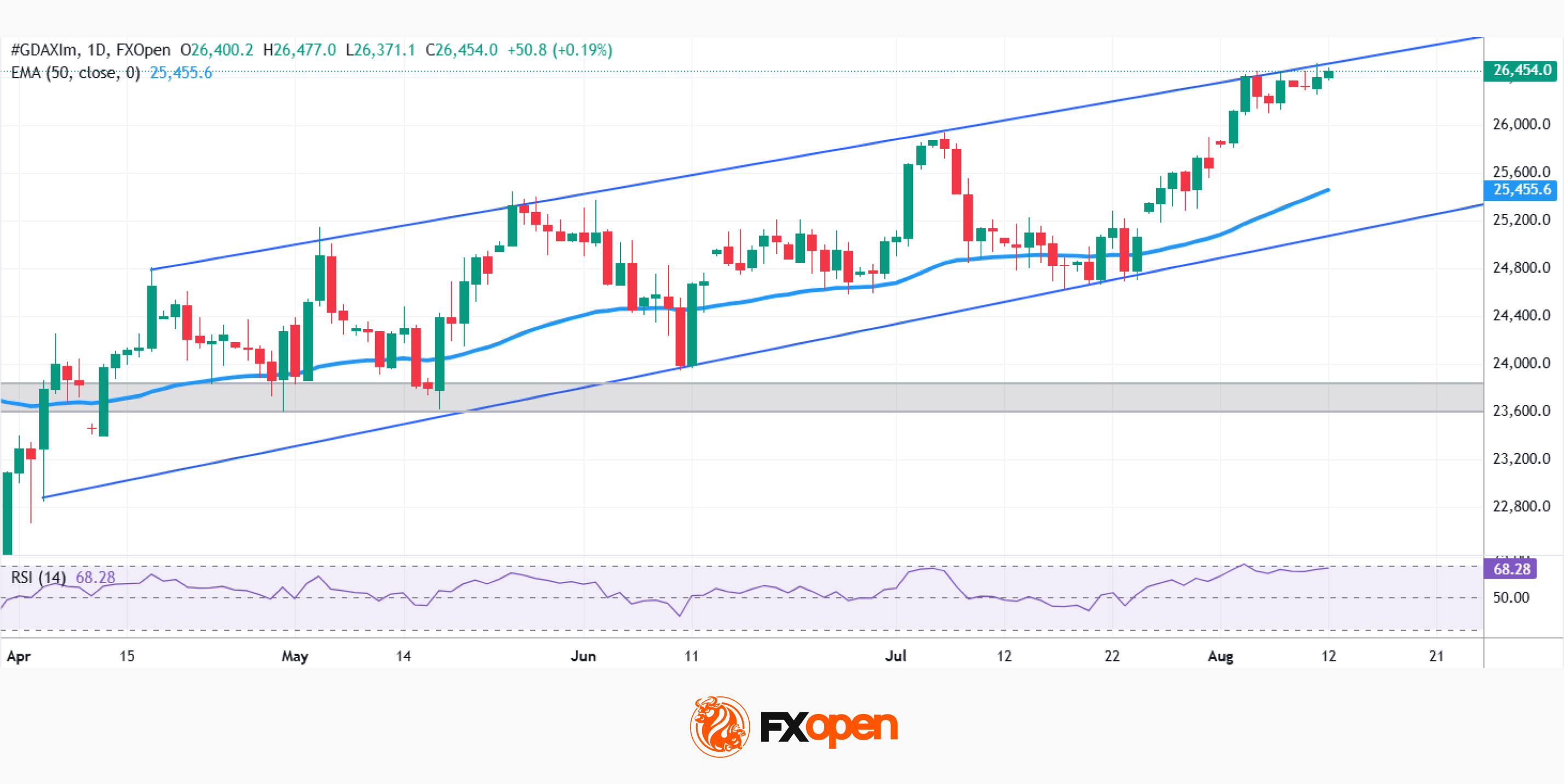
As the daily DAX 40 (GDAXIm on FXOpen) chart shows, the index remains firmly within a well-defined ascending channel that has guided price higher since April, with the index now testing the channel’s upper boundary near current record highs. The 50-period EMA continues to trend higher well below price, reinforcing the strength of the broader uptrend, while the RSI sits at 67.83, comfortably bullish without yet flashing overbought extremes.
Bullish Scenario
Should buyers maintain momentum and break above the upper channel trendline, the index would confirm a genuine acceleration of the current trend, opening the door toward fresh uncharted territory beyond 26,800, with the EMA and lower channel boundary offering strong support on any pullback.
Bearish Scenario
Conversely, a rejection at the upper trendline could see price pull back toward the 50-period EMA near 25,450, or even the lower channel boundary, without necessarily threatening the broader bullish structure. Only a decisive break below the channel itself, and the 23,600-23,800 support zone that anchored April’s advance, would put the medium-term uptrend genuinely at risk.
With price testing the top of a channel that has held for nearly five months, the DAX 40 (GDAXIm on FXOpen) faces a familiar question: does the trend simply extend once again, or is this finally where momentum starts to fade?
Trade global index CFDs with zero commission and tight spreads (additional fees may apply). Open your FXOpen account now or learn more about trading index CFDs with FXOpen.
This article represents the opinion of the Companies operating under the FXOpen brand only. It is not to be construed as an offer, solicitation, or recommendation with respect to products and services provided by the Companies operating under the FXOpen brand, nor is it to be considered financial advice.
Crypto World
Bitcoin (BTC) price steady as U.S. inflation data looms, Harmony exploit rattles altcoins
Crypto markets were steady on Wednesday as traders absorbed a protocol exploit while waiting for a U.S. inflation report that often sets the tone for risk assets.
Harmony, a layer-1 blockchain network for DeFi protocols and marketplaces. confirmed it had been hit by an exploit early in the Asian day. An attacker minted some 4 billion ONE tokens through empty blocks, representing about 26% of the token’s circulating supply.
Around 2.8 billion of the tokens were quickly funneled to exchanges, pushing ONE down as much as 40% to a record low.
Broader markets were also little changed before the July U.S. CPI print, due at 12:30 UTC. Brent crude is near $90 a barrel after more Houthi attacks on shipping in the Bab el-Mandeb Strait and a U.S. strike on a vessel in the Gulf of Oman renewed supply concerns overnight.
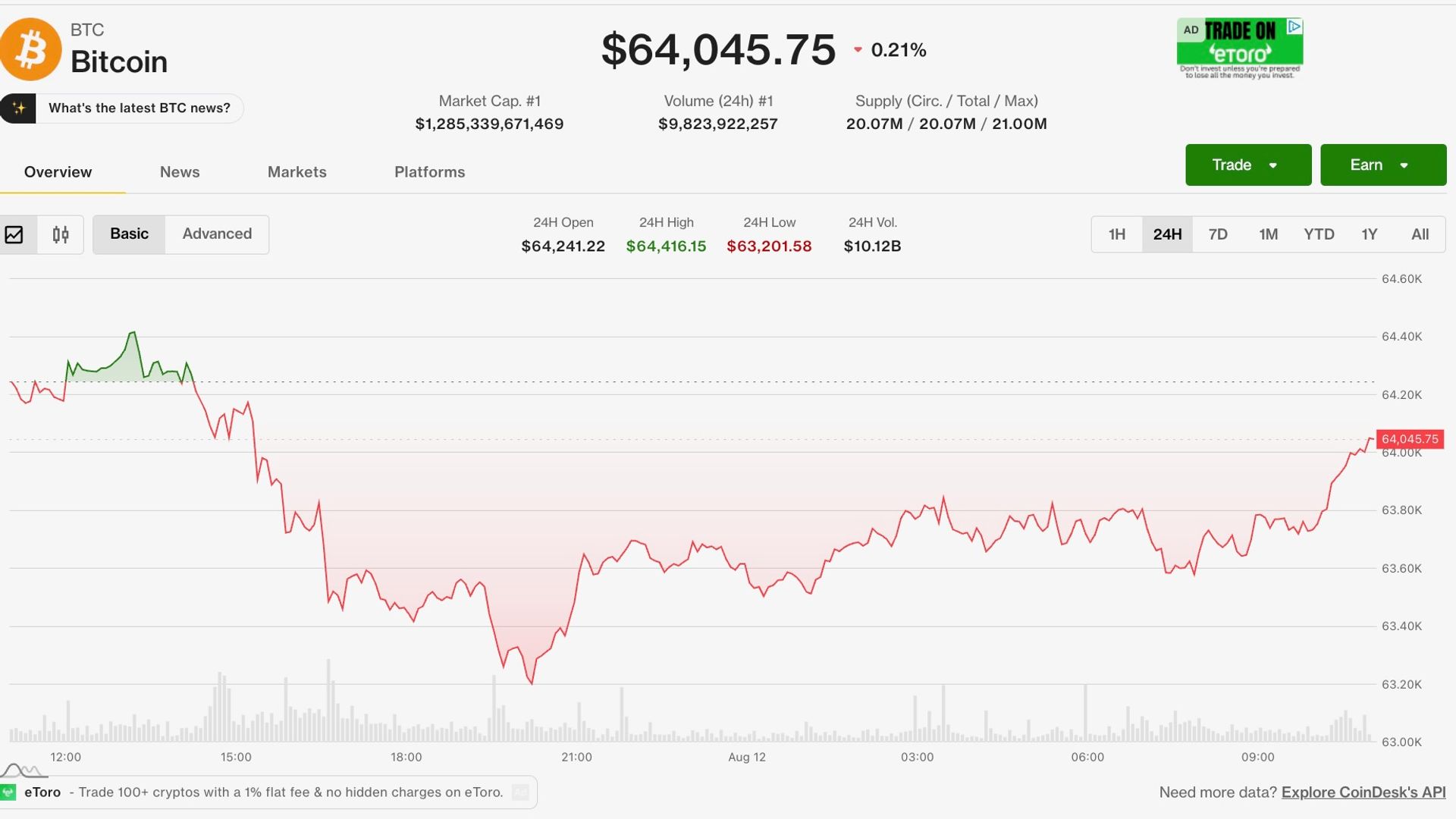
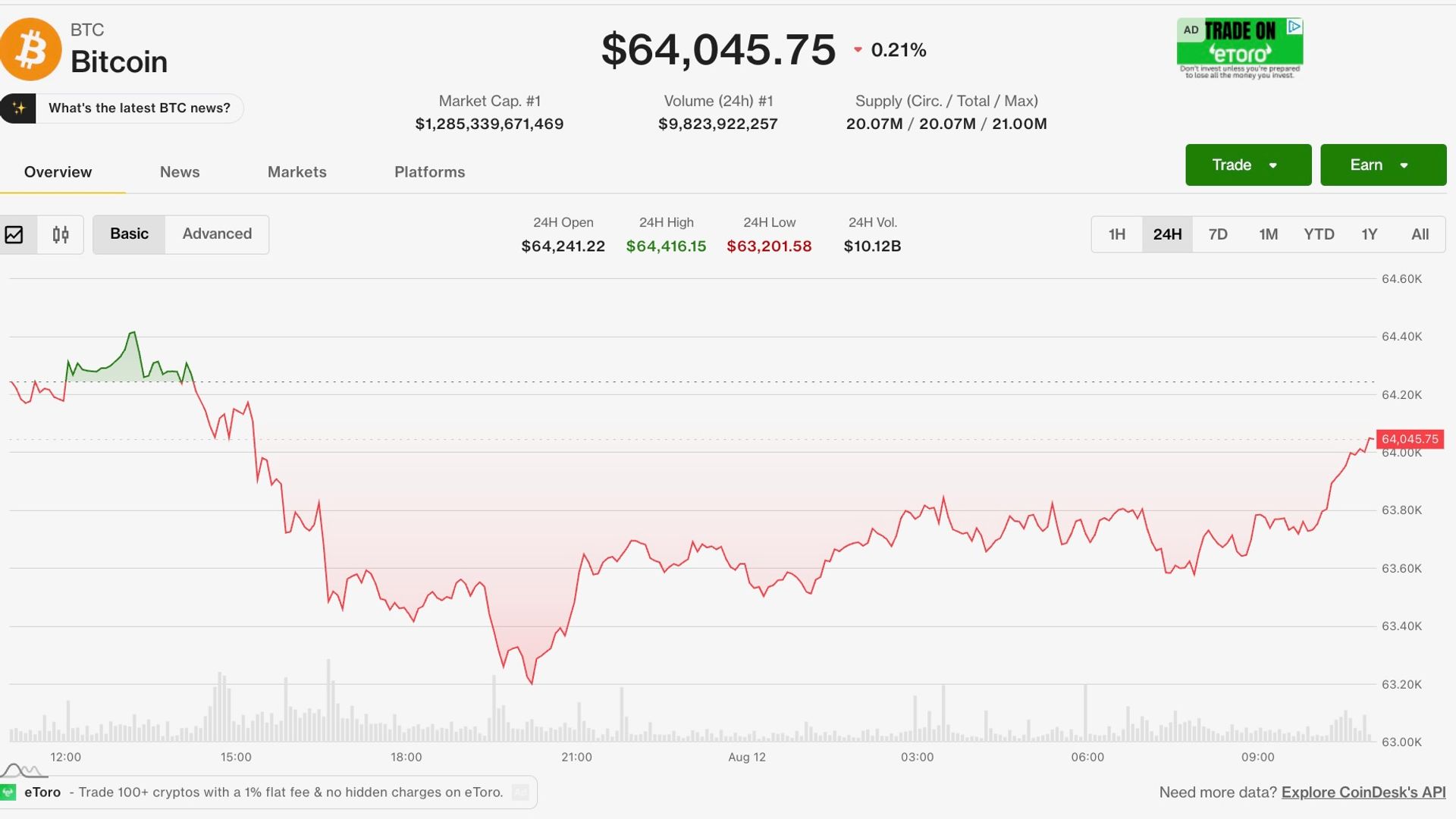
Bitcoin absorbed all of this quietly, adding 0.23% since midnight UTC to around $63,900. The Fear and Greed index is at 38.
Derivatives positioning
- Futures market stasis masks a bearish shift in taker sentiment: While the aggregate crypto futures market appears to be in stasis, with negligible changes in total volume and open interest, underlying positioning is shifting. The long-short ratio for takers, or those executing market orders that remove liquidity from the book, has flipped bearish, with shorts now accounting for 51.36% of activity. This is a 180-degree reversal from the bullish bias observed earlier in the week.
- Avalanche shows signs of aggressive shorting as open interest climbs: The AVAX token has emerged as one of the largest laggards among the top 100 coins over the past 24 hours, even as open interest (OI) grew 6%. A combination of falling prices and rising OI validates the current weakness in the spot price. Confirming this trend is the 24-hour cumulative volume delta (CVD), which is the most negative among major assets, suggesting that bears are aggressively shorting via market orders rather than utilizing passive limit orders.
- Dogecoin leverage builds toward a potential volatility breakout: Open interest in DOGE futures continues to climb, surpassing 17.2 billion tokens, the most since October. This significant growth from the June low of 12 billion tokens occurred while the price remained pinned near the 7-cent mark. The buildup of leverage amid sideways price action suggests that the market may be coiled for a significant volatility event in the near term.
- Major assets see light positioning: Market participation in the two largest cryptocurrencies remains subdued, with bitcoin’s open interest hovering below 750,000 BTC. This lack of momentum has persisted for several weeks, and a similar trend is visible in ether , indicating that institutional and retail traders alike are currently sidelined in the majors.
- Selling pressure dominates the altcoin market according to CVD trends: Most of the 25 largest cryptocurrencies are exhibiting negative 24-hour cumulative volume deltas. This widespread selling pressure indicates a general bearish tilt across the sector, with Chainlink , Cronos , and Tron being the only notable exceptions.
- Implied volatility remains depressed ahead of key U.S. inflation data: Bitcoin’s 30-day implied volatility index, BVIV, is back under pressure, receding to 37.5% from Monday’s high of 38.66%. Short-dated one-week implied volatilities also remain at low levels, signaling that options traders are not anticipating significant changes following the U.S. CPI release. This suggests the market may be underpricing the actual event risk.
- Options traders eye the $70,000 level while hedging for volatility: In the Deribit bitcoin options market, the $70,000 call remains the most actively traded contract for the second consecutive day. Simultaneously, there is a growing preference for BTC strangles, a strategy involving the simultaneous purchase of puts and calls, indicating that some participants are positioning to profit from a sharp move in either direction.
Token talk
- CRV is the week’s standout performer, up roughly 35% over seven days and trading around 28 cents. The move coincides with a 15% annual emissions reduction that is set to trigger imminently. It has risen by more than 3% since midnight UTC.
- Uniswap (UNI) has tumbled by more than 10% over the past 24 hours with no clear catalyst for the slide, suggesting the altcoin market remains vulnerable to price swings due to limited liquidity and market depth.
- Monero (XMR) is up by 5.8% since midnight and has now retraced Tuesday’s entire shift to the downside.
- AI tokens NEAR, FET and TAO are all also in the black, up by between 1.3% and 2.3% respectively as AI-themed optimism slowly returns to the market after months of waning sentiment.
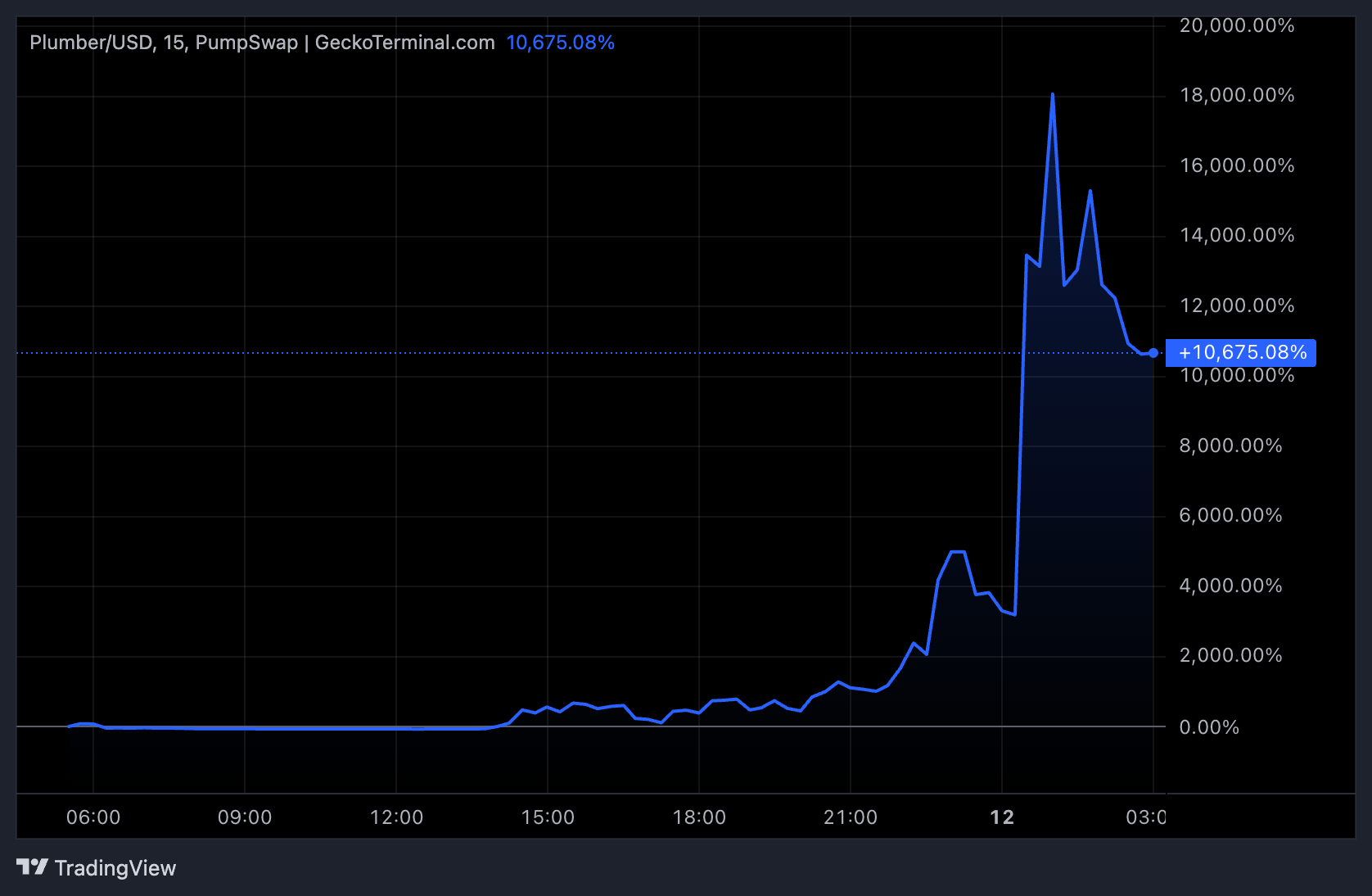
A meme coin called PLUMBER has surged more than 10,000% since its launch, riding a viral Crypto Twitter argument over whether early crypto traders once beat weaker rivals.
The token’s market capitalization climbed from below $1 million to above $5 million on its first day, then pulled back and held in the multimillion-dollar range.

What is PLUMBER Meme Coin?
According to analyst Stitch, it all began with a simple post. Trader Frank DeGods claimed crypto veterans were trading against weaker retail players he called “plumbers.”
Follow us on X to get the latest news as it happens
Commentator Threadguy pushed the point further. He suggested that legendary traders from 2017 to 2019 simply faced softer competition.
Trader Ansem pushed back. He argued those years were brutal, full of scams, leverage wipeouts, and tokens that later collapsed to near zero. The exchange hardened into a running theme on Crypto Twitter, framed as “oldheads versus plumbers.”
A developer then created the PLUMBER meme coin. Moonshot also verified it earlier today.
“Then someone did what CT always does: tokenize the attention. PLUMBER didn’t create this meme. The dev simply saw the ‘oldheads vs plumbers’ debate heating up and deployed a token right in the middle of it,” Stitch said.
Attention Is Doing the Heavy Lifting
Trading volume has surged to $14.2 million as the meme spread across group chats and timelines. Well-known accounts amplified it. Cobie posted plumber memes, and traders, including traderpow and ResellCalendar, bought into the token.
That created a familiar feedback loop. Social attention drew key opinion leaders (KOLs), capital followed, volume rose, and fresh visibility pulled in more buyers. The chart tracked the frenzy.
Yet, the token carries risks. Similar attention-driven rallies tend to fade. Cash Cat (CASHCAT) jumped roughly 4,000% in a week during July before the rally lost momentum.
Coinbase Man (BRIAN) jumped from under $1 million to $37 million after CEO Brian Armstrong changed his profile picture. The token crashed roughly 90% once he reverted it.
“The bundle is currently around 60%…For a token this dependent on momentum, the worst combination would be the narrative cooling down while supply starts hitting the market at the same time. That can turn a strong chart into a completely different setup very quickly,” Stitch added.
For now, PLUMBER’s momentum depends on the meme staying loud. Whether the developer builds anything beyond the joke remains an open question.
Subscribe to our YouTube channel to watch leaders and journalists provide expert insights
The post A Crypto Twitter Post Just Spawned a 10,000% Meme Coin Rally appeared first on BeInCrypto.
Wings Over Scotland | The Other Kind Of Winning

Aces end Mystics’ seven-game winning streak with victory

Swarms of Tiny Robots Remove Microplastics From Soil and Water


-

 Fashion5 days ago
Weekend Open Thread: Mattifying Sunscreen
-

 Fashion5 days ago
Frugal Friday’s Workwear Report: Cap-Sleeve Pointelle Crewneck Sweater
-

 News Videos4 days ago
Can Astrology Help Find Gold and Silver Trends? A Financial Astrology Guide
-

 Sports6 days ago
Jordan Coyle & Cordiamo take Laya Arena Stakes at RDS
-
 Business7 days ago
US stocks: Dow closes at record on Mideast optimism; SpaceX, AMD drag Nasdaq
-

 Politics6 days ago
Reform UK And Greens Sink To Lowest Favourability Ratings To Date
-

 Business7 days ago
Supply chain issues impact Ingredion
-

 Tech5 days ago
Rinn Pharma & Biopharma to join NordicPharmaTrain network
-

 Business3 days ago
How to Start a Cleaning Business: A Step-by-Step Guide
-

 Business3 days ago
Datadog: Best Of Breed For Multiple Reasons
-

 Business3 days ago
BDC Weekly Review: Private BDC Q2 Numbers Are Strong
-
 NewsBeat12 hours ago
Communication cards help banking customers access services or report scams
-
Sports6 days ago
Spider-Man: Brand New Day ending explained: Is Peter Parker alive?
-

 Fashion7 days ago
Suit of the Week: Me + Em
-
 Fashion7 days ago
Birthstone pendant necklaces for women by ottomanhands – 18ct gold plated
-

 Tech5 days ago
Price Hikes May Be Coming for PC Motherboards Next
-

 Business5 days ago
Brightwater secures funding for WA-first dementia projects
-
 Crypto World6 days ago
Galaxy Digital Stock Slides 14% as Crypto Prices Hit Earnings
-

 Politics7 days ago
Comedian Jimmy Cricket Has Died, Aged 80
-

 Politics6 days ago
The Not-So Talented Mr Arday
You must be logged in to post a comment Login