
Crypto World
Russia moves to restrict retail crypto trading to bitcoin (BTC), ether (ETH) and USDT



Russia’s central bank will allow retail investors to only trade bitcoin , ether and USDT on regulated exchanges, making Tether’s dollar-linked token the only stablecoin on the initial list.
The draft rules would limit non-qualified investors to 300,000 rubles (around $3,600) of crypto purchases per year at each intermediary. Qualified investors wouldn’t face the cap.
The whitelist adds detail to legislation passed in July that opens regulated crypto trading from Sept. 1 but did not specify which assets retail investors could buy. Crypto payments inside Russia remain prohibited.
The wording sets the 300,000-ruble limit per intermediary rather than across an investor’s total purchases, potentially allowing larger aggregate exposure through multiple brokers or exchanges.

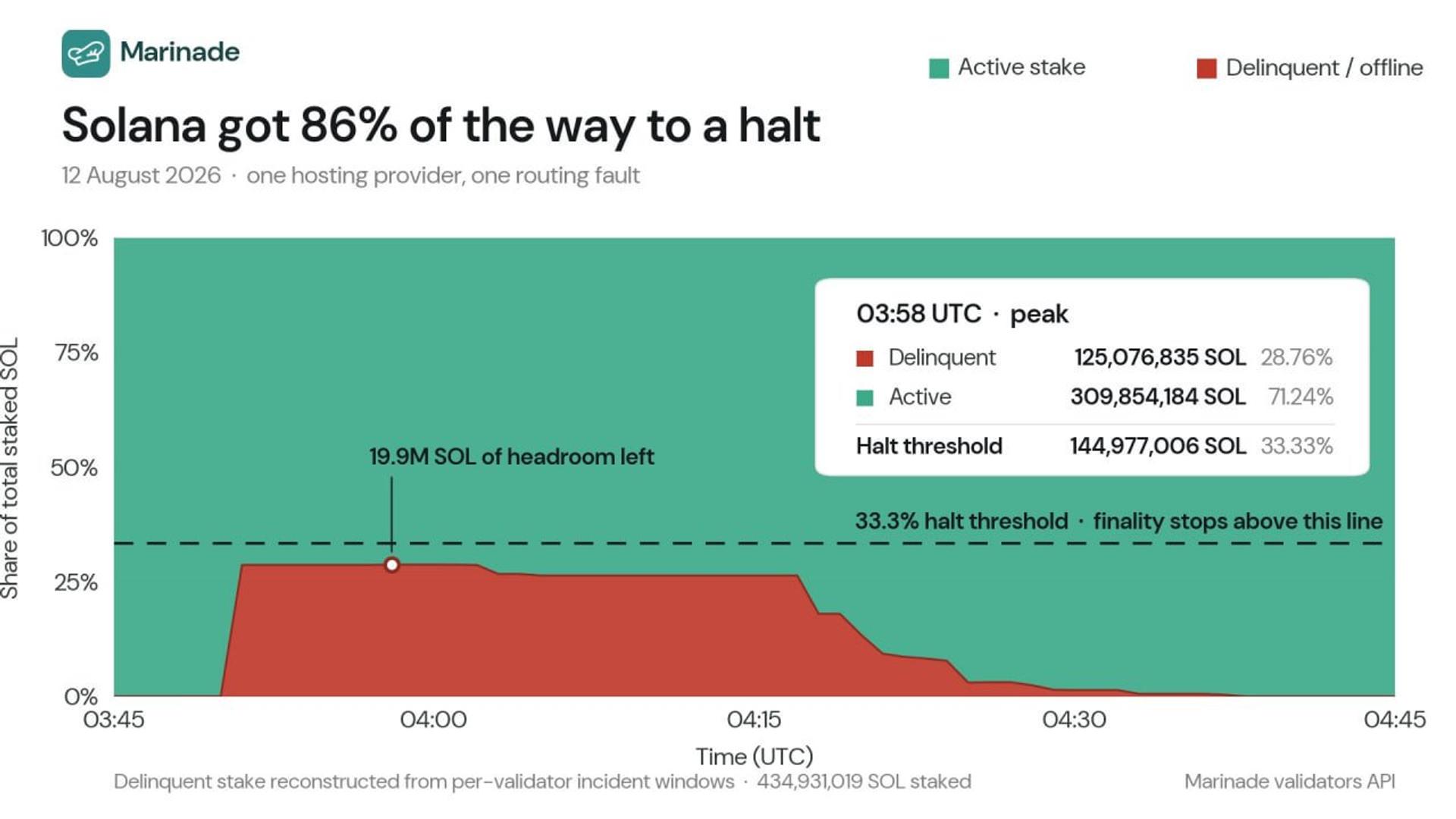
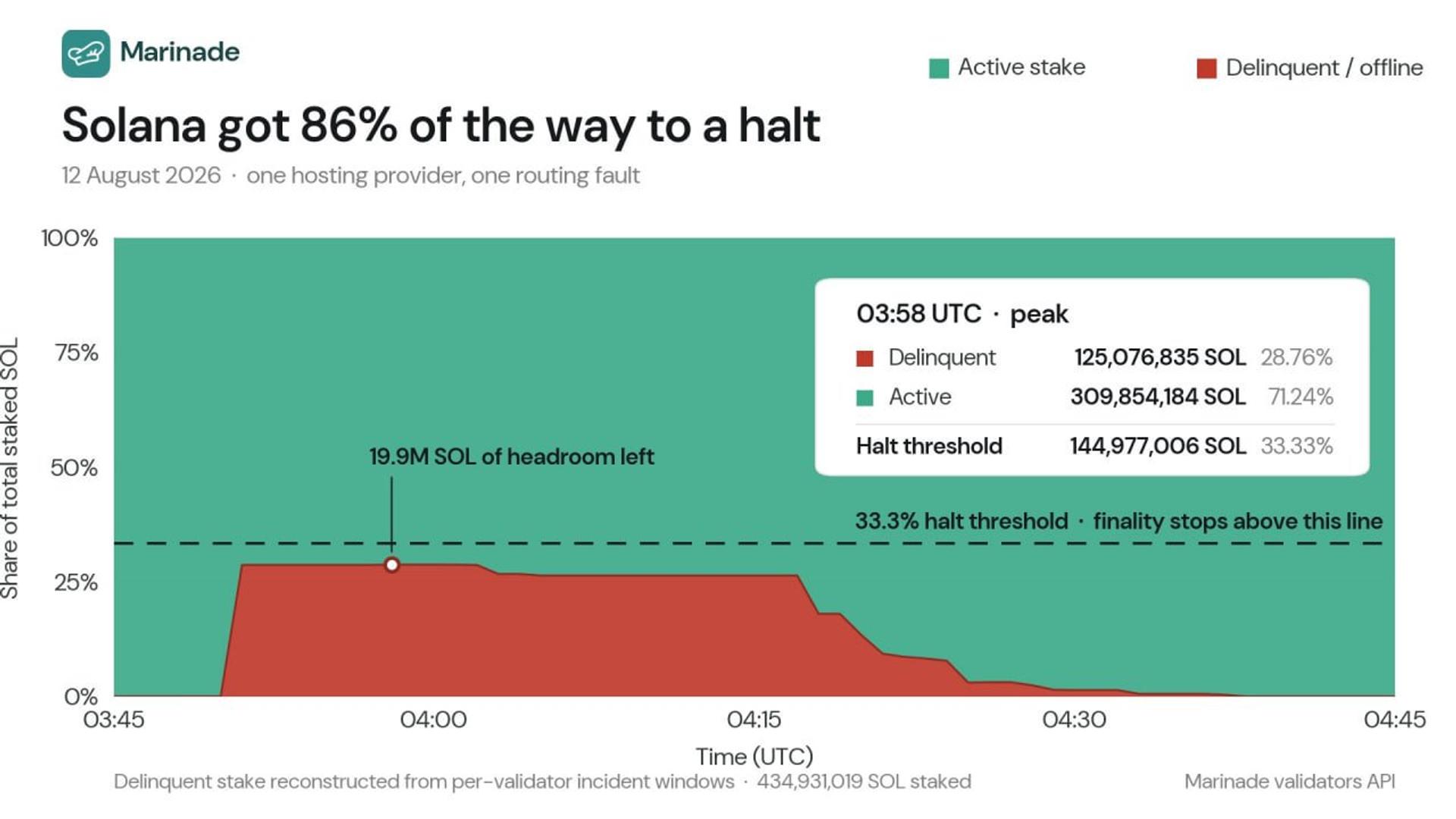
The latest issue started with a bad internet route from Teraswitch’s Miami facility that then spread to data centers across Europe and Asia, cutting off validators in London, Amsterdam, Frankfurt, Singapore and Tokyo. North America stayed online. The company fixed the issue in about 10 minutes, and traffic was flowing again by 4:16 a.m. UTC.
One single network operator, identified as AS2032, controlled more than a quarter of all the tokens people had locked up to secure the network, which was more than the Solana-prescribed safety limit. Almost all of those tokens went offline at the same time. Other companies lost another 14 million tokens in the same short period. Most of the affected validators, including the big one called Helius, stayed offline for the full 33 minutes because their backup systems never switched on.
This whole event is a clear warning: if more than one-third of the network’s tokens ever go offline at once, the entire blockchain freezes for every single person holding SOL, and there is no quick way to fix the bigger damage that would follow.
Pi Network price rose more than 5% toward $0.090 on Aug. 12 as the Protocol 26 deadline passed and softer U.S. inflation data supported speculative assets.
Summary
- Pi Network price rose more than 5% before settling near $0.088 during the session.
- Protocol 26’s Aug. 11 deadline required Mainnet node operators to update or lose connectivity.
- PI remains above its 20-day moving average at $0.0853, but below the 50-day average.
- A breakout above $0.096–$0.10 could open a path toward $0.12 and potentially $0.15.
Pi Network price action today
According to data from crypto.news, Pi Network (PI) price climbed more than 5% to approach $0.090 on Aug. 12, while trading activity reportedly increased by about 35%. PI traded near $0.0883 at the time of writing after giving back part of its intraday advance.
The move followed the Aug. 11 deadline for Mainnet node operators to complete the Protocol 26 upgrade. The Pi Core Team previously said nodes that missed the cutoff would lose Mainnet connectivity until they installed the required update.
No widespread network disruption had been reported by the time of writing. However, the team had not published figures showing how many operators completed the upgrade, making it difficult to confirm the participation rate across Pi Network’s node infrastructure.
Protocol 26 improves smart contract safety, state management, interoperability, and cryptographic functions. The upgrade is also intended to prepare the network for Protocol 27, the final planned step in the current protocol update sequence.
Cooling US inflation supports PI recovery
U.S. macroeconomic conditions provided a second tailwind for PI and the broader crypto market. The Bureau of Labor Statistics reported that the Consumer Price Index rose 0.1% in July and 3.4% from a year earlier.
Annual inflation slowed from 3.5% in June, while core CPI increased 0.2% month over month and 2.5% annually. Both annual readings eased from the previous month.
Slower inflation can reduce pressure on the Federal Reserve to raise interest rates further. Lower rate expectations generally support risk assets by improving liquidity conditions, although PI’s immediate move remained closely tied to the network upgrade and retail trading activity.
PI’s price is still more than 95% below its February 2025 peak, leaving the token exposed to sharp swings as short-term traders respond to technical breakouts and project updates.
Supply also remains an important risk. Data attributed to PiScan indicates that approximately 775.8 million PI could be unlocked by the end of 2026. Unlocks do not guarantee immediate selling, but they may increase the amount of PI available in the market if recipients choose to sell.
PI price holds above short-term support
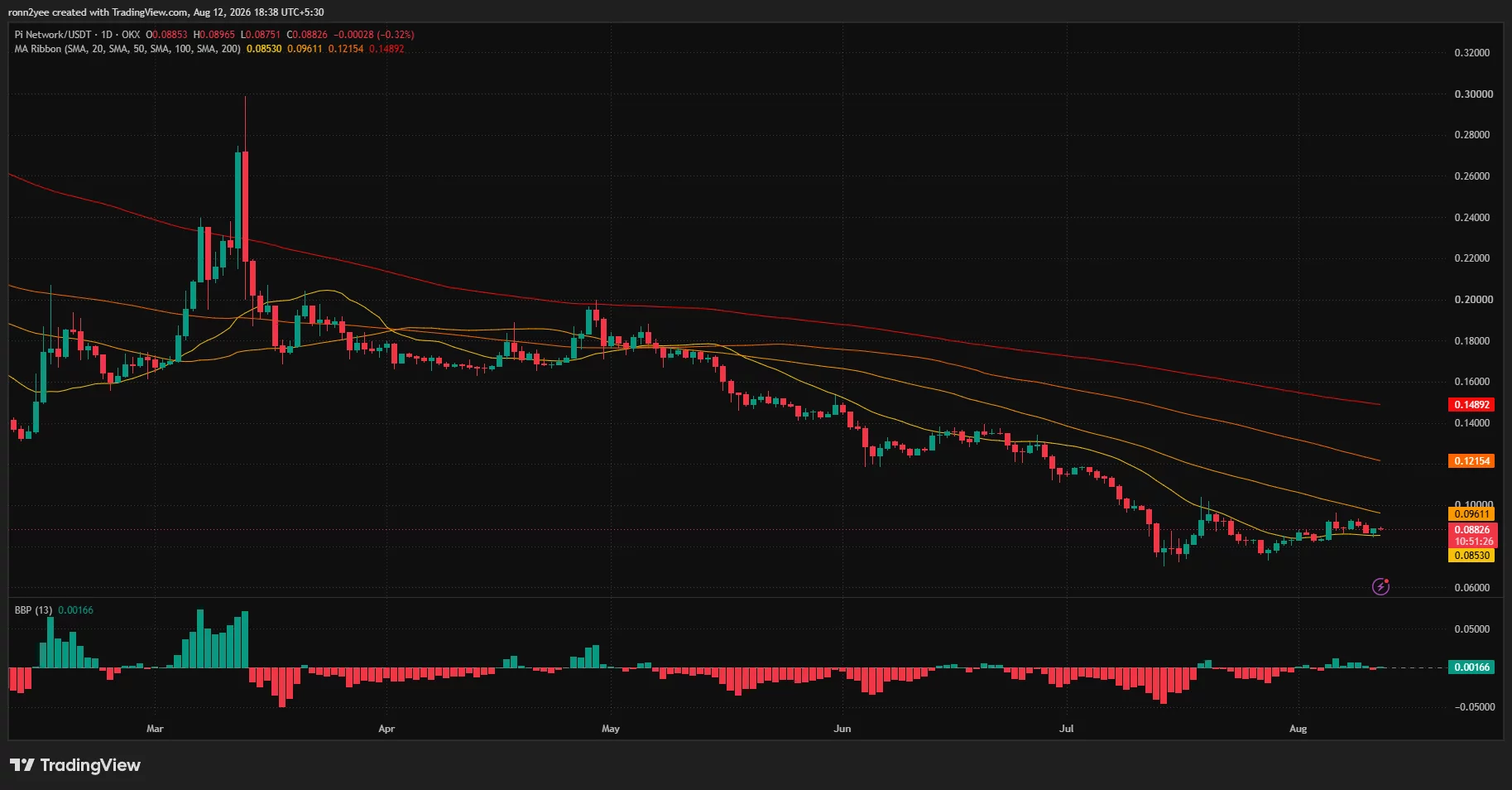
The daily chart shows PI trading above its 20-day simple moving average at $0.0853. Reclaiming the average marks an improvement from the sustained downtrend that pushed the token from above $0.20 in March to a July low near $0.071.
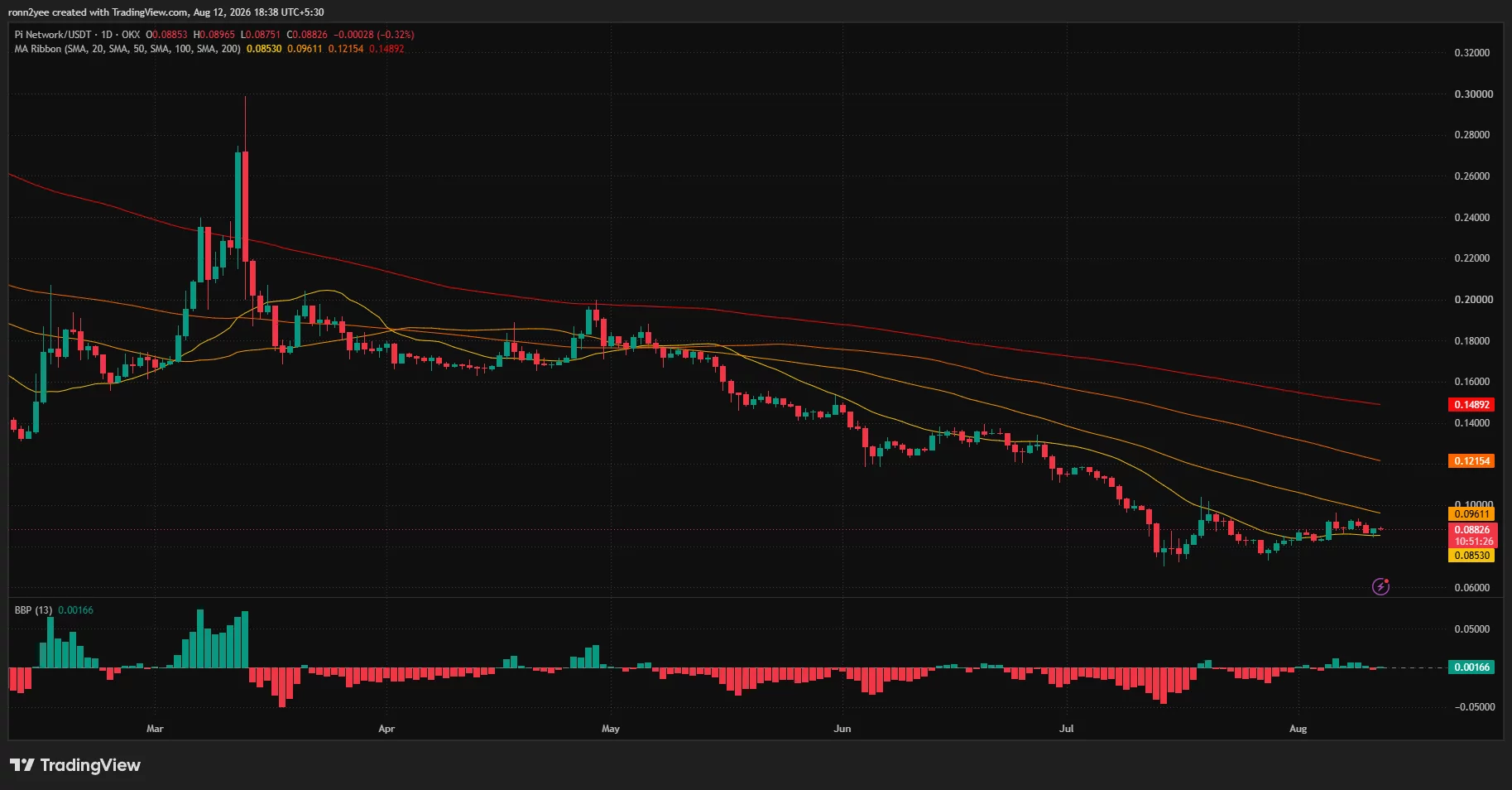
Bull-bear power has also turned slightly positive at 0.00166, indicating that buyers have gained limited control around the current range. Price has nevertheless failed to produce a decisive trend reversal.
PI remains below the 50-day moving average at $0.0961, which forms the first major resistance zone. The 100-day and 200-day averages sit much higher at $0.1215 and $0.1489, respectively, showing that the broader daily trend remains bearish.
A daily close above $0.096 would strengthen the recovery case and place the psychological $0.10 level in focus. Clearing both barriers could allow buyers to target the 100-day average near $0.12.
Failure to hold $0.0853 would weaken the current setup. Sellers could then test $0.080, followed by the July support area between $0.071 and $0.075.
4-hour indicators show weak but improving momentum
PI’s 4-hour chart shows price consolidating between approximately $0.085 and $0.092 after recovering from the late-July low. Buyers have repeatedly defended the lower end of the range, but rallies have lost momentum around $0.090–$0.093.
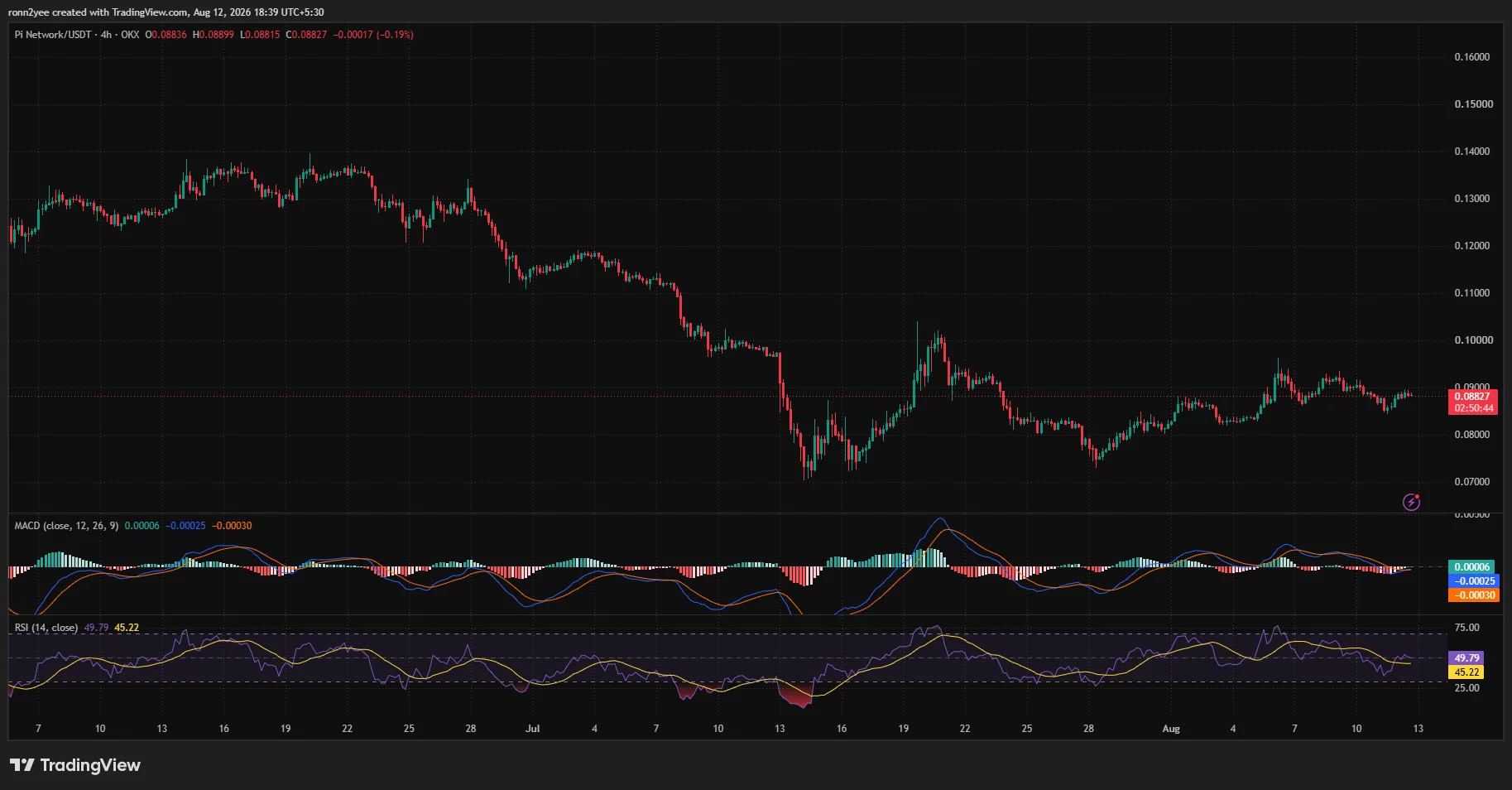
The 4-hour Relative Strength Index stood at 49.79, just below the neutral 50 level. The reading shows that selling pressure has eased without confirming strong bullish momentum.
MACD offered a slightly more constructive signal. Its histogram turned positive at 0.00006 as the MACD line moved above the signal line, although both remained below zero. The setup points to an early recovery attempt rather than a confirmed breakout.
A 4-hour close above $0.093 would improve the short-term structure and expose the $0.096–$0.10 resistance zone. Losing $0.085, however, would invalidate the immediate bullish setup and raise the risk of another move toward $0.080.
Analyst sees $0.15 target after triangle breakout
Crypto analyst Crypto With Gopal said PI was compressing between descending resistance and rising support, creating a large triangle pattern.
According to the analyst’s chart, a clean break above approximately $0.10 could trigger a larger move toward $0.15. Such a move would require PI to reclaim its 50-day and 100-day moving averages before challenging the 200-day average near the analyst’s target.
Until PI closes above $0.10, the pattern remains unconfirmed. The token’s position below its major long-term averages and the pending supply unlocks continue to limit the strength of the bullish case.
Disclosure: This article does not represent investment advice. The content and materials featured on this page are for educational purposes only.
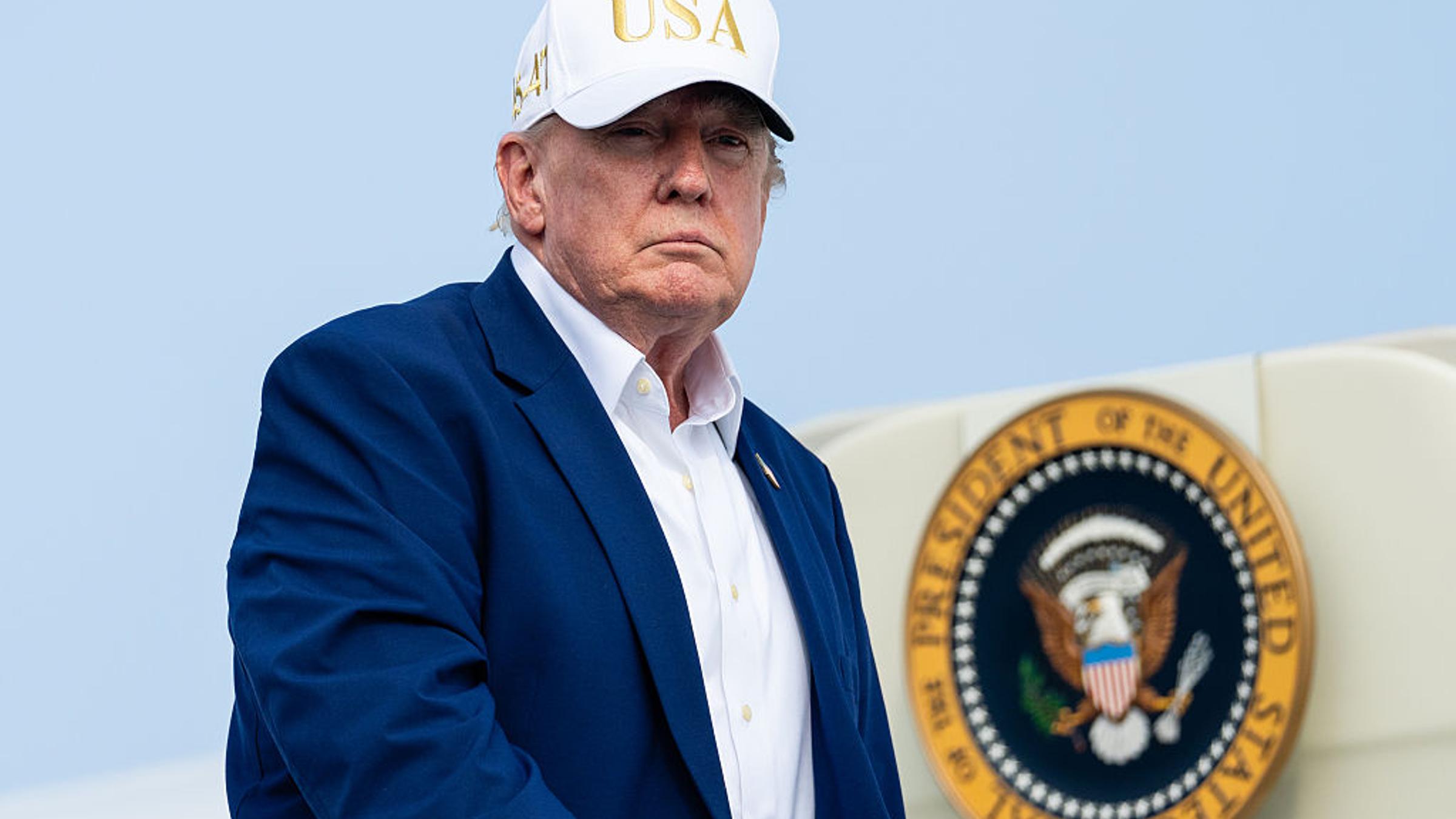
Trump isn’t the only President to execute a decoy mission
Although rare, a decoy maneuver such as this is not unheard of when it comes to presidential travel.
A similar episode occurred in March 2000, when former President Bill Clinton secretly switched to a decoy jet, with all of the markings of Air Force One, as he traveled to Islamabad, Pakistan for a visit marked by extraordinary security.
The switch was revealed when a Secret Service agent resembling Clinton stepped out of Air Force One upon touching down in Pakistan, while Clinton disembarked from the second aircraft.
However, at least one member of the White House pool was aware of the ruse: Susan Page, then-president of the White House Correspondents’ Association, who was covering the trip for USA TODAY.
Page this week broke her 26-year silence on the briefing that preceded the secret switch.
“They told me about the extraordinary security procedures being taken because of the dangers in flying there, including use of the decoy plane,” she told the Post. “Of course, the dangers threatened the journalists covering the trip as well as President Clinton.”

A coalition of crypto companies and industry groups has asked frontier artificial intelligence (AI) labs to provide Bitcoin developers and other open-source “defenders” early access to their most capable models. The request comes in a letter published Monday by the Bitcoin Policy Institute (BPI), arguing that current access arrangements can leave critical infrastructure teams operating behind the pace of rapidly advancing AI-assisted cyber capabilities.
In the letter, signatories say many defenders—including Bitcoin Core developers—can be limited by the absence of dedicated “trusted-access programs” and by guardrails applied to publicly available frontier systems. As a result, they contend that qualified teams may be forced to rely on less capable open-weight models, even as attackers may use more powerful AI tooling to probe for weaknesses.
Key takeaways
- The Bitcoin Policy Institute letter calls for “standing trusted-access programs” so open-source financial infrastructure defenders can use top-tier frontier AI before widespread public release.
- Signatories argue that guardrails and limited access to advanced models can hinder security research and response for Bitcoin and broader crypto systems.
- The letter links the push to the rising scale of AI-enabled vulnerability discovery and threats, citing multiple reports from open-source maintainers.
- Industry data referenced in the letter points to a sharp jump in monthly crypto hacks, with April 2026 losses exceeding $634 million.
- The coalition includes major ecosystem participants such as Anchorage Digital, BitGo, Bitwise, Blockstream, Kraken, Ledger, and Trezor, among others.
Why the letter centers on “trusted access”
The BPI says the economics of security research and cyber operations are shifting as frontier AI models become more capable. According to the letter, advanced systems can search large codebases, surface potential weaknesses, and compress timelines for complex technical work—benefits that apply not only to attackers, but also to defenders responsible for maintaining open-source financial infrastructure.
Without early, dedicated access programs, the letter warns that defenders may struggle to keep pace with evolving threats. It also argues that cyber incidents exploiting open-source vulnerabilities can translate directly into real-world harm, including the risk of losing “life savings,” given how widely open-source software underpins digital finance.
To address this asymmetry, the letter asks frontier AI labs to “establish or expand standing trusted-access programs” for qualified open-source defenders. The focus is less on broad public access and more on structured access channels for teams charged with safeguarding infrastructure.
What data and security commentary are used to support the case
The letter points to recent increases in hack activity across the sector. It cites DefiLlama data showing that total monthly crypto hacks surged in April 2026, with malicious actors stealing more than $634 million from cryptocurrency platforms—described as the highest monthly total since the Bybit hack. That earlier incident, the letter notes, contributed to losses of roughly $1.4 billion in February 2025, again according to DefiLlama.
In addition to incident volume, the letter frames AI as a force multiplier for vulnerability discovery. It references concerns raised across the crypto security industry as newer AI systems make it easier to automate parts of the probing and exploit development cycle.
Earlier coverage cited within the letter highlights comments from Mitchell Amador, CEO of bug bounty platform Immunefi, who characterized the moment as a “vulnerability apocalypse” in relation to developments in AI-assisted research. The letter also mentions the emergence of newer frontier models—described in the article as Claude Opus 4.8 and ChatGPT 5.5—as part of the broader shift raising security stakes.
Who signed the request
The open letter is co-signed by a broad cross-section of the crypto industry, signaling that the concern is not confined to one segment of infrastructure. Alongside the Bitcoin Policy Institute, the signatories include organizations such as the African Bitcoin Institute, Anchorage Digital, BitGo, Bitwise, Blockstream, Bull Bitcoin, MARA, Kraken, Ledger, and Trezor, among others.
By bringing together companies spanning custody, exchanges, analytics, wallet infrastructure, and Bitcoin-focused organizations, the letter underscores the “system-wide” nature of the risk it describes: open-source code and shared software dependencies can affect multiple products, operators, and user bases at once.
Implications for Bitcoin developers and the broader security community
If frontier AI labs establish or expand trusted-access programs as requested, the most immediate practical impact would be on the speed and effectiveness of defensive work around open-source financial infrastructure. In the letter’s framing, having early access to capable models could improve how maintainers audit code, identify potential weaknesses, and respond to new exploit techniques.
The request also highlights a tension that many in security research recognize: attackers may benefit from advanced tools faster than defenders can. By arguing that public guardrails and limited availability of powerful models can block legitimate defense work, the letter effectively calls for a policy-like solution—one that treats certain defenders as authorized users of frontier capabilities.
At the same time, it remains unclear what “standing trusted-access programs” would look like in practice, including how labs would vet applicants, what models would be shared, and how output would be handled. The letter is a policy request rather than a technical specification, so builders and investors should watch for follow-up actions that clarify implementation details.
For now, the key signal is the coalition’s insistence that time-to-defense matters as AI capabilities scale—especially as hack activity remains elevated and AI-assisted vulnerability discovery accelerates. The next phase will likely involve whether frontier AI labs respond, and whether any program structures emerge that could help Bitcoin and other open-source maintainers close the gap between defensive capacity and adversarial capability.

London, United Kigdom, August 12th, 2026, Chainwire
HCB Advisory has published a new analysis examining the role of market sentiment in financial markets and how changes in investor behaviour, demand, and expectations can influence short- and medium-term asset price movements.
Financial markets are shaped not only by economic indicators and fundamental developments, but also by the behaviour and expectations of market participants. Changes in investor confidence, risk appetite, demand for particular assets, and reactions to new information can contribute to significant changes in market dynamics.
According to HCB Advisory, analysing market sentiment can provide an additional perspective when assessing financial markets. By observing how participants respond to economic developments, corporate news, monetary policy decisions, and changes in broader market conditions, analysts can gain a better understanding of the factors influencing price movements.
“Market sentiment can provide important context when analysing short- and medium-term changes in asset prices,” Blake Rees said a representative of HCB Advisory. “Investor behaviour, changes in demand, and reactions to new information can all contribute to market dynamics. Understanding these factors allows analysts to evaluate price movements from a broader perspective.”
Understanding Market Sentiment
Market sentiment describes the general attitude and expectations of participants toward a particular asset, market, or the broader financial environment.
Sentiment can change as investors respond to new information, economic data, company announcements, central bank decisions, geopolitical developments, or changes in financial conditions.
Periods of positive sentiment may be associated with increased risk appetite and stronger demand for certain assets. Conversely, declining confidence can lead investors to become more cautious and reduce exposure to assets perceived as carrying greater uncertainty.
HCB Advisory notes that sentiment is not necessarily uniform across all market participants. Different investors can interpret the same information differently, creating a range of expectations and contributing to changes in market activity.
Investor Behaviour and Market Dynamics
Investor behaviour represents an important component of sentiment analysis.
Market participants continuously evaluate available information and make decisions based on their expectations about future conditions. These decisions can affect buying and selling activity and, consequently, the balance between supply and demand.
According to HCB Advisory, observing changes in investor behaviour can help analysts understand why an asset may experience increased activity even when there has been no major change in its underlying fundamentals.
Behaviour can also change rapidly when new information enters the market. Unexpected economic data, policy announcements, or significant corporate developments can alter expectations within a short period of time.
For this reason, monitoring behavioural changes can complement traditional market analysis.
Changes in Demand
Demand is another important indicator when assessing market sentiment.
An increase in demand can indicate growing interest in a particular asset or market segment, while declining demand may reflect a reduction in investor interest or a shift toward alternative opportunities.
HCB Advisory considers changes in demand alongside other market indicators rather than treating them as an independent signal.
Trading volumes, price movements, liquidity, and broader market conditions can provide additional context when evaluating whether changes in demand represent a temporary development or part of a broader shift in sentiment.
Understanding these relationships can help analysts develop a more complete view of market behaviour.
Identifying Potential Trading Signals
Changes in sentiment and investor behaviour can also be incorporated into the process of identifying potential trading signals.
A trading signal does not necessarily represent a prediction of future market performance. Instead, it can serve as an indicator that a particular market condition or change in participant behaviour may require additional analysis.
For example, a significant increase in trading activity accompanied by a change in investor sentiment may indicate that market participants are responding to new information.
Similarly, a sharp change in demand may prompt analysts to investigate the factors behind the movement and determine whether it is connected to broader market developments.
According to HCB Advisory, such signals should be evaluated together with other analytical factors rather than used in isolation.
Combining Sentiment With Market Analysis
Market sentiment is only one component of a broader analytical framework.
Traditional market analysis can include economic indicators, interest rates, inflation, corporate developments, valuation measures, liquidity conditions, and other factors relevant to a particular asset.
HCB Advisory believes that combining these areas of analysis with information about investor behaviour can provide a broader perspective on market conditions.
For example, a change in asset prices may be driven by fundamental developments, changing expectations, or a combination of both. Understanding the role of sentiment can help analysts examine the behavioural component of the movement.
This approach is particularly relevant when evaluating short- and medium-term market changes, where investor expectations can influence price dynamics over relatively short periods.
Technology and Sentiment Analysis
Modern financial technologies are creating new opportunities for analysing market sentiment.
Analytical platforms can process large volumes of information from financial markets, news sources, economic publications, and other data channels. Advanced data-processing systems can help identify changes in activity and highlight developments that may require further investigation.
Artificial intelligence and machine learning technologies can also assist with processing large datasets and identifying patterns in market behaviour.
According to HCB Advisory, these tools can support analysts by improving the speed at which information is collected and organized.
However, technological systems still require interpretation. Changes in sentiment can have different meanings depending on the broader market environment, making professional analysis an important part of the process.
Short-Term and Medium-Term Market Movements
Sentiment analysis can be particularly relevant when examining short- and medium-term price dynamics.
In the short term, markets can respond quickly to changes in expectations, news events, and investor positioning. Over longer periods, sentiment can interact with economic and fundamental developments to influence broader market trends.
HCB Advisory emphasizes that distinguishing between temporary changes in sentiment and more persistent shifts is an important part of the analytical process.
A short-lived increase in demand may have a different significance from a sustained change in investor behaviour that continues across multiple trading sessions or market cycles.
Avoiding a Single-Indicator Approach
HCB Advisory stresses that no single sentiment indicator can provide a complete explanation of market behaviour.
Investor sentiment can change quickly, and indicators based on historical or current activity may not fully reflect future developments.
For this reason, the company advocates combining sentiment analysis with broader market research.
Analysts can consider price dynamics, trading activity, economic conditions, liquidity, fundamental developments, and other relevant information alongside changes in investor behaviour.
This multi-factor approach can provide greater context when evaluating potential market scenarios.
Looking Ahead
Financial markets are becoming increasingly data-driven, while investors have access to information from a growing number of sources.
As information becomes more readily available, understanding how market participants respond to that information may become increasingly relevant to financial analysis.
According to HCB Advisory, the combination of traditional market research, behavioural analysis, and modern data-processing technologies can provide additional insight into changing market conditions.
The company concludes that understanding investor behaviour and changes in market sentiment can help analysts evaluate the reasons behind short- and medium-term price movements more comprehensively.
About HCB Advisory
HCB Advisory is a financial research and advisory company focused on financial markets, investment analysis, market intelligence, and modern financial technologies. The company publishes research and industry insights covering global economic developments, market trends, investor behaviour, investment processes, and the evolution of financial decision-making.
Website: https://hcbadvisory.com/
Disclaimer
This press release is provided for informational purposes only and does not constitute financial, investment, legal, or tax advice. Market sentiment and behavioural indicators cannot guarantee future price movements or investment outcomes. The information presented is for general informational purposes and should not be interpreted as a recommendation to buy, sell, or hold any financial instrument, security, digital asset, or investment product.
Contact
Caleb Grant
marketing@hcbadvisory.com


Key takeaways
- Harmony’s ONE token plunged roughly 40% following an apparent exploit that created about 4 billion tokens.
- The unauthorized issuance was equivalent to approximately 26% of ONE’s existing supply.
- Harmony released an emergency software update to prevent further minting and urged network operators to install it immediately.
Harmony’s ONE token fell approximately 40% on Wednesday after an apparent exploit reportedly created around 4 billion new tokens.
Harmony confirmed the attack and instructed the network operators responsible for maintaining the blockchain to install an emergency software update. The project said the patch would prevent the attacker from minting additional ONE tokens.
However, the update does not resolve the status of tokens that were already created. Harmony is still evaluating how to isolate or remove those assets from circulation.
The scale of the incident triggered intense selling pressure as traders assessed the risks of token dilution, exchange deposits, and a potential reversal of blockchain transactions.
Unauthorized issuance equals 26% of ONE supply
Approximately 15 billion ONE tokens existed before the exploit. The creation of another 4 billion represents a sudden supply increase of roughly 26%.
Such a large unauthorized issuance can severely dilute existing holders. If the attacker successfully transfers the newly created tokens to exchanges and sells them, the additional circulating supply could place further downward pressure on ONE’s price.
Harmony has not officially confirmed the total number of tokens minted or explained how the reported 4 billion figure was calculated.
The network was once among the cryptocurrency industry’s largest projects, reaching a market capitalization of approximately $4 billion in January 2022.
Harmony temporarily paused its token bridge to prevent potentially compromised assets from moving between networks.
The project also asked centralized exchanges to block and freeze funds traced to four wallet addresses associated with the incident. By flagging those addresses, Harmony hopes trading platforms can prevent the attacker from converting or withdrawing the newly minted tokens.
Cooperation from exchanges may limit the damage if the assets remain identifiable. However, recovery becomes more difficult if the tokens are swapped through decentralized exchanges, transferred to other networks or divided among additional wallets.
Blockchain transaction monitoring may still allow investigators to trace some movements, but it cannot guarantee that all unauthorized assets will be recovered.
Harmony’s software update is intended to close the vulnerability and stop any additional ONE from being created.
Network operators must adopt the new software for the patch to become effective across the blockchain. A coordinated upgrade is therefore essential to ensure that validators and other infrastructure providers follow the corrected network rules.
Harmony has not publicly identified the vulnerability, disclosed how the attacker gained minting authority or confirmed whether any additional parts of the protocol remain at risk.
Until the project releases a complete technical explanation, uncertainty may continue to weigh on ONE and applications operating on the network.
“We are working on a patch and rollback options,” Harmony said, promising further updates as its investigation progresses.
A rollback would return the blockchain to a state recorded before the exploit. The network would then resume from that point, removing subsequent transactions from its accepted history.
This approach could erase the creation of unauthorized tokens still on Harmony. However, it could also reverse legitimate transactions completed after the selected rollback point.
Will ONE recover following the massive dip?
The ONE/USD 4-hour chart is extremely bearish and efficient, as ONE has lost 40% of its value in the last 24 hours.
The coin briefly dropped to the $0.000605 level before bouncing back to now trade above $0.00074.
The technical indicators suggest that the bears are currently in control. The RSI of 12 means that ONE is currently in an oversold territory. The MACD lines also support the bearish narrative.

If the bearish trend persists, ONE could retest the daily low of $0.000605 before heading towards the $0.00050 psychological level.
However, if the bulls regain control, they would likely seek efficiency on the 4-hour chart at the $0.00112 level in the near term.

A Kalshi billboard displaying New York City mayoral election odds in Times Square in New York, US, on Tuesday, Nov. 4, 2025.
Adam Gray | Bloomberg | Getty Images
The New York City Council is investigating marketing practices by prediction market platforms, the office of Council Speaker Julie Menin said on Wednesday.
In letters to four prediction market platforms — Polymarket, Kalshi, Coinbase and Gemini Titan — Menin wrote that the council has been examining allegations of “false, deceptive, unconscionable, and objectionable marketing practices” by event contract exchanges for months.
“Prediction markets aggressively entice consumers to bet and wager on sports, politics, culture, weather, and pretty much anything,” Menin said in a statement. “I intend to harness the full power of the Council to protect New Yorkers from deceptive and predatory marketing practices by prediction market platforms.”
Menin the letters referenced an investigation by The Wall Street Journal that claimed that Polymarket conducted misleading marketing campaigns. The Journal said in a June article that Polymarket made it appear as though content creators it partnered with were winning on the platform when, in fact, they were not using their own money. The Journal’s reporting led to an investigation by the Commodity Futures Trading Commission, the federal regulator for prediction markets.
CNBC reported on Tuesday that Polymarket has taken steps to revamp its marketing strategy, including through updated and streamlined guidelines for staff at the company and the content creators it works with.
Menin added in her letters to the platforms that the council is investigating whether such advertising strategies are used by other prediction market companies. A memo attached to these letters said the allegations against Polymarket show an urgent need to determine if legislation or other policy changes are necessary. Menin’s office added that the council plans to hold a hearing on the matter.
The memo, which also described the probe, made clear that the inquiry is not exploring whether or not event contract exchanges violate New York’s state gambling laws.
New York state is currently in active litigation against Kalshi, Coinbase and Gemini, alleging that the companies are running illegal gambling operations. The platforms assert that they are federally regulated financial exchanges and aren’t subject to state betting laws. New York state is currently not in litigation against Polymarket.
Kalshi, Polymarket and Gemini are all headquartered in New York City. Coinbase officially operates out of Texas, but announced plans earlier this year to expand its total workforce to more than 1,000 employees in New York.
“We look forward to engaging with The New York City Council on this matter,” a Polymarket spokesperson said in a statement.
When contacted by CNBC for comment, a Coinbase spokesperson said, “Coinbase offers our customers access to federally regulated prediction markets overseen by the CFTC, and fully complies with applicable laws.”‘
Kalshi spokesperson Dani Lever in a statement said that the company looks “forward to educating the New York City Council about our business model and practices.”
Gemini did not immediately respond to a request for comment.
Disclosure: CNBC and Kalshi have a commercial relationship that includes customer acquisition and a minority investment.
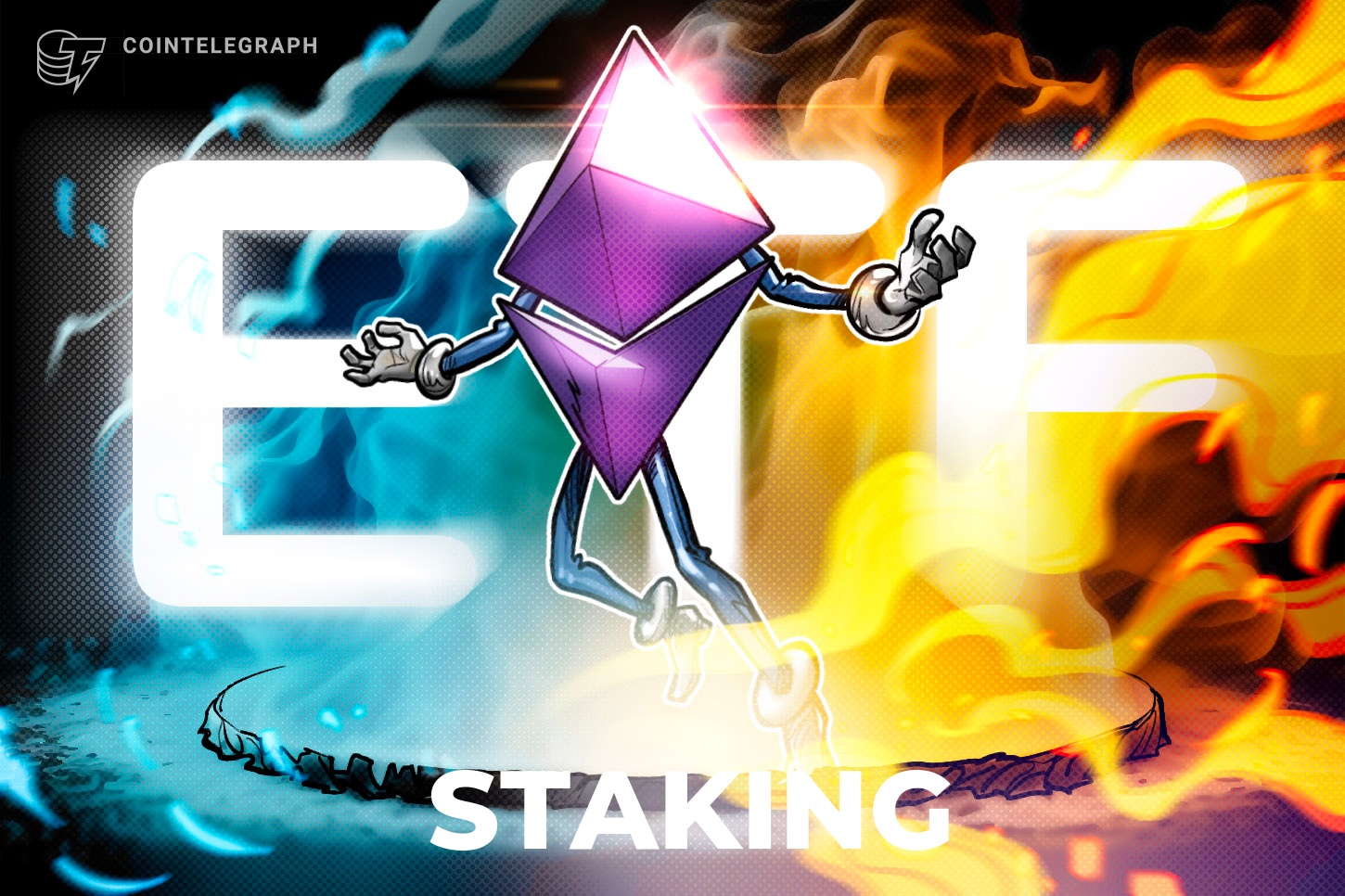
Fidelity plans to add staking to its Ether fund, with 85% of rewards retained by FETH and quarterly cash distributions planned for investors.

Binance and stablecoin payments card issuer RedotPay are trading competing narratives over whether a Singapore legal case tied to their wider dispute is set to end after a hearing on Aug. 7. RedotPay says it expects Binance to discontinue the proceedings, while Binance insists it is not withdrawing its claims.
The disagreement is the latest turn in a broader legal battle involving Binance-affiliated entities and RedotPay, which also includes a separate Hong Kong lawsuit seeking close to $473 million in damages.
Key takeaways
- RedotPay expects Binance to discontinue a Singapore case after an Aug. 7 hearing and plans to pursue legal costs.
- Binance says reports about it withdrawing Singapore claims are false and that it is continuing to press its case.
- The Singapore dispute sits within a larger conflict that includes a Hong Kong lawsuit alleging diversion of Binance Card users.
- The cases hinge on the terms of the Binance Pay–RedotPay relationship and whether card funding was used outside agreement scope.
Dispute over whether Singapore proceedings will be dropped
In comments to Cointelegraph on Tuesday, a spokesperson for RedotPay said the company expects Binance to discontinue the Singapore proceedings following the Aug. 7 hearing. RedotPay added that it would “be seeking legal costs arising from the discontinuance of the matter from the claimant,” while the parties would attempt to agree on costs.
Binance, however, rejected that characterization. A Binance spokesperson told Cointelegraph: “Reports that Binance will be withdrawing its Singapore claims are false.” The spokesperson added that Binance has not abandoned its claims and said it has informed both the court and RedotPay accordingly.
For market participants tracking crypto-related litigation, the immediate practical implication is uncertainty over process and timelines. Even if a party seeks to end one track of litigation, the question of who bears legal costs—and whether claims persist in the background—can affect strategy and leverage in the parallel Hong Kong matter.
How the legal fight expanded to multiple jurisdictions
According to earlier reporting by Bloomberg on Aug. 5, Binance-affiliated plaintiffs brought proceedings connected to the RedotPay business in Hong Kong. Bloomberg reported that Nest Trading, DistributedTechnologies and Chaintecs Consulting Singapore filed a petition in Hong Kong involving RedotPay co-founders.
Cointelegraph previously detailed the core allegations as well: the Hong Kong plaintiffs claim RedotPay diverted more than 470,000 Binance Card users by allowing Binance Pay funds to be used for stablecoin card top-ups outside the terms of a commercial agreement. They put their estimated damages at $472.8 million, based on a claimed lifetime customer value of $925 per user.
In parallel, Chaintecs brought related proceedings against RedotPay affiliates in Singapore, where a hearing was scheduled for Aug. 7. The existence of a Singapore hearing indicates the dispute has been actively litigated rather than merely threatened, which makes the latest exchange between the parties—over discontinuance versus continuation—material for observers.
What RedotPay says it was doing—and what Binance says it violates
RedotPay has denied what it described as “unfounded allegations” made against the company and its co-founders. In its communications to Cointelegraph, the company said it would defend the claims through the legal process.
The commercial relationship at the center of the litigation began in December 2023, when RedotPay announced its Binance Pay partnership. Under that arrangement, Binance Pay users could make direct deposits to RedotPay cards.
Binance later ended support for the integration as of April 3, 2026, citing a review of merchant partners. That withdrawal occurred months before the legal fight became widely public, suggesting the dispute has continued to develop independently of whether the integration was still active.
Crucially, the competing positions are not simply about whether RedotPay could provide card top-ups, but whether the use of Binance Pay funds fell within (or outside) what the parties agreed. The way courts interpret “terms of a commercial agreement” is often determinative in crypto platform and fintech disputes, particularly where multiple payment rails, intermediaries, or tokenized balances are involved.
What to watch after the Aug. 7 hearing
While RedotPay says it expects Binance to discontinue the Singapore proceedings, Binance’s spokesperson says the company is not abandoning its claims. The discrepancy means the next filings and court actions will matter more than either side’s statements in the short term.
If the Singapore case is indeed discontinued, RedotPay’s intention to pursue legal costs could become a focal point—especially if Binance contests costs or argues that discontinuance does not reflect wrongdoing. If Binance instead continues to litigate, it could signal that the company intends to maintain pressure on RedotPay in multiple venues simultaneously.
Either way, readers should pay close attention to how the Singapore track evolves alongside the Hong Kong case seeking nearly $473 million. With both proceedings tied to alleged user diversion connected to the Binance Pay–RedotPay setup, developments in one jurisdiction can influence negotiation posture in the other, even if legal standards and procedures differ.
For now, the main unknown is whether Binance’s position will translate into continued court steps in Singapore or whether RedotPay’s expected discontinuance plays out in formal filings—an outcome that will also shape the parties’ leverage and cost exposure across the wider $473 million dispute.
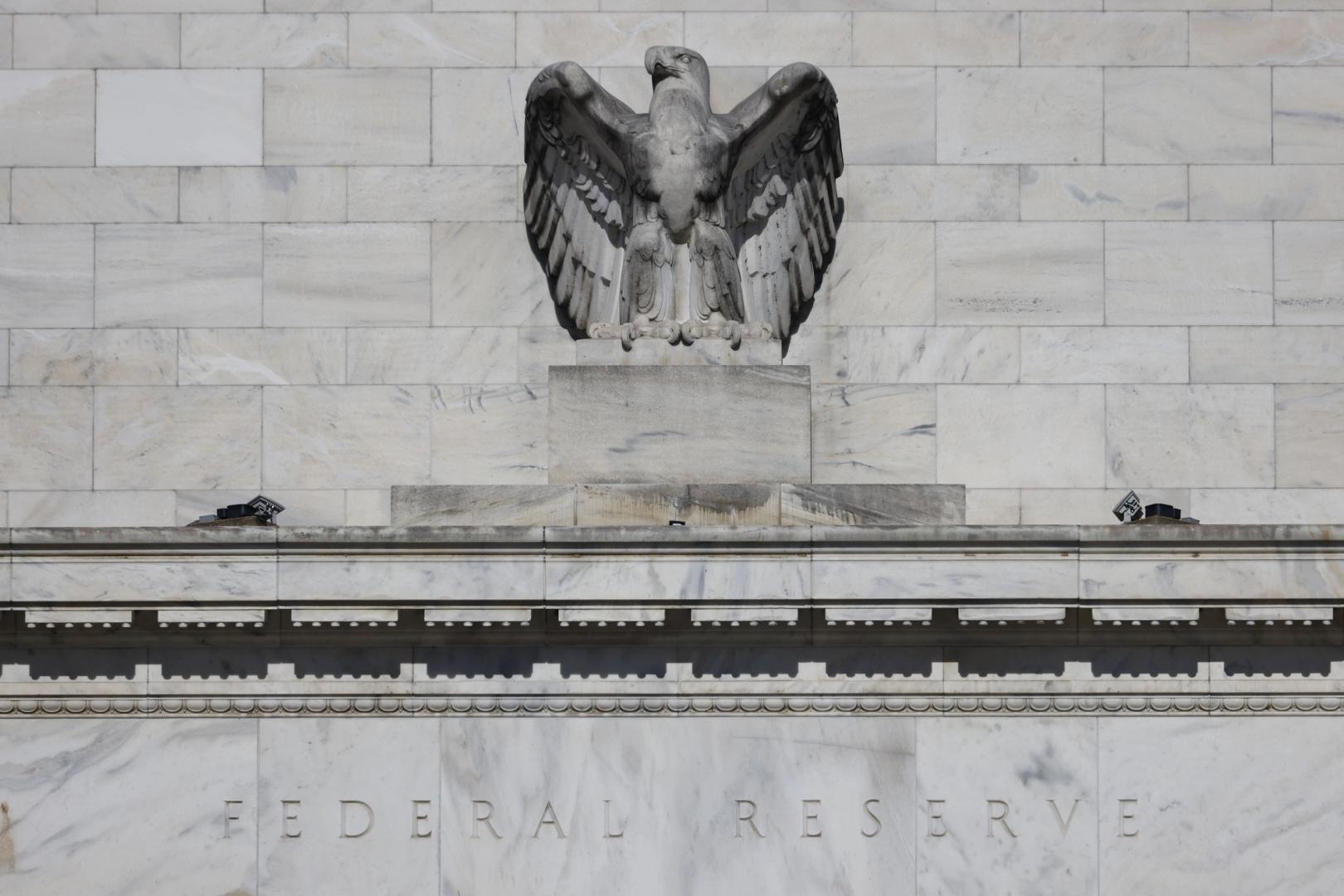
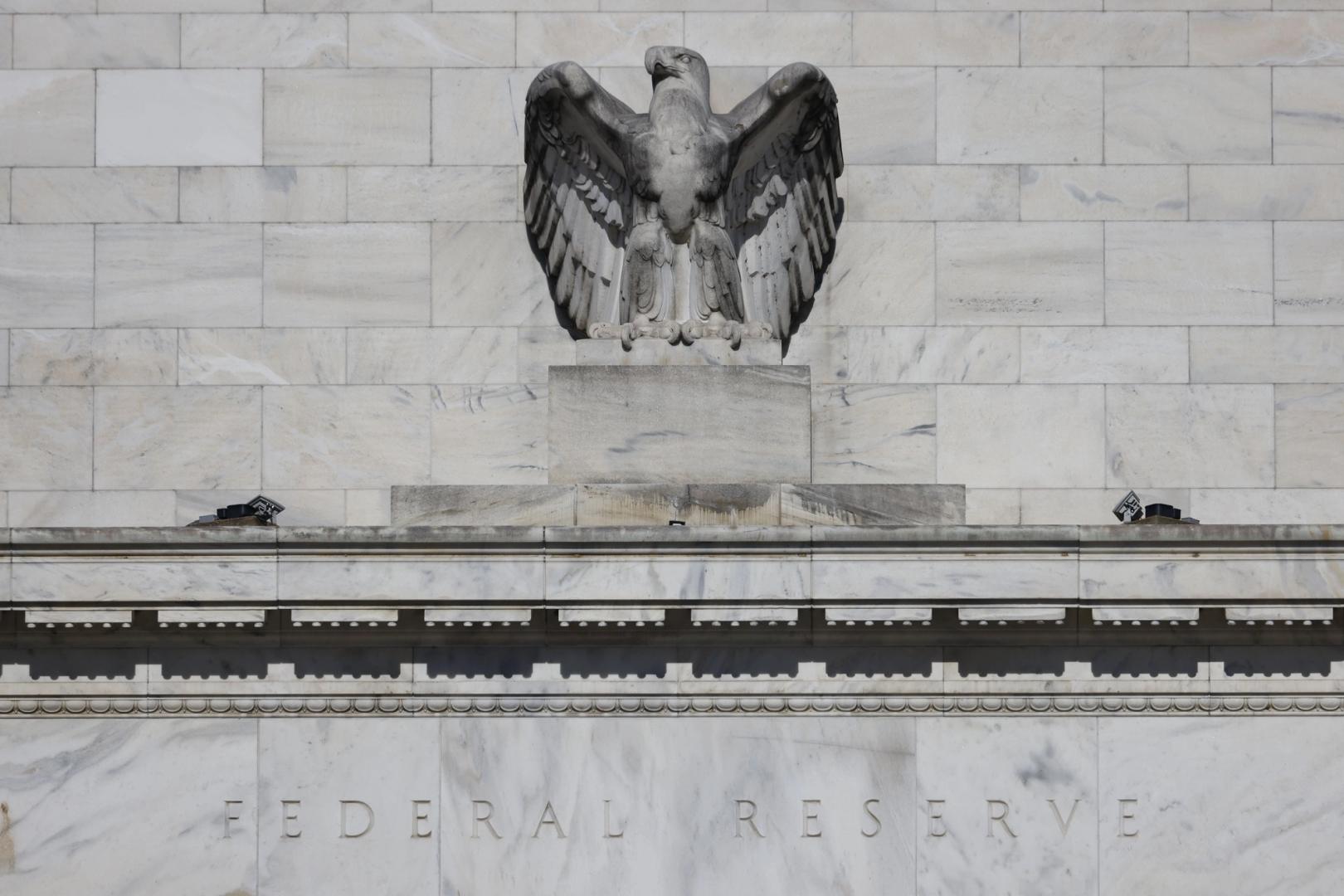
The Federal Reserve payment system is a walled garden, and rightly so; there are serious risks to opening access to unregulated or underregulated entities. But the walls should be drawn around prudent regulation, not arbitrary criteria. Fed membership should automatically mean access to Fed payment rails. Otherwise, if you build the walls in the wrong place, innovation will go offshore into foreign jurisdictions, beyond the reach of any U.S. regulator.
FDIC insurance is one of those arbitrary lines. Some point to its absence as a reason to hesitate, but that confuses two different risks. FDIC insurance protects against the risk created when a bank lends out client deposits, a risk inapplicable to a fully reserved custodial bank like Anchorage Digital Bank. Even stablecoin issuance, which more national trust banks are doing, is effectively full-reserve banking. Every stablecoin is always backed 100% by reserves, there is no fractional reserve banking being done, no asset-liability mismatch, and the risk to capital is fundamentally different. Federal Reserve Payment rail access should reflect actual risk, not assumptions carried over from a different banking model. Those differences should be reflected in how payment access is evaluated.
What is missing is not more studies to summarize longstanding banking law, but a published, uniform standard, applied the same way across the Federal Reserve’s system, so that similarly regulated banks get full access to Federal Reserve master accounts. Without them, institutions that took the harder path of federal oversight may still find themselves locked out of the very system they were regulated to join.

FIFA defends Infantino against allegations tied to his time at UEFA | Football News

Modders give the Steam Machine a Radeon eGPU and water cooling, because why not

Convicted fraudster selling himself as a financial guru | A Current Affair


-

 Fashion5 days ago
Weekend Open Thread: Mattifying Sunscreen
-

 Fashion5 days ago
Frugal Friday’s Workwear Report: Cap-Sleeve Pointelle Crewneck Sweater
-

 News Videos4 days ago
Can Astrology Help Find Gold and Silver Trends? A Financial Astrology Guide
-

 Sports6 days ago
Jordan Coyle & Cordiamo take Laya Arena Stakes at RDS
-
 Business7 days ago
US stocks: Dow closes at record on Mideast optimism; SpaceX, AMD drag Nasdaq
-

 Politics6 days ago
Reform UK And Greens Sink To Lowest Favourability Ratings To Date
-

 Business7 days ago
Supply chain issues impact Ingredion
-

 Tech5 days ago
Rinn Pharma & Biopharma to join NordicPharmaTrain network
-

 Business3 days ago
How to Start a Cleaning Business: A Step-by-Step Guide
-

 Business3 days ago
Datadog: Best Of Breed For Multiple Reasons
-

 Business3 days ago
BDC Weekly Review: Private BDC Q2 Numbers Are Strong
-
 NewsBeat15 hours ago
Communication cards help banking customers access services or report scams
-
Sports7 days ago
Spider-Man: Brand New Day ending explained: Is Peter Parker alive?
-

 Fashion7 days ago
Suit of the Week: Me + Em
-

 Tech5 days ago
Price Hikes May Be Coming for PC Motherboards Next
-

 Business5 days ago
Brightwater secures funding for WA-first dementia projects
-
 Crypto World6 days ago
Galaxy Digital Stock Slides 14% as Crypto Prices Hit Earnings
-

 Politics7 days ago
The Not-So Talented Mr Arday
-

 Politics7 days ago
Comedian Jimmy Cricket Has Died, Aged 80
-
 Tech6 days ago
How to Use Your Phone as a Webcam on PC and Mac (2026)
You must be logged in to post a comment Login