
Crypto World
Bitcoin Miners Hit 10-Year Low as Fee Revenue Falls Below 0.7%

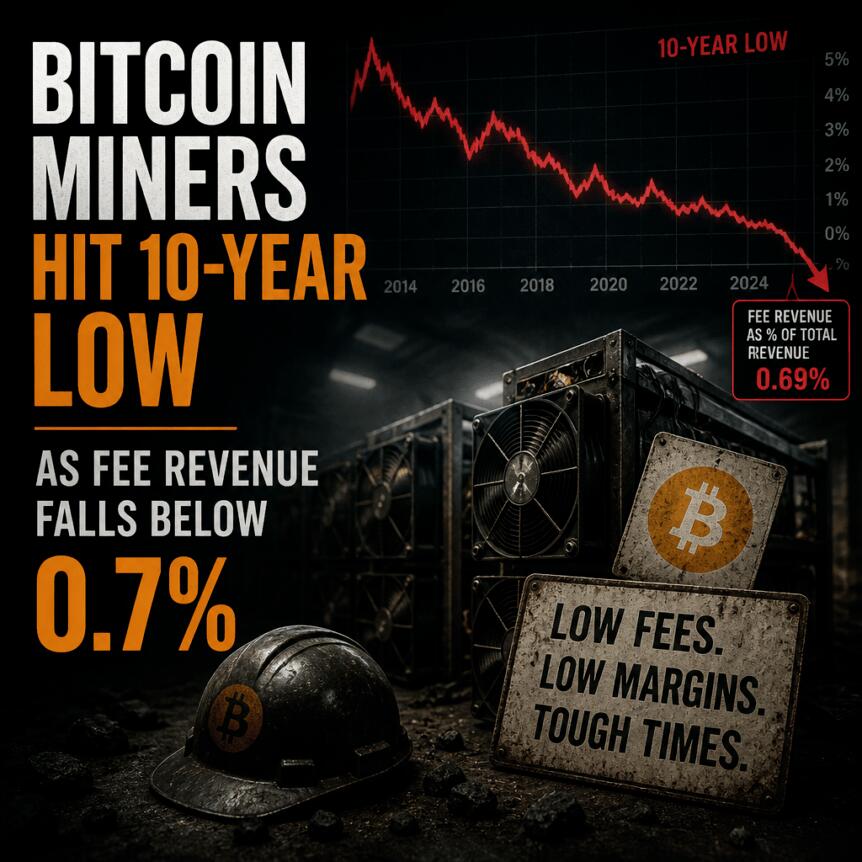
Bitcoin’s mining economics are looking increasingly subsidy-driven as transaction fees sink to levels last seen in the late stages of the decade. At the same time, multiple analysts point to a shift in miner strategy toward AI and high-performance computing (AI/HPC), coinciding with a noticeable decline in network hash rate.
Onchain analytics and mining cost estimates show fees make up just 0.69% of miner revenue, while the broader pressure on margins continues as Bitcoin’s price weakens and electricity costs remain a critical factor for operators. The resulting question for investors is whether miners’ AI pivot will stabilize long-term operations—or introduce new volatility to the network’s security parameters.
Key takeaways
- Glassnode data indicates Bitcoin fees are contributing only 0.69% of miner revenue, returning close to decade-low territory.
- Fees were reported as low as 0.52% in April, leaving miners more dependent on the fixed block subsidy.
- Checkonchain estimates show hash rate fell about 33% from an October 2025 peak of 1.3 ZH/s to 861 EH/s.
- Analysts argue the industry’s shift toward AI/HPC has contributed to reduced mining activity as difficulty adjustments evolve.
- Estimated mining production costs remain above current spot price, intensifying profitability pressure for marginal operators.
Fees fade as miner reliance on subsidies grows
According to Glassnode, transaction fees now represent just 0.69% of miner revenue—near the lowest levels seen in years. Glassnode co-founder Rafael Schultze-Kraft previously highlighted that fees had stayed below 1% of miner revenue for almost a year, with the share falling to 0.52% in April.
In a post on X, Schultze-Kraft said that “Bitcoin was below $400 the last time fee share was this low.” While that comparison is meant to contextualize the current environment, the practical impact is straightforward: when fee revenue collapses, miners lean more heavily on the block subsidy to cover operating expenses.
That matters because the subsidy is fixed in BTC terms—currently 3.125 BTC per block—but its value in US dollars depends on Bitcoin’s price. The article notes Bitcoin has fallen nearly 50% since its October 2025 all-time high, which would reduce the USD value of each subsidy payment and squeeze margins unless operational costs fall or fee rates rebound.
Cost pressure stays high: production estimates outpace spot
The mining picture is also constrained by profitability math. Checkonchain’s mining analytics put the estimated average cost to produce one Bitcoin at $78,254 as of Tuesday—about 23% above the current spot price referenced in the source.
Even if these are “estimated” costs rather than audited figures for every operator, the direction is what counts for the market: when production costs exceed spot value, miners are incentivized to either optimize aggressively, consolidate, or exit. That dynamic tends to hit smaller players first, potentially concentrating hash rate among operators with more capital flexibility and better power procurement.
Investors should also consider that production costs are influenced by variables outside the chain itself, especially electricity prices and hardware efficiency. In periods where fees remain weak, any non-chain cost increase can accelerate the churn in mining capacity.
Hash rate drops 33% since October 2025 peak
Network security metrics reflect the mining sector’s changing behavior. Checkonchain estimates hash rate declined from a peak of about 1.3 ZH/s in October 2025 to roughly 861 EH/s, a drop of 33%.
Hash rate is an important indicator not because it alone determines security, but because sustained decreases can signal reduced competitive participation. If the network’s mining base becomes less active, difficulty and mining economics may adjust over time—but the transition itself can be disruptive for operators and for the incentives that sustain long-run security.
Analysts warn AI/HPC pivot could be a concerning shift
Beyond the numbers, several analysts argue the decline in hash rate is linked to a strategic redeployment of compute resources. Independent analyst William Clemente, in an analysis published at the weekend and shared on X, acknowledged the downturn while arguing that automated difficulty readjustments would have offered a window for miners to increase activity. With difficulty reported as rising again, he suggested that miners’ move toward “more lucrative AI computing” has become more visible.
“There is no other way to slice it, hash rate has been in a decline,” Clemente wrote, pointing to margin compression after 2022 and higher energy prices, but also emphasizing a pivot by “many into AI/HPC.” He characterized these AI-related moves as “prudent business decisions” for publicly traded companies that pursued them.
The broader claim is not simply that miners are diversifying; it’s that the timing and direction of the shift could reduce mining participation during a period when fees are already contributing less than 1% of revenue. In an environment where the subsidy is already under pressure from Bitcoin’s price drawdown, a reduction in mining activity could widen the gap between operational realities and long-term security assumptions.
Cointelegraph previously reported that CleanSpark refocused on AI, shifting toward operating data centers after missing profit targets. Another example cited in the source is Keel Infrastructure, which shut down all US mining operations after revenue fell 50% in the second quarter. These cases support Clemente’s argument that operators facing weaker mining profitability may look to alternative compute markets.
Charles Edwards of Capriole Investments also linked hash rate declines to miners’ AI pivot, describing it as a “concerning Bitcoin development in 2026” and noting acceleration since April.
What to watch next as incentives keep shifting
With fee revenue near decade-low levels and estimated mining costs exceeding spot value, the next signal will be whether hash rate stabilizes as difficulty adjusts—or whether additional miners continue reallocating capital toward AI/HPC. Investors may also want to monitor how quickly fee share recovers, since sustained low fees increase the network’s dependence on the subsidy at exactly the moment when operators appear to be changing how they deploy compute.

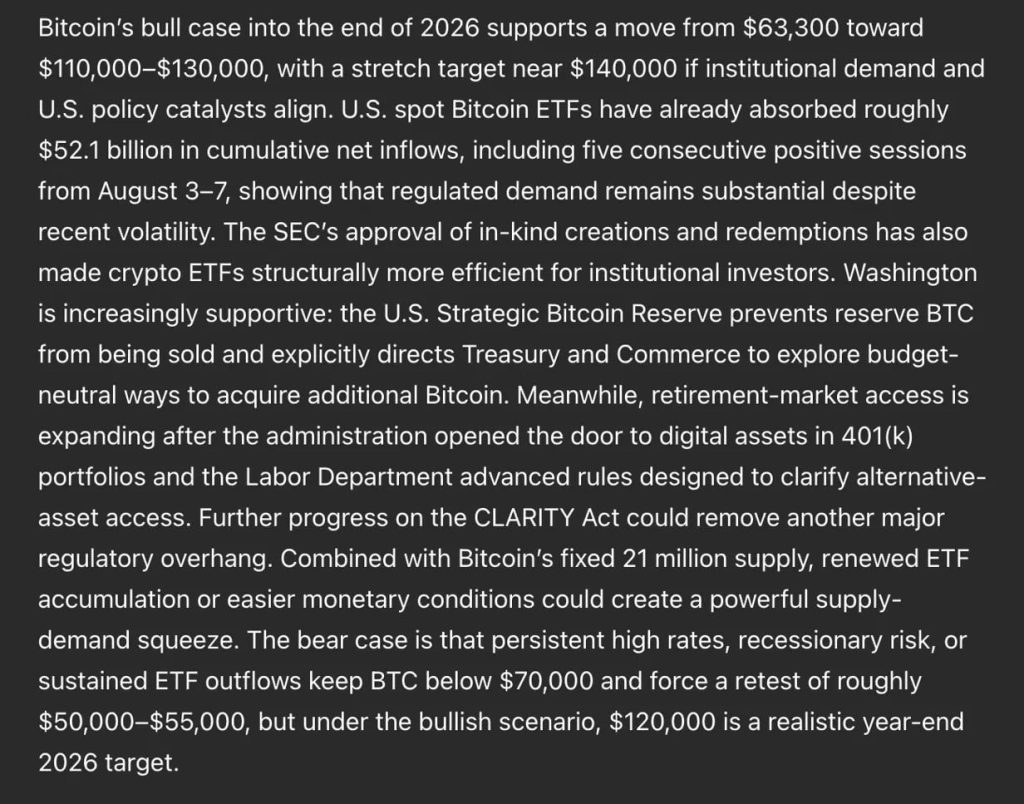
Bitcoin has already been cut nearly in half from its 2025 peak. ChatGPT AI predicts the punishment may end with an explosive reversal, with its latest Bitcoin price prediction targeting $120,000 by the end of 2026 and a stretch toward $140,000.
The call from Sam Altman’s OpenAI chatbot asks Bitcoin to nearly double from $63,593. That sounds aggressive until you look at where the money could come from.
US spot Bitcoin ETFs have already absorbed roughly $52.1 billion in cumulative net inflows, including 5 straight positive sessions from August 3-7. The SEC’s approval of in-kind creations and redemptions also gives institutional investors a more efficient route into crypto ETFs.
Washington is shifting too. The US Strategic Bitcoin Reserve keeps reserve BTC off the market while directing Treasury and Commerce officials to explore budget-neutral ways of acquiring more Bitcoin.
Then there is the retirement market. Digital assets now have a wider path into 401(k) portfolios, while further progress on the CLARITY Act could strip away another layer of regulatory uncertainty.
Bitcoin only has 21 million coins. Put stronger ETF accumulation, broader retirement access and easier monetary conditions against that fixed ceiling, and the supply-demand equation can change fast.
But the trade can break the other way. High rates, recession pressure or sustained ETF withdrawals could trap Bitcoin below $70,000 and send it back toward $50,000-$55,000.
[crypto-chart coin=”bitcoin”]
Discover: Everyone’s Got a Take. Get Free $25 to Actually Trade Yours
AI Predicts Bitcoin Price: BTC Has to Escape the $60,000s First
The chart makes ChatGPT’s $120,000 target look distant. Bitcoin has fallen from above $120,000 and spent months printing lower highs before finally finding buyers around $60,000.
That selloff has now given way to a tight base around $60,000-$66,000. Holding $60,000 keeps that base alive, while $68,000-$70,000 is the first serious barrier bulls need to reclaim.
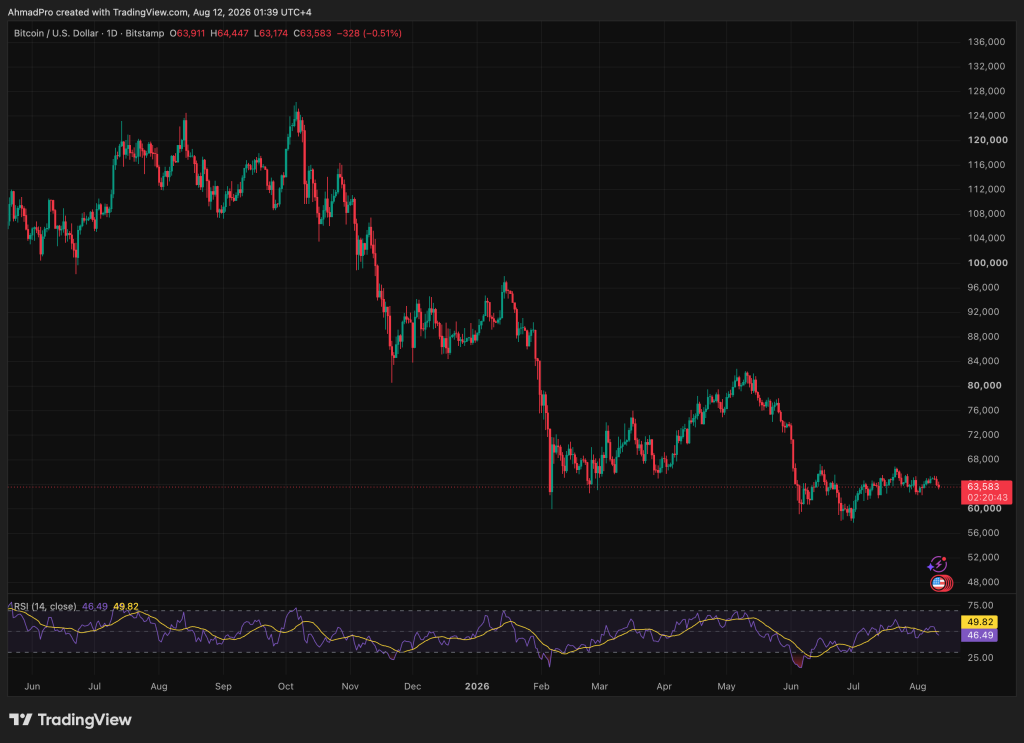
Bitcoin closed at $63,593, down 0.50% on the day after trading between $63,174 and $64,447. Above $70,000, the chart opens toward the previous $76,000-$82,000 recovery zone.
RSI reads 46.55 against a 49.82 signal line. That 3.27-point deficit puts sellers slightly ahead, but neither side has enough momentum to control the market decisively.
For now, Bitcoin is compressing rather than collapsing. A clean break from this base would be the first chart signal that ChatGPT AI’s road toward $120,000 has actually begun.
Discover: Your Market Calls Are Worth Something. Start With Free $25 on Kalshi
Bitcoin at $120,000? Kalshi Lets Traders Put a Price on the Outcome
Forecasts are easy to publish. Kalshi turns them into markets where traders can take a position on what actually happens.
That makes a call like ChatGPT AI’s $120,000 Bitcoin target more than something to debate. Traders can use prediction markets to gauge how real money prices future crypto outcomes, alongside elections, economics, technology and other major events.
For readers watching whether Bitcoin can turn this $60,000 base into a six-figure comeback, Kalshi offers another signal worth following: what the market itself is willing to bet on.
→ Get up to $25 to trade your first market on Kalshi
Don’t Miss Out on Our $1,000 USDT Airdrop on ByBit
The post ChatGPT AI Predicts Bitcoin Will Test This Level Before The End of 2026 appeared first on Cryptonews.
Crypto World
Solana platform taps prediction market Kalshi for Wall Street-style high-speed data feed


The growing presence of financial institutions in cryptocurrency brings with it increasing demand for Wall-Street style systems in digital asset markets, such as servers that offer split-second advantages when executing trades.
Solana-based DoubleZero looks to meet that demand by adding prediction market Kalshi’s order book to its low-latency market data feed.
The DoubleZero Foundation said this will provide trading firms with a machine-readable view of a prediction market for pricing, hedging and signal generation on Solana, one of the major layer-1 blockchains.
The foundation described DoubleZeroEdge as a transport layer, sending live exchange and onchain data over dedicated fiber, publishing the data and distributing it simultaneously to all connected traders.
In traditional finance (TradFi), institutions use specialized networks to access data at high speed, whereas in crypto, traders still largely rely on the internet. DoubleZero attempts to address that through a bespoke onchain system.
“This is the same distribution model that has underpinned traditional financial exchanges, from NYSE to Nasdaq to the CME, for decades,” the foundation said in an emailed announcement on Wednesday.

“It’s not about not talking about problems,” says Stephanie Mahalec, a therapist in Los Angeles. “Talking about problems is a very important part of relationships. It’s just how you talk about it.”
Here’s how to tell when trauma dumping might be reaching unhealthy levels in a friendship or relationship, according to therapists—and how to repair.
There’s no room for the other person to set a boundary
Asking whether someone has time to listen is considerate. It can be as simple as: “Do you have a minute? Can I vent about something?”
Dr. Hans Watson, a psychiatrist in South Jordan, Utah, recommends taking into account the time, place, and audience. Is this a workable moment? Is this an appropriate setting? Is this someone you ordinarily talk to about personal things?
With some relationships, that understanding is already in place. If you and a close friend routinely call each other when life falls apart, you probably don’t need to renegotiate the terms every time. And if you forget to ask permission during an especially painful moment, that alone does not make the conversation a trauma dump. “One conversation or one trauma dump is not a problem,” Groskopf says. “We’re all human.”
Harmony released a mainnet patch on Aug. 12 that changes two verification paths after reports of an unauthorized ONE mint: a quorum check affecting pre-staking-epoch committees and a cross-shard receipt mechanism that could apply the same transfer more than once. The v2026.1.1 release came after… Read the full story at The Defiant
Google has unveiled the Pixel 11 lineup, but the new phones arrive with unusually modest hardware upgrades, higher prices, and even a downgrade in RAM on some models.
The Pixel 11, Pixel 11 Pro, Pixel 11 Pro XL and Pixel 11 Pro Fold bring Google’s new Tensor G6 chip and several AI-powered software features. However, the physical changes are limited compared with previous generations.
What is Changing on the Google Pixel 11 Lineup
Some of the main hardware changes include:
- The standard Pixel 11 gets a 56% larger main camera sensor, faster 25W wireless charging and a smaller camera bump.
- Battery-life claims remain largely unchanged from last year.
- Most camera sensors are unchanged, while Google has not announced any meaningful graphics-performance improvement for Tensor G6.
- The Pixel 11 Pro gets a brighter display and a 30% larger telephoto sensor, but its main camera specifications remain largely similar.
- The Pro models now start with 12GB of RAM, down from 16GB on last year’s starting configurations.
- Google also removed the body-temperature sensor and replaced it with a new LED-based “Highlight” notification feature.
The biggest change may be the price.
The Pixel 11 starts at $899, up from $799. The Pixel 11 Pro starts at $1,099, while the Pro XL rises to $1,299.
The Fold also gets a $100 price increase despite keeping the same 256GB starting storage.
Why Google Is Cutting Back on Hardware
The weak upgrade cycle comes as smartphone makers face a global memory shortage driven by the AI boom.
AI data centers consume huge amounts of high-bandwidth memory, server DRAM and enterprise storage. Memory makers such as Samsung, SK hynix and Micron are therefore shifting more production toward higher-margin AI hardware.
That has made smartphone memory significantly more expensive.
TrendForce estimated that LPDDR5X mobile memory contract prices jumped 78% to 83% quarter-on-quarter in Q2 2026.
Earlier data showed the cost of an 8GB RAM and 256GB storage configuration had already risen close to 200% year-on-year.
Manufacturers are responding by cutting memory specifications, increasing prices or limiting hardware upgrades.
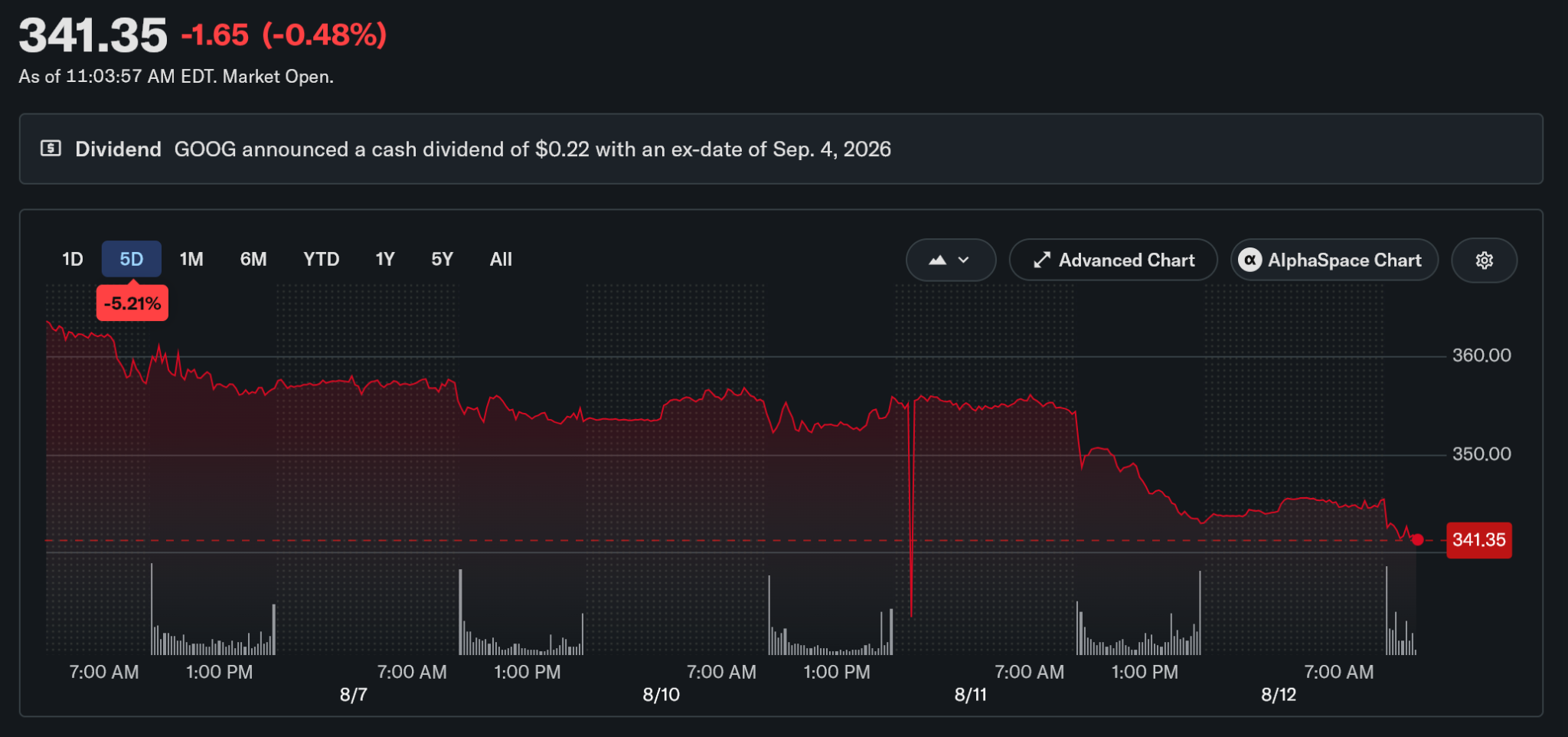
Alphabet Shares Reverse Early Gain
Alphabet shares initially rose about 0.6% at Wednesday’s market open, briefly approaching a 1% gain.
However, the stock later reversed course and fell about 0.2%, even as the broader Nasdaq remained higher.

There is no evidence that Pixel 11 reviews caused the decline. Still, the early reversal comes as Google asks consumers to pay more for phones whose biggest improvements increasingly come from software and AI rather than new hardware.
The post Google Pixel 11 Launch Disappoints as Alphabet Stock Falls appeared first on BeInCrypto.
Lumentum Holdings (LITE) reported fiscal fourth-quarter earnings and revenue that topped consensus estimates amid high expectations. The company’s fiscal first-quarter 2027 guidance for Lumentum stock came in slightly above views. The company reported fiscal Q4 earnings after the market close on Tuesday. “Lumentum reported a quarter with revenue effectively in-line and gross margin above, the same dynamic in the prior…
Copyright ©2026 Investor’s Business Daily, LLC. All rights reserved. 87990cbe856818d5eddac44c7b1cdeb8


That is the flaw volatility exposes. Markets have become faster, more global and more interconnected, while capital movement remains slow and fragmented. Closing that gap requires a different way of thinking about cash, collateral and settlement.
Stablecoins are no longer peripheral
Settlement remains one of the weakest links in capital markets. Institutions can execute trades globally in milliseconds, but the transfer of value that supports those trades can still take days. That delay creates funding pressure, operational risk and unnecessary capital drag.
This is where stablecoins become relevant to institutional markets. Strip away the noise and the use case is straightforward: they allow cash-like value to move with the speed and programmability of digital assets. For firms still working around T+1 or T+2 settlement, nostro and vostro accounts, and hard cut-off times, that is not a marginal improvement. It changes what is operationally possible.
The market has already moved beyond theory. Stablecoin market capitalisation is now around $320 billion, and recent industry data points to record levels of on-chain transfer activity. The more important point, however, is not the headline number. It is that regulated institutions are beginning to treat stablecoins and tokenised cash as settlement infrastructure rather than crypto-market curiosity.
A 70% rally from here would only get XRP to the middle of Perplexity’s target range. Perplexity AI predicts XRP can reach $1.60-$2.20 by the end of 2026, with its latest XRP Price Prediction settling on $1.75 as the most likely bullish target.
That is a bold reversal call with XRP sitting at $1.0235. Perplexity co-founder and CEO Aravind Srinivas’s AI sees legal clarity, institutional products and real network demand as the fuel.
Ripple’s ongoing court settlement progress could finally shrink the legal discount that has followed XRP for years. Clearer US crypto rules would give the market one less reason to price in regulatory risk.
An XRP-specific ETF or institutional product launch could bring fresh capital into the asset. Rising on-chain demand from exchange wallets and treasury inflows would add something even more important: evidence that XRP is being used, not merely traded.
Get those pieces moving together and $1.60-$2.20 stops looking absurd. The model puts $1.30-$1.50 closer to its base case, with $1.75 its preferred bullish year-end target.
The bear case is already knocking. A negative SEC outcome or delayed regulatory milestones could break $1.20 support and expose the $1.05-$1.15 region, levels XRP is already trading below.
Discover: Everyone’s Got a Take. Get Free $25 to Actually Trade Yours
AI Predicts XRP: Ripple Is Running Out of Room Near $1
The chart tells a much uglier story than the forecast. XRP has collapsed from above $3.00, carved out a long sequence of lower highs and now sits just above the psychologically important $1.00 mark.
There is no convincing reversal yet. The structure still resembles a descending trend grinding into support, with $1.00-$0.99 acting as the immediate floor and $1.10-$1.20 forming the first meaningful resistance zone.
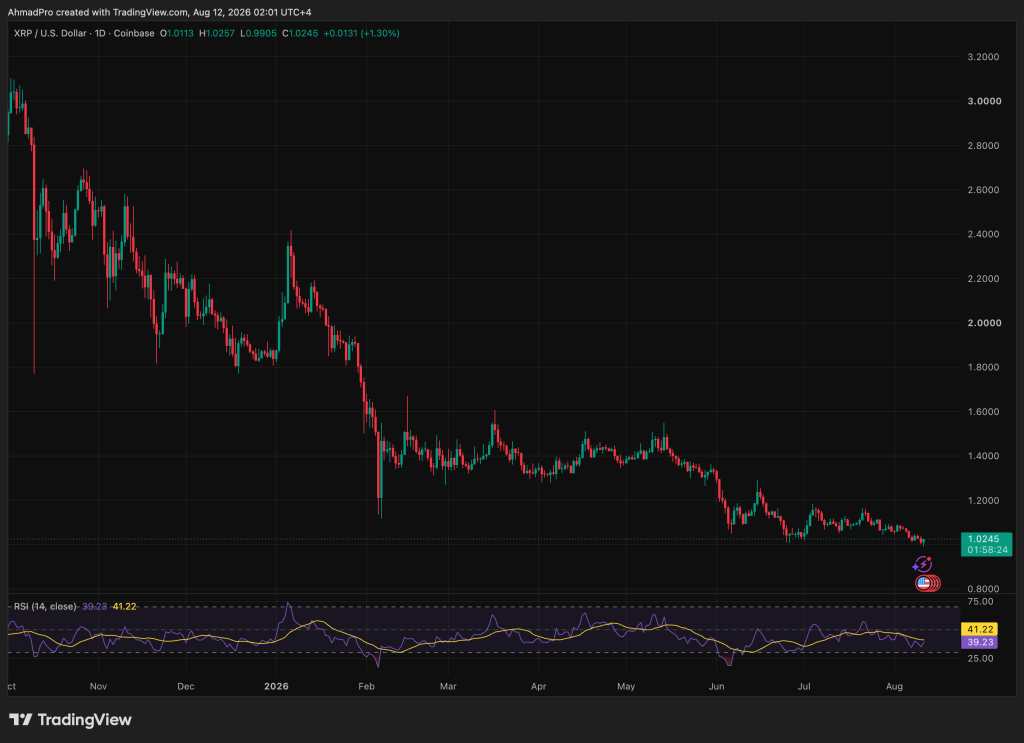
XRP closed at $1.0235, up 1.20% for the session after trading between $0.9905 and $1.0257. That intraday recovery kept $1.00 alive, but one green candle does not erase months of selling.
RSI sits at 38.94 while its signal line reads 41.20. The 2.26-point gap keeps momentum tilted toward sellers, although XRP has not yet entered deeply oversold territory.
This is where Perplexity AI’s $1.75 call gets tested. XRP first needs to stop defending $1.00 and start attacking $1.20 before a run toward $1.60-$2.20 deserves serious attention.
Discover: Your Market Calls Are Worth Something. Start With Free $25 on Kalshi
Bitcoin Hyper Takes the Opposite Side of the Crypto Speed Problem
XRP’s thesis depends heavily on institutional access and clearer rules. Bitcoin Hyper attacks a different bottleneck: making Bitcoin useful for faster, cheaper on-chain activity without abandoning the network that made it valuable.
Bitcoin Hyper combines Bitcoin Layer 2 infrastructure with the Solana Virtual Machine, bringing high-speed execution, low fees and smart contract functionality into a Bitcoin-focused ecosystem. Its Canonical Bridge is designed to move BTC between Bitcoin and the Layer 2, while decentralized governance gives the network a path beyond centralized control.
That creates a sharper proposition than simply betting on another standalone chain. Bitcoin Hyper is effectively betting that Bitcoin’s next chapter is not just about holding BTC, but actually putting that capital to work.
For investors watching whether the next crypto expansion reaches beyond simple price appreciation, Bitcoin Hyper puts that thesis front and center.
→ Get up to $25 to trade your first market on Kalshi
cta url=”[https://cryptonews.com/ext/bybit-airdrop-campaign”]Don’t Miss Out on Our $1,000 USDT Airdrop on ByBit[/cta]
The post Perplexity AI Predicts an XRP Scenario Few Analysts Are Discussing appeared first on Cryptonews.

Commodities Trader Marex Jumps 13% On Earnings, Flashes Buy Signal

The House passed a stopgap funding bill 220-205 on July 21, moving its proposed government-funding deadline from September 30 to December 4 and placing it after the midterms. This has led to the odds of a Government shutdown happening across all predition markets.
But that is no longer the full picture: on August 8, the Senate passed its own version 90-6, extending funding through December 11 instead. The two versions still need to be reconciled, meaning Congress has moved closer to avoiding an October shutdown without yet completing the process.
For Bitcoin traders, that distinction matters. The immediate September 30 cliff looks less threatening, but the underlying funding fight has largely been pushed deeper into the year rather than eliminated.

Discover: Everyone’s Got a Take. Join Kalshi and Get a Free $25 to Actually Trade Yours
Odds of a Government Shutdown: A Rescheduled Fight, Not a Settled One
The disputes behind the funding deadline were not settled by the July House vote. The House measure simply extended current funding largely at existing levels through December 4, while the Senate’s subsequent version would run through December 11 and contains provisions absent from the House bill.
The Senate bill also restricts the administration’s ability to redirect certain funds and temporarily blocks a White House rule requiring political review of federal grants. Those differences mean the legislation must return to the House before it can reach President Trump’s desk.
Meanwhile, House Republicans have separately advanced a $95 billion budget plan covering Iran-related defense and intelligence spending, farm assistance and parts of President Trump’s election-law agenda. The baseline appropriations fight has therefore been postponed rather than permanently settled.
Discover: Your Market Calls Are Worth Something. Start With Free $25 on Kalshi
What the Prediction Markets Are Saying
Kalshi and Polymarket run event contracts that pay according to whether defined outcomes occur under each market’s resolution rules. The October 1 shutdown market therefore measures whether a shutdown occurs around that specific deadline, not whether another funding confrontation emerges in December.
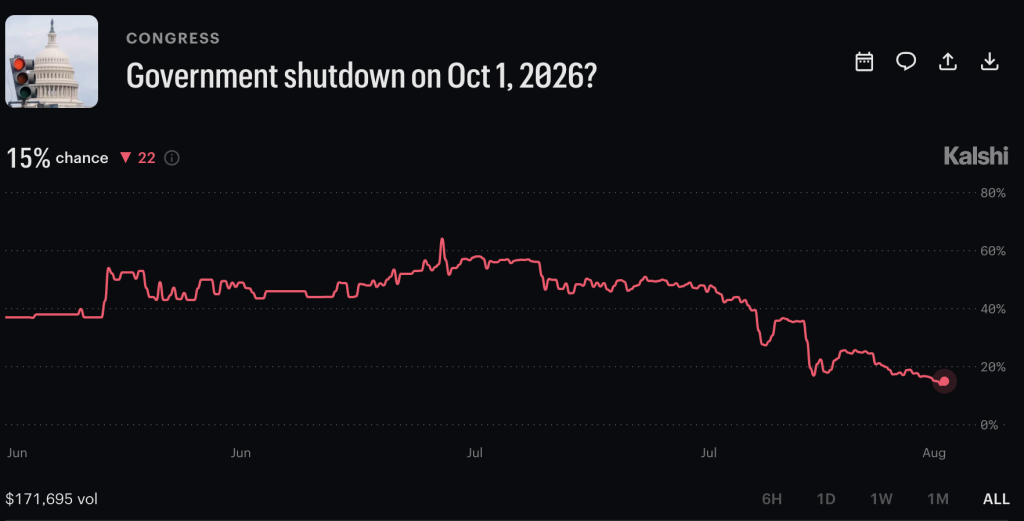
That distinction has become even more important since the Senate vote. With both chambers now backing temporary funding beyond the midterms, the probability of an October shutdown should not be treated as a proxy for the broader probability of another fiscal confrontation later in 2026.
Prediction markets have also proved highly sensitive to congressional developments during previous funding fights. The Department of Homeland Security shutdown that began February 14, for example, generated large swings in contracts tracking when funding would return as negotiations evolved.
Why Bitcoin Traders Are Watching December Aside from the Odds of a Government Shutdown
Shutdown risk can matter for crypto because fiscal uncertainty, liquidity expectations and broader risk sentiment can all influence Bitcoin. But the relationship is not mechanical, and a shutdown by itself does not guarantee either a Bitcoin rally or decline.
Arthur Hayes has separately argued that potential Federal Reserve intervention to support the Japanese yen could expand dollar liquidity and ultimately benefit Bitcoin. His broader liquidity thesis makes the policy response surrounding fiscal or monetary stress potentially more important for Bitcoin than the political event itself.
A December funding standoff would also arrive after the midterm elections and during year-end market positioning. For traders considering a liquidity-driven framework, the key issue is therefore not only whether a shutdown occurs, but what fiscal and monetary conditions develop around it.
Bitcoin’s Other Near-Term Catalysts
On August 12, Bitcoin remained below $65,000 after briefly reaching about $65,200 earlier in the week. The congressional funding timeline is only one of several macro variables influencing the market.
July CPI is due on August 12, leaving the Federal Reserve’s September decision sensitive to another inflation surprise. Market expectations remain divided over whether policymakers could raise rates again, meaning a hotter-than-expected inflation print could reset the rate outlook independently of developments in Congress.
The Strait of Hormuz relief trade has also unraveled after President Trump demanded decades of compensation from Iran, pushing oil prices higher. Bitcoin has struggled to establish a sustained move above $65,000 amid the renewed geopolitical uncertainty.
That leaves Bitcoin exposed to several simultaneous catalysts: inflation, Federal Reserve expectations, oil prices, Iran-related developments and the evolving U.S. funding negotiations. Any attempt to attribute its next move solely to shutdown odds would therefore oversimplify the macro picture.
Don’t Miss Out on Our $1,000 USDT Airdrop on ByBit
The post Congress Pushes Odds of a Government Shutdown to December as Bitcoin Watches appeared first on Cryptonews.

Heatwave triggers ‘essential travel only’ warning for train passengers

SpaceX Stock Climbs Nearly 7% After Starlink Launch as Shares Hold Above IPO Price

ChatGPT AI Predicts Bitcoin Will Test This Level Before The End of 2026


-

 Fashion5 days ago
Weekend Open Thread: Mattifying Sunscreen
-

 Fashion5 days ago
Frugal Friday’s Workwear Report: Cap-Sleeve Pointelle Crewneck Sweater
-

 News Videos4 days ago
Can Astrology Help Find Gold and Silver Trends? A Financial Astrology Guide
-

 Sports7 days ago
Jordan Coyle & Cordiamo take Laya Arena Stakes at RDS
-
 Business7 days ago
US stocks: Dow closes at record on Mideast optimism; SpaceX, AMD drag Nasdaq
-

 Politics6 days ago
Reform UK And Greens Sink To Lowest Favourability Ratings To Date
-

 Business7 days ago
Supply chain issues impact Ingredion
-

 Tech5 days ago
Rinn Pharma & Biopharma to join NordicPharmaTrain network
-

 Business4 days ago
How to Start a Cleaning Business: A Step-by-Step Guide
-

 Business3 days ago
Datadog: Best Of Breed For Multiple Reasons
-

 Business4 days ago
BDC Weekly Review: Private BDC Q2 Numbers Are Strong
-
 NewsBeat17 hours ago
Communication cards help banking customers access services or report scams
-
Sports7 days ago
Spider-Man: Brand New Day ending explained: Is Peter Parker alive?
-

 Fashion7 days ago
Suit of the Week: Me + Em
-
 Tech6 days ago
Price Hikes May Be Coming for PC Motherboards Next
-

 Business6 days ago
Brightwater secures funding for WA-first dementia projects
-
 Crypto World6 days ago
Galaxy Digital Stock Slides 14% as Crypto Prices Hit Earnings
-

 Politics7 days ago
The Not-So Talented Mr Arday
-

 Fashion5 days ago
Weekly News Update, 8.6.26 – Corporette.com
-

 Politics7 days ago
Comedian Jimmy Cricket Has Died, Aged 80
You must be logged in to post a comment Login