
Crypto World
How to Tell If You’re Trauma Dumping or Just Venting


“It’s not about not talking about problems,” says Stephanie Mahalec, a therapist in Los Angeles. “Talking about problems is a very important part of relationships. It’s just how you talk about it.”
Here’s how to tell when trauma dumping might be reaching unhealthy levels in a friendship or relationship, according to therapists—and how to repair.
There’s no room for the other person to set a boundary
Asking whether someone has time to listen is considerate. It can be as simple as: “Do you have a minute? Can I vent about something?”
Dr. Hans Watson, a psychiatrist in South Jordan, Utah, recommends taking into account the time, place, and audience. Is this a workable moment? Is this an appropriate setting? Is this someone you ordinarily talk to about personal things?
With some relationships, that understanding is already in place. If you and a close friend routinely call each other when life falls apart, you probably don’t need to renegotiate the terms every time. And if you forget to ask permission during an especially painful moment, that alone does not make the conversation a trauma dump. “One conversation or one trauma dump is not a problem,” Groskopf says. “We’re all human.”

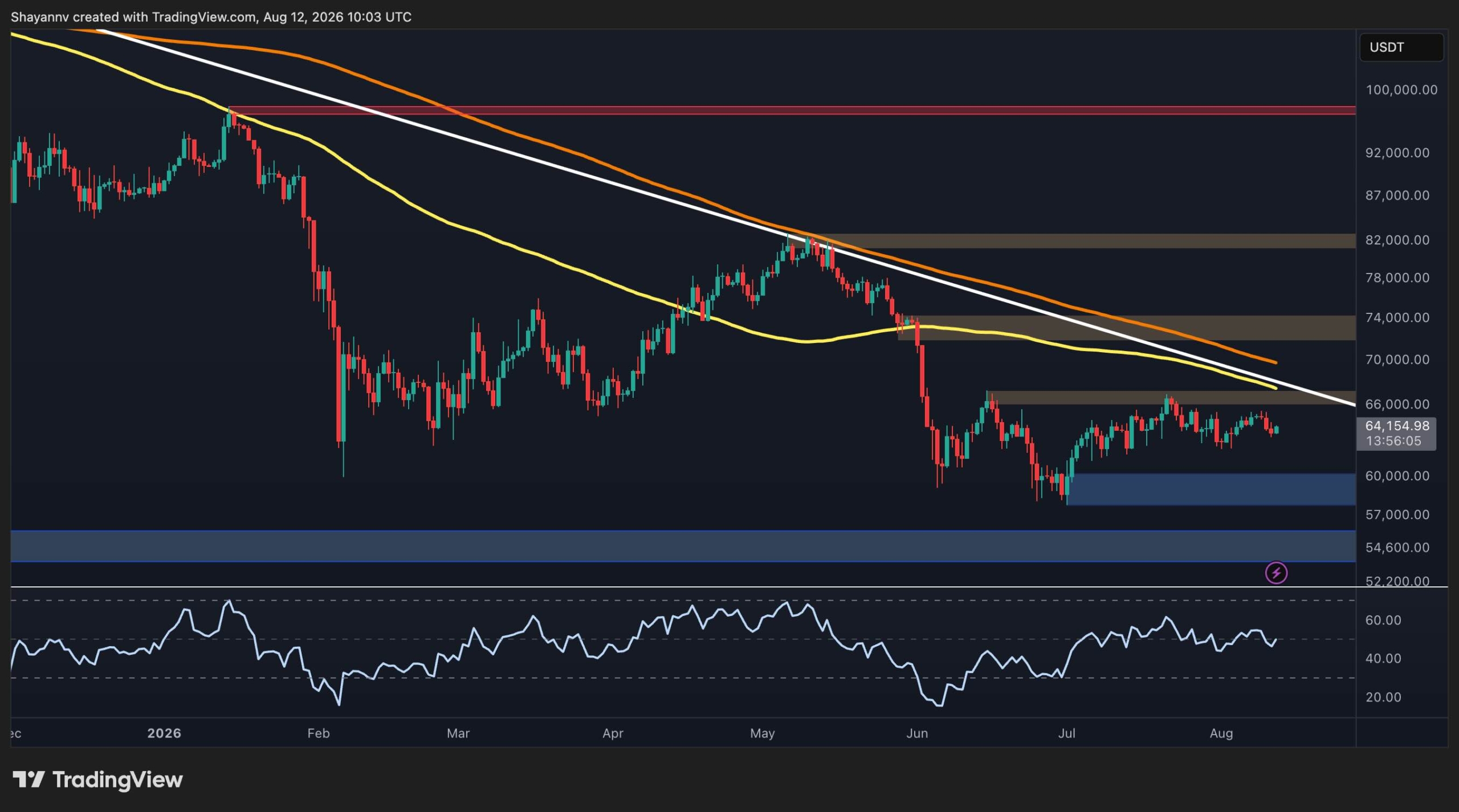
Bitcoin remains trapped in a broad consolidation phase, with the price struggling to break above the descending resistance that has governed the market for several months. At around $63.5K, BTC is showing some short-term recovery, but the broader structure remains cautious until the key resistance zones are decisively broken.
Bitcoin Price Analysis: The Daily Chart
The daily chart shows Bitcoin trading below a descending trendline that connects the major highs since the beginning of the year. The trendline currently sits around the $66K area, making this the first major hurdle for the buyers. A daily breakout above this resistance would represent an important structural improvement and could open the door toward the $74K resistance zone.
The broader trend remains bearish-to-neutral; however, BTC is still trading below the major moving averages displayed on the chart. The longer-term moving averages are sloping downward, reinforcing the significance of the descending trendline.
On the downside, the $60K area represents an important support zone, while the broader $54K region is the next major demand area visible on the chart. Holding above these levels keeps the current consolidation structure intact, whereas a sustained breakdown could signal another leg lower.
BTC/USDT 4-Hour Chart
The 4-hour chart provides a more constructive picture in the short term. Bitcoin has been forming a tightening structure, with an ascending support trendline converging toward a descending resistance trendline. The price is currently around $64K, leaving the market relatively close to the upper boundary.
The key resistance is concentrated around $66K-$67K. A clean breakout above this zone, particularly if accompanied by a sustained move beyond the descending trendline, could trigger a continuation toward the $66K-$67K area and potentially higher.
Conversely, the rising support line and the $62K zone are the most important levels to watch on the downside. A break below this area would weaken the short-term bullish structure and could expose BTC to the $60K support zone again.
The 4-hour RSI has also rebounded from near-oversold conditions and is now recovering toward the middle of its range. This points to improving momentum, although it is not yet strong enough to confirm a sustained upside breakout. For now, the market appears to be waiting for a decisive break from the tightening range.

Sentiment Analysis
The funding-rate chart provides an interesting contrast to Bitcoin’s price action. Funding rates were deeply negative during the sharp sell-off earlier in the year, with several significant spikes below zero as BTC traded around the $70K-$80K region. This indicated that bearish positioning had become particularly aggressive.
Since then, funding has gradually normalized and has turned predominantly positive. The latest reading is around 0.006%, while Bitcoin is trading near $64K. This suggests that leveraged long positioning has returned, but the funding rate is not yet at an extreme level comparable to the highly crowded periods over the past few years.
That is broadly constructive, although it also introduces some short-term downside risk. If BTC fails to break the $65K-$67K resistance area while funding remains positive, long positions could become vulnerable to a liquidation-driven pullback. Conversely, a breakout accompanied by only moderately positive funding would provide a healthier setup, as it would suggest that the move is not being driven by excessive leverage.

The post Bitcoin Price Analysis: What Does BTC’s Bearish Market Structure Signal Next? appeared first on CryptoPotato.
Flash.Trade founder Anas Khader gave three reasons for shutting down his Solana perps exchange on Aug. 7, and the second one named the Solana Foundation. Four days later the Foundation's president was publicly rejecting the word "kingmaking." The underlying discussion is how an organization with a… Read the full story at The Defiant
For the first time, TIME will publish a ranking of America’s Most Innovative Companies, in partnership with Statista, a leading international provider of market and consumer data and rankings. Innovation within a company can take many forms. For this ranking, three dimensions will be considered: product innovation, process innovation, and innovation culture. To identify the most innovative companies in the U.S., comprehensive surveys will be conducted. Employees will evaluate their own employers, providing an internal assessment of innovation; experts will recommend and evaluate companies they are familiar with, contributing an external perspective; and the strength of a company’s patent portfolio will be evaluated as an objective criterion. The survey results and objective criterion will be combined into a single score.
Norway’s sovereign wealth fund has earned a record 1.75 trillion kroner, or about $184.3 billion, in the first half of 2026 while disclosing a $1.22 billion investment in SpaceX for the first time.
Summary
- Norway’s sovereign wealth fund generated a 9.4% return during the first six months of 2026.
- Asian technology stocks helped lift first-half profit to a record 1.75 trillion kroner.
- The fund owned a 0.05% SpaceX stake worth $1.22 billion as of June 30.
- Its 10 largest investments now account for about 20% of the total portfolio.
Asian technology stocks drove the record profit
Norges Bank Investment Management reported on Aug. 12 that the Government Pension Fund Global produced a 9.4% investment return during the first half of 2026, taking its profit to 1.75 trillion Norwegian kroner.
The result surpassed the previous first-half record of 1.5 trillion kroner, set in 2023. Gains across global equity markets supplied much of the return, with Asian technology companies making an especially strong contribution.
“The result is driven by good returns in the equity market, particularly from Asian technology stocks,” NBIM CEO Nicolai Tangen said.
After losing 2.6% during the first quarter, the fund recovered as technology and semiconductor stocks advanced in the following three months. The Wall Street Journal reported that its investments returned 11.5% in the second quarter, the best quarterly performance in six years, while equities gained 16% over the period.
Currency movements had reduced the fund’s value by 427 billion kroner during the first quarter. Its market value then increased from 19.998 trillion kroner at the end of March to 22.683 trillion kroner, or about $2.3 trillion, as of June 30.
The fund received net inflows of 89 billion kroner during the first half after expenses, according to the Journal. Norway deposits revenue from its oil and gas industry into the portfolio, which invests abroad to spread the country’s wealth across global markets.
Operating under a mandate set by Norway’s Ministry of Finance, NBIM manages investments across equities, fixed-income securities, unlisted real estate, and renewable energy infrastructure. The portfolio contains holdings in about 7,100 companies across more than 50 countries and owns an average of nearly 1.5% of all listed shares worldwide.
Norway wealth fund has disclosed its first SpaceX stake
Alongside the half-year results, NBIM’s updated holdings list showed that the fund owned about 7.3 million Class A shares in SpaceX on June 30. The position represented 0.05% of Elon Musk’s aerospace company and carried a value of roughly $1.22 billion.
NBIM had not previously reported an investment in SpaceX. Deputy CEO Trond Grande said in April that the fund was discussing a possible investment with the company before SpaceX completed its U.S. listing in June.
SpaceX sold 555.6 million shares for $135 each on June 12, raising about $75 billion at a valuation near $1.75 trillion. The offering became the largest initial public offering in U.S. history, according to earlier IPO coverage by crypto.news.
Goldman Sachs led the underwriting group alongside Morgan Stanley, Bank of America Securities, Citigroup, and JPMorgan. SpaceX also allocated 30% of its offering to individual investors, compared with the smaller retail portions commonly offered in large U.S. listings.
Shares opened at $150 and climbed sharply during the company’s first trading sessions before losing part of those gains. NBIM’s investment remains small beside several early SpaceX backers, including Alphabet, whose second-quarter filing revealed a stake valued at $94.1 billion.
Google joined Fidelity in a $1 billion SpaceX funding round in 2015. As reported in July, Alphabet’s resulting position equaled about 6% of the newly listed company, although some of the shares remained subject to sale restrictions.
U.S. investors gained SpaceX exposure through major indexes
SpaceX’s public listing has given U.S. investors several routes to hold the company through shares, funds, and index-linked products. The stock entered the Nasdaq-100 on July 7, creating demand from funds that follow the U.S. technology index.
An estimated $4.3 billion in passive buying was tied to the addition, according to the earlier crypto.news report. Index-tracking funds generally purchase newly included companies to keep their portfolios aligned with the benchmark, exposing their shareholders to SpaceX without requiring a direct stock purchase.
SpaceX also connects the Norwegian fund’s new holding with the digital-asset market. The company disclosed 18,712 Bitcoin on its balance sheet following its IPO, with the position valued at about $1.2 billion around the time of its listing.
Under U.S. accounting rules adopted by the Financial Accounting Standards Board, public companies measure eligible crypto holdings at fair value. Changes in the value of SpaceX’s Bitcoin can therefore affect its reported earnings, although the asset represents only a small part of the company’s total market capitalization.
A July valuation analysis found that the Bitcoin position represented about 0.076% of SpaceX when the company was valued near $1.56 trillion. The calculation challenged descriptions of SPCX as a major Bitcoin proxy because an ordinary daily move in its stock could change more market value than its entire cryptocurrency holding.
NBIM’s SpaceX stake consequently provides the Norwegian fund with a small amount of indirect Bitcoin exposure. Based on its 0.05% ownership and SpaceX’s disclosed balance, the fund’s share of the company’s Bitcoin would be economically minor and does not constitute a direct purchase by NBIM.
Large technology holdings now make up more of the portfolio
Technology companies already occupy several of the largest positions in the Norwegian fund. At the end of June, NBIM owned a 1.28% stake in Nvidia valued at about $62 billion, making the chipmaker its biggest disclosed technology investment.
Apple followed with a position worth approximately $52 billion, while Alphabet accounted for about $50 billion. Its Microsoft and Taiwan Semiconductor Manufacturing holdings were valued at around $35 billion and $34 billion, respectively.
The figures place five technology companies among the fund’s most valuable investments. U.S.-listed equities account for about 40% of the total portfolio, giving American companies a large role in its performance even though Asian technology shares led the first-half gains.
During the results presentation, Tangen said the fund’s 10 largest holdings now represent roughly 20% of its total value. He identified the growing concentration of large technology companies as a risk for a portfolio designed to spread investments across thousands of businesses and several asset classes.
Equities make up more than two-thirds of the fund. The remaining assets are mainly fixed-income securities, along with smaller allocations to unlisted real estate and renewable energy infrastructure.
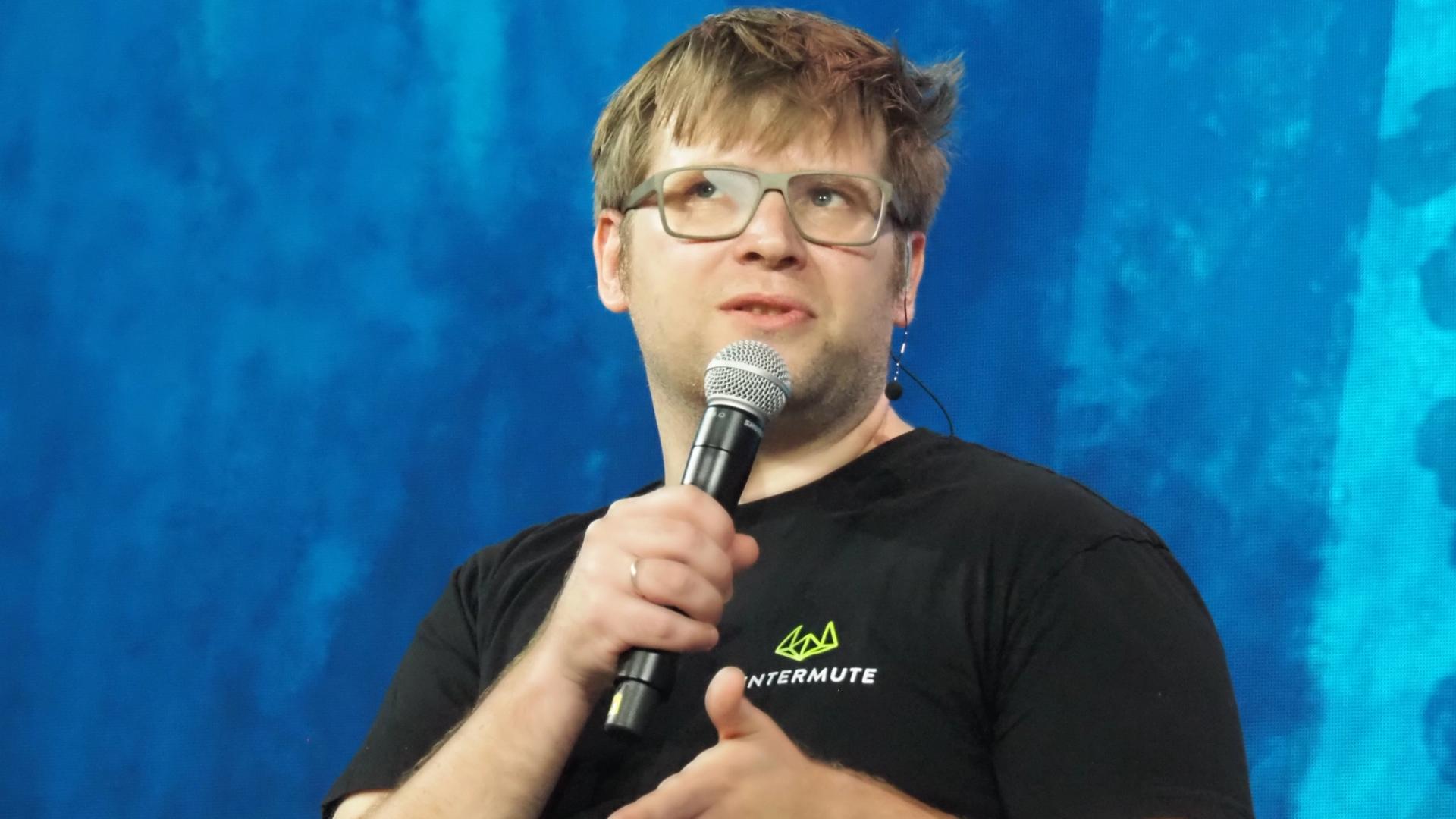
Crypto market maker Wintermute plans to invest about $1 billion in high-frequency trading and artificial intelligence data-center infrastructure over five years as it expands into stocks, commodities and foreign exchange.
The London-based firm wants non-crypto markets to generate more than 50% of revenue by the end of 2027, up from 10% now, according to a Bloomberg report citing founder and CEO Evgeny Gaevoy. Wintermute expects to fund the spending with retained earnings.
The push follows a drop in crypto activity. Wintermute’s average daily trading volume fell to about $10 billion this year from $15 billion in 2025 as bitcoin declined to roughly half its October peak above $126,000.
Institutions accounted for a record 72% of spot trading volume on its over-the-counter desk in the first half of 2026.
Gaevoy said the privately held company was profitable in 2025 and expects to remain profitable this year, without providing figures. Wintermute recorded $582 million in profit during the 2021 crypto bull market, according to Forbes.

Crypto OG and self-proclaimed “financial educator” Tone Vays has admitted he was an “idiot” for giving hackers remote access to his PC during an hour-long Microsoft Teams interview.
According to Vays, the hackers, who claimed to run a legitimate YouTube Channel, downloaded Trojan malware onto his computer using the screen sharing fuction.
When he realised what happened, he disconnected his PC, reinstalled his operating system, and skipped saving any files.
“I was an idiot and gave them access control permissions,” he explained.
Read more: Solana DEX Stabble urges liquidity exit after alleged DPRK mole revealed
Vays claims that everything looks “OK,” and said that he doesn’t store any Bitcoin credentials or password details on his PC.
He compared the incident to what happened to a fellow Bitcoin educator Jimmy Song. In March, Song admitted that his Telegram was likely hacked by North Korea and used to set up fake Zoom calls with Song’s contacts with the intention of uploading malware.
Vays’ recent experience, however, appears to have scared him away from strangers and Microsoft Teams.
Indeed, he claimed he “will no longer do interviews unless I’m friends with the person. Will also never use software like Zoom or Teams or any other download, only web interfaces like Google meets.”
Got a tip? Send us an email securely via Protos Leaks. For more informed news and investigations, follow us on X, Bluesky, and Google News, or subscribe to our YouTube channel.
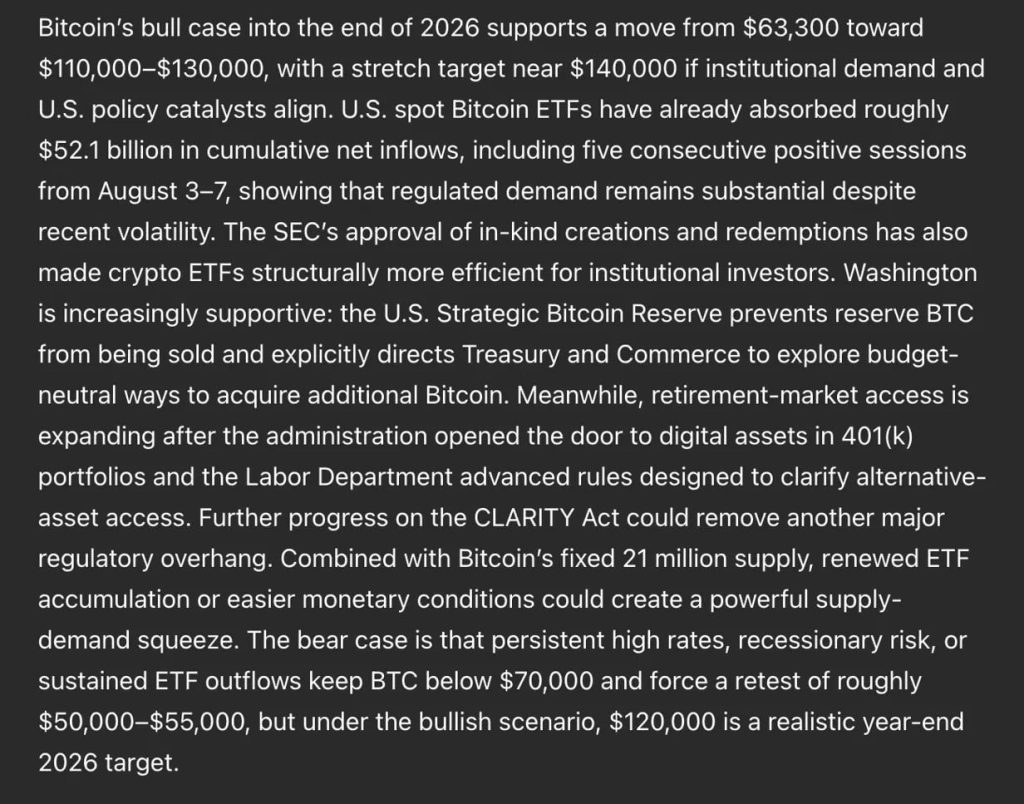
Bitcoin has already been cut nearly in half from its 2025 peak. ChatGPT AI predicts the punishment may end with an explosive reversal, with its latest Bitcoin price prediction targeting $120,000 by the end of 2026 and a stretch toward $140,000.
The call from Sam Altman’s OpenAI chatbot asks Bitcoin to nearly double from $63,593. That sounds aggressive until you look at where the money could come from.
US spot Bitcoin ETFs have already absorbed roughly $52.1 billion in cumulative net inflows, including 5 straight positive sessions from August 3-7. The SEC’s approval of in-kind creations and redemptions also gives institutional investors a more efficient route into crypto ETFs.
Washington is shifting too. The US Strategic Bitcoin Reserve keeps reserve BTC off the market while directing Treasury and Commerce officials to explore budget-neutral ways of acquiring more Bitcoin.
Then there is the retirement market. Digital assets now have a wider path into 401(k) portfolios, while further progress on the CLARITY Act could strip away another layer of regulatory uncertainty.
Bitcoin only has 21 million coins. Put stronger ETF accumulation, broader retirement access and easier monetary conditions against that fixed ceiling, and the supply-demand equation can change fast.
But the trade can break the other way. High rates, recession pressure or sustained ETF withdrawals could trap Bitcoin below $70,000 and send it back toward $50,000-$55,000.
[crypto-chart coin=”bitcoin”]
Discover: Everyone’s Got a Take. Get Free $25 to Actually Trade Yours
AI Predicts Bitcoin Price: BTC Has to Escape the $60,000s First
The chart makes ChatGPT’s $120,000 target look distant. Bitcoin has fallen from above $120,000 and spent months printing lower highs before finally finding buyers around $60,000.
That selloff has now given way to a tight base around $60,000-$66,000. Holding $60,000 keeps that base alive, while $68,000-$70,000 is the first serious barrier bulls need to reclaim.
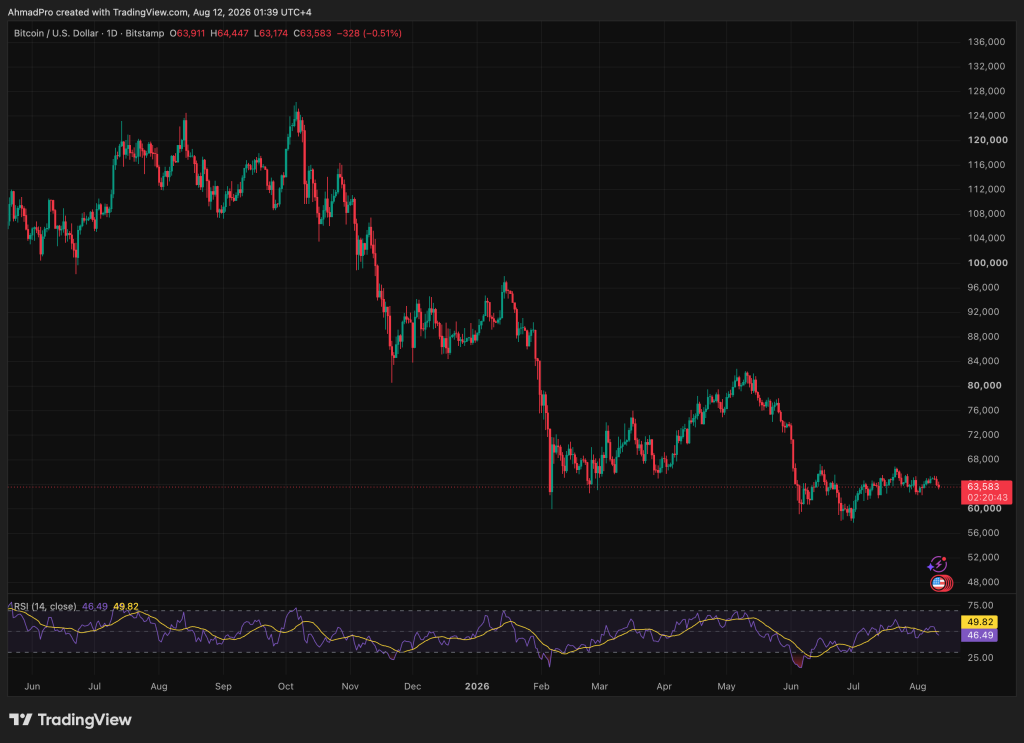
Bitcoin closed at $63,593, down 0.50% on the day after trading between $63,174 and $64,447. Above $70,000, the chart opens toward the previous $76,000-$82,000 recovery zone.
RSI reads 46.55 against a 49.82 signal line. That 3.27-point deficit puts sellers slightly ahead, but neither side has enough momentum to control the market decisively.
For now, Bitcoin is compressing rather than collapsing. A clean break from this base would be the first chart signal that ChatGPT AI’s road toward $120,000 has actually begun.
Discover: Your Market Calls Are Worth Something. Start With Free $25 on Kalshi
Bitcoin at $120,000? Kalshi Lets Traders Put a Price on the Outcome
Forecasts are easy to publish. Kalshi turns them into markets where traders can take a position on what actually happens.
That makes a call like ChatGPT AI’s $120,000 Bitcoin target more than something to debate. Traders can use prediction markets to gauge how real money prices future crypto outcomes, alongside elections, economics, technology and other major events.
For readers watching whether Bitcoin can turn this $60,000 base into a six-figure comeback, Kalshi offers another signal worth following: what the market itself is willing to bet on.
→ Get up to $25 to trade your first market on Kalshi
Don’t Miss Out on Our $1,000 USDT Airdrop on ByBit
The post ChatGPT AI Predicts Bitcoin Will Test This Level Before The End of 2026 appeared first on Cryptonews.
Crypto World
Solana platform taps prediction market Kalshi for Wall Street-style high-speed data feed


The growing presence of financial institutions in cryptocurrency brings with it increasing demand for Wall-Street style systems in digital asset markets, such as servers that offer split-second advantages when executing trades.
Solana-based DoubleZero looks to meet that demand by adding prediction market Kalshi’s order book to its low-latency market data feed.
The DoubleZero Foundation said this will provide trading firms with a machine-readable view of a prediction market for pricing, hedging and signal generation on Solana, one of the major layer-1 blockchains.
The foundation described DoubleZeroEdge as a transport layer, sending live exchange and onchain data over dedicated fiber, publishing the data and distributing it simultaneously to all connected traders.
In traditional finance (TradFi), institutions use specialized networks to access data at high speed, whereas in crypto, traders still largely rely on the internet. DoubleZero attempts to address that through a bespoke onchain system.
“This is the same distribution model that has underpinned traditional financial exchanges, from NYSE to Nasdaq to the CME, for decades,” the foundation said in an emailed announcement on Wednesday.
Harmony released a mainnet patch on Aug. 12 that changes two verification paths after reports of an unauthorized ONE mint: a quorum check affecting pre-staking-epoch committees and a cross-shard receipt mechanism that could apply the same transfer more than once. The v2026.1.1 release came after… Read the full story at The Defiant
Google has unveiled the Pixel 11 lineup, but the new phones arrive with unusually modest hardware upgrades, higher prices, and even a downgrade in RAM on some models.
The Pixel 11, Pixel 11 Pro, Pixel 11 Pro XL and Pixel 11 Pro Fold bring Google’s new Tensor G6 chip and several AI-powered software features. However, the physical changes are limited compared with previous generations.
What is Changing on the Google Pixel 11 Lineup
Some of the main hardware changes include:
- The standard Pixel 11 gets a 56% larger main camera sensor, faster 25W wireless charging and a smaller camera bump.
- Battery-life claims remain largely unchanged from last year.
- Most camera sensors are unchanged, while Google has not announced any meaningful graphics-performance improvement for Tensor G6.
- The Pixel 11 Pro gets a brighter display and a 30% larger telephoto sensor, but its main camera specifications remain largely similar.
- The Pro models now start with 12GB of RAM, down from 16GB on last year’s starting configurations.
- Google also removed the body-temperature sensor and replaced it with a new LED-based “Highlight” notification feature.
The biggest change may be the price.
The Pixel 11 starts at $899, up from $799. The Pixel 11 Pro starts at $1,099, while the Pro XL rises to $1,299.
The Fold also gets a $100 price increase despite keeping the same 256GB starting storage.
Why Google Is Cutting Back on Hardware
The weak upgrade cycle comes as smartphone makers face a global memory shortage driven by the AI boom.
AI data centers consume huge amounts of high-bandwidth memory, server DRAM and enterprise storage. Memory makers such as Samsung, SK hynix and Micron are therefore shifting more production toward higher-margin AI hardware.
That has made smartphone memory significantly more expensive.
TrendForce estimated that LPDDR5X mobile memory contract prices jumped 78% to 83% quarter-on-quarter in Q2 2026.
Earlier data showed the cost of an 8GB RAM and 256GB storage configuration had already risen close to 200% year-on-year.
Manufacturers are responding by cutting memory specifications, increasing prices or limiting hardware upgrades.
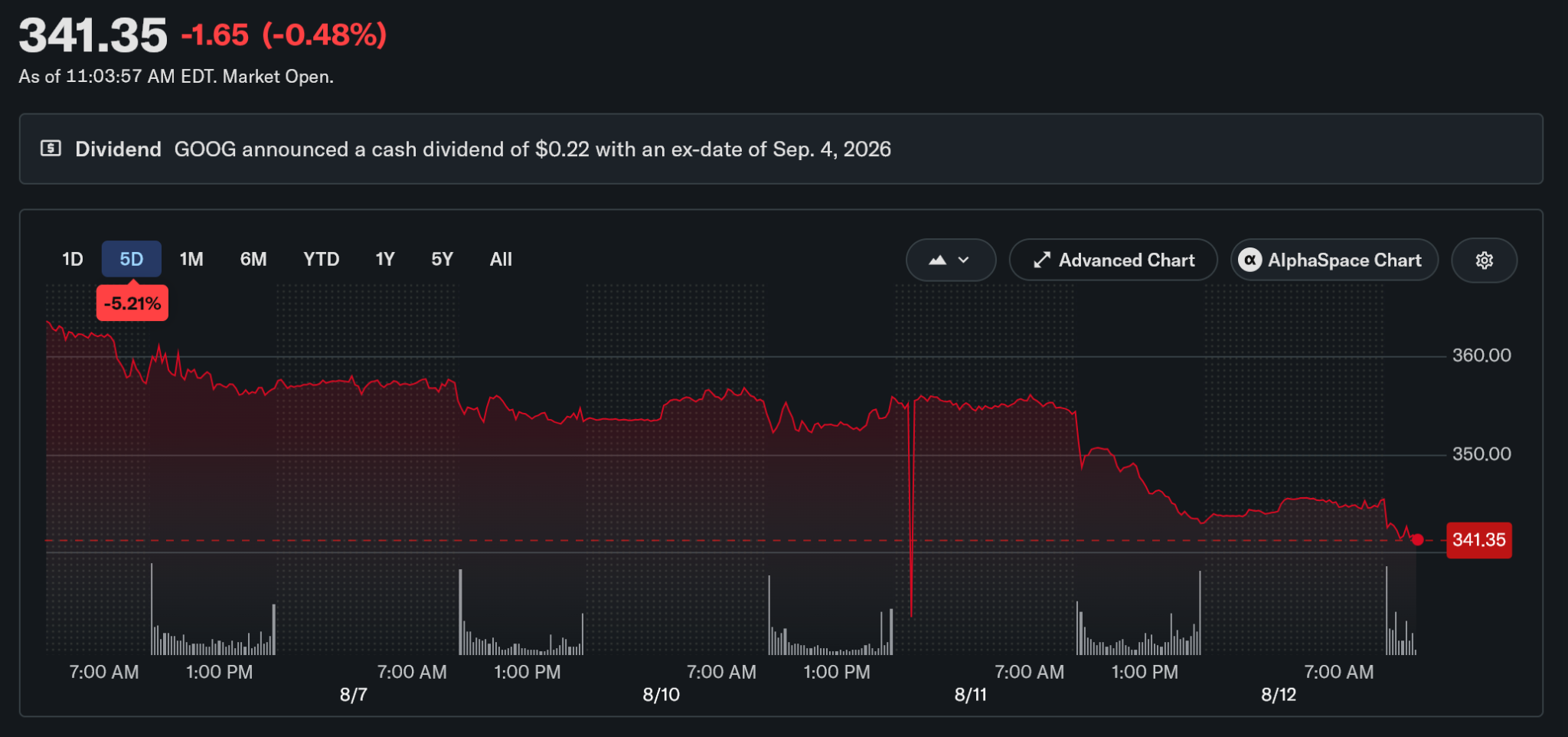
Alphabet Shares Reverse Early Gain
Alphabet shares initially rose about 0.6% at Wednesday’s market open, briefly approaching a 1% gain.
However, the stock later reversed course and fell about 0.2%, even as the broader Nasdaq remained higher.

There is no evidence that Pixel 11 reviews caused the decline. Still, the early reversal comes as Google asks consumers to pay more for phones whose biggest improvements increasingly come from software and AI rather than new hardware.
The post Google Pixel 11 Launch Disappoints as Alphabet Stock Falls appeared first on BeInCrypto.

Yahoo Finance Live: Daily Market Coverage – August 10, 2026 9AM-11AM (ET)

Defense attorneys in Charlie Kirk’s killing say shooter didn’t endanger others

Discord ordered to suspend livestreams in Brazil following teen suicide


-

 Fashion5 days ago
Weekend Open Thread: Mattifying Sunscreen
-

 Fashion5 days ago
Frugal Friday’s Workwear Report: Cap-Sleeve Pointelle Crewneck Sweater
-

 News Videos4 days ago
Can Astrology Help Find Gold and Silver Trends? A Financial Astrology Guide
-

 Sports7 days ago
Jordan Coyle & Cordiamo take Laya Arena Stakes at RDS
-
 Business7 days ago
US stocks: Dow closes at record on Mideast optimism; SpaceX, AMD drag Nasdaq
-

 Politics6 days ago
Reform UK And Greens Sink To Lowest Favourability Ratings To Date
-

 Business7 days ago
Supply chain issues impact Ingredion
-

 Tech5 days ago
Rinn Pharma & Biopharma to join NordicPharmaTrain network
-

 Business4 days ago
How to Start a Cleaning Business: A Step-by-Step Guide
-

 Business3 days ago
Datadog: Best Of Breed For Multiple Reasons
-

 Business4 days ago
BDC Weekly Review: Private BDC Q2 Numbers Are Strong
-
 NewsBeat18 hours ago
Communication cards help banking customers access services or report scams
-
Sports7 days ago
Spider-Man: Brand New Day ending explained: Is Peter Parker alive?
-

 Fashion7 days ago
Suit of the Week: Me + Em
-
 Tech6 days ago
Price Hikes May Be Coming for PC Motherboards Next
-

 Business6 days ago
Brightwater secures funding for WA-first dementia projects
-
 Crypto World6 days ago
Galaxy Digital Stock Slides 14% as Crypto Prices Hit Earnings
-
 Politics7 days ago
The Not-So Talented Mr Arday
-

 Business6 days ago
SpaceX Shares Plunge 13.6% After First Public Earnings as AI Capex Surge and Lockup Spark Selloff
-

 Fashion5 days ago
Weekly News Update, 8.6.26 – Corporette.com
You must be logged in to post a comment Login