
Crypto World
FlightAware Drops Kalshi Lawsuit One Day After Filing

Just a day after real-time flight tracking website FlightAware filed a lawsuit against prediction markets platform Kalshi over use of its name and data, the flight data company gave notice of voluntary dismissal of the case.
In a Tuesday filing in the US District Court for the Southern District of New York, attorneys for FlightAware said that they had voluntarily dismissed the case against Kalshi. The flight tracking company had filed the lawsuit a day earlier, claiming that Kalshi had used its “data and name to run gambling markets on flight cancellations.”
While the immediate turnaround could suggest a closed-door settlement, neither company had publicly commented on the case as of Wednesday. On Tuesday, a judge ordered Kalshi to show cause why the court should not issue a temporary restraining order over FlightAware’s trademark and data.
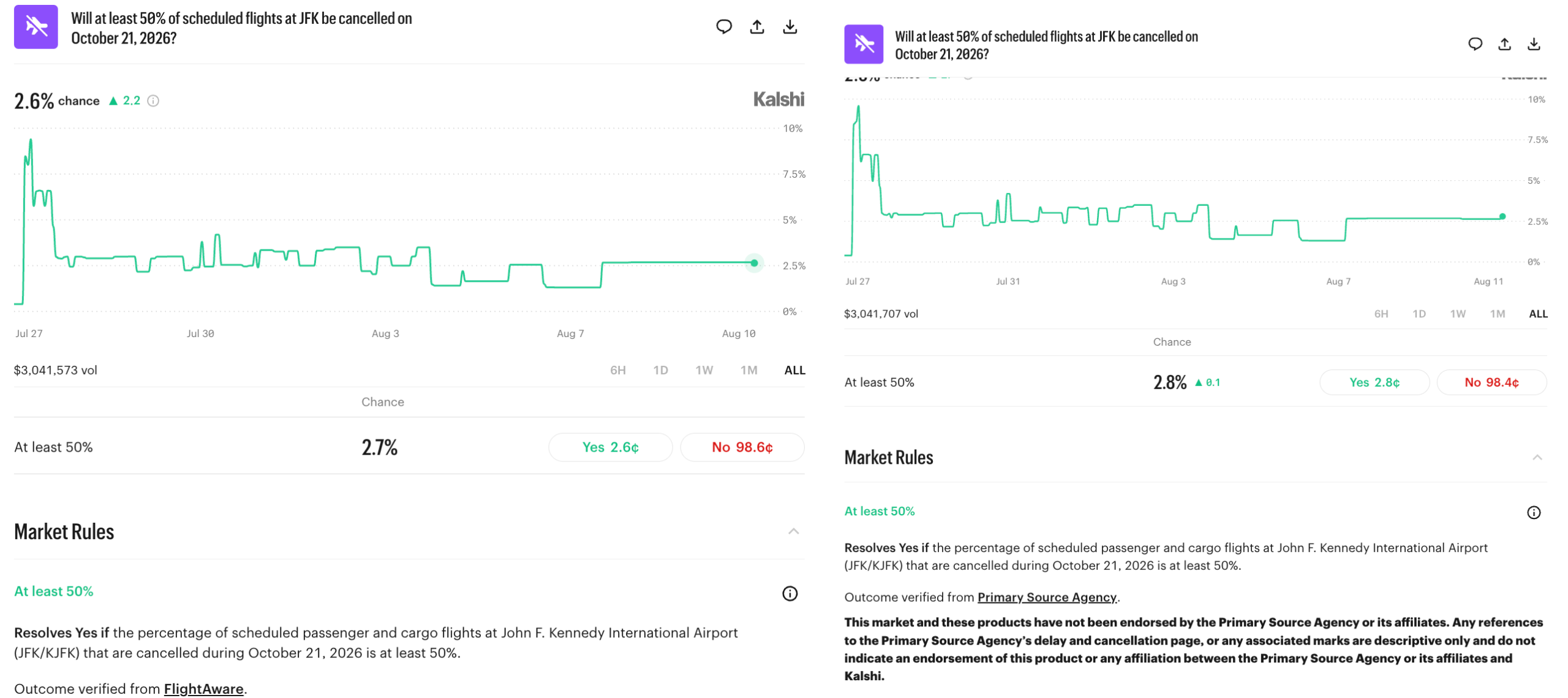
Notably, at least one event contract showed that Kalshi had changed its language from “FlightAware“ to “Primary Source Agency” as the entity responsible for verifying data related to the outcome of flight cancellations, including that the trade did not “indicate an endorsement of this product or any affiliation” between FlightAware and Kalshi. Primary Source Agency linked to FlightAware’s website. Cointelegraph reached out to the companies for comment but did not receive an immediate response.
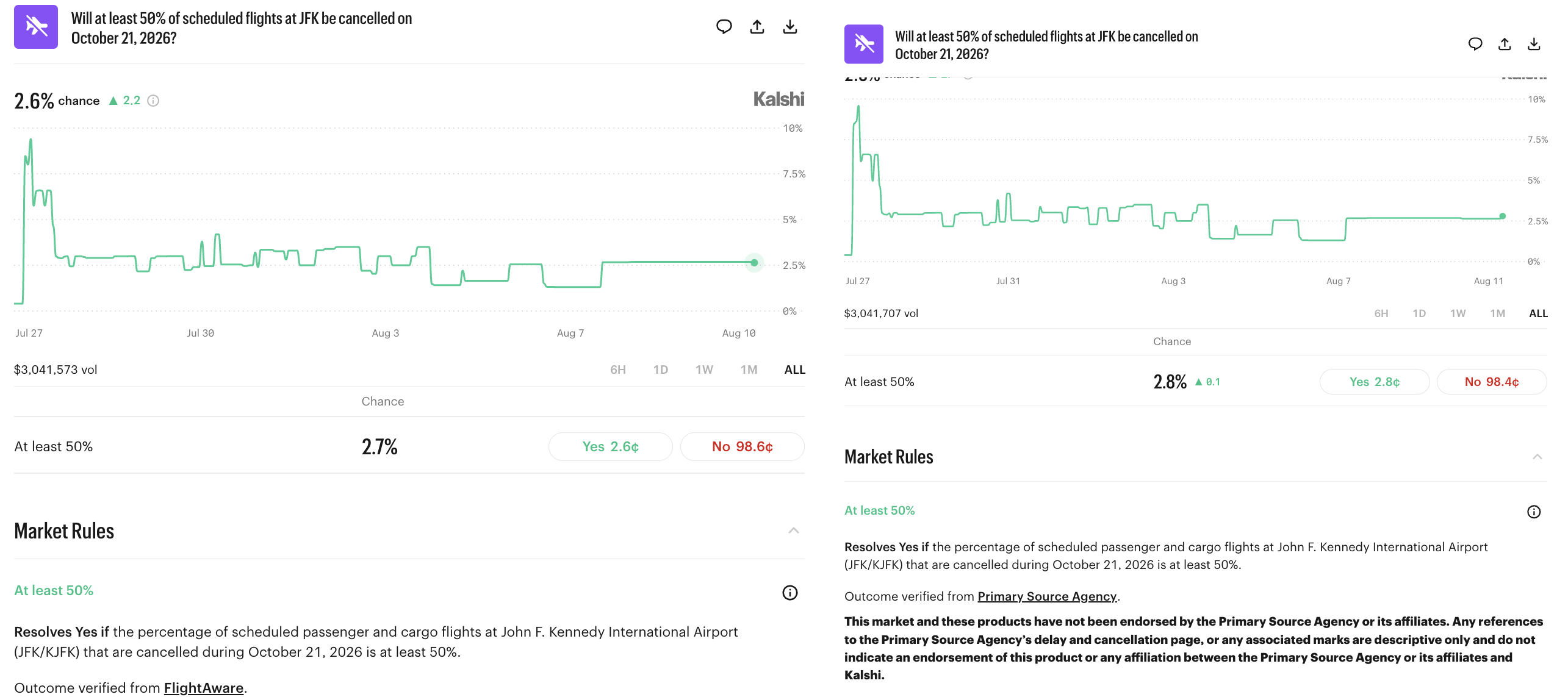
Side-by-side comparison of event contract citing FlightAware data before the lawsuit was dropped (left) and after (right). Source: Kalshi
Related: Kalshi launches sports and crypto perps data feed on DoubleZero
FlightAware’s suit had alleged trademark infringement, breach of contract, injury to its reputation and unfair competition in the latest legal action involving prediction market companies. Kalshi, Polymarket and other prediction market companies face legal action brought by many US state gaming authorities and regulators over alleged illicit sports betting offered to residents.
CFTC still at odds with state authorities over prediction markets
On Tuesday, the US Commodity Futures Trading Commission (CFTC), whose chair Michael Selig has repeatedly claimed the agency has “exclusive jurisdiction“ over prediction markets, said it had invoked “emergency authority“ to block New York state officials’ attempts to seek a temporary restraining order prohibiting the company from offering event contracts nationwide. The action followed New York authorities filing a lawsuit against Kalshi in July, alleging that the company was operating an unlicensed gambling platform through its contracts on sports and other events.
The CFTC decision echoed the agency’s actions in a Michigan case over Kalshi. In June, a Michigan judge ordered the company to stop offering sports betting contracts to residents until the civil case reached a conclusion. However, the CFTC under Selig ordered Kalshi not to comply with the state order — something the company’s head of enforcement and legal counsel said put it in an “impossible position“ between US state and federal orders.
Magazine: El Salvador’s Bitcoin experiment turns 5: ‘It was for us, not them’

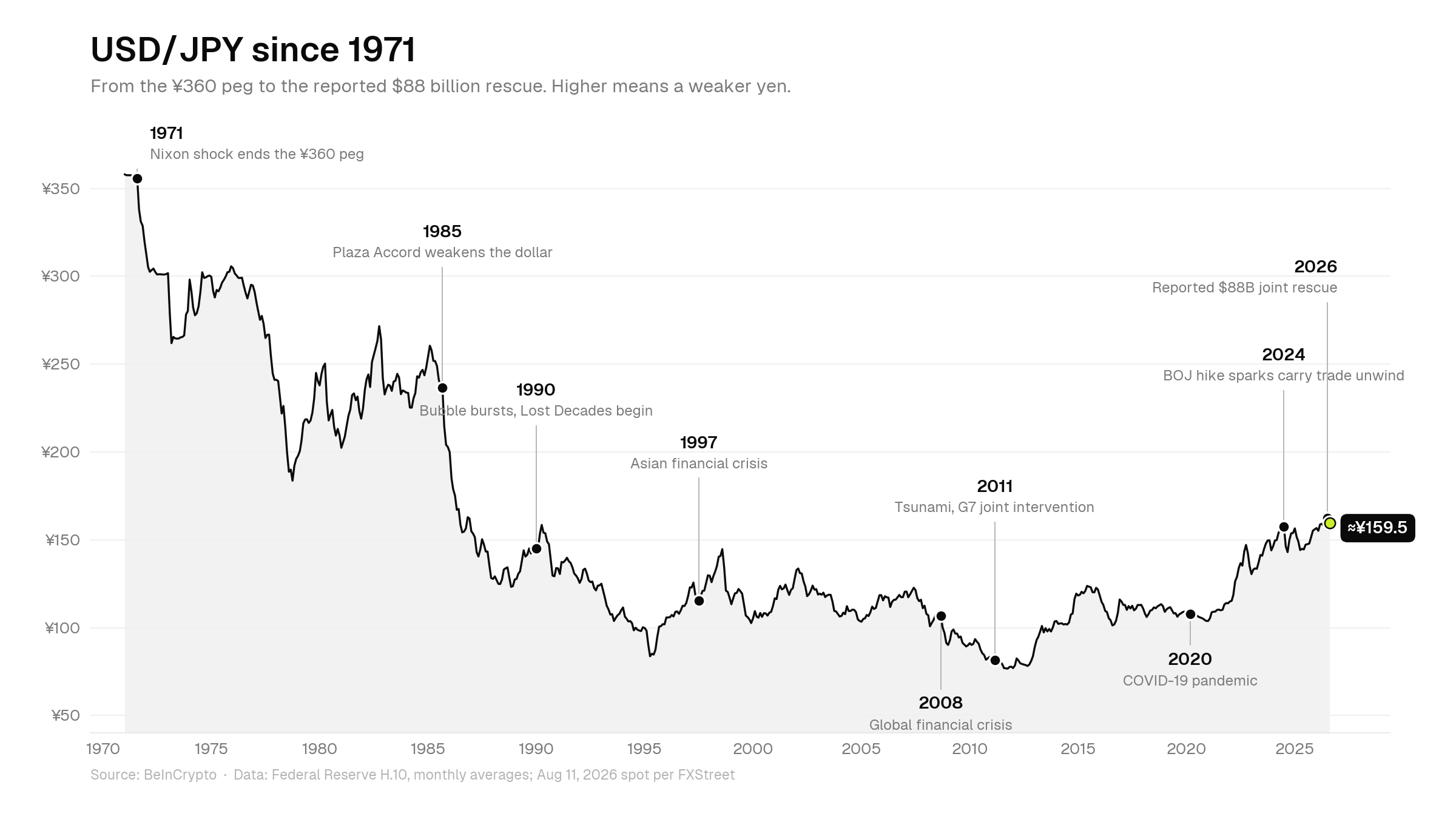
Japan’s economy is finally growing again after 30 lost years, JPMorgan Asset Management strategist David Lebovitz says. The escape from the Lost Decades is real, and crypto may end up paying for it.
The Lost Decades were Japan’s long slump after its 1990 bubble burst, when prices fell and rates stayed near zero. That cheap money quietly funded risk bets around the world, including crypto.

Japan’s Lost Decades Made the Yen the World’s Cheapest Money
Japan’s slump had one global side effect. The Bank of Japan (BOJ) held rates near zero from 1999. It even went negative in 2016 and stayed there until 2024.
That made the yen the cheapest money on Earth. Investors borrowed it for almost nothing and bought assets that paid more, from US bonds to tech stocks. Traders call this the yen carry trade.
Crypto grew up inside that easy-money era. So did every other risk asset.

Japan’s recovery is now closing the tap.
The Recovery Comes With a Bill
The good news is real. JPMorgan Asset Management global strategist David Lebovitz made the case in a televised interview. Japan is posting nominal growth, meaning growth in cash terms, for the first time in decades, he said.
Subscribe to our YouTube channel to watch leaders and journalists provide expert insights
“Japanese economy is generating nominal growth for the first time in decades,” said.
However, growth brought inflation, and inflation crushed the yen. The currency hit a 40-year low near 164 per dollar in July. In real terms, it was the cheapest since the 1960s, the Council on Foreign Relations notes.
Japan and the U.S. spent $88 billion propping it up. The relief lasted two weeks before the rescue faded. The dollar is back near 159.50 yen.
US Treasury Secretary Scott Bessent says the real fix is higher Japanese rates. Markets agree and price another hike by October, Japan’s third in 12 months.
Voters are pushing the same way. Analyst account Bull Theory noted that 71% disapprove of Prime Minister Sanae Takaichi’s handling of living costs.
Higher rates already sting at home. They sit at their highest since 1995, and Japan’s biggest insurers are nursing $96 billion in bond losses.
Crypto Has Seen This Squeeze Before
The last one was brutal. In July 2024, a surprise BOJ hike blew up the carry trade. The Bank for International Settlements (BIS) documented the shock in a bulletin. Bitcoin (BTC) fell about 25% in one week to near $49,000. Japan’s stock market had its worst day since 1987.

The trade survives because the rate gap is still wide. US rates sit at 3.50% to 3.75%, while Japan’s are at 1%. Every new hike makes cheap yen less cheap.
For now, markets are calm. Bitcoin trades near $64,700, little changed in 24 hours, per BeInCrypto Markets data.
Not everyone expects pain. BitMEX co-founder Arthur Hayes argues a Fed-backed yen defense could add liquidity and pump Bitcoin instead.
Japan waited 30 years for this recovery. Crypto is about to learn what defending it costs. The first answer comes at the BOJ’s September and October meetings.
The post Japan Escaped a 30-Year Economic Slump, But Crypto Could Pay the Price appeared first on BeInCrypto.

For the second time, TIME will publish a ranking of India’s Fastest-Growing Companies, in partnership with Statista, a leading international provider of market and consumer data and rankings. The list will recognize the country’s leading companies with strong revenue growth between the fiscal years 2023 and 2026.
As part of the research phase, TIME and Statista are now accepting data submissions. While submitting data ensures that eligible companies will be considered for inclusion, it does not guarantee a place on the final list. Additionally, the final ranking will not be limited to companies that submit data.

The Bank of England’s Digital Pound Lab is running a new experiment that tests whether stablecoins—and a notional digital British pound—could work together inside the same cross-border trade payment flow. The project is designed to show how payment and settlement could be connected to trade finance in a way that reduces the delays and cash-flow pressure that small and medium-sized businesses often face.
According to an announcement from the project participants, the trial involves NOBO Finance, Dun & Bradstreet and Polygon Labs. In the setup, an exporter receives an advance through a stablecoin-based “rail,” while a UK importer completes settlement using simulated digital pounds—without using real customers or real money.
Key takeaways
- The Digital Pound Lab experiment tests stablecoin rails alongside simulated digital pounds in a single cross-border trade settlement flow.
- NOBO Finance, Dun & Bradstreet and Polygon Labs are collaborating, with Polygon providing smart contract infrastructure.
- A second workstream focuses on generating reusable credit profiles for small businesses using transaction data and open-finance inputs.
- The Bank of England has not committed to issuing a digital pound, and lab tests are not intended as signals of future policy.
How the trade finance pilot is meant to work
The core concept targets a structural problem in international trade: payment timing. When exporters ship goods before receiving full payment, they may have to wait days to be paid, tying up working capital. That delay can make trade finance harder to access—particularly for smaller firms that may lack established lines of credit.
In the lab’s proposed flow, the exporter receives an advance via a stablecoin pathway, while the importer performs settlement through simulated digital pounds. The pairing is intended to demonstrate how stablecoin-based payment mechanics could coexist with a central-bank-style settlement layer, at least in a controlled testing environment.
The experiment is also designed to be realistic in terms of participants’ roles: it is built around trade finance and settlement processes rather than a generic token transfer scenario. That distinction matters because trade finance depends on paperwork, counterparty assessment and timing—factors that can be difficult to model in simple demonstrations.
Building blocks beyond payments: credit profiles for SMEs
The project does not stop at moving value. It includes a separate workstream intended to improve how small businesses are assessed for credit, by creating reusable credit profiles.
As described in the announcement, that credit-profile effort combines transaction data, open-finance information and Dun & Bradstreet’s commercial risk data. Polygon Labs is contributing smart contract infrastructure for the overall system, which suggests the test may explore whether on-chain logic can help standardize or reuse parts of the credit assessment process rather than rebuilding them from scratch for every transaction.
For investors and builders, the value of this component is that trade finance bottlenecks are often caused by more than settlement latency. Information asymmetry and rigid underwriting cycles can restrict financing even when payment rails are upgraded. By aiming at “reusable” profiles, the project appears to target a way to shorten the time between data availability and a credit decision—though the outcomes of that part of the work are not yet detailed.
Why regulators and central banks are watching stablecoins and tokenized payments
The Bank of England’s experiment lands in the middle of broader regulatory and infrastructure work in the UK. The central bank and other regulators are preparing for stablecoins and tokenized assets, while also modernizing the plumbing behind traditional payment settlement.
Earlier this year, the Bank of England published draft rules for sterling-denominated stablecoins it considers systemic to the UK financial system. According to the central bank’s proposal referenced in the report, issuers could hold up to 70% of their reserves in interest-bearing government debt, and the framework introduces a temporary issuance cap of 40 billion pounds (about $52.8 billion) for each systemic stablecoin.
The policy timeline included in the article points to potential finalization by the end of 2026, ahead of a planned 2027 rollout. Stablecoins deemed “systemic” would fall under the Bank of England’s regulatory regime, while non-systemic stablecoins would remain under the Financial Conduct Authority.
That split between systemic and non-systemic tokens is an important practical detail for market participants. It implies that not every stablecoin would be treated the same way, and that compliance requirements could vary depending on how widely a token is used and how much it matters to financial stability. For developers, it also suggests that designs and reserve structures may need to be aligned with which regulatory lane a token is likely to occupy.
The lab’s trade test is also tied to the UK’s wider push to upgrade settlement speed and flexibility. In May, the Bank of England proposed moving its RTGS and CHAPS systems toward near-24/7 operation, including weekend and extended daily hours—an effort framed as support for cross-border payments and evolving settlement models that could incorporate tokenization.
In July, the central bank also approved HSBC’s Orion platform to operate in the UK’s Digital Securities Sandbox. The article notes that Orion is expected to support digital bond issuance, including the country’s planned Digital Gilt Instrument. While that is separate from stablecoin rules, it reinforces the theme that UK authorities are testing tokenized approaches across multiple asset types, not only payments.
What the Digital Pound Lab trial does—and does not—indicate
Even as the experiment explores stablecoin rails and simulated digital pound settlement, the Bank of England is explicit that the Digital Pound Lab uses no real customers or money and that it has not committed to issuing a digital pound.
The central bank also cautions that participant-designed experiments in the lab should not be interpreted as indications of future policy or as endorsements of the companies or products involved. In practice, that means readers should treat the pilot as proof-of-concept work: useful for identifying technical and process challenges, but not a guarantee of a specific eventual product roadmap.
What to watch next is whether the project can demonstrate measurable improvements—such as reduced settlement delays, more efficient financing workflows, or faster credit assessment cycles—within its controlled environment. Since the announcement does not provide results or performance metrics yet, the most immediate signal will come from any follow-on reporting from the lab on what worked, what failed, and which regulatory assumptions were necessary for the trial design.

Extreme heat wasn’t the only notable climate event Americans were dealing with. Wildfires in eastern Oregon burned through 140,000 acres, forcing thousands of residents to evacuate. Federal fire resources were stretched thin as other fires burned in Colorado, Washington, and beyond.
The smoke from the blazes, coupled with fires in neighboring Canada, worsened air quality for millions across the country. By mid-July, Chicago was reporting the worst air quality in the world.
Though the month ranked as the third driest July of the 132-year record, with about 48.5% of the contiguous U.S. in drought, mid-month flash floods in Central Texas along the Guadalupe River brought over 28 inches of rainfall. The floods killed two people in the same area which saw catastrophic flooding over last year’s July 4th weekend.
The month showed just how varied the impacts of climate change can be. Residents in Texas and Oregon saw their homes damaged or destroyed by flooding or fire, while those in the Midwest found themselves digging out N95 masks to walk their pets or commute to work while facing some of the worst particulate air quality the region has seen in over 25 years. Many others found creative ways to take respite from the heat—seeking shade in tree-lined streets or cooling off in fire hydrants and lakes alike. Here’s what it was like to live through the hottest month on record.
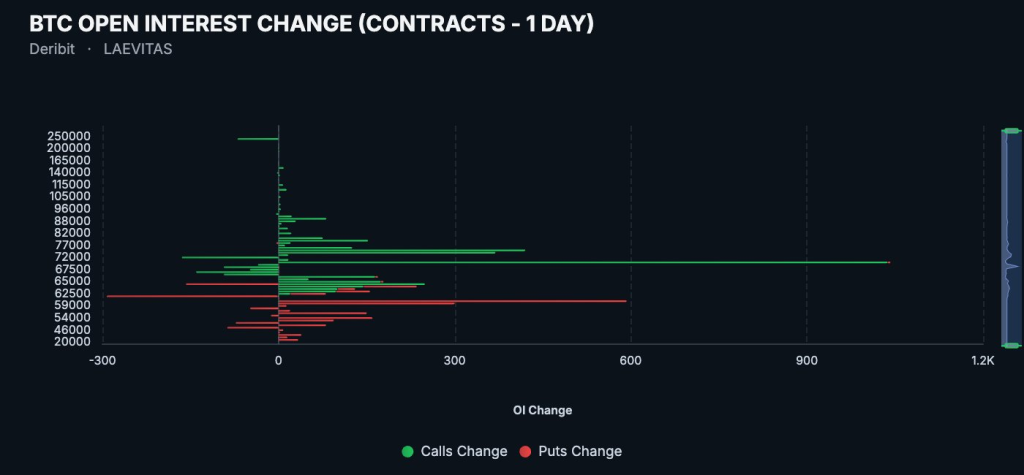
Bitcoin has spent weeks pinned inside a $62,000-to-$66,000 corridor, and options flow on Deribit shows traders paying roughly $2.5 million in aggregate premium to bet the coin clears $70,000 by late September.
That positioning puts real money behind a breakout thesis at the exact moment the U.S. Consumer Price Index print threatens to decide which way the range finally breaks.
The tension is straightforward: a cooler-than-expected inflation read could extend the risk-on mood already visible in equities, while a hotter number revives the case for another Federal Reserve rate hike in September. Either outcome could force a resolution to a consolidation phase that has left Bitcoin’s $64,000 support level under repeated scrutiny.
Discover: Everyone’s Got a Take. Join Kalshi and Get a Free $25 to Actually Trade Yours
Why the CPI Print Is a Binary Event for Crypto Markets
Consensus estimates compiled from Reuters, Dow Jones, and Bloomberg surveys point to headline CPI rising 0.1% month over month and 3.4% year over year, a step down from June’s reported 3.5% pace. Core CPI is expected at 0.2% monthly and 2.5% annually, figures tight enough that a modest surprise in either direction could swing rate-path expectations meaningfully.
That sensitivity matters because Bitcoin’s range has compressed heading into a scheduled catalyst. Traders positioning ahead of the print are effectively wagering that compressed ranges could resolve violently once the data lands, a dynamic explored in detail in CPI-driven Bitcoin price scenarios published ahead of the release.
Discover: Your Market Calls Are Worth Something. Start With Free $25 on Kalshi
What the Deribit Options Flow Actually Shows
The dominant flow on Deribit BTC options in the sessions leading into the print has concentrated in the September 25 expiry at the $70,000 strike, per Laevitas. The premium paid represents the maximum loss if Bitcoin sits below that strike at expiration, while the calls offer leveraged upside exposure without committing spot capital.

That’s a directional bet, not a certainty. Concentrated call buying at a single strike shows conviction among a subset of derivatives traders; it does not prove the broader market shares that view, and it says nothing about how quickly a move toward $70,000 would need to happen to make those contracts profitable.
Separately, TDX Strategies has recommended accumulating December optionality, favoring strangles on Bitcoin and Solana that pay out on a large move in either direction rather than picking a side. That’s a materially different bet than the September call flow – it’s a wager on volatility itself, not on direction, and it suggests not everyone in derivatives markets is convinced the CPI print resolves the range cleanly.
The Seasonal Headwind Nobody’s Pricing In
STS Digital managing partner Jeff Anderson has flagged September as historically Bitcoin’s weakest month, with an average decline of roughly 4% since 2013, and argued that a decisive break of either edge of the current spot range should see volatility expand quickly. That seasonal pattern sits awkwardly against the September 25 call positioning – traders are betting on a breakout in the same month that has statistically been Bitcoin’s softest.
Spot-market data adds another wrinkle. Nansen has reported Ether exchange net outflows of $49.7 million over 24 hours and $164.6 million over the past week, a pattern typically read as accumulation.
At the same time, Hyperliquid smart-money positioning shows net short exposure of $46.8 million in Bitcoin and $20.9 million in Ether. Spot flows and derivatives positioning are telling two different stories, and CPI is the event that could force them into alignment.
Don’t Miss Out on Our $1,000 USDT Airdrop on ByBit
The post CPI Sets the Stage for Bitcoin’s Next Major Range Break appeared first on Cryptonews.


A pair of would-be crypto thieves have been sentenced in France this week for their part in a home invasion that targeted a house lawyers say was previously owned by doxxed crypto millionaires.
Lawyers representing the house’s current owners, a farmer and bank executive both in their twenties, believe that the financial details of the previous owners, a wealthy retired couple who made millions with crypto, were leaked on the dark web.
As such, they believe that three separate teams of robbers used this outdated information to target the Somme property in the hopes of securing a crypto ransom.
The first group broke into the home on June 24, but the couple’s dogs were able to scare them off. The second broke in on June 26 and managed to tie up one of the victims and beat the other before fleeing.
Read more: France crypto conference doubles security as wrench attacks rise
A third attack took place on July 17 but the two criminals involved were deterred by an alarm installed after the first two break-ins.
It was these two men that were sentenced by the Amiens criminal court on Monday. One received a three-year prison sentence, while the other was sentenced to 18 months.
The couple now claims they no longer “feel safe at all” living in the property, and want to sell. Their lawyer stated, “They bought their house in the wrong place, at the wrong time.”
Got a tip? Send us an email securely via Protos Leaks. For more informed news and investigations, follow us on X, Bluesky, and Google News, or subscribe to our YouTube channel.


Nansen co-founder and CEO Alex Svanevik has projected that Bitcoin could reach $1 million by 2030 while arguing that the asset may never trade below $60,000 again.
Summary
- Svanevik sees $1 million Bitcoin by 2030 as a plausible outcome rather than a certainty.
- Expanding money supply and currency debasement form the main basis of his forecast.
- The Nansen chief expects Bitcoin’s market cycles to produce progressively higher price floors.
- U.S. spot Bitcoin ETFs give American investors regulated access but remain exposed to sharp price swings.
Monetary expansion could carry Bitcoin toward $1 million
In a statement to crypto.news, Nansen co-founder and CEO Alex Svanevik said Bitcoin’s long-term value will depend largely on global liquidity, government spending, and the continued expansion of the money supply.
Rather than pointing to one event that could send Bitcoin (BTC) to $1 million, Svanevik described the cryptocurrency as an alternative to monetary systems in which central banks and governments can create more currency. Bitcoin’s supply rules limit the total number of coins to 21 million, although new BTC will continue entering circulation through mining until the maximum supply is reached.
“I think the base case for Bitcoin is basically that you get higher lows, and you do have these run-ups that happen, roughly every four years,” Svanevik told crypto.news.
Under his argument, more money circulating through financial markets can raise demand for assets with limited supply. Svanevik said the direction of global liquidity matters more to Bitcoin’s long-term price than any single headline or market event.
“The more circulating money supply in a broad sense, the higher Bitcoin goes. I think Bitcoin should be thought of as a counterpoint to what’s happening on the central bank side, or the treasury side.”
Bitcoin’s four-year market pattern is often linked to its halving schedule, which cuts the block reward paid to miners. The next halving is expected in 2028, reducing new supply before Svanevik’s 2030 target date. Previous cycles have included steep rallies after halvings, but they have also produced drawdowns of more than 50%, meaning the historical pattern does not guarantee another increase.
An August 2025 Bitcoin forecast review published by crypto.news placed many 2030 projections between $250,000 and $500,000. The report also cited ARK Invest’s bull case of $1.5 million, base case of about $700,000, and bear case near $300,000.
Svanevik compared today’s $1 million forecasts with predictions made when Bitcoin traded far below $100,000. In his view, monetary debasement changes the unit used to measure Bitcoin, making price levels that once appeared unrealistic easier to consider over time.
“It sounds crazy to say Bitcoin at $1 million from our vantage point, but I’m sure it sounded crazy to say $100,000 Bitcoin if you’re in 2018,” he said. “You’re updating the unit of account because we’re just spending so much more money.”
Why Svanevik believes Bitcoin will hold above $60,000
Alongside his 2030 projection, Svanevik said he does not expect Bitcoin to return below $60,000, describing the level as a permanent floor in his personal assessment.
“My personal view is that I don’t think Bitcoin is ever going to go back below $60,000. I think forever.”
The claim rests on Svanevik’s expectation that future market cycles will establish higher lows. Continued currency creation, combined with Bitcoin’s fixed maximum supply and growing use among retail and institutional investors, supports his view that demand will prevent another fall beneath the threshold.
Market history, however, shows how difficult permanent price-floor forecasts can be. Bitcoin briefly traded below $60,000 in February 2026, while June volatility later pushed it close to the same level. On June 28, Bitcoin held near $60,000 after falling to its lowest price since late 2024.
More recently, BTC slipped below $63,000 on Aug. 3 as ETF outflows, security concerns, and uncertainty over U.S. crypto legislation weighed on the market. The asset traded near $62,556 at the time, down 4.35% over seven days, according to a report on the decline.
Veteran trader Peter Brandt has offered a different assessment of the same price region. Brandt said on Aug. 10 that he would lean toward another decline, while his head-and-shoulders chart pointed to a possible move toward $58,000 if BTC failed to recover key resistance.
The scenario was a technical projection rather than a confirmed target. Brandt had not opened a trade based on the pattern, and a sustained break above $67,260 would weaken the bearish setup shown on his chart.
U.S. ETFs extend Bitcoin access to large portfolios
For American investors, Svanevik’s expectation that Bitcoin will enter more retail and institutional portfolios can already be measured through U.S.-listed spot Bitcoin exchange-traded funds. The products allow investors to gain price exposure through brokerage and retirement accounts without directly holding private keys.
Demand through those funds has not moved in one direction. U.S. spot Bitcoin ETFs recorded nine consecutive sessions of net withdrawals in late May 2026, with investors removing roughly $2.8 billion. BlackRock’s iShares Bitcoin Trust accounted for about $2.04 billion of the total, while May ended with approximately $2.43 billion in net outflows.
Fund demand later recovered. During the five sessions ending Aug. 7, U.S.-listed Bitcoin ETFs attracted more than $850 million, their strongest weekly inflow total since April. The reversal showed that regulated investment products can add buying demand when capital enters, although redemptions can create selling pressure when investors reduce exposure.
Institutional disclosures also offer evidence that some U.S. advisers are adding Bitcoin products to diversified portfolios. Clear Creek Financial Management reported about $10.4 million across three Bitcoin ETFs in its latest Form 13F, led by a $9.69 million position in Bitwise’s BITB.
Form 13F reports cover certain long positions held by investment managers overseeing at least $100 million in qualifying U.S. securities. Because the filings are backward-looking and exclude cash, short positions and some other assets, they do not prove that the disclosed holdings remain unchanged.
Svanevik placed Bitcoin alongside gold as one of the best-known assets used by investors seeking protection from currency debasement. Portfolio inclusion, in his assessment, will expand as both individual buyers and institutions look for assets outside systems based on discretionary money creation.
“Bitcoin is kind of the most well-known way to counter that, except for maybe gold,” he said. “That’s why I do think it’s going to be part of a lot of people’s portfolios, both retail and institutions.”
Bitcoin’s $1 million target remains a conditional forecast
Reaching $1 million would require Bitcoin to rise almost sixteenfold from a price of roughly $64,000. At that price, its fully diluted value would approach $21 trillion because the protocol limits total supply to 21 million coins, although circulating supply will remain lower than the maximum in 2030.
Svanevik did not present the target as guaranteed. His case depends on continued monetary expansion, increasing portfolio adoption, and the absence of major threats capable of damaging Bitcoin’s role as an alternative monetary asset.
Regulatory restrictions, declining liquidity, or weaker institutional demand could interfere with that path. ETF activity in 2026 has already shown that professional capital can leave the market quickly when economic conditions or risk appetite change.
Svanevik nevertheless considers the seven-figure target possible within the remaining years of the decade.
“There’s nothing that suggests that we’re going to stop printing money; on the contrary, probably,” he said. “And in 2030, I think a million dollars per Bitcoin is definitely within the realm of possibility.”
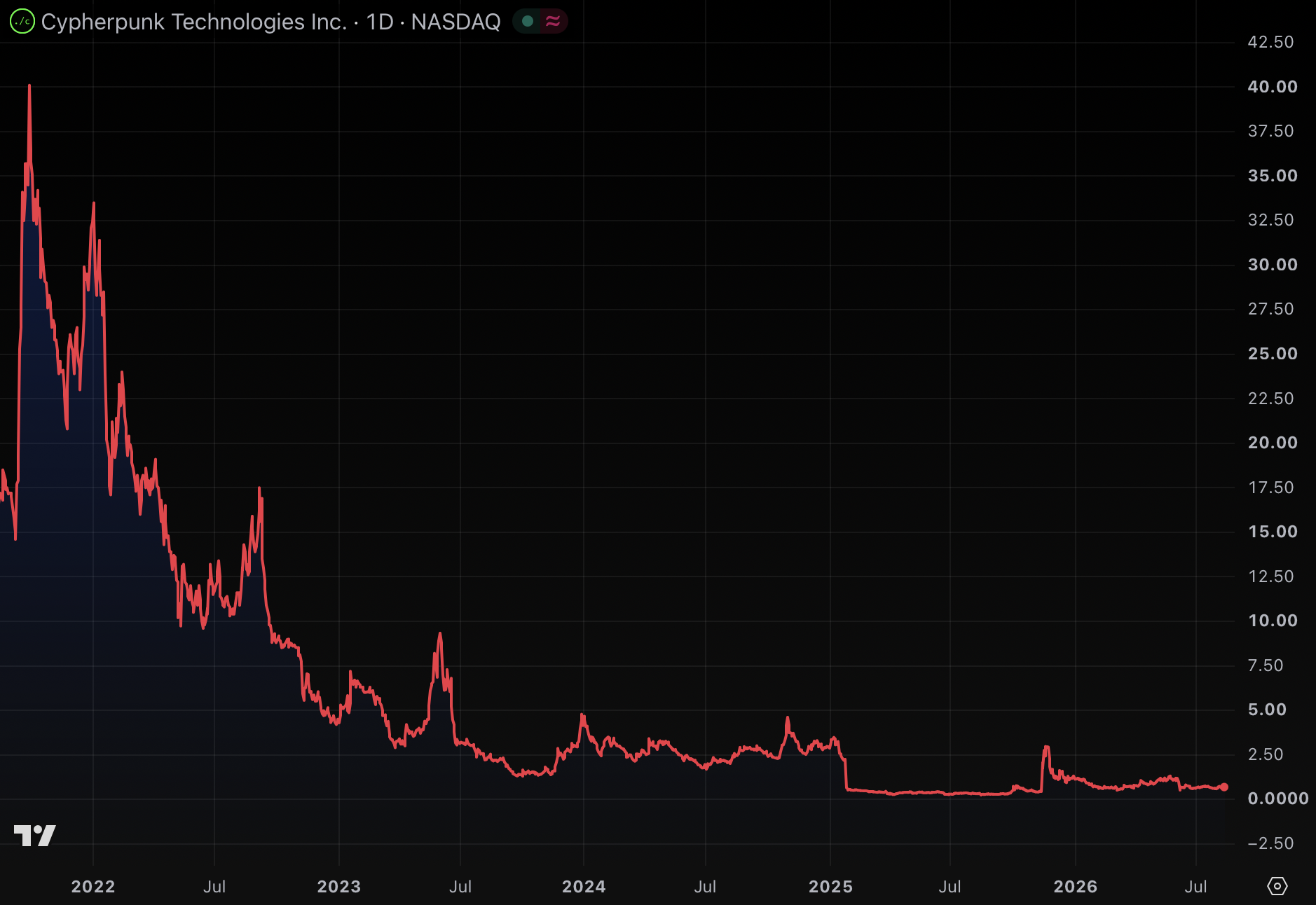
Winklevoss-backed Zcash (ZEC) treasury company Cypherpunk Technologies has announced plans to pivot focus to its cancer drug candidate after it reported a $37.8 million net loss for the first six months of 2026.
Unless the price of ZEC rallies soon, the company has admitted that it will need to raise a lot of money to pay for its upcoming FDA trials.
“We expect to continue to generate operating losses for the foreseeable future,” the company forecasted today.
Cypherpunk’s ZEC holdings are worth roughly $157 million, yet Nasdaq traders value the entire company at just $74 million.
That is a basic multiple-to-Net Asset Value (mNAV) of just 0.47x and sadly unremarkable as crypto treasury stocks continue to trade for less than their holdings.
Counting pre-funded warrants and other sweeteners for its self-described Enterprise Value mNAV brings that multiple up to 0.96x on the company’s homepage — still less than the value of its ZEC.
Backed by Cameron and Tyler Winklevoss
Cameron and Tyler Winklevoss are the billionaires who helped create the company’s ZEC brand.
Initially successful, the company was able to acquire its ZEC for a $341.84 average purchase price — well below the current market for ZEC at $486.
The stock also hit $3.70 last November before falling back below $0.69 per share today.
Cypherpunk has lost tens of millions of dollars this year and continues to plan an expensive FDA trial path for its cancer drug. The stock has lost 40% of its value this year and 96% of its value over the past five years.
Gemini, the exchange the Winklevoss twins control, is the custodian for the company’s ZEC.
Read more: Zcash vs Bitcoin debate exposes Naval Ravikant’s conflicts of interest
More expensive cancer trials, and ZEC isn’t helping
Cypherpunk’s cancer drug candidate, an anti-DKK1 antibody Sirexatamab, failed to beat the control arm on progression-free survival across all patients in the randomized Phase 2 study.
The company attributes that miss to an underpowered final analysis.
On the DAT side of the business, the price of ZEC is flat year-to-date, so that didn’t help.
The FDA granted its drug candidate fast track designation in May anyway, a status that speeds up regulatory review. Regulators also agreed on the shape of a roughly 270-patient Phase 3 trial for colorectal cancer.
Onsi said the company is “conducting a strategic process to determine the best path to advance sirexatamab, whether as an independently financed spin-out company or with a partner who shares our commitment to cancer patients.”
In plainer terms, its drug candidate needs more money.
Tyler Winklevoss wrote at launch that “We plan to continue accumulating ZEC rapidly so that Cypherpunk owns at least 5% of the total ZEC supply.”
Nine months later, the company holds 323,394 ZEC today, or 1.92% of the circulating supply.
The company had just $7.6 million in cash and cash equivalents as of June 30, half a billion dollars of accumulated deficits, loss-generating operations, and an expensive path toward FDA approval for an aspirational drug.
Got a tip? Send us an email securely via Protos Leaks. For more informed news and investigations, follow us on X, Bluesky, and Google News, or subscribe to our YouTube channel.


Bitwise Asset Management has cut about 14% of its workforce, reducing headcount to roughly 155 from around 180 as the crypto-focused manager contends with a sharp retreat in assets. Bloomberg reported that Bitwise confirmed the reduction in an emailed statement. The reported totals amount to… Read the full story at The Defiant

Super Micro Computer’s (SMCI) upbeat second-quarter earnings report provided a positive read-through for partner Nvidia (NVDA), analysts say. Supermicro stock jumped on Wednesday while Nvidia also advanced. The Q2 report from Supermicro “is almost a direct read-through for Nvidia,” Daniel O’Regan, managing director of equity trading for Mizuho Securities USA, said in a client note. “They take Nvidia’s chips, integrate…
Copyright ©2026 Investor’s Business Daily, LLC. All rights reserved. 87990cbe856818d5eddac44c7b1cdeb8

Solar Eclipse 2026 LIVE as incredible celestial display peaks over Greater Manchester

Professional chef debuts pantry staple brand

Japan Escaped a 30-Year Economic Slump, But Crypto Could Pay the Price

Weekend Open Thread: Staud – Corporette.com

Weekend Open Thread – Corporette.com

Weekend Open Thread: Brooks Brothers

Paul Smith makes good financial choices…

What should you invest in? #stockmarket #stocks #investing #invest #money #finance #rich #wealth

EARNING APP | NEW EARNING APP TODAY | NEW LOOT OFFER TODAY | MONEY EARNING APPS | ONLINE EARNING APP
-

 Fashion5 days ago
Weekend Open Thread: Mattifying Sunscreen
-

 Fashion5 days ago
Frugal Friday’s Workwear Report: Cap-Sleeve Pointelle Crewneck Sweater
-

 News Videos4 days ago
Can Astrology Help Find Gold and Silver Trends? A Financial Astrology Guide
-

 Sports7 days ago
Jordan Coyle & Cordiamo take Laya Arena Stakes at RDS
-
 Business7 days ago
US stocks: Dow closes at record on Mideast optimism; SpaceX, AMD drag Nasdaq
-

 Politics6 days ago
Reform UK And Greens Sink To Lowest Favourability Ratings To Date
-

 Business7 days ago
Supply chain issues impact Ingredion
-

 Tech5 days ago
Rinn Pharma & Biopharma to join NordicPharmaTrain network
-

 Business4 days ago
How to Start a Cleaning Business: A Step-by-Step Guide
-

 Business3 days ago
Datadog: Best Of Breed For Multiple Reasons
-

 Business4 days ago
BDC Weekly Review: Private BDC Q2 Numbers Are Strong
-
 NewsBeat20 hours ago
Communication cards help banking customers access services or report scams
-
Sports7 days ago
Spider-Man: Brand New Day ending explained: Is Peter Parker alive?
-

 Tech6 days ago
Price Hikes May Be Coming for PC Motherboards Next
-

 Business6 days ago
Brightwater secures funding for WA-first dementia projects
-
 Crypto World6 days ago
Galaxy Digital Stock Slides 14% as Crypto Prices Hit Earnings
-
 Business2 days ago
Oil Price Today (August 11): Crude oil rises to $88 after Trump’s compensation demand dents Hormuz opening. Here’s why
-

 Politics7 days ago
The Not-So Talented Mr Arday
-
 Tech6 days ago
How to Use Your Phone as a Webcam on PC and Mac (2026)
-

 Business6 days ago
SpaceX Shares Plunge 13.6% After First Public Earnings as AI Capex Surge and Lockup Spark Selloff
You must be logged in to post a comment Login