
Crypto World
‘Big Short’ investor Steve Eisman sees an Achilles heel in the AI boom



Steve Eisman is warning that the artificial intelligence boom has become increasingly dependent on the fortunes of just two companies: OpenAI and Anthropic.
The investor, best known for his bet against the housing market ahead of the global financial crisis, said the two AI startups account for roughly 70% of AI-related revenue at Microsoft, Amazon, Alphabet‘s Google and Oracle — and as much as 25% to 35% of their cloud revenue.
“The futures of these massive companies, in a sense, are a bet that OpenAI, Anthropic are going to succeed,” Eisman said late Tuesday on CNBC’s “Fast Money.”
“The Real Eisman Playbook” podcast host and former Neuberger Berman senior portfolio manager believes that the biggest revenue threat could come from China, as Chinese open-source AI models are significantly cheaper and appear to be gaining market share.
“The Achilles heel of this whole story … is if something bad happens to Anthropic and OpenAI … the Chinese open end models, open weight models are much cheaper. And if they start really taking a lot of market share and it sounds like, from what I’m hearing, that they’re starting to, you could have a big price war. And then we have a problem,” he said
Eisman’s warning adds another prominent voice to a growing debate over whether the extraordinary spending behind the AI boom can generate sufficient returns.
Michael Burry, another investor whose wager against the housing bubble was chronicled in The Big Short, has taken an even more bearish view. Burry has questioned whether much of current and future AI demand ultimately comes from end customers, arguing instead that a significant portion is financed through what he has described as circular arrangements.
Burry is putting his money where his mouth is, placing bearish bets against some of the biggest beneficiaries of the AI boom, including Nvidia, while also disclosing bearish positions tied to the broader semiconductor sector.

Crypto World
Trump Is Sued Over Selling Early Access to Truth Social Posts Amid Backlash Against Scheme

Trump and other White House officials are listed as defendants but TMTG is not. (Trump holds the largest stake in TMTG through a revocable trust which owns around 41% of the company.)
TIME has reached out to the White House and TMTG for comment.
The legal challenge lands in the midst of mounting backlash over the data feed, as Democratic lawmakers have already called for probes into the service, citing concerns over potential market impacts.
Here’s what you need to know:
What exactly does the lawsuit say?
The complaint argues that the Truth Social early access service violates the First and Fifth Amendments of the U.S. Constitution.
“The First Amendment guarantees equal access to the President’s public announcements, and even content-neutral burdens on that access must be narrowly tailored to serve a significant government interest,” the lawsuit reads.
“Similarly, the Fifth Amendment prohibits charging unreasonable sums that cannot be justified to offset the cost of the government benefit, and granting preferential access to crucial government information for arbitrary and irrational reasons, as is the case here.”
Crypto World
Trezor Provider ShipMonk Breach Exposed Order Data for 13,689 Hardware Wallet Customers

The breach hit 11,742 customers whose names, email addresses, phone numbers, and shipping addresses were all exposed, plus 1,947 whose names, cities, and email addresses were taken.
Order numbers were included. Trezor said the records came from orders received between May 10 and August 8, 2026, and named the United States, United Kingdom, Sweden, Colombia, Brazil, Italy, and Portugal as the affected markets.
“Our systems were not compromised, and your Trezor device is secure,” the company stated, adding that hardware wallets, private keys, and wallet backups were not affected.
A 90-day data storage policy, which Trezor said it negotiated into its fulfillment partners’ terms as well, kept older orders out of the exposed set, but every affected customer was contacted individually by email.
Phishing Warning Follows Address Leak
Trezor told customers to treat any communication that demands immediate action or requests personal information as “suspicious,” to check claims against official channels, and to never enter a wallet backup on a website or share it with anyone.
Its disclosure said affected customers “could experience an increase in phishing attempts.” But it seems users found that statement cynical. “Phishing?? They have physical addresses, you imbeciles,” wrote an X user posting as Chikun, in a reply that collected about 159 likes within the hour. Another reply called the exposure “irl phishing.”
We have some difficult news to share. Unfortunately, one of our shipping providers has experienced a data breach that exposed sensitive order data. This affects new customers in the US, UK, Sweden, Colombia, Brazil, Italy, and Portugal who received an order within the 90 days…
— Trezor (@Trezor) August 13, 2026
The phishing risk still tracks what followed a comparable incident at a rival. CryptoPotato reported that scammers used order data leaked from Ledger’s e-commerce partner Global-e to send phishing emails claiming Ledger and Trezor had merged, pushing recipients to enter 24-word recovery phrases on a fake site.
Yet Another Trezor Incident
Trezor said it is investigating and will publish updates on its blog. The company also mentioned building an Anonymous Delivery option, with neutral packaging, generic sender details, and automatic deletion of shipping identifiers.
Not an easy time for being a Trezor customer, as they have been reached through vendors twice before. Attackers sent phishing emails through a Trezor mailing list compromised at MailChimp in 2022, pointing users to lookalike download domains built to steal seed phrases.
Two years later, a breach of a third-party support ticketing portal exposed names and email addresses for roughly 66,000 users who had contacted Trezor Support since December 2021. Both of those exposed contact details, but this one exposed home addresses across multiple countries.
The post Trezor Provider ShipMonk Breach Exposed Order Data for 13,689 Hardware Wallet Customers appeared first on CryptoPotato.


Key takeaways
- XLM remains under pressure at $0.160.
- Positive funding rates for both tokens offer limited hope of a recovery.
- XLM must reclaim the $0.176–$0.180 area to improve its outlook.
XLM continues to trade below several major moving averages. Mixed derivatives and on-chain signals reveal uncertainty among traders, leaving XLM exposed to further losses despite tentative signs of improving sentiment.
XLM traders show mixed positioning
CoinGlass derivatives data points to a more bearish outlook for Stellar. XLM’s long-to-short ratio was notably weaker at 0.92, approaching its lowest level in more than a month.
A reading below one indicates that short positions outnumber longs, reflecting expectations of further downside.
Funding rates for both tokens have improved despite their weak price performance. XLM’s funding rate climbed to 0.0092%.
Positive funding means traders holding long positions are paying short sellers, generally indicating bullish demand in the perpetual futures market.
The figures suggest that some traders are willing to maintain bullish exposure while prices remain under pressure. However, continued declines could leave those long positions vulnerable to liquidations.
CryptoQuant data presents a mixed picture for Stellar. XLM’s futures market shows selling-side dominance across both spot and futures markets.
The presence of large whale orders adds uncertainty, but the broader data continues to favor caution while sellers control trading activity.
Stellar remains below major moving averages
Stellar traded near $0.160 on Thursday, maintaining a bearish short-term outlook below all three major EMAs.
The 50-day EMA is positioned at $0.176, while the 100-day and 200-day EMAs stand at $0.180 and $0.190, respectively.
Their convergence above the current price creates a dense resistance zone that buyers must overcome before a meaningful recovery can develop.
Momentum indicators also remain weak. XLM’s RSI is near 33, placing it close to oversold territory, while the MACD continues to trade in negative territory.
Although the low RSI could eventually support a relief rally, it does not by itself confirm that XLM has reached a bottom.
The first important resistance zone for Stellar sits between the 50-day EMA at $0.176 and horizontal resistance at $0.177.
A break above this area could ease selling pressure and open the way toward the 100-day EMA at $0.180. Bulls would then need to clear the 200-day EMA at $0.190 to establish a stronger recovery.

If XLM remains below these levels, the bearish outlook will persist. Continued selling could send the token toward its next meaningful horizontal support at $0.142, where buyers may attempt to defend the price.
For now, XRP’s slight bullish positioning provides limited recovery hope, but both tokens remain technically vulnerable while trading below their major moving averages.
Crypto hardware wallet Trezor revealed today that the personal details of 13,689 of its customers have been leaked.
The breach at Trezor’s mailing partner, ShipMonk, impacted users across the UK, US, Sweden, Colombia, Brazil, Italy, and Portugal, who ordered a Trezor product between May 10 and August 8, 2026.
Nearly 12,000 customers had their full name, physical address, phone number, and email address leaked, while almost 2,000 saw their name, city, and email address leaked.
Trezor says private keys are safe
Trezor claims someone gained “unauthorized access” to ShipMonk’s systems, and that Trezor infrastructure, such as its devices and private keys, is unaffected.
It warned that leaked users are now at risk of phishing scams via phone, email, or post, and stressed that “Nobody from Trezor ever asks for a wallet backup.”
Read more: Search engines fix Claude leak but Perplexity users’ files still online
The wallet firm says only users who received a warning email from Trezor today are impacted by the leak.
Trezor says it’s yet to decide on ShipMonk partnership
Trezor told Protos that it was informed of ShipMonk’s breach on August 10.
It said it’s still gathering information on the incident and that, only when it has the full picture, will it “decide on the future” of its partnership with ShipMonk.
Trezor emphasised how its 90-day data policy helped mitigate the leak with its ability to “delete or anonymize order data 90 days after delivery.”
It claims that it is also pushing an “anonymous delivery” this year, and noted that it will share more details of the ShipMonk breach once a full report is ready.
Wallet data leaks lead to targeted scams
Crypto wallet maker Ledger suffered similar customer data leaks back in 2020 and 2026.
Following the 2020 breach, hackers sent fake Ledger devices that were designed to upload malware into a user’s computer.
Scammers used this same leaked data five years later to send fake Ledger letters that attempted to trick recipients into handing over their recovery phrases.
Trezor customers have previously been targeted with phishing campaigns that used phoney stories of quantum vulnerability disclousres to trick victims.
Read more: Why did I receive a Trezor phishing email from Substack?
It’s also believed that criminals use this sort of leaked data to physically target crypto users.
This was the case last week when lawyers in France claimed the leaked address of one retired crypto millionaire, who had since moved out of his former property, led to the attacks against the new owners.
Got a tip? Send us an email securely via Protos Leaks. For more informed news and investigations, follow us on X, Bluesky, and Google News, or subscribe to our YouTube channel.
Crypto World
SEC May Push Crypto Rules, 24/7 Trading Without Clarity Act. OCC Paves Way For Crypto Banks.
A vote on the Clarity Act may be delayed until the Senate returns from its August recess. But that isn’t stopping regulators from rulemaking on digital assets. The Securities and Exchange Commission on Friday may introduce two initiatives for the cryptocurrency industry. Meanwhile, the Office of the Comptroller of the Currency opened the door for bitcoin and cryptocurrency firms to…
Copyright ©2026 Investor’s Business Daily, LLC. All rights reserved. 87990cbe856818d5eddac44c7b1cdeb8


Tempo on Aug. 12 launched Tempo Earn, a product that lets fintechs pay their users rewards on idle stablecoin balances and keep part of the return, with payroll platform Deel as the first named deployment. Section 4(a)(11) of the GENIUS Act bars any permitted payment stablecoin issuer from paying… Read the full story at The Defiant
It was the start of June when the second-largest cryptocurrency last traded above the $2,000 psychological level and is currently down 60% on a yearly scale.
Despite the downfall, many analysts see upside potential, while some believe the ongoing conditions represent a great buying opportunity.
The Right Strategy?
As of press time, ETH is worth around $1,880, as some market participants are perhaps waiting for the ultimate confirmation that the cycle’s bottom has arrived so they can jump on the bandwagon. According to Michael van de Poppe, that moment never comes, claiming the ideal time to position yourself in ETH is literally right now.
“It’s always awkward to be positioning yourself into a position, as that’s the purpose of the markets. Previous breakouts of the market have resulted in generally big returns, as ETH is known for volatile movements. In that sense, last time a 60% breakout in less than a week took place. In 2023, the same happened,” he added.
Van de Poppe said he wouldn’t be surprised to see such an upswing in the following months, with a rally to $3,000 in a matter of days/weeks. Shortly after, the analyst argued that “a volatile move” is on the horizon, suggesting that ETH’s range is getting smaller day after day and that a pump might be coming next.
“Remaining positive for the coming period,” he concluded.
Other commentators who have also recently touched upon Ethereum include Ali Martinez and Gerla. The former opined that the drop to $1,580 in June was the launchpad for a potential upcoming rally, setting $3,000 as the target. Martinez noted that this level has historically acted as a precursor to major revivals on multiple occasions.
X user Gerla was even more bullish, spotting an RSI signal that has previously been followed by a price explosion. That said, the analyst thinks the next move could send ETH to a new all-time high above $10,000.
The Factors to Consider
Multiple elements hint that ETH may indeed be poised for a substantial ascent. Not long ago, CryptoQuant revealed that large investors (those holding between 10,000 and 100,000 coins) and “mega-whales” have accumulated aggressively since mid-2025. At the same time, smaller players have been selling, which is typically considered a bullish combination.
The next factor on the list is the amount of ETH stored on exchanges, which continues to hover near a 10-year low. This suggests that many investors have transferred their holdings from centralized platforms to self-custody, effectively reducing immediate selling pressure.
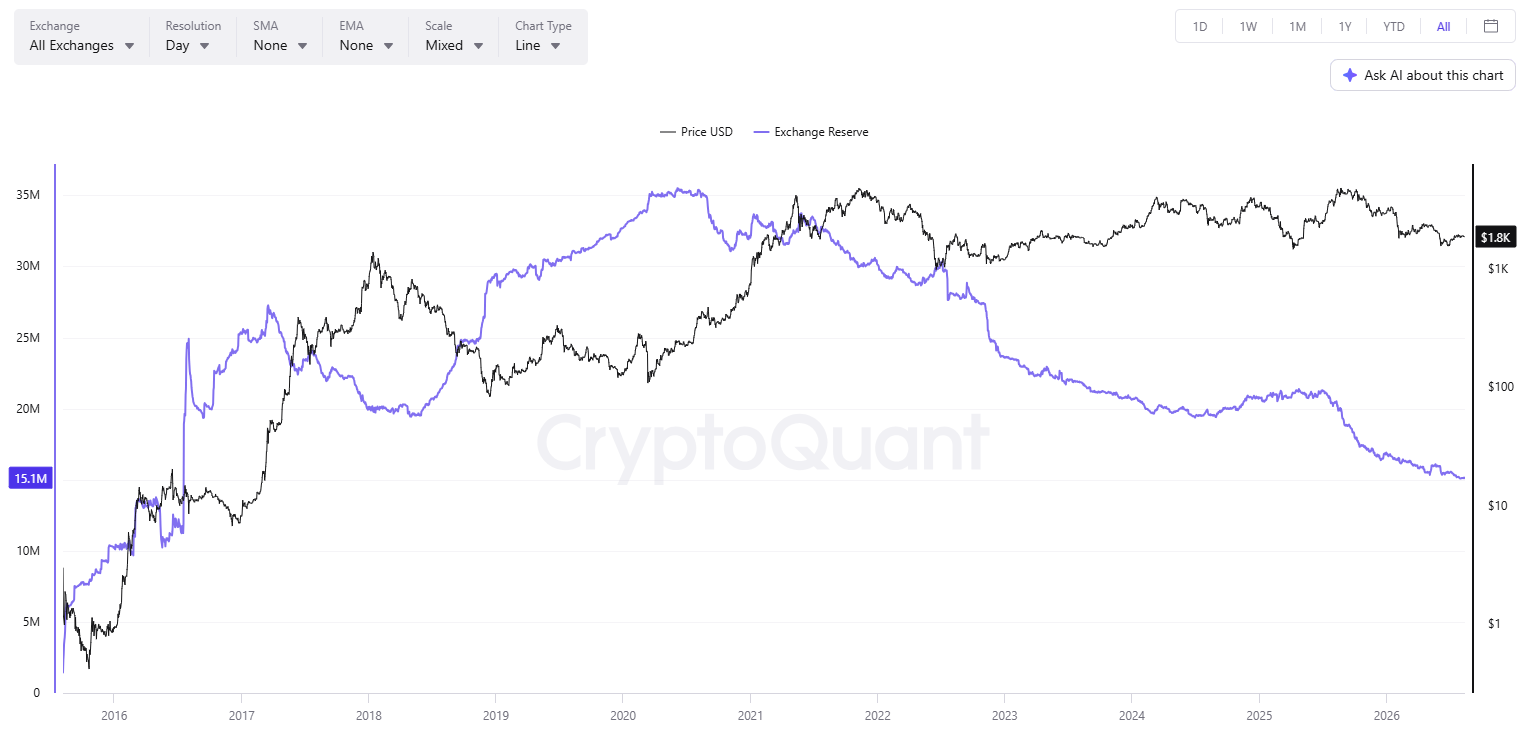
- ETH Exchange Reserves, Source: CryptoQuant
Last but not least, we shall pay attention to the institutional interest in ETH. Since the start of July, spot Ethereum ETFs have seen a strong wave of inflows, possibly paving the way for a potential price move north.
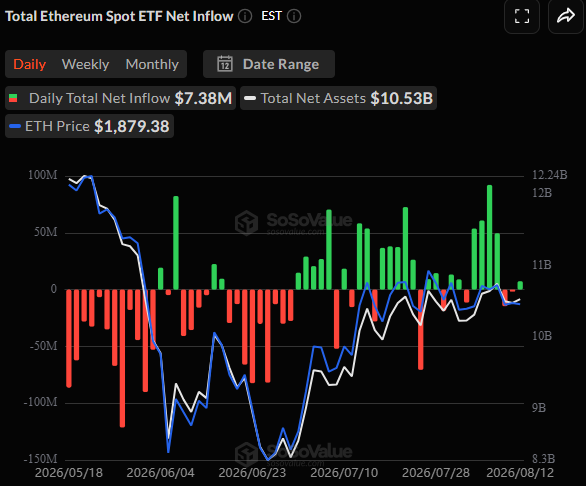
- Spot ETH ETFs, Source: SoSoValue
The post The Ideal Moment to Buy Ethereum (ETH) Is Now: Here’s Why appeared first on CryptoPotato.

Bullish (NYSE: BLSH) shares jumped in early trading on Thursday after the institution-focused crypto exchange and CoinDesk owner reported a strong rebound in quarterly results. The company said second-quarter adjusted revenue climbed 62% year over year, while adjusted EBITDA more than tripled, reflecting both improved operating performance and a shift in where income was coming from.
The stock’s move also followed a regulatory step in Gibraltar that broadens Bullish’s ability to operate in tokenized securities—an area that has increasingly drawn attention from traditional finance. Investors appear to be weighing the quarter’s financial momentum alongside the company’s push toward more regulated onchain market activity.
Key takeaways
- Bullish reported second-quarter adjusted revenue of $92.6 million, up from $57.0 million a year earlier.
- Adjusted EBITDA rose to $29.5 million from $8.1 million, indicating a significant improvement in profitability.
- Subscription, services and other revenue reached a record $62.7 million, helping offset weaker exchange activity.
- The company’s quarterly trading volume totaled $179.6 billion, down from $197.4 billion year over year, while average daily volume fell to $2.0 billion.
- Bullish received approval from Gibraltar’s Financial Services Commission to offer secondary trading in issuer-sponsored tokenized securities and raised full-year guidance for subscription-related revenue.
Quarterly results point to operating leverage
In its earnings update, Bullish said adjusted revenue for the second quarter reached $92.6 million, compared with $57 million in the same period of the prior year. The profitability turnaround was even more pronounced: adjusted EBITDA increased to $29.5 million from $8.1 million.
On the bottom line, the company reported adjusted net income of $14.3 million, reversing a $6.0 million loss in the year-ago quarter. For shareholders, the combination of rising revenue and sharply higher adjusted EBITDA suggests the business is capturing more value per unit of activity—an important signal for exchanges that have historically been sensitive to market volumes.
Revenue mix strengthens as exchange activity cools
While exchange volumes softened compared with the year before, Bullish highlighted a key offsetting driver. Subscription, services and other revenue totaled a record $62.7 million in the quarter.
That figure mattered because trading metrics declined: Bullish reported $179.6 billion in quarterly trading volume, down from $197.4 billion a year earlier. Average daily volume also slipped to $2.0 billion from $2.2 billion. The implied message is that the company’s income stream is becoming less dependent on pure trading throughput and more supported by services and subscription-related earnings.
For traders and institutional users, a revenue mix that relies more on subscriptions and services can be beneficial—especially if broader market activity fluctuates. It may also indicate that Bullish is attracting customers not only for spot trading, but for infrastructure and ongoing platform access.
Gibraltar approval expands tokenized securities business
Separate from the financial results, Bullish reported it received approval from the Gibraltar Financial Services Commission to offer secondary trading in issuer-sponsored tokenized securities. This is a notable development for a company positioning itself in regulated onchain markets.
The approval matters because secondary trading permission moves tokenized securities beyond primary issuance mechanics and into ongoing liquidity, where regulatory frameworks and market structure typically become more complex. Bullish framed the step as part of its expansion into regulated tokenized markets.
However, the exact scope of what products can be listed and how trading will operate in practice was not detailed in the provided information. Investors will likely watch for further clarification on launch timelines, participating issuers, and how trading activity in tokenized securities compares with the broader crypto exchange volume.
Guidance raised amid improved visibility
Bullish also lifted its full-year guidance. The company now expects $225 million to $245 million in subscription, services and other revenue, citing performance in the first half of the year and improved visibility.
Raising guidance can be interpreted as management signaling confidence that the stronger revenue mix seen in the quarter will persist. That is particularly relevant given the reported decline in trading volume versus the prior year—suggesting the company believes its non-exchange revenue streams are gaining enough momentum to offset weaker trading activity.
At the same time, investors should note that guidance is tied specifically to subscription, services and other revenue. The company did not provide a revised outlook in the provided excerpt for exchange-specific results, so it remains unclear how much of the improvement will translate into sustained volume growth.
Shares rally, but longer-term performance remains a concern
Thursday’s advance extends a broader rebound for Bullish shares. The stock has gained around 20% over the past month, according to Yahoo Finance data. Even with the recent rally, Bullish shares remain far below levels seen after the company’s listing last year, trading about 70% under post-listing highs, based on the same Yahoo Finance reference.
In other words, the near-term reaction to stronger financial metrics and a regulatory expansion comes against a backdrop of still-limited recovery from earlier drawdowns. That dynamic often shapes how markets respond to the next earnings report: investors may continue to reward progress on profitability and services growth, while still requiring evidence that trading volumes and tokenized securities activity can scale.
Looking ahead, the key signals to watch are whether Bullish can maintain subscription and services momentum as trading volumes fluctuate, and how quickly the Gibraltar tokenized securities approval translates into tangible secondary-market activity. The regulatory green light may open doors, but the market will ultimately want proof in execution and sustained earnings.

Public Bitcoin miners are trimming capacity faster than the network itself, according to a BlocksBridge Consulting analysis shared in the Miner Weekly newsletter. The data points to a gradual redeployment of electricity, sites, and operational expertise toward data centers and high-performance computing (HPC)—a key shift in the sector’s business model.
BlocksBridge reported that realized hashrate among a cohort of public miners fell from 368.3 exahashes per second (EH/s) in Q4 2025 to 319 EH/s in Q2 2026, a 13.4% decline. The pullback was steeper when excluding Bitdeer, which continued to grow.
Key takeaways
- Realized hashrate among public Bitcoin miners dropped 13.4% from Q4 2025 to Q2 2026, according to BlocksBridge’s Miner Weekly cohort.
- Without Bitdeer, the cohort’s realized hashrate fell 21.2%, indicating that most operators contracted more aggressively.
- Bitdeer was an outlier: its realized hashrate rose 44% to 63 EH/s during the same period.
- Bitcoin network average hashrate declined 10.6% over the same six months, suggesting miners’ reductions outpaced the broader network.
- Several miners are increasingly deriving revenue from non-mining activities such as colocation and HPC leasing.
Miners shrink capacity faster than the network
BlocksBridge’s latest Miner Weekly update frames the change as part of a longer transition underway in the mining industry. In its reported cohort, realized hashrate decreased from 368.3 EH/s in Q4 2025 to 319 EH/s in Q2 2026. When Bitdeer is removed from the comparison, the decline becomes more pronounced: realized hashrate drops from 324.6 EH/s to 255.9 EH/s, or 21.2%, across the six-month span.
Bitdeer’s figures diverge sharply from the rest. BlocksBridge reported that Bitdeer’s realized hashrate increased 44% to 63 EH/s, highlighting how competitive dynamics among public miners have started to split between those expanding and those contracting.
For context, BlocksBridge also noted that the Bitcoin network’s average hashrate fell 10.6% over the same period. The gap—miners reducing faster than the network—matters because it can signal that some operators are prioritizing other uses for capital and power rather than continuing to chase mining economics.
Why non-mining revenue is becoming more central
Alongside the capacity pullback, the sector’s revenue mix is shifting. The article points to growing contributions from non-mining activities—particularly colocation and HPC leasing—at miners that have positioned their power and infrastructure for broader technology demand.
In an example highlighted alongside the hashrate data, Core Scientific generated $136.7 million in colocation revenue in Q2, compared with $27.5 million from Bitcoin mining. Similarly, TeraWulf reported $31.9 million in HPC lease revenue versus $12.8 million from mining.
While the specific companies referenced show the trend clearly, the overall message is broader: the economics of mining alone are not carrying the same weight they once did. For investors and market observers, that shift changes how to interpret operational performance. Realized hashrate trends may no longer map cleanly to profitability if more of a miner’s earnings depends on leasing, hosting, or AI-related workloads rather than block rewards and transaction fees.
The post-2021 mining migration is losing momentum
BlocksBridge attributed the current slowdown to the unwinding of the expansion cycle that followed China’s 2021 Bitcoin mining ban. That policy shock triggered one of the most dramatic hashrate declines in Bitcoin’s history, followed by a recovery as miners relocated overseas.
North America became a key destination, where migration and new operational capacity supported an expansion among public miners. The analysis frames that phase as a capital-raising and build-out period—one characterized by power-site acquisitions and a push to scale mining infrastructure.
However, the newsletter argues that after a halving cycle, conditions look materially different. Weaker mining profitability is paired with escalating demand for AI infrastructure since 2022, creating incentives for some public miners to repurpose sites and shift power capacity away from Bitcoin mining entirely.
That doesn’t mean the mining business is disappearing, but it does suggest a structural change in priorities. Instead of simply competing to add more hashpower during favorable windows, operators are increasingly treating their electricity access and data-center capabilities as an asset that can serve multiple markets.
What to watch next: divergence among operators
The most important signal in the BlocksBridge report is divergence. Bitdeer’s continued realized hashrate expansion contrasts with more aggressive contraction from other public miners in the cohort, while Bitcoin network hashrate overall falls more moderately. For readers tracking the sector, the next question is whether the gap between “expanding” and “contracting” operators persists as electricity costs, hosting demand, and AI workloads evolve.
As more miners report meaningful revenue from colocation and HPC leasing, future comparisons may need to focus less on how quickly companies add or remove mining equipment and more on whether their non-mining services can sustainably offset changes in mining profitability.
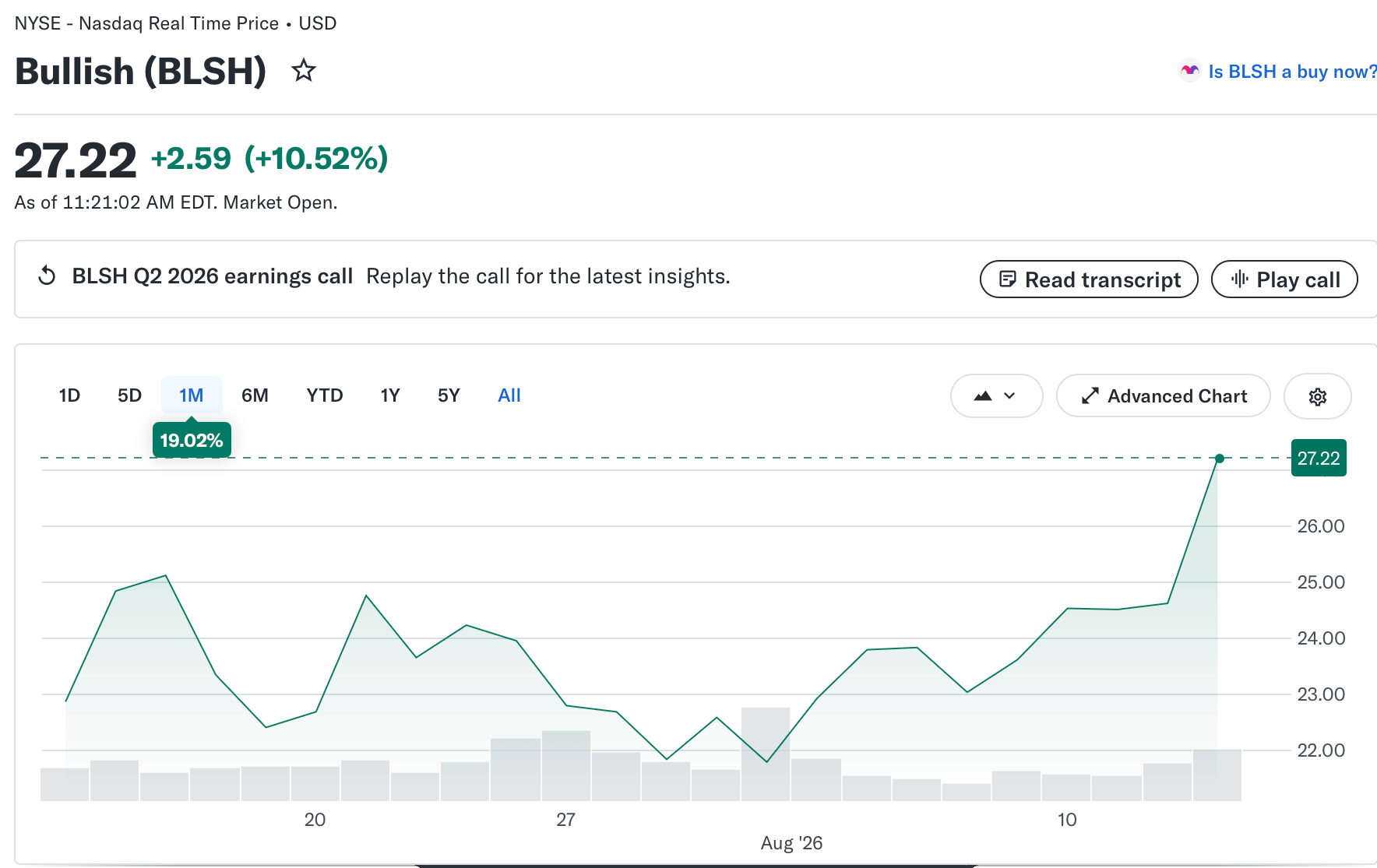
Bullish shares jumped around 13% in early trading Thursday after the institutional-focused crypto exchange and CoinDesk owner reported a 62% year-over-year increase in second-quarter adjusted revenue and more than tripled its adjusted EBITDA.
Bullish reported $92.6 million in adjusted revenue for the quarter, up from $57 million a year earlier, while adjusted EBITDA rose to $29.5 million from $8.1 million. Adjusted net income reached $14.3 million, reversing a $6 million loss in the year-ago quarter.
Subscription, services and other revenue hit a record $62.7 million, helping offset weaker exchange activity. The company recorded $179.6 billion in quarterly trading volume, down from $197.4 billion a year earlier, while average daily volume fell to $2 billion from $2.2 billion.
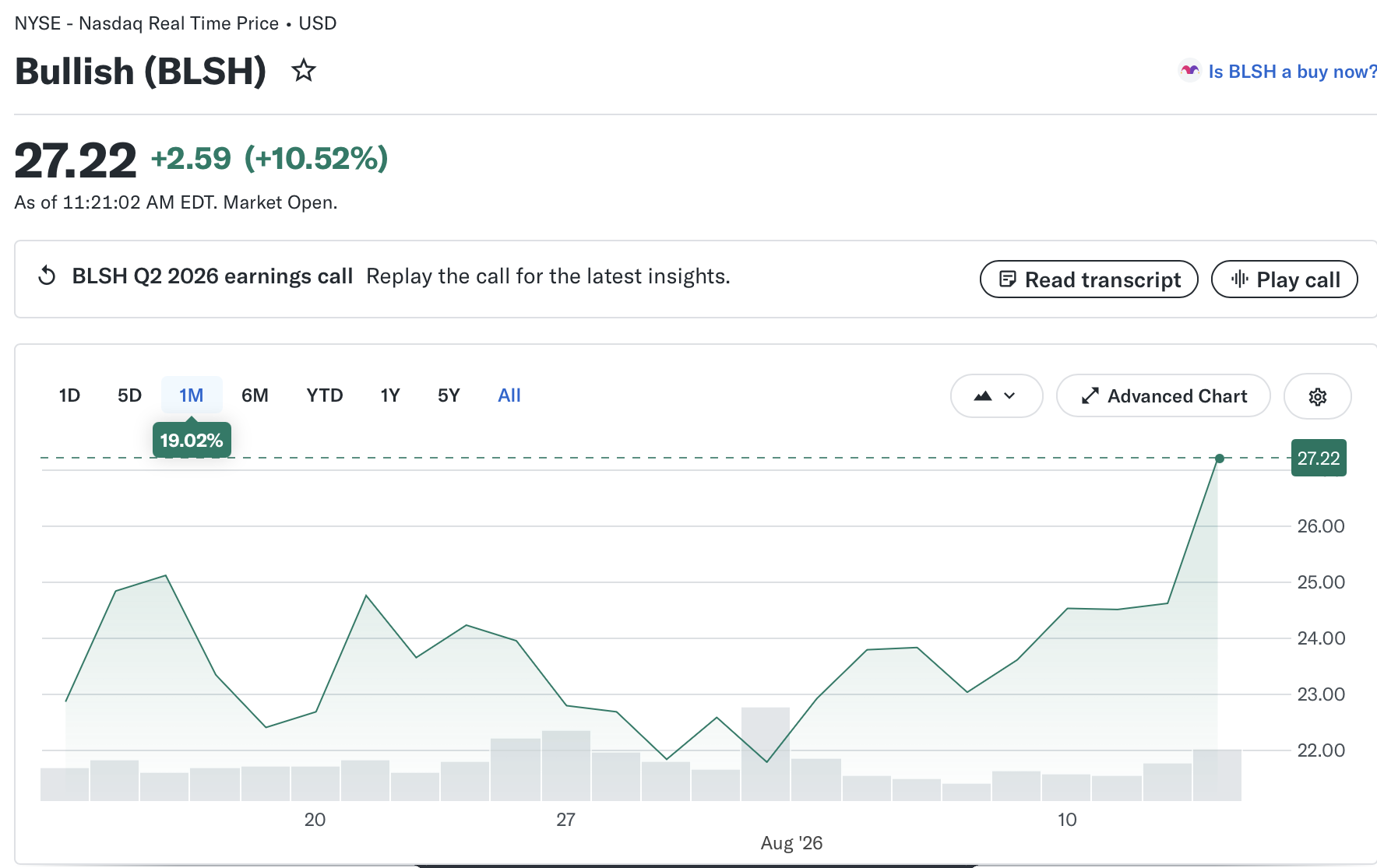
The NYSE-traded BLSH shares were up more than 10% on Thursday morning. Source: Yahoo Finance.
The company also received approval from the Gibraltar Financial Services Commission to offer secondary trading in issuer-sponsored tokenized securities, expanding its push into regulated onchain markets.
Bullish lifted its full-year guidance, forecasting $225 million to $245 million in subscription, services and other revenue, citing its first-half performance and improved visibility.
Thursday’s rally extends a recent rebound for Bullish shares, which have gained around 20% over the past month. The stock, however, remains about 70% below its post-listing highs last year, according to Yahoo Finance data.
Magazine: El Salvador’s Bitcoin experiment turns 5: ‘It was for us, not them’

BRYONY GORDON: Brad Pitt is a sad old man and I pity him. Here’s why

Google’s Gemini App Surpasses 1 Billion Monthly Users, Becoming Fastest-Growing Product Ever

Trump Is Sued Over Selling Early Access to Truth Social Posts Amid Backlash Against Scheme


-

 Fashion6 days ago
Weekend Open Thread: Mattifying Sunscreen
-

 Fashion6 days ago
Frugal Friday’s Workwear Report: Cap-Sleeve Pointelle Crewneck Sweater
-

 News Videos5 days ago
Can Astrology Help Find Gold and Silver Trends? A Financial Astrology Guide
-

 Tech6 days ago
Rinn Pharma & Biopharma to join NordicPharmaTrain network
-

 Business5 days ago
How to Start a Cleaning Business: A Step-by-Step Guide
-

 Business4 days ago
Datadog: Best Of Breed For Multiple Reasons
-

 Business5 days ago
BDC Weekly Review: Private BDC Q2 Numbers Are Strong
-
 NewsBeat2 days ago
Communication cards help banking customers access services or report scams
-

 Business7 days ago
Brightwater secures funding for WA-first dementia projects
-

 Tech7 days ago
Price Hikes May Be Coming for PC Motherboards Next
-
 Business3 days ago
Oil Price Today (August 11): Crude oil rises to $88 after Trump’s compensation demand dents Hormuz opening. Here’s why
-

 Fashion6 days ago
Weekly News Update, 8.6.26 – Corporette.com
-

 Business6 days ago
Aussie shares lose steam to close record-breaking week
-
 Entertainment6 days ago
Brand New Day’ Characters, Ranked
-

 Fashion7 days ago
The Best Stores Like Ann Taylor
-

 Entertainment7 days ago
Coastal House Media Can Disney Redeem Live Action Dragon Ball?
-

 Fashion6 days ago
Irina Shayk Wows in REVOLVE Los Angeles’ Summer Styles
-

 Fashion6 days ago
Burberry Fall 2026 Takes On Commuter Style
-

 Politics5 days ago
Be quiet, Miriam! – spiked
-

 Fashion4 days ago
Amazon Sundays: Closet Care Before Fall
You must be logged in to post a comment Login