

Connect with us

Business

Astronomers Discover Three Supermassive Black Holes In A Single Distant Galaxy For The First Time Ever

Published

on

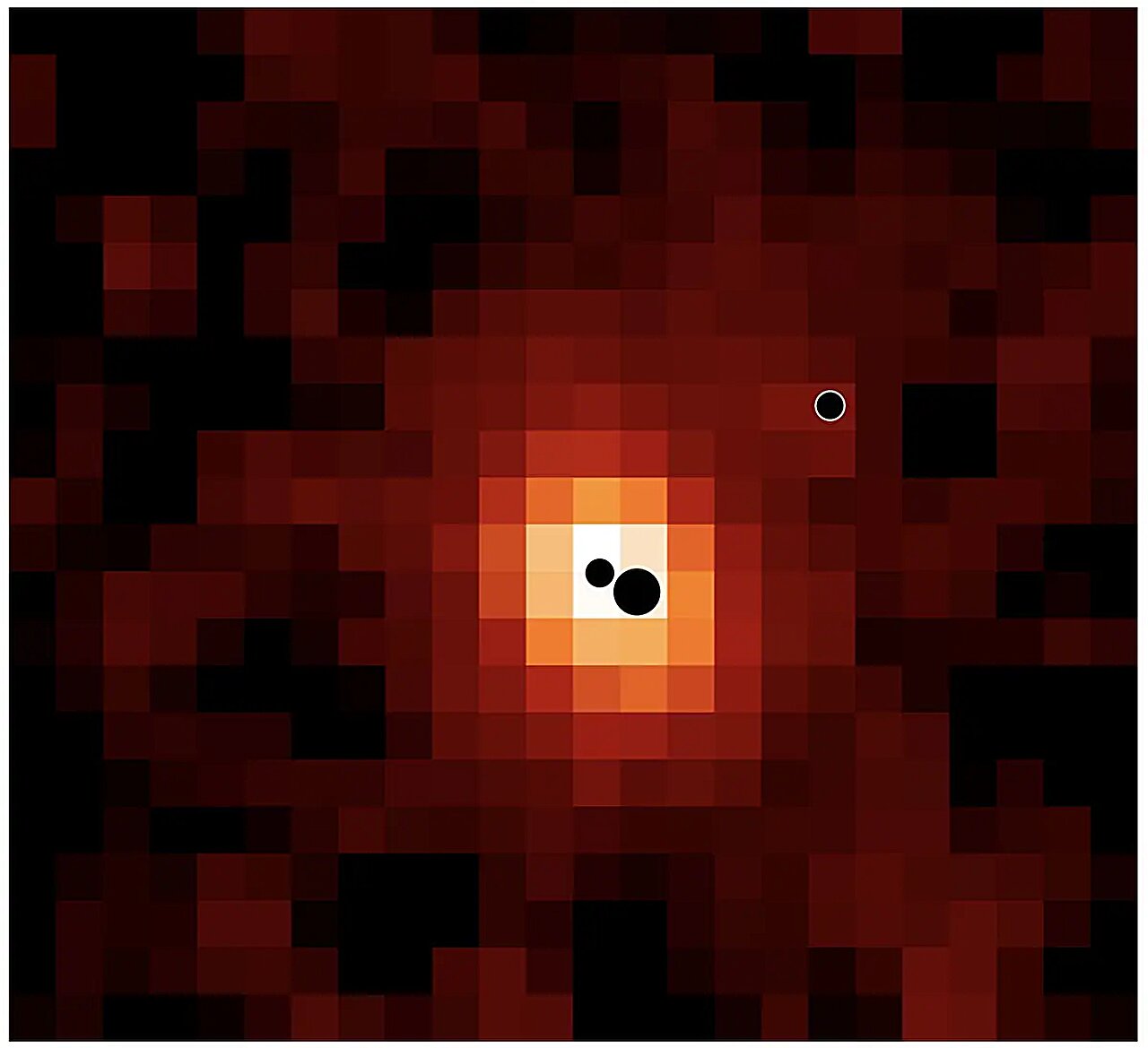
Map of the distant galaxy J0148-4214 in ionised hydrogen (Hα).

An international team of astronomers has identified three actively feeding supermassive black holes within a single galaxy, marking the first time scientists have documented such a configuration in the distant universe and offering new clues about how the earliest, most massive black holes may have grown.

The discovery was made in the galaxy J0148-4214, located more than 12.5 billion light-years from Earth. Because the galaxy is so far away, its light has taken 12.5 billion years to reach Earth, meaning astronomers are observing it as it existed only about 1.2 billion years after the Big Bang. The research, led by the Max Planck Institute for Extraterrestrial Physics, was published in the journal Astronomy & Astrophysics.

Hannah Übler, a research group leader at the institute and lead author of the study, said the finding represents a milestone in the study of early black hole formation. “This is the first evidence of three active black holes in a single galaxy in the distant universe,” Übler said.

The three black holes vary considerably in both size and location within the galaxy. Two sit near the galactic center, separated from one another by roughly 620 light-years, while a third is positioned much farther out, approximately 5,500 light-years from the center. Using observations from the James Webb Space Telescope, researchers estimated the masses of the three black holes at roughly 80 million, 600,000 and 2 million times the mass of the sun, respectively.

Advertisement

Notably, the most massive of the three black holes is not the fastest-growing. According to the study, the smallest of the black holes, with a mass of roughly 600,000 suns, is accreting matter at a rate that actually exceeds the theoretical maximum predicted by standard models of black hole growth, a threshold known as the Eddington limit, while the larger, 80-million-solar-mass black hole is growing more slowly by comparison.

Researchers identified the three black holes by analyzing the spectral signatures of hydrogen gas moving at extremely high velocities within the galaxy, a pattern consistent with material orbiting close to a black hole’s gravitational field. Because the two central black holes were too close together to be visually distinguished as separate points of light, the team relied on a technique called spectro-astrometry, which measures subtle spatial shifts in the emitted light across the galaxy, to disentangle their individual signatures and confirm that two distinct sources, rather than one, were responsible for the observed spectral pattern.

Dr. Giovanni Mazzolari, a researcher at the Max Planck Institute and the study’s second author, said the depth of data provided by the James Webb Space Telescope made the full analysis possible. “The JWST data allowed us not only to identify the three black holes,” Mazzolari said, noting that the observations also allowed the team to estimate the black holes’ growth rates and the total stellar mass of their host galaxy, which the researchers calculated at approximately 1.3 billion solar masses.

The two central black holes are expected to merge within the next several hundred million years, according to the study’s dynamical estimates. Roberto Maiolino, a professor at the University of Cambridge and a co-author of the research, said the finding carries significant implications for understanding how the universe’s earliest supermassive black holes reached such enormous sizes so quickly. “These results are extremely exciting,” Maiolino said, adding that the findings suggest black hole mergers may represent an additional, faster pathway for rapid black hole growth in the early universe, alongside the more commonly studied process of direct gas accretion.

Advertisement

The origin of the third, more distant black hole remains less certain. Researchers said it could represent the leftover core of an earlier galactic merger, may have been displaced from the galactic center by a gravitational recoil following a previous black hole collision, or could simply be in the process of migrating inward toward the galaxy’s center over time.

The discovery adds direct observational support to existing theories of galaxy evolution, which hold that galaxies in the early universe frequently collided and merged with one another, a process that would have similarly driven the black holes at each galaxy’s center to merge and grow progressively larger over cosmic time. Scientists have said such mergers between supermassive black holes are expected to be a key source of the gravitational waves that future space-based observatories are designed to detect, making systems like J0148-4214 valuable natural laboratories for understanding how such mergers unfold.

Researchers emphasized that the discovery would likely not have been possible without the specific combination of spectroscopic and spatial data provided by the James Webb Space Telescope’s Near-Infrared Spectrograph integral field unit. Without that spatially resolved information, the team said, it is likely that only one of the three black holes in J0148-4214 would have been detected, with the other two remaining hidden within a single, blended spectral signature.

The findings are expected to inform future searches for similarly complex, multi-black-hole systems in other distant galaxies, as astronomers continue using the James Webb Space Telescope to probe the earliest chapters of black hole and galaxy formation in the universe’s history.

Advertisement
Continue Reading
Click to comment

You must be logged in to post a comment Login

Leave a Reply

Business

Major AI infrastructure investment at South Wales data centre campus

Published

on

Business Live

Vantage Data Centers has struck a major deal with Nebius for its CWL1 campus in Newport

Newport CWL1 campus of Vantage Data Centers.

A US hyperscale data centre firm has confirmed a major AI infrastructure investment at its Newport campus.

Vantage Data Centers has struck an agreement with Nasdaq listed AI cloud company Nebius to deploy high-density, Nvidia-powered AI infrastructure at its CWL1 campus.

Advertisement

The deployment represents the first announced commercial capacity commitment in the South Wales AI Growth Zone and will support growing UK demand for domestic AI compute capacity.

Under the agreement, Nebius will lease high-density capacity at CWL1 to support AI training, inference, agentic AI and enterprise AI workloads, serving enterprises, researchers, startups and public sector organisations seeking access to advanced AI infrastructure.

This capacity is part of Nebius’ broader UK expansion and commitment to scale domestic AI compute capacity. In June, the company announced approximately £1.7bn of committed capacity buildout across four UK sites.

The agreement builds on Vantage’s long-standing presence in Newport and reinforces the role hyperscale data centers play in enabling the UK’s AI economy. O

Advertisement

perational since 2010 and one of Europe’s largest data center campuses, the CWL1 campus provides the scale, connectivity and power infrastructure required for high-density AI workloads and serves a diverse base of hyperscale, enterprise and public sector customers.

Its electricity consumption is matched with 100% certified renewable energy, and its newest facilities are designed to minimise operational water consumption through a closed-loop cooling system that recirculates water rather than evaporating/

South Wales was designated as a UK AI Growth Zone in recognition of its concentration of digital infrastructure, fiber connectivity to London, high-capacity electricity grid infrastructure and strong industrial base.

The region is also home to the UK’s largest cluster of semiconductor businesses, creating a growing ecosystem for advanced technology, AI infrastructure and high-value digital investment.

Advertisement

CWL1 is part of Vantage’s multi-billion-pound investment strategy across South Wales, where the company expects to deliver more than 1GW of AI-ready capacity across Newport, Bridgend (where work is under way at the former Ford engine factory site) and the Welsh Government-owned Bro Tathan business park in the Vale of Glamorgan where it has planning for a major campus.

“This is an important milestone for South Wales and for the UK’s AI infrastructure ambitions,” said David Howson, Europe, the Middle East and Africa (EMEA) president for Vantage Data Centers.

He added:“Nebius is scaling AI cloud infrastructure in the UK at a time when demand for domestic compute capacity continues to accelerate. Vantage’s Newport campus provides the scale, connectivity and operational excellence needed to support that growth, and we’re proud to help establish South Wales as a leading destination for AI investment.”

General manager for EMEA at Nebius, Gary Tierney, said“The UK is one of the places where AI is being built, deployed and adopted by startups, enterprises and the public sector.

Advertisement

“Vantage’s Newport campus gives us a strong foundation to expand access to Nvidia-powered AI infrastructure in the UK and support customers building the next generation of AI applications.”

Kanishka Narayan, the Vale of Glamorgan MP

Kanishka Narayan, the Vale of Glamorgan MP(Image: Laurie Noble Photography / Houses of Parliament)

UK AI Minister and MP for the Vale of Glamorgan Kanishka Narayan said: “This government (UK)wants to put AI to work as a tool for renewing Britain and delivering new jobs. It is central to our mission to reindustrialise the country, drive good growth in every postcode and ensure our public services match-fit for the decades ahead.

“Making that happen relies on having cutting-edge compute–the horsepower that makes AI possible–here on home shores. The infrastructure at Newport will create new high skilled jobs in South Wales and help British businesses and innovators using AI to solve some of the toughest problems.”

Adam Price, Cabinet Minister for Enterprise, Connectivity and Energy, said: This announcement marks an important milestone for the South Wales AI Growth Zone and demonstrates Wales’ growing reputation as a strategic location for the infrastructure that will power the AI economy.

Advertisement

“Nebius and Vantage’s investment will help unlock new economic opportunities, support highly skilled jobs and reinforce Wales’ position as a leading destination for advanced digital investment.

“We look forward to working with partners to maximise the benefits of this investment for businesses, communities and the wider Welsh economy.”

Continue Reading

Business

Tata Motors PV Q1 Results: Net profit plunges 80% YoY to Rs 775 crore, revenue rises 9%

Published

on

Tata Motors PV Q1 Results: Net profit plunges 80% YoY to Rs 775 crore, revenue rises 9%
Tata Motors Passenger Vehicles on Thursday reported a consolidated net profit of Rs 775 crore for the April-June quarter of FY27, marking more than 80% year-on-year decline from the Rs 3,924 crore reported in the same period last year, amid supply constraints, including a fire at a key component supplier, Middle east conflict and planned Jaguar wind-down.

The company’s revenue from operations increased over 9% YoY to Rs 95,799 crore during the quarter, from Rs 87,677 crore reported in the year-ago period. Its EBITDA margin contracted by 130 basis points to 7.4%.

The net profit reported by the company for the first quarter of FY27 included an exceptional loss of Rs 32 crore, while the same for the first quarter of FY26 stood at Rs 47 crore. The company’s earnings per share reduced to Rs 2.10 per share, from Rs 6.84 per share reported in the year-ago period.

Jaguar Land Rover Q1 financials

Jaguar Land Rover (JLR) saw a 9% YoY drop in wholesales, as volumes were impacted by temporary supply constraints, including a fire at a major component supplier at the start of the quarter, market disruption linked to the conflict in the Middle East and planned wind-down of outgoing Jaguar models ahead of the launch of Jaguar Type 01.
Consequently, the company’s revenue dropped nearly 10% YoY to £6 billion during the quarter under review. In addition to the impact of reduced volumes, profitability was impacted by market conditions pushing retail VME up from 4.1% to 7.1%, the company said.

Advertisement


Jaguar Land Rover’s profit crashed 73% YoY to £66 billion during the first quarter. Despite the supply constraints and market disruption faced by the business, the first quarter has been profitable, the company said.
“JLR delivered first quarter profits of £109m and an adjusted EBIT margin of 2.8%. Despite the near-term industry challenges, we continue to see strong demand for our brands and look forward to the launch of four sensational new products in the coming months: Range Rover Electric, Range Rover Sport Electric, Range Rover GT and Jaguar Type 01. I would like to thank all our people, suppliers and retail partners for their continued dedication, resilience and support,” said Jaguar Land Rover CEO PB Balaji.

Tata Motors PV segment Q1 financials

Tata Motors PV segment saw volumes sharply rise by 46% YoY, which the company said significantly outperformed the industry. Electric vehicle volumes meanwhile rallied 112% YoY, backed by a comprehensive portfolio, new launches and leveraging demand growth post West Asia conflict. The segment saw a 65% YoY growth in revenue.

However, the impact of strong revenue growth was partially diluted by adverse FX and commodities, Tata Motors PV said. “Q1 FY27 marked a strong start to the year for Tata Motors PV, with industry-beating 46% YoY volume growth driven by robust customer demand and the success of our recent launches…While supply constraints affected Sierra volumes during the quarter, customer interest remains strong and the Sierra.ev has seen a positive response. In Q1 FY27 we delivered a resilient financial performance while being impacted on account of elevated levels of commodity and forex,” said Shailesh Chandra, Managing Director & CEO of Tata Motors Passenger Vehicles.

Supported by a strong order book, exciting product pipeline, sustained demand, and focused margin improvement initiatives, Chandra said the company is confident of maintaining growth momentum and delivering sequential improvement through the rest of the year.”

Advertisement
Continue Reading

Business

Earnings growth to play larger role in determining portfolio returns than valuation re-rating: Nilesh Shah

Published

on

Earnings growth to play larger role in determining portfolio returns than valuation re-rating: Nilesh Shah
Earnings growth is likely to play a larger role in determining portfolio returns than valuation re-rating in the near term, as valuations of Indian equities remain neither cheap nor expensive, according to Nilesh Shah, Managing Director, Kotak Mahindra Asset Management Company.

In an exclusive conversation with ANI, Shah said the first-quarter earnings season has been broadly positive, with companies reporting results that were either ahead of expectations or broadly in line with them.

“So the first quarter numbers came reasonably ahead of expectations or in line with expectations. There were very few disappointments,” Shah said.

He noted that the overall earnings growth figure was affected by the performance of oil marketing companies. However, excluding these companies, he said the broader economy delivered fairly good results.

Advertisement

“The aggregate earnings growth was obviously impacted by oil marketing companies’ results, but excluding them, the entire economy delivered fairly good numbers,” Shah said.


According to Shah, the market’s future performance will depend increasingly on whether companies can deliver sustained earnings growth. He said investors should not expect valuation expansion to be the main source of returns at the current stage.
“We still believe that despite a strong set of numbers, market returns will still be linked with earnings growth,” he said.Shah described current market valuations as balanced, saying they are not at levels that can be considered particularly cheap, but neither are they excessively expensive.

“Valuations are fair, not cheap, not expensive,” he said.

Against this backdrop, Shah expects earnings growth to contribute more to portfolio returns than a further increase in valuation multiples.

“At this point of time, it looks like that earnings growth will be a bigger contributor to portfolio returns than valuation re-rating, and earnings growth looks like it is coming in low double-digit numbers,” he said.

Advertisement

His comments come amid continued activity by both domestic and foreign investors in Indian equities. Shah said foreign portfolio investors (FPIs) have turned buyers in July, with August also broadly moving in a similar direction. However, he cautioned investors against looking only at aggregate FPI flow figures.

He said FPIs have been selling large-cap stocks, particularly banks and IT companies, while buying small and mid-cap stocks. More than 100 small and mid-cap companies, according to Shah, have recorded all-time-high FPI holdings.

He also pointed to continued foreign investor participation in the primary market. While FPIs have been sellers in the secondary market, they have been buyers in IPOs.

“They have been sellers in the secondary market, but they are buyers in the primary market. Every single IPO in which we wanted to invest, we had to compete with the FPI for anchor allotment,” Shah said.

Advertisement

Shah said this shows why investors need to look beyond headline market-flow numbers and understand the underlying movement of money.

“Don’t look at just the headline number; focus on the nuances because underlying currents many times are very different,” he said.

Overall, Shah’s assessment suggests that with valuations at fair levels, the ability of Indian companies to deliver low-double-digit earnings growth could become a more important driver of investor returns than further valuation re-rating.

Advertisement
Continue Reading

Business

LG Electronics India Q1 Results: PAT rises 27% YoY to Rs 653 crore; revenue up 15%

Published

on

LG Electronics India Q1 Results: PAT rises 27% YoY to Rs 653 crore; revenue up 15%
Household appliances maker LG Electronics India reported a marginal 27.2 % year-on-year rise in profit after tax (PAT) at Rs 653 crore for the first quarter of FY27 (Q1FY27), compared with Rs 513 crore reported in the same quarter of the previous fiscal year.

The company’s revenue from operations for the quarter stood at Rs 7,233 crore, up 15.5% year-on-year from Rs 6,262 crore in Q1FY26.

EBITDA increased 26.2% year-on-year to Rs 904 crore in Q1FY27, from Rs 716 crore in the year-ago quarter.

EBITDA margin expanded 106 basis points year-on-year to 12.5%, from 11.4% in Q1FY26, driven by operating leverage at higher volumes, premium mix and strong Home Entertainment demand.

Advertisement

Televisions were the highlight of the quarter, driven by a shift towards larger screens and premium technologies. OLED and QNED strengthened the company’s premium mix, while a sports event accelerated upgrade demand. The company said proactive launches helped maximise the opportunity.


The ID business also maintained strong momentum, supported by government and institutional orders.
Growth was broad-based across categories, with washing machines delivering robust growth alongside strong compressor-based demand. Premium large-capacity products, including French Door and SBS refrigerators, 8kg+ washing machines and dishwashers, recorded standout growth, while the LG Essential range scaled across volume markets.Exports also delivered growth, complementing domestic demand and supported by a growing consumer shift towards feature-rich, higher-value and energy-efficient products.

Shares of LG Electronics India settled with marginal gains of 0.07% at ₹1,578.50 apiece on the BSE on Thursday, August 13.

LG Electronics Outlook

LG Electronics India said it remains constructive on the outlook for FY27, with demand momentum intact across segments, supported by a strengthening product mix, export ramp-up and the scale-up of its B2B and AMC businesses.

“While geopolitical and macroeconomic headwinds continue, we are actively protecting our margin trajectory through pricing discipline, operational efficiencies, and localization,” the company said.

Advertisement

The company said its diversified growth engines and execution capabilities reinforce its confidence in delivering performance ahead of its FY27 targets of mid-teen revenue growth and an early double-digit EBITDA margin.

Continue Reading

Business

SMCI options activity: call volume surges as implied volatility hits 82.6%

Published

on


SMCI options activity: call volume surges as implied volatility hits 82.6%

Continue Reading

Business

US stocks: Cerebras slumps 12% as mixed quarterly results test AI growth narrative

Published

on

US stocks: Cerebras slumps 12% as mixed quarterly results test AI growth narrative
Cerebras Systems slumped over 12% in early trading Thursday after it missed key estimates despite soaring cloud revenue, raising doubts about the ability of its AI chips to challenge Nvidia.

Expectations were high for AI-linked companies including Cerebras and networking equipment maker Cisco, given the strong ‌run-up in ⁠shares driven by ⁠Big Tech’s ballooning spending, set to cross more than $740 billion for this year. Here ​are some details:

Cerebras, in its second earnings report as a public ​company, offered a mixed picture as it increasingly derived revenue from cloud computing rather than its AI chips.

The AI chips business had ​helped position Cerebras as a challenger ⁠to Nvidia and ‌fueled a 41% rise in shares from the ​IPO price ​of $185.

Advertisement

The Sunnyvale, California-based company’s cloud business roughly quadrupled ⁠to $126 million, versus the year-ago quarter.


But its ​hardware sales, including AI chips, declined to $54.1 million ​from $70.3 million a year ago.
Second-quarter adjusted gross margin fell to 40.6% from 46.5% in the prior quarter, while revenue missed analysts’ estimates despite a higher annual outlook. “Execution remains the key debate given the scale and speed of the capacity build required to ‌support the ramp,” said analysts at Morgan Stanley.

Citi and Mizuho cut their price targets slightly; the ​median target ​as per estimates compiled ⁠by LSEG implied an upside of 15% from the previous close.

Separately, shares of Cisco Systems fell around 8% as its outlook fell short of lofty expectations tied to its rise as a beneficiary of the AI data center buildout. The stock has gained more than 60% this year.

Cisco expects $7.5 billion in revenue from AI infrastructure orders from hyperscalers in fiscal 2027.

Advertisement
Continue Reading

Business

Google’s Gemini App Surpasses 1 Billion Monthly Users, Becoming Fastest-Growing Product Ever

Published

on

Google Gemini AI is Here

Google’s Gemini app has surpassed 1 billion monthly active users, the company announced Tuesday, marking the fastest any product in Google’s 28-year history has reached that scale and placing the artificial intelligence assistant in direct competition with OpenAI’s ChatGPT.

Chief Executive Sundar Pichai announced the milestone in a post on X, writing that Gemini has become the company’s 14th product to reach 1 billion monthly users, joining a group previously occupied only by Search, Gmail, Android, Maps, Chrome, Play and YouTube. “1B+ people are now using the Gemini app every month to spark new ideas,” Pichai wrote, crediting the app’s rapid growth to Google Labs vice president Josh Woodward and the broader Gemini engineering team. Woodward marked the milestone with his own post, writing simply, “One billion for Gemini!”

The growth trajectory behind Tuesday’s announcement has been steep. Pichai first disclosed 400 million monthly active users for Gemini at Google I/O in May 2025. That figure climbed to 650 million by Alphabet’s third-quarter earnings disclosure in October 2025, reached 750 million by February 2026, hit 900 million when Pichai took the stage at Google I/O again in May 2026, and stood at 950 million as of the company’s second-quarter earnings report on July 22. The jump from 950 million to 1 billion took place in roughly the three weeks that followed.

In a blog post accompanying the announcement, Google shared new data illustrating how people are using the app. The company said 63% of users now speak directly to Gemini rather than typing, including a growing number of “voice only” users, and noted that busy parents are 43% more likely than other users to rely on voice for everyday tasks. Beyond straightforward conversation, Google said one in five interactions through Gemini Live now extend beyond voice alone, with users increasingly relying on live camera feeds and screen sharing for real-time problem-solving, a feature the company said has proven especially popular among do-it-yourself hobbyists and students.

Advertisement

Students in particular have leaned heavily on the app’s file-upload capabilities, with Google reporting that 38% of school-related requests submitted through Gemini include an attached document or image. On the creative side, Google said the app now generates more than 150 million images per day, a capability the company has positioned as particularly useful for small businesses producing their own marketing materials using a combination of image, video and audio tools within a single platform.

Google also highlighted Gemini’s expanding reach across devices beyond its own Android ecosystem. The company said the app now has more than 100 million active users on iOS, with power users on the macOS version of the app submitting prompts roughly twice as frequently as users on other platforms. On Android specifically, Google said Gemini can now automate tasks across more than 40 popular third-party apps, enabling functions like booking a rideshare or reserving a restaurant table directly through the assistant.

Tuesday’s announcement arrived one day ahead of Google’s scheduled Made by Google hardware event on August 12, where deeper integration of Gemini into the company’s Pixel 11 device lineup is widely expected to be unveiled. Woodward, in a separate video message, indicated that additional Gemini product updates remain in the pipeline, including a planned rollout of more than 60 new regional dialects for the assistant, a feature previewed earlier at Google I/O in May.

Notably, Google’s announcement did not disclose how many of Gemini’s 1 billion monthly users are paying subscribers, a detail some industry observers flagged as a meaningful omission from an otherwise data-heavy announcement. The distinction matters because Google’s user count includes people who may have been automatically routed to Gemini through their device’s operating system or migrated from an existing Google product, rather than users who actively sought out and paid for the standalone app.

Advertisement

Tuesday’s figure also refers specifically to the standalone Gemini app and does not include users who interact with Google’s AI systems through other channels, such as AI Mode in Google Search, which the company has said separately surpassed 1 billion monthly active users of its own.

The milestone places Gemini in close proximity to OpenAI’s ChatGPT, which reached 1 billion monthly active users in the months prior to Google’s announcement, according to reporting from TechCrunch, and had already cleared the more demanding threshold of 1 billion weekly active users by the time Google made Tuesday’s disclosure. Industry analysts have cautioned that comparing the two companies’ user figures directly can be misleading, since monthly and weekly active-user counts represent different, non-equivalent measures of engagement, and companies frequently define and calculate those metrics using their own internal methodologies.

Google launched the standalone Gemini app in 2024 and has since worked to embed the assistant across a growing share of its product ecosystem, including its Chrome browser, Android smartphones, and the Google Workspace suite of productivity tools spanning Docs, Sheets and Drive. In its blog post, the company said its goal moving forward remains building toward “the next billion” users by continuing to make Gemini more personal, proactive and powerful.

Advertisement
Continue Reading

Business

US stocks: Birkenstock shares jump 18% as strong demand prompts revenue forecast hike

Published

on

US stocks: Birkenstock shares jump 18% as strong demand prompts revenue forecast hike
Birkenstock raised its annual sales growth forecast and beat quarterly revenue estimates on Thursday, banking on resilient ‌full-price demand for ⁠its ⁠premium sandals from affluent shoppers, sending its shares up about 18%.

Strong pricing power and brand loyalty have ​helped companies such as Birkenstock that cater to wealthier consumers remain largely insulated from a wider pullback in ​U.S. discretionary spending affecting much of the apparel and footwear sector.

Demand for the company’s high-end sandals and closed-toe shoes has remained resilient for the quarter, while its expanding direct-to-consumer (DTC) business ​and retail footprint helped drive growth across regions.

“Birkenstock’s strong ⁠quarter shows that ‌consumers continue to demonstrate a preference for premium brands, and are ​willing to pay ​extra for products they perceive to be high-quality,” EMarketer analyst Rachel ⁠Wolff said.

Advertisement

Growth was supported by Birkenstock’s expanding DTC business, with sales through its own stores and website rising 14% and accounting for nearly 39% of quarterly revenue.


Birkenstock said the Middle East conflict’s impact was more contained than initially anticipated, estimating a hit of only high single-digit millions of euros in the second half versus an earlier forecast of 10 million to 12 million euros. “We were able to mitigate much of the pressure (from the Middle East conflict) through adjustments in ‌the delivery routes and strength in the other parts of the region,” CFO Ivica Krolo said on a post-earnings call.
Asia-Pacific sales increased 18% on a reported basis during the quarter, while ⁠the Americas grew 11% and EMEA rose 15%.Birkenstock now expects fiscal year 2026 revenue growth of 15% on a constant currency basis, compared with its earlier forecast of a 13% ​to 15% rise. It maintained its annual profit forecast of 1.90 euros to 2.05 euros per share.

Third-quarter revenue rose 13% to 719.5 million euros ($829.1 million), beating analysts’ average estimate of 713.4 million euros, according to data compiled by LSEG. Adjusted earnings per share came in at 0.74 euro, below estimates of 0.76 euro.

Continue Reading

Business

(VIDEO) Total Solar Eclipse Thrills Millions Across Europe In First Sighting From Spain Since 1905

Published

on

Total Solar Eclipse Thrills Millions Across Europe In First Sighting

Millions of people across Europe stepped outside Wednesday to witness a rare total solar eclipse, as the moon’s shadow swept across Greenland, Iceland and northern Spain in the first total eclipse to touch mainland Europe in 27 years.

The path of totality, roughly 182 miles wide, began over the Arctic Ocean near Siberia before arcing down through eastern Greenland, western Iceland and into northern Spain, where the eclipse reached its climax shortly before sunset. Observers within that narrow band experienced roughly two minutes of complete darkness as the moon fully blocked the sun, while a much broader partial eclipse was visible across the northern United States, most of Canada, much of Europe and northwestern Africa.

For Spain specifically, Wednesday’s event marked the country’s first total solar eclipse since 1905, according to the European Space Agency, drawing large crowds to viewing locations across the country’s north. Because totality arrived there in the evening, spectators in Spain experienced what is known as a sunset eclipse, watching the sun disappear behind the moon and later reemerge as a thin, glowing crescent low on the horizon.

Advertisement

Crowds gathered at viewing sites across the path of totality and well beyond it. In Iceland, people gathered in Reykjavik to watch the sky darken, while cruise ship passengers aboard vessels including the Ambassador cruise ship Ambition used protective glasses to observe the eclipse off the coast of Greenland. In Spain, spectators gathered in locations including Mallorca, A Coruña, Buitrago del Lozoya and Berlanga de Duero, while astronomers from the University of Toulouse set up observation equipment on the summit of the Pic du Midi in France to capture the partial eclipse visible from that location. Further north, people in Berlin, Warsaw and Stockholm also turned out to watch the partial phase of the eclipse using protective eyewear and, in at least one case documented in Warsaw, a welder’s mask.

Anthony Wood, a skywatching writer for Space.com, described witnessing totality from Valoria la Buena, Spain, alongside a team of citizen scientists from the Dynamic Eclipse Broadcast initiative. “It was the most incredible thing I’ve seen in my entire life,” Wood said. Space.com skywatching editor Daisy Dobrijevic offered a similarly emotional reaction after watching the event unfold. “I cannot believe what I just witnessed,” Dobrijevic said, adding that no amount of preparation looking at photos beforehand could fully capture the experience of watching the sun transform in person.

Some viewing locations faced complications beyond weather. In A Coruña, Spain, a wildfire broke out near a park where thousands had gathered to watch the eclipse, according to photos documenting the scene, adding an unexpected element of disruption to what was otherwise a clear day for viewing across much of the region.

NASA streamed live coverage of the eclipse beginning at 1:15 p.m. Eastern time, offering viewers outside the path of totality a chance to follow the event in real time. The agency’s map of the eclipse showed the red band of totality crossing Greenland, Iceland and Spain, with surrounding yellow contour lines indicating the percentage of the sun’s disk covered by the moon across the wider swath of the Northern Hemisphere experiencing a partial eclipse that day.

Advertisement

The eclipse also drew specialized scientific and tourism-focused expeditions. Western Iceland’s Snæfellsnes Peninsula hosted the Iceland Eclipse Festival, a multi-day cultural gathering running from August 12 to 15 combining the astronomical event with music, art and wellness programming set against the region’s glaciers and volcanic landscapes. Separately, cruise operators including HX Expeditions positioned ships within the path of totality near Greenland’s Scoresby Sund, giving passengers open-horizon views of the event from onboard.

Astronomers noted that total solar eclipses, while striking, are not exceptionally rare on a global basis, occurring somewhere on Earth roughly every 18 months. What makes any individual eclipse notable is how infrequently the path of totality happens to cross a specific, densely populated location, a gap that in Europe’s case had not been filled since a total eclipse crossed the continent in August 1999. Since then, only two total eclipses have brushed the edges of Europe, clipping Georgia and Russia in 2006 and the Faroe Islands and Svalbard in 2015, neither reaching the kind of population centers Wednesday’s eclipse touched across Spain.

Looking ahead, the next total solar eclipse will occur August 2, 2027, passing over southern Spain, North Africa and parts of the Middle East, including Morocco, Algeria, Tunisia, Libya, Egypt, Saudi Arabia and Yemen. For observers in the United States hoping for another domestic total eclipse, the wait will be considerably longer, with the next one not expected until 2044, when totality will be visible only across parts of Montana, North Dakota and South Dakota. A more widely accessible U.S. eclipse, tracing an arc from Northern California to Florida similar to the widely watched 2017 eclipse, is not expected until the following year.

For now, Wednesday’s celestial event has left a lasting impression on those who witnessed it firsthand, with photographers and eclipse chasers across Greenland, Iceland and Spain capturing images of the moon’s shadow racing across the landscape, a spectacle that briefly turned day into an eerie, temporary twilight before the sun’s light gradually returned.

Advertisement
Continue Reading

Business

Pharma packing firm Chester Medical buys Yorkshire’s Power Health Products in ‘milestone deal’

Published

on

Business Live

Deal brings together packaging and manufacturing services

A woman and a man shaking hands

Power Health Products said the deal ‘secures a strong future for the business’(Image: Getty Images)

Pharmaceutical packaging specialist Chester Medical has acquired East Yorkshire vitamin and health food manufacturer Power Health Products in what bosses call a “major milestone deal”.

Wirral-based Chester Medical, which also has a carton and label manufacturing site in Deeside in North Wales, was founded in 1965 and works with pharmaceutical, medical and veterinary businesses across the UK.

Power Health Products, based in Pocklington, was founded in 1972 and today is a contract manufacturer of health food supplements, sports nutrition products, and hair and skin care products. It employs some 80 people.

The firms will keep trading under their existing names and will maintain their current operations.

Advertisement

David Patterson, managing director of Chester Medical, said: ”This acquisition is a major milestone for Chester Medical. It enhances our offering, creates new opportunities for collaboration and growth, and strengthens our ability to support customers at every stage of their journey. There is an excellent cultural and operational fit between the two companies, and we are excited to see what we can achieve together.”

Vicky McIver, managing director of Power Health Products, said: “The health food supplements market has evolved significantly over the last five decades, and we are proud to have grown and evolved with it. Joining forces with Chester Medical marks an exciting new stage of growth for us and secures a strong future for the business. We are grateful to the RSM and LCF Law teams for their expertise and advice throughout the process.”

Brabners Deal Advisory, led by Paula McGrath with Dan Rice and Nicole Turton, provided acquisition advice to Chester Medical. Craig Geraghty, Kieran Donovan, Kevin Howard, Megan Parker, Paige Draper and Paul Hardy at Napthens provided legal advice.

DSG, led by Adam Brighouse with Andrew Moss, Anna Pope and Callum Lea, provided financial due diligence for Chester Medical. Rob Hackney and Alex Kier supported with tax advisory work.

Advertisement

Power Health was advised by RSM UK, led by James Atkinson with Rich Winter and Charlotte Turner, with tax advice led by Chris Etherington and Camilla Taylor. LCF Law, led by Rebecca Ridley and Brad Stewart slongside Sam Durling, Duncan Robertson, Harriet Thornton and Danielle Lynn, provided legal advice to Power Health’s shareholders.

Paula McGrath, principal and head of Brabners Deal Advisory, said: “Our long-standing relationship with Chester Medical and close contact with RSM aided this process immensely. It has been a pleasure to help the business take this important step in its growth and we look forward to watching it continue to develop under this new structure.”

James Atkinson, deal services partner at RSM UK, said: “Power Health Products’ strategic union with Chester Medical represents a strong deal for both parties. Their combined expertise and ambitions offer a healthy foundation for the combined entity’s continued growth across the health supplements market. We wish the whole team the best of luck as they move forward.”

Kieran Donovan, corporate partner and head of Liverpool office at Napthens said: ” We were delighted to advise Chester Medical on its acquisition of Power Health Products, a well-established Yorkshire business with a strong reputation in the health and wellness sector. The acquisition represents an exciting strategic opportunity for our client and provides an excellent platform for the continued growth and development of their business.”

Advertisement
Continue Reading

Trending

Copyright © 2025