
Crypto World
Researcher claims Rollbit co-founder tied to CSGO scams



The pseudonymous co-founder of crypto casino Rollbit is the subject of an attempted doxxing by an online researcher who says the platform stole from customers, and that some of its games are rigged.
According to a 128-page dossier put together by X user “HalfRetired,” Rollbit co-founder “Lucky” is actually a British national called Daniel Robert Dixon.
The dossier specifically ties Lucky to Counter-Strike:Global Offensive (CSGO) video game skin-gambling scandals, and claims that his companies have refused valid withdrawal requests by some customers.
The research also alleges that Rollbit and its predecessor Interdax built their audiences by quietly paying crypto influencers BTC to shill the platforms through referral links, without disclosing those payments to followers.
It frames the practice as a repeat playbook, as though the same undisclosed arrangements that drove Interdax’s growth were carried over to Rollbit.
HalfRetired’s allegations rely on UK corporate filings, years-old CSGO community drama, and social media posts by aggrieved customers.
Protos hasn’t verified their accuracy and doesn’t endorse these allegations.
Who is Daniel Robert Dixon?
Dixon was a director of DAX Financial Technologies Ltd and International Digital Assets Exchange Ltd, a derivatives exchange known as Interdax.
Interdax offered up to 100x leverage before it was dissolved in 2022. Dixon is listed as an Interdax co-founder.
Because Rollbit’s parent company is licensed in Curaçao, official UK registers cannot confirm that Dixon is Lucky, nor that he owns Rollbit.
HalfRetired’s claim rests on a screenshot of a CSGO Empire user called “Monarch” who is widely known in that community, and on other secondhand posts from social media.
Rollbit co-founder “Razer” has publicly denied any Dixon or CSGO Diamonds connection, a denial that HalfRetired calls dishonest. People have alleged that Dixon is Lucky since at least 2025.
Rollbit hasn’t publicly responded to HalfRetired’s dossier.
Read more: Crypto gambling livestreams to be banned from Twitch after $200K scam
Livestream rigging?
HalfRetired revived the 2016 CSGO Diamonds scandal, which saw streamer “m0E” accuse the site’s owner — who HalfRetired alleges is Dixon — of secretly feeding livestreamers advance dice roll outcomes.
The dispute ended after CSGO developer Valve sent cease-and-desist letters.
After m0E publicly accused the site of predetermining outcomes for promoted players, its owner admitted in a post, “We made a mistake with m0E and decided to tell him some of his future rolls in an effort to make his stream more entertaining on our site.”
In July 2016, CSGO Diamonds went offline.
Withheld withdrawal requests?
HalfRetired also catalogs a pattern of user complaints. “Rov777,” for example, claims Rollbit froze a $250,000 balance in June 2026.
Another, “anonadep,” said the platform withheld a withdrawal request that HalfRetired estimated at more than $29,000.
HalfRetired argues that Rollbit cited a different justification each time for delays, such various regional restrictions, once certain users tried to cash out winning balances.
Selvlabs founder Foobar has separately alleged that Rollbit is “notorious for stealing people’s money” by “locking accounts” and “delaying payouts.”
‘Provably fair’
Rollbit also markets its in-house games as “provably fair,” but HalfRetired doubts that claim.
A 2023 analysis alleged that Rollbit’s then-current Plinko game changed the server seed for every bet.
Changing a server seed breaks the mathematical design that makes provably fair games trustworthy.
In a standard setup, the operator publishes a cryptographic hash of a secret server seed before gameplay. The player supplies a client seed, and the result is derived from both.
Once the server seed is disclosed, the player can verify the commitment and reproduce the result, provided the protocol and implementation are sound.
Changing the server seed after new gameplay rounds removes that commitment.
HalfRetired argues that Rollbit previously let its house server choose when to serve a favorable seed. HalfRetired conceded the analysis didn’t establish that Rollbit was cheating currently, only doubting the fairness of its historical games.
Rollbit has since said it moved several games to a verifiably random system requiring no revealed server seed. The older design at the center of unfairness allegations is no longer in use.
Got a tip? Send us an email securely via Protos Leaks. For more informed news and investigations, follow us on X, Bluesky, and Google News, or subscribe to our YouTube channel.


[PRESS RELEASE – Dubai, United Arab Emirates, August 19th, 2026]
Swapiz Telegram Swap Bot announces its public launch. Designed with Telegram users in mind, the Swapiz Telegram Swap Bot allows users to make crypto-to-crypto swaps directly within the Telegram messaging app, without opening an external browser or exchange interface. Swapiz currently supports more than 50 cryptocurrencies and requires no KYC.
Swapiz is not the first crypto platform to turn to Telegram for swap capabilities. Over the past few years, Telegram has become a preferred channel for platforms offering crypto swap capabilities, emerging as one of the most important distribution channels in the crypto and blockchain space. The popular messaging app has more than 1 billion monthly active users and hosts numerous dedicated crypto communities. Swapiz is the latest platform to join the Telegram trend.
While the Swapiz Telegram Swap Bot is designed for users of all experience levels, its simple mechanics make it particularly accessible to crypto newcomers. After opening the bot on Telegram, users first create their Swapiz wallet and choose the cryptocurrency they want to deposit.
Once the deposit is confirmed and the funds appear in their balance, users can select “Exchange”, choose the cryptocurrency they want to swap and the cryptocurrency they want to receive, and enter the amount. The bot then displays the available exchange details for the transaction. After reviewing and confirming the swap, Swapiz processes the exchange using the funds already held in the user’s wallet, and the swapped new cryptocurrency is credited.
“We made the Swapiz Telegram Swap Bot with the Telegram crypto user in mind,” said Michael Rodriguez, Chief Technology Officer at Swapiz. “This is the convenience economy. People are looking for the easiest and quickest way to complete their crypto swaps. The Swapiz Telegram Swap Bot makes this possible.”
The Swapiz Telegram Swap Bot also incorporates secure data encryption and non-custodial swap technology to help protect transactions against potential threats. In addition to processing swaps quickly, the bot allows users to manage, track, and trade their assets without leaving the Telegram chat. Swapiz Support is also available around the clock via Telegram.
“The one area we refuse to compromise on is speed,” Rodriguez added. “At the moment, our swaps are completed in 2–15 minutes. We expect that time to drop to under two minutes within the next few months. This is the direction the entire industry is headed. Latency will no longer be tolerated, particularly in cross-chain and payment-focused applications. We want to be at the forefront of this transformation.”
About Swapiz
Swapiz is a privacy-first, non-custodial Telegram tool that allows users to instantly exchange cryptocurrencies across multiple blockchains. To use Swapiz for crypto-to-crypto swaps, users are not required to create an account, provide an email, or complete KYC verification.
The post Swapiz Telegram Swap Bot Launches to Remove Friction in Crypto-to-Crypto Swaps appeared first on CryptoPotato.

After weeks and weeks of sideways movements without any clear signs of a breakout in either direction, the crypto market is finally on the move.
Bitcoin led the charge with a massive surge that drove it to its highest price tag since the middle of June at just over $69,000.
Recall that BTC dipped below $63,000 at the end of the previous business week before it found some support and recovered to $63,000 during the weekend.
It started to show revival signs on Monday and Tuesday, but today’s increase is the most impressive in months.
Ethereum has soared past $2,000 for the first time in months as well, and has even tapped the $2,100.
XRP has finally rebounded above the key $1 support after dipping below it on a couple of occasions last week.
The liquidations are also on the rise given the sharp movement. Data from CoinGlass shows that $1.2 billion worth of leveraged positions has been wrecked in the past hour alone.
Naturally, the lion’s share is from shorts, as they are responsible for $1.14 billion out of the total.
BTC and ETH lead the pack, with $680 million and $425 million liquidated longs, respectively.
The post Over $1B in Liquidations as Bitcoin Surges to 2-Month High Above $69K appeared first on CryptoPotato.

Arthur Hayes has said that he is coming out of retirement to lead Flop Labs, a new project centered on a token called $FLOP that aims to work as a kind of currency for AI agents.
The announcement doubled as a defense of the move: Hayes, who has spent months warning that AI investment is a bubble, argued the excess sits in the debt piling up to build data centers, not in the underlying technology his new venture is built on.
A Fair Launch and a Compute-Backed Token
Hayes described $FLOP as “food for your AI agent” and said the token would launch without a presale or venture capital funding. “100% fair launch,” he wrote, adding that he expects a “massive airdrop in Q4” followed by a genesis block in the first quarter of 2027.
Flop Labs’ announcement describes the network as a proof-of-useful-inference protocol. Its stated goal is to give AI agents a native currency for buying computing power and storing memories. The project uses floating-point operations, or FLOPs, as the basis for its economic model. Miners would provide computing power and receive $FLOP through block rewards and inference payments.
Validators would verify that miners delivered the computing work requested by agents. They would also store agent memories and receive $FLOP through block rewards and inference payments.
On their part, AI agents would spend the token on computing and memory services, while community partners could receive $FLOP based on network activity.
Flop Labs stresses that the network has not launched and remains under development. Its current design can change, and the project makes no guarantees about receiving tokens or making money.
The AI Bubble Argument
Before announcing Flop Labs, Hayes had compared the AI buildout to the 2008 housing crisis, arguing that lenders, private credit funds, and governments are financing data centers on the assumption that demand keeps climbing without limit.
He expects AI capital spending to slow in 2027 before contracting, which he said would force governments into bailouts larger than those that followed the 2008 financial crisis, sending new money into crypto markets and potentially pushing Bitcoin toward $1 million.
When asked why he would build an AI project while calling AI a bubble, Hayes said the excess lies in debt used to fund data centers and in the shares of hyperscalers and frontier labs that are not yet profitable, not in agentic technology itself.
“Price is what you pay, value is what you get,” he wrote, adding that the compute overcapacity built on borrowed money strengthens his case for Flop Labs.
Hayes’s bet on an agent-native currency also arrives against thin real-world usage elsewhere. Analyst Jamie Coutts reported on August 12 that daily settlement volume on x402, the Coinbase-built payment protocol for AI agents, is down 93% year-to-date, with the seven-day average around $41,800, well below the $800,000 to $1 million peaks seen in late 2025.
Coutts called the drop a “reality check” on claims that the agentic economy has arrived, though he expects volume to climb again in the fourth quarter.
The post Arthur Hayes Called AI a Bubble, Now He’s Launching an AI Project appeared first on CryptoPotato.

The cryptocurrency market was revived over the past several hours, with essentially all assets rocketing to new multi-month peaks. Some assets, though, performed better than others, including Hypeliquid’s native token.
HYPE surged by nearly 10% from bottom to top, tapping $71 minutes ago. It came just inches away from its June 2026 all-time high of $76 before it was stopped and pushed to just under $70.
The major boost came after reports emerged that US President Donald Trump pushed the CFTC to bring Hyperliquid to the US.
Trump says the CFTC is working to bring Hyperliquid to the US, in remarks at White House crypto summit today.
Trump: “I understand that Mike (Selig) is also working to bring Hyperliquid into the United States in a fully compliant and legal fashion.”
— Yueqi Yang (@Yueqi_Yang) August 19, 2026
The other notable reason behind HYPE’s major rally today was the broader market’s resurgence. As reported earlier, bitcoin skyrocketed to over $69,000 for the first time since June. Ethereum followed suit with a run to $2,100; XRP is well above $1.05, and so on.
The unexpected rally, given the overall market sluggishness over the past few weeks, resulted in well over $1 billion in liquidations from over-leveraged traders.
The most likely reason for the spectacular Wednesday run came after the US Treasury announced increased liquidity-support buybacks for government bonds, impacting the broader financial market.
The post HYPE Skyrockets Past $70 as Trump Reveals CFTC Push for Hyperliquid’s US Entry appeared first on CryptoPotato.

BlackRock said Bitcoin’s more than 50% decline from its all-time highs in October 2025 to its mid-2026 lows has not changed its long-term investment case.
In its latest report, the asset manager attributed the sell-off to “idiosyncratic deleveraging and flow dynamics” rather than a structural shift in the cryptocurrency’s trajectory.
Long-Term Case Remains Intact
BlackRock said that Bitcoin’s core role as an emerging global monetary alternative and a unique portfolio diversifier remains unchanged. During the sell-off, BTC showed a “dual personality,” at times acting as a haven asset, especially after the US-Iran conflict, while also showing high correlations with risk assets during deleveraging episodes such as February 2026.
According to BlackRock, this was shaped by investors seeking a hedge against macro risks and by market positioning. The firm said Bitcoin’s correlation with risk assets tends to rise when speculative positioning becomes high and is followed by deleveraging. Positioning reached extreme levels as the crypto rose above $120,000 last October, during which futures open interest exceeded $90 billion and was heavily concentrated in leveraged perpetual futures on offshore exchanges.
A macro-driven risk-off catalyst, including China tariff headlines, then ended up triggering deleveraging across precious metals as well as crypto markets. Liquidation waves pushed BTC below $60,000 by June 2026. Weaker institutional inflows were yet another factor that slowed Bitcoin’s price recovery. Spot BTC ETPs had attracted a record $60 billion in inflows from their January 2024 launch through October 2025, but later saw more than $5 billion in outflows as investor attention pivoted toward AI-themed products, which attracted $30 billion during the same period.
Concerns about the balance sheet sustainability of digital asset treasury entities further weighed on sentiment. But BlackRock views these developments as cyclical flow dynamics and not as evidence of a structural change in BTC’s long-term institutional adoption.
BlackRock Endorses Modest BTC Allocation
Over longer periods, the firm said Bitcoin has remained a low-correlation asset, supported by its potential role as a global monetary alternative and a hedge against fiat debasement. BlackRock also explained that every developed-market currency has lost more than 99% of its value against gold over the past century. Its portfolio analysis found that the crypto asset has offered positively skewed returns and low correlation with traditional risk assets, including equities, over extended periods.
The heavy deleveraging since last October could lead to lower correlations between Bitcoin and risk assets, according to BlackRock. At the same time, its volatility has trended down over the past decade as the market structure has matured, with the expansion of derivatives and ETPs helping drive that decline.
However, the growth of leveraged perpetual futures over the past year has partly offset that trend. BlackRock’s updated trailing 10-year analysis found that a 1%-2% BTC allocation could have improved risk-adjusted returns in a traditional 60/40 portfolio, and it said a measured allocation could remain “compelling” as a strategic diversifier for long-term portfolio construction.
The post BlackRock Says Bitcoin’s 50% Plunge Didn’t Break Its Long-Term Investment Case appeared first on CryptoPotato.

U.S. President Donald Trump renewed pressure for passage of the Digital Asset Market Clarity (CLARITY) Act as the Senate remains in recess, urging lawmakers to move quickly on a bill he framed as essential for keeping the United States competitive.
During a Wednesday press conference with prominent crypto executives—including Coinbase CEO Brian Armstrong and Gemini co-founders Cameron and Tyler Winklevoss—Trump said Congress should adopt “a fair version” of CLARITY, arguing the measure would help the U.S. stay “ahead of China.” The bill already cleared the House of Representatives in July 2025, but its momentum in the Senate has stalled for months amid concerns raised by market structure provisions related to tokenized equities, stablecoin-related rewards, and potential conflicts of interest involving the Trump family.
Key takeaways
- Trump pushed for a Senate advance of the CLARITY Act while lawmakers are out of session, emphasizing long-term competitiveness.
- Coinbase CEO Brian Armstrong argued the bill could provide “durable” U.S. crypto policy and suggested it may attract a large Senate coalition.
- Trump referenced former Sen. Lindsey Graham as a key early supporter and urged action in his honor.
- Industry comments came as the CFTC prepared for an Innovation Advisory Committee meeting before Congress returned.
- At the same time, the SEC has proposed a framework aimed at offering certain safe harbors in the absence of CLARITY.
Trump links CLARITY to competitiveness and legislative urgency
Trump’s remarks positioned CLARITY as both a regulatory and economic strategy. He told reporters that members of Congress should pass a version he described as “fair,” asserting it would help the U.S. remain competitive with China.
While the Senate is not currently in session, Trump used the moment to press for momentum. He also characterized support as broad, saying “Lot of Democrats support,” and described CLARITY as “very bipartisan.” The president’s framing suggests the White House is treating the bill as a priority item not only for crypto-focused constituencies, but for the broader political calculus around technology leadership.
Coinbase and Gemini executives emphasize potential durability
Brian Armstrong spoke after Trump and top U.S. regulators at the press event. Armstrong argued that CLARITY would make U.S. crypto policy “durable into the future,” implying that clearer rules could outlast short-term political shifts and help businesses plan beyond election cycles.
Armstrong also floated a potential path to Senate progress. He speculated the bill could garner “more than 60 votes” once the Senate addresses a cloture motion on Sept. 18—an important procedural step that can limit debate and allow a final vote on legislation. Even without claiming certainty, Armstrong’s estimate reflects an industry belief that the bill may be closer to a legislative breakthrough than critics suggest.
Why the Senate delay matters: provisions under scrutiny
CLARITY’s legislative trail provides key context for why the delay has become politically and technically significant. The House approved the bill in July 2025, but the Senate has not taken it up decisively for months. The stall has been tied to debates over specific components, including how tokenized equities would be treated, how stablecoin rewards could operate under the proposed structure, and whether the Trump family’s involvement creates conflicts of interest perceptions within the crypto industry.
These concerns matter for investors and market participants because they affect not just legal interpretation, but also product design and market structure. Rules shaping how digital assets are regulated can influence liquidity, custody practices, exchange operations, and the willingness of traditional finance firms to engage with tokenized markets.
Regulators move in parallel: CFTC planning and SEC proposals
Trump’s push came amid a busy regulatory backdrop. Industry executive remarks arrived one day before the CFTC was scheduled to hold an Innovation Advisory Committee meeting. CFTC Chair Michael Selig said the agency would explore how it can move forward on crypto regulation at the meeting, noting that Congress would not return for another month. The timing highlights a tension investors frequently face during legislative gridlock: while Congress debates market structure, agencies continue attempting to build practical frameworks through their own processes.
That parallel effort extends to the SEC as well. Earlier coverage noted that the Securities and Exchange Commission proposed crypto rules designed to offer companies a safe harbor from tokens being treated as “investment contracts,” along with exemptions related to token issuance. The implication is that, even if CLARITY remains stuck, regulated entities are still being offered potential pathways to compliance—though the approach is necessarily narrower and varies by agency authority.
Taken together, the developments suggest the U.S. regulatory landscape is moving forward on multiple tracks at once: one involving comprehensive legislation through CLARITY, and another involving agency rulemaking or proposed regulatory guidance in the interim.
What to watch next
Attention is likely to center on whether the Senate advances the cloture motion discussed by Armstrong for Sept. 18, and on how the SEC and CFTC continue building workable rules while Congress remains out of session. For market participants, the key question is whether CLARITY ultimately resolves the structural uncertainties that agencies are trying to address piecemeal.
Your day-ahead look for Aug. 19, 2026
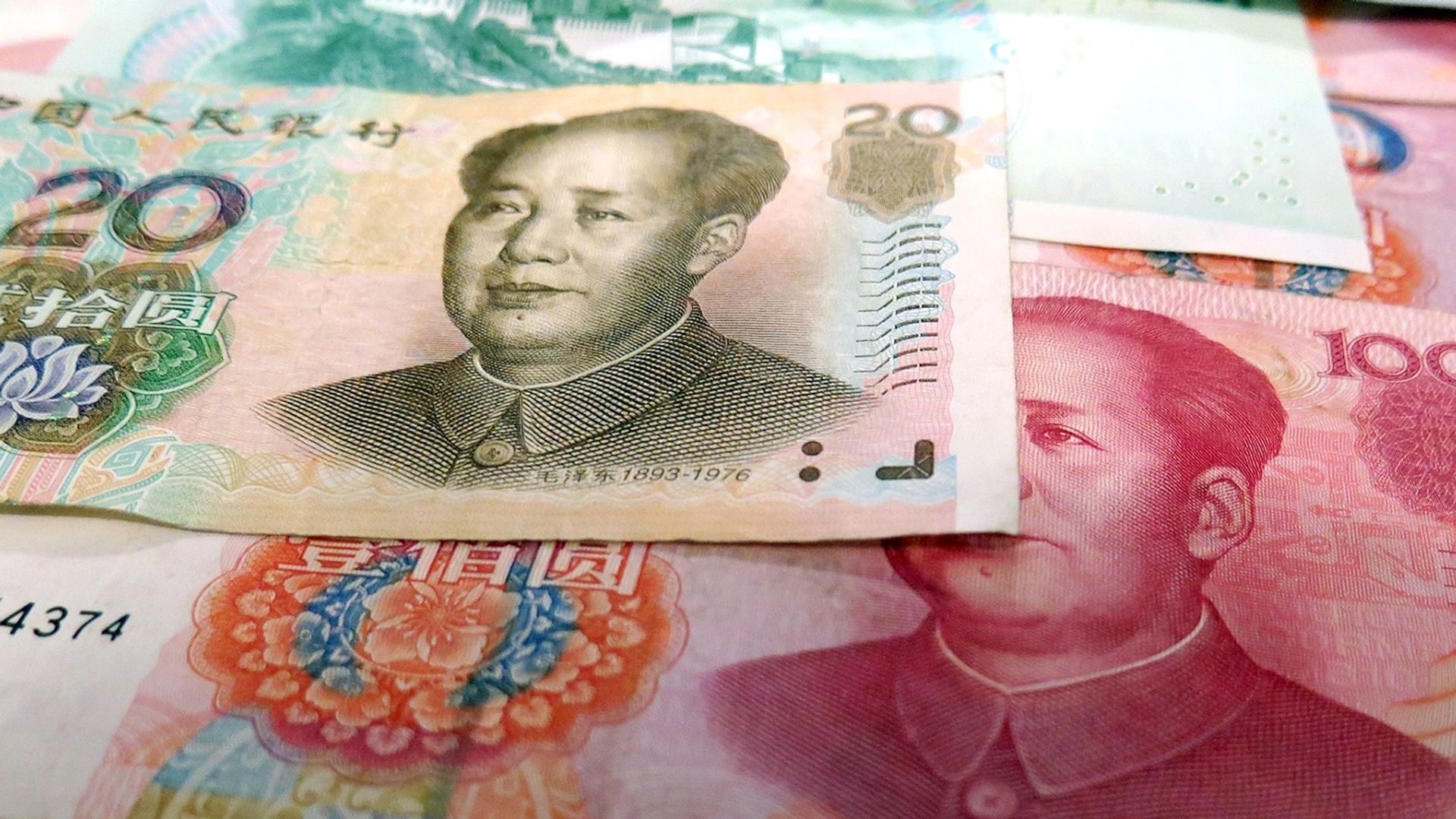
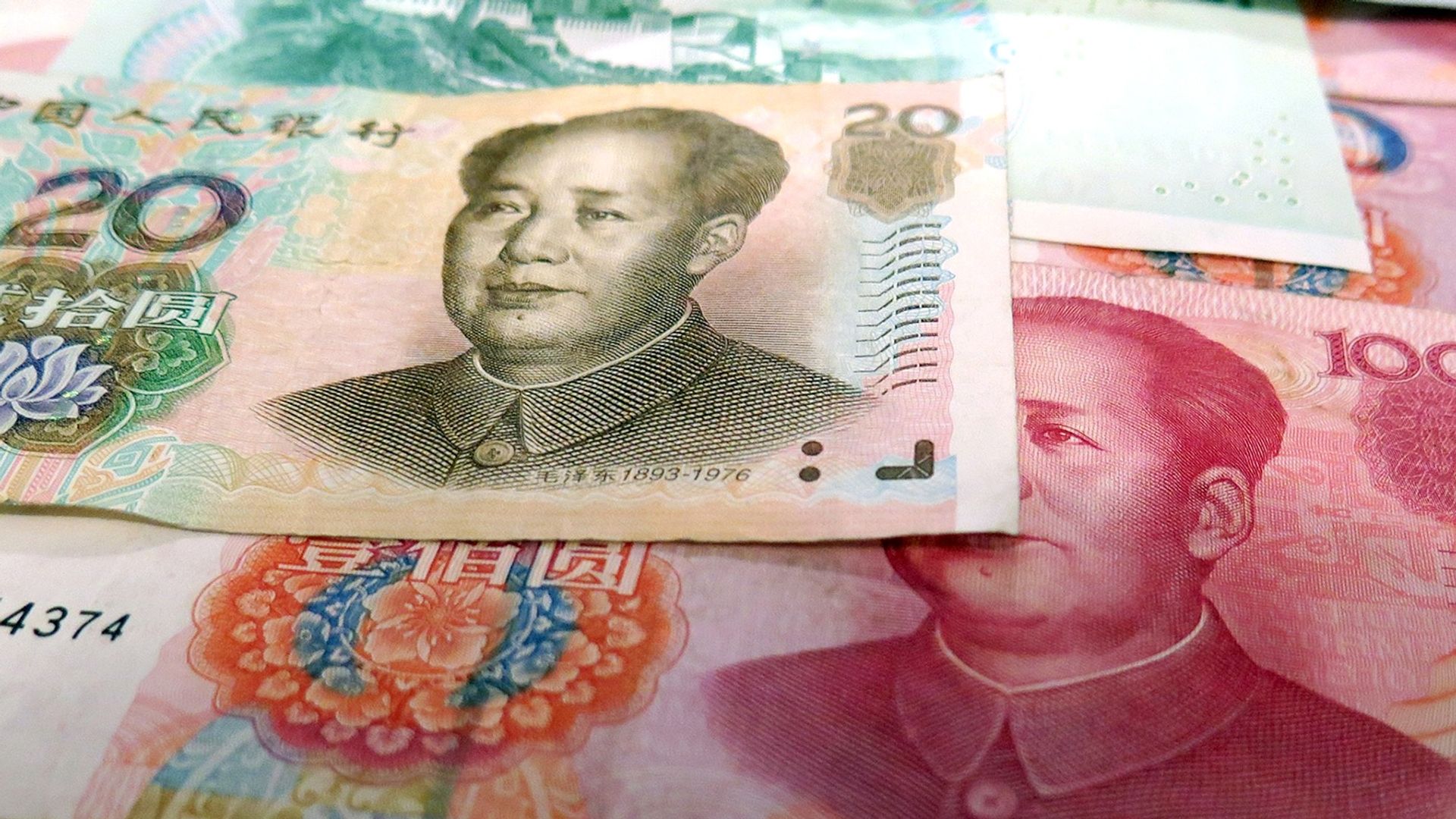
The People’s Bank of China (PBOC) added 20 new operators this year across two rounds of expansions, including eight additions this week.

Bitcoin functions as a genuine cheat code for retiring without ever selling, according to analyst and entrepreneur Mark Moss, who laid out that thesis in a recent Coin Stories podcast interview.
His central thesis runs counter to conventional wisdom. The goal should never be to sell Bitcoin to fund a lifestyle, but to stay in the owner column rather than the consumer column.
Bitcoin: The Owner Column vs. the Consumer Column
Under the debt-based monetary system in place since 1971, money enters circulation through credit, and credit requires collateral. Owning even $1 of Bitcoin makes someone an owner who can borrow against it.
Selling, by contrast, triggers tax events, eliminates that collateral, and converts a long-term asset into short-term spending. He also challenges traditional retirement thinking.
The goal should not be freedom from work, he argues, but freedom to work on whatever someone actually chooses.
“…So the retirement path is that that Bitcoin appreciates and hopefully it continues at 30% per year. We already talked about that and so eventually it’s worth $1 million and then it’s worth $5 and $10 million $20 million. But if I sell it to get some of the money, I instantly take myself from the owner column back to the consumer column…,” Moss said.
Follow us on X to get the latest news as it happens.
Moss points to billionaires and creators who stay active into old age, arguing they belong to the builder class rather than consumers dreaming of poolside leisure. He dismisses passive income and the FIRE movement, proposing instead what he calls retiring from assets.
The concrete strategy involves borrowing against Bitcoin with discipline: low loan-to-value ratios, multiple liquidity layers including checking accounts, cash equivalents, and income, with asset sales reserved as a last resort.
Understanding market cycles matters throughout that process, harvesting appreciation without abandoning ownership or triggering unnecessary taxable events.
Why Moss and Schiff Disagree Completely
Moss illustrates the danger of becoming a forced seller through his own history. In 2008, he built a property valued at $12 million, rejected an $11 million offer, then watched the bank sell it for just $4 million after the crash. It is worth roughly $20 million today.
Volatility was never the real problem, he explains. Becoming a forced seller at exactly the wrong moment was:
“…Everybody wants that financial freedom, the ability to live uh without being forced to work off of income, things like that. And so what I like to talk about is how people can have asset freedom. So there are certainly movements like my mentor Robert Kiyosaki talks about building passive income…,” the analyst noted.
Economist and longtime Bitcoin critic Peter Schiff offered a starkly different view. Writing on X, he argued that retiring on Bitcoin only works if someone bought it long ago and sells before a crash.
Moss sees Bitcoin as structural infrastructure for generating liquidity without abandoning ownership, even amid the current 26% yearly decline. Schiff insists that the only realistic path is to sell in time, before volatility erodes accumulated capital.
That leaves a genuine open question for holders. Is Bitcoin an asset to preserve and leverage indefinitely, or one that demands exiting before conditions turn too late?
Subscribe to our YouTube channel to watch leaders and journalists provide expert insights.
The post Bitcoin is a “Cheat Code” to Retire Without Selling, Analyst Explains Why appeared first on BeInCrypto.
Bitcoin price surged past $68,000 late Wednesday as a break above crowded liquidation levels forced short sellers to buy back positions, turning a gradual recovery into a one-minute price spike of roughly 4%.
Summary
- Bitcoin price jumped from below $65,000 to a high near $69,500 before settling around $68,500.
- More than $1 billion in crypto shorts were reportedly liquidated within one hour.
- The breakout cleared a 4-hour double-bottom neckline near $65,400.
- Bitcoin now faces daily resistance between $69,000 and $70,000 after its RSI entered overbought territory.
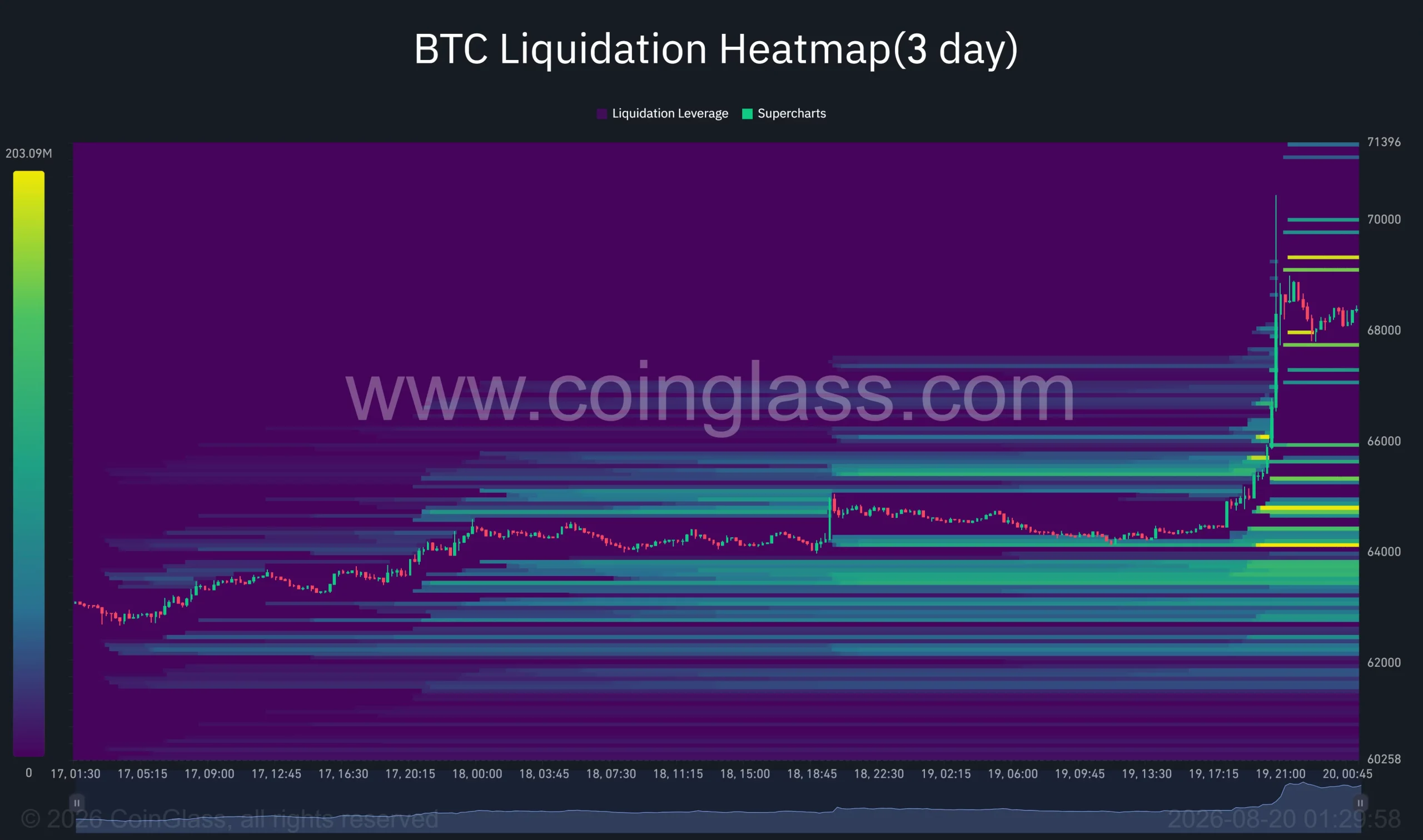
Market analyst Daan Crypto Trades said in an Aug. 19 X post that Bitcoin experienced a “massive squeeze” after crossing the $67,000 liquidation cluster. He said the resulting one-minute candle gained about 4%, exceeding the size of any full daily candle recorded in recent weeks.
Bitcoin price clears a two-month trading range
According to data from crypto.news, Bitcoin (BTC) price traded near $68,500 at the time of writing after reaching an intraday high of about $69,500 on Binance. The move represented a gain of nearly 6% from Wednesday’s opening price of around $64,725.
The rally followed several weeks of limited movement between approximately $62,000 and $66,000. Buyers had repeatedly failed to hold above $65,000, encouraging traders to build leveraged short positions around the upper end of that range.
Bitcoin reversed the setup within minutes. Once BTC price crossed $67,000, exchanges began closing positions that no longer had enough collateral, requiring short sellers to buy Bitcoin and adding further upward pressure.
The broader crypto market recorded more than $1 billion in short liquidations within one hour as Bitcoin climbed above $69,000. Total crypto short liquidations later reached $1.79 billion, suggesting that forced buying played a major role in accelerating the rally.
The three-day CoinGlass heatmap shows Bitcoin moving through multiple liquidation bands between $65,000 and $67,500 before reaching the upper cluster near $69,000. Much of the liquidity that had built above the previous trading range was therefore removed during the spike.
Treasury buybacks and SEC proposal support risk appetite
The squeeze followed a U.S. Treasury announcement that it would at least double the maximum size of liquidity-support buybacks for longer-dated government bonds.
Starting Sept. 9, the Treasury plans to raise the maximum purchase size for 10- to 30-year securities from $2 billion to at least $4 billion per operation. Long-term Treasury yields fell after the announcement, while the dollar weakened and US stocks advanced.
Lower bond yields can improve demand for risk assets by reducing the return available from government debt, although the Treasury described its purchases as a way to improve market liquidity rather than a monetary stimulus program.
Bitcoin also benefited from a more favorable US regulatory backdrop after the Securities and Exchange Commission proposed its new “Regulation Crypto Assets” framework on Aug. 18.
According to the SEC proposal, the framework would create tailored registration exemptions for certain crypto-related investment contracts. One exemption would allow eligible startups to raise up to $5 million over four years, while another would permit qualifying issuers to raise as much as $75 million in a 12-month period, subject to disclosures and other requirements.
The proposal has not taken effect and may change following public feedback. Its publication nevertheless added to expectations that US crypto companies could receive clearer fundraising rules.
Bitcoin breakout targets the $69,000 resistance zone
The 4-hour Bitcoin chart shows a double-bottom structure formed between late July and mid-August. Both lows developed near $62,200, while the neckline sat around $65,400.
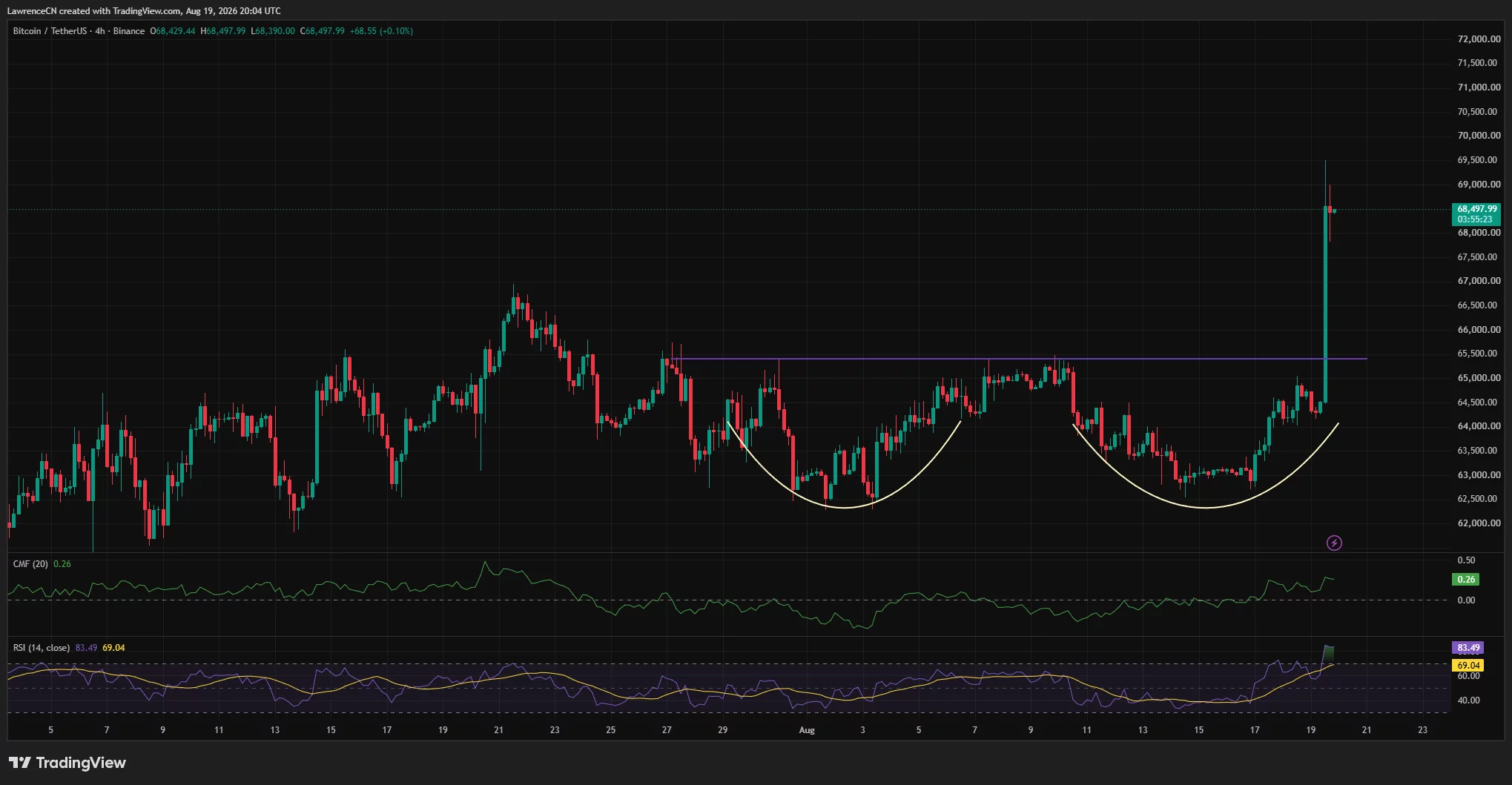
Wednesday’s move broke through that neckline with one large candle, placing Bitcoin roughly $3,000 above the former resistance level. The pattern’s measured move points toward the $68,500–$69,000 region, which Bitcoin reached during the breakout.
Capital flow also strengthened alongside the price. The 4-hour Chaikin Money Flow reading rose to 0.26, indicating that buying pressure outweighed selling pressure during the move.
Short-term conditions have become stretched, however. The 4-hour relative strength index reached 83.49, well above the 70 level commonly associated with an overbought market. The RSI average stood near 69, showing how quickly momentum increased.
An overbought RSI does not require an immediate decline, especially during a short squeeze, but it raises the risk of profit-taking or a retest of the breakout. The long upper wick near $69,500 shows that sellers already responded above $69,000.
On the daily chart, Bitcoin reclaimed its 100-day simple moving average around $66,288. Price remained slightly below the 200-day average near $69,031, making the $69,000–$70,000 area the next test for the recovery.
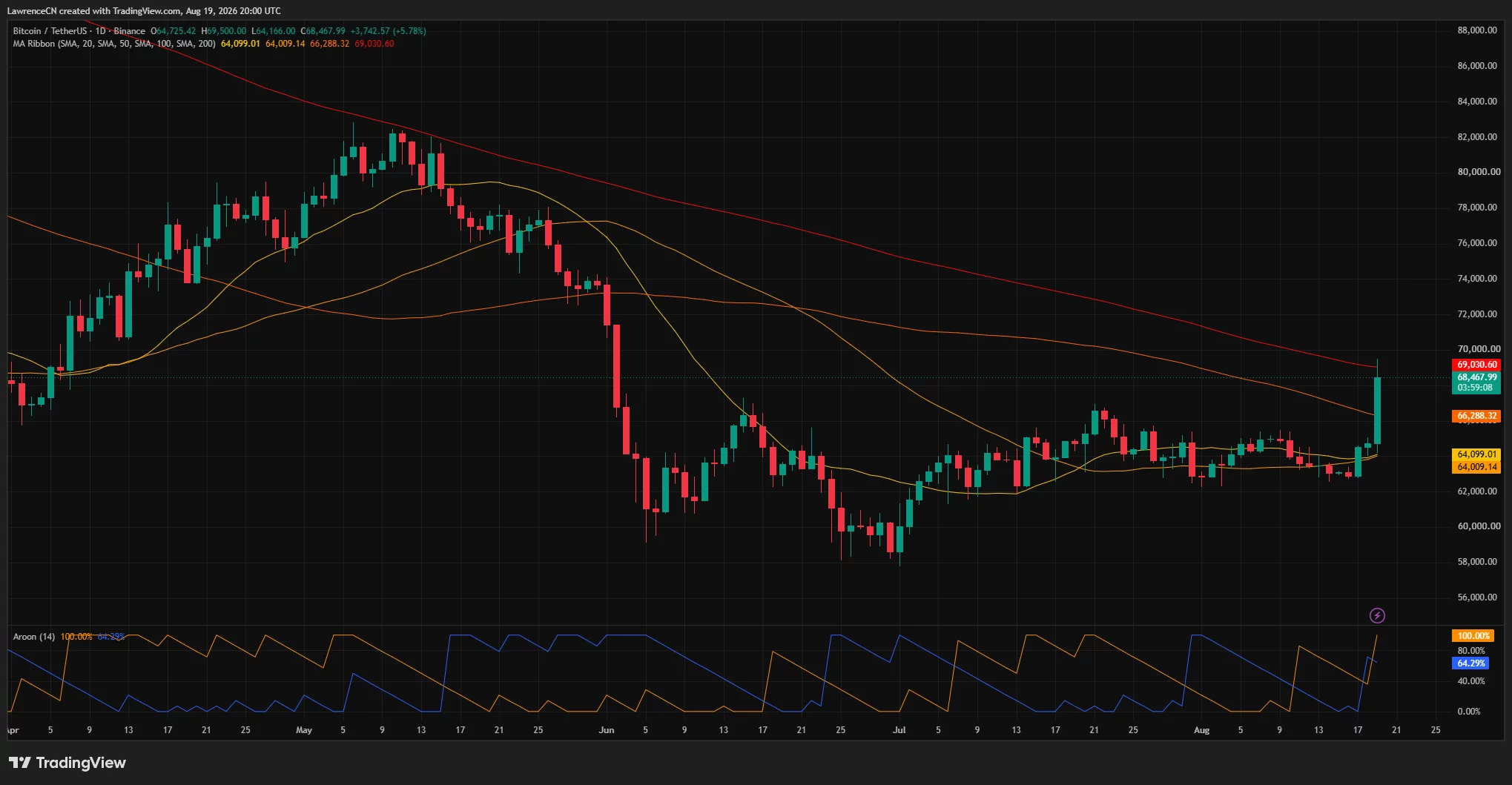
A daily close above that zone would improve the case for a move toward $72,000. Analyst Ted Pillows identified $74,000 as the more important weekly level, arguing that reclaiming it would reduce the likelihood of Bitcoin falling below $55,000.
Failure to hold the breakout could return attention to $67,000, followed by the former neckline around $65,400. The strongest nearby support cluster visible on the liquidation heatmap sits between approximately $64,000 and $65,500.
ETF demand and weaker selling preceded Bitcoin breakout
Before Bitcoin broke above $65,700 on Wednesday evening, the Bitfinex analyst team told crypto.news that fading profit-taking and renewed spot ETF demand had created a more supportive supply setup.
The analysts said Bitcoin had begun rising while US equities fell, marking a break from the cross-asset pattern seen after the Iran-US conflict disrupted correlations in early March. At the time, rising Treasury yields and energy prices continued to pressure traditional markets while Bitcoin remained below $65,000.
On-chain spending also suggested that sellers had less capacity to realize gains. Bitfinex analysts said long-term holders who moved coins were recording small losses, while short-term holders were selling close to their purchase prices.
“Long-term holders are realising losses, albeit minimal, at the deepest ratios since June, short-term holders are transacting at break-even and the aggregate profit ratio of every coin moved on-chain has now closed below par for 10 consecutive sessions.”
The ratio between long-term and short-term holder spent output profit ratios had declined steadily since Bitcoin reached its $126,110 all-time high in October 2025. Short-term-holder distribution still exceeded selling by long-term holders, which Bitfinex described as a signal commonly associated with the later stages of a bear market.
“The supply available to be spent at a profit is increasingly constrained, and the constraint favours bullish price action by mitigating selling interest at the range highs,” the analysts said.
US spot Bitcoin ETFs added to that tightening supply. Bitfinex reported that the funds attracted $297.5 million on Aug. 17, their largest daily inflow of the month, followed by another $189.3 million on Aug. 18. The two sessions produced the first back-to-back net inflows since Aug. 7.
Bitfinex had identified $65,700 as the level Bitcoin needed to clear to extend its recovery. The later breakout carried BTC through that threshold and into the short liquidation clusters above $67,000, where forced buying accelerated the move toward $69,500.
The analysts linked the reduced selling pressure to a longer process of clearing coins held by investors who bought more than two years earlier.
“In December, we expressed that long-term holder sell pressure approaches saturation as the two-year supply overhang clears,” Bitfinex said. “This is what the terminal stage of that process looks like in the tape.”
The breakout supports the analysts’ supply-side assessment, although holding above $65,700 remains important. A return below that level would suggest the move was driven mainly by forced short covering, while continued ETF inflows and firm spot volume would provide stronger evidence of sustained demand.
Zhang’s broader outlook still warns against chasing
Zhang offered a more cautious view of Bitcoin’s longer-term position, arguing that signs of a bottoming process did not yet confirm a durable market bottom.
When Bitget Wallet’s research analyst spoke to crypto.news, Bitcoin price was trading between $64,000 and $64,700 after spending several weeks inside a $62,000–$66,000 range. She cited moderate leverage, compressed volatility, and slower selling by long-term holders as factors that reduced the likelihood of a sharp move in either direction.
“Bitcoin is showing signs of a bottoming process, but not a confirmed bottom,” Zhang said before the rally.
“If $60,000–$62,000 support holds, the setup offers asymmetric upside; confirmation of a durable bottom still requires sustained volume and less fear.”
The subsequent move invalidated the immediate expectation that Bitcoin would remain confined below $66,000, but it did not settle Zhang’s broader question about whether the market has established a durable low. The breakout relied partly on forced short covering, while the 4-hour RSI and rejection near the 200-day average leave room for a pullback.
Zhang expects Bitcoin to trade within a broad $55,000–$80,000 range through year-end. Holding above $65,400 after the initial squeeze would provide stronger evidence that spot buyers, rather than liquidations alone, can support the latest recovery.
Disclosure: This article does not represent investment advice. The content and materials featured on this page are for educational purposes only.

India vs Pakistan hockey live streaming: Where to watch today’s WC match? | Other Sports News

Xbox Furniture Grows From Controllers Into Living Rooms, Thanks to New IKEA Collaboration

Woman stabbed to death in street in London is named as man is charged with murder

Weekend Open Thread – Corporette.com

Weekend Open Thread: Brooks Brothers

London Mayor Sadiq Khan handed a peerage by Keir Starmer alongside 15 other Labour figures… just days before the PM leaves No10

Hungry On A Budget…. #budget #asianfood #candy #firstperson #pov #money #viralvideo

06 Her Dad Still Pays Her Car Insurance Financial Audit #shorts

Why Rob Gronkowski Never Spent his NFL Money #football #TikTokCampaign #robgronkowski #money
-

 Fashion5 days ago
Weekend Open Thread: Ann Taylor
-
 Sports6 days ago
This U.S. Amateur is a glimpse into golf’s future in more ways than you think
-

 Tech6 days ago
11 Ways to Rank Your Videos
-
 NewsBeat5 days ago
Myanmar says over 300,000 Rohingya refugees verified for repatriation as exodus enters ninth year
-

 Sports5 days ago
Birmingham 2026: Day 6 Timetable for Irish Athletes
-

 Politics4 days ago
SEQ Code: The Three Letter Boarding Pass Code That Could Give You The Worst Seat
-

 Tech6 days ago
DeepSeek Harness launches as open source rival to Claude Code, alongside V4-Pro on API with higher prices
-

 Crypto World2 days ago
OCC Greenlights Trump Family Crypto Firm for Trust Charter
-

 Tech2 days ago
Qwen3.8-27B runs frontier-class coding agents and reasoning locally, no cloud API required
-
 Entertainment5 days ago
10 Netflix Shows That Quietly Became Modern Classics
-

 Fashion5 days ago
Weekly News Update, 8.14.26 – Corporette.com
-

 Tech4 days ago
Every fusion startup that has raised over $100M
-
 Entertainment5 days ago
Marvel Studios Reveals New X-Men Cast Including Adam Driver and Sadie Sink
-

 Fashion7 days ago
The Details Do the Dressing
-

 Business5 days ago
Facebook Down Now? Users Report Login And Loading Problems As Outage Trackers Monitor Ongoing Issues
-

 Crypto World6 days ago
Robinhood Chain Approaches $1B TVL as Uniswap Integration Boosts Liquidity
-

 Fashion5 days ago
Cart Confidential Vol. 44 – Julia Berolzheimer
-
 Business4 days ago
Monarch Mutual Fund set to enter MF space with maiden overnight fund; files draft with Sebi
-

 Business1 day ago
SMA Solar Technology AG (SMTGY) Q2 2026 Earnings Call Transcript
-

 Politics6 days ago
The migrant mega-dinghy – spiked
You must be logged in to post a comment Login