
Crypto World
Crypto Just Saved a 60-Year Science Project Trump Cuts Nearly Killed

Strangers on the internet minted a token about fat mountain rodents. It has since raised more than $120,000 and rescued a 64-year science project that federal grants abandoned.
The token is OnlyMarms (ONLYMARMS). It trades on Solana, and its fees flow to a field lab in Colorado. The scientists did not create it. They just claimed the money.
Why a 64-Year Study Ran Out of Money
Kenneth Armitage started counting yellow-bellied marmots in 1962 and ran the project until 2001. UCLA has kept it alive since.
The lab needs $75,000 to $100,000 a year. That pays graduate students and a five-month field season near Crested Butte. Almost none of it is skimmed, because UCLA takes only 6% overhead on gifts.
The National Science Foundation (NSF) funded decades of that work. Then the renewals stopped coming.
The squeeze is national, not personal. NSF had issued 5,684 new grants by Aug. 19, Nature reported this week. That is 46% below its 2021 to 2024 average, and the lowest count in over 40 years.
Under the Trump administration, roughly $1 billion of the NSF’s $8.8 billion budget sits unspent in a holding account.
So UCLA professor Daniel Blumstein put the marmots on OnlyFans in June. The account cleared roughly $6,000. Nowhere near enough.
How OnlyMarms Memecoin Fees Pay for Marmot Science
Fans then minted a token with the same name. On-chain records show the first pool opened on July 25.
Supporters told the scientists to register as the creator. That registration is the whole trick. Pump.fun pays trading fees straight to whoever holds it.
Under its Pump.fun creator fee model, small tokens earn up to 0.95% of every trade. The rate slides toward 0.05% as a coin nears a $20 million valuation.
So every buy and every panic sell paid the lab. Fees hit $88,000 in two weeks, then passed $120,000. The coin was already outraising the OnlyFans account by early August.
Julien Martin, a University of Ottawa professor who co-leads the study, assumed the token was a scam at first.
“I’m completely amazed that this internet culture that I barely know of has raised so much money,” Julien Martin, University of Ottawa, via the Guardian.
Follow us on X to get the latest news as it happens
The Hard Part Is Making It Last
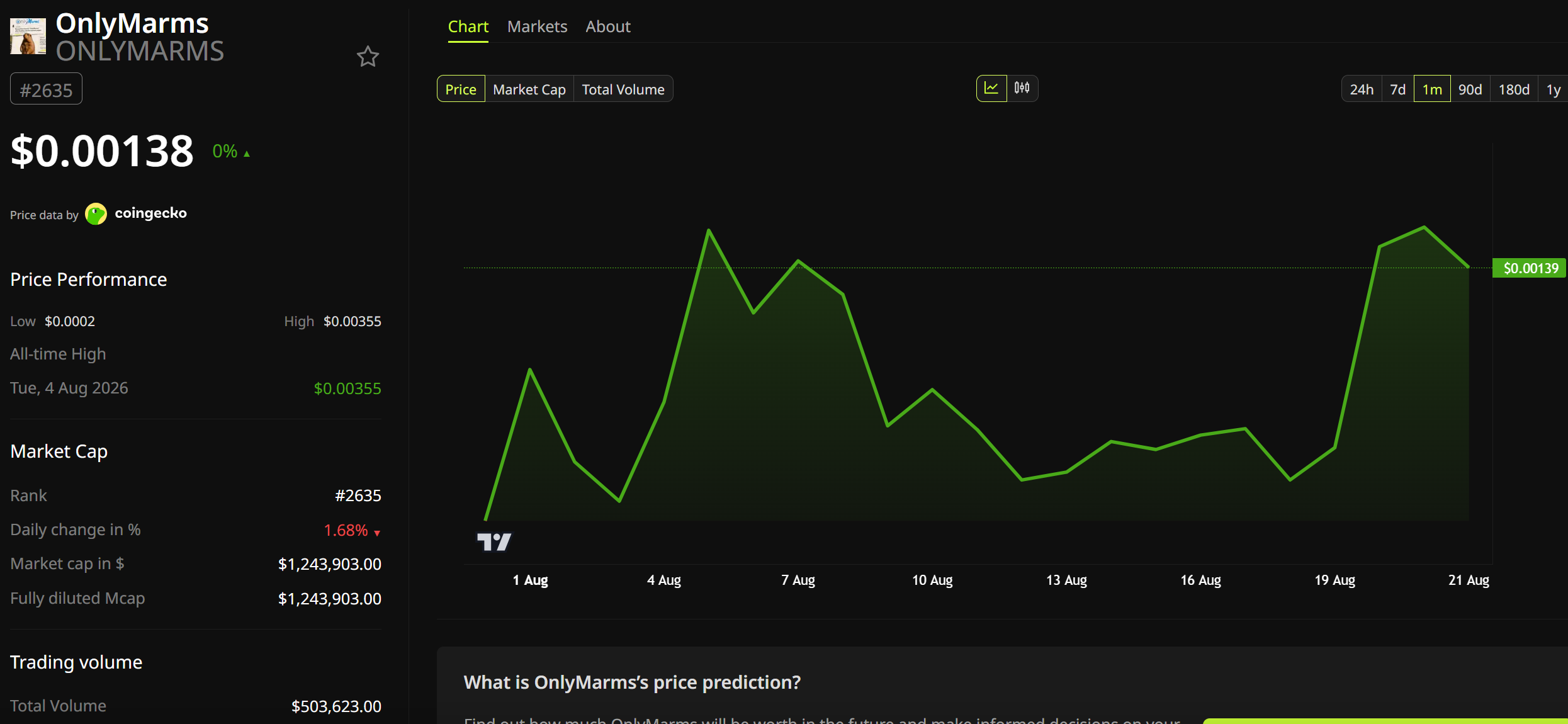
The hype has already cooled. ONLYMARMS peaked at $0.0036 on August 4. It is now trading near $0.0014, down about 61%, at a $1.24 million valuation.

Volume is the paycheck here, so volume is the number to watch. The token turned over $503,623 in 24 hours. At the rates above, that is a few hundred to a few thousand dollars a day. Sellers also outnumbered buyers in the main pool.
History is unkind too. Moo Deng, the pygmy hippo coin of 2024, now trades 93% below its peak. Moo Deng’s 2024 crash shows how quickly animal tokens lose their crowd.
Galaxy Research analyst Will Owens put the median Solana meme coin hold time at 100 seconds. A year earlier it was 300. His work on who profits from meme coins argues launchpads and bots take the real cut.
That is the awkward math. A charity funded by churn needs the churn to keep going.
Martin wants a broader token that funds science beyond marmots. He also knows the trick may not work twice.
“It worked for us because we were the first. But it has been nice to see crypto be used for good,” Julien Martin, University of Ottawa, via the Guardian.
A doctoral student costs about $300,000 over four years. The marmots are $180,000 short. Whether strangers keep trading long enough to close that gap is the next test.
The post Crypto Just Saved a 60-Year Science Project Trump Cuts Nearly Killed appeared first on BeInCrypto.


Decentralized finance has always promised a financial system that operates without traditional intermediaries. Smart contracts automate lending, trading, borrowing, staking, and liquidity provision. But the same automation that makes DeFi powerful also creates a dangerous reality: when the code fails, the money can move at machine speed.
That raises an increasingly important question: Can artificial intelligence predict a DeFi exploit before an attacker executes it?
The short answer is yes—but not with certainty.
AI is becoming increasingly capable of identifying suspicious smart-contract behavior, unusual transaction patterns, vulnerable code, and attack signals before they turn into catastrophic losses. At the same time, attackers are gaining access to increasingly sophisticated AI capabilities of their own. The future of DeFi security may therefore become an ongoing contest between AI-powered defense and AI-powered exploitation.
The Growing Need for Predictive DeFi Security
Crypto security remains a major challenge. Chainalysis reported that more than $3.4 billion in cryptocurrency was stolen during 2025, although the distribution of losses shifted significantly across centralized services, personal wallets, and DeFi. Interestingly, Chainalysis also observed that DeFi hack losses remained relatively suppressed during 2024–2025 even as DeFi’s total value locked recovered—suggesting that improved security practices may be having an effect.
Historically, many security systems operated reactively.
An exploit happened.
A monitoring system detected it.
The protocol paused.
Developers investigated.
Users tried to determine what happened.
By then, millions of dollars could already be gone.
AI changes the potential timeline from reaction to prediction.
Instead of asking, “Has this transaction stolen funds?”, an AI-powered security system can ask:
“Does this behavior look like the beginning of an attack?”
That distinction could be enormously valuable in DeFi.
How Could AI Detect an Exploit?
AI does not need to magically “know” that an exploit is coming. Instead, it can analyze enormous amounts of data and identify patterns that humans might miss.
Several layers of information can be combined.
1. Smart Contract Code Analysis
AI models can examine smart-contract code for patterns associated with known vulnerabilities.
These can include:
- Reentrancy risks
- Improper access controls
- Oracle manipulation vulnerabilities
- Unsafe external calls
- Integer and arithmetic issues
- Flash-loan attack surfaces
- Logic flaws
- Suspicious upgrade mechanisms
- Incorrect permission configurations
Traditional security tools already perform static and dynamic analysis. AI can complement these approaches by learning from large collections of vulnerable and secure contracts.
Research published in 2026 has explored transformer-based anomaly detection for smart contracts, demonstrating how machine-learning architectures can analyze contract opcode sequences to identify suspicious patterns.
The important development is not that AI replaces auditing.
It is that AI can potentially make continuous security analysis possible.
2. Transaction Behavior Analysis
A smart contract may look safe when examined in isolation but behave dangerously when interacting with other protocols.
This is where transaction-level AI becomes particularly interesting.
Imagine a lending protocol normally receiving relatively predictable transactions. Suddenly, an address:
- Obtains a huge flash loan.
- Interacts with an unfamiliar contract.
- Manipulates an oracle-related asset.
- Moves liquidity between several pools.
- Initiates an unusually large withdrawal.
Each individual action might appear legitimate.
Together, however, they could form an attack pattern.
AI can analyze these sequences as behavioral signals rather than looking at transactions independently.
This is essentially on-chain behavioral intelligence.
3. Real-Time Anomaly Detection
One of the strongest applications for AI may be detecting deviations from normal protocol behavior.
Every DeFi protocol develops a kind of behavioral fingerprint.
AI systems can monitor variables such as:
- Transaction frequency
- Wallet interactions
- Liquidity movements
- Token approvals
- Borrowing patterns
- Liquidations
- Oracle updates
- Governance activity
- Contract deployments
- Cross-chain transfers
- Large withdrawals
When behavior suddenly deviates from historical patterns, the system can generate a risk score.
For example:
Normal behavior → Low risk
Unusual behavior → Medium risk
Multiple correlated anomalies → High risk
Known exploit pattern + abnormal transaction → Critical risk
This approach is already moving beyond theory. Chainalysis has described the use of pattern recognition and machine learning to flag risky assets associated with malicious DeFi activity in real time. Its Hexagate security platform reportedly flagged more than $402.1 million in risky assets tied to malicious DeFi activity during Q1 2025.
4. AI Can Learn From Previous Exploits
One of AI’s biggest advantages is its ability to learn from historical data.
The DeFi ecosystem has experienced countless attacks involving different combinations of:
- Smart-contract vulnerabilities
- Flash loans
- Price manipulation
- Governance attacks
- Bridge exploits
- Privileged-access compromises
- Oracle failures
- Liquidity manipulation
These incidents create a massive dataset of attacker behavior.
An AI security system can use historical exploits to identify similarities between past attacks and current activity.
For example, if an attacker begins reproducing a transaction sequence resembling a previous exploit, the system could raise an alert before the final extraction transaction occurs.
That is where predictive security becomes much more powerful than traditional monitoring.
The AI Arms Race Has Already Started
There is an uncomfortable side to this story.
AI does not belong exclusively to defenders.
Attackers can use it too.
Recent research from Anthropic demonstrated just how significant this development could become. In simulated testing using a benchmark containing 405 historically exploited smart contracts, AI agents were able to reproduce exploits associated with approximately $4.6 million in simulated value. Researchers also tested agents against 2,849 recently deployed contracts and reported two novel vulnerabilities in simulation. The experiments were conducted in blockchain simulators rather than on live networks.
This creates a fundamental shift.
The traditional security battle was:
Human attacker vs. human security team
The emerging battle could become:
AI attacker vs. AI defender
That could make DeFi security significantly faster—and significantly more competitive.
Can AI Actually Predict a Zero-Day Exploit?
This is where expectations need to be realistic.
AI can identify risk signals.
It can discover suspicious patterns.
It can analyze code.
It can simulate potential attack paths.
It can compare current behavior with historical exploits.
But predicting an unknown exploit with 100% accuracy is extremely difficult.
A zero-day vulnerability may involve a combination of protocol assumptions that has never appeared in the training data.
There is also a fundamental problem with DeFi: the environment changes constantly.
Protocols upgrade.
Liquidity moves.
New tokens appear.
Governance changes parameters.
Oracles update.
New chains launch.
Protocols integrate with other protocols.
An AI model trained yesterday may encounter an attack pattern tomorrow that has never existed before.
Therefore, the goal should not be to build an AI system that claims:
“I know an exploit will happen.”
A better goal is:
“I detect that the probability of an exploit has increased significantly.”
That distinction matters.
From AI Prediction to Automated Defense
The most powerful DeFi security systems may eventually combine AI prediction with automated response mechanisms.
Imagine a protocol detecting the following:
Risk detected → AI analyzes behavior → threat confidence rises → protocol activates defensive controls
Depending on the protocol’s architecture, the response could include:
- Temporarily pausing specific functions
- Restricting unusually large withdrawals
- Increasing confirmation requirements
- Freezing suspicious addresses
- Switching to a safer oracle
- Alerting governance participants
- Notifying security teams
- Limiting bridge exposure
- Triggering emergency procedures
This creates a security architecture that resembles an immune system.
The protocol doesn’t wait until the attacker has completely drained the treasury.
It detects the abnormal behavior and attempts to contain it.
A real-world example illustrates the potential. Chainalysis reported that Venus Protocol’s security monitoring detected suspicious activity 18 hours before a 2025 attack, followed by another alert when the malicious transaction occurred. The protocol was able to pause operations and subsequently recover the affected funds.
The lesson is important:
Detection speed can matter as much as detection accuracy.
AI Will Not Replace Smart-Contract Auditors
It would be a mistake to assume AI makes traditional security professionals obsolete.
DeFi security is multidimensional.
An AI system may identify a suspicious code pattern, but a human security researcher still needs to understand:
- Economic incentives
- Governance structures
- Protocol assumptions
- Business logic
- Cross-protocol dependencies
- Attack profitability
- Real-world operational risks
Some vulnerabilities are not obvious bugs.
They are economic vulnerabilities.
A protocol may function exactly as programmed while still allowing an attacker to manipulate incentives or market conditions.
That requires more than pattern recognition.
It requires understanding the system.
The strongest security architecture will therefore likely combine:
AI + formal verification + automated testing + human researchers + real-time monitoring + incident response.
The Biggest Challenge: False Positives
Predictive security has another problem.
If an AI system generates too many false alarms, developers may eventually stop paying attention.
Imagine a protocol receiving 500 “critical” alerts every day.
Eventually, someone will ignore alert number 501.
This is why AI security systems need sophisticated risk scoring rather than simple binary decisions.
Instead of saying:
“This transaction is malicious.”
A better system might say:
“This transaction has a 92% probability of matching behaviors associated with a high-risk exploit pattern.”
That allows security teams to prioritize threats.
Privacy and Data Quality Matter Too
AI security is only as good as the data it receives.
Incomplete blockchain data can produce misleading conclusions.
Cross-chain activity can be difficult to correlate.
Private transactions can obscure behavioral signals.
New protocols may lack sufficient historical data.
And attackers can deliberately attempt to generate noise.
There is also a deeper issue: attackers can study defensive models and attempt to manipulate them.
If hackers learn what triggers an AI warning, they can potentially design transactions that stay just below the detection threshold.
That means AI security systems must continuously adapt.
The Future: Self-Defending DeFi
The most exciting possibility is not simply AI that tells developers an exploit might happen.
It is self-defending DeFi infrastructure.
Imagine protocols with security layers that continuously:
Monitor → Analyze → Predict → Simulate → Respond → Learn
The AI observes protocol behavior.
It identifies anomalies.
It estimates potential attack paths.
It simulates possible consequences.
The protocol applies defensive measures.
The system then learns from the incident.
That creates a feedback loop.
Over time, the protocol becomes increasingly capable of recognizing threats.
This could fundamentally change how DeFi is secured.
The Bottom Line
So, can AI predict DeFi exploits?
To a degree, yes.
But AI should not be viewed as a crystal ball.
Its real strength is combining huge amounts of blockchain data, smart-contract information, historical exploit patterns, and real-time behavioral signals to identify threats before they become obvious to humans.
And the urgency is increasing.
Attackers are already experimenting with AI-assisted exploitation capabilities, while defenders are developing machine-learning systems for proactive monitoring and anomaly detection.
The future of DeFi security may therefore depend on who can build the better intelligence system first.
The winning protocols may not simply be the ones with the best audits.
They may be the ones capable of seeing an attack coming—and reacting before the attacker can turn code into cash.
Final Thought
DeFi was built around the idea that financial infrastructure could become programmable.
The next evolution may be making that infrastructure intelligent enough to defend itself.
AI will not make DeFi exploits disappear.
But it could make the window between “something looks wrong” and “millions have been stolen” dramatically smaller.
And in decentralized finance, those few seconds—or even milliseconds—can be worth everything.
REQUEST AN ARTICLE
The YZi-backed bitcoin restaking firm BounceBit announced today that it is shutting down its blockchain after hackers exploited an authorization vulnerability and stole over $3.1 million of its BB token.
BounceBit claims that between August 19 and August 20, attackers were able to move 286 million BB tokens out of nine of BounceBit Chain’s wallets without authorization.
Evmos stack caused exploit
An authorization flaw in the vesting and lockup account module hosted by Evmos, and utilized by BounceBit Chain, seemingly led to the exploit.
BounceBit says the attacker sent an estimated 254 million BB tokens to one “major” crypto exchange, almost 10 million BB tokens to another exchange, and 18.5 million BB tokens remain sitting in a consolidated address.
Read more: Aave TVL still down 43% since KelpDAO hack
BounceBit rules out network upgrade
BounceBit claims that it is sunsetting its blockchain after a technical review and will not be able to implement a network upgrade since it is built on the already discontinued Evmos infrastructure.
It said, “Moving our fork onto a successor codebase would therefore not be a conventional upgrade, but a substantial re-platform requiring a full rebuild, re-audit, and revalidation before it could safely carry user assets again.”
BB tokens will now turn into BEP-20 tokens
Every other BB token, bar the attackers, will be reissued as a BEP-20 token on BNB Chain. A snapshot of the block before the exploit will be used to determine the sum of BEP-20 tokens a user will receive.
BounceBit also claims it has asked crypto exchanges to freeze specific addresses that won’t affect the funds of innocent users.
Read more: Tone Vays says his PC looks ‘OK’ after giving hackers access
BB token holders were told that they won’t need to do anything and that they should be cautious of scammers offering help.
BounceBit raised $6 million in 2024 as part of a seed funding round co-led by Blockchain Capital and Breyer Capital. According to the Binance Square moderator “Tang Hua,” YZi Labs invested later in April 2024.
Got a tip? Send us an email securely via Protos Leaks. For more informed news and investigations, follow us on X, Bluesky, and Google News, or subscribe to our YouTube channel.

Crypto stocks finished the week on a strong upswing as Bitcoin reclaimed the upper end of its recent trading range. The latest leg of the rally coincided with a broader improvement in risk sentiment following an announcement from the US Treasury about doubling certain long-dated bond buybacks—an action intended to support liquidity in the Treasury market.
That macro tailwind fed directly into shares linked to digital-asset demand and balance-sheet exposure. According to market data cited by Cointelegraph, Bitcoin rose above $79,000 during Friday’s trading, while major crypto-related equities posted double-digit gains.
Key takeaways
- Bitcoin’s move above $79,000 helped lift publicly traded miners and crypto treasury companies, including Canaan, Strive and Metaplanet.
- US Treasury’s decision to double select long-dated bond buybacks was framed as liquidity support, boosting overall risk appetite.
- Crypto exchange and brokerage stocks such as Coinbase and Robinhood also advanced sharply, reflecting spillover from BTC strength.
- US regulatory optimism resurfaced after Donald Trump renewed calls for the CLARITY Act, which remains stalled after lawmakers missed progress before the August recess.
Miners and treasury plays catch the rally
Miner and treasury-focused equities led the momentum toward the end of the week, mirroring the strength in the underlying crypto complex. Cointelegraph reported that Canaan was among the top movers, rising more than 25% on Friday. MARA Holdings gained roughly 16% after climbing nearly that amount in Thursday’s session, underscoring how quickly equity sentiment shifted as Bitcoin strengthened.
Balance-sheet exposure proved especially influential. Strive, which holds more than 20,000 Bitcoin (BTC) as described in the report, jumped more than 16% on Friday. Japan-listed Metaplanet, which Cointelegraph noted recently expanded its Bitcoin treasury strategy by acquiring Nasdaq-listed Super League Enterprise, also added more than 16%—a clear reminder that corporate treasury decisions can amplify market reactions when BTC prices move decisively.
These moves also highlight a recurring dynamic in crypto equities: when Bitcoin’s direction stabilizes, investors often rotate from pure crypto proxies to listed companies that either mine BTC or hold it directly. The result is typically synchronized performance across segments with different business models but shared price exposure to BTC.
Exchanges and brokers move with Bitcoin
Beyond miners and treasuries, companies with more direct access to retail and institutional crypto activity joined the climb. Cointelegraph cited double-digit gains in Coinbase and Robinhood, suggesting that stronger BTC price action can quickly translate into improved sentiment for platforms that benefit from trading volume and user engagement.
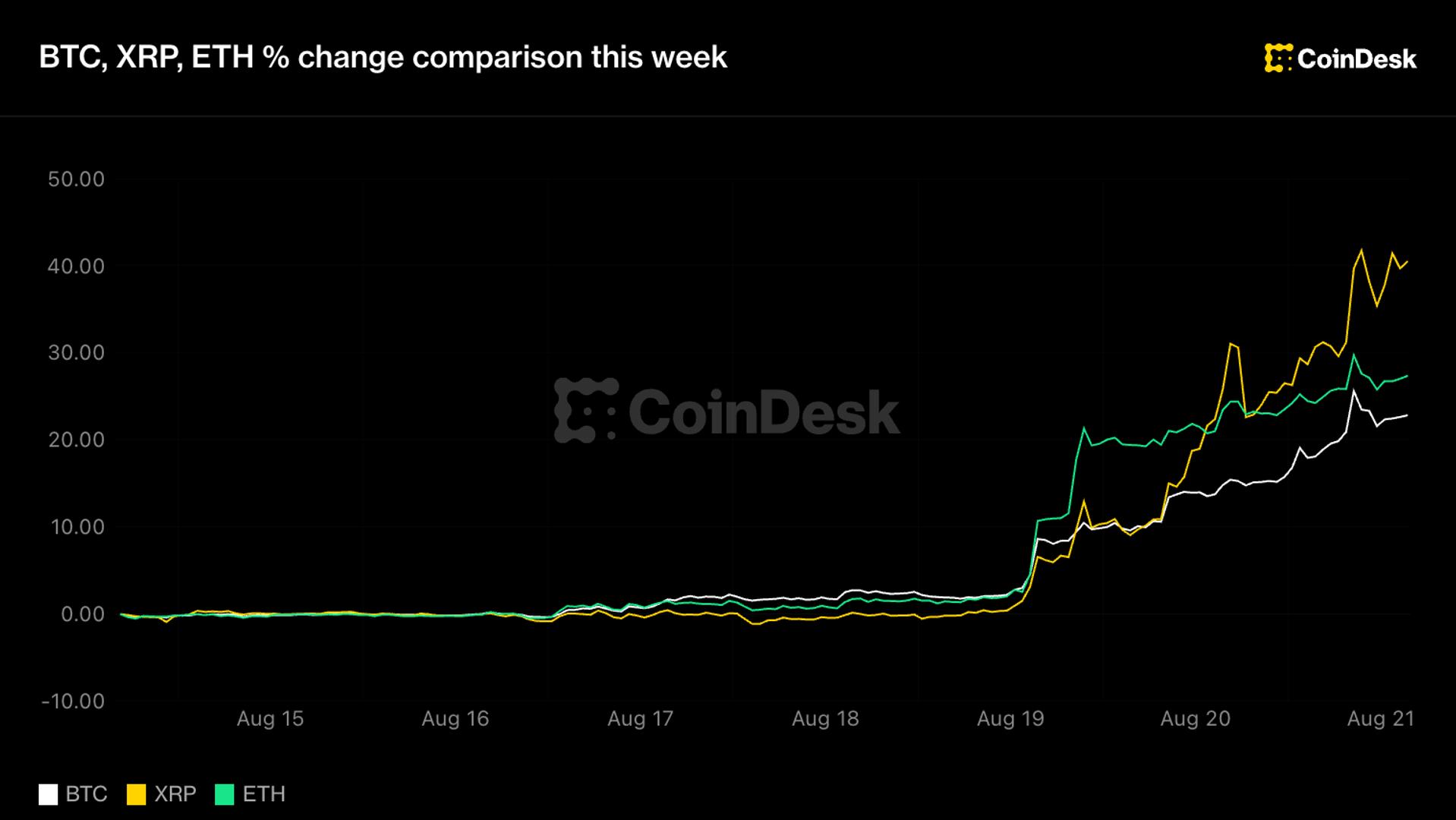
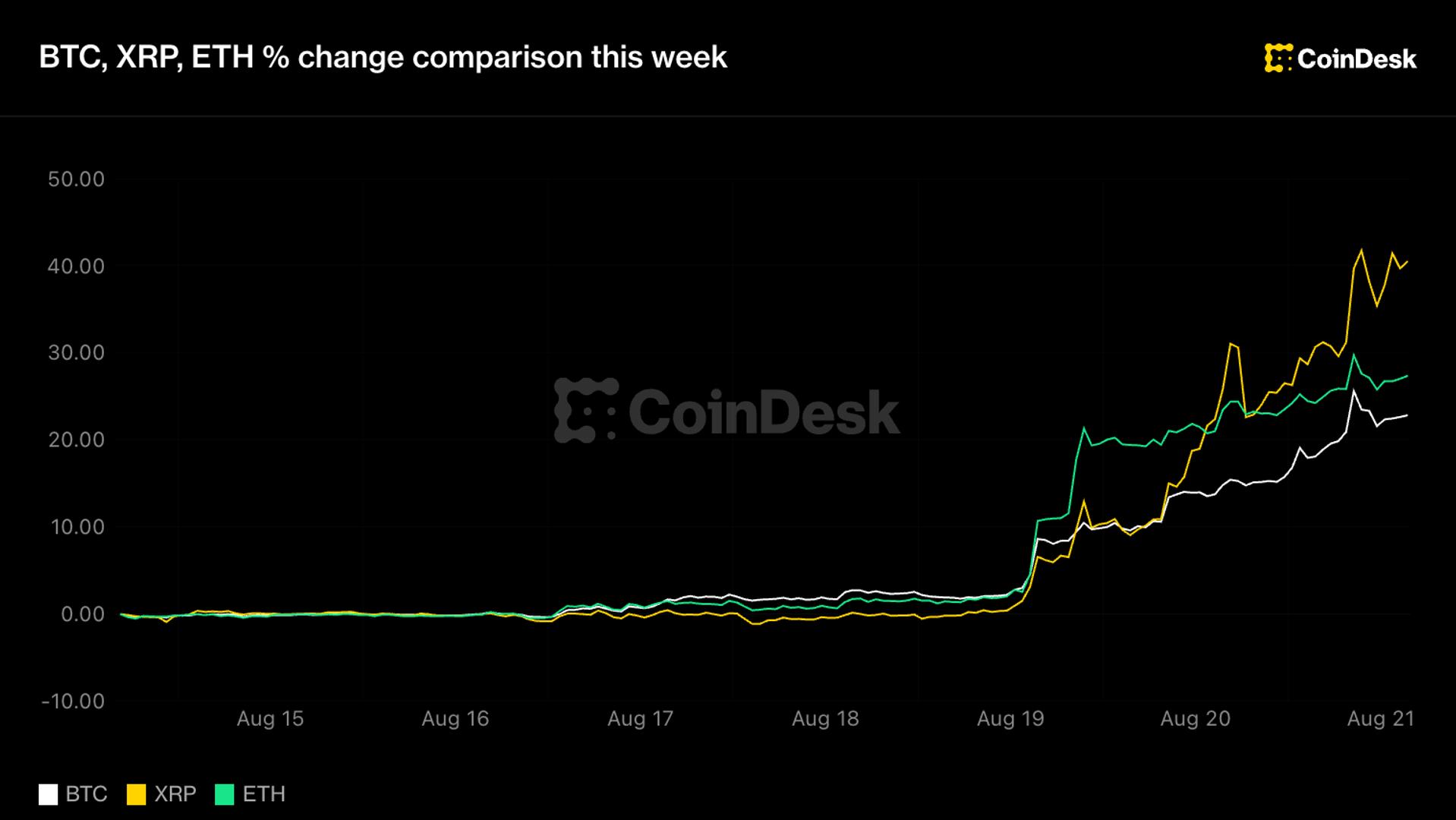
In this episode, the linkage was reinforced by the broader market move: CoinMarketCap data referenced in the coverage showed Bitcoin’s weekly gain extending to more than 23% by Friday, briefly surpassing $79,000. Ether (ETH) was also firm, with gains of nearly 30% over the same period and a move above $2,400, according to the report. With both major assets advancing, risk appetite broadened across the publicly traded crypto value chain.
For investors, this matters because listed digital-asset firms often face a mix of idiosyncratic fundamentals (regulatory positioning, custody, cost structures, and product focus) alongside market-driven demand signals. When the underlying coins move together, it can mask—or temporarily override—company-specific concerns as traders reposition around the “beta” of the sector.
Macro liquidity and US policy optimism add fuel
The equity rally didn’t rely on crypto-specific news alone. According to Cointelegraph, stocks rose in tandem with a broader improvement in sentiment after the US Treasury announced it would double certain long-dated bond buybacks. The stated goal was to support liquidity in the Treasury market, which can influence funding conditions across asset classes and strengthen the case for taking risk.
On the policy side, comments by US President Donald Trump renewed attention on regulatory progress. Cointelegraph reported that Trump again urged Congress to advance the CLARITY Act. The bill is still stalled after lawmakers failed to push it forward before the August recess.
As described in the coverage, CLARITY is widely seen as a step toward a clearer framework for digital assets in the United States, including clarifying the respective oversight roles of the Commodity Futures Trading Commission (CFTC) and the Securities and Exchange Commission (SEC). Even when legislation is not immediately enacted, expectations of a cleaner regulatory boundary can influence how investors price compliance risk and market access for exchanges, custody providers, and other intermediaries.
Trump also revived the possibility of the US government acquiring Bitcoin at a “sizable” scale following meetings with leaders in the crypto industry this week, according to the report. While such statements are not the same as formal policy or procurement authorization, they can still affect near-term sentiment by shaping expectations about long-term demand and government posture.
What to watch next for crypto equities
With Bitcoin’s recovery translating into sharp gains for miners, treasuries, exchanges and brokers, the next key question for market participants is whether the rally can hold if macro liquidity conditions or US regulatory momentum changes. Investors should monitor follow-through in BTC price action above recent resistance levels and keep an eye on any new movement around the CLARITY Act after the recess—since clearer regulatory timelines can matter as much as spot-market direction for listed crypto stocks.


Illuvium's team has agreed to reduce its wages again to preserve the studio's runway, which co-founder Kieran Warwick now puts at more than 12 months, he said Friday. The cut buys Illuvium past August 2027 on Warwick's own numbers, at a point when crypto gaming studios are closing. Proof of Play… Read the full story at The Defiant
Digital Asset, the creator of the Canton Network, and former US House Speaker Paul Ryan’s American Idea Foundation plan to pilot a blockchain-based system for distributing state-administered benefits across three US states using the Canton Network.
The RISE program is expected to launch in the first quarter of 2027 and would combine multiple benefits into monthly or twice-monthly payments, with spending rules applied to categories including food, child care and cash.
According to Friday’s announcement, the system would automatically adjust benefit levels as household income changes and allow participating agencies to track payments, balances, spending and compliance data through Canton. Digital Asset said Canton would coordinate the rules, permissions and transactions used to distribute benefits while limiting access to sensitive information.
Ryan said the pilot is intended to reduce penalties that can occur as benefit recipients’ incomes rise:
By combining fragmented benefits, reducing penalties as families earn more, and rigorously measuring results, these pilots can help show what a modern safety net should look like.
The companies did not name the participating states or specify which benefit programs would be included, and said the pilots remain subject to federal approval.
Related: FalconX, Interstice Connect Canton to Ethereum, Solana and Robinhood Chain
Canton expands government-linked use cases
The RISE program could add a public-benefits use case to Canton, whose recent growth has largely centered on institutional finance, including projects involving government securities.
In April, Japan Securities Clearing Corporation, Mizuho, Nomura and Digital Asset launched a proof of concept using Canton to test Japanese government bonds as digital collateral, including for real-time, cross-border transactions. The project was selected for support under Japan’s Financial Services Agency Payment Innovation Project.
Canton was also used in July to settle a tokenized US Treasury trade between Franklin Templeton and Virtu Financial, with Tradeweb handling execution and price discovery. The Treasury changed hands against USDCx in real time, which Tradeweb described as an industry first.
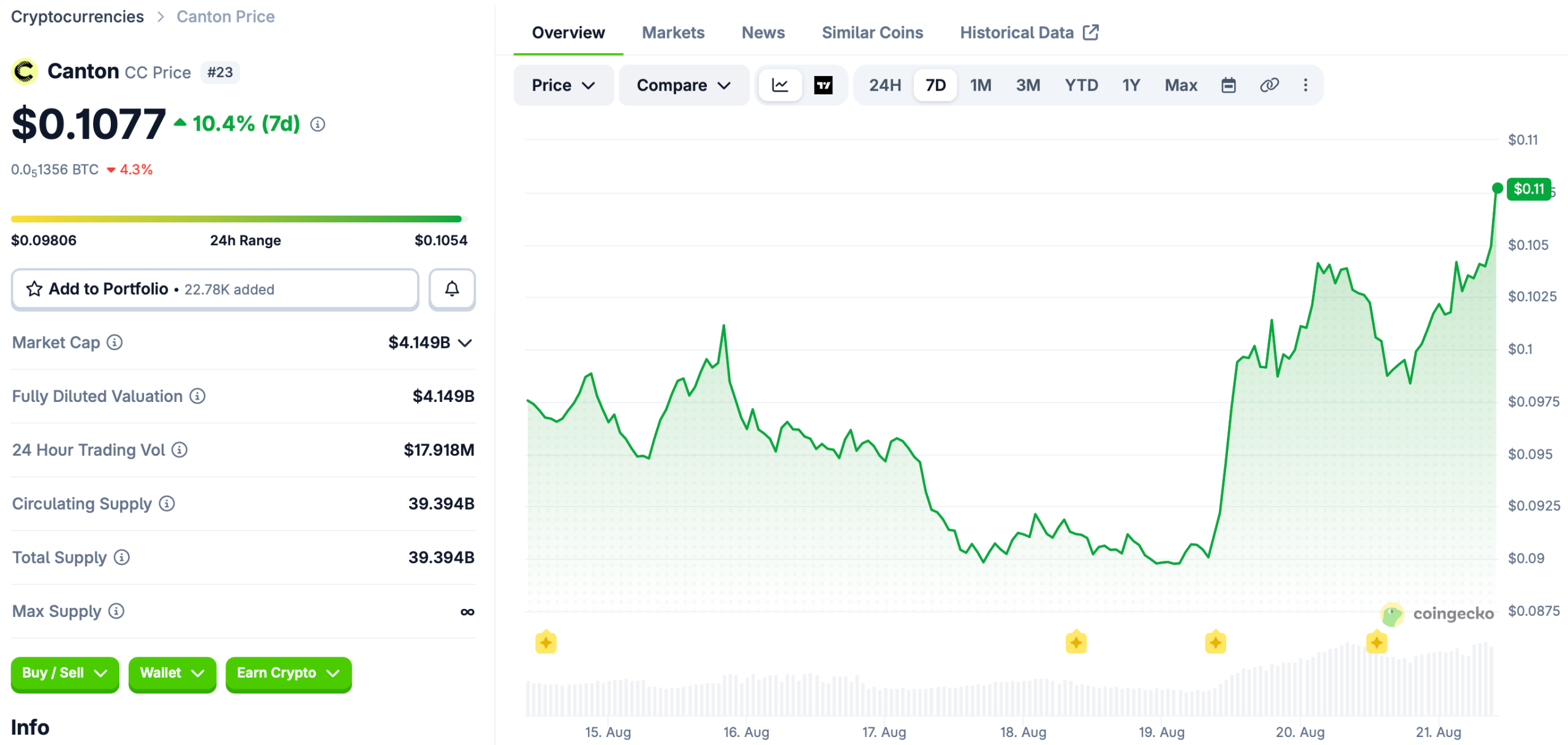
Canton’s native Canton Coin (CC), which is used to pay fees for transactions through the network’s Global Synchronizer, has a market capitalization of about $4.1 billion and ranks 23rd among cryptocurrencies, according to CoinGecko data. CC is up around 10% over the past week.
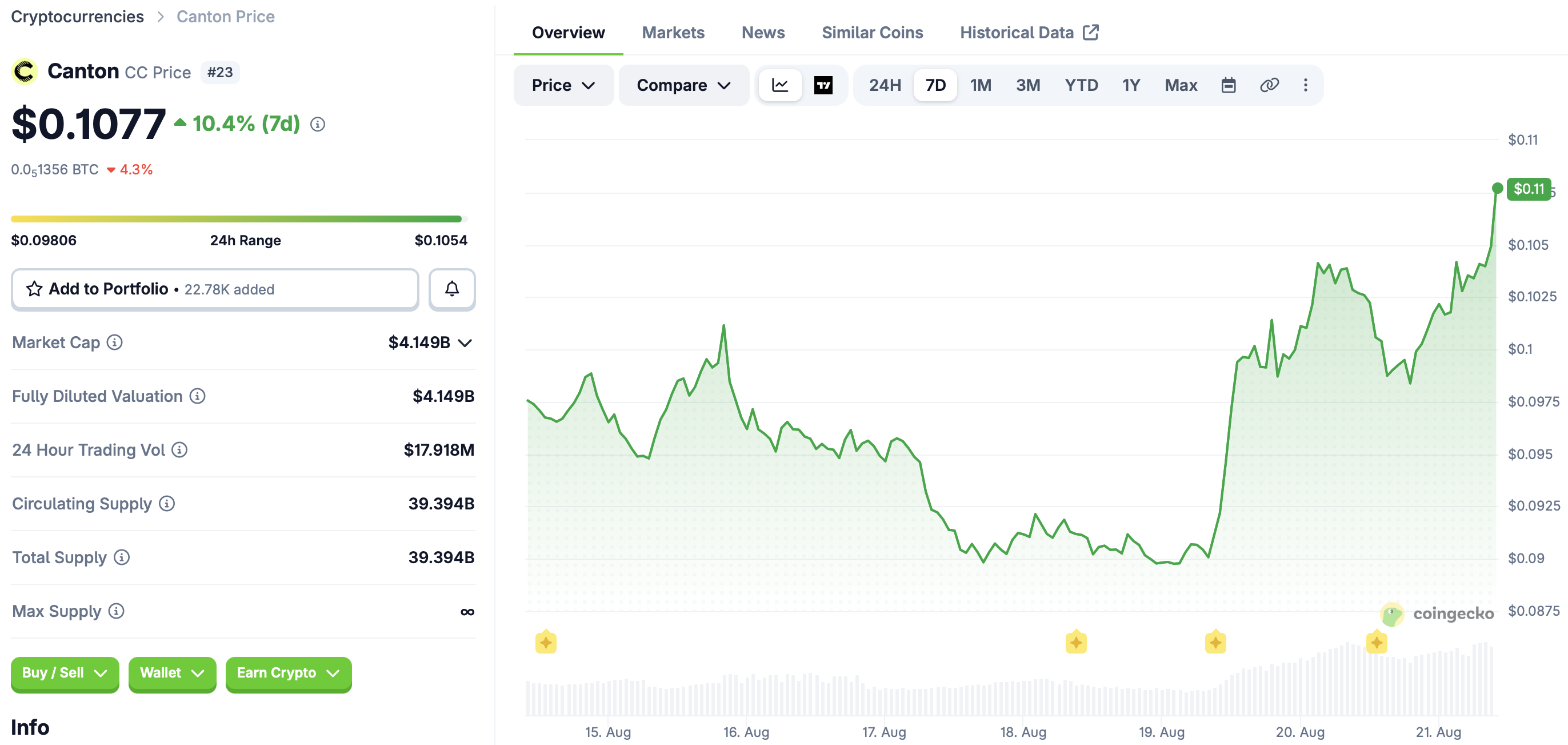
Source: CoinGecko
Magazine: MiCA cracks down on USDT in Europe… but no one else cares
PI is up 5% this week and is looking to find more buyers. Will they come?
PI Network (PI) Price Predictions: Analysis
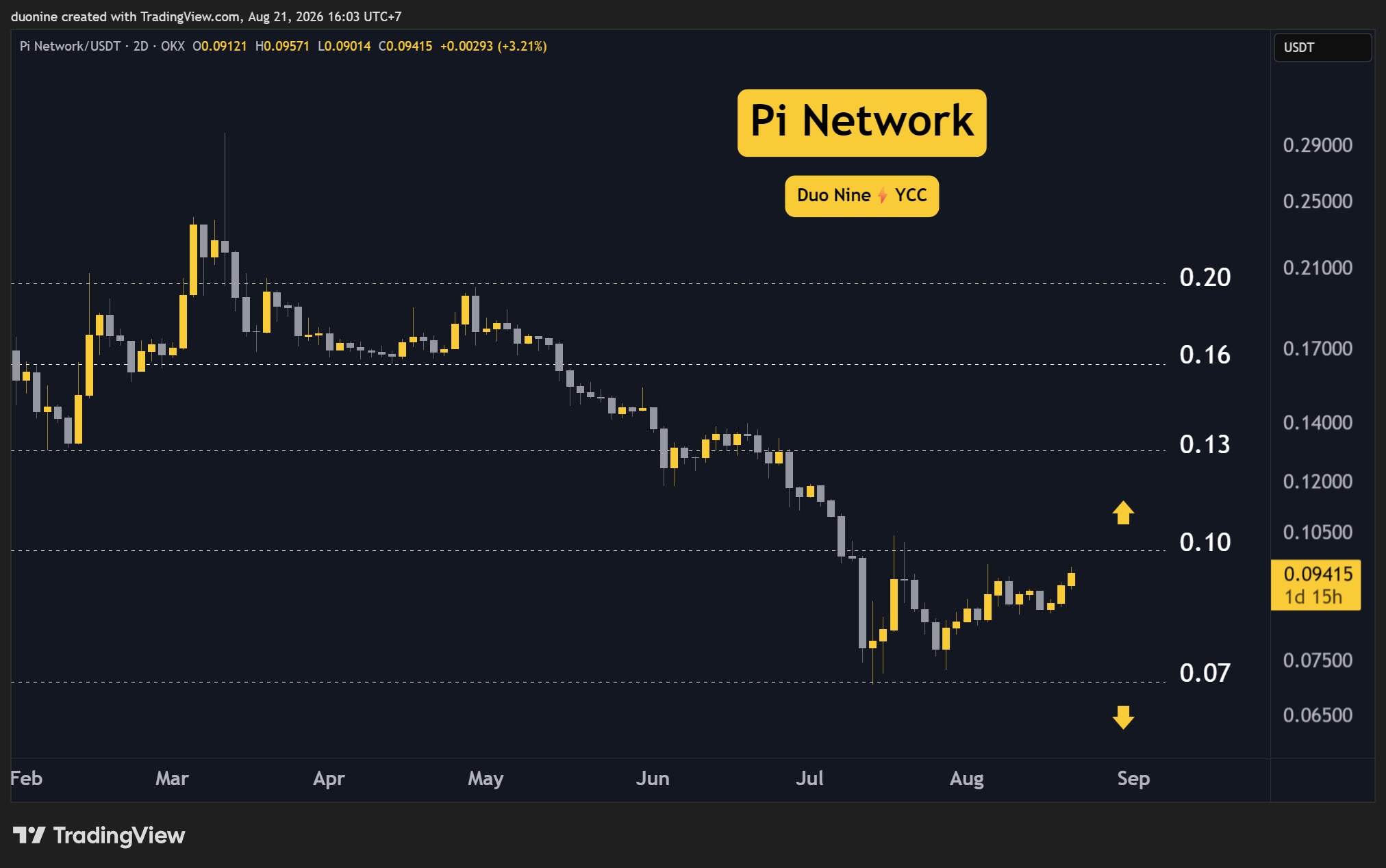
Key support levels: $0.070
Key resistance levels: $0.10, $0.13, $0.16
PI Aims for $0.10
After confirming 7 cents as a key support, PI has been consolidating in a range. The current resistance and major psychological target is found at 10 cents. Considering the bullish market context, a test of this resistance is likely.
However, even if PI is making higher lows and appears bullish, volume has been in a steady decline for months. This shows a lack of conviction and also explains the lower gains from PI compared to other altcoins like XRP or ETH.
Momentum Shifts Bullish
Even if volume remains low, the price has been on a steady uptrend since early August. The momentum indicators such as the MACD or RSI are also bullish, and higher highs appear likely in the future.
The biggest challenge for PI is the resistance at 10 cents, which will likely bring back sellers. If it manages to turn that level into a key support, then this cryptocurrency has a real chance at a major reversal and sustained gains in the future.

Volume Continues to Decline
Until the volume profile makes a higher high, the outlook remains somewhat bearish and allows sellers to regain control at their discretion. The recent gains are positive, but they need to be consolidated with a clean break above $0.10.
Any failure at the key resistance will likely see bears return. To avoid that, buyers will have to spike the volume and improve the ongoing momentum, which favors them, at least at the time of this post.

The post Pi Network Price Predictions for This Week (August 21) appeared first on CryptoPotato.
Trump’s second term so far
Since Trump returned to the White House for a second term in January last year, the debt has gone up by about $3.8 trillion. That means that the national debt has climbed by a total of $11.6 trillion across the two Trump Administrations—so far—a figure that comprises more than a quarter of the total amount.
Why has the debt soared?
Experts credit a significant portion of the growth in the national debt to the federal government’s response to the COVID-19 pandemic. According to Reuters, about one-third of the growth seen since 2017 took place during two years or so of the pandemic, when the first Trump Administration and then the Biden Administration intensified borrowing to fund the country’s pandemic response and recovery.
Both Trump’s and Biden’s fiscal policies have also contributed to—and exacerbated—the longer-standing issue of government spending exceeding tax and other revenues, which has led to the ballooning national debt.
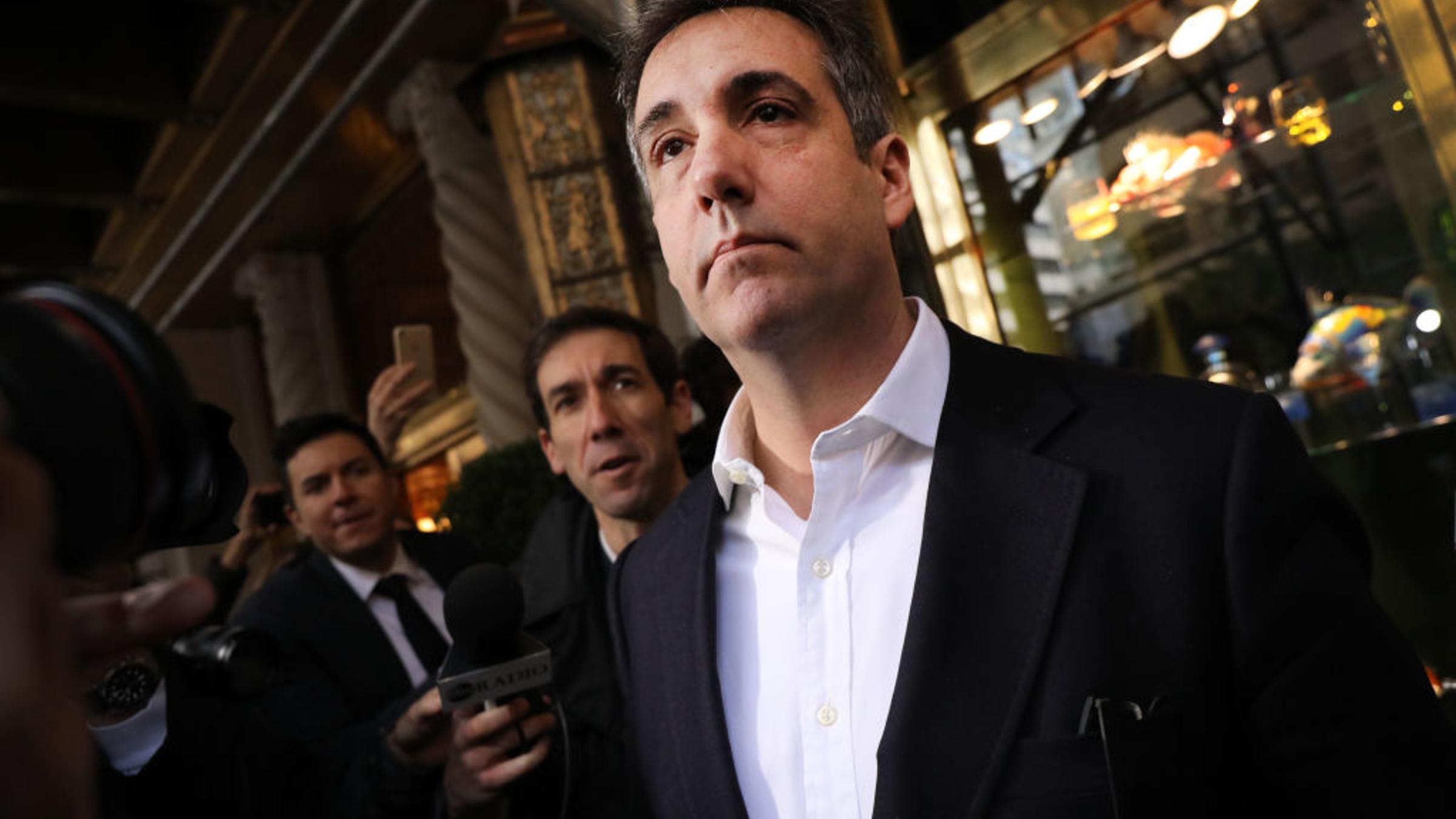
“We forgave,” Cohen wrote. “Forgiveness doesn’t require amnesia. It requires the courage to stop allowing yesterday to dictate tomorrow.”
Cohen’s remarks ring in stark contrast to previous words he has offered about the President.
In 2019, after pleading guilty, Cohen was called by the House Oversight and Reform Committee to further detail his role as Trump’s attorney and said Trump “is a racist. He is a conman. He is a cheat.” When asked how many times Trump had asked him to threaten an individual or entity on his behalf, Cohen responded that Trump had done so on over 500 occasions throughout their professional relationship.
The following year, Cohen published Disloyal: A Memoir: The True Story of the Former Personal Attorney to President Donald J. Trump, a 432-page tell-all about the years he spent as Trump’s lawyer and fixer.
“I knew Trump better than anyone else did,” Cohen wrote at one point in the book. “I knew him better than even his family did, because I bore witness to the real man, in strip clubs, shady business meetings, and in the unguarded moments when he revealed who he really was: A cheat, a liar, a fraud, a bully, a racist, a predator, a con man.”

The logo of Samsung is seen at the Samsung Electronics Seocho building in Seoul on July 30, 2026. South Korean technology giant Samsung Electronics posted on July 30, a massive 19-fold jump in second-quarter operating profit from a year earlier, buoyed by sustained AI-driven demand for memory chips. (Photo by Jung Yeon-je / AFP via Getty Images)
Jung Yeon-je | Afp | Getty Images
Samsung Electronics has announced a shareholder return package, marking a blockbuster week for shareholder returns among South Korea’s chip giants following SK Hynix’s share buyback.
The company announced Friday that it expects shareholder returns to total between 90 trillion won and 110 trillion won ($65.1 billion to $79.52 billion) in 2026.
Samsung said it was “the largest ever by a Korean company.”
The company has been seeking to catch up with its domestic rival SK Hynix in high-bandwidth memory chips used in AI systems. The stock is up around 135% year-to-date.
The company also announced it would pay around 30 trillion won in cash dividends in the third quarter, including its regular quarterly dividend.
Details of the payout will be finalized at a board meeting in late October, the company said.
Samsung’s announcement comes just days after SK Hynix announced a 40 trillion won share buyback.
Samsung said it will decide the size and details of the remaining shareholder returns at a board meeting in late January 2027, considering a combination of cash dividends and share buybacks and cancellations.
Friday’s announcement follows Samsung’s 2024-2026 shareholder return program, under which the company pledged to return 50% of free cash flow generated between 2024 and 2026 while maintaining annual regular dividends of 9.8 trillion won.
In a corporate value enhancement plan released in March, Samsung said it paid 20.9 trillion won in cash dividends in 2024 and 2025 and spent 8.4 trillion won on share repurchases for cancellation.
ENA is rallying on a $1 billion FalconX deal, while HYPE tests its record, though flat dominance shows this is no broad alt season.

Cambridge student died in hospital from ‘poisoning’, inquest hears

Via Transportation: Lock In Gains On This Massive Rebound (Downgrade)

Can AI Predict DeFi Exploits?

Weekend Open Thread – Corporette.com

Weekend Open Thread: Brooks Brothers

London Mayor Sadiq Khan handed a peerage by Keir Starmer alongside 15 other Labour figures… just days before the PM leaves No10

Financial Due Diligence | Transaction Services | M&A | Deal Advisory I Interview | Equity Bridge

95% Orang Indonesia Gagal Pensiun Tenang & Nyaman: Strategi Keuangan Untuk Masa Tua.

The NEW Rules of Traveling with Crypto (Don’t Get Caught at TSA!)
-

 Fashion7 days ago
Weekend Open Thread: Ann Taylor
-

 Sports7 days ago
Birmingham 2026: Day 6 Timetable for Irish Athletes
-
 NewsBeat6 days ago
Myanmar says over 300,000 Rohingya refugees verified for repatriation as exodus enters ninth year
-

 Business3 days ago
SMA Solar Technology AG (SMTGY) Q2 2026 Earnings Call Transcript
-

 Politics6 days ago
SEQ Code: The Three Letter Boarding Pass Code That Could Give You The Worst Seat
-

 Crypto World7 days ago
Pi Network Protocol 27 endgame: last upgrade before what?
-

 Tech4 days ago
Qwen3.8-27B runs frontier-class coding agents and reasoning locally, no cloud API required
-

 Crypto World4 days ago
OCC Greenlights Trump Family Crypto Firm for Trust Charter
-

 Tech6 days ago
Every fusion startup that has raised over $100M
-
 Entertainment6 days ago
Marvel Studios Reveals New X-Men Cast Including Adam Driver and Sadie Sink
-

 Fashion7 days ago
Weekly News Update, 8.14.26 – Corporette.com
-
 Business6 days ago
Monarch Mutual Fund set to enter MF space with maiden overnight fund; files draft with Sebi
-

 Business6 days ago
Cristiano Ronaldo’s Secret Wedding Deepens As Presenter Claims Family Learned ’30 Seconds’ Before
-

 Business6 days ago
Facebook Down Now? Users Report Login And Loading Problems As Outage Trackers Monitor Ongoing Issues
-

 News Videos2 days ago
Don’t Leave Your Financial Future To Chance | August 19, 2026
-

 Crypto World5 days ago
Data of 54K Wallet Users Leaked, Clarity Odds Just 10%: Hodler’s Digest, Aug. 16
-

 Crypto World4 days ago
NAVI Prime launches institutional lending framework on Sui
-

 Politics5 days ago
Britain is facing a housing disaster
-

 Business6 days ago
New Avengers Doomsday Trailer Drops at D23 Showing Robert Downey Jr as Doctor Doom
-
 Business7 days ago
OCC approves World Liberty Financial national bank charter for USD1
You must be logged in to post a comment Login