Microsoft has started rolling out a Classic Outlook theme for users of Outlook on the web and the New Outlook for Windows.
This new Outlook theme is rolling out as part of a targeted release beginning mid-August and expected to complete by the end of September. The theme will become generally available worldwide between late September and late October.
“When enabled, the setting applies coordinated changes across the Outlook experience, including visual styling, layout, typography, icons, and selected interactions,” Microsoft said in a Microsoft 365 Message Center update.
Once rolled out, the feature will not override any existing administrator configurations and will not automatically migrate users from classic Outlook to the new Outlook.
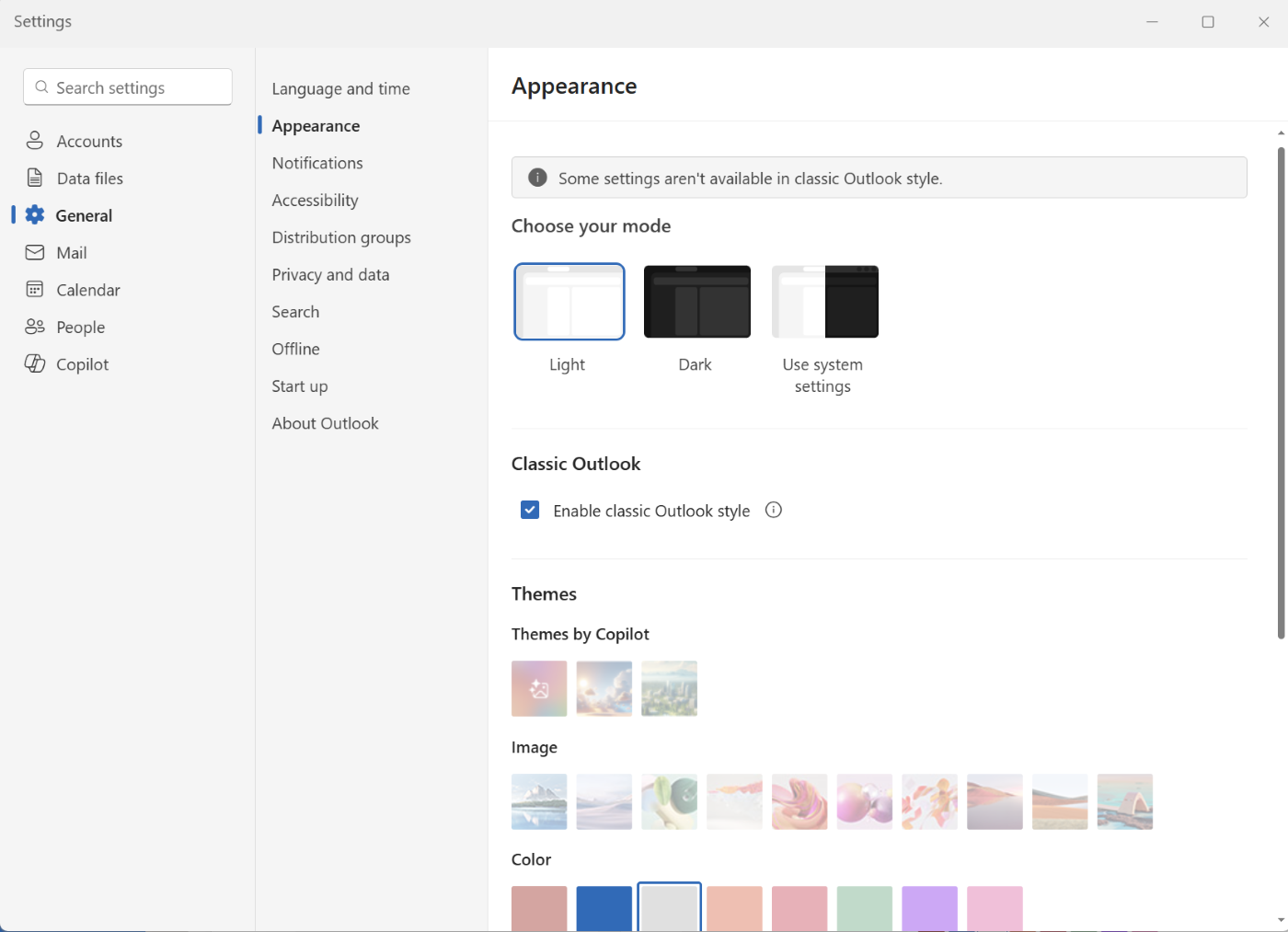
Microsoft also added that the new user interface style will be enabled by default for some users, but they can toggle it off to switch to the standard theme from Settings > General > Appearance.
Advertisement
“This update is designed to help users who are transitioning from classic Outlook by providing a more familiar experience while maintaining the capabilities of the new Outlook,” it added.
“The setting will be available to all users and can be turned on or off at any time. It will be off by default for most users. As part of a phased rollout, Microsoft will enable the setting by default for some users moving from classic Outlook to the new Outlook. Those users can change the setting at any time.”
Classic Outlook theme toggle (Microsoft)
New Outlook (also known as Outlook for Windows), which still lacks some Classic Outlook features, replaced Windows Mail as a pre-installed app on Windows 11 and Windows starting in October 2023 and January 2025, respectively.
In February, Microsoft announced that it would postpone the new Outlook opt-out phase for businesses from April 2026 to March 2027, giving enterprise admins 12 additional months to prepare a staged migration to the new client.
Advertisement
Microsoft made this decision even though, according to the company, it was “seeing strong and accelerating adoption of new Outlook.”
In July, Microsoft also said that it would disable Outlook Web Access (OWA) Light, a lightweight version of the Outlook Web App email client introduced roughly two decades ago as an alternative to OWA Premium, in a future Exchange Server update.
Overall prevention scores can hide what happens after initial access. Once attackers are using valid credentials, prevention drops sharply.
The Blue Report 2026 measures defenses technique by technique across 338 million simulations run in customer production environments.
An ‘aggressive’ paramedic who told a stroke patient that ‘Jesus and Jehovah are not coming to help you’ while responding to a 999 call has been struck off.
Rachel Lemonofides also told the patient, who was later diagnosed with a brain bleed and abdominal aortic aneurysm, to stop acting ‘like a baby’ and forced her to crawl down the stairs.
Lemonofides was dismissed by North West Ambulance Service in July 2024 after being accused of making dozens of allegedly ‘discriminatory’ or ‘racially motivated’ comments about or to the woman in January the same year.
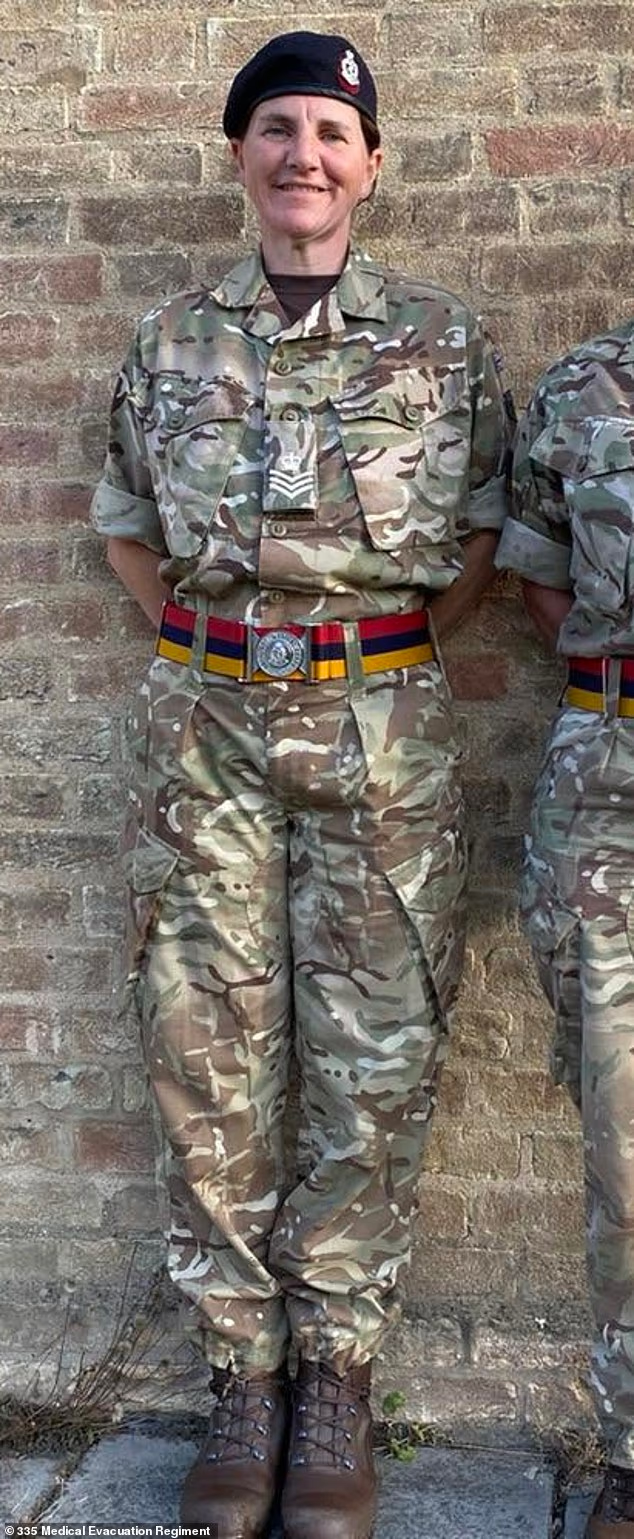
A tribunal has now ruled that the British Army reservist, who holds the rank of staff sergeant, made up to 31 comments of this nature against the patient.
Advertisement
On January 11, 2024 an ambulance was called to the patient’s address when she began feeling a ‘sharp pain in her chest’ as she got ready for work.
Ms Lemonofides’s crew responded to the call and they spent a total of 104 minutes at the scene before bringing the patient to hospital.
The patient had described the pain as ‘severe and excruciating’ and she was later ‘informed that her aorta had burst and she had a blood clot in the brain which had caused her to suffer a stroke’.
She was ‘given a 50 per cent chance of surviving an aortic dissection’ (emergency heart surgery).
Advertisement
A nurse in the emergency department explained that the patient was having a cerebral bleed and later on, that she was also having an abdominal aortic aneurysm.
Rachel Lemonofides was struck off as a paramedic at North West Ambulance Service. She is also a British soldier with the rank of staff sergeant
Ms Lemonofides accused the stroke patient of ‘absolutely ridiculous behaviour’ and refused to help her walk down the stairs after responding to the 999 call
Advertisement
However, while responding to the emergency call, Ms Lemonofides had allegedly made a series of discriminatory or racially motivated comments either to or about the patient in which the paramedic accused her of ‘ridiculous behaviour’.
Ms Lemonofides’s remarks included telling the patient: ‘Jesus and Jehovah are not coming to help you’; ‘You are acting ridiculous now’; ‘This is like a child now’; ‘You are stuck on the floor like a child’; ‘This is a bit like silly behaviour now’; ‘We are not helping you like this, you are being silly’; and ‘I am really mad now because people are waiting for this ambulance and you are acting like a child.’
The paramedic also accused the patient of ‘absolutely ridiculous behaviour’ and of acting ‘as though you have had your leg ripped off’.
She also refused to help the patient walk down the stairs at her home, forcing the stroke sufferer to crawl instead.
Advertisement
Ms Lemonofides said the woman was ‘behaving as if you are possessed’ and told her: ‘I should let your employer know how you are behaving given the fact that you work with vulnerable people.’
On several occasions it was noted that Ms Lemonofides had shouted at the woman in between making some of these comments, including when she told her to ‘act your age’.
The paramedic also said: ‘You are not dying, you have got a bad back’; ‘You should be assessed by the mental health team’; ‘You are lying, stop what you are doing, stop being a baby, let’s go downstairs.’
She accused the woman of ‘wasting time and making a scene’ and then told her ‘I’m not going to help you’ when she asked for ‘help to stand up and/or descending the stairs’.
Advertisement
Ms Lemonofides also threatened to make the patient’s workplace aware of the incident, saying: ‘Stop being a baby, many people need this ambulance, we will tell your employer that you are being funny.’
The paramedic later said the patient was ‘just being dramatic’, telling her: ‘You have gone through child labour which is worse than this pain.’
In remarks that appear to have been made to a colleague during the incident, Ms Lemonofides also said: ‘I do not think this is medical, she is choosing to do this’; ‘This is like the worst behaviour I have seen for a very long time’; ‘Does she believe in black magic or anything like that?’; and ‘I can’t believe someone with a child is behaving like this’.
The paramedic’s final comments included telling the patient that ‘we can’t take you to the hospital because your condition is not that serious’ and ‘you have 60 seconds to get up or we are leaving’.
Advertisement
The tribunal ruled that the list of 31 alleged comments made by Ms Lemonofides during the incident, some of which the Daily Mail has revealed here, were ‘proved on the balance of probabilities’.
It was ruled that her ‘dismissive and aggressive comments and behaviour continued throughout her attendance at the address’.
Ms Lemonofides admitted that she made these comments but had denied in July 2025 that her remarks were discriminatory on the grounds of ethnicity.
However, the tribunal also found that these comments were, as alleged, ‘discriminatory on the grounds of ethnicity; and/or racially motivated; and/or unprofessional, in that it breached professional boundaries’ with the patient.
Advertisement
This promotional image identifying Ms Lemonofides as a reserve soldier was posted by North West Ambulance Service on social media
The tribunal found that four witnesses, who included colleagues and the patient’s housemates, were ‘shocked’ at hearing the paramedic’s remarks about the patient being ‘possessed’ and whether she used ‘black magic’.
‘The panel considered the audio recordings from the incident, noting the registrant [Ms Lemonofides]’s tone when making the comments about and being to Patient A,’ the tribunal ruled.
‘In addition, the panel noted from the recordings that, when Patient A was calling out in her native language, the registrant is heard to make comments such as “stop with this nonsense”, which could have been in response to Patient A speaking in her native language and therefore suggests hostility towards Patient A’s ethnicity…
Advertisement
‘Colleague A confirmed [that] two other calls [on the same day] involved white female patients and neither of these patients were treated by the registrant in the same way she had treated Patient A.’
The panel ruled on the balance of probabilities that ‘it was more likely than not that the registrant’s conduct towards Patient A was discriminatory on the grounds of ethnicity’.
Ms Lemonofides denied her conduct was racially motivated on the day of the incident. However she was not present for the tribunal hearing.
The tribunal found that the Army reservist’s comments about ‘black magic’ and the patient being ‘possessed’ were ‘said for a purpose’, which was to ‘make reference to Patient A’s race’.
Advertisement
‘The panel considered if the act was done in a way showing hostility or a discriminatory attitude to the relevant racial group and agreed that it was.’
It was ruled that Ms Lemonofides ‘appeared to have a bias towards the ethnicity’ of the woman.
After finding that the paramedic’s comments amounted to racially motivated discrimination, it was further ruled that her conduct ‘was an example of gross unprofessionalism and a breach of professional boundaries’ and the allegation was found proven.
‘The panel acknowledged that some patients require a more assertive manner for different reasons, but having considered the evidence in this case, the tone and manner of the registrant’s comments, together with her treatment of Patient A, the panel agreed that her conduct was abhorrent,’ it was ruled.
Advertisement
‘It noted the distinct lack of dignity and respect for Patient A, with no evidence of empathy or compassion from the registrant and unacceptable treatment continued over a period of time.’
As part of the tribunal, Ms Lemonofides also faced allegations that she told a colleague in reference to the incident: ‘If it had been filmed, you would watch it back and laugh at it.’
The panel found the paramedic guilty of having made this remark on the balance of probabilities.
Ms Lemonofides was also accused of failing to recognise the seriousness of the patient’s condition.
Advertisement
The tribunal found this allegation proved on the balance of probabilities after the patient described ‘having to crawl downstairs as she was unable to walk and was not assisted in doing so’.
Ms Lemonofides was accused of ‘refusing’ to help the patient walk despite having ‘pain to her back, throat and neck’.
One of the patient’s housemates told the tribunal that they saw the woman reach out to Ms Lemonofides with her hand and ask for help, but the paramedic ‘physically moved away’ and ‘refused to help her’.
The panel noted: ‘It was clear to the panel from the recordings that Patient A was crying out in apparent pain on numerous occasions, but the registrant was heard telling her to.’
Advertisement
A spokesman for North West Ambulance Service NHS Trust told the Daily Mail: ‘The individual no longer works for the trust.
‘All of our patients are entitled to be treated with dignity and respect and there is no place within our organisation for colleagues who do not uphold those values.’
An Army spokesman said: ‘We have a common law and Data Protection Act duty to protect the personal information of our employees or ex-employees, as such we will not release any personal information relating to this case.’
I am a full-time analyst interested in a wide range of stocks. With my unique insights and knowledge, I hope to provide other investors with a contrasting view of my portfolio, given my particular background.If you have any questions, feel free to reach out to me via a direct message on Seeking Alpha or leave a comment on one of my articles.
Analyst’s Disclosure: I/we have no stock, option or similar derivative position in any of the companies mentioned, and no plans to initiate any such positions within the next 72 hours. I wrote this article myself, and it expresses my own opinions. I am not receiving compensation for it (other than from Seeking Alpha). I have no business relationship with any company whose stock is mentioned in this article.
The analysis is provided exclusively for informational purposes and should not be considered professional investment advice. Before investing, please conduct personal in-depth research and utmost due diligence, as there are many risks associated with the trade, including capital loss.
Advertisement
Seeking Alpha’s Disclosure: Past performance is no guarantee of future results. No recommendation or advice is being given as to whether any investment is suitable for a particular investor. Any views or opinions expressed above may not reflect those of Seeking Alpha as a whole. Seeking Alpha is not a licensed securities dealer, broker or US investment adviser or investment bank. Our analysts are third party authors that include both professional investors and individual investors who may not be licensed or certified by any institute or regulatory body.
Each week, Investors Intelligence, an independent provider of market research and technical analysis, tracks more than 100 stock market newsletters and measures how many are making bullish calls and how many are advising against owning stocks. When the number of bulls reaches irrationally high levels — you guessed it — the market is often near a significant top. When fear…
Early in the week, Shane Steichen announced that the Colts starters wouldn’t be playing in this game, paving the way for Riley Leonard to get the start.
Advertisement
As Leonard competes with Anthony Richardson for the backup quarterback role, the two have alternated starting opportunities in the preseason up to this point. With Richardson getting the start against New England, it is now Leonard’s turn.
Advertisement
Richardson will then take over in the second half, just as Leonard did a week ago.
From the outside looking in, it’s difficult to decipher who has the upper hand in this battle. As Steichen said on Thursday, both quarterbacks have flashed, but each has had thier ups and downs as well.
As of now, Steichen didn’t put a timetable on when he plans on making a decision.
This competition may be close, but perhaps there’s a little more extra pressure on Leonard this week, with Richardson having the better performance in Week 1.
A movie can be both “Filmed for IMAX” and shot with IMAX cameras, which is why the two labels are easy to confuse.
Aaronp/bauer-griffin/Getty Images
“Shot with IMAX” and “Filmed for IMAX” sound like two ways of saying the same thing. They aren’t, although IMAX’s own branding makes the difference less obvious than the names suggest. The simplest way to think about it is that shooting with IMAX film cameras describes the camera used to capture the movie, while “Filmed for IMAX” describes a broader production process built around an IMAX presentation.
A “Filmed for IMAX” movie can be shot digitally, as Dune was, but IMAX also includes productions using its own film cameras. Christopher Nolan’s The Odyssey shows the overlap: it was shot entirely with IMAX film cameras and is also officially part of the “Filmed for IMAX” program.
Advertisement
Shot with IMAX means using IMAX film cameras
Grusho Anna/Shutterstock
IMAX’s own marketing generally uses the more specific phrase “Shot with IMAX Film Cameras” rather than “Shot with/in IMAX.” In this case, the description is literal: filmmakers captured at least some of the movie using IMAX’s large-format film cameras.
IMAX film cameras use a 15-perf 65mm format. The 65mm film runs horizontally through the camera, with each frame spanning 15 perforations across the film. That creates the large, tall 1.43:1 image associated with IMAX film, meaning the image is about 1.43 times as wide as it’s tall. The camera film is 65mm, while theatrical release prints are 70mm, which is why those screenings are advertised as IMAX 70mm.
A movie doesn’t necessarily have to use IMAX cameras for the whole movie to receive the label. Oppenheimer, for example, was shot partly with IMAX film cameras, with those sequences expanding into the taller IMAX image in compatible theaters. The Odyssey goes further: IMAX says it is the first feature shot entirely with IMAX film cameras, helped by a newly-engineered camera enclosure that made synchronized dialogue scenes practical at that scale.
That makes The Odyssey a clear example of what people usually mean when they say a movie was “shot in IMAX”: every frame was captured with an IMAX film camera. Seeing it projected from an IMAX 70mm print, however, requires one of the select theaters equipped for that format.
Advertisement
Filmed for IMAX is a broader production program
Rneaw/Getty Images
IMAX’s “Filmed for IMAX” program begins in pre-production, when filmmakers choose either IMAX film cameras or IMAX-certified digital cameras. During production, they shoot with IMAX’s taller 1.90:1 or 1.43:1 aspect ratios in mind, while IMAX’s post-production team later works with them to optimize the movie for its theaters.
In 2020, IMAX launched a certification program for digital cinema cameras from manufacturers including ARRI, Panavision, RED and Sony. These aren’t cameras built by IMAX, but digital cinema cameras approved for use in the “Filmed for IMAX” workflow.
Dune shows how the digital side of the program works. Denis Villeneuve did not shoot the 2021 film on IMAX film cameras. It was captured using IMAX-certified digital cameras, but composed for IMAX presentation. In select theaters, parts of Dune expanded to 1.43:1, showing more of the image above and below than the wider theatrical presentation.
Advertisement
Other “Filmed for IMAX” releases show how much the presentation can vary. F1: The Movie was shot with IMAX-certified digital cameras and presented entirely in the 1.90:1 aspect ratio. Mission: Impossible: The Final Reckoning also used certified cameras, but only certain sequences expanded to 1.90:1 for over 45 minutes. In other words, “Filmed for IMAX” does not guarantee how much of the film will fill the taller screen.
The label alone doesn’t tell you which screening is better
ZikG/Shutterstock
A movie being shot with IMAX film cameras doesn’t automatically make every IMAX screening the better choice. The format used to capture the movie is only part of what determines the experience in the theater.
What matters next is how the movie is presented at that particular location. Not every IMAX theater can show the full 1.43:1 image. IMAX 70mm theaters can project that taller frame from film, while some IMAX with Laser auditoriums can also support 1.43:1. Other IMAX presentations may use the wider 1.90:1 presentation instead.
Advertisement
That means two theaters showing the same “Filmed for IMAX” movie can offer noticeably different presentations. A movie may contain 1.43:1 footage, for example, but you won’t necessarily see the full frame unless the auditorium is equipped to display it.
So if a movie has an expanded IMAX presentation, check the individual screening rather than relying on the badge alone. The bottom line is that you should look for IMAX 70mm or confirmation that the IMAX with Laser auditorium supports 1.43:1 before buying your ticket.
Most people try to fix behavior.
Few are willing to rebuild belief.
👇 Let’s discuss:
What identity have you been unconsciously living out lately?
If you’re ready to move forward with clarity:
Advertisement
🧠 Clinical Therapy (KS & MO) — Identity formation, anxiety, depression, alignment.
📈 Professional Coaching — Business development, professional identity, holistic growth.
🧭 Personal Coaching — Identity formation, purpose clarity, disciplined action.
🎓 Training Program — For therapists and business leaders ready to integrate identity and business.
Abubakarr Moiba, 43, of Falsgrave Road, Scarborough, pleaded guilty to causing actual bodily harm to a woman. He was jailed for 12 weeks and ordered to pay £100 compensation.
Nathan Collinson, 37, of no fixed address, pleaded guilty to assaulting two men in Scarborough and obstructing a police officer He was jailed for eight weeks.
Damien Wilson, 39, of St Andrews Road, Whitby, pleaded guilty to harassment of a woman.
Advertisement
He was given a 12-month community order with a two-month curfew and 10 days’ rehabilitative activities. He was made subject to a three-year restraining order to protect the woman from him and ordered to pay £85 prosecution costs and a £114 statutory surcharge.
Jamie McPake, 21, of Fishermans Square, Redcar, pleaded guilty to causing grievous bodily harm to a man in Scarborough.
He was given an eight-month prison sentence suspended for 18 months on condition he wears an alcohol abstinence tag for 80 days. He must pay £1,000 compensation.
Dale Bonson, 44, of Hertford Close, Eastfield, pleaded guilty to affray and carrying a baseball bat as an offensive weapon, both committed in Eastfield.
Advertisement
He was given a 12-month prison sentence suspended for 12 months and ordered to pay £650 prosecution costs.
PLYMOUTH, Mass. — A GoFundMe fundraiser established to help the parents of Lindsay Clancy, the Massachusetts woman on trial for killing her three children, has surpassed $1 million in donations, drawing support from more than 27,000 contributors even as the campaign has sparked significant public debate.
The fundraiser, titled “The Musgrove Family Fund,” was created to support Mike and Paula Musgrove, Clancy’s parents, who organizers say have depleted their savings while remaining close to their daughter throughout the more than three-year legal process following the January 2023 deaths of Clancy’s three children in the family’s Duxbury home. According to the campaign page, the fund is intended to cover “accumulated costs of travel, lodging, living expenses, and other family expenses” the Musgroves have absorbed while supporting their daughter through pretrial proceedings and her ongoing murder trial.
The fundraiser was started by Brandee Mulligan, who launched the campaign Aug. 14 with an initial goal of $500,000. According to Court TV, by Aug. 17 that goal had already been raised to $2 million after donors had contributed more than $849,000 within just a few days of the campaign’s launch. As of the most recent update, the fund had raised $1,003,758, according to Fast Company.
Mulligan has been explicit in clarifying what the donated funds can and cannot be used for, given GoFundMe’s policies regarding fundraising connected to individuals facing criminal charges. “You can’t do that,” Mulligan told her followers on social media, addressing questions about whether donations could go toward Clancy’s legal defense. “You cannot make GoFundMes that support legal stuff.” A GoFundMe representative confirmed to Fast Company that the campaign has been verified and that funds will go directly to Mike Musgrove as the designated beneficiary, though the platform did not offer detailed comment on how the fundraiser fits within its broader policy framework. GoFundMe maintains a policy against fundraising for the legal defense of anyone accused of a violent crime, though the platform’s terms do not explicitly address fundraisers benefiting family members of accused individuals rather than the accused person directly.
Advertisement
The campaign page itself addresses the parents’ continued support for their daughter directly, without asking donors to weigh in on the underlying criminal case. “They have not walked away from their daughter,” the page states, “and they have never been unclear about why: they love her. Nothing about this fund asks anyone to share their view of Lindsay or the criminal case.”
Among the fundraiser’s notable contributions, a $10,000 gift was recently listed on the campaign page, according to Newsweek, part of a wave of both large and small donations that have continued arriving even as the fundraiser has drawn public scrutiny.
Reaction to the fundraiser has been sharply divided. According to Newsweek, supporters of the campaign argue that the Musgroves have endured significant emotional and financial hardship while remaining steadfastly committed to their daughter throughout the legal process, and that the fund simply provides practical relief for costs unrelated to Clancy’s legal defense. Critics, meanwhile, have questioned the broader appropriateness of raising substantial sums of money for relatives of a woman who has admitted to killing her three children, even as she maintains a not-guilty plea based on her defense’s argument that she was experiencing severe postpartum psychosis at the time of the killings.
Clancy, 36, has acknowledged in court documents that she strangled her children — Cora, 5; Dawson, 3; and 8-month-old Callan — but has pleaded not guilty to three counts of first-degree murder, arguing she should not be held criminally responsible due to the severe mental illness her defense says she was experiencing at the time. Her trial, now well into its fourth week in Plymouth Superior Court, has drawn extensive national attention, with thousands of people following daily testimony and case developments across social media platforms.
Advertisement
Paula Musgrove is expected to provide testimony offering a family member’s firsthand perspective on Clancy’s mental state and the changes she observed in her daughter in the period leading up to the killings, as the defense continues building its case that Clancy’s actions stemmed from a profound mental health crisis rather than deliberate intent.
The current fundraiser for Clancy’s parents is not the only significant crowdfunding effort connected to the case. A separate GoFundMe campaign established shortly after the killings in 2023 to support Patrick Clancy, Lindsay’s husband and the father of the three children who died, also surpassed $1 million in donations at the time, according to earlier reporting. That fund, created and managed by Matthew Glaser, drew contributions from more than 15,000 individuals, families, corporations and community groups, with donations ranging from as little as $15 to as much as $7,500. Organizers of that earlier fund said the money was intended to help Patrick Clancy cover medical bills, funeral services and legal expenses, given that he would be unable to work for an extended period following the tragedy. Donors to that campaign left messages of support and solidarity, including one from a group at Massachusetts General Hospital, where Lindsay Clancy had previously worked as a nurse, which contributed $5,125 to the fund.
As the current fundraiser for the Musgroves continues climbing toward its stated $2 million goal, the scale and speed of the donations reflect the broader intensity of public interest surrounding the Clancy case more than three years after the deaths first drew national attention. Whether the fundraiser continues its rapid pace toward its full fundraising target is likely to remain closely tied to ongoing developments in the trial itself, which continues in Plymouth Superior Court as jurors weigh extensive testimony regarding Clancy’s mental state at the time of the killings against prosecutors’ arguments that she bears full legal responsibility for her actions.
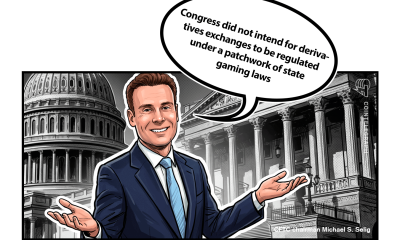
Washington state is cut off for Kalshi customers while the company combats the development in court and its federal regulator keeps pursuing new rules.
Quentin Tarantino is one of the greatest filmmakers in Hollywood today, having made a name for himself with modern classics such as Jackie Brown, Kill Bill: Vol. 1, and Django Unchained, and is universally known for his unique style of storytelling, intense action, and intriguing characters. Born in Knoxville, Tennessee, Tarantino grew up in Los Angeles and spent most of his time at a nearby movie theater where his love for film and storytelling flourished into an undeniable passion, leading him to write one of his earliest screenplays at the age of fourteen.
In 1992, Tarantino made his feature-length directorial debut with his crime thriller, Reservoir Dogs, but two years later, the young filmmaker’s career officially took off with his 1994 Oscar-winning classic, Pulp Fiction. Over the years, the writer and director has become a defining figure in modern cinema and continues to captivate audiences with his artistic ambition and unpredictability. Tarantino has delivered a collection of notable flicks, including Inglourious Basterds and Once Upon a Time…in Hollywood, with many of them being credited as some of the finest films to grace the silver screen in years.
Advertisement
10
‘Death Proof’ (2007)
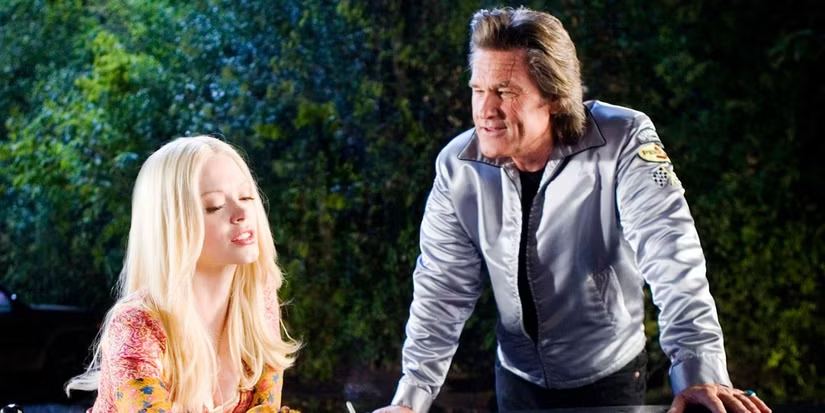
Rose McGowan and Kurt Russell in Quentin Tarantino’s Death ProofImage via Troublemaker Studios
Kurt Russell stars in the 2007 slasher movie, Death Proof, as a stuntman, Mike, who cruises around picking up young women only to murder them with modified cars that he believes to be “death-proof.” The movie was originally released as part of Robert Rodriguez‘s Grindhouse, which flopped at the box office, leading Tarantino to release Death Proof as a standalone movie. The film’s combination of sharp dialogue, memorable characters, dark humor, and brutal suspense showcases Tarantino’s distinctive filmmaking style, while Russell gives one of his most entertaining performances as a charismatic madman that varies from his traditional good-guy roles.
While Tarantino has cited Death Proof as the worst film he’s ever made, the movie still has several strengths, notably the contrast between its relaxed, conversational first half and its increasingly intense second half, which culminates in a thrilling car chase and a satisfying reversal of power. Tarantino also fills the film with references to 1970s exploitation movies, complete with deliberately rough visual touches that give it an authentic grindhouse feel, effectively immersing audiences in a nostalgic movie-going experience.
Advertisement
9
‘Jackie Brown’ (1997)
Pam Grier in Jackie Brown (1997)Image via Miramax Films
Jackie Brown is a thrilling homage to blaxploitation films based on the 1992 novel Rum Punch, written by Elmore Leonard, and stars Pam Grier as the titular character, a clever flight attendant who, after being caught by the authorities trying to smuggle money for her arms dealer boss (Samuel L. Jackson), decides to play both sides against each other and take off with the money herself. The movie was both a critical and commercial success and earned praise from critics, notably Roger Ebert, who gave the movie four out of four stars, citing it as one of his favorite movies of the year.
Unlike some of Tarantino’s more explosive movies, Jackie Brown is a hangout movie that takes its time, allowing the characters and shifting alliances to develop naturally, which essentially sets it apart from other crime films of its time. The movie earned several award nominations, including an Oscar nomination for Best Supporting Actor for Robert Forster and two Golden Globe Award nominations for Grier and Jackson. Its stylish 1970s atmosphere, excellent soundtrack, intricate plot, and emphasis on character over spectacle are just a few qualities that make Jackie Brown one of Tarantino’s most rewarding and underrated films.
Advertisement
8
‘The Hateful Eight’ (2015)
Samuel L. Jackson and Walton Goggins in western attire firing weapons in The Hateful Eight.Image via The Weinstein Company
Tarantino’s The Hateful Eight combines his trademark dialogue, dark humor, brutal violence, and morally complex characters with the traditional tropes of the Western genre, delivering a tense mystery that would impress Agatha Christie herself. Set in Wyoming after the Civil War, the movie follows several strangers who all seek shelter from a blizzard in a remote cabin and are forced to confront one another while suspicion and paranoia steadily build around them. The movie features an ensemble cast including Kurt Russell, Samuel L. Jackson, Walton Goggins, and Tim Roth, as well as a haunting musical score composed by the legendary Ennio Morricone.
The gorgeous 70mm cinematography, razor-sharp dialogue, and unpredictable twists give The Hateful Eight the feel of a classic Western mixed with a locked-room murder mystery, making it one of Tarantino’s most ambitious and memorable films. The Hateful Eight received three Oscar nominations, including Best Cinematography and Best Supporting Actress for Jennifer Jason Leigh, and went on to win Best Original Musical Score for Morricone.
Advertisement
7
‘Once Upon a Time…in Hollywood’ (2019)
Leonardo DiCaprio stars in Once Upon a Time…in Hollywood as a former Western TV star, Rick Dalton, who, along with his stunt double and best friend, Cliff Booth (Brad Pitt), tries to find their place in the rapidly changing film industry while the chaos and increasing violence of society begin to creep towards the doorstep of Hollywood’s rising star, Sharon Tate (Margot Robbie). DiCaprio and Pitt give outstanding performances, with their chemistry providing much of the film’s heart and humor, while Robbie shines as the lovely and bubbly Tate.
Tarantino creates an incredibly detailed recreation of late-1960s Hollywood that makes the backdrop and its culture feel like characters themselves, while the alternate-history approach to the Manson murders turns real-world tragedy into a violent, darkly comic fantasy. Once Upon a Time…in Hollywood earned ten Oscar nominations, including Best Picture and Best Director, and ended up winning for Best Production Design and Best Supporting Actor for Pitt. With its fantastic performances, authentic atmosphere, and unforgettable finale, Once Upon a Time… in Hollywood is easily one of Tarantino’s most entertaining and emotionally satisfying films to date.
Advertisement
Collider Exclusive · Oscar Best Picture Quiz Which Oscar Best Picture Is Your Perfect Movie? Parasite · Everything Everywhere · Oppenheimer · Birdman · No Country
Five Oscar Best Picture winners. Five completely different visions of what cinema can be — and what it can do to you. One of them is the film that was made for the way your mind works. Ten questions will figure out which one.
🪜Parasite
Advertisement
🌀Everything Everywhere
☢️Oppenheimer
🐦Birdman
🪙No Country for Old Men
Advertisement
01
Advertisement
What kind of film experience do you actually want? The best movies don’t just entertain — they leave something behind.
02
Advertisement
Which idea grabs you most in a film? Great films are driven by a central obsession. What’s yours?
03
Advertisement
How do you like your story told? Form is content. The way a story is shaped changes what it means.
04
Advertisement
What makes a truly great antagonist? The opposition defines the protagonist. What kind of opposition fascinates you?
05
Advertisement
What do you want from a film’s ending? The final note is the one that lingers. What do you want it to sound like?
06
Advertisement
Which setting pulls you in most? Where a film takes place shapes everything — mood, stakes, what’s even possible.
07
Advertisement
What cinematic craft impresses you most? Every great film has a signature — a technical or artistic element that makes it unmistakable.
08
Advertisement
What kind of main character do you root for? The protagonist is the lens. Who you choose to follow says something about you.
09
Advertisement
How do you feel about a film that takes its time? Pace is a choice. Some films sprint; others let tension accumulate slowly, deliberately.
10
Advertisement
What do you want to feel walking out of the cinema? The best films leave a mark. What kind of mark do you want?
The Academy Has Decided Your Perfect Film Is…
Advertisement
Your answers have pointed to one Oscar Best Picture winner above all others. This is the film that was made for the way your mind works.
Parasite
Advertisement
You are drawn to films that operate on multiple levels simultaneously — that begin in one genre and quietly, brilliantly migrate into another. Bong Joon-ho’s Parasite is a film about class, desire, and the architecture of inequality that manages to be darkly funny, deeply suspenseful, and genuinely shocking across a single extraordinary running time. Your instinct is for cinema that hides its true intentions until the moment it’s ready to reveal them. Parasite is exactly that — a film that rewards close attention and punishes assumptions, right up to its devastating final image.
Everything Everywhere All at Once
Advertisement
You want it all — and this film gives you all of it. The Daniels’ Everything Everywhere All at Once is one of the most maximalist films ever made: action comedy, multiverse sci-fi, family drama, existential crisis, and a genuinely earned emotional core that sneaks up on you amid the chaos. You are someone who responds to ambition, who doesn’t want cinema to choose between being entertaining and being meaningful. This film refuses that choice entirely. It is overwhelming by design, and its overwhelming nature is precisely the point — because the feeling of being crushed by infinite possibility is exactly what it’s about.
Oppenheimer
Advertisement
You are drawn to cinema on a grand scale — films that understand history not as a backdrop but as a force, and that place their characters inside that force and watch what happens. Christopher Nolan’s Oppenheimer is a film about the terrifying gap between what we can do and what we should do, told with the full weight of one of the most consequential moments in human history behind it. You want your films to feel important without feeling self-important — to earn their ambition through sheer craft and the gravity of their subject. Oppenheimer does exactly that. It is enormous, complicated, and refuses easy comfort.
Birdman
Advertisement
You are drawn to films that foreground their own construction — that make the how of the filmmaking part of the what it’s about. Alejandro González Iñárritu’s Birdman, shot to appear as a single continuous take, is cinema examining itself through the cracked mirror of a fading actor’s ego. You respond to formal daring, to the feeling that a film is doing something that probably shouldn’t be possible. Michael Keaton’s performance and Emmanuel Lubezki’s restless camera create something genuinely unlike anything else — a film that is simultaneously about creativity, relevance, self-destruction, and the impossibility of ever truly knowing if your work means anything at all.
No Country for Old Men
Advertisement
You are drawn to cinema that trusts silence, that refuses to explain itself, and that treats dread as a form of meaning. The Coen Brothers’ No Country for Old Men is a film about the arrival of a new kind of evil — implacable, arbitrary, and utterly indifferent to the moral frameworks we use to make sense of the world. It is one of the most formally controlled films ever made, and its controlled restraint is what makes it so terrifying. You want your films to haunt you, not comfort you. You are not interested in resolution if resolution would be dishonest. No Country for Old Men is honest in a way that most cinema never dares to be.
Advertisement
6
‘Kill Bill: Volume 2’ (2004)
Uma Thurman in Kill Bill Vol. 2Image via Miramax Films
Uma Thurman returns in Kill Bill: Vol. 2 as the fierce assassin, Beatrix, A.K.A. the Bride, who, after leaving a slew of bodies behind her, continues to cross off the names on a list she compiled of those who tried to kill her four years ago before her wedding, including her former boss and boyfriend, Bill (David Carradine). While Kill Bill: Vol. 1 focuses heavily on action and revenge, Vol. 2 slows down to explore Beatrix’s relationships, her past, and her complicated connection with Bill, exposing a more humanizing side to the vengeful heroine without downplaying her physicality and purpose.
Advertisement
The dialogue is sharp and memorable, especially during the long conversations between Beatrix and Bill, while the action sequences feel meaningful because they reflect Beatrix’s growth and determination. The movie also blends martial arts, Western, romance, and drama in a way that only a filmmaker of Tarantino’s caliber could pull off with such precision and originality. The emotional depth, combined with Tarantino’s incredible dialogue, fascinating characters, cinematography, and vivid storytelling, makes Kill Bill: Vol. 2 one of his finest films of all time.
5
‘Inglourious Basterds’ (2009)
Christoph Waltz in Inglourious BasterdsImage via The Weinstein Company
Brad Pitt stars in Inglourious Basterds as an Allied officer, Lieutenant Aldo Raine, who, along with a group of American soldiers, join forces with a German actress (Diane Kruger) to take down the leaders of the Third Reich at the premiere of their latest propaganda film, while the owner of the theater, Shosanna Dreyfus (Mélanie Laurent), has a plan of her own hidden up her sleeve. As Raine and everyone else prepare for their plan, they are unaware that the fearsome SS colonel, Hans Landa (Christoph Waltz), has caught on to their elaborate plot, raising the already high stakes to unforeseen heights for everyone involved.
Advertisement
Inglourious Basterds keeps audiences engaged through long, tense conversations, with the opening scene immediately establishing Tarantino’s ability to build suspense with little to no dialogue, cementing it as one of his most distinctive and impressive movies. While the overall cast delivers exceptional performances, Waltz undoubtedly steals the show, conveying his character with charm and intimidation in a way that is both alluring and unsettling. Inglourious Basterds received eight Academy Award nominations, including Best Picture, Best Director, and Best Original Screenplay, and went on to win for Best Supporting Actor for Waltz’s tremendous performance.
4
‘Django Unchained’ (2012)
Django lights a cigarette and stands among the ruins of the Candyland mansion in Django Unchained.
Image via The Weinstein Company
Advertisement
Tarantino’s revisionist Western, Django Unchained, is a gripping tribute to the spaghetti Western starring Jamie Foxx as a slave, Django, who, with the help of a German bounty hunter, Dr. King Shutlz (Christoph Waltz), sets out to rescue his wife (Kerry Washington) from a ruthless plantation owner, Calvin Candie (Leonardo DiCaprio). The title refers to the 1966 spaghetti Western, Django, starring Franco Nero, who also has a brief cameo in Django Unchained, which provides a bit of comic relief to the extreme intensity of the scene.
The film’s greatest strength is Tarantino’s ability to rawly explore the brutality of slavery while also creating an entertaining and unpredictable revenge story, making it one of the best Westerns in movie history. Foxx gives a tour de force performance as Django, and effectively uses his character’s quiet and reserved demeanor to conceal his wrath until the perfect moment. With its stylish visuals, edgy dialogue, emotional moments, and satisfying action sequences, Django Unchained shows how Tarantino can take a serious subject and turn it into an innovative and unforgettable film. Out of its five Oscar nominations, including Best Picture, Django Unchained won for Best Original Screenplay for Tarantino and Best Supporting Actor for Waltz.
3
‘Kill Bill: Volume 1’ (2003)
Uma Thurman in Kill Bill: Volume 1Image via Miramax Films
Advertisement
Tarantino’s action-packed hit, Kill Bill: Vol. 1, is a love letter to the Kung Fu and Western genres, celebrated for its vibrant visuals, catchy soundtrack, and creative camerawork. Uma Thurman stars as a former assassin, Beatrix, who hunts down her former boss and boyfriend, Bill (David Carradine), and the people responsible for nearly killing her four years ago. Tarantino had originally planned on releasing both volumes together, but with a runtime of over four hours, he was forced to split the project into two separate films while also cutting several vital scenes.
While both movies are genuine masterpieces, Tarantino’s full vision came to fruition with Kill Bill: The Whole Bloody Affair, which is simply a sight to behold and a must-see for any diehard Tarantino fan. What makes Kill Bill: Vol 1 stand out is how Tarantino brilliantly combines elements of martial arts films, samurai movies, and classic revenge stories to create something that feels both familiar and original. Between its brutal action, Thurman’s powerhouse performance, and distinctive style, Kill Bill: Vol. 1 shows Tarantino at his most energetic and visually creative and is hands down one of his all-time best contributions to contemporary cinema.
2
‘Reservoir Dogs’ (1992)
The cast of ‘Reservoir Dogs’ wearing black suits and walking down the street.Image via Miramax Films
Advertisement
Reservoir Dogs is a vital Tarantino movie that not only led to the director making his first major mark on the big screen but also embodies many of the elements that would go on to define the director’s signature style of filmmaking. The movie follows six criminals, all with pseudonyms, who are hired to carry out a robbery, but when things go horribly wrong, the surviving culprits realize that they were set up by someone in the group, forcing them to smoke the traitor out at any cost.
Reservoir Dogs is a simple but ingenious crime thriller that stands out for its quick-witted dialogue, non-linear storytelling, menacing humor, and intense violence. The characters, played by an ensemble cast of stars including Harvey Keitel, MichaelMadsen, andSteve Buscemi, are especially memorable and, despite a lack of backstory and details, are incredibly detailed. While the movie takes off running and quickly comes to a slow pace, the tension constantly rising between the criminals manages to maintain and even build up the intensity, showcasing Tarantino’s uncanny ability to create suspense through conversations and character interactions rather than relying only on action.
1
‘Pulp Fiction’ (1994)
Uma Thurman as Mia Wallace wearing a white top smoking a cigarette in ‘Pulp Fiction’Image via Miramax Films
Advertisement
Tarantino’s legendary neo-noir thriller, Pulp Fiction, is an iconic throwback to hardboiled crime fiction and is often considered to be Tarantino’s best movie, mainly because it perfectly captures everything that makes his filmmaking so unique and distinct. The movie follows a non-linear narrative about several different characters whose storylines eventually become intertwined, making the plot unpredictable and engaging from beginning to end. The movie was a massive success, earning praise for its original story and string of compelling performances by an all-star cast including John Travolta,Bruce Willis, and Uma Thurman, and has since been credited as one of the most significant movies of its era.
Tarantino’s rich dialogue turns ordinary conversations into some of the most memorable scenes in the movie, while moments of over-the-top action and unexpected plot twists effectively keep audiences on their toes at all times. Pulp Fiction received seven Oscar nominations, including Best Picture, Best Director, and Best Actor, and went on to win Best Original Screenplay for Tarantino, marking his first of two wins in the prestigious category. While Tarantino has delivered an array of notable modern classics, the combination of strong characters, clever storytelling, and unforgettable scenes in Pulp Fiction is what ultimately makes it not only an influential masterpiece but also Tarantino’s greatest cinematic achievement (so far).



























































You must be logged in to post a comment Login