
Business
US fiscal strain deepens as $40 trillion debt milestone raises treasury yield risks: Jefferies


The brokerage said the US public debt has crossed the $40 trillion milestone even as the fiscal deficit continues to widen, creating an environment in which long-term borrowing costs could remain elevated.
The US fiscal deficit rose to $432 billion in July, the highest monthly deficit since March 2021 and a record for the month. The deficit for the first 10 months of the fiscal year reached $1.799 trillion, already exceeding the full-year FY25 deficit of $1.775 trillion. The annualised fiscal deficit-to-GDP ratio also increased to 6.1 per cent in July from 5.7 per cent in June.
Jefferies expects fiscal deterioration to continue putting upward pressure on long-term Treasury yields. Nominal US GDP growth has averaged 5.9 per cent over the past 12 quarters, and the brokerage argues that nominal growth running above the 10-year Treasury yield is a signal that yields should move higher. Recent auctions underline the pressure: the 10-year Treasury auction yield reached 4.683 per cent, the highest since 2007, while the 30-year auction yield climbed to 5.216 per cent, its highest since 2001.
The pressure is compounded by rising government spending and weakening receipts. Federal government outlays surged 21.7 per cent year-on-year in July, while receipts declined 1.3 per cent. National defence spending increased 19.9 per cent during the month. At the same time, net interest and entitlement spending rose to 98.4 per cent of annualised government receipts, highlighting the growing fiscal burden.

Going ahead, the key market trigger will be the 10-year Treasury yield crossing 5 per cent, which Jefferies sees as a potential near-term risk for equities. The yield was around 4.69 per cent after recently touching 4.746 per cent. Treasury Secretary Scott Bessent‘s decision to at least double long-term Treasury buybacks could help contain the rise, but the underlying fiscal pressures remain.
Jefferies also noted that the Treasury’s growing reliance on short-term funding and intervention to support the long end highlights the constraints facing monetary policy. The brokerage believes the fiscal backdrop is ultimately supportive for gold, while higher-yield risks could make equity valuations increasingly vulnerable if the 5 per cent Treasury threshold is breached.

Business
(VIDEO) Luka Doncic Debuts Slimmer Physique at Lakers’ Slovenia Minicamp Ahead of New NBA Season as Fans React

Los Angeles Lakers superstar Luka Doncic drew widespread attention over the weekend after photos and video from an unofficial team minicamp in his native Slovenia showed him sporting a noticeably slimmer physique, fueling renewed discussion about his conditioning ahead of a season in which he will serve as the franchise’s undisputed leader for the first time.
Doncic organized and hosted the multi-day gathering in Slovenia, bringing nearly the entire Lakers roster to his home country for a trip centered on workouts, team meals and sightseeing, according to Heavy.com. The group spent time training and bonding in Ljubljana and nearby areas, with several videos and photos from the camp circulating widely on social media over the weekend. The Lakers offered their clearest official look at Doncic’s new appearance Sunday, posting a video showing the guard with longer hair, a white headband similar to one worn by teammate Austin Reaves, and a visibly leaner frame.
Fan reaction to the images was immediate and largely enthusiastic, though tempered by a degree of skepticism rooted in past experience. According to Yardbarker, supporters have expressed excitement that Doncic’s leaner conditioning could translate into improved movement and endurance on the court heading into the new season. At the same time, several fans cautioned against premature celebration, pointing to previous offseasons in which Doncic arrived looking trim before his conditioning appeared to regress over the course of a long NBA campaign. One social media reply captured that lingering skepticism directly: “I won’t be fooled like last year,” while another added, “Par for the course! Just wait until February!”
Unlike some of those earlier offseason transformations, however, Doncic’s current physique reflects a sustained, well-documented overhaul that began well over a year ago rather than a temporary summer adjustment. According to Heavy.com, the transformation started immediately following the Lakers’ first-round playoff elimination in the spring of 2025, when Doncic instructed his performance team to begin training without the customary offseason break. He initially spent a full month focused specifically on recovery, strength and conditioning work before expanding his regimen to two 90-minute workout sessions per day, incorporating weightlifting, resistance-band exercises, hurdles, sprints, agility drills and shooting work.
Doncic also overhauled his diet as part of the broader program, adopting a gluten-free, low-sugar eating plan that includes at least 250 grams of protein daily, according to Heavy.com. He follows an intermittent-fasting schedule that generally keeps him from eating between 8:30 p.m. and noon, with his first daily workout typically occurring near the end of that fasting window. Doncic detailed the specifics of that regimen in a July 2025 cover story for Men’s Health, describing the visible physical results of the program at the time. “Just visually, I would say my whole body looks better,” Doncic told the magazine.
According to Today.com’s coverage of that Men’s Health feature, Doncic had been listed at 6-foot-6 and 230 pounds during the prior season before undertaking the transformation, and appeared visibly leaner following the changes to his training and nutrition. His diet regimen has relied heavily on sugar-free shakes made with low-carb whey protein, along with eggs, chicken and nuts for healthy fats, with fruit serving as his primary dessert option to provide essential vitamins. One of Doncic’s trainers told Men’s Health that a central goal of the overhauled program was to help reduce inflammation throughout his body.
According to SI.com, citing Slovenian media reports, Doncic lost approximately 31 pounds compared with the prior year as part of that initial conditioning push in the summer of 2025. That reported weight loss came after Doncic had faced public criticism over his conditioning in previous seasons, criticism that intensified following a widely discussed trade that sent him from the Dallas Mavericks to the Lakers.
The physical changes appeared to translate directly into on-court performance improvements. According to Yahoo Sports, Doncic produced an MVP-caliber 2025-26 season following his initial conditioning overhaul, averaging 33.5 points, 7.7 rebounds and 8.3 assists per game, statistical output that reinforced the connection between his improved physical conditioning and his continued dominance on the court despite the significant physical transformation.
This year’s Slovenia trip carries added significance beyond simply continuing that conditioning trend, given the shifting leadership dynamics within the Lakers organization. According to Heavy.com, the gathering represented Doncic’s first real leadership gesture since LeBron James departed the franchise earlier this summer to sign with the Philadelphia 76ers, formally establishing Doncic as the Lakers’ unquestioned centerpiece and leader heading into the new season. Yahoo Sports similarly described the camp as an arguably necessary bonding opportunity given how many new players the Lakers acquired over the offseason, including newcomers Walker Kessler, Quentin Grimes, Collin Sexton and Matisse Thybulle, who joined Doncic and Reaves as part of a reshaped roster following James’ exit.
Doncic has continued to sign long-term commitments to the franchise alongside his physical transformation, having agreed to a three-year, $165 million contract extension with the Lakers on Aug. 2, 2025, according to SI.com, a deal that positions him as the face of the franchise for at least the next three seasons and likely well beyond that, according to many observers within the league.
With the Lakers set to open their preseason schedule Oct. 5 and begin the regular season shortly afterward, Doncic’s continued conditioning and leadership presence heading into training camp are likely to remain closely watched storylines, particularly given the significant roster turnover the team has undergone following James’ departure and the increased responsibility now resting on Doncic as the franchise’s unquestioned leading figure. Whether his current physique proves to be a durable, season-long transformation or gives way to the kind of in-season regression some skeptical fans have referenced from previous years remains a question that will only be answered once the Lakers’ 2026-27 campaign gets fully underway.
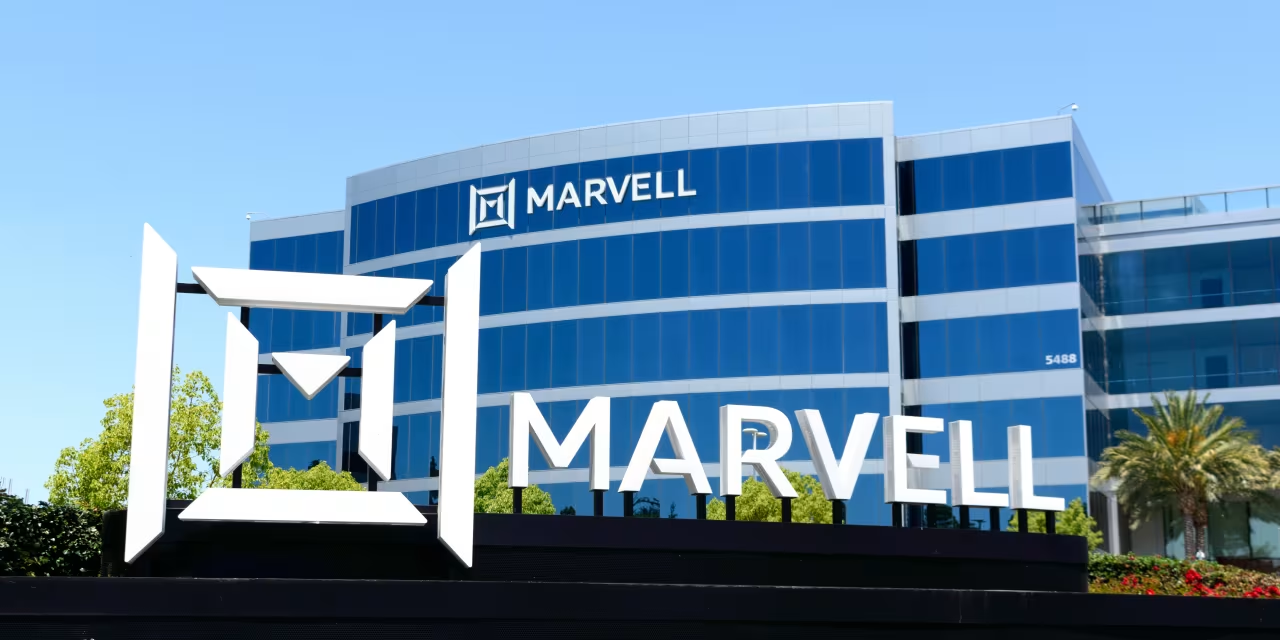
Marvell’s $120 Billion Google Deal Changes Everything Ahead of Earnings
Business
Fubon Financial Holding Co., Ltd. 2026 Q2 – Results – Earnings Call Presentation (OTCMKTS:FUISF) 2026-08-24


Seeking Alpha’s transcripts team is responsible for the development of all of our transcript-related projects. We currently publish thousands of quarterly earnings calls per quarter on our site and are continuing to grow and expand our coverage. The purpose of this profile is to allow us to share with our readers new transcript-related developments. Thanks, SA Transcripts Team
Business
Paladin Energy Shares Surge Over 10% After JORC Re-Reporting of Patterson Lake South Uranium Resources
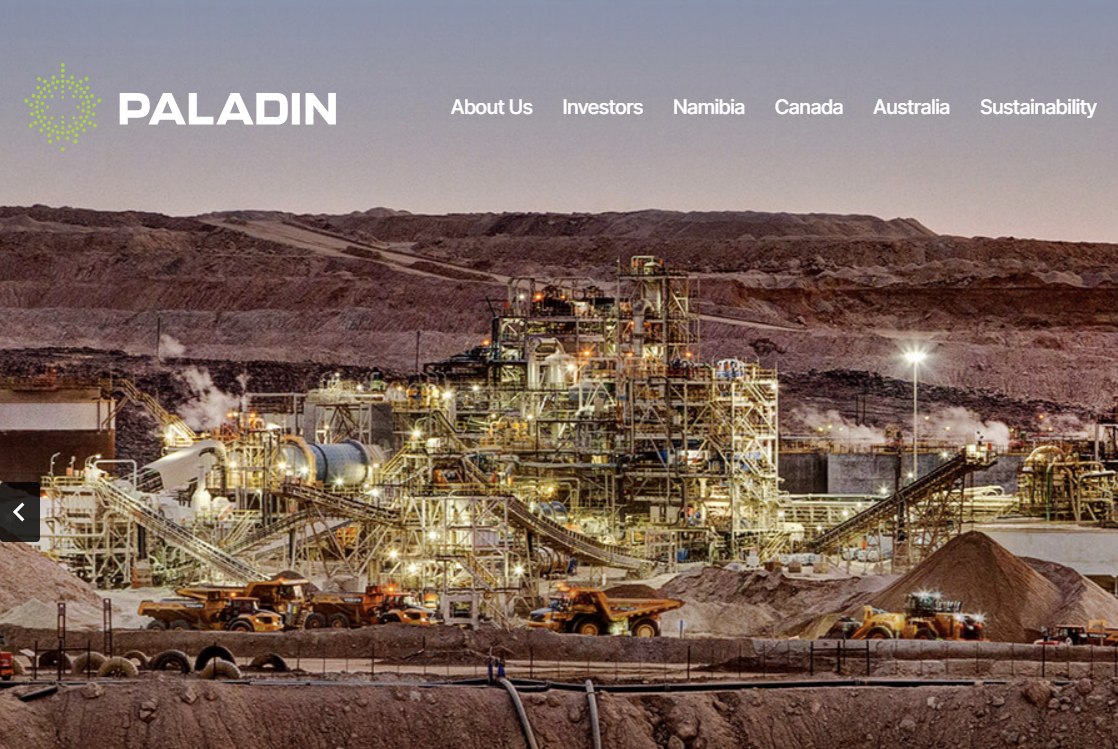
PERTH, Australia — Shares of Paladin Energy Ltd jumped more than 10% on Monday as investors responded to the company’s re-reporting of Mineral Resource and Ore Reserve estimates for its Patterson Lake South project under the JORC Code, alongside continued strong operational momentum at its Langer Heinrich Mine in Namibia.
Paladin Energy (ASX: PDN) closed at A$11.71, up A$1.13 or 10.68%, after trading as high as A$11.98 during the session. The move came days after the company released updated estimates for the high-grade Patterson Lake South (PLS) uranium project in Saskatchewan’s Athabasca Basin, presented in accordance with the JORC Code (2012) to complement its existing disclosures under the Canadian NI 43-101 standard.
The company stated there was no material change to the previously disclosed mineral resource and mineral/ore reserve estimates as a result of the re-reporting. Non-material updates were incorporated for certain zones, while the overall reserve figures remained unchanged. The dual-standard reporting provides greater accessibility for Australian and international investors following the JORC framework.
The stock’s sharp rise occurred against a broader backdrop of strength in uranium-related equities, with several peers also advancing on the day. Paladin’s market capitalisation moved above A$5 billion on the gain.
Paladin operates as a uranium producer with a 75% interest in the Langer Heinrich Mine in Namibia and is advancing the Tier-1 PLS project in Canada. The company also holds exploration assets in Australia and additional interests in Canada.
In its June 2026 quarterly report, released in late July, Paladin detailed the successful completion of the operational ramp-up at Langer Heinrich. Full-year FY2026 production reached 4.82 million pounds of U₃O₈, meeting or exceeding the upper end of revised guidance of 4.5 to 4.8 million pounds. Sales totalled 4.35 million pounds, also above guidance of 3.8 to 4.2 million pounds. The average realised price for the year was approximately US$70 per pound, while the cost of production came in at US$43.30 per pound, better than the guided range of US$44 to US$48 per pound.
In the June quarter alone, Langer Heinrich produced 1.23 million pounds and sold 1.35 million pounds at an average realised price of US$70.6 per pound. Plant recovery rates remained strong, and mining volumes increased as the operation transitioned to higher reliance on primary mined ore.
Looking ahead, Paladin issued FY2027 guidance for Langer Heinrich of 5.1 to 5.6 million pounds of U₃O₈ production and 4.8 to 5.3 million pounds of sales, with costs expected in the US$44 to US$48 per pound range. Capital expenditure is forecast at US$29 million to US$35 million. Production is anticipated to be weighted toward the second half of the year following planned maintenance in the first half.
The company has highlighted that the ramp-up phase is complete, positioning the Namibian operation for sustained output. All ore processed in FY2027 is expected to come from the mine, with ongoing optimisation of mining and processing activities.
At the same time, progress continues at Patterson Lake South. The Canadian Nuclear Safety Commission determined that the construction licence application had achieved sufficiency status, allowing it to proceed through the regulatory review process. Paladin has signed a binding term sheet with the Birch Narrows Dene Nation regarding a Mutual Benefits Agreement and is working toward key development milestones. An administrative protocol with the CNSC targets completion of hearings for the construction licence application by the end of calendar year 2027.
In June, the company reported a new high-grade uranium discovery, known as the Atlas discovery, from its 2026 winter drilling program at PLS. The project is viewed as a high-grade, relatively shallow deposit that could support future growth as global demand for uranium increases in support of nuclear energy expansion.
Paladin has strengthened its balance sheet through earlier equity raisings totalling approximately A$400 million to support both the Langer Heinrich ramp-up and advancement of PLS. Analyst coverage has been mixed but includes several upgrades in recent months, with some brokers citing the scale and development potential of the Canadian asset as the company transitions toward a multi-asset producer.
Uranium market conditions have remained supportive, with elevated prices reflecting supply constraints and growing interest in nuclear power as a low-carbon baseload energy source. Paladin’s sales contracts provide exposure to higher prices while delivering into long-term customer agreements.
The company’s dual listing on the ASX and TSX, along with OTCQX trading in the United States, has broadened its investor base. The JORC re-reporting of the PLS estimates is intended to align disclosure practices more closely with Australian market conventions without altering the underlying resource picture previously reported under Canadian standards.
Trading volume was elevated on the day of the share price move, reflecting heightened interest following the resource announcement and the recent operational updates. The 52-week range for the stock has seen significant movement, with the shares having traded as high as approximately A$15 earlier in the year before consolidating.
Paladin’s management has emphasised disciplined cost control, safety performance and steady delivery against guidance as the Langer Heinrich operation matures. Total recordable injury frequency rates have been tracked as part of ongoing operational reporting. Capital spending remains focused on sustaining and optimising the Namibian mine while advancing permitting and engineering work in Canada.
As the uranium sector continues to attract attention from institutional and retail investors, Paladin’s combination of near-term production growth from Langer Heinrich and longer-term development optionality at PLS positions it as a key independent producer. The latest share price reaction underscores market focus on both the resource transparency provided by the JORC update and the company’s ability to execute on production targets.
Financial results for the full year ended June 30, 2026, are scheduled for release in late August, with a conference call planned to discuss the outcomes and outlook. Investors will be watching for further detail on cash generation, contract book performance and the pathway toward a final investment decision at Patterson Lake South.
The stock’s advance on Monday reflected a convergence of operational delivery, resource disclosure updates and sector sentiment. With Langer Heinrich now operating on a stable footing and PLS advancing through key regulatory steps, Paladin continues to build its profile as a multi-jurisdictional uranium company supplying nuclear utilities worldwide.

BMO raises CoStar Group stock price target on Zonda acquisition


Apart from my academic training in Biology and Chemistry, I hold a Ph.D. in Environmental Science with a specialization in Bio-Medical Waste Management. My areas of research and analysis include clean technologies, renewable energy, pollution control systems, and environmental compliance solutions. I follow companies operating in these sectors using a research-driven approach that integrates regulatory trends, sustainability metrics, and scientific evaluation to assess long-term growth opportunities, risks, and value potential. By actively tracking and analyzing companies engaged in environmental management, renewable energy, and green technologies, my work aims to blend scientific depth with market analysis to provide practical insights that help investors understand financial outcomes and emerging opportunities. At a personal level, I also provide free stock market consultation to a select group of friends, relatives, and former colleagues. I am associated with Seeking Alpha analyst Eudaemon Research.
Analyst’s Disclosure: I/we have no stock, option or similar derivative position in any of the companies mentioned, and no plans to initiate any such positions within the next 72 hours. I wrote this article myself, and it expresses my own opinions. I am not receiving compensation for it (other than from Seeking Alpha). I have no business relationship with any company whose stock is mentioned in this article.
Seeking Alpha’s Disclosure: Past performance is no guarantee of future results. No recommendation or advice is being given as to whether any investment is suitable for a particular investor. Any views or opinions expressed above may not reflect those of Seeking Alpha as a whole. Seeking Alpha is not a licensed securities dealer, broker or US investment adviser or investment bank. Our analysts are third party authors that include both professional investors and individual investors who may not be licensed or certified by any institute or regulatory body.

Qiagen names Jonathan Pratt as CEO amid takeover talks
Operator
Thank you for standing by, and welcome to the Perenti FY ’26 Results Presentation. [Operator Instructions] Finally, I would like to advise all participants that this call is being recorded. I’d now like to welcome Vanessa Torres, Managing Director and Chief Executive Officer, to begin the presentation. Vanessa, over to you.
Vanessa Torres
CEO, MD & Director
Good morning, everyone, and thank you for joining the Perenti FY ’26 Results Call. My name is Vanessa Torres, and presenting with me today is Mike Ellis, our CFO. Today, we will outline our full year performance, the outlook for our business and how we plan to maximize returns for our shareholders. As this is my first reporting period as CEO for Perenti, I am very pleased to be announcing another year that Perenti has delivered to our guidance, marking our fifth consecutive year.
For those who are new to the Perenti story, we illustrate on Slide 3, our diversified portfolio of businesses spanning across the mining life cycle. Our businesses offer a broad suite of services, spreading across 12 different countries. We have world-leading expertise in underground mining and drilling. 66% of our revenue in FY ’26 was generated from underground operations, and this was mostly from gold and copper projects. We operate 20 mines around the world. And collectively, we employ around 10,000 people to service more than 160 different clients. We aim to be the safest and most productive in industry, which unlocks enduring value and certainty for our people, our clients, our communities and ultimately deliver sustainable returns for our shareholders.

Successful investors prioritise capital preservation because unnecessary losses reduce the amount available to generate future returns. A damaged portfolio must spend time recovering before it can produce genuine growth again.
Capital preservation places risk limits ahead of profit targets. By controlling things like drawdowns, position sizes, emotional decisions, and hidden exposure, investors give their strategies a stronger base for pursuing sustainable returns.
Large Losses Make Recovery Harder
Investment losses and gains are not mathematically equal. A portfolio that falls by 50% must subsequently gain 100% simply to return to its original value.
Smaller drawdowns leave more capital available for future opportunities and make recovery more achievable. Also, protecting against severe losses allows compounding to continue working rather than forcing every new gain to repair previous damage.
Clear Limits Reduce Exposure
Successful investors define acceptable losses before committing money. Predetermined limits remove uncertainty and prevent a disappointing position from causing disproportionate damage.
Setting an overall risk tolerance is only the starting point. Investors who actively trade must also decide how much of their account they can afford to lose on one position, rather than allowing each opportunity to carry an arbitrary level of exposure.
The position-level limit is commonly known as risk per trade. Expressed as either a fixed sum or a percentage of account equity, it sets the maximum acceptable loss if the position reaches its stop-loss.
A practical risk plan therefore covers three connected points:
- Maximum capital exposed to one position
- Stop-loss placement before entry
- Position size based on account equity
Putting the limit into practice requires converting the selected percentage into a monetary amount. A risk per trade calculation does so by multiplying account equity by the chosen risk percentage.
Thus, investors gain a clear figure to use when determining position size before placing an order.
Discipline Prevents Emotional Decisions
Losses can trigger fear, frustration, or an urge to recover money immediately. Decisions made under those emotions often involve oversized positions, abandoned stop-losses, or unnecessary trades.
An investor’s objectives, time horizon, financial needs, and personality should shape their approach to risk. Knowing those boundaries beforehand makes it easier to follow a plan when markets become uncomfortable.
Hidden Risk Can Appear Suddenly
Hidden risk can appear suddenly. Strong past returns do not always reveal how much danger sits beneath an investment strategy. Leverage, concentration, poor liquidity, and correlated positions may remain unnoticed until market conditions deteriorate.
Investors who focus only on recent performance may underestimate potential losses precisely when greater caution is required.
Preserved Capital Creates Flexibility
Available capital gives investors choices during volatile periods. They can adjust exposure, rebalance holdings, or act on attractive opportunities. And that is without first selling damaged positions at unfavourable prices.
Keeping losses manageable can preserve the flexibility needed when markets shift quickly.
Enabling Capital Preservation to Support Future Profit
Capital preservation does not mean avoiding every risk or settling for weak returns. It means choosing calculated exposure so that no single position, market event, or emotional decision can permanently undermine long-term progress.
A consistent capital-preservation approach gives profits more time and space to develop.
Was this article helpful? In that case, take a moment to explore our other insightful posts.

According to Motilal Oswal, the Mobile Phone Manufacturing Scheme (MPMS) has an incentive outlay of Rs 62,500 crore spread over five years from FY26 to FY31, with incentives ranging from 2.25% to 5.0% depending on whether companies meet prescribed sales thresholds.
The brokerage said the scheme aims to increase domestic and export volumes while encouraging greater local value addition, with its scale requirements restricting competition to companies with sufficient manufacturing capacity and backward integration. The mobile phone manufacturers and electronics manufacturing services (EMS) players must have a minimum turnover of Rs 10,000 crore in FY25-26 to qualify. With FY26 as the base year, it noted, a brand must also generate minimum incremental sales of Rs 5,000 crore each year.
As per the brokerage’s note, the cumulative sales threshold above FY26 levels rises to Rs 5,000 crore in FY27, Rs 10,000 crore in FY28, Rs 15,000 crore in FY29, Rs 20,000 crore in FY30 and Rs 25,000 crore in FY31.
Motilal Oswal added that meeting these targets would require brands to increase production rapidly, supported not only by domestic demand but also by a sharp rise in exports. The brokerage believes Dixon has the brand-level scale needed to satisfy these conditions.
The incentive framework has two tiers. Sales up to the difference between baseline domestic sales and average sales for FY24, FY25 and FY26 will receive incentives of 2.75% in FY27 and FY28, 2.50% in FY29 and FY30, and 2.25% in FY31, it said, with baseline domestic sales assumed to increase by 15% annually.
Eligible sales above the baseline, according to the brokerage, will attract a higher incentive of 5.0% in FY27 and FY28, 4.5% in FY29 and FY30, and 4.0% in FY31.The brokerage added that further companies can also receive additional incentives of up to 1.5% for sourcing key components domestically, comprising 0.3% each for display and camera modules, 0.5% for enclosures, and 0.2% each for batteries (including cells) and USB cables (including connectors).
These benefits, it noted, will apply when domestically sourced components are used in at least 25% of the mobile phone units sold during a financial year.
Motilal Oswal also said that the scheme provides separate support for Indian mobile brands. India-registered manufacturers and EMS companies with a minimum turnover of Rs 1,000 crore in FY26 will be eligible, it said, although there is no minimum sales threshold for Indian brands, with the Empowered Committee selecting the brands that qualify.
Selected Indian brands, according to the brokerage, will receive an incentive of 5% on incremental sales over the base year, along with an additional 3% on eligible sales involving Indian design and research and development. The domestic sourcing incentives, it added, will remain the same as those available under the broader mobile phone manufacturing programme.
Motilal Oswal expects the scheme to lift volumes for mobile brands and EMS companies, particularly through exports. It also sees greater benefits for manufacturers that have already invested in backward integration and domestic component sourcing.
(Disclaimer: Recommendations, suggestions, views and opinions given by the experts are their own. These do not represent the views of The Economic Times)

Dad asks if son can sit in stranger’s plane seat and she’s livid when she realises age

(VIDEO) Luka Doncic Debuts Slimmer Physique at Lakers’ Slovenia Minicamp Ahead of New NBA Season as Fans React

What Is ‘Ferritin Face’? Signs Of Iron Deficiency Explained





-

 Fashion3 days ago
Weekend Open Thread: Madewell – Corporette.com
-

 Business6 days ago
SMA Solar Technology AG (SMTGY) Q2 2026 Earnings Call Transcript
-

 Crypto World2 days ago
anatomy of crypto’s biggest liquidation event since 2021
-

 Business2 days ago
Musk’s Tesla, SpaceX Confirm $16.8 Billion ‘Terafab’ Chip Plant as World’s Largest Building in Texas
-

 Tech6 days ago
Qwen3.8-27B runs frontier-class coding agents and reasoning locally, no cloud API required
-

 Crypto World7 days ago
OCC Greenlights Trump Family Crypto Firm for Trust Charter
-

 Politics2 days ago
6 months on, Irish renters crushed by effects of government housing bill
-
 NewsBeat2 days ago
The ‘Lucky Dip Gang’ causing carnage for clicks: After five thugs were killed speeding in the wrong direction on a motorway, GUY ADAMS investigates a sick new trend… and why police aren’t even allowed to pursue them
-

 Crypto World7 days ago
NAVI Prime launches institutional lending framework on Sui
-

 News Videos4 days ago
Don’t Leave Your Financial Future To Chance | August 19, 2026
-

 Tech5 days ago
GLM-5.3 hits the API at $1.4/$4.4 per million tokens
-
Tech7 days ago
5 Of The Most Reliable Car Brands To Consider If You’re Buying A Used SUV
-
 Crypto World7 days ago
Dow’s 3-Year Winning Run Isn’t a Crash Signal, Still 49% Odds of Double-Digit Gains
-

 Business6 days ago
Stock Market Today: Tech Futures Slide As Treasury Yields Jump; Nvidia, Micron, Sandisk Sell Off
-

 Tech6 days ago
Keychron K8 Ultra 8K review: a great value keyboard with comfort issues
-
 NewsBeat7 days ago
Trump explodes at CNN reporter after question about young blonde aide who wrote him besotted letters
-
 Tech7 days ago
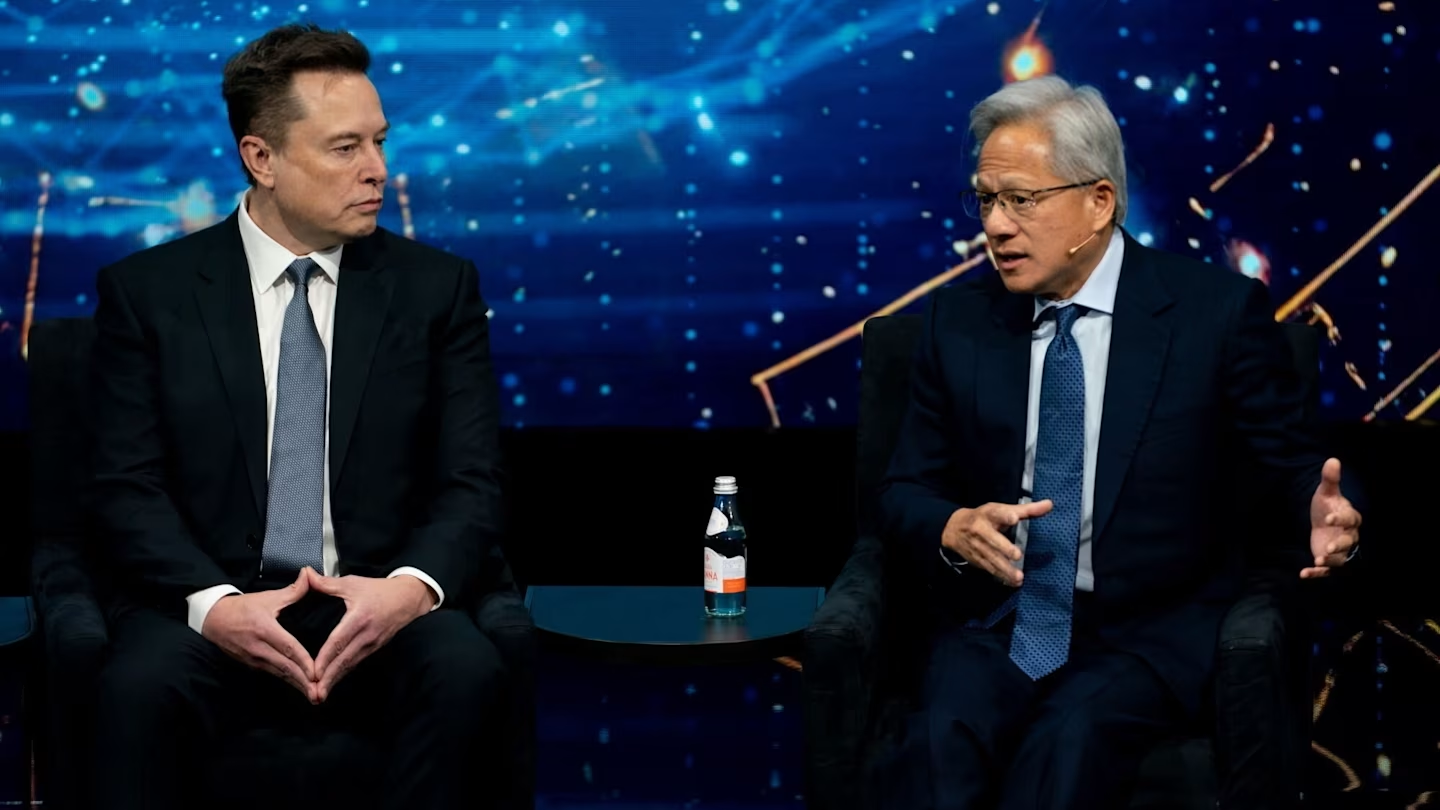
Nvidia discloses $21B stake in SpaceX
-
Business7 days ago
Fabrinet (FN) Q4 2026 Earnings Call Transcript
-

 Business4 days ago
Five Below: Kids Discount Retailer Reaps Rich Rewards
-

 Business5 days ago
Marvell Shares Jump 7% as Google Chip Deal Confirms Custom AI Silicon Partnership, Analysts
You must be logged in to post a comment Login